

Introduction
The coffee berry borer (CBB) Hypothenemus hampei (Coleoptera: Curculionidae: Scolytinae) is the most important insect pest in coffee plantations (Le Pelley, Reference Le Pelley1968; Damon, Reference Damon2000; Jaramillo et al., Reference Jaramillo, Borgemeister and Baker2006). Since it was first detected in Nariño, Colombia in 1988, the CBB rapidly became the major economic pest throughout the country's major coffee-growing regions, such as Cauca, Valle, Caldas, Risaralda, Quindío, Cundinamarca, Santander and Huila (Bustillo et al., Reference Bustillo, Cárdenas, Villalba, Benavides, Orozco and Posada1998; Baker, Reference Baker1999). Infested mature coffee berries that are allowed to fall to the ground at the end of the harvest periods and are not collected are the main source of re-infestation of coffee plantations by the CBB. Due to the agro-ecological conditions in Colombia, coffee plantations typically have at least two flowering, and hence harvest, periods (Arcila et al., Reference Arcila, Jaramillo, Baldión and Bustillo1993). This situation creates a favourable habitat for the CBB throughout the year, making co-ordinated and widespread control problematic (Baker, Reference Baker1999).
In the years following its detection, the National Coffee Research Centre (Cenicafé) in Colombia developed an integrated pest management (IPM) programme to control the CBB, which included recommendations for monitoring, as well as efforts to implement cultural and biological control (Bustillo et al., Reference Bustillo, Cárdenas, Villalba, Benavides, Orozco and Posada1998; Baker, Reference Baker1999). Cultural control methods have focused on efficient harvesting techniques to remove a high percentage of mature and dry (ripe and overripe) berries in the field, thus limiting the development of CBB populations. In this process, mature coffee berries, which serve as the main source for new emerging CBB adults, are harvested every 15–25 days throughout the year, and preferably more frequently, every 12–18 days, during peak harvesting times. Although effective, implementing cultural control of the CBB is expensive and depends on the quality of field workers (Bustillo et al., Reference Bustillo, Cárdenas, Villalba, Benavides, Orozco and Posada1998; Benavides et al., Reference Benavides, Bustillo, Montoya, Cárdenas and Mejía2002; Aristizábal et al., Reference Aristizábal, Jiménez, Bustillo and Arthurs2011).
Regarding biological control, there were attempts to mass-produce the entomopathogenic fungus Beauveria bassiana (Balsamo) Vuillemin, and it was distributed as a bioinsecticide (Bustillo et al., Reference Bustillo, Cárdenas, Villalba, Benavides, Orozco and Posada1998; Bustillo, Reference Bustillo2005). In addition, three African parasitoid species were imported, mass reared and released in Colombia between 1989 and 2000 for long-term suppression of the CBB (Bustillo et al., Reference Bustillo, Cárdenas, Villalba, Benavides, Orozco and Posada1998; Portilla, Reference Portilla1999). The first two species, Cephalonomia stephanoderis (Betrem) and Prorops nasuta (Waterton) (both Hymenoptera: Bethylidae), are ectoparasitoids of immature CBB stages, while Phymastichus coffea (La Salle) (Hymenoptera: Eulophidae) is an endoparasitoid of adult beetles, and was later released (Aristizábal et al., Reference Aristizábal, Salaza, Mejía and Bustillo2004b; Bustillo, Reference Bustillo2005).
A critical part of this effort has been to implement and evaluate these IPM programmes for the CBB among the smallholder coffee growers. Cenicafé, with external funding, conducted two participatory projects to educate coffee growers about the CBB and train them in various strategies to manage the pest (Baker, Reference Baker1999; Bentley et al., Reference Bentley, Baker, Aristizabal, Campos, Chilan, Garcia, Munoz, Jarquin, Larco, Mejía and Salazar2002; Aristizábal et al., Reference Aristizábal, Bustillo, Jiménez and Trujillo2004a). Aristizábal et al. (Reference Aristizábal, Salazar and Mejía2002) conducted a survey of pest management practices among 113 small coffee growers from the central coffee region in Colombia in 1998. Results showed that over 80% of coffee growers were using the insecticides endosulfan and chlorpyrifos due to concerns about rising populations of the CBB, while just 18% had used B. bassiana and few had heard about the parasitoids. Although 95% of growers reported using cultural harvesting practices, the workers concluded that the implementation of cultural harvesting practices was sporadic and generally inadequate to control the CBB effectively. Consequently, levels of damage in parchment coffee were often >5%, which surpassed export quality thresholds (Aristizábal et al., Reference Aristizábal, Salazar and Mejía2002). In response, many of these same coffee growers, with the support of Cenicafé, agreed to participate in establishing an IPM programme for the CBB on their farms. The goals were to reduce the use of insecticides through implementing sustained and improved cultural harvesting methods and sanitation and also introduce growers to the exotic CBB parasitoids.
In this paper, we report on efforts to release and establish the parasitoids C. stephanoderis and P. nasuta in the central coffee-growing region of Colombia. A second objective was to monitor the population of the CBB in the field and on parchment coffee before and after the growers released the parasitoids and were trained on implementing cultural control practices on their farms.
Materials and methods
Study location
A project to establish an IPM programme for the CBB was conducted on 34 small coffee farms over 28 ha in three municipalities (Quimbaya, Montenegro and Buenavista) from the central coffee region, Quindío Department, Colombia. Each municipality had slightly different climatic conditions and varied according to topography and cultivation practices. In particular, Buenavista, which comprised 5.5 ha located at higher elevation (1500–1850 m above sea level (masl)), was cooler (average annual temperature of 17°C), with inclined topography and lower planting density (3600 trees/ha) compared with the other two municipalities. Quimbaya (14 ha) and Montenegro (8.5 ha) were located in flat or rolling farms (1300–1450 masl), with an average annual temperature of 21–22°C, and a planting density of 4700–5000 trees/ha. Three varieties of coffee (Coffea arabica L. (Rubiaceae)) were grown, which comprised Typica (14%), Caturra (50%) and Colombia (36%). Most (89%) of the coffee plants were grown under shade, and were planted in association with banana plantations (Musa spp. (Musaceae)), fruit trees (citrus, avocado, mango, cacao and guanabana) and native trees (Guaiacum angustifolium Engelm. (Zygophyllaceae), Ceiba spp. (Malvaceae) and Cecropia spp. (Urticaceae)). The harvesting age of plots ranged from 1 to 15 years, with 19% between 1 and 2 years, 25% between 3 and 5 years and 56% >6 years old.
IPM training programme
Concurrently with the parasitoid releases, various workshops and hands-on training sessions were provided to coffee growers and harvest workers. Participants learned about the importance of regular and efficient harvesting as a cultural management practice for the CBB. Coffee farmers were also trained about the identification, monitoring, biology and behaviour of the CBB and the importance of natural enemies such as the parasitoids and the entomopathogenic fungus B. bassiana. Farmers learned how to monitor CBB's populations, identify problem areas and record the presence of B. bassiana. Growers established release sites for parasitoids in blocks where insecticides would not be used. An important consideration was the need to reduce CBB levels to < 5% damage in the parchment coffee to sell exportable quality coffee.
Parasitoid releases
Releases of C. stephanoderis and P. nasuta were conducted in 34 small coffee farms (plots) in three municipalities (Table 1). All releases were made using dried coffee beans from the mass-rearing facility at Cenicafé. The dried beans contained parasitized CBB larvae and pupae. In total, 119 releases were conducted between January 1999 and November 2000, with an estimated 10.6 million C. stephanoderis and 5 million P. nasuta. In each coffee plot, three or four separate releases were made with an average of 543,642 parasitoids per ha. Introduction strategies varied among the plots. While C. stephanoderis or P. nasuta were generally released separately, in some plots, both species were released in combination to look for possible competitive interactions. Each plot was separated by at least 200 m. No supplemental insecticides were applied in the plots where sampling for the CBB and parasitoids was conducted.
Parasitoid releases per municipality for Cephalonomia stephanoderis and Prorops nasuta

+ Releases were made between February 1999 and November 2000.
Field surveys
To monitor the impact of the IPM programme, technicians from Cenicafé, with the assistance of coffee growers, documented field populations of the CBB and damage on parchment coffee from the three municipalities for several months (September 1998 to January 1999) prior to the start of the IPM programme and for approximately 2 years following its initiation (February 1999–2001). Surveys were conducted to monitor CBB populations according to Cenicafé recommendations (Bustillo et al., Reference Bustillo, Cárdenas, Villalba, Benavides, Orozco and Posada1998) as follows: each plot was evaluated every 1–2 months. On each occasion, 30 coffee trees were randomly selected and the total number of berries in a representative coffee branch was counted and examined in situ for CBB entry holes or damage to determine the percentage of field infestation. During monitoring, CBB infected with white fungal growth (ostensibly B. bassiana) were sometimes found, even though B. bassiana was not applied in sampled plots during the observation period. Therefore, the natural occurrence of B. bassiana was also noted for each coffee plot. To estimate damage by the CBB at harvest, 0.5 kg of parchment coffee was collected monthly from every plot. Three subsamples of 100 g were examined to determine the average proportion of CBB damage by weight. Due to the high pest pressure when the study was conducted, it was not feasible to incorporate non-managed plots for comparison. In addition, funds for compensation of crop losses were not available in this project.
To assess the establishment of parasitoids, each coffee plot was thoroughly sampled at least 6 months after the final release was made. At each location, at least 200 infested berries, i.e. those with typical CBB entry holes, were collected from a representative sample of trees and returned to the laboratory for processing. Berries with immature stages of parasitoids (eggs, larvae or pupae) were placed in plastic containers covered with muslin cloth, and monitored for 3 weeks at 25°C and 80% relative humidity to identify the emerging adult parasitoid. All coffee plots were sampled for parasitoids within a 30-day period to minimize seasonal bias.
Statistical analyses
We compared monthly CBB infestation in the field and also damage on parchment coffee for each municipality to examine population trends but did not conduct formal statistical tests since no control group was available. Differences in parasitoid establishment among release sites were compared using χ2 analysis with Yates correction, while a Student's t-test was used to compare average parasitism rates across municipalities (SPSS version 17).
Results
Field infestation by CBB
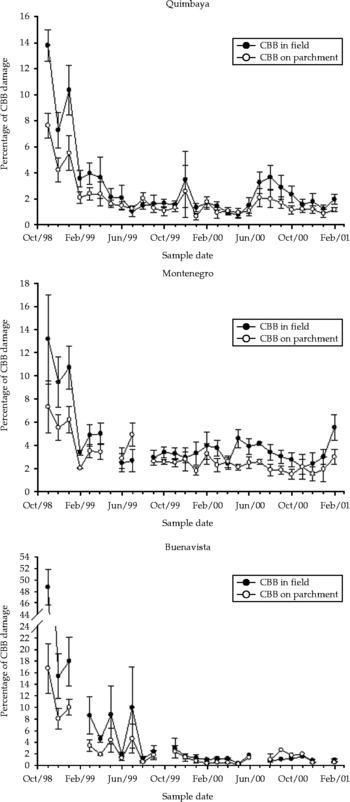
Initial infestations of the CBB before the start of the participatory research project were in the range of 7–14% in Químbaya, 10–13% in Montenegro and 15–48% in Buenavista from November 1998 to January 1999 (Fig. 1). The higher infestation in Buenavista was unexpected, given its higher altitude and lower average temperatures that may have slowed the development of the CBB. After the start of the project, CBB populations quickly fell, with average ( ± SEM) monthly infestations of 2.1 ± 0.2% in Químbaya, 3.5 ± 0.2% in Montenegro and 2.8 ± 2.1% in Buenavista between February 1999 and 2001. In Montenegro, although CBB populations were initially higher, they actually fell to a lower level, ≤ 2%, in the final 12 months.
Per cent damage by the CBB on berries in the field and on parchment coffee during a 28-month period in three municipalities in Colombia. Data show means ( ± SEM) from sampled lots across each municipality both several months before and following an IPM programme involving cultural harvesting practices and release of parasitoids. Line gaps denote months where data were not collected.

Damage by CBB on parchment coffee
Initially, coffee growers were selling parchment coffee with CBB damage ranging from 7.5 to 16.8% (Fig. 1), with any level >5% resulting in a reduced price for growers. After the IPM programme was initiated, damage in parchment coffee was reduced, with monthly averages of 1.5 ± 0.1% in Químbaya, 2.6 ± 0.2% in Montenegro and 2.9 ± 0.8% in Buenavista from February 1999 until 2001. At this time, parchment coffee with < 2% of damage by the CBB and other physical defects, commanded a price premium. Over the 2 years of this study, 83% of parchment coffee produced and sold had ≤ 2% damage by the CBB, 15.2% had 2.1–5% damage and 1.8% had >5% damage.
Establishment of parasitoids
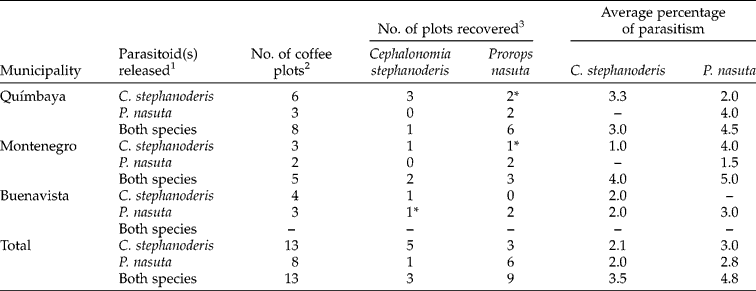
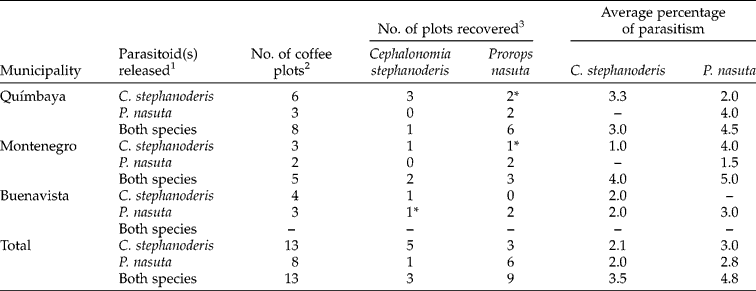
There was evidence for short-term establishment of both parasitoid species in all three municipalities. Overall, P. nasuta were recovered in a higher percentage of plots where they were previously released, 71.4% (15 out of 21 plots), compared with C. stephanoderis, which was found in 30.8% of the plots (8 out of 26 plots) in which they were released (Table 2). This difference in establishment between the two parasitoid species was significant (χ2 = 7.69, df = 1, P < 0.01). Similar results were found among the plots where both species were released in combination, i.e. P. nasuta was recovered in 69% plots (9 out of 13) compared with 23.1% for C. stephanoderis (3 out of 13); this difference was also significant (χ2 = 5.57, df = 1, P < 0.05). Proportionally, both species were recovered at a similar rate among the three different municipalities, i.e. P. nasuta recovered at 67–73% of release sites and C. stephanoderis recovered at 25–38% of release sites. Interestingly, both P. nasuta and C. stephanoderis were also recovered from three and one plot, respectively, where they had not been originally released, suggesting possible movement between the plots. Average parasitism rates recorded in the plots where parasitoids were recovered remained low for both species, i.e. 3.7% for P. nasuta and 2.9% for C. stephanoderis. This difference in parasitism rates was not statistically different (t = 1.1, df = 25, P = 0.28).
Recovery of two species of CBB ecoparasitoids at least 6 months after the last release on commercial coffee farms in three municipalities of the Department of Quindío, Colombia
1 Species were released in separate plots and also in combination in the same plot.
2 Number of plots where parasitoids were originally released.
3 Columns indicate number of plots where parasitoid species were recovered. An asterisk indicates recovery of a parasitoid species in a plot where it was not released.
Natural incidence of B. bassiana
An entomopathogenic fungus, ostensibly B. bassiana, was observed in all three municipalities, although it was most prevalent in Montenegro with on average 9.5% adult beetles symptomatic over the sample period, and up to 35.3% infection observed in individual lots. This compared with an average of 4.3 and 4.4% infection (and a maximum of 15 and 18%) observed in Quimbaya and Buenavista, respectively, over the sampling period.
Discussion
An IPM programme for the CBB based on improved cultural harvesting practices and releases of exotic parasitoids was conducted in three municipalities in the central coffee-growing region of Colombia from 1998 to 2001. A hands-on training through the participatory research programme with Cenicafé was instrumental in getting widespread support for these practices with the grower community. Due to logistical limitations concerning the CBB population, it was not feasible for growers to incorporate non-managed control plots; hence, the effectiveness of the IPM programme is based on circumstantial evidence. However, the observation that CBB populations were reduced across multiple locations, with concurrent improvements in the quality of parchment coffee sold by the small coffee growers over 2 years, suggests that this approach was successful. The results were also noteworthy, given that many plots contained older trees (56% were 6 or more years into harvesting), conditions which make CBB control more challenging. We also noted that climatic conditions throughout the study may also influence CBB pressure. In particular, since plantations received no artificial irrigation, variations in seasonal rainfall would influence frequency of flowering and fruit set. A higher than average rainfall in 1999 may have also contributed to an initial decline in CBB populations by delaying the harvesting periods.
Although expensive in terms of labour costs, cultural harvesting methods designed to disrupt conditions for the successful reproduction of the CBB remain the safest, simplest and most accessible control method for small coffee producers. Bustillo et al. (Reference Bustillo, Cárdenas, Villalba, Benavides, Orozco and Posada1998) demonstrated that a single efficient harvest could remove about 80% of the CBB population. In another study, Saldarriaga (Reference Saldarriaga1994) reported that a severe CBB infestation was reduced from 70 to < 6% of berries in the field. Cultural harvesting rapidly became the principal component of CBB management recommended in Colombia. In two surveys on the adoption of IPM practices among smallholder coffee growers, cultural control was adopted by 94–98% of the respondents (Aristizábal et al., Reference Aristizábal, Salazar and Mejía2002, Reference Aristizábal, Vélez and León2006). However, cultural controls are only effective if a sufficiently high proportion of the mature berries are removed. It has been estimated that an efficient harvest occurs when five or less mature or overripe berries (representing potential sources for new infestations) remain after a single harvesting pass (Bustillo et al., Reference Bustillo, Cárdenas, Villalba, Benavides, Orozco and Posada1998; Benavides et al., Reference Benavides, Bustillo, Montoya, Cárdenas and Mejía2002; Aristizábal et al., Reference Aristizábal, Jiménez, Bustillo and Arthurs2011). Such a level requires commitment from growers and the availability of cheap and effective labour, which can be difficult to maintain if the market price of coffee drops too low (Baker, Reference Baker1999; Bentley et al., Reference Bentley, Baker, Aristizabal, Campos, Chilan, Garcia, Munoz, Jarquin, Larco, Mejía and Salazar2002).
The introduction of C. stephanoderis and P. nasuta in Colombia was made possible through mass-rearing facilities established by Cenicafé in the early 1990s (Abraham et al., Reference Abraham, Moore and Godwin1990; Portilla, Reference Portilla1999; Bustillo, Reference Bustillo2005). In 1996, a third African parasitoid, Phymastichus coffea La Salle (Hymenoptera: Eulophidae), was also introduced into some coffee regions in Colombia (Aristizábal et al., Reference Aristizábal, Salaza, Mejía and Bustillo2004b). These three parasitoids have also been released in other coffee-producing regions throughout Latin America as well as the Caribbean, Oceania and India (Barrera et al., Reference Barrera, Baker, Schwarz and Valenzuela1990; Damon, Reference Damon2000; CCRI, 2002). In Colombia, technology transfer was needed for farmers to become familiar with and interested in conserving parasitoids and to support the release effort. Through the extension service of the National Coffee Growers Federation (Federacafé) in Colombia and Cenicafé, more than 1500 million C. stephanoderis, 500 million P. nasuta and 300 million P. coffea were released between 1994 and 2003 (Bustillo, Reference Bustillo2005; Maldonado and Benavides, Reference Maldonado and Benavides2007). Although the release programme was largely successful, it has since been discontinued. The high cost of mass rearing probably makes parasitoids impractical for routine releases, i.e. through inundative biological control approaches (Bustillo et al., Reference Bustillo, Cárdenas, Villalba, Benavides, Orozco and Posada1998; Baker, Reference Baker1999; Portilla, Reference Portilla1999).
The establishment and long-term impact of these parasitoids in coffee farms is thus of concern. In our survey, P. nasuta established more frequently compared with C. stephanoderis 6 months or more post-release; even though only about half the numbers of P. nasuta were released, it was recovered in over twice as many release sites. However, parasitism rates for both species were generally low (1–5%) at this time. It can be presumed that regular harvesting, which relies on the removal of berries before the CBB can complete their development, will limit parasitism rates by similarly removing developing parasitoids. Higher rates of CBB parasitism have been reported elsewhere where CBB populations are not routinely removed (Cisneros and Tandazo, Reference Cisneros and Tandazo1990; Campos, Reference Campos and Barrera2005; Irulandi et al., Reference Irulandi, Rajendran, Samuel, Chinniah, Kumar and Sreedharan2008). Jaramillo et al. (Reference Jaramillo, Chabi-Olaye, Borgemeister, Kamonjo, Poehling and Vega2009a) proposed the use of screened enclosures for fallen or infested berries as a method to enhance biological control where cultural control is practised. Where used, such enclosures should permit the release of parasitoids but prevent escape of the CBB.
Maldonado and Benavides (Reference Maldonado and Benavides2007) evaluated CBB parasitism in 80 farms over five municipalities approximately 15 years after P. nasuta and C. stephanoderis were released. Whereas C. stephanoderis was not found, P. nasuta was recovered from all municipalities in 65% of the farms, covering altitudes between 1150 and 1840 masl. Average parasitism rates per municipality were 0.2–12.8%, with an overall average of 5.6% (Maldonado and Benavides, Reference Maldonado and Benavides2007). In sum, such findings suggest that P. nasuta is the superior competitor under the conditions of the Colombian coffee agro-ecosystem. However, the converse situation was seen in Mexico, where P. nasuta did not establish after its release (Infante et al., Reference Infante, Mumford and Méndez2001), but C. stephanoderis did (Barrera, Reference Barrera and Barrera2005). It is not clear why such differences in parasitoid establishment should occur, although various factors, such as the use of insecticides, cultural management practices, density of release rates, weather conditions, and seasonality, may be significant.
Some authors have suggested that low parasitism rates of exotic bethylid parasitoids in commercial lots limit their importance as biological control agents, and there is renewed interest in native parasitoid species (Damon, Reference Damon2000; Jaramillo et al., Reference Jaramillo, Borgemeister and Baker2006, Reference Jaramillo, Chapman, Vega and Harwood2009b). However, conservation biological control techniques (such as the use of screened enclosures mentioned previously) may improve the status of both native and exotic parasitoids in practices of sustainable coffee production. Simple assessment of parasitism rates alone may underestimate parasitoid impact, since adult wasps may also reduce pest populations through host feeding strategies (Jervis and Kidd, Reference Jervis and Kidd1986). Anecdotal evidence also suggests that parasitoid populations may increase significantly in cases where coffee plots are abandoned, a situation that might significantly limit the invasive impact of the CBB on surrounding coffee farms (Baker, Reference Baker1999).
Our observations of B. bassiana, found on 80.5% of coffee lots evaluated, were notable, given that no applications of this fungus were made during the study. This suggested natural incidence of diseases or else residual infections from B. bassiana applications conducted 1 or more years prior to our assessments. The fungus was previously suggested to be a primary natural mortality factor of the CBB in Colombia (Bustillo and Posada, Reference Bustillo and Posada1996). Posada et al. (Reference Posada, Salazar, Aristizábal, Mejía and Jiménez2003) also reported on the natural incidence of B. bassiana in the CBB. Infection rates of adult beetles collected from three Colombian villages and incubated under moist conditions ranged from 6.4 to 81%. In field studies in Mexico, Baker et al. (Reference Baker, Barrera and Rivas1992) estimated that a white fungus (ostensibly B. bassiana) naturally infected up to about 10% of older adult females inside berries, a level in line with our findings. However, the impact of fungal infections on CBB populations may have been more limited, given that death due to fungal mycosis may have occurred after the main oviposition period of the beetles (Baker et al., Reference Baker, Barrera and Rivas1992). The use of mass-produced B. bassiana and other entomopathogenic fungi to control the CBB on infested trees in fallen berries has received significant interest in Colombia (Bustillo et al., Reference Bustillo, Bernal, Benavides and Chaves1999; Vera et al., Reference Vera, Montoya, Benavides and Gongora2010) and other countries (De La Rosa et al., Reference De La Rosa, Altorre, Barrera and Torrello2000; Haraprasad et al., Reference Haraprasad, Niranjana, Prakash, Shetty and Wahab2001; Irulandi et al., Reference Irulandi, Rajendran, Samuel, Chinniah, Kumar and Sreedharan2008).
In conclusion, we observed decreased CBB populations in three municipalities after growers implemented improved cultural harvesting and released 10 million C. stephanoderis and 5 million P. nasuta. Both parasitoid species were considered established after 6 months, although P. nasuta appeared to be the superior species under the prevailing agro-ecological conditions in Colombia. Ongoing research at Cenicafé continues to improve IPM programmes for the CBB.
Acknowledgements
This study was part of the project ‘Integrated Pest Management of coffee berry borer through Participatory Research with Small Coffee Growers’ supported by the National Coffee Research Center (Cenicafé), International Coffee Organization (ICO), Common Fund for Commodities (CFC) and CABI Bioscience (1998–2002). We thank Peter Baker for his leadership, and employees from Entomology Discipline (Cenicafé) and coffee farmers from Buenavista, Montenegro and Químbaya for their enthusiastic support.