The expected increase in the frequency and scale of natural disasters as a result of climate changeReference Gibbs, Waters and Bryant 1 poses immediate health problems through injuries; exacerbation of chronic health problems; loss of clean water, shelter, household goods, and sanitation; and a disrupted health system.Reference Keim 2 In the longer term, disasters have been linked to mental health problems and posttraumatic stress disorder.Reference Galea, Nandi and Vlahov 3 However, nearly one third of people exposed to a disaster demonstrate psychological resilience.Reference Bonanno, Brewin, Kaniasty and La Greca 4 Resilience is a nascent concept that can be understood in various ways when viewed through the lens of differing disciplines or epistemologies.
Understood as both a process and an outcome, resilience includes a number of intrapersonal and environmental factors.Reference Boon, Cottrell, King, Stevenson and Millar 5 How resilience is defined and operationalized may affect the nature of intervention planning. In this report, resilience is understood as “the intrinsic capacity of a system, community or society predisposed to a shock or stress to adapt and survive by changing its non-essential attributes and rebuilding itself.”Reference Manyena 6 (p446) Thus, resilience can potentially be used in a strength-based approach, within a public health framework, to increase the proportion of the population that experiences efficient recovery.
Resilience is highlighted in the Hyogo Framework for Action 2005 to 2015, which is the International Strategy for Disaster Reduction, that aims to build the resilience of nations and communities to disasters. 7 More recently, the United Kingdom developed the Strategic National Framework on Community Resilience, 8 and the Council of Australian Governments have released the National Strategy for Disaster Resilience. 9 Although the literature has expanded in understanding and measuring the resilience of populations after disaster, much less work has addressed the application and testing of the resilience construct into practice.Reference Boon, Cottrell, King, Stevenson and Millar 5 As a consequence, the level of evidence for strategies planned to support resilience of a population affected by disaster is not clear. This report aims to examine the literature regarding evidence about community-based interventions that use the concept of resilience to increase positive health outcomes after disaster.
Methods
Search Strategy
A search of databases was conducted from inception to December 2013 and included PsychArticles, Psychbooks, PsychInfo, Psychological and Behavioural Sciences collection, CINAHL, Sociological abstracts, and MEDLINE. A search of the gray literature included ProQuest Dissertation & Thesis, DART—Europe, Global Health database, WHOLIS, Libraries Australia, Conference Papers Index, and OpenGrey. An initial search of public health journals produced no results, so a final manual search of available key journals focused on disaster, emergency, and trauma. The journals included Disaster Prevention and Management: an International Journal, Disasters, Journal of Traumatic Stress, Journal of Emergency Primary Health Care, Disaster Management and Response, Journal of Loss and Trauma, and Journal of Trauma Management and Outcomes. The search terms were developed using the population, intervention, comparison, and outcome framework and the method of an earlier review on non-natural environmental incidents.Reference James, Nazar and Sanchez-Sweatman 10 Each term was then searched in MEDLINE to find related MeSH headings. The Scope notes for each were also checked to find the most appropriate terms. The final search terms were modified for each search engine (Table 1).
Search Terms for Present Study

Study Selection
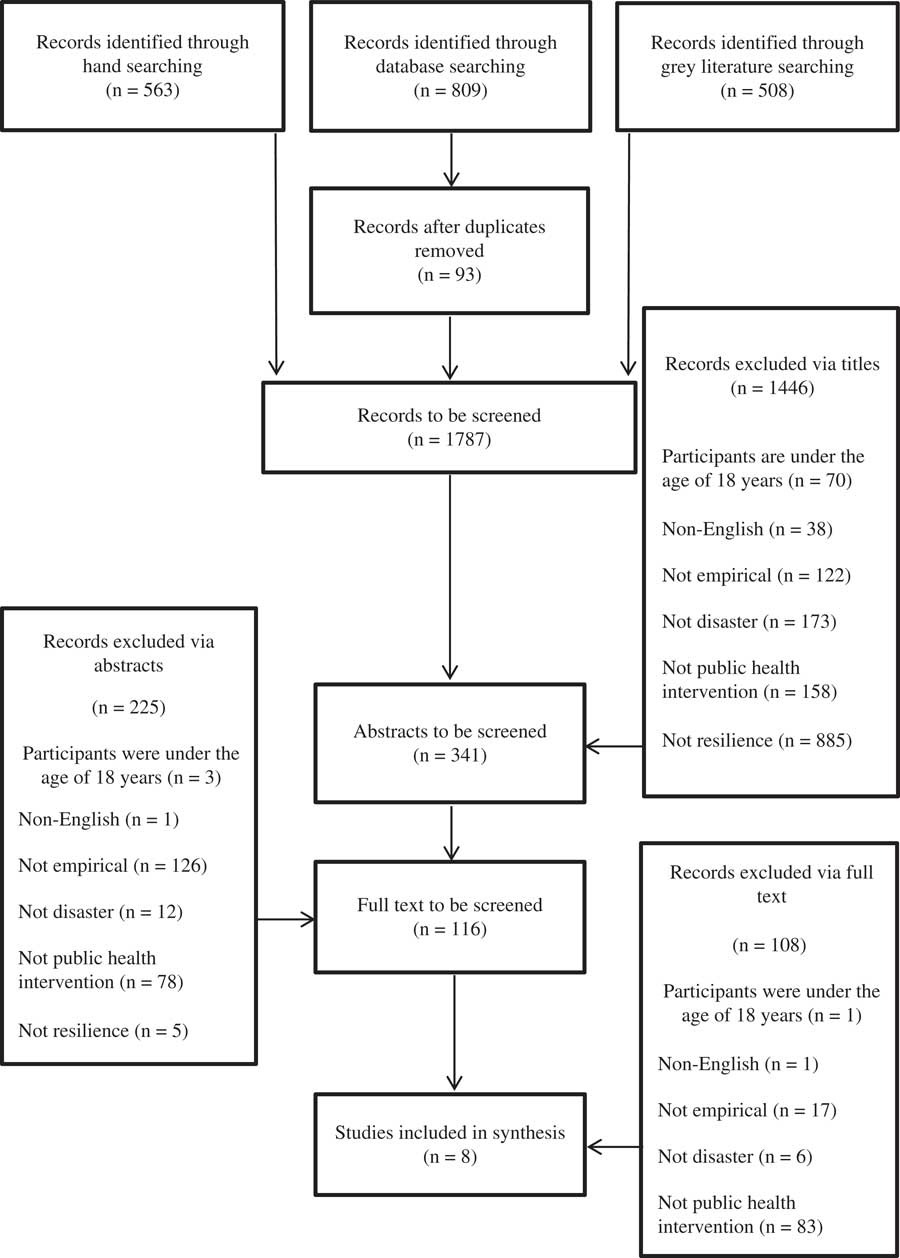
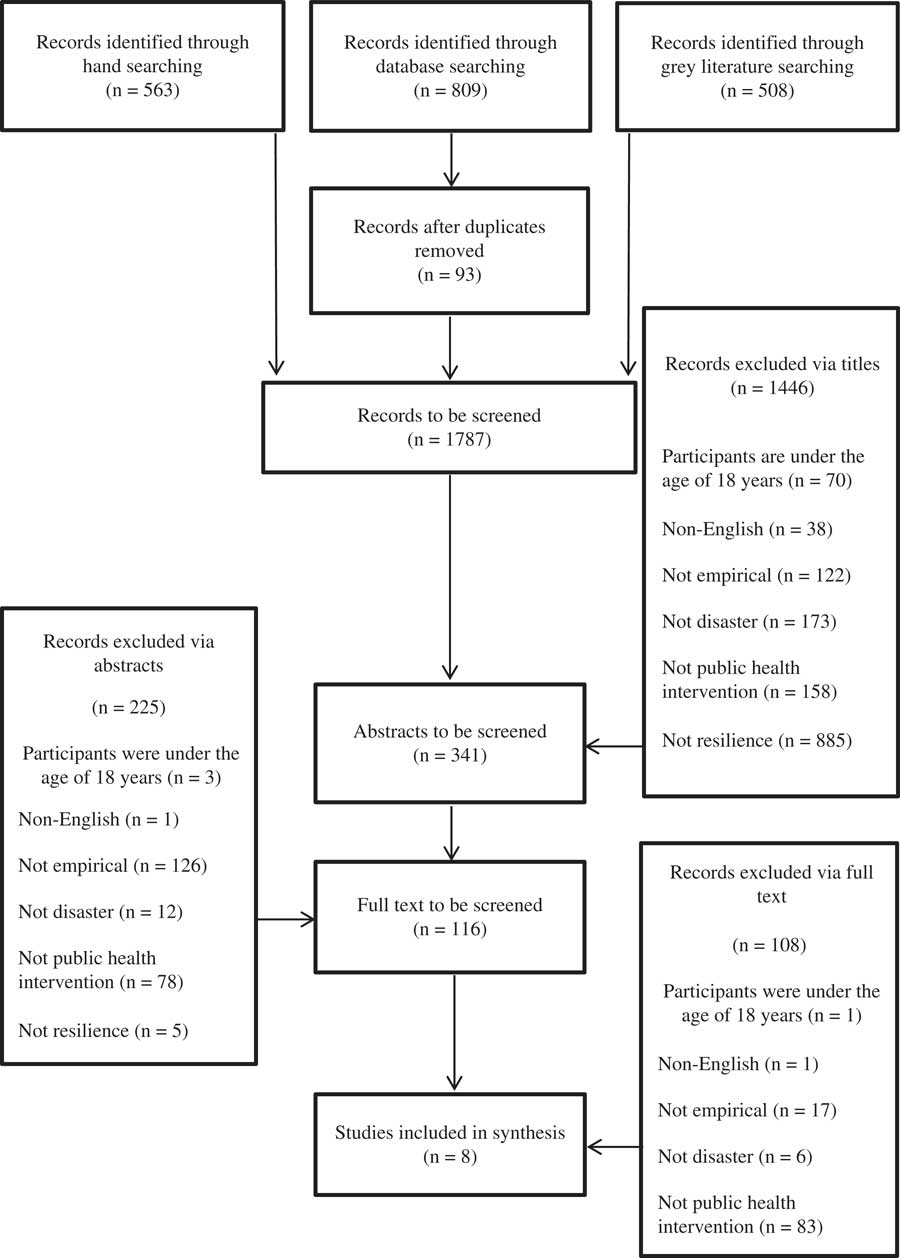
Reports of studies were included with participants older than age 18 years that investigated empirical improvement of resilience as a result of a public health intervention in a disaster setting. Also, reports were included if they studied a disaster that was technological (eg, transport accident) or natural, including geophysical (eg earthquakes), hydrological (eg, floods), meteorological (eg, hurricanes), and climatological (eg, drought and fires).Reference Guha-Sapir, Vos, Below and Poserre 11 Biological disasters are often considered a separate category, and so were excluded from this review.Reference Guha-Sapir, Vos, Below and Poserre 11 A process of screening titles, abstracts, and full texts excluded publications if they were not published in English, were only about children or adolescents, or were a commentary or theoretical discussion on resilience (Figure).
Flow Chart of Search Results.
Quality Assessment
A modified version from the Centre for Reviews and Dissemination’s Guidance for Undertaking Reviews in Health Care was used to extract data to assess bias. 12 Data included type of publication, country of origin, disaster type, aim/objectives, study design, inclusion and exclusion criteria, sampling, sample characteristics, control group characteristics, intervention, control intervention, measurement tool or method used, statistical techniques used, follow-up, number of withdrawals, results, costs, and adverse events.
Confounding factors such as publication bias, provider bias, selection bias (sample characteristics), detection bias (types of outcome measures used), performance bias (provision), and attrition bias by calculating percentages that demonstrated unequal weighting were examined to assess risk of bias across studies.
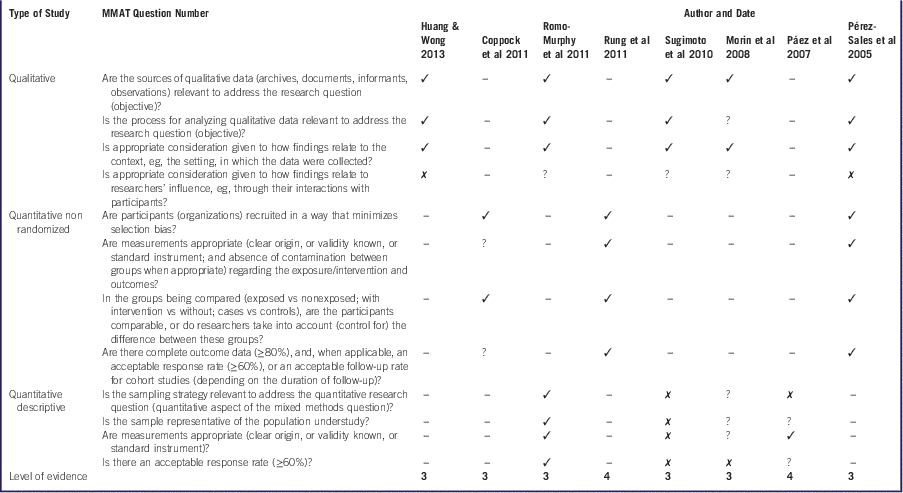
The standard approach to examining the risk of bias in individual studies uses a critical appraisal tool to determine methodological rigor. This approach privileges study design and, in particular, the randomized control trial over other criteria. However, randomized control trials are recognized as lacking the flexibility required to accommodate multiple community driven public health interventions. While they may be the best design for strength of evidence, they are not always practical or appropriate.Reference Rychetnik, Frommer, Hawe and Shiell 13 Consequently the quality of the selected full text articles that met the inclusion criteria was assessed using the mixed methods appraisal tool (MMAT) summarized in Table 2.Reference Pluye, Robert and Cargo 14 This tool can adapt to a number of different methodologies and has an intraclass correlation of 0.72 to 0.94.Reference Pace, Pluye and Gillian Bartlett 15 Two reviewers (G.vK., and C.M.) independently used the MMAT to appraise the selected studies, and results of the appraisal were discussed to reach consensus.
Critical Appraisal Results Using the Mixed Methods Appraisal Tool (MMAT)Footnote a
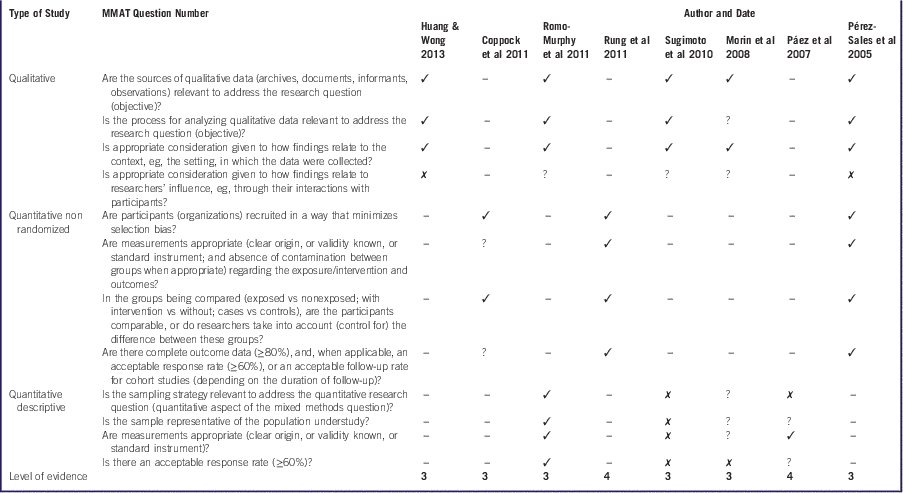
a Key to responses: hyphen (−), indicates not applicable; check mark (✓), yes; question mark (?), can’t tell; and x (✗), no.
The quantitative studies were ranked using the National Health and Medical Research Council guidelines. 16 The qualitative studies were ranked using the qualitative hierarchy of evidence for practice.Reference Daly, Willis and Small 17 Both described 4 levels of evidence; however, nothing suggests that the different methods are contributing the same sort of evidence. Instead, each hierarchy provided an indication of the level of rigor used for that method within each study, and hence the applications of the findings in terms of informing policy and practice. In rankings of quantitative studies, systematic reviews were ranked level 1, providing the highest level of evidence for practice; randomized, control studies were ranked second; comparative studies were ranked level 3, and case studies were ranked level 4. 16 In a proposed hierarchy for ranking the strength of evidence of qualitative studies, theoretical studies were ranked level 1, conceptual studies were ranked level 2, descriptive studies were ranked level 3, and case studies level 4.Reference Daly, Willis and Small 17
Synthesis
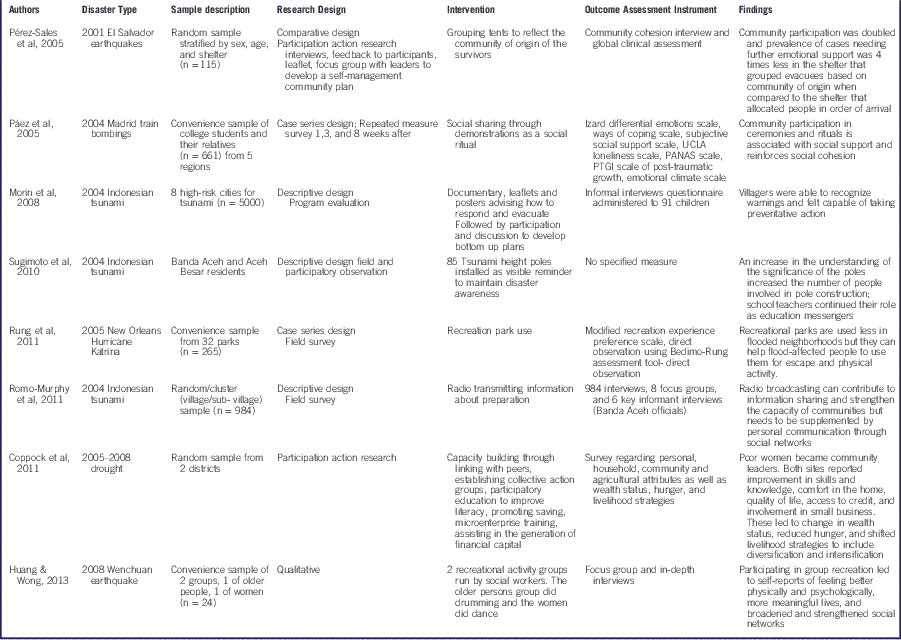
A narrative synthesis of findings was conducted due to the heterogeneity of studies. 12 A narrative synthesis required a more systematic and rigorous approach than the broader concept of a narrative review. We used the framework outlined in the Guidance for Undertaking Reviews in Health Care to ensure a meticulous analysis underpinned by resilience theory. 12 A preliminary synthesis tabulated the included studies in Table 3. A textual approach was then used to analyze the relationships within and between studies and included an assessment of the robustness of the evidence.
Summary of Search Results
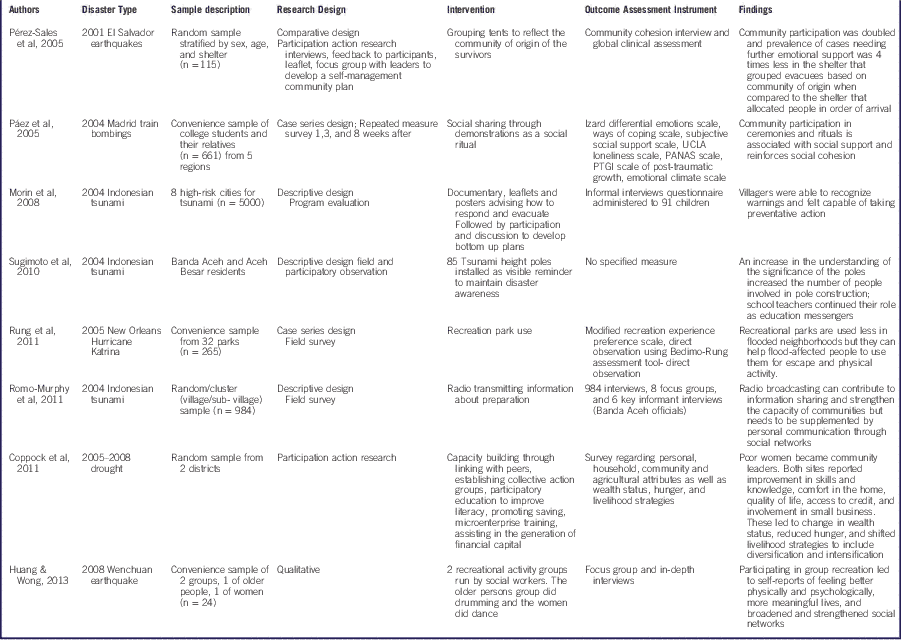
Abbreviations: PANAS, positive and negative affect scale; PTGI, posttraumatic growth inventory; and UCLA, University of California Los Angeles.
Results
The search found a total of 1880 records, excluding duplicates (Figure). Reasons for exclusions included participants who were younger than age 18 years (n=74), non-English (n=40), nonempirical (n=265), not referring to disaster (n=188), not a public health intervention (n=319), and not related to an intervention targeting resilience (n=890). The screening process found 8 reports that met the inclusion criteriaReference Pérez-Sales, Cervellón, Vázquez, Vidales and Gaborit 18 – Reference Rung, Broyles, Mowen, Gustat and Sothern 24 ; these are summarized in Table 3.
The included studies described interventions within 5 different natural disasters including the 2011 El Salvador earthquake,Reference Pérez-Sales, Cervellón, Vázquez, Vidales and Gaborit 18 2008 Wenchuan earthquake,Reference Huang and Wong 19 2005 to 2008 Ethiopian drought,Reference Coppock, Desta, Tezera and Gebru 20 2004 Indonesian tsunami,Reference Romo-Murphy, James and Adams 21 – Reference Morin, De Coster and Paris 23 and 2005 Hurricane Katrina.Reference Rung, Broyles, Mowen, Gustat and Sothern 24 One technological disaster, the 2004 Madrid train bombings was also included.Reference Páez, Basabe, Ubillos and González-Castro 25 Six different countries and continents were represented in the final sample of papers.
The risk of bias across studies was difficult to determine because the included papers provided insufficient information regarding how subjects were recruited, how the intervention was implemented, the attrition of subjects and confounding factors. The studies employed mixed methods for their assessments, with no single method dominating. No provider bias was evident, as each study covered a different intervention.
Overall the method rigor was low. Four reports used a qualitative methodology that ranked descriptive studies as level 3,Reference Pérez-Sales, Cervellón, Vázquez, Vidales and Gaborit 18 , Reference Huang and Wong 19 , Reference Romo-Murphy, James and Adams 21 – Reference Morin, De Coster and Paris 23 while 2 reportsReference Pérez-Sales, Cervellón, Vázquez, Vidales and Gaborit 18 , Reference Coppock, Desta, Tezera and Gebru 20 used a level 3 comparative approach for the quantitative component. The remaining 2 reports were ranked as level 4 evidence.Reference Rung, Broyles, Mowen, Gustat and Sothern 24 , Reference Páez, Basabe, Ubillos and González-Castro 25 Resilience was conceptualized within the study aims and rationale but not in the methods, with ambiguous relationships to study design and measures for all included studies.
A narrative synthesis that explored relationships between the studies identified that strategies to enhance resilience in a disaster setting were either based on providing information, creating social capital (through social integration), or supporting community competence.
Resilience Supported Through the Provision of Information
Three reports described the effect on resilience of information provision after the 2004 Indonesian tsunami.Reference Romo-Murphy, James and Adams 21 – Reference Morin, De Coster and Paris 23 Information was provided before a disaster occurrence to enable preventative action that would avoid adverse health outcomes and consequently support resilience. The strategies included a film supplemented by leaflets, posters on tsunami history, signs on how to respond and evacuateReference Morin, De Coster and Paris 23 ; the use of tsunami height poles to provide visual information of the effect of previous disasters to maintain disaster awarenessReference Sugimoto, Iemura and Shaw 22 ; and radio transmission of information about disaster preparation.Reference Romo-Murphy, James and Adams 21
Information that sought to educate people about risks and the actions to minimize the effect of a disaster was reported by people to change their readiness to act. The combination of 85 poles built in Banda Aceh City and Ache Besar district to educate the community about the height of the 2004 Indonesian tsunami, and the distribution of a documentary and written promotional material about tsunami response and evacuation, enabled villagers to feel better prepared to face the 2006 tsunami.Reference Sugimoto, Iemura and Shaw 22 , Reference Morin, De Coster and Paris 23 By contrast, information provided via radio had limited success, as 27% of villagers reported that they did not learn anything, because they did not have access to technology.Reference Romo-Murphy, James and Adams 21
Resilience Supported Through the Promotion of Social Integration
Three studies explored interventions that addressed social integration after the 2008 Wenchuan earthquake,Reference Huang and Wong 19 the 2005 Hurricane Katrina,Reference Rung, Broyles, Mowen, Gustat and Sothern 24 and the 2004 Madrid train bombings.Reference Páez, Basabe, Ubillos and González-Castro 25 These studies investigated strategies that theoretically increased resilience, and thereby psychosocial well-being, by enhancing social interaction and increasing social support.
Páez and colleagues established some support for this finding when they demonstrated that people who participated in gatherings that facilitated communication, social sharing, and communicating about events were able to create a positive emotional climate, which reinforced social integration.Reference Páez, Basabe, Ubillos and González-Castro 25 Taking part in demonstrations to transmit a symbolic message against terrorism was also shown to predict posttraumatic growth.Reference Páez, Basabe, Ubillos and González-Castro 25 On a smaller scale, participation in recreational groups (dance and drumming) could broaden and strengthen social networks and perceptions of feeling better physically and psychologically.Reference Huang and Wong 19
The crucial aspect of these interventions may have been the ability to participate. Rung and colleagues found that people who were affected by the flooding during Hurricane Katrina were less likely to visit a park or to interact with an animal than those who were not flooded.Reference Rung, Broyles, Mowen, Gustat and Sothern 24 Consequently, this impact limited the opportunity for the use of local recreational parks to promote social interaction by strengthening informal social ties.Reference Sugimoto, Iemura and Shaw 22
Resilience Through the Development of Community Competence
Two reports investigated strategies that sought to develop community competence to deal with the aftereffects of the 2001 earthquakes in El Salvador and the 2005 to 2008 drought in Ethiopia.Reference Pérez-Sales, Cervellón, Vázquez, Vidales and Gaborit 18 , Reference Coppock, Desta, Tezera and Gebru 20 Community competence through collective self-efficacy and community action may have mobilized the resources of a community to promote resilience and contribute to mental health and well-being.
Pérez-Sales and colleagues suggested that building community competence and resilience through strategies that create a sense of belonging, sense of community, social recognition, locus of control, and self-efficacy result in effective coping.Reference Pérez-Sales, Cervellón, Vázquez, Vidales and Gaborit 18 The authors compared the experience in 2 shelters with different management processes after the 2001 earthquakes in El Salvador. In 1 shelter, the grouping of tents reflected the community of origin of evacuees. In this shelter, evacuees participated more often in developing community solutions and decision-making procedures and reported more positive emotional memories, fewer feelings of having been humiliated, and less emotional discomfort than evacuees in the second shelter that randomly allocated people to tents.Reference Pérez-Sales, Cervellón, Vázquez, Vidales and Gaborit 18
Coppock and colleagues developed community competence in their participation action research through collective action, microfinance, and participatory education strategies with 2 communities affected by drought.Reference Coppock, Desta, Tezera and Gebru 20 The results of a survey highlighted that women, in particular, were able to take leadership roles and increase their involvement in small business. This finding led to an increase in skills and knowledge, changes in wealth, reduction in hunger, and increased quality of life.Reference Coppock, Desta, Tezera and Gebru 20
Discussion
The significance of this review lies in establishing a substantial gap in the literature regarding evidence about interventions, underpinned by the concept of resilience in the disaster setting, to increase positive health outcomes in affected communities. The results of the review drew attention to a low level of evidence and a lack of generalizability to a range of disasters or countries. The search process did screen out some well-planned interventions, because they did not include empirical evidence of efficacy. The lack of evidence limited the potential to scale up, generalize, or implement strategies tried elsewhere for new disasters. The review itself was limited by the selection criterion of studies published in English. Within these limitations, some support was tentative, and further research into strategies based on providing information, promoting social integration, or developing community competence may have been able to demonstrate enhanced resilience in a disaster setting.
The findings provided some preliminary knowledge about the mechanisms underpinning interventions seeking to enhance the resilience of people subjected to the effects of a disaster. Translating resilience theory into effective interventions required strategies that were designed and evaluated in a logical, defensible, and sequential order.Reference Patton 26 If interventions were implemented effectively, then a set of outputs would be achieved, and they may be moderated by the characteristics of individuals, or the community as a collective. This review has identified activities that include producing and distributing a film, leaflets, posters, tsunami height poles, and radio transmissions that resulted in information provision outputs. Also, activities that promoted gatherings with a unified purpose, such as demonstrations or recreation, led to social integration outputs, while activities such as the strategic grouping of tents, providing microfinance, and participatory education, have been observed to lead to community competence outputs. The review has provided some evidence that these outputs of effective information provision, promotion of social integration, and development of community competence go on to support resilience outcomes, and subsequently, improved mental health or well-being.
Future Research Directions
Disaster management interventions were targeted to the needs of the different chronological phases of disaster-related events. The information provision strategies in this review that addressed disaster preparation were notably more effective than the radio transmissions during the disaster event. The activities promoting social integration and development of community competence all occurred in the recovery phase. However, future work could consider evaluating the prevention effect of implementing similar strategies as part of disaster preparation.
Information provision (eg, when and how to move to a safe place) may support resilience through a mechanism of promoting a sense of safety.Reference Hobfoll, Watson and Bell 27 Some work has already examined the effect of information provision on developing disaster awareness, and thus skills in preparation and evacuation planning.Reference Becker, Johnston, Lazrus, Crawford and Nelson 28 , Reference Mileti and Darlington 29 This review has provided further evidence that increased knowledge and action arising from disseminating information before a disaster subsequently has a relationship with promoting preparedness and, subsequently, resilience.Reference Huang and Wong 19 , Reference Coppock, Desta, Tezera and Gebru 20 , Reference Romo-Murphy, James and Adams 21 This review also has highlighted the need for more research into the influence on resilience of effective access to information during times of major infrastructure damage. As the world has become more dependent on technology for communication, strategies that address infrastructure management and access, and their relationship with community well-being after a disaster may be worth researching. Furthermore, the studies in this review have concentrated on information as a strategy to improve community preparation. Thus, the effects on resilience of media strategies before and during the event and the role of information during recovery can be further explored.
Social integration activities foster positive emotions that enable a sense of calming and promote connectedness, and they may facilitate resilience by increasing access to information and resources.Reference Hobfoll, Watson and Bell 27 Although informal networks can be effective,Reference Litt 30 formal interventions such as participation in meaningful public events can be implemented after a disaster, as they have been shown to influence recovery outcomes.Reference Kruahongs 31 The social integration strategies identified in this review indicate that interventions that increased social sharing of emotions about the event with others and built social connections through participating in recreational activities and social rituals, can increase resilience.Reference Huang and Wong 19 , Reference Sugimoto, Iemura and Shaw 22 , Reference Morin, De Coster and Paris 23 While evidence of the relationship between resilience and social networks or social engagement exists, further research could consider investigating the efficacy of the implementation of interventions designed to enhance social connections and emotional support. 9 , Reference Hobfoll, Watson and Bell 27
Community competence can lead to resilience through interventions designed to encourage community action, critical reflection, problem solving, flexibility, creativity, collective self-efficacy, empowerment, and political partnerships.Reference Norris, Stevens, Pfefferbaum, Wyche and Pfefferbaum 32 For example, promoting collective efficacy can be done through activities that are conceptualized and implemented by the community, including religious activities, rallies, and mourning rituals.Reference Hobfoll, Watson and Bell 27 , Reference De Jong 33 Community action relies on the empowerment of community members, so that they have a sense of their ability to take control and develop the community competencies required to build capacity.Reference Tadele and Manyena 34 , Reference Paton and Johnston 35 Although limited to 2 studies, the preliminary indication is that the development of community competence may increase the intrinsic capacity of populations at risk to adapt, change, and rebuild and, as a consequence, be resilient in the wake of a disaster.Reference Pérez-Sales, Cervellón, Vázquez, Vidales and Gaborit 18 , Reference Coppock, Desta, Tezera and Gebru 20 The potential is to investigate the efficacy of interventions designed to facilitate other aspects of community competence such as the processes of governance that support community decision making.
Issues with Resilience Research
The intrinsic capacity of a system, community, or society to adapt and survive and consequently demonstrate resilience may also rely on the level of economic development within a particular society.Reference Bonanno, Brewin, Kaniasty and La Greca 4 , 9 , Reference Norris, Stevens, Pfefferbaum, Wyche and Pfefferbaum 32 Financial assistance can form a significant and sometimes substantial support provided by governments to a disaster-affected population. However, aid distribution is not guaranteed to reach marginalized communities.Reference Kamel and Loukaitou-Sideris 36 On the other hand, microfinance in developing countries may contribute to capacity building and the ability to diversify and participate in small business activities.Reference Huang and Wong 19 Therefore, further research investigating the implementation of financial assistance and its ability to contribute to resilience may be helpful. In addition to investigating the effect of providing grants on resilience provided after a disaster, longitudinal studies could investigate the effect of increasing the diversity of income sources for a community and targeting the inclusion of economically vulnerable populations before a disaster hits.Reference Norris, Stevens, Pfefferbaum, Wyche and Pfefferbaum 32
The paucity of results emerging from this review may be due to the complexity of resilience and the challenges of disaster-related research. Consequently, the search and subsequent analysis have been limited by the definition of resilience within a health context. Some reports may fail to use the word resilience but may contribute to community resilience. Theoretical resilience models demonstrate multiple domains that have numerous relationships that occur at many levels, from the individual to government. 9 , Reference Norris, Stevens, Pfefferbaum, Wyche and Pfefferbaum 32 The studies identified in this review demonstrate an approach to facilitate a manageable research design by selecting simpler components of resilience theory in the first instance. However, caution does need to be taken with a reductionist approach. In simplifying an understanding of resilience, the risk is omitting variables related to the context of the disaster, or the public health strategy, or characteristics of the affected population. This approach may influence the generalizability of the results and the capacity to measure effect. Consequently, Boon and colleagues argue for a design that incorporates a variety of methods that collect data from a range of ecological levels at baseline, which is followed up during the recovery time.Reference Boon, Cottrell, King, Stevenson and Millar 5
The unpredictable nature of disasters creates a particular challenge for research into resilience interventions. Both the interventions themselves, and the opportunity to implement them, may emerge throughout the disaster. Researchers are required, therefore, to be alert and to preplan, or have the flexibility to design naturalistic projects. Study designs and evaluation frameworks in disaster resilience need to be flexible enough to accommodate emergent interventions and contextual variations; comprehensive enough to capture process data including intervention integrity, as well as impact and outcome data (both intended and unanticipated); and rigorous enough to provide sufficient strength of evidence to establish causality.Reference Patton 26
Conclusions
This systematic review highlighted a gap in the evidence relating to interventions targeting the resilience of adults who have experienced a disaster. Only 8 intervention studies were identified that met the inclusion criteria. These studies used a variety of strategies to enhance resilience based on either providing information, promoting social interactions, or developing community competence. The results were mixed in relation to information provision but promising for strategies that promote social interactions or develop community competence. However, the strength of evidence was low and the results should be considered inconclusive. Future studies could explore the ability of interventions to build the intrinsic capacity of a system, community, or society at risk of a disaster to adapt and survive. To date, the evidence that the construct of resilience is being translated into evidence-based practice has been minimal.