Introduction
Rice, Oryza sativa L. (Poaceae), is the most important cereal crop grown in 117 countries and is a staple food for people in 39 countries. This includes 2.70 billion people in Asia alone (Sardesai et al., Reference Sardesai, Rajyashri, Behura, Nair and Mohan2001). With a projected increase in world population to 9 billion over the next four decades, an immediate priority is to achieve maximum rice production in an environmentally sustainable and cost-effective manner (Selvaraju et al., Reference Selvaraju, Shanmugasundaram, Mohankumar, Asaithambi and Balasaraswathi2007). It is cultivated extensively in the most diverse ecosystems of tropical and subtropical regions of the world. India has the largest area among rice-growing countries and stands second in production. India produces 89 million tonnes of rice on an area of 37 million ha with a productivity of 3.02 tonnes/ha (Anonymous, 2009). In Punjab, during 2010, rice was grown over an area of 2.8 million ha with a total production of 11.24 million tonnes and an average yield of 6.03 tonnes/ha (Anonymous, 2011). Among the various biotic constraints to rice production, insect pests are of prime importance as the warm humid environment is conducive to their survival and proliferation (Heong et al., Reference Heong, Teng and Moody1995). Globally, more than 100 species of insects are known as pests of this crop, out of which 20 are of major economic significance (Pathak and Dhaliwal, 1981). Heinrichs et al. (Reference Heinrichs, Saxena and Chelliah1979) have estimated yield loss due to rice insect pests at about 30–40% and Dhaliwal et al. (Reference Dhaliwal, Arora and Dhawan2004) at 25%.
The rice leaffolder (RLF) Cnaphalocrocis medinalis (Guenée) (Lepidoptera: Pyralidae), earlier considered as a minor pest, has gained the status of a major pest with the widespread planting of high-yielding rice varieties and the accompanying changes in cultural practices (Bautista et al., Reference Bautista, Heinrichs and Rejesus1984; Teng et al., 1993). It is a destructive and widespread pest throughout the rice-growing regions in South and South-East Asia (Gottfried and Faheemah, Reference Gottfried and Faheemah1981). Damage due to this species ranged from 18 to 58% in India (Ramasamy and Jatileksono, Reference Ramasamy and Jatileksono1996) depending on the stage of the crop at the time of infestation. Bautista et al. (Reference Bautista, Heinrichs and Rejesus1984) have clearly shown that yield loss due to the RLF is positively related to the percentage of damaged leaves. In their studies, 17.5% damaged leaves resulted in a 16.5% yield loss, and a 21.3% yield loss occurred with 26.6% damaged leaves. Patel et al. (Reference Patel, Patel and Desai1986) estimated the losses caused by this pest to grain and straw yield as 63.3 and 7.6%, respectively, in Gujarat. The infested rice plants are also predisposed to bacterial and fungal infection, sheath rot, difficulty in heading, and massive yield loss at the reproductive stage (Xiao, Reference Xiao1990).
The yellow stemborer (YSB) Scirpophaga incertulas (Walker) (Lepidoptera: Pyralidae) is the dominant species in India (Nair, Reference Nair1995) and rice plants are most prone to stemborer infestation at the tillering and flowering stages (Viajante and Heinrichs, Reference Viajante and Heinrichs1987). The YSB has been reported to cause 18–40% damage to rice in India (Inayatullah et al., Reference Inayatullah, Ul Haq, Tanweer and Mahmood1989; Senapati et al., Reference Senapati, Samalo and Patnaik1990; Anonymous, 2006). For every per cent of whitehead (WH) damage, l–3% yield loss may be expected (Pathak, Reference Pathak1968; Dale, Reference Dale1994; Pathak and Khan, Reference Pathak and Khan1994), whereas Rubia and Penning (Reference Rubia and Penning de Vries1990) observed almost proportional yield reduction due to simulated WH damage.
The whitebacked planthopper (WBPH) Sogatella furcifera (Horvath) (Hemiptera: Delphacidae) is an important sucking pest of rice. Both nymphs and adults suck the sap from the leaves and leaf sheaths, which results in the yellowing of leaves, reduced tillering and plant height, and an increase in unfilled grains. A severe attack of the WBPH causes ‘hopper burn’ (Horgan, Reference Horgan2009). It has become a serious threat to rice cultivation in most of the rice-growing countries including India, causing 8–80% yield losses under variable conditions of insect abundance, varieties, crop age, agronomic practices and insecticide usage (Kushwaha et al., Reference Kushwaha, Mrig and Kapoor1986; Kushwaha and Chand, Reference Kushwaha and Chand1988; Ramaraju et al., Reference Ramaraju, Babu and Venugopal1996; Heong and Hardy, 2009).
Planting of susceptible varieties is one of the causes of insect outbreaks. Cultivation of resistant varieties is one major strategy for the population management of insect pests, which needs to be evaluated as it can play a pivotal role in formulating the integrated pest management strategy for a low-input farming system in India. Of the 690 rice varieties developed and released for commercial cultivation in India since 1965, 20% were specifically bred for insect resistance (Prasada Rao et al., Reference Prasada Rao, Rama Prasad and Mishra2002), with breeding of resistant varieties of rice for pest control considered as a cost-effective and safe method (Song et al., Reference Song, Qiang, Liu, Xu and Liu2002; Li et al., Reference Li, Fu, Wang, Yao, Lai, Wu and Zhang2004). Keeping this objective in mind, the present study was conducted to evaluate the elite rice germplasm at the Punjab Agricultural University (PAU) against the RLF, stemborer and planthopper under field conditions and for the WBPH under glasshouse conditions to identify new sources of resistance for use as donors in a breeding programme.
Materials and methods
Raising of nursery beds
Field experiments were conducted during the wet seasons of 2005 and 2006 at the PAU, Ludhiana, Punjab (30°54′N and 75°48′E). Sixty-six rice lines from randomized yield trials (RYT) including eight recommended varieties were sown in well-prepared seed beds of 5 × 0.5 m on 20 and 15 May 2005 and 2006, respectively. The nursery was raised according to agronomic practices of PAU Package of Practices under unsprayed conditions (Anonymous, 2011).
Transplanting of germplasm
The field screening experiment was conducted in a randomized block design with three replications. Ten seedlings of each line/variety were transplanted in 1.5 m rows at 2 seedlings/hill on 24 and 21 June during 2005 and 2006, respectively. Row-to-row spacing was maintained at 0.2 m. Urea was applied at 0.275 tonne/ha in three equal splits, one at puddling and thereafter at 3 and 6 weeks after transplanting. These lines were evaluated for the performance under natural infestation conditions. The germplasm was raised following the recommended PAU Package of Practices (Anonymous, 2011) and was evaluated under unsprayed conditions. A 50 cm alley was left between the blocks.
Glasshouse screening for the WBPH
Glasshouse screening of rice germplasm was done during the wet season of 2007 using the standard seedbox screening technique (Heinrichs et al., 1985). Germinated seeds (15–20 of each line/variety) were sown into a seedbox of about 0.45 × 0.35 × 0.10 m containing well-puddled soil. In case of glasshouse evaluation for the WBPH, each line/variety was sown in rows with a 3.5 cm distance between the rows and in a complete randomized block design with three replications. Seven-day-old seedlings were infested with second/third instar nymphs at 7–10 nymphs per seedling (Kalode et al., Reference Kalode, Vishwanathan and Seshu1975; Heinrichs et al., 1985). ARC 6248 and TN 1 were used as resistant and susceptible checks, respectively. Damage scores on each seedling were recorded on a 0–9 scale when 90–100% plants of TN 1 were dead (7 days after WBPH infestation) following the Standard Evaluation System (SES) of rice (Anonymous, 1996). A score of 0 represents no visible damage, whereas a score of 9 represents complete drying of the plant. The mean damage score of each line was classified as resistant (0–3), moderately resistant (5) and susceptible (7–9) following the scale developed by Heinrichs et al. (1985).
Field screening observations
A leaf was considered to be damaged by the leaffolder if at least one-third of its area was showing symptoms. Leaf damage was recorded from five hills selected at random in a replication in each RYT line. The observations were recorded at two crop phenophases, viz. vegetative and panicle initiation stages. For this purpose, the total number of leaves per hill and damaged leaves were recorded, and per cent damage was calculated by the following formula:
 $$\begin{eqnarray} Leaffolder\ damage\ (\%) = \frac {number\ of\ infested\ leaves\ per\ five\ hills}{total\ number\ of\ leaves\ per\ five\ hills}\times 100. \end{eqnarray}$$
Similarly, observations on stemborer damage, i.e. dead heart (DH) and WH, were recorded and per cent damage was determined as follows:
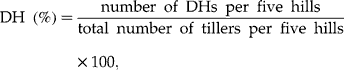 $$\begin{eqnarray} DH\ (\%) = \frac {number\ of\ DHs\ per\ five\ hills}{total\ number\ of\ tillers\ per\ five\ hills}\times 100, \end{eqnarray}$$
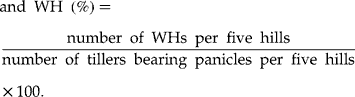 $$\begin{eqnarray} and\ WH\ (\%) = \frac {number\ of\ WHs\ per\ five\ hills}{number\ of\ tillers\ bearing\ panicles\ per\ five\ hills}\times 100. \end{eqnarray}$$
The planthopper population was counted from five hills selected at random in a replication. The plant was slightly tilted and tapped two or three times at the base, and the planthoppers seen floating on the water or fallen on the ground were counted.
Morphological characters
Leaf width was measured from the centre of the flag leaf, and plant height was measured from the base of the plant to the height of the flag leaf/panicle tip.
Statistical analysis
The data pertaining to the evaluation of rice germplasm for resistance against insect pests, viz. leaffolder, stemborer and planthopper, were statistically analysed with analysis of variance (ANOVA) using Minitab 15 software. The different treatment means were separated by the least significant difference test at P < 0.05 (Gomez and Gomez, 1984). The mean values, ranges and standard deviations for the above data were also calculated.
Results and Discussion
Cnaphalocrocis medinalis
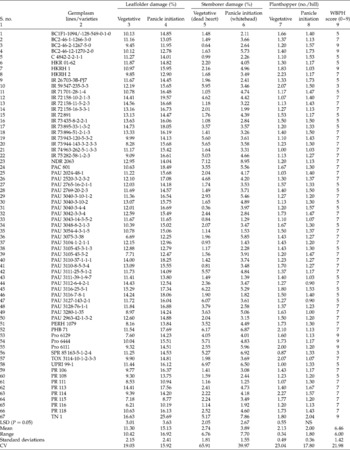
The ANOVA over the years for C. medinalis infestation at the vegetative stage indicated that the damaged leaves differed significantly (F 66,132 = 6.08; P = 0.0001) among the different lines/varieties (Table 1). Its damage varied from 6.21 ± 0.33 to 16.63 ± 3.78% among the different lines/varieties. In varieties/lines, viz. PR 116, PAU 3075-3-38, PR 115, Pro 6129, PAU 3105-45-3-2, PERH 1079, IR 73 944-143-3-2-3-3, PR 111, PAU 3280-1-35, IR 75 282-58-1-2-3, PR 108, Pro 6111, PR 114, BC2-46-2-1267-5-0, PR 106, HKRH 2, TOX 3114-10-1-2-3-3 and IR 73 943-120-5-3-2, damage was significantly less (6.21 ± 0.33 to 9.99 ± 4.07%) than the other lines/varieties (Table 1).
Overall field evaluation of rice germplasm against Cnaphalocrocis medinalis, Scirpophaga incertulas and Sogatella furcifera during 2005 and 2006 and glasshouse evaluation for S. furcifera during 2007

LSD, least significant difference; CV, coefficient of variation.
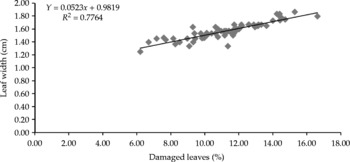
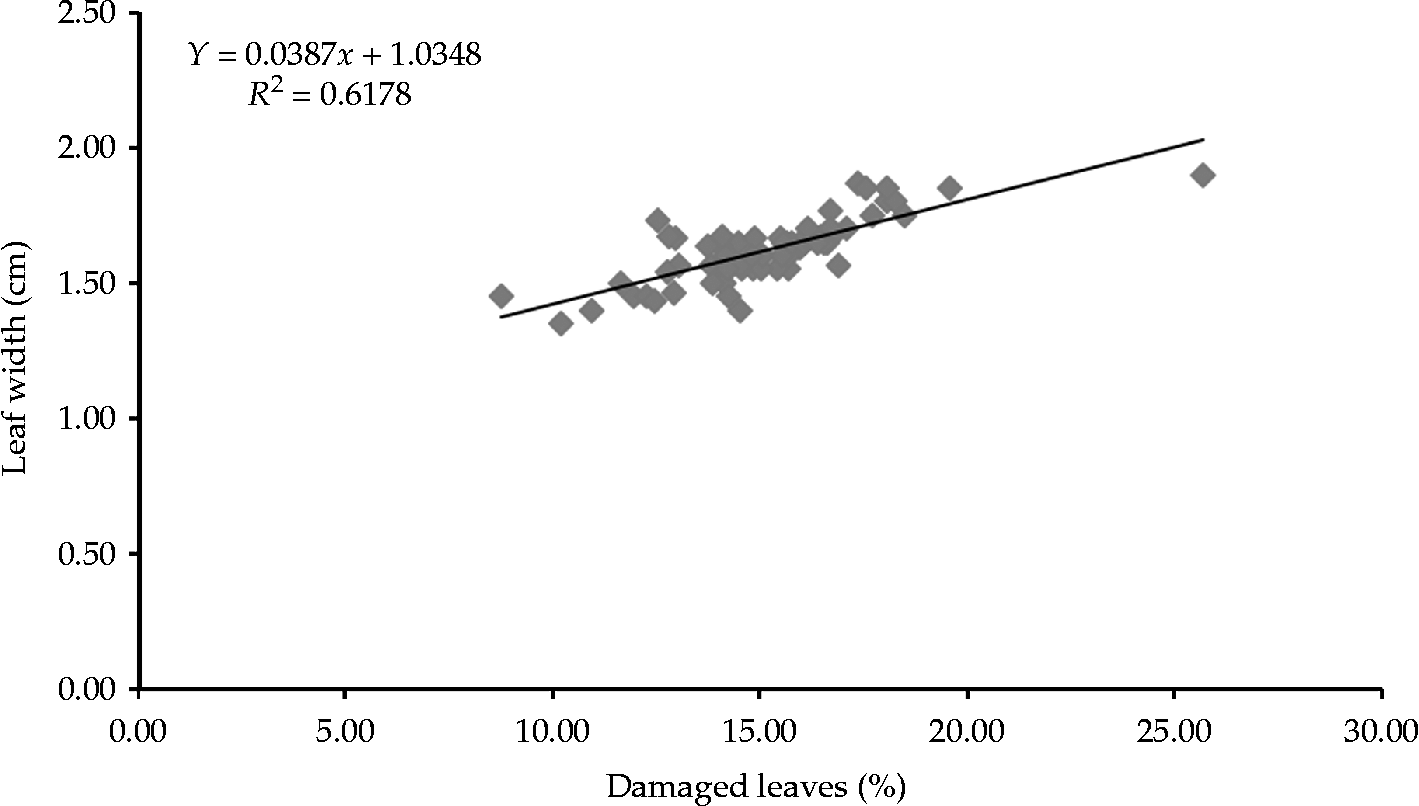
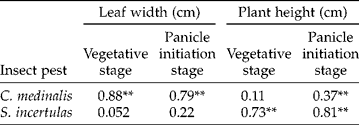
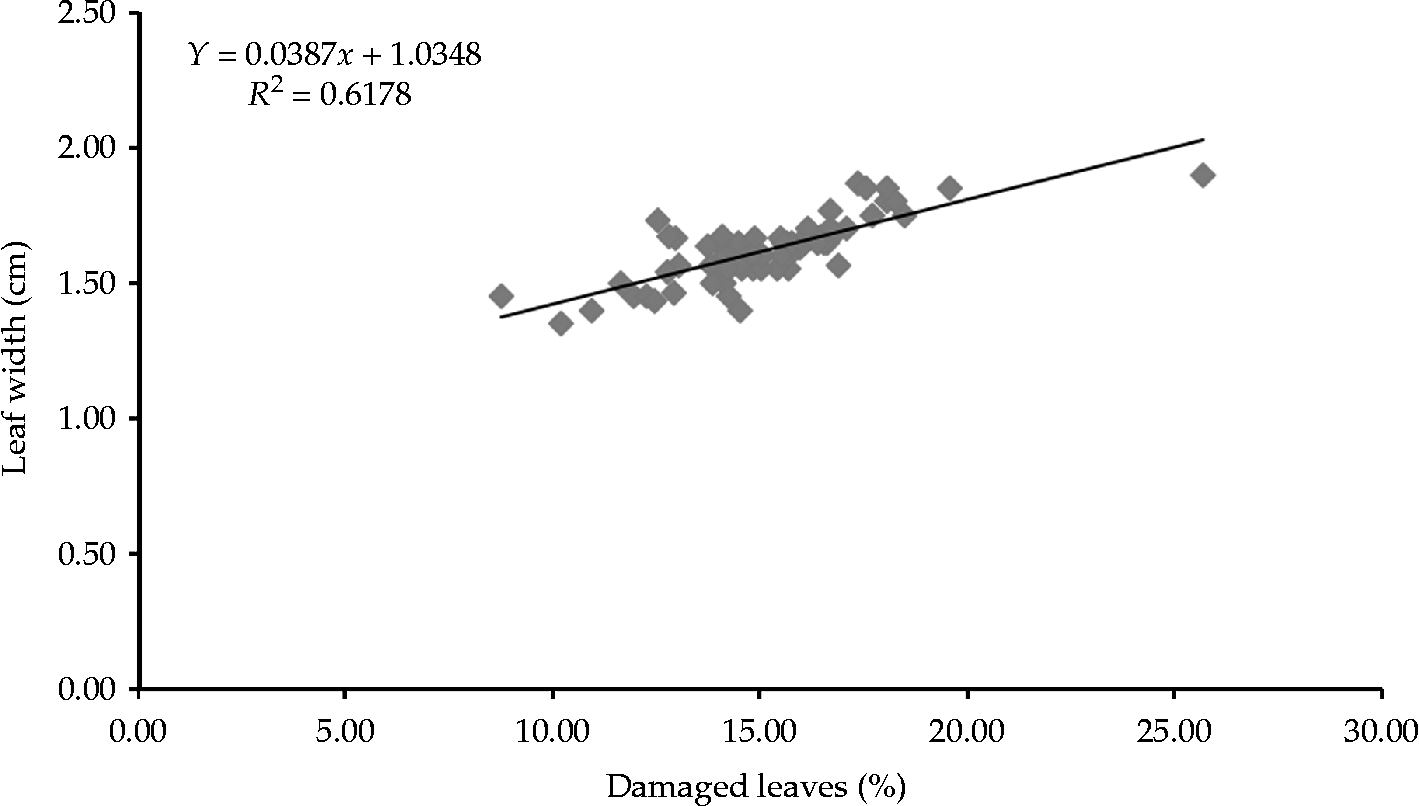
The ANOVA over the years for C. medinalis infestation at the panicle initiation stage indicated that the damaged leaves differed significantly (F 66,132 = 3.14; P = 0.0001) among the different lines/varieties (Table 1). Its damage varied from 8.77 ± 1.25 to 25.69 ± 0.93% among the different lines/varieties. In varieties/lines, viz. PR 115, PR 116, PR 111, PAU 3043-14-3-5-2, PAU 3075-3-38 and BC2-46-2-1267-5-0, leaffolder damage varied from 8.77 ± 1.25 to 12.25 ± 4.67%, respectively, which was significantly less than the other materials evaluated (Table 1). The results obtained from the correlation studies between per cent leaffolder damage at the vegetative and panicle initiation stages, and leaf width and plant height during the present studies showed that there was a highly significant correlation between leaf width and per cent infested leaves at the vegetative (r = 0.88**; Fig. 1) and panicle initiation (r = 0.79**; Fig. 2) stages (Table 2). The present findings were substantiated by earlier reports (Majumdar et al., Reference Majumdar, Pathak and Brothakur1986; Xue et al., Reference Xue, Shen, Zhan and Ihao1987; Shrivastava, Reference Shrivastava1989; Dakshayani et al., Reference Dakshayani, Bentur and Kalode1993; Pandhya et al., Reference Pandhya, Shah, Patel and Pruohit1995; Islam and Karim, Reference Islam and Karim1996, 1997; Rao et al., Reference Rao Chalapathi, Singh and Subhas2002; Laskar et al., Reference Laskar, Ghimiray and Biswas2008; Xu et al., Reference Xu, Qi-Xiang Wang and Wu2010) stating that plants with a broad leaf width facilitate easy folding and provide more mesophyll cells and chloroplasts in rolled-up leaves for larvae to scrape the area for feeding. No significant correlation was observed between plant height and leaffolder infestation during the vegetative stage. Similar findings have been reported by Islam and Karim (Reference Islam and Karim1997), Rao et al. (Reference Rao Chalapathi, Singh and Subhas2002), and Xu et al. (Reference Xu, Qi-Xiang Wang and Wu2010); however, a significant correlation was observed between plant height and leaffolder infestation at the panicle initiation stage (r = 0.37**; Table 2). In lines PR 116, PAU 3075-3-38 and PR 115, leaf width varied from 1.25 to 1.45 cm, and this material also showed less leaffolder damage.
Relationship between Cnaphalocrocis medinalis damage and leaf width at the vegetative stage over the years

Relationship between Cnaphalocrocis medinalis damage and leaf width at the panicle initiation stage over the years
Correlation coefficient between Cnaphalocrocis medinalis and Scirpophaga incertulas damage with leaf width and plant height
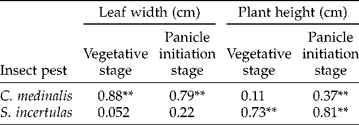
**Significant at the 1% level.
Scirpophaga incertulas
The ANOVA over the years for stemborer infestation at the vegetative stage indicated that DH damage differed significantly (F 66,132 = 4.01; P = 0.0001) among the different lines/varieties (Table 1). DH damage varied from 0.36 ± 0.61 to 7.12 ± 2.43% among all the lines. The lines PAU 3040-3-4-4, BC2-46-2-1267-5-0, PAU 3110-8-5-3-4, PAU 3043-14-3-5-2, PAU 3104-1-2-1-1 and C 4842-2-2-1-1 showed less than 1% DH damage, whereas in lines/varieties PAU 3054-4-3-1-5, PR 116, PR 111 and PAU 3105-45-3-1-3, DH damage varied from 1.14 ± 1.12 to 1.17 ± 1.20%, which differed significantly from the other materials (Table 1). Kumar (Reference Kumar1995) reported that all varieties except IR66 were susceptible to DH damage by S. incertulas, whereas Chaudhary et al. (Reference Chaudhary, Khush and Heinrichs1984) and Heinrichs (Reference Heinrichs1988) observed that many rice varieties are available with moderate levels of resistance to this pest during the vegetative stage.
The ANOVA over the years for stemborer infestation at the panicle initiation stage indicated that WH differed significantly (F 66,132 = 3.64; P = 0.0001) among the different lines/varieties (Table 1). WH damage varied from 1.25 ± 0.64 to 8.95 ± 2.67% among all the lines. Over the years, in the varieties/lines PR 111, PR 116, PAU 3043-14-3-5-2, PAU 3111-39-1-9-7, PAU 3104-1-2-1-1, PAU 3054-4-3-1-5, PAU 3116-7-8-1 and IR 72 158-16-3-3-1, WH damage varied from 1.25 ± 0.64 to 1.99 ± 1.10%, which differed significantly from the other germplasm materials (Table 1). In the commercially recommended varieties PR 113, PR 114 and PR 115, WH damage was 4.73 ± 1.43, 4.18 ± 0.23 and 3.49 ± 1.41%, respectively. A similar trend of WH damage has been reported by Subudhi and Padhi (Reference Subudhi and Padhi2008) in the case of PR 113, PR 114 and PR 115 with 9.87, 6.80 and 4.06% WH, respectively.
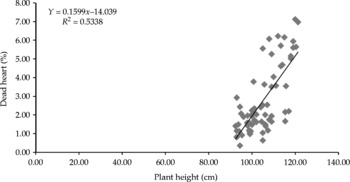
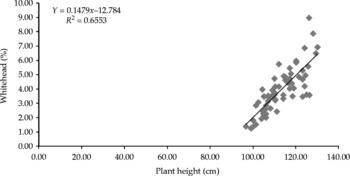
The results obtained from the correlation studies between per cent stemborer damage at the vegetative and panicle initiation stages, and leaf width and plant height during the present studies showed that there was a highly significant correlation between plant height and per cent DH and WH at the vegetative (r = 0.73**; Table 2 and Fig. 3) and panicle initiation (r = 0.81**; Table 2 and Fig. 4) stages (Table 2). The results were corroborated by the findings of Patanakamjourn and Pathak (Reference Patanakamjourn and Pathak1967), Israel (1967), Pathak (Reference Pathak1971) and Pathak et al. (1971) who reported several morphological factors including plant height, which is positively correlated with the number of eggs laid by females. No significant correlation was observed between leaf width and stemborer infestation during the vegetative (r = 0.05) and panicle initiation (r = 0.22) stages (Table 2). The lines/varieties PR 106, PAU 3040-3-10-1-2, PAU 3043-14-3-5-2, PAU 3110-8-5-3-4, PR 111, PAU 3111-39-1-9-7, PR 116 and PAU 3040-3-4-4 showed less DH infestation during both the years and their plant height varied from 92.33 to 94.33 cm. The lines PAU 3111-39-1-9-7, PAU 3111-39-1-9-7, PAU 3043-14-3-5-2, PR 111, PAU 3116-7-8-1, PAU 3104-1-2-1-1, PAU 3042-3-3-4, PAU 3054-4-3-1-5, PR 106 and PR 116 showed less WH infestation during both the years and their height varied from 96.67 to 104.00 cm. The susceptible lines TN 1, NDR 2063, SP 85 163-5-1-2-4 and UPRI 99-1 showed more WH infestation and their height varied from 126 to 130 cm.
Relationship between Scirpophaga incertulas damage (dead heart) and plant height at the vegetative stage over the years

Relationship between Scirpophaga incertulas damage (WH) and plant height at the panicle initiation stage over the years

Sogatella furcifera
The ANOVA over the years for WBPH numbers per hill at the vegetative stage differed significantly (F 66,132 = 3.15; P = 0.0001) among the different lines/varieties, whereas no such difference was observed at the panicle initiation stage (F 66,132 = 1.25; P = 0.140) (Table 1). At the vegetative and panicle initiation stages, planthopper numbers were low and varied from 0.87 ± 0.12 to 2.27 ± 0.66 and 0.90 ± 0.00 to 2.04 ± 0.23 WBPH per hill, respectively, over the 2 years (Table 1). Under glasshouse screening, the ANOVA for the WBPH damage score differed significantly (F 66,134 = 282.87; P = 0.0001) among the different lines/varieties. Two lines, viz. IR 59 547-235-3-3 and SPR 85 163-5-1-2-4, were resistant to the WBPH, whereas 20 lines were moderately resistant and the remaining lines were susceptible (Table 1). Earlier studies have also suggested some sources of resistance to this pest (Heinrichs and Rapusas, Reference Heinrichs and Rapusas1983; Gupta and Shukla, Reference Gupta and Shukla1985; Shukla et al., Reference Shukla, Saini and Gupta1987, Reference Shukla, Gupta and Saini1993; Singh et al., Reference Singh, Sidhu, Shukla and Sharma1993; Sogawa et al., Reference Sogawa, Zeng, Qiang and Zeng2005; Heong and Hardy, 2009).
Conclusion
Over the 2 years, study varieties, viz. PR 111 and PR 116, showed less leaffolder and stemborer infestation than other lines/varieties. Only two lines, viz. IR 59 547-235-3-3 and SPR 85 163-5-1-2-4, showed resistance to the WBPH. These lines can be used as donors in a hybridization programme for germplasm improvement.
Acknowledgements
We thank the Senior Rice Breeder and Head, Department of Plant Breeding and Genetics for providing access to the rice germplasm and facilities for the smooth conduct of the experiments.