In his darkly humorous depiction of the Būyid state, the litterateur Abū Ḥayyān al-Tawḥīdī (d. 411/1023) illustrated the greed of one vizier with the following anecdote.Footnote 1 Abuʾl-Faḍl Ibn al-ʿAmīd (d. 360/970), says Tawḥīdī, one day repeatedly asked the head of his kitchen what happened to the leftovers of his meals. The latter, exasperated by his insistence, told him bluntly that he “shoved it in the … of the vizier's wife”. Of interest here is not the vizier's pettiness, nor the vulgarity of the answer, but the setting of the anecdote: “The vizier asked this question while he was at the back of the kharkāh, thinking that no one would hear” (Tawḥīdī: 349, line 9, cf. trans. 151). The term kharkāh, used by Tawḥīdī on the basis of oral information, is problematic. It is equivalent to the Persian khargāh, but has no root in Arabic or Middle Persian. It has usually been associated with nomadic Turks, but here it clearly appears as the dwelling of an Iranian secretary. In his translation of the chronicles on Būyid history, Margoliouth rendered it as “pavilion” and “marquee”, but also as “hut”.Footnote 2 Hut is the meaning preferred by French scholars translating pre-Mongol authors such as Ibn Ḥawqal or Manūchihrī.Footnote 3 All of them follow the definition given by Dozy (“tentoria lignea coactis tecta”) and copied by de Goeje (Dozy Reference Dozy1881: 1/366; BGA, 4/224). Dozy's understanding seems in turn to be derived from the description left by Ibn Baṭṭūṭā (d. 770/1368–69 or 779/1377) about his trip to Turkey:
The sultan [of Birgi] sent me a tent [of the kind] which is called by them khargāh, and consists of wooden laths put together in the shape of a cupola and covered with pieces of felt. The upper part of it can be opened to admit light and air, like a ventilation pipe, and can be closed when required (Ibn Baṭṭūṭā, 2/186, trans. 2/440; cf. Andrews Reference Andrews1997: 1/37).Footnote 4
The reference dictionary of Classical Persian, the Burhān-i qāṭiʿ (wr. 1062/1651-52), merely defined khargāh as “a great round tent” (Burhān, 2/736). This definition clearly did not satisfy the great Iranian scholar Muḥammad Qazwīnī who wrote in his notebook, after referring to Ibn Baṭṭūṭā's aforementioned passage: “it seems that its meaning differs totally from the khayma; it appears to mean something like an arbour (ālāchīq), [or] something which amounts to a cover on the wooden part of an arbour” (Qazwīnī Reference Qazwīnī and Afshār1959: 4/199). Vladimir Minorsky glossed over the problem, yet the term khargāh appears 12 times in the fourth/tenth century Ḥudūd al-ʿalam, a work he studied with extreme care. Minorsky did not discuss it or include it in his index of technical terms, and like his predecessors he translated khargāh by “hut” or “felt huts”.Footnote 5
Nothing changed until Peter Andrews' ground-breaking work on tents and pavilions. Andrews, an architect trained in Oriental languages and anthropology, shows irrefutably that in the thirteenth century, khargāh refers to the trellis tent, a kind of framed tent characteristically formed of two separate parts: a collapsible wooden structure (the trellis and an upper structure) and a removable felt coating.Footnote 6 The equivalence is proven by a painting of a trellis tent bearing an explicit caption (Andrews Reference Andrews1999: 1/630–1). Contrary to the passage of Ibn Baṭṭūṭā, the trellis is here clearly recognizable (see Figure 1). Further indisputable proof from the same period is the equivalence postulated in Rashīd al-Dīn's chronicle (completed 710/1310–11) between khargāh and kërëkü, the latter being the Turkic word for trellis and trellis-tent (Rashīd al-Dīn: 5, line 4; cf. Andrews Reference Andrews1997: 1/25).Footnote 7 For earlier periods however, where iconography is scarce to non-existent, and the corpus of written sources bilingual and much more difficult to deal with, Andrews has not been able to go beyond hypothesis (e.g. Andrews Reference Andrews1999: 1/195).Footnote 8 Some scholars have recently translated early mentions of khargāh by “yurt” (e.g. Stark Reference Stark2008: 40), but without justifying why. In a previous publication on the tents of the Saljūqs (eleventh–twelfth centuries), I discussed the meaning of the term khargāh, a key setting of the royal court, but I noted that only an overall analysis of the pre-Mongol sources could provide definitive answers (Durand-Guédy Reference Durand-Guédy and Durand-Guédy2013: 157). Thus the purpose of the present article is to show when and why the term khargāh entered the Arabic and Persian vocabulary of tentage. I argue that from its inception in the fourth/tenth century, khargāh referred exclusively to the trellis tent originated in Inner Asia.
(Colour online) Trellis tent
Left: Wooden structure of a trellis tent without the felt covering (source: Andrews Reference Andrews1997, 1: plate a2, reproduced with permission of the author). Right: Fourteenth-century painting of a trellis tent explicitly identified as khargāh (hand sketch by Durand-Guédy of a detail of an illustrated manuscript of Jājarmī’ Muʾnis al-aḥrār kept at the Metropolitan Museum of Art and reproduced in Swietochowski and Carboni Reference Swietochowski and Carboni1994: 29).

Such an investigation lies at the crossroads of three different fields of research. First, lexicography, because the corpus of sources consists exclusively of texts (no relevant paintings or artefacts survive from this period) and any attempt to establish correspondences must start with words. Second, the history of technology, since it is not the morphology, but also the function and even the meaning of an object, here a particular type of tentage, which must be analysed. Finally history itself, because piecing together the history of the khargāh amounts to investigating the growing influence of the Turks in Muslim polities, a subject which has already been thoroughly investigated, but never from this perspective.Footnote 9 The “Turkish tent”, I argue, had been adopted as a status symbol outside its original environment at a very early date, and in any case long before the Saljūq conquest.
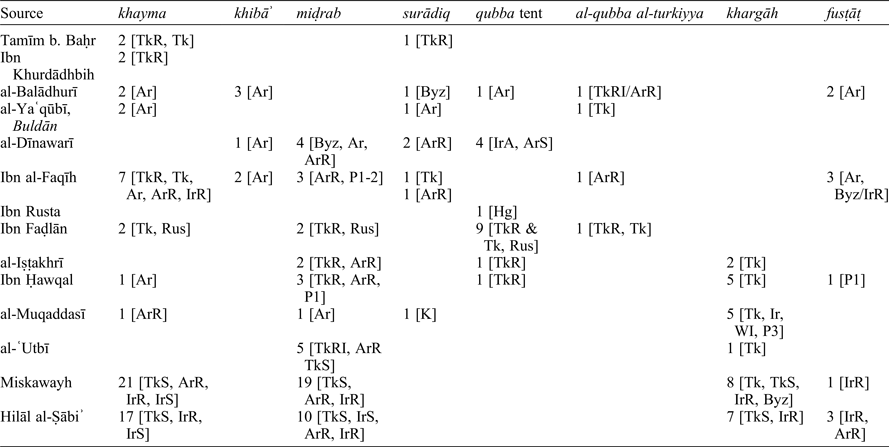
Methodologically, a study of this kind is complicated by the fact that many texts in our corpus have an intricate history which is still only imperfectly understood. However, I believe that we can to some degree compensate for this weakness through a comprehensive overview of the available material. Indeed, while a technical term in one particular non-poetical sourceFootnote 10 may reflect the usage of the time when the text was copied, if all the references point in the same direction, then we have a much stronger basis for the argument. To this end, not only should all occurrences of the word khargāh be put into context, but they should also be compared to other terms of tentage appearing in the same text and/or in the same period. For this task, I was greatly helped by digital libraries allowing targeted searches in the corpus of historical, geographical and poetic texts.Footnote 11 I have provided in the appendix a list of the terms for tentage used in the most relevant sources. My argument is based on an analysis of this material.Footnote 12
Before the fourth/tenth century
Before investigating the way khargāh was first used by Muslim authors (in the fourth/tenth century), we must establish what terms of tentage were previously used. Among Muslim authors, the first reference to the tent of the Turks is made by Tamīm b. Baḥr, who travelled from the Central Asian city of Ṭaraz to the capital of the Turkic Uyghurs in present-day Mongolia (the voyage is dated between 143/760–1 and 184/800–1). In his account, which has been most accurately transmitted by Ibn al-Faqīh (end of the third/ninth century), khayma is used for the tents of pastoral nomads (like the Kimeks) as well as those of the Uyghur elite. Tamīm also mentions a surādiq al-malik at the centre of the Uyghur royal camp. This surādiq, in the singular, might well refer to the royal enclosure characterizing early Turkic courts.Footnote 13 Whatever the case, it is an understatement to say that, given the vast resources of the Arabic language in this field, the lexicon of tentage in this source is very basic.Footnote 14
Significant progress is made with the coining of the expression al-qubba al-turkiyya, “the Turkish qubba”. Al-Balādhurī (d. 279/892) seems to be the first to have used it, in a passage about the ruler of Zābulistān (see below). Qubba, which can mean dome or cupola, fits very well with the convex shape of the trellis tent (see Figure 1). However, qubba, whose root gives the idea of erection, has been part of the Arabic lexicon of tentage since at least the late second/eighth century. Thus the prolific writer of Kūfa, Hishām al-Kalbī (d. 204/819 or 206/821), uses it in a clearly Bedouin context (al-Marzūqī, 403). Al-Balādhurī himself mentions a qubba erected by the Arabs on the site of the future city of Basra (see Appendix 1). Al-Dīnawarī (d. before 290/902–3) uses qubba to speak of the tents of the Sasanian king Shāpūr as well as the Arabs (see Appendix 3). Al-Ṭabarī (d. 310/923) repeatedly alludes to the qubba of the Prophet Muḥammad.Footnote 15 In all these cases qubba refers to guyed tents. Conversely, when the word qubba is qualified by the adjective “Turkish”, it refers to another type of structure. This is proven by a passage of al-Yaʿqūbī (fl. 278/891), a contemporary of al-Balādhurī and al-Dīnawarī, about the dwellings of the nomadic Turks:
[The Qarluqs, Toquz-Oghuz, Türgesh, Kimeks and Oghuz] only pitch Turkish qubba, which are ribbed, and the nails are strips from the hide of pack animals and the coverings are felt (wa innamā yanzulūna al-qibāb al-turkiyya al-muḍallaʿa wa masāmīruhā suyūr min julūd al-dawwāb wa aghshiyatuhā lubūd) (Yaʿqūbī, 295, lines 7–8, trans. Andrews Reference Andrews1999: 1/180 recte: muḍallaʿa).
Andrews has shown that mention of nails is an irrefutable argument that these tents were trellis tents (because the nails connect the trellis laths together). He supposes that al-Yaʿqūbī was able to see trellis tents at the Caliphal capital Samarra, where Turks formed the backbone of the army. Archaeological reports show that the cantonment sites at Samarra were filled by houses of all sizes (Northedge Reference Northedge2005: 167–95). However, this does not preclude the presence of tents, erected either in the courtyard of these houses, as was the case in the Central Asian region of Khwārazm (see Ibn Faḍlān, 8, lines 11–2), or on the open spaces called maydāns. This hypothesis is even stronger if this military did not consist of rootless children captured in the steppe and trained in Iraq as previously thought, but of grown-ups, as de la Vaissière (Reference de la Vaissière2007: 210–7) argues. Turks raised in Inner Asia in a nomadic environment would have been more inclined to bring with them the kind of dwelling they were used to.
Beyond al-Yaʿqūbī, another valuable source linking “the Turkish qubba” with nomadic Turks is Ibn Faḍlān (fl. after 309–10/921–2). In the account of his journey to the Bulghār Turks, Ibn Faḍlān explicitly speaks of “Turkish qubba” for Khwārazm and for Oghuz territory. These two territories adjoined the north-eastern border of the Sāmānid state and overlapped the old territory of the Western Türk qaghanate, the first polity for which sources attested the existence of trellis tents. Although the expression al-qubba al-turkiyya comes only twice from Ibn Faḍlān's pen (see Appendix 4), the fact that it appears at the beginning of the text suggests that his subsequent references to qubba without epithet (for the Pechenegs and the Bulghārs) are saving space rather than referring to a different kind of structure.Footnote 16 Generally speaking, tent-related terms in Arabic became specialized during the middle ʿAbbāsid period. When it was not used in the sense of cupola, qubba (without epithet) tended to be reserved for the Turkish tent. Al-Yaʿqūbī employs it exclusively for the Turks while he reserves khibāʾ for the Bedouin tents. The same is true for al-Balādhurī: the three occurrences of khibāʾ in his Futūḥ al-buldān relate to Bedouins (see Table 1). Likewise the Kufian philologist Ibn al-Aʿrābī (d. 231/846) defines khibāʾ as “a tent made of goat hair or wool” (al-Marzūqī, 356: al-khibāʾ min shaʿr aw ṣawf) and in his K. al-Azmina wa'l-amkina, the eleventh-century philologist al-Marzūqī uses khibāʾ eight times, always for the Bedouin tent. As for the terms miḍrab and fusṭāṭ, they refer not so much to specific structures as to the higher social status of those using them (see Table 1).
Now, and this is a key point, the “Turkish qubba” appears from a very early date outside of its prime socio-geographical milieu, i.e. nomadic Inner Asia. It is difficult to interpret two references made by al-Ṭabarī to “Turkish qubba” among first/seventh-century Arabs in Western Arabia.Footnote 17 They may be the result of a retrospective illusion (Turkish tents being associated with power from the early ʿAbbāsid period onwards), or refer to a kind of framed tent, not necessarily Turkish, in use in the Middle East during the first millennium. However the “Turkish qubba” mentioned by the same al-Ṭabārī (I-2444–5, trans. 13/24) at the Sasanian court of Ctesiphon may well have been trellis tents since the Sasanians and the Turks (the first polity in which the trellis tent is attested) had become neighbours from the mid-sixth century, and at times were even allies.
For the Islamic period, the earliest reference to a “Turkish qubba” used outside the nomadic milieu appears in the tribute sent by the local ruler of Zābulistān (now southern Afghanistan) to the ʿAbbāsid governor of Sīstān during the caliphate of al-Manṣūr (r. 136–58/764–75).Footnote 18 There is no reason to think that these “Turkish qubba” could not have been trellis tents. The kingdom of Zābulistān was probably established by Khalaj Turks, who could have migrated from the north of the Hindu Kush some time before the mid-seventh century ad.Footnote 19 But even without relying on the Turkish origin of the rulers of Zābulistān, trellis tents could easily have been obtained through contacts with Turks living north of the Hindu Kush.Footnote 20 Since during al-Manṣūr's caliphate the governor of Sīstān was an Arab and Turks did not yet constitute the backbone of Caliphal armies, these “Turkish tents” must have been destined for members of the ʿAbbāsid elite.Footnote 21
Early use of “Turkish qubba” outside of Central Asia is also confirmed by the litterateur Ibn al-Faqīh al-Hamadhānī in a chapter of his K. al-Buldān (c. 290/903). During a lengthy and heated discussion about the respective qualities of Hamadan and Baghdad, one of the debaters opposes the miasma of the Iraqi summer in favour of the healthiness of winter in Hamadan. To make his point he adds that the princes of Jibāl (mulūk al-jabal) “only live in wellbeing during the winter-days” because then they can put on their fur garments, spread their rich carpets, and make use of all manner of protection from the cold such as “large tents (maḍārib), buildings (abniya), curtains (sitārāt, sic), surādiqs and Turkish tents (qibāb turkiyya)…” (Ibn al-Faqīh Reference al-Hamadhānī and Jamgotchian1979: 484). These qibāb (plural of qubba) turkiyya were obviously a kind of framed tent, because not only is it the only time Ibn al-Faqīh speaks of qubba for tents, but also it is the only term of tentage in this work related to the Turks (not mentioning naturally the quotations from Tamīm b. Baḥr).Footnote 22 The “princes of Jibāl” referred to by Ibn al-Faqīh can only be the Dulafid governors of Jibāl, the descendants of Abū Dulaf al-ʿIjlī (d. c. 225/840) whose verses have just been quoted by Ibn al-Faqīh. The Dulafids were Arabs, but because trellis tents covered with felt were designed to withstand the cold winters of Inner Asia, their technical superiority to the Bedouin tent during the harsh winters of Western Iran (the Dulafid capital was south of present-day Arak) was obvious. This does not mean that these powerful and refined rulers lived like ordinary Türkmen nomads. As Andrews has clearly shown, nomadic tradition had already been adapted to princely use in Inner Asia. Besides, the list of furnishings given by Ibn al-Faqīh leaves no doubt concerning the luxury of these tents. Significantly, Ibn Faḍlān (28, line 21) remarks that the tents of the leaders and their followers were of a similar structure, but easily distinguished by their size as well as their luxurious furnishings.Footnote 23 To quote the anthropological literature, al-qubba al-turkiyya was a catch-all expression “highlighting the ethnic specificity of the object at the expense of its socio-differential variants” (Bromberger Reference Bromberger1979: 134).
The inception of the term khargāh
Khargāh first appeared in Arabic–Persian writings during the first half of the fourth/tenth century. The most ancient reference is probably in a verse attributed to Rūdakī (d. c. 340/951–2), the poet of the Sāmānid court.Footnote 24 It is drawn from a poem celebrating the festival of mihrigān which was held at the time of the autumnal equinox:
O King! The time of the festival of mihrigān, the royal feast, has come,
Fur replaces the mulhim [silken] garment, and the khargāh is pitched in the middle of the garden (Rūdakī Reference Rūdakī, Bereginsky, Samailovich and Nafīsī1388: 78, verse 141–2).Footnote 25
The addressee is probably the amir Naṣr II b. Aḥmad (r. 301–31/913–42), Rūdakī's patron. At this point, we do not know what a khargāh is, except that it was erected in the royal garden when temperatures began to drop.
Rūdakī's contemporary, the vizier and geographer Abū ʿAbd Allāh Jayhānī (d. between 309/921 and 322/934) employed the term khargāh for the Turkic people who lived in the steppe north of the Sāmānid state. Jayhanī's work has not survived, but we have a pretty good idea of its content for Inner Asia thanks to the relevant accounts of the Ḥudūd al-ʿālam and Gardīzī's Zayn al-akhbār, which both rely heavily, if not exclusively, on it. In the Ḥudūd al-ʿālam, khargāh appears twelve times in total, always in relation to Turkic peoples, with the possible exception of the mysterious Ajāyul, of Tunguz or Mongol origin (see Appendix 7). Likewise, in Gardīzī, five out of six occurrences of khargāh concern nomadic Turks: Kimeks, Oghuz, Chigils, as well as the early Saljūqs (see Appendix 12).
In the next generation, khargāh is mentioned by Amirāk Balʿamī (d. between 382/992 and 387/997) about Afrāsiyāb, the legendary king of Tūrān – he writes:
This Afrāsiyāb was a Turkish king, son of Afshanj [i.e. Pashang]. He was a great king and all the Turks and the people of the East were ruled by him. The seat of his power was Balkh, sometimes [Marw]. The Turks had all [the territory] as far as Transoxania. The power and the khargāhs of the Turks – this was their dwelling (khānahā-yi Turkān būd) – stretched as far as Sarakhs and even up to Mazdūrān, at three stages from Nīshāpūr (Balʿamī: 1/253).
This is the sole reference to khargāh in this very lengthy adaptation of al-Ṭabarī's historical chronicle (see Appendix 6). Where tentage is concerned, Balʿamī follows his main source, al-Ṭabarī, and employs principally khayma (84 occurrences), and occasionally qubba. That this mention of khargāh could be attributed to the thirteenth-century copyist of the manuscript(s) we have is not credible: four centuries after its inception, khargāh did not need to be defined. But three facts should be noted: first, this passage is not translated from Ṭabarī (cf. I-435, trans. 3/23); second, it shows that at this date, Balʿamī's readership (the elites of Greater Khurāsān) knew what the “dwelling of the Turks” was, but were not familiar with the Persian term khargāh; and third, since Balʿamī calls the wooden hut built for the Prophet Muḥammad before the battle of Badr khayma (Balʿamī: 3/124, khayma az shākh-i khurmā wa az dirakht), this proves that khargāh was not a hut.
The term khargāh also appears in the fragment of the Shāh-nāma composed by the poet Daqīqī (d. c. 366/976), a contemporary of Balʿamī. The king of Tūrān Arjāsp is referred to as shāh-i khargāh, i.e. “lord of the khargāh” (Firdawsī 5:112, verse 373). This expression should be understood as a metonym to speak of the “lords of the Turks” since, according Balʿamī's definition, khargāh should be understood as the “dwelling of the Turks”.Footnote 26
At about the same period, the geographer al-Iṣṭakhrī (d. after 340/951) was the first to use khargāh, twice, in Arabic – the four previous authors wrote in Persian (see Appendix 5). The first reference concerns the Khazars living in the capital Atil, on the Lower Volga: their houses are scattered and consist essentially of “khargāh of felt” (abniyatuhum kharkāhāt lubūd) (al-Iṣṭakhrī: 220; cf. Marquart Reference Marquart1903: xliii “Filz gedeckte Holzzelte”). The second reference concerns the Bulghārs, on the Upper Volga, who used wooden buildings (abniya khashab) during the winter and khargāh during the summer. This distinction confirms that khargāh meant something other than a wooden hut.
Let us review these initial findings. First, khargāh appears simultaneously in Arabic and Persian in the fourth/tenth century in very different genres (history, geography, lyric poetry, epic poetry). Second, the term is associated with the Turks (Jayhanī, Balʿamī, Daqīqī, al-Iṣṭakhrī). Third, it refers both to the standard dwelling of nomadic, or semi-nomadic, Turks (Jayhanī, al-Iṣṭakhrī), as well as the setting of courtly life for Iranian rulers (Rūdakī). Fourth, it was a moveable structure covered with felt (al-Iṣṭakhrī).
Two lines of argument can be used to postulate that from the beginning khargāh designated the trellis tent. The first relies on its relationship with the expression al-qubba al-turkiyya used in previous Arabic writings. We have seen that in second–fourth/eighth–tenth century Arabic texts, the expression “Turkish qubba” was associated with nomadic Turks on the one hand, sedentary Iranian rulers on the other. Since it is the same with khargāh, this is an argument to surmise that they referred to one and same structure. The fact that the expression al-qubba al-turkiyya is no longer found in Arabic texts after the introduction of the term khargāh gives more strength to this hypothesis: khargāh simply replaced al-qubba al-turkiyya to refer to the trellis tent.
The second argument is the region of origin of the term khargāh. Strikingly, all of the first authors to use it can be linked to the Sāmānid court and knew each other: Balʿamī's father was Rūdakī's patron; Daqīqī and Balʿamī had the same patron, Amir Manṣūr (r. 350–65/961–76); Balʿamī was succeeded to the vizierate by Jayhanī's son. The only author not living at the Sāmānid court is al-Iṣṭakhrī, who wrote in Baghdad – but he is also a part of this “Sāmānid connection” because he visited Bukhārā (he was even inspired to write his Masālik wa'l-mamālik by the work of the Sāmānid secretary Abū Zayd Balkhī, d. 322/934). Now, we also know that first, Transoxania, the heartland of the Sāmānid state, had been in close contact with Turkic people from at least the mid-sixth century (Stark Reference Stark2008: 209–86) and second, that these Turkish people were using the trellis tent (in Turkic: kërëkü). While the Irk Bitig manuscript, the earliest source mentioning the kërëkü/trellis tent, dates to the tenth century, an array of other literary evidence suggests that it was used by the Turks since at least the eighth century (Andrews Reference Andrews1999: 1/106–31). Not only this, but recent archaeological discoveries in Eastern Turkestan have provided us with several representations of trellis tents of Turkic rulers.Footnote 27 The depiction is stylized, the framework is not shown and as in many cases, the door is made wide to show the interior, but the general shape (especially the vertical side walls) implies the presence of a trellis. This piece of evidence suggests that the spread of trellis tents to Central Asia can be dated to the establishment of a Türk qaghanate in the sixth century ad.
The etymology of the term khargāh cannot be known with certainty. It probably derives from a Sogdian word, itself possibly deriving from the Turkic kërëkü.Footnote 28 The rationalizations proposed to explain the word khargāh according to Persian schemes (e.g. Dikhudā: khargāh < khar/large + gāh/place, throne) are from modern lexicographers and do not inform us about the formative period. But while the derivation from kërëkü can only be suggested in the state of our documentation, it is clear that the inhabitants of Bukhara, who had had long and extensive contacts with Turks, had coined a term to refer to their specific dwelling (apparently unknown previously in Central Asia), especially if they had adopted it for themselves. In any case Turkish influence was growing in Sāmānid Transoxania, whatever the intensity we are ready to attribute to this much-debated phenomenon.Footnote 29 The Sāmānid state derived great wealth from its control of the steppe but at the same time became increasingly dependent on Turkish military manpower.Footnote 30 Authors writing in the Sāmānid circles had no reason to use (or translate) the expression al-qubba al-turkiyya used so far in Muslim writings to speak of what everyone must have called kërëkü in Turkic or a variant of γrγ Sogdian in the old lingua franca. Besides, the Persian word khargāh rhymed with dargāh (“court”), which perfectly fitted the use of the object in Bukhara.Footnote 31
Interestingly, in his dictionary of Khaqanid Turkic to Arabic, Kāshgharī (fl. 464/1072) does not define kërëkü (the Turkic term for trellis tent) by khargāh, but rather by khibāʾ.Footnote 32 This does not preclude the synonymy khargāh and trellis tent, our main concern, but can seem nonetheless surprising. In fact this translation is perfectly justified insofar as we have seen that in Arabic writings from the ʿAbbāsid period, the term khibāʾ came to refer to the tent of the Bedouins, while other terms (miḍrab, fusṭāṭ) were used for more elaborate and/or urban tentage. Kāshgharī wished to convey that kërëkü was for nomadic Turks what the khibāʾ was for their Arabic-speaking counterparts. That is, kërëkü is defined not by the form of the structure it refers to, but rather by the social milieu in which that structure originated.Footnote 33 The very fact that Kāshgharī does not employ khargāh to define kërëkü shows that for him the two terms were not only synonymous, but also related: to write “kërëkü: al-kharkāh” would be a tautology, a grave fault in a dictionary.
Spread of the term khargāh into Arabic through the Mamālik wa l-masālik genre
We have argued that the term khargāh was introduced through Sāmānid literature and that it referred to the trellis tent. The question which now arises is: how did the term find its way into Arabic? We have already noted that al-Iṣṭakhrī was the first to use it, about the Khazar capital Atil and about the Bulghārs. These are two territories of which he had no first-hand knowledge.Footnote 34 Significantly al-Iṣtarkhrī mentions “a preacher (khaṭīb) of the Bulghārs” as his informant on that region. It is likely that he met him at Bukhārā, the Sāmānid capital playing the role of hub between Bulghāria and the wider Muslim world. Whatever the case, to speak of something so familiar and at the same time technical as the trellis tent, this Bulghār would not use the periphrasis al-qubba al-turkiyya (if he knew it at all), but rather the very word by which this object was known in Inner Asia and in the sedentary courts of Eastern Iran.Footnote 35
While the use of khargāh to refer to the trellis tent was self-evident in the new literary language of Greater Khurāsān, the same was not true of its use in Arabic. It is well shown by Ibn Faḍlān's risāla: although he passed through Bukhārā and had contact with the same Sāmānid circles as al-Iṣṭakhrī, Ibn Faḍlān keeps using the expression al-qubba al-turkiyya to speak of the dwelling of the Turkic nomads. The reason is that his report on this difficult and official mission was intended for the highest circles of the ʿAbbāsid state, maybe the Caliph himself, and that the text needed to be clear. Better use an expression known for two centuries than a Persian word unknown outside Greater Khurāsān.
Ibn Ḥawqal's geographical work (completed 378/988) confirms the meaning and the Sāmānid origin of khargāh. He employs the term five times and always for the Turks (see Appendix 8). Two occurrences for Khazaria (on Atil and Samandar) derive from al-Iṣṭakhrī, but are rephrased. About Atil, Ibn Ḥawqal says that “their homes are similar to khargāh-s made of wood and covered with felts (390, lines 2–3: ka-l-kharkāhāt min khashab qad ghashiyat bi-lubūd)”. Ibn Ḥawqal may have found al-Iṣṭakhrī's elliptic statement insufficiently clear and decided to explain a still rare term on its first occurrence in his work. Perhaps he also wanted to add a nuance: that the buildings in which the Khazars wintered in Atil looked like trellis tents, but were not. This would be consistent with the aforementioned Bulghārs living in wooden buildings during the winter and in khargāh-tents during the summer. In other words, Ibn Ḥawqal's text could mean that the ordinary buildings in Atil were constructed of similar materials to the trellis tents (wood, felt), but that they were not moveable. Whether this should it be interpreted as a trend towards sedentarization, a phenomenon often observed in nomadic polities before they are overthrown (e.g. the Uyghur empire), I cannot say.
For Samandar, in southern Khazaria, Ibn Ḥawqal writes that “the homes are khargāh-s and their buildings are made of wood interwoven and their roofs are rounded” (394, lines 2–3: kānat manāzil Samandar kharkāhāt wa abniyatuhum min khashab qad nusija wa sannamat suṭūḥim). The term khargāh was not in al-Iṣṭakhrī's text on which Ibn Ḥawqal based himself. The new wording suggests that the dwellings in Samandar were of two types: khargāhs on the one hand, wooden buildings on the other, the latter perhaps mobile (similar to the “bender tents” pondered by Andrews Reference Andrews1999: 1/196), but probably fixed insofar as Ibn Ḥawqal seems to reserve banāʾ (plural abniya) for non-moveable structures as his comment on the Turks of Sütkend, a small city west of Fārāb/Otrar inside Sāmānid territory, proves.Footnote 36 The last occurrence of khargāh in Ibn Ḥawqal's text confirms that it was the standard dwelling of pastoral nomads in Central Asia. Speaking of the fortified area around Ṭaraz, Ibn Ḥawqal writes that nobody goes beyond it for “he who crosses it enters the khargāhs of the Qarluqs” (511, line 10: al-ʿābir bihā dākhil fī kharkāhāt al-kharlukhiyya). The formulation is interesting because khargāh is used here as a metonym to refer to the encampments of pastoral nomads, a use quite frequent in our corpus (e.g. Ḥudūd: § 5, line 7).Footnote 37
Like al-Iṣṭakhrī, Ibn Ḥawqal had no first-hand knowledge of the territories for which he speaks of khargāh. Like him, he obviously relied on information gathered in Sāmānid Bukhārā. Significantly, and by Ibn Ḥawqal's own account, his informant on Inner Asia was none other than a Turk, the Sāmānid chamberlain Ibrāhīm b. Alp-Tegin (Ibn Ḥawqal: 14, lines 3–4).
A last key source is the Palestinian geographer al-Muqaddasī (Maqdisī), his contemporary. Like Ibn Ḥawqal he had travelled to Bukhārā, and like him he uses khargāh (five times) to speak of the dwellings of nomadic Turks (see Appendix 9). The occurrences for Atil and Suwār obviously derive from al-Iṣṭakhrī and/or Ibn Ḥawqal, perhaps checked during his stay in Bukhārā, the most north-easterly city he visited. Khargāh also appears in an anecdote on the foundation of Kāth in Khwārazm: a group of people alone in the steppe managed to survive by “building kharkāh for themselves”.Footnote 38 It shows that the khargāh was the dwelling best adapted to withstand the harsh Central Asian winters, which was precisely one of the noted characteristics of the trellis tent. Significantly al-Muqaddasī never employs qubba to refer to a tent (he reserves it for fixed cupolas, such as those in the mosques of Dīnawar, Dārābjird or Kāzirūn), which is perfectly logical if khargāh now conveyed the meaning that qubba [turkiyya] previously had.Footnote 39
Unlike al-Iṣṭakhrī and Ibn Ḥawqal, however, al-Muqaddasī also mentions khargāh for regions outside of nomadic Inner Asia. The first case involves Kuhan Rūdh, a territory at the northern extreme of Gīlān near the Dasht-i Mughān: “some of their buildings (banāʾ) are of stone (ḥajar), some others are kharkāhs”. This apparent combination of permanent and mobile constructions would be very much in line with what we know of settlements in the steppe. There is no record of any permanent presence of nomadic Turks in this region at the time of al-Muqaddasī, but it should be noted that Khazars had a foothold south of the Caucasus (Bosworth Reference Bosworth1970: 5), not mentioning the fact that proximity with former Khazaria could have encouraged the spread of techniques to Iranian pastoralists.Footnote 40 The last occurrence is entirely different and cannot be linked to a wider nomadic influence. Indeed khargāh is listed among the products of Fasā, in Fārs, along with:
silk (qazz) clothing exported afar, nice thin dresses (aksiya ḥisān riqāq), blankets (anmāṭ), rugs, towels, munayyar fabrics like those of Iṣfahān, variegated clothes (washī), precious hangings (sutūr), superior carpets, silken hangings (al-sutūr al-abarīsamiyya) dyed in safflower (ʿuṣfur), tables (mawāʾid), scarves (manādil) of the sharābiyya cloth, and other things.
The insertion of khargāh in this extremely detailed list should be taken seriously. We know not only that al-Muqaddasī paid great attention to technical matters, but also that architecture was one of his favourite subjects.Footnote 41 Besides, he started to compose his work in Fārs, a region in which he spent two years, giving him many opportunities to visit Fasā, one of its largest cities before the Saljūq period. In other words, when al-Muqaddasī speaks of khargāh “made in Fasā”, it cannot be by chance. Andrews (Reference Andrews1999: 1/204), on the basis that Fārs was at bay of any Turkish influence at the time, takes this occurrence as proof that khargāh could also mean something other than a trellis tent. This does not hold. Though it is clear that no Türkmen lived in Fārs at al-Muqaddasī's time, it does not mean that there were no trellis tents there. We have already noted that trellis tents had very probably been familiar to the elites of the Iranian world for centuries. Now the analysis of the historical chronicles shows that when al-Muqaddasī was writing (at the end of fourth/tenth century), trellis tents had reached a wide distribution in Iranian polities.
Khargāh in pre-Saljūq Iranian polities
Given the eastern origin of the khargāh/trellis tent Chronicles dealing with eastern Iran are not as informative as one might have hoped given the origin of the khargāh/trellis tent. Gardīzī writes that the Arab followers of the second Muslim governor of Marw, in the first/seventh century, stayed in khargāh wa kharpushta (Gardīzī: 229 recte). Kharpushta literally means “ass's back”. It was consequently used to speak of “anything elevated in the centre and sloping downwards at either side” (Dihkhudā, q.v.), thus a ridged tent, very different from the convex trellis tent.Footnote 42 When kharpushta is paired with khargāh, it suggests once again that the latter term refers to a trellis tent. In Marw the Arab conquerors had perhaps adopted this local item to withstand the harshness of the Central Asian winter, just as the Dulafids would do later in Western Iran. Tribal Arabs in Afghanistan still used the trellis tent at least until the twentieth century (Andrews Reference Andrews1997, 1: 130–6). However, Gardīzī does not mention khargāh at the court of the next Muslim rulers of Khurāsān, the Sāmānids and their Ghaznavid successors. The same is true for al-ʿUtbī (d. 427/1036 or 431/1040) who reserves the term khargāh for nomadic Turks and merely speaks of miḍrab for royal courts. Since miḍrab was the term commonly used in Arabic to refer to the ruler's tent (see Table 1), this tells us nothing about what the tents of the first Ghaznavids looked like. This being said, the other chronicler of the Ghaznavids, Bayhaqī (d. 470/1077), employs the term khargāh to speak of Masʿūd b. Maḥmūd's tents as well as those of the nomadic Saljuqs.Footnote 43 We can therefore assume that some (if not all) of the miḍrabs mentioned by al-ʿUtbī were indeed trellis tents.Footnote 44
Our documentation is much more detailed and informative for the courts of western Iran and Iraq. The chronicles of Miskawayh (d. 421/1030) and Hilāl al-Ṣābiʾ (d. 448/1055) in particular are outstanding for our purpose. Their authors, who worked as secretaries in Būyid administrations (Miskawayh in Rayy, Hilāl in Baghdad), were extremely knowledgeable and well-connected. They identify their sources with the utmost precision for events they did not witness themselves.Footnote 45 This degree of authenticity is all the more valuable as their narrative is very detailed, which allows for unique information about the setting of the events reported – settings otherwise not mentioned, or referred to ambiguously in most other sources. Moreover, especially in the case of Miskawayh, we note a real attention to technical vocabulary (e.g. his care to distinguish different types of sailing boats on the Tigris). Hence we can assume that his choice of words for tents (in total 45 occurrences in Miskawayh alone, see Appendix 13) are not haphazard. Khargāh makes up for 18 per cent of the terms of tentage in the two chronicles. Neither Miskawayh nor Hilāl bother to define it.Footnote 46 But by collecting all the available data, and comparing them with what is said of the other classes of tent (miḍrab, khayma, etc.), we get a fairly accurate picture of what a khargāh was and was not.
First, the analysis shows that in these two sources, miḍrab and khayma belong to the same category of tentage. When the Ḥamdanid ruler Nāṣir al-Dawla arrived in Baghdad in 334/946, the tent in which he spent the night is identified first as a khayma, then, in the next sentence, as a miḍrab (Miskawayh: 6/126, cf. trans. 5/98).Footnote 47 It is well known that in Arabic khayma is the generic term for mobile housing, but it also came to take on a more limited – and technical – meaning, referring to guyed tents (as opposed to framed tents).Footnote 48 This specialization (khayma = guyed tent) is for example visible when Miskawayh mentions a tent-flap (dhayl) at the back of a khayma.Footnote 49
Conversely, four arguments suggest that khargāh refers specifically to framed tents with a trellis. First, Miskawayh employs the term khargāh in his only mention of nomadic Inner Asia, a striking similarity to ʿUtbī's chronicle (Miskawayh 6/222, cf. trans. 5/196: “about 200,000 khargāhs of Turks converted to Islam”).Footnote 50 Second, the pairing khargāh wa khayma, which appears on several occasions (five times, see Appendix 13–14Footnote 51), obviously refers to distinct structures because the pairing miḍrab wa khayma (two terms which are interchangeable as we have just seen) never appears.Footnote 52 The third argument is the reference to a felt covering over a khargāh. This appears when Hilāl relates the arrest of Būyid amir Ṣamṣām al-Dawla by his brother Sharaf al-Dawla Shīrzīl in 376/987:
The following was narrated by Abū Manṣūr Aḥmad b. Layth: I was told (he said) as follows by Ṣamṣām al-Dawla: I was (he said) in a khargāh in the Shāfiʿī district [of Baghdad], with nothing between me and Sharaf al-Dawla except its felt [walls] (libd) and the fabric (thawb) of the neighboring khayma. (Hilāl/Rūdrāwarī: 7/159, cf. trans. 6/136).
The fact that the anecdote was told by Ṣamṣām al-Dawla himself, someone knowledgeable about the various type of tents, increases its informative value. In addition to the felt covering over the khargāh, the use of the term thawb (fabric) for the walls of the khayma pitched nearby, confirms that the setting of the anecdote was a felt-covered trellis tent set up next to a guyed tent.Footnote 53
The fourth and last argument is the reference to a door frame, another specific feature of trellis tents. The most explicit reference is about the khargāh in which one of Bahāʾ al-Dawla's vizier was held prisoner:
[Two officers of Bahāʾ al-Dawla] went to Ḥusayn [al-Farrāsh], met him in his khargāh, talked to him for a time and when they left, closed the door upon him (aṭbaqū ʿalayhu bābahā) and put him and his stores under guard. (Hilāl/Rūdrāwarī: 7/202, cf. trans. 6/176–7).
The verb aṭbaqa ʿalā used by Hilāl implies a real door and not the simple opening of the guyed tents and pavilions. We can also note that Hilāl mentions a bāb (door) for other occurrences of khargāh, but not for other kinds of tent.Footnote 54
To summarize the result of this inquiry: none of these arguments is in itself enough to prove that trellis tents were meant, but the accumulation of internal arguments (the khargāh is the tent used by Central Asian nomads; it has a felt covering, a door frame and probably a wooden structure) and external arguments (khargāh is not a guyed tent) does amount to proof. Logically, as was already the case with al-Muqaddasī, we note that neither Miskawayh nor Hilāl employ the term qubba to speak of tentage.
Khargāh as a status symbol
Who made use of the khargāh/trellis tent in the central lands of the caliphate? For the military elite, it was a common item and may have been visible already in Samarra. But even in the Būyid period it was not an ordinary tent. On the contrary, sources clearly show that being installed in a khargāh was a mark of consideration. For example, during ʿAḍud al-Dawla's Luristān campaign in 371/982, the Kurdish leaders “were brought to the camp and seated in a khargāh” (Hilāl/Rūdrāwarī: 7/17, cf. trans. 6/1). Similarly, after being captured by his brother Sharaf al-Dawla, Ṣamṣām al-Dawla “was taken to a khayma and a khargāh which had been pitched for him without surādiq” (this last term is discussed below); and once in Baghdad, he was led to a khargāh “at the far end of which three cushions had been laid”.Footnote 55 This setting (a khayma close to a khargāh) brings to mind the Turko-Mongol camps represented in post-thirteenth-century Iranian paintings, as well as the Khitan camp on the Wen-chi scrolls (Durand-Guédy Reference Durand-Guédy and Durand-Guédy2013: 163). Three cushions was a well-known symbol of authority in the ʿAbbāsid world and their mention indirectly confirms the special status of the khargāh. Therefore, when a source mentions khargāh in the plural, we should not imagine a camp made up entirely of trellis tents, but rather one in which some trellis tents have been set up for the leaders.Footnote 56
The special status of the khargāh appears clearly in its relationship with the word surādiq. Surādiq is of Persian origin but entered Arabic before Islam. It appears in the earliest Muslim chronicles, such as al-Balādhurī's (see Table 1). At the end of the third/ninth century, al-Ṭabarī uses it frequently (17 occurrences). In some cases it clearly means a tent, for example when the miḍrab of Hārūn al-Rashīd is called surādiq (Ṭabarī: II-711, trans. 30/264). For the Saljuq period, however, surādiq refers exclusively to the cloth enclosure inside which the ruler's tents could be erected and which is called sarāparda in Persian (Durand-Guédy Reference Durand-Guédy and Durand-Guédy2013: 159–63). Miskawayh's account shows that this might already have been the case during the Būyid period. For example, in the anecdote about Sharaf al-Dawla imprisoning his brother, we learn that he installed him “in a khayma and a khargāh which had been pitched for him without surādiq”. This is a carefully considered decision: by providing his brother with a khargāh (maybe his own khargāh), Sharaf al-Dawla showed respect for his rank, but by ordering that no surādiq be set up around this khargāh, he made it easier to keep an eye on him.Footnote 57 This sense of enclosure for surādiq also suits the description of the encounter between ʿAḍud al-Dawla and the Kurdish leaders: according to Hilāl, it took place fī kharkāh min warāʾ al-surādiq, which may be translated as “a trellis tent within the [royal] enclosure”.Footnote 58 Since the purpose of the cloth enclosure was not defensive but hierarchical (to set apart the ruler's private quarters), its being associated with khargāh confirms that the latter was also one of the appurtenances of royalty.
As regards military elites, it is important to stress that trellis tents were also used by non-Turks. In the chronicles of Miskawayh and Hilāl the number of occurrences of khargāh for non-Turks outnumbers those for Turks.Footnote 59 It often takes place in the context of military campaigning, but not exclusively, which is proven by the well-known case of Mardawīj's camp near Isfahan (see n. 58). The presence of khargāhs at the Ziyārid court is confirmed by one of Manūchihrī's qaṣīdas dedicated to a grand-nephew of Mardawīj, Manūchihr b. Qābūs (d. 420/1029). After twenty verses describing the harsh winter of Māzandarān, Manūchihrī sings its praise as follows:
Now [i.e. during the cold season] what's better than a khargāh and a ṭārum,Footnote 60 except … a khargāh and a ṭārum in which a fire has been lit, drunken companions with their heads bent down unconscious and the voices of singers being heard? (Manūchihrī: 75, verse 1064).Footnote 61
The subject is almost identical to Rūdakī's verse quoted above, and this provides further confirmation that outside its original nomadic environment (where it was used by ordinary nomads, but not exclusively by them), the khargāh could be a luxury tent. As with the Sāmānids and the Būyids, the case of the Ziyārids is significant because they are considered to be the epitome of “Iranianess”.
The khargāh was not the sole privilege of the military elite. The Būyid vizier Abu'l-Fatḥ Ibn al-ʿAmīd was staying in a khargāh, as shown in the anecdote quoted in the introduction.Footnote 62 The same was true for his most brilliant successor, the Isfahani Ṣāḥib Ibn ʿAbbād (d. 385/995):
[The Būyid amir ʿAḍud al-Dawla] bestowed splendid robes of honour on al-Ṣāḥib, mounted him on a horse with a golden saddle, made up for him a dais (dast) in a khargāh contiguous with his own tents (maḍārib), wherein he escorted him to his seat. He also bestowed on him splendid estates (aqṭaʿahu ḍiyāʿan) in various districts of Fārs.Footnote 63
The khargāh is described as a status symbol, at the same level as the parasol and the grant of property. This is why a khargāh was made available for the Qarmaṭi representative when he accompanied ʿAḍud al-Dawla to Iran in 371/982 (Hilāl/Rūdrāwarī: 7/28, cf. trans. 6/12). In fact, in the fourth/tenth century, the only state figure not mentioned in a khargāh appears to be the caliph;Footnote 64 that was not a matter of principle, however, because stripped of all his powers, the caliph had become sedentary in his palace. When the caliph moved outside the palace, as did al-Qāʾim during the pro-Fatimid revolt of Basāsīrī, he was eventually accommodated in a khargāh by his Saljūq protector Toghrïl Beg.Footnote 65
In the fourth/tenth century therefore, it is beyond doubt that the trellis tent had spread far beyond Turkestan. It is therefore not surprising that khargāh were being produced in Fasā, at the heart of the Būyid states. Trellis tents had to be built somewhere and Fasā was a renowned production centre. In the twentieth century, the production of trellis tents could be carried out by “fully sedentary craftsmen”, as was the case at Aqsu in Afghanistan (see Andrews Reference Andrews1997: 1/12). The trellis tent was part of the landscape of power long before the arrival of the Saljūqs.
Conclusion
At the 1970 symposium on Medieval Persia held in Rome, Claude Cahen commented on Berthold Spuler's paper on “the role of the Turks in the history of Iran before the Mongol invasion”. Cahen lamented “the tendency to make a clear opposition between Iranians on the one hand, the Turks on the other”. What Cahen found regrettable was an essentialist approach which obfuscated the issue of the contacts between Inner Asia and the larger Muslim world. The debate was particularly heated, as Cahen knew. The same year he had published in his Philologiae turcicae fundamenta, Bosworth's stimuling but critical overview of past scholarship. For Cahen (as for Bosworth), essentialist tendencies stemmed from an abundant literature, beginning with the Iranian national epic (the Shāh-nāma) in which the Turks (Turanians) and the Iranians are repeatedly introduced as two irreconcilable elements (this is the “water versus fire” paradigm quoted by Spuler in the incipit of his paper). The strong affirmation of Turkish nationalism in the twentieth century played its part in complicating matters. The progress of research on early Central Asia in the last four decades, such as de la Vaissière's writings on the “turko-Sogdian” symbiosis, has done much to ameliorate our understanding of the issue. Our present findings progress further in this direction. The trellis tent which, as first attested stemmed from nomadic Inner Asia, was far more widespread than anticipated. Its success was due to its technical merits (it was extremely well designed to live through the harsh winters of the Iranian plateau and Central Asia), but it also reflected the growing prestige of the Turks in the ʿAbbāsid period. In the fourth/tenth century, the trellis tent was no longer tied to its nomadic origins but had become another element of the new pattern of power, exactly like the Turkish horseman and the maydāns. On this basis the radical novelty of the model of kingship heralded by the Saljūqs and followed by their Turko-Mongol successors can be reassessed. Indeed, as far the trellis tent was concerned, not only was it used in the wider Iranian world several centuries before the Saljūqs, but those using it did not see it as an intrinsically nomadic technique.
While this inquiry falls within a wider framework, it can also help to provide answers to more specific issues. For example, the thesis of Turkish influence on Muslim funerary architecture, first advanced by Ernst Diez (Reference Diez1950) and followed by many (e.g. Esin Reference Esin1967), has so far remained an open question because, as Robert Hillenbrand notes (Reference Hillenbrand1994: 275), “it has to be conceded that the earliest surviving tomb towers were built by princes of Iranian rather than Turkish stock and in pre-Saljuq time”. But if the introduction of the Turkish trellis tent to the ʿAbbāsid world predates the arrival of the Saljūqs, this no longer appears so strong a counter-argument and the thesis of early Turkish (or Central Asian) influence is considerably strengthened.
Appendix: Terms of tentage in some key sources on pre-Saljūq Iran, Iraq and Inner Asia
The first 14 appendices list the various terms for tentage in several key sources with (in order): the number of occurrences; and the page number of each occurrence (“x2” indicates that the term is mentioned twice in the the same passage – but such repetitions are only counted once in calculating the total number of occurrences). Table 1 is a synthesis of the previous lists.
1. al-Balādhurī's K. Futūḥ al-buldān (d. 279/892)
Khayma: 2 occ: 146 (Tanūkh Arabs in Syria: ~ al-shaʿr), 332, 341 (Arabs founding Basra: ~ min aksiya). Khibāʾ: 3 occ.: 47 (Abū Sufyān), 101 (Bedouins), 393 (Arabs conquering Khurāsān). Surādiq: 1 occ.: 197 (Byzantine general). Qubba tent: 2 occ.: 332 (Arabs founding Basra), 389 (~ al-turkiyya sent by the rutbīl). Fusṭāṭ: 5 occ.: 332 (Arabs), 409 (x4: Arabs founding Fusṭāṭ/Cairo).
2. Ibn al-Faqīh al-Hamadhānī's K. al-Buldān (written c. 290/903), Reference al-Hamadhānī and Jamgotchian1979 edition
Miḍrab: 3 occ.: 302 (x2: soldiers of Caliph al-Manṣūr), 319 (produced in Baghdad and Egypt), 484 (princes of Jibāl, i.e. Dulafids). Khayma: 10 occ.: 85, 106 (Quran), 229 (ʿUtba b. Ghazwān), 302 (Caliph al-Manṣūr), 406 (inhabitants of Fārs), 627 (Uighur khāqān < Tamīm), 628 (Kimek ruler < Tamīm), 637–9 (x2 Uighurs + Kimeks < Tamīm). Khibāʾ: 2 occ.: 229 (Arabs founding Basra), 608 (verse). Surādiq: 3 occ.: 638 (x2: khāqān Uighur < Tamīm), 484 (“princes of Jibāl”). Qubba tent: 1 occ.: 484 (~ al-turkiyya: Dulafids). Fusṭāṭ: 3 occ.: 60 (Fusṭāṭ/Cairo), 137 (Byz.), 253 (Basra).
3. Abū Ḥanīfa al-Dīnawarī's K. al-akhbār al-ṭiwāl (d. before c. 290/902)
Miḍrab: 4 occ.: 50 (Byz.), 105 (Bisṭām), 256–8 (x2 Karbalāʾ), 380 (al-Manṣūr). Khibāʾ: 1 occ.: 117 (ʿUtba b. Ghazwān). Surādiq: 2 occ.: 183 (x 4 Muʾawiya), 373 (al-Manṣūr). Qubba tent: 4 occ.: 50–1 (Shāpūr), 56 (Bahrām Gūr), 101 (Khusraw Parwīz), 117 (ʿUtba). Fusṭāṭ: 3, 56 (Bahrām Gūr), 128, 246–9 (x3 Karbalāʾ).
4. Ibn Faḍlān's Risāla (written after 309–10/921–2)
Miḍrab: 2: 44, l. 14 (~ around each qubba-like wooden building for the Khazar princesses), 39, l. 20 (~ on a boat for the funeral of the Rus'). Khayma: 2: 14, l. 9 (Oghuz: for the sicks), 38, l. 13 (Rus': for the sicks). Qubba tent: 15: 8, l. 11 (~ lubūd turkiyya: in Khwārazm); 12, l. 7, 15, l. 13 (~ turkiyya) (Oghuz); 19, l. 19, 20, l. 2, 25, l. 7 and l. 8 (Bulghār king); 20, l. 18 (set up by for the embassy by the Bulghār king); 28, l. 17, 34, l. 17 and 20 (Bulghār nomads); 40, l. 8, 41, l. 11 and l. 14, 42, l. 7 (~ on a boat for the funeral of a Rus' warrior). Bayt tent: 4: 10, l. 10 (~ shaʿr of the Oghuz), 13, l. 22 (Oghuz leader Inal), Bulghār: 29, l. 4 and 5.
5. al-Iṣṭakhrī's K. al-Masālik wa'l-mamālik (d. c. 340/951)
Kharkāh: 2 occ.: 220 (Khazars in Atil), 225 (Bulghārs). Miḍrab: 2 occ.: 225 (Khazar khāqān), 435 (Caliph al-Maʾmūn). Qubba tent: 1 occ.: 224 (Khazar khāqān).
6. Balʿamī's Tārīkhnāma (started in 352/963, completed 382–7/992–7)
Khargāh: 1 occ.: 1/253 (Turk Afrasiyāb). Khayma: 84 occ. not referenced (including Banū Isrāʾīl, pre-Islamic Arabs, early Muslim Arabs, Sasanians). Sarāparda: 1 occ.: 4/1302 (Caliph al-Muqtadir). Qubba tent: 5 occ.: 1/296 (Pharao), 1/452 (Banū Isrāʾil), 3/281 (Arab), 3/605 (pilgrims in Mekka), 3/645 (Caliph Muʾawiya).
7. Ḥudūd al-ʿālam (written 372/982–3)
Khargāh: 12 occ.: §5 (Yaghma territory), §12/9 (Toquz-Oghuz), §15/3 (Qarluqs), §16 (Chigils), §17 (Tukhs), §18 (Kimeks), §25/89 (Muslim Turks near Isfijāb), §46 (Mirvāt < Petchenegs), §47 (Petcheneg), §51 (Bulghars), §52 (Burtas); § 11/7 (*Ajāyul). Khayma: 5 occ.: §12/9 (Toquz-Oghuz), §16 (Chigils), §17 (Tukhs), §51 (Bulghārs), § 11/1 (Rāng-rong in Tibet). Qubba tent: 2 occ.: § 46 (Mirvāt < Petcheneg), §47 (Petcheneg).
8. Ibn Ḥawqal's K. Ṣūrat al-arḍ (completed 378/988)
Khargāh: 5 occ.: 390 (Khazars in Atil), 394 (Samandar in Khazaria), 396 (Bulghārs), 511 (Sütkend), 511 (Qarluqs). Miḍrab: 3: 396 (Khazars), 435 (al-Maʾmūn), 159 (Egypt). Qubba tent: 1: 396 (Khazar khāqān). Fusṭāṭ: 1: 159 (Egypt).
9. al-Muqaddasī's Aḥsan al-taqsīm fī maʿrifat al-aqālim (started in 375/985, completed before c. 380/990)
Kharkāh: 5 occ.: 285 (Khwārazm), 361 (Khazars in Atil), 362 (Volga), 360 (South Caucasus), 442 (Fārs). Miḍrab: 1 occ.: 76 (x2 Minā in Arabia). Khayma: 2 occ.: 361 (Khazars), 75 (Caliph al-Manṣūr). Surādiq: 1 occ.: 291 (Tirmidh).
10. al-Tanūkhī's Nishwār al-muḥāḍara (d. before 384/994)
Khayma: 2 occ.: 74, trans. 80 (tents' poles in Baghdad), 213, trans. 224 (given by caliph). Miḍrab: 1 occ.: 227, trans. 238 (caliph). Qubba tent: 250, trans. 260 (Jahzah). Khibāʾ: 1 occ.: 265, trans. 276 (Bedouin). Surādiq: 1 occ.: 22, trans. 23 (a qādī).
11. al-ʿUtbī's K. al-Yamīnī (d. before c. 430/1038)
Kharkāh: 1 occ.: 385 (nomadic Turks). Miḍrab: 9 occ.: 3 and 29 (metaphor), 46 (Ṭāhirid), 120 and 176 (Sebüktegin), 166 (Sebüktegin's army at Nishapur), 163 and 415 (Maḥmūd of Ghazna), 348 (metaphor). Khayma: 169, 242. Surādiq: 1 occ.: 36 (metaphor).
12. Gardīzī's Zayn al-akhbār (written between 440–3/104–52)
Khargāh: 6 occ.: 411 and 430 (Saljūqs), 550 (Kimeks) 570 (Oghuz), 597 (Chigils), 229 (Arab governor of Marw). Kharpushta 4 occ.: 405 (Maḥmūd of Ghazna), 417 (Ghaznavid general), 168 (Ṭāhirid), 400 (Indian ruler). Sarāparda occ.: 5: 400–1 (x2 Maḥmūd of Ghazna), 49 (Kay-Khusraw), 239 (Saʿīd b. ʿUthmān), 400 (Indian ruler).
13. Miskawayh's Tajārib al-umām (d. before 421/1030)
Kharkāh : 4 occ.: 5/403 (x2 Maz. Mardāwīj), 6/35 (Maz. Wushmgīr), 6/236 (Byz. Domesticus); 6/222 (nomadic Turks). Kharkāh wa khayma: 4 occ.: 6/167 (Būyid vizier Ibn al-ʿAmīd), 6/258 (Būyid Rukn al-Dawla), 6/386 (Tk troops), 6/418 (Bakhtyār's soldiers). Miḍrab: 19 occ.: 5/249 and 5/321 (amir al-umarāʾ = a.u. Muʾnis), 5/302 (Muʾnis' followers), 5/317 (Caliph al-Muqtadir), 5/352 (a.u. ʿAlī b. Yalbak), 5/402 (Maz. Mardāwīj), 5/411 (Ḥujarī and Sajjī regiments), 5/417 (Abb. vizier Ibn Muqla), 5/429 (Abb. envoy), 5/450 (Caliph al-Raḍī and Ibn Rāʾiq's army), 5/443 and 6/22 (a.u. Bajkam), 6/100 (a.u. Tuzun), 6/114 (Tk and Dayl. troops), 6/114 (Ḥamdanid Nāṣir al-Dawla), 6/175 (Būyid Rukn al-Dawla), 6/244 (Būyid Muʿizz al-Dawla), 6/368-9 (Tk emir), 6/414 (Bakhtyār's soldiers). Khayma 17 occ.: 5/107 (Dayl. amir), 5/271 (Maṣṣāfī regiments), 5/245 and 5/443 (Ḥujarī regiments), 5/248 (Qarmatians), 5/254 (vizier ʿAlī b. ʿIsā), 5/403 (Maz. Mardāwīj), 6/43 (Bajkam's soldiers), 6/55 (Caliph), 6/126 (Ḥamdanid Nāṣir al-Dawla), 6/141 (Ṣaymarī), 6/150 (Būyid chambellan), 6/167 and 6/197 (Būyid vizier Ibn al-ʿAmīd), 6/209-210 (Hamdanids), 6/258 (Būyid Rukn al-Dawla), 6/460 (Rukn al-Dawla's vizier). Surādiq: 1 occ.: 6/258 (Būyid Rukn al-Dawla).
14. Hilāl/Rūdrāwarī: Hilāl b. al-Ṣābiʾ's Taʾrīkh (d. 448/1055 and abridged by Rūdrāwarī before 488/1095)
Kharkāh : 6 occ. : 7/17 (Būyid ʿAḍud al-Dawla), 7/19 (Būyid vizier Ṣāḥib Ibn ʿAbbād), 7/28 (Ibn Shāhūya at ʿAḍud al-Dawla's court), 7/159 (Būyid Sharaf al-Dawla), 7/202 (vizier Ḥusayn al-Farrāsh), 7/407–8 (x3 Arslan of Bust). Khargāh wa khayma: 7/158 (Būyid Sharaf al-Dawla). Miḍrab: 11 occ.:: 7/19 (Būyid ʿAḍud al-Dawla), 7/33 (metaphorical use), 7/165 and 299 (Dayl. soldiers), 7/200, 7/228 (Timur-Tash), 7/319 and 7/378–80 (Būyid Bahāʾ al-Dawla), 7/236 (Sīstān), 7/488–9 (Ibn Mazyad), 7/488–9 (Būyid amir Abū Jaʿfar Ḥajjāj). Khayma: 17, 7/28–30 (x2 Tanūkhī), 7/110 (Bādh), 7/114 (Būyid army), 7/157–8 (Būyid Sharaf al-Dawla), 7/168 (Badr Ḥasanwayh's soldiers), 7/199 and 205 (Būyid Fakhr al-Dawla's army), 7/228 (naqīb nuqabā al-Daylam), 7/300 (Būyid Ṣamṣām al-Dawla's mother), 7/304 (Dayl. soldiers), 7/335 (Ibn Sākīl), 7/337 and 368 (Būyid Bahāʾ al-Dawla), 7/380 (*Rukhkhajī), 7/412 (Ibn Bakhtyār's camp), 7/421 and 425–6 (vizier al-Muwaffaq). Surādiq: 3 occ.:: 7/17 (Būyid ʿAḍud al-Dawla), 7/158 (lack of ~ for Ṣamṣām al-Dawla held prisoner), 7/255 (ruler of Raqqa).
Words for tents in Arabic sources before and after the introduction of khargāh
Notes: The number indicates the number of occurrences, followed [in brackets] by the people or group associated with this term and/or, if relevant, the place of production. Terms of tentage mentioned in verses have not been considered.
Abbreviations: Persons or groups associated with tents: Ar: Arabs taking part in the Islamic conquests and Bedouins; ArR: Arab ruler (ʿUmayyad, ʿAbbāsid, Ḥamdanid, Dulafid); Byz: Byzantine ruler or general; Hg: Magyars; Ir: Iranians (including Khwārazmians); IrR: Iranian ruler (Sasanian, Būyid, Ziyārid) and high state officials; IrS: Daylamite soldiers; Rus: Rus'; Tbt: Tibetans; Tk: Turks in Inner Asian; TkR: Turkic ruler of nomadic polities in Inner Asia; TkRI: Turkic ruler in Iran (rutbil of Zābulistān, Ghaznavid, Saljuq); TkS: soldiers of Turkish ethnicity in Muslim armies.
Tents mentioned in K: Khurāsān; S: Sīstān; WI: Western Iran.
Region of production of tents: P1: Egypt, P2: Bagdad, P3: Iran