Introduction
Increasing complexity in paediatric cardiac critical care requires highly trained, interprofessional teams to achieve optimal outcomes for patients with congenital or acquired paediatric heart disease. Reference McBride, Beke and Fortenberry1,Reference Katz, Minder and Olenchock2 Expert providers, including physicians, registered nurses, and advanced practice providers, have variable education and backgrounds. Reference Checchia, Brown, Wernovsky, Penny and Bronicki3 Simulation-based education can be a powerful tool to teach communication, teamwork, leadership, confidence, critical thinking, and decision-making skills in the care of paediatric cardiac critical care patients. Reference Choudhury, Flyer and McBride4 Multi-modal simulation training bootcamps have demonstrated success in other clinical environments. Reference Choudhury, Flyer and McBride4–Reference Young, Lewis and Kailavasan8 As the major international society for paediatric cardiac critical care, the Pediatric Cardiac Intensive Care Society has developed continuing education curricula for nurses and advanced practice providers. Reference Beke, Jones and Rummell9,Reference Callow and Justice10 Advanced practice providers have reported increased knowledge as well as heightened confidence and preparedness to practice because of the Pediatric Cardiac Intensive Care Society curriculum. Reference Callow and Justice10,Reference Justice, Florez and Diller11 While simulation bootcamps have previously been offered addressing introductory and basic scenarios, no interprofessional bootcamps for paediatric cardiac critical care have been offered at an advanced national level. Reference Nishisaki, Hales and Biagas6–Reference Young, Lewis and Kailavasan8,Reference Brown, Mudd and Hunt12,Reference Brown, Hunt and Duval-Arnould13 To address the need for advanced bootcamps and evaluate their effectiveness and contribution to learning, the Pediatric Cardiac Intensive Care Society developed and implemented a pilot interprofessional simulation-based curriculum as a pre-conference bootcamp at the Pediatric Cardiac Intensive Care Society Annual Meeting in December 2022.
Materials and methods
Bootcamp course development
Course development began in the fall of 2021, after Pediatric Cardiac Intensive Care Society approval. Using Kern’s curriculum development framework, a paediatric cardiac critical care multidisciplinary group comprised of attending physicians, advanced practice providers, bedside nurses, and nursing educational specialists met every month virtually from October 2021 to December 2022. Reference Thomas, Kern, Hughes, Tackett and Chen14 The target audience represented various interprofessional disciplines participating in the care of children with CHD in an intensive care unit environment, with the goal of creating an inclusive learning environment applicable to anyone caring for critically ill cardiac patients. This included experienced nurses, nurse educators, advanced practice providers (at least 3–5 years in practice), Cardiac Intensive Care Unit fellows, cardiology and critical care fellows in their 4th or 5th year of training, and junior faculty (1–5 years out from training) from paediatric intensive care units, cardiac intensive care units, and mixed units. The objective was to create an advanced bootcamp relative to the introductory educational bootcamps already offered by the Pediatric Cardiac Intensive Care Society. This study was designed as a pilot feasibility and acceptability study to assess the implementation of an educational intervention aimed at improving participants’ perceived ability to care for patients. The study did not fall under Lurie Children’s Institutional Review Board guidelines and was, thus, exempt from review.
We used a modified Delphi process with interprofessional content experts to develop the perceived learning needs and define the goals and objectives of course content. Given the significant practice variation in paediatric cardiac critical care, we assembled a broad, multi-institutional team to capture this diversity. The content expert panel comprised of 10 physicians, 6 registered nurses, and 8 advanced practice registered nurses who came from diverse training backgrounds in cardiac critical care across the United States, including Boston Children’s Hospital, Children’s Hospital of Philadelphia, Lucille Packard Children’s Hospital Stanford, Children’s Hospital of Atlanta, Ann & Robert H. Lurie Children’s Hospital of Chicago, and Phoenix Children’s Hospital, with more than 5 years out of their respective training and majority amongst education faculty within their respective institutions. Consensus was generated through repetitive feedback via virtual meetings and shared documentation for asynchronous review, then voting regarding educational strategy (didactic, case-based, or simulation format) for the selected topics, as well as for speakers and facilitators. Content submitted received independent ratings and feedback until consensus was achieved by majority agreement of >75 %. The goal of the case-based discussions and complex case-based simulations was to enrich basic physiologic concepts with interdisciplinary and inter-institutional discussion, targeting advanced learners across healthcare disciplines who have foundational clinical experience. During planning, we clarified the language and structure of the materials to ensure alignment with educational objectives and ease of comprehension. These refinements were based on early feedback and iterative review.
Bootcamp course implementation
Participants completed the pre-test evaluation within 2 days of the bootcamp on Thursday, December 15th, 2022. The pre-test assessment included fourteen multiple-choice questions related to the content curriculum to identify baseline knowledge. Content domains were associated with the core topics and physiology, which included: sedation in a sick CHD patient, cardiopulmonary bypass, and intraoperative management considerations, single ventricle physiology, cardiopulmonary interactions, borderline two ventricle heart disease management, ventilator management for CHD, and communication strategies. Objectives by course session are found in Supplementary Table S1. We encouraged participants to complete the same test with the same set of questions at the end of the bootcamp (hereafter, post-test) via a Quick Response code to Microsoft Forms. To track progress from pre- to post-test while maintaining participant anonymity (aside from provider specialty), we asked participants to generate a unique identifier composed of the first three letters of their specialty, first three letters of their favourite colour, the last three digits of their phone number, and the final letter of their first name.
We compared mean pre- and post-test scores using a paired t-test with a significance level of p < 0.05. We performed a simple statistical analysis for participant survey responses and scores.
Programme evaluation
We established predefined objectives related to feasibility, acceptability, and perceived effectiveness. At the bootcamp conclusion, we asked participants to complete a course evaluation scored on a five-point Likert scale via a Quick Response code to Google Forms. We collected post-intervention feedback using a structured survey to evaluate feasibility and acceptability, with the goal of a score of four (agree) or five (strongly agree) by at least 80% of participants for the question that asked participants to rate the effectiveness of the bootcamp. In addition, we assessed whether the intervention improved participants’ self-reported perception of their ability to care for patients, which served as a proxy for effectiveness, with the goal of a score of four (agree) or five (strongly agree) by at least 80% of participants.
Results
This bootcamp was a planned one-day bootcamp that took place on December 15, 2022. The workshop day flow can be found in Figure 1.
Workshop day flow.

Participants were assigned to six groups prior to the bootcamp to ensure a similar number of nurses, fellows/physicians, and advanced practice providers (advanced practice registered nurses or physician assistants) for the afternoon case-based/simulation sessions (approximately thirteen participants in each group). A respiratory therapist was included in a group with fewer nurses to balance clinical skillsets across teams.
The bootcamp curriculum consisted of morning didactic lectures and six rotating simulation sessions in the afternoon. During the first hour of didactics, participants were divided by discipline to receive content tailored to their professional roles: nurses attended a nursing-specific session, while advanced practice providers, fellows, and physicians attended a separate session. This distinction was made to ensure that each group received education aligned with their scope of practice, responsibilities, and developmental needs.
The nursing-specific sessions included professional development after orientation and a question-and-answer panel. These sessions were designed to support the ongoing professional growth of experienced nurses. Informed by feedback from prior cohorts and frontline nurse educators, these sessions focused on long-term career development, accessing institutional resources, and navigating evolving clinical expectations within the nursing profession. In contrast, the session for advanced practice providers and fellows/physicians focused on advanced clinical content, including airway management and ventilation strategies in paediatric cardiac care, as well as interpretation of cardiology data such as echocardiograms and cardiac catheterisation findings. The didactic lectures for all participants included borderline two ventricle heart disease management, cardiopulmonary interactions, and basics of the cardiac operating room.
In the afternoon, there were six case-based discussions and simulation sessions, including leadership skills and communication strategies, treating the “too-sick-to-sedate“ patient with CHD, temporary pacing, ventricular assist device management, single-ventricle physiology, and most common residual lesions. After the simulation scenarios, each group of facilitators utilised Eppich and Cheng’s “Promoting Excellence and Reflective Learning in Simulation” conceptual framework for a structured debriefing with participants. Reference Eppich and Cheng15
Demographics
From the registration data, eighty-three participants enrolled and participated in the bootcamp: thirty-eight advanced practice providers, ten fellows, thirty-two nurses, one respiratory therapist, and two attending physicians. The majority (n = 81) of participants were enrolled from hospitals located within the United States (24 different states), as well as one participant from Brazil and another from Austria.
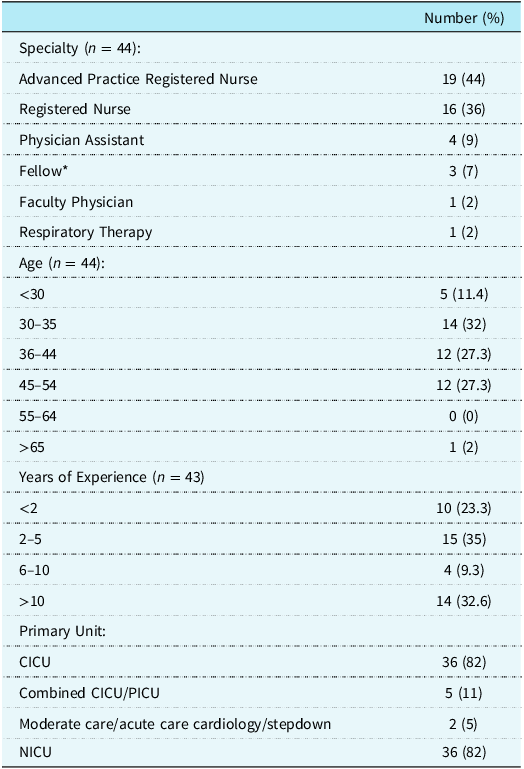
The demographic data of the forty-four participants who completed the post-course evaluations are shown in Table 1. Most participants (82%) primarily work in a cardiac intensive care unit.
Demographic data

* Did not specify if from categorical cardiology, critical care, 4th year CICU or other fellowship programme . CICU = Cardiac Intensive Care Unit; NICU = Neonatal Intensive Care Unit; PICU = Paediatric Intensive Care Unit.
Course evaluation
Of the 82 participants, 44 (53.7%) completed the post-course evaluation. All respondents (100%) indicated they were likely to refer a peer. A total of 37 participants (84.1%) strongly agreed that the course improved their clinical knowledge, and 37 of 43 respondents (86.0%) strongly agreed it enhanced their ability to care for patients. Regarding overall effectiveness, 42 of 43 participants (97.7%) agreed (n = 11) or strongly agreed (n = 31) that the course was effective.
Participant feedback on breakout simulation scenarios is presented in Figure 2. A total of 31 participants (70.5%) strongly agreed that the scenarios were realistic, while 10 (22.7%) agreed, 2 (4.5%) were neutral, and 1 (2.3%) disagreed. The most frequently endorsed course strengths included the simulation scenarios, the interprofessional nature of the facilitation team, and the relevance of high-yield clinical topics. Suggestions for improvement included aligning didactic lectures more closely with simulation scenarios, extending the course beyond a single day, and allocating more time for simulation-based activities.
Participant evaluations of individual components of the course.

Knowledge
In addition to the bootcamp course evaluation, we also sought to determine Kirkpatrick Level 2 outcomes. Reference Kirkpatrick16 Thirty-nine participants completed the pre-test: 21 advanced practice providers, 13 nurses, 4 physicians or fellows, and 1 unidentified. The post-test was completed by 28 participants: 15 advanced practice providers, 9 nurses, 3 physicians or fellows, and 1 unidentified. Matched pre- and post-test data based on the unique codes were available for 20 participants, comprising 12 advanced practice providers, 5 nurses, and 3 physicians or fellows.
As summarised in Table 2, the overall average score improved from 55.0% (95% Confidence Interval, 49.9%–59.8%) to 64.6% (95% Confidence Interval, 59.9%–69.4%), reflecting an 11.5% increase. Among advanced practice providers, scores increased from 54.2% (95% CI, 47.3%–60.9%) to 62.5% (95% Confidence Interval, 56.7%–68.4%), an increase of 9.3%. Nurses showed an improvement from 54.2% (95% Confidence Interval, 42.8%–65.6%) to 64.3% (95% Confidence Interval, 50.1%–78.5%), representing a 9.0% increase. Physicians and fellows improved from 59.5% (95% Confidence Interval, 22.6%–96.4%) to 69.0% (95% Confidence Interval, 41.9%–96.1%), a gain of 9.5%. All groups demonstrated statistically significant knowledge improvement following course completion (p < 0.05).
Pre-test and post-test knowledge outcomes of participants

Discussion
Due to the increase in paediatric cardiac critical care complexity, more hospital systems are staffing dedicated paediatric cardiac units with multidisciplinary and inter-professional teams to best manage children with heart disease. Reference Horak, Alexander and Amirnovin17 However, not all hospitals can have a dedicated cardiac intensive care unit and providers may come from various training backgrounds, which can lead to practice variation. Reference Justice, Callow, Loomba, Harvey, FitzGerald and Cooper18,Reference Tabbutt, Krawczeski and McBride19 This complexity and variation creates a need for training and education standardisation.
In response to the perceived need for advanced interprofessional training in paediatric cardiac critical care, an area previously unaddressed by existing introductory-level simulation bootcamps, we developed and implemented a national-level, simulation-based bootcamp as a pre-conference course at the Pediatric Cardiac Intensive Care Society Annual Meeting in December 2022. We demonstrated that creating a multidisciplinary interprofessional educational simulation for a specific patient population is feasible by leveraging the natural practice variation of differing units and institutions as an enrichment to education for advanced-level learners across healthcare professions. We also demonstrated a statistically significant improvement in knowledge gained immediately after the bootcamp, which received high ratings from participants. Course attendees came from a variety of professions and represented institutions nationally and internationally. Most participants were above the target set for advanced learners, with at least two to three years of experience. Post-intervention feedback, gathered through a structured survey, indicated strong feasibility and acceptability, with over 80% of participants rating the intervention as “excellent,” surpassing our predefined benchmark. Additionally, the intervention enhanced participants’ self-reported confidence in their ability to care for patients, suggesting preliminary effectiveness. While most bootcamps in other disciplines deliver core concepts to beginner learners of a particular profession, our course was unique because it was built to meet the needs of a heterogeneous, interdisciplinary group of advanced learners. Reference Nishisaki, Hales and Biagas6,Reference Young, Lewis and Kailavasan8
There is an effort to develop curricula that support the interprofessional paediatric cardiac critical care team, including establishing entrustable professional activities and standardising educational content for paediatric cardiac critical care physician trainees. Reference Werho, DeWitt, Owens, McBride, van Schaik and Roth20,Reference Chlebowski, Migally and Werho21 Simulation-based continuing education and professional development initiatives can augment knowledge and skill. Reference Kshetrapal, McBride and Mannarino5 We propose that interprofessional bootcamps such as ours can serve this purpose throughout the paediatric cardiac critical care community. The evaluations from this advanced interprofessional bootcamp will help inform future iterations offered by the Pediatric Cardiac Intensive Care Society. Furthermore, it may be advantageous to evaluate whether there is a benefit for isolated team members receiving this training at national meetings versus training a team at an institution, or even a combination of the two approaches.
There are several limitations to our study. The one-day duration of the course as a pre-conference bootcamp to the Pediatric Cardiac Intensive Care Society Annual Meeting limited the amount of content and the duration of simulations while simultaneously creating an exhaustive cognitive processing speed. While the Pediatric Cardiac Intensive Care Society is an international organisation, the facilitators/content creators were from institutions across the United States, limiting the perspectives from an international lens. Furthermore, only two attendees were from international institutions, potentially limited by location and/or cost. We did not request to specify fellow or attending physician for the pre- and post-test, just physicians, nor the type of fellow training pathway to identify knowledge outcomes between the different training pathways (e.g., paediatric intensive care vs. cardiology categorical fellow vs. advanced cardiac intensive care fellow). Furthermore, there may be a mismatch between pre- and post-test responses, as not all participants completed both assessments. As a result, some matched data may not correspond to the same individuals. The sample size for pre- and post-test comparisons of immediate knowledge acquisition was small, and we have not assessed the longitudinal retention of knowledge and/or its impact on patient care and outcomes (i.e., level 3 and 4 in the Kirkpatrick framework). Reference Kirkpatrick16 Additionally, further evaluation of pre-test and post-test validity and reliability would be necessary to implement prior to future evaluations of knowledge acquisition. Finally, only 53% of participants completed the course evaluation, which may limit our findings’ validity.
Paediatric cardiac critical care relies on interprofessional teamwork and understanding CHD’s underlying pathophysiology. Our course applied didactic and simulation-based education to successfully teach cardiac critical care concepts to a diverse, advanced, and interprofessional cohort. Based on our findings, future iterations of this programme, particularly in larger regional and international bootcamps, will incorporate more robust qualitative and quantitative analyses to better assess learning outcomes and broader impacts. In addition to measuring quantitative gains in knowledge, there may also be an important qualitative assessment with thematic analysis regarding how and why these simulations are meaningful, given that the learner perception of knowledge improvement was greater than the measured improvement.
Supplementary material
The supplementary material for this article can be found at https://doi.org/10.1017/S1047951125109529
Acknowledgements
The authors would like to thank the other facilitators of the bootcamp: Catherine Allan, MD, Katherine Harrison, MSN, APRN, Nick Huggins, MD, Annette Imprescia RN, BSN, Jen Kramer, MD, Catherine Krawczeski, MD, Michelle Pileggi, RN, Laura Presnell, APRN, Cailyn Rood, MD, Loren Sacks, MD, Lillian Su, MD and Ilya Shekhter, CHSE.
Financial support
None
Competing interests
Dr Mary McBride is a paid consultant of the American Heart Association.
Ethical standard
This study was exempt from Ann & Robert H. Lurie Children’s Institutional Review Board review.