Introduction
Manilkara Adans. (Sapotaceae) is a pantropical genus consisting of 78 species: 30 in the Neotropics, 30 in Africa, five in Madagascar and 13 in Asia and the Pacific, where it occurs from India in the west to Samoa in the east. It is predominantly found in wet, lowland forest, although some, mostly African, species occur in dry forest and scrub, while many Asian species occur in coastal areas and on limestone.
In Pennington’s (Reference Pennington1991) classification, Manilkara is placed in the subtribe Manilkarinae of the tribe Mimusopeae and is characterised by having perianth parts in multiples of three: a calyx composed of two whorls of three sepals, six petals, six stamens and six staminodes. This distinguishes Manilkara from other genera in the subtribe Manilkarinae, which also have two whorls of three sepals, but may differ in the number of corolla lobes, number of stamens and the presence of staminodes, and from closely related genera in the subtribe Mimusopineae (e.g. Mimusops), which have perianth parts in multiples of four: two whorls of four sepals, eight petals, eight stamens and eight staminodes.
Historically, there has been debate over the importance of certain characters in the circumscription of Manilkara, with the result being segregate genera created to accommodate different combinations of characters. This discrepancy is due in large part to confusion over the varying degree of development of the petal appendages and staminodes, with some authors placing more weight than others on the presence or absence of these characters. However, variation in petal dissection has apparently evolved independently in the Neotropics, Africa and Asia (Lam, Reference Lam1941; Van Royen, Reference Van Royen1953; Armstrong, Reference Armstrong2010). For example, Manilkara zapota in Central America can range between having undivided to fully divided petals. The same trend is found in African Manilkara discolor (Hemsley, Reference Hemsley1966), whereas the Pacific species M. hoshinoi always has undivided petals (i.e. without appendages). Therefore, placing all species with undivided petals in a separate genus, as did Baehni (Reference Baehni1965), creates an artificial group of unrelated species. Pennington (Reference Pennington1991) adds that aside from the degree of development of the petal segments and staminodes, ‘Manilkara is a remarkably consistent pantropical genus’.
In the most recent account of Asian Manilkara species, Van Royen (Reference Van Royen1953) followed Gilly’s (Reference Gilly1943) circumscription of the genus in which species without petal appendages were included in Manilkara rather than split into the genus Achras. However, the distinction was maintained at the subgeneric level with Manilkara subgenus Euachras Gilly for species without petal appendages (i.e. M. hoshinoi) and Manilkara subgenus Eumanilkara (Dubard) Gilly for species with petal appendages (i.e. all the remaining Asian species). Since the absence of petal appendages is a paraphyletic character, this subgeneric classification is not natural and is not used here.
Recent molecular studies (Armstrong, Reference Armstrong2010) reveal that while Manilkara sensu stricto is a monophyletic group, it does not include the three Asian-Pacific species M. fasciculata, M. udoido and M. dissecta, which all form a well-supported clade sister to Faucherea and Labourdonnaisia. In other words, Manilkara is monophyletic with the exclusion of these three species. The most appropriate way to accommodate these new molecular findings, taking into account the morphological variation, is either to resurrect the genus Abebaia Baehni to hold Manilkara fasciculata, M. udoido and M. dissecta, or to expand the circumscription of Manilkara to include the Madagascan genera Faucherea Lecomte and Labourdonnaisia Bojer. The only tentative character which distinguishes Manilkara fasciculata, M. udoido and M. dissecta from Manilkara sensu stricto is the tendency for the leaves in this group to have striate venation, where the tertiary veins are nearly indistinguishable from the secondary veins. This character is also present in many Faucherea and Labourdonnaisia species, to which the clade is most closely related. However, striate venation is a variable character in the group, and it is not consistently present in Manilkara dissecta, nor is it a strong enough character on its own to justify the creation of a new genus. Therefore, as there are no strong, consistent characters to separate Manilkara fasciculata, M. udoido and M. dissecta from Manilkara sensu stricto, they will remain in the genus Manilkara, but in doing so the circumscription of the genus will need to change to include Faucherea and Labourdonnaisia. Molecular support for this taxonomic change will be presented in a forthcoming paper.
Materials and Methods
This taxonomic treatment is based on a study of 853 herbarium specimens representing c.523 collections from the following herbaria: A, AK, B, BISH, BKF, BM, C, CAL, CANB, CAS, E, F, FU, G-DC, HAW, K, KYO, L, MICH, MO, NSW, NY, P, RSA, SING, TI, UBC, US and WAG. All cited specimens have been examined unless otherwise specified. Measurements have been made from dried herbarium specimens and are given for the largest dimension of a structure at maturity; length is reported first, then width. Conservation assessments were made using IUCN Standards and Petitions Subcommittee (2010) criteria.
Morphology
Habit. All species are trees, often large in size, with sympodial branching and leaves clustered at the apex of branches. One species, Manilkara hexandra, occasionally has short shoots. These are condensed branches bearing leaves in a cluster along a main axis. Outside the Asian-Pacific region short shoots are found in the eastern-southern African species Manilkara mochisia.
Bark slash and wood. The bark of Manilkara is dark brown, turning a greyish-white as it matures, and is rough with deep fissures. Little information about bark slash characters is recorded on herbarium specimens, but Manilkara fasciculata was observed in the field as having a creamy-tan coloured slash with copious latex and deep red-brown heartwood. The wood of all species is often noted as being very hard, durable and rot resistant and is, therefore, prized for heavy construction.
Stipules. Although stipules are reported for the genus, they are caducous and none have been found on the Asian-Pacific specimens examined.
Leaves. Young apical leaf bud primordia are often covered in a shiny, waxy substance. Leaves are spirally arranged and are often densely clustered at the shoot apex. They are typically coriaceous, but one Indian species, Manilkara roxburghiana, has a thinner, more chartaceous feel. Many species have distinctly obovate to oblanceolate leaves (Manilkara fasciculata, M. dissecta, M. udoido, M. kauki, M. celebica, M. littoralis and M. kanosiensis) or are elliptic to oblong (M. hoshinoi, M. samoensis, M. hexandra, M. roxburghiana, M. smithiana, M. vitiensis). Likewise, many species also tend to have leaves with an emarginate apex, particularly Manilkara hexandra. The venation is brochidodromous and in the majority of species secondary and tertiary veins are distinct from one another. However, in Manilkara fasciculata, M. udoido, and to a lesser extent M. dissecta, these two levels of venation are more or less indistinguishable, giving the leaf a striate appearance (as in Calophyllum, Guttiferae). The presence or absence of an indumentum on the underside of the leaf can also be a useful species-level character. However, in Manilkara dissecta the utility of this character disappears as both states are found to varying degrees. When present, the indumentum forms a tightly matted conglomerate of adpressed hairs, giving a smooth appearance, and can sometimes require a hand lens to determine its presence. As with many tropical trees, the leaves of juvenile Manilkara specimens (i.e. saplings) can significantly differ in shape and size from leaves on mature trees, giving the impression of two different species. This field observation was made particularly for Manilkara fasciculata, which has much larger elliptic leaves when young and smaller oblanceolate leaves when mature.
Flowers. As described in the introduction, Manilkara flower morphology is amongst the most complex in the Sapotaceae. Flowers typically have two whorls of three sepals, six petals, each with two appendages, and six stamens alternating with six staminodes. In many species the outer whorl of sepals is darker in colour (often with a ferruginous indumentum) than those in the inner whorl (often with a tawny or whitish indumentum). The corolla tube is usually short ((0.5–)1–2.5(–4) mm) in relation to the size of the flower. In the Asia-Pacific region the majority of Manilkara species have petal appendages. The only species lacking appendages is Manilkara hoshinoi, an endemic of Pohnpei in the Caroline Islands. Staminodes are present in all Asian-Pacific species to varying degrees. Manilkara sensu stricto tend to have more well-developed staminodes with fringed apices, whereas their morphology in the group which includes M. fasciculata, M. udoido and M. dissecta is quite variable. Manilkara udoido has the smallest staminodes at only 0.3–0.8 mm long, with the apex appearing truncate or gnawed, whereas M. fasciculata exhibits the whole range from 0.5 to 4.5 mm long, elliptic, with a fringed apex, and Lam (Reference Lam1941) described them as ‘if any, filiform, often wanting’. The presence or absence of a disk is used as a character by Lam (Reference Lam1941) and Van Royen (Reference Van Royen1953) in their taxonomic keys to the Asian-Pacific species of Manilkara. I believe that the disk described by these earlier authors is actually a glabrous zone at the base of the ovary. This region does not appear to be glandular or different to the rest of the ovary in any way other than its lack of an indumentum. Therefore, I do not recognise this as a disk and the character is not used in this account. The ovaries of all Asian-Pacific Manilkara species have an indumentum.
Fruit and seed. The fruit of all species is fleshy and when mature it varies in colour from yellow-orange to deep wine red. The smallest come from Manilkara hexandra and M. dissecta (c.0.8–1.5 × 0.6–1 cm), and the largest from M. hoshinoi and M. kanosiensis (c.4–6.5 × 2.5–6.5 cm). The indumentum, which is present on the ovary, falls off during maturation, leaving a fruit with glabrous, shiny or slightly scaly skin. One to several ovules mature into seeds with a hard, shiny, medium to dark brown testa. Two species, Manilkara kauki and M. kanosiensis, can be distinguished from the other Asian-Pacific species by the beige-pale brown colour of their seed coat. The seed scar of Manilkara is typically ovate-elliptic to obovate and extends between 1/3 and 3/4 the length of the seed on the ventral side from the base upwards. A single Asian-Pacific species, Manilkara dissecta, has a small, circular, basal seed scar. The fruit of most species is consumed locally. Some, such as the Central American Manilkara zapota (included in the key below but not further discussed) and the Asian M. kauki, are cultivated in part for their fruit.
Systematic Treatment
Manilkara Adans., Fam. Pl. 2: 166 (1763), nom. cons. – Mimusops subgen. Manilkara (Adans.) Pierre & Urb., Symb. Antill. 5: 162 (1904). – Type: Manilkara kauki (L.) Dubard.
Achras L., Sp. Pl. 1190 (1753). – Type: Achras zapota L. (= Manilkara zapota (L.) P.Royen).
Stisseria Scop., later homonym, Introd. Hist. Nat. (1777) (type not designated).
Mimusops sect. Ternaria A.DC., Prodr. 8: 203 (1844). – Mimusops subgen. Ternaria (A.DC.) Engl., Monogr. Afrik. Pflanzen.-Fam. 8: 55 (1904). – Type: Mimusops hexandra Roxb. (= Manilkara hexandra (Roxb.) Dubard).
Kaukenia Kuntze, Revis. Gen. Pl. 2: 406 (1891) (pro parte, excluding type).
Mimusops subgen. Pleio-Mimusops Engl., Nat. Pflanzenfam. ed. 1, 4: 152 (1897). – Type: Mimusops littoralis Kurz (= Manilkara littoralis (Kurz) Dubard).
Northiopsis Kaneh., Bot. Mag. (Tokyo) 47: 677 (1933). – Type: Northiopsis hoshinoi (Kaneh.) Kaneh. (= Manilkara hoshinoi (Kaneh.) P.Royen).
Abebaia Baehni, Arch. Sci. 17(1): 78 (1964). – Type: Abebaia fasciculata (Warb.) Baehni (= Manilkara fasciculata (Warb.) H.J.Lam & Maas Geest.).
The generic synonymy listed here is primarily for Asian names. A complete list of generic synonymy including names from other geographic regions can be found in Pennington (Reference Pennington1991) or at the Royal Botanic Gardens Kew World Checklist website. The generic description below is also based only on Asian-Pacific species.
Trees with sympodial branching. Shoot apex and buds often covered with a clear, waxy-resinous substance. Leaves spirally arranged, often clustered at the stem apex. Stipules small, caducous, rarely present. Venation brochidodromous with an intra-marginal vein. Inflorescences axillary at the apex of the stem. Flowers solitary or fasciculate, bisexual. Calyx of 2 whorls of 3 sepals free to the base, the outer whorl valvate, sometimes becoming reflexed after anthesis. Corolla glabrous, corolla tube much shorter than petal lobes; petals 6, usually divided to the base into three segments or rarely entire; median segment erect, keeled and clasping the stamen, longer than or equal to the two lateral appendages, which are spreading or reflexed. Stamens 6 in a single whorl, inserted at the apex of the corolla tube; filaments free, glabrous. Staminodes 6, rarely absent, alternating with the stamens, small, truncate and entire to large, petaloid and laciniate or bifid. Ovary 6–12 locular, hairy, style exserted. Fruit 1–several seeded, indehiscent, fleshy, glabrous. Seed ellipsoid to obovoid, often strongly laterally compressed, with a hard brown testa; scar basi-ventral, narrowly elongate or circular, rarely extending the length of the seed.
Key to the species
1a. Petal appendages absent 2
1b. Petal appendages present 3
2a. Leaves small, 7–9.5 × 2.5–4 cm, flowers small, 7–10 × 10 mm, pedicel not swollen below bud (Cultivated)M. zapota
2b. Leaves large, 9.5–19 × 5–9.2 cm, flowers large, 15–20 × 15–20 mm, pedicel sometimes swollen below bud (Caroline Islands)5. M. hoshinoi
3a. Mature leaves with an adpressed indumentum on the underside (viewed under magnification) 4
3b. Mature leaves glabrous on undersurface 7
4a. Leaves small, 2.5–6.5(–8) × 1–3 cm, oblanceolate, crowded at apex of branch, fruit small, 0.9–1.2 × 0.6–1.3 cm, seed scar circular and basal (New Caledonia, Vanuatu, Samoa, Tonga, Fiji)2. M. dissecta
4b. Leaves larger, 6.5–12 × 4–7.5 cm, obovate, oblong-oblanceolate or broadly elliptic, not strongly crowded at branch apices, fruit larger, seed scar not circular and basal 5
5a. Leaves oblong to oblanceolate, style 11–14 mm at anthesis (Fiji)11. M. smithiana
5b. Leaves distinctly obovate, occasionally elliptic, style 7 mm at anthesis 6
6a. Leaf strongly obovate, flower buds clavate, pedicel swollen below bud, petal appendages just over 1/2 the length of the central petal lobe (Sulawesi)1. M. celebica
6b. Leaf obovate to broadly elliptic, flower buds ovoid, pedicel not swollen below bud, petal appendages nearly equal in length to the central petal lobe (Burma, Thailand, Cambodia, Vietnam, Malaysia, Indonesia, Philippines, Papua New Guinea, Australia and widely cultivated)7. M. kauki
7a. Flower small, outermost sepals 3–6 × 2–3 mm, flower at anthesis 4–8 × 6–10 mm 8
7b. Flower large, outermost sepals 6–17 × 2–4 mm, flower at anthesis 10–15 × 6–25 mm 11
8a. Leaf venation striate, tertiary veins almost indistinguishable from secondary veins 9
8b. Leaf venation not striate, tertiary veins clearly distinguishable from secondary veins 10
9a. Fruit large, 1.7–3 × 1.5–2 cm, seed 1.6–2 × 1–1.3 cm, flowering pedicels 0.8–2 cm long (Indonesia: Borneo, Sulawesi, Moluccas, Papua; Philippines)3. M. fasciculata
9b. Fruit small, 1–1.5 cm × 0.6–0.8 cm, seed 1 × 0.5 cm, flowering pedicels 2–4 cm long (Palau)12. M. udoido
10a. Leaves oblanceolate, strongly clustered at branch apex (2–5 mm between petioles), seed scar circular and basal (New Caledonia, Vanuatu, Samoa, Tonga, Fiji)2. M. dissecta
10b. Leaves slightly obovate to oblong, occasionally obcordate, not strongly clustered at branch apex (5–10 mm between petioles), but occasionally with short shoots, seed scar obovate, extending 1/2–3/4 the length of the seed (India, Sri Lanka, Burma, Thailand, Cambodia, Vietnam, Malaysia, China)4. M. hexandra
11a. Leaves obovate to oblanceolate 12
11b. Leaves elliptic, ovate or oblong 13
12a. Pedicel swollen below bud, outermost sepals 10–17 mm long, mature fruit depressed-globose, 1.5–3 × 2–4 cm, seed mid-dark brown, 1.2–1.7 × 0.7–1 cm, seed scar extending 1/3-way up the ventral side (Andaman and Nicobar islands, coastal areas of Thailand and Burma)8. M. littoralis
12b. Pedicel not swollen below bud, outermost sepals 6.5–10 mm long, mature fruit ellipsoid-obovoid, 4–6.5 × 3.5–6 cm, seed beige-pale brown, 3 × 1.5 cm, seed scar extending 3/4-way up the ventral side (New Guinea and Tanimbar island)6. M. kanosiensis
13a. Leaf oblong, 1.6–7.5 × 1–5.2 cm, petal appendages equal in length to central lobe (Peninsular India)9. M. roxburghiana
13b. Leaf narrowly elliptic to oblong, 4.3–19 × 2–8.5 cm, petal appendages shorter than central lobe (Fiji and Samoa) 14
14a. Petal appendages small, 1.5–3 × 0.5–1 mm, staminodes 1–2 × 0.7–2 mm (Fiji)13. M. vitiensis
14b. Petal appendages large, 7 × 1.7 mm, staminodes 5 × 2 mm (Samoa)10. M. samoensis
1. Manilkara celebica H.J.Lam, Blumea 4: 331, t.4 (1941); Van Royen, Blumea 7: 407 (1953); Baehni, Boissiera 2: 91, 93 (1965); Govaerts et al., Checklist Sapot. 142 (2001). – Type: Indonesia, Sulawesi, Gorontalo, Boalemo, Bilatto, 26 v 1932, Boschproefstation bb.16.979 (holo L).Fig. 1.
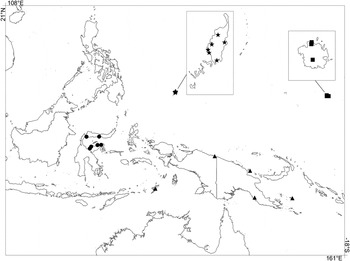
Fig. 1.Distribution of Manilkara kanosiensis H.J.Lam (▴), Manilkara celebica H.J.Lam (•), Manilkara udoido Kaneh. (★) (Palau insert), and Manilkara hoshinoi (Kaneh.) P.Royen (▪) (Pohnpei insert).


Tree to 27 m. Leaves 3.5–13.5 × 2–7.5 cm, coriaceous, strongly obovate, apex truncate to rounded, occasionally emarginate, base acute, discolorous, glabrous above, with a layer of ferruginous tightly adpressed hairs below; secondary venation c.12–18 pairs, inconspicuously impressed above, obscure to finely raised beneath. Petiole 1–4 cm long, glabrescent or scurfy and resinous in patches. Flowers 1–3 per fascicle in leaf axils, 9 × 9 mm at anthesis, mature bud clavate. Pedicel 0.7–1 cm long, adpressed scurfy ferruginous-tomentose, thick and swollen below bud, erect. Calyx lobes 8 × 3 mm, lanceolate, outer surface of both whorls densely adpressed tawny-ferruginous-tomentose, inner surface of both whorls glabrescent with sparse white pilose hairs at the apex and margin. Corolla glabrous, colour unknown, likely creamy white; corolla tube 0.5 mm long; petal central lobe 6 × 2 mm, elliptic, keeled; petal appendages present, just over 1/2 the length of the central lobe, 3.5 × 1 mm, entire with an undulating margin. Stamens glabrous; filaments 1 mm long; anthers 3 mm long. Staminodes 3 × 1 mm, elliptic, apex fringed or laciniate. Ovary 6-locular, ferruginous-tomentose. Style 7 mm at anthesis, often persistent in fruit. Fruit (immature) 1.8 × 1.8 cm, globose, colour at maturity unknown. Seed unknown.
Habitat. Lowland forest at 5–300 m altitude.
Distribution. Sulawesi, rare endemic.
Phenology. Flowering: May; fruiting: August, November.
Vernacular names. Gorontalo: timboewolo, timboealo, ster; Bare’e: komea (Lam, Reference Lam1941).
Uses. Timber possibly used for construction (Soerianegara & Lemmens, 1994).
Diagnostic characters. Manilkara celebica and M. kauki, which both occur on Sulawesi, appear superficially similar in that they both have obovate leaves with an indumentum. However, the indumentum of Manilkara celebica is ferruginous, whereas that of M. kauki is whitish-silvery. Additionally, the leaf apex of Manilkara celebica is often truncate as opposed to the more often rounded to broadly acute leaf apex of M. kauki. The mature flower bud of Manilkara celebica is swollen at the apex, giving a club-shaped appearance, whereas M. kauki has an ovoid bud. The petal appendages of Manilkara celebica are just over half the length of the central petal lobe, and those of M. kauki are nearly equal in length to the central petal lobe. Manilkara fasciculata, which also occurs on Sulawesi, has entirely glabrous, oblanceolate leaves with tightly striate venation, whereas the venation of M. celebica is more open and does not appear striate.
IUCN conservation status. Endangered (EN A2c B2ab(iii)). Much of the area where this species was originally collected has come under intense cultivation and encroachment by human settlements (Cannon et al., Reference Cannon, Summers, Harting and Kessler2007). Ground surveys by the author in Sulawesi Utara between Manado and Gorontalo during 2008 revealed very little remaining viable coastal forest and no individuals of Manilkara celebica. Additionally, this species is unknown to local botanists and foresters, so is obviously uncommon.
Notes. Manilkara celebica is known from 10 specimens, most of which are sterile. Only two are in bud (bb.31885 and the type bb.16.979), and the fruiting specimens are also immature. Therefore, it remains a poorly understood species.
Specimens studied. Indonesia.Sulawesi: Gorontalo: Boalemo, Bilatto, 21 xii 1934, Neth. Ind. For. Service bb.19401 (L); ibid., 14 viii 1940, van Gabel, M. 30 (bb.32.365) (K, L); ibid., 9 xi 1940, van Gabel, M. 34 (bb.32.528) (K, L). Central Sulawesi: Banggai, Hoehak, 5 iv 1940, Neth. Ind. For. Service bb.31885 (L); Loewoek, Sioena, 21 x 1939, Neth. Ind. For. Service bb.30152 (A, L); ibid., 14 xii 1939, Neth. Ind. For. Service bb.31840 (L); Poso, Kotamboea, 15 iv 1935, Neth. Ind. For. Service bb.19637 (L); Poso, Oeedele, 10 ii 1940, Neth. Ind. For. Service bb.31489 (A, L, SING); Poso, Teteboegis, 19 iii 1940, Neth. Ind. For. Service bb.31903 (L).
2. Manilkara dissecta (L.f.) Dubard, Ann. Inst. Bot.-Geol. Colon. Marseille 3(3): 13 (1915); Guillaumin, J. Arnold Arbor. 13: 15 (1932); Lam, Blumea 4: 325, t.1 (1941); Lam, Blumea 5: 42 (1942); Van Royen, Blumea 7: 405 (1953); Yuncker, Bernice P. Bishop Mus. Bull. 220: 212 (1959); Aubreville, Fl. N. Caledonie 1: 30–33, t.4 (1967); Parham, Pl. Fiji 228 (1972); Smith, Fl. Vit. Nova 2: 778–779 (1981); Pennington, Gen. Sapot. 133 (1991); Govaerts et al., Checklist Sapot. 142–143 (2001). – Achras dissecta L.f., Suppl. Pl. 210 (1782). – Mimusops dissecta (L.f.) R.Br., Prodr. Fl. Nov. Holland. 531 (1810); Don, Gen. Hist. 4: 35 (1837); De Candolle, Prodr. 8: 204 (1844). – Achras octodecemfida Stokes, Bot. Mat. Med. 2: 294 (1812), nom. superfl. [This name is illegitimate because the earlier name Achras dissecta (presumably of L.f.) is cited in synonymy. Stokes’ taxonomic concept, however, applies to both Manilkara dissecta (L.f.) Dubard and Manilkara kauki (L.) Dubard.] – Kaukenia dissecta (L.f.) Kuntze, Revis. Gen. Pl. 2: 406 (1891). – Type: Tonga-Tabu [Tonga], J.G.A. Forster s.n. (lecto LINN-Sm; isolecto C, K). [For a further discussion of type material see Nicolson & Fosberg, Reference Nicolson and Fosberg2004: 629.]Fig. 2.
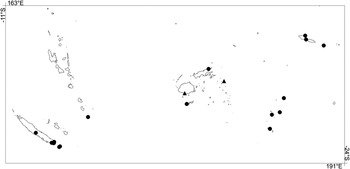
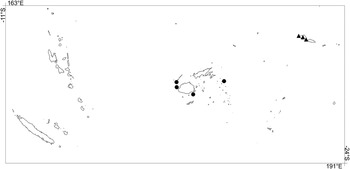
Fig. 2.Distribution of Manilkara dissecta (L.f.) Dubard (•) and Manilkara smithiana H.J.Lam (▴).
Mimusops pancheri Baill., Bull. Mens. Soc. Linn. Paris 2: 907 (1891). – Manilkara pancheri (Baill.) Dubard, Ann. Inst. Bot.-Geol. Colon. Marseille 3(3): 12 (1915). – Manilkara dissecta var. pancheri (Baill.) Maas Geest., Blumea 4: 327 (1941); Lam, Blumea 5: 42 (1942). – Type: New Caledonia, 1870, Pancher s.n. (lecto P n.v.; isolecto E).
Mimusops vieillardii Pierre, Ann. Inst. Bot.-Geol. Colon. Marseille 3(3): 12 (1915), nom. nud. [This name from Pierre’s unpublished manuscript (c.1891) is noted in Dubard (Reference Dubard1915: 12) as being an older name than Mimusops pancheri Baill. However, as Pierre’s manuscript remained unpublished, Dubard did not adopt the name.]

Tree to 21 m, dbh to 75 cm. Leaves 2.5–6.5(–8) × 1–3 cm, coriaceous, oblanceolate; apex rounded to broadly acute, often emarginate, base acute, entirely glabrous above and below or with a layer of white tightly adpressed hairs below; secondary venation c.10–15 pairs, inconspicuously impressed above and slightly raised below, tertiary veins sometimes equally prominent as secondary veins, occasionally obscuring the distinction between the two. Petiole 1–2 cm long, glabrous or ferruginous-scurfy resinous in patches. Flowers 1–4 per fascicle in leaf axils, 4–6 × 6–8 mm at anthesis, mature bud ovoid. Pedicel 1.5–3.5 cm long, glabrous or scurfy and resinous in patches, not swollen below bud, strongly reflexed. Calyx lobes 4–6 × 2–3 mm, deltoid-lanceolate, outer surface of outer whorl glabrescent with occasional sparse ferruginous or scurfy resinous hairs particularly around the margin, sometimes appearing as a darkened glabrous central stripe, outer surface of inner whorl densely adpressed whitish-tomentose, inner surface of outer whorl glabrous in the centre with a band of white pilose hairs along the margin, inner surface of inner whorl glabrous. Corolla glabrous, yellowish white or pink; corolla tube 1–1.5 mm long; petal central lobe 4–5 × 1–1.5 mm, elliptic, keeled; petal appendages present, 3/4 to nearly equal in length to central lobe, 3–4 × 1–1.8 mm, entire. Stamens glabrous; filaments 1.5–2.5 mm long; anthers 2 mm long. Staminodes 1–2 × 1 mm, irregularly deltoid-elliptic, apex rounded to gnawed or slightly fringed. Ovary 6-locular, whitish or ferruginous-tomentose. Style 4–6 mm at anthesis, often persistent in fruit. Fruit 0.9–1.2 × 0.6–1.3 cm, globose, red when mature. Seed 0.8 × 0.5 cm, ovoid; testa smooth, mid-brown in colour; seed scar 2 × 2 mm, circular, basal.
Habitat. Littoral forest to lower hills on sandy soil or limestone at sea level to 150 m altitude. According to Aubreville (Reference Aubreville1967) Manilkara dissecta is sometimes the dominant element in littoral forests on calcareous soil in New Caledonia.
Distribution. New Caledonia, Vanuatu, Samoa, Tonga, Fiji.
Phenology. Flowering: February, August–September, November–December; fruiting: February–March, May, November.
Vernacular names. New Caledonian: buni, bunier, bugny; Vanuatuan: niping; Samoan: pani, pagi; Tongan: ngesi; Fijian: mbau sanggali, bausagali.
Uses. In Samoa and Tonga the bark is used to produce a bright reddish-brown dye for tinting the hair and painting siapo/tapa cloth (Lam, Reference Lam1941; Whistler et al., Reference Whistler, Thomas and Fakaosi2011). The red, very hard wood is used for posts in sandy soil in Tonga (Yuncker, Reference Yuncker1959) and is favoured for making slit gongs and bowls. It is noted to be one of the best house timbers but is no longer used due to its rarity. Whistler et al. (Reference Whistler, Thomas and Fakaosi2011) noted that Manilkara dissecta is possibly a Polynesian introduction to Tonga as it appears to be restricted to cultivation in villages. In Vanuatu it is said to be too scarce to be of commercial value, but is the most durable, hard timber on the island (Guillamin, Reference Guillamin1932).
Diagnostic characters. In comparison with other species which grow on the same islands (Samoa: Manilkara samoensis; Fiji: M. smithiana and M. vitiensis), M. dissecta typically has smaller, more distinctly oblanceolate leaves. It also has a very small fruit with a seed scar which is circular and basal, unlike any other Asian-Pacific Manilkara species.
IUCN conservation status. Vulnerable (VU B2ab(ii,iii)). Although Manilkara dissecta is widespread on various islands in the Pacific, its area of occupancy is relatively small and it has reportedly become scarce over half its range (in Samoa, Tonga and Vanuatu) (Guillamin, Reference Guillamin1932; Whistler, Reference Whistler2011).
Notes. Lam (Reference Lam1941) made a distinction between Manilkara dissecta var. typica (= var. dissecta) with entirely glabrous leaves and M. dissecta var. pancheri with an indumentum on the underside of the leaf. The former was described from Samoa and Tonga, while the latter was described from New Caledonia. Here, however, these two varieties are not recognised. This is because the presence or absence of the indumentum is not considered a robust character, as it is found to varying degrees throughout its geographical range. Most New Caledonian specimens have a dense indumentum, although in some it is caducous, whereas most specimens from Samoa, Tonga and Fiji are glabrous, but some have a few sparse hairs near the central vein and the margins. All specimens from Vanuatu are entirely glabrous.
Specimens studied. Vanuatu.Aneityum Island: Anelgauhat Bay, 17 iii 1929, Kajewski, S.F. 937 (BISH, K, P); ibid., ix 1929, Wilson, J.P. 983 (A, BISH, K, P).
New Caledonia. 1861–1867, Drake del Castillo, E. 904 (A). South Province: Isle of Pines, 1874–1876, Germain, M.R. s.n. (A, L); ibid., 17 xi 1983, McPherson, G. 6002 (MO); ibid., xii 1855, Milne, W.G. 430 (K); ibid., 28 ii 1943, Virot, R. 977 (A); Isle of Pines, Kuto, 24 v 1951, Baumann-Bodenheim, G. 13595 (L); Kuebini, 6 iii 1966, MacKee, M. 14490 (L); Port Boise, xi 1915, Franc, I. 2027 (E, K); ibid., 20 xi 1981, McPherson, G. 4407 (L, MO); ibid., 19 xi 1981, Pennington, T.D. & McPherson, G. 10330 (MO, NY); ibid., 19 xi 1981, Pennington, T.D. & McPherson, G. 10334 (K, NY); Prony, xii 1935, Franc, I. 1617 serie A (A); Yate, Cape Reine Charlotte, Gardner, M.F. et al. TNCA 4012 (E).
Fiji.Northern Division: Vanua Levu, Mathuata, Ndongotuki, 13 viii 1968, Howard, W.J. 158 (BISH). Western Division: Viti Levu, Serua, Taunova, Waimate Beach, 15 xi 1969, Parham, J.W. 17130 (BISH, K); ibid., 20 xi 1969, Vodonaivalu, S. & Koroiveibau, D. 17131 (BISH, K, L).
Samoa.Powell, T. s.n. (A); ii 1880, Powell, T. 187 (A, K). Upolu: Aleipata, Malaela, 1 viii 1977, Whistler, W.A. W 3889 (B, BISH, K).
American Samoa. Tutuila, 1939, Guest, P. s.n. (BISH).
Tonga. 1838–1842, Wilkes, C. s.n. (P). Tongatapu: 10 ii 1954, Yuncker, T.G. 16281 (NY). Ha’apai: Lifuka, 18 ii 1987, Whistler, W.A. 6079 (B, K). Vava’u: Tefisi, 13 ii 1987, Whistler, W.A. 6035 (B, K).
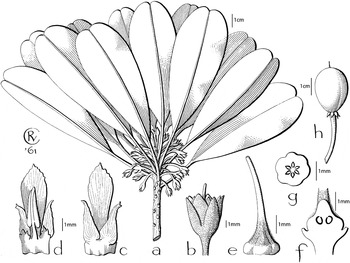
3. Manilkara fasciculata (Warb.) H.J.Lam & Maas Geest., Blumea 4: 335–336, t.8 (1941); Van Royen, Blumea 7: 408–409 (1953); Pennington, Gen. Sapot. 133 (1991); Govaerts et al., Checklist Sapot. 143 (2001). – Mimusops fasciculata Warb., Bot. Jahrb. Syst. 13(3–4): 401 (1891). – Northia fasciculata (Warb.) H.J.Lam, Bull. Jard. Bot. Buitenzorg, Ser. III, 7: 241, t.63 (1925). – Abebaia fasciculata (Warb.) Baehni, Arch. Sci. 17(1): 78 (1964); Baehni, Boissiera 2: 89 (1965). – Type: Indonesia, West Papua, 1888, O. Warburg 21361 (lecto E, designated here). [Believing that Warburg’s original specimen in the Berlin herbarium was destroyed, Van Royen (Reference Van Royen1953, pp. 408–409) designated two neotypes at L: Kostermans 255 = NIFS bb.33925 in fruit and NIFS bb.31835 in flower. However, as a duplicate of Warburg’s original material was located at E, the lectotypification of this material takes precedence.]Figs 3–5.
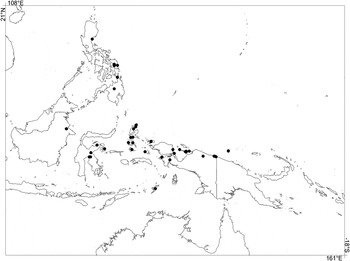
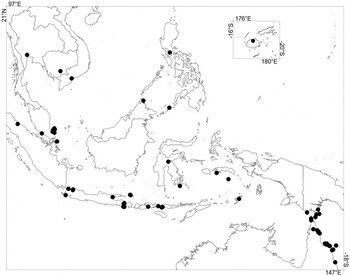
Fig. 3.Distribution of Manilkara fasciculata (Warb.) H.J.Lam & Maas Geest. (•).
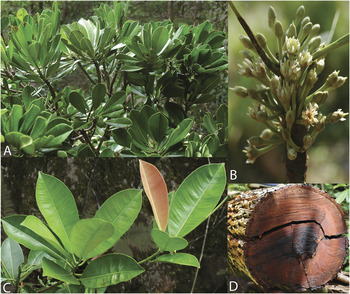
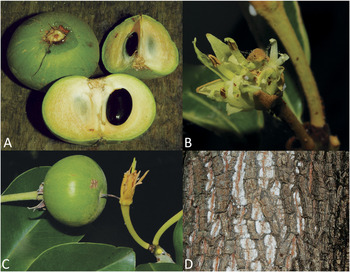
Fig. 4.Manilkara fasciculata (Warb.) H.J.Lam & Maas Geest. A, branch with mature leaves; B, inflorescence; C, branch with juvenile leaves; D, cut trunk showing fissured bark and red heartwood. Photos: K. Armstrong, RBGE.
Fig. 5.Manilkara fasciculata (Warb.) H.J.Lam & Maas Geest. a, flowering branch with oblanceolate, emarginate leaves clustered at the stem apex; b, calyx of two whorls, each with three pubescent sepals; c, dorsal view of a single petal showing the central lobe and two lateral appendages; d, ventral view of a single petal with stamen opposite the central lobe and alternating with fringed staminodes; e, ovary and style, showing a glabrous zone at the base of the ovary above which it is pubescent; f, longitudinal cross-section of the ovary with pendulous ovules; g, transverse section of ovary with axile placentation and six ovules; h, fruit with persistent style. Illustration by Ruth van Crevel, reproduced with permission from the Nationaal Herbarium Nederland, Universiteit Leiden, The Netherlands.
Manilkara calophylloides H.J.Lam, Bull. Jard. Bot. Buitenzorg, Ser. III, 7: 240 (1925). – Mimusops calophylloides Merr., Philipp. J. Sci. 10(5): 337 (1915), nom. illeg. – Manilkara merrilliana H.J.Lam, Blumea 4: 334–335, t.7 (1941), nom. illeg. – Type: Philippines, Surigao del Norte, viii 1914, S.S. Ponce 22834 (lecto L, designated here; isolecto BM, K, P).
Manilkara teysmannii Dubard, Ann. Inst. Bot.-Geol. Colon. Marseille 3(3): 12 (1915) [based on Mimusops teysmannii Pierre from an unpublished manuscript]. – Type: Indonesia, cultivated in Jard. Bot. Buitenzorg, xi 1881, Treub 4188 (lecto L, designated here).


Tree to 40 m, dbh to 90 cm. Leaves 4.5–15.5 × 1.5–6.8 cm, coriaceous, oblanceolate to narrowly obovate, occasionally oblong, juvenile leaves can be much larger and elliptic, apex typically rounded to broadly acute, occasionally truncate or emarginate, base acute, glabrous above and below (but see notes); secondary venation c.18–20 pairs, inconspicuously raised above and below, tertiary veins as equally prominent as secondary veins, obscuring the distinction between the two and giving a striate appearance. Petiole 2–6 cm long, glabrous or occasionally finely ferruginous-tomentose or scurfy and resinous in patches. Flowers 1–5 per fascicle in leaf axils, 6–8 × 6–10 mm at anthesis, mature bud ovoid. Pedicel 0.8–2 cm long, scurfy adpressed-tomentose to glabrescent, not swollen below bud, semi-erect or reflexed. Calyx lobes 3–6 × 2–3 mm, deltoid-lanceolate, outer surface of both whorls densely adpressed ferruginous or whitish-tomentose, inner surface of both whorls glabrous-glabrescent in the centre with white pilose hairs at the apex and margin. Corolla glabrous, white or greenish; corolla tube 1–2.5 mm long; petal central lobe 3–7 × 1–1.3 mm, elliptic-lanceolate, keeled; petal appendages present, 1/2 the length of the central lobe, 2.5–5 × 0.3–1.5 mm, entire. Stamens glabrous; filaments 1.5–3 mm long; anthers 2 mm long. Staminodes 0.5–4.5 × 0.3–1 mm, elliptic or occasionally filiform, apex slightly fringed to laciniate. Ovary 6–8 locular, ferruginous-tomentose. Style 3–10 mm long at anthesis, occasionally persistent in fruit. Fruit obovoid, 1.7–3 × 1.5–2 cm, dark red when mature. Seed 1.6–2 × 1–1.3 cm, obovate; testa smooth, mid-brown in colour; seed scar 10–17 × 6–10 mm, obovate, extending 3/4-way up the ventral side from the base.
Habitat. Locally common species scattered in old primary and secondary forest on sandy-clayey soil on top of limestone, often on steep slopes, at sea level to 800 m altitude.
Distribution. Indonesia (Borneo, Sulawesi, Moluccas, Papua), Philippines.
Phenology. Flowering: January–March, July–December; fruiting: February, May–October, December.
Vernacular names. Moluccas: ligoweer, liguer; Lolang Papua: sawai; Papua: torong sasajat, torong boetair; Waigeo: sner; Kamtoek: koelit; Pom: hine; Yapen, Roberbai: sebaraip, sebaraipi; Sko[w]: peww; Manikiong: sekahako, sner; Kokas/Maleis: kajoe torong; Biak: sner; Sulawesi: Malili koemea, koemia batoe; Philippines: patsaragon, duyuk-duyuk (Merrill, Reference Merrill1915).
Uses. Valued timber tree for its very hard, heavy, strong, durable, rot-resistant wood. The timber is suitable for heavy construction in contact with the soil and in fresh water, but is not resistant to marine borers (Vink & Van Royen, draft revision of Manilkara for Flora Malesiana, unpublished).
Diagnostic characters. Manilkara fasciculata can be distinguished from other Manilkara species occurring in Wallacea by its distinctly coriaceous leaves with striate venation, resembling that of Calophyllum. The related species Manilkara udoido has similar venation, but is endemic to Palau.
IUCN conservation status. Vulnerable (VU A2cd). Manilkara fasciculata grows in coastal forest on limestone. These coastal areas are often cleared for settlement and this species is sometimes selectively logged for its timber. It is estimated that Manilkara fasciculata has undergone a decline in its area of occupancy of at least 30% due to conversion of habitat and direct exploitation.
Notes. The leaves of juvenile Manilkara fasciculata saplings differ greatly in size and shape from those of mature trees. They are typically elliptic and larger (up to 20 × 7 cm) and superficially resemble mature Manilkara hoshinoi leaves. Examples of this juvenile form are Armstrong 355, 358 and 362 (BO, E) as well as Womersley NGF 19398 (CANB, L) and Koster 1274 (CANB, L). Throughout its range, Manilkara fasciculata has entirely glabrous leaves. The exceptions to this rule are two specimens collected on Mt. Ilas Bungaan (Kostermans 13816 (CANB, L)) and Mt. Ilas Mapulu (Kostermans 14055 (K, L)) near Berau in eastern Borneo, which have an indumentum on the underside of the leaf. Additionally, these two specimens are the only records of Manilkara from the island of Borneo, so both the character state and the geographical range are not typical. Manilkara fasciculata is closely related to M. udoido and M. dissecta.
Specimens studied. Indonesia.Borneo: East Kalimantan: Berouw, Mt. Ilas Bungaan, 11 ix 1957, Kostermans, A.J.G.H. 13816 (CANB, L); Berouw, Mt. Ilas Mapulu, 23 ix 1957, Kostermans, A.J.G.H. 14055 (K, L). Central Sulawesi: Banggai, Sampaka, 16 xi 1939, Neth. Ind. For. Service bb.31835 (L, SING); Banggai, Toentoeng, 2 iv 1940, Neth. Ind. For. Service bb.31881 (L); Kolonodale, Boschgeb Boesanga, 23 xii 1939, Neth. Ind. For. Service bb.31519 (L). South Sulawesi: Malili, 22 iii 1935, Neth. Ind. For. Service bb.19574 (L); ibid., 24 xi 1924, Neth. Ind. For. Service bb.8553 (K [2], L); Malili, Tabarano, 18 viii 1940, Reppie, H.N. 4 bb.32.357 (L); ibid., 5 ii 1941, Reppie, H.N. 40 bb.32.599 (L). North Maluku: Halmahera, Weda Subdistrict, Kobe, 14 i 1952, de Haan, G.A.L. bb.34.998 (L); ibid., 19 i 1952, de Haan, G.A.L. bb.35001 (L); Morotai, 24 vi 1926, Lam, H.J. 3584 (K, L); ibid., 1949, Tangkilisan, W. s.n. (L); Morotai, Tobelo Subdistrict, 16 v 1949, Tangkilisan, W. 153 (bb.33.841) (A, L, SING); Morotai, Tobelo Subdistrict, Totodoku, 15 vii 1949, Tangkilisan, W. & Kostermans, A.J.G.H. 255 (bb.33.925) (A, BM, K, L, NY, P, SING); Ternate, Tidore en Batjan, Nanoang Eil., Kasiroeta, 31 viii 1937, Neth. Ind. For. Service bb.23216 (L); Ternate, Tidore en Batjan, Wooi Eil., Obi, 5 xii 1937, Neth. Ind. For. Service bb.23831 (L). Maluku: Kepalauan Tanimbar, Ilgnei Otimmer, 13 iii 1938, Neth. Ind. For. Service bb.24232 (L); ibid., 16 iii 1938, Neth. Ind. For. Service bb.24277 (A, L). West Papua: Cenderawasih Bay, Meos Num, 6 x 1939, Neth. Ind. For. Service bb.30983 (A, L, SING); ibid., 6 x 1939, Neth. Ind. For. Service bb.30981 (L, SING); ibid., 6 viii 1962, Schram, F.A.W. BW15054 (CANB, L); ibid., 2 viii 1962, Schram, F.A.W. BW15035 (CANB, L); Fak-Fak, Argoeni Bay, Weswasa, 1 xi 1957, Telussa, A.W. BW5159 (CANB, L); Fak-Fak, Oegar Island, 4 ix 1956, Dajoes, Imam BW3167 (CANB, L, SING); ibid., 4 ix 1956, Dajoes, Imam BW3168 (L, P); ibid., 2 xii 1957, Van der Sijde, H.A. BW5542 (CANB, L); ibid., 2 xii 1957, Van der Sijde, H.A. BW5543 (CANB, L); ibid., 2 xii 1957, Van der Sijde, H.A. BW5544 (CANB, L); Fak-Fak, Pasir Pandjang, 4 ix 1956, Dajoes, Imam BW3169 (BM, L); Fak-Fak, Uswain, 21 vi 1955, Dajoes, Imam BW3132 (CANB, L); ibid., 17 vi 1955, Dajoes, Imam BW3130 (L, P, SING); ibid., 17 vi 1955, Dajoes, Imam BW3131 (L); Fak-Fak, Uswain to Kokas, 17 vi 1955, Dajoes, Imam BW3128 (BM, L); ibid., 17 vi 1955, Dajoes, Imam BW3129 (L); Kokas, 28 ii 1937, Neth. Ind. For. Service bb.22270 (L, MICH); Radjah Ampat, Misool, Waigama, xii 1940, Eykman Unstituut sasak I-II (A, K, L, SING); Radjah Ampat, Waigeo Island, 8 x 1952, Versteegh, C. 11 (L); Radjah Ampat, Waigeo Island, Selgof, 21 i 1955, Van Royen, P. 5249 (A, CANB, K, L, P, SING). Papua: Hollandia Division, Jayapura, 22 iii 1956, Schram, F.A.W. BW2710 (CANB, L); Hollandia Division, Jayapura, Berap, Nimboeran, 10 viii 1939, Neth. Ind. For. Service bb.28966 (L, SING); Hollandia Division, Jayapura, Cyclop Mountains, 9 xii 1955, Brouwer, A. BW2664 (CANB, L); ibid., 19 ix 1957, Westerhuis, V.E. BW5444 (A, K, L, P, SING); Hollandia Division, Jayapura, Kustvlakte, 7 vii 1938, Neth. Ind. For. Service bb.25079 (L); Hollandia Division, Jayapura, Sabronsamon to Borowai, 13 viii 1957, Kalkman, C. BW6213 (CANB, L); Hollandia Division, Sidoarsi Mountains, 18 v 1959, Schram, F.A.W. BW7991 (CANB, L, WAG); ibid., 21 v 1959, Vink, W. BW8437 (L, WAG); Yapen island, Barclay, A. s.n. (BM); ibid., 18 ix 1939, Neth. Ind. For. Service bb.30666 (A, L, SING); ibid., 17 ix 1939, Neth. Ind. For. Service bb.30649 (L, SING); ibid., 17 ix 1939, Neth. Ind. For. Service bb.30640 (A, L, SING); Yapen island, Aisaoe, Sebosiari, 23 ix 1960, Iwanggin, G. BW10003 (CANB, L, SING); ibid., 30 ix 1960, Iwanggin, G. BW10051 (A, CANB, L); ibid., 28 ix 1960, Iwanggin, G. BW10028 (CANB, L); Yapen island, Kabupaten Yapen, Kechamatan Selatan, Pantai Pasir Lima, 25 ii 2008, Armstrong, K.E. 358 (E); ibid., 25 ii 2008, Armstrong, K.E. 359 (E); Yapen island, Kabupaten Yapen, Kechamatan Kosiwo, Sarawandori, 24 ii 2008, Armstrong, K.E. 355 (E); ibid., 24 ii 2008, Armstrong, K.E. 356 (E); ibid., 24 ii 2008, Armstrong, K.E. 357 (E); ibid., 24 ii 2008, Armstrong, K.E. 354 (E); Yapen island, Kabupaten Yapen, Kechamatan Kosiwo, Tatui village, 21 ii 2008, Armstrong, K.E. 339 (E); ibid., 21 ii 2008, Armstrong, K.E. 333 (E); ibid., 21 ii 2008, Armstrong, K.E. 342 (E); ibid., 21 ii 2008, Armstrong, K.E. 341 (E); Yapen island, Woda, 16 vii 1961, Koster, C. BW11189 (L).
Papua New Guinea.Manus Province: Wuvulu Island, 25 viii 1964, Womersley, J.S. NGF 19398 (CANB, L).
Philippines.Aurora: Baler, viii 1903 – x 1903, Merrill, E.D. 1150 (K). Samar: Bo Sta Rosa, v 1971, Madulid, D.A. 1458 (L); Mt. Calbiga, Wright, 24 v 1948, Sulit, M.D. 6412 (A, L, SING); Mt. Comorel, v 1969, Gutierrez 185 (L).
Non wild-collected material.Java: Bogor Botanic Garden (from Papua), IV B 19 (K [2], L, P, SING). West Papua: Manokwari: Balai Lathihan Kehutanan, 28 ii 2008, Armstrong, K.E. 362 (E).
4. Manilkara hexandra (Roxb.) Dubard, Ann. Inst. Bot.-Geol. Colon. Marseille 3(3): 9 (1915); Lam, Bull. Jard. Bot. Buitenzorg, Ser. III, 7(1&2): 269 (1925); Lecomte, Fl. Indo-Chine 3: 881 (1930); Alston in Trimen, Handbook Fl. Ceylon 6: 179 (1931); Fletcher, Fl. Siam. 2(4): 362 (1938); Lam, Blumea 4: 332–333, t.5 (1941); Van Royen, Blumea 7: 408 (1953); Worthington, Ceylon Trees 310 (1959); Aubréville, Fl. Cambodge, Laos & Viêtnam 3: 12–14 (1963); Baehni, Boissiera 2: 92–93 (1965); Matthew, Fl. Tamilnadu Carnatic (Further Ill.) 4: t.342 (1988); Pennington, Gen. Sapot. 133 (1991); Verdcourt & Meijer, Revis. Handb. Fl. Ceylon 9: 362–364 (1995); Lee & Pennington, Fl. China 15: 208 (1996); Chantaranothai, Thai Forest Bull., Bot. 27: 148–149 (1999); Govaerts et al., Checklist Sapot. 143, 145 (2001); Kress et al., Checklist Myanmar 365 (2003). – Mimusops hexandra Roxb., Pl. Coromandel 1: 16 (1795); Willdenow, Sp. Pl. 5: 326 (1800); Wallich, Wall. Cat. 146, n.4148 (1831), pro parte; Roxburgh, Fl. Ind. 2: 238, t.116 (1832); Don, Gen. Hist. 4: 35 (1837); De Candolle, Prodr. 8: 204 (1844); Wight, Icon. Pl. Ind. Orient. 4: 13, t.1587 (1850), pro parte; Clarke, Fl. Brit. Ind. 3: 549 (1882); Trimen, Handb. Fl. Ceylon 3: 86–87 (1895); Broun, Ind. Forester 26(8): 369–373 (1900); Gamble, Manual Indian timber 450–451 (1902); Brandis, Indian Trees 425–426, t.163 (1906); Haines, Bot. Bihar Orissa 4: 513 (1922). – Kaukenia hexandra (Roxb.) Kuntze, Revis. Gen. Pl. 2: 406 (1891). – Type: India, Roxburgh, [icon] in Pl. Coromandel t.15 (1795) (lecto designated by Dassanayake et al. (Reference Dassanayake, Fosberg and Clayton1995: 362)). [Van Royen (Reference Van Royen1953: 408) chose the specimen ‘Hooker & Thompson s.n. (L) Malabar, India’ as a neotype, but this designation is not legitimate since original material in the form of an illustration is available.] Figs 6,7.
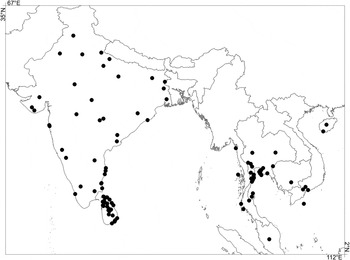
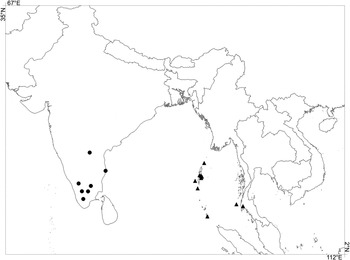
Fig. 6.Distribution of Manilkara hexandra (Roxb.) Dubard (•).
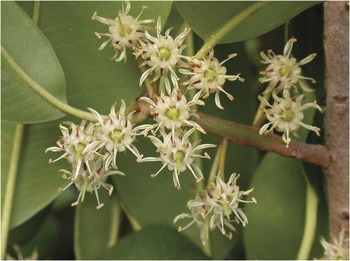
Fig. 7.Manilkara hexandra (Roxb.) Dubard, inflorescence. Photo: D. Middleton, RBGE.
Mimusops indica A.DC., Prodr. 8: 205 (1844). – Type: India, Gaur, 19 xi 1809, Wallich 4149A (lecto G-DC, designated here; isolecto K-W, E [as F. Buchanan-Hamilton 840]).
Manilkara emarginata H.J.Lam, Bull. Jard. Bot. Buitenzorg, Ser. III, 7: 241 (1925); Lam, Blumea 4: 342 (1941); Lam, Blumea 5: 42 (1942). – Type: USA, Hawai’i, Oahu, Honolulu, 9 ix 1949, M.C. Neal s.n. (neo L, designated here; isoneo BISH n.v.). [The original specimen seen by Lam (Curran 132) was not located. However, a note in Van Royen (Reference Van Royen1953: 408) explains that Neal s.n. was collected from a cultivated accession in Foster Botanic Garden on Oahu and that Curran 132 is likely to be from the same individual. Neal s.n. (L) is, therefore, designated as the neotype here.]


Tree to 25 m, dbh to 200 cm; occasionally with short, swollen shoots. Leaves 1.5–10.5 × 1–5.7 cm, coriaceous, obovate to oblong, occasionally obcordate, apex rounded, often emarginate (particularly Sri Lankan specimens), base acute to rounded, glabrous above and below; secondary venation c.13–17 pairs, inconspicuously impressed above or finely raised on both surfaces. Petiole 0.5–3 cm long, glabrous or scurfy and resinous in patches. Flowers 1–6 per fascicle in leaf axils, 3–5 × 5–7 mm at anthesis, mature bud elliptic. Pedicel 0.5–1.5 cm long, glabrous or ferruginous tomentose, not swollen below bud, erect. Calyx lobes 3–4.5 × 1.5–3.5 mm, elliptic-lanceolate, outer surface of outer whorl glabrescent with occasional ferruginous or scurfy resinous hairs, outer surface of inner whorl slightly lighter in colour, tawny densely adpressed tomentose, inner surface of both whorls glabrous except for occasional white pilose hairs along the margin. Corolla glabrous, creamy white; corolla tube 1–2 mm long; petal central lobe 3–3.5 × 1 mm, elliptic-lanceolate, keeled; petal appendages present, nearly equal in length to the central lobe, 2.5–4 × 0.6–1 mm, entire or occasionally with a small serration. Stamens glabrous; filaments 1–2 mm long; anthers 1.5–2 mm long. Staminodes 0.5–4 × 0.5–1 mm, elliptic, apex entire to gnawed or laciniate. Ovary 6–11 locular, ferruginous-tomentose. Style 2.5–5.5 mm long at anthesis, occasionally persistent in fruit. Fruit ellipsoid, 0.8–1.5 × 0.6–1 cm, orange to red when mature. Seed 0.8–1.5 × 0.5 cm, obovate; testa smooth, mid-dark brown in colour; seed scar 4–6 × 1–2 mm, obovate, extending just over 1/2–3/4 way up ventral side from the base.
Habitat. A primary component of evergreen forest and scrub in dry regions, often growing on sandstone or laterite, but also found on sand (Broun, Reference Broun1900; Gamble, Reference Gamble1902; Dassanayake et al., Reference Dassanayake, Fosberg and Clayton1995), at sea level to 895 m altitude.
Distribution. India, Sri Lanka, Burma, Thailand, Cambodia, Vietnam, Malaysia, Hainan (China).
Phenology. Flowering: January–December; fruiting: January, March–July, September–November.
Vernacular names. Bengali: krikhiyur; Gujarati: khirni, rayan; Gondi: raini; Hindi: khir, khirni, kshiri, drirh, rayan; Kannada: bakula; Konkani: karni, ranjana; Malayalam: krini, pazhamunpaala; Marathi: rajana, ranjana, rayan, rayani, ranjana-raini, khirni, karani; Meywar: rain; Palkonda: pal; Sanskrit: kshirini, nimbabija, rajadana; Tamil: palla, pala, palai, kannupalle, kanun palle, ulakkaippalai; Telugu: pala, palle panlo, palla pandu, palachettu, ankalu, nandivriqshamu; Uriya: khiri, khirakuli (Beddome notes that in India the name pala is also given to other [latex bearing] trees such as Alstonia scholaris (L.) R.Br. and Wrightia tinctoria R.Br.) (names from Beddome, Reference Beddome1873; Trimen, Reference Trimen1895; Gamble, Reference Gamble1902; Porcher, Reference Porcher2009); Sri Lanka: paloo-gass (Thwaites, Reference Thwaites1864), palu, palai; Burmese: khayay (Kress et al., Reference Kress, DePhilipps, Farr and Yin2003); Thai: khet (Fletcher, Reference Fletcher1938); Vietnamese: cây gung néo, cãy gang, cãy vịèl, phu qùsć; Moï: ba ro (Lecomte, Reference Lecomte1930); Standard Chinese: tie xian zi, tie se (Li & Pennington, Reference Li, Pennington, Wu and Raven1996); English: Ceylon ironwood, milk tree.
Uses. Valuable timber tree with very hard, heavy, durable, close-grained, dark red to purplish-brown wood, capable of high polish. It is used for sugar mill beams, oil-presses, house posts, tool-handles, carving and turnery. According to Gamble (Reference Gamble1902) the wood is an excellent fuel and one of the chief products of the scrub forests of the Carnatic district. Broun (Reference Broun1900) gives an account of the durability and longevity of the wood, noting that in Sri Lanka the gates of the Kalpitiya fort, made from this wood, were still sound after 135 years, and piles in Mannar also made from it lasted under water for 100 years. In India, the bark is stripped and used for medicine and the latex is applied to cuts, bruises and boils. The fruit is very sweet and is eaten fresh or dried and the seeds can be compressed for oil (Broun, Reference Broun1900; Gamble, Reference Gamble1902).
Diagnostic characters. Manilkara hexandra differs from M. roxburghiana in India in having much shorter pedicels (0.5–1.5 cm vs. 1.5–3.5 cm), smaller flowers (3–5 × 5–7 mm vs. 10 × 13 mm at anthesis) and slightly smaller ellipsoid fruit vs. globose fruit in M. roxburghiana. In Thailand and Indochina, Manilkara hexandra differs most obviously from the other common Manilkara species in the region, M. kauki, in having entirely glabrous leaves, whereas M. kauki has a silvery adpressed indumentum on the underside of the leaf making it distinctly discolorous. Manilkara hexandra also has shorter pedicels and smaller flowers and fruit than M. kauki.
IUCN conservation status. Least Concern (LC). This species is widespread and, based on herbarium specimen collections, there appear to be healthy populations throughout its range, particularly in Sri Lanka.
Notes. Manilkara hexandra is the only Asian-Pacific species of Manilkara which is recorded as inhabiting dry regions and scrubland. It is also the only Asian-Pacific species which produces short swollen shoots. It can have very variable morphology across its geographical range. This is exhibited most characteristically in leaf size and shape. Thai specimens tend to have much larger leaves, whereas Sri Lankan specimens typically have smaller leaves, which are often emarginate.
Specimens studied. India. s.n. (E); 713 (C); 1852, Cleghorn, H.F.C. 186 (E); 1922, Drummond, J.R. 25057 (K); 1844, Edgeworth, M.P. 14 (K); 1846, Jacquemont 262 (A); Jameson, W. 675 (E); Leschenault de la Tour, J.B.L.T. 44 (G-DC, L); xi 1853, Ritchie, Dr. C. s.n. (E); Royle s.n. (K); Stewart, J.L. s.n. (E [2]); xii 1844, Thomson, T. 751 (K); Wallich, N. s.n. (G-DC); Wallich, N. 4148A (K-W); Wallich, N. 4149 (K); Wallich, N. 4149D (G-DC, K-W); Wallich, N. 4149E (G-DC, K-W p.p., bottom half of sheet); Wight, R. 1738 (A, K); Wight, R. s.n. (E); Upper Gangetic Plain, Thomson, T. s.n. (A). Punjab: 7 i 1886, Drummond, J.R. 2266 (K); 1922, Drummond, J.R. 24842 (K); Drummond, J.R. 24841 (K); Drummond, J.R. 24840 (E, K). Delhi: Merhrauli, 11 xii 1948, Janaki Ammal, E.K. 1702 (K). Rajasthan: Allahabad, Jhalawar Patan, 27 xii 1965, Mazumdar, R.B. 10043 (E); Chodia, 22 iii 1969, Hodd, K.T.B. 156 (K). Uttar Pradesh: Amaria, 21 ix 1972, Malhotra, C.L. 50957 (L); Kheri, 15 iii 1898, Inayat 22410 (K); Tomb of Akbar, 15 xi 1831, Dalhousie, Countess C.B. s.n. (E). Gujarat: 1915, Saxton, W.T. 7793 (K); Bordevi Gir, Patel, N.G. s.n. (US). Madhya Pradesh: Denwa Valley, 16 vi 1912, Haines, H.H. 3349 (K). Bihar: Monghyr, viii 1820, Wallich, N. 4148b (K-W); West Bengal: Bengal, ii 1879, Watt, G. s.n. (E). Maharashtra: Belgaum, Ritchie, Dr. C. 1829 (E, K); Belgaum to Poona, xi 1853, Ritchie, Dr. C. s.n. (E [2]); Bombay, xi 1984, J. M. W. 1004 (E); Bombay Presidency, Mahd Island, 20 x 1945, Sinclair, J. 4553 (E, US); Buldana District, Berar, 13 xii 1889, Whittenbaker, G.H. 50 (E); Chanda District, 7 i 1890, Duthie, J.F. 9555 (E); Haveli Range, Gilbrili to Kotari, Haines, H.H. 3350 (K). Orissa: Athmallik State, Malipodar, 1 ii 1949, Mooney, H.F. 3264 (K); ibid., 26 iii 1948, Mooney, H.F. 3002 (K); Puri, Southern Range, Aran Forest, 16 xii 1915, Haines, H.H. 3870 (K). Karnataka: Pala, s.n. (E); ibid., Roxburgh, W. s.n. (E). Andhra Pradesh: Rajahmemdry, xi 1822, s.n. (E). Kerala: Malabar coast, Concan, Law s.n. (K); ibid., Stocks, J.E. & Law, J.S. s.n. (A, L). Tamil Nadu: Killai, Kandangkadu, 4 x 1978, Perumal, P. 17942 (A); Madras, Cleghorn, H.F.C. s.n. (E); ibid., 1851, Elliot, W. s.n. (E); ibid., i 1884, Gamble, J.S. s.n. (K); ibid., 1830, Graham, R.C. s.n. (E); ibid., Wight, R. s.n. (K); ibid., Wight, R. s.n. (K); Wallich, N. 4149B (G-DC, K-W sheet 1, p.p. sheet 2); Madras, Chingleput District, Kambakam Drug, 15 iii 1901, Bourne, A.G. & Bourne, E.T. 2179 (K); Madras, Coromandel, Wight, R. s.n. (K); Madras, Cuddopa, 1885, Beddome, R.H. 4887 or s.n. (BM, K); ibid., 1885, Beddome, R.H. 4888 (SING); Madras, Godavari, Darapali, 1885, Gamble, J.S. 15848 (K); Madras, Godavari, Kadimakouda, 8 i 1902, Bourne, A.G. & Bourne, E.T. 3542 (K); Narthamalai Pudukkottai, 30 x 1969, Matthew, K.M. 10471 (BM); Negapatam, 1830, Wight, R. 118 (A, E); South Arcot District, Chidambaram, Kille, Puliamarathurai, 8 iv 1979, Venugopal, N. 22720 (K).
Sri Lanka.Northern Province: Jaffna, 8 vii 1971, Dassanayake, M.D. 438 (K); Jaffna, Kaddaikadu, Point Pedo, 16 iii 1973, Bernardi, L. 14256 (L); Jaffna, Madhu Road to Mannar, 27 v 1973, Kostermans, A.J.G.H. 24871 (K, L); Jaffna, Mannar, 5 ii 1923, Petch, T. s.n. (A); Jaffna, Mulliyan, 22 ii 1973, Townsend, C.C. 73/84 (K); Jaffna, Pooneryn, 17 iii 1973, Bernardi, L. 14285 (L); Jaffna, Pooneryn to Mannar, 9 vii 1971, Meijer, W. 792 (A, MO, SING); Mannar District, Illuppaikkadavai, 25 i 1950, Worthington, T.B. 4485 (K); Vavuniya District, Jaffna Road, Vavuniya, 24 x 1973, Ashton, P.S. 2324 (A, US); ibid., 9 xii 1970, Fosberg, F.R. & Balakrishnan, N.P. 53530 (MO, NY, RSA, US). Northwestern Province: Wilpattu National Park, Marai Villu, 30 vi 1969, Wirawan, N. et al. 894 (A, K, L, MO, NY, RSA). North Central Province: Keikirawa, 25 ix 1969, Beusekom, C.F.v. & Beusekom, R.J.v. 1594 (CANB, L); Polonnaruwa District, Elahera, 16 x 1975, Bernardi, L. 15396 (US); Polonnaruwa District, Habarane, 27 ii 1977, Bremer, B. & Bremer, K. 912 (US); Polonnaruwa District, Polonnaruwa Sacred Land, 13 i 1978, Cramer, L.H. 5082 (K); ibid., 8 i 1970, Fosberg, F.R. & Ditters, W. 51919 (K, MO, NY, POM, RSA); ibid., 24 x 1969, Hladik, A. 1044 (US); ibid., 23 i 1969, Ripley, S. 252 (US). Eastern Province: Kuchchaveli, 14 i 1968, Comanor, P.L. 791 (K, MO, NY); Sastrawela, 1 xi 1975, Bernardi, L. 15563 (K); Trincomalee, Foul Point, 23 x 1976, Fosberg, F.R. 56431 (A, L, MO, NY, TI, US). Central Province: Kandy District, 24 vi 1970, Meijer, W. & Balakrishnan, N.P. 95 (L, US); Matale District, Dambula, 29 v 1971, Kostermans, A.J.G.H. 24286 (K, L, US); ibid., 8 ix 1977, Meijer, W. & Jayasuriya, A.H.M. 1271 (K, L); Matale District, Sigiriya Tank, 15 vii 1973, Nowicke, J.W. et al. 366 (MO, US). Uva Province: Badulla District, Mahyangane to Bibile, 29 vii 1974, Kostermans, A.J.G.H. 25308 (K, L). Southern Province: Hambantota District, Colombo to Hambantota, 3 x 1973, Ashton, P.S. 2278 (US); Ruhuna National Park, 25 vi 1967, Comanor, P.L. 401 (L, MO, NY, RSA, US); ibid., 22 vii 1967, Mueller-Dombois, D. 67062220 (US); ibid., 25 ii 1968, Mueller-Dombois, D. & Cooray, R.G. 68022509 (RSA, US); Ruhuna National Park, Situlpauwa to Galkaduwa, 25 vi 1967, Mueller-Dombois, D. & Comanor, P.L. 67062532 (US); Ruhuna National Park, Ureniya Kalipuwa, 28 i 1968, Comanor, P.L. 868 (A, L, MICH, MO, NY, RSA, TI).
China.Hainan: 5 ix 1933, Liang, H.Y. 62119 (E); 26 x 1933, Wang, C. 34889 (US); Kumyun, 5 ix 1936, Lau, S.K. 27846 (KYO); Nam Shan Ling, Yaichow, i 1933, Tso, C.L. 23021 (E); Ngai District, Kong Moon, 13 ix 1932 – 15 ix 1932, Lau, S.K. 501 (B, BM, E, K, KYO, MICH).
Burma.Mon State: Amherst, 1831, Wallich, N. 4148 (K); Amherst, 14 vii 1827, Wallich, N. 4148 (G-DC). Tenasserim Region: Helfer, J.W. 3613 (Kew distribution number) (A, CAL).
Thailand. Kan Kadai, 13 i 1929, Put, N. 2262 (B, BKF, K); ibid., 18 ix 1926, Put, N. 283 (B, BKF, K). Nakhon Ratchasima: Korat, Bupram, 2 i 1925, Kerr, A.F.G. 9816 (BKF); Korat, Chan Tuk, 18 xii 1923, Kerr, A.F.G. 8048 (BKF). Uthai Thani: Ban Kao, Mount Kao Pattavee, 18 xi 1961, Larsen, K. 8312 (C, L). Kanchanaburi: Williams, L. 17183 (E, F); Salak Phra Wildlife Sanctuary, Shimizu, T. et al. T 21316 (KYO); Salak Phra Wildlife Sanctuary, Sadong, 30 xi 1971, Beusekom, C.F.v. et al. 4059 (BISH, C, KYO, L, MO). Ratchaburi: Huai Yang, vii 1966 – viii 1966, Larsen, K. et al. 1320 (BKF, L). Prachuap Khiri Khan: Amphoe Kaeng Krachan, Kaeng Krachan National Park, 11 viii 2002, Middleton, D.J. et al. 961 (A, BKF, E, SING); Amphoe Pran Buri, Khao Sam Roi Yot National Park, 14 viii 2002, Middleton, D.J. et al. 1145 (BKF, E); Amphoe Pran Buri, Khao Sam Roi Yot National Park to Khao Daeng Viewpoint, 23 ii 2000, Chayamarit, K. et al. 1855 (BKF, L); Amphoe Pran Buri, Kui Buri National Park, 19 viii 2002, Middleton, D.J. et al. 1221 (BKF); Hua Hin, 8 xi 1928, Kerr, A.F.G. 16130 (BKF, BM, K, L); Kan Kadai, 13 i 1929, Put, N. 2262 (B, BKF, K); ibid., 18 ix 1926, Put, N. 283 (B, BKF, K); Pranburi, 25 iii 1982, Santisuk, T. s.n. (BKF); Thap Sa Kae, Hat Wanakorn National Park, 9 i 2002, Chayamarit, K. et al. 3076 (BKF). Sa Kaeo: Aran Pratet, 17 x 1928, Put, N. 1996 (B, BKF, K, L). Chon Buri: Ko Kaeo, 4 ii 1969, Phengklai, C. 1982 (C, K, L); Samaesan Islands, Koh Juang, 12 vi 1998, Wongprasert, T. 123595 (BKF); ibid., 8 viii 1998, Wongprasert, T. 124751 (BKF); Sattahip District, Ira Island, 2 x 1976, Maxwell, J.F. 76-657 (BKF, L); Sattahip District, Koh Phai, 26 viii 2000, Phengklai, C. 12824 (BKF); Sattahip District, Thung Prong, 14 ix 1969, Maxwell, J.F. s.n. (L); ibid., 20 xi 1969, Maxwell, J.F. s.n. (BKF, L); Satthahip, Koh Khram, 14 viii 1999, Phengklai, C. 11963 (BKF); Siracha District, Si Chang Island, Laem Tahm Pahng beach, 26 vii 1993, Maxwell, J.F. 93-843 (A, CAS, L); Sriracha, ix 1913, Collins, D.J. 185 (E, K); ibid., 20 i 1926, Collins, D.J. 1129 (BKF, K); ibid., 22 ix 1911, Kerr, A.F.G. 2091 (K). Surat Thani: 17 iv 1977, Phengklai, C. 3864 (A, BKF); Kaw Nga Talam, 7 iv 1927, Kerr, A.F.G. 12531 (BKF); Kaw Tao, 13 iv 1927, Kerr, A.F.G. 12689 (BKF, E); Koh Sam Sao, Koh Ang Thong National Park, 24 vii 1982, Smitinand, T. 118007 (BKF). Phangnga: Ko Yao Yai, 20 ii 1966, Hansen, B. & Smitinand, T. 12394 (C, L, SING).
Vietnam. 1862–1866, Thorel, C. s.n. (P). Dong Nai: Bien Hoa, Tri Huyen, vi 1871, Pierre, J.B.L. 3261 (K, L, P, SING, TI); ibid., vii 1868, Pierre, J.B.L. 3261 (P). Ninh Thuan: Phanrang, Ba Lap to Barau, 7 ii 1916, Chevalier, A.J.B. 30554 (P). Ba Ria Vung Tau: Baria, viii 1876, Pierre, J.B.L. 3261 (K, L, SING); Baria, Cholen, v 1870, Pierre, J.B.L. 3261 (P); Dinh to Baria, iii 1867, Pierre, J.B.L. 3261 (K, L, MO, US); Iles de Poulo-Condor, vii 1909, Alleizette, A.C.d. s.n. (L); ibid., 1875–1877, Harmand, J.H.A.J. 742 (P).
Cambodia. Sruoi, v 1871, Pierre, J.B.L. 3261 (K); ibid., v 1870, Pierre, J.B.L. 3261 (L, MICH).
Malaysia.Johor: Kulai, viii 1868, Pierre, J.B.L. 3261 (K).
Non wild-collected material. India.Thomson, T. s.n. (L); Wight, R. s.n. (E [7], K). West Bengal: Calcutta Botanic Garden, s.n. (E, L); Pierre, J.B.L. s.n. (A). Tamil Nadu: Coimbatore, 21 vii 1965, Subramanian, K.N. 1903 (L). Uttarkhand: Dehra Dun, viii 1898, Gamble, J.S. 27116 (K). Gujarat: Girnar, 3 x 1953, Raizada, M.B. 21228 (L). Sri Lanka. Central Province: Peradeniya Botanical Gardens, 5 ix 1977, Meijer, W. 1259 (US). Vietnam. Ho Chi Minh: Institut Scientifique de Saigon, 25 x 1922, Poilane, M. 2986 (A, B). USA.Hawaii: Honolulu, 27 iii 1997, Annable, C.R. & Van Sickle, G. 3399 (NY).
5. Manilkara hoshinoi (Kaneh.) P.Royen, Blumea 7: 410 (1953); Lam, Blumea 5: 43 (1942); Pennington, Gen. Sapot. 133 (1991); Govaerts et al., Checklist Sapot. 145 (2001). – Northia hoshinoi Kaneh., Bot. Mag. (Tokyo) 46: 489 (1932). – Northiopsis hoshinoi (Kaneh.) Kaneh., Flora Micronesica 302–303, t.152 (1933); Kanehira, Bot. Mag. (Tokyo) 47: 677 (1933); Lam, Blumea 4: 344–345 (1941); Lam, Blumea 5: 43 (1942); Glassman, Bernice P. Bishop Mus. Bull. 209: 88 (1952). – Achras hoshinoi (Kaneh.) Baehni, Boissiera 11: 80 (1965). – Type: Caroline Islands, Pohnpei, xii 1930, M. Hoshino 1265 (lecto FU, designated here). [Van Royen (Reference Van Royen1953: 410) designated Hoshino 2138 (FU) from Kolonia, Pohnpei, Caroline Islands as the type of Manilkara hoshinoi. However, this choice is not valid since it is not part of Kanehira’s originally cited material. Kanehira mentioned two specimens in his (1932) publication: Hoshino 1265 in flower and Hoshino 695 in fruit. The flowering specimen is chosen as the lectotype here.]Fig. 1.
Tree to 30 m, dbh to 120 cm. Leaves 9.5–19 × 5–9.2 cm, coriaceous, elliptic, apex broadly acute, base acute, glabrous above, young leaves ferruginous-tomentose below, becoming entirely glabrous when mature; secondary venation c.20–23 pairs, inconspicuously or faintly raised above, obscure to very finely raised beneath. Petiole 2–5 cm long, glabrous or with ferruginous hairs at the base. Flowers 2–4 per fascicle in leaf axils, 15–20 × 15–20 mm at anthesis, mature bud elliptic. Pedicel 0.7–1 cm long, densely ferruginous-tomentose, thick and sometimes swollen below bud, often reflexed. Calyx lobes 8–15 × 3–5 mm, elliptic, outer surface of outer whorl densely adpressed ferruginous-tomentose, outer surface of inner whorl often slightly lighter in colour, densely tomentose, inner surface of both whorls densely white lanose. Corolla glabrous, white; corolla tube 2–3 mm long; petal central lobe 10–17 × 2–4 mm, narrowly lanceolate, keeled; petal appendages absent. Stamens glabrous; filaments 10–12 mm long; anthers 5 mm long. Staminodes 3–5 × 0.7–1 mm, linear, strap-like, apex acute-entire or minutely fringed. Ovary 6-locular, ferruginous-tomentose. Style 15–17 mm long at anthesis, slightly persistent in fruit. Fruit 4–5 × 2.5–4.5 cm, ellipsoid to ovoid or globose, glabrescent, red when mature. Seed 3.5–4 × 1.5–2 cm, oblanceolate or elliptic; testa smooth, mid-brown in colour; seed scar 10–25 × 6–10 mm, ovate, extending just over 1/3-way up ventral side.
Habitat. Lowland primary forest; altitude not reported.
Distribution. Pohnpei (Caroline Islands), endemic.
Phenology. Flowering: March, July–August, December; fruiting: March, July–August.
Vernacular names. Kohlé.
Uses. Wood used for making furniture, implements and walking canes.
Diagnostic characters. Manilkara hoshinoi differs from all other Asian and Pacific species in being the only one in the region which lacks petal appendages. It was for this reason that Kanehira originally placed it in the genus Northia in 1932 and then Northiopsis in 1933, before it was formally recognised as a Manilkara by Van Royen in 1953. Other distinguishing features of Manilkara hoshinoi are its linear staminodes, and its comparatively large flowers, fruit and elliptic leaves.
IUCN conservation status. Vulnerable (VU D2). Because Manilkara hoshinoi is endemic to Pohnpei it naturally has a restricted distribution. However, at present there do not appear to be any significant threats to its habitat, but should the situation change (i.e. due to logging or a climate-induced sea level rise) the species could easily become threatened. Additionally, only three of the eight collections have specific localities identified, one of which (Kolonia) is one of the main towns on the island and habitat in that area has become disturbed. It is uncertain if this species has been affected by the expansion of Kolonia. Future assessments could result in a higher category of threat being assigned.
Notes. Sterile specimens of Manilkara samoensis have been mistaken for M. hoshinoi by previous authors due to the similarity of their leaf morphology. However, when fertile, these species can easily be differentiated by their petal appendages, which Manilkara samoensis has, and M. hoshinoi lacks. As currently circumscribed Manilkara hoshinoi occurs only on Pohnpei (for a more complete discussion, see the notes under M. samoensis). Diameter at breast height and fruit colour characters have been taken from the Flora Micronesica account (Kanehira, Reference Kanehira1933) as they were not recorded on any of the specimens seen in this study.
Specimens studied. Federated States of Micronesia. Pohnpei: 17 viii 1949, Glassman, S.F. 2875 (BISH); vii 1931, Kanehira, R. 1572 (A, FU, KYO, P, TI); viii 1929, Kanehira, R. 695 (FU); viii 1932, Kanehira, R. 2139 (K, P); Kamal, 30 viii 1933, Hosokawa, T. 6113 (A, BISH, L); Kolonia, iii 1933, Hoshino, M. 2138 (FU, L, TI); Toleailuka, 7 iii 1936, Takamatsu, M. 823 (BISH).
6. Manilkara kanosiensis H.J.Lam, Blumea 4: 337–338, t.9 (1941); Van Royen, Blumea 7: 410 (1953); Van Royen, Blumea 8: 206 (1957); Pennington, Gen. Sapot. 133 (1991); Govaerts et al., Checklist Sapot. 146 (2001). – Type: Papua New Guinea, Kanosia, 10 ii 1935, C.E. Carr 11237 (holo L; iso A, BM, K, SING).Fig. 1.
Manilkara napali P.Royen, Blumea 8: 204–206, t.1 (1957); Pennington, Gen. Sapot. 134 (1991); Govaerts et al., Checklist Sapot. 147 (2001). – Type: Indonesia, New Guinea, Hollandia [Jayapura], Holtekang, 27 x 1954, A. Brouwer BW1579 (holo L).
Tree to 34 m, dbh to 102 cm. Leaves 5–13 × 2–8 cm, subcoriaceous, obovate, apex rounded to truncate or broadly acute, occasionally slightly emarginate, base acute, glabrous above and below; secondary venation c.15–20 pairs inconspicuously impressed above, obscure to finely raised beneath. Petiole 1.2–4 cm long, glabrescent to scurfy-tomentose and resinous in patches. Flowers 3–6 per fascicle in leaf axils, 10–13 × 6–10 mm at anthesis, mature bud elliptic. Pedicel 1.5–3.2 cm long, ferruginous-tomentose, not swollen below bud, erect to sub-erect. Calyx lobes 6.5–10 × 2–4 mm, lanceolate, outer surface of outer whorl densely adpressed ferruginous-tomentose, outer surface of inner whorl slightly lighter in colour, tawny densely tomentose, inner surface of both whorls glabrescent with white pilose hairs at the apex and margin. Corolla glabrous, yellowish or greenish white; corolla tube 2–4 mm long; petal central lobe 8–10 × 1.2–2.5 mm, elliptic, keeled; petal appendages present, just over 1/2 the length of the central lobe, 4–6 × 1–1.5 mm, entire. Stamens glabrous; filaments 2–3 mm long; anthers 2.5–3.5 mm long. Staminodes 1.8–4 × 1–2 mm, elliptic to irregularly deltoid, apex laciniate. Ovary 6–8 locular, ferruginous-tomentose. Style 8–15 mm at anthesis, not persistent in fruit. Fruit 4–6.5 × 3.5–6 cm, ellipsoid to obovoid, yellow in colour when still immature. Seed 3 × 1.5 cm, obovate; testa smooth, beige-pale brown in colour; seed scar 18 × 6 mm, oval-elliptic, distinctly impressed, extending 3/4-way up ventral side from the base.
Habitat. Lowland forest at sea level to 150 m altitude.
Distribution. New Guinea and Tanimbar island, rare.
Phenology. Flowering: February–March; fruiting: June, September.
Vernacular names. Skou and Wembi: napali; Arso: tifem. Logging names: torem, sawai.
Uses. Hard, red timber used for building bridges, wharves, decking, flooring, tools, sleepers, joinery, boat building, moorings and truck bodies (Eddows, date unknown). Timber in minor international trade, reported to be exported to Japan (UNEP-WCMC, 2007).
Diagnostic characters. The other Manilkara species which occur in the same region as M. kanosiensis are M. kauki and M. fasciculata. Manilkara kanosiensis can be distinguished from M. kauki in having glabrous leaves, petal appendages which are just over half the length of the central lobe, and large fruit (4–6.5 × 3.5–6 cm), whereas M. kauki leaves have an indumentum on the underside, petal appendages nearly equal to the central lobe, and smaller fruit (2.5–5 × 2 cm). They are similar in both having obovate to elliptic leaves and being the only two Asian-Pacific species with a light-coloured (beige-pale brown) seed. Manilkara fasciculata differs from both M. kanosiensis and M. kauki in having oblanceolate to narrowly obovate leaves with a distinctly striate venation and a mid-brown coloured seed.
IUCN conservation status. Vulnerable (VU A2c). Manilkara kanosiensis is only known from five localities, two of which (Jayapura and Kanosia) were visited in 2008 and no individuals were found. As the timber is reported in international trade on a small scale this also increases the level of threat. Additionally, Manilkara kanosiensis has a coastal distribution and is prone to disturbance by human settlement. Therefore, the species is threatened by a decline in its area of occupancy and the quality of its habitat.
Notes. Van Royen (Reference Van Royen1957) described the species Manilkara napali as being related to M. kanosiensis, but different from it in the colour of the leaves when dry (pale cinnamomous in M. napali and reddish in M. kanosiensis) as well as in the number of flowers in the leaf axils (2–7 in M. napali and 1–3 in M. kanosiensis). However, in reviewing the specimens for this account it was found that these characters are not consistent and are insufficient for retaining these species as separate. There are, however, very subtle differences between the taxa as originally delimited, which are part of the natural variation of a species. Manilkara kanosiensis has a slightly larger calyx and slightly smaller leaves with a rounded apex as opposed to the slightly smaller calyx and larger leaves with a broadly acute apex in M. napali. Here they are treated as conspecific. It should also be noted that although in the mature state Manilkara kanosiensis has entirely glabrous leaves, the type specimen has sparse patches of ferruginous adpressed hairs, which are caducous with age.
Specimens studied. Indonesia.Maluku: Kepalauan Tanimbar, Ilegnei to Otimmer, 19 iii 1938, Buwalda, P. 4321 (A, K, L, P); Kepalauan Tanimbar, Ilgnei Otimmer, 19 iii 1938, Neth. Ind. For. Service bb.24311 (BISH, L, P, SING). Papua: Hollandia Division, Jayapura, Holtekang, 21 iv 1956, Schram, F.A.W. BW2841 (CANB, K, L); ibid., 9 x 1953, Versteegh, C. BW49 (A, CANB, K, L); Hollandia Division, Jayapura, Tami, 15 i 1955, Brouwer, A. 763 (L); ibid., 17 i 1955, Schram, F.A.W. BW1636 (CANB, L).
Papua New Guinea.Madang Province: Christmas Bay, Bagabag Island, 16 vi 1969, Vandenberg, J. & Mann, E. NGF42261 (CANB, K, L, SING). Milne Bay Province: Woodlark Island, 5 ix 1979, Kairo, A. 167 (E, L).
7. Manilkara kauki (L.) Dubard, Ann. Inst. Bot.-Geol. Colon. Marseille 3(3): 9, t.1 (1915); Lam, Bull. Jard. Bot. Buitenzorg, Ser. III, 7: 239–240 (1925); Lam, Bull. Jard. Bot. Buitenzorg, Ser. III, 8: 481 (1927); Lam, Blumea 4: 329–330, t.3 (1941); Van Royen, Blumea 7: 405–406 (1953); Aubréville, Fl. Cambodge, Laos & Viêtnam 3: 14–15 (1963); Baehni, Boissiera 2: 93 (1965); Ng, Tree Fl. Malaya 1: 414 (1972); Smith, Fl. Vit. Nova 2: 780–781 (1981); Pennington, Gen. Sapot. 133 (1991); Chantaranothai, Thai Forest Bull., Bot. 27: 149 (1999); Govaerts et al., Checklist Sapot. 146 (2001); Kress et al., Checklist Myanmar 365 (2003). – Mimusops kauki L., Sp. Pl. 349 (1753); Willdenow, Sp. Pl. 5: 326 (1800); Roxburgh, Fl. Ind. 2: 238, t.2482 (1832); Don, Gen. Hist. 4: 35 (1837); Clarke, Fl. Brit. Ind. 3: 549 (1882); Lace, List Burma 105 (1922). – Kaukenia kauki (L.) Kuntze, Revis. Gen. Pl. 2: 405 (1891). – Type: Sri Lanka, Hermann 1: 35, No. 137 (lecto BM). [Lectotypified in Trimen, Handb. Fl. Ceylon 3: 87 (1895).] Figs 8,9.
Fig. 8.Distribution of Manilkara kauki (L.) Dubard (Fiji inserted) (•).
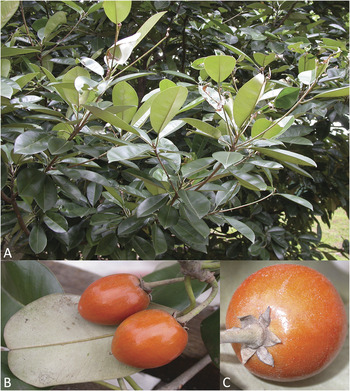
Fig. 9.Manilkara kauki (L.) Dubard. A, branch with mature leaves; B, leaf undersurface with whitish indumentum and fruit; C, fruit showing calyx lobes. Photos: P. Wilkie, RBGE.
Imbricaria malabarica Poir. in Lamarck, Encycl. 4: 434 (1798). – Mimusops manilkara G.Don, Gen. Hist. 4: 35 (1837); De Candolle, Prodr. 8: 206 (1844). – Type: Illustration in Van Rheede, Hortus Malabaricus 4: 53, t.25, Manyl-kara (1678) (lecto designated here).
Mimusops balota auct. non Gaertn.: Blume, Bijdr. Fl. Ned. Ind. 13: 673 (1826).
Mimusops dissecta auct. non R.Br.: Hooker, Bot. Mag. 59: t.3157 (1832).
Mimusops hookeri A.DC., Prodr. 8: 204 (1844). – Type: Illustration in Hooker, Bot. Mag. 59: t.3157 (1832) (lecto designated here).
Mimusops kauki var. browniana A.DC., Prodr. 8: 204 (1844). – Mimusops browniana (A.DC.) Benth., Fl. Austral. 4: 285 (1868). – Type: Australia, Prince of Wales Island, 1802–1805, R. Brown 2825 (lecto BM [000948714], designated here).
Mimusops bojeri A.DC., Prodr. 8: 205 (1844). – Type: Cultivated specimen from Mauritius 1829, W. Bojer s.n. (lecto G-DC, designated here).


Tree to 20 m, dbh to 30 cm. Leaves 4–10.5 × 2.5–6.5 cm, coriaceous, obovate to broadly elliptic, apex rounded or broadly acute, occasionally slightly emarginate, base acute, discolorous, glabrous above, with a layer of white tightly adpressed hairs below; secondary venation c.10–15 pairs, inconspicuously impressed above, obscure to finely raised beneath. Petiole 1.5–5 cm long, glabrescent to scurfy-resinous or tomentose. Flowers c.2–3 per fascicle in leaf axils, 8–10 × 10–12 mm at anthesis, mature bud ovoid. Pedicel 1.5–2.3 cm long, ferruginous-tomentose, not swollen below bud, reflexed to semi-erect. Calyx lobes 6–8 × 4 mm, elliptic-lanceolate, outer surface of outer whorl densely adpressed ferruginous-tomentose, outer surface of inner whorl often slightly lighter in colour, densely tomentose, inner surface of outer whorl glabrescent with white pilose hairs at the apex and margin, inner surface of inner whorl glabrous. Corolla glabrous, creamy white to yellowish; corolla tube 1.5–2 mm long; petal central lobe 6–7 × 1.3–1.5 mm, lanceolate, keeled; petal appendages present, nearly equal in length to the central lobe, 6–7 × 1.5–2 mm, entire or occasionally with a small serration. Stamens glabrous; filaments 2–2.5 mm long; anthers 2.5–3 mm long. Staminodes 2.5–4 × 1.3–2 mm, ovate, apex fringed or laciniate. Ovary 6-locular, ferruginous-tomentose. Style 7–8 mm long at anthesis, occasionally slightly persistent in fruit. Fruit obovoid, 2.5–5 × 2 cm, dark wine red to nearly black when mature. Seed 1.6–2 × 0.8–1.2 cm, obovate, testa smooth, beige-pale brown in colour; seed scar 7–12 × 1–3 mm, linear, extending 1/3–3/4 way up ventral side.
Habitat. Lowland or coastal forest, occasionally montane forest, widely cultivated at sea level to 300 m altitude.
Distribution. Thailand, Cambodia, Vietnam, Malaysia, Indonesia, Philippines, Papua New Guinea, Australia, Fiji.
Phenology. Flowering: February–April, June, August, December; fruiting: February–December.
Vernacular names. Burmese: Khayay-yaing (Kress et al., Reference Kress, DePhilipps, Farr and Yin2003); Thai: lamut sida, lamut (Chantaranothai, Reference Chantaranothai1999); Indonesian: sawo kacik, sawo katjik; Australian English: wongai plum; Fijian: bau baubulu.
Uses. The wood is popular for furniture making and carving, particularly in Bali, and has become locally rare there due to this use. The fruit is edible and is said to taste like a commercial date when ripe.
Diagnostic characters. Manilkara kauki can be distinguished from other Asian and Pacific Manilkara species by a combination of characters. Firstly, it has distinctly discolorous obovate to broadly elliptic leaves, with the underside appearing silvery white, while the upper side is green. Secondly, the petal appendages are nearly equal in length to the central lobe of the petal. Thirdly, the seed is beige-pale brown, being much lighter than most other species (except Manilkara kanosiensis, which has glabrous leaves, shorter petal appendages and a significantly larger fruit).
IUCN conservation status. Least Concern (LC). Manilkara kauki is widely distributed and commonly cultivated, although it may be locally threatened in the wild in Bali due to its popularity for carving.
Notes. Manilkara kauki is the species for which the generic epithet Manilkara was coined, after the Malayam name ‘Manyl-kara’ recorded by Van Rheede (1678), who observed the species under cultivation in India but attributed its origin to the Philippines. He further indicated that ‘Manil’ was adapted from the Portuguese for ‘Manilhas Insulas’, referring to Manila in the Philippines, and that ‘kara’ is a reference to its edible fruit (Manilal, Reference Manilal2003). Manilkara kauki has become widespread in Asia and the Pacific through cultivation, and its origins remain unclear. In Indonesia it is commonly planted as a street tree, but historically Manilkara kauki has also been important to Javanese royalty, particularly in Solo and Yogyakarta, where it was planted in the palace garden as a symbol of kindness. Members, or servants, of the palace community also planted it next to their door as a mark of their relationship with the palace (‘kraton’). The Indonesian name for Manilkara kauki is ‘sawo kecik’ and is said to be derived from the Javanese word ‘becik’ which means ‘good’, or ‘sarwo becik’ meaning ‘good in all things’ or ‘full of kindness’ (Wisnu Handoyo, pers. comm., 2011). An alternative etymology is that ‘sawo’ is the Indonesian word for the cultivated Neotropical species Manilkara zapota, and ‘kecik’ is an alternative spelling of ‘kecil’, meaning small, and therefore translated as ‘small Manilkara’. Nonetheless, it is a well-known tree in Indonesia and has likely been transported by humans throughout the archipelago. Manilkara kauki also occurs in natural stands in Australia and the Torres Straits region, where on some islands it forms a common vegetation type (De Sloover & Jacquemart, 2008).
Specimens studied. Thailand.Nakhon Pathom: Puttamontol, Boonchu s.n. [BKF no. 077494] (BKF).
Vietnam. Mekong Delta, 1875–1877, Harmand, J.H.A.J. s.n. (K).
Cambodia.Kandal: Phnom Penh, 14 x 1911, Lecomte, P.H. & Finet, A.E. 1835 (P).
Malaysia.Pahang: Pulau Chibeh to Pulau Tioman, 19 viii 1935, Corner, E.J.H. s.n. (SING); Pulau Sribuah, 10 v 1932, Lambak 15043 (SING); ibid., 22 iv 1927, Wakan, J.G. 11504 (SING); Pulau Tioman, 24 v 1927, Henderson, M.R. 18480 (A, SING). Malacca: x 1893, Goodenough, J.S. 1521 (SING). Johor: Pulau Lima, Mersing, 17 iv 1967, Ng, F.S.P. FRI 5064 (A, K, L, SING); Pulau Tinggi, 21 vi 1996 – 26 vi 1996, PT 96-307 (SING); ibid., 15 vi 1915, Sweklie, J.M. 942 (SING). Sabah: Kudat, Malawali Island, 24 iii 1979, Dewol, S. & Phillipps, C. SAN 89959 (L, SING).
Indonesia.Unknown collector s.n. (L); Horsfield, T. s.n. (BM); Van Royen, A. s.n. (L). Sumatra, province unknown: 1880–1881, Brau de St-Paul Lias, M.F.X.J.J.H. 130 (P); ii 1926 – iii 1926, Fairchild 18 (L). Riau Islands: Rhio, 3 xi 1930, Nur, M. 24091 (SING). Java, province unknown: s.n. (P); Blume, C.L.v. s.n. (L); de Vriese, W.H. 31 (L); de Vriese, W.H. 32 (L); 1857–1861, de Vriese, W.H. s.n. (L); 1802–1818, Horsfield, T. s.n. (SING); Koorders, S.H. 10142 (K, L); Koorders, S.H. 10143 (K, L); Kuhl, H. & Hasselt, J.C.v. s.n. (L); Reinwardt, C.G.C. s.n. (L); Zollinger, H. 2887 (BM, P). Banten: Bay of Bantam, Pulau Dua, 28 ix 1952, Hoogerwerf, A. 2 (L); Pandeglang, Trouwers island, 29 iv 1933, Neth. Ind. For. Service 2598 (L). Jakarta: Batavia, Tavojong Priok, 3 ix 1918, Immink, D.H. s.n. (WAG). East Java: 10 iv 1932, Coert, J.H. 1099 (L); Banjaiwangi, v 1926, Danser, B.H. s.n. (L); Blambangan Peninsula, Kalipantjur, Besuki, 31 v 1957, Jacobs, M. 4962 (K, L, SING); ibid., 10 vi 1889, Koorders, S.H. 10142B (WAG); Poerwo-Blambangen, 19 ix 1971, Hoogerwerf, A. 102 (L); ibid., 1971, Hoogerwerf, A. 134 (B); Soerabaja, Poekolilo, 10 vii 1923, Dorgelo, J. 1929 (L). Bali: Prapatagoeng, iii 1920, Becking, J.H. 75 (L); ibid., v 1919, Proefstation Boschivezen s.n. (L); ibid., 9 iv 1936, Steenis, C.G.G.J.v. 7667 (A, K, L, NY, SING). West Nusa Tenggara: Sumbawa, 26 vi 1927, Boschproefstation bb.12036 (L). East Nusa Tenggara: Flores, 5 xii 1967, Schmutz, P.E. 1928 (L); Flores, Sesok-Djoneng, 12 ii 1967, Schmutz, P.E. 1175 (L); Komodo, Loho Liang, 6 vi 1982, Verheijen, Father J.A.J. 5368 (L). South Kalimantan: Kangean Archipelago, Saobi Island, 12 iv 1919, Backer, C.A.B. 28379 (L, SING); ibid., 3 ix 1954, Hoogerwerf, A. 171 (P); ibid., 31 viii 1954, Hoogerwerf, A. 120 (L); Kangean Archipelago, Sepapan, 1920, Backer, C.A.B. 28500 (L). Sulawesi, province unknown: Unknown collector s.n. (P). Southeast Sulawesi: Eil. Boeton, Sampolawa, iii 1921, de Boer, H.W. bb.2250 (L). Maluku: Ambon, 1938, Buwalda, P. s.n. (K, L); Banda, s.n. (L); Kepalauan Tanimbar, vi 1884, Meyer s.n. (K); Kepalauan Tanimbar, Olilit, 24 iv 1938, Neth. Ind. For. Service bb.24436 (L, NY, SING).
Philippines.Laguna: Los Banos, 7 ii 1953, Britton, B.B. 78 (L); ibid., Llohua, M. 70 (L); ibid., 2 vii 1953, Trono, G.C. 40 (L). Sulu: Jolo Sulu Archipelago, vi 1918 – vii 1918, Wester, P.J. 26 (A, P).
Papua New Guinea.Western (Fly) Province: Daru Island, 1936, Brass, L.J. 6443 (A, CANB, K, L); Daru Subdistrict, Gelam tail, 20 vii 2005, Waterhouse, B.M. & Paul, O. BMW7244 (CANB); Daru Subdistrict, Mabadauan, iv 1936, Brass, L.J. 6476 (A, CANB, L); ibid., 13 vii 1968, Henty, E.E. & Katik, P. NGF38805 (A, L).
Australia. [Unreadable locality], vii 1819, Cunningham, A. s.n. (K [2]). Queensland: 10 viii 1991, Clarkson, J.R. & Neldner, V.J. 9095 (L); Cook, Bathurst Bay, 17 vi 1984, Clarkson, J.R. 5400 (L); ibid., 27 vii 1972, Hyland, B.P.M. 6286 (K, L); Cook, Great Barrier Reef, Bewick Island, 29 vii 1973, Stoddart, D.R. 4091 (L); Cook, Howick Island, 12 vi 1978, Clarkson, J.R. 2305 (K); Cook, Ingram Island, 27 vii 1973, Stoddart, D.R. 4056 (K, L, MO, NY); Cook, Kennedy Hill, 10 vii 1991, Forster, P.I. PIF8924 (K, L); Cook, Low Wooded Island, 14 ix 1973, Stoddart, D.R. 4550 (L, MO); Cook, Pipon Island, 24 x 1973, Stoddart, D.R. 4875 (K, L, MO); Cook, Restoration Island, 29 ii 1980, Clarkson, J.R. 2953 (MO); ibid., viii 1965, Gittins, C.H. 1062 (NSW); Cook, Sue Island, 27 x 1981, Clarkson, J.R. 3947 (K, L, MO); ibid., 12 xii 1977, Edwards, E.D. s.n. (CANB); Cook, Torres Straight, Le Guillou, M. s.n. (P); Cook, Torres Straight, Deliverance Island, 22 v 1999, Waterhouse, B.M. BMW5362 (CANB); Cook, Torres Straight, Yorke Island, 31 v 1977, Paton, R. 7703521 (CANB); Cook, Two Isles, 19 viii 1947, Fielding, A. 11326 (NSW); Cook, Two Isles, Shingle Island, 21 ix 1973, Stoddart, D.R. 4628 (K, L, MO, NY); Olive River, 14 ix 1974, Hyland, B.P.M. 7487 (L); Prince of Wales Island, 2 xi 1802, Brown, R. 2825 (BM); Rodds bay, Cunningham, A. 153 (K); Torres Straits, Ile Warrior, 1838–1840, Hombron, M. s.n. (P); ibid., 1838–1840, Le Guillou, M. s.n. (L, P).
Fiji.Western Division: Viti Levu, Ba, Nadarivatu, 3 vi 1963, Vetawa, J. 34 (BISH).
Non wild-collected material. India.Wallich, N. 4149E (K-W p.p., top half of sheet). Kerala: 7 xi 1908, Bourne, A.G. & Bourne, E.T. 5283 (K). Thailand. 27 viii 1920, Kerr, A.F.G. 4429 (E, K). Krung Thep Maha Nakhon: 25 i 1925, Marcan, A. 1907 (K). Vietnam. An Giai: xii 1867, Pierre, J.B.L. 3260 (A, L, P). Singapore. Singapore Botanic Gardens, 20 ix 1981, Pennington, T.D. & bin Kiah, S. 10266 (NY). Indonesia. Java: 1867, Zipelius, A. s.n. (L); 1877, Zipelius, A. s.n. (P); v 1903, Backer, C.A.B. s.n. (L); 2 vi 1925, Ochse, J.J. s.n. (L); Bogor Botanic Garden, Pierre, J.B.L. s.n. (P). Bali: 9 iv 2008, Armstrong, K.E. 379 (E); 9 iv 2008, Armstrong, K.E. 380 (E); Philippines. Laguna: 5 iv 1955, Pancho, J.V. 22861 (L). Australia.Queensland: 13 v 1948, Brass, L.J. 18800 (CANB, L); 12 ii 1967, Brass, L.J. 33517 (K, L).
8. Manilkara littoralis (Kurz) Dubard, Ann. Inst. Bot.-Geol. Colon. Marseille 3(3): 11 (1915); Lam, Blumea 4: 343 (1941); Van Royen, Blumea 7: 411 (1953); Pennington, Gen. Sapot. 134 (1991); Chantaranothai, Thai Forest Bull., Bot. 27: 149 (1999); Govaerts et al., Checklist Sapot. 146 (2001); Kress et al., Checklist Myanmar 365 (2003). – Mimusops littoralis Kurz, Pegu, App. E: 34 (1875) [replacement name for Mimusops indica sensu Kurz, Pegu, App. B: 64 (1875)]; Kurz, J. Proc. Asiat. Soc. Bengal 45(2): 138 (1876); Kurz, Contributions Burmese Fl. 231 (1877); Kurz, Forest Fl. Burma 2: 123 (1877); Clarke, Fl. Brit. Ind. 3: 549 (1882); Gamble, Manual Indian timber 451–452 (1902); Brandis, Indian Trees 426 (1906); Lace, List Burma 105 (1922). – Kaukenia littoralis (Kurz) Kuntze, Revis. Gen. Pl. 2: 406 (1891). – Type: India, Andaman islands, South Andaman, W.S. Kurz s.n. (lecto K, designated here). [No Kurz specimens from Burma could be located. In the protologue Kurz made reference to previously collected material from the Andaman islands, which had mistakenly been named Mimusops indica A.DC. in Rep. Veg. Andaman Isl. The Andamanese specimen is, therefore, part of the original material.] Figs 10,11.
Fig. 10.Distribution of Manilkara roxburghiana (Wight) Dubard (•) and Manilkara littoralis (Kurz) Dubard (▴).
Fig. 11.Manilkara littoralis (Kurz) Dubard. A, cut fruit showing seed; B, flower; C, fruit, flower and leaves; D, fissured bark. Photos: P. Triboun, BK.
Mimusops indica auct. non A.DC.: Kurz, Rep. Veg. Andaman Isl. 42 (1870).


Tree to 45 m, dbh to 182 cm. Leaves 5.5–19.5 × 3–9.2 cm, coriaceous, obovate to oblanceolate, apex rounded or broadly acute, base acute, entirely glabrous above and below; secondary venation c.13–17 pairs, obscure to slightly raised or finely impressed both above and beneath. Petiole 1–3 cm long, glabrous. Flowers 1 per fascicle in leaf axils, 10–15 × 20–25 mm at anthesis, mature bud elliptic. Pedicel 2–4 cm long, adpressed ferruginous-tomentose, thick, swollen below bud, erect. Calyx lobes 10–17 × 2.5–4 mm, lanceolate, outer surface of outer whorl densely adpressed ferruginous-tomentose, outer surface of inner whorl slightly lighter in colour, densely tomentose, inner surface of both whorls densely whitish puberulent-lanose. Corolla glabrous, white or yellowish; corolla tube 1.5 mm long; petal central lobe 10–16 × 2–3 mm, lanceolate, keeled; petal appendages present, just over 1/2 the length of the central lobe, 7–10 × 1–2 mm, entire. Stamens glabrous, filaments 4–8 mm long, anthers 5 mm long. Staminodes 4 × 2 mm, elliptic, apex broadly acute, more or less entire. Ovary 6-locular, ferruginous-tomentose. Style 10–12 mm long at anthesis, persistent in fruit. Fruit 1.5–3 × 2–4 cm, depressed-globose, colour at maturity unknown. Seed 1.2–1.7 × 0.7–1 cm, ovoid; testa smooth, mid-dark brown in colour; seed scar 4–5 × 1.5–2 mm, narrow oval, extending 1/3-way up ventral side from the base.
Habitat. Coastal forest at sea level to 5 m altitude.
Distribution. Andaman and Nicobar islands (India), coastal Burma and Thailand.
Phenology. Flowering: February, July, September, November; fruiting: February, May, September–November.
Vernacular names. Andaman Islands: dogla, mowha (Gamble, Reference Gamble1902); Burmese: kupalee, kap-pa-lee, katpali-thit, katpali, pinle-mowha, thit-ni (Kurz, Reference Kurz1870, Reference Kurz1875, Reference Kurz1877; Gamble, Reference Gamble1902; Kress et al., Reference Kress, DePhilipps, Farr and Yin2003); Thai: lamut pa (Chantaranothai, Reference Chantaranothai1999); English: Andaman bullet wood (Kurz, Reference Kurz1875, Reference Kurz1877; Gamble, Reference Gamble1902).
Uses. Timber tree valued for its hard, durable, close-grained, smooth, red wood, which is used in the Andaman Islands for bridge construction and house posts as well as gun stocks. The ripe fruit is edible and a red dye can be produced from the bark.
Diagnostic characters. Manilkara littoralis can be distinguished from M. kauki by its glabrous leaves (where M. kauki has an indumentum on the underside of the leaf) and by its larger, singular flowers (10–15 × 20–25 mm in M. littoralis vs. 8–10 × 10–12 mm in fascicles of 2–3 in M. kauki). Manilkara littoralis also differs from M. hexandra in having much larger, singular flowers (10–15 × 20–25 mm in M. littoralis vs. 3–5 × 5–7 mm in fascicles of 1–6 in M. hexandra) with longer pedicels (2–4 cm vs. 0.5–1.5 cm long) and larger fruit (1.5–3 × 2–4 cm vs. 0.8–1.5 × 0.6–1 cm).
IUCN conservation status. Least Concern (LC). Areas where Manilkara littoralis has been collected appear either to be well protected or not presently under threat from logging or encroachment. However, given the limited distribution of this species, if this situation should change then Manilkara littoralis could easily become threatened or vulnerable.
Notes. According to Gamble (Reference Gamble1902), in the Andamans Manilkara littoralis can be found in nearly pure stands on the beach and behind mangrove swamps.
Specimens studied. India.Andaman Islands: Helfer, J.W. 3613 (Kew distribution number) (K); Rogers, C.G. s.n. (E); Little Andaman, 2 ii 1981, Premanath, R.K. 8378 (MO); Long Island, Par Kuison, C.E. 668 (K); ibid., ii 1934 – iii 1934, Ram, K. 3678 (E); Long Island, Lalaji, 30 vii 1975, Bhargava, N. 2858 (L); Middle Andaman, Rongat, ii 1934 – iii 1934, Ram, K. 3814 (E); Ritchie’s Archipelago, N. Button Island, 5 v 1905, Lace, J.H. 2840 (E); South Andaman, 23 ix 1867, Kurz, W.S. s.n. (K); South Andaman, Chiriatapu, 12 xi 1977, Balakrishnan, N.P. et al. 6493 (L, MO); Wilson Island, ii 1934 – iii 1934, Ram, K. 3748 (E). Nicobar Islands: Katschall, ii 1875, Kurz, W.S. s.n. (K).
Burma.Yangon Region: Great Coco Island, Unknown collector 187 (E); ibid., 22 x 1869, Maung Gale 14654 (E); ibid., 1889, Prain, D. s.n. (K).
Thailand.Phangnga: Muang Phangnga, Ao Phangnga National Park, 17 ix 2010, Middleton, D.J. et al. 5455 (E); Similum National Park, Koh 4, 26 xi 1992, Niyomdham, C. & Puudjaa, P. 3338 (BKF); Similum National Park, Koh 6, 27 xi 1992, Niyomdham, C. & Puudjaa, P. 3353 (BKF).
9. Manilkara roxburghiana (Wight) Dubard, Ann. Inst. Bot.-Geol. Colon. Marseille 3(3): 10, t.3 (1915); Lam, Bull. Jard. Bot. Buitenzorg, Ser. III, 7(1&2): 269 (1925); Lam, Blumea 4: 336–337 (1941); Van Royen, Blumea 7: 409–410 (1953); Pennington, Gen. Sapot. 134 (1991); Govaerts et al., Checklist Sapot. 148–149 (2001); Noltie, Reg. Veg. 145: 435 (2005). – Mimusops roxburghiana Wight, Icon. Pl. Ind. Orient. 4: 13, t.1588 (1850), pro parte; Beddome, For. Man. S. India 142 (1873); Clarke, Fl. Brit. Ind. 3: 548–549 (1882); Brandis, Indian Trees 425 (1906). – Kaukenia roxburghiana (Wight) Kuntze, Revis. Gen. Pl. 2: 406 (1891). – Type: India, Ayamallay, 1866–1867, R. Wight 1740 (lecto K, designated by Van Royen (Reference Van Royen1953: 409); isolecto K, P). [As Wight’s numbers are distribution rather than collection numbers, and as there are two labels on the K lectotype with different dates and different spellings of the same locality, indicating multiple collections on one sheet, clarification of the lectotype material is required. On the K duplicate with two collecting tickets, the flowering specimen at the centre, left-hand side of the sheet is designated as the lectotype, and the flowering specimens on the K and P duplicate sheets are designated as probable isolectotypes. Also see Noltie (Reference Noltie2005: 435) for a brief discussion of the type localities.]Fig. 10.
Tree to 15 m. Leaves 1.6–7.5 × 1–5.2 cm, chartaceous, oblong, apex rounded, occasionally emarginate, base truncate or rounded, occasionally acute, glabrous above and below (but see notes); secondary venation c.13–15 pairs slightly raised or obscure on both surfaces. Petiole 1–2 cm long, glabrous or occasionally slightly tomentose at base. Flowers 1–3 per fascicle in leaf axils, 10 × 13 mm at anthesis, mature bud ovoid. Pedicel 1.5–3.5 cm long, glabrescent with occasional hairs at base and apex, not swollen below bud, sub-erect to erect. Calyx lobes 7–9 × 2–4 mm, lanceolate, outer surface of outer whorl adpressed tawny-ferruginous-tomentose becoming glabrescent at the margins, outer surface of inner whorl densely white puberulent-lanose, inner surface of both whorls glabrous in the centre, white puberulent-lanose at the apex and margin. Corolla glabrous, colour unknown, likely creamy white; corolla tube 1.5–3 mm long; petal central lobe 6–10 × 1.5–2 mm, lanceolate, keeled; petal appendages present, nearly equal in length to the central lobe, 5–9 × 1–1.5 mm, entire or with an occasional small serration. Stamens glabrous, filaments 2–3 mm long, anthers 3 mm long. Staminodes 1–3.5 × 0.8–1.5 mm, elliptic, apex fringed or laciniate. Ovary 7–11 locular, ferruginous-tomentose. Style 12–16 mm long at anthesis, often persistent in fruit. Fruit 1–1.5 × 1–2 cm, globose, colour at maturity unknown. Seed 0.8–1 × 0.3–0.5 cm, elliptic; testa smooth, dark brown in colour; seed scar 3–5 × 1–3 mm, oval, extending mid-way up ventral side from the base.
Habitat. Unrecorded, likely to be evergreen forests; altitude: 360 m.
Distribution. Southern peninsular India, endemic.
Phenology. Flowering: March, May, August; fruiting: February, August–September.
Vernacular names. Tamil: nakeliguian (Dubard, Reference Dubard1915), kanupala (Beddome, Reference Beddome1873); S. Canara: renga (Beddome, Reference Beddome1873).
Uses. Timber used for house building and gun stocks (Beddome, Reference Beddome1873).
Diagnostic characters. Manilkara roxburghiana is distinct from the other Indian species, M. hexandra, in having much longer pedicels (1.5–3.5 cm vs. 0.5–1.5 cm), larger flowers (10 × 13 mm vs. 3–5 × 5–7 mm at anthesis) and larger globose fruit (vs. ellipsoid fruit in M. hexandra).
IUCN conservation status. Vulnerable (VU A2c). It is estimated that Manilkara roxburghiana has undergone a decline of at least 30% in its area of occupancy, and the quality of its habitat in the Nilgiri, Anaimalai and Yellamala hills has been degraded due to encroachment by villages and tea plantations.
Notes. A single specimen (Cleghorn s.n. from Chilthra Kulthoor, 1857 (E)) has a ferruginous indumentum on the underside of the leaves, becoming glabrescent with age. It also has abnormally orbicular leaves, but in all other respects is a typical Manilkara roxburghiana and likely to be part of the natural variation that exists in the species. Another specimen, Gamble 10912 (K), has much smaller flowers which are not as expansive as the typical Manilkara roxburghiana and superficially resemble M. hexandra. Verified hybrid specimens are not known, but this could be a possible explanation of the aberrant morphology in this specimen given the overlap in the distribution of Manilkara roxburghiana and M. hexandra.
Specimens studied. India.Wight, R. s.n. (K, L); Tirechecoorum, Wallich, N. 4149C (K-W). Kerala: Shevagerry Hills, viii 1836, Wight, R. 3512 (E); ibid., viii 1836, Wight, R. 3508 (E). Tamil Nadu: Amamalley hills, 1886, King s.n. (P); Kodaikanal, Dindigul, 8 v 1986, Matthew, K.M. & Rajendren, N. 44790 (K); Madras, Wight, R. s.n. (K); Madras, Chilthra Kulthoor, 1857, Cleghorn, H.F.C. s.n. (E); Madras, Coimbatore, Tallamalai, 1902–1903, Lushington, A.W. s.n. (K); Madras, Kurnool, Yerramalai Hills, iii 1883, Gamble, J.S. 10912 (K); Madras, Neilgherries, 1857, Cleghorn, H.F.C. s.n. (E); Madras, Nilgiris District, viii 1886, Gamble, J.S. 17974 (K); ibid., 8 ii 1886, Lawson, M.A. s.n. (K).
10. Manilkara samoensis H.J.Lam, Blumea 4: 338–339, t.10 (1941); Lam, Blumea 5: 42 (1942); Van Royen, Blumea 7: 410 (1953); Van Royen, Blumea 8: 206 (1957); Pennington, Gen. Sapot. 134 (1991); Govaerts et al., Checklist Sapot. 149 (2001). – Type: Samoa, iii 1878, Revd. T.J. Whitmee 226 (holo K).Fig. 12.
Fig. 12.Distribution of Manilkara samoensis H.J.Lam (▴) and Manilkara vitiensis (H.J.Lam & Olden) B.Meeuse (•).

Tree to 18 m. Leaves (7.5–)9.5–17.5(–19) × 4.5–6.5(–8.5) cm, coriaceous, elliptic to narrow elliptic, apex rounded to acute, occasionally attenuate, base acute, glabrous above and below; secondary venation c.20–23 pairs, inconspicuously impressed above, obscure to finely raised beneath. Petiole 2–5 cm, glabrous. Flowers 1–3 per fascicle in leaf axils, 10 × 18 mm, mature bud ovoid-elliptic. Pedicel 1.5–2 cm long, ferruginous-tomentose, somewhat thickened below bud, reflexed. Calyx lobes 12 × 3–5 mm, lanceolate, outer surface of outer whorl densely adpressed ferruginous-tomentose, outer surface of inner whorl slightly lighter in colour, inner surface of both whorls glabrous in the centre with white pilose hairs at the apex and margin. Corolla glabrous, white; corolla tube 1.5 mm long; petal central lobe 13 × 2 mm, lanceolate, keeled; petal appendages present, just over 1/2 the length of the central lobe, 7 × 1.7 mm, entire. Stamens glabrous; filaments 3–4 mm long; anthers 4 mm. Staminodes 5 × 2 mm, elliptic, apex fringed. Ovary 9-locular, ferruginous-tomentose. Style 15–17 mm at anthesis, persistent in fruit. Fruit (immature) 1 × 2 cm, depressed globose, yellow-brown. (Mature fruit not recorded; size, shape and colour are likely to be different when mature.)
Habitat. Lowland forest at sea level to 150 m altitude (Whistler, Reference Whistler2011).
Distribution. Samoa, rare endemic.
Phenology. Flowering: March, December; fruiting: January.
Vernacular names. Pau (Pouli et al., Reference Pouli, Alatimu and Thomson2002; Whistler, Reference Whistler2011).
Uses. Heavy, hard, dark brown-red timber, favoured on Savai’i for making tanoa (bowls), war clubs, axe handles, eating implements, wooden handicrafts and fale posts (Atherton, Reference Atherton1999; Pouli et al., Reference Pouli, Alatimu and Thomson2002).
Diagnostic characters. Manilkara samoensis is distinct from the other Manilkara species occurring on Samoa, M. dissecta, in having much larger, elliptic to narrow elliptic leaves (9.5–17.5 × 4.5–6.5 cm vs. 2.5–6.5 × 1–3 cm) and larger flowers (10 × 18 mm vs. 4–6 × 6–8 mm).
IUCN conservation status. Critically Endangered (CR B1ab(iii,v)). Manilkara samoensis is a restricted endemic, known only from the Falealupo Peninsula at the western end of Savai’i island (Atherton, Reference Atherton1999; Whistler, Reference Whistler2011). Known populations are exposed to cyclone damage and are threatened with over-harvesting. A conservation project has been developed by SPRIG (South Pacific Regional Initiative on Forest Genetic Resources) to combat some of these threats (Atherton, Reference Atherton1999; Pouli et al., Reference Pouli, Alatimu and Thomson2002; Whistler, Reference Whistler2011).
Notes. Until recently Manilkara samoensis was only known from the type specimen (collected in 1878), and it remains the only specimen with open flowers. The leaves on the type specimen are on the small end of the scale for the species, and therefore sterile specimens (e.g. Christophersen 2660 and 3319) with larger leaves were not recognised as Manilkara samoensis. They were instead placed in Manilkara hoshinoi by previous authors (including Lam, Reference Lam1941: 345) due to their similarity in appearance in the sterile state. However, Manilkara hoshinoi is endemic to Pohnpei, and expanding its range to Samoa presented an unlikely disjunction. As new material has come to light (Whistler 6806, 8236, 11278, 11471 and Atherton s.n.), which bridges the morphological gap between the flowering type and the sterile specimens, it has become clearer that the Samoan specimens which were previously attributed to Manilkara hoshinoi are in fact M. samoensis. It should be noted, however, that only scanned images of the Whistler and Atherton specimens were examined, so Atherton s.n., which is in bud, was not dissected to check floral characters. The clearest morphological difference between Manilkara samoensis and M. hoshinoi is in the flowers. Although their flowers are of a similar size, Manilkara samoensis has petal appendages which reach just over half the length of the central petal lobe and elliptic staminodes, whereas M. hoshinoi lacks petal appendages altogether and has linear or strap-like staminodes. Additionally, Manilkara samoensis fruit is recorded as being smaller than that of M. hoshinoi (A. Whistler, pers. comm.). However, Manilkara samoensis specimens with fully mature fruit have not yet been collected and so this character has not been independently verified.
Specimens studied. Samoa.Savai’i: ix 1931, Christophersen, E. 2660 (BISH, L); Falealupo, xii 1998, Atherton, J. s.n. (HAW); ibid., 22 xi 1931, Christophersen, E. 3319 (B, BISH, K); ibid., 1 viii 1989, Whistler, W.A. 6806 (HAW); ibid., 28 i 1999, Whistler, W.A. 11278 (HAW); ibid., 6 ix 1991, Whistler, W.A. 8236 (HAW); Falealupo, Fagelele Bay, 2 xi 2000, Whistler, W.A. 11471 (HAW).
11. Manilkara smithiana H.J.Lam, Blumea 4: 328, t.2 (1941); Lam, Blumea 5: 42 (1942); Van Royen, Blumea 7: 405 (1953); Parham, Pl. Fiji 228 (1972); Smith, Fl. Vit. Nova 2: 779 (1981); Govaerts et al., Checklist Sapot. 149 (2001). – Type: Fiji, Vanua Mbalavu, 29 iii 1934, A.C. Smith 1450 (holo BISH; iso A, K, L, NY).Fig. 2.
Tree to 30 m. Leaves 6.7–12.5 × 2.6–6.5 cm, coriaceous, oblong or oblanceolate, apex rounded, base acute to broadly acute, discolorous, glabrous above, with a layer of white tightly adpressed hairs below or occasionally entirely glabrous; secondary venation 20–25 pairs, inconspicuously impressed above, obscure to finely raised beneath. Petiole 2.5–4.5 cm long, glabrous, occasionally scurfy-resinous at base. Flowers 3–6 per fascicle in leaf axils, 10 × 10 mm at anthesis, mature bud elliptic. Pedicel 2–2.5 cm long, adpressed ferruginous-tomentose, thickened and somewhat swollen below bud, often reflexed. Calyx lobes 5–8 × 3–3.5 mm, lanceolate, outer surface of both whorls densely adpressed ferruginous-tomentose, inner surface of both whorls glabrous in the centre with white pilose hairs at the apex and margin. Corolla glabrous, white; corolla tube 1.5–2 mm long; petal central lobe 8–9 × 1.5 mm, elliptic-lanceolate, keeled; petal appendages present, 2/3 as long as the central lobe, 5–7 × 1–1.2 mm, entire. Stamens glabrous; filaments 5 mm long; anthers 4 mm long. Staminodes 2.5–3 × 1.5–2 mm, elliptic; apex laciniate. Ovary 8-locular, ferruginous-tomentose. Style 11–14 mm at anthesis. Fruit unknown.
Habitat. Lowland forest at sea level to 100 m altitude.
Distribution. Fiji, endemic.
Phenology. Flowering: March; fruiting: unknown.
Vernacular names. Language unknown: Bausa; Mba: mbau mbulu; Serua: mbau sa; Serua and Namlata: mbau (Smith, Reference Smith1981).
Uses. Timber tree.
Diagnostic characters. Manilkara smithiana differs from the other Fijian endemic M. vitiensis in having an adpressed indumentum on the underside of the leaf and petal appendages which are 2/3 as long as the central petal lobe, whereas M. vitiensis has entirely glabrous leaves and comparatively small petal appendages, 1/5 the length of the central petal lobe. The widespread Manilkara dissecta, which also occurs on Fiji, can be distinguished from both M. smithiana and M. vitiensis in its distinctively oblanceolate leaves and much smaller fruit, the seed of which has a small, basal circular scar.
IUCN conservation status. Endangered (EN B2ab(iii)). Manilkara smithiana is endemic to Fiji, and therefore naturally has a restricted distribution. It is only known from two collections, one of which was from a sawmill. Therefore the species is both poorly known and used for timber. Additionally, lowland forest in Fiji is highly disturbed, increasing the threat to this species.
Notes. Manilkara smithiana is an imperfectly known species, although the fact that it is reported on a specimen label as being a recognised timber tree to sawmill operators suggests that it may be more widespread. Only two herbarium specimens are verified as belonging to this species. (Note that Smith (Reference Smith1981) also includes the following specimens in his circumscription of the species, which are excluded here: Vetawa FD 552, which is Manilkara kauki, Howard 88, which is an unidentifiable sterile specimen of just two leaves, and Graeffe 1401, which is also sterile.) Additionally, although the type specimens of Manilkara smithiana and M. vitiensis were collected on the same day (only 11 numbers apart), and therefore are likely to be from the same locality, they are nonetheless distinct species (see comparison in the notes above). It is also worth noting that of the five duplicates of the type specimen (Smith 1450), only the Kew specimen has glabrous leaves, whereas the rest have an indumentum. This would suggest that the indumentum may be caducous.
Specimens studied. Fiji.Western Division: Viti Levu, Serua, Navutulevu, 5 iii 1968, Howard, W.J. H40 (BISH, K).
12. Manilkara udoido Kaneh., Fl. Micron. 304–307, t.154 (1933); Kanehira, Bot. Mag. (Tokyo) 47: 677–678 (1933); Lam, Blumea 4: 333–334, t.6 (1941); Lam, Blumea 5: 42 (1942); Van Royen, Blumea 7: 408 (1953); Pennington, Gen. Sapot. 134 (1991); Govaerts et al., Checklist Sapot. 151 (2001); Hillmann Kitalong et al., Palau trees 104–105 (2008). – Type: Palau, Babeldaob, Aimeliik, vii/viii 1932, R. Kanehira 1925 (lecto FU, designated here; isolecto K, NY, P). [Van Royen (Reference Van Royen1953: 408) designated Nisida 2129 (FU) from Palau as the ‘flowering lectotype’ and Kanehira 1925 (FU) as the ‘fruiting lectotype’, both of which were cited by Kanehira in Bot. Mag. (1933). However, the protologue cites only Kanehira 1925.]Fig. 1.
Tree to 15 m, dbh to 30–70 cm. Leaves 3.7–11 × 1.5–4 cm, coriaceous, oblanceolate, occasionally oblong, apex rounded or broadly acute, occasionally slightly emarginate, base acute, entirely glabrous above and below; secondary venation c.16–20 pairs, inconspicuously impressed above and raised below, tertiary veins equally prominent as secondary veins, obscuring the distinction between the two and giving a striate appearance. Petiole 1–3 cm long, glabrous. Flowers 2–3 per fascicle in leaf axils, 5–7 × 8–10 mm at anthesis, mature bud ovoid. Pedicel 2–4 cm long, glabrous, not swollen below bud, often strongly reflexed. Calyx lobes 3–4 × 2–2.5 mm, deltoid-lanceolate, outer surface of outer whorl glabrescent with occasional sparse ferruginous or scurfy resinous hairs, outer surface of inner whorl densely adpressed whitish-tomentose, inner surface of outer whorl glabrous in the centre with sparse white pilose hairs along the margin, inner surface of inner whorl glabrous. Corolla glabrous, white; corolla tube 0.7 mm long; petal central lobe 3–4 × 1–1.5 mm, elliptic, keeled; petal appendages present, c.2/3 the length of the central lobe, 2–3 × 1–1.2 mm, entire or occasionally with a small serration. Stamens glabrous; filaments 1 mm long; anthers 2 mm long. Staminodes 0.3–0.8 × 0.3–0.8 mm, irregularly deltoid, apex gnawed. Ovary 6-locular, ferruginous-tomentose. Style 5–7 mm long at anthesis, persistent in fruit. Fruit obovoid to ellipsoid, 1–1.5 × 0.6–0.8 cm, red when mature. Seed 1 × 0.5 cm, obovate; testa smooth, mid-brown in colour; seed scar 5 × 2 mm, oval, extending mid-way up ventral side from the base.
Habitat. Lowland forest on deeply weathered volcanic rock/soil at 50–130 m altitude.
Distribution. Palau, endemic.
Phenology. Flowering: January, March–April, August–September, November; fruiting: April, July–September.
Vernacular names. Auduidh, uduidh, udoido, uduied.
Uses. Timber tree with strong, extremely hard and long-lasting, rot-resistant wood, which is pale pink in colour, used in bridge construction and other architecture (Kanehira, Reference Kanehira1933). The leaves are also used for healing after childbirth, and fruit bats are reported to drink the nectar of the flowers (Kitalong et al., Reference Kitalong, DeMeo and Holm2008).
Diagnostic characters. Manilkara udoido is the only Manilkara species recorded from Palau. Like Manilkara fasciculata, it has distinctly coriaceous leaves with striate venation.
IUCN conservation status. Vulnerable (VU D2). Because Manilkara udoido is endemic to Palau and according to Kitalong et al. (Reference Kitalong, DeMeo and Holm2008) is primarily found in the southern section of Babeldaob island, it naturally has a restricted distribution. At present there do not appear to be any significant threats to its habitat, but should the situation change (i.e. due to logging or a climate-induced sea level rise) then the species could easily become threatened.
Notes. Manilkara udoido is closely related to M. fasciculata and M. dissecta. The diameter at breast height for this species was taken from the Flora Micronesica account (Kanehira, Reference Kanehira1933) as it was not recorded on any of the specimens seen in this study.
Specimens studied. Palau. 1933, Nishida, S. 2776 (FU, L, NY); ix 1932, Nishida, S. 2129 (FU, NY); Kaiguru, 15 iv 1936, Takamatsu, M. 1626 (K, L). Babeldaob: 2 ix 1965, Fosberg, F.R. 47683 (K, L, NY); 6 iii 1914, Ledermann, C.L. 14491 (B, L); 1933, Nishida, S. 2776 (L, NY); 3 iv 1996, Slappy, S. LR26622 (BISH); Gaspna, 1 i 1963, Stone, B.C.M. 4636 (BISH); Kanehira, R. & Kasahara s.n. (FU). Aimeliik: 26 ix 1938, Hosokawa, T. 7232 (A); 26 ix 1933, Hosokawa, T. 7272 (A); 28 viii 1937, Tuyama, T. s.n. (BISH); Garikiai, 18 iv 1936, Takamatsu, M. 1751 (BISH, L); Nekken, 23 xi 1968, Fosberg, F.R. 50583 (BISH, L, NY); vii 1933, Kanehira, R. 2324 (FU). Airai: 5 i 1968, Emmons, B. 54 (RSA); 31 iii 1996, Falanruw, M. LR 26450 (BISH). Ngatpang: 19 vii 1991, Herbst, Stemmermann & Canfield 9436 (BISH); 16 viii 1939, Tuyama, T. 7201 (A, K, TI).
13. Manilkara vitiensis (H.J.Lam & Olden) B.Meeuse, Blumea 4: 339 & 342, t.11 (1941); Lam, Blumea 5: 42 (1942); Van Royen, Blumea 7: 410 (1953); Van Royen, Blumea 8: 206 (1957); Parham, Pl. Fiji 228 (1972); Smith, Fl. Vit. Nova 2: 779–780 (1981); Pennington, Gen. Sapot. 135 (1991); Govaerts et al., Checklist Sapot. 152 (2001). – Northia vitiensis H.J.Lam & Olden, Bernice P. Bishop Mus. Bull. 141: 163, t.83 (1936). – Type: Fiji, Vanua Mbalavu, 29 iii 1934, A.C. Smith 1461 (holo L; iso K).Fig. 12.
Tree to 10 m, dbh to 15 cm. Leaves 4.3–11 × 2–5 cm, coriaceous, elliptic to oblong, apex rounded or broadly acute, occasionally emarginate; base acute or rounded; glabrous above and below; secondary venation c.12–15 pairs, slightly raised above, obscure to finely impressed or raised beneath. Petiole 1.5–4.5 cm long, glabrous, occasionally scurfy and resinous at the base. Flowers 1–3 per fascicle in leaf axils, 10 × 12 mm at anthesis, mature bud elliptic. Pedicel 1–2.5 cm long, glabrescent with a ferruginous indumentum, not swollen below bud, semi-erect to reflexed. Calyx lobes 6–10 × 2–3 mm, lanceolate, outer surface of outer whorl glabrescent or adpressed ferruginous-tomentose, becoming glabrous, outer surface of inner whorl densely white puberulent-lanose, inner surface of both whorls white puberulent-lanose. Corolla glabrous, creamy white; corolla tube 1–1.5 mm long; petal central lobe lanceolate, keeled, 6–10 × 1.5–2 mm; petal appendages present, 1/5 the length of the central lobe, 1.5–3 × 0.5–1 mm, entire. Stamens glabrous; filaments 2–4 mm long; anthers 3 mm long. Staminodes 1–2 × 0.7–2 mm, elliptic, apex entire or slightly fringed-gnawed. Ovary 6-locular, ferruginous-tomentose. Style 8–15 mm at anthesis, persistent in fruit. Fruit 3.5–4.5 × 2.5–4 cm, ellipsoid, colour at maturity unknown. Seed 2–2.2 × 1–1.3 cm, obovate; testa smooth, mid-brown in colour; seed scar 5–7 × 3–4 mm, obovate to obdeltoid, extending 1/3-way up ventral side from the base.
Habitat. Coastal forests and limestone sea cliffs at sea level to 300 m altitude.
Distribution. Fiji, endemic.
Phenology. Flowering: February–March; fruiting: February, July.
Vernacular names. Mbotha; Wayan: bau, bau som.
Uses. No uses are recorded for this species.
Diagnostic characters. Manilkara vitiensis differs from the other Fijian endemic, M. smithiana, in having entirely glabrous leaves (whereas M. smithiana has an adpressed indumentum on the underside of the leaves) and petal appendages which are only 1/5 the length of the central petal lobe (whereas M. smithiana has petal appendages which are 2/3 the length of the central petal lobe). The widespread Manilkara dissecta, which also occurs on Fiji, can be distinguished from both M. vitiensis and M. smithiana by its distinctively oblanceolate leaves and much smaller fruit, the seed of which has a small, basal circular scar.
IUCN conservation status. Vulnerable (VU D2). As Manilkara vitiensis is endemic to Fiji, it naturally has a restricted distribution. It is currently only known from four localities. Additionally, lowland forest in Fiji is highly disturbed, increasing the threat to this species.
Notes. See note under Manilkara smithiana.
Specimens studied. Fiji.Western Division: Malolo Group, Ngualito, 5 ii 1969, Degener, O. & Degener, I. 32,210 (BISH, C, E); ibid., 6 ii 1969, Degener, O. & Degener, I. 32244 (BISH); ibid., 17 ii 1969, Degener, O. & Degener, I. 32216 (B, BISH); Yasawa Islands group, Waya Island, Vatunareba, 16 vii 1992, Gardner, R.O. 6732 (AK); ibid., 13 vii 1992, Gardner, R.O. 6689 (AK). Central Division: Lau Group, Ndalithoni, 11 ix 1939, Wagatabu, A.R. 2740 (A).
Incompletely Known Species
14. Manilkara kurziana H.J.Lam & Maas Geest., Blumea 4: 342–343 (1941); Van Royen, Blumea 7: 411 (1953); Govaerts et al., Checklist Sapot. 146 (2001). – Mimusops parvifolia Kurz, Forest Fl. Burma 2: 124 (1877), non R.Br. (1810). – Kaukenia parvifolia Kuntze, Revis. Gen. Pl. 2: 406 (1891). – Manilkara parvifolia (Kurz) H.J.Lam, Bull. Jard. Bot. Buitenzorg, Ser. III, 7: 269 (1925), non Dubard (Reference Dubard1915).
Kurz first used the name Mimusops parvifolia to refer to this species in an appendix of Burmese forest trees in his Preliminary report on the forest of Pegu (1875), noting that it was a ‘small tree?’ He later described it in his Forest flora of Burma (1877) as follows:
Probably a small evergreen tree, the young shoots tomentose; leaves ovate to obversely ovate, resembling much those of Sapota elengoides [= Xantolis tomentosa (Roxb.) Raf.], acute at the base, on a slender up to 1/2 an inch long petiole, retuse or nearly so, entire, chartaceous, glabrous; flowers like those of M. kauki, on long, glabrous, tolerably thick pedicels; sepals 6, in two rows; petals linear-lanceolate. Habitat - Ava [Innwa] - Flowering in January.
Lam (Reference Lam1941) recognised from Kurz’s description of ‘sepals 6, in two rows’ that this species should be a Manilkara rather than a Mimusops. He also recognised that Kurz’s use was a later homonym of Mimusops parvifolia R.Br. (1810) [= Mimusops elengi L. (1753)] and that the epithet Manilkara parvifolia (Nutt.) Dubard (Reference Dubard1915) was already in use. Lam therefore published the name Manilkara kurziana to accommodate this species, without having seen a specimen. Manilkara kurziana remains an incompletely known species, as no specimens have yet been found attached to this name.
Unidentified Specimens
The following are Manilkara specimens which were seen but were unable to be determined to currently recognised species at this time. Most are sterile.
Malaysia.Selangor: Batu Tiga Klang, 24 xi 1924, Milsum, J.N. C.F. 6546 (SING).
Indonesia. Acc. no. 1 vouchered as 12 iv 2008, Supranto, A. s.n. (E). East Java: Soerabaja, Hall, H.C.v. s.n. (L). Maluku: Aru Islands, Pulau Enu, 18 iv 1993, van der Wal, C.S. 5 (L). New Guinea: Papua: Hollandia Division, Jayapura, Berap, 8 viii 1939, Neth. Ind. For. Service bb.28950 (L).
Papua New Guinea.Milne Bay Province: 24 v 1996, Damon, F.H. 217 (A).
Solomon Islands. Santa Cruz Group, Tevai Island, 26 iii 1963, Whitmore, T.C. BSIP 1605 (K, L, SING).
Fiji.Northern Division: Vanua Levu, Cakaudrove, Tunuloa, 31 v 1968, Howard, W.J. 88 (BISH). Western Division: Sui Sui, Graeffe 1401 (K).
Acknowledgements
This revision is one of the outcomes of a PhD project funded by the Torrance Bequest at the University of Edinburgh. Its subsequent write-up and publication were made possible through a Sibbald Trust fellowship at the Royal Botanic Garden Edinburgh. For this support, I am extremely grateful. I would particularly like to thank David Middleton for his guidance, nomenclatural advice and keen editorial eye. I would also like to thank Martin Pullan for his help with PADME, the specimen database. Thanks are also due to Vanessa Plana, Terry Pennington and Laurent Gautier who all discussed taxonomic circumscription and diagnostic characters in Manilkara with me; to David Harris for his taxonomic opinion and for testing the key; and to Wim Vink for providing his unpublished Flora Malesiana manuscript of Manilkara. This study would not have been possible without the cooperation of the many herbaria which lent me their specimens: A, AK, B, BISH, BKF, BM, C, CANB, CAS, E, F, G, K, KYO, L, MICH, MO, NSW, NY, P, RSA, SING, TI, UBC, US and WAG. Thanks to Helen Hoy and Adele Smith for arranging my specimen loans and also to colleagues at other herbaria who kindly went out of their way to search for Manilkara type specimens in their collections and digitise them for me: Linnean Society – Ben Sherwood; BM – Charlie Jarvis, Steve Cafferty and Ranee Tiwari; HAW – Art Whistler and Michael Thomas; CAL – Bikash Jana and Tapas Kumar Paul; K – Barbara Mackinder. Thanks to Art Whistler for providing insightful details about Manilkara samoensis which greatly informed this study; to Henry Noltie for advice on Indian collecting localities and collectors; to Wisnu Handoyo for providing cultural information about Manilkara kauki in Java; and to David Middleton, Peter Wilkie and Pramote Triboun for the contribution of their photographs to this revision. Lastly, thanks again to the three reviewers whose comments helped improve the quality of this manuscript: Terry Pennington, Peter Wilkie and Philip Thomas.
Index of Exsiccatae
Alleizette, A.C.d. s.n. (4); Annable, C.R. & Van Sickle, G. 3399 (4); Armstrong, K.E. 333 (3), 339 (3), 341 (3), 342 (3), 354 (3), 355 (3), 356 (3), 357 (3), 358 (3), 359 (3), 362 (3), 379 (7), 380 (7); Ashton, P.S. 2278 (4), 2324 (4); Atherton, J. s.n. (10).
Backer, C.A.B. s.n. (7), 28379 (7), 28500 (7); Balakrishnan, N.P. et al. 6493 (8); Barclay, A. s.n. (3); Baumann-Bodenheim, G. 13595 (2); Becking, J.H. 75 (7); Beddome, R.H. s.n. (4), 4887 (4), 4888 (4); Bernardi, L. 14256 (4), 14285 (4), 15396 (4), 15563 (4); Beusekom, C.F.v. & Beusekom, R.J.v. 1594 (4); Beusekom, C.F.v. et al. 4059 (4); Bhargava, N. 2858 (8); Blume, C.L.v. s.n. (7); Boonchu 077494 herbarium number (7); Boschproefstation bb.12036 (7), bb.16.979 (1); Bourne, A.G. & Bourne, E.T. 2179 (4), 3542 (4), 5283 (7); Brass, L.J. 6443 (7), 6476 (7), 18800 (7), 33517 (7); Brau de St-Paul Lias, M.F.X.J.J.H. 130 (7); Bremer, B. & Bremer, K. 912 (4); Britton, B.B. 78 (7); Brouwer, A. BW1579 (6), BW2664 (3), 763 (6); Brown, R. 2825 (7); Buchanan-Hamilton, F. 840 (4); Buwalda, P. s.n. (7), 4321 (6).
Carr, C.E. 11237 (6); Chayamarit, K. et al. 1855 (4), 3076 (4); Chevalier, A.J.B. 30554 (4); Christophersen, E. 2660 (10), 3319 (10); Clarkson, J.R. 2305 (7), 2953 (7), 3947 (7), 5400 (7); Clarkson, J.R. & Neldner, V.J. 9095 (7); Cleghorn, H.F.C. s.n. (9), 186 (4); Coert, J.H. 1099 (7); Collins, D.J. 185 (4), 1129 (4); Comanor, P.L. 401 (4), 791 (4), 868 (4); Corner, E.J.H. s.n. (7); Cramer, L.H. 5082 (4); Cunningham, A. s.n. (7), 153 (7).
Dajoes, Imam BW3128 (3), BW3129 (3), BW3130 (3), BW3131 (3), BW3132 (3), BW3167 (3), BW3168 (3), BW3169 (3); Dalhousie, Countess C.B. s.n. (4); Damon, F.H. 217 (indet); Danser, B.H. s.n. (7); Dassanayake, M.D. 438 (4); de Boer, H.W. bb.2250 (7); de Haan, G.A.L. bb.34.998 (3), bb.35001 (3); de Vriese, W.H. s.n. (7), 31 (7), 32 (7); Degener, O. & Degener, I. 32,210 (13), 32,216 (13), 32244 (13); Dewol, S. & Phillipps, C. SAN 89959 (7); Dorgelo, J. 1929 (7); Drake del Castillo, E. 904 (2); Drummond, J.R. 2266 (4), 24840 (4), 24841 (4), 24842 (4), 25057 (4); Duthie, J.F. 9555 (4).
Edgeworth, M.P. 14 (4); Edwards, E.D. s.n. (7); Elliot, W. s.n. (4); Emmons, B. 54 (12); Eykman Unstituut sasak I-II (3).
Fairchild 18 (7); Falanruw, M. LR 26450 (12); Fielding, A. 11326 (7); Forster, J.G.A. s.n. (2); Forster, P.I. PIF8924 (7); Fosberg, F.R. 47683 (12), 50583 (12), 56431 (4); Fosberg, F.R. & Balakrishnan, N.P. 53530 (4); Fosberg, F.R. & Ditters, W. 51919 (4); Franc, I. 1617 serie A (2), 2027 (2).
Gamble, J.S. s.n. (4), 10912 (9), 15848 (4), 17974 (9), 27116 (4); Gardner, M.F. et al. TNCA 4012 (2); Gardner, R.O. 6689 (13), 6732 (13); Germain, M.R. s.n. (2); Gittins, C.H. 1062 (7); Glassman, S.F. 2875 (5); Goodenough, J.S. 1521 (7); Graeffe 1401 (indet); Graham, R.C. s.n. (4); Guest, P. s.n. (2); Gutierrez 185 (3).
Haines, H.H. 3349 (4), 3350 (4), 3870 (4); Hall, H.C.v. s.n. (indet); Hansen, B. & Smitinand, T. 12394 (4); Harmand, J.H.A.J. s.n. (7), 742 (4); Helfer, J.W. 3613 (Kew distribution number) (8); Henderson, M.R. 18480 (7); Henty, E.E. & Katik, P. NGF38805 (7); Herbst, Stemmermann & Canfield 9436 (12); Hermann 137 (7); Hladik, A. 1044 (4); Hodd, K.T.B. 156 (4); Hombron, M. s.n. (7); Hoogerwerf, A. 2 (7), 102 (7), 120 (7), 134 (7), 171 (7); Horsfield, T. s.n. (7); Hoshino, M. 695 (5), 1265 (5), 2138 (5); Hosokawa, T. 6113 (5), 7232 (12), 7272 (12); Howard, W.J. H40 (11), 88 (indet), 158 (2); Hyland, B.P.M. 6286 (7), 7487 (7).
Immink, D.H. s.n. (7); Inayat 22410 (4); Iwanggin, G. BW10003 (3), BW10028 (3), BW10051 (3).
J. M. W. 1004 (4); Jacobs, M. 4962 (7); Jacquemont 262 (4); Jameson, W. 675 (4); Janaki Ammal, E.K. 1702 (4).
Kairo, A. 167 (6); Kajewski, S.F. 937 (2); Kalkman, C. BW6213 (3); Kanehira, R. 695 (5), 1265 (5), 1572 (5), 1925 (12), 2139 (5), 2324 (12); Kanehira, R. & Kasahara s.n. (12); Kerr, A.F.G. 2091 (4), 4429 (7), 8048 (4), 9816 (4), 12531 (4), 12689 (4), 16130 (4); King s.n. (9); Koorders, S.H. 10142 (7), 10142B (7), 10143 (7); Koster, C. BW11189 (3); Kostermans, A.J.G.H. 13816 (3), 14055 (3), 24286 (4), 24871 (4), 25308 (4); Kuhl, H. & Hasselt, J.C.v. s.n. (7); Kurz, W.S. s.n. (8).
Lace, J.H. 2840 (8); Lam, H.J. 3584 (3); Lambak 15043 (7); Larsen, K. 8312 (4); Larsen, K. et al. 1320 (4); Lau, S.K. 501 (4), 27846 (4); Law s.n. (4); Lawson, M.A. s.n. (9); Le Guillou, M. s.n. (7); Lecomte, P.H. & Finet, A.E. 1835 (7); Ledermann, C.L. 14491 (12); Leschenault de la Tour, J.B.L.T. 44 (4); Liang, H.Y. 62119 (4); Llohua, M. 70 (7); Lushington, A.W. s.n. (9).
MacKee, M. 14490 (2); Madulid, D.A. 1458 (3); Malhotra, C.L. 50957 (4); Marcan, A. 1907 (7); Matthew, K.M. 10471 (4); Matthew, K.M. & Rajendren, N. 44790 (9); Maung Gale 14654 (8); Maxwell, J.F. s.n. (4), s.n. (4), 76-657 (4), 93-843 (4); Mazumdar, R.B. 10043 (4); McPherson, G. 4407 (2), 6002 (2); Meijer, W. 792 (4), 1259 (4); Meijer, W. & Balakrishnan, N.P. 95 (4); Meijer, W. & Jayasuriya, A.H.M. 1271 (4); Merrill, E.D. 1150 (3); Meyer s.n. (7); Middleton, D.J. et al. 961 (4), 1145 (4), 1221 (4), 5455 (8); Milne, W.G. 430 (2); Milsum, J.N. C.F. 6546 (indet); Mooney, H.F. 3002 (4), 3264 (4); Mueller-Dombois, D. 67062220 (4); Mueller-Dombois, D. & Comanor, P.L. 67062532 (4); Mueller-Dombois, D. & Cooray, R.G. 68022509 (4).
Neal, M.C. s.n. (4); Neth. Ind. For. Service 2598 (7), bb.8553 (3), bb.19401 (1), bb.19574 (3), bb.19637 (1), bb.22270 (3), bb.23216 (3), bb.23831 (3), bb.24232 (3), bb.24277 (3), bb.24311 (6), bb.24436 (7), bb.25079 (3), bb.28950 (indet), bb.28966 (3), bb.30152 (1), bb.30640 (3), bb.30649 (3), bb.30666 (3), bb.30981 (3), bb.30983 (3), bb.31489 (1), bb.31519 (3), bb.31835 (3), bb.31840 (1), bb.31881 (3), bb.31885 (1), bb.31903 (1); Ng, F.S.P. FRI 5064 (7); Nishida, S. 2129 (12), 2776 (12); Niyomdham, C. & Puudjaa, P. 3338 (8), 3353 (8); Nowicke, J.W. et al. 366 (4); Nur, M. 24091 (7).
Ochse, J.J. s.n. (7).
Pancher s.n. (2); Pancho, J.V. 22861 (7); Par Kuison, C.E. 668 (8); Parham, J.W. 17130 (2); Patel, N.G. s.n. (4); Paton, R. 7703521 (7); Pennington, T.D. & McPherson, G. 10330 (2), 10334 (2); Perumal, P. 17942 (4); Petch, T. s.n. (4); Phengklai, C. 1982 (4), 3864 (4), 11963 (4), 12824 (4); Pierre, J.B.L. s.n. (7), 3260 (7), 3261 (4); Poilane, M. 2986 (4); Ponce, S.S. 22834 (3); Powell, T. s.n. (2), 187 (2); Prain, D. s.n. (8); Premanath, R.K. 8378 (8); Proefstation Boschivezen s.n. (7); Put, N. 283 (4), 1996 (4), 2262 (4).
Raizada, M.B. 21228 (4); Ram, K. 3678 (8), 3748 (8), 3814 (8); Reinwardt, C.G.C. s.n. (7); Reppie, H.N. 4 bb.32.357 (3), 40 bb.32.599 (3); Ripley, S. 252 (4); Ritchie, Dr. C. s.n. (4), 1829 (4); Rogers, C.G. s.n. (8); Roxburgh, W. s.n. (4); Royle s.n. (4).
Santisuk, T. s.n. (4); Saxton, W.T. 7793 (4); Schmutz, P.E. 1175 (7), 1928 (7); Schram, F.A.W. BW1636 (6), BW2710 (3), BW2841 (6), BW7991 (3), BW15035 (3), BW15054 (3); Shimizu, T. et al. T 21316 (4); Sinclair, J. 4553 (4); Slappy, S. LR26622 (12); Smith, A.C. 1450 (11), 1461 (13); Smitinand, T. 118007 (4); Steenis, C.G.G.J.v. 7667 (7); Stewart, J.L. s.n. (4); Stocks, J.E. & Law, J.S. s.n. (4); Stoddart, D.R. 4056 (7), 4091 (7), 4550 (7), 4628 (7), 4875 (7); Stone, B.C.M. 4636 (12); Subramanian, K.N. 1903 (4); Sulit, M.D. 6412 (3); Supranto, A. s.n. (indet); Sweklie, J.M. 942 (7).
Takamatsu, M. 823 (5), 1626 (12), 1751 (12); Tangkilisan, W. 153 (bb.33.841) (3), s.n. (3); Tangkilisan, W. & Kostermans, A.J.G.H. 255 (bb.33.925) (3); Telussa, A.W. BW5159 (3); Thomson, T. s.n. (4), 751 (4); Thorel, C. s.n. (4); Townsend, C.C. 73/84 (4); Trono, G.C. 40 (7); Tso, C.L. 23021 (4); Tuyama, T. s.n. (12), 7201 (12).
Van der Sijde, H.A. BW5542 (3), BW5543 (3), BW5544 (3); van der Wal, C.S. 5 (indet); van Gabel, M. 30 (bb.32.365) (1), 34 (bb.32.528) (1); Van Royen, A. s.n. (7); Van Royen, P. 5249 (3); Vandenberg, J. & Mann, E. NGF42261 (6); Venugopal, N. 22720 (4); Verheijen, Father J.A.J. 5368 (7); Versteegh, C. 11 (3), BW49 (6); Vetawa, J. 34 (7); Vink, W. BW8437 (3); Virot, R. 977 (2); Vodonaivalu, S. & Koroiveibau, D. 17131 (2).
Wagatabu, A.R. 2740 (13); Wakan, J.G. 11504 (7); Wallich, N. s.n. (4), 4148 (4), 4148A (4), 4148B (4), 4148C (4), 4149 (4), 4149A (4), 4149B (4), 4149C (9), 4149D (4), 4149E (4); Wang, C. 34889 (4); Warburg, O. 21361 (3); Waterhouse, B.M. BMW5362 (7); Waterhouse, B.M. & Paul, O. BMW7244 (7); Watt, G. s.n. (4); Wester, P.J. 26 (7); Westerhuis, V.E. BW5444 (3); Whistler, W.A. W 3889 (2), 6035 (2), 6079 (2), 6806 (10), 8236 (10), 11278 (10), 11471 (10); Whitmee, Revd. T.J. 226 (10); Whitmore, T.C. BSIP 1605 (indet); Whittenbaker, G.H. 50 (4); Wight, R. s.n. (4), 118 (4), 1738 (4), 1740 (9), 3508 (9), 3512 (9); Wilkes, C. s.n. (2); Williams, L. 17183 (4); Wilson, J.P. 983 (2); Wirawan, N. et al. 894 (4); Womersley, J.S. NGF 19398 (3); Wongprasert, T. 123595 (4), 124751 (4); Worthington, T.B. 4485 (4).
Yuncker, T.G. 16281 (2).
Zipelius, A. s.n. (7); Zollinger, H. 2887 (7).
Index
In the list below, accepted names are given in Roman and synonyms are in italic. Numbers in brackets after names refer to the taxon numbers in the text.
Abebaia fasciculata (Warb.) Baehni (3)
Achras dissecta L.f. (2)
Achras hoshinoi (Kaneh.) Baehni (5)
Achras octodecemfida Stokes (2)
Imbricaria malabarica Poir. (7)
Kaukenia dissecta (L.f.) Kuntze (2)
Kaukenia hexandra (Roxb.) Kuntze (4)
Kaukenia kauki (L.) Kuntze (7)
Kaukenia littoralis (Kurz) Kuntze (8)
Kaukenia parvifolia Kuntze (14)
Kaukenia roxburghiana (Wight) Kuntze (9)
Manilkara calophylloides H.J.Lam (3)
Manilkara celebica (1)
Manilkara dissecta (2)
Manilkara dissecta var. pancheri (Baill.) Maas Geest. (2)
Manilkara emarginata H.J.Lam (4)
Manilkara fasciculata (3)
Manilkara hexandra (4)
Manilkara hoshinoi (5)
Manilkara kanosiensis (6)
Manilkara kauki (7)
Manilkara kurziana (14)
Manilkara littoralis (8)
Manilkara merrilliana H.J.Lam (3)
Manilkara napali P.Royen (6)
Manilkara pancheri (Baill.) Dubard (2)
Manilkara parvifolia (Kurz) H.J.Lam (14)
Manilkara roxburghiana (9)
Manilkara samoensis (10)
Manilkara smithiana (11)
Manilkara teysmannii Dubard (3)
Manilkara udoido (12)
Manilkara vitiensis (13)
Mimusops balota auct. (7)
Mimusops bojeri A.DC. (7)
Mimusops browniana (A.DC.) Benth. (7)
Mimusops calophylloides Merr. (3)
Mimusops dissecta (L.f.) R.Br. (2)
Mimusops dissecta auct. (7)
Mimusops fasciculata Warb. (3)
Mimusops hexandra Roxb. (4)
Mimusops hookeri A.DC. (7)
Mimusops indica A.DC. (4)
Mimusops indica auct. (8)
Mimusops kauki L. (7)
Mimusops kauki var. browniana A.DC. (7)
Mimusops littoralis Kurz (8)
Mimusops manilkara G.Don (7)
Mimusops pancheri Baill. (2)
Mimusops parvifolia Kurz (14)
Mimusops roxburghiana Wight (9)
Mimusops teysmannii Pierre (3)
Mimusops vieillardii Pierre (2)
Northia fasciculata (Warb.) H.J.Lam (3)
Northia hoshinoi Kaneh. (5)
Northia vitiensis H.J.Lam & Olden (13)
Northiopsis hoshinoi (Kaneh.) Kaneh. (5)