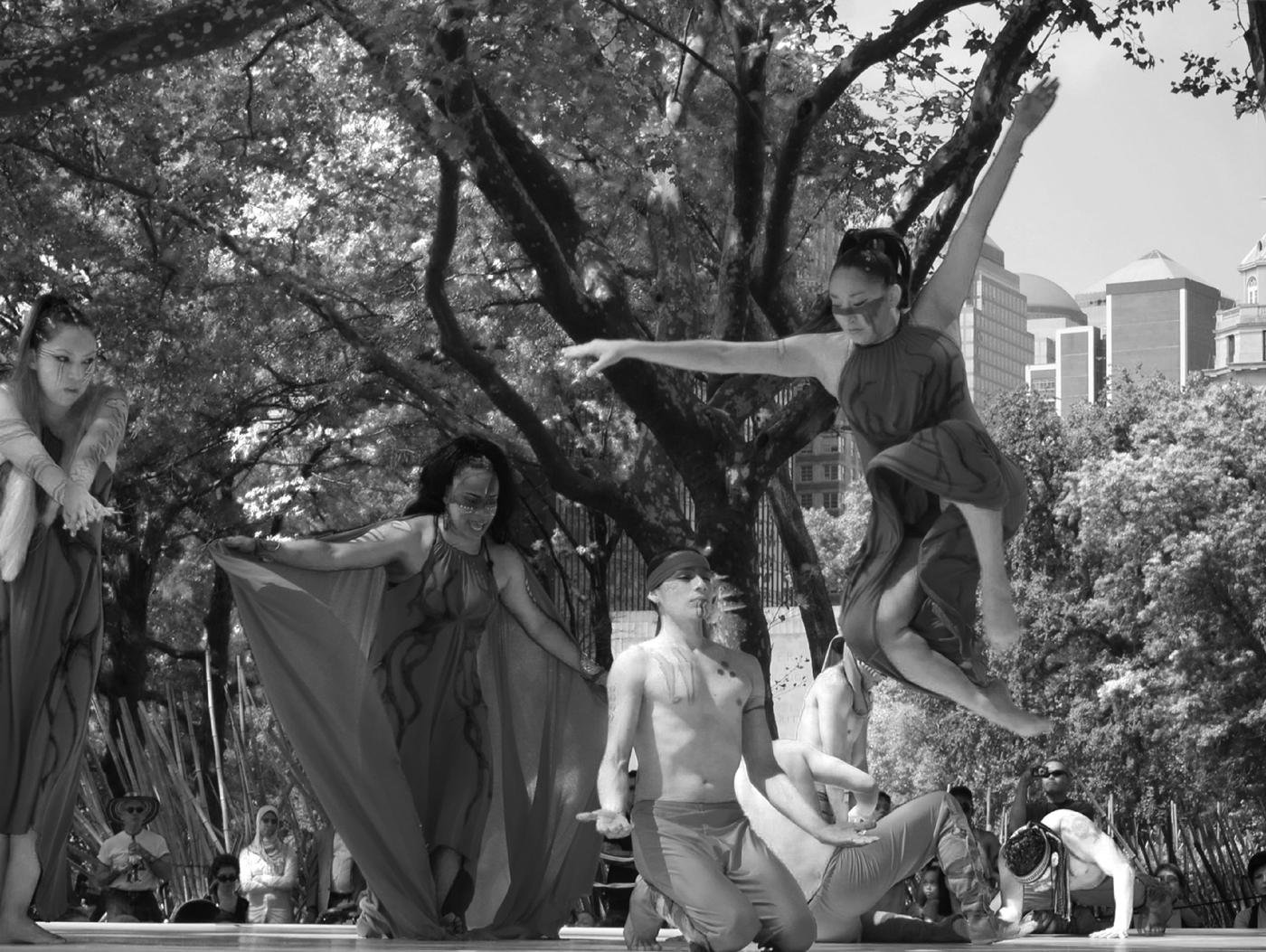
The Creation Story of Walking at the Edge of Water
Photo Essay Design by Cara Mumford
… at the centre of the most relevant issue of our time, In her multifaceted diversity, is Water, guiding us towards learning about our planet, our spirit, ourselves …”
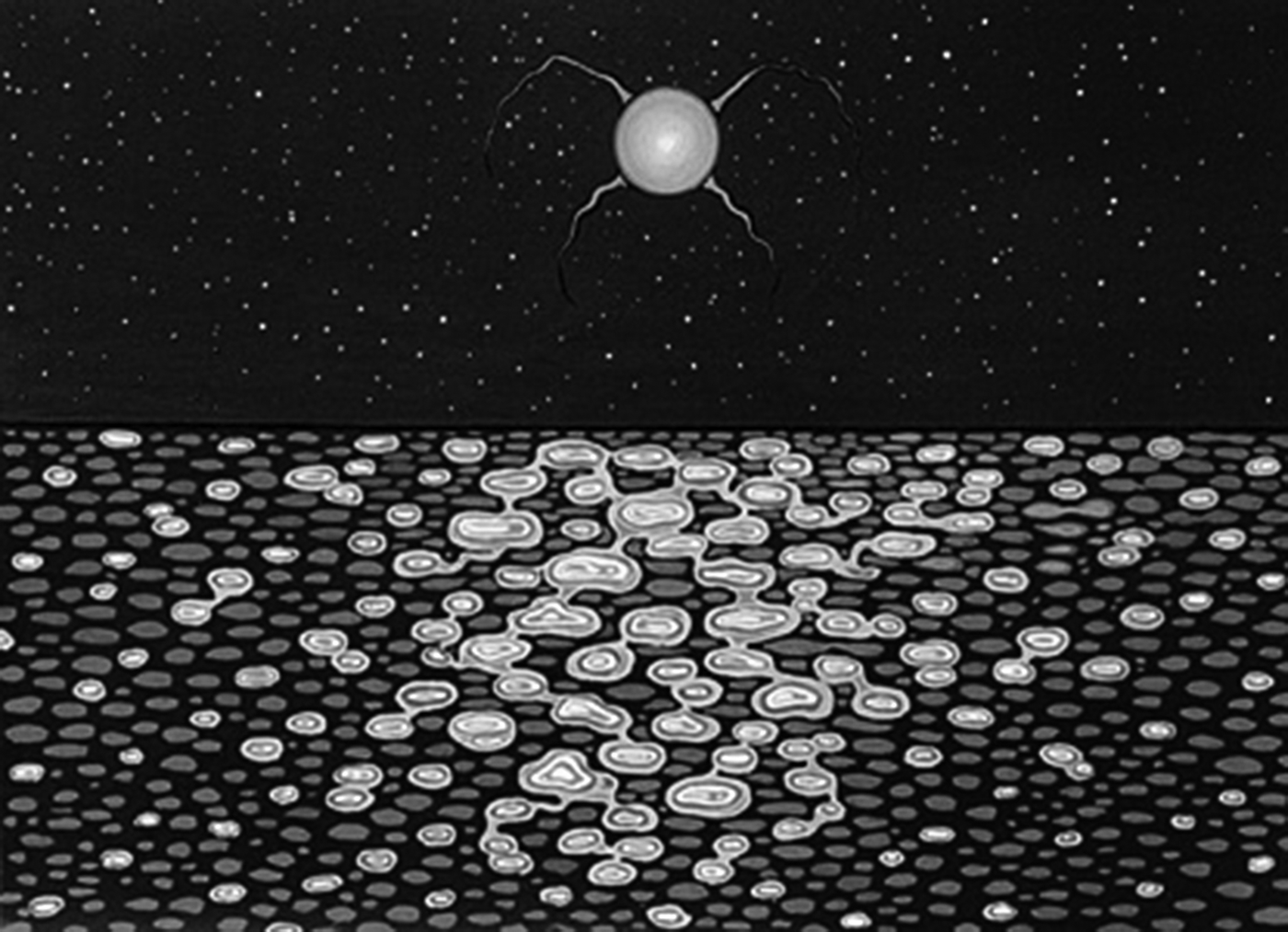
—Rulan TangenWiky Bay from Mary's Tipi, 1997. Acrylic on canvas, 24” × 30” by Christi Belcourt (www.christibelcourt.com).

Dr. Leanne Simpson, in her book Dancing on Our Turtle's Back (Reference Simpson2011a), writes “In Nishnaabeg thought, resurgence is dancing on our turtle's back; it is visioning and dancing new realities and worlds into existence.” The creation story of Walking at the Edge of Water was informed by the AnishinaabegFootnote 1 process of Naadmaagewin, working with Anishinaabeg Grandmothers through Aadizookaan (ceremonies, traditional teachings) and Debaajimowin (ordinary stories, personal stories, histories) (Simpson Reference Simpson2011a). New realities and worlds were envisioned and danced into existence during a journey that took place in Nozhem First Peoples Performance Space at Trent University; the journey began in 2011with student investigations that led to the creation and production of a work-in-progress. This work developed into a site-specific work in 2012 and resulted in the creation of a major new work that has since performed in Santa Fe, New Mexico twice (in 2012 and 2013) and toured to New York City and New Zealand (both in 2013).
Platiality: Nozhem First Peoples Performance Space
Nozhem is the vision of Elder and Grandmother Edna Manitowabi,Footnote 2 supported by the Department of Indigenous Studies at Trent University, and seven First Nations in this region, Nogojiwanong … the place at the foot of the rapids, where the ancestors sing (otherwise known as Peterborough) in southern Ontario, Canada. The First Nations include six Michi Saagig Nishnaabeg territories and one Mohawk territory. In Anishinaabemowin (the Ojibwe language), Nozhem is the name for the female bear and Edna chose Mkwa (the Bear) to represent the theater because she embodies the characteristics of transformation, balance and knowledge, which are essential components to Indigenous ways of knowing.
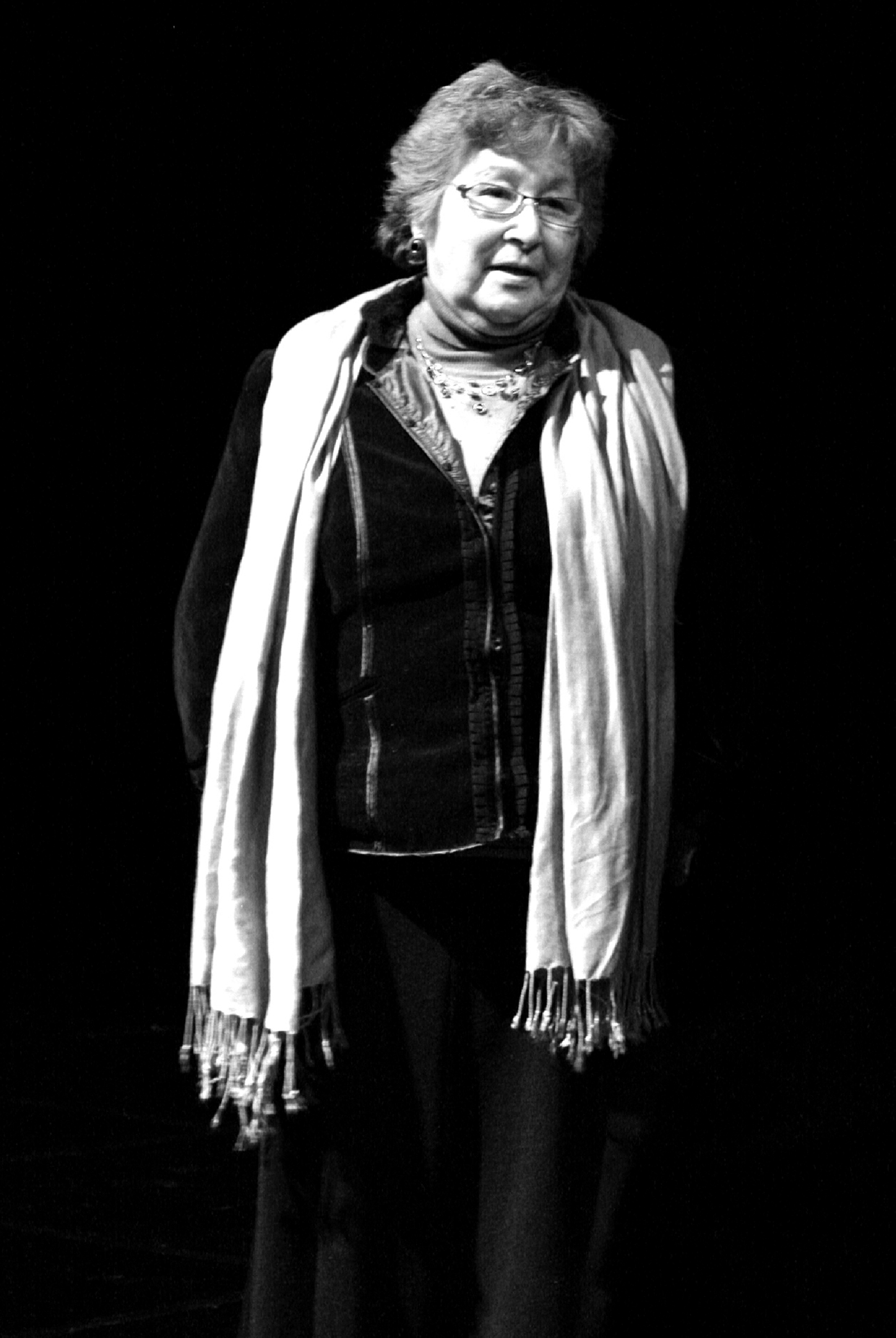
Edna Manitowabi at Anishinaabe Maanjiidwin X: Naabin Waabinong (Look to the East) … when the night meets the day, March 24, 2012. Photo: Wayne Eardley.
My role as Canada Research Chair (CRC) was to animate Nozhem to become an innovative international Indigenous center of creativity. I pursued my research objectives through a combination of programming professional Indigenous performance activities in Nozhem, while providing a creative and safe environment for regional artists and a community of learners at Trent. The Indigenous Studies department, through Indigenous Performance Initiatives (IPI), celebrated the opening of Nozhem with Spiderwoman Theater's Persistence of Memory in the fall of 2004. Nozhem has since become a centre for living research to investigate traditional Indigenous performance practices while creating and/or co-producing contemporary original works merging cultural history with current concerns. To initiate programs, I called upon numerous Indigenous artists and traditional performance specialists from this region and around the world – those who have the knowledge of Indigenous performance traditions and have worked consistently for the perpetuation of these practices. Nozhem is the first performance space of its kind at a Canadian university.
My research in Nozhem was inspired by the Habima Theatre, founded in Moscow in 1917 following the revolution. I was introduced to the Habima Theatre in the 1970s, while studying in New York City. Harold Clurman, founding director of the Group Theatre, said of Habima, “This is a story of a vision, of a dream that became a reality.” He also wrote, “Two goals beckoned its earliest members. One was the need to create for the theatre a new and vital form. . . . The other was the desire to recreate among the Jewish people an awareness of their identity, of the majesty of their history, and of the lyric grandeur of their language” (Clurman Reference Clurman, Raikin, Gross and Soref1957, n.p.).
During my first five-year term as CRC at Trent (from January 1, 2004 to December 31, 2008), I established Indigenous Performance Initiatives (IPI), a research advisory council and collective to fundraise for professional artists programs. The council/collective included Elder and Professor Emeritus Edna Manitowabi and regional artists Joeann Argue, Barb Rivett and Paula Sherman. The mandate was and is to address Indigenous community issues of transformation and nation building, with Indigenous performance practice as a strategy for the transference of Indigenous knowledges, languages and cultures to future generations.
During my second five-year term as CRC (from May 1, 2009 to April 30, 2014), through my work as artistic director of Nozhem and as artistic producer of IPI, as well as program director of Indigenous Performance Studies (IPS), I refined my research goals, now redefined as “Naadmaagewin … The Art of Working Together in Our Communities.” This marked a new stage in my research and signified that programs initiated at Nozhem during my first CRC term had been successful in inspiring regional performance communities.
Naadmaagewin … The Art of Working Together in Our Communities
Research undertaken in the field of Indigenous performance addresses new and innovative ways of conducting research. During my second term, two significant projects were created; each developed over a three-year period. The first project, Walking at the Edge of Water, enacted a new working model for living history research projects, based on the concept that the land base is critical to the language and text; and stories that emerge from oral traditions are expressed in a contemporary collective memory of place, regionality and identity. In the words of Elder Doug Williams from Wshkiigimongaki (Curve Lake First Nation): “It is up to each new generation to reinterpret and to breathe new life into our teachings” (Simpson Reference Simpson2011b, 3). Re-creation stories in relation to water, plants and the land were gathered and then translated into movement, spoken-word and song. Weaving these stories together brought into focus the importance and urgency of sustaining our water. “(This) cycle of creation—destruction—re-creation within Nishnaabeg thought … sets the stage for interpretation of re-creation as a new emergence or resurgence” (Simpson Reference Simpson2011a, 68).
Naadmaagewin proceeded with a refined intention: the recognition of Indigenous performance as a medium for the process of restoring Indigenous cultures and languages. In the words of playwright Monique Mojica, we would be “deconstructing the house of colonization” through the process of “creating art that returns to the site of cultural origin” (Mojica Reference Mojica2013, 6). During the second term, the process that grounded the research was the production of stories of this land and of the ancestors, a process that documented a regional journey of Indigenous people's survivance, restoration and resurgence. In this context, learning becomes reality based, concrete and tangible.
This creation project built on years of work in regional communities to build engagement and sensitivity to local needs and issues. It also models the research methodology of Naadmaagewin, bringing senior Indigenous artists to work together with regional elders, performers, youth and their families in creative collaboration with local collectives and organizations. Thus, the final outcome of the project reflected a hybrid of community engagement, honouring art and environmental work already in the region, as well as regional artists with guest artists from Canada and international artists from the United States and Mexico, all coming together to create original work on behalf of the act of clean water.
Beginning at the Beginning …
When I arrived at Trent in January 2004, I had just completed eight years (1995–2003) as the artistic director of the Aboriginal Arts Program, a partnership negotiated by the Aboriginal Film and Video Arts Alliance (AFVAA) with the Banff Centre for the Arts’ Vice-President Carol Phillips. The partnership gathered Indigenous artists to support the creation of national Indigenous arts movements across Canada with the theme of Self Government in the Arts. When I left Banff in 2003, we had just completed two major new works: BONES: An Aboriginal Dance Opera, directed and choreographed by Colombian artist Alejandro Ronceria, and Miinigooweziwin … the Gift, directed and choreographed by Zapotec artist Georgina Martinez from Mexico.
During my tenure at Banff, I initiated the Aboriginal Dance Program in 1996, a summer program for Indigenous professional and emerging professional dancers, which is how I first met Rulan Tangen and Jacqueline Shea Murphy. Although my background was theatre, the need for Aboriginal dance training that was culturally specific and created a continuum between traditional and contemporary dance had been identified as a priority by Aboriginal dancers at one of eight provincial artists visioning circles that were separated by disciplines. The circles were held at the Association for Native Development in the Performing and Visual Arts (ANDPVA) in Toronto, Ontario in 1992. As a result of the Aboriginal Dance Program at Banff, dancers who participated in the program were inspired to establish nine new contemporary Indigenous dance companies across Canada that were not there before. The Aboriginal Dance training program was inspired by Cree Elder James Buller-ba,Footnote 3 the first executive director of ANDPVA, who established the Native Theatre School (NTS) in 1974. Although NTS was only a summer program, graduates who returned each year inspired an Indigenous Theatre movement across Canada.
In May 2004, I was invited to present at Red Rhythms: Contemporary Methodologies in American Indian Dance, the first Native dance conference in North America, held at the University of California, Riverside, initiated by Jacqueline Shea Murphy. Most of the featured dancers, choreographers and presenters were artists that I had worked with when I was artistic director of the Aboriginal Arts Program at Banff, and who have since started their own companies and were creating new dance works. The conference presented a unique occasion to assess the current needs of both established and emerging leadership in Indigenous dance performance across Canada. Almost all identified the need for co-productions, production facilities and partnerships to increase both the resources and personnel required to bring a new work to full production.
When I returned to Trent, I persuaded the department to hire Daystar Rosalie Jones to create a dance program in the winter semester of 2005, which has expanded and continues to this day. And in the winter semester of 2006, IPI co-produced and presented Evening in Paris (with Michelle Olson) and Iskwew (with Geraldine Manossa), two new works that had been presented at Red Rhythms in their early stages of development. Creation-based dance collaborations became a regular part of IPI's annual programming at Nozhem.
Guest Artist Residency: Walking at the Edge of Water, 2011
In November 2010, Tangen had just completed a four-year cycle with her company, Dancing Earth, touring a major new work, Of Bodies of Elements, which played to critical acclaim across the United States. While Tangen was on tour, Anishinaabeg grandmothers in the United States who participate in the Mother Earth Water Walks around the Great Lakes requested that Tangen create a work about water. Coincidentally, in the summer of 2010, Tangen had been invited by IPI to come to Trent to work in collaboration with students in the Indigenous Performance Studies (IPS) program. As a result, in February 2011, she arrived at Trent to work on the collaborative creation of a new work, Of Bodies of Water.
Of Bodies of Water became Walking at the Edge of Water, as Tangen began a three-week intensive research and development residency working with seven Indigenous and culturally diverse studentsFootnote 4, who were also emerging professional performers. Her work offered an exemplary paradigm, with contemporary Indigenous dance/ theatre practice as a catalyst that reflected balanced integration within an ecological cultural environment.
Walking at the Edge of Water was presented as a work-in-progress at the ninth annual student production Anishinaabe Maanjiidwin … the Art of Performing in Nozhem, March 2011.
The residency was organized for Tangen to engage with regional artists and communities connected to IPI—this included elders, artists, students, youth and their families—through workshops, presentations and symposia. The project drew inspiration from the Anishinaabeg women and men of this territory including cottagers who, every Mother's Day, walk around a different lake in this region to raise awareness about the state of the waters in our homelands. Taking place in Michi Saagiig Nishnaabeg territory, these communities worked together by drawing on the traditional stories of the land from regional elders and traditional knowledge holders; weaving these stories together to bring into focus the importance and urgency of sustaining our water.
Thus the groundwork was laid with ideas from regional artists and traditional language and performance specialists, and together, they planted seeds that nurtured a vision that grew into a three-year cycle. Reflecting on this initial residency, Tangen writes, “It was a truly serendipitous confluence… I found myself in the home region of the women who walk the Great Lakes to bring awareness to us all of the sacredness of the water. I give thanks to Josephine Mandamin who initiated the first Women's Water Walk around the Great Lakes and asks us all to ‘look after the water for the next generation—for the unborn’” (Tangen Reference Tangen2011, 2).
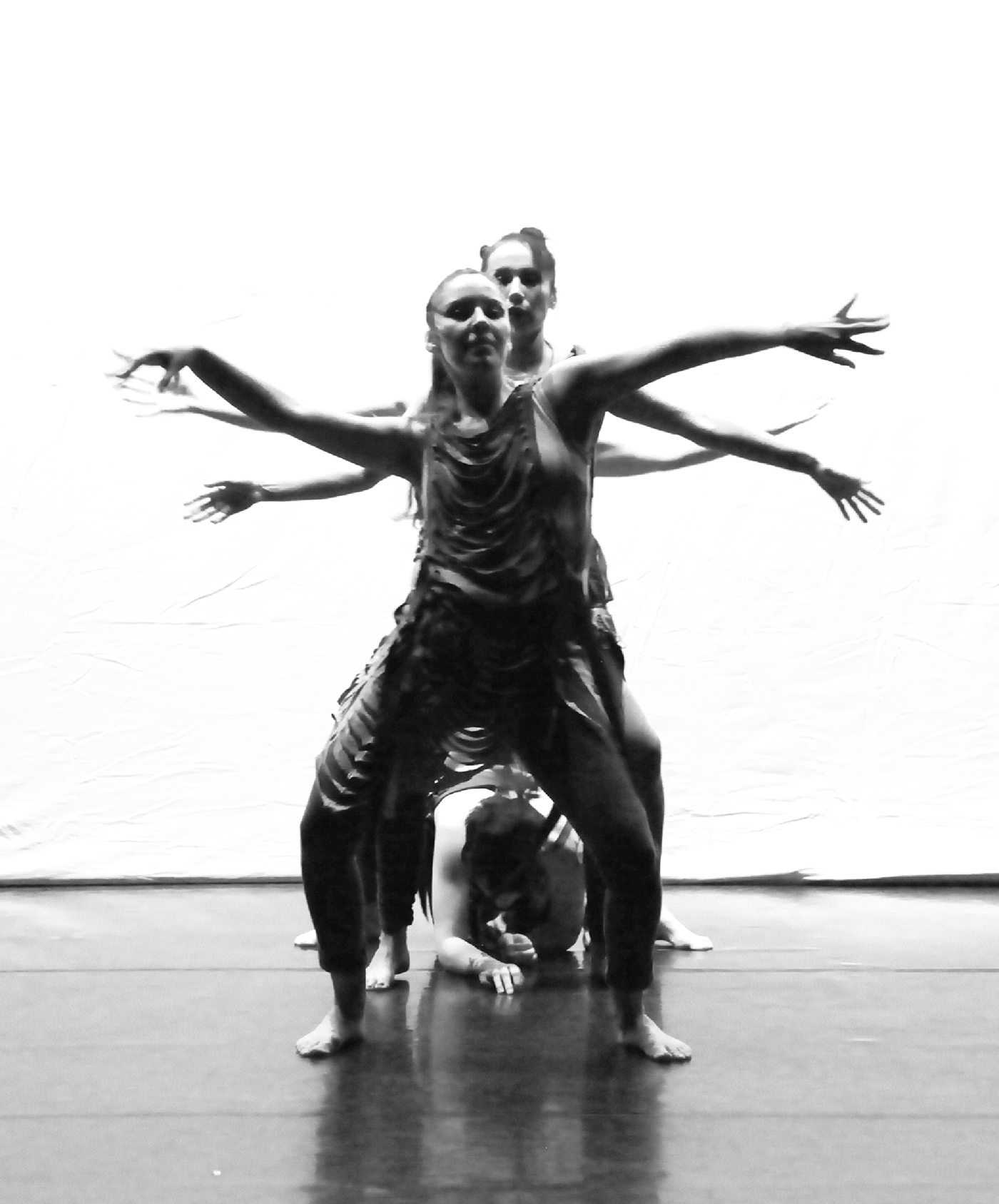
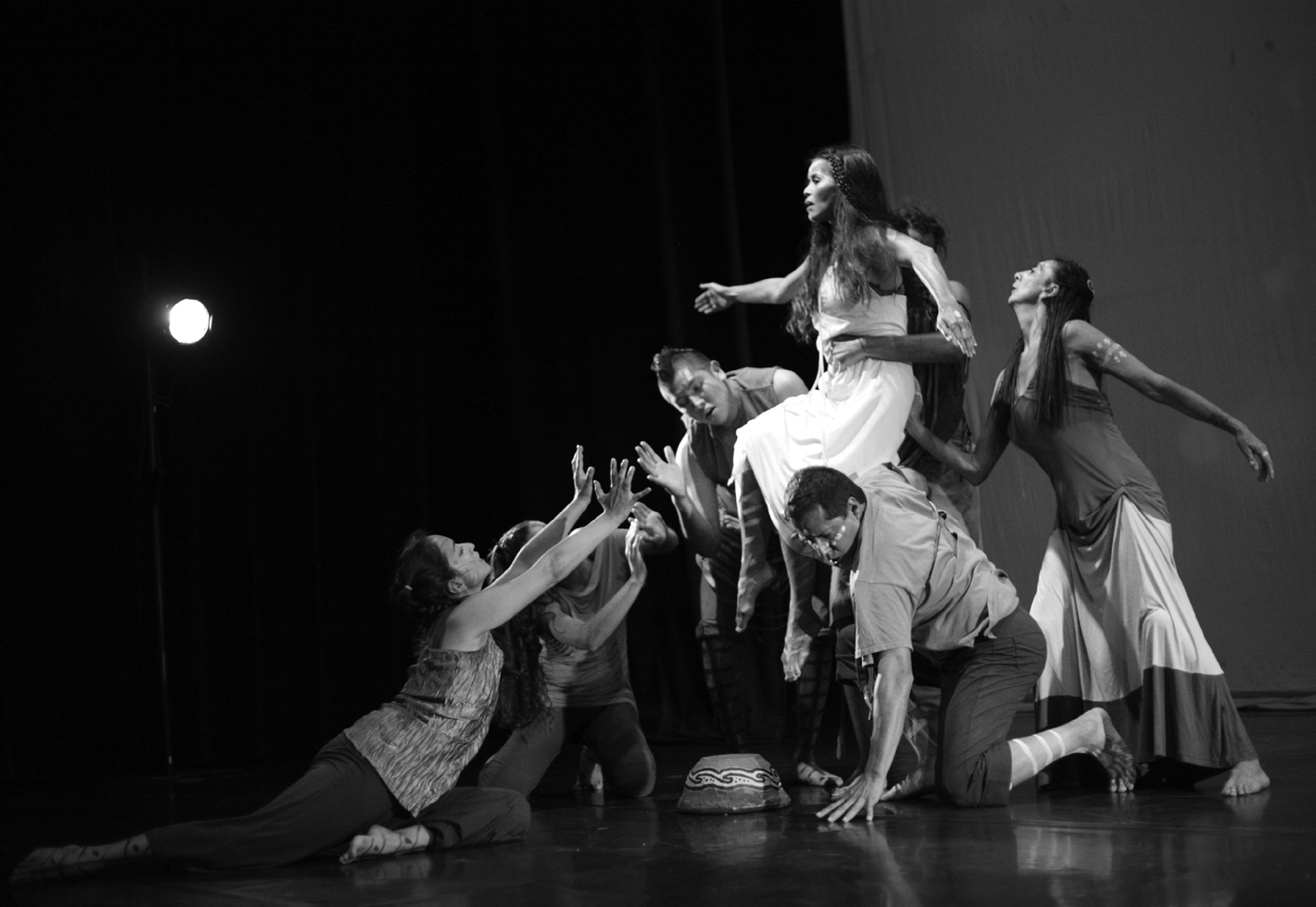
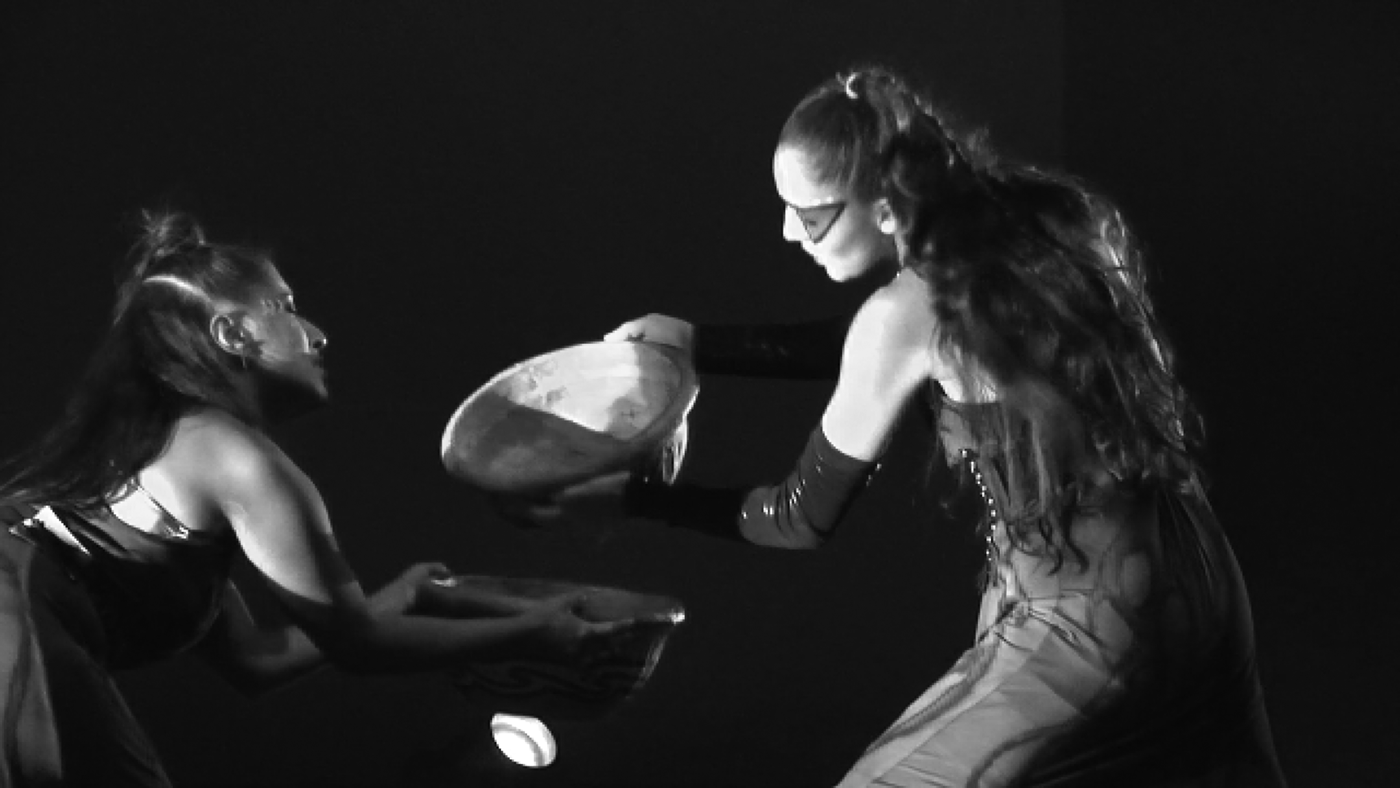
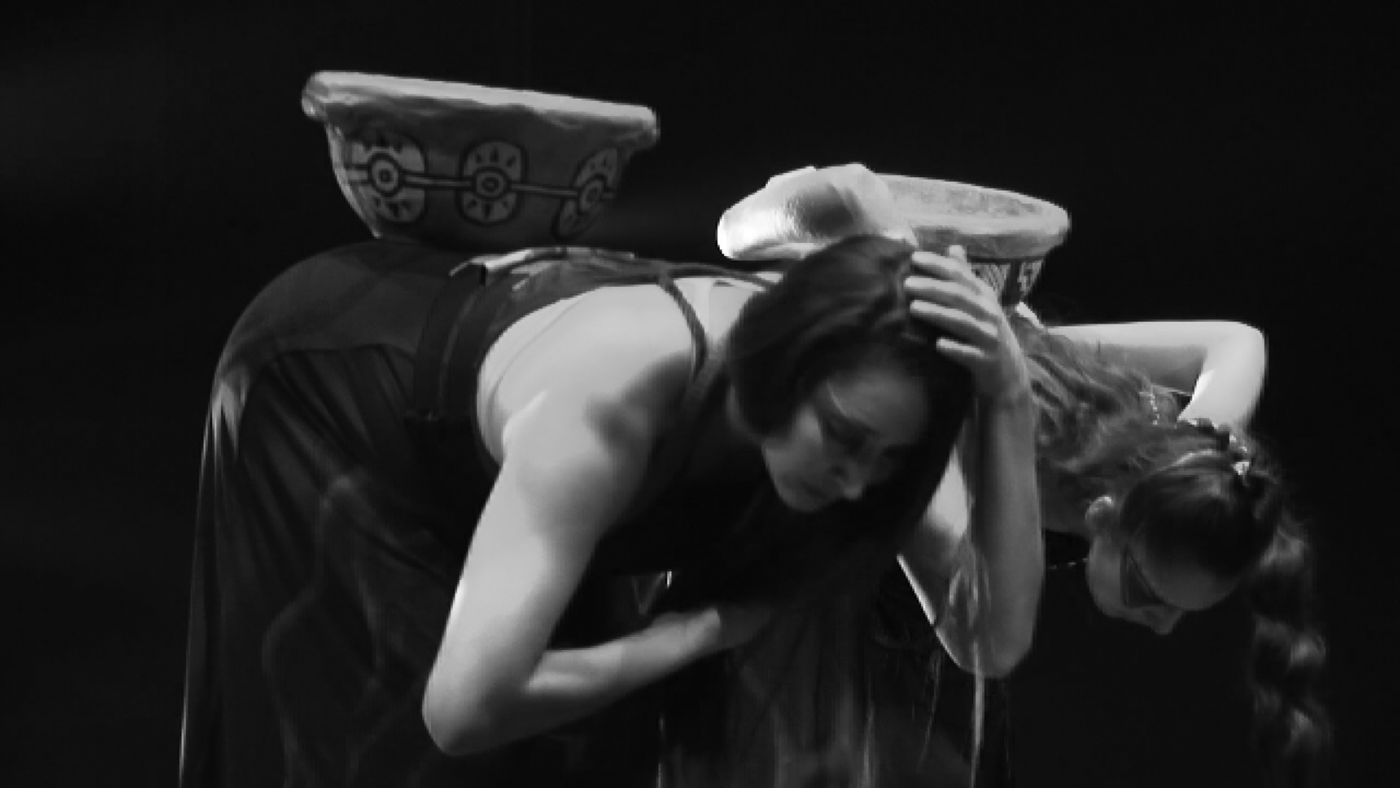
Anishinaabe Maanjiidwin IX: Walking at the Edge, of Water, Scene 6: Water Carriers … caring for the unborn. Presented by Indigenous Performance Initiatives in association with the Department of Indigenous Studies. Collaborative Creation directed and choreographed by Rulan Tangen, artistic director DANCING EARTH: Indigenous Contemporary Dance Creations; performed by Sandra Lamouche, Lianna Tootoosis, Anna Tennent-Riddell (standing behind Lianna Tootoosis, not seen), and Jane Atkinson, coming through, being born; at NOZHEM: First Peoples Performance Space, March 17–18, 2011. Photo: Wayne Eardley.
The Mother Earth Water Walkers
Traditionally, the Nishnaabeg people consider water to be our relative. The Elder and Grandmother who inspired Walking at the Edge of Water was Josephine Mandamin. She, with other Anishinaabeg grandmothers, women, men, and children, took action regarding the contaminated water issues in Aboriginal territories across Canada by walking the perimeter of the Great Lakes. Along with supporters, they walked around Lake Superior in the spring of 2003, around Lake Michigan in 2004, Lake Huron in 2005, Lake Ontario in 2006, Lake Erie in 2007, Lake Michigan in 2008, and the St. Lawrence River in 2009. To highlight the immediacy of the water issue, just as the group passed through Cape Croker in 2004, the community had been put under its fifth boil water advisory. According to the Assembly of First Nations, “There are 114 First Nations communities across the country under Drinking Water Advisories and 49 First Nations with water systems classified as ‘high risk.’ Some of these communities have been under a Drinking Water Advisory for 10 years or longer” (Assembly of First Nations 2010, n.p.).
In 2015, the route of the walk retraced the original migration of the Anishinaabeg people, which occurred more than a millennium ago, from the mouth of the St. Lawrence River to Madeline Island located in Lake Superior. As Mandamin notes, “This journey with the pail of water that we carry is our way of Walking the Talk. We don't really have to say anything. Just seeing us walk is enough to make a person realize that, yes; we are the carriers of the water. We are carrying the water for the generations to come. Our great grandchildren and the next generation will be able to say, yes, our grandmothers and grandfathers kept this water for us!!” (Mandamin Reference Mandamin2005, n.p.).
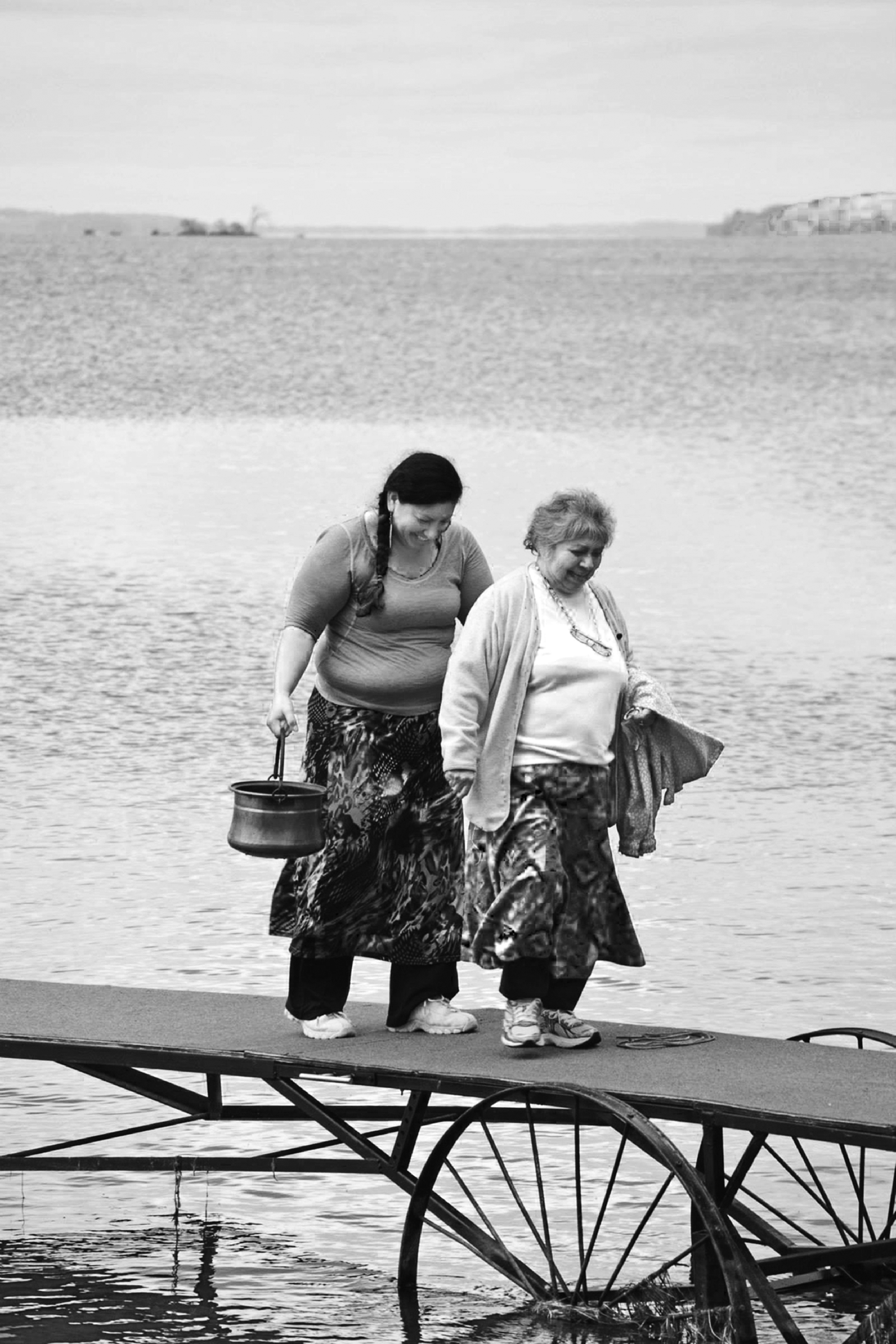
Shirley Williams and Liz Osawamick collecting water at Pamaadashkodeyang (Rice Lake) for the 2013 Water Walk. Photo: Georgie Horton Baptiste.
Mandamin also inspired Nibi Emosaawdamajig … Those That Walk for the Water. According to the Nibi Emosaawdamajig website, “The Kawartha Water Walks in this region are the vision of Elder Shirley Williams and Liz Osawamick. Mother's Day weekend in May is the symbolic date for the Water Walks. It is a fitting choice because as we pay homage to our mothers and grandmothers, we also remember and honour our Earth Mother and her life-giving water that nourishes and sustains all creation.”
Zhishodewe … Being at the Water's Edge, 2012
The second research phase of Walking at the Edge of Water at Trent became Zhishodewe … Being at the Water's Edge, the overall title for all IPI's activities and performances presented throughout the three-week residency in June 2012, so that the title of Walking at the Edge of Water would remain with Tangen's company. The intention of the research was to activate a goal to intensify engagement with regional issues and increase community involvement by creating a collaborative space where traditional knowledge and contemporary artistic practices came together to further expand our understanding of our human relationship with the natural world. The focus was to advance the creative process explored in the student investigations in 2011, with the underlying principle of ‘flexibility’ to be the working mode, as reflective of the Zhishodewe thematic of water. Our cultural consultants included Midewiwin grandmothers Shirley Williams and Liz Osawamick, and included Dr. Leanne Simpson. The performances of Zhishodewe included seven senior and emerging professional artists—dancers and choreographers, from seven different national and international Indigenous nations.Footnote 5
There are nine independent Indigenous performance collectives in the Peterborough region that I am aware of. Six of these collectivesFootnote 6 (established since 2004, when the work in Nozhem began) contributed to the final production of Zhishodewe; in addition to the contributions of four regional organizations: the Art Gallery of Peterborough, Public Energy, Nibi Emosaawdamajig … Those that Walk for the Water and the Sacred Water Circle. These contributions and collaborations are an example of Naadmaagewin at work.
Zhishodewe consisted of five components—three performances, a visual art exhibition and an intergenerational community workshop series, all working within the space of Nozhem and two Indigenous gardens. The performances included: gaabinjigabaa'aang … where we came ashore, a site-specific dance performance that took place in the space of ayaandaagon,Footnote 7 an Anishinaabe garden at the Art Gallery of Peterborough (AGP); the performances of the intergenerational workshops, which took place in the Gitigaan gardens; and Zhishodewe … Being at the Water's Edge, which took place in Nozhem. The linked performances in these different spaces drew on local Anishinaabeg stories of water, as well as dance inspired by stories from the Narragansett people and the people of the Southwest.
William Kingfisher, associate artistic producer of IPI, curated the multi-faceted visual art exhibition, jiigbiig: at the edge where the water and the land meet, at the AGP. He writes,
Jiigbiig is an anishinaabeg word that refers to an anishinaabeg creation story where humans crossed the edge between the water and the earth to leave the water and live on the land … it also refers to the edge where the water and the land come together—thought of as a metaphor where two worlds come together. I feel we are again standing at that edge—in the contemporary world clean water has come to be a vitally important issue.
(Kingfisher Reference Kingfisher2012, n.p.)Kingfisher was also a member of the O'Kaadenigan Wiingashk Collective (OKW) that, in partnership with Public Energy, produced the Ode'min Giizis (Strawberry Moon) Festival in Nogojiwanong each year, during the summer solstice. Kingfisher was invited to guest curate an exhibition to open the fifth annual Ode'min Giizis Festival in June 2012 and he proposed that Tangen create a dance/performance ritual by Zaagigaans (Little Lake) on the grounds behind the AGP, in collaboration with jiigbiig to celebrate the opening of the festival.
Zhishodewe created a collaborative space where Indigenous knowledge, cultural research and contemporary artistic practices came together to further expand our understanding of our human relationship with the natural world. The intention of the residency this year was to “plant seeds”; gathering stories in relation to water, plants and the land and translating them into movement. Kingfisher explained, “The site chosen for this performance is a traditional portage site, a place where the ancestors came out of the water to take refuge along the journey; this site connects us with the Anishinaabeg creation story of emerging out of the water …” He further described the process,
The project began with the gathering of stories from Elders, Edna Manitowabi, Shirley Williams, and Marrie Mumford (stories by Marrie Mumford and Shirley Williams were also included in the exhibition).… Water features prominently in many traditional stories—in the earthdiver creation stories and in the long migration stories where the anishinaabeg followed various rivers and lakes throughout the Great Lakes … (Kingfisher Reference Kingfisher2013b, 2)
In this exhibition I begin with a creation story, one collected by Basil Johnston and included in his book titled Ojibway Heritage. I included this story for a number of reasons. The first is that I wanted to honor the ancestors that have come to and enjoy this place. The site of the Art Gallery of Peterborough was once a portage site and, for me, because of this contains within it the reference to the act of coming out of the water—as in the creation story … (Kingfisher Reference Kingfisher2012, n.p.)
Behind the Art Gallery of Peterborough … if you look to the East you would see a grassy area that slopes down into the water of Zaagigaans … a place to wait, to think, to remember the previous journey and plan for the next one. (Kingfisher Reference Kingfisher2010, 3)
Woven into the fabric of Zhishodewe … Being at the Water's Edge is “gaabinjigabaa'aang … where we came ashore,”Footnote 8 a site specific dance performance inspired by a traditional Anishinaabeg re-creation story, following the flood at the end of the first world. Author Basil Johnston-baFootnote 9 describes the destruction:
Disaster fell upon the world. Great clouds formed in the sky and spilled water upon the earth, until the mountain tops were covered. All men died. All the land creatures perished. All the plants were covered by the sea. Only the water animals and birds and fishes lived on. What was once earth was a huge unbroken stretch of water whipped into foam and waves by the ferocious winds. The world remained at sea for many generations.
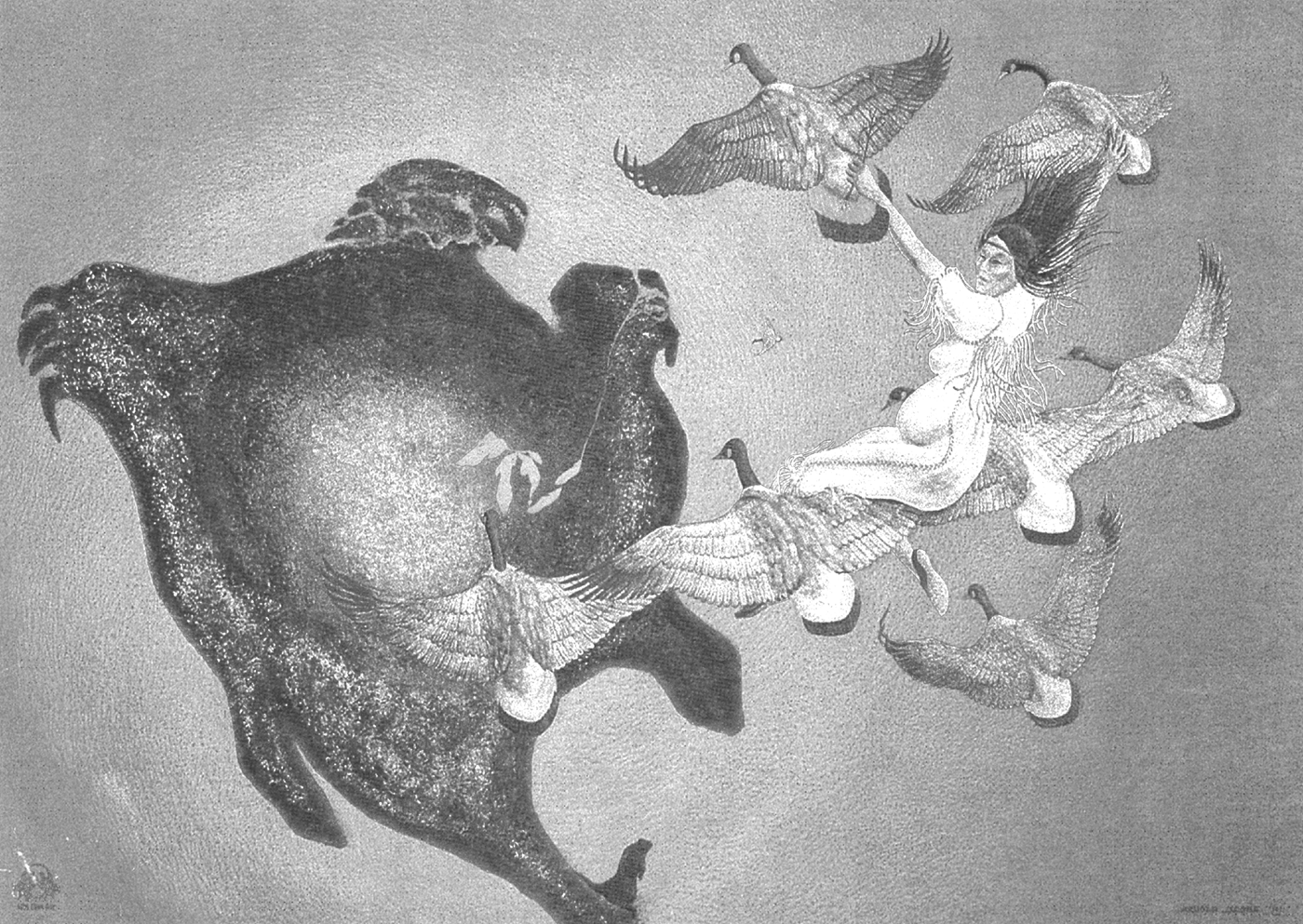
(Johnston Reference Johnston1976, 13)Sky Woman Descending on Great Turtle Island, 1981. 30” × 20” lithograph by Arnold Jacobs available at Two Turtle Iroquois Fine Art Gallery (http://www.twoturtle.ca).
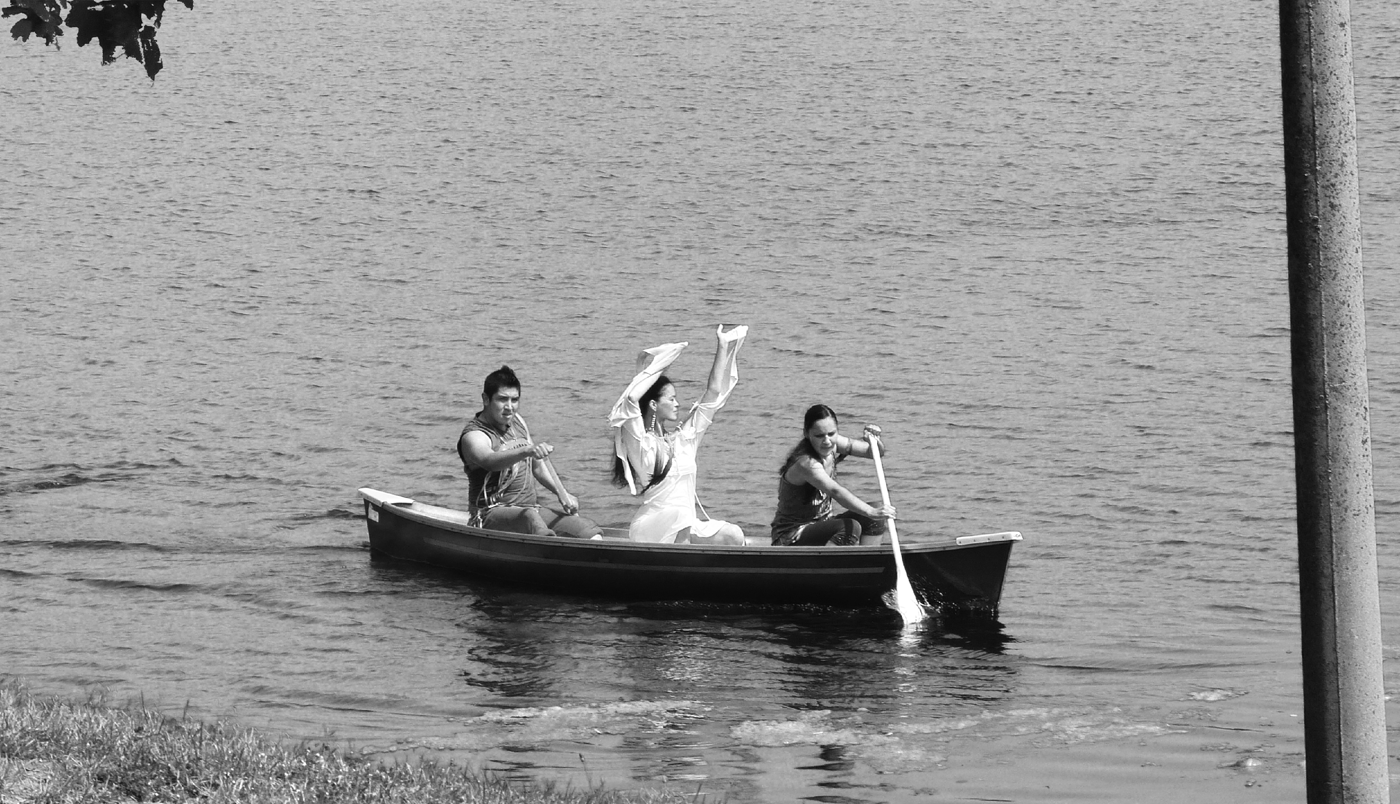
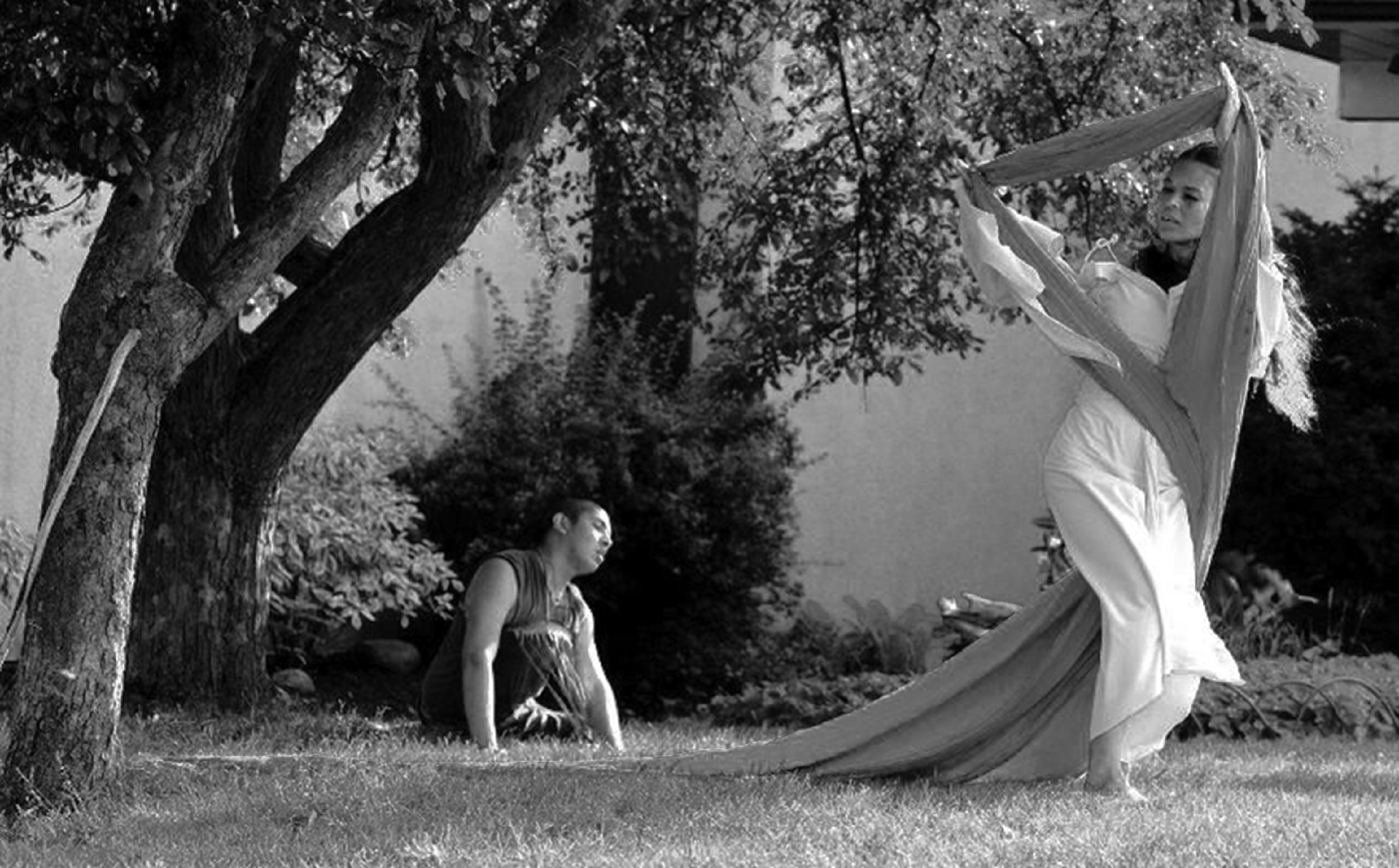
gaabinjigabaa'aang …where we came ashore, produced by Indigenous Performance Initiatives, performed at the opening of the Ode'min Giizis (Strawberry Moon) Festival presented by O'Kaadenigan Wiingashk and Public Energy at the Art Gallery of Peterborough on the banks of Zaagigaans (Little Lake) at Nogojiwanong (Peterborough) on June 20, 2012. Featuring Waawaate Fobister, Rulan Tangen, and Sandra Lamouche. Photo: Renata Sadowska.
Site-Specific Performance: gaabinjigabaa'aang … where we came ashore
On the evening of the opening of the Ode'min Giizis Festival, before the performance begins, Kingfisher observes,
… There are around two hundred of us gathered at the old portage site … in the late afternoon on a hot June day. We know that our stories of rituals are grounded in our relationship with the land, the plants, the animals and with the ancestors. We know this is not a search for origin but more about actively maintaining and using our traditional stories and perspectives in today's world. We know these stories are about being in the world as it exists in the present.
We have planted and tended the gardens
We have offered gifts and prayers to those who will watch over our work
We have made nourishing food for all to come and enjoy
We have honoured those teachers who have come before us (Kingfisher Reference Kingfisher2013a, 6)
The evening begins with a young woman walking along the edge where the water and the land meet, with copper plates attached to her feet, looking for ancestral “tracks” in the landscape while leaving her own and recording them as prints. We are imagining a landscape being written, as she moves through it…. A part of the Creation Story is being performed. (Kingfisher Reference Kingfisher2013a, 22)
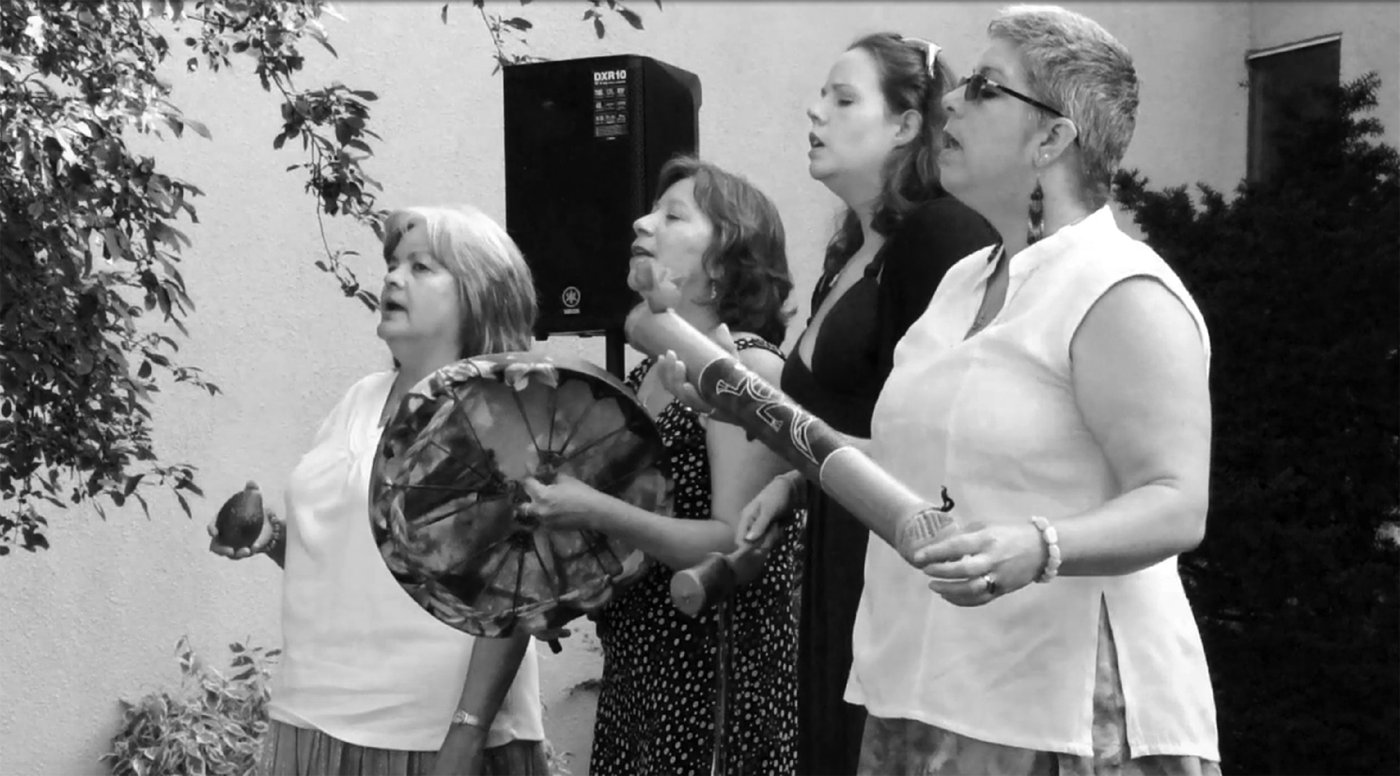
As she stops, looking East over the water, the harmonies of “Ghost Dancer” begin, a song written and performed live by The Unity Singers, calling on ancestral spirits connected to this land.
Unity Singers performing “Ghost Dancer” at gaabinjigabaa'aang … where we came ashore as the canoe crosses the lake. Barb Rivett, Brenda Maracle O'Toole, Heather Shpurniarsky, and Joeann Argue. Still from video: John Abrams.
Ghost DancerFootnote 10
As they sing, the woman in the present (Vanessa Dion Fletcher) envisions a woman from our collective past—Giizhigokwe… Spirit-woman—calling her to cross the water. Giizhigokwe (Rulan Tangen) and the sky beings (Sandra Lamouche and Waawaate Fobister) come across the waters of Zaagigaans in a canoe to cross over the edge of the water and onto the shore.
Re-creating the Anishinaabeg Re-Creation story as told by Johnston-ba, “Eventually [the water beings] persuaded a giant turtle to rise to the surface of the waters and offer her back as a haven…” He describes further how, when Giizhigokwe “has settled on the back of the turtle, she asked the water animals to get some soil from the bottom of the sea” (Johnston Reference Johnston1976, 14).
Johnston-ba continues with the story of the earthdivers, describing each of the water animals' actions in detail, as they try and fail to retrieve a handful of earth from the bottom of the sea. Finally, he writes, muskrat succeeded. Placing the earth on the turtle's back, Spirit-woman:
…began to sing. The animals danced in a clockwise circular fashion and the winds blew, creating a huge and widening circle. Eventually, they created the huge island on which we live, North America. (Simpson 2011a, 68)
…after the soil was painted on the turtle's back…and the water subsided, the animal beings brought grasses, flowers, trees and food-bearing plants to the Spirit-woman. Into each she infused her life-giving breath and they lived once more. …Everything [that was destroyed] lived once more. (Johnston 1976, 14)
In Dancing On Our Turtle's Back, Simpson also writes about Naadmaagewin in both the Re-Creation story and the lives of Anishinaabeg people today, “In order to dance a new world into existence, we need the support of our communities in collective action.”
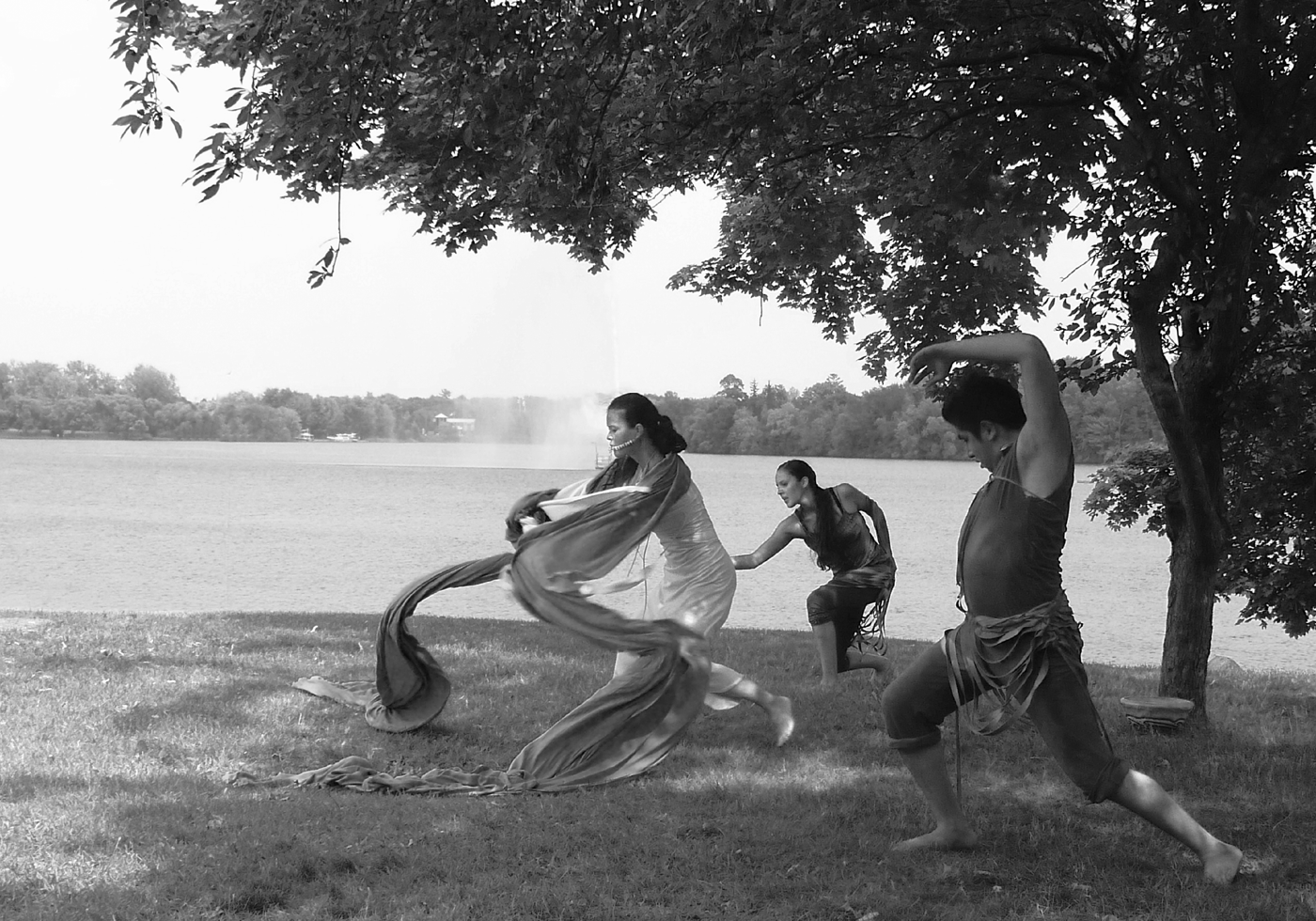
gaabinjigabaa'aang … where we came ashore, featuring Rulan Tangen, Sandra Lamouche, and Waawaate Fobister. Photos: Renata Sadowska.
gaabinjigabaa'aang … where we came ashore, featuring Rulan Tangen and Waawaate Fobister. Photos: Renata Sadowska.
In the jiigbiig catalogue, Kingfisher explains how another song, Salmon War Cry, came to be included in the performance. He writes, “The second [closing] song comes a different way. I have heard that Leanne Betasamosake Simpson is in Banff working on a new recording so I send her an email. She writes back telling me that her work is a spoken word/poetry piece about salmon called Salmon War Cry or Maajaamegos Nidizhinaakaz … My name is Salmon (literally the trout that leaves).” The performance ended with this spoken word piece which “imagines what it would be like to be free, to move as we need to through our natural lands,” written and performed by scholar and artist, storyteller and doctor of environmental science, Leanne Simpson.
Salmon War CryFootnote 11 Maajaamegos Nidizhinaakaz … My name is Salmon
“I wrote a spoken word piece around
salmon in which I imagined
myself as being the first salmon
back into Lake Ontario and
coming back to our territory.
The lift-locks were gone.
And I learned the route that the salmon would have gone in our language.
And so that was one of the ways I was trying to connect my community back to that story and back to that river system, through this performance.”
~ Leanne Simpson,
Dancing the World into Being:
A Conversation with Idle No More's Leanne Simpson by Naomi Klein
“To (the Mississaugas), the
Trent Severn Waterway
meant the loss of territory,
as the natural flow of the water
was artificially altered.
It meant the flooding of our
cemeteries and sacred sites,
and it meant the destruction of our
rice beds. Today, the lift locks act like a system of dams constricting and constraining and controlling
what the river can do.
The lift locks block and disrupt the
power of that flowing water with handcuffs and shackles, interfering with the cleansing, with bringing forth new life, and with the river's responsibility of sustaining the territory.
When the construction of the lift locks colonized an ancient travel route,
it also colonized the life-blood of
our first mother.”
~ Leanne Simpson,
Lighting the Eighth Fire
nishnaabemowin: bozhoo odenaabe is hello otonabee, shki maajaamegos ndizhinaakaz means my name is new trout that leaves (salmon), odenaabe is the river that boils and bubbles and beats like a heart, weweni means carefully, doodoom is a name for mother used by children, meaning “my breastfeeder”, kobade is link, great grandmothers, great grandchildren, chi'nibiish is lake ontario, saagetay'achewan is trent river, pimadashkodeyaang is rice lake, odenaabe is the otonabee river, gichi gaming is katchewanooka lake, atigmeg zaageguneen is clear lake, asin saagegun is stoney lake, jijaak is crane, migizi is eagle, pimizi is eel (Simpson Reference Simpson2013, 126).
The audience stayed and mingled in the ayaandagon garden into the early evening, long after the afternoon's performance. Kingfisher observed,
During the performance, the landscape has become a place for the unity of the people, the environment, the past and the present. Part of the creation story is performed and like our ancestors the community gathers, celebrating and sharing stories on this old portage site …
Rulan Tangen reflects on the performance saying that, “the trees and wind taught us the dances, and indeed the most powerful compliment from audience members was hearing how the dance made them see the land and water and trees and wind more vividly than they had ever felt before.” (2013a, 22)
Intergenerational Workshop Series: Babaamikawe … to go about making tracks
It was the Anishinaabe Elder Peter O'Chiese-baFootnote 12 who remarked that our Indigenous ancestors left “tracks” along trails across Turtle Island for subsequent generations to discover, work with, and to disseminate forward for generations that follow. This is the essential process that grounds us through the production of stories of the land and of our ancestors, and documents the journey of Indigenous people's survivance,Footnote 13 restoration, and resurgence, celebrating our capacity to continue to move forward.
In 2012, IPI's theme for programming was “Babaamikawe … to go about making tracks.” IPI took on the responsibility of taking our turn to leave our own tracks, “signs for the next generations so they can see, feel, hear, and understand how it is that the Indigenous peoples of this generation sought to understand this world and to transform it through their art forms” (Kingfisher Reference Kingfisher2012, n.p.). This theme was carried forward through an inter-generational community workshop series led by the Zhishodewe company after the site-specific performance. The workshops were for families from the collectives of Wii-Kendiming Nishinaabemowin Saswaansing… the Art of Learning Language in the Little Nest (coordinated by Simpson, Hilary Wear, and Christine Sy) and Baagaataa'awe … Passing the ball back and forth … Lacrosse (coordinated by Wear), for a total of 38 community participants. Wear was also the community workshop advisor, collaborator and coordinator, with support from Sheri Smith and Marnie Williams.
Zhishodewe… Being at the Water’s Edge, “Constellations: Sky Is Water” featuring Rulan Tangen as Gizhigokwe (Spirit Woman) descending on Turtle Island, with Norma Araiza, Waawaate Fobister, Javier Fresquex, Sandra Lamouche, Jerry Longboat, and Heryka Miranda. Photo: Esther Vincent.
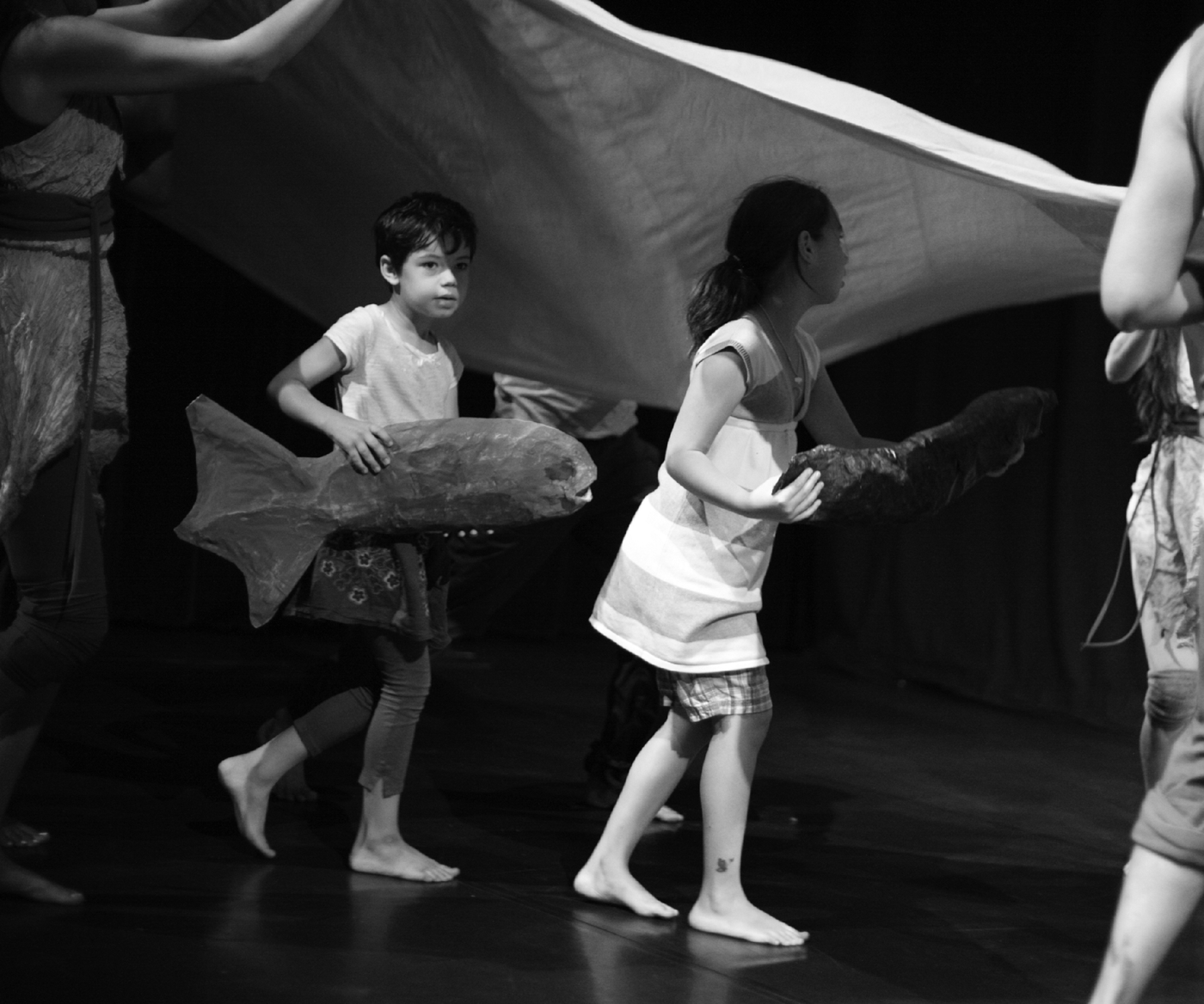
Odenaabe Sibi … the River that Beats Like a Heart, with families and youth from Wii-Kendiming Nishinaabemowin Saswaansing … the Art of Learning Language in the Little Nest and Baagaataa'awe … Passing the ball back and forth … Lacrosse, Liliana Osawamick and Minowe Simpson pictured here. Photo: Esther Vincent.
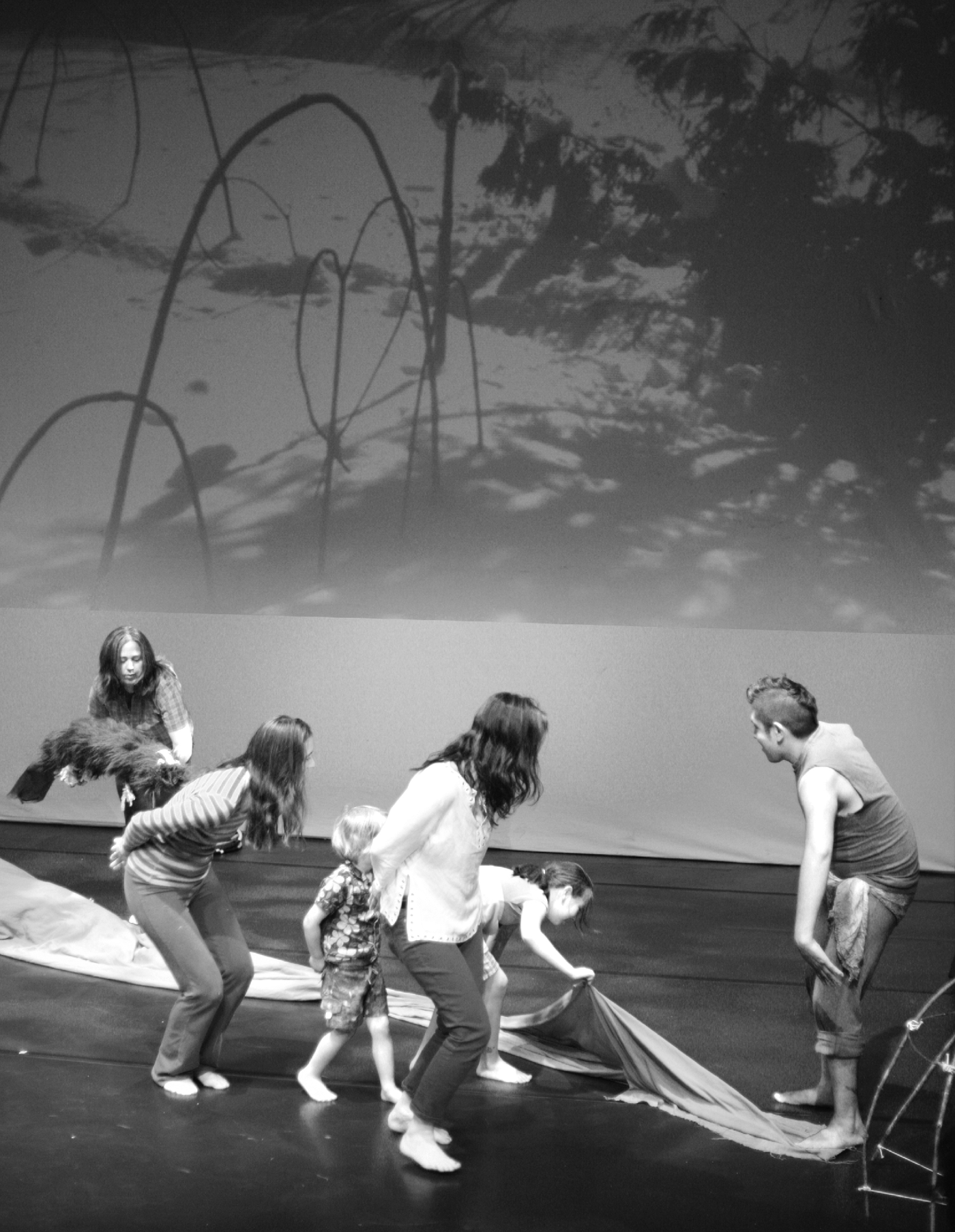
Niimd’win Amik-gamig … the Dance of the Beaver Lodge, with Hilary Wear, Cynthia Osawamick, Quinn Bayers, Kerry Bebee, Liliana Osawamick, Waawaate Fobister, and Javier Fresquez (not pictured). Photo: Esther Vincent.
These workshops included three-hour sessions held three times weekly to develop a community-based performance in the Gitigaan gardens, where the tipi resides in the Cedar Grove at Trent University; the consistent return of 38 participants surpassed our expectations. Regional youth and their families, worked with the Zhishodewe company of dancers as well as the creative and production staff. Tangen explained how, in the workshops, “They focused on stories, songs, dance and movement with words in Anishinaabemowin for the plants, animals, four directions, seasons, numbers, as well as cultural concepts of the environment that also featured stories of Amik (Beaver) and Odenaabe Sibi—the river that flows through Nogojiwanong—in order to localize learning” (Tangen Reference Tangen2012b, 1).
Visual art workshops led by Jerry Longboat, choreographer and dancer with Zhishodewe, as well as artistic director of Circadia Indigena based in the national Capital region, resulted in the creation of three-dimensional water and sky beings that were subsequently used for characters in performance. These workshops complemented the movement workshops. All work was consistently reinforced and developed into choreography. A light, nutritious supper was served after each session, as well as a feast after the performance.
Through this process, two new choreographies were created and performed in the Gitigaan gardens. The first, Odenaabe Sibi … the River that Beats like a Heart was guided by Tangen and the second piece, Niimid'win Amik-gamig … The Dance of the Beaver Lodge, was guided by Longboat.
Performance in Nozhem: Zhishodewe … Being at the Water's Edge
Following the site-specific work, gaabinjigabaa'aang, and the intergenerational workshops, Babaamikawe, the company prepared to move from ayaandagon, an Anishinaabe garden, and the Gitigaan gardens into Nozhem, where they continued with their explorations of the relationships that maintain balance in the natural world; male and female; water and land; plants and medicines. Tangen's “Director's Notes” for this June 27, 2012 production in the Nozhem theatre explained:
The prophetic year of 2012 calls me into creation of a new cycle of work, Walking at the Edge of Water, invoking the healing of waters. I serve as director/choreographer for Dancing Earth, an Indigenous contemporary dance initiative in the USA; we have been entrusted by Native cultural advisors to create work around this theme …
This time of year is associated with a feminine spirit of summer, of warmth and blossoming under Ode'min Giizis (the Strawberry Moon). At Solstice, we invoked the spirit of the water with an outdoor site-specific dance honouring William Kingfisher's ayaandagon anishinaabe garden and art exhibition, for the Ode'min Giizis Festival, with an unforgettable entry via canoe!
… Still in exploratory stages as a work-in-progress, we have gathered thematic movements into a large swirling bowl of imagination. Constellations, creation stories, bears, beavers, petroglyphs, the gathering of wild rice and the calling back of the salmon, offerings for the restoration of the health and sacredness of this essential element and its association with the Sacred Feminine—all these themes spiral into each other to continually invoke rebirth, renewal and transformation. We interpret the images in a shimmer mosaic of reflections, flowing together like the life blood of Mother Earth that connects us all.
Endless thanks [to all], but with special acknowledgement … to the Grandmother Water Walkers for asking us, “and what are you going to do about it?”
Maajaamegos Ndizhinaakaz … My name Is Salmon (literally the trout that leaves)… Written and performed live by Leanne Simpson; accompanied by Waawaate Fobister, Sandra Lamouche, and Rulan Tangen; Music: War Cry Movement I by Cris Derksen from The Cusp. Photo: Esther Vincent.
International Invitations
Performances of Walking at the Edge of Water in Santa Fe, 2012 and 2013
Walking at the Edge of Water, produced by Rulan Tangen, artistic director and choreographer, Dancing Earth Indigenous Contemporary Dance Creations, co-presented by The Lensic, Santa Fe Art Institute and Institute of American Indian Arts, September 2012. “Destruction,” featuring Nimkii Osawamick. Still from video: Jonathan Sims, No Reservations Productions.
As a follow up to the second phase of this CRC project completed at Trent, the third phase of this project, “Destruction,” was completed by Dancing Earth and co-presented by The Lensic, Santa Fe Art Institute and the Institute of American Indian Arts, New Mexico, August 2012. There, the project returned to its original title, Walking at the Edge of Water. This phase was completed over a three-week period with 24 emerging professional performance artists from the United States, New Mexico, New Zealand, and Canada. The three emerging professional artists from Canada all performed in IPI's productions in Nozhem at Trent: Sandra Lamouche, a master's degree candidate and professional dancer; Heryka Miranda, a professional dancer from Toronto; and Nimkii Osawamick, a regional emerging professional dancer and theater artist who currently working with Kaha:wi Dance Theatre with artistic director Santee Smith. Tangen, in writing about this “Destruction” phase, states that, ”Creation stories will twist into issues of uranium drilling and hydro-fracking on reserves, translating into primal and futuristic expressions that parallel ancestral healing rituals” (Tangen Reference Tangen2012a, 4).
Walking at the Edge of Water at the Lensic, Erika Archer and Sandra Lamouche. Still from video: Jonathan Sims, No Reservations Productions.
Walking at the Edge of Water at the Lensic, Nichole Salazar and Sandra Lamouche. Still from video: Jonathan Sims, No Reservations Productions.
The outcomes of this project have international significance for the work that IPI has been co-producing at Trent in Nozhem. Dancing Earth was selected to perform Walking at the Edge of Water at the Smithsonian Institution's National Museum of the American Indian and to tour to New York City to perform at the annual international Downtown Dance Festival in August 2013. Again, two dancers from the Nozhem productions at Trent were invited to perform with the company. Dancing Earth was also invited to perform Walking at the Edge of Water in New Zealand in November 2013. This project shows how the work in Nozhem supports Indigenous performance students and trains them for future roles in leadership, providing support from national and international networks for students to work within.
Other Voices …
The impact of this work, developed over a three-year period through collaborations, connections, and relationships outlined above, is affirmed by these responses from around the world, from Canada to Santa Fe, New Mexico, from New York to New Zealand.
Reflections (Dancing Earth Summer Training Program) Walking at the Edge of Water in Santa Fe, New Mexico, August 2012, by Heryka Miranda
… The summer intensive with Dancing Earth deepened my greater understanding of Indigenous dance/theater approaches, techniques, and world views that I have been exposed to under Ms. Tangen when she was in Canada and as an apprentice under professor/dance artist from Mexico/Yaqui Nation, Norma Araiza, and Maori Artist, Charles Koroneho, and Colombian Artist, Alejandro Ronceria … [Ms. Tangen] shared about spending time accompanying elders who inspired her brilliant work with water …
I learned how to actively tune in to my ancestral body-based memory and actively engage in a decolonizing practice in order to enter into a process of recovery and reintegration of one's Indigenous roots and use it as an incredible resource to create and heal from.
… This training provided participants like me, who grew up with little to no encouragement to identify with her Indigenous roots, to participate in a rite of passage providing a sense of great permission to reconnect with my Mayan heritage in community with others, with the support of my fellow peers and local Santa Fe Indigenous community that supported the participants with a home to stay in, food and rides when needed…. They were an essential part of the logistical process, inter-tribal cultural exchange and were part of our ecological/environmental expert team from which we gathered research and inspiration. If it wasn't for local community members coming together, I don't see how Ms. Tangen would have been able to provide this summer program. . . . Approaches and concepts from this summer training have become essential ingredients to a new evolving philosophy as a creator.
Walking at the Edge of Water in New York City, by Thomas Victor, photographer, August 14, 2013
… The pictures do not, cannot, show the healing these dancers brought to the audience. I don't know that I have ever seen anything like this. They are all of Native American heritage and the dance is ceremonial dance brought to the stage, in beautiful choreography by the founder Rulan Tangen. Even while my focus was to take pictures, the energy they brought to us literally made tears roll down my cheeks. If you get a chance to see them, DO IT!!
Reflecting (on Dance): Dancing Earth brings Walking at the Edge of Water to New York City by Sandra Lamouche
… In a recent professional development opportunity … we were taught that reflecting is one of the highest forms of empathetic listening. . . . For me this resonated with my experiences in Walking at the Edge of Water throughout this piece the dancers simply reflect. . . . Reflecting water itself, reflecting Indigenous stories and teachings around water, reflecting how we all contribute to the destruction of water, reflecting the sacredness of water and the healing of water, thereby demonstrating the greatest form of empathy, one that makes no judgement or assumptions. . . . And if the title of the training is accurate this is a ‘highly effective’ way to bring awareness to and show empathy for the sacred waters ‘of our bodies and of the earth’ (as Tangen would say). We can only hope that this passion for the environment will continue to be reflected back to us through the people we meet, leaders that speak out, women that sing for the water, and is joined by the actions and voices of many more …
Sandra Lamouche was one of the seven students at Trent who worked with director/choreographer Tangen when Walking at the Edge of Water was first presented as a student work-in-progress in Nozhem in 2011. Since then, she has performed in five different productions of Walking at the Edge of Water with Tangen.
Walking at the Edge of Water at the 32nd Annual Downtown Dance Festival, Battery Park, New York City, August 2012, featuring Nichole Salazar and the Dancing Earth company. Photo: Nicholas Emond.
Review of Dancing Earth's Walking at the Edge of Water, by Peter Handy, NYC playwright (ExploreDance.com)
32nd Annual Downtown Dance Festival, Battery Park Near the southern tip of Manhattan August 11, 2013
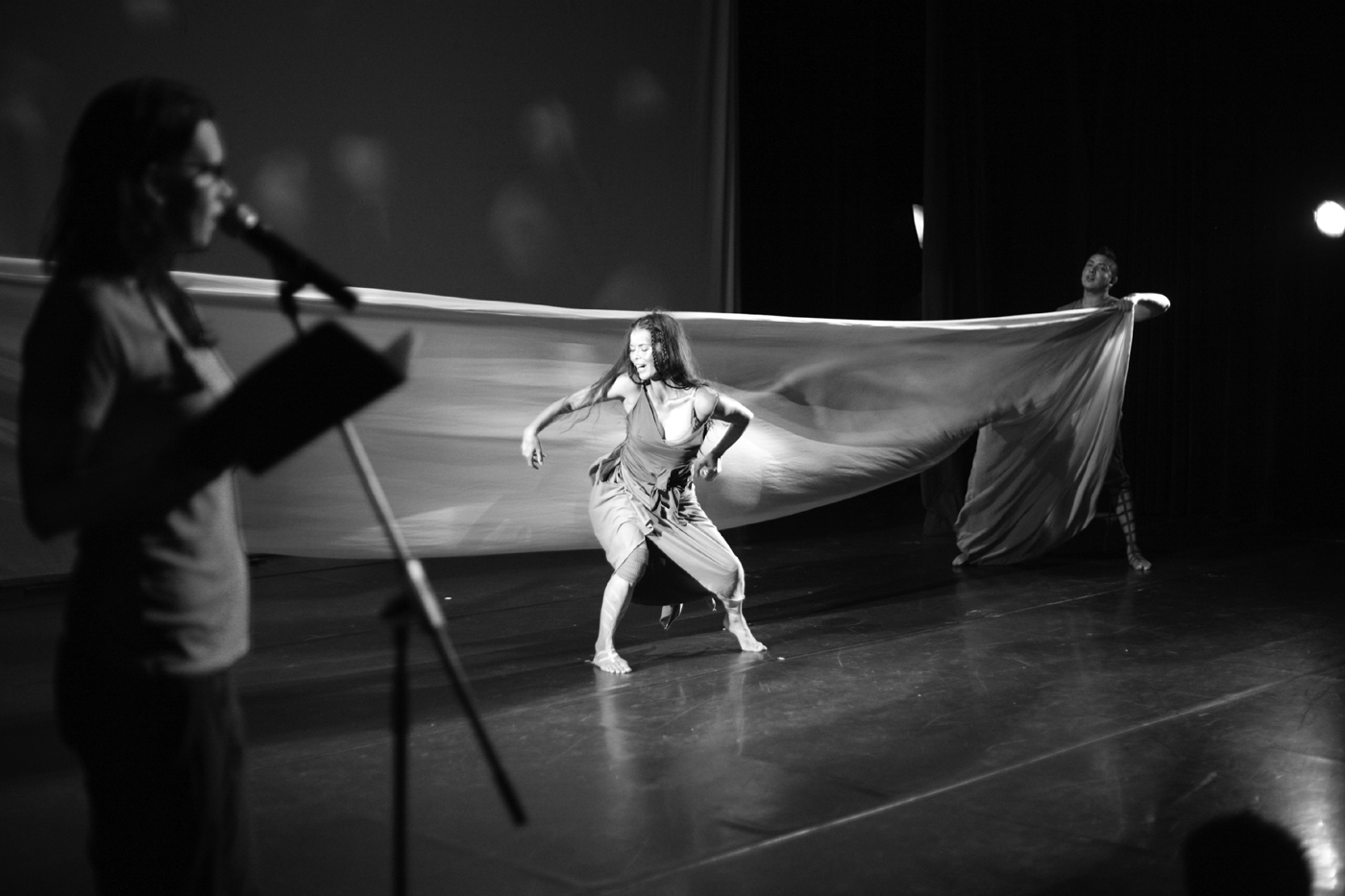
This exquisite dance piece, which was expertly choreographed by Dancing Earth's Artistic Director Rulan Tangen, holds up a mirror to the destructive implications of modern humanity's exploitative relationship with water.
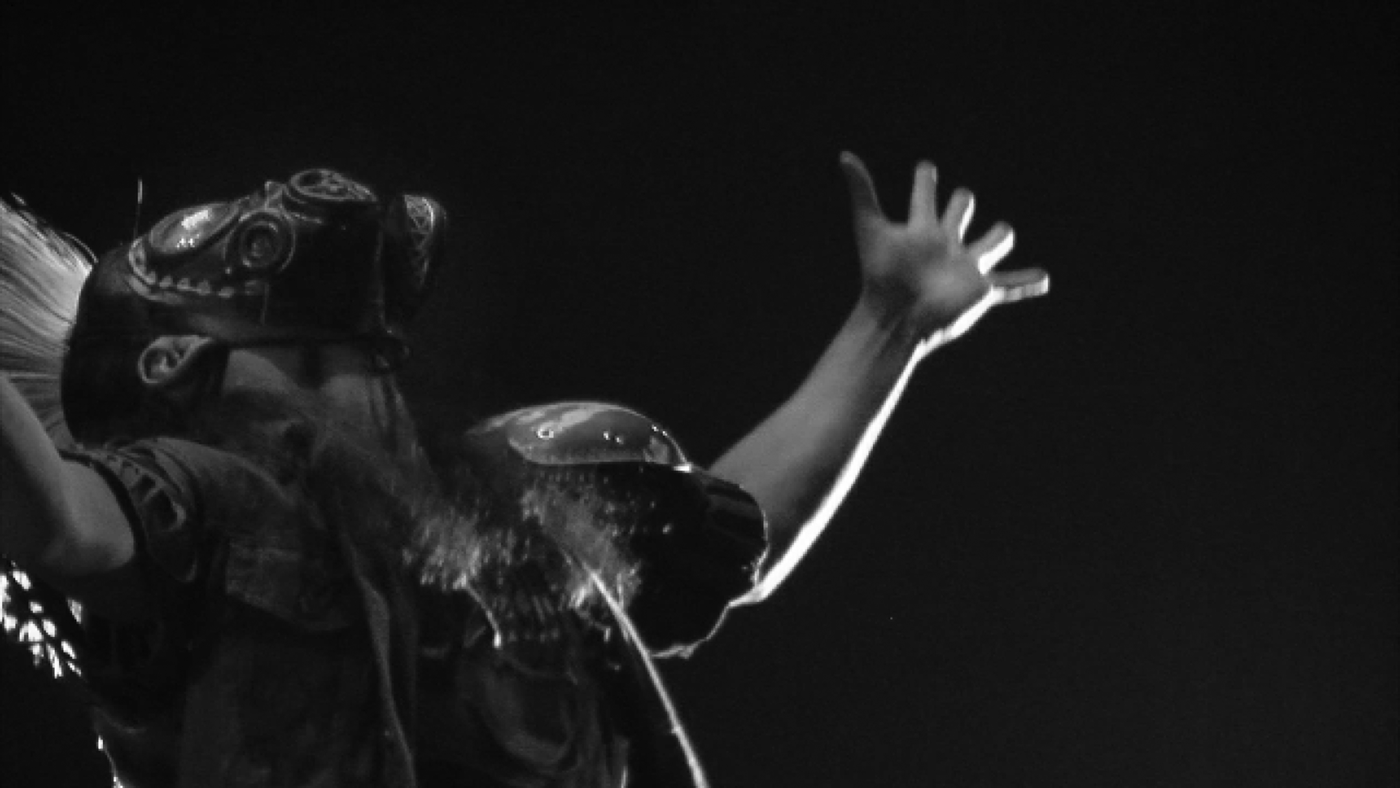
A billowing azure banner was wielded to symbolic effect; for me, it represented pure running water and exemplified the fragility of life.… In parts of the piece, the performers donned gasmasks and utilized them in a manner similar to how the ancients once employed mask-work in their traditional rituals. No doubt—the implications of the gasmasks are: “It is not just the water, but even the air has become poisonous.”
In this performance, Rulan Tangen and Dancing Earth offer a profound life-affirming message that inspires us to respect the sanctity of the bond that exists between the natural elements and all living beings.
Walking at the Edge of Water in New Zealand November by Jack Gray, ExploreDance.com, November 8, 2013
… Irrepressible dreamer and visionary, Rulan Tangen—the company's tireless Artistic Director—drew 12 years of research collecting intertribal stories of the Indigenous Grandmothers in a prophetic dance theatre retelling through traditional dance movement, symbolic patterns reflecting ancient motifs, and dreamscapes that gave mystic and horrifying real scenarios exploring the consequences of human activity surrounding the pollution and greed in mismanagement of tribal waterways. The consequences are potentially devastating.
The work “[Walking] at the Edge of Water” … has survived the realities of a non-funded dance company by its adaptability. Since then … the piece has continued to evolve and its iterations have been seen on different dancer's bodies in performances in New Mexico, at a festival in New York and now in its greatest migration to the land of the long white cloud, Aotearoa …
The performances of Dancing Earth at Kowhiti were exemplary and affecting. Audiences here were treated to a new experience yet the message was poignant, real and familiar somehow. The dancers themselves were treated like the dignitaries they are—and enjoyed the attention of festival goers and participants including the US Embassy in New Zealand …” Congratulations Dancing Earth. Tihei Mauriora (Breath of Life).
~
Conclusion
About a year after we had established the Aboriginal Dance Program at the Banff Centre, I was sitting in an advisory circle with elders, traditional performance specialists and dance artists, when we were asked, “What is the biggest impact that colonization has had on us, our families, our communities and our nations; what is the one thing that keeps us from moving forward?” After much discussion, we all agreed that the biggest impact was on how divided we have become amongst ourselves, in our families, our communities and our nations, that is what keeps us from moving forward. For me, Naadmaagewin became a response to that question asked so long ago.
In “Bubbling Like a Beating Heart”: Reflections on Nishinaabeg Poetic and Narrative Consciousness, Simpson writes “… we as artists and writers have the power to create decolonized spaces of resurgence within our communities. We have the power to vision alternative realities … [and] the responsibility to collectivize these visions in order to bring those dreams of our ancestors into realities” (2014, 116).
Nozhem has been a home to many, not only in this region, but across Canada and around the world, providing a safe place to be Indigenous—collaborating in collectivity. My work in Indigenous performance at Nozhem at Trent is due to the vision of the Elders, who were here since the university first began in the 1960s. I am grateful to the Elders I have worked with since I arrived at Trent—Elders Edna Manitowabi, Shirley Williams, Doug Williams and Daystar Rosalie Jones, as well as artists and scholars such as Dr. Leanne Simpson, Dr, Nicole Bell, William Kingfisher, Liz Osawamick, Hilary Wear, Joeann Argue and the Unity Singers, as well as the production team led by Deborah Ratelle, and the administrative team in the Indigenous Studies department, and of course, so many, many more artists, families, faculty, students, and communities beyond Trent—more than I can name here. Gchi Miigwech to all the parents who brought their children and to the children who brought us joy, as well as to the entire Zhishodewe company for all the love that you gave; with a special Miigwech to Rulan for so generously sharing her gifts, her passion and her talents; for being so generous to all of us. So much has happened, it seems like such a short time that I have been here, but it has now been more than ten years. I am so grateful to have worked with such a supportive and ethical community, where the teachings of the ancestors are honoured and we can practice Naadmaagewin … The Art of Working Together in Our Communities.
And to close, I would like to give special thanks to Jacqueline Shea Murphy for inviting me to participate in this journal and to my beautiful daughters, Darmody and Cara, who helped me to write, with a special Miigwech to Cara who also designed the photo essay. Miigwech to you all, for being so patient with me.