Introduction
The lowbush blueberry (Vaccinium angustifolium Aiton (Ericaceae)), cultivated mainly in the northeastern United States of America and eastern Canada, depends on insect pollination, primarily bees (Hymenoptera: Apidae), for fruit set because of its self-incompatibility (Mohr and Kevan Reference Mohr and Kevan1987). Aras et al. (Reference Aras, de Oliveira and Savoie1996) have shown that there is a strong relationship between honey bee presence and fruit production. Blueberry producers are Canada’s main honey bee hive renters, with more than 20 000 colonies used in Québec alone in 2011 (Institut de la statistique du Québec 2012). The cost for renting hives has increased rapidly in recent years, and for most producers, pollination represents a major expense. The area cultivated for blueberry production has increased by 48% between 2004 and 2010, making it a key fruit crop in this province (Ministère de l’Agriculture, des Pêcheries et de l’Alimentation 2011). Consequently, the demand for pollinating insects is expected to rise in coming years, while the beekeeping industry is struggling to maintain its honey bee stock (Currie et al. Reference Currie, Pernal and Guzmán-Novoa2010). Blueberry producers fear that, with declining honey bee colony availability, these pollinators may not be as reliable in the future. Interest in alternative and more secure sources of pollination is growing, and native pollinators could represent a viable option.
Native pollinators have recently received greater attention not only due to honey bee colony losses, but also because other species are more efficient at pollinating blueberry. Lacking a capacity for buzz pollination (Buchmann Reference Buchmann1983) and mostly interested in nectar, honey bees are less effective in extracting pollen from the poricide anthers of the lowbush blueberry than some native bees. In contrast, native bees such as Bombus Latreille (Hymenoptera: Apidae) and Andrena Fabricius (Hymenoptera: Andrenidae), which use sonication while collecting pollen from blueberry flowers, can deposit 6.5 times more pollen per visit than honey bees (Javorek et al. Reference Javorek, Mackenzie and Vander Kloet2002). Moreover, the great diversity of native bees can reduce dependence of the growers on a single species for crop pollination. Native bees may thus provide an insurance policy against declining honey bee availability (Winfree et al. Reference Winfree, Williams, Dushoff and Kremen2007).
Native bees are not exempt from anthropogenic threats and significant declines have been reported in most parts of the world (Buchmann and Nabhan Reference Buchmann and Nabhan1997; Kevan and Viana Reference Kevan and Viana2003; Goulson et al. Reference Goulson, Lye and Darvill2008; Winfree et al. Reference Winfree, Aguilar, Vazquez, LeBuhn and Aizen2009). Agricultural practices, including pesticide use (Kevan Reference Kevan1975; Kevan et al. Reference Kevan, Greco and Belaoussoff1997; Brittain et al. Reference Brittain, Bommarco, Vighi, Barmaz, Settele and Potts2010), ploughing (Shuler et al. Reference Shuler, Roulston and Farris2005) and establishment of large monocultures (which typically offer minimal nutritional diversity) have been associated with the loss of pollinators in agroecosystems (Kevan et al. Reference Kevan, Greco and Belaoussoff1997). As a result, most agricultural lands are not considered suitable nesting habitats for the majority of solitary or social bees, while forest remnants (Chacoff and Aizen Reference Chacoff and Aizen2006), hedgerows (Goulson Reference Goulson2003; Hannon and Sisk Reference Hannon and Sisk2009), roadsides (Hopwood Reference Hopwood2008) and other non-cultivated areas surrounding or inside agroecosystems have proven to be fertile habitats for alternative pollinators.
Past studies of the impact of artificial windbreaks on pollination (Lewis and Smith Reference Lewis and Smith1969; Pinzauti Reference Pinzauti1986) did not evaluate the potential of these often hospitable, non-cultivated areas as pollinator habitats. We hypothesised that windbreaks in blueberry fields may contribute to support larger communities of pollinators. We compared the effect of four different types of wooded area on pollinators and we predicted that (1) pollinator abundance and species richness would be favoured by the proximity of windbreaks; and (2) more heterogeneous types of windbreaks (i.e., with greater assemblages of nesting substrates and nutritional resources) would host more pollinators and a more diverse assemblage of pollinators.
Materials and methods
Study area
The study was conducted in the northern part of the Lac-St-Jean region, the leading area of blueberry production in Québec, Canada. This area is part of the balsam fir (Abies balsamea (Linnaeus Miller (Pinaceae)) / yellow birch (Betula alleghaniensis Britton (Betulaceae)) bioclimatic domain (Ministère des Ressources Naturelles 2003); the dominant tree species surrounding blueberry fields are balsam fir, black spruce (Picea mariana (Miller) (Pinaceae), and two different species of Pinus Linnaeus (Pinaceae) (Pinus banksiana Lambert and Pinus resinosa Aiton). Vaccinium angustifolium is usually cultivated on well-drained sandy soil with an average pH of 4.4 (Vander Kloet Reference Vander Kloet1988). On large blueberry farms such as those we studied, windbreaks are an integral part of the landscape and are mainly used to reduce wind speed and maintain a thick cover of snow over the fields during winter, protecting rhizomes from freezing. Blueberry farms without windbreaks are nonexistent in this region. Three types of windbreaks are common on blueberry farms. Natural windbreaks (NWBs) are remnants of the native forest that have remained unharvested since establishment of the farm. They usually range between 7 and 20 m in width and 10 and 20 m in height. They are primarily composed of P. banksiana, although they may sometimes feature Populus tremuloides Michaux (Salicaceae) and Prunus virginiana Linnaeus (Rosaceae). The second type of windbreak consists of a single row of planted trees, and the third of two rows. In our study area, these man-made windbreaks were planted 10–12 years ago with a single tree species (P. banksiana or P. resinosa). Natural windbreaks typically have higher flower diversity compared with single row or two-row windbreaks.
Experimental design
Four farms, ranging in size from 332 to 1150 ha, were selected in the study region: Albanel (48.926175°N, 72.369388°W), St-Augustin (48.822036°N, 71.846414°W), Notre-Dame-de-Lorette (49.014298°N, 72.394395°W), and St-Eugène (49.002597°N, 72.330050°W). The shortest distance between two farms was 4 km, while the largest distance was 40 km. Each farm was considered as an experimental block.
We compared the impact of four different treatments (wooded area): (1) forest border (FB), representing the forest edge surrounding the blueberry field (FB); (2) NWB; (3) windbreaks with one row of trees (WB1); and (4) windbreaks with two rows of trees (WB2). The main difference between FB and NWB is the width of the wooded area: 7–10 m for NWB and >150 m for FB. On each farm, individual treatments were assigned to separate fields. Each treatment was replicated four times for a total of 16 experimental units, i.e., 16 blueberry fields. Their size ranged from 4 to 7 ha. While the width of the fields were relatively narrow (120 m), their lengths were comparatively long (up to 1.2 km). The shortest distance between two experimental units on the same farm was 650 m.
In order to sample the pollinators present in the blueberry fields, we delimited two parallel 60 m long transects, from the windbreak (or FB) across the field towards its centre. Distance between transects was 60 m. This was done for each replicate of the four treatments. Three sets of three pan-traps were placed perpendicular to each transect line at 5, 30, and 60 m of the wooded area, for a total of nine pan-traps per transect. These distances were selected because windbreaks were generally 120 m apart, and therefore most of the open field surface was within 60 m of a wooded area. The pan-traps consisted of 15 cm diameter plastic bowls glued to the top of garden stakes at the height of surrounding flowers (~20–30 cm high). The three pan-traps in a series were placed 1 m apart horizontally from one another, had a differently coloured bowl (blue, white, or yellow), and were placed in a random order according to their colour. These colours were selected for their ability to attract the largest array of pollinator species (Campbell and Hanula Reference Campbell and Hanula2007).
Bowls were filled with 300 mL of water containing a drop of dishwashing liquid to break the surface tension and, when needed, refilled every 48 hours to compensate for water evaporation. Since each treatment was replicated four times, we used a total of 288 pan traps (4×4×2×9). The traps were set at the beginning of the blueberry blooming period on 26 May and maintained until 6 June, for a total of 12 sampling days/trap. Insects were retrieved every third day during this period. Specimens were collected from bowls using a large finely perforated spoon, were placed in Ziploc (S.C. Johnson & Son, Racine, Wisconsin, United States of America) bags containing 70% ethanol, and then stored in a freezer until further processing. The study was conducted in 2010, a year characterised by a short blooming period marked by a freezing event that killed most of the remaining flowers on 5 June.
Specimen identification
Specimens were sorted in the laboratory and only insects assumed to be potential pollinators were retained for further identification and analysis. Insects from different taxonomic groups (Hymenoptera: Apoidea, Vespidae; Diptera: Syrphidae; and Lepidoptera: Sphingidae (Hemaris Dalman) were selected for their known pollinating behaviours. Cleptoparasites were excluded from the data set.
Specimens were pinned and identified to the lowest taxonomic level possible using mainly Mitchell (Reference Mitchell1960, Reference Mitchell1962), Vockeroth (Reference Vockeroth1992), and Gibbs (Reference Gibbs2010). Morphospecies were used for some genera for Syrphidae, including Cheilosia Meigen, Eupeodes Osten Sacken, Platycheirus LePeletier and Serville, and Sphaerophoria LePeletier and Serville. Three unique forms of Lasioglossum Curtis (Hymenoptera: Halictidae) also had to be identified as morphospecies due to lack of taxonomic references (subgenus Evylaeus Robertson). Specimen identifications were cross-checked at Dr. Laurence Packer’s laboratory (York University, Toronto, Ontario, Canada) and at the Canadian National Collection of Insects, Arachnids and Nematodes (CNC) in Ottawa, Ontario, Canada. Vouchers are housed at Laval University (Ville de Québec, Québec, Canada), the CNC, Cornell University (Ithaca, New York, United States of America), and York University.
Statistical analyses
A generalised randomised incomplete block analysis of variance (ANOVA) model with two types of repeated measurements, one through time and the other through space (distance), was adjusted to abundance and richness data. We use the term “generalised” to take into account the fact that some treatments were repeated twice on the same farm. The “incomplete” term refers to the fact that not all treatments were present on each farm. Therefore, there are two levels of replication in this experimental design: one across the blocks and the other among the same block. The blocks are the four blueberry farms (Albanel, St-Augustin, St-Eugène, and Notre-Dame-de-Lorette) which were considered as random effects in the model. The treatments are the four wooded areas: FB, NWB, windbreaks with one row of trees (WB1) or with two rows of trees (WB2). In total, there were 16 experimental units in this study (four treatments×four replicates). Measurements were taken over time (28 May, 30 May, 3 June, and 6 June 2010) and over three distances from the windbreaks (5, 30, and 60 m), for a total of 12 observations per experimental unit. Data from the two transects were pooled together as well as the three pan traps at each distance in order to avoid pseudo-replication. The best type of dependency between observations from the same experimental unit was chosen based on the Akaike information criteria. An unstructured type of correlation was chosen for the distances measurements, while a first-order autoregressive structure was chosen for the time measurements. The normality assumption was verified using the Shapiro–Wilk’s statistic, while the homogeneity of variances was verified using the scaled residual plots. Assumptions of the model were never violated. Following a significant effect in the ANOVA table, post hoc protected least significant difference (LSD) multiple comparisons was used to identify where the differences occur. Statistical analyses were performed using the SAS Mixed Procedure (SAS Institute 2012).
Results
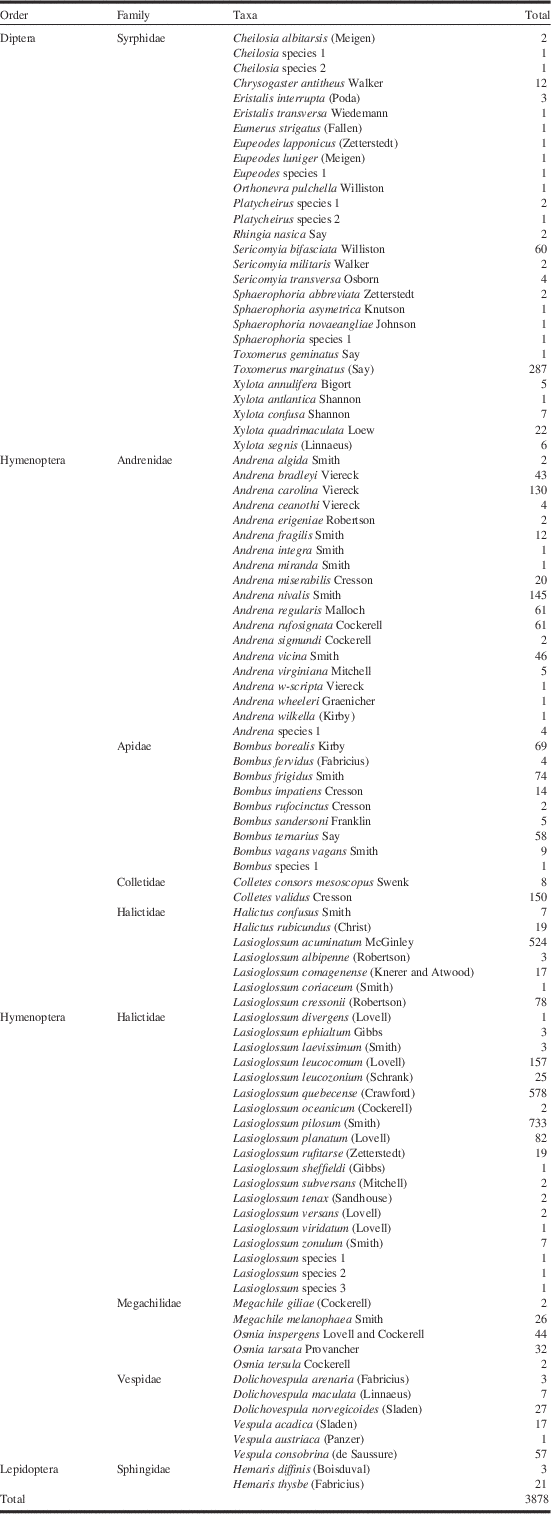
Overall, 3878 native pollinators were collected from the 16 experimental units. We recorded 97 species, from three different insect orders (Hymenoptera, Diptera, and Lepidoptera). A species list is provided in Table 1. Hymenoptera were the most diverse and abundant, with 67 species and 3424 specimens (88% of total) belonging to six families (Andrenidae, Apidae, Colletidae, Halictidae, Megachilidae, and Vespidae) (61 species were Apoidea), followed by the Diptera, with 28 species, and 430 specimens (11% of total) of Syrphidae. We also collected 24 specimens (<1% of total) of Lepidoptera, representing two species of Sphingidae.
List of native pollinators collected during the 2010s blueberry bloom from various farm edge types (all treatments combined: forest border, natural windbreak, two-row windbreak, or one-row windbreak) in lowbush blueberry fields located in Lac-St-Jean area, Québec, Canada.
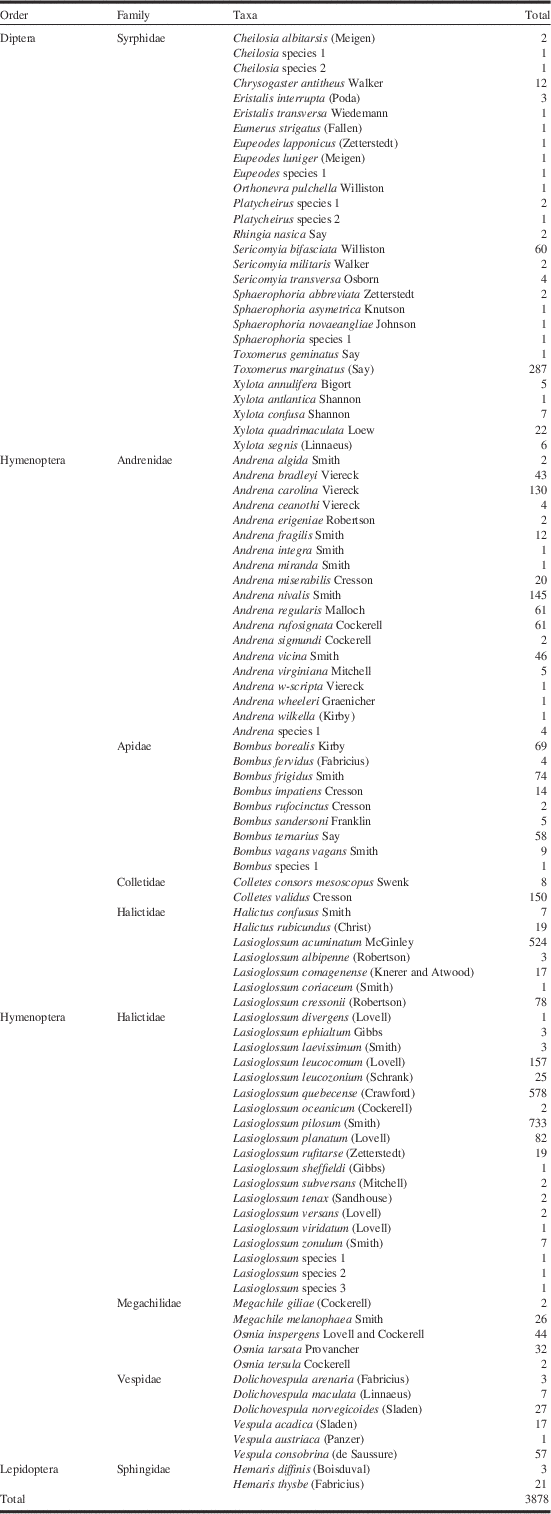
Halictid bees belonging to the genus Lasioglossum accounted for more than 44% of all pollinator specimens collected. Lasioglossum pilosum (Smith) alone represented 19% of the total, followed by L. quebecense (Crawford) with 15% and L. acuminatum McGinley with 14%. The most frequent non-Apoidea pollinator was Toxomerus marginatus (Say) (Diptera: Syrphidae), accounting for more than 7% of the total specimens collected. Together, the 10 most common species accounted for 78% of all specimens collected: ~81% were ground-nesting bees, 12% were “non-nesters” (i.e., Diptera and Lepidoptera) and 7% were cavity nesters. Ground-nesting bee species from the families Halictidae, Andrenidae, and Colletidae dominated this agroecosystem community.
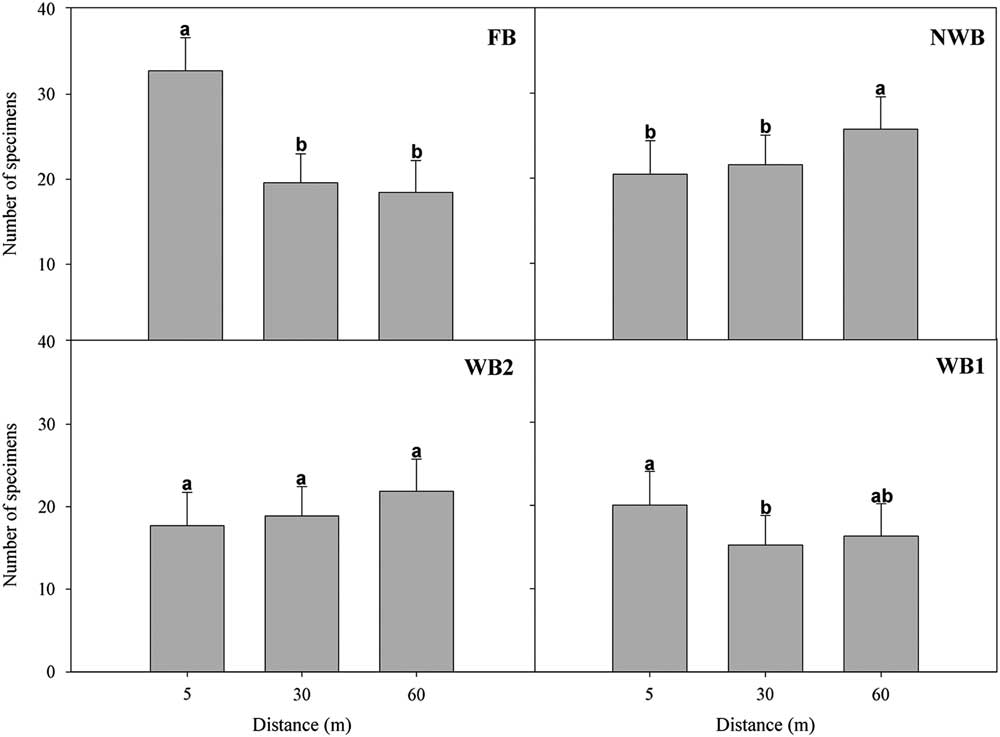
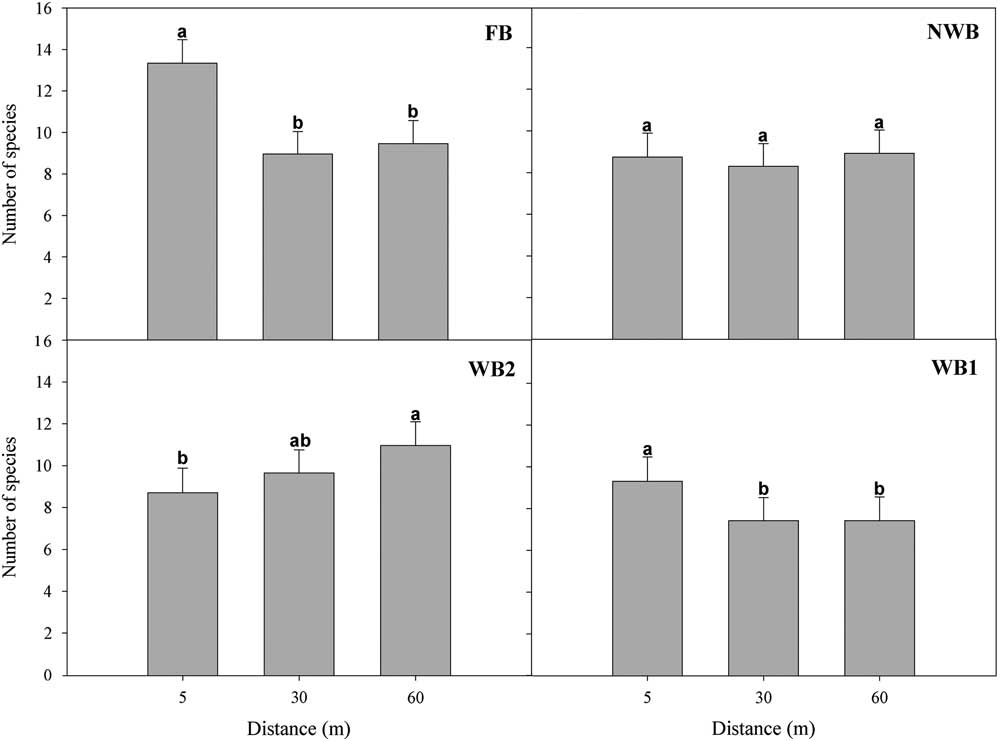
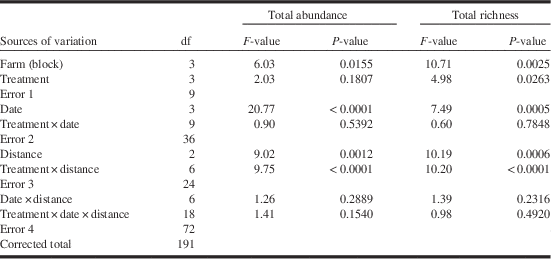
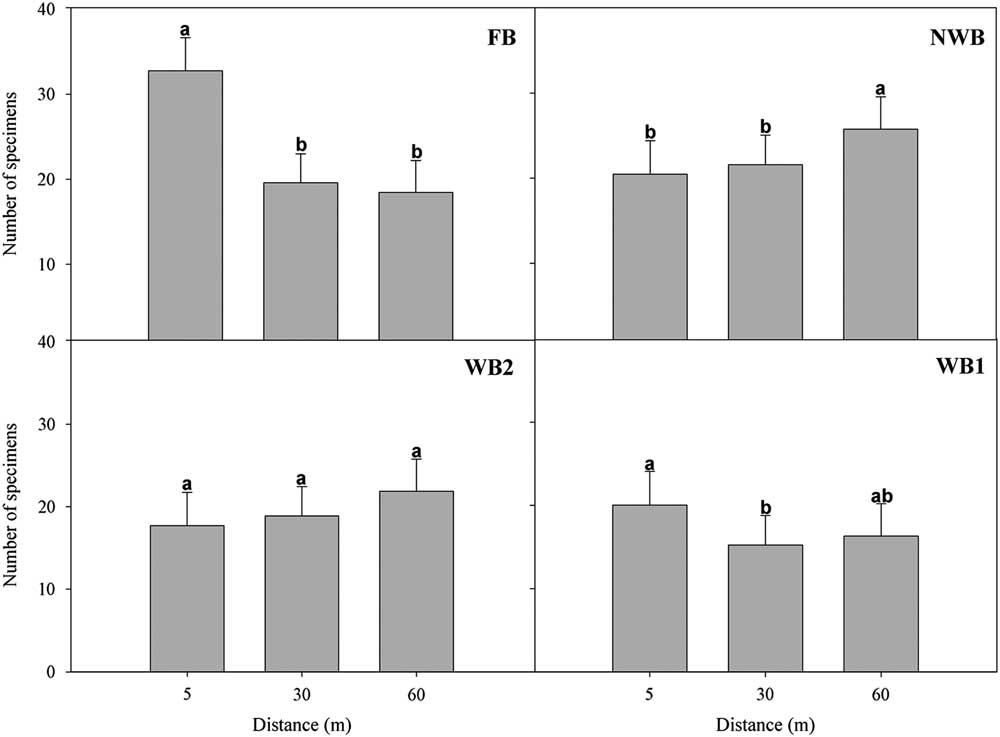
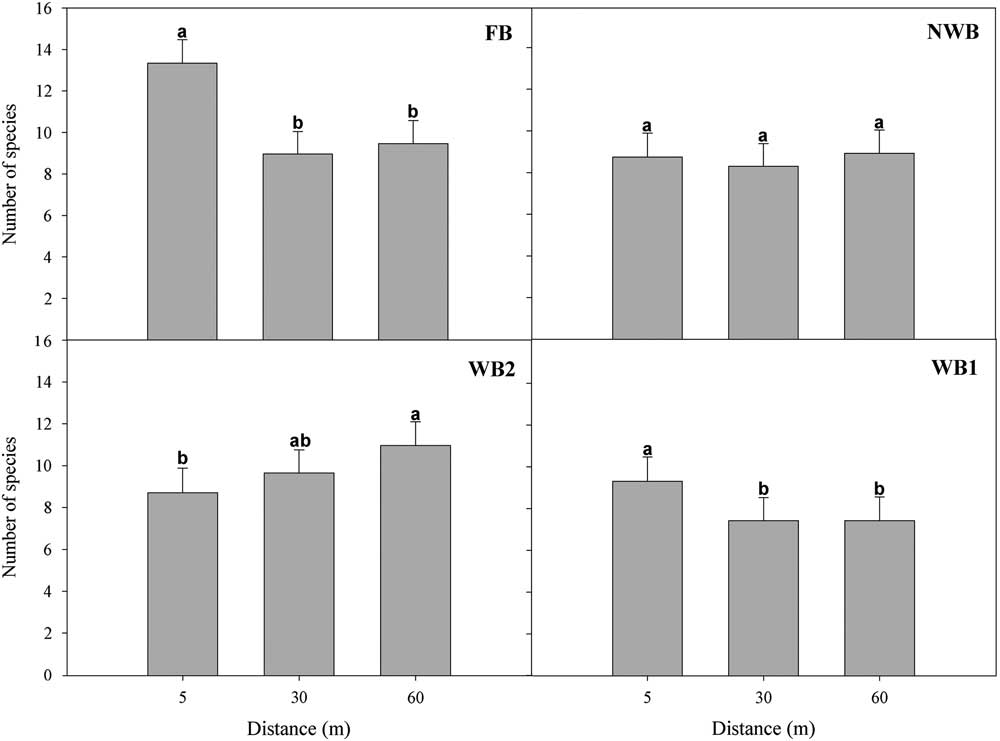
Date influenced total abundance and total richness (F=20.77; df=3, 36; P<0.0001; and F=7.49; df=3, 36; P=0.0005, respectively) and a significant treatment×distance interaction was observed (F=9.75; df=6, 24; P<0.0001; and F=10.20; df=6, 24; P<0.0001, respectively), as illustrated in ANOVA tables (Table 2). Contrasts were used to compare the treatments at each distance (5, 30, 60 m). A significant difference for abundance (F=6.84; df=3, 24; P=0.0017) and richness (F=12.95; df=3, 24; P<0.0001) was observed at 5 m. Forest border treatment harboured greater abundance and richness than other treatments as shown by protected LSD multiple comparisons. At 60 m, a marginally significant difference for abundance (F=2.80; df=3, 24; P=0.0614) and richness (F=4.69; df=3, 24; P=0.0102) were also observed. Natural windbreak treatment had greater abundance than treatment FB and treatment WB1 while treatment WB2 had greater species richness compared with treatments NWB and WB1. Contrasts were also used to compare distances among each other within each treatment. Significant differences for abundance for treatments WB1 (F=3.32; df=2, 24; P=0.0533); FB (F=29.13; df=2, 24; P<0.0001) and NWB (F=3.69; df=2, 24; P=0.0402) (Fig. 1) were revealed by contrasts. As for species richness, significant differences for treatments WB1 (F=5.77; df=2, 24; P=0.0090), WB2 (F=6.33; df=2, 24; P=0.0062), and FB (F=28.20; df=2, 24; P<0.0001) (Fig. 2) were observed. Finally, the periphery of the field (5 m) had the greatest abundance and species richness in treatments WB1 and FB, as indicated by protected LSD multiple comparisons. At 60 m, the greatest abundance was found in treatment NWB and the greatest species richness was found in treatment WB2, although it was not different than richness found at 30 m.
Mean number of wild pollinators captured per sampling date in Québec, Canada lowbush blueberry fields from pan-traps placed at various distances (5, 30, 60 m) from a forest border (FB), natural windbreak (NWB), two-row windbreak (WB2), one-row windbreak (WB1). Error bars represent standard error. Means with the same letter are not significantly different (P>0.05).
Mean number of species of wild pollinators captured per sampling date in Québec, Canada lowbush blueberry fields from pan-traps placed at various distances (5, 30, 60 m) from a forest border (FB), natural windbreak (NWB), two-row windbreak (WB2), one-row windbreak (WB1). Error bars represent standard error. Means with the same letter are not significantly different (P>0.05).
Repeated measures ANOVA for effects of various farm edge types (treatment: forest border, natural windbreak, two-row windbreak, or one-row windbreak), collection date, and distance from edges on wild pollinator abundance and richness in lowbush blueberry fields in Québec, Canada.
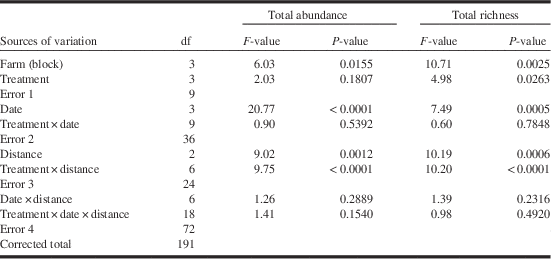
ANOVA, analysis of variance.
Discussion
Few surveys have been conducted in recent decades on the diversity and abundance of native pollinators foraging lowbush blueberry flowers (Boulanger et al. Reference Boulanger, Wood, Osgood and Dirks1967; Finnamore and Neary Reference Finnamore and Neary1978; Morrissette et al. Reference Morrissette, Francoeur and Perron1985). In our study, almost 100 species were collected during a single spanning blueberry blossom. Interestingly, only about 40% of the species we collected had been recorded by Finnamore and Neary (Reference Finnamore and Neary1978) who listed a total of 192 species pollinating this plant in northeastern North America. Furthermore, we collected almost 33% more species of bees than Morrissette et al. (Reference Morrissette, Francoeur and Perron1985) did in the same region, Lac-St-Jean, some 25 years ago. Finally, Boulanger et al. (Reference Boulanger, Wood, Osgood and Dirks1967) collected 89 species associated with the lowbush blueberry in Maine, United States of America and eastern Canada.
While Morrissette et al. (Reference Morrissette, Francoeur and Perron1985) found 46 species of bees on V. angustifolium blossoms in the Lac-St-Jean region (Québec, Canada), only four species, Lasioglossum pilosum, Lasioglossum quebecense, Bombus ternarius Say, and Bombus terricola Kirby, were frequently observed visiting this crop. We believe the most likely explanations for the amplitude of differences between the species found within our study (61 bee species) versus the ones found in Morrissette et al. (Reference Morrissette, Francoeur and Perron1985) are the (1) refinement of identification techniques, (2) more extensive sampling, and (3) geographic expansion. However, the most important dissimilarity between our findings and those of Morrissette et al. (Reference Morrissette, Francoeur and Perron1985) concerned B. terricola, found to be one of the most abundant pollinators of blueberry blossoms in the past, while not a single specimen of this species was collected in our study. This observation coincides with the rapid decline of B. terricola populations in recent decades throughout most of northeastern North America, its native distribution range (Cameron et al. Reference Cameron, Lozier, Strange, Koch, Cordes and Solter2011).
Studies on the dispersal of native pollinators inside large agroecosystems have demonstrated that abundance and species richness are negatively affected with increasing distance from unmanaged habitats such as FBs, hedgerows, and field margins (Chacoff and Aizen Reference Chacoff and Aizen2006; Garibaldi et al. Reference Garibaldi, Steffan-Dewenter, Kremen, Morales, Bommarco and Cunningham2011). Both of these studies found a linear decrease in abundance and diversity with increasing distance from unmanaged habitats. Our findings partially support this observation, since higher abundance and diversity were observed close (5 m) to FB. Our overall results however show variability among treatments and distance from edges, in regard to these variables, and suggest that native pollinators are distributed quite homogeneously in blueberry fields. Because windbreaks are typically 120 m apart, the furthest in-field distance we could sample was 60 m, which is well within the flight range of most small bees (Greenleaf et al. Reference Greenleaf, Williams, Winfree and Kremen2007). Therefore, it is likely that our study sites did not have large enough unbroken fields to reveal clear edge distance effects on the presence of pollinators in the fields. Partitioning blueberry fields with windbreaks, as done in Québec, could thus be favourable to the sustainability of pollinator communities in this crop. In addition, we could stress that due to the presence of windbreaks, the blueberry production in Québec may be favoured compared with other production areas since native pollinator abundance and diversity do not decrease significantly away from the edge of windbreaks. Because of the constant presence of introduced pollinators such as honeybees, a study taking this fact into account would be needed to assess the impact of native pollinators harboured in windbreaks on pollination levels, fruit set and crop yields. Further work to look at the distributions of the body size of the pollinator in relation to windbreak distances would be interesting.
Forest border
We speculate that the greater abundance and diversity of pollinators found near FBs may be partly explained by the ecological quality of this environment. Its varied microhabitats (e.g., dead trees, hollow twigs, rocks, etc.) may accommodate the needs of a wider range of species.
We further speculate that ground-nesting bees, the dominant group found in this agroecosystem, might have been drawn to the greater floral diversity present in the first few metres surrounding FBs, despite the fact that they might have nested away from this zone. Some flowering plants, often considered as weeds by farmers, are important sources of nectar and pollen for pollinators (Odoux et al. Reference Odoux, Feuillet, Aupinel, Loublier, Tasei and Mateescu2012).
Windbreak habitat
In the fields surrounded by windbreaks, pollinators were scattered quite homogeneously, as their abundance and diversity remained comparable from the edge of windbreaks towards the inner fields. These findings suggest that windbreak habitats may not attract pollinators as much as FBs but still have a positive effect on the presence of these beneficial insects throughout the fields. We speculate that these wooded habitats, established at every 120 m, allow pollinators to always be close to a relatively undisturbed environment. Few differences were found in the abundance and species richness harboured in the different types of windbreaks (NWB, WB1, and WB2). It is possible that extending our sampling outside of the blueberry bloom could have highlighted more important differences between windbreaks; our current sampling period (during bloom) was relatively short (12 days). Finally, while it obviously would have been desirable to include a treatment consisting of fields without windbreaks, such blueberry fields were simply non-existent in the study area.
Conclusion
Our study showed that pollinator communities are distributed homogenously throughout the lowbush blueberry fields found in Lac-St-Jean, Québec, Canada. For many reasons, the lowbush blueberry agroecosystem from this region appears to be a relatively favourable environment for pollinators, particularly for ground-nesting bees. While windbreaks and forest edge might offer interesting biotic and abiotic conditions for the predominant ground-nesting bees surveyed across the blueberry fields, our study did not test for any explanatory mechanisms or factors such as flower diversity and nesting sites.
Acknowledgements
The research was funded by the Programme de soutien à l'innovation agroalimentaire (PSIA), Ministère de l’Agriculture, des Pêcheries et de l’Alimentation (MAPAQ), Natural Sciences and Engineering Research Council of Canada-Discovery, and Natural Sciences and Engineering Research Council of Canada-Canadian Pollination Initiative (NSERC-CANPOLIN). The authors would like to thank Cory S. Sheffield, Jason Gibbs, and Jeff Skevington for their taxonomic expertise. They also wish to thank Véronique Moreau (Club Conseil Bleuet) and Andrée Tremblay (MAPAQ, Alma) for their help in selecting appropriate sites; Geneviève Dufour Tremblay and Andrée Rousseau for their field and laboratory assistance; and Gaétan Daigle for statistical analyses. They are also grateful to anonymous reviewers for their constructive comments and helpful suggestions. This is contribution #78 of NSERC-CANPOLIN.