

Essentialism about species is today a dead issue. (Sober Reference Sober[1980] 1992, 249)
Folk essentialism is both false and fundamentally inconsistent with the Darwinian view of species. (Griffiths Reference Griffiths2002, 72)
1. Introduction
The idea that biological natural kinds, particularly a species like dogs, have intrinsic underlying natures is intuitively appealing. It has been shown to be widespread even among children (Keil Reference Keil1989). It was endorsed by a great philosopher, Aristotle. Under the influence of the logical positivists, Popper (Reference Popper1950), Quine (Reference Quine1960), and others, it fell from philosophical favor in the twentieth century until revived by Saul Kripke (Reference Kripke1980), Hilary Putnam (Reference Putnam1975), and David Wiggins (Reference Wiggins1980). Many philosophers probably now take the view for granted. If so, they are right out of touch with biologists and, especially, philosophers of biology. For, the consensus among philosophers of biology, and a wide-spread view among biologists, is that this sort of “Aristotelian essentialism” is deeply wrong, reflecting “typological” thinking instead of the recommended “population” thinking (Sober Reference Sober[1980] 1992, 247–248). This essentialism is thought to arise from a naive and uninformed view of biology, indeed to be incompatible with Darwinism.Footnote 1 This view is nicely presented and argued for in a paper by Samir Okasha (Reference Okasha2002). I shall take that as my main text. I shall defend intrinsic biological essentialism. I think that the children are right and the philosophers of biology, wrong.Footnote 2
I start by saying something about essentialism in general and about the essentialism I shall defend in particular. A property P is an essential property of being an F iff anything is an F partly in virtue of having P. A property P is the essence of being an F iff anything is an F in virtue of having P. The essence of being F is the sum of its essential properties. Essences can be fully intrinsic; for example, the essence of being gold is having atomic number 79. Essences can be partly intrinsic and partly extrinsic and relational;Footnote 3 for example, the essence of being a pencil is partly being an instrument for writing, which an object has in virtue of its relation to human intentions, and partly having the sort of physical constitution that distinguishes it from a pen, which an object has intrinsically. Finally, essences can be fully relational and extrinsic; being Australian is probably an example because it seems that anything—Rupert Murdock, Phar Lap (a horse), the Sydney Opera House, a bottle of Penfolds’ Grange, the expression “no worries mate,” and so on—can have the property provided it stands in the right relation to Australia.Footnote 4
The doctrine I want to defend, which I shall call “Intrinsic Biological Essentialism,” abbreviated sometimes to “Essentialism,” is that Linnaean taxa have essences that are, at least partly, intrinsic underlying properties. This calls for some clarification and comment:
• By “Linnaean taxa” I mean kinds that are thought to fall under the biological categories in the Linnaean hierarchy: kingdoms, phyla, classes, orders, families, genera, species, and even subspecies (varieties).Footnote 5 I do not mean kinds like those of predators or parasites. And I do not mean the categories themselves. Essentialism is a thesis about what it is for an organism to be, say, a dog not a cat, not about what it is for, say, dogs to be a species not a genus. (This distinction will loom large in Sections 5 –9.) The focus of my discussion will be on species but, I emphasize, Essentialism covers kinds that fall under all the categories.
• I include the qualification “at least partly” because I shall not take issue with the consensus that a species is partly an historical entity.Footnote 6
• In sexual organisms the intrinsic underlying properties in question are to be found among the properties of zygotes; in asexual ones, among those of propagules and the like.Footnote 7 For most organisms the essential intrinsic properties are probably largely, although not entirely, genetic. Sometimes those properties may not be genetic at all but in “the architecture of chromosomes,” “developmental programs,” or whatever (Kitcher Reference Kitcher[1984] 2003, 123).Footnote 8 For convenience, I shall often write as if the essential intrinsic properties were simply genetic but I emphasize that my Essentialism is not committed to this.
• Intrinsic Biological Essentialism would certainly be opposed by the consensus because of its commitment to intrinsic essences. But the consensus should not be opposed to biological essentialism in general because, as I am understanding essentialism, the consensus is that species have essences but these are extrinsic or relational. And Kim Sterelny and Paul Griffiths, in their excellent introduction to the philosophy of biology, Sex and Death, are explicitly not opposed to this sort of essentialism: “the essential properties that make a particular organism a platypus … are historical or relational” (Reference Sterelny and Griffiths1999, 186). Of course, the very term ‘essentialism’ has become so distasteful to biologists because of its association with Aristotelian metaphysics that a biologist would doubtless be reluctant to admit to any sort of essentialism. But the essentialism I have defined need not come with those Aristotelian trappings. Many philosophers would be similarly reluctant because the term ‘essentialism’ strikes them as quaintly old-fashioned, scholastic, even unscientific. But such reluctance would be a merely verbal matter. The issue of essentialism would remain even if the term ‘essentialism’ were dropped. It is the issue of in virtue of what an organism is a member of a certain Linnaean taxon; the issue of what makes an organism a member of that taxon; the issue of the very nature of the taxon. I stick with ‘essentialism’ because it is the term that philosophers of biology use for the doctrine that they want to reject and I want to promote. Those who are offended by the term should replace it with one of the other ways of characterizing the issue.
• There is some controversy over whether species are natural kinds or individuals. Michael Ghiselin (Reference Ghiselin[1974] 1992) and David Hull (Reference Hull[1978] 1992) seem to see individualism as an antidote to essentialism.Footnote 9 But, as Okasha points out, “the issues about essentialism … do not depend on which view of the ontological status of species we favour” (2002, 193–194; see also Kitcher Reference Kitcher and Ruse[1989] 2003, 137–140).Footnote 10 Thus, if a species is an individual rather than a kind, our essentialism issue for species becomes that of saying in virtue of what organisms are parts of a certain species, for example, the species Canis familiaris. And the consensus answer should be that it is entirely in virtue of the organisms’ historical or relational properties, entirely “because they are part of the genealogical nexus” (Hull Reference Hull[1978] 1992, 309), whereas my Essentialism's answer would be that it is, at least partly, in virtue of the organisms’ intrinsic underlying properties.Footnote 11 Indeed the essentialism issue can be posed “nominalistically” in a way that is noncommittal on the ontological status of species: In virtue of what is an organism, say, a Canis familiaris? And that is how I do pose the issue in Section 5. I mean to be neutral on the ontological issue but for convenience will mostly talk of species as if they were kinds.
• Essentialism is primarily concerned with the natures of the actual groups identified by the folk and biologists for explanatory purposes. This “descriptive” issue needs to be distinguished from the “normative” issue of the natures of the groups that we should identify for explanatory purposes. Clearly, we might not be doing what we should be doing. However, I shall write as if we are. If we are not, then my Essentialism should be taken to cover the groups that we should be identifying for explanatory purposes as well.
In Section 2, I give evidence that the consensus really is opposed to Intrinsic Biological Essentialism. In Section 3, I argue for the doctrine: explanations in biology demand that there be essential intrinsic underlying properties. I turn then to objections. In Section 4, I describe the standard relational views of species which, according to the consensus, make Essentialism untenable. In Section 5, I emphasize a distinction which is crucial to showing that the consensus is wrong about this. The distinction is between two questions:
1. What is it to be a member of any group that happens to be a species?
2. What is it for a group to be a species?
In Sections 6 –9, I argue that the relational views of species are, primarily at least, answers to 2. Essentialism, in contrast, is an answer to 1. Indeed, these relational views can, mostly, be happily wedded to Essentialism. Even the influential phylogenetic-cladistic view can be wedded if it loses some implausible features. How has the consensus got it so wrong? My tentative diagnosis is that the error has arisen from conflating questions 1 and 2, a conflation encouraged by some mistaken thoughts about conspecificity. Finally, in Section 10, I accommodate some general features of Darwinianism, associated with variation and change, features that are thought to undermine Essentialism. The accommodation requires acceptance of some indeterminacy in what constitutes a biological kind. But we must all accept that, whatever our views of Essentialism.
If the arguments in Sections 4 –10 are right, the stated objections to an essentialist doctrine like Intrinsic Biological Essentialism fail. Perhaps there are some unstated objections that would succeed. And perhaps these could provide the basis for showing that the arguments in Section 3 in favor of Essentialism are inadequate. Given the strength and longevity of the consensus in biology against intrinsic essentialism, it seems reasonable to predict this. Still, it remains to be seen whether it is so. At the very least I hope to show that the case for the consensus needs to be made a lot better than it has been.
2. Evidence of the Consensus
I have claimed that the consensus among philosophers of biology is that doctrines like Intrinsic Biological Essentialism are wrong. Among those philosophers, the claim hardly needs support because the consensus is so established. Still, among philosophers in general, the claim does need support because, influenced by Kripke and Putnam, many find the claim incredible and so think I must be struggling with a straw man. The epigraphs to this article, drawn from the works of Elliott Sober and Paul Griffiths, two leading philosophers of biology, are some evidence that I am not. Here is some more.
The consensus starts by denying that members of a species share a distinctive set of genetic properties. Thus, according to Okasha, “virtually all philosophers of biology agree that … it simply is not true that the groups of organisms that working biologists treat as conspecific share a set of common morphological, physiological or genetic traits which set them off from other species” (2002, 196).
Clearly, if the members of a species do not share a distinctive set of genetic properties then those properties could not be essential properties of that species. Indeed, Okasha claims that “biologists and philosophers of biology typically regard essentialism about species as incompatible with modern Darwinian theory” (2002, 191). And John Dupré claims that “it is widely recognized that Darwin's theory of evolution rendered untenable the classical essentialist conception of species” (1999, 3). Alex Rosenberg says: “The proponents of contemporary species definitions are all agreed that species have no essence” (1985, 203). Mohan Matthen claims that “species … are associated with no nonrelational real essence” (1998, 115). Sober expresses this consensus as follows: “biologists do not think that species are defined in terms of phenotypic or genetic similarities”; tigers are “not defined by a set of traits” (1993, 148). Sterelny and Griffiths put the point bluntly: “no intrinsic genotypic or phenotypic property is essential to being a member of a species” (1999, 186). Ghiselin puts it even more bluntly: “That John Doe has a particular set of genes is about as relevant to his being a specimen of Homo sapiens L. as it is to his working for the manufacturers of Brand X” (Reference Ghiselin[1974] 1992, 283).
Finally, if the essence of a species is not in the least intrinsic then it must be entirely relational. I have already quoted Sterelny and Griffiths's claim to this effect about the platypus. And they think that nearly everyone agrees with them: there is “close to a consensus in thinking that species are identified by their histories” (1999, 8). Their view is endorsed by Okasha (Reference Okasha2002, 202). Sober declares that tigers are “historical entities” (Reference Sober1993, 148, his emphasis). “Two organisms are conspecific in virtue of their historical connection to each other, not in virtue of their similarity” (1993, 150). Marc Ereshefsky makes similar comments, speaking for “Darwin, the founders of the Modern Synthesis, and most cladists” (Reference Ereshefsky2001, 209). Finally, Hull claims: “If species are interpreted as historical entities, then particular organisms belong in a particular species because they are part of that genealogical nexus, not because they possess any essential traits. No species has an essence in this sense” (Reference Hull[1978] 1992, 313). Ruth Millikan says much the same (2000, 19).
The consensus is broad but some are not part of it. Thus David B. Kitts and David J. Kitts (Reference Kitts and Kitts1979) urge an intrinsic essentialism like mine. According to Richard Boyd (Reference Boyd and Wilson1999) and Robert Wilson (Reference Wilson and Wilson1999), species are “homeostatic cluster kinds” and I take it that they think that they have at least partly intrinsic essences.Footnote 12 And Philip Kitcher has this to say: “I want to remain agnostic on the issue of whether any species taxon has a nontrivial essence” (Reference Kitcher[1984] 2003, 132, note 16).
I take the opposition to Intrinsic Biological Essentialism to be established. It is now time to argue for the doctrine.
3. An Argument for Intrinsic Biological Essentialism
I shall offer two reasons for believing Essentialism. The first is superficial but still, it seems to me, indicative of where the truth lies. Such essential properties seem to be part of what “genome projects” are discovering. The projects seem to be throwing light on the very nature of certain species. Thus the New York Times recently reported that researchers hope “to discover, from a three-way comparison of chimp, human and Neanderthal DNA, which genes have made humans human” (Wade Reference Wade2006).Footnote 13 Philosophers of biology disparage this common view (Sterelny and Griffiths Reference Griffiths and Wilson1999, 7; Okasha Reference Okasha2002, 197), but the view is certainly appealing.
The second reason is deep and shows why the view is appealing. We group organisms together under what seem, at least, to be the names of species or other taxa and make generalizations about the morphology, physiology, and behavior of the members of these groups: about what they look like, about what they eat, about where they live, about what they prey on and are prey to, about their signals, about their mating habits, and so on. These generalizations are the stuff of popular nature programs and are to be found throughout the writings of biologists and philosophers of biology. For example, we are told that ivy plants grow toward the sunlight (Sober Reference Sober1993, 6); that polar bears have white fur; that Indian rhinoceri have one horn and Africa rhinoceri have two (1993, 21); that Hawaiian Drosophila “routinely form interspecific hybrids in the wild” (1993, 156); that the Australasian bittern is superbly camouflaged (Sterelny and Griffiths Reference Griffiths and Wilson1999, 32); that “Major Mitchell cockatoos occasionally hybridize with galahs” (1999, 189); that “Australian trees … are not just drought-proof; they are fireproof as well” (1999, 203); that “magnetotactic bacteria … come equipped with little compasses called magnetosomes, which they use to navigate away from oxygen-rich surface water because oxygen is toxic to them” (1999, 209).
Generalizations of this kind demand an explanation. Why are they so? Why, for example, is there this difference between the Indian and African rhinos? Such questions could, of course, be seeking an explanation of the evolutionary history that led to the generalization being true. Set that aside for a moment. The questions could also be seeking an explanation of what makes the generalization true. Regardless of the history of its coming to be true, in virtue of what is it now true? What are the mechanisms? The truth of these generalizations cannot be brute facts about the world and so must be explained. Explanations will make some appeal to the environment,Footnote 14 but they cannot appeal only to that. There has to be something about the very nature of the group—a group that appears to be a species or taxon of some other sort—that, given its environment, determines the truth of the generalization. That something is an intrinsic underlying, probably largely genetic, property that is part of the essence of the group. Indeed, what else could it be?Footnote 15 Some intrinsic underlying property of each Indian rhino causes it, in its environment, to grow just one horn. A different such property of each African rhino causes it, in its environment, to grow two horns. The intrinsic difference explains the physiological difference. If we put together each intrinsic underlying property that similarly explains a similar generalization about a species, then we have the intrinsic part of its essence.Footnote 16
The generalizations we have been discussing reflect the fact that it is informative to know that an organism is a member of a certain species or other taxon: these classifications are “information stores” (Sterelny and Griffiths Reference Griffiths and Wilson1999, 195). But being a member of a certain taxon is more than informative, it is explanatory. Matthen points out that “many biologists seem committed to the idea that something is striped because it is a tiger” (1998, 115). And so they should be: the fact that an individual organism is a tiger, an Indian rhino, an ivy plant, or whatever, explains a whole lot about its morphology, physiology, and behavior. At first sight, the explanation of the animal's stripes may seem rather superficial, but it is not really. For, when biologists group organisms together under some name on the basis of observed similarities, they do so partly on the assumption that those similarities are to be explained by some intrinsic underlying nature of the group. It seems to me clear that this is their practice, whatever they say about essentialism.Footnote 17 So the apparently superficial explanation points to the deep fact that there is something intrinsic, probably unknown, partly in virtue of which the animal is a tiger and which causes it to be striped. That something is an essential intrinsic property. The sum of those properties, together perhaps with some historical ones, constitute the essence of a tiger. Sober rightly insists that the essence of a species must explain why its members are the way they are. It must be “a causal mechanism that acts on each member of the species, making it the kind of thing that it is” (Reference Sober[1980] 1992, 250). That is exactly what this (partly) intrinsic essence is.
I distinguished two sorts of explanation that might be sought in asking why members of a species have a certain property. In so doing I am following in the footsteps of Ernst Mayr (Reference Mayr1961). He regards an explanation of the mechanisms within members of a species that make a generalization true (regardless of the history) as concerned with “proximate” causation and part of “functional biology.” In contrast an explanation of the evolutionary history that led to the mechanism being present in the members of a species is concerned with “ultimate” causation and is part of “evolutionary biology.” The use of “ultimate” to describe the latter explanation seems like a gratuitous put-down of the former. Kitcher's even-handed description in response to Mayr's is prima facie more appropriate: “there are indeed two kinds of biological investigation that can be carried out relatively independently of one another, neither of which has priority over the other” (Reference Kitcher[1984] 2003, 121). Adopting Kitcher's terminology, I shall call the former sort of explanation “structural” and the latter “historical.” Structural explanations, as he says, seek to “explain the properties of organisms by means of underlying structures and mechanisms.” He gives a nice example (Reference Kitcher[1984] 2003, 121):
A biologist may be concerned to understand how, in a particular group of bivalve mollusks, the hinge always comes to a particular form. The explanation that is sought will describe the developmental process of hinge formation, tracing the final morphology to a sequence of tissue or cellular interactions, perhaps even identifying the stages in ontogeny at which different genes are expressed.
He goes on to claim that “explanations of this type abound in biology: think of the mechanical accounts of normal (and abnormal) meiosis, of respiration and digestion, of details of physiological functioning in all kinds of plants and animals” (Reference Kitcher[1984] 2003, 121). And my point is that, at bottom, structural explanations will advert to essential intrinsic, probably largely genetic, properties.Footnote 18 It is because the bivalve mollusks have a certain intrinsic underlying nature that the hinge takes that form. That is the deep explanation.Footnote 19
This discussion generates a number of questions. Here are two:
• “Surely any of the generalizations we have been discussing could have exceptions: a small mutation may lead to an organism that seems to be a member of a species and yet lacks the property attributed to the species by a generalization. So the generalizations do not seem to be lawlike. How does Intrinsic Biological Essentialism deal with that?”Footnote 20
• “It is of course the case that the truth of any such generalization must be explained by an intrinsic, probably largely genetic, property, but why does that property have to be an essential property of the kind in question?”Footnote 21
I shall consider these questions in Section 10, along with others arising from Darwinian views of variation and change. I shall argue that Essentialism has an adequate answer to all these questions.
Sober claims that “evolutionary theory has removed the need for providing species with constituent definitions” and hence with intrinsic essences (Reference Sober[1980] 1992, 255). I suspect that this sort of focus on evolution, hence on historical rather that structural explanations, has misled biologists and philosophers of biology about essentialism.Footnote 22 This having been said, I suspect that even historical explanations demand a partly intrinsic essence; that, for example, the explanation of how polar bears came to be white will ultimately depend on essential intrinsic properties of polar bears and of their grizzly ancestors. But I shall not attempt to argue this.
I have presented a positive argument for Intrinsic Biological Essentialism. We might sum it up: structural explanations in biology demand that kinds have essential intrinsic properties. That is my first main point in defense of Essentialism. In the rest of the article I will develop the case for Essentialism in the course of responding to objections.
4. Relational Species Concepts
I start with what is alleged to be the central objection to Intrinsic Biological Essentialism: according to nearly all current “species concepts”—theories about the nature of species—species are relational. Okasha expresses this consensus as follows: “On all modern species concepts (except the phenetic), the property in virtue of which a particular organism belongs to one species rather than another is a relational rather than an intrinsic property of the organism” (2002, 201).
Despite the consensus that these species concepts make Essentialism untenable, the nature of biological species is, and always has been, an extremely controversial issue: “The species problem is one of the oldest controversies in natural history” (O’Hara Reference O’Hara1993, 231); it is “one of the thorniest issues in theoretical biology” (Kitcher Reference Kitcher2003, xii).Footnote 23 There are around two dozen species concepts and “at least seven well-accepted ones” (Ereshefsky Reference Ereshefsky1998, 103). I shall follow Okasha in placing them in “four broad categories.” In this section I shall briefly describe these concepts. In the next, I shall draw a distinction which is crucial to showing, in Sections 6 –9, that the consensus is wrong.
• Phenetic concepts. On this sort of view, organisms are grouped into species on the basis of overall similarity of phenotypic traits. This is thought by its proponents to have the advantage of being fully “operational.” Okasha says that phenetic concepts are “the least popular” (2002, 199) and this is hardly surprising because they arise from the “philosophical attitude … of empiricism” (Sokal and Crovello Reference Sokal and Crovello[1970] 1992, 29). “Phenetic taxonomists have often wanted to segregate taxonomy from theory” (Sterelny and Griffiths Reference Griffiths and Wilson1999, 196).Footnote 24 This category of species concept is the only one of the four that is not in the least historical and relational. I shall set it aside.
• Biological Species concepts (BSC). The most famous example of BSC is due to Mayr. He defined species as “groups of interbreeding natural populations that are reproductively isolated from other such groups” (Mayr Reference Mayr1969, 26). Sterelny and Griffiths remark that “If the received view has a received species concept” it is BSC (1999, 188).Footnote 25
• Ecological Niche concepts (ENC). According to ENC, a species occupies a certain ecological niche. “A species is a lineage … which occupies an adaptive zone minimally different from that of any other lineage in its range and evolves separately from all lineages outside its range” (van Valen Reference van Valen[1976] 1992, 70). Okasha puts the view succinctly: species “exploit the same set of environmental resources and habitats” (2002, 200).Footnote 26
• Phylogenetic-Cladistic concepts (P-CC). On this view we “identify species in terms of evolutionary history … [with] particular chunks of the geneological nexus. … Species come into existence when an existing lineage splits into two … and go extinct when the lineage divides, or when all members of the species die” (Okasha Reference Okasha2002, 200). Sterelny and Griffiths claim that “something like a consensus has emerged in favor of a cladistic conception of systematics” (Reference Sterelny and Wilson1999, 194). Nonetheless, it has some surprising features, as we shall see (Section 9).
But perhaps the most important feature of the P-CC concept for the purposes of this article is that it is, as everyone agrees, incomplete. It needs to be supplemented by a theory of speciation, a theory that explains when a lineage has split in two. For this, as Okasha says, P-CC “will have to rely on a concept of one of the other types” (2002, 201).
5. A Crucial Distinction
It is alleged that, according to each of these species concepts, except the phenetic which we are setting aside, species are relational. These concepts are thought, therefore, to show that the nature of a species could not be partly intrinsic and hence that doctrines like Intrinsic Biological Essentialism are false. In assessing this thought it is very important to distinguish the question that Essentialism is supposed to answer from another which it isn’t.
Let F's be some group that has been classified for biological purposes under one of the taxa; for example, a group of poodles, dogs or Canis. The question that Essentialism answers has many forms, as already indicated:
1. In virtue of what is an organism an F?
• What makes an organism an
 $F$
?
• What is the nature of being
$F$
?• What is the essence of being
$F$
?


This is a question about the properties of organisms. When it concerns F's that form a species, Mayr calls it the species “taxon” problem (Reference Mayr1982, 253–254). So let us generalize this as “the taxon problem.” It needs to be distinguished from the very different, “higher level,” problem about the properties of those properties:
2. In virtue of what are F's a subspecies, a species, a genus, etc.?
• What makes a group of
$F$
's a subspecies, a species, a genus, etc.?• What is the nature of being a subspecies, a species, a genus, etc.?
• What is the essence of being a subspecies, species, genus, etc.?

When it concerns species, Mayr calls it the species “category” problem (Reference Mayr1982, 253–254). So let us generalize this as “the category problem.”
“What is it to be a poodle not a bulldog?” is an instance of the taxon problem 1, “What is it for poodles to be a subspecies not a species?” is an instance of the category problem 2. The distinction between the two problems may seem obvious and yet it is easily conflated by certain forms of words. In particular, consider the question, “What is a species?” or “What is the nature/definition of a species?” These questions are ambiguous. They could be asking what sort of a nature any group has that happens to be a species, an instance of the taxon problem 1. But they are more likely to be asking what is it for any group to be a species, an instance of the category problem 2.
The distinction between the two problems is absolutely crucial to this article. Which problem are the species concepts supposed to answer? According to Okasha, speaking for the consensus, they are at least supposed to answer problem 1 for species: they are supposed to show, as we noted, that “the property in virtue of which a particular organism belongs to one species rather than another is a relational rather than an intrinsic property of the organism” (Reference Okasha2002, 201). Yet Ereshefksy, in his introduction to a collection that includes many classic papers on species concepts, says that “our concern is with a definition of the species category” rather than of the species taxon (1992a, xiv; see also Kitcher [1984], 120). And according to Sterelny and Griffiths (Reference Griffiths and Wilson1999, 211) and Wilson (Reference Wilson and Wilson1999, 191–192), the species concepts provide answers to both taxon and category problems. I shall argue that, on the contrary, the species concepts are primarily concerned with 2 and throw little light on 1.Footnote 27 Yet Intrinsic Biological Essentialism is concerned with 1. So, the central objection to Essentialism, based on the species concepts, fails. This is my second main point in defense of Essentialism.
In Section 6, I shall show how much the species concepts bear on the category problem 2. In Sections 7 and 9, I shall show how little they bear on the taxon problem 1.
6. Species Concepts and the Category Problem 2
The species concepts straightforwardly answer problem 2 for species: they tell us about “the species category” (Sterelny and Griffiths Reference Griffiths and Wilson1999, 184).Footnote 28 Thus the popular BSC tells us that a group is a species in virtue of being an interbreeding natural population that is reproductively isolated from other such groups. And the ENC tells us that a group is a species in virtue of being a lineage which occupies an adaptive zone minimally different from that of any other lineage in its range and evolving separately from all lineages outside its range. And both these answers do indeed entail that being a species is relational: a group is a species in virtue of its breeding or niche relations to other groups.
The story for the influential P-CC is a bit more complicated. As we have noted, the P-CC account of species adverts to the splitting of a lineage and so needs to be supplemented with a theory of splitting, a theory of speciation. Thus, according to P-CC, a group of organisms constitute one species at time t 1 and their descendents constitute two daughter species at t 2. But what makes it the case that the descendents are members of the daughter species rather than the original species? An account of speciation will tell us.
When faced with the need to supplement P-CC it is customary to wave a hand toward other species concepts to provide the needed theory of speciation. “The biological species concept, perhaps supplemented by the ecological species concept or by something else, reemerges as an account of speciation” (Sterelny and Griffiths Reference Griffiths and Wilson1999, 192). Thus, if P-CC is supplemented by BSC it will take a lineage to split when it yields two groups each of which is interbreeding but reproductively isolated from the other. And if it is supplemented by ENC, it will take a lineage to split when it yields two groups exploiting different sets of environmental resources and habitats. With some such supplement in mind, P-CC, just like the other species concepts, straightforwardly yields an answer to problem 2 for species. Thus, return to Okasha's statement of P-CC: “species come into existence when an existing lineage splits into two … and go extinct when the lineage divides, or when all members of the species die” (Okasha Reference Okasha2002, 200). Supplemented by a theory of speciation, this tells us what it is for a group of organisms to be a species rather than, say, a subspecies or a genus. And it tells us that this is a relational matter.
Not only do the species concepts straightforwardly yield answers to problem 2 for species, that seems to be what they are intended to do. Ever since Darwin, the species concepts have been tied closely to views of speciation and to distinguishing when two groups constitute subspecies of the one species and when they constitute two distinct species of a genus. They are concerned, for example, with whether the British red grouse (Lagopus lagopus scoticus) and its continental relative (L. l. lagopus) are separate species; and with whether the divergent forms of the bluegill sunfish (Lepomis macrochirus) constitute a single species. They are concerned with what distinguishes species from other taxa. And, we should note, they do not seem to be concerned with the taxon problem 1; with, for example, the nature of the British red grouse or the bluegill sunfish.Footnote 29
Consider also the earlier-mentioned controversy over species (Section 4). The arguments here are all over problem 2. Thus, alluding to the controversy, Ereshefsky says: “Biologists differ widely on how to define the species category … [on how] to provide the essential property of the species category—a property found in all and only species taxa” (Reference Ereshefsky and Ereshefsky1992a, xiv–xv). The controversy has led some (Mishler and Donoghue Reference Mishler and Donoghue[1982] 1992; Kitcher Reference Kitcher[1984] 2003; Sterelny and Griffiths Reference Griffiths and Wilson1999, 194–201) to the view that “there is no unique factor common to all species” (Ereshefsky Reference Ereshefsky and Ereshefsky1992a, xv). This pluralism, as Robert Wilson notes, is “about the species category” (Reference Ereshefsky and Wilson1999, 192). Biologists are concerned with whether groups that we have picked out for biological purposes should be counted as a subspecies, a species, a genus, or whatever. And with whether various considerations do, and should, play a role in settling such issues. In response to these issues, and inspired by cartographic generalization, Robert O’Hara urges that we take up the perspective of “systematic generalization” and then “we will be better able, not to solve the species problem, but rather to get over it” (Reference O’Hara1993, 232) It is quite clear that what he thinks we will be able to get over is fussing about when to judge a group to be a species. And, once again, the issues are not over problem 1, not over what is it for an organism to be a member of a group that we have picked out for biological purposes, irrespective of whether that group is a subspecies, species, genus, or whatever. So the issues are largely orthogonal to Essentialism. Essentialism is concerned with the nature of a group whatever the category it falls under.
I turn now to consider the bearing of species concepts on the taxon problem 1. In Section 7, I will argue that BSC and ENC do not bear on this problem and so the consensus is wrong. In Section 8, I will try to diagnose the error. In Section 9, I will consider the bearing of P-CC.
7. BSC, ENC, and the Taxon Problem 1
One reason for thinking that species concepts are not intended to answer the taxon problem 1 for species is that they quite obviously have nothing to say in answer to this problem for taxa other than species.Footnote 30 Yet if they were answering 1 for species we would expect them to be like Essentialism in saying something, at least, in answer to 1 for the other taxa, in saying something about what it is to be a member of a particular genus, for example.
Despite the consensus, neither BSC nor ENC provides an answer to 1. Let F's be a group of organisms that is a species according to BSC or ENC; for example, the group of tigers. What do BSC or ENC, as they stand, tell us about how to complete ‘Some organism is an F in virtue of … ’? Since F's are a species, BSC or ENC obviously tell us that whatever the completion it must specify some property or other of an organism that is at least compatible with the organism being a member of some group or other that, briefly, interbreeds or occupies a niche. But, beyond that, they tell us nothing at all! They don’t tell us what property makes an organism a member of the group of F's in particular. Indeed, they don’t even tell us what sort of property that must be. As we have just noted, BSC and ENC tell us what it is for F's to be a species rather than, say, a subspecies or genus, but they are silent on what it is for an organism to be an F, say, a tiger rather than a lion. Analogously, an account of what it is for a group of objects to be tools rather than, say, pets or toys would not tell us what it is for an object to be a hammer rather than, say, a saw. In brief, BSC and ENC, as they stand, say nothing about what identifies a particular species, hence nothing about what constitutes its essence. The consensus view expressed by Okasha is simply false: it is not the case that, according to BSC and ENC, “the property in virtue of which a particular organism belongs to one species rather than another is a relational rather than an intrinsic property of the organism” (2002, 201). These concepts, as they stand, say nothing about this matter and so need not be at odds with any doctrine that does. Indeed, they are not at odds with Intrinsic Biological Essentialism.
Essentialism's answer to taxon problem 1 is that the group F is identified (partly at least) by certain intrinsic underlying properties: it is in virtue of having such properties that an organism is a tiger rather than a lion. This is compatible with the BSC view that what makes F's a species rather than a subspecies or a genus is a matter of interbreeding, and with the ENC view that it is a matter of occupying a niche. Indeed, it is better than compatible: Essentialism partly explains why the members of a species have the characteristics which, according to BSC or ENC, make them a species: it is partly because those members have a certain essential intrinsic properties that, in the given environment, they interbreed and occupy a niche. Far from being undermined by these species concepts, Essentialism is complementary to them.
BSC and ENC do not entail a relational answer to 1 despite the consensus that they do. But perhaps we can see them as associated with such an answer. We can indeed find signs of two such answers in the literature. But neither could be a serious rival to Essentialism's answer.
The first answer is the simple idea that what makes something an F is that its parents are F's. This seems to be suggested by the following: “the reference of an individual to a species is determined by its parentage, not by any morphological attribute” (Griffiths Reference Griffiths1974, 102). Consider also a statement by Ruse: “if we suppose that humans first appeared about a half million years ago, Homo sapiens is the name for the group that descended from the original organisms” (1987, 344).
Hull quotes the Griffiths passage approvingly (Reference Hull[1978] 1992, 305). He goes on to consider whether a human-like organism made by a scientist would be a human and this leads him to modify the simple idea: what makes something human is “being born of human beings and/or mating with human beings” (Reference Hull[1978] 1992, 306, emphasis added). A difficulty with the simple idea is that it rules out speciation: all organisms will be conspecific with their ancestors, however distant. Set that aside until later (Section 10). The idea is open to an obvious objection: it is not really an answer to 1. It tells us that an organism is an F if its parents are F's. But what is it for them to be F's? The idea does not solve our problem, it simply moves it back a generation. And Hull's modification of the simple idea is open to a similar objection. It tells us that an organism is an F if it mates with F's. But what makes the organisms it mates with F's?
The second relational answer might be considered an elaboration of the first. It gets its inspiration from the typical naming practices of biologists: “Biologists coin new species terms by providing a sample, called a ‘type specimen’” (LaPorte Reference LaPorte2004, 5). Could we then identify a species by referring to its type specimen? So, what makes this interbreeding or niche-occupying group F's is that it contains a certain type specimen. This idea seems to be suggested by some other remarks of Hull: “The taxonomist … selects a specimen, any specimen, and names it. … A taxon has the name it has in virtue of the naming ceremony, not in virtue of any trait or traits it might have” (Reference Hull[1978] 1992, 308). He goes on to write that “any organism related to [the type specimen] in the appropriate ways belongs to its species, regardless of how aberrant the type specimen might turn out to be or how dissimilar other organisms may be” (Reference Hull[1978] 1992, 311–312). And consider this (entertaining) proposal for using BSC for taxonomic definitions: “Specify some individual, say Brigham Young, as your reference point, and then members of the same taxon are potential and actual interbreeders” (Ruse Reference Ruse[1987] 1992, 344).Footnote 31
Combining this idea with BSC or ENC seems to suggest that what makes an organism a lion is that it is part of an interbreeding or niche-occupying group that contains a certain historically identified type specimen, say Leo; and what makes this other organism a tiger is that it is part of another interbreeding or niche-occupying group that contains a certain other historically identified type specimen, say Benji.
This answer is transparently inadequate. Relating an organism to a type specimen may sometimes be a convenient way to tell what species the organism belongs to—for example, if the type specimen is held in some museum—but it should not be taken seriously as an account of what constitutes being a member of a species. The answer may be epistemically useful but it is metaphysically hopeless.Footnote 32 Why? Briefly, because being an F—for example, being a lion or being a tiger—is an explanatory property, as we noted in discussing the generalizations in Section 3.
The hopeless answer itself immediately generates the demand for an explanation that it cannot possibly fulfill: Why can lions interbreed with Leo and not Benji? It is clearly no help to be told that that is what it is to be a lion. And this failure is just the tip of the iceberg. Consider the following questions (construed structurally not historically): Why do tigers have stripes? It is no help to be told that it is because they can interbreed with Benji. That does not tell us why any tiger, including Benji, has stripes. Why do polar bears have poor eyesight? Once again, their relation to some Ur-bear gives no explanation just as the relation of pieces of gold to the stuff in Fort Knox gives no explanation of why they are malleable. And so on through indefinitely many structural questions about the morphology, physiology, and behavior of species.
All these questions concern facts about species that could not be brute: the facts have to be explained. The suggested answers to 1 cannot provide adequate explanations. The moral of this discussion is that any adequate explanation cannot appeal only to relational properties of members of the species in question because those relations cannot bear the explanatory burden. An adequate explanation must appeal to intrinsic properties of the organisms. It is something about the intrinsic natures of lions, tigers, polar bears, and so on that provides the explanation (along with some environmental factors).
It is worth noting that the main point of the argument is not restricted to biology. Suppose we ask: Why do paperweights make good weapons? The answer is not that they are the same tool as a certain specimen paperweight kept in some museum. The answer is that the nature of paperweights makes them suitably heavy and easily grasped. And if they had a different nature, say that of buttons, then they would not make good weapons.Footnote 33
So, contrary to consensus opinion, BSC and ENC do not give relational accounts of species identity. Indeed they do not give any account of species identity. Furthermore, they cannot be happily wedded to a relational account because such accounts are explanatorily hopeless. They can, however, be happily wedded to Intrinsic Biological Essentialism because intrinsic underlying properties can bear the explanatory burden.
We are left with a puzzle. BSC and ENC do not give a relational answer to the taxon problem 1 for species and yet the consensus is that they do. What has gone wrong? How can we diagnose the error?
8. The Conspecificity Route to Error about the Taxon Problem 1
The obvious answer to the diagnostic question is that the error has come from somehow conflating the problems 1 and 2 that Mayr distinguished.Footnote 34 BSC and ENC do indeed offer relational accounts of what it is to be a species. But that is a very different matter from offering a relational account of what it is to be a member of a group that is a species.
Sterelny and Griffiths are interesting on this score. They nicely distinguish the taxon problem 1 from the category problem 2 in the “Further Reading” that concludes a chapter discussing the species concepts (1999, 211). Yet, surprisingly, the preceding discussion itself does not distinguish the problems (1999, 184–194). Indeed, they themselves draw attention to this conflation! Their defense is that “an answer to the taxon problem should solve the category problem, and vice versa” (1999, 211).
This raises our puzzle in an acute form. Why would anyone think that an answer to the one problem would answer the other? The discussions in Sterelny and Griffiths, and in Okasha (Reference Okasha2002), suggest that the route from a category answer to a taxon answer may be via an answer to the conspecificity problem, the problem of saying in virtue of what organisms are in the same species. This route is most explicit in Wilson's discussion (Reference Wilson and Wilson1999). Wilson takes what are, in effect, the BSC and P-CC answers to the species category problem to imply answers to the taxon problem: they “imply that the properties determining species membership for a given organism are not intrinsic properties of the organism at all, but depend on the relations the organism bears to other organisms” (1999, 192). How so? Because they imply that “conspecificity is not determined by shared intrinsic properties, but by organisms’ standing in certain relations to one another” (1999, 193). So the idea is that (a) BSC and P-CC imply a relational nonintrinsic answer to the conspecificity problem, and (b) this implies a relational nonintrinsic answer to the taxon problem. And the problem with the idea is that, although (a) is clearly tempting, it is false. However, (b) is true. I shall start with it.
The first thing to note in considering (b) is that an answer to the conspecificity problem does not alone provide an answer to the taxon problem. A conspecificity answer tells us what it is for two organisms to be members of the same species and hence what makes Leo not conspecific with Benji. A taxon answer tells us what it is to be a member of a particular species and hence what makes Leo a lion and Benji a tiger. These are two very different matters. An answer to the conspecificity problem does not answer the taxon problem because it does not determine which species conspecific organisms are members of; it does not determine species identity; it does not tell us that these conspecifics are lions, those, tigers. So, even if a species concept did answer the conspecificity problem, as (a) claims it does, more would still need to be done to answer the taxon problem. Still, the two problems are related in a way that sustains (b).
Suppose that the answer to the taxon problem is that an organism is a member of species F in virtue of being Q; and the answer to the conspecificity problem is that two organisms are conspecific in virtue of being R-related. Now, necessarily, if two organisms are both Q then they are both F's and hence conspecific. So the fact that they are both Q must determine, in a very strong way, that they are R-related and hence conspecific: R must be the relation of sharing a property of the Q sort, whatever that sort may be. Now suppose, as Intrinsic Biological Essentialism does, that Q is a partly intrinsic property of F's then R must be partly the relation of sharing that sort of intrinsic property. So if a species concept did imply a nonintrinsic answer to the conspecificity problem, as (a) claims it does, that would indeed count against Essentialism, as (b) claims.
Turn now to (a) and consider BSC. I have allowed that (a) is tempting. Yet BSC, as it stands, says nothing at all about conspecificity. So why is (a) tempting? Because, as Wilson notes, citing Mayr, BSC implies something about conspecificity: it implies that “a given individual organism is conspecific with organisms with which it can interbreed” (1999, 192–193). And it is easy to think that this amounts to (a). But it doesn’t, because BSC does not imply that organisms are conspecific in virtue of interbreeding. The crucial error is to suppose that it does imply this, to suppose, quoting Wilson again, that BSC implies that “conspecificity is … determined by … organisms’ standing in certain relations to one another” (1999, 193, emphasis added).Footnote 35 The point is a bit subtle and so I shall provide more details.
BSC, as it stands, straightforwardly provides an answer to the category problem. Now that answer implies that conspecific organisms are members of a group that is, as a matter of fact, an interbreeding (and reproductively isolated) group. For, to be conspecific is, by definition, to be members of a group that is a species and, according to BSC's category answer, what makes a group a species is being an interbreeding group. The category answer tells us that conspecific organisms are members of an interbreeding group but it does not tell us in virtue of what they are members of that group. Indeed, BSC's category answer is compatible with Intrinsic Biological Essentialism's answer to the conspecificity problem: it is compatible with the view that organisms are conspecific in virtue of sharing a certain intrinsic underlying property and, perhaps, a history. The compatibility is easy to see. Essentialism is motivated by the need to explain the observable properties of a group of organisms (Section 3). These properties include, of course, the property of interbreeding. So, according to Essentialism, it is because the members of a species share the intrinsic underlying properties necessary to make them conspecific that, in the given environment, those members interbreed and hence have the property than makes them a species according to BSC.
Now we could, of course, supplement BSC as it stands with a relational answer to the conspecificity problem: organisms are conspecific in virtue of being able to interbreed. But, first, this supplement is not entailed by the BSC answer to the category problem and gets no support from the considerations that motivate that answer. Without further argument, the supplement is gratuitous. And, second, the supplement is a very bad answer to the conspecificity problem. It is a very bad answer because, as (b) shows, it is at odds with Intrinsic Biological Essentialism. It is shown by (b) that a relational conspecificity answer entails a relational taxon answer and our earlier argument shows that relational taxon answers are explanatorily hopeless. The supplement is not something that BSC should be saddled with.
Although (a) is certainly tempting it remains puzzling that people would give in to the temptation: it remains puzzling that they would not have doubts about this conspecificity route to anti-Essentialism. For, although the answer to the conspecificity problem that BSC is wrongly thought to give does entail that the answer to the taxon problem must be relational and nonintrinsic it does not give such an answer. And as soon as one tries to give one, it should becomes apparent how explanatorily inadequate a relational answer must be. It least, this should be apparent if one keeps in mind the needs of structural explanations. So, it remains puzzling that a person who starts with the idea that BSC implies a relational conspecificity answer would not be led to contemplate one of two responses: abandoning BSC simply because of that implication; or, abandoning the idea that BSC has the implication.Footnote 36
Our discussion of the puzzling conflation of the category problem with the taxon problem has focused on BSC. Yet the discussion applies just as much to ENC.
This concludes our discussion of how little bearing BSC and ENC have on the taxon problem 1. We turn now to consider the bearing of P-CC on that problem
9. P-CC and the Taxon Problem 1
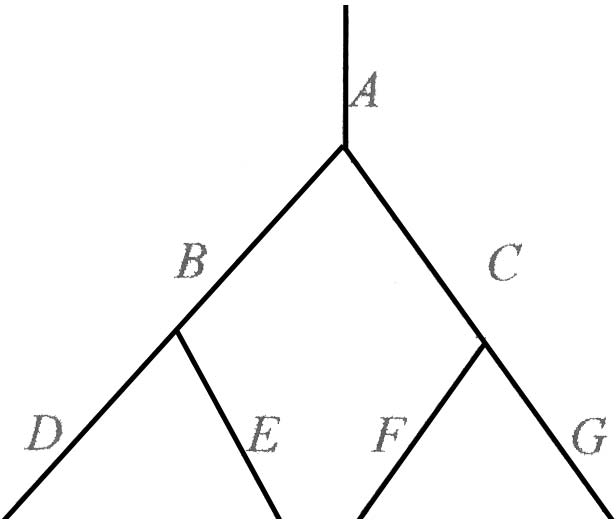
At first sight P-CC, unlike BSC and ENC, may seem to provide an answer to the taxon problem 1 for species. Let F's be a group of organisms that is a species according to P-CC. Whereas BSC and ENC told us little about how to complete ‘Something is an F in virtue of … ,’ P-CC may seem to tell us a lot. The idea would be that since F's are a species, an organism is an F in virtue of being a member of a group with a particular “evolutionary history;” the species is “this particular chunk of the genealogical nexus.” What makes this organism a lion not a tiger is that it is a member of a species having this particular place in “the branching tree-of-life” (Okasha Reference Okasha2002, 200). But this idea amounts to identifying a species simply by its relation to other species, to the species that preceded and succeeded it in its lineage: “You and I are members of Homo sapiens, therefore, because we both belong to the segment of the genealogical nexus which originated in Africa some 300,000 [years] ago (on current estimates), and which has not budded off any daughter species since that point” (2002, 200–201). But this answer to 1 is inadequate in just the same sort of way as our earlier second answer in discussing BSC and ENC: its relational identification of a species is explanatorily hopeless. To see this, it helps if we drop the actual names of species (like “Homo sapiens”) , which might provide some illicit information, and replace them with schematic names using which we can capture the relational information that is all we are entitled to on this P-CC view. Thus suppose that species A splits into species B and C, then B splits into D and E and C splits into F and G. This is represented in the “tree-of-life” as depicted in Figure 1.
Figure 1.

What does the P-CC view tell us about the nature of B? That B is descended from A and that B is distinct from C. And that's what P-CC tells us that about the nature of C too. So that clearly does not distinguish B from C. No more does it distinguish D and E to know that each is descended from B, and F and G to know that each is descended from C. Furthermore, since P-CC does not distinguish B from C it does nothing to distinguish D and E, descended from B, from F and G, descended from C. Suppose D were lions and G, tigers. Relational facts of the sort captured in this representation, which are the only facts that P-CC allows to constitute the natures of species, would do nothing to distinguish lions from tigers, hence nothing to explain the morphological, physiological, and behavioral differences between them. Suppose that we want to explain why C has poor eyesight, all we could appeal to on this view is its relation to A, F, and G. This is no more helpful in explaining the poor eyesight of C than was the relation of Polar Bears to some Ur-bear in explaining theirs. The structural explanations we need must appeal to the intrinsic properties of a species.
In sum, if P-CC is taken to give an answer to the taxon problem 1 for species, its answer is a very poor one. But it would be more charitable to suppose that it does not really intend to give an answer. Indeed, why would anyone think that it does? We have already noted a possible explanation in Section 8: the route from a category answer to a taxon answer may be via an answer to the conspecificity problem, the problem of saying in virtue of what organisms are conspecific.
We have agreed with Wilson that a relational answer to the conspecificity problem implies a relational answer to the taxon problem; that is (b) in Section 8. Wilson also thinks that P-CC, like BSC, implies such an answer to the conspecificity problem: P-CC implies that “conspecificity is determined by a shared pattern of ancestry and descent” or by something similar (1999, 193); that is (a) in Section 8. Now P-CC does indeed seem to give such a relational answer to the conspecificity problem, just as it seems to give a relational answer to the taxon problem. But that conspecificity answer would be bad because that taxon answer would be explanatorily hopeless, as we have seen. So, if P-CC really did involve such an answer it should be abandoned. But it is more charitable to suppose that, despite appearances, P-CC does not really propose an answer to the conspecificity problem.
In Section 8 I argued that the account given by Intrinsic Biological Essentialism of what it is for an organism to be a member of a particular species—an answer to 1—can be wedded happily to the accounts that BSC and ENC give of what it is for a group to be a species—answers to 2. Can it also be wedded happily to the influential P-CC? No. Adjustments would have to be made.
There is no problem wedding Essentialism to P-CC's view that species are historical entities because Essentialism is not committed to a fully intrinsic essence. The wedding would yield the view that a species is constituted partly by intrinsic, probably genetic, properties and partly by a particular history: an organism is a member of a certain species F in virtue of having a certain intrinsic properties and being part of a particular chunk of the geneological nexus. Those intrinsic properties are the ones that, together with environmental properties, explain the morphological, physiological, and behavioral properties of members of F. The chunk of the genealogical nexus in question should be the one that plays a role in explaining the evolution of the species.
But this wedding of Intrinsic Biological Essentialism to P-CC could not include two rather surprising features of P-CC.
• P-CC does not allow anagenesis, the forming of a new species without any split in the old. No matter how dramatically a lineage changes it will not form a new species unless it splits (Hennig Reference Hennig1966; cf. Simpson Reference Simpson1945). So if Homo sapiens had evolved from protists without any splits, all the organisms in this lineage would be in the same species. Kitcher aptly notes that “this strikes many people as counterintuitive (even insane)” (Reference Kitcher and Ruse[1989] 2003, 151). Essentialism could not go along with this rejection of anagenesis (assuming, as we obviously do, that some groups covered by Essentialism are species).Footnote 37 For, as Sterelny and Griffiths point out, the rejection of anagenesis has the consequence that “there is no upper limit to the amount of evolutionary change that can take place within one species” (1999, 7). So there would be no limit to genetic variation in a species and hence its essence could not consist of genetic properties. But the rejection of anagenesis is deeply implausible. Why? Because a doctrine that, in some possible world, places homo sapiens and protists in the same species seems to have lost track of the explanatory significance of an organism being a homo sapiens or a protist.
• Suppose that a species A splits off a side branch that forms a daughter species B but the population otherwise remains unchanged; that is to say, apart from the members of B, the descendents of the members of A do not differ phenotypically or genetically from their ancestors. So, had there not been the split forming B, those descendents would have all been members of A, on anyone's view of species. Yet P-CC has the consequence that because B did come into existence those descendents form a new species C. Essentialism cannot accept this. According to Essentialism, if a population remains unchanged then its members must be conspecifics. But the P-CC view is another implausible one, and for a closely related reason. If a population remains unchanged then its members should all be grouped together in explaining their common morphological, physiological, and behavioral properties. That's what the explanatory role of species seems to require.Footnote 38
In sum, Essentialism could be wedded to P-CC at the cost of dropping P-CC's two surprising, and implausible, features.
This concludes the discussion of the bearing of species concepts on the taxon problem 1 for species. Despite the consensus, BSC and ENC do not give a relational answer to that problem and if P-CC is taken to do so, its answer is a very poor one. My tentative diagnosis of the error in the consensus is that it arises from a conflation of the taxon problem with the category problem, a conflation encouraged by some mistaken thoughts about conspecificity. Perhaps also a focus on evolution has taken attention away from the needs of structural rather than historical explanations.
10. Variation and Change
The consensus among philosophers of biology is that doctrines like Intrinsic Biological Essentialism are at odds with Darwinian evolutionary theory (Sober Reference Sober[1980] 1992; Griffiths Reference Griffiths2002). We have been discussing what is thought to be the most important problem for such doctrines: contemporary historical views of species. We must now consider a number of other alleged problems centering on variation and change.
Variation A
Sober claims that “no genotypic characteristic can be postulated as a species essence; the genetic variability found in sexual populations is prodigious” (Reference Sober[1980] 1992, 272). Others write in the same vein. Thus Wilson rejects genetic essentialism because “the inherent biological variability or heterogeneity of species with respect to both morphology and genetic composition is, after all, a cornerstone of the idea of evolution by natural selection” (1999, 190). And Okasha claims that
Intra-specific genetic variation is extremely wide—meiosis, genetic recombination and random mutation together ensure an almost unlimited variety in the range of possible genotypes that the members of a sexually reproducing species can exemplify. It simply is not true that there is some common genetic property which all members of a given species share and which all members of other species lack. (2002, 196).
Surely, one thinks, this must be an exaggeration. Surely there are genetic properties that humans share and that say chimpanzees, let along worms, lack. Indeed, even Mayr, no friend of essentialism, talks of “the historically evolved genetic program shared by all members of the species” (Reference Mayr[1963] 1992, 17).Footnote 39 And Okasha continues: “This is not to deny, of course, that there are important genetic similarities between members of a single species … species taxa are distinguished by clusters of covarying [chromosomal and genetic] traits, not by shared essences” (2002, 197). Great! So the clusters are the essences!! On the strength of these remarks, it seems as if the consensus should be simply that the crude idea that there is, say, “a tiger gene” is wrong. But to reject that crudity is not to reject the idea that a certain cluster or pattern of underlying, largely genetic, properties is common and peculiar to tigers.Footnote 40 So my third main point in defense of Intrinsic Biological Essentialism is: an intrinsic essence does not have to be “neat and tidy.” And, because the intrinsic essence is identified by its causal work, we need not be concerned that the identification will be ad hoc: the essence of the Indian rhino is the underlying property that does, as a matter of fact, explain its single horn and other phenotypical features.
Variation B
Okasha emphasizes the importance of variation to natural selection: “Darwinianism leads us to expect variation with respect to organismic traits, morphological, physiological, behavioural and genetic. For genetically-based phenotypic variation is essential to the operation of natural selection” (2002, 197). Sober thinks that this variation clashes with essentialism's commitment to the Aristotelian “Natural State Model”: essentialism takes the variation to be the result of “interfering forces” taking an organism away from its “natural state” (Reference Sober[1980] 1992, 257–259); to be “the result of imperfect manifestations of the idea implicit in each species” (Mayr Reference Mayr[1963] 1992, 16); to be “deviation” from an “ideal” (Griffiths Reference Griffiths2002, 78–79). This contrasts with the Darwinian view: “Individual differences are not the effects of interfering forces confounding the expression of a prototype; rather they are the causes of events that are absolutely central to the history of evolution” (Sober Reference Sober[1980] 1992, 264). Furthermore, “the Natural State Model presupposes that there is some phenotype which is the natural one which is independent of a choice of environment” (Sober Reference Sober[1980] 1992, 268).
Essentialism need not go along with the teleological thinking of the Aristotelian Model and Intrinsic Biological Essentialism does not.Footnote 41 That doctrine can and should accept the Darwinian view of variation: variation within a species is indeed to be expected; species are indeed, as Griffiths says, “pools of variation” (2002, 78). Essentialism is committed simply to the view that in the pool of variation among the members of a species there are shared intrinsic, probably largely genetic, properties. And Essentialism rejects the idea that it is “not natural” for a corn plant of a particular genotype to wither and die, owing to the absence of trace elements in the soil (cf. Sober Reference Sober[1980] 1992, 268).
Gradual Change
Hull puts the problem for essentialism thus: “according to evolutionary theory, species develop gradually, changing one into another. If species evolved so gradually, they cannot be delimited by means of a single property or set of properties” (Reference Hull[1965] 1992, 203; see also Ruse Reference Ruse[1987] 1992, 347). According to Griffiths, essentialism “is precisely the ‘typological’ perspective on species that Darwin had to displace in order to establish the gradual transformation of one species into another” (2002, 77; see also Caplan Reference Caplan, Asquith and Giere1980, 73).Footnote 42 But Darwin didn’t have to. Suppose that S1 and S2 are distinct species, on everyone's view of species, and that S2 evolved from S1 by natural selection. Essentialism requires that there be an intrinsic essence G1 for S1 and G2 for S2. G1 and G2 will be different but will have a lot in common. This picture is quite compatible with the Darwinian view that the evolution of S2 is a gradual process of natural selection operating on genetic variation among the members of S1. Indeed, gradual change is obviously compatible with having essential intrinsic properties: rivers, mountains, continents, planets, and so on, are all the result of gradual change and yet all have partly intrinsic natures.
Still, there may seem to be a worry, nicely expressed by Sober:
Evolution is a gradual process. If species A gradually evolves into species B, where in this lineage should one draw the line that marks where A ends and B begins? Any line will be arbitrary. Essentialism, it is alleged, requires precise and nonarbitrary boundaries between natural kinds. (Reference Sober1993, 147)
This raises three issues: indeterminacy (or vagueness), arbitrariness, and “worldmaking.”
Indeterminacy
Ereshefsky, paraphrasing Hull (Reference Hull[1965] 1992), starkly puts the problem that indeterminacy is alleged to pose: “The boundaries of species are vague … there is no genetic or phenotypic trait that marks the boundary from one species to the next. Therefore no trait is essential for membership within a species” (Reference Ereshefsky and Ereshefsky1992b, 188–189). But this is a mistake: Essentialism does not require sharp boundaries between species. On the Essentialist picture, the evolution of S2 from S1 will involve a gradual process of moving from organisms that determinately have G1 to organisms that determinately have G2 via a whole lot of organisms that do not determinately have either. There is no fact of the matter about where precisely the line should be drawn between what constitutes G1 and what constitutes G2, hence no fact of the matter about where precisely to draw the line between being a member of S1 and being a member of S2. Essences are a bit indeterminate.
There are two reasons not to be worried by this. First, indeterminacy is everywhere. It is indeterminate whether a certain x is a mountain, or a certain y, a planet,Footnote 43 but this does not show that that there is no essence to being a mountain or a planet. Mount Everest has the somewhat indeterminate essence of being a mountain and yet is determinately a mountain; Mars has the somewhat indeterminate essence of being a planet and yet is determinately a planet. Second, there is just the same level of indeterminacy about species whatever one's (Darwinian) view of them and of essentialism, as indeed the passage from Sober indicates. For, everyone agrees that there comes a point where two organisms that have some common ancestor are nonetheless of different species. Yet there is no determinate matter of fact about precisely where that point is. And it is very easy to spot the root of the problem. We are tempted to say that an offspring and its parent are conspecific whatever the mutation (as Okasha indicates; see Reference Okasha2002, 197). But if we do say this, it is obvious that all organisms will (probably) come out conspecific. Biology faces a classic sorites problem. The indeterminacy that biology must learn to live with is no special problem for Intrinsic Biological Essentialism.Footnote 44 That is my fourth main point in the defense of the doctrine.
We have been talking about the issue of indeterminacy in the world. This is likely to raise a worry about arbitrariness. There may indeed be some arbitrariness in the way we talk about the world. But that is not to say that there is arbitrariness in the world.
Arbitrariness
Biologists choose, for various explanatory purposes, to introduce names for certain groups of organisms thought to be species. There could be some arbitrariness about what groups to choose. Let us start with the worst case. Suppose that we allow for anagenesis, as my Essentialism must (Section 9): a new species can be formed without any split in a lineage. Suppose next that evolution were not only gradual but also steady: the morphological, physiological, behavioral and genetic properties of organisms in the lineage change at a steady rate. Essentialism alone does not rule this out. How then would we choose where to draw our (indeterminate) lines in naming the species of this lineage? Clearly, there would be a deal of arbitrariness about this choice.Footnote 45 But we should not exaggerate how much. Our explanatory purposes in introducing a name for a species demand that we draw the lines around a group that is small enough to share a whole lot of important properties and large enough to yield broad generalizations. That is what is required for structural explanations. And, as G. G. Simpson points out, “such arbitrary subdivision does not necessarily produce taxa that are either ‘unreal’ or ‘unnatural’” (Reference Simpson1961, 60–61). Furthermore, wherever we draw the lines in naming a group “F,” it is still the case that the intrinsic essence of being F, together with the environment, explains the morphological, physiological, and behavioral properties typical of F's.
Turn next to the best case. This is the situation if the hypothesis of punctuated equilibrium (Eldredge and Gould Reference Eldredge, Gould and Schopf1972) is right. On this hypothesis, evolution is far from steady. Species do not change much over most of their existence and then, in a relatively short period of time, either go extinct or evolve into daughter species. So, on my Essentialist picture, the need to explain the morphological, physiological and behavioral properties of organisms would dictate that organisms in the period of stasis formed a species that should be named. We would draw our (indeterminate) lines in the period of rapid change. Our choice would hardly be arbitrary at all.
The important point for our purposes is that, wherever the truth lies between the worst and the best cases, arbitrariness poses no threat to Essentialism. The groups we name will still have partly intrinsic essences. Indeed, arbitrariness is really a problem for the species category rather than the taxa.
“Worldmaking.”
We do have a choice about what groups of organisms to name “F.” It is sadly common to confuse this with a choice we certainly do not have: the choice about which things are F. This is, in effect, the distinction between making theories and making worlds, a distinction the importance of which can hardly be exaggerated.Footnote 46 We name a group of organisms “F” for explanatory purposes and hence, even at worst, the choice of what group to name is mostly not arbitrary. But, however arbitrary it is, indeed even if it was totally arbitrary, we would not thereby make those organisms F. When biologists chose to apply the name ‘Drosophila melanogaster’ to a vast number of insects, they did not thereby make those insects Drosophila melanogaster. They always were Drosophila melanogaster and would have been even if there had been no biologists around to call them anything.Footnote 47 It is common to talk as if, in doing science, we impose our concepts to “divide up reality.” But this is not literally so: we choose our concepts in an attempt to discover the causally significant features of a nature that is already “divided up.”Footnote 48
Monsters
This discussion provides the wherewithal to deal with “monsters,” offspring that differ greatly from their parents. Monsters are thought to refute Essentialism because they lack what might plausibly be proposed as the intrinsic essences of their parents’ species. For example, Okasha claims that “if a member of the species produced an offspring which lacked one of the [essential] characteristics, say because of a mutation, it would be very likely to be classed as conspecific with its parents” (Reference Okasha2002, 197). Sterelny and Griffiths put the point more firmly: “No intrinsic genotypic or phenotypic property is essential to being a member of a species. … People born with the wrong number of chromosomes, eyes, or arms are still human beings. So the essential properties that make a particular organism a platypus, for example, are historical or relational” (1999, 186). Now Okasha is surely right that we would very likely classify any offspring as conspecific with its parents. But the sorites problem shows that we cannot always be right to do so, whatever we think of Essentialism: as Hull says, “Obviously … there must have been instances in which non-horses (or borderline horses) gave rise to horses” (Reference Hull[1978] 1992, 306). So what should the Essentialist say about monsters? One of two things: (i) If the mutations are gross enough, we should indeed say that the offspring is not of the same species as its parents. And that surely is what we would say, as monster movies sometimes illustrate. I doubt that we would even hesitate to say it of embryos that are so monstrous that they would not grow into viable organisms and are spontaneously aborted. (ii) In other circumstances we should say that the status of the offspring is indeterminate. Return to our schematic example of the evolution of S2 from S1. At the beginning of that process, there were organisms that determinately had G1 and so were determinately members of S1, and at the end, there were organisms that determinately had G2 and so were determinately members of S2. But in between there were organisms that did not determinately have G1 or determinately have G2 and so were not determinately members of S1 or determinately members of S2. All we can say is that the further an organism gets from determinately having G1 to determinately having G2, the further it gets from being determinately a member of S1. This is vague of course, but that's the way a lot of the world is, not just living things. Monsters are no special problem for Essentialism.Footnote 49
Laws
We are now in the position to respond to the questions raised in Section 3 about my treatment of biological generalizations. Question 1 was: “Surely any such generalization could have exceptions: a small mutation may lead to an organism that seems to be a member of a species and yet lacks the property attributed to the species by a generalization. So the generalizations do not seem to be lawlike. How does Intrinsic Biological Essentialism deal with that?” Essentialism surely does demand that these generalizations be lawlike rather than accidental. In a group of animals, it does not just happen to be the case that the members of a certain subgroup have one horn and the members of another, two. It is because the first subgroup are Indian rhinos and the latter, African rhinos; it is part of their very natures to have (in their environments) one horn and two horns respectively. But how can the generalizations be lawlike if there could be exceptions?Footnote 50
There are several things we might say in answer. First it is common, perhaps even the rule, for laws in the special sciences to have exceptions: they hold only ceteris paribus. So why should this be a problem for biology in particular? Indeed, if Nancy Cartright (Reference Cartright1983) is right the situation is not much different in physics. Second, statistical generalizations can be lawlike. Thus the claim that, say, 90% of F's are P can be lawlike: it can sustain the subjunctive conditional that if something were an F it would very likely be P.Footnote 51 Finally, we can say that universal biological generalizations are indeed lawlike but that there is some indeterminacy about precisely which organisms they would cover. ‘All F's are P’ may be a law in that anything that would be determinately F would be P but there might be some organisms that would not be determinately F or determinately not F and so there would be no determinate matter of fact about whether the law covered them. Note that this is not primarily an epistemological problem of telling what organisms the generalizations cover: it is primarily a metaphysical problem. Of course, even where there is a determinate matter of fact that generalizations cover certain organisms there can still be a problem discovering this; thus, many black birds in Australia were determinately swans at a time when biologists believed that all swans were white.
Essentialism?
Question 2 was: “It is of course the case that the truth of any such generalization must be explained by an intrinsic, probably largely genetic, property, but why does that property have to be an essential property of the kind in question?” Suppose that the generalization is ‘All F's are P’ and that the explanatory intrinsic property is G. So it is agreed that, ultimately, it is because F's have G that they have P. The question asks why we must take G to be an essential property of F's. My answer rests on the just-argued claim that the generalization is lawlike. So, anything that would be determinately an F would be P (in the appropriate environment). But now, in virtue of what is that the case? The answer is that anything that would be an F would have G. Indeed what other answer could we seriously entertain given that having G explains why all actual F's are P? We have now answered question 2. For, if anything that would be an F would have G then having G is essential to being an F: that is what it is to be an essential property.
11. Conclusion
I have proposed the doctrine, Intrinsic Biological Essentialism: Linnaean taxa have essences that are, at least partly, underlying, probably largely genetic, intrinsic properties. The consensus in biology and philosophy of biology is that any such essentialism is deeply mistaken. In Section 2, I set out evidence that this is indeed the consensus.
In Section 3, I presented my central argument for Essentialism: the ubiquitous generalizations of biology need structural explanations that rest on essential intrinsic underlying properties of kinds. That was my first main point in defense of Essentialism.
In Section 4, I described current species concepts. The consensus view is that these make doctrines like Essentialism untenable because, according to these concepts, species are relational. In Section 5, I emphasized a distinction that is crucial to my defense of Essentialism from this consensus view. It is the distinction between two problems, a taxon problem 1 and a category problem 2:
1. What is the essence of being F (where F's are a group under one of the biological taxa)?
2. What is the essence of being a subspecies, species, genus, etc.?
This distinction yields two ways to understand the question “What is a species?” The question could be asking about the nature of any group that happens to be a species or it could be asking about what it is to be a species. My second main point in defense of Essentialism, argued for in Sections 6, 7, and 9, was that the (partly) relational species concepts are primarily concerned with 2 whereas Essentialism is concerned with 1.
In Section 6, I argued that, not only do the species concepts straightforwardly yield answers to question 2 for species, that seems to be what they are intended to do. In Section 7, I argued that, contrary to the consensus, the biological species concept and the ecological niche concept do not answer 1 nor are they even associated with relational answers that are close to being explanatorily adequate. Indeed they can both be happily wedded to Essentialism's (partly) nonrelational answer. Where has the consensus gone wrong? My tentative diagnosis in Section 8 was that the error arises from a conflation of the taxon problem with the category problem, a conflation encouraged by some mistaken thoughts about conspecificity.
In Section 9, I considered the influential phylogenetic-cladistic concept (P-CC). P-CC might be taken to give a relational answer to 1 as well as 2 but, if it were, its answer would be explanatorily inadequate. Can Essentialism's answer to 1 be wedded to P-CC's answer to 2? Essentialism can easily accommodate P-CC's view that species are historical entities. However it cannot accommodate two of P-CC's features: its rejection of anagenesis and its view that a species must go extinct when it has a daughter. But those features seem unwelcome anyway.
Finally, in Section 10, I argued that some general features of Darwinism do not undermine Essentialism. Variation within a species can be seen to be compatible with Essentialism once one realizes that an intrinsic essence does not have to be “neat and tidy”—my third main point in defense of Essentialism—and that Essentialism is not wedded to the Aristotelian “Natural State Model.” Essentialism can accept the gradual change of one species into another. Still, there are some concerns raised by the lack of sharp boundaries between species. First, Essentialism must accept a certain indeterminacy about species. But this is no worry because this indeterminacy has to be accepted whatever one's (Darwinian) view of species and of essentialism; biology faces a sorites problem. That was my fourth main point in defense of Essentialism. Next, Essentialism is compatible with there being a certain amount of arbitrariness in choosing which groups of organisms to name as species. But this choice, however arbitrary, must not be confused with a choice we do not have: the choice to make things member of a group we have named. The fact of indeterminacy enables Essentialism to deal with the problem of monsters—organisms lacking what might plausibly be proposed as the intrinsic essences of their parent's species—and to maintain the lawlike status of biological generalizations despite apparent exceptions.
I have dealt with the objections to Intrinsic Biological Essentialism that I have found in the literature. Perhaps there are other objections that would be more effective. Perhaps it can be shown that my argument in favor of Essentialism—the argument from explanation—is inadequate. Given the strength and longevity of the consensus against such an essentialist doctrine, it seems reasonable to predict this. Still, it remains to be seen whether it is so. At the very least I hope to have shown that the case for the consensus needs to be made a great deal better than it has been.
If the arguments of this article are good, the consensus relational view about particular species is quite mistaken. And many claims that biologists make day in and day out about the living world require species to have natures that they do not have according to this consensus.