The dairy industry currently faces the major challenge of consumer demand for a cheap and excellent product, in parallel to an increased focus on animal welfare and changing climate conditions (Segerkvist et al., Reference Segerkvist, Hansson, Sonesson and Gunnarsson2020). These demands force farmers to identify new ways to maintain profitable businesses. Consumer demand and good economy could be harmonised by focusing on longevity, namely, favouring an overall more efficient cow and good welfare (De Vries and Marcondes, Reference De Vries and Marcondes2020; Hoffman and Valencak, Reference Hoffman and Valencak2020). There is evidence that herd life is influenced by the body size of cows (Tsuruta et al., Reference Tsuruta, Misztal and Lawlor2005; du Toit et al., Reference du Toit, van Wyk and Maiwashe2012). This phenomenon might explain why the smaller framed Jersey breed is receiving increasing interest from dairy farmers and scientists compared to pure-bred Holstein cows (Roxburgh, Reference Roxburgh2018; WHFF, 2018; VDJ, 2020). Jerseys exhibit high feed conversion efficiency per kilogram of live weight, produce milk with high nutrient density and have a high reproductive performance and heat tolerance (Hickson et al., Reference Hickson, Lopez-Villalobos, Dalley, Clark and Holmes2006; Capper and Cady, Reference Capper and Cady2012; Smith et al., Reference Smith, Smith, Rude and Ward2013). In numbers, Jersey cows are currently the second largest dairy breed in many countries and are widely used for crossbreeding (Heins et al., Reference Heins, Hansen, Seykora, Johnson, Linn, Romano and Hazel2008; ICAR, 2019). However, knowledge remains limited on their feeding behaviour over the entire period of lactation. Knowledge about feeding behaviour is of great importance for dairy cow keeping. For instance, research suggests that changes to eating time indicate changes to the health status of a cow, indirectly contributing to animal welfare and economics (Gonzalez et al., Reference Gonzalez, Tolkamp, Coffey, Ferret and Kyriazakis2008; Llonch et al., Reference Llonch, Mainau, Ipharraguerre, Bargo, Tedo, Blanch and Manteca2018). Gröhn et al. (Reference Gröhn, Rajala-Schultz, Allore, DeLorenzo, Hertl and Galligan2003) showed that diseases negatively influence production efficiency by reducing milk production, lowering reproductive performance or increasing culling rates.
Despite the growing interest and numbers of Jersey cows in Europe (Rehberg, Reference Rehberg2019), most studies on feeding behaviour focus on Holstein or Jersey cross cows. Information on behavioural differences between breeds and different parities could help farmers to select appropriate breeds and optimise management with respect to welfare and production. However, for detailed study of feeding behaviour of cows kept in loose-housing systems, expensive research facilities are required and more than one group of cows, since keeping different breeds in the same group could affect the social interactions. A strict comparison of the feeding behaviour of Holstein and Jersey cows is thus difficult. However, we had the chance to explore the feeding behaviour of two Holstein groups and one Jersey group housed in a single barn overcoming some, although not all, difficulties in comparing feeding behaviour of two breeds. Thus, here, we describe and compare the feeding behaviour of primiparous and multiparous Jersey and Holstein cows housed in the same barn. We hypothesised that, compared to Holstein cows, Jersey cows would visit the feeder more frequently but would have shorter overall eating time per day, shorter eating time per visit, shorter intervals between meals and lower eating rates. We also expected that, compared to multiparous cows, first parity cows would exhibit shorter eating times per day and per visit, shorter intervals between meals and lower eating rates but a higher feeder visit frequency.
Material and methods
Animals
This study included 116 Danish Jersey and 218 Danish Holstein cows in their 1st to 8th lactation housed in the same barn at the Danish Cattle Research Centre (Foulum, Denmark). The cows were kept in three groups. One group of Danish Jersey cows (mean n = 59.78) and two groups of Holstein cows (mean n = 57.98 and 58.56) were included. Data from cows fed the standard partially mixed ration (PMR) were collected between 4 January 2018 and 30 April 2019. The group composition was dynamic, with cows entering and leaving the experiment, depending on their expected calving dates. Cows that received veterinary treatment during lactation were not excluded from the study unless they were moved to a sick pen. On average number of treatments per cow per day was 1.26, 1.23 and 1.13 for groups 1, 2 and 3, respectively. As the study was performed without directly affecting the animals, an ethical approval was not needed according to European and Danish laws and current guidelines for the ethical use of animals in research. The animals were not involved in other concurrent experiments.
Housing and management
The cows were kept in three groups in a loose-housing system with a slatted floor and at least one cubicle with mattress (Comfi Cushion, Egtved, Denmark) per cow. Each group had free access to one automatic milking robot (DeLaval AB, Tumba, Sweden), water and PMR, which was fed ad libitum using computerised feeding troughs (Insentec Roughage Intake Control system; Insentec BV, Marknesse, The Netherlands) and was delivered four times a day. The two Holstein groups each had access to 27 feed bins, while the Jersey group had access to 29 feed bins. For the two Holstein groups, stocking density (animal to feed bin ratio) ranged from 2 to 2.3 in group 1 and 2.1 to 2.3 in group 2. For the Jersey group, stocking density ranged from 1.8 to 2.3. Feeder units were equipped to electronically identify individual cows. Cows were free to use any feeder.
Feeding behaviour
All cows were allowed to feed on PMR ad libitum and were fed up to 3 kg of concentrate per day in the milking robot during milking. Chemical composition of PMR and concentrate is described in the online Supplementary File. Daily dry matter intake of the PMR and the number of visits and the duration of each visit to a feed bin were recorded using the automatised feeding troughs (Insentec Roughage Intake Control system). Individual cows were identified via a transponder attached to the ear. Individual PMR intake was estimated according to the procedure described by Bossen et al. (Reference Bossen, Weisbjerg, Munksgaard and Hojsgaard2009) but only used for calculating the feeding rate. To calculate daily eating time (min/d), the duration of each visit to a feeder was summarised over a day. PMR eating rate (g DM/min eating) was defined as intake of PMR (g DM/d) divided by the daily time spent eating PMR (min eating/d).
Time intervals between visits were calculated for each cow from the stop time of the previous visit and the start time of the subsequent visit. To determine if an interval was part of a meal, we estimated a minimum interbout interval, and time intervals shorter than 3 min were deleted.
Data handling
To investigate the effect of breed and parity on feeding behaviour, feeding behaviour recordings were analysed utilising SAS 9.4 (SAS Institute Inc., Cary, NC, USA). The experimental unit was the individual cow with feeding behaviour records obtained from 218 individual Danish Holstein and 116 Danish Jersey cows. However, data from 15 Holstein cows and 6 Jerseys cows as well as 63 dates were excluded from the analyses due to cleaning (details in online Supplementary File). The cows were grouped according to breed and parity (first, second and later parity). As we had two groups of Holstein cows, we firstly tested if group number affects the outcome by using group number as fixed effect within the Holstein breed. As no statistically significant effect of group number was observed, and group composition was dynamic, breed and not group number was used for further analysis.
After exclusions, data from 419 dates recorded from a total of 211 Holstein cows and 112 Jersey cows remained available for the analysis. Some cows were included from more than one parity. The total number of cows at first, second and later parities was 130, 79 and 83 for Holstein cows, respectively, and 68, 50 and 37 for Jersey cows, respectively.
Statistical analysis
The overall effects of breed and parity group, as well as their interaction, were analysed by linear mixed effects models using the MIXED procedure in SAS. Weekly averages were log-transformed to fulfil the normality assumption. The results are reported as least square means with 95% confidence intervals, both on the log-transformed and exponentially back-transformed scale. The confidence intervals and P values for differences were adjusted with the Tukey−Kramer method at a significance level of 5%, i.e., (adjusted) P < 0.05 was considered statistically significant.
Model 1 to analyse the effect of breed and parity on eating time per visit as well as eating rate, included breed (Holstein, Jersey), parity (1, 2, 3+), weeks in milk and their interaction as fixed effects and the cow within parity was used as random effect in the repeated statement. To analyse the effect of breed and parity on between meal intervals, model 1 was used without weeks in lactation as it was not significant (P > 0.05).
To analyse the effect of breed and parity on eating time per day and number of visits per day, a second-order polynomial was used for weeks in milk to better fit nonlinear changes during lactation. Model 2 therefore included weeks in milk squared and its interactions with breed and parity in addition to the parameters described for model 1.
More detailed descriptions of the statistical analyses can be found in the online Supplementary File.
Results
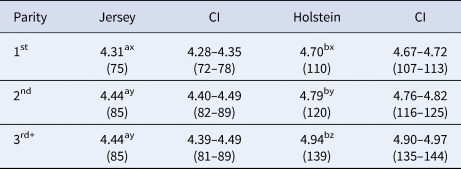
Time intervals between meals were longer for Holstein cows compared to Jersey cows (Table 1). Time intervals increased over parity for Holstein cows. Within the Jersey herd, time intervals increased from first to second parity but not from second to third parity.
Meal intervals, log(min), for Jersey and Holstein cows in each parity

Results from a linear mixed effects model of Breed (B), Parity (P) and their interaction (B × P) with least-squares means (LSM) presented on the logarithmic scale and exponentially back-transformed values in parentheses. LSM differences are only presented for breeds within parity and parities within breeds. Confidence intervals and the significance of differences are adjusted using the Tukey method for all 15 possible comparisons. The B × P interaction was significant: P < 0.001.
abDifferences between breeds within parity.
xyzDifferences between parities within breed.
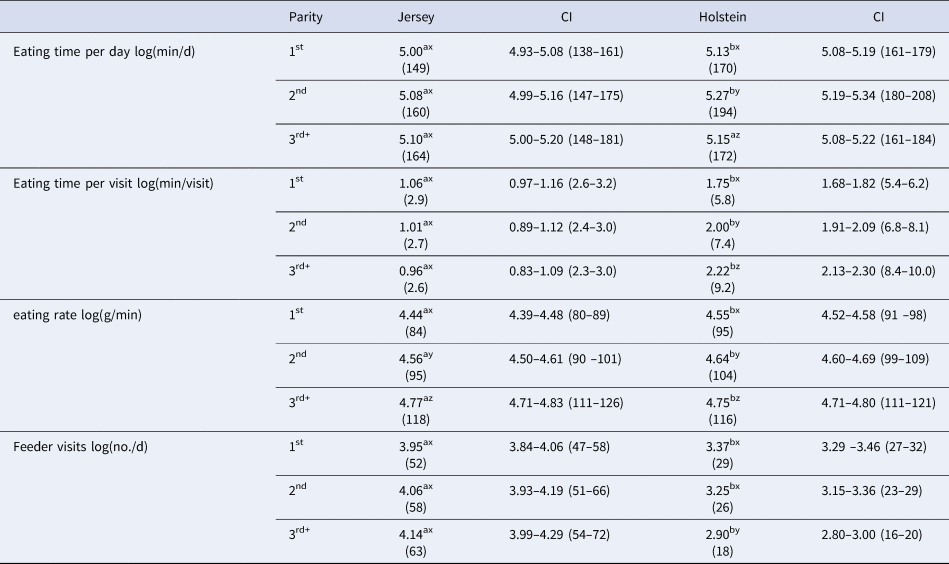
Holstein cows spent more time eating per visit than Jersey cows in all parities (Table 2). Older Holstein cows had longer eating times per visit compared to second or first parity cows. In comparison, for Jersey cows, there was no significant difference between parities for eating time per visit. Holstein cows spent more time eating per day during first and second parity compared to Jersey cows (Table 2). For older cows, no difference between breeds within a given parity was observed. In Jersey cows, there were no differences in the daily eating time between parities. For Holstein cows, individuals in second parity ate for a longer time per day compared to cows in other parities. First and second lactation Holstein cows had a higher eating rate as opposed to Jersey cows (Table 2). For older cows, no difference between the two breeds was found. For both breeds, younger cows had a lower eating rate compared to older cows.
Eating time per day and per visit, eating rate, and feeder visits, for Jersey and Holstein cows in each parity

Results from a linear mixed effects model of Breed (B), Parity (P) and their interaction (B × P) with least-squares means (LSM) presented on the logarithmic scale and exponentially back-transformed values in parenthesis. LSM differences are only presented for breeds within parity and parities within breeds. Confidence intervals and significance of differences are adjusted using Tukey method for all 15 possible comparisons. For eating time per day, the B × P interaction was not significant (P = 0.24). For eating time per visit and eating rate, the B × P interaction was significant (P < 0.0001) and for feeder visits P = 0.05.
abdifferences between breeds within parity.
xyzdifferences between parities within breed.
Contrary to Holstein cows, Jersey cows visited the feeder more often (Table 2). Holstein cows in third parity or higher visited the feeder significantly fewer times compared to younger cows, whereas there was no difference in the number of visits per day for Holstein cows during first and second lactation. However, for Jersey cows, no significant differences between parities were found for the number of visits to the feeder.
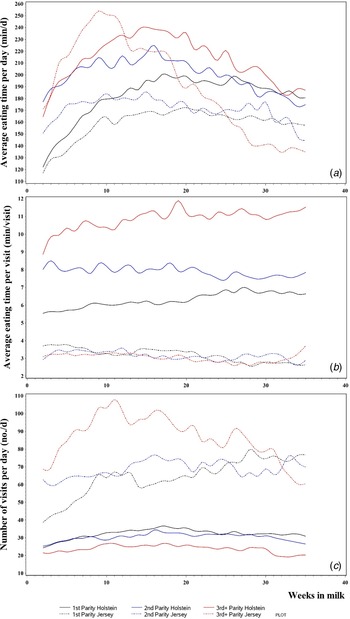
Visual inspection of changes during lactation (Fig. 1a) showed that the daily eating time changed during lactation and that this trend differed among parities, but not between breeds. Overall, the daily duration of eating decreased for multiparous cows after a short peak during lactation, however, this decline was less sharp for older Holstein cows compared to older Jersey cows. Second parity cows exhibited a moderate increase in the daily duration of eating before it slowly declined towards the end of lactation. For primiparous cows, daily eating time remained constant after a short period of increase during early lactation. Duration per visit was constant throughout lactation for all breeds and parities (Fig. 1b). However, duration levels differed between breeds and also among parities for Holstein cows. The daily eating rate changed throughout lactation (online Supplemental Figure S1), with this trend differing with respect to parity within breed but not between breeds. The eating rate of older cows slightly increased within the first 5 weeks in milk, which subsequently remained constant. A slight increase in the eating rate of Jersey cows was observed after 25 weeks in milk. Second parity cows showed a steady increase in eating rate throughout lactation. The eating rate of primiparous Jersey cows increased throughout lactation, whereas the eating rate of primiparous Holstein cows decreased over the first 15 weeks in milk and then increased. The daily number of visits to the feeder changed during lactation with similar trends for both breeds (Fig. 1c). Until the tenth weeks in milk, the number of visits increased slowly and decreased again from week 30 after staying relatively constant in between. However, the daily number of visits did not decline in primiparous Jersey cows towards the end of lactation.
Average eating time per day (a), average eating time per visit (b), and average number of visits per day (c), vs. weeks in milk for Jersey and Holstein cows at each parity. Daily records were averaged for each week in milk and each animal, and smoothed lines were drawn through the scatter of points against weeks in milk.

Discussion
Compared to the cows in the two Holstein groups, the cows in the Jersey group visited the feeder more often, however, their visit duration and, hence, total daily eating time were shorter. As all analysed factors are likely to be interrelated the shorter visiting times of Jersey cows might not just led to shorter eating times per day but also to a lower feed intake per visit, forcing cows to visit the feeder more often to get an sufficient amount of food. The trajectory during lactation did not differ between Jersey and Holstein cows. Weeks in milk affected the eating time per day, number of visits per day and eating rate.
Number of visits
Compared to Holstein cows, Jersey cows visited the feeder significantly more often, supporting our hypothesis. While we focused mainly on number of visits other studies used an intermeal interval to combine several visits into meals. Similarly to our study, Durst et al. (Reference Durst, Senn and Langhans1993) found that Jersey cows ate more meals per day compared to Holstein cows. However, in tie stalls, Aikman et al. (Reference Aikman, Reynolds and Beever2008) found no differences in meal frequency between the two breeds. Yet, opposed to our study, their data was calculated from jaw movements. Furthermore, this system restrains natural behaviour and behavioural observations have to be interpreted with caution. Nevertheless, they also reported that Jersey cows tended to spread their eating bouts more evenly throughout the day, which is supported by our finding of shorter between meal intervals for Jersey cows. Thus we can conclude that, compared to Holstein cows, Jersey cows do not just visit the feeders more often within a meal, they also have more meals. The rather high stocking density in our study might have affected the number of visits to the feeder, increasing competition and causing animals to be more frequently displaced from feeders. If Jersey cows were more aggressive or motivated to feed, they would probably displace other cows more often and therefore have more visits, as it is well documented that restricting access to feed increases the frequency of displacement, especially for subordinate cows (von Keyserlingk and Weary, Reference von Keyserlingk and Weary2010; Beauchemin, Reference Beauchemin2018). In our study, Holstein cows showed the expected pattern of higher parity cows visiting the feeder significantly fewer times compared to younger cows (Dado and Allen, Reference Dado and Allen1994; Azizi et al., Reference Azizi, Kaufmann and Hasselmann2009; Neave et al., Reference Neave, Lomb, von Keyserlingk, Behnam-Shabahang and Weary2017). In contrast, we found no significant difference in the number of visits among parities in Jersey cows. The more even distribution of visits to the feeder might provide opportunities for subordinate cows to visit at greater frequencies and therefore, limit differences between parities. The increase in feeder visits during early lactation in our study likely compensated for an increase in energy demand during early to peak lactation. (Bossen et al., Reference Bossen, Weisbjerg, Munksgaard and Hojsgaard2009; Johnston and DeVries, Reference Johnston and DeVries2018).
Duration of eating time per day and per visit
We hypothesised that the eating time per day and per visit would be shorter for Jersey cows than for Holstein cows. Our findings supported these hypotheses, with first and second parity Holstein cows spending more time eating per day compared to Jersey cows. Moreover, for all parities, the feeder visits of Holstein cows were longer compared to Jersey cows. However, we found no differences in the daily eating time between older Holstein and Jersey cows, supporting what was reported by Aikman et al. (Reference Aikman, Reynolds and Beever2008). Jersey cows of higher parities might achieve the same daily eating time due to more feeder visits, whereas older Holstein cows had the lowest number of visits.
Our expectation of primiparous cows spending less time eating per visit compared to multiparous cows was confirmed, as older Holstein cows spent more time at the feeder compared to younger cows. Our observed eating times were similar to those reported by Kaufmann et al. (Reference Kaufmann, Azizi and Hasselmann2007) and were slightly longer than those reported by Tolkamp et al. (Reference Tolkamp, Schweitzer and Kyriazakis2000). Social constraints might drive these differences with the lower body weight of primiparous cows giving them a lower rank, forcing greater flexibility with their visits to the feeder (Arave and Albright, Reference Arave and Albright1976; Sarova et al., Reference Sarova, Spinka, Stehulova, Ceacero, Simeckova and Kotrba2013). In our study, primiparous Holstein cows spent less time eating per day compared to second parity Holstein cows. However, in contrast to our expectations, we found that Holstein cows of higher parity spent less time eating compared to cows in second parity. This phenomenon might be explained by older cows spending more time ruminating and, thus, less time eating (Llonch et al., Reference Llonch, Mainau, Ipharraguerre, Bargo, Tedo, Blanch and Manteca2018). Some studies support the assumption of eating time increasing with parity (Dado and Allen, Reference Dado and Allen1994; Henriksen et al., Reference Henriksen, Weisbjerg, Lovendahl, Kristensen and Munksgaard2019), whereas others found that younger cows spend more time eating than older cows (Azizi et al., Reference Azizi, Kaufmann and Hasselmann2009; Gomez and Cook, Reference Gomez and Cook2010). These differences between studies might be attributed to different experimental conditions such as feed composition or forage ratios affecting eating behaviour (DeVries et al., Reference DeVries, Beauchemin and von Keyserlingk2007). Additionally, it should be noted that the mixed ages of third and greater parity cows may have influenced comparisons with the two other parity groups. Yet, as only a very few older cows were included in this study their influence is presumably low.
Unexpectedly, significant differences between parities in the Jersey group were not observed. The reason for this result is not clear. Because Jersey cows tend to distribute their visits to feeders more evenly, this might reduce the number of conflicts among parities, leading to more similar eating times. Alternatively, this behaviour might be attributed to higher levels of agonistic behaviour in this group, forcing cows to optimise the time spent at the feeder (Nielsen, Reference Nielsen1999) by shortening the time spent per visit and, consequently, eating time per day. Many factors such as characteristics of the diet or health can affect eating time (Beauchemin, Reference Beauchemin2018). Thus, our findings of slightly shorter daily eating times compared to previous studies (Dado and Allen, Reference Dado and Allen1994; Azizi et al., Reference Azizi, Kaufmann and Hasselmann2009) should be treated with caution.
In both breeds, the time spent eating per visit was relatively constant over the course of lactation (Fig. 1b and online Supplemental Figure S2B). In contrast, the trend for eating time per day changed during lactation with a steep increase at the beginning of lactation and a slower decrease towards the end of lactation (Fig. 1a and online Supplemental Fig. S2A). This result reflects our observation for feeder visits per day (Fig. 1c and online Supplemental Fig. S3B); thus, cows that visited the feeder more often spent more time eating per day but not per visit. This finding was not unexpected, as dry matter intake, eating time and feeder visits are correlated (Johnston and DeVries, Reference Johnston and DeVries2018).
Eating rate
The eating rate of Holstein and Jersey cows in our study is supported by previous research (Nielsen, Reference Nielsen1999). Specifically, Holstein cows during the first and second lactation exhibited higher eating rates compared to Jersey cows, which agrees with previous studies (Durst et al., Reference Durst, Senn and Langhans1993; Aikman et al., Reference Aikman, Reynolds and Beever2008), with no differences being found between older cows in our study. In addition, for both breeds, a lower eating rate was observed in younger cows compared to older cows, supporting previous studies (Azizi et al., Reference Azizi, Kaufmann and Hasselmann2009; Henriksen et al., Reference Henriksen, Weisbjerg, Lovendahl, Kristensen and Munksgaard2019). Older cows tend to have higher eating rates compared to younger cows, probably due to their greater bodyweight and, perhaps, higher motivation to feed (Neave et al., Reference Neave, Lomb, von Keyserlingk, Behnam-Shabahang and Weary2017).
Study implications and limitations
The objective of this study was to describe and compare the feeding behaviour of primiparous and multiparous Jersey and Holstein cows housed in the same barn. The motivation for the study was that behavioural differences between breeds and different parities could help farmers to select appropriate breeds and optimise management with respect to welfare and production. The data presented in this study point toward the existence of substantial differences in the feeding behaviour of Jersey and Holstein cows.
Although it is not possible to definitively separate group effects from breed effects, we suggest an effect of breed since there was no difference between the two Holstein groups and all three groups were kept in the same barn under the same management conditions. Therefore, differences between the two Holstein groups and the Jersey group are referred to as breed difference in the following, aiming to give implications for future research cancelling out such confounding effects. However, having the two breeds as one group was not possible, as it would likely influence normal breed behaviour. Keeping age distribution similar between breeds, the taller and heavier Holstein cows would probably rank higher and, therefore, displace Jersey cows more often at the feed bunk (Arave and Albright, Reference Arave and Albright1976; Sarova et al., Reference Sarova, Spinka, Stehulova, Ceacero, Simeckova and Kotrba2013).
In conclusion, we demonstrated that, compared to Holstein cows, Jersey cows visited feeders more often and with shorter time intervals between meals. However, their visits were of shorter duration, and the total daily eating time was longer for Holstein cows compared to Jersey cows. There were no differences between parities within the Jersey cow group; however, further studies are needed to confirm the breed differences.
Supplementary material
The supplementary material for this article can be found at https://doi.org/10.1017/S0022029922000061.
Acknowledgements
The project was financially supported by the Federal Ministry of Education and Research (Berlin, Germany, programme ‘FHprofUnt 2018’). We thank the Department of Animal Science, Aarhus University, Denmark, for providing access to the data
Conflict of interest
All authors declare no potential conflicts of interest.