The current method for selecting presidential nominees by the two major parties went into place mostly in 1972 and certainly by 1976, after Buckely v. Valeo. It was the natural culmination of reform efforts over the history of the republic in that, while prior reforms consistently invoked greater openness and democratic governance as rationales for their adoption, this method actually empowered voters as the central figures in determining who would be nominated (see Aldrich Reference Aldrich, Heard and Nelson1987). This fact became fully evident almost at once. The selection via primaries of senator George McGovern in 1972 and governor Jimmy Carter in 1976 as the Democratic presidential nominees arguably not only would not have happened, they would not have even come close to winning nomination without successful appeal to the voting public.
A consensus emerged that the McGovern and Carter nominations led to electoral disaster in 1972 (and perhaps to putting the Democrats at a long-term electoral disadvantage) and to a failed incumbency and electoral disaster again in 1980. This consensus, in turn, led to a series of modifications of the nomination system as designed in the 1972–76 period. For example, on the recommendation of its Hunt Commission, the Democratic Party adopted superdelegates (that is, party and elected officials receiving automatic delegate slots and being formally uncommitted to any candidate) in time for the 1984 convention. The explicit intention was to soften the effects of the McGovern-Fraser Commission (see Price Reference Price1984), and just in time to play a key role in Walter Mondale's nomination campaign that year.
I argue that the effect of these modifications and reforms of the nomination process have, in net, served to reduce the influence of the citizen-voter, election cycle after election cycle, since about 1984. Indeed, I claim that we have now reached the point where the standard nomination setting has sufficiently reduced the role of the public to the point that it can barely be considered truly a democratic selection at all. To be sure, the system is sufficiently rich, complex, and uncertain that (even with no further changes) the situation will on occasion be ripe for the public playing its once regularly critical role. The balance of influence, however, has altered sufficiently that it has changed from a case in which the public generally rules to one in which their role is secondary to the roles of those whom we might call the “nomination elite” (officeholders, activists, resource providers, campaign specialists, media personnel, and the like). In a system as complicated and nearly incoherent as this one, there are many reasons for particular outcomes and so there are many reasons for this undermining of democratic choice. The focus in this paper is on the most significant characteristics of this system.Footnote 1
I turn next to make the case for the apparent undermining of democratic choice over time. That is an empirical case. I then turn to make the theoretical case—to offer an account of why this undermining occurred. It so happens that there is a simple, well understood, and broadly accepted theory of winning presidential nominations. While it has been modified in a number of ways, the general outlines have persisted, and I use a very simplified version of even this simple theoretical account to make the point. I then add the so-called invisible primary season to it, and demonstrate how the invisible primary (roughly the organizational building, strategic maneuvering, and resource acquisition that candidates do in the six months to year before the Iowa caucuses) can undermine the democratic determination of outcomes that was typical of primary seasons before the rise of the invisible primary. Finally, I turn to the questions of whether technological changes are sufficient by themselves to undo these effects, or, if not, what reforms might reasonably re-empower the public.
THE RISE OF ELITE CONTROL OVER PRESIDENTIAL NOMINATIONS
The empirical case for the reduction of the public's influence over the selection of presidential nominees is simply a relatively straightforward enumeration. It is, in particular a count of who won or ran very strongly as relatively little-known outsider candidates, in which it seems evident that success in Iowa, New Hampshire, and so on was central to making their campaigns at all consequential. Doing so assumes that the only way for the little-regarded candidate to emerge during the primary season is by appeals to and support from the public (notably by votes or their caucus-participant equivalent) in the primary season itself. A fuller explanation might be necessary to make the case that this or that contender was not a party-elite preferred candidate (fortunately, Cohen et al. [Reference Cohen, Karol, Noel and Zaller2008] do something very much like this in more detail). I consider only non-incumbent races.
THE VOTERS CHOSE IN THE 1970s
Some may argue that 1972 is too early for the system to be fully in place. But if it is close enough to being so, the nomination of the chair of the commission most central to the creation of this system, George McGovern, over his major contender, Hubert Humphrey, hardly needs further detail. The system was fully in place by 1976 and Jimmy Carter, proudly adopting the moniker “Jimmy Who?” defines what is meant by the successful outsider candidate, and he defined the strategy of using Iowa and New Hampshire to build momentum to win the nomination as an outsider (who proudly proclaimed his lack of experience in or even knowledge of Washington and its politicians).Footnote 2
THE VOTERS STILL “MATTERED” IN THE 1980s
In 1980, George H.W. Bush would hardly be called an outsider to Washington or to party elites, but he did mimic the Carter strategy to challenge the odds-on frontrunner and the unquestioned leader, indeed the very heart, of the Republican Party, Ronald Reagan. It was Bush who borrowed the term momentum.Footnote 3 It was his victory over Reagan in Iowa that propelled him from (in his words again) “an asterisk in the polls,” and it was his loss to Reagan in New Hampshire that ended his quest. John Anderson also emerged as a little-known conservative congressman who attracted public attention to become sufficiently popular to take on an independent candidacy for the presidency in the fall.Footnote 4
By 1984, the momentum in nomination reform began to shift back towards the insider candidate. The Hunt Commission adopted reforms in the Democratic Party that turned out to be particularly consequential that year. Gary Hart, McGovern's advisor on the McGovern-Fraser Commission, his campaign manager in 1972, and then senator from Colorado, served as the seemingly typical candidate who was leveraging early success into national prominence. Indeed, he fought the quintessential insider candidate, former vice president Walter Mondale, to a virtual dead heat through the primary season. At the end of the last primary, neither held a majority of the delegates, although Mondale held a noticeable lead. The Hunt Commission had, however, approved the creation of a large block of so-called superdelegates (mostly current officeholders and party leaders who were appointed as delegates because of their positions and without commitment to any candidate). These delegates were uncommitted and therefore up for grabs, and it was (unsurprisingly) the insider who won the great majority of these insiders serving as superdelegates and with them, the nomination.Footnote 5 The superdelegate provision was proposed precisely to ensure a greater role for the party elite in the nomination and the convention, and it instantly succeeded in doing just that.
Both parties had open contests for the 1988 presidential nominations. The Republican one was dominated by two quintessential insiders, then vice president Bush and senator Robert Dole. While they were both consummate insider types and while New Hampshire was the final decision point between the two, the case is not particularly instructive, because virtually any system would likely have been dominated by a Bush-Dole contest. The Democrats started out with Gary Hart being the frontrunner in a crowded field, one originally dubbed “Gary Hart and the Seven Dwarfs” (Abramson, Aldrich, and Rohde Reference Abramson, Aldrich and Rohde1991, 11). When Hart proved to be no Snow White, the seven dwarfs contested through the primaries and caucuses. A concentration of primaries and caucuses in March, called Super Tuesday, was to have been determinative and presumed to be helpful to a southern or at least moderate Democrat (Norrander Reference Norrander1992). Crowded with additional, non-southern primaries, the contest ended in a three-way tie—one candidate won the most states, one the most delegates, and one the most votes. Reverend Jesse Jackson saw this, his second, bid stall, and then senator Al Gore lost to governor Michael Dukakis in the following primary in New York, leaving Dukakis the last candidate standing. One reason a Massachusetts Democrat could do so well in a concentration of southern primaries was that he had built the strongest campaign organization, a virtue for a candidate that was increasingly telling. Equally telling was that it provided another entry point for elite influence over nominations as candidates appealed to that elite for their services in creating and staffing that organization, often well before Iowa.
VOTERS PLAY A DECREASINGLY CONSEQUENTIAL ROLE, 1992–2004
In 1992, the crowded Democrat field almost immediately boiled down to then governor Bill Clinton and senator Paul Tsongas. Clinton, like Dukakis, built the largest and strongest campaign organization (as Hillary Rodham Clinton had done in 2007 for 2008), and that certainly helped him weather the charges of adultery and draft dodging. Conversely, Tsongas discovered that someone trying to follow in Jimmy Carter's footsteps faced a more expensive and more frontloaded primary season. Thus, instead of being able to use successes in Iowa, New Hampshire, and the like to gain access to significant amounts of campaign resources and still have the time to invest them in subsequent primaries, Tsongas faced a true dilemma. His tradeoff was that time spent raising resources was time away from the campaign trail, using those resources to try to win voter support. Of course, this was Carter's set of tradeoffs, too. Tsongas, however, faced much greater demands for resource acquisition and also a foreshortened primary season, so that the tradeoff had become acute. And, with Clinton, his major opponent, having built his resource and organization in advance, the tradeoffs Tsongas had to make became impossible for him to counter the less binding constraints facing Clinton.
If Carter's campaign led to the creation of the momentum model I use in the next section, Clinton's advance preparations led to the first sustained study of the importance of the pre-primary season—what came to be called the invisible primary—that assessed the role it played in the primary season and the way in which it advantaged (but not exclusively determined) the candidate best able to use the insider's campaign (Paolino Reference Paolino1995).
In 1996, Dole all but cruised to victory as an example of the culmination of these trends. Gore defeated Bradley easily in 2000 in much the same fashion. George W. Bush's victory in 2000 was not an insider's victory, per se. Rather it further cemented into place the importance of building to (rather than being one of) the insiders to party politics in the invisible primary season. And, finally, Kerry was perhaps the most inside of the candidates in 2004. The boomlet of media attention to Howard Dean followed by his inability to translate his newfound method for raising campaign funds into votes (and thereby creating a possible solution to the Tsongas dilemma) is a healthy reminder that, as important as the pre-primary season is, it is the actual votes cast and caucuses attended that select delegates who ultimately make the difference.
SUMMARY
Two facts of campaign life have changed fundamentally since the 1970s when outsiders could run as unknowns and convince people to vote for them—and win the nomination. One is the spiraling cost of campaigns. When the matching funds provision went into effect for the 1976 contests (the FECA of 1974), those candidates accepting matching funds for the presidential nomination were limited by law to spending no more than $10 million (in 1974 dollars, adjusted for inflation—$37.1 million in 2004 dollars). George W. Bush, in 2000, was the first victor to have declined matching funds, and he raised $90 million, roughly three times what others were allowed to spend. For 2004, Kerry (and Dean) declined matching funds—largely so that they could avoid the fate of Gore in 2000. By being able to spend no more than a third of Bush's funding total, and by both having victory in hand by early March, Gore was massively outspent over the rest of the pre-convention period in what was essentially an early opening of the general election campaign but was, for legal compliance, still the nomination campaign. Bush (although uncontested) appeared ready to raise up to $200 million for 2004, so Kerry and Dean sought to avoid spending limits to be able to clash with Bush, should they win the nomination. Kerry ended up raising over $215 million for his nomination campaign (drawn from http://www.gwu.edu/~action/2004/presfin04.html).
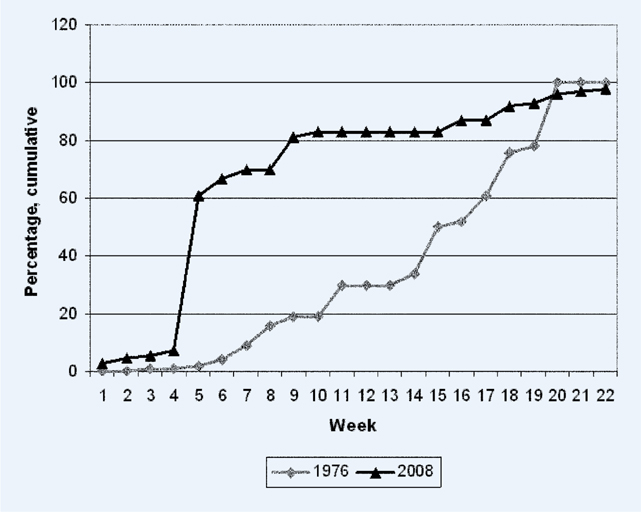
The second fact of life, which with resource demands makes up the second half of the Tsongas dilemma, is frontloading. This is well known, but Figure 1 illustrates the different electoral landscape in 2008 compared to 1976. Lots more money is needed today than in 1976, and it is now needed much more quickly. Hence, early campaign building efforts move from valuable to essentially mandatory. I will consider the Obama campaign in these terms later, but I do note that he built extensive plans and organizational bases in 2007 for what was accomplished in 2008.
Delegates Awarded by Week, 1976, 2008

DYNAMICS OF PRESIDENTIAL NOMINATION CAMPAIGNS: THE THEORY OF MOMENTUM WITH AN INVISIBLE PRIMARY SEASON TO START
Based on observation of the McGovern and Carter campaigns in the 1970s, I proposed a very simple dynamic model of presidential primary campaigns (Aldrich Reference Aldrich1980a; Reference Aldrich1980b), a momentum model if you will. Later work has extended this model in interesting and important ways. Bartels, for example, added a dynamical account of voter behavior that (in this context) supplements the campaign-level momentum model (Bartels Reference Bartels1988). Gurian and co-authors have written extensively on these dynamics from a candidate level in ways that give strong micro-level underpinnings of this general account (e.g., Gurian Reference Gurian1986; Gurian et al. Reference Gurian, Haynes, Crespin and Zorn2004). Norrander has also written on a wide range of relevant topics, such as her development of the “attrition game” perspective (e.g., Reference Norrander2006). Her account (which underlies what follows) ties the pre-primary and primary season together in that “attrition”—the speed of depletion of resources depends upon the amount gathered in advance as well as on primary and caucus outcomes and other pertinent variables. Of course, the afore-cited Paolino (Reference Paolino1995) develops the ideas of an invisible primary in the pre-primary campaign period in detail. While the academy's understanding of primary campaigns has advanced, the simple dynamics of momentum remains essentially the state of the science.
The momentum model is a simple positive feedback account, in which success in one primary spirals upward, through more positive media coverage, access to greater resources, and therefore more favorable reception by the public in the next primary or caucus. Of course, an unfavorable showing leads to a “decay” dynamic, essentially the opposite of the positive momentum just described. What gives the kick to a candidate (whether upwards or downwards) is exceeding (or failing to meet) expectations. Thus, Mondale essentially did as well as everyone expected—winning but with no knockout blow in Iowa and a close loss in New Hampshire in 1984—and his poll numbers were stagnant, standing at 37% before Iowa and 34% afterwards. Conversely, Hart became the surprising new candidate showing strength (winning in New Hampshire, for example) and his poll numbers went from 3% to 38%. Senator John Glenn, the other potentially strong candidate, along with Mondale, in the beginning did poorly in both, and he withdrew after the second, seeing his poll numbers decline from 18% to 6%. Note that expectations are largely set through media coverage and will be described more fully below.
While even this simple model has a number of equations to describe it, I truncated it down to the following equation, where S will denote success and E(St) denotes the expectations for a candidate in primary t:Footnote 6

where 1 > |β| > 0.

In words, the success of a candidate in, say, the New Hampshire primary is how that candidate did in Iowa plus the increment or decrement due to momentum. And that momentum is the difference between what was expected and what actually happened in Iowa. Thus, if success is higher than expected, the candidate gets a boost (or β) that is positive, while if the candidate fails to meet expectations, the boost is negative and it is zero if expectations are just met. The last, for instance, means that such candidates should do just as well in New Hampshire as everyone expects, because they were neither hurt nor helped by Iowa.
The important point is about momentum. If St−1 is positive, then at the next time point (t), S will be larger, and then it will be larger at t + 1, and again still more at t + 2—the candidate benefits from momentum, the vote analogue to the miracle of compound interest.
We can assess this simply by looking at the bump a candidate gets from a strong showing in Iowa and New Hampshire, which we do via a change in poll standings by coming in among the top candidates (versus not) over the course of competitive, multi-candidate nomination contests since 1972. Over the 10 non-incumbent races in this period, the candidate who came in first (in terms of interpretation by the media) in Iowa and New Hampshire saw poll standings increase by an average of 19.3 points (on the “if your primary were held tomorrow which candidate would you vote for” types of question in a major national poll). This is so even though Bush in 1988 increased only 1.7 points, and Dole, who essentially wrapped up the nomination by that point in 1996, actually declined 7 points. Those who came in second averaged an increase of 5.7 points, while the third candidate increased 0.8 points. Others averaged negative results. After even the next round of primaries, someone who started as an asterisk in the polls, if the campaign followed that up as strongly after New Hampshire as before and during it, would become the first choice of nearly two in five party supporters. This would, therefore, be a very large lead.Footnote 7
All of this is very nice for explaining why the candidate who starts out with a large enough boost from Iowa and/or New Hampshire is harder and harder to beat and why nominations end well before the convention even with crowded fields. What is left to explain is t 0, that is, the starting point. Indeed, that is the nature of all self-generating, or positive dynamical feedback, systems. And it is here that the pre-primary campaign plays its role. It is what sets the opening position. One might have argued (as I still do) that in 2000, George W. Bush and Elizabeth Dole were equally plausible competitors for the same constituency of relatively moderate conservative Republicans before the invisible primary began. It was Bush, however, who moved first and most rapidly to lock up most of the relevant resource providers for that constituency in 1999, so that, by the time they even neared the actual starting line, they were no longer in nearly equal position, but Bush had a sizeable lead. Indeed, it was so sizeable that Dole could not imagine defeating Bush where it would really count, in the early primary and caucus states. This, of course, defines the starting value, t o, and the, let us say, 15- or 20-point boost to someone who starts at nearly zero that may make them viable, but if it is added to someone who starts at, say, 15 or 20 points, it would make the latter close to invulnerable. Further, if the candidate who does get a strong starting point from this invisible primary is only the second strongest out of Iowa and New Hampshire, getting “only” a 5-point or so boost puts that candidate at about the same level as an asterisk candidate getting the large momentum boost. This sounds a bit like Mondale (and Hart) in 1984, perhaps helping us understand how a frontrunner can lose the large momentum gain to an unknown and still be in a strong and possibly winning position. Indeed, the thesis of this article is that the importance of t o has been realized and has been made a, perhaps even the, central part of candidate strategy. This invisible primary is called that precisely because it is a critical part of the campaign determined by elites and not by the public.
Once we know this starting point—the next and final step—in understanding nomination-campaign dynamics is the comparison of actual and expected outcomes. Expectations are a function of all the resources and the like (e.g., money, campaign staff, and poll support in the public) that translate, somehow, into support in Iowa and New Hampshire, as in the following equation.

This step is appending different translations of resources into different starting points. That is, how do predictions of resources become transformed into support in the first primaries and caucuses—how do they get translated into expectations for Iowa and New Hampshire? This is akin to standard “money-votes” equations, such as in Jacobson (Reference Jacobson1978).
If we (meaning academics, media personnel, politicians, etc.) actually knew how expectations form in any systematic way, we would need only one empirical observation to solve this system: the Iowa results compared to expectations.
However, we know a lot about what is necessary but little about what is sufficient for resources to translate into expectations. Consider a few examples. Early on the media used the standard of qualifying for matching funds and, when that proved too low a hurdle, how soon a candidate qualified for matching funds. When that proved not very telling, total funds were used, at least until John Connally's “six million dollar delegate”—when Connally spent $6 million and won a single delegate in 1980. So, cash could not be the full story. Poll standings appeared promising. Bartels (Reference Bartels1988), however, showed that Mondale in 1983–84 had high standing only because he was an acceptable alternative and most voters did not know who else was running until the campaign began. At that point, Hart became the repository of non-Mondale support. Only after New Hampshire did people begin to learn about Hart and thus people began to choose to support (or oppose) Hart based on who he was rather than his simply being “not Mondale.” The race turned to a standard choice between two known quantities. Similarly, Dean's initial popularity and web-based fundraising drew a lot of attention in 2004, but drew less actual support as more candidates became known. Organization seems important and indeed is my explanation for why Bush won so easily in 2000. But the best-organized campaign does not always win, and we may have just observed how organization does not indicate victory in one or both parties this year. Similarly, Cohen et al. (Reference Cohen, Karol, Noel and Zaller2008) argue the importance of party activists, something I fully agree with. It is also not merely the greatest number of activists, however, that predict victory, or Jackson would have soundly defeated Dukakis in 1988.
Two points seems clear. First, we know a fair amount about what sorts of resources are helpful—we have a set of necessary conditions. None of these individually is, nor even are collectively, sufficient for understanding success. Secondly, we can write about what set of resources go into that bundle, but we have much less knowledge about how these go together (what is the appropriate functional form). Even if we have good measures of these necessary conditions (the content of the resources term in equation 2), we do not know much at all about the way they go together (we do not know the function or f that translates resources into expectations in equation 2). While even with knowledge of the sufficient conditions there would remain a stochastic term (the u), given the great unknowns, the size of the stochastic term is much larger than otherwise—much, much larger.
This is the largest remaining challenge for scientific understanding of presidential nominations. How are expectations formed? And, therefore, how should we model them? Answering this pair of related questions would mean that the “only” remaining uncertainty would be the (by then much smaller) u, or term measuring what is unknown.
WHAT DOES 2008 TEACH US?
Perhaps the most notable change in nomination politics in the last few cycles has been the development of the Internet as a basis for building a strong campaign. Perhaps ironically, the first to develop fundraising to any significant level through the Internet was John McCain in 2000. It was, of course, but a first serious effort, and it was insufficient at the time for him to be able to offset the more traditional use of the pre-primary season (often by corralling large campaign financiers and fundraisers early on) by George W. Bush. In 2004, Howard Dean's campaign refined and furthered Internet fundraising considerably, demonstrating its potential to raise large sums of money while going around the campaign elite. Of course, his campaign also demonstrated that having funds may be necessary but is certainly insufficient to win popular support. It was Obama in 2008 who broke the Tsongas tradeoff, however. Of course, while Obama was more successful than Clinton in this regard, he was only somewhat more successful. Had he not run, the sentence would almost certainly have read, “It was Clinton in 2008 who broke the Tsongas tradeoff,” and if not her then someone else in 2012. The technology was finally fully integrated into the polity to make it a viable way to raise huge sums of money. And, even more importantly, to do so in a timely fashion (during the campaign), and, even still more importantly, to be able to do so without having to go off the campaign trail and thereby having to trade off raising funds over campaigning for votes. In this sense, the most important lesson is that the campaign finance provisions that were for so long a critical part of the nomination system are now ineffective. What other campaign effects will prove as decisively shaped by the Internet or other new technologies remain to be seen (will interactive engagement of the campaign with the individual citizen really amount to much?), but Obama has now pretty clearly set to the side the reform effects FECA, its amendments, and the Buckley decision.
CONSEQUENCES FOR REFORMS
Suppose that we prefer to have the public play a consequential role in presidential nominations? One approach to thinking about how to make the visible primary effective involves tackling the Tsongas dilemma without simply opening all avenues to money and thereby reinvigorating the potential for corruption. Can we find a way to loosen the tradeoff he faced between the need for resources and the need to win votes? Consider two sets of reforms that are not particularly controversial (famous last words!), that indeed might even be seen as consensual—without any serious belief that they will ever be adopted.
The first is to affect the time of the campaign. We will never be able—nor even want—to limit candidates from seeking the nomination, and we can be certain that they will start the nomination process as soon as can be imagined. Campaigns have been “full length” (i.e., four-years long) since at least 1956, when John F. Kennedy's decision to step aside from a potential vice-presidential nomination is usually understood as the overt opening of his campaign for the 1960 presidential nomination. We can, however, imagine putting the visible and even significant parts of the invisible primary into a time frame when voters care, and thus the invisible primary is made more visible and relevant to the public. And, we can imagine if not reforms, at least adjustments to media coverage such that the campaign is made more timely and relevant to actual people as it once was.
One way to achieve that reform is through the national parties. Move the window. That is, instead of having the window for delegate selection start in early March, February, or even January (or right after a moving target like New Hampshire), set the window to be open in, say, April and May. Allow Iowa and New Hampshire, and whatever other exceptions to the window are desired, if one wants, but make them be in, say, mid to late March. This shortens the campaign and places the end of the invisible primary into the same year as the visible one. One reason Humphrey wanted a McGovern-Fraser Commission was because nearly a third of the delegates to the 1968 convention were selected in 1967. And by now, we have returned to the case where a substantial portion of the determinative parts of the campaign actually happened in 2007, not 2008 (including the building of Obama's fundraising apparatus, even if its effects were seen more in 2008 than 2007). Further, there often remains a huge amount of time after the nomination campaign is effectively over but before the general-election campaign begins. This would shorten that. It would have made Ross Perot's quixotic bid less consequential in May 1992 (when he was in a virtual three-way tie in support for president, before he dropped out of the campaign, only to return in October). It would forestall at least a reasonable proportion of the need to raise funds for a campaign against the other party, as Kerry felt he needed to match Bush's efforts in 2004—why should Bush have even been tempted to raise $200 million for an uncontested nomination? States should like it, because it would put even the most frontloaded state primary in a time when holding their primary for other offices is sensible. It would move Iowa and New Hampshire to springtime. But most of all, at least for here, it would put the campaign into a timeframe of relevance for actual citizens.
The second set of reforms seeks to loosen the other side of the Tsongas dilemma by reducing the demands for resource gathering, so that more effort can go into winning support. There are many ways to do so. And, maybe Obama has shown that for all future serious contenders fundraising is no longer a serious problem. Further, maybe we are happy with unregulated, open fundraising on the Internet without constraint. But it seems likely that strength in Internet fundraising abilities will vary by candidate—and not vary in a way that is strongly correlated with attributes that would make the best president. So, perhaps we might consider reform, too.
While there are many ways to do this, let me propose what seems the simplest: Update campaign financing so that, for example, matching funds and spending limits are made sufficiently generous as to make acceptance of matching funds again realistic. A formula such as 110% of the last campaign in that state, for example, summed over all states, could be made available for matching funds. Or some other definition or formula could be devised of what is sufficient to conduct a full campaign, with the campaign raising only half that amount. Shifting the campaign window would reduce general election campaigning before the convention, but additional funds could make such campaigning more equal and not detract from spending for the nomination itself. Finally, since these are voluntary and seemingly in compliance with Buckley v. Valeo, one could require that matching funds be spent only within an augmented window, say within the window plus a month in advance (perhaps it is even possible to require that funds used to qualify for matching be spent only within the augmented window). That would encourage concentrating actual campaigning to an actual campaign period that makes sense. Of course, tax dollars would have to be found for this, because the check-off procedure on tax returns seems far too little to produce anything close to the sums needed. Nonetheless, it would contribute to loosening the bounds of the Tsongas dilemma. Nothing requires anyone to accept matching funds, but making them large enough to once again be a significant source of campaign resources makes the potential for having to raise only half as much as otherwise enticing. It would open the prospects for candidacy to a larger range of contenders.
It is, of course, a separate argument to claim that the public should play a great role consistently, as they once seem to have. If one decides they should, giving them a greater opportunity to do so consistently seems virtually uncontroversial. The proposals here are designed to make campaigns more timely and relevant for voters and to give them as large a set of viable and competitive—or at least resource endowed—candidates to choose from. Doing so are at least reasonable first steps toward re-empowering the voter in presidential nominations. ■