


Introduction
In the collective imagination, it is the notion of ‘family’ which is most evoked and associated with organised crime and, more specifically, with Italian mafias. For many, Italian mafias equate to family (and, in some respects, Italian family equates to mafia). This can be seen in the many mafia films that depict the family as this backward traditional social structure that limits and imposes rules on its members, sometimes in comical ways, without really accounting for the importance of family and kinship ties in reproducing mafia structures. The concept of family, with all its symbolic power, has been stretched to the point where it now stereotypically represents the basic unit of all mafia organisations. In the mafia world, multiple forms of family structures can exist and co-exist, these being nuclear, extended, blended and adoptive. Reality is far more complex than the stereotype of the traditional patriarchal family, which is considered to be the foundation of all mafia structures.
In 1991, Falcone explained how the idea of the traditional family structure had come to overlap and be used by criminal families:
The basic unit of Cosa Nostra is the ‘family’, with all its traditional values: honour, respect for blood relatives, loyalty, friendship … It can have up to two or three hundred members, but the average is about fifty. Every family controls a specific territory where nothing can happen without the prior consent of the family head. The family consists of individual men of honour, or ‘soldiers’, whose importance within the family is independent of the responsibilities he takes on. (Falcone and Padovani Reference Falcone and Padovani1992, 89)
The ‘family’ referred to by Falcone corresponds to the cosca mafiosa – the basic organisational unit within the criminal structure of Cosa Nostra during the 1980s. However, it is important to note that this crime group is not made up of blood relatives; its members are appointed by the leadership through formal initiation rituals and the leaders themselves are selected through an election. The term ‘family’ highlights group loyalty and solidarity, but it does not refer to a family in the literal sense and does not correspond to the natural kinship family. The overlap between the concept of the blood family and the mafia family lies at the root of many misunderstandings that have shaped the public representation of the phenomenon.
That said, the family – as a form of kinship – plays a significant role; this holds true both in the past and today. In recent times, for example, we find new types of organisations in which blood ties are one of the crucial elements that hold mafia groups together. Recent investigations have revealed that efforts to rebuild new mafia structures in Palermo have sought to rely on a combination of both familial bonds and new members (see Procura di Palermo 2025). If in the Sicilian Mafia we can detect the presence of blood ties, it is in other types of mafias that the biological family appears to represent a more significant and enduring form of connection over time. This is particularly true of the Calabrian ‘Ndrangheta. In essence, the parental support structures of mafia groups change depending on historical periods (which are also influenced by changes in society) and on the territories involved, along with their specific demographic, social, economic and cultural contexts.
Whereas the nuclear family has been seen by some as a by-product of the heteropatriarchal capitalist system, which in turn it reinforces by confining women to the domestic sphere to the benefit of men (Kern Reference Kern2021), we see the family in another light. Mafia families can be traditional or, in some cases, more modern family-type associations, but the key is that their members exploit existing structures, relationships, codes and norms within the parental network for criminal ends. Even if there is a multitude of power dynamics at play, we see the family as a social unit still based on a collective sense of identity. In this sense, the family is a safe space, a factor that stabilises behaviour and promotes loyalty. Thus, the family can be seen as a barrier to individualism. In the world of the Camorra, for example, there are no fixed roles, and criminal power is not passed down according to rigid rules. Here, leadership may fall to mothers or fathers, sons or daughters, depending on the circumstances and on the individual qualities of clan members (Gribaudi Reference Gribaudi2010; Zaccaria Reference Zaccaria2010; Allum Reference Allum2024).
This article aims to denaturalise existing established narratives of the ‘family’ in the mafia. It seeks to reconceptualise the family’s contours as a multidimensional forum that has different uses and functions, both culturally and economically. We move beyond and demystify the predominant notion that ‘mafia families represent a specific form of organised crime group whose structures and operations are based on kinship systems and values’ (Holt Reference Holt2021, 96) and that it is a static unit which serves only blood ties.
The structure of family in the mafia world is an important resource for many purposes, but it does not correspond to the mafia clan and therefore does not reflect its characteristics as a closed group, as the classic definition of organised crime would have it (see, for example, Cressey Reference Cressey2017). In this article, we present a shift in theoretical perspective for the study of families in the mafia to see the family as a separate entity that can be exploited and manipulated as a value, resource, network and space by criminals. First, we revisit the existing literature. Second, we explain the framework that emerged from our empirical material. And third, we present two case studies, which allows us to specify, articulate and explain our conceptualisation of the mafia family.
The concept of ‘family’ in social and mafia studies
The term ‘family’ is a concept that identifies a social group conventionally situated within civil society. It is an important concept because, in its conventional meaning, it argues for the existence of a ‘natural’ social unit – one based on kinship bonds and ties – and distinguishes it from other institutions, such as the state, and the other formal economic, cultural, and political structures of social life. The family unit exists and exerts its influence over the private sphere – particularly the domestic realm – in a way that is fundamentally different from state institutions, which conventionally exist and operate within the public sphere. Although the family is the institution of intimate ties, it exerts its influence on wider social behaviour in both the private and the public sphere (Eisenstadt and Roniger Reference Eisenstadt and Roniger1984; Trigilia Reference Trigilia2023). The flexibility, pervasiveness and ‘performativity’ of family and parental networks are particularly visible and useful in phases of modernisation and social and economic change (in so-called ‘transitional societies’). The family is thus defined as ‘a flexible organisation, which, while adapting to new conditions, may continue to rely upon traditional forms and way of relating’. This can help explain ‘both the continuities and the incongruities that exist in transitional cultures’ (Yans-McLaughlin Reference Yans-McLaughlin1977, 23).
In the sociological literature, there exist two main theoretical frameworks that present the institutions of family and parental networks during phases of modernisation. First, the family unit is analysed as an obstacle and barrier to democratic and pluralist societies (Banfield Reference Banfield1967; Putnam Reference Putnam1993; Fukuyama Reference Fukuyama1995). According to this perspective, the bonds of trust that family relationships maintain reflect an aspect of gemeinschaft that inhibits the development of trust in modern state institutions. The centrality of kinship-based and community ties prevent the formation of broader loyalties. Even during periods of transition towards formal institutions, households continue to seek out particularistic relationships with the political and economic spheres. For these reasons, in the literature on modernisation processes, gemeinschaft values, familistic behaviour and particularistic networks centred on kinship ties are considered the cultural basis for the development of political clientelism (Allum Reference Allum1973; Eisenstadt and Roniger Reference Eisenstadt and Roniger1984; Zinn Reference Zinn2019).
Edward Banfield’s contribution (1967) had a seminal influence on subsequent studies. His research based on a village in southern Italy, while being simple and clear to understand, has also had a profound influence on the way in which Italian families are considered and examined in the academic literature and in the world generally. Banfield spent a year in Basilicata studying the local community and concluded that the predominance of family loyalties weakened civil society by directing individuals’ commitments and resources primarily towards the family. In particular, he ‘associated endemic backwardness with the presence of an amoral vision of the family – the so-called “amoral familism”' (Ferragina Reference Ferragina2009, 144).
Banfield’s theory was rather straightforward: it explained how and why citizens invested their time and energy in the family unit in the private sphere and dedicated little time to the public sphere and civil society. But, as Muraskin (Reference Muraskin1974, 1495) noted, he produced a ‘disturbing picture’. Indeed, Pizzorno (Reference Pizzorno1966) highlighted that amoral familism was not what caused problems (inertia, corruption, etc.); on the contrary, this was the rational response of households in a situation marked by long historical processes of marginalisation and poverty. Nevertheless, it remains one of the longest-standing explanations of the relationship between family and civic culture, owing in part to the simplicity of its central argument, regardless of its methodological flaws. It is also one that has seeped into the cultural industry and can be linked both to the construction of the family in television series and gangster films as well as in literature, and, at times, to academic studies where the image of the Italian family has been reproduced in a stereotypical way. See, for example, the movie The Godfather or the television series The Sopranos, both based on the notion of family (Renga Reference Renga2019). Nelson Moe (Reference Moe and Gribaudi2009) talks about the ethnising of the mafia phenomenon in American public discourse (see also Gardaphé Reference Gardaphé2006). This is part of the construction of an exotic and picturesque imaginary surrounding southern Italy, which can be linked to an ethnocentric stance (Moe Reference Moe2002).
Second, the family unit is considered as a resource for economic development and a relevant element in an individual’s rational strategies. Family is crucial for the socialisation of individuals, the stability of behaviour, and the mediation of individuals in the mechanisms of the market (Arrighi and Piselli Reference Arrighi and Piselli1987). Particularistic kinship relations may also play a complementary role in development, virtuously integrating the processes through which state legality is consolidated (Bagnasco Reference Bagnasco1988; Trigilia Reference Trigilia1986). This literature stresses the role of the family in Mediterranean societies, as well as in more advanced industrial societies, abandoning the notion that the family is merely a cornerstone for the reproduction of backward forms of social relations. In this perspective, the family and kinship networks are not merely cultural institutions exerting normative pressure towards conformity; they are also arenas of regulation in which individuals’ acquisitive and instrumental action unfolds, both in the private and the public sphere (Davis Reference Davis1977). These two lines of thought have greatly influenced the elaboration of the concept of family in social studies, including studies on the mafia.
In the literature on mafias, the versatile concept of ‘family’ in a broad sense is sometimes replaced by the notion of parental networks or similar terms. It is also used to denote the elementary cell, the specific organisational structure of mafia groups, or even the overall normative architecture of mafia organisations. Indeed, more than violence, trust, corruption, reputation, honour, extra-legal governance and business, family is the one concept that is seen as the essential foundation of successful organised crime groups and mafias. However, the concept is used and referred to in different ways according to different theoretical lenses. The lack of precision and the related aura of patriarchal authoritarianism that it brings with it have shifted the concept of family onto a purely evocative plane, making it difficult to employ for analytical purposes.
The attention to the concept of ‘family’ and its conventional–traditional definition as the basic organisational unit of organised crime (even when the group is not based on blood ties) is reinforced in the analysis of organised crime in the United States, and, in particular, in the work of the Kefauver Commission (1950–1). This commission identified ‘ethnicity’ as the main feature of the phenomenon. This first ‘official’ definition of family fostered a conception of the mafia as an external body – that is, as the product of a foreign ethnicity – according to an ‘alien conspiracy theory’ (Smith Reference Smith1975). During this time, journalists (Sondern Reference Sondern1960) and academics (Ianni and Reuss-Ianni Reference Ianni and Reuss-Ianni1972) researching the American mafia underlined that its origins derived from the traditional cultural world of the Italian South, and thus it was directly linked to the centrality of the blood family and its hierarchy.
On the other hand, Henner Hess’s research (Reference Hess1991) on the Sicilian Mafia highlighted that the mafia organisation was an expression of kinship networks in their dynamics of transformation towards modernity. In his view, the Mafia did not derive from the patriarchal family or from tradition but remained undifferentiated from the family network itself (Hess Reference Hess1991) – as also noted by Lupo (Reference Lupo2009, 22). These were the years, as we have already noted, in which Banfield’s work (Reference Banfield1967) was being shared, and Anglo-American political science research characterised Italian political culture as ‘parochial’ (Almond and Verba Reference Almond and Verba1989). It is easy to identify – well beyond the intentions of the authors we have mentioned – a connection between these conceptualisations and common-sense understandings of the mafia phenomenon.
This simplification is further reinforced by research on clientelism. Even though networks of personalised exchanges exist across all modern political systems based on legal–rational apparatuses (Roth Reference Roth1968), clientelism is investigated almost exclusively in developing societies undergoing modernisation. In these contributions, familism, clientelism, corruption and mafias are interconnected notions, ultimately subsumed within the broader category of ‘backwardness’, which embodies a feeling of rejection and estrangement – cultural and factual – from modern liberal institutions (Zinn Reference Zinn2001). These positions, which are widespread in public discourse, have also spilled into social science frameworks that place the ‘mafia spirit’ – a precipitate of the concepts mentioned above – at the centre of the analysis, connecting it directly to the supposed traits of Sicilian-ness and southern-ness: omertà (code of silence), honour, and, along these lines, a rejection of the state.
The main limitations of these approaches can be summarised as follows: (1) the use of binary and narrow categories which means that little attention is given to the uncertainty regarding the boundaries of mafia networks; (2) the reification of the concept of mafia and thus the naturalisation of ‘mafia-ness’ as a characteristic of people; (3) a synchronic analysis that obscures the historical depth of the processes that led to the genesis of mafia groups; and (4) a rigid conception of family and its identification with the mafia without an analysis of the social, economic and cultural changes that modify and articulate kinship structures over generations in certain communities.
Methods and framework
Over the last 25 years, we have collected judicial documents, police reports, newspaper articles and in-depth interviews with prosecutors, former criminals and members of local communities. Without adopting any pre-existing theoretical framework, we studied the intricate details of mafia families – Calabrian, Sicilian, Italo-American and Neapolitan – which forced us to question and challenge mainstream conceptualisations. We used an inductive approach to look at the concept of ‘family’ within mafia-type organisations. This meant adopting a bottom-up approach rather than a predetermined model to analyse the material. We used police/judicial material as the basis of our reconstruction of families (see Table 1).
Material collected for research on mafia families

Table 1 Long description
Crime group, dates, and material consulted or collected are listed for four groups. Italo American Mafia covers 1850 to 2025 and includes court documents, police files, trial transcripts, newspaper articles, penitentiary archives, and personal diaries. Neapolitan Camorra covers 1950 to 2026 and includes the same materials plus interviews with former criminals and prosecutors. Sicilian Cosa Nostra covers 1950 to 2026 and includes the same materials plus interviews with prosecutors. Calabrian Ndrangheta covers 1950 to 2026 and includes the same materials plus interviews with former criminals and prosecutors.
Source: Authors.
To do this, we collected and studied judicial material relating to Italian mafias and the Italo-American mafia and to events spanning the period between 1890 and 2026. This material includes trial transcripts, interrogations, wiretaps, sentences and police reports; we examined how family relationships were described, enacted and mobilised by mafia actors, how kinship was conceptualised within criminal organisations, and how relationships between different families evolved over time. We looked at family using both an outsider’s and an insider’s perspective, focusing on organisational units, networks and values. We plotted family trees, kinship relationships, marriages, tensions and conflicts to see how families existed, behaved, moved and evolved and whether there were general patterns and trends. The findings were then discussed with state witnesses, police officers and prosecutors. Drawing on this extensive empirical material, in the following pages we have selected – for the sake of brevity – two examples of family genealogies, the reconstruction of which allows us to highlight the key issues outlined in the previous section.
What emerged was something that differed from the traditional, unique and stable mafia organisational family unit that is often portrayed. The family concept that we observed is not a fixed normative and regulatory space, but a set of relationships, functions and values that exist in a structured kinship forum which emerges and is embedded in civil society across time and locations. The family structure is a social site that is not innately criminal. It exists in different social contexts and manifests in different shapes and sizes. There are examples of legitimate business families, such as the Rothschild and Agnelli, where family, capitalism and professional–entrepreneurial networks organise around kinship (James Reference James2006). What we were looking at was a similar kinship structure, but it was manipulated by criminals for their own agenda and purpose. Thus, the family becomes a crime family when its members use it as a tool for market control strategies, a device of power and governance in the illegal world, a space of resistance against the consequences of neoliberal society, a system for the reproduction of values and practices over time, and a sphere for establishing bonds of loyalty. In other words, the mafia family is not a natural expression of the ethnicity of certain cultures. Rather, it is an extension of blood family towards a purpose-driven criminal organisation. The family can also be a site of conflict between rival groups and a social space and ideology that can be manipulated for individual purposes.
Our framework is one that looks at the multilayered and multidimensional relationships, functions and values within the family forum and how these are criminalised by their members. Our approach is one that analyses mafias in relation to the social institutions with which they are interconnected and interlinked. In the next section, we discuss two different family structures drawn from the Italo-American mafia and the Neapolitan Camorra.
The Morello-Terranova family, New York (1892-1947)
In general history books on organised crime in New York and America, Giuseppe Morello is often presented as one of the ‘first players’ in the emerging Italo-American mafia: ‘he and his family were trailblazers’. Cascio elaborates further: ‘Morello’s legacy in the United States is unparalleled, both in his kinship ties among mafiosi, and in the organizational legacy of Mafia Families that evolved from his efforts’ (2023, 150). Indeed, Dash (Reference Dash2009) has suggested that he should be considered as the first real boss of the American mafia because he went on to be the adviser of one of the first leaders of the Genovese family, Giuseppe Masseria. The Genovese family was one of the Five Mafia Families that would dominate New York in the 1930s and most narratives about the American mafia in the postwar period.
Between 1897 and 1910, Giuseppe Morello, together with his associate Ignazio Lupo,Footnote 1 dominated the New York criminal landscape with their counterfeit-money operations. Both men are portrayed as solitary figures within the emerging New York criminal underworld of the 1900s, even though their collaboration is not clearly articulated nor systematically analysed. But both were surrounded by various associates, networks and kinship groups that facilitated their criminal trajectories. Indeed, as Lupo (Reference Lupo2015) has argued, the trajectory of the Morello family shows how the parental network: (1) constitutes a resource for survival in conditions of social disadvantage; (2) represents an important infrastructure for achieving positions of power in the underworld; and (3) connects networks across space and time, marking mafia affiliation and reputation, which are key factors in building mafia groups across the Atlantic.
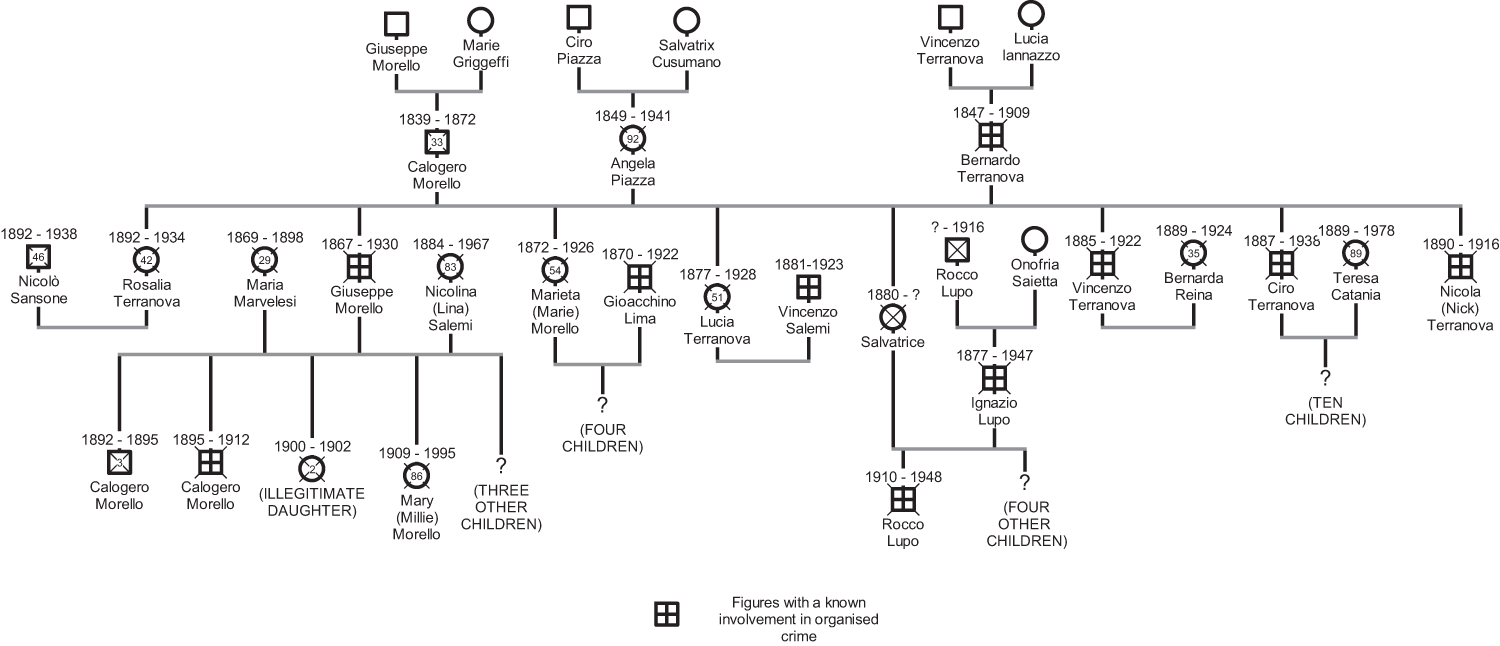
Giuseppe Morello was constantly surrounded by his family, including his mother, wivesFootnote 2 and his stepfamily (see Figure 1).Footnote 3 Here, we would like to highlight the centrality of family as a natural space in three specific moments of Morello’s life and criminal career which illustrate the importance of parental networks: first, 1893‒7, when the Morello–Terranova family left New York and went south; second, 1897‒1915, when Morello emerged as an important criminal figure and was then incarcerated in Atlanta Prison (until 1920, when he was released on parole); and third, during and after his imprisonment in 1915, culminating in his release on parole in 1920, when he became an ally and associate of Giuseppe Masseria, the future head of one of New York’s major mafia organisations.
The Morello–Terranova family, New York (1892–1947).

Figure 1 Long description
Family tree of the Morello-Terranova family from 1830 to 1995. It highlights individuals involved in organized crime using specific symbols. The tree starts with Calogero Morello and Angela Piazza, branching out to show their descendants. Key figures include Giuseppe Morello and Ignazio Lupo, marked for their criminal involvement. The tree illustrates familial connections, marriages and offspring, with some branches noting the number of children rather than listing names. The layout is horizontal, with generations aligned from top to bottom, showing relationships and significant family members involved in organized crime.
Giuseppe Morello arrived in New York from Sicily in 1892,Footnote 4 six months before the rest of his family. New York in 1893 was a tough place, work was hard to find and economic conditions were challenging. So, the family took a strategic decision to survive: Morello went south to Louisiana to look for work in the cotton fields and sugar plantations. Why Louisiana? Because there was a demand for labour and Sicilians had a good reputation for being hard workers, but also because one of his cousins, Antonio Saltaformaggio, was there together with a larger Sicilian community (Dash Reference Dash2009, 62). His half-sister, Lucia, married Saltaformaggio.Footnote 5
Although he was a cripple, Morello soon found work; after two months of hard work in the fields, he had made enough money to send for the rest of his family, including his six step-siblings, the Terranovas.Footnote 6 In this way, the family unit acted as a safety net and a resource for their survival strategy. Between 1894 and 1896, the family unit decided to move to an agricultural community in Texas where labourers were in demand and working conditions were good and fair (Dash Reference Dash2009). Here, all the family members were put to work: the men laboured in the cotton field, while the women cooked, baked, sewed, made their soap and did the washing. The children also worked on the land and assisted with other tasks (Dash Reference Dash2009). This life was particularly harsh and hard especially for Morello, but he was able to survive thanks to his extensive parental network, which was a vital resource.
Hard work did not produce ‘a quick fortune from cotton’ (Dash Reference Dash2009, 65) and there was no incentive to make money for others and to be continuously exploited. The hardship and disease saw Morello and his extended family return to Little Italy, New York, in early 1897.Footnote 7 However, they were not empty-handed when they returned as they had accumulated funds, which were soon invested in a number of business projects. His stepfather, Bernardo Terranova, set up a plastering business while Morello invested in various bars, although these ventures had failed by around 1899. Morello then turned to crime, his speciality being counterfeit money but also Black Hand extortions, horse theft, insurance fraud and related murders (Landolfi Reference Landolfi2023; Hortis Reference Hortis2021).
Between 1897 and 1910, Morello rose to power in the New York criminal underworld by outwitting his rivals, his extensive use of violence and his good business acumen:
Morello had been in the country only since 1893, restarted his counterfeiting career in 1899, and formed his criminal family in 1900. By 1903, though, he, was the uncrowned king of Little Italy. And three years after that, he was acclaimed as boss of bosses of the entire American Mafia. (Dash Reference Dash2009, 139; see also Landolfi Reference Landolfi2023)
While the family acted as a reason for survival in Texas, when he returned to New York, Morello’s family unit was transformed from a resource into an infrastructure: his female relatives were an essential part of this infrastructure not only during his time in prison but also before. Indeed, Cascio has argued that his family members were ‘fearless innovators of social networking’ (Reference Cascio2023, 150), and it is clear that, without the women’s active involvement, this would not have happened.
Morello’s mother, Angela Terranova, his sister and his stepsisters are mentioned en passant by Dash without really being given due attention because, as he points out, ‘as befitted’ mafia women, these women left ‘no records’ of their ‘thoughts and feelings’ (2009, 209), but they were crucial to Morello at all stages of his life.
Angela (Morello) Terranova (née Piazza) was a strong woman who held the extensive family group together. It is likely that she brought up Morello’s son, Calogero, who was born in Corleone in 1892Footnote 8 and emigrated with the family in 1893. Morello’s wife and mother of Calogero, Maria Rosa Marvelesi, returned to Sicily after the family’s stay in Texas, probably ill with malaria; she died there in 1898, far from New York. In the 1910 New York census, Angela Terranova was the head of the household in which her son Giuseppe Morello lived with his new wife as well as his stepsister, Salvatrice, her daughter and her husband ‒ Morello’s associate ‒ Ignazio Lupo. Angela died of diabetes in 1941 at the age of 93, having outlived her husband and son. She wrote to her son regularly when he was in Atlanta prison between 1910 and 1920.
After a few years as a widower, Giuseppe’s sister, Marieta, and his stepsisters, Lucia and Salvatrice, travelled to Sicily to arrange a second marriage. They returned with Nicolina Salemi (Lena or Lina), who became his second wife and mother of his four children. Lina was born in Corleone in Sicily in March 1884 and arrived in New York in 1903 to join her future husband, Morello. They married in December 1903 at Saint Lucy’s Church, New York: ‘the Salemi family was clearly sealing an alliance with the Morello–Terranova clan; the Salemis were also obviously aware of their in-laws’ criminal activities and may even have had ties of their own to the Corleone mafia’ (Dash Reference Dash2009, 102).
Lina was very protective of her husband and was constantly there for him, as her letters to him testify. She was well informed on all matters and sought to keep up his spirits while he was in prison in Atlanta. In one letter in 1916, she wrote:
[T]he reason we did not write you about it, is that we wanted the papers in our hands but the lawyer assured me that it is the truth, and he will soon have the papers in his hands. But you may be notified beforehand. Kisses. Your wife, Lina Morello. (Letter from Lina Morello to Giuseppe Morello, 8 October 1916)
Morello’s sister and his stepsisters all married his friends and associates. Maria married Gioacchino Lima in New York in 1893. Gioacchino, a cart driver from Corleone, had emigrated to the US with Morello in 1892 as there was an arrest warrant out for him. Gioacchino was close to Morello and was a suspect in the shooting of American police detective Joseph Petrosino in Palermo in 1909 (Critchley Reference Critchley2008). Maria and Gioacchino had six children. Lucia Terranova married Vincenzo Salemi, brother of Nicolina Salemi, in New York in 1903 after having emigrated from Sicily. Vincenzo Salemi would be murdered in 1923.
Lastly, Salvatrice (Dora) Terranova married Ignazio Lupo, ‘the Wolf’ – one of Morello’s key associates – in 1903 in New York. This marriage has been analysed through a traditional mafia lens:
Lupo’s union with Terranova may have been a marriage of convenience, a way of tying a man of obvious ability to the Morello family and perhaps even sealing some sort of pact between the Mafiosi of Palermo and Corleone. If so, that did not prevent the marriage from being a success. (Dash Reference Dash2009, 101)
They had five children. She was a very caring and understanding wife, as her letters about her husband to the prison authorities testify:
[B]oth before and after the marriage my husband has been very considerate of me and has always attempted to provide the necessities of life for myself and our children. He has been kind to us all and I would consider him an excellent father and husband. (Letter from Salvatrice Lupo to prison authorities, 28 July 1936, p. 1893)
Morello’s sister and stepsisters were in constant contact with their brother while he was in Atlanta prison. As Maria, his sister, writes, ‘[M]y only thoughts are always with my treasure, you, your pains are mine’ (letter from Maria Morello to Giuseppe Morello, 30 March 1916).
Morello’s younger stepbrothers also acted as part of his extensive networks. In 1910, Giuseppe Morello was finally caught and sentenced to 25 years in prison for his counterfeit activities. It was at this point that his stepbrothers emerged from his shadow and stepped in to fill the leadership vacuum in the crime family, when Morello’s designated successors, the Lo MonteFootnote 9 brothers – Fortunato and Thomas ‒ failed in this task. Instead of appointing his stepbrothers to lead the crime family, Morello selected these two brothers, although neither proved capable or efficient. Their poor leadership skills weakened Morello’s crime family and resulted in members joining other crime families and other mafia bosses challenging his power. Both Lo Monte brothers were murdered in 1915, as was a Neapolitan boss, Galucci, leaving space for Morello’s stepbrothers to lead his crime operations until he was released in February 1920 (see Landolfi Reference Landolfi2023).
His stepbrothers, Nick, Vincenzo and Ciro Terranova, were ruthless leaders and were targeted by rivals. Nick was murdered in 1916 and Vincenzo in 1922. Ciro became the real boss while his brother was in prison:
Ciro and Vincenzo Terranova were, in effect, the last men standing in the Italian underworld […] the Mafia’s grip over Little Italy was as strong in 1919 as it had been a decade earlier. (Dash Reference Dash2009, 262)
All the brothers visited and wrote to Giuseppe while he was in Atlanta prison, but he did not control or command their criminal activities. They visited him as regularly as they could, but they interpreted their own concept of crime family, in particular Ciro Terranova, ‘the Artichoke king’, who became a criminal in his own right. He died of a stroke in 1938.
This brief case study has sought to show how family is separate from Morello’s criminal project. Although the family structure allows for the reproduction of power and connections between different mafia circles in certain circumstances, it does not in itself constitute the centre of strategic action; rather, this stems from the intentions of individuals and the opportunities that their networks provide.
The Giuliano family, Naples (1889–2025)
The Giuliano family clan has lived in Forcella, a densely populated neighbourhood in the city centre of Naples, for several generations. We can trace the older generations mainly through the direct testimonies of family members (Giuliano Reference Giuliano, Rivieccio and Marrone2006). These accounts have been collected by investigating judges and journalists and even published in autobiographies.
The first member of the family that we have been able to identify is Luigi Giuliano, born in 1889, who worked as a coachman. We know that his father’s name was Pio, a name that reappears across different generations as a sign of respect for the elders. The same tradition is evident among the women, with the names Erminia and Gemma recurring across generations as granddaughters were named after their grandmothers. Luigi worked at the beginning of the twentieth century and probably died soon after the Second World War. He was a well-known and recognised figure in Forcella. Forcella is a working-class and densely populated neighbourhood close to the central station, located behind the more affluent areas of the city centre, where local markets and illegal and informal traffic take place. It is there that Luigi undertook his activity of coachman.
This job was an activity interconnected with the organisation of transport at the time. In general, he would have owned one or two horses and a cart and would have offered transport, haulage and rental services. In some cases, he would have driven a two-wheeled horse-drawn vehicle for funerals in the long and elegant processions that in Naples traditionally had great significance for the family in terms of social status. Before electrification, during the nineteenth and early twentieth centuries, carts and wagons on rails were pulled by horses. Even after the introduction of electricity and combustion engines and until the Second World War, horse-drawn carts were widely used in the city for the transportation of people and goods.
The job of coachman was not well paid at the time. Nevertheless, within the popular classes, it conferred social status, respectability and a central position in the social relationships and illegal markets in the neighbourhood and the region. Drivers were indeed essential for markets and trade because they connected the different districts of the city and the transport hubs: the port, the central train station, and the roads coming into the city from the north and the south. Coachmen easily became mediators of these social and business networks. Many supplemented their income from transport by selling hay, pasture grass and fodder (effectively the fuel of the time). They therefore operated in the selling of agricultural products, another crucial sector of the city’s economy. It is no coincidence that some of the city’s most prominent Camorra bosses, both in the nineteenth century and in the postwar period, operated in this commercial sector, including Pasquale Simonetti (Allum Reference Allum2006).
We do not have precise information about the involvement of previous Giuliano generations in Camorra circuits, but we do know, thanks to a number of their testimonies, that Luigi (’O russo), class of 1889, was a ‘guappo’, a greatly respected person in the district, and a feared leader.Footnote 10 Together with his three brothers, Luigi managed the horse-drawn cart business and imposed a racket on the neighbourhood. Bag carriers and porters were forced to use their carts.
According to the information we have gathered, the first generation descended from Luigi’s father, Pio Vittorio, and comprised twelve children. The second generation descended from the guappo Luigi ’O russo and comprised eleven children; we know that they already controlled important sectors and portions of illegal activities in Forcella. Luigi, who we can consider the founder of the family, married Erminia Eligone in the early 1900s (the exact year is unknown). She belonged to another respectable family in the city’s working-class environment.
It is important to note that, with the judicial repression following the Cuocolo murder in 1906, the entire network of historical Camorra leaders was dismantled. Until the post-War period, there is no evidence of the reconstitution of criminal groups that could be considered mafia-type organisations (Hobsbawm Reference Hobsbawm1959). Only in the 1950s, with the growth of markets and consumerism, do we observe the emergence of more stable groups that, over time, gradually acquire, during the 1970s, the typical characteristics of mafia clans. Before this period, what we see is a kind of diffuse mafia behaviour: violent figures, such as the guappi, who became social reference points in their neighbourhoods, or individuals active in markets and illicit trades – often members of large families. In some cases, these two roles overlapped, as in the case of the Giuliano family: guappi active in key economic sectors and embedded in families that, over time, gained a degree of social respectability through strategic marriage alliances.
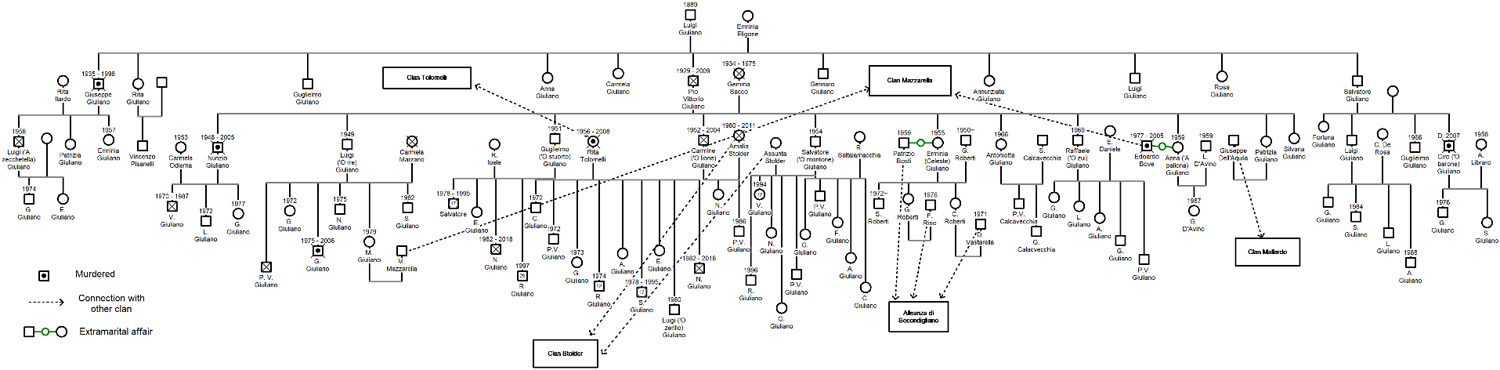
Large families are a recurring feature of Camorra families, even today. A large number of brothers and sisters enable the family to extend power and authority in various directions. It allows the family to defend its business and reputation more efficiently. Through strategic intermarriages, the Giuliano family built alliances and expanded its social power. In the postwar period, it began to accumulate significant resources and influence. The first opportunity arose with the presence in Naples, starting in 1943, of the Allied forces’ General Command. A large quantity of goods arrived in the port of Naples to supply the Allied army and to provide aid to a population exhausted by the war and 20 years of Fascist rule. The black market for essential goods – medicines, food, clothing – offered many young guappi the chance to assert themselves (Allum Reference Allum2006). Later, during the 1960s, cigarette smuggling, and then, starting in the 1970s, drug trafficking became the backdrop for the most significant rise of Camorra families in the city Figure 2.
The Giuliano family tree (1889-2025).

Figure 2 Long description
A hierarchical tree structure arranged horizontally from left to right across the full width of the image. The tree contains multiple levels of nodes connected by lines, branching downward and outward from a central root area near the top middle of the diagram. Each node appears to represent an individual or entity, depicted by a small symbol, with connecting lines showing parent-to-child or superior-to-subordinate relationships. The structure spans at least four to five visible levels of depth. At the top level, there is a single root node. Below it, the tree branches into two or more main sub-branches, each of which further divides into additional nodes. Some branches extend significantly wider than others, suggesting uneven distribution across the hierarchy. Several nodes near the middle and right portions of the diagram appear to have more connections than those on the left, indicating denser groupings in those areas. A legend is present in the lower-left area of the diagram. The legend contains at least two symbol types, one appearing to represent a standard node and another representing a distinct category of node, though the specific label text is too small to read accurately. Some nodes appear to have small circular markers or distinct symbols distinguishing them from standard nodes. Connecting lines between nodes are straight and the overall layout follows a top-to-bottom and left-to-right reading order. No voltage values, electrical component labels, or circuit-specific notations are present, confirming this is not an electrical circuit diagram.
The Giuliano family could rely on the resources best suited to rapidly asserting itself on the criminal scene. Pio Vittorio (1929–2009), the eldest of twelve children born to the old guappo/coachman Luigi, quickly became one of the city’s most influential bosses. The neighbourhood of Forcella, strategically located between the train station, the port and the wealthier quarters of the city centre, became a hub for the storage and resale of all kinds of illicit goods – so much so that it was referred to as the ‘casbah of Naples’ (Paliotti Reference Paliotti1970). Pio Vittorio’s many brothers and sisters, along with their respective families and associates, provided the labour force needed to control and defend the underground trade. As is typical of Camorra families in Naples, all the relatives lived in the same neighbourhood, just a short distance from one another. This meant having access to a multitude of homes, shops and warehouses where goods could be hidden and fugitives sheltered from the police. The dense urban structure – full of vicoli and tightly packed dwellings – greatly facilitated this form of protection against law enforcement.
Between the 1970s and 1980s, this illegal economic system, rooted in a limited territory, became a veritable Camorra fiefdom. The industrialisation of cigarette smuggling had already fostered the development of more stable organisational structures. This was a matter of controlling a more complex commercial activity, involving a range of roles and chains of command. For example, teams of men had to be formed to board powerful speedboats and load crates of cigarettes from ships passing through international waters off the coast of the Gulf of Naples. These smugglers then required support via land-based radio networks; landing points along the coast had to be protected from police raids; the transport of the cigarettes had to be ensured via road vehicles; the goods had to be stored in clandestine warehouses; and a retail distribution network had to be put in place. In short, these were all activities requiring organisational structures capable of exercising a certain degree of military-style control over the territory. In return for these efforts, the profits became enormous (Brancaccio Reference Brancaccio2017).
The specific characteristics of the cigarette-smuggling market favoured the rise to leadership positions of large extended families, well versed in operating within illegality and in exercising violence in a controlled manner – a form of violence aimed at pursuing economic profit. The second generation of Pio Vittorio’s children was also notably large: eleven children, six male and five female, born between 1948 and 1969. Among them, the boss was the second-born, Luigi (b. 1949), nicknamed ’O rre (the king). The steady expansion of the drug market led to a violent war between the clan of Raffaele Cutolo (Nuova Camorra Organizzata, New Organised Camorra) and the cartel bringing together groups from the city of Naples and the northern province (Nuova Famiglia, New Family), including the Giuliano clan, which held a leading position. This took place in the early 1980s; the war resulted in over 1,000 deaths, and the Camorra became a serious public order issue.
The city’s criminal landscape had evolved into a network of Camorra groups with clearly defined mafia characteristics: military-like structures, territorial control and centralised leadership. During those years, the Giuliano brothers and sisters built a fully fledged mafia dynasty. Their strength lay in the wealth accumulated through trafficking activities and in an extended kinship network built through marital alliances. One of Luigi’s brothers, Guglielmo (b. 1951), married Rita Tolomelli (1956–2006), a member of a prominent Camorra family from the Sanità district in central Naples. Two other brothers, Carmine (1953–2004) and Salvatore (b. 1954), married two sisters from the Stolder family, another longstanding criminal group based in the Maddalena area, adjacent to Forcella. The generation of adults active in the 1980s marked the peak of the Giuliano clan’s power. Considering the relatives of Luigi ’O rre’s siblings and cousins (including both the children of Pio Vittorio’s many brothers and the grandchildren of his father Luigi ’O russo’s equally numerous siblings), the clan could count on a kinship network of around 100 active adult members – a backbone of mutual support that is very important for the status of the family, and that lived entirely in the small Forcella neighbourhood (Tribunale di Napoli 2006, 2007, 2015).
The growth in profits from drug trafficking allowed the kinship network to expand and strengthen, but at the same time introduced potential sources of internal rivalry. It is important to note that Camorra groups do not have a tradition of codified rules governing their organisation, unlike the situationduring the same period with Cosa Nostra in Palermo. For instance, there are no formal rules regulating the transfer of power from one generation to the next, nor are there collective bodies responsible for electing representatives, leaders or similar roles. As the Camorra is essentially a form of violent market control, it operates primarily on the economic principle of competition. Leadership roles are held by those with the greatest capacity for managing both trafficking and violence. Two consequences follow from this in terms of internal governance: (1) agreements tend to be more ad hoc; and (2) regulation relies on natural elements of civil society rather than formal organisational codes – in particular, on kinship relations, which help to ensure loyalty and align interests.
One of Luigi Giuliano’s brothers, whom we interviewed,Footnote 11 recounted how in order to govern the entire clan, regular meetings were held involving all the brothers (and sisters), each of whom controlled an autonomous group. Those attending the meetings would arrive at the table armed and escorted by their own men. Each of them ran their own business operations and commanded a personal military squad. The purpose of these meetings was to reach agreements and, when needed, to reinforce internal loyalty within the clan and to present a united front against rival families and enemy groups.
The Giuliano clan’s success began to decline in the early 1990s. This was mainly due to the rise of the Secondigliano Alliance, a cartel of clans – also structured around kinship ties – which, during those years, became dominant in both cigarette and drug trafficking. The Alliance controlled a vast territory stretching from the municipalities north of the metropolitan area, through the suburbs , and up to the edge of Naples’s central districts.
By the mid-1990s, the Secondigliano Alliance had entered into conflict with the Mazzarella clan and its allies. The Giuliano clan found itself caught in the middle, maintaining ties with both sides . This opposition began to generate centrifugal forces within the clan – forces that grew stronger as the family’s power declined. The boss, Luigi, attempted to steer events by forging a marriage alliance with the Mazzarella family. Thus, in 1996, a lavish wedding was held between Marianna Giuliano, daughter of boss Luigi, and Michele Mazzarella, son of Vincenzo, head of the clan bearing his name. The two largest Camorra families in the city – both of which had emerged from postwar smuggling operations – were sealing a bond intended to counter the growing power of the Secondigliano Alliance (Longrigg Reference Longrigg1997). However, events soon took a dramatic turn. The boss, Luigi, turned himself in to the authorities, the main male siblings of the family were arrested, and some of them became state witnesses. Luigi’s sister, Erminia, who was having an extramarital relationship with Patrizio Bosti – one of the leaders of the Secondigliano Alliance – sided with the latter. Erminia’s two daughters went on to marry members of this cartel as well (Tribunale di Napoli 2006).
The internal split within the Giuliano family led to a feud between the two factions, territorially distinguished as ‘Upper Forcella’ and ‘Lower Forcella’, and divided by opposing alliance strategies. This first feud caused numerous deaths, including that of Giuseppe (1935–98), a brother of the family patriarch, Pio Vittorio. By the early 2000s, the Giuliano clan had been decimated. The territory of Forcella had fallen under the control of the Mazzarella clan, thanks to the ‘strategic’ marriage of 1996 and to the fact that the local representative of the Mazzarella clan, Eduardo Bove (1977–2005), had entered a romantic relationship with Anna Giuliano, one of the younger sisters of boss Luigi, who was by then serving a prison sentence (Tribunale di Napoli 2005). Over time, however, Eduardo Bove – supported by the remaining members of the Giuliano clan – began to operate independently, aiming to break away from the Mazzarella clan and re-establish Forcella’s autonomy. This attempt was cut short in 2005 with Bove’s murder, ordered by the leadership of the Mazzarella clan.
A final attempt to rebuild the Giuliano clan occurred between 2013 and 2015. The main actors were a group of young people known as the ‘Paranza dei bambini’ (the Children’s Gang), some of whom were connected to members of the third generation of descendants from boss Luigi Giuliano. Within this new generation, judicial investigations identified around ten individuals bearing the Giuliano surname, all born in the 1990s. Once again, the operation led by these very young figures ended with the murder of their leader, Emanuele Sibillo (1997–2015).
Although the family’s power was by then exhausted, the Giuliano surname still carried symbolic weight, representing a marker of status and distinction. This lingering prestige explains the attempts to rebuild the ‘dynasty’ in the name of a former glory.
Moving beyond amoral familism
Our material forced us to re-think and re-evaluate the concept of mafia family, not as a form of amoral familism but as a multilayered space. Although this article draws on two specific mafia contexts – the Italo-American mafia and the Camorra – and on two corresponding case studies (see Table 2), we argue that the evidence presented here contributes to a critical re-assessment of approaches that regard the traditional family, per se, as the central locus of mafia power dynamics.
An overview of the main families studied in this article

Table 2 Long description
Two columns compare the Morello-Terranova family, New York 1892 to 1930, and the Giuliano family, Naples 1889 to 2025, across territorial setting, context, activities, kinship, and organisation. Territorial setting lists Sicily to New York to Louisiana and Texas to New York for Morello, and the Forcella district, Naples for Giuliano. Historical context notes Sicilian migration to the United States and formation of the Italo American Mafia for Morello, and transformation of the urban Camorra from the postwar period to the present for Giuliano. Initial economic activities list agricultural labour and small businesses, later counterfeiting operations and bars for Morello-Terranova, and transport services, commercial brokerage, urban markets, extortion, later cigarette smuggling and drug trafficking for Giuliano. Primary function of kinship is survival, social mobility, reputation and network building for Morello, and territorial control, coercive capacity, recruitment and reproduction of power for Giuliano. Family size is extended but relatively limited for Morello, and exceptionally large with 10 to 12 children per generation for Giuliano. Relationship between family and criminal organisation remains analytically distinct for Morello-Terranova, and family and clan are more closely intertwined for Giuliano. Role of women is central yet often invisible, maintaining cohesion, correspondence, marriage alliances and support for imprisoned relatives for Morello, and central to alliance building, clan continuity and strategic decision making for Giuliano. Marriage strategies are used to create links between Sicilian and emerging Italo American mafia families for Morello, and systematically employed to forge alliances among Camorra clans for Giuliano. Transmission of power is not automatic for Morello, with no rigid dynastic succession, and is transmitted within kinship networks for Giuliano, without formal succession rules. Family support during imprisonment lists moral, logistical and economic support for imprisoned leaders for Morello, and maintenance of clan cohesion and management of criminal activities for Giuliano. Relationship with markets states the family facilitates criminal advancement and network creation within illegal markets for Morello, and clan expansion follows growth of illegal markets, particularly smuggling and drug trafficking for Giuliano.
Source: Authors.
As a consequence, our approach moves away from previous frameworks as it does not define the family as an exceptional unit within the mafia context. We propose to move away from conceiving the mafia family in purely organisational, cultural or economic terms. The distinctive feature of a mafia is not the traditional family but rather the hybridisation of this form with more formalised institutions (mutual aid societies, co-operatives, parties, business networks, trade unions – as in the American case) that assert themselves in the expansion of economic and social spheres in line with social changes (Lupo Reference Lupo2009, 20–23).
We believe that families are shaped by certain structural conditions in specific local communities made up of different cultural norms, formal institutions and state structures. They are a forum that provide biological, socialising, psychological, economic, protective, educational and religious values and functions. This means that not all families are similar across countries or continents. Families respond to these specific contexts, which explains how they adapt and function using their different strategies. Crime families evolve and adapt to their context (see Figure 3).
Overview of Neapolitan family structures and mafia behaviour.

Values in families from a specific cultural, economic and historic context can be very similar but crime families make criminal use of these values, resources and functions, as Badolati has made clear:
[T]he exploitation of the concept of family is therefore one of the greatest strengths of this system. The family is power from a military point of view, it is a clique, an offensive and defensive aggregate. It is a nucleus of people linked by blood ties that becomes mafia lordship, state and fortress. The offense suffered by one member therefore becomes the offense suffered by all. (Badolati Reference Badolati2024, 25)
In the context of the Neapolitan Camorra, for example, the so-called home, the familial clan, is not always a space of sincere or stable affection. Despite the fact that it is presented as an extended family, in reality it is profoundly individualistic. Relations between members are often instrumental: family relationships are not necessarily the refuge they should be. Here, they are often used and driven by personal interest, betrayed and manipulated when power needs to be consolidated, money obtained and individuals saved from threats.
Even blood ties do not guarantee loyalty: brothers, sisters, cousins, even parents and children can become rivals or enemies if the circumstances require it. The sense of belonging is more a mask than a real emotional tie. In other words, what really counts is an individual’s survival within a highly competitive system, in which loyalty is a commodity that can easily be traded or revoked, and trust is always conditioned by power and control. Mafia socialisation and education are crucial elements in the construction of the mafia identity. It is through these processes that values, norms and behaviour of mafia organisations are transmitted to their members, often from childhood, and consolidated once they formally join the organisation. These processes enable the creation of a collective identity that is shared and which reinforces the internal cohesion of the group and legitimates its actions. But the lifespan of such groups is relatively short.
Ultimately, kinship ties are manipulated to serve individual strategies, or they may be used to forge alliances with rival groups, even at the cost of betraying one’s loyalty to one’s original family. Families can become the stage for betrayals, intrigues and feuds. In other words, the family is a resource available to all mafia groups – but not a fixed organisational structure. It is not a normative environment that restrains individual ambition.
For example, in the highly complex landscape of Camorra organisations, there are highly differentiated groups that occupy limited social spaces. As is also found in ‘Ndrangheta organisations, family and kinship networks are a very common feature of Camorra groups. These networks take a variety of internal forms. We can thus identify a very wide range of situations in the history of criminal power over the last 50 years. Figure 3 presents different types of family-based criminal organisations, arranged in ascending order of mafia power: families with criminal specialisation, minor criminal groups, mafia clans (generally formed by several allied families) and mafia dynasties (families capable of perpetuating mafia power for several generations). These categories are not stable over time; there are movements in and out, and groups can ascend or descend the mafia ladder or even become extinct.
Concluding thoughts
In the most stereotypical view, ‘mafiosity’ (mafiosità) is said to derive from the traditional character of the family (Hess Reference Hess1991), which ultimately resides in a value system grounded in ethnic belonging. In other words, ‘mafiosity’ would amount to a family – that is, an ethnic identity taken to its extreme, capable of combining modern contexts, rational choice and evolving markets. Even in the most careful and recent contributions that explicitly claim to distance themselves from purely culturalist interpretations of mafia organisations, and that therefore place economic action and organisational aspects at the centre of their analysis, we see the lens of familism re-emerge insofar as the very essence of criminal power is located in the family infrastructure.
In these approaches, family relations invariably play, in a one-dimensional way, the role of a vehicle of ‘mafiosity’, well beyond the mere transmission of a sense of belonging from one generation to the next. In this way, the mafia is portrayed as the survival, within modernity, of an archaic world: a coagulation of ‘natural’ social units embodied by the blood family, set in opposition to the external world of legality. Violence and the ferocity associated with familistic action are thus interpreted as a deep-seated impulse, a way of being, which points to clear ethno-cultural determinants.
From this follows the idea that familistic behaviour is intrinsic to the mafia world and belongs to the same conceptual category. According to this view, mafias function as social devices that elevate ‘family’ to its highest authority. We argue, by contrast, that the family is not in itself a driver of criminal power. The recurrence of family ties within mafias cannot be attributed to an inherent connection between family and mafia, but rather to the utility of having a social infrastructure through which to organise illicit trades and dynamics of domination in the underground world of illegality. The very same social infrastructure, grounded in the same appeal to shared values and communality, also operates within the legal world. In our analysis we have sought to re-define the contours of the mafia family as a wider economic, cultural and political forum. Mafia families are no different from other families: they are not separate from civil society but deeply embedded and immersed within it; their behaviour mirrors and runs parallel to civil society until mafia groups are able to manipulate and use their values, functions and behaviours to their advantage.
A final consideration concerns the changing nature of family structures in light of the processes of modernisation. One of the limitations of classical approaches to the study of mafias is that they tend to treat the family as a fixed and unchanging institution, implicitly assuming a continuity between traditional kinship structures and contemporary criminal organisations. Our findings suggest the opposite. As family forms have changed over time – becoming smaller, more diverse, less hierarchical and increasingly shaped by broader social and economic transformations – the ways in which mafia groups mobilise kinship ties have also changed. What remains constant is not a particular family model, but the strategic use of family relationships as resources for trust, protection, alliance building and the reproduction of power. The persistence of kinship networks within mafia organisations should therefore not be interpreted as evidence of cultural continuity or familial traditionalism. Rather, it reflects the capacity of criminal actors to adapt existing family structures to changing economic opportunities, market conditions and forms of governance. In this sense, mafia families evolve because families themselves evolve.
Competing interests
The authors declare none.
Felia Allum is Professor of Comparative Organised Crime and Corruption in the Department of Politics, Languages and International Studies at the University of Bath, UK. Her research focuses on organised crime, mafias, criminal mobility, gender and political corruption.
Luciano Brancaccio is Associate Professor at the Department of Social Sciences, University of Naples Federico II, where he teaches Sociology of Mafia Phenomena and Social and Political Movements. His research focuses on organised crime, clientelism, electoral participation and urban politics.




 Open access

