

Introduction
China’s post-reform transition since the 1980s has involved rapid economic, social, and institutional changes amid marketisation, demographic transition, and shifting social norms (Ji et al., Reference Ji, Wu, Sun and He2017). These transformations have restructured the Chinese welfare system from work-unit-based provision to an employment-contingent model, from collective childcare to privatised care infrastructure, and from basic universal benefits to stratified entitlements dependent on household registration ( hukou ) status, profoundly and unevenly reshaping women’s everyday lives. Crucially, this was not a clean break: patriarchal gender-role divisions preserved throughout the socialist era remained constitutive of present inequalities (Ji and Wu, Reference Ji and Wu2018; Li, Reference Li2025). Women have achieved unprecedented educational gains, maintained relatively high labour market participation, and seen fertility decline, yet continue to face intensifying occupational segregation, widening motherhood penalties, and employment discrimination, all whilst shouldering disproportionate care responsibilities that the state, having retreated from collective provision, now leaves to families (He and Wu, Reference He and Wu2017; Shen, Reference Shen2022; Tong, Reference Tong2022).
Existing scholarship on women’s experiences in post-reform China offers sophisticated analyses of continuities and changes across employment, family life, gender ideologies, and specific policy areas (Wang and Klugman, Reference Wang and Klugman2020; Zhang and Xie, Reference Zhang and Xie2022; Zhang et al., Reference Zhang, Tong and Liu2025). However, examining these areas largely in isolation obscures how women’s different roles as workers, carers, welfare recipients, and members of wider society are simultaneously constituted and mutually reinforcing, producing interconnected disadvantages that single-domain analysis cannot capture (Ji et al., Reference Ji, Wu, Sun and He2017; Zhou, Reference Zhou2020). Such debate also tends to portray the state as primarily retreating, whilst underestimating its active involvement in both public and private spheres through family and family-planning policies that predominantly target women (Yu and Xie, Reference Yu and Xie2021) and ideological campaigns that promote social norms aligned with broader political priorities (Yang et al., Reference Yang, Zhang and Sun2024). Rooted in the longer-run entanglement of socialist heritage and market logic, post-reform transitions have reconstituted rather than simply continued gender dynamics through the interaction of state-led marketisation, welfare restructuring, and shifting social norms. Understanding this reconstitution requires moving beyond singular assessments of whether conditions have “improved” or “worsened” towards how women’s different roles and responsibilities interact across intersecting dimensions of everyday life (Wu et al., Reference Wu, Wang and Wang2022; Liu, Reference Liu2025a).
Yet systematic integration that examines how, in the context of these socioeconomic and political transitions, the interaction among social policy, the labour market, and family relations shapes women’s everyday lives remains limited. This article does not seek to survey Chinese social policy comprehensively; rather, it examines how three key areas converge in women’s everyday lives: employment-based welfare, care infrastructure, and family policy. At the heart of employment-based welfare is a two-tier social insurance system ( shebao , 社保): Employee Five Social Security Insurance, contingent on continuous formal employment, provides healthcare, pension, maternity, work-related injury, and unemployment coverage to those with formal employment status, whilst a separate self-contributory resident scheme covers informal workers and non-employed groups at significantly lower reimbursement rates. These differentiations are further shaped by two factors: hukou status, which determines welfare eligibility and access to public services by rural–urban residency, and socioeconomic position, which shapes the capacity to purchase private care and educational resources (Xiao and Bian, Reference Xiao and Bian2018; Lin et al., Reference Lin, Wu and Li2020).
Family policy represents the convergence point within this broader social policy architecture, where labour regulations, social security insurance entitlements, and care infrastructure interact to formally define the organising structures of family life (Daly, Reference Daly, Nieuwenhuis and Van Lancker2020; Sung, Reference Sung and Sung2024). Post-reform China does not always label as “family policy” the measures that materially govern women’s family lives. Tied to economic growth and shifting population strategies, Chinese family policy has shifted away from state-led and employer-provided welfare towards privatised and family-based models of care, most visibly in early childhood education, where public and workplace-supported childcare centres were dismantled and public subsidies for children aged 0–2 terminated (Ministry of Education, 2019). Understood broadly, family policy here encompasses explicit measures such as maternity leave and childcare provision, as well as the implicit regulatory effects of employment-based welfare and state ideological campaigns, which together shape women’s roles as mothers, workers, and caregivers (Daly, Reference Daly, Nieuwenhuis and Van Lancker2020). These economic, institutional, and social configurations produce the uneven conditions under which different groups of women have varying capacities to navigate their multidimensional everyday lives.
Against this background, this article asks: what economic, institutional, and social dynamics affect women’s experiences in a Chinese city and how have employment-based welfare, care infrastructure, and family policies, within everyday contexts, shaped their wellbeing through the realisation of human dignity, understood as the capacity to realise autonomy and mutuality? To address this, the article adapts and integrates the principles of human dignity (Chan and Bowpitt, Reference Chan and Bowpitt2005), autonomy as competence and freedom to choose and mutuality as interdependent social interactions, treated as irreducible and co-constitutive human needs, with social policy analysis and a gender lens. It develops a multidimensional approach for understanding how welfare, care, and family policy together enable or foreclose women’s capacity to live as whole persons. This approach, the human dignity approach, is operationalised through five dimensions to examine everyday lives: physical and psychological wellbeing, care relations, social integration, self-determination, and equal value. In doing so, this article draws together scholarship on human dignity and social policy analysis, exploring their relevance for revealing gendered mechanisms of dignity violation in urban China and the implications for women’s wellbeing across multiple dimensions of everyday lives.
The article draws on 33 semi-structured interviews with women aged 22–40 in Guangzhou, a first-tier megacity with advanced marketisation and a substantial migrant population, to examine how women navigate these dimensions. The analysis reveals three mechanisms through which gender inequality is reconstituted: structural trade-offs, where pursuing wellbeing in one dimension systematically forecloses it in another; intensifying violations, where institutional exclusions multiply across dimensions to produce qualitatively distinct dignity realities; and constrained autonomy, where women strategically exercise agency within limited choices.
The article makes two interconnected contributions. For dignity scholarship, it extends the conceptualisation and operation of human dignity’s geographic scope beyond the European welfare democracies to post-reform urban China, where economic liberalisation coexists with authoritarian governance. Theorising how economic, institutional, and social dynamics violate dignity through reconstitution mechanisms in authoritarian modernisation contexts shifts dignity analysis from an outcome-focused (e.g. whether minimum standards are met) to a mechanism-focused approach. For social policy scholarship, it demonstrates social policy’s constitutive function: not merely redistributing resources but structuring the conditions under which dignity becomes realisable or systematically impossible, thereby revealing cross-domain mechanisms that are invisible when employment, care, and family policy are analysed separately. The article proceeds as follows: by bringing together human dignity, social policy analysis, and a gender lens, the following three sections adapt and develop an integrative, multidimensional human dignity approach for examining how the interaction of social, institutional, and economic dynamics shapes women’s wellbeing across multiple dimensions of everyday life. It then sets out the research design and methods, examines the findings across the five dimensions, and concludes with theoretical contributions and policy implications.
Human dignity and social policy
Human dignity has evolved from an aristocratic concept tied to rank into a universalist principle asserting the inherent and equal worth of every human being (Misztal, Reference Misztal2012; Bayefsky, Reference Bayefsky2013; Bal, Reference Bal2017). Contemporary dignity scholarship reflects a pragmatic turn towards its concrete empirical manifestations across specific policy fields (Chan and Bowpitt, Reference Chan and Bowpitt2005; Chan et al., Reference Chan, Ngok and Phillips2008; Bedford, Reference Bedford, Becchi and Mathis2019; Matteucci and Repetto, Reference Matteucci and Repetto2021), establishing dignity not as rhetoric but as an evaluative lens revealing how policies enable or violate human dignity across different dimensions and in specific social contexts. To understand the impact of welfare measures on people’s wellbeing, Chan (Reference Chan2004), for instance, conceptualises dignity through four mutually reinforcing dimensions: equal human value, self-respect, autonomy, and positive mutuality.
Grounding social policy in human dignity reframes the purpose of policy evaluation. Dominant comparative welfare scholarship assesses social policy through the financial relationships between individuals and markets, using metrics such as welfare expenditure, decommodification indices, and stratification measures. Treating human flourishing as a byproduct of redistribution, these approaches marginalise the physical, psychological, social, and relational dimensions of wellbeing that constitute everyday life (Chan and Bowpitt, Reference Chan and Bowpitt2005; Chan et al., Reference Chan, Ngok and Phillips2008). Early childhood education and care illustrates the cost: economic evaluations assess provision through labour-supply effects and fiscal returns (Daly and Ferragina, Reference Daly and Ferragina2018), obscuring how such configurations can simultaneously coerce maternal employment and devalue care, violating autonomy through forced trade-offs between financial security and care relations.
The dignity approach begins from a different ontology of wellbeing. Where economic frameworks ask what states spend or redistribute, dignity analysis examines how institutional arrangements, including the configuration of formal welfare, employment, and care provisions, constitute the conditions under which people realise autonomy and mutuality as fundamental human needs (Chan and Bowpitt, Reference Chan and Bowpitt2005). This imposes obligations on the state beyond distributing material resources, encompassing how support is delivered and whether people are treated as full, equal members of society (Chan and Lei, Reference Chan and Lei2018). Social policy is thus understood not as a redistributive instrument but as a constitutive mechanism, actively structuring whether dignity becomes realisable or systematically impossible. It is assessed not by incremental improvements against baseline deprivation but by whether its configurations, as a whole, enable people to live as whole persons whose autonomy and mutuality are respected and supported (Chan and Bowpitt, Reference Chan and Bowpitt2005; Bal, Reference Bal2017).
Despite its philosophical significance, dignity has received limited application as an evaluative lens in social policy, leaving policy directions without a coherent grounding in human wellbeing (Chan, Reference Chan2004; Chan and Bowpitt, Reference Chan and Bowpitt2005). The human dignity approach initially developed by Chan and Bowpitt (Reference Chan and Bowpitt2005) addresses this directly, moving beyond frameworks that examine social policy through class or gender stratification alone to assess how physical, psychological, social, and relational wellbeing are affected simultaneously. This approach’s strength also lies in its multidimensionality, operationalised through six interlinked dimensions: physical and psychological wellbeing, care relations, social integration, human learning, self-determination, and equal value (Chan and Bowpitt, Reference Chan and Bowpitt2005). Moving beyond material or rights-based frameworks, this architecture enables examination of how the dimensions interact to produce intensifying violations, and of whether welfare arrangements together enable or foreclose the comprehensive realisation of dignity to which all persons are entitled: the analytical foundation that this article extends to gendered experiences in urban China.
Human dignity and gender
Human dignity and gender have rarely been connected in social policy scholarship, despite both addressing women’s autonomy, recognition, and capacity for human development. Dignity scholarship has advanced understanding of social policy’s relationship to human worth by evaluating how unemployment benefits affect the dignity of unemployed persons (Chan and Bowpitt, Reference Chan and Bowpitt2005) and how dignity operates across broader policy domains (Chan et al., Reference Chan, Ngok and Phillips2008), yet its integration with a gender lens remains limited. Where connections do exist, they focus primarily on biomedical contexts and violence against women, narrowing dignity to “protecting women’s bodies from exploitation” (Thiem, Reference Thiem, Düwell, Braarvig, Brownsword and Mieth2014: 237). Reducing dignity to bodily integrity forecloses its potential as a multidimensional framework for examining how economic, institutional, and social dynamics shape women’s capacity to realise autonomy and mutuality. Without a gender lens, dignity scholarship risks treating welfare recipients with gender blindness, missing how the institutions it evaluates are organised around gendered assumptions about productive and reproductive work (Sung, Reference Sung and Sung2024).
Gender-focused approaches, such as defamilisation, degenderisation, and capabilities approaches, have developed sophisticated tools for understanding gender inequalities, examining women’s rights to work and care, and addressing tensions between dependence and independence in family life and labour market participation (Ferragina, Reference Ferragina2019). However, they tend to measure discrete outcomes, including labour market participation rates, maternity leave compensation, and educational attainment, focusing on policy-outcome relations whilst overlooking how socioeconomic and institutional contexts interact across life domains (Zagel and Lohmann, Reference Zagel and Lohmann2021). Treating labour participation and care as independent objectives fragments the relation between paid and unpaid work and masks women’s multiple roles in everyday experience (Finch, Reference Finch2021). Defamilisation, moreover, is a Western concept that seeks independence from family support, which is not necessarily the case in East Asian contexts, where family is not always seen as a burden or a form of suppression but can be a mutual responsibility and commitment (Chau and Yu, Reference Chau and Yu2022). These limitations signal the need for a framework with sufficient contextual depth that holds autonomy and mutuality together rather than treating them as opposed values: a gap that human dignity-gender integration is positioned to fill.
The philosophical foundation of this integration treats autonomy and mutuality as irreducible and co-constitutive human needs. Chan and Bowpitt (Reference Chan and Bowpitt2005: 13) establish dignity through “rational and social capacities striving for autonomy and mutuality”: requiring both rather than privileging either. Autonomy encompasses competence, the freedom to choose, and the recognition that choices exist, extending beyond Western notions of independent life-course decision-making (Hasselberger, Reference Hasselberger2012). Mutuality, central to Confucian values, emphasises responsibility and interdependence (Fisher and Tu, Reference Fisher and Tu1994). Far from being in tension, these philosophical traditions are complementary: human rational capacity develops through social interaction (Richardson, Reference Richardson2000) whilst wellbeing depends on supportive relationships (Bowlby, Reference Bowlby1953). This cultural-philosophical grounding is essential for understanding Chinese women’s experiences without imposing normative frameworks that privilege independence over interdependence. Accordingly, this article adopts a tripartite family conceptualisation: conjugal relations, parent–child relations, and intergenerational support networks (Zhang and Xie, Reference Zhang and Xie2022; Yan, Reference Yan2025), recognising that intergenerational interdependence remains central to welfare provision in post-reform China even as nuclear households become demographically prevalent.
Connecting human dignity and gender advances both domains. For dignity scholarship, a gender lens reveals that the institutional arrangements through which dignity is produced or denied are themselves gendered: eligibility criteria premised on continuous formal employment, conditionality requirements that assume independent agency, and care infrastructures resting on family, mostly women’s, unpaid labour all encode assumptions the dignity literature has rarely interrogated. Gender dynamics thus provide the empirical terrain on which dignity violations become visible in their specificity. For gender scholarship, the dignity framework supplies a multidimensional architecture that holds autonomy and mutuality together and theorises how welfare arrangements interact across domains, moving beyond measuring outcomes one domain at a time. This integration specifies both how institutions are gendered and how their gendering produces interconnected, multidimensional consequences for women’s wellbeing, particularly for women with children, where assumptions about caregiving, dependency, and moral worthiness have shaped eligibility and conditionality in ways that disproportionately undermine wellbeing (Lohmann and Zagel, Reference Lohmann and Zagel2016; Sung, Reference Sung and Sung2024). Gender is conceptualised here not as a static binary but as a dynamic set of social relations enacted through culturally and historically specific performances intersecting with socioeconomic status, age, and locality (Lindqvist et al., Reference Lindqvist, Sendén and Renström2020), shifting the focus from women or families to the mechanisms through which resources and opportunities are organised and gender inequalities are reproduced.
The development and implementation of the human dignity approach
The human dignity approach (Chan and Bowpitt, Reference Chan and Bowpitt2005) provides a philosophical foundation for examining the complexity and intersectionality of women’s lived experiences. Grounded in everyday experiences beyond abstract theorisation, the five interlinked dimensions, as applied in this article, examine how women contextualise, make sense of, and achieve wellbeing whilst navigating post-reform transitions (see Table A1). Physical and psychological wellbeing captures the interaction of physical health (e.g. healthcare access, maternal health), psychological states (e.g. stress, guilt), relational quality (e.g. “intimate and warm” care relations), and social dimensions (e.g. workplace inclusion and exclusion), addressing the fragmentation of wellbeing scholarship by integrating aspects typically scattered across disciplinary boundaries (Briguglio et al., Reference Briguglio, Czap and Laffan2025). Care relations examine how women maintain interdependent nuclear and intergenerational networks, including autonomy in choosing care arrangements, the quality of reciprocal relationships, time for meaningful interaction, intergenerational negotiation dynamics, and spatial constraints (Yan, Reference Yan2025). This dimension conceptualises care as manifesting reciprocal experiences and a sense of meaning beyond mere financial duty, capturing care relations that embody both constraint and meaningful connection.
Social integration recognises individuals’ rights as “social beings” (Chan and Bowpitt, Reference Chan and Bowpitt2005: 175), with adequate access to welfare for economic, social, and cultural participation beyond family: labour market inclusion versus discrimination, community participation, belonging versus marginalisation, and recognition as valued social members. It captures both formal labour market exclusion and informal social stigmatisation. Self-determination examines how women exercise autonomy across financial independence, household decision-making, and critical life decisions, within specific institutional, economic, and social constraints that shape what choices are actually available (Xie, Reference Xie2021). Equal value examines how unfulfilled “intrinsic capacities” (Chan and Bowpitt, Reference Chan and Bowpitt2005: 28) manifest in unequal valuation of paid work and care work, labour market segregation, and differential treatment by employment status or hukou registration, whilst also addressing inequalities among women themselves (Ji and Wu, Reference Ji and Wu2018). This article views these key dimensions not merely as a device of organising data but as a way to capture how women’s multiple roles and responsibilities interact and reshape one another in post-reform urban China.
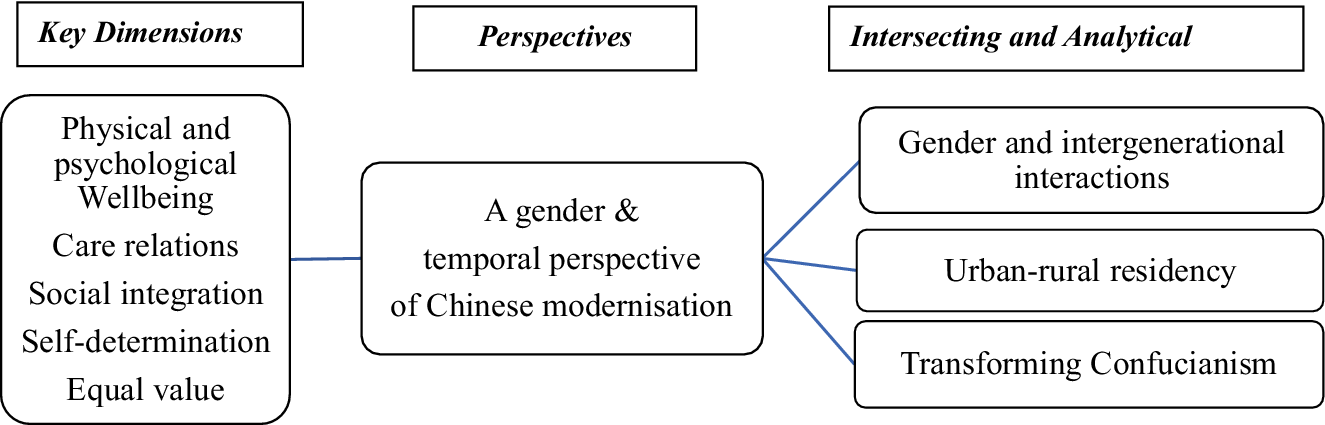
Responding to Bennett’s (Reference Bennett2007) critique that the original approach lacks contextual depth regarding diversity among those researched, this article integrates three analytical layers that intersect with the five dimensions (see Figure A1), including gender and intergenerational interactions, the rural–urban divide, and transforming Confucianism. These layers constitute social, economic, and institutional dynamics in which women’s experiences are embedded.
Research design: A qualitative case study approach
Case study research enables in-depth investigation of complex phenomena within their real-world contexts (Yin, Reference Yin2014). This article employs a qualitative case study methodology to examine women’s everyday lives in Guangzhou, Guangdong Province, a megacity in China (see Table A2). Concentrating recruitment in a single city minimises cross-provincial variation whilst capturing individual differences in depth, suiting the analysis of how gender inequality, socioeconomic status, and generational difference intersect across the dimensions of women’s lives.
Guangzhou, contextually distinctive yet not entirely unique, was selected for two strategic reasons. First, its substantial migrant population (43.3%) enables urban-migrant comparison within a single context, isolating hukou effects from regional variations. Second, its first-tier economic development (GDP per capita of £17,216) reflects advanced coastal urbanisation, where relatively abundant resources allow investigation of whether institutional arrangements structure opportunity and constraint even when scarcity is not the primary limiting factor. This demographic composition and socioeconomic profile make Guangzhou an illustrative case for examining women’s experiences in China’s rapidly urbanising coastal regions. Not intending to compare different cities or claim universal patterns, this article’s contribution is a pilot study that, through a multidimensional framework, explores women’s lived experiences in an affluent coastal urban context.
Purposive and snowball sampling strategies identified and recruited women (aged 22–40) with at least one child for semi-structured interviews (Ethics Approval No.: SPSREC/19-20/085, University of Bristol). The sample of 33 participants, including 23 urban residents and 10 migrants, achieved thematic saturation whilst maintaining analytical depth. “Migrants” here denotes those with rural residency who live and/or work in urban China. This composition mirrors Guangzhou’s demographic profile and ensures sufficient representation of migrants for comparative analysis of hukou-based differentiation. Variation within categories enables examination of intersecting mechanisms rather than treating urban and migrant groups as monolithic. Urban participants are stratified by education (secondary to doctoral), employment sector, and occupational level, factors that shape resource access and negotiating capacity. Among migrants, education and employment type create similar heterogeneity, though hukou -based exclusions impose baseline disadvantage from the outset, regardless of human capital. Fieldwork was conducted in 2020–2021, capturing participants as they made critical life decisions in real time about employment, child-rearing, and care arrangements (for individual profiles, see Tables A3 and A4). Whilst the article’s temporal framing, “post-reform transition since the 1980s,” refers to the institutional historical context and how policies transformed over four decades, the analytical focus is how women in the 2020s navigate these transitions.
Semi-structured interviews explored women’s subjective experiences and decision-making whilst maintaining consistency across the five analytical dimensions, capturing both the constraining force of institutional arrangements and women’s agency in navigating constrained-choice environments. Rather than illustrating every aspect of women’s experiences or representing a homogeneous picture of women’s opportunities and challenges, this article reveals their contextualised everyday lives and interpretations through the five dimensions. Guided by the human dignity approach, the topic guide explored demographic backgrounds, daily routines, family lives, work, and wellbeing, operationalising the five dimensions in individual contexts to maintain data complexity alongside methodological consistency (see Appendix section “Topic guide for individual informants”).
Analysis employed thematic analysis (Braun and Clarke, Reference Braun and Clarke2006), guided by an abductive approach (Timmermans and Tavory, Reference Timmermans and Tavory2012), iterating between the five dimensions and the patterns emerging from the data, thereby maintaining a deductive structure whilst remaining open to unanticipated themes. Crucially, the human dignity approach functions both ontologically, viewing women as whole persons navigating interconnected demands rather than as isolated workers, caregivers, or autonomous agents, and methodologically, as an analytical structure revealing interactions across different life dimensions. This dual function offers analytical tools for comparative research into how similar institutional arrangements structure differentiated experiences across contexts, advancing understanding of gender dynamics in state-led authoritarian modernisation beyond China’s case.
Physical and psychological wellbeing in a predicament
Chan and Bowpitt (Reference Chan and Bowpitt2005) initially focused on welfare recipients’ wellbeing support (e.g. minimum living allowance, primary medical care). Women’s experiences, however, reveal how a stratified, patriarchal society makes wellbeing a complex, ongoing negotiation. The two-tier healthcare architecture described above imposes concrete constraints on women’s autonomy in organising their caring and working lives. Linlin’s experience illustrates this constraint: wanting to care for her child full-time until school age, she nevertheless required part-time work to afford even basic Residential Healthcare Insurance as a “minimal safety net”:
There is no ‘real choice’. I cannot freely decide how to support my health and care for my child part-time or full-time. (Linlin, 35, one child aged four, part-time work, partnered household, Librarian)
This employment-based welfare architecture shifts women from state-reliant to self-reliant and family-dependent, constraining informal caregivers’ autonomy over how to care for both dependents and themselves. By making healthcare, a universal need, conditional on economic productivity, employment-based welfare violates women’s dignity, denying that their worth is inherent rather than earned through productive capacity. Mothers in formal employment, by contrast, secure full social security and physical wellbeing, but often at a psychological cost: in full-time work, they report guilt at being unable to practise their idea of “good motherhood”: “spending more time with the children,” and at being seen as irresponsible mothers and employees who fail to balance both roles. Moli’s account exemplifies this trade-off: Although wanting to spend more time with her two young children, she had to resume her full-time job immediately after maternity leave to secure her employment contract.
I often regret returning to work […], and I feel I am a ‘bad’ mother without spending enough time with my children. Meanwhile, I feel I have no choice but to work harder to secure my social security. (Moli, 26, two children aged three and four months, full-time work, partnered household, Marketing assistant)
These coping strategies reveal inherent complexity in achieving wellbeing: women continue full-time paid work to secure health insurance and financial security whilst compromising psychological wellbeing through guilt and regret. The forced choice between psychological wellbeing and physical wellbeing violates dignity by treating fundamental human needs as mutually exclusive. Women cannot realise dignity in fragments, holding secure employment but guilt-ridden care, or present motherhood but financial insecurity. Where policy ignores individual variation in need, relational and material deprivation follow (Chau and Yu, Reference Chau and Yu2022), each intensifying the other and further narrowing the choices available to women.
Regardless of their choices, full-time paid work, part-time employment, or unpaid care, no available option fully reconciles their multiple roles and responsibilities. The two-tier healthcare system creates distributional pressures that require continuous formal employment; care responsibilities create relational constraints incompatible with those demands; and state discourse valorising intensive motherhood creates intrinsic expectations that the welfare architecture simultaneously demands and forecloses, manifesting as psychological distress, maternal guilt, and health insecurity. Their navigation of multiple roles demonstrates that maintaining physical and psychological wellbeing in post-reform urban China involves ongoing, complex negotiations shaped not by individual inadequacy but by welfare provisions that structurally produce the very impossibilities women are expected to resolve.
Care relations: Precarious mutuality
Care relations in post-reform urban China reflect the separation of public and private spheres following the collapse of the danwei system. Women’s experiences reveal flexible care arrangements shaped by the interaction of a divisive welfare system and shifting socioeconomic and demographic contexts. Among urban residents, family support commonly takes the form of financial transfer from parents and in-laws, regardless of geographical proximity or the availability of care providers. Chuya is such a case: her parents-in-law preferred a relaxed retirement and offered financial support rather than childcare themselves, a pattern more common where older parents hold higher pensions and stronger finances.
My parents-in-law have a more comfortable life and prefer paying a professional childminder. This reduces our financial and time pressure for childcare. (Chuya, aged 27, two children aged two and four years, part-time work, partnered household, Sales manager)
Chuya’s access to intergenerational financial support reflects socioeconomic stratification among urban residents: extended-family wealth shapes which forms of support are available, with financial transfers enabling market solutions in place of in-residence childcare. Not all women, however, can arrange care as they prefer. Rural migrant women struggle to share childcare, since their families rarely live nearby and, owing to rural household registration, their children lack access to public healthcare and education that urban locals enjoy. Faced with distance and unequal provision, some send their children back to the villages for family childcare. Xiaodai’s experience illustrates this impossible choice: she moved to the city for a higher salary after completing her bachelor’s degree. Like many working-class families, she found it hard to sustain a stable income on her husband’s earnings alone. After maternity leave, Xiaodai left her baby with her parents-in-law, who live in a village some 300 miles away.
After maternity leave, I was asked to return to work full-time or resign. It seems there is no third choice. I have to compromise the separation from my child until we are more financially secure in the city in the future. (Xiaodai, 30, one child aged one, partnered household, full-time work, migrant, Secretary)
Xiaodai’s separation from her 1-year-old child is a profound dignity violation through the severing of mutuality: her employment (necessary for economic survival) and her care relationship with her child (necessary for mutuality and maternal identity) are rendered irreconcilable. The hukou system’s welfare exclusions create spatial impossibilities in which migrant women cannot simultaneously access urban economic opportunities and remain close to family care networks. Temporary separation, children living in skipped-generation households with only grandparents, thus becomes an unwanted but structurally compelled solution, trading family time together for material security.
This reveals care relations as irreducibly multidimensional. Amid uneven development between cities and villages, what appears to be individual choice is better understood as the constrained navigation of an institutional architecture that makes simultaneous care and economic survival structurally difficult. Care extends well beyond financial capability, encompassing spatial, relational, and temporal dimensions that policies premised on the assumed proximity of families fail to accommodate, producing a broader pattern of precarious mutuality.
Contemporary China, an increasingly individualised society with prolonged reliance on family support, generates significant uncertainty for women in maintaining care relations. The challenges are sharpest for those with fewer socioeconomic resources and those living in rural areas, where institutional barriers are intensified by geographical distance, exposing the incompatibility between rapid urbanisation and a welfare architecture that treats family support as given rather than as a condition requiring active institutional provision.
Social integration: Formal and informal exclusion
Women’s economic and social lives reveal distinct forms of exclusion produced by divisive urban and employment-based social security systems and by state-led narratives about individual life. There is an emerging trend where rural migrants working in the city return to their hometowns, an adaptive reaction to feeling rejected as “outsiders” in the city, above all to the unequal access to social security and protection that separates them from urban locals. Xian’s trajectory exemplifies this pattern: with her master’s degree, she initially worked in Guangzhou but returned to her home village after experiencing the exclusivity of the welfare system and labour market that continually distinguish urban and rural residents.
The household registration system discriminates against rural residents, as do private sector employers. They are less willing to sign a longer contract with us (as migrants). If forcing myself to integrate into the city is so hard, I prefer to return to the village and town. (Xian, 35, two children aged three and five, full-time work, partnered household, migrant, Finance officer)
Migrants with degrees and professional qualifications, like Xian, have been defined as the “new generation” of migrant workers since the 2010s (NBS, 2025). They differ from first-generation migrants, who endured lower-paid jobs with fewer skill demands and more household registration restrictions. Educational attainment among the mobile population rose sharply, from 16.5% holding secondary education or higher in 2010 to nearly 50% in 2020 (NBS, 2025), making urban settlement increasingly popular among well-educated migrants. Yet despite human capital identical to that of urban residents, the hukou system assigns Xian lesser worth solely by registration status, a characteristic unrelated to her capacities or contributions.
Beyond this discriminatory welfare system, the state defines ideal “citizens” and families through top-down narratives, as an extension of authoritarian policy practices. Campaigns such as “The Most Beautiful Family” model family harmony, active fertility, solid household finances, loving heterosexual coupledom, and supportive in-law relations; those who fall outside this “mainstream” ideal are informally excluded from social, cultural, and even economic life. Xiaorong’s experience reveals these informal exclusions: having been divorced three years ago, she often feels judged by the community and at work.
People are expected to have a harmonious family. I want that, too. People often think someone has gone wrong if they get divorced. I had just moved to a new town, and nobody knew about my divorce. Then, they are less likely to judge me. (Xiaorong, 37, two children aged seven and nine, full-time work, migrant, single-parent household, Dressmakers)
As the market economy has developed a more liberal, individualised ethos, the state maintains a conservative one, with authoritarian mechanisms prescribing what a “modern” Chinese family should be. These narratives of personal virtue and moral ethics strategically adopt Confucian values, so that Confucianism returns as a state-building project that infiltrates individuals and families, reshapes distinctions between citizens, determines which groups warrant support, and assigns duties to produce ideal citizens (Jacka, Reference Jacka2009: 524). Under these narratives, achieving a financially secure and harmonious family with loving heterosexual couple relations becomes the ideal mainstream Chinese family model. This simultaneously stigmatises and marginalises those who do not conform, such as divorced women and full-time care providers without paid work, revealing how formal institutional exclusions interact with informal social exclusions to amplify disadvantages. The dignity violations here operate not only through material deprivation but through the active denial of inherent human worth. Women are treated as less valuable by hukou status, marital status, or nonconformity to state ideals, making their worth contingent on administrative classification and normative conformity rather than being recognised as unconditional.
Self-determination: Constrained choices with autonomy
Whilst the original framework emphasised self-determination manifested as political participation and employability development, women in this article experienced it primarily as personal autonomy across unpaid care, paid work, and personal development. Unpaid care and paid work arrangements emerge not as purely individual choices but as negotiations embedded in intergenerational dynamics. Women and their nuclear families often depend on parents and in-laws to provide childcare and financial support. This dependence constrains their autonomy in household decision-making as they navigate tensions between traditional and modern approaches to parenting with the older generation. Hada’s experience illustrates this intergenerational collision: living under the same roof as her parents-in-law, she describes how traditional gender roles adopted by the older generations make it challenging to negotiate more equitable participation from her partner.
Whenever I ask my husband to do housework, my mother-in-law always stops him, saying men cannot do it well. Gradually, my husband thought domestic work was not his responsibility. (Hada, 29, one child aged two, full-time work, partnered household, Project manager)
Hada’s autonomy becomes conditional on accepting subordination as the price of childcare support, yet autonomous decision-making is an essential entitlement of dignity, not a privilege reserved for those who can afford to refuse family help. For most interviewees, receiving day-to-day support from parents and in-laws creates a strategic trade-off: it provides time to develop careers and potential financial independence, but requires surrendering some household autonomy. The dignity violations occur not when women are embedded in family networks but when institutional arrangements transform potential mutual support into structural compulsion, denying women the autonomy to navigate those networks on their own terms. These entanglements can also deepen financially: some interviewees described accepting property down payments that blur the boundaries between nuclear and extended families. Ting’s case exemplifies this autonomy exchange: having offered Ting and her husband a down payment, her parents-in-law (living 100 miles away) expected a high level of involvement in her childcare and living arrangements.
My mother-in-law often talks about the financial support they offer and wants us to do something for her, for example, visiting them more often or inviting her to stay with us for an extended period. (Ting, 29, one child aged two, full-time work, partnered household, Finance adviser)
Some women still assert decision-making autonomy within a clear nuclear-family boundary despite financial reliance on their in-laws. Yet parents-in-law tend to perceive their adult children, grandchildren and themselves as a single household unit entitled to a collective say: a generational disconnect that creates ongoing tensions over the terms of self-determination. Within this configuration, the family resource organisation remains deeply entangled with son preference and patriarchal norms. As Ting’s case illustrates, patrilocality has shifted beyond the requirement of co-residence: the normalisation of relying on male partners’ parents for housing down payments continues to marginalise women’s autonomy whilst reinforcing wealth disparities and patriarchal property ownership. Rather than disappearing, patrilineality and patrilocality persist in adapted forms: their mechanisms are adapted, but their gender consequences remain intact. Consequently, financial dependency extends in-law influence into nuclear-family decisions without requiring shared residence, widening the terrain on which women’s self-determination is renegotiated and constrained. Echoing and extending existing scholarship (Cheng, Reference Cheng2019; Liu, Reference Liu2025b), this suggests that equal intergenerational resource transmission is not merely a matter of fairness but a structural condition for women’s capacity to negotiate self-determination and disrupt the reproduction of gender inequality.
Rather than reading these as straightforward returns to traditional gender roles, these experiences reveal women accepting reduced household autonomy in exchange for intergenerational support. It is neither structural determinism nor voluntaristic individualism, but strategic choice within severely limited option sets. This shifts the analytical focus from measuring gender balance to how institutional arrangements and patriarchal norms jointly structure constrained choices, revealing gender equality as contingent on dismantling the intergenerational mechanisms that reproduce inequality (Zheng, Reference Zheng2019).
Equal value: The interplay between the state and market
Interviewees’ experiences reveal how couples’ income gaps and stalled careers after maternity leave lead women to accept that their labour market participation is not as financially valuable as their male partners, reinforcing traditional gendered roles. Ailin’s experience demonstrates how these gendered roles are reproduced through the interaction of substantial couple income disparities and limited childcare budgets:
If I were to work, I would probably earn about 4,000 yuan [appx. 480 GBP] a month. My husband earns around 10,000 yuan and works long hours [appx. 1,100 GBP]. If the working hours are from 9 am to 5 pm, I might be unable to look after the family properly. I cannot tutor my children properly, either. (Ailin, 40, two children aged four and seven, stay-at-home mother, partnered household)
A competitive labour market privileges the ideal full-time worker with constant availability, business-trip flexibility, and minimised leave-taking, into whose predominantly male culture women describe uncomfortable assimilation as they advance (Chung and Van der Lippe, Reference Chung and Van der Lippe2020). Amid persistent discrimination, couples negotiate more effective, though not equal, divisions of labour to maximise family time and income, with secondary breadwinners (usually women) taking more leave or shifting to part-time work to care for children. Money drives these calculations, but so does the aspiration to be a good mother and provide quality parenting time. These mothers struggle to establish equal value for paid and unpaid care work at the intersection of state policies, market forces, and Confucian traditions.
Women in this article valued an equal division of housework and care work, yet not all families practise it, some adopting conventional male-breadwinner models, particularly after childbirth or once children reach school age. Findings are consistent with Western research (Mari, Reference Mari2019). Some interviewees expressed acceptance of the gendered division of labour: “it makes life easier,” they said. This article reads such practices not as regressive returns to traditional roles but as strategic negotiations through which women exercise agency within patriarchal structures: optimising household welfare and counteracting the heightened uncertainty of sustaining dual-breadwinner families in post-reform China. This signals a collective rather than individualistic orientation, prioritising what works best for the family. Although Chinese modernisation follows a distinctive state-led path, these women navigate global tensions identified elsewhere between economic imperatives and care responsibilities (Zagel and Lohmann, Reference Zagel and Lohmann2021).
The unequal valuation of work is also reflected in dual labour markets between the public and private sectors. Consistent with previous research (Feng et al., Reference Feng, Cooke and Zhao2020), women working in the public sector, such as state-owned enterprises or public schools, face fewer barriers to income and career progression. With more regular working hours and better-enforced social security, some interviewees perceive working in the public sector with a formal contract as the “most wanted occupation,” particularly after becoming a mother. Hui’s strategy exemplifies this:
My husband works in the private sector, earning a higher salary but with less job stability, and I am a public school teacher with more guaranteed time off, a stable income and contract. I can be the stable and flexible backing for the family. (Hui, 39, two children aged one and eleven, full-time work, partnered household, Public school teacher)
Yu and Kuo (Reference Yu and Kuo2017) find that women experience less discrimination in positions with regular schedules and flexibility. This advantage, however, is restricted: stable public-sector work is concentrated in urban areas and accessible mainly to those with higher educational qualifications, reproducing multilayered hierarchies and intersecting inequalities of education, socioeconomic resources, and urban residency that inadequate universal welfare and limited oversight of market forces leave intact. More fundamentally, the resulting opportunity structure institutionalises the assumption that women should prioritise flexibility for family: unchallenged, these selective “family-friendly” flexibilities entrench occupational segregation, channelling women with caregiving responsibilities into designated positions whilst leaving structural inequality untouched.
Discussion and concluding remarks
This article advances a multidimensional understanding of women’s dignity and wellbeing as enacted through everyday practice, revealing how institutional arrangements, interacting with patriarchal and state-promoted norms, systematically constrain women’s capacity to realise dignity across multiple life dimensions simultaneously, and foregrounding social policy as central to both producing and addressing these constraints. The human dignity approach functions as both an analytical framework and interpretive lens: its five dimensions illuminate the structural and agential factors shaping women’s wellbeing, identify both facilitative and constraining elements in their everyday lives, and elucidate how women contextualise and attribute meaning to their coping strategies. When institutional arrangements enable realisation across all five dimensions, the result is comprehensive wellbeing: women living as whole persons, with supportive relationships, social inclusion, autonomous decision-making, and equal recognition woven into everyday lives, moving beyond single-domain or outcome-oriented measures (Briguglio et al., Reference Briguglio, Czap and Laffan2025).
Contrary to assumptions that link market participation, declining fertility, and gender equality (Stockemer and Sundström, Reference Stockemer and Sundström2016; Phillips, Reference Phillips2018), this article shows how marketisation, authoritarian cultural engineering, and welfare retrenchment interact to simultaneously advance and erode gender equality across multiple dimensions, even within a single highly marketised city. This reinterprets urban Chinese women’s experiences by showing how social policies, labour markets, and family relations institutionally configure everyday possibilities: a gendered lens underexplored in Chinese social policy scholarship. By revealing economic development and gender (in)equality as non-additive and non-substitutable, the findings problematise linear modernisation narratives, highlighting the nuances of how gender inequality manifests and is reshaped in multidimensional, socially mediated everyday experiences. This also challenges both Western-centric modernisation theory and its critiques, advancing debates on “multiple modernities” (Martinelli, Reference Martinelli2005) beyond documenting diversity in developmental paths to specifying the mechanisms through which state-led marketisation generates context-specific formations of inequality: ones in which economic liberalisation and intensified patriarchal practices are not contradictory but mutually constitutive.
This article reveals three interconnected mechanisms through which gender inequality is reconstituted, not as linear progress or decline, but through simultaneous advance and retreat across life dimensions. These mechanisms, including trade-offs, multiplicative violations and constrained autonomy, do not merely reduce welfare outcomes; they violate dignity by treating women as possessing only instrumental value as workers, mothers, or carers rather than as whole persons entitled to wellbeing across all dimensions at once.
Structural trade-offs, as the experiences of healthcare and care access showed, violate dignity by making autonomy and mutuality mutually exclusive within the institutional architecture itself rather than within individual circumstances. When employment secures healthcare but forecloses caregiving, or care provides meaning but denies economic security, the welfare architecture forces women to fragment their lives: accessing dignity in one dimension only by relinquishing it in another. This violates the indivisibility of dignity: one cannot possess partial dignity or be recognised as fully human in employment whilst simultaneously being denied the conditions for meaningful care relations (Chan and Bowpitt, Reference Chan and Bowpitt2005). It thereby advances work-family scholarship beyond attitudinal explanations (Zhang and Shi, Reference Zhang and Shi2019): the persistence of gender inequality despite growing egalitarian attitudes reflects not cultural lag but institutional production, explaining why attitude shifts produce limited behavioural change amid intensifying work-family imbalance and inadequate institutional support.
Where trade-offs fragment women’s lives within dimensions, inequalities operate multiplicatively across them. Hukou functions not as a form of demographic stratification but as an institutional apparatus that actively constructs differentiated opportunity structures and multiplies dignity violations across domains (Xiao and Bian, Reference Xiao and Bian2018). For rural migrant women, welfare exclusion exacerbates the constraints imposed by caregiving responsibilities; these constraints compound with workplace discrimination, thereby deepening psychological distress. Each violation intensifies the others, producing lived realities qualitatively distinct from those of urban residents with identical human capital. This extends Ji and Wu’s (Reference Ji and Wu2018) intersectionality argument by theorising the specific mechanism by which differentiation occurs: not the accumulation of separate disadvantages, but their mutual intensification, leaving no domain in which their worth is fully recognised and supported. Among urban women, socioeconomic position further modulates these mechanisms. Public-sector employment with more stable welfare, regulated hours, and better-enforced maternity protections functions as a dignity-preserving resource accessible primarily to higher-educated urban residents (Feng et al., Reference Feng, Cooke and Zhao2020). This intra-urban stratification extends intersectionality theory beyond identity categories to examine how institutional arrangements produce layered hierarchies of human worth.
Constrained autonomy reveals a third modality: dignity violations operating not only through the denial of choice but through its exercise. Nussbaum’s (Reference Nussbaum2003) capability frameworks illuminate what women value and what they are able to do, but are less equipped to theorise contexts in which exercising valued capabilities, including paid employment and care provision, requires accepting conditions that simultaneously violate other fundamental capacities. Constrained autonomy violates dignity by making self-determination conditional on subordination: one in which autonomous agency is treated as a privilege contingent on socioeconomic position and willingness to accept gender-intergenerational subordination, rather than as an inherent entitlement of human worth (Chan and Bowpitt, Reference Chan and Bowpitt2005). This bridges capability approaches emphasising agency (Nussbaum, Reference Nussbaum2003) with structural analyses emphasising constraints (Ferragina, Reference Ferragina2019; Yu et al., Reference Yu, Chau and Kühner2019). It also directly addresses the core limitation of defamilisation and degenderisation frameworks: their outcome-focused measurements register women’s choices without theorising the structural conditions producing them, risking misreading constrained navigation as preference (Kurowska, Reference Kurowska2018; Zagel and Lohmann, Reference Zagel and Lohmann2021).
Methodologically, the article advances research into how social policy shapes women’s wellbeing. Beyond describing women’s experiences, adapting and applying the human dignity approach generates analytical tools for understanding gendered experiences within socially, historically, and politically specific modernisation processes. Its theoretically informed, multidimensional architecture identifies gaps between state welfare measures and women’s varied needs for autonomously organising their caring and working lives, pointing to multiple intervention points rather than single-factor solutions (Yang and Kühner, Reference Yang, Kühner and Greve2020), and offering new directions for research on human dignity, social policy, and wellbeing in urban contexts undergoing state-led marketisation.
Chinese social policy has historically functioned less as a coherent welfare system grounded in social rights than as a reactive, politically driven set of measures for managing the sociopolitical instability attendant upon economic reform (Mok et al., Reference Mok, Kühner and Huang2017; Zheng, Reference Zheng2017; Hong and Ngok, Reference Hong and Ngok2022). The three mechanisms are the gendered materialisation of that logic, produced by a system in which social security functions as a productivity instrument, population mobility as a developmental resource, and family life as a site of political governance. Where dignity scholarship expects welfare to underwrite universal human worth, Chinese social policy has organised entitlements around economic utility and political order, and it is within that gap that gender inequality is reconstituted and sustained. In this case, family policy is better understood as a political compromise through which women’s subordination is organised, extending patriarchal control from the private family into social policy design, labour market regulation, and normative governance (Walby, Reference Walby1989; Ji et al., Reference Ji, Wu, Sun and He2017). Work-family reconciliation, care provision, and the structuring of women’s working lives are not peripheral welfare concerns but constitutive of how dignity is realised or denied in everyday life. That these remain inadequately addressed in the Chinese context reflects the system’s foundational orientation towards growth and stability over human worth. Addressing this requires the reorientation that the human dignity approach demands: evaluating institutional arrangements not by their economic returns but by whether they enable women, and all persons, to realise autonomy and mutuality as irreducible entitlements of their humanity.
The article has several limitations that inform future research. The relevance of different dimensions in the human dignity approach may vary across socioeconomic contexts, and future applications require careful adaptation to specific populations, alongside refinement of the integration of qualitative and quantitative data within contextualised, cross-national dignity measures. Extending comparative analysis to other East Asian societies, or to specific groups such as men and older women, would broaden understanding of how similar institutional logics produce differentiated dignity and wellbeing outcomes across welfare systems. Whilst hukou status represents a primary axis of stratification in this article, examining intra-urban socioeconomic stratification alongside gender would further advance understanding of how multiple stratification systems produce heterogeneous experiences even within institutionally advantaged categories (Xie, Reference Xie2021). Finally, generalising nationally is limited by the significant disparity across Chinese cities and the country’s fragmented social security systems (Lin et al., Reference Lin, Wu and Li2020).
Acknowledgements
I am grateful to colleagues, in particular, my supervisors at the University of Bristol for their valuable feedback on this manuscript. Special thanks go to all participants who generously shared their experiences. I also thank the anonymous reviewers for their thoughtful comments that helped strengthen this article.
Competing interests
The author declares none.
Appendix
Human dignity approach with a gender perspective in the Chinese context.
Source: The author revised and further developed this based on Chan and Bowpitt’s (Reference Chan and Bowpitt2005) original approach.

Figure A1. Long description
The flowchart is organized into three horizontal sections from left to right.
1. Key Dimensions (Left Section): A vertical rounded rectangle contains five bulleted points: Physical and psychological Wellbeing, Care relations, Social integration, Self-determination, and Equal value. A single horizontal line connects this box to the central section.
2. Perspectives (Middle Section): A central rounded rectangle contains the text: A gender & temporal perspective of Chinese modernisation. Three blue lines branch out from the right side of this box to the final section.
3. Intersecting and Analytical (Right Section): Three separate rounded rectangles are stacked vertically, each connected to the central box.
* The top box reads: Gender and intergenerational interactions.
* The middle box reads: Urban-rural residency.
* The bottom box reads: Transforming Confucianism.
Key dimensions of the human dignity approach

Table A1. Long description
The table consists of two columns: Dimensions and Areas of analysis.
* Physical and psychological wellbeing: Includes 1. Emotional and material support and challenges; 2. Implications of the interaction between care, paid work and other dimensions of wellbeing.
* Care relations: Includes 1. Autonomous choices to maintain preferred care relations with support; 2. A fair proportion of care responsibilities between women and men, family, market and the state.
* Social integration: Includes 1. Different forms of social attachment, e.g., interpersonal network; 2. A sense of belonging, community, security and acceptance.
* Self-determination: Includes 1. Financial independence and empowerment via welfare provisions, paid work incomes or other forms of material measures; 2. Constraints and decision-making autonomy on critical life events and its interactions with other dimensions.
* Equal value: Includes 1. Fair share and equal recognition in paid work, unpaid care work and other forms of social interactions; 2. Equal treatment, a sense of equal attitudes, participation and self-determination among different groups in terms of social stratification in age, gender, and residency; 3. Extra support for meeting the needs of disadvantaged groups.
Source: It is revised and developed by the author from Chan and Bowpitt (Reference Chan and Bowpitt2005: 29).
Demographics of Guangzhou City

Table A2. Long description
The table contains seven columns and two rows of data for Guangzhou city.
Column 1, Cases: Guangzhou city.
Column 2, G D P per capita in pounds: 17 216.
Column 3, Population in 2024 (Local residents): 10 750 000.
Column 4, Population in 2024 (Non-local residents): 8 250 000.
Column 5, Industrial structure in G D P (Primary): 1 percent.
Column 6, Industrial structure in G D P (Secondary): 25 percent.
Column 7, Industrial structure in G D P (Tertiary): 74 percent.
A footnote specifies that local residents refers to those with local household registration residency and local welfare entitlement. The source is the Guangzhou National Economic and Social Development Statistical Bulletin 2025.
Source: Guangzhou National Economic and Social Development Statistical Bulletin (2026).
Work and household status of individual informants

Table A3. Long description
The table contains 33 rows of data under five headers.
* I U 1: Linlin, Urban, Librarian, Partnered household.
* I U 2: Biqiao, Urban, Accountant, Single-parent household.
* I U 3: Yunduo, Urban, Translator, Partnered household.
* I U 4: Moli, Urban, Marketing assistant, Partnered household.
* I U 5: Qi, Urban, Academia, Partnered household.
* I U 6: Xiaorong, Migrant, Dressmakers, Single-parent household.
* I U 7: Shisha, Urban, Stay-at-home mother, Partnered household.
* I U 8: Zhulu, Urban, Private school teacher, Partnered household.
* I U 9: Xian, Migrant, Finance officer, Partnered household.
* I U 10: Kaixin, Urban, Stay-at-home mother, Partnered household.
* I U 11: Ting, Urban, Finance adviser, Partnered household.
* I U 12: Hada, Urban, Project manager, Partnered household.
* I U 13: Beibei, Urban, Stay-at-home mother, Partnered household.
* I U 14: Ailin, Urban, Stay-at-home mother, Partnered household.
* I U 15: Luoya, Migrant, Early education and childcare services, Partnered household.
* I U 16: Chuya, Urban, Sales manager, Partnered household.
* I U 17: Yingying, Migrant, Human resources administrative, Partnered household.
* I U 18: Xiaodai, Migrant, Company secretary, Partnered household.
* I U 19: Yiwen, Urban, Accountant, Single-parent household.
* I U 20: Wei, Urban, Stay-at-home mother, Partnered household.
* I U 21: Danti, Migrant, Officers of non-governmental organisations, Partnered household.
* I U 22: Erjia, Migrant, Government officer, Partnered household.
* I U 23: Jiaotang, Urban, Stay-at-home mother, Partnered household.
* I U 24: Qinlao, Urban, Stay-at-home mother, Partnered household.
* I U 25: Hui, Urban, Public school teacher, Partnered household.
* I U 26: Qiuqiu, Migrant, Specialist nurses, Partnered household.
* I U 27: Xinren, Migrant, Self-employed, Partnered household.
* I U 28: Huanyu, Urban, Stay-at-home mother, Partnered household.
* I U 29: Ran, Urban, Stay-at-home mother, Partnered household.
* I U 30: Minmin, Migrant, Stay-at-home mother, Partnered household.
* I U 31: Yuyue, Urban, University lecturer, Partnered household.
* I U 32: Jiayi, Urban, Stay-at-home mother, Partnered household.
* I U 33: Siwan, Urban, Couriers, Partnered household.
Demographic information of individual informants

Table A4. Long description
The table contains two columns: the demographic category and the number of women.
* Age: 14 women are aged 22 to 29, 13 are aged 30 to 35, and 6 are aged 36 to 40.
* Marital status: 3 are single and 30 are married or partnered.
* Education attainment: 7 have high school and college education, 19 have a B A or B S c, 5 have an M A or M S c, and 2 have a P h D.
* Number of children: 18 have one child, 12 have two children, and 3 have three or more children.
* Age of the youngest child: 16 have a child aged 0 to 3, 10 have a child aged 4 to 6, 5 have a child aged 7 to 12, and 2 have a child aged 13 plus.
* Household registration status: 23 are urban residents and 10 are domestic migrants.
Topic guide for individual informants
-
1. Introduction and consent form
-
- Introduce myself
-
- Remind the participants about the research topics
-
- Explain the use of data and data storage procedures clearly
-
- If they agree, invite the participant to sign the consent form once they are willing to join
-
- Get permission to tape the interview
-
-
2. About you
In the beginning, I will ask some formal questions that will help me to know more about you. After this, we will go on chatting about your daily life.
-
- If you agree, I will ask you for the following personal information:
-
(1) Age
-
(2) Marital status
-
(3) Household registration (Hukou system residence)
-
(4) Number of children and their age
-
(5) Working status and occupation (stay-at-home mum; full-time employment; part-time employment)
-
(6) Number of people in household and living arrangement
-
(7) How long have you lived in this location?
-
-
-
3. About your daily activities and care relations
-
- How does your day start?
-
- Do your daily activities vary across the week?
-
- How do you feel about your daily activities/routine?
-
- You have mentioned different activities, how does care responsibilities fit into these daily routines?
-
- Do you share these responsibilities with anyone? (for example, other family members, friends, community, private services, and state care services)
-
- How do you feel about the level of care responsibilities you have?
-
- Is there anything you would like to change?
-
-
4. About your work
-
- Could you please tell me about your employment history and trajectory?
-
- What has affected your decision to work/not work in the paid work?
-
- What does your partner/family think of your working choices (for example, occupations, employment status, work patterns at home, the labour market and the community)?
-
- How have their ideas and attitudes affected your decisions to engage/not participate in the paid work?
-
- (For women who have work outside the home) How do you manage the balance between the work outside the home and the family responsibilities?
-
- How does your work(place) respond to your family responsibilities (like childcare, elderly care)?
-
- Do you think your gender makes any difference in the way you are treated at work or the jobs you are asked to do? Do you have any examples of this?
-
- Do you want something different or something to be changed?
-
-
5. Autonomy and self-determination
-
- Who is managing the household finances?
-
- Who contributes the household finances and how?
-
- And what about decision-making at home – how does that work in your household?
-
- Are you responsible for any decision-making? And what are these?
-
- How do you feel about that?
-
- Do you want something different or something to be changed?
-
-
6. About your relationships with family, friends, and work colleagues (if appropriate)
-
- Since having care responsibilities, what has changed in your interpersonal relationships and the interaction in daily life with your
-
(1) family
-
(2) friends
-
(3) colleagues in the paid work (if appropriate)?
-
-
- What kinds of support have you received in managing work-life balance and participating in social and cultural life from your
-
(1) family
-
(2) friends
-
(3) colleagues in the formal labour market (if appropriate)
-
(4) Local and national government services
-
-
-
7. Your feeling and wellbeing.
-
- How do you feel about these changes (if there are any)?
-
- How do you feel about the support that you received (if there is any)?
-
- What do you want to change or to be different?
-
- How do you perceive yourself as a woman with children?
-
- Have you ever experienced any difficulties in the family and the workplace?
-
- What about stress or anxiety?
-
- What kinds of mental and physical health support have you received from the family and the workplace (if appropriate)?
-
- What kinds of wellbeing support have you received in the current policies?
-
- How do you think of these wellbeing supports?
-
- Do you want something different or something to be changed?
The end
-
- The researcher will give an overview of the interview and ask you whether they have any more to add or any questions.
-




 Open access

