INTRODUCTION
The ‘Rat Lungworm’ Angiostrongylus cantonensis (Nematoda: Metastrongylidae) was first described from the lungs of captive rats in Southern China (Chen, Reference Chen1935) and is the parasite most commonly causing human eosinophilic meningitis (EM) in many parts of the world (Qvarnstrom et al. Reference Qvarnstrom, Bishop and da Silva2013). In 1994, a case of autochthonous EM was described in an adult Jamaican who had had not travelled outside the country (Barrow et al. Reference Barrow, St. Rose and Lindo1996) and, although confirmatory histology or serology was not conducted, the finding raised important questions regarding the endemic status of A. cantonensis in the island. Four years later, the autopsy report of a 14-month-old boy revealed adult A. cantonensis in his lungs and larvae in the meninges (Lindo et al. Reference Lindo, Escoffery, Reid, Codrington, Cunningham-Myrie and Eberhard2004) and became the first confirmed case of human infection with the parasite in Jamaica. Also in 2000, 12 of 23 vacationing US medical students in Jamaica, who earlier had shared a salad meal at a hotel, developed EM within weeks of returning to the USA (Slom et al. Reference Slom, Cortese, Gerber, Jones, Holtz, Lopez, Zambrano, Sufit, Sakolvaree, Chaicumpa, Herwaldt and Johnson2002; Murphy and Johnson, Reference Murphy and Johnson2013). This outbreak is considered the largest for EM in the Western world (Slom et al. Reference Slom, Cortese, Gerber, Jones, Holtz, Lopez, Zambrano, Sufit, Sakolvaree, Chaicumpa, Herwaldt and Johnson2002). The endemic status of A. cantonensis in Jamaica was ultimately confirmed by Lindo et al. (Reference Lindo, Waugh, Hall, Cunningham-Myrie, Ashley, Eberhard, Sullivan, Bishop, Robinson, Holtz and Robinson2002) who revealed that 22% of 109 wild rats were infected with A. cantonensis and that four of ten Thelidomus asper, a commonly occurring land snail in Jamaica, harboured third-stage larvae of the parasite. Elsewhere in the Caribbean, five cases of human EM, presumed to be caused by A. cantonensis, were reported from localities in or near Havana, Cuba (Pascual et al. Reference Pascual, Bouli and Aguiar1981), while De Meuron (Reference De Meuron2005) has described four paediatric cases from Martinique.
Adult A. cantonensis occurs naturally in the pulmonary arteries and right ventricle of numerous wild rodents, including Rattus spp. (Spratt, Reference Spratt2015). Briefly, first-stage larval worms are expelled in the feces and enter a wide range of terrestrial molluscs through ingestion or penetration. Following consumption of infected snails or slugs, third-stage larvae penetrate the intestine of rodents and enter the blood stream. A portion of this population invades the central nervous system where high-intensity infections are associated with neuropathology. After a week or so, fourth-stage larvae re-enter the blood from the brain and establish as sexually mature adults in the pulmonary arteries. Eggs are carried to the lung capillaries where they hatch and larvae penetrate the respiratory tissues. These are then carried up the trachea, are swallowed, and are eventually released in feces about 6 weeks post-infection (Mackerras and Sandars, Reference Mackerras and Sandars1955). It is also possible that infections are transmitted by paratenic hosts, which include freshwater shrimps, land crabs, predatory planarians, amphibians and reptiles (see Thiengo et al. Reference Thiengo, Simões Rde, Fernandez and Maldonado2013). Humans are exposed to A. cantonensis infection by ingestion of third-stage larvae in infected snails or slugs either accidentally, as food, or even as a dare to consume raw snail tissue (see Cowie, Reference Cowie2013a , Reference Cowie b ). Infection through ingestion of raw vegetables contaminated with snail slime has also been suggested (Waugh et al. Reference Waugh, Shafir, Wise, Robinson, Eberhard and Lindo2005; Giannelli et al. Reference Giannelli, Colella, Abramo, do Nascimento-Ramos, Falsone, Brianti, Varcasia, Dantas-Torres, Knaus, Fox and Otranto2015).
In the Caribbean, A. cantonensis has been recovered in rats from Cuba, Dominican Republic, Grenada, Haiti, Martinique, Puerto Rico and Jamaica (see Robinson et al. Reference Robinson, Waugh, Todd, Lorenzo-Morales and Lindo2013). The parasite was introduced to mainland USA in the mid-1980s, probably by infected rats from ships docking in New Orleans (Campbell and Little, Reference Campbell and Little1988; Louisiana Office of Public Health, 2006). Currently, A. cantonensis is generally restricted to the tropics and subtropics. However, it has been suggested that the natural range of the parasite will expand because of climate change (Zhang et al. Reference Zhang, Chen, Gao, Geng, Huang, Liu, Wu and Zhu2008; Lv et al. Reference Lv, Zhang, Steinmann, Yang, Yang, Zhou and Utzinger2011). On the other hand, York et al. (Reference York, Butler and Lord2014) contended that climate change may actually reduce the total geographic area of most suitable climatic conditions for A. cantonensis during the coming decades. In either event, the parasite is likely to continue to expand its current range in the near future due to introductions and host expansion.
The paper reports baseline data on angiostrongylosis following the 2000 emergence in Jamaica, against which future surveys aiming to track emergence may be compared. Specifically, the island-wide geographic distribution and levels of infection of A. cantonensis in wild rats and terrestrial molluscs in Jamaica are reported together with a brief review of human cases to date. The paper also includes recommendations for required research.
MATERIALS AND METHODS
Wild rat data
During the period 2002–2005, 437 wild rats (Rattus rattus and Rattus norvegicus) were captured in Jamaica using baited (smoked red herring) snap traps, glue traps, poison (warfarin) traps and live traps; road-kill was also accepted. The rats were collected from all 14 Parishes (Kingston and St. Andrew were merged) comprising the four Regional Health Authorities (RHA) on the island. Health-management personnel assigned to a RHA are responsible for the provision of health care for the population living within its boundaries and report to the Ministry of Health.
Post-capture, the rats were tagged for geographic location, bagged and returned on ice for analysis. Morphometric data on the rats [sex, weight and snout-to-vent length (SVL)] were collected, and the species confirmed. A measure of physical condition of each rat was generated as an independent variable from Studentized residual values from least-squares regression of log10 weight (g) vs log10 SVL (cm) (after Wilson, Reference Wilson1991).
Angiostrongylus in wild rats
Adult A. cantonensis were recovered from the right ventricle and pulmonary arteries of infected rats using fine forceps and a stereomicroscope while taking care not to break the worms. They were then counted, fixed in 10% formalin–glycerol and stored in 70% ethanol. Confirmation of species was based on Commonwealth Institute of Helminthology Keys (Anderson et al. Reference Anderson, Chabaud and Willmott2009). Voucher Specimens of A. cantonensis were deposited as Zoological Accessions #2906 in the Department of Life Sciences, University of the West Indies, Kingston.
Descriptive terms of parasite prevalence and mean intensity adhere to Margolis et al. (Reference Margolis, Esch, Holmes, Kuris and Schad1982) with revisions by Bush et al. (Reference Bush, Lafferty, Lotz and Shostak1997). Univariate associations between host variables (species, sex, log10 weight (g), log10 SVL (cm), physical condition and geographic location at capture) and parasite variables (prevalence and intensity) were sought using Quantitative Parasitology v3.0 (Rózsa et al. Reference Rózsa, Reiczigel and Majoros2000; Reiczigel, Reference Reiczigel2003) and Statistical Package for the Social Sciences (SPSS) v12 for Windows®. Exact confidence limits for the population prevalence of A. cantonensis in wild rats were based on Sterne's exact method (see Reiczigel, Reference Reiczigel2003). Binary logistic regression was used to model prevalence of A. cantonensis using variables achieving P < 0·20 in the univariate analyses. Risk factors for infection were expressed as odds ratios (OR) and 95% confidence intervals (CI).
Angiostrongylus in terrestrial molluscs
To determine the terrestrial molluscs most likely to be involved in transmission of A. cantonensis in Jamaica, collections were made from 30 locations spanning the four RHA that were known to harbour infected rats. In total, 777 adult terrestrial snails and slugs were gathered from the surface of the soil, under logs, leaves, etc. The molluscs were then placed in individual plastic bags pending documentation and parasitological analysis. Identification of the snails was based on morphology, reference to Voucher Specimens held at the Institute of Jamaica, Kingston, and interactive keys by Rosenberg and Drumm (Reference Rosenberg and Drumm2004).
Parasitological investigation of the snails and slugs involved excision of the cephalopodal mass followed by incubation at 37 °C in an aqueous solution of 0·2% pepsin and 0·7% HCl for 4 h (after Wallace and Rosen, Reference Wallace and Rosen1966). Larvae of Aelurostrongylus abstrusus (Railliet), a lungworm usually of cats, were occasionally encountered in the snails, but these were readily distinguished from A. cantonensis (see Ash, Reference Ash1970). Briefly, third-stage larvae of A. abstrusus tended to be longer than A. cantonensis (mean 520 µ m compared with 475 µ m); have a longer oesophagus (mean 210 µ m compared with 180 µ m); and possessed rounded rather than fine-pointed tail terminations.
RESULTS
Wild rat data
In total, 437 wild rats (297 R. rattus and 140 R. norvegicus) were collected from 14 Parishes comprising the four RHAs in Jamaica. Rattus norvegicus was significantly longer than R. rattus (means = 16·98 and 14·67 cm, respectively; F = 40·01; P < 0·001) and heavier (means = 205·4 and 118·8 g respectively; F = 82·57; P < 0·001). Based on residual values (length-corrected weight) accruing from the regression of log10 weight vs log10 SVL, R. norvegicus appeared to be in better physical condition than R. rattus (F = 31·97; P < 0·001). Physical condition, however, did not differ between the sexes within either species.
Angiostrongylus in wild rats
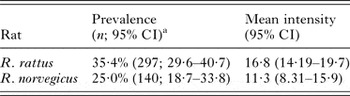
Adult A. cantonensis males measuring 15–20 mm and females measuring 18–28 mm (based on measurement of at least ten worms from rats trapped in each of the Parishes) were recovered from the right ventricle and pulmonary arteries of 32·0% (95% CI = 28–37%) of the rats. The prevalence and mean intensity of A. cantonensis infection in R. rattus and R. norvegicus is shown in Table 1. Rattus rattus was significantly more likely to be infected with A. cantonensis (35·4% of 297 rats) than R. norvegicus (25·0% of 140 rats) (χ 2 = 4·684; P = 0·037) and harboured significantly more worms (mean = 16·8) than R. norvegicus (mean = 11·3) (Mann–Whitney U-test: P = 0·01). Infection intensity ranged 1–76 worms. Although strong associations between both the prevalence (F = 17·102; P < 0·001 and F = 17·001; P < 0·001 for R. rattus and R. norvegicus, respectively) and intensity (F = 4·927; P = 0·027 and F = 9·187; P = 0·003 for R. rattus and R. norvegicus, respectively) were observed with log10 SVL, none was observed with either log10 weight or body condition in either species of rats. Further, comparisons of the prevalence or mean intensity of A. cantonensis between the host sexes revealed no significant associations. On the other hand, the parasites were aggregated in both species of rats (index of discrepancy, D > 0·8) (Poulin, Reference Poulin1993).
Prevalence and mean intensity of infection with Angiostrongylus cantonensis in Rattus rattus and R. norvegicus in Jamaica

a Sterne's exact method (Reiczigel, Reference Reiczigel2003).
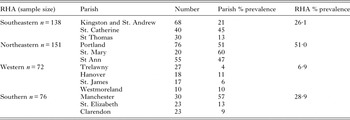
The prevalence of A. cantonensis differed significantly in rats trapped in the different RHAs (χ 2 = 48·319; P < 0·001). Fifty one per cent of 151 rats emanating from the north-eastern RHA were infected, followed by rats from the southern, south-eastern and western regions (Table 2). On a Parish level, A. cantonensis infections ranged from 4% of 27 rats from Trelawny (western RHA) to 60% of 20 rats from St. Mary (north-eastern RHA). No significant associations were detected between the mean intensities of A. cantonensis in infected rats and geographic location.
Distribution of Angiostrongylus cantonensis in wild rats in Parishes and Regional Health Authorities (RHA) in Jamaica

Multivariate analyses were performed to determine significant independent host factors that achieved P < 0·02 in the univariate analyses (i.e. species and log10 SVL) and geographical predictors (RHA) of the distribution of the parasites. A binary logistic regression model confirmed the statistically significant univariate analyses that R. rattus was more likely to be infected with A. cantonensis than R. norvegicus (OR = 1·76) and that A. cantonensis occurred more frequently in R. rattus in the northeastern RHA (OR = 11·66).
Angiostrongylus in terrestrial molluscs
Of the 777 snails and slugs examined, 12·5% harboured third-stage larvae of A. cantonensis. Infected molluscs included Pleurodonte spp. (29% of 86 snails), Poteria spp. (20% of 5 snails); T. aspera (18·7% of 369 snails), Sagda spp. (11% of 18 snails) and veronicellid slugs (6% of 34 individuals). Eighty-two of the 86 specimens of Pleurodonte spp. collected were gathered in the north and south-eastern RHAs where infection levels were 10·3% of 29 snails and 41·5% of 53 snails, respectively. In comparison, prevalence rates of A. cantonensis in T. aspera were not associated with geographical location (RHA).
DISCUSSION
In this survey of 437 wild rats conducted during the 5 years immediately following the 2000 outbreak of angiostrongylosis in Jamaica, we report an overall prevalence of infection of 32% rats. This represents a significantly higher prevalence of infection with A. cantonensis (χ 2 = 4·167; P = 0·04) than that reported by Lindo et al. in Reference Lindo, Waugh, Hall, Cunningham-Myrie, Ashley, Eberhard, Sullivan, Bishop, Robinson, Holtz and Robinson2002 (22% of 109 rats). Despite the lower sample size in the initial report which could negatively influence prevalence estimates (Jovani and Tella, Reference Jovani and Tella2006), it appears that A. cantonensis has further established in the rat population during the study period. Further, Lindo et al. (Reference Lindo, Waugh, Hall, Cunningham-Myrie, Ashley, Eberhard, Sullivan, Bishop, Robinson, Holtz and Robinson2002) reported no significant difference in the rate of infection of R. rattus and R. norvegicus but we found a significantly higher prevalence and mean intensity of infection in R. rattus, establishing this species as an important reservoir of infection in Jamaica.
Infection rates of A. cantonensis in rats elsewhere in the Caribbean range 16–100% (Aguiar et al. Reference Aguiar, Morera and Pascual1981; Andersen et al. Reference Andersen, Gubler, Sorenson, Beddard and Ash1986; Vargas et al. Reference Vargas, Gomez Perez and Malek1992; Raccurt et al. Reference Raccurt, Blaise and Durette-Desset2003; Chikweto et al. Reference Chikweto, Bhaiyat, Macpherson, De Allie, Pinckney, Richards and Sharma2009). However, Qvarnstrom et al. (Reference Qvarnstrom, Bishop and da Silva2013) recently showed that dissections of rodents, such as conducted in this and other studies, may significantly underestimate the prevalence rates of A. cantonensis in definitive hosts in endemic areas: These authors revealed that although 54% of 37 rats in Hawai'i were positive based on morphology, 100% of tissue samples from the same animals were positive using a real-time polymerase chain reaction assay.
More than twice as many R. rattus (n = 297) than R. norvegicus (n = 140) were trapped in the present study. This may reflect a higher population density of R. rattus in Jamaica, although R. norvegicus is dominant in Europe and North America (Burton and Burton, Reference Burton and Burton2002). There appears to be no definitive data on the comparative trappability of R. norvegicus and R. rattus. However, Webster et al. (Reference Webster, Brunton and MacDonald1994) showed that R. norvegicus infected with Toxoplasma gondii exhibited behavioural changes that rendered Toxoplasma-infected individuals more susceptible to predation, or trapping and poisoning during control programmes.
Aggregated distributions of A. cantonensis were encountered in both species of rats in this study, indicating heterogeneity of host behaviour and/or differences in host susceptibility to infection, exposure, genetic factors or immunity (Anderson and Gordon, Reference Anderson and Gordon1982). Although this also suggests that the parasite (in large numbers) may be detrimental to its host, we did not detect any association between prevalence of infection or worm burden and physical condition in either species of rats. On the other hand, a study of the same 437 rats in Jamaica (Waugh et al. Reference Waugh, Lindo, Forona, Angeles-Santana, Lorenzo-Morales and Robinson2006) also indicated a significantly higher prevalence of gastrointestinal helminths (35%) in R. rattus compared with R. norvegicus (18·6%).
The persistence of A. cantonensis in the Caribbean and its potential spread throughout the islands and Southern USA has been linked not only to the spread of infected rats but also the abundance of suitable intermediate (Lindo et al. Reference Lindo, Waugh, Todd, Brown, Robinson and Eamsobhana2011) and, possibly, paratenic hosts for the parasite. Of 777 terrestrial snails and slugs examined in this study, 12·5% harboured A. cantonensis based on dissection/digestion. Given the ability of A. cantonensis to infect a wide range of molluscs in the Caribbean (see Robinson et al. Reference Robinson, Waugh, Todd, Lorenzo-Morales and Lindo2013) research is urgently needed to assess the intermediate host range of the parasite in Jamaica where more than 560 valid species of terrestrial molluscs have been recognized (Rosenberg and Muratov, Reference Rosenberg and Muratov2006). The importance of eating eat raw or undercooked freshwater and terrestrial snails and slugs, thus providing opportunities for human infection with A. cantonensis, was highlighted by Zhang et al. (Reference Zhang, Chen, Gao, Geng, Huang, Liu, Wu and Zhu2008) in China. However, the potential for direct transmission by land snails can only be assessed with a full understanding of the intermediate host range of the parasite in which case molecular-based studies (see Aziz et al. Reference Aziz, Daly, Allen, Rowson, Greig, Forman and Morgan2016) should focus on common snail species which are present in domestic and farming environments.
Although Alicata (Reference Alicata1969) speculated that the giant African land snail, Achatina fulica, was important to the spread of A. cantonensis to new localities, areas exist such as Jamaica where the parasite is endemic yet A. fulica is absent. In the absence of giant African land snails from Jamaica, A. cantonensis probably reached here in infected rats from cargo ships as appears to have been the situation in Southern USA (Louisiana Office of Public Health, 2006). It therefore appears that infected rats may be more critical to the expansion of the parasite's geographic range than introduced infected molluscs. Certainly, A. fulica appears to have played little part in the establishment of A. cantonensis in the Caribbean, but the existence of this huge snail in many islands of the Lesser Antilles may further consolidate infections.
It has not been established whether the mucus slime trail from infected molluscs can transfer infective, third-stage larvae to humans if ingested. Unpublished, preliminary observations by the authors of larval shedding by A. cantonensis-infected snails showed that two of 15 infected T. aspera released just three third-stage larvae in mucus over a period of 10–15 min, and then only after feeding on fresh lettuce leaves, and that none of 11 infected Pleurodonte spp. released larvae of A. cantonensis under the same conditions. This apparent low rate of larval release in snail slime is inconsistent with the assumption that contaminated raw vegetables were implicated in the 2000 outbreak of EM on the island (Slom et al. Reference Slom, Cortese, Gerber, Jones, Holtz, Lopez, Zambrano, Sufit, Sakolvaree, Chaicumpa, Herwaldt and Johnson2002). In comparison, Heyneman and Lim (Reference Heyneman and Lim1967) reported third-stage larvae of A. cantonensis larvae were shed in the mucus of the Malayan slug Microparmarion malayanus, but there are conflicting reports of slime from infected molluscs containing few or no larvae, even when the same animals had high-intensity infections (Qvarnstrom et al. Reference Qvarnstrom, Bishop and da Silva2013). As a priority, studies are needed to clarify the role of mollusc slime in human disease transmission.
The role of paratenic hosts in the transmission of A. cantonensis also requires further study in situations like Jamaica where blended raw molluscs or crustaceans might be included as ingredients in drinks and tonics which form part of the traditional ‘grass roots’ culture (Waugh et al. Reference Waugh, Shafir, Wise, Robinson, Eberhard and Lindo2005). One confirmed paratenic host, the American Bullfrog Rana catesbeiana (Asato et al. Reference Asato, Taira, Nakamura, Kudaka, Itokazu and Kawanaka2004) has been present in Jamaica and Puerto Rico for several decades (Mahon and Aiken, Reference Mahon and Aiken1977) and awaits urgent investigation for A. cantonensis. Another, the predatory flatworm Platydemus manokwari, although not yet reported from Jamaica, has recently been detected in Puerto Rico and Florida (Justine et al. Reference Justine, Winsor, Barrière, Fanai, Gey, Han, La Quay-Velazquez, Lee, Lefevre, Meyer, Philippart, Robinson, Thévenot and Tsatsia2015).
The incidence of A. cantonensis in endemic areas and its geographical range appear to be increasing worldwide (see Cowie et al. Reference Cowie, Hollyer, da Silva, Hollingsworth, Dixon, Eamsobhana, Fox, Gosnell, Howe, Johnson, Kim, Kramer, Lim, Lindo, Lun, Maldonado, Morassutti, Murphy, Park, Qvarnstrom, Robinson, Sawanyawisuth, Teem, Thiengo, Todd, Tsai, Wallace, Waugh, Whelen and Wilkins2012). The parasite readily establishes itself in faunas where a large range of mollusc species can act as intermediate hosts and rats are ubiquitous. The wide distribution of A. cantonensis in rats across Jamaica suggests that the parasite has been here for some time. Infection prevalence in rats was significantly associated with geographic location with highest prevalence, representing almost two-thirds of all the infected rats in our study, occurring in the northeastern RHA. In contrast, the lowest prevalence of infection occurred in the western RHA. A possible explanation for this is that northeastern RNA boasts the highest forest coverage, rainfall levels (in excess of 300 mm per year) and minimal land utilization compared with the other RHAs in Jamaica. The northeastern RHA is also likely to support a larger population of terrestrial molluscs – the highest prevalence rate of A. cantonensis in Pleurodonte spp. occurred in eastern Jamaica – and would be expected to result in increased rat–mollusc interaction. Environmental parameters linked to the transmission of A. cantonensis require further investigation (Cowie et al. Reference Cowie, Hollyer, da Silva, Hollingsworth, Dixon, Eamsobhana, Fox, Gosnell, Howe, Johnson, Kim, Kramer, Lim, Lindo, Lun, Maldonado, Morassutti, Murphy, Park, Qvarnstrom, Robinson, Sawanyawisuth, Teem, Thiengo, Todd, Tsai, Wallace, Waugh, Whelen and Wilkins2012).
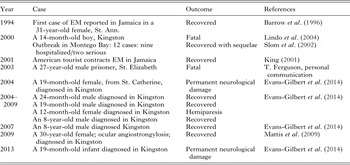
As a follow-up to survey of rats and terrestrial molluscs, the medical and scientific communities attached to our major hospitals were contacted regarding to the signs and symptoms of angiostrongylosis and invited to submit reports of suspicious findings for the period 2000–2015. While acknowledging that improved awareness and effort would be expected lead to increased reporting of cases, Table 3 shows, as a matter of record, that about 2 dozen cases of EM or confirmed angiostrongylosis were recorded in Jamaica since 1994, 25% of which were children 2 years old or younger at time of diagnosis. Pica disorder is more commonly seen in women and children in Jamaica (Robinson et al. Reference Robinson, Tolan and Golding-Beecher1990) and in areas of low socioeconomic status (Wong et al. Reference Wong, Bundy and Golden1991) and could be implicated in this apparent bias in infection risk.
Reported cases of eosinophilic meningitis (EM) and infections with Angiostrongylus cantonensis in Jamaica

Based on this 2002–2005 survey it appears that A. cantonensis has further established in the wild rat population in Jamaica since 2000; the study also confirms that several endemic snails can harbour infections at high prevalence. These data, combined with continuing reports (at least ten cases) during the last 15 years of infections in humans who never travelled off-island, indicates that A. cantonensis persists as an important zoonosis here. However, we are still uncertain how the parasite is being transmitted but suspect accidental ingestion of small, raw snails (Cowie, Reference Cowie2013b ) and vegetables contaminated with larvae (Slom et al. Reference Slom, Cortese, Gerber, Jones, Holtz, Lopez, Zambrano, Sufit, Sakolvaree, Chaicumpa, Herwaldt and Johnson2002; Waugh et al. Reference Waugh, Shafir, Wise, Robinson, Eberhard and Lindo2005), and the role of paratenic hosts in transmission of the parasite in Jamaica still awaits investigation. Meanwhile, the expansion of A. cantonensis in Jamaica and should be closely monitored.
ACKNOWLEDGEMENTS
The work was untaken while one of the authors (C. A. W.) was registered in the Ph.D. (Parasitology) programme, and another (J. L-M.) was an Honorary Research Fellow at The University of the West Indies, Jamaica. We are grateful to the Ministry of Health, Jamaica, for assistance with collecting wild rats, and the Institute of Jamaica for providing access to Voucher Specimens. Emergent third-stage larvae of A. cantonensis were confirmed by colleagues at the Centers for Disease Control and Prevention, Atlanta, Georgia, USA.
ETHICAL AND REGULATORY GUIDELINES
All procedures contributing to this work comply with the ethical standards of the University of the West Indies (Mona) Ethics Sub-Committee on the Use of Animals in Research.
FINANCIAL SUPPORT
We thank the Graduate Student Research Fund (University of the West Indies) for partial funding for the work (to C. W.).