

It is well known that most second language (L2) learners struggle to distinguish (in perception and production) nonnative phoneme contrasts that are not present in their native language. This reality has led to numerous empirical studies measuring the degree of difficulty with nonnative phoneme contrasts. Most studies have focused on English contrasts, as a large proportion of the world is faced with the task of learning to understand and speak English as a foreign or second language, for multiple reasons. An English phoneme contrast that has been shown to be particularly difficult for Japanese, Korean, and Chinese speakers is the one that distinguishes the words “rocket” and “locket” (for a review, see Aoyama, Flege, Guion, Akahane-Yamada, & Yamada, Reference Aoyama, Flege, Guion, Akahane-Yamada and Yamada2004). Some English vowel contrasts are also difficult for speakers of many languages; in particular, the contrast that distinguishes “sheep” and “ship,” namely, /i/–/ɪ/, has been shown to cause large difficulty for Greek, Japanese, Polish, Portuguese, Russian, and Spanish speakers (for a review, see Escudero, Benders, & Lipski, Reference Escudero, Benders and Lipski2009), because none of these languages contrasts these two English vowels.
More recent studies have shown that phoneme contrasts present in languages other than English also cause problems for L2 learners. With respect to vowel contrasts, it has been shown that Spanish learners of Dutch (SLD) with either beginning or advanced proficiency in the Dutch language have difficulty with distinguishing Dutch vowel contrasts that do not have counterparts in Spanish (Escudero & Wanrooij, Reference Escudero and Wanrooij2010; Escudero & Williams, Reference Escudero and Williams2012). The explanation for this difficulty is that the Dutch vowels in these difficult contrasts are heard as a single Spanish vowel. For instance, Escudero and Williams (Reference Escudero and Williams2011) showed that most instances of the vowels in the Dutch contrasts /a/–/ɑ/ and /y/–/ʏ/ are classified as Spanish /a/ and /u/, respectively. This explanation is at the core of current models that predict levels of difficulty in L2 sound perception, namely, the L2 linguistic perception model (Escudero Reference Escudero2005, Reference Escudero and Pennington2007, Reference Escudero, Boersma and Hamann2009) and the extension of the perceptual assimilation model to L2 acquisition (Best & Tyler, Reference Best, Tyler, Bohn and Munro2007).
A number of recent studies have shown continuity between phonological and lexical development in L2 learners, as they show large difficulty in accurately recognizing words or parts of words that are only distinguished by L2 contrasts that are difficult to discriminate in perception tasks. For instance, Escu-dero, Hayes-Harb, and Mitterer (Reference Escudero, Hayes-Harb and Mitterer2008) show that Dutch learners of English who were exposed to only auditory forms (as opposed to auditory and orthographic forms) during word learning could not distinguish the first syllable of newly learned words containing English /æ/–/ɛ/, a contrast that has been shown to be difficult to discriminate for these learners (Broersma, Reference Broersma2005; Cutler & Broersma, Reference Cutler, Broersma, Hardcastle and Beck2005). That is, when the only information available during word learning is spoken words and visual referents, Dutch listeners looked at both the image of the novel English word “tandik” (/tændək/) and that of the novel English word “tenzer” (/tɛnzə/) when hearing the first syllable of either of the two novel English words.
Broersma (Reference Broersma2005), Escudero, Broersma, and Simon (Reference Escudero, Broersma and Simon2013), and Weber and Cutler (Reference Weber and Cutler2004), among others, have shown that not all L2 minimal pairs, that is, two words that differ in a single vowel or consonant (e.g., /ʃip/–/ʃɪp/), are difficult to discriminate, because L2 learners (beginning to advanced) accurately recognize familiar and novel minimal pairs that differ in phonemes that they can readily distinguish, for example, “bottle”–“beetle” (/bɔtl/–/bitl/) for Dutch learners of English and “pig”–“pag” (/piχ/–/pɑχ/) for SLD, because these phonemes are also distinguished in their native language. As mentioned above, studies have shown that difficulties in minimal pair discrimination are related to the difficulty in discriminating the phoneme contrasts present in the same minimal pairs. For instance, Escudero et al. (Reference Escudero, Broersma and Simon2013) showed that Spanish learners’ accuracy when recognizing novel Dutch minimal pairs was in line with the results of a previous study reporting on these listeners’ discrimination accuracy for Dutch vowels (Escudero & Wanrooij, Reference Escudero and Wanrooij2010).Footnote 1 Specifically, Dutch minimal pairs that contained vowel contrasts that were perceptually difficult for Spanish listeners (e.g., /a/–/ɑ/ or /i/–/ɪ/), those with discrimination accuracy close to chance or well below Dutch natives’ performance, yielded lower accuracy than minimal pairs containing vowels that were easy to discriminate (perceptually easy contrasts). Escudero et al. (Reference Escudero, Broersma and Simon2013) show that Spanish listeners’ performance on Dutch novel minimal pairs containing perceptually easy vowel contrasts (e.g., /i/–/a/ or /u/–/a/) was nearly at ceiling (93%), just like that of Dutch natives (95%). Thus, vowel discrimination difficulty predicted performance in the recognition of novel minimal pairs, which demonstrates that there is continuity between the phonological knowledge that underlies vowel perception and the lexical knowledge underlying word recognition.
Despite the evidence for continuity between phonological and lexical difficulties in L2 acquisition described above, it has also been shown that L2 learners can have separate lexical representations for perceptually difficult L2 contrasts. Specifically, Weber and Cutler (Reference Weber and Cutler2004) showed that although Dutch learners of English have difficulty perceiving the difference between English /æ/ and /ɛ/, they seem to have represented the vowels differently at the lexical level, because they only looked at the image of the target word “pencil” (/pɛnsl/) and not at that of the competitor “panda” (/pændɑ/) during the first syllable of the word. How can L2 learners acquire lexical contrasts without being able to reliably distinguish the contrast perceptually?
Escudero et al. (Reference Escudero, Hayes-Harb and Mitterer2008) demonstrated that this lexical difference could have emerged via a different piece of information, namely, through a difference in the orthographic representations of the novel pseudowords. Specifically, they showed that only Dutch listeners who learned novel English words together with their spellings had the same result as that of Weber and Cutler (Reference Weber and Cutler2004), that is, they only looked at the target when listening to words containing /ɛ/, whereas listeners presented with only spoken forms during learning confused syllables containing English /æ/ and /ɛ/ with one another. The authors explain that the vowels in the first syllable of the English words “panda” (/pændɑ/) and “pencil” (/pɛnsl/) are spelled with letters that also distinguish two native Dutch vowels, namely, /ɑ/ and /ɛ/, and Dutch learners seem to use this Dutch phoneme-to-grapheme correspondence in their English lexicon to distinguish these two English vowels in a word-recognition task, which involves lexical knowledge. Thus, availability of orthography can lead to a discontinuity between lexical and perceptual performance, in that Dutch learners exhibited a lexical contrast that they could not reliably distinguish in perception.
This means that the availability of different orthographic representations for the members of perceptually difficult contrasts may help L2 learners’ perception, in that they can form separate lexical representations for minimal pairs containing the contrast, which can lead to further L2 development. This is because having separate lexical representations may help in the learning of novel minimal pairs as well as in their recognition and production, especially when the orthographic form or the word meaning activates the stored lexical form prior to its production. This may explain why some L2 speech studies find that accuracy in production precedes accuracy in perception for difficult L2 sound contrasts such as /ɹ/–/l/ in Japanese learners of English (for a review, see Escudero, Reference Escudero2005, pp. 1–5). Thus, separate lexical representations may help not only when reading but also when retrieving words that have been stored as separate items, either for production or for picture identification.
A number of recent studies (Escudero, Simon, & Mulak, Reference Escudero, Simon and Mulak2014; Hayes-Harb, Nicol, & Barker, Reference Hayes-Harb, Nicol and Barker2010; Showalter & Hayes-Harb, Reference Showalter and Hayes-Harb2013; Simon, Chambless, & Alves, Reference Simon, Chambless and Alves2010) have confirmed these positive consequences, suggesting that Escu-dero et al.'s (Reference Escudero, Hayes-Harb and Mitterer2008) findings demonstrate that orthography may aid L2 phonological and lexical learning. This potential L2 success with the availability of orthography has also instantiated and opened up a potentially interesting and fruitful avenue for the use of orthographic input to facilitate L2 phonological acquisition (Simon et al., Reference Simon, Chambless and Alves2010; Showalter & Hayes-Harb, Reference Showalter and Hayes-Harb2015 [this issue]).
However, it is important to bear in mind that other studies have shown that orthographic information may have a negative impact on L2 learners’ developing phonological systems. For instance, Bassetti (Reference Bassetti, Guder, Jiang and Wan2007) shows that orthography negatively affects the production of beginning and advanced English learners of Mandarin who are exposed to the Pinyin writing system. Specifically, exposure to the Pinyin system led to nontargetlike productions that are not found in the learners’ input or in young Chinese children's pronunciation (see also Bassetti & Atkinson, Reference Bassetti and Atkinson2015 [this issue], and Young-Scholten & Langer, Reference Young-Scholten and Langer2015 [this issue], for further examples of negative effects of native language orthography in L2 production). Hayes-Harb et al. (Reference Hayes-Harb, Nicol and Barker2010) also report a negative effect of orthography on the learning of phonological forms as their English learners accepted both “togeg” and “thogeg” as instances of the same spoken word, /togeg/, if they had learned this word together with the written form <thogeg>.
Even in the cases where learners are able to form a lexical contrast between two vowels based on orthographic input, they do not automatically gain the ability to discriminate the vowels in all situations. That is, they do not readily use their lexical knowledge when confronted with novel words, which indicates a discontinuity between their perceptual and lexical abilities. An example of this situation is shown by Escudero et al.'s (Reference Escudero, Hayes-Harb and Mitterer2008) listeners who learned new English words without orthographic input. These listeners were unable to use the lexical contrast that they have in place for familiar words, such as /pændɑ/ or /pɛnsl/, to distinguish the first syllable of English novel words, such as “tandik” (/tændək/) and “tenzer” (/tɛnzə/), which they learned without their orthography. As mentioned above, they looked at the images of both /tændək/ and /tɛnzə/ when hearing the first syllable of either word. Cutler (Reference Cutler2015, [this issue]) argues through the review of numerous priming studies that not having continuity between lexical (words) and prelexical (phonological) representations, that is, being able to distinguish words in the lexicon but not being able to discriminate phonological contrasts, could lead to more disadvantages than benefits.
Escudero and Wanrooij (Reference Escudero and Wanrooij2010) and Escudero et al. (Reference Escudero, Simon and Mulak2014) demonstrate the specific spectrum of contrasts that orthography seems to aid. The former uses a vowel discrimination task that measures phonological knowledge, while the latter uses a word-learning and recognition task that taps into newly acquired lexical knowledge. Both studies show that availability of orthography has a positive effect, in L2 phonological and lexical acquisition, respectively, only when both auditory and orthographic forms support similar contrastive information, that is, when orthography acts as a redundant cue for a contrast that is already perceived with high accuracy (see Hayes-Harb et al., Reference Hayes-Harb, Nicol and Barker2010). Escudero and Wanrooij (Reference Escudero and Wanrooij2010) show that Spanish listeners correctly discriminate the Dutch vowels /a/–/ɑ/ when presented with their orthographic representations, which signal their duration differences (<a> vs. <aa>). This is because Spanish listeners have been shown to readily use duration differences to distinguish perceptually difficult contrasts in English (Escudero & Boersma, Reference Escudero and Boersma2004) and Dutch (Escudero et al. Reference Escudero, Benders and Lipski2009) and that they use this acoustic dimension to a larger extent than native listeners, who commonly use the spectral differences between the vowels (Escudero et al. Reference Escudero, Benders and Lipski2009; Escudero & Boersma, Reference Escudero and Boersma2004). Escudero and Wanrooij demonstrate that orthographic information was only beneficial for the discrimination of one perceptually difficult contrast, namely, /a/–/ɑ/, which has a duration difference in both orthographic and auditory forms, while the same effect was not found for /y/–/ʏ/, which has the same orthographic information for duration (<uu> vs. <u>) but does not have a durational difference in the auditory forms, because the two vowels are commonly produced with comparable lengths.
Similarly, in their Dutch word-learning and word-recognition study also with Spanish listeners, Escudero et al. (Reference Escudero, Simon and Mulak2014) show that availability of orthographic input during word learning yielded positive effects only for perceptually difficult minimal pairs with congruent orthographies across Spanish and Dutch, that is, minimal pairs with orthographic representations that signal a vowel contrast in both languages (e.g., <i>–<uu>). In other words, Spanish listeners exposed to auditory forms together with their orthographic representations during word learning were more successful at recognizing words containing orthographically congruent minimal pairs than were Spanish listeners who were exposed to auditory forms only. This congruence effect was larger for SLD who were proficient in Dutch and its orthographic system (for a similar finding, see Veivo & Järvikivi, Reference Veivo and Järvikivi2013). It is interesting that Escudero et al. (Reference Escudero, Simon and Mulak2014) also showed a discontinuity between the role of orthography in vowel discrimination and word recognition, because orthography had a negative effect on minimal pairs containing both Dutch /a/–/ɑ/ and /y/–/ʏ/, for which Escudero and Wanrooij showed positive and negative effects, respectively.
Escudero and Wanrooij (Reference Escudero and Wanrooij2010) and Escudero et al. (Reference Escudero, Simon and Mulak2014) differ mainly in the level of representation tested in their tasks: the former has a prelexical discrimination task with isolated vowel tokens, while the latter uses a lexical task with vowels embedded in words and carrier sentences. It seems that the availability of a duration contrast in orthography may act as hindrance rather than help in a word-recognition task where a duration contrast becomes more perceptually difficult than in a vowel discrimination task. This is because duration differences between vowels may be less salient when produced embedded in words and sentences. This clearly suggests that orthography only helps perceptually easy contrasts.
THE PRESENT STUDY
The aim of this study is to further examine the role of orthography in two different listener populations, which may differ in their level of difficulty with Dutch vowel contrasts and in the degree to which they may be affected by orthographic information. Specifically, we compare the performance of Escudero et al's (Reference Escudero, Simon and Mulak2014) Spanish listeners to that of Australian English listeners tested for the present study. This comparison is particularly interesting because English has some of the phonological vowel contrasts found in Dutch that are not present in Spanish. In addition, orthographic information may affect English and Spanish listeners differently because Spanish is an orthographically transparent language, where many phonemes and graphemes have commonly a one-to-one correspondence, while English has an opaque orthography, with fewer one-to-one grapheme-to-phoneme correspondences.
Previous research has shown that orthographic transparency affected the production of nonnative words differently in English and Turkish speakers, because the latter have a transparent orthography (Erdener & Burnham, Reference Erdener and Burnham2005). In the present study, we examine whether a similar difference in the effect of orthography is found for nonnative word learning and recognition in Spanish versus English listeners. We compare the effect of orthography using a contrast-by-contrast approach for perceptually difficult L2 contrasts to elucidate which specific contrasts are most affected by language background and availability of orthographic information during word learning.
As in Escudero et al. (Reference Escudero, Simon and Mulak2014), we report whether experience with the target language (Dutch) leads to a larger effect of the availability of orthographic information on the recognition of novel words, because the Spanish listeners had different levels of proficiency in Dutch, which implies that they had different levels of experience with the Dutch orthographic system.
METHODOLOGY
Participants
We report on data from 151 participants: 78 with Australian English (AusE) as their native or dominant language and 73 with Iberian or Latin American Spanish as their native language. Participants were either given course credit or a small fee for participation.
The AusE-speaking participants were undergraduate students at an Australian University, aged 18–35 years. A language background questionnaire administered at the beginning of the session revealed that 43 spoke only AusE, had no communicative knowledge of any other language, and had never been exposed to Dutch (English monolinguals [EM]). The remaining 35 spoke at least one language other than English (mostly Arabic and Mandarin, which have writing systems that are different from those of Dutch, English, and Spanish) on a regular basis but had never been exposed to Dutch (English bilinguals/multilinguals [EB/M]); some of them were native English speakers and some had another language as native, but all used English most often in their current setting and it was therefore their dominant language.
The Spanish-speaking participants were those reported in Escudero et al. (Reference Escudero, Simon and Mulak2014), 30 of whom were undergraduate students at a Peruvian University with only basic knowledge of English; had no knowledge of languages other than Spanish; had never been exposed to Dutch, as measured by a language background questionnaire (Spanish monolinguals [SM]); and were aged 18–25. The remaining 43 were learners (aged 24–55) of Dutch from various Spanish-speaking countries who were living in The Netherlands at the time of testing and had different levels of Dutch and English proficiency (SLD). Proficiency in Dutch and English for the SLD group was also assessed with the listening component of the Dialang diagnostic language assessment test for Dutch and English (http://www.dialang.org; Alderson & Huhta, Reference Alderson and Huhta2005). This test has six scores, ranging from basic to highly advanced, which correspond to those established by the Common European Framework for language learning (http://www.coe.int/t/dg4/linguistic/source/framework_EN.pdf). Escudero et al. (Reference Escudero, Simon and Mulak2014) report that these learners had higher Dutch than English proficiency and that there was a positive correlation between the two language scores.
As mentioned in the introductory section, if participants’ dominant or native orthographic system determines the size of an orthographic effect on novel word recognition, learning words with their spelling may affect Spanish-speaking participants (SM and SLD), who commonly use a transparent orthographic system (Spanish), more than AusE-speaking participants (EM and EB/M), who are commonly exposed to an opaque orthographic system (English). In addition, if experience with the target language of the novel words, that is, Dutch, has an effect on word recognition, the SLD group might exhibit the largest effect of availability of orthographic information during word learning, because they have the most experience with the Dutch orthographic system. Because Escudero et al. (Reference Escudero, Simon and Mulak2014) found that SLD had more accurate performance than SM, we also expect that their Dutch experience will lead them to outperform the groups with English as their native or dominant language (EM and EB/M).
Stimuli and procedure
We tested the AusE-speaking undergraduates in a testing room at an Australian University using the same stimuli and procedure as in Escudero et al. (Reference Escudero, Broersma and Simon2013, Reference Escudero, Simon and Mulak2014), word-learning and subsequent word-recognition studies, including the two word-learning conditions in Escudero et al. (Reference Escudero, Simon and Mulak2014) that were designed to test the effect of orthography. That is, approximately half of the participants in each of the four language groups described above (with an extra participant in one condition) were presented with a purely auditory word-learning condition (audio only) and the other half with an auditory and orthography condition (audio + orthography). The only difference between conditions was that the latter included presentation of the orthographic form of the word (following the Dutch phoneme-to-grapheme correspondence) during word learning. No orthographic representations were present in the word-recognition test.
The experiment was run in E-prime 2.0 (Psychology Software Tools Inc.) and lasted approximately 30 min (word-learning phase = 10–12 min, testing = 15–18 min). As in the previous studies, participants were given oral instructions on the word-learning and word-recognition tasks and were told that each trial would start immediately after their response to the previous trial. They were encouraged to learn the Dutch words as well as possible because they would be subsequently tested on how well they could recognize them.
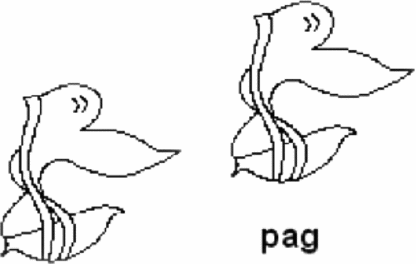
During word learning, participants were taught to associate 12 pseudowords (phonotactically legal in Dutch) with their corresponding image. A female Dutch speaker produced the pseudowords in generic carrier sentences of the form “This is an X” or “Click on the X,” where X was one of the pseudowords. Six of the 12 pseudowords were monosyllables of the form /p/–vowel–/χ/, which formed minimal pairs containing one of the six Dutch vowels /ɪ, i, ɑ, a, ʏ, y/. The remaining 6 pseudowords, namely, /‘beːptu:/, /‘foːmpəl/, /‘tœykfɔm/, /‘jɔmtoː/, /‘kɛsta/, /‘surkɛt/, had very different segmental composition, and had two rather than one syllable. Each of the 12 pseudowords was randomly associated with one of 12 line drawings of nonsense objects (see Appendix A). At the start of a learning trial, participants saw 1 line drawing and heard its corresponding pseudoword within the carrier sentence “Dit is een X” (“This is an X”). The sound file and image started simultaneously, with the latter staying in the middle of the screen for 2 s. In the audio + orthography condition, the orthographic representation of the pseudoword was presented below the line drawing, as shown in Figure 1 (right).
Example of visual referent used during word learning. Participants heard “Dit is een /pɑχ/” (This is a /pɑχ/) in the audio only (left) and audio + orthography (right) conditions.

After the previous image disappeared and 1.5 s after the offset of the previous sound file, the same pseudoword was presented in the sentence “Klik op de X” (“Click on the X”) and the target image was presented side-by-side with another image (the distractor) at the offset of the sentence. Participants had to press on a computer key that corresponded to the correct image. The two images stayed on the screen until a key response was pressed with a time-out of 10,000 ms. The next trial started 1 s after the key press. Testing was the same as the second part of word learning but the next trial started 500 ms after the key press.
During word learning, the 12 pseudowords were presented as target 6 times each, for a total of 72 learning trials. During testing, the 12 pseudowords were presented 22 times as target, twice with each of the other 11 pseudowords as the distractor, for a total of 264 testing trials comprising 204 nonminimal, for example, “beeptoe”–“fompel” or “beeptoe”–“pag” (51 pairs × 4 presentations); 32 perceptually easy, for example, “pag”–“pieg” (8 pairs × 4); and 28 perceptually difficult pairs, for example, “pag”–“paag” (7 pairs × 4). Participants took approximately 10–12 min to complete the word-learning phase and 15–18 min to complete the testing phase, for a total experiment duration of approximately 30 min.
Escudero et al. (Reference Escudero, Broersma and Simon2013, Reference Escudero, Simon and Mulak2014) divided these 15 minimal pairs into 8 perceptually easy (/ɪ–ɑ/, /ɪ–a/, /i–ɑ/, /i–a/, /ɑ–ʏ/, /ɑ–y/, /a–ʏ/, /a–y/) and 7 perceptually difficult (/ɑ–a/, /i–ɪ/, /y–ʏ/, /ɪ–ʏ/, /ɪ–y/, /i–ʏ/, /i–y/) minimal pairs based on Spanish listeners’ vowel discrimination performance (Escudero & Wanrooij, Reference Escudero and Wanrooij2010) and on the likelihood that a Dutch vowel contrast would be perceived as two different Spanish vowels (perceptually easy) or as a single Spanish vowel (perceptually difficult). For the present study, we used the exact same division to be able to compare Spanish and English performance. For all language groups, higher accuracy was expected for nonminimal than for minimal pairs, and for perceptually easy than for perceptually difficult minimal pairs, mirroring the auditory difficulty in distinguishing the members of each of these three pair types. If orthographic information has a positive effect on word learning in general, all listener groups in the auditory + orthography word-learning condition should outperform those in the auditory-only condition in all word pairs. In contrast, the effect of orthography may be specific to some pair types and some listener groups. It may be the case that the effect of orthography goes in the opposite direction to that of auditory difficulty, that is, perceptually difficult minimal pairs will be more affected by the availability of orthographic information during word learning than are nonminimal pairs or perceptually easy minimal pairs.
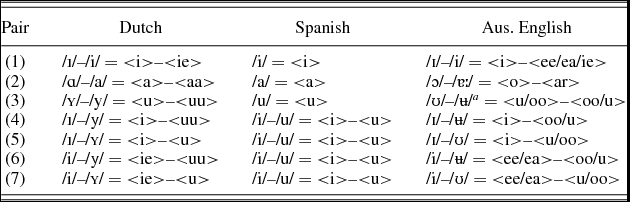
Table 1 shows the seven Dutch perceptually difficult contrasts, the acoustically closest Spanish and AusE vowels or vowel contrasts, and their corresponding graphemes. It can be seen that English listeners are likely to have higher accuracy for minimal pairs containing the first three perceptually difficult contrasts. This is because the vowels in these Dutch contrasts fall in the acoustic spaces of two different AuE vowels, as shown in Alispahic, Escudero, and Mulak (Reference Alispahic, Escudero and Mulak2014), who compared the acoustic values reported in van Leussen, Williams, and Escudero (Reference van Leussen, Williams and Escudero2011) and Cox (Reference Cox2006) for Dutch and AusE vowels, respectively. If orthographic information during word learning affects Spanish and English listeners’ performance equally, they should show similar effects for all perceptually difficult contrasts. For instance, although they hear the difference between the first three pairs, learning words containing these contrasts together with their orthographic representations may lead to the same negative effect shown in Escudero et al. (Reference Escudero, Simon and Mulak2014) for Spanish listeners. In contrast, Spanish listeners whose orthography is most transparent may be more affected by the availability of orthographic information during word learning than are English listeners who have an opaque orthographic system, as evident by the many orthographic representations a vowel can have (Table 1).
Dutch perceptually difficult vowel contrasts and acoustically closest Spanish and Australian English vowels

Note: Phonemes are represented between / / and graphemes between < >.
aSee Note 2.
RESULTS
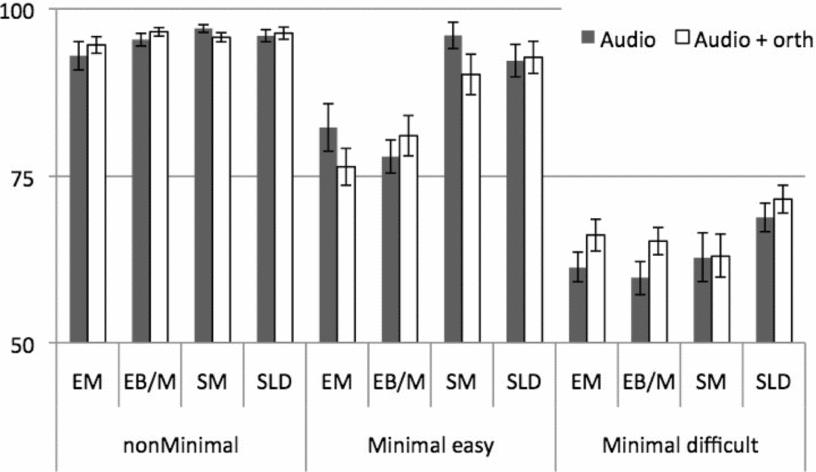
Figure 2 shows accuracy at test for nonminimal pairs, perceptually easy minimal pairs, and perceptually difficult minimal pairs in the four listener groups and in the two word-learning conditions (audio only vs. audio + orthography).
Percentage accuracy (chance = 50%) for the three types of word pairs in the two word-learning conditions and the four language groups. EM, English monolinguals; EB/M, English bilinguals/multilinguals; SM, Spanish monolinguals; SLD, Spanish learners of Dutch.
We conducted a repeated-measures analysis of variance (ANOVA) on participants’ accuracy with pair type (nonminimal pairs, perceptually easy minimal pairs, and perceptually difficult minimal pairs) as within-subjects and language group (EM vs. EB/M vs. SM vs. SLD) and word-learning condition (audio only vs. audio + orthography) as between-subjects factors. In line with Escudero et al.'s (Reference Escudero, Broersma and Simon2013, Reference Escudero, Simon and Mulak2014) findings, there was a main effect of pair type, F (2, 286) = 566.170, p < .001, η2p = 0.798. Bonferroni corrected post hoc tests showed that the mean accuracy for nonminimal pairs was higher than that of minimal easy and minimal difficult pairs, while accuracy for easy pairs was higher than that of difficult minimal pairs (all ps < .001). The analysis also revealed a main effect of language group, F (3, 143) = 9.858, p < .001, η2p = 0.171, with both Spanish-speaking groups showing higher overall accuracy than the two English-speaking groups (ps < .05). This main effect was qualified by a Pair Type × Language Group interaction, F (6, 286) = 9.700, p < .001, η2p = 0.169. One-way ANOVAs with Bonferroni corrected post hoc comparisons showed that the two Spanish-speaking groups had higher accuracy than the two English-speaking groups in minimal easy pairs (ps < .001), while the SLD had higher accuracy than the other three groups for the minimal difficult (ps < .05) pairs. No group effect was found for nonminimal pairs.
The omnibus ANOVA also yielded a Pair Type × Word-Learning Condition interaction, F (2, 286) = 4.143, p = .017, η2p = 0.028, indicating that orthography had different effects on the learning of the different pair types. Independent samples t tests (two-tailed) showed that listeners in the audio + orthography condition had a marginally higher accuracy than those in the audio only condition for perceptually difficult minimal pairs, t (149) = 1.964, p = .051, whereas the word-learning condition did not have an effect on either nonminimal, t (149) = –0.658, p = .512, or minimal easy, t (149) = 0.048, p = .398, pairs.
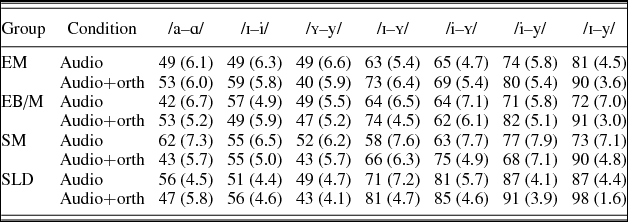
Escudero et al. (Reference Escudero, Simon and Mulak2014) divided difficult minimal pairs into congruent and incongruent, depending on whether the grapheme-to-phoneme correspondence led to contrastive vowels across Dutch and Spanish. For instance, the graphemes <i> and <a> are congruent because they contrasted similar phonemes in the two languages, while <aa> and <a> are incongruent because they correspond to a phonemic contrast in Dutch but to a single phoneme in Spanish, namely, /a/. Because orthographic congruence is different for English and Dutch versus Spanish and Dutch, we examine here the general effect of availability of orthographic forms during word learning on the learning of all perceptually difficult minimal pairs (in this case seven in total) for these two groups of listeners. Table 2 shows word-recognition accuracy for the seven different minimal pairs that contain perceptually difficult vowel contrasts for Spanish listeners.
Percentage (standard error) accuracy across perceptually difficult minimal pairs per language group and word-learning condition
Note: EM, English monolinguals; EB/M, English bi/multilinguals; SM, Spanish monolinguals; SLD, Spanish learners of Dutch.
To examine whether the availability of orthographic forms during word learning affected all perceptually difficult minimal pairs and all language groups equally, we conducted a second repeated-measures ANOVA with pair (six levels) as the within-subjects factor and language group and word-learning condition as the between-subjects factors. The analysis revealed the same main effect of language group described above for perceptually difficult minimal pairs, F (3,143) = 4.397, p = .005, η2p = 0.084, with the SLD outperforming the other three groups (Bonferroni corrected ps < .05). Because there was no significant difference in accuracy across the other three groups, it can be said that exposure to Dutch results in higher accuracy in the learning of novel words that contain perceptually difficult minimal pairs, as suggested in Escudero et al. (Reference Escudero, Simon and Mulak2014). No interactions involving language group were found.
The analysis also revealed a main effect of minimal-difficult pair, F (6, 858) = 59.511, p < .001, η2p = 0.294, and a Minimal-Difficult Pair × Word-Learning Condition interaction, F (6, 858) = 3.159, p = .005, η2p = 0.022. Bonferroni corrected post hoc tests showed that /a–ɑ/, /i–ɪ/, and /y–ʏ/ had lower accuracy than /ɪ–ʏ/, /ɪ–y, /i–y/, and /i–ʏ/, whereas /i–y/ and /ɪ–y/ had higher accuracy than /i–ʏ/ and /ɪ–ʏ/. Thus, based on the ranking for vowel discrimination difficulty reported in Escudero and Wanrooij (Reference Escudero and Wanrooij2010), we found the following word-recognition ranking, from lowest to highest accuracy, for novel perceptually difficult minimal pairs: /a–ɑ/ ~ /i–ɪ/ ~ /y–ʏ/ >> /i–ʏ/ ~ /ɪ–ʏ/ >> /i–y/ ~ /ɪ–y/. The present ranking is different from that of Escudero and Wanrooij's in that /a–ɑ/, /i–ɪ/, and /y–ʏ/ had comparable difficulty here, whereas /i–ɪ/ and /y–ʏ/ were less difficult than /a–ɑ/ in their study, suggesting further problems for perceptually difficult vowels when presented within novel minimal pairs.
As for the Minimal-Difficult Pair × Word-Learning Condition interaction, we found that learning words with their orthography had a robust positive effect (α = 0.05/7 comparisons = 0.007) for one of the contrasts with the highest overall accuracy, namely, /ɪ–y/ (p < .001). A positive effect of orthography approached significance for /ɪ–ʏ/ (p = .027), which had intermediate accuracy. Availability of orthographic forms during word learning had no effect (either positive or negative) on the accuracy of the other five contrasts (ps > .05).
DISCUSSION
The present study aimed at testing how the availability of orthographic information affects nonnative word learning and recognition. Listeners with English or Spanish as their dominant language were tested on novel word pairs that form minimal pairs, containing perceptually difficult or perceptually easy vowel contrasts, as well as on novel nonminimal pairs. The results show that the effect of orthography was only present for 2 of the 7 perceptually difficult minimal pairs, while no effect was found for word pairs that had a large perceptual difference, namely, nonminimal pairs (51 pairs) and perceptually easy minimal pairs (8 pairs). The two contrasts that showed a positive effect of orthography, namely, /ɪ–ʏ/ and /ɪ–ʏ/, were the ones with the highest or intermediate accuracy levels within the perceptually difficult pairs, suggesting that orthography acted as a redundant or extra cue to enhance differences that could already be perceived. No effect of orthography (positive or negative) was found for the most difficult contrasts, for which performance was at chance.
Spanish-speaking listeners outperformed English listeners in perceptually easy contrasts that involved the low vowels and high or semihigh vowels, which have a large acoustic distance in both languages. This was not expected because those contrasts should be more perceptually salient for English speakers who have a larger vowel inventory than that of Spanish (12 vs. 5 vowel monophthongs). However, having more vowels to choose from may create larger competition and lead to lower accuracy in the recognition of nonnative minimal pairs. Previous studies have shown that the number of response options affects sound perception (Benders, Escudero, & Sjerps, Reference Benders, Escudero and Sjerps2012), and this may be the case when many native vowel categories are perceived for a single nonnative vowel. This scenario in nonnative vowel perception has been referred to as multiple-category assimilation and has been shown to cause problems for Dutch learners of Spanish vowels who hear some Spanish vowels as more than one Dutch vowel (Boersma & Escudero, Reference Boersma, Escudero, Avery, Dresher and Rice2008; Escudero, Reference Escudero2005; Escudero & Boersma, Reference Escudero, Boersma, Skarabela, Fish and Do2002) and for AusE listeners' discrimination of Brazilian Portuguese vowels (Elvin, Escudero, & Vasiliev, Reference Elvin, Escudero and Vasiliev2014). Current research at our laboratory is examining the amount of multiple-category assimilation of Dutch vowels in AusE listeners and how that affects their recognition of Dutch words and their discrimination of Dutch vowels. Preliminary results comparing 11 participants per language group (Alispahic et al., Reference Alispahic, Escudero and Mulak2014) show that, although they have a vowel inventory similar to that of Dutch, AusE listeners have similar performance to Spanish listeners in the same discrimination task reported in Escudero and Wanrooij (Reference Escudero and Wanrooij2010), which includes the same perceptually difficult Dutch vowel contrasts of the present study.
In contrast, the Dutch vowels in the perceptually easy contrasts may be acoustically closer to Spanish /i/, /a/, and /u/ than to the AusE phonetic counterparts, /i/, /ɐ/, and /ʊ/. Acoustic analysis comparing distances between AusE, Spanish, and Dutch vowels are being conducted, similar to those presented in Elvin et al. (2014) for AusE, Brazilian Portuguese, and European Spanish, to shed light on the possible cross-linguistic differences in perception that can be predicted from these comparisons. Further research should also show whether Spanish listeners outperform AusE listeners in a discrimination task containing the perceptually easy Dutch vowel contrasts of the present study.
We were unable to find an effect of language background on the influence of orthography on nonnative word recognition: effects of orthography were comparable for English and Spanish listeners. This may be because congruent orthography, that is, orthographic representations that signal a contrast in both the native and nonnative language, may act as redundant information for listeners with any type of orthographic system. However, that orthography did not help perceptually easy contrasts in either listener group suggests that the role of orthography is even more limited and that it does not act as helpful redundant information in all cases where native orthographic representations match a nonnative phonemic contrast.
Although the results of this study are based on performance on 12 novel words after a word-learning phase of only 10–12 min, they suggest that nonnative listeners are able to rapidly and accurately map perceptually easy novel words to a picture meaning, while with perceptually difficult words, learners perform at chance. Orthography had a very limited effect on L2 word learning and recognition: it had no effect on most minimally different word pairs, including the most difficult to perceive, which were neither positively nor negatively influenced by availability of orthographic representations during word learning. The positive results for the two perceptually difficult contrasts with some of the highest accuracy levels suggest that orthography may sharpen performance on contrasts that have been auditorily mastered. It is important that our results apply both to naive listeners who have not yet been in contact with the target language and to learners with advanced levels of proficiency in the target language, as many of the SLD had the highest possible score in the listening-comprehension test (i.e., Dialang; Alderson & Huhta, Reference Alderson and Huhta2005) that was used to determine their Dutch proficiency. In addition, these Spanish learners had scored higher on the Dutch than on the English version of the same comprehension test, which suggests that as a group, they had high proficiency in understanding Dutch audio passages and accurately responding to written questions about them.
In sum, the current results show that orthography may not help L2 learners’ accuracy. In our study, it only aided when auditory information was sufficient, while it did not help for cases of substantial perceptual difficulty. Avoiding orthographic input may well be a good strategy, given that Cutler (Reference Cutler2015 [this issue]) and Escudero et al. (Reference Escudero, Simon and Mulak2014) have demonstrated that it may hinder rather than aid many cases of L2 learning, while its positive effect is only redundant, as demonstrated in the present findings. A more fruitful research direction may be to further examine the effect of auditory training in improving the perception of difficult L2 contrasts (e.g., Escudero, Benders, & Wanrooij, Reference Escudero, Benders and Wanrooij2011; Escudero & Williams, Reference Escudero and Williams2014; Wanrooij, Escudero, & Raijmakers, Reference Wanrooij, Escudero and Raijmakers2013) as well as the consequence of such implicit auditory training on L2 word learning and recognition.
APPENDIX A
The following are the 12 pseudowords and their randomly assigned picture image that were used in the present study and in Escudero et al. (Reference Escudero, Broersma and Simon2013):
ACKNOWLEDGMENTS
Many thanks to Karen Mulak for help in setting up the experiment in Sydney and to her and Jaydene Elvin for recruitment and testing of AusE participants.