Introduction
The population in Hong Kong is aging and the number of those with cognitive impairment or dementia is escalating (Chiu et al., Reference Chiu1998; Lam et al., Reference Lam2008a). Managing one's medications has been recognized as an important everyday function and is essential for safe, independent living (Skelton et al., Reference Skelton, Kunik, Regev and Naik2010). The mental capacity to decide on one's own medication management and the capacity to perform the management, though conceptually related, should be considered separately because of their different clinical implications. For patients unable to manage their medications, appropriate supervision and assistance may be sufficient. For those unable to make competent decisions, e.g. whether to utilize a reminder system or have someone administer medications to them, substitute decision-making or other kinds of protection such as guardianship may be needed. With an aging population, it is expected that guardianship proceedings will be increasingly important (Moye et al., Reference Moye, Butz, Marson, Wood and Adults Working Group2007).
Although the importance of decisional capacity evaluation is recognized (Skelton et al., Reference Skelton, Kunik, Regev and Naik2010), an approach to specific assessment of the capacity to make decisions with regard to medication management is lacking (Lai et al., Reference Lai, Gill, Cooney, Bradley, Hawkins and Karlawish2008). Existing assessment tools for activities of daily living usually focus on the ability to perform specific tasks associated with everyday functioning (Moore et al., Reference Moore, Moseley and Palmer2008), rather than on the decisional component. Decision-making capacity has been conceptualized as comprising four abilities: understanding the relevant information, appreciating the information, reasoning with the information, and expressing a choice (Dunn et al., Reference Dunn, Norwangi, Palmer, Jeste and Saks2006; Appelbaum, Reference Appelbaum2007). Different legal jurisdictions may have different requirements and standards for these abilities. However, studies of these abilities are largely limited to treatment and research decisions (Appelbaum, Reference Appelbaum2010; Knapp, Reference Knapp2010). There is an important knowledge gap in understanding these abilities with regard to managing one's own medications.
The objectives of the present study were to assess if decisional capacity and the four decision-making abilities related to medication management were impaired among community-dwelling older persons with amnestic mild cognitive impairment (MCI) and mild Alzheimer's disease (AD), as compared with cognitively normal older adults. Their relationships with cognitive and functional measures are also examined.
Methods
Participants
In this study, 95 patients with mild AD, 99 participants with amnestic MCI, and 97 cognitively normal control (NC) participants were recruited from local social centers and residential hostels for the elderly in Hong Kong. The participants were all volunteers over the age of 60 years who responded to announcements and advertisements at the centers and hostels. All participants were assessed by a trained geriatric psychiatrist and three groups of subjects were recruited. Cognitively normal controls were neurologically intact, i.e. cognitively normal older adults with an absence of medical and psychiatric conditions that could compromise cognition. Participants with amnestic MCI were diagnosed using the locally adapted criteria of MCI, which include (1) subjective memory complaints; (2) objective memory impairment, based on delayed recall of list learning test scores 1.5 standard deviations (SD) or more below the norm obtained from cognitively intact subjects (CDR = 0) in the corresponding age and education group in a local epidemiological study (Lam et al., Reference Lam2008b); and (3) clinically without dementia. These criteria have been found to be comparable to the original Mayo criteria (Petersen et al., Reference Petersen2001) for the local older age population. Clinical Dementia Rating (CDR) staging (Hughes et al., Reference Hughes, Berg, Danziger, Coben and Martin1982; Morris, Reference Morris1997) was used to evaluate the severity of dementia. If a participant had CDR of 1 (mild dementia), the diagnosis of AD was established based on the NINCDS-ADRDA criteria for probable or possible AD (McKhann et al., Reference McKhann, Drachman, Folstein, Katzman and Stadlan1984).
The exclusion criteria included a CDR of 2 or above and the presence of profound communication difficulties. One of the research team's psychiatrists explained the details of the study and obtained written informed consent from each participant. The study was approved by the Institutional Ethical Review Board.
Assessment
Decision-making abilities in making everyday medication decisions
Chinese version of the Assessment of Capacity for Everyday Decision-Making (ACED): The Assessment of Capacity for Everyday Decision-Making (ACED) (Lai and Karlawish, Reference Lai and Karlawish2007; Lai et al., Reference Lai, Gill, Cooney, Bradley, Hawkins and Karlawish2008) was used to measure the four decision-making abilities. It was developed for assessment of everyday decision-making in a Western population of older adults with very mild to moderate late-life cognitive impairments (Lai et al., Reference Lai, Gill, Cooney, Bradley, Hawkins and Karlawish2008). This tool was translated into Chinese with back-translation (Yu et al., Reference Yu, Lui, Lam, Chiu, Karlawish and Appelbaum2009).
The Chinese ACED, like the original, has three versions for different activities of daily living. These include preparing meals, managing medications, and managing money. In the present study, the medication management version was used. Before the ACED interview, subjects' functional ability was assessed and information from caregivers regarding functional deficits was collected to allow the ACED instrument content to be tailored to each subject. For subjects without identified medication management problems, a standardized hypothetical scenario, which described a patient with dementia and difficulty in managing medications, was used. Hypothetical scenarios have been used successfully in previous capacity assessment studies (Raad et al., Reference Raad, Karlawish and Appelbaum2009) for research on specific diagnostic groups. The interviewer used the structured format of the ACED to discuss a patient's everyday medication management and the possible solutions to managing his or her problems and had standardized rating criteria for subjects' responses.
The Chinese ACED was administered to each subject by a trained research assistant, who was blind to whether the participants were classified as cognitively normal, MCI, or mild AD. Relevant nonverbal communication was recorded. The Chinese ACED evaluates mental capacity along four dimensions: understanding, the ability to comprehend basic information about a problem, its potential solutions, and the risks and benefits associated with those solutions; appreciation, the ability of a person to recognize how a problem or solution pertains to his or her specific situation; reasoning, the ability to process the information in a logical fashion toward a decision; and expressing a choice, the ability to communicate his or her choice for the decision. Each dimension yields a respective ability score. The full ability score for understanding is 10, appreciation is 8, reasoning is 10, and expressing a choice is 2. An ACED total score is not calculated, as significant deficits on any single dimension may result in mental incompetence, even when performance on other dimensions is intact. To determine interrater reliabilities, 100 ACED interviews were audio-recorded digitally and rated by an independent geriatric psychiatrist.
Clinician ratings
To evaluate the clinical significance of ACED scores, the mental capacity to make everyday medication management decisions was independently assessed by a geriatric psychiatrist who was blind to the ACED scores. The psychiatrist was asked to assess whether the person was mentally competent to decide on daily medication arrangements. The clinical judgment was based on the criteria in section 3 of the UK Mental Capacity Act 2005 (Department of Constitutional Affairs, 2005). The Act stipulates that persons are unable to make decisions for themselves if:
(a) they are unable to understand the information relevant to the decision;
(b) they are unable to retain that information;
(c) they are unable to use or weigh the information; or
(d) they are unable to communicate a decision.
This criterion was adopted in our study because it is explicit and consistent with contemporary approaches for assessment of mental capacity. The participants were rated as “Fully Incapable,” “Incapable,” “Capable,” and “Fully Capable.” Twenty subjects were assessed for interrater reliability and the κ value between the two raters was 0.64, which indicated substantial agreement (Landis and Koch, Reference Landis and Koch1977).
Medical decision-making capacity
To compare decision-making abilities across different capacity domains, the MacArthur Competence Assessment for Treatment (MacCAT-T) (Grisso et al., Reference Grisso, Appelbaum and Hill-Fotouhi1997) was used to assess the capacity of subjects to consent to medical treatment, based on a hypothetical situation. The Chinese version has been shown to be a reliable tool in the local population (Lui et al., Reference Lui2009). The MacCAT-T interviews were digitally recorded and rated independently by a trained geriatric psychiatrist.
Cognitive and functional assessment
The Cantonese version of the Mini-Mental State Examination (MMSE): The MMSE was administered to each participant as an index of global cognitive function (Folstein et al., Reference Folstein, Folstein and McHugh1975); it has been validated in Hong Kong (Chiu et al., Reference Chiu, Lee, Chung and Kwong1994).
The Chinese version of the AD Assessment Scale–Cognitive Subscale (ADAS-Cog): The ADAS-Cog is an 11-item standardized scale specifically designed for the evaluation of cognitive deficits in subjects with AD (Mohs et al., Reference Mohs, Rosen and Davis1983; Rosen et al., Reference Rosen, Mohs and Davis1984; Chu et al., Reference Chu, Chiu, Hui, Yu, Tsui and Lee2000). The ADAS-Cog comprises subscales that examine different aspects of cognitive function. The maximum score is 70, with increasing scores indicating greater severity of impairment.
Delayed Recall Test: A word list of ten items was read to each subject, who was asked to recall the list ten minutes later. The score was the number of items correctly recalled. The test, which has been validated for local population (Lam et al., Reference Lam2008b), was used for MCI classification in this study
Chinese version of the Disability Assessment for Dementia (CDAD): The CDAD was used to assess functional impairment in subjects. It has been validated in local community-dwelling Chinese elderly people with AD with excellent reliability (Gelinas et al., Reference Gelinas, Gauthier, McIntyre and Gauthier1999; Mok et al., Reference Mok, Siu, Chan, Yeung, Pan and Li2005). A total score is obtained by adding the rating for each question and converting this total score to a range from 0 to 100. Lower scores represent more functional disabilities.
Procedure
All participants were assessed by a trained geriatric psychiatrist for clinician ratings. Demographic and clinical data were recorded. Cognitive and functional assessments and the MacCAT-T were performed by a trained research assistant (RA). Another trained RA, who was a registered occupational therapist, independently administered and rated the Chinese ACED.
Statistical analyses
Analysis was performed using PASW Statistics 17.0. An α level of 0.05 was considered statistically significant. To understand the clinical significance of the ACED ability scores, Spearman correlation coefficients between the ACED ability scores and clinician ratings were calculated. The clinician ratings “Fully Incapable” and “Incapable” were collapsed into the category of “Incompetent” and the other two into “Competent.” The difference in the ability scores between mentally competent and mentally incompetent participants was evaluated using the independent samples t test. Spearman correlation coefficients between the ACED ability scores and demographic and clinical variables, and cognitive and functional measures were calculated. Interrater agreement was assessed by intraclass correlation coefficients. Cronbach's α was used to evaluate the internal consistency of each decisional dimension. Linear regression analysis was done to explore the associations between correlated variables.
Results
Demographic and clinical characteristics of participants
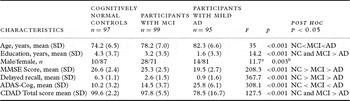
Two hundred and ninety-one participants were recruited. Their characteristics are shown in Table 1. Participants in the mild AD group were significantly older, with fewer years of education, and had worse performance on both cognitive and functional measures.
Demographic characteristics of study participants (n = 291)

One-way ANOVA, post hoc analysis with Bonferroni method. MCI = mild cognitive impairment; AD = mild Alzheimer's disease; ADAS-Cog = AD Assessment Scale–Cognitive Subscale; CDAD = Chinese version of the Disability Assessment for Dementia.
a χ2 value.
b Male/female ratio in MCI > NC (χ2 = 10.1, p = 0.001), MCI > AD (χ2 = 5.2, p = 0.022).
ACED ability scores and MacCAT-T summary scores
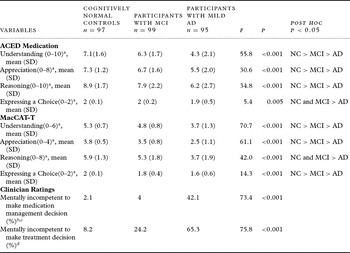
The scores on the ACED and the MacCAT-T are shown in Table 2. On the ACED, the mild AD group performed significantly below the MCI group in all abilities. With the MacCAT-T, participants with MCI performed significantly below the cognitively normal controls in understanding, appreciation, and reasoning. Correlations between each decision-making ability in the MacCAT-T and ACED are shown in Table 3.
Decisional capacity on the ACED and clinician-rated performance of study participants (n = 291)

One-way ANOVA, post hoc analysis with Bonferroni method. NC = cognitively normal controls; MCI = mild cognitive impairment; AD = mild Alzheimer's disease; MacCAT-T = MacArthur Competence Assessment for Treatment.
a Range of possible scores for each ability measure.
b No difference between NC and MCI (χ2 = 0.6, p = 0.421).
c AD > MCI (χ2 = 40.1, p<0.001)
d MCI > NC (χ2 = 9.2, p = 0.002), AD>MCI (χ2 = 33.1, p<0.001)
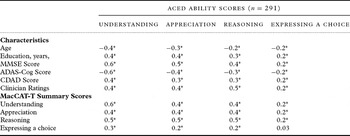
Relationship between the ACED ability scores and demographic characteristics for all participants

Values are Spearman's ρ. MacCAT-T = MacArthur Competence Assessment for Treatment; ADAS-Cog = AD Assessment Scale–Cognitive Subscale; CDAD = Chinese version of the Disability Assessment for Dementia.
* p < 0.01
Interrater reliability of the ACED
The intraclass correlation coefficients between two raters were 0.84 for understanding, 0.88 for appreciation, 0.92 for reasoning, and 0.57 for expressing a choice.
Internal consistency of the ACED
Cronbach's α was 0.77 for understanding, 0.59 for appreciation, and 0.76 for reasoning.
Clinician ratings
Based on clinician ratings, 97.9% of participants in the cognitively intact group and 96% in the MCI group were found to be mentally competent (χ2 = 0.6, p = 0.421). However, only 57.9% were found to be mentally competent in the mild AD group and the difference was statistically significant when compared with the MCI group (χ2 = 40.1, p < 0.001). No significant difference in gender ratio was found between mentally competent and mentally incompetent participants (χ2 = 0.009, p = 0.926).
The clinician ratings correlated significantly with the ACED ability scores for understanding (rs = 0.4, p < 0.001), appreciation (rs = 0.4, p < 0.001), reasoning (rs = 0.5, p < 0.001), and expressing a choice (rs = 0.2, p < 0.001).
Correlation and regression analysis of decision-making abilities
The correlations between the ACED ability scores and demographic variables, and cognitive and functional performance are shown in Table 3. No significant correlation between ACED ability scores and gender was found (p = 0.5 for understanding, 0.3 for appreciation, 0.3 for reasoning, and 0.1 for expressing a choice).
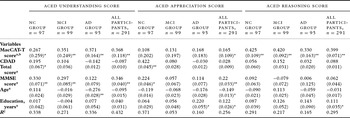
For each ACED ability score, linear regression analyses were conducted to evaluate whether correlated variables were predictive in each participant group and for all participants. The ability score was entered as the dependent variable, with the corresponding summary score in the MacCAT-T, the CDAD total score, the MMSE score, and age and education entered as independent variables. The results are shown in Table 4. The relationships among these measures account for 29% (in reasoning) to 43% (in understanding) of the variance of the ACED scores across all participants. Summary scores in the MacCAT-T were found to be significant predictors for the corresponding ACED ability score.
Linear regression results for decision-making abilities measured by the ACED (n = 291)

a Value is β (Std. Error). NC = cognitively normal controls; MCI = mild cognitive impairment; AD = mild Alzheimer's disease; MacCAT-T = MacArthur Competence Assessment for Treatment; CDAD = Chinese version of the Disability Assessment for Dementia.
b Corresponding MacCAT-T scores are used (e.g. MacCAT-T understanding score is used in ACED understanding score).
** p < 0.01, * p < 0.05.
Discussion
In this study, decisional capacity and the four decision-making abilities for medication management were assessed by clinician ratings and the ACED, respectively. The clinicians deemed a significant proportion of patients with mild AD (42.1%) but not patients with MCI or normal controls mentally incompetent to decide on their own medication management. Similarly, the mild AD patients scored significantly more poorly on all four ACED ability scales compared with the other groups. These patients would appear to be at risk of poor drug adherence, which, in turn, may jeopardize their physical and mental health.
Perhaps more surprising, however, were the findings concerning the MCI group. Although almost all were rated by the clinicians as competent to make decisions about managing their medications, their ACED ability scores on understanding, appreciation, and reasoning were significantly lower than those of the cognitively normal controls. These results suggest that the decision-making of patients with MCI may be qualitatively different, in ways as yet undetermined, from the decisions of the unaffected elderly. The impairment of these decisional abilities may have a material impact on patients' decisions – and hence on their lives – even before the clinical diagnosis of dementia is made.
That impairment was detected in the MCI group with the ACED at a stage before clinicians deemed these patients incompetent suggests the utility of the ACED as a screening tool for early impairment. In our hands, the ACED was a reliable tool, with interrater reliability ranging from 0.8 to 0.9 for the abilities to understand, appreciate, and reason. These are comparable to the reliabilities reported in a previous study in a Western population (Lai et al., Reference Lai, Gill, Cooney, Bradley, Hawkins and Karlawish2008). The internal consistency for these three dimensions, ranging from 0.59 to 0.77, was also found to be satisfactory. However, the lowest internal consistency was for appreciation, suggesting that the elements assessed by this scale (the abilities to appreciate the problem in medication management and to appreciate possible solutions) may be somewhat different constructs.
For expressing a choice, most of our participants scored well in ACED and MacCAT-T, with mean scores ranging from 1.6 to 2.0. This finding is consistent with observations in Western populations (Gurrera et al., Reference Gurrera, Moye, Karel, Azar and Armesto2006) that community-dwelling patients with early dementia will be able to express a choice, even if their ability to understand, appreciate, or reason is impaired. The narrow range of scores for expressing a choice may limit its ability to help discriminate among levels of severity of cognitive impairment. This observation highlights the importance of measuring the other three decisional abilities in competence determination.
Convergent validity of the ACED was assessed by comparison with clinicians' dichotomous ratings of competence, which correlated significantly with all ability scores. Mentally competent participants scored significantly higher than incompetent participants on all abilities measured by the ACED. The ACED has also demonstrated good applicability to clinical practice. Most of our subjects completed the ACED interview for medication management within ten minutes. No marked difficulty was reported in administering the ACED to our participants. The ACED provides a structured format to discuss medication management problems and potential solutions comprehensively and effectively, and may be a useful adjunct to clinical assessment.
Our study did not find significant associations between the ACED decision-making abilities and gender (Lai et al., Reference Lai, Gill, Cooney, Bradley, Hawkins and Karlawish2008; Lui et al., Reference Lui2009). In contrast to the previous Western study of the ACED, however, decisional abilities correlated significantly with age and educational attainment. A similar relationship between education and the capacity to make treatment decisions was found previously in a sample from Hong Kong (Lui et al., Reference Lui, Lam, Luk, Chiu and Appelbaum2010), perhaps because the average educational status of local participants is much lower than in many Western settings. Older participants and participants with lower educational attainment may have difficulty learning and utilizing relevant information for their decision-making, which can subsequently affect their performance on capacity assessment.
To better understand the relationships between the ACED and standard measures of cognitive functioning, we explored the associations of our cognitive measures with each ACED ability. The MMSE and ADAS-Cog scores correlated most strongly with the ACED understanding score (Spearman's ρ = 0.6), although they had significant correlations with the other ACED scores as well. Multivariate regression was used to assess the power of the cognitive measures, functional performance, the corresponding MacCAT-T decision-making scores, and age and education in predicting the ACED ability scores. The MacCAT-T scores were the strongest predictors of ACED understanding and reasoning, suggesting that these decision-making abilities may generalize substantially across decisional domains. Although ACED appreciation was predicted by the MacCAT-T appreciation score across all participants, predictive power was less than for understanding and reasoning, and the general cognitive measures, age and education were also significant predictors. This finding suggests that the constructs of appreciation in everyday decisions and treatment decisions may differ to a greater extent than is true for understanding and reasoning. ACED understanding and appreciation ability scores were significantly predicted by the general cognitive measures but this relationship is not found for the reasoning ability score. This finding is different from the results of our study of capacity for financial decisions where all three ACED abilities were significantly predicted by the general cognitive measures (unpublished data), suggesting some underlying differences in the cognitive functions required for these different tasks.
This study is limited in a number of ways. To obtain a more representative sample of the population, we recruited participants from the community, rather than from a healthcare setting. The significant differences in education and age among the subject groups complicate the interpretation of the findings. In addition, the generally low education levels of our participants, although consistent with previous studies (Lam et al., Reference Lam2008a, Lui et al., Reference Lui2009; Reference Lui, Lam, Luk, Chiu and Appelbaum2010), may affect the generalizability of our findings to other, better educated populations. Finally, our findings and their interpretation are limited by the cross-sectional design. However, our findings represent the first systematic effort to investigate psychometrically the impairment of decisional abilities with regard to medication management in early dementia and MCI.
Decisional capacity with regard to medication management is central to a judgment on whether most older adults are competent to live independently and safely (Skelton et al., Reference Skelton, Kunik, Regev and Naik2010; Moye and Naik, Reference Moye and Naik2011). Although guardianship hearings are increasingly important mechanisms to protect incompetent older adults, the accuracy of their findings depends on the quality of the information that is introduced into evidence. Unfortunately, such information is often incomplete or illegible (Moye and Naik, Reference Moye and Naik2011). A specific, structured assessment of the relevant decisional abilities can enhance the reliability and validity of these important proceedings, with regard to the questions at issue. The ACED offers a user-friendly standardized clinical framework and documentation method when a person's capacity to make decisions about medication management is in question, which can serve as a useful component of the data for legal proceedings.
Conflict of interest
None.
Description of authors' roles
Victor Wing-Cheong Lui planned and organized the study, collected and analyzed the data, and prepared the paper. Linda Chiu-Wa Lam was involved in organizing the study, collecting the data, and preparation of the paper. Kwok-Fai Leung and Jason H.T. Karlawish were involved in planning of this study. Rachel Ching-Man Chau, Ada Wai-Tung Fung, Billy Mou-Lam Wong, and Grace Tak-Yu Leung were involved in data collection. Helen Fung-Kum Chiu and Paul S. Appelbaum were involved in planning the study and preparation of the paper.
Acknowledgments
This project was supported by the Health and Health Services Research Fund (No. 07080471) of the Food and Health Bureau, the Government of Hong Kong Special Administrative Region.