


1. Introduction
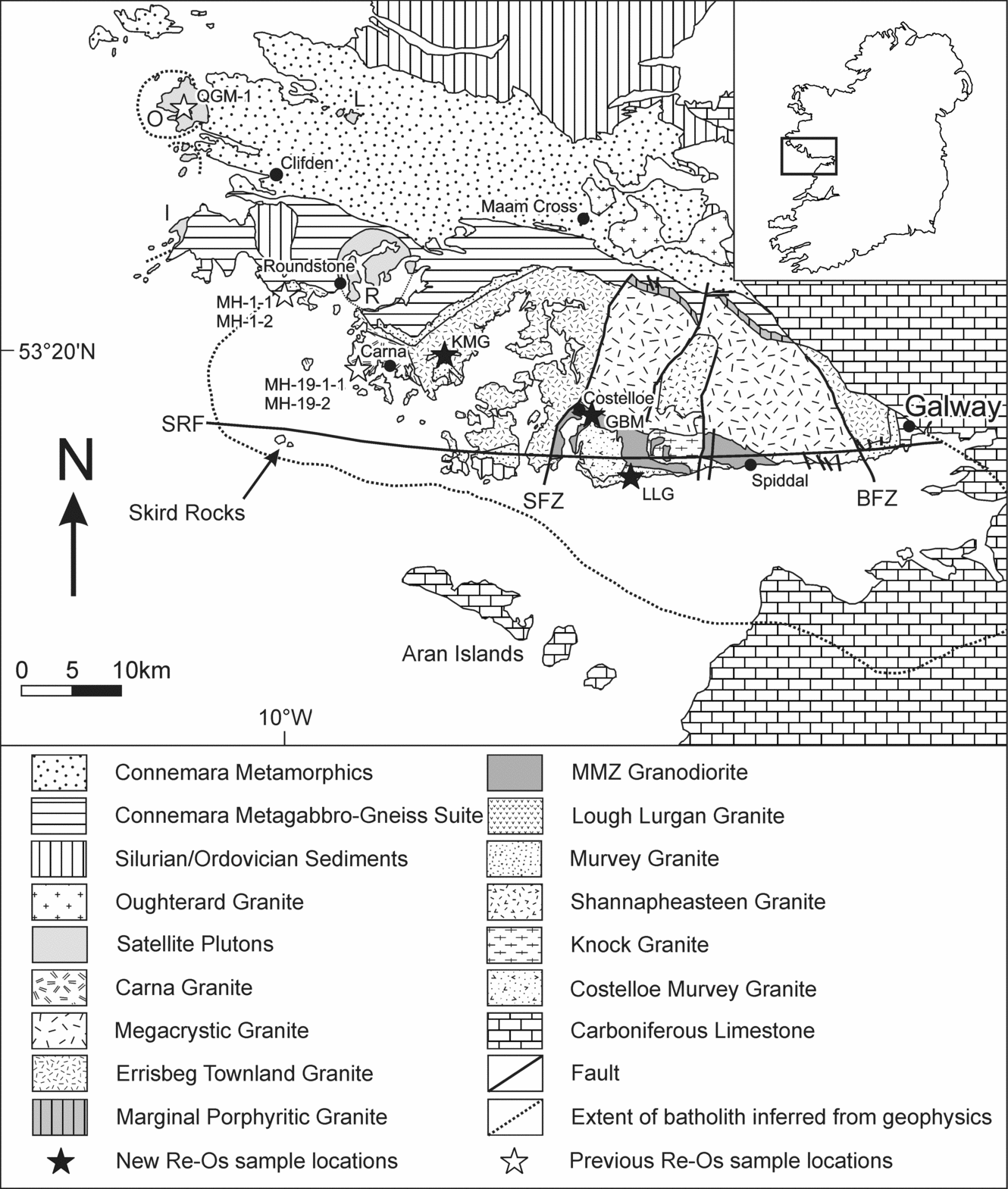
The late-Caledonian granites of south Connemara occupy a key location in the western Irish Caledonides. The granites comprise the Galway Granite and its satellite plutons Roundstone, Inish, Omey and Letterfrack (Fig. 1). The Galway Granite's 80 km long, WNW-trending axis reflects a stitching relationship between the granite and the EW-trending Skird Rocks Fault. This fault is a splay of the orogen-parallel Southern Uplands Fault and one of a number of major strike-slip faults that parallel the Iapetus suture in the British and Irish Caledonides (Leake, Reference Leake, Bowes and Leake1978; Dewey & Strachan, Reference Dewey and Strachan2003). The Skird Rocks Fault separates high-grade metamorphic rocks of the Connemara Massif from Lower Ordovician greenschist-facies metavolcanic and metasedimentary rocks (Fig. 1). Recent U–Pb zircon and Re–Os molybdenite geochronology from the Galway Granite provide constraints on the timing of final motion on the orogen-parallel strike-slip Southern Uplands–Skird Rocks Fault System to c. 410 Ma, in keeping with time constraints for final movement on the Great Glen Fault (Feely et al. Reference Feely, Coleman, Baxter and Miller2003; Selby, Creaser & Feely, Reference Selby, Creaser and Feely2004). Furthermore, Re–Os molybdenite age determinations from the Omey Granite showed that granite emplacement and molybdenite mineralization occurred at c. 422 Ma, pre-dating the emplacement of the main Galway Granite by c. 10 Ma (Feely et al. Reference Feely, Selby, Conliffe and Judge2007). Within this framework, however, the age of granite-related molybdenite mineralization only extends from c. 422 to c. 408 Ma. We present new Re–Os molybdenite ages from three new localities in the central sector of the main Galway Granite which demonstrate that the time span for molybdenite mineralization in Connemara must be significantly extended (c. 20 Ma), reflecting long-lived granite emplacement and granite-related molybdenite mineralization in Connemara.
Geological map of Galway Bay area. The Galway Granite's main varieties are shown: Carna, Errisbeg Townland, Megacrystic, Mingling Mixing Zone (MMZ) and Lough Lurgan and Murvey (including Roundstone and Kilkieran varieties) Granites are the earliest, followed by the Shannapheasteen, Knock and Costelloe Murvey granites. Satellite plutons are Letterfrack (L), Omey (O), Inish (I) and Roundstone (R) granites. The older (463 Ma: Friedrich et al. Reference Friedrich, Bowring, Martin and Hodges1999) Oughterard Granite of east Connemara is also shown. Geology adapted from Townend (Reference Townend1966), Leake & Tanner (Reference Leake and Tanner1994), Pracht et al. (Reference Pracht, Lees, Leake, Feely, Long, Morris and McConnell2004), Feely et al. (Reference Feely, Leake, Baxter, Hunt and Mohr2006) and Leake (Reference Leake2006). SFZ – Shannowona Fault Zone; BFZ – Barna Fault Zone; SRF – Skird Rocks Fault.
2. The Galway Granite
The late-Caledonian calc-alkaline Galway Granite was emplaced between c. 410 Ma and 380 Ma (Feely et al. Reference Feely, Coleman, Baxter and Miller2003; Selby, Creaser & Feely, Reference Selby, Creaser and Feely2004) into the 474.5 to 462.5 Ma Metagabbro–Gneiss Suite to the north (Leake, Reference Leake1989; Leake & Tanner, Reference Leake and Tanner1994; Friedrich et al. Reference Friedrich, Bowring, Martin and Hodges1999), and into Lower Ordovician greenschist-facies rocks (South Connemara Group) to the south (McKie & Burke, Reference McKie and Burke1955; Williams, Armstrong & Harper, Reference Williams, Armstrong and Harper1988; see Fig. 1). Gravity and aeromagnetic maps indicate that the Granite extends for several kilometres beneath the Carboniferous rocks of the Galway Bay area (Murphy, Reference Murphy1952; Max, Ryan & Inamdar, Reference Max, Ryan and Inamdar1983). Two major faults, the NNE-trending Shannawona Fault and the NW-trending Barna Fault, divide the Granite into three blocks: the western, central and eastern blocks (Fig. 1).
The western block comprises lithologies that range from granodiorite (Carna Granite) through granite (Errisbeg Townland Granite) to an alkali leucogranite (Murvey Granite). The two latter types also occur in the eastern block (Coats & Wilson, Reference Coats and Wilson1971).
The central block (the area between the Shannawona Fault and Barna Fault) exposes a significantly broader spectrum of lithologies ranging from quartz diorites through granodiorites and granites to alkali granite. A zone of magma mingling and mixing (MMZ) active during emplacement of the Galway Granite is bounded to the north by a concordant contact with the foliated Megacrystic Granite and intruded to the south by the transgressive Lough Lurgan Granite (El-Desouky, Feely & Mohr, Reference El-Desouky, Feely and Mohr1996).
The petrology, geochemistry and field relationships of the central block granites has been described in detail by the following: El-Desouky, Feely & Mohr (Reference Buchwaldt, Kroner, Toulkerides, Todt and Feely1996), Crowley & Feely (Reference Crowley and Feely1997), Baxter et al. (Reference Baxter, Graham, Feely, Reavy and Dewey2005), Feely et al. (Reference Feely, Leake, Baxter, Hunt and Mohr2006) and Leake (Reference Leake2006). These studies present unequivocal evidence for several phases of granite emplacement. Intergranite relationships indicate that the Megacrystic Granite was emplaced first along with the MMZ Granodiorite and its enclaves of coeval diorite magma. These fabrics within the Megacrystic Granite and MMZ Granodiorite are suggested to relate to successive emplacement of magma batches (e.g. Megacrystic Granite and MMZ Granodiorite and Lough Lurgan Granite: Baxter et al. Reference Baxter, Graham, Feely, Reavy and Dewey2005). In addition, detailed mapping of the central and northern parts this block suggest that emplacement was incremental by progressive northward marginal dyke injection and stoping of the country rocks (Leake, Reference Leake2006). These granites were intruded by the Shannapheasteen, Knock and Costelloe Murvey granites (Crowley & Feely, Reference Crowley and Feely1997; Feely et al. Reference Feely, Leake, Baxter, Hunt and Mohr2006; Leake, Reference Leake2006).
3. Granite-related molybdenite mineralization, south Connemara
Disseminated and quartz vein-hosted molybdenite mineralization occurs throughout the late-Caledonian Galway Granite and its satellite plutons (O'Raghallaigh et al. Reference O'Raghallaigh, Feely, McArdle, MacDermot, Geoghegan and Keary1997). Notable occurrences are at the western end of the Galway Granite, that is, at Mace Head and Murvey (Derham, Reference Derham, Andrews, Crowe, Finlay, Pennell and Pyne1986; Derham & Feely, Reference Derham and Feely1988; Max & Talbot, Reference Max, Talbot, Andrews, Crowe, Finlay, Pennell and Pyne1986; Gallagher et al. Reference Gallagher, Feely, Hoegelsberger, Jenkin and Fallick1992; Fig. 1). Molybdenite-bearing quartz veins (~ 5–30 cm thick) at Mace Head trend NE–SW, their orientation controlled by early jointing in the host granite (Derham, Reference Derham, Andrews, Crowe, Finlay, Pennell and Pyne1986; Max & Talbot, Reference Max, Talbot, Andrews, Crowe, Finlay, Pennell and Pyne1986). Vein minerals also include chalcopyrite, pyrite, magnetite and muscovite. The Roundstone Murvey Granite contains both fine-grained (~ 5 mm) disseminated and quartz vein hosted molybdenite. There is an estimated 240 000 t at 0.13 % Mo in this low-grade deposit (Max & Talbot, Reference Max, Talbot, Andrews, Crowe, Finlay, Pennell and Pyne1986). In the Omey granite, disseminated molybdenite (2–4 mm) and rosettes (~ 5 mm across) are hosted by thin, discontinuous quartz veins (< 5 cm across) that trend NE–SW across the central sector of the pluton (Feely et al. Reference Feely, Selby, Conliffe and Judge2007). The quartz veins typically contain muscovite-bearing alteration selvages similar to that encountered in Carna Granite (at Mace Head) and Roundstone Murvey Granite molybdenite deposits (Gallagher et al. Reference Gallagher, Feely, Hoegelsberger, Jenkin and Fallick1992).
Geochemical, fluid inclusion and stable isotope (O, H, S and C) studies indicate that the molybdenite mineralization in the Carna Granite (at Mace Head) and Roundstone Murvey Granite was magmatic in origin (Gallagher et al. Reference Gallagher, Feely, Hoegelsberger, Jenkin and Fallick1992). O'Reilly et al. (Reference O'Reilly, Jenkin, Feely, Alderton and Fallick1997) concluded that a H2O–CO2–NaCl-bearing fluid of moderate salinity (4–10 eq. wt % NaCl) deposited late-magmatic molybdenite mineralized quartz veins. This fluid composition is similar to molybdenite-bearing vein quartz in the Omey Granite (Feely et al. Reference Feely, Selby, Conliffe and Judge2007).
Thermal Ionization Mass Spectrometry (TIMS)-based U–Pb zircon geochronology of the Galway Granite indicates that emplacement occurred over a period of at least 20 Ma from c. 400 to 380 Ma (Feely et al. Reference Feely, Coleman, Baxter and Miller2003). Molybdenite Re–Os ages for granite-related molybdenite mineralization (Omey Granite, Roundstone Murvey Granite and Carna Granite from Mace Head; Fig. 1) at the western end of the batholith extend the period of magmatic activity by c. 20 Ma from 423 to 380 Ma (Selby, Creaser & Feely, Reference Selby, Creaser and Feely2004; Feely et al. Reference Feely, Selby, Conliffe and Judge2007). This geochronology indicates granite emplacement spanned a period of c. 40 Ma. We present below three new Re–Os molybdenite ages that indicate a similar time span for molybdenite mineralization in south Connemara.
4. Sampling and analytical methods
Molybdenite Re–Os geochronology was carried out on aliquants of mineral separates of disseminated molybdenite from the Kilkieran Murvey Granite (sample KMG), the Lough Lurgan Granite (sample LLG) and quartz vein hosted molybdenite from the MMZ Granodiorite (sample GBM; Fig. 1). These samples were collected following the results of Re–Os molybdenite geochronology of the Omey Granite, which showed that the initiation of granite magma emplacement in south Connemara was much earlier (c. 12 Ma) than previously thought (Feely et al. Reference Feely, Selby, Conliffe and Judge2007). The geology of the three samples analysed for Re–Os geochronology is described below.
Sample KMG. Disseminated molybdenite and chalcopyrite mineralization occurs in the Kilkieran Murvey Granite, which is similar to the Roundstone Murvey Granite (Wright, Reference Wright1964). Mineralization extends over an area of about four square kilometres to the NW of the village of Kilkieran. The leucocratic granite has a grainsize of < 5 mm and contains quartz (~ 35 %), K-feldspar (~ 35 %), plagioclase (~ 25 %) and biotite (~ 5 %). The disseminated flakes of molybdenite are generally < 2 mm. The sample was collected in a disused roadside quarry between the water treatment station and Kilkieran village (GR L835,322).
Sample GBM. The molybdenite mineralization occurs along a prominent road-cutting 0.5 km S of Costelloe village (GR L968,274). Sample GBM is from a NE striking vertical 2 cm thick quartz vein within the road section containing abundant molybdenite and chalcopyrite (< 3 mm grain size). The quartz vein can be traced along strike for ~ 5 m and cross-cuts the coarse grained (5–10 mm) MMZ Granodiorite.
Sample LLG. Fine disseminations of molybdenite (< 2 mm) occur in the Lough Lurgan Granite 200 m SW of the contact with the Costelloe Murvey Granite (GR M008, 216). The host Lough Lurgan Granite is a greyish pink granite of 1 to 7 mm grainsize (El Desouky, Feely & Mohr, Reference El-Desouky, Feely and Mohr1996).
The molybdenite samples were analysed for their Re and 187Os abundances by Isotope Dilution Negative Thermal Ionization Mass Spectrometry (ID-NTIMS) at the Northern Centre for Isotopic and Elemental Tracing facility at Durham University. Detailed sample preparation and analytical protocols are given by Selby & Creaser (Reference Selby and Creaser2001), Selby & Creaser (Reference Selby and Creaser2004) and Selby et al. (Reference Selby, Creaser, Stein, Markey and Hannah2007). In brief, molybdenite was isolated from the host rock or quartz vein using traditional mineral separation techniques (crushing, Frantz magnetic separation, heavy liquids (MI and LST), and water flotation). An aliquant of the molybdenite separate was digested in a 3:1 mix of HNO3: HCl (inverse aqua regia) with an known amount of mixed isotope tracer (185Re and normal Os) in a carius tube at 220 °C for 24 hours. Osmium was purified from the acid mix using solvent extraction (CHCl3) and micro-distillation methods. Rhenium was purified using anion column chromatography. The purified Os and Re were loaded to Pt and Ni filaments, respectively. The isotope ratios were measured using NTIMS on a Thermo Electron TRITON thermal ionization mass spectrometer using Faraday collectors. Although insignificant to the Re and Os abundance in the three molybdenite samples analysed in this study, all Re and Os data were blank corrected. All three molybdenite samples were analysed at the same time. The full procedural blank during for Re and Os is 2 picograms (pg) and 0.5 pg, respectively, with an 187Os/188Os blank composition of 0.17 ± 0.02 (n = 1). The determined Re and 187Os abundances together with the 187Re decay constant (1.666 × 10⁻¹¹a−1; Smoliar, Walker & Morgan, Reference Smoliar, Walker and Morgan1996) are used to calculate Re–Os molybdenite model dates. As a check on analytical accuracy and reproducibility, an in-house and inter-laboratory ‘control’ Chinese molybdenite powder was also analysed during the period of this study (HLP-5; Stein, Markey & Morgan, Reference Stein, Markey and Morgan1997). This molybdenite control sample yields an average Re–Os age of 219.9 ± 0.7 Ma (0.32 % 2σ, n = 3). This age is within the uncertainty reported by Markey, Stein & Morgan (Reference Markey, Stein and Morgan1998; 221.0 ± 2 Ma, 0.8 % 2σ, n = 19) and Selby & Creaser (2004; 220.5 ± 0.2, 0.11 % 2σ, n = 17).
5. Results
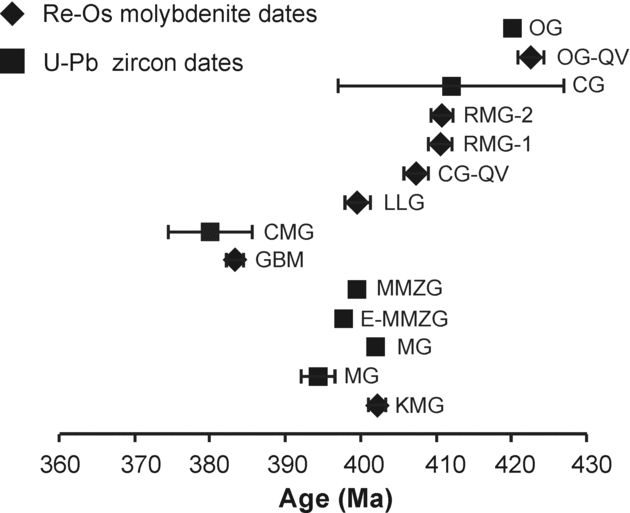
The Re–Os molybdenite data, with uncertainties at the 2σ level, for the three samples are reported in Table 1. This table also presents the previously reported Re–Os molybdenite data for samples from Omey Granite, Roundstone Murvey Granite and Carna Granite (Selby, Creaser & Feely, Reference Selby, Creaser and Feely2004; Feely et al. Reference Feely, Selby, Conliffe and Judge2007). Molybdenite from the six granite samples shows significant differences in Re and 187Os abundance (Table 1). The lowest Re and 187Os abundances occur in samples LLG (Re = 0.531 ± 0.001 ppm and 187Os = 2.230 ± 0.003 ppb) and GBM (Re = 3.16 ± 0.01 ppm and 187Os = 12.73 ± 0.02 ppb). Relatively low abundances also occur in the Roundstone Murvey Granite sample (MH-1-1 Re = 5.14± 0.01 ppm and 187Os = 22.16 ± 0.04 ppb). The Omey granite sample QGM-1 contains the highest abundance of Re (150.46 ± 0.55 ppm) and 187Os (667.9 ± 2.1 ppb). The samples from the Carna Granite (MH-19–1-1) and Kilkieran Murvey Granite (KMG) are also relatively enriched in Re (~ 76 and 54 ppm) and 187Os (~ 325, 229), respectively. The 187Re and 187Os molybdenite data for the samples investigated in this study (KMG, GBM, LLG) yield Re–Os model dates of 402.2 ± 1.1, 383.3 ± 1.1 and 399.5 ± 1.7 Ma, respectively (Table 1). Table 2 and Figure 2 present all the Re–Os molybdenite and U–Pb zircon dates for the Connemara region. Figure 2 highlights the close agreement between the zircon and molybdenite dates across the region.
Re and Os abundances and model ages for molybdenite, late Caledonian Connemara granites, Ireland
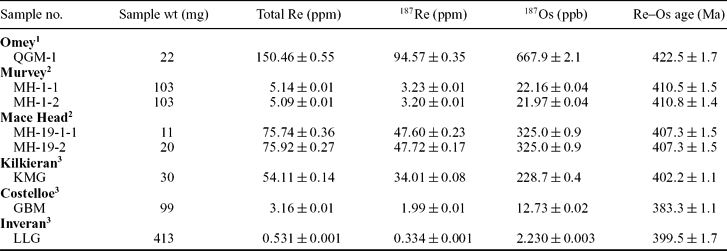
Data sources: 1Feely et al. (Reference Feely, Selby, Conliffe and Judge2007); 2Selby et al. (Reference Selby, Creaser and Feely2004); 3this study
Tabulation of age determinations presented in the text
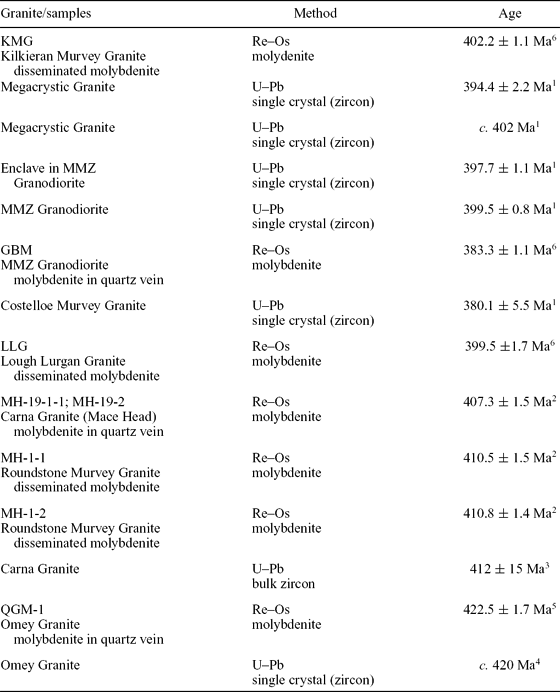
Sources: 1Feely et al. (Reference Feely, Coleman, Baxter and Miller2003); 2Selby et al. (Reference Selby, Creaser and Feely2004); 3Pidgeon (Reference Pidgeon1969); 4Buchwaldt et al. (Reference Buchwaldt, Kroner, Toulkerides, Todt and Feely2001); 5Feely et al. (Reference Feely, Selby, Conliffe and Judge2007); 6this study.
Comparative plot of Re–Os molybdenite and U–Pb zircon data for the Connemara Granites using data in Table 2. KMG – Kilkieran Murvey Granite; MG – Megacrystic Granite; E-MMZG – enclave in MMZ Granodiorite; MMZG – MMZ Granodiorite; GBM – Molybdenite-bearing quartz vein in MMZ Granodiorite; CMG – Costelloe Murvey Granite; LLG – Lough Lurgan Granite; CGQV – Molybdenite-bearing quartz vein in Carna Granite; RMG-1 and RMG-2 – Roundstone Murvey Granite; CG – Carna Granite; OG-QV – Molybdenite-bearing quartz vein in Omey Granite; OG – Omey Granite.
6. Discussion
The new and existing Re–Os isotopic data for the south Connemara granites show that episodic granite-related molybdenite mineralization extended over a period of c. 40 Ma, that is, from c. 423 Ma in the NW Omey pluton to c. 383 Ma at Costelloe in the east. While the Re–Os age determinations for sample KMG and LLG are consistent with predictions from field relationships, sample GBM yields the youngest Re–Os age so far determined for the Galway Granite. The quartz vein cuts the MMZ Granodiorite, which is c. 400 Ma based upon TIMS single zircon U–Pb age determinations (Feely et al. Reference Feely, Coleman, Baxter and Miller2003). The gap of c. 17 Ma between granite zircon crystallization and deposition of molybdenite can be explained by relating the mineralization to the final stages of magmatic activity in the Galway Granite, in particular the c. 380 Ma Costelloe Murvey Granite (Feely et al. Reference Feely, Coleman, Baxter and Miller2003), which is located < 1 km to the south of the sample location.
Buchwaldt et al. (Reference Buchwaldt, Kroner, Todt, Feely and Toulkerides1998, Reference Buchwaldt, Kroner, Toulkerides, Todt and Feely2001) reported U–Pb and Pb–Pb zircon ages (single grain evaporation) that yielded a c. 420 Ma age for the Omey Granite and a c. 400 to 380 Ma range for emplacement of the Galway Granite. More recent U–Pb zircon age determinations for the Galway Granite, using TIMS (Feely et al. Reference Feely, Coleman, Baxter and Miller2003), support the findings of Buchwaldt et al. (Reference Buchwaldt, Kroner, Todt, Feely and Toulkerides1998, Reference Buchwaldt, Kroner, Toulkerides, Todt and Feely2001). However, Re–Os age determinations for molybdenite at the western end of the Galway Granite yield ages from c. 410 Ma at Murvey, to c. 407 Ma at Mace Head. A bulk zircon age determination (Pidgeon, Reference Pidgeon1969) for the Carna Granite, which hosts the molybdenite at Mace Head, yielded an age of 412 ± 15 Ma. Combining (a) the three new molybdenite ages reported here with those of Selby, Creaser & Feely (Reference Selby, Creaser and Feely2004) and Feely et al. (Reference Feely, Selby, Conliffe and Judge2007) and (b) the zircon ages of Pidgeon, (Reference Pidgeon1969), Buchwaldt et al. (Reference Buchwaldt, Kroner, Todt, Feely and Toulkerides1998, Reference Buchwaldt, Kroner, Toulkerides, Todt and Feely2001) and Feely et al. (Reference Feely, Coleman, Baxter and Miller2003) shows that Connemara granite emplacement and related molybdenite mineralization extended from c. 423 Ma to 380 Ma.
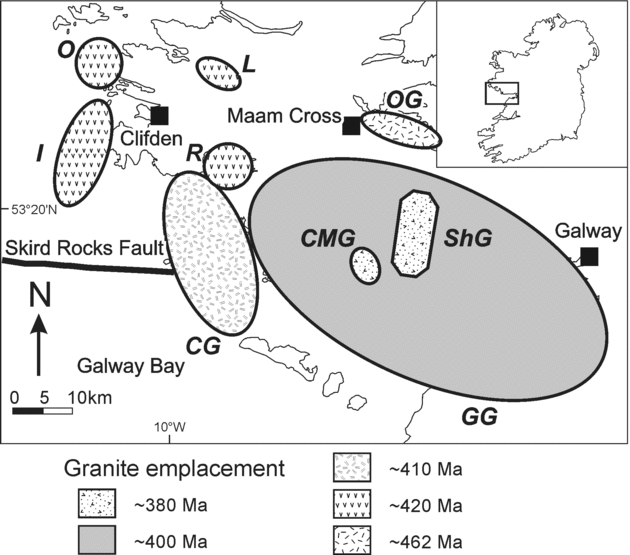
The spatial distribution of the U–Pb and Re–Os ages indicates that the emplacement of individual plutons and the deposition of granite-related molybdenite commenced in the NW of Connemara with the Omey Granite probably accompanied by the other satellite plutons, that is, the Inish, Letterfrack and Roundstone plutons. The granite-related molybdenite Re–Os ages for the western end of the Galway Granite gave a minimum age for Carna Granite emplacement of 407 Ma, post-dating the emplacement of the Roundstone Murvey Granite at 410 Ma, in keeping with field relationships mapped by Leake (Reference Leake1974). Further east, the U–Pb and Re–Os ages indicate granite emplacement and molybdenite mineralization took place at c. 400 Ma and c. 380 Ma (Fig. 3).
Schematic diagram showing the spatial and temporal distribution of Connemara's late-Caledonian granites. O – Omey Granite; L – Letterfrack Granite; I – Inish Granite; R – Roundstone Granite; CG – Carna Granite + Roundstone Murvey Granite; GG – Main Galway Granite (Megacrystic Granite, Errisbeg Townland Granite, MMZ Granodiorite, Lough Lurgan Granite and Kilkieran Murvey Granite); ShG – Shannapheasteen Granite and CMG – Costelloe Murvey Granite. OG is the Oughterard Granite.
The prolonged and episodic emplacement of the south Connemara Granites, from c. 423 to 380 Ma, is similar to the span of emplacement ages recorded from other sectors of the Appalachian–Caledonian orogeny (Fig. 4). The emplacement of post-collisional granites is commonly associated with major crustal lineaments, such as the Skirds Rock Fault in south Connemara, and numerous authors have proposed a genetic relationship between tectonics and magmatism (Watson, Reference Watson1984; Jacques & Reavy Reference Jacques and Reavy1994; Neilson, Kokelaar & Crowley, Reference Neilsen, Kokelaar and Crowley2009). However, it is unlikely that granite magmatism is related to a single tectonic event with a duration of c. 50 Ma, and a number of tectonic models have been proposed to account for the variety of granite magmatism observed across the Appalachian–Caledonian orogeny. In light of the geochronological data presented above, the granites of South Connemara can now be placed within this tectonic framework.
Range of emplacement ages for post-collisional granites in the Appalachian–Caledonian orogeny. 1 – Neilson, Kokelaar & Crowley (Reference Neilsen, Kokelaar and Crowley2009); 2 – Conliffe et al. (Reference Conliffe, Selby, Porter and Feely2010); 3 – Porter & Selby (Reference Porter and Selby2010); 4 – Condon et al. (Reference Condon, Bowring, Pitcher and Hutton2004); 5 – this study; 6 – Kerr (Reference Kerr1997); 7 – Whalen et al. (Reference Whalen, McNicoll, Van Staal, Lissenberg, Longstaffe, Jenner and Van Breeman2006); 8 – Lynch et al. (Reference Lynch, Selby, Feely and Wilton2009); 9 – Bradley et al. (Reference Bradley, Tucker, Lux, Harris and McGregor2000).
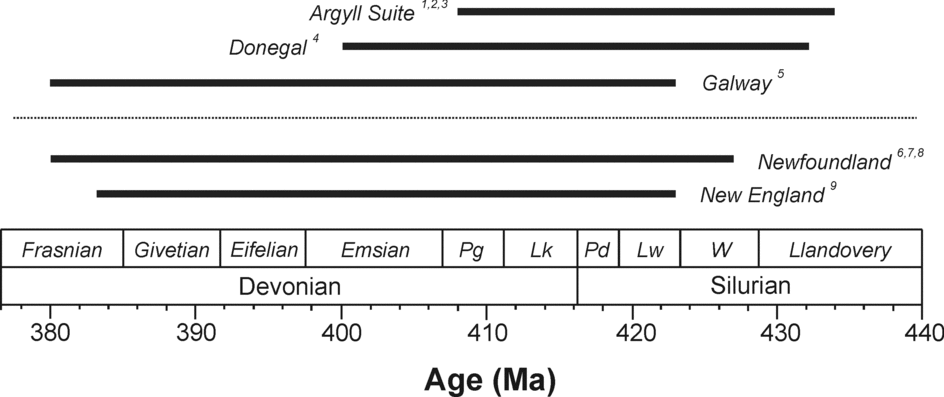
Atherton & Ghani (Reference Atherton and Ghani2002) proposed a slab break-off model to account for the onset of ‘syn-collisional magmatism’ in the Scottish Highlands, whereby the detachment of the subducted Iapetus lithospheric slab followed the collision of Laurentia with Baltica, allowing the ascent of the ‘dry’ hot asthenospheric material which impacted against the lithospheric mantle. Similarly, Whalen et al. (Reference Whalen, McNicoll, Van Staal, Lissenberg, Longstaffe, Jenner and Van Breeman2006) argued that the onset of granite magmatism in Newfoundland was related to slab break-off. Initial granite emplacement in south Connemara is broadly synchronous with other sectors of the Appalachian–Caledonian orogeny, for example, Donegal (c. 428 Ma; Condon et al. Reference Condon, Bowring, Pitcher and Hutton2004), Argyll Suite (c. 434 Ma; Conliffe et al. Reference Conliffe, Selby, Porter and Feely2010), Newfoundland (c. 432 Ma; Whalen et al. Reference Whalen, McNicoll, Van Staal, Lissenberg, Longstaffe, Jenner and Van Breeman2006); New England (c. 423 Ma; Bradley et al. Reference Bradley, Tucker, Lux, Harris and McGregor2000). This suggests that slab break-off may also be responsible for early granite magmatism in south Connemara, and was relatively synchronous across the Appalachian–Caledonian orogeny.
Neilson, Kokelaar & Crowley (Reference Neilsen, Kokelaar and Crowley2009) showed that asthenospheric flow, providing mantle-derived (appinite–lamprophyre) magmas in the Scottish Highlands, occurred for c. 22 Ma after slab break-off. These authors argued that heat and volatiles derived from this magma would be sufficient to generate the large volumes of intermediate-silicic magmas in the Argyll Suite Granites. Geochemical similarities between the main Galway Granites and the Argyll Suite Granites (Q. Crowley, unpub. Ph.D. thesis, Nat. Univ. Ireland, Galway, 1997) indicate a similar source of granite magmas, and therefore the emplacement of the main Galway Granite may be related to prolonged asthenospheric flow following slab break-off. The ascent of granite magma was facilitated by extensional fractures associated with a releasing bend on the sinistrally moving Skird Rocks Fault (Leake, Reference Leake2006). The final stages of magmatic activity in the Galway Granite (e.g. emplacement of the Costelloe Murvey Granite) may be associated with Devonian transtension, decompression and heating of enriched Avalonian sub-continental lithosphere (Brown et al. Reference Brown, Ryan, Soper and Woodcock2008).
7. Conclusions
This study reports three new Re–Os molybdenite ages from the Galway Granite. When these ages are combined with published Re–Os molybdenite ages (Selby, Creaser & Feely, Reference Buchwaldt, Kroner, Toulkerides, Todt and Feely2004 and Feely et al. Reference Feely, Selby, Conliffe and Judge2007) and the zircon ages of Pidgeon (Reference Pidgeon1969), Buchwaldt et al. (Reference Buchwaldt, Kroner, Todt, Feely and Toulkerides1998, Reference Buchwaldt, Kroner, Toulkerides, Todt and Feely2001) and Feely et al. (Reference Feely, Coleman, Baxter and Miller2003), they show that Connemara granite emplacement and related molybdenite mineralization extended from c. 423 Ma to 380 Ma. The spatial and temporal distribution of the granites shows that initial emplacement (c. 420 Ma) occurred in the NW of Connemara with later granites (c. 410 to 380 Ma) sited to the south and east, along the extension of the Southern Uplands Fault (the Skird Rocks Fault) in western Ireland. The prolonged nature of magmatism in south Connemara is comparable to other sectors of the Appalachian–Caledonian orogeny, and a number of tectonic processes (e.g. slab-breakoff, asthenospheric flow, transtension and decompression) may account for the duration and variety of granite magmatism in south Connemara.



