Introduction
This study offers a conceptual analysis of the social economy in China within the context of institutional transition. Although the term itself is quite new, the social economy is no new phenomenon in China. It is composed of social organizations (shehui zuzhi), co-operatives (hezuoshe) and mutual benefit societies, although the latter have very limited practice in China. China has a relatively long tradition of co-operatives, and they are continuously undergoing a process of revival. China's social organizations, referred to by Chinese academics as non-profit or non-governmental organizations (NPOs, NGOs), or the third sector,Footnote 1 have also developed quickly and aroused extensive attention over the past two decades. This revitalization and advancement of social economy organizations in China is due to the accelerated socio-economic development, the privatization of China's social welfare system, as well as the rise of civil society during the economic reform and transition period (after the late 1970s). Moreover, the development of the social economy in China has been greatly influenced by the framework set by political institutions and, accordingly, legal-enabling environments. Finally, the link to the West, as well as local historical and cultural traditions, also contribute to explaining its re-emergence.
Although still unknown terminology in China, the concept of the ‘social economy’ has been widely discussed worldwide and introduced into economic and social policies in countries in Western Europe, North America (especially in Canada and Quebec), Latin America and the Caribbean, Central and Eastern Europe (CEE) and the Commonwealth of Independent States (CIS), as well as Africa and Asia. Overall two evolutions have been witnessed. The first concerns a refashioning of the social economy in the developed countries, and the second refers to a re-emergence of social economy organizations in the developing and transitional economies. Also in China, various components of the social economy have become more and more prominent in socio-economic development. However, this revival and redesigning of the social economy in China have been generally neglected. The systematic study of the social economy development in present-day China, under transition from a central-planning to a socialist market economy, is insufficient. In other words, while the practice of the social economy has become vibrant and dynamic enough in China, its conceptualization remains underdeveloped.
In order to close this gap between practice and theory, this study attempts to understand the re-emergence and development of the social economy in China. The outlining of the past and the present leads to a consideration of the social economy as an important way to achieve a balanced economy and an inclusive society, together with the public sector and private for-profit sector. Through this analysis, this study aims to answer the following questions: How can we define the social economy in China? Under what contextual background have social economy organizations re-emerged in China? Which roles has the social economy played in China?
To throw light on these issues, this study presents a brief overview of the theoretical debates concerning the concept of social economy per se and other related concepts; the historical trajectory of the social economy in China; and a discussion on the existence of its social economy before the socio-economic transition, after which the impacts of the transition upon the renaissance of the social economy are examined. These various impacts shape the driving forces that favour development of the social economy in China. These driving forces provide a framework for understanding its present situation. The study also focuses on the social economy in its current context. Based on a literature review on the concept as discussed worldwide as well as the historical account and contextual background in China, a conceptualization of the social economy in China is firstly proposed. Afterwards, its legal-enabling environment is examined. Also, four broad categories of social economy organizations in China are delineated on the basis of their objectives and activities. This explains their roles and significance in a contemporary context.
The social economy: a conceptual synthesis
Concept and dimensions of a third sector
The term social economy in its modern sense has its roots in France in the early nineteenth century, but took on added significance worldwide throughout the twentieth century. Before the process of being institutionalized, various social economy initiatives arose under the influences of a number of visions, ideologies and inspirations. Some main influences and ideas that have fuelled a variety of experiments are ancient associationism, ideological pluralism (utopian socialism, social Christianism, the liberal movement), the influence of religion and of regional and national identity, as well as cultural entrenchment.Footnote 2 At the turn of the twentieth century, the term ‘social economy’ received full academic and institutional recognition, thanks to several pioneering thinkers such as Frédéric Le Play, Charles Gide, Léon Walras, and Max Weber, who began using the term Sozialökonomische Wissenschaft in 1904, and Émile Durkheim, who came upon the term following his stay in Germany.Footnote 3 Since the term originated in France, a great number of Francophone literature contributes to the pioneering conceptualization of the social economy.Footnote 4
However, it was not until the 1970s that a much more precise conception of the social economy as a third sector existing alongside the private for-profit sector and the public sector was rediscovered. Various initiatives in the field were reactions to the capitalist economic crisis and the overburdening welfare state. The renaissance of the social economy gives rise to an abundant literature which questions existing theoretical frameworks, particularly those from economics. The first step in reconstructing a theory of social economy organizations ‘was made possible by the development of new institutional economics and the transaction costs theory’.Footnote 5 Borzaga and Tortia examine in particular the Hansmann modelFootnote 6 which proves that the emergence of organizations other than for-profit enterprises is due to efficiency criteria. However, they also argue that the choice between different organizational forms is more complex than that which is granted by transaction costs theory. Social economy organizations exist because they seem able to mix goals and incentives, giving rise to a variety of organizational and governance forms.Footnote 7 These different incentive mixes would also be suitable for the pursuit of various organizations’ own specific goals.Footnote 8 Therefore, by giving importance to economic pluralism, the social economy sector challenges market fundamentalism, which is based on an incorrect understanding of economic theory and brings about the failure of the Washington Consensus policies.Footnote 9
Overall, one popular definition of the social economy can be defined as follows: it includes all economic activities conducted by enterprises, primarily co-operatives, associations and mutual benefit societies, whose ethics convey the following principles: (1) providing service to its members or to the community ahead of profit; (2) autonomous management; (3) a democratic decision-making process; (4) the primacy of people and work over capital in the distribution of revenues. The fact that the objective of the social economy is to provide services to its members or to a wider community, and not serve as a tool in the service of capital investment, is particularly important.Footnote 10 In one International Centre of Research and Information on the Public, Social and Cooperative Economy (CIRIEC) study on the social economy in the European Union, the social economy comprises two major sub-sectors: (a) the market or business sub-sector, and (b) the non-market producer sub-sector. The former sub-sector designates those microeconomic organizations that have the market as their main source of resources (most co-operatives, mutual societies and other not-for-profit companies), whereas the latter group refers to the other organizations deriving their monetary resources mainly from non-market sources such as donations, membership dues, property income or subsidies (most associations and foundations).Footnote 11 This classification is very useful for drawing up reliable statistics and analysing economic activities in national accounting terms. Nonetheless, from a socio-economic point of view there is obviously a permeability between the two sub-sectors and close ties between market and non-market in the social economy, as a result of the fundamental objective shared by all social economy organizations.Footnote 12
Other related concepts
In the academic arena around the world, the term third sector has become a meeting point for different concepts, fundamentally the NPO/NGO approach and the social economy.Footnote 13 Although the term third sector has mostly been used in Anglo-Saxon countries to describe the voluntary and non-profit nature of civil society organizations which are largely composed of voluntary associations and foundations and which exclude economic objectives in the third sector,Footnote 14 it is used in many cases in continental Europe and in other parts of the world as a synonym for the social economy.Footnote 15
When comparing the social economy and the NPO/NGO approach, there are various reasons leading some researchers to be more inclined to accept the former. One such explanation is that social economy is an appropriate term, for it is more comprehensive (it includes co-operatives) and underlines the productive aspect (it includes the term ‘economy’).Footnote 16 Moreover, nowadays it is widely argued that the surplus non-distribution principle cannot serve as a line of demarcation between for-profits and non-profits anymore.Footnote 17 Finally, two other main reasons justifying the scholars’ preference for the social economy perspective have been identified.Footnote 18 Firstly, the social economy approach more accurately reflects the socio-political dimension of the organizations involved, and the closeness of the ties that they maintain with a wider movement or project. And the second explanation concerns the soundness and pragmatism of the social economy perspective and the increasing recognition it gains from national and supranational authorities such as the European Union and the International Labour Organization.
About two or three decades ago, however, a new term, social enterprise, became the subject of fast-growing interest.Footnote 19 Generally speaking, there exist two basic perspectives on social enterprise. Following the European tradition, the concept of social enterprise ‘made its first appearance. . .at the very heart of the third sector, following an impetus that was first Italian, linked closely with the co-operative movement’.Footnote 20 Borzaga and Sanuari provide a pertinent explanation that its growth was linked to inadequate public service provision.Footnote 21 According to the approach of EMES European Research Network,Footnote 22 they have economic and entrepreneurial dimensions on the one hand and social dimensions on the other hand. The latter idea is deeply rooted in the European historical-contextual tradition. Another major perspective on social enterprises concerns the Anglo-Saxon ‘earned income’ approach, in which the economic activity is mostly regarded simply as a source of financial income for non-profit organizations delivering social services, and the nature of the traded goods or services does not necessarily matter.Footnote 23 In comparing the European rationale for social enterprise with that of America, Defourny and Nyssens provide at least three points of difference between these two approaches.Footnote 24 First, the multidimensional character of the governance of social enterprises in Europe is far richer than the sole non-distribution constraint rooted in the American tradition, and hence the involvement of stakeholders tends to be common in Europe and limited in America. Second, the economic dimension of social enterprises in Europe does not necessarily refer to the growing importance of a trading activity which is emphasized in America, but can have a hybrid character. And thirdly, the nature of the continuous activity of social enterprises should be connected to the social mission based on the European concept, but its nature does not necessarily matter in America. At the same time, Kerlin concludes that ‘many of the areas where the US has difficulty with social enterprises, Europe shows strengths, and vice versa, making it possible for the two to learn a number of valuable lessons from one another’.Footnote 25
A social enterprise is, therefore, regarded as an operator and a key stakeholder in the social economy whose main objective is to have a social impact rather than to make a profit for their owners or shareholders.Footnote 26 In China, since the concept ‘social enterprise’ was first introduced in 2004, it aroused more and more academic interest by Chinese social scientists (mostly with non-profit training backgrounds) and several organizations. As a result, ‘social enterprise’ has become a hot expression in China whereas ‘social economy’ is almost unknown. In fact, since social enterprises belong to an important part of the social economy, in a normative sense, they share a number of core values that make them both important in economic and social life. This importance of both concepts is increasingly acknowledged from various points of view.Footnote 27 Both have come to be widely accepted at an institutional level. Moreover, there is also a similarity between the two in a legal and institutional sense: inside each category, there exists actually no general demarcation between various partners. As Borzaga and Mittone show, various new hybrid organizational forms labelled as ‘social enterprises’ are the outcome of a mix of associative (voluntary sector) and co-operative models.Footnote 28 The approach of EMES European Research Network puts the social enterprise position ‘at the crossroads of the co-operative and the non-profit sector’. Mentioning the ‘social economy’, Defourny and Develtere stress that ‘the lines of demarcation separating its three components are neither sharp nor immovable, especially in countries where such distinctions are not legally recognized’.Footnote 29 Chaves and Monzón share the same vision by proposing the existence of a permeability between the market and non-market sub-sectors in the social economy and close ties between the two, as already mentioned.Footnote 30 With regard to China, it would be reasonable to say that present-day China is more characterized by an emphasis of economic freedom and a discovery of entrepreneurship than by a quest for democracy. And it would be due to this fact that the concept of social enterprise has become so dominant as compared with that of social economy.Footnote 31 Therefore, it is important to understand the concept of social economy, given the unbalanced knowledge on the two concepts. In what follows I will list two further reasons justifying the significance of the topic discussed in this study.
The first reason, in explaining the meaningfulness of conceptualizing the social economy in China, has to do with the concepts’ discussion background in China, which lacks a general understanding of both concepts. The term ‘social organization’ (shehui zuzhi) is the only officially recognized concept, comprising mainly social associations (shehui tuanti), private non-enterprise units (minban feiqiye danwei) and foundations (jijinhui). The concept ‘third sector’ and ‘NPO/NGO’ are the most common terms discussed by scholars. It was not until recently that the Chinese government started to use the term ‘NPO’. Besides the three types of ‘social organizations’, the public institution (shiye danwei), a quasi-government agency generally shaped by the government and staffed with government employees, is also considered as one type of NPO in China.Footnote 32 With regard to ‘social economy’ and ‘social enterprise’, there was a lack of prominence. The current discourse in China is much closer to the non-profit sector approach in the West. Co-operatives are generally excluded from this discussion. The peculiar historical development of the co-operatives in China and the significant influence of America and Britain in the development and discussion of NPOs and NGOs in China, may explain this exclusion. Both being new to China, why does ‘social economy’ seem more appropriate to understanding the Chinese present-day third sector situation?
As already mentioned, there is no agreed definition of social enterprise. This is well known among social scientists with non-profit training backgrounds, and research into social enterprise in China is emerging.Footnote 33 Some organizations also make lots of effort to promote social enterprise and social entrepreneurship in China (such as the British Council in China, or the China Social Entrepreneur Foundation). Generally speaking, the social enterprise approach seems to be considered as an important direction for NPO and NGO development in China. On the one hand, the introduction to social enterprise development worldwide tends to focus more on NPOs in Anglo-Saxon countries, the discussion on social entrepreneurship in China is highly related to the social innovation approach rooted in America and Britain, and some directors of NGOs and NPOs are therefore called ‘social entrepreneurs’ (seen as social ‘heroes’) who drive the social innovation in China. On the other hand, co-operative enterprises are not necessarily regarded as an integral part of NPOs. These and co-operatives appear to belong to two different schools of thought in China. Based upon the three models of social enterprise identified by Cafaggi and Iamiceli, it is observed that in most cases, the ‘NGO/NPO model’ and the ‘company model’ have dominated the discourse of social enterprises in China, whilst the ‘co-operative model’ tends to be neglected in the discussion.Footnote 34 In this case, ‘social enterprise’ discussion per se might not help in integrating two schools of thought into creating an area with common ground and shared values. In contrast, ‘social economy’, with its specific legal framework (including associations as well as co-operative enterprises and mutual benefit societies), appears to have its advantage in helping advance one's knowledge in understanding the third sector in China which exists alongside the private for-profit sector and the public sector.
The second explanation contributing to my focus on the term ‘social economy’ is due to the fact that compared with ‘social enterprise’, it reflects more accurately the socio-political dimension of both social organizations and co-operatives in China. As Develtere shows, in both the north and the south, organizations of the social economy not only provide a framework for voluntary participation, but generally also convey a normative vision on society and provide an organizational instrument for carrying out a societal project.Footnote 35 Historically, social movements and co-operative movements in China have always risen and fallen with the turns of the economic and political cycles. The rich historical tradition of various movements should nevertheless be taken into account when trying to understand the current situation of social organizations and co-operatives (and other various organizations concerned) in China. Obviously, ‘social enterprise’, through highlighting entrepreneurial dynamics within the sector, has its limitations in demonstrating this socio-political dimension directly and therefore does not share a close tie with wider collective social movements inside China.
The social economy in China in transition
The social economy before the transition in China
In China, as in the West, numerous grassroots co-operative and mutual-aid initiatives emerged long before they received legal recognition. In Early Imperial China (during the Qin and Han Dynasties, 221 BC–AD 220), private associations (Si She) emerged in response to popular demands for mutual help. This support could be related to production and daily lives or communal worship and sacrificial rituals. Some mutual aid societies and associations helped their members with funeral arrangements, or were operated in the community in order to ensure that they had enough money to carry out sacrificial rituals to worship the God of Land.Footnote 36 This role played by primitive religions and the practice of communal worship is regarded as an important factor that helped form the very first associations in ancient China. Later on, people started raising funds to help those facing difficulties. Along with the development of social and economic life, nature worship and rituals began gradually to take on more social functions.
The first handicraft and commercial organizations emerged during the Tang dynasty (particularly in the eighth and ninth centuries), and flourished in the Song dynasty (tenth to thirteenth centuries). Somewhat like guilds in the West, they were created to coordinate the internal relations and to deal with government bureaucrats. In addition, charitable organizations also took root in China, with the introduction of Buddhism (Tang dynasty), the development of Confucianism (Early Song), as well as the emergence of industrial and commercial culture (Late Song to Early Qing).Footnote 37 Moreover, other civil society organizations in the Western sense also arose in China and appeared in township life in the Tang and Song dynasties, such as book clubs, folk art venues and theatres, literary circles, tea houses and kinship clubs.
With the process of great transformation in Late Imperial China (Late Qing and the Republic), various social economy organizations became further expanded and institutionalized. There existed both old forms of the social economy inherited from before, and new types of it generated in the process of modem societal integration and state-making.Footnote 38 During the past two decades, a number of studies have been dedicated to understanding the existence of a civil society/third sector/third realm/public sphere in Late Imperial China.Footnote 39
Around the beginning of the twentieth century, when the term ‘social economy’ was receiving full academic and institutional recognition in the West, some pioneering Chinese scholars began to open up to western economic ideas. Among them, Yan Fu (1853–1921), Kang Youwei (1858–1927) and Liang Qichao (1873–1929), were mostly prominent in transmitting and interpreting Western economics.Footnote 40 In the 1920s, Sun Zhongshan (Sun Yat-sen), the leader of the national revolution in China, proposed a collectivist and quasi-socialist thought that prevailed in the policy ideas of the time. At the same time, some reformers and philanthropists started to introduce the Western co-operative system into China. Most of them came back from the West after searching for a way to help the poor and save the nation.Footnote 41 The church-sponsored China International Famine Relief Commission (founded in 1921) established the first credit societies in China in 1923, promoting the Raiffeisen system and principles with the purpose of lessening the aftermath of drought and famine. Those reformers regarded the co-operative economy as the best form for improving agricultural marketing and rural handicrafts. Though limited in area, these co-operatives represented a general attempt to bring about a new economic order.Footnote 42 In addition, private organizations associated with foreign private forces were also witnessed, such as the Young Men's Christian Association (YMCA), the Red Cross, the Rockefeller Foundation, and thousands of missionary schools and hospitals.Footnote 43 During the 1930s and 1940s, political motives were injected into the promotion of co-operatives. Those private co-operative initiatives were outstripped by government intervention. Co-operative ideas generally became the national government's tool of policy and control. Still, some practices of establishing co-operatives and credit societies were driven by the forces of nationalism and a quest for a ‘third way’, the rural re-construction movement being the most prominent example. According to Hsu, ‘rural reconstruction in China, as a social movement. . .presupposes that if China is to survive, it must modernize its social organization and vastly increase its working efficiency’.Footnote 44 At the same time, following the ideological belief of the Chinese Communist Party (CCP) in adapting Marxist ideas to Chinese realities, Mao Zedong (Mao Tse-tung), the leader in the Communist-led areas of China, gradually adopted the principle of co-operative production, and a co-operative economy in these areas was established. Actually Marxist ideas did not serve as prominent elements in the pre-1949 Chinese economic system.
After the founding of New China, the communists’ ideology won the final victory in the ideological struggle. According to Trescott,
Much of the popularity of the Communists in China by 1949 arose from their patriotic heroism in the war against Japan. They had also gained a reputation for honesty and competence in administering the areas which came under their control. But there was also an important economic element in the appeal of Chinese Communism—the prospect of a better life for the poor, especially the farmers.Footnote 45
Afterwards, co-operative and social movements in China have always risen and fallen with the turns of economic and political cycles. During the period of centrally planned economy in China, People's Communes were established in 1958 and made compulsory under government command. Their development restricted the growth of a genuine co-operative movement. Also various social organizations were either suppressed or nationalized. During the most radical ten years of the Cultural Revolution between 1966 and 1976, activities concerning private organizations were virtually non-existent. The CCP's efforts to control all aspects of life in China ‘came to a calamitous end’.Footnote 46
The re-emergence of the social economy in China
After reform and the ‘opening-up’ of the late 1970s, new waves of social and co-operative movements have been witnessed in China. With growing economic and social freedom, there has been a revival of traditional private institutions and co-operative organizations as well as a rise in new forms of social organizations and co-operatives. However, this social economy development has not proceeded without setbacks. It has been greatly influenced by different stages of economic reform and transition, and by the framework set by political institutions and policy change accordingly. Therefore, it can be said that economic transition and development explain to a great extent the importance of institutional contexts in which the social economy in China re-emerges. Generally speaking, the upsurge of the social economy in China has experienced three main periods.
The first period happened along with the beginning of the transition (1978 to circa mid-1990s). This was a period that favoured the re-emergence of the social economy in China. In rural areas, in the 1980s, with the shift to the household contract responsibility systemFootnote 47 and the dismantling of the commune system,Footnote 48 a new shareholding co-operative system emerged through a bottom-up route creating a new ownership form, which aims to achieve ‘an alliance between capital and labour’, as well as co-operation between local governments, collective enterprises, and community residents. This hybrid form has been invented by rural people in an attempt to break the bottleneck, which prevented the development of a private and co-operative economy.Footnote 49 The shareholding co-operative system experienced rapid development and contributed significantly to the development of rural industry in China. Most rural industries were officially called township and village enterprises (previously commune and brigade enterprises) by 1984. These grew rapidly in the mid-1980s to fill niches of market demand unmet by the state sector. Most of them played significant roles in providing employment for a rural surplus labour force,Footnote 50 in increasing farmers’ income through non-agricultural production, and in lessening social tensions. However, during the process of rapid rural industrialization, township and village enterprises have also faced two conflicting objectives, namely, being market-oriented by way of profit maximization, and being community-oriented through promoting job creation and local development. In this context, various experiments in the reform of property rights and management systems in the township and village enterprises have also been carried out under the shareholding co-operative system.Footnote 51 Moreover, as farmers became responsible for their own purchasing and marketing decisions, they gradually established for themselves various farmer organizations in the form of professional technical associations. With the gradual opening of markets since the 1980s, these organizations have taken on additional roles such as joint marketing and purchasing of inputs.Footnote 52
In the mid-1980s, when central government gradually shifted its primary focus from rural areas to urban areas, an upsurge in professional and social associations in cities was also witnessed. The development of a self-employed, private economy related to public welfare might have appeared first in the healthcare sector, when the State Council approved a report by the Ministry of Health ‘requesting for permitting self-employed doctors to operate business in practicing medicine’ (in 1980). A private medical market was thus re-opened. In 1985, the approval of another report drafted by the Ministry of Health on ‘several policies concerning health work’ encouraged multiple resources to invest in the healthcare sector. Similarly, reform happened in the education sector in 1985 when the state drafted a policy document on reforming and decentralizing the education system which made the localities themselves responsible for developing ‘basic education’. Social organizations and individuals (together with state-owned enterprises) were also encouraged to pool funds to pay for schools. After the promulgation of the Regulation on Registration and Administration of Social Associations (No. 43/1989), the registered number of social associations reached 10,855 in 1990.Footnote 53 Moreover, with the diversification of the ownership structure and increasing market competition, work units (danwei) began to decline.Footnote 54 The Ministry of Civil Affairs, started in the mid-1980s to construct a new type of organization to provide community welfare services, at grassroots level in urban areas. It was expected to take over some functions of the old work units and to satisfy social needs by delivering daily services for local residents.
In the second period of economic transition in the 1990s, social economy organizations developed in twists and turns. There existed a ‘mix of attitudes’ by the state towards co-operative enterprises and social organizations. After Deng Xiaoping's southern tour in 1992, the Chinese government finally accepted the socialist market economy as the formal nomination of the current economic system in China. Economic reform had surpassed political reform and formed the core of state policy. During this stage, the state stimulated the development of private enterprises. As the market economy had fully gained its official status in the national economy, it became a period when ‘[the Chinese government's] promotion of capitalism relegates co-operative development to a tertiary role behind the state and large corporate entities’.Footnote 55 In rural China, after the mid-1990s, market development and competition led to a rapid privatization of township and village enterprises. At the same time, farmer associations also encountered a setback.Footnote 56 After the 1990s, farmer co-operatives started to re-appear. But they were powerless and incapable of confronting great social and environmental challenges.Footnote 57 Under the influence of decentralization, the state has gradually withdrawn its interest in and its support of local rural development. Besides, the market has not picked up the needs because of the non-profitable character of the services required and the poor income position of the rural population. This phenomenon resonates with the sector-specific rationale for agricultural co-operatives.Footnote 58 With the state finally easing its policy of officially encouraging rural-urban migration, this trend (notably in the young) has presented, over time, a severe threat to the survival of local communities. A mass of coastal areas as well as peri-urban rural areas are characterized by rapid urbanization and industrialization, the processes of which are playing a negative role in dissolving local ties and disrupting communities. To a great extent it was a period of ‘institutional dissonance’ which emerged between the political and economic reform. This dissonance, resulting in a dislocation of institutional environments between state, market and rural society, indicates a painful, poignant reform period in rural China.
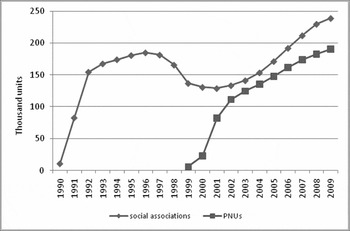
A similar setback for the development of social economy organizations also happened in urban areas. Along with the economic reform and marketization, a great number of organizations, formerly state-owned or collectively-owned, underwent a series of privatization waves. Among these were schools, healthcare centres and hospitals, welfare homes, service centres for the disabled, including social welfare enterprises. Thus in 1998, with the promulgation of Regulation No. 251/1998, a new type of social organization—the private non-enterprise units —was formally established.Footnote 59 At the same time, during the first half of the 1990s, the number of registered social associations also increased rapidly, reaching 184,821 in 1996. However, due to higher entrance requirements for social organizations’ registration set by new Regulation No. 250/1998, they experienced a downturn in numbers. As Figure 1 shows, the registered number of social organizations decreased by 56,016 in a short five-year period (1996–2001). One of the most important phenomena during this period is that China experienced a large-scale structural adjustment and the biggest flood of laid-off workers and urban employment destruction. From 1996 to 2004, there were 50.72 million laid-off unemployed workersFootnote 60 ‘abandoned’ by the public-owned sectors.Footnote 61 Because of the state's weakened welfare functions, the privatization of social welfare and the market-oriented employment model provided more space for social economy organizations to deal with social problems and tensions, as institutional reforms deepened.
The number of social organizations in China (1990–2009)
Source: China Statistical Yearbook 2009 and 2009 Statistical Report of the Ministry of Civil Affairs.

The third period, commencing with the new millennium, represents a new public effort towards ‘reconciling state, market and society’.Footnote 62 This period witnessed the development of social economy organizations both in rural and urban China. In rural areas, in response to the rural crisis, the state has placed rural development once again as China's top priority, and recognized the important role a co-operative economy can play. In consequence, a new co-operative movement has been witnessed.Footnote 63 After the promulgation of the first national co-operative law in 2007, co-operatives have flourished and experienced a surge in membership. At the end of 2011, the registered number of farmer-specialized co-operatives nationwide reached 521,700. There were 41 million farmers’ household members involved, accounting for 16.4 per cent of the total number of rural households.
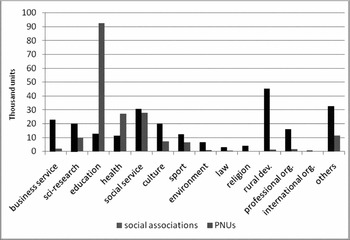
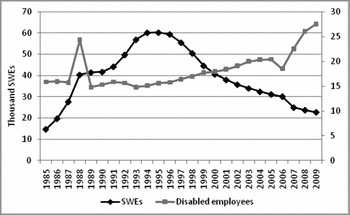
In urban areas, in response to the government's policy preferences emphasizing the importance of diversification of the economic development and of social harmony, social organizations continued to grow. At the end of 2009, there were in total 431,069 social organizations, 2.8 times the number as in 2000. The service domains include education and health, science and technology, culture and sports, legal consulting and other social services, environment protection and rural development (cf. Figure 2). The social welfare enterprises belonging to the traditional social welfare system originated in the 1950s and still play an active role in integrating disabled people into the labour market. Although there was a statistical decrease in their number to realize economies of scale under market pressure from competition, they have nevertheless exerted impressive economic and social effects. In 2009, the social welfare enterprises realized an added value of 51.78 billion yuan (representing 0.36 per cent of the tertiary sector), a 145.8 per cent increase from the previous year. There were 627,000 disabled working staff, an increase of 8,000 from 2008 (cf. Figure 3).
The number of social organizations by social service types (2009)
Source: 2009 Statistical Report of the Ministry of Civil Affairs.

The number of social welfare enterprises and disabled employees in China (1985–2009)
Source: The China Statistical Yearbook 2009 and 2009 Statistical Report of the Ministry of Civil Affairs.

Conditions for the development of the social economy in China
The impact of the economic and social transition on the upsurge of the Chinese social economy is not only through direct means of de-nationalization and marketization and, as a consequence, the privatization of China's social welfare system, as already mentioned, its impact works also very much through indirect means by the rise of civil society, and a strengthened link with the West. Last but not least, driving forces for the upsurge of the social economy in China are deeply rooted in local historical and cultural traditions.
The rise of civil society came along with economic development and social modernization. In China, several groups of institutional and social entrepreneurs have dedicated themselves as forces for social change. They promote social justice, equity and social cohesion, participatory democracy and social responsibility through individual involvement in the process of active citizenship. Among them, a first group refers to critical intellectuals, most of whom have educational experience abroad. Being critical of the runaway development and privatization and westernization model developed since the mid 1990s in China, many of them serve as institutional entrepreneurs to promote institutional innovations and demand for increasing social welfare and greater democratic participation. They form an important factor in supporting a vibrant civil society and a strong civic culture in China.Footnote 64 A second group concerns numerous active NPOs and foundations who promote social innovation and a pluralism of social and economic activities. Among them, the China Social Entrepreneur Foundation,Footnote 65 the Narada FoundationFootnote 66 and the Non-Profit IncubatorFootnote 67 are the most prominent. They cultivate social entrepreneurs, advance the knowledge and awareness of social entrepreneurship, and disseminate good practices as well as other information on social economy enterprises.
A third group comprises farmer entrepreneurs as local elites in rural China. Since the reform and opening-up, farmers have sought to expand their opportunities in participating in market activities and in gaining more power. Economic liberation enables them to pursue income-generating activities by allocating capital and labour to different sectors. As they have gained economic capital, they seek to create new opportunities for meaningful participation in village resource management decisions. Besides having the resources that ordinary farmers dispose of, these rural entrepreneurs are likely to have a better educational background and better access to modern technologies, as well as more market and relationship networks. They establish new co-operatives, promote local community identity and development, negotiate local issues as brokers between local and collective officials and ordinary farmers.Footnote 68 Some of them work together with rural experts. This collaboration among rural entrepreneurs and various stakeholders engendered a new wave of social movements. They are represented by a series of innovative collective actions, such as a new rural reconstruction movement, and movements of community supported agriculture, as well as farmers’ water-use co-operative organizationsFootnote 69 and the emergence of financial holding co-operatives and multi-purpose service co-operatives at village level. It is important to note that each aforementioned collective action has its resonance throughout the twentieth century in modern China. Therefore, it is appropriate to call it a re-emergence of the social economy movement in China rather than a completely new phenomenon.
The second driving force for the development of the social economy is the link with the West. Besides the economic link, geographic proximity is the most important connection.Footnote 70 Geographically China is not in close proximity to the West like the CIS or CEE. Only after the reform and opening-up did China begin to have closer economic ties, more extensive diplomatic contact, and higher cross-border flows of people, information and organizations. Therefore, the process for China to learn social economy and co-operative movement from the West has started to accelerate, though this experience was previously very small and limited. Similar to the situation in Central East and South East Europe, in China, different international and foreign donors also provided financial and practical support for the development of some elements of the social economy. But the difference in this exogenous driving force between these two regions lies in the fact that in the former region, rural co-operatives have hardly survived as they were not supported by foreign donors,Footnote 71 whereas in China, under the influence of various exchange programmes, a new co-operative movement is moving impressively forward. It was reported in 1997 that a Chinese delegation went to Canada to exchange experiences with Canadian counterparts.Footnote 72 This visit might be one of the earliest exchanges during the emergence of new co-operatives in China. Besides this, such exchange programmes with nearby regions, like Taiwan, Japan and South Korea also helped greatly to promote co-operative ideas and the social economy in China.Footnote 73
Finally, sources of inspiration for the re-emergence of the social economy in China were deeply rooted in local historical and cultural traditions. Chinese intellectual and moral traditions influenced the way in which western economic ideas were received. Confucian traditions stressed obedience to hierarchical authority and the responsibility of rulers to promote the social welfare of their subjects. These and other traditional views certainly affected the way in which the early Chinese scholars responded to western ideas.Footnote 74 This holds true for the period after the economic transition as well. The social economy in China has developed within a framework of what some scholars call ‘soft authoritarianism’ or ‘Asian-style democracy’.Footnote 75 ‘Soft authoritarianism’ is explained as one system of economic liberalism but also political quasi-authoritarianism, emphasizing conformity to group interests over individual rights. This awareness of group interests and collective identity is in many cases conducive to the emergence of the social economy in China. And Chinese cultural traditions of Confucianism and kinship systems play an important role in fostering community solidarity and social cohesion. This happens especially in rural areas, contributing to the upsurge of many non-registered, informal associations and co-operative, mutual, economic activities as a strategy of poverty alleviation. Moreover, it is mostly recognized that the sense of community solidarity and collective identity are found to be much easier in local, rural areas. It seems that this is difficult to establish in cities, where there is less room for localism.
Roles of the social economy in China
Towards a conceptualization of the social economy in China
Previously I provided a literature review of the concept of ‘social economy’ in the West. Generally speaking, it is defined as a third sector existing alongside the private for-profit sector and the public sector, re-emerging as reactions to the capitalist economic crisis and the overburdening welfare state. In the previous section, I looked at the historical and contextual background of the social economy in China. The analysis showed that various aspects of the social economy in China had a deep historical tradition. The impact of transition on the upsurge of the Chinese social economy was not only through a direct means of de-nationalization and marketization and, as a consequence, the privatization of China's social welfare system, but also through various indirect ways. In addition, local historical and cultural traditions were also considered.
Based upon the above discussions, for the purposes of this study, I define the social economy in China as a range of not-for-profit organizations that provide goods or services to its members or to the community. They belong to a specific institutional system that is neither state-owned nor capital-driven. It is not identical to the concept of ‘third sector’ discussed by most Chinese scholars, who usually refer to the ‘third sector’ exclusively with regard to NGOs and social organizations. The concept of ‘social economy’ in China should be an expanding concept of the ‘third sector’ and include co-operative enterprises and other economic activities that are defined as being neither operated by the public sector nor by the capitalist market. Consequently, according to a division provided by CIRIEC,Footnote 76 co-operatives and other social enterprises in China, such as the private non-enterprise units and social welfare enterprises, constitute the market sub-sector social economy, whereas social associations, foundations and various voluntary organizations, whose principal resources come from voluntary contributions and donations, membership dues, property income or subsidies, form the non-market sub-sector.Footnote 77
The reasons for adopting this conceptualization are threefold: first, this description based on a legal approach serves as a means of avoiding the problem of definition ambiguity. It has come to be widely accepted at an institutional level. Second, unlike the ‘third sector’ in China which is discussed as a synonym of the NGO/NPO, or even non-profit organizations operating under a total non-profit distribution constraint, the term ‘social economy’ under discussion includes both traditional non-profits and innovative forms of enterprise. And last, considering the reality that most organizations in China (especially the registered NGOs/NPOs) lack some basic principles generated in the Western discourse (such as autonomy in management and a democratic decision-making process), the definition proposed stresses the very basic social economy role of providing goods or services to people and the society, rather than insisting on these principles, although some co-operatives and grassroots social organizations in China indeed enjoy autonomy in management and search for economic democracy.
Legal enabling environment for social economy organizations in China
Some social economy organizations have been gradually institutionalized during the transition periods outlined above. In the 1990s, apart from Regulations No. 250/1998 and No. 251/1998, there were more legislations which deserve to be mentioned. For social welfare enterprises, under the Regulation (Ministry of Civil Affairs No. 21/1990), they are defined as ‘special enterprises with some traits of public welfare, engaged in group employment of disabled people who have a certain working ability’ (Article 2). In fact, some legislation came out in favour of the social welfare enterprises through preferential tax policies, the Code Guoshui No. 155/1994 being an example. For community services, the Opinion (Ministry of Civil Affairs No. 11/1993) mentions social aims and social obligations in order to promote the development of community service centres.
More statutes in the 2000s set up various framework laws regulating social economy organizations. In what follows some important legal institutions are discussed, although they are not intended to be exhaustive.
• To promote the development of NPOs, some regulations emerged, allowing them to receive various tax privileges. According to the Enterprise Income Tax Law (President Order No. 63/2007), NPOs are exempt from income tax provided that they meet the relevant provisions (Article 26). Specifically, state subsidies, membership fees, donations and some other income sources are free from income tax. According to the Regulation on Business Tax (Order of the State Council No. 540/2008), NPOs that engage in nursing, medical, educational, cultural, or religious activities in which services are performed by the disabled are exempt from business tax on the sale of services; the income from tickets generated in cultural activities in museums, exhibitions or libraries are also exempt from business tax. Besides those, NPOs also qualify for exemptions from some other taxes, including real estate tax, urban land use tax, and tax on the acquisition of real estate. In addition, the importance of non-state education is also acknowledged by the Non-state Education Promotion Law (President Order No. 80/2002), the Notice on Education Tax Policies (No. 39/2004), as well as the Regulation (Order of the State Council No. 399/2004).
• For social welfare enterprises, some tools emerged which set out specific requirements to qualify these enterprises. For example, the Notice (Ministry of Civil Affairs No. 103/2007) regulates that ‘to establish a social welfare enterprise, it should offer employment to disabled people up to at least 25% of the total workforce. Besides, at least 10 of the employees should be disabled’ (Article 2). There is also a set of Standards (Ministry of Civil Affairs MZ009-2001/2008). In 2008, the Law on the Protection of Disabled People (President Order No. 3/2008) called on the government and society to establish social welfare enterprises, blind massage centres as well as other types of welfare institutions to arrange for the employment for the disabled (Article 32). The government grants tax privileges to the enterprises who employ a certain number of disabled workers. They are supported in various aspects such as production, management, skill, capital, material resources as well as the place of work. For self-employed disabled people, the government generally exempts their administrative fee; for the disabled willing to do self-employed business, the government prioritizes the certificate issuing. Besides this, the Notice Caishui No. 92/2007 and Notice Caizong No. 47/2008 provide more specifics concerning tax privileges to promote employment for the self-employed disabled.
• A new national co-operative law (President Order No. 57/2006) took effect in 2007. It formulates a new legal entity ‘farmer specialized co-operative’ (FSC). It appears to herald a general drive to promote farmers’ economic organizations, by providing regulations safeguarding voluntary membership and autonomy (voluntarily formed, mutual-aid professional organizations), democratic member control (one-member-one-vote basis plus 20 per cent ceiling of additional voting rights), member economic participation (20 per cent ceiling for each member contribution, plus 60 per cent bottom line of distributable profits in accordance with patronage). This law represents a significant departure from the former official entrenched caution about permitting rural organizations of any kind. Furthermore, the Notice Caishui No. 81/2008 puts forward a series of tax preferential policies in favour of co-operative enterprises.Footnote 78 Finally, the China Banking Regulatory Commission and the Ministry of Agriculture issued a Document No. 13/2009, stipulating five measures to offer financial support to co-operatives. In particular, it proposes a co-operation model between co-operatives, the government and financial institutions.
• Besides this, the Chinese government has developed several policies and programmes aiming at creating businesses and offering labour market subsidies (grants, training supports, etc.), such as the Employment Promotion Law (President Order No. 70/2007), the Notice of the State Council No. 5/2008, the Notice Yinfa No. 238/2008 to improve small-sum secured loans, and the Notice Caishui No. 84/2010 to promote employment by starting a business in the form of tax privileges. A key aspect of these regulations has been the focus on improving the environment for creating businesses, including easy registration, training provision, access to small-sum secured loans (the sum can reach up to 50,000 yuan), calling for the participation of community employment service institutions in providing public interest posts such as jobs and training centres as well as in verifying the application of unemployed families. The target groups include all disadvantaged people, from the disabled, migrant people from rural areas who lose farm land, to the laid-off and other unemployed people registered unemployed for more than one year. In addition, these policies also target social entrepreneurs (especially graduate students) who wish to start up businesses in Western China or at the grassroots-below-county-level. Moreover, promoting community development is also shown in the Opinions on strengthening and improving the community service work (the State Council No. 14/2006) and the Eleventh Five-year Plan for community service system development (No. 975/2007).
Apart from the above-mentioned regulations, in rural China, an even broader enabling environment is often provided by the state through Number One Documents of the Year.Footnote 79 Along with a series of the state and CCP supportive policies, such as ‘building a new socialist countryside programme’ and new rural construction movement whose aim was to create ‘educated, technology-savvy, entrepreneurial new socialist farmers’,Footnote 80 some of the most important public policies and innovations can now be traced. These policies generally make it easier for farmers to lease or trade their land-use rights, help them to establish a land shareholding co-operative, and encourage the establishment of co-operative enterprises. In this sense, state policy, market reform, and civil society all constitute positive institutional environments in a state of institutional harmony.
What kind of role has the social economy played in China?
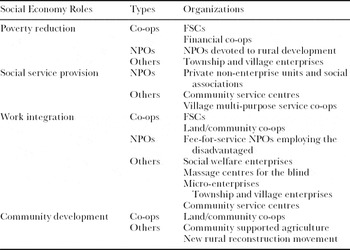
The social economy is generally considered as an important way to achieve a balanced economy and an inclusive society, together with the public sector and for-private sector. In China, various social economy organizations (traditional NPOs and co-operatives as well as innovative organizations labelled ‘social enterprises’) play a range of important roles in, amongst other things, poverty reduction, social service provision, work integration, and community development. Table 1 provides an overview of various organizations classified into four broad categories. Obviously this typology is only one way of classifying the social economy in China; ‘social service provision’ and ‘community development’ roles in particular are not entirely conceptually separate or mutually exclusive. Besides, some organizations, especially in rural China, tend to play ‘poverty reduction’ and ‘work integration’ roles at the same time, because the two roles are functionally supportive of each other. Nevertheless, it is a useful attempt to understand how various social economy organizations exert positive economic, social and ecological influences in the field.
The roles played by the social economy in China

Source: Author's tabulation.
Poverty reduction
With regard to poverty reduction, most organizations (being a co-operative, an NPO or a company legal entity) play an active role in rural China. Indeed, currently there are more than 700 million rural people in China, most of whom belong to various vulnerable groups. As mentioned above, after the rural crisis originating in the 1990s, the population and its communities in rural areas have become the most vulnerable in China.Footnote 81 Nowadays, with the upsurge of FSCs and the emergence of financial co-operatives, co-operatives indeed serve as an effective tool to fight poverty and foster social cohesion.Footnote 82 According to the data provided by the Ministry of Agriculture, members of an FSC can have an income more than 10 to 20 per cent higher than that of non-member farmers who produce the same products in the local area, whilst members in a ‘demonstration co-operative’ can have an income more than 30 per cent higher than that of ordinary farmers.Footnote 83 Besides FSCs, various financial co-operatives have also recently developed to increase access to financial services in disadvantaged rural areas. They differ from commercial banks in that they are not based on the expectation of profit from capital invested. Some are encouraged by government agencies (notably the State Council Leading Group Office of Poverty Alleviation and Development), while others are regulated by the China Banking Regulatory Commission, amongst which rural mutual credit co-operatives are most noteworthy. Moreover, there are also numerous NPOs actively engaged in agriculture and rural development. In 2009, there were 45,367 such social associations involved. Finally, it is important to mention the township and village enterprises which have, since the 1980s, played a crucial role in improving rural household incomes and prospering the rural economy. It is calculated that in 2008, 35 per cent of per-capita rural household income originated from township and village enterprises.Footnote 84 Apparently, they have contributed significantly to the increase in rural population income.
Social service provision
NPOs have traditionally provided a range of services in China, particularly private non-enterprise units. As Figure 2 shows, in 2009, there were 92,703 units engaged in the education sector, 27,237 in the health sector, and 28,060 in other social service activities. There were also 30,818 social associations active in the social service area. Besides NPOs, a number of social and personal services have also been provided by two open models,Footnote 85 namely ‘community service centres’ in urban areas and newly-established ‘multi-purpose service co-operative communities’ at the village level in rural areas. The services delivered by these service centres in urban areas include personal services such as healthcare, babysitting and childcare, home nursery, counselling, and services for disadvantaged groups like the homeless or the elderly without relatives, as well as environmental services such as recycling. According to the Ministry of Civil Affairs, at the end of 2009, there were 175,000 various kinds of community service centres, of which 10,003 provided comprehensive services. There were also 289,000 community service volunteer organizations in China.Footnote 86
In disadvantaged rural areas, local people tend to suffer a lot from the absence of social services. In many cases there are also few or no cultural, recreational activities. To fulfil these unsatisfied social needs in the context of local development, a number of service co-operative communities were set up at the beginning of the 2000s at village level as pilot projects, mostly initiated by the supply and marketing co-operatives. Such service co-operative communities function by providing guarantees for the quality of the production inputs and consumer goods villagers buy, as well as creating space for cultural and sport activities. Generally speaking, various stakeholders invest in this community. They tend to be the village committee, local villagers, local supply and marketing co-operatives, and township offices. Sometimes they also include the local health station, in which situation healthcare service delivery is also integrated into the community. Based on this series of successful pilot programmes, in November 2009, the State Council issued a central document encouraging the reform and development of supply and marketing co-operatives. It urged them to create new service provisions to deliver childcare and care for the elderly, as well as employment services for the local communities. Their operations may not conform to the principles of certain organizations such as co-operative enterprises or social enterprises, but they do indeed fulfil the definition of the social economy adopted in the research.
Work integration
The social economy organizations categorized as ‘work integration’ in this research are concerned with those providing employment and labour-market integration for the disadvantaged—the disabled, laid-off, rural migrant workers, the university graduates, and others. Recently organizations involved in such initiatives can be found in many European countries,Footnote 87 for example, in the CEE/CIS countriesFootnote 88, and East Asia.Footnote 89 In China, ‘work integration’ includes a wide variety of social economy organizations. The main organizational forms can be co-operatives, NPOs or special companies—the social welfare enterprises, blind massage centres, micro-enterprises with specific target groups, community service centres, and township and village enterprises providing job opportunities to rural populations with relatively low skills and education.
Social welfare enterprises belong to the traditional social welfare system which originated in the 1950s and still play an active role in integrating disabled people into the labour market. Figure 3 shows that, although the number of enterprises has been decreasing since the mid-1990s, the total number of disabled employees is nevertheless increasing. As a result, the average number of disabled workers employed by each enterprise has increased from 16 in 1985 to 18.5 in 2006, and again to 27.5 in 2009. Besides social welfare enterprises, massage centres employing blind people are another type of organization specifically targeting the disabled who face unemployment. In 2006, these centres offered 14,707 working posts for the blind.Footnote 90 Moreover, community service centres in urban areas also help the disadvantaged through improving employment services for laid-off workers and unemployed people. In 2009, they provided employment for 531,000 laid-off workers, accounting for one-fourth of the total number of employed people in urban communities.Footnote 91 In rural areas, township and village enterprises have served as the main engine for employment creation. In 2010, it is estimated that they have provided employment for 158 million people, accounting for 22 per cent of the total rural population.Footnote 92
A final type of company providing labour-market integration concerns ‘micro-enterprises’. Currently there are several pilot projects at provincial level encouraging the development of micro-enterprises. In Chongqing, for example, they target nine types of disadvantaged people in the labour market, including secondary vocational school students and junior college students, the laid-off, rural migrant workers returning to the countryside, rural-to-urban household residents, soldiers released from military services, Three Gorges Dam migrants, the disabled, individuals engaged in cultural and creative industries as well as in activities related to information and technology (Yufufa No. 66/2010, Yubanfa No. 192/2010).Footnote 93 The Chongqing Municipal government aims to support 100,000 such enterprises between 2011 and 2016, in order to create more than 1 million jobs.Footnote 94
Fee-for-service NPOs are currently regarded as an innovative third sector in China. Sometimes they aim at supporting the integration of the disadvantaged (workers with disabilities, or the socially excluded) into the labour market. In this sense they can be considered as ‘work integration social enterprises’ in China.
Finally, some types of co-operatives (mainly FSCs and land/community co-operatives) also tend to fulfil the ‘work integration’ function, although not always as a primary aim of the organization. This is done through providing temporary, seasonal jobs to, for instance, middle-aged women without a job, or elderly people with production skills. But sometimes they also specifically target the disadvantaged, recruiting most members and working staff with disabilities (to work alongside non-disabled people). In FSCs, they may choose products that are easy to plant and will teach disabled people plantation skills. The FSCs then purchase the products at the end of the season and return to them a certain amount of dividends. In this way they also combine the ‘work integration’ and ‘poverty reduction’ functions.
Community development
Community development is supported by a wide variety of initiatives, using either a co-operative model, or an open model (in the form of ‘community supported agriculture’, or a new rural reconstruction movement).Footnote 95 To distinguish them from those organizations carrying out a ‘social service provision’ role as mentioned above, the organizations in this category primarily refer to those with environmental concerns or those fulfilling various needs (not only social ones) in a community.
The community supported agriculture has been promoted very recently in China. It is due to the fact that after three decades of Chinese institutional reforms designed to boost efficiency in agricultural production, it has now become the world's leader in both chemical fertilizer and pesticide consumption.Footnote 96 The overuse of fertilizers and pesticides has generated considerable environmental pollution and damaged agriculture's ecological sustainability, thus becoming a significant problem for rural China. Nature recently published an article online, claiming that ‘acid soil threatens Chinese farms’ and ‘Chinese farmers’ rampant use of fertilizers could soon endanger the nation's ability to feed itself’.Footnote 97 Consequently, inorganic and even toxic fertilizers are threatening food quality and causing negative effects on people's health. Dale Wen, a China expert, argues that environmental pollution and land degradation are most serious in the countryside, yet most NGOs are predominantly focused on urban issues.Footnote 98 Against this background, several pioneering community supported agriculture initiatives have been conducted nationwide. Some projects started out with urban consumers, whilst others are promoted by scholars and practitioners with significant support from volunteers and rural farmers. Some prominent examples are the Farmer's Friend in Guangxi, the Chengdu Urban Rivers Association in Sichuan, the Little Donkey Farm in Beijing and the Guoren Green Alliance (a marketing network for environmentally friendly agricultural co-operatives, combining producers’ co-operatives in villages and consumers’ co-operatives in cities), to name but a few.
Another social movement is the new rural reconstruction movement, echoing a similar movement in the 1930s. While being critical of mainstream economic development theories regarding rapid industrialization and urbanization as a panacea, some rural experts propose building a ‘farmer-centred’ and ‘rural community-centred’ local economy to revive community spirits and empower rural people. Activists have conducted many concrete projects which have shaped a vibrant movement. They view total community development as a unified whole, combining economic, social, ecological and cultural functions. This social movement has involved several NGOs and academic institutions, numerous rural co-operatives and associations, and hundreds of self-conscious participants (including academics, social workers, student volunteers, and grassroots activists). Several training institutes have been established for volunteers and grassroots activists, teaching them how to set up, run and support sustainable development projects such as co-operatives to serve the entire community. It is indeed a national social movement. Up till now the Rural Reconstruction Centre at Renmin University in Beijing, for example, has set up more than 60 experimental villages in more than 15 provinces in China.
A final type of organization worth mentioning concerns land co-operatives in China. It is a China-specific form of farmer-owned co-operatives. This very popular form has emerged in some of the most developed coastal areas as well as in peri-urban rural areas characterized by rapid urbanization and industrialization. This form of organization belongs to the category ‘community development’ because it usually operates on the basis of a village, and mostly employs an integrated development model by way of conducting unified planning of regional development. It emerged in the context of rural-urban migration and the elderly left behind, as well as land degeneration and circulation. Generally speaking, this co-operative organization is more oriented to the whole community and puts more emphasis on multiple stakeholder ownership.Footnote 99 In a rural economy in transition, it at best represents an attempt to alleviate rural tensions and forge cohesion by creating new mechanisms of participation, to create employment opportunities for the villagers, and to promote local empowerment.
Conclusions
In China, economic reform and transition have engendered significant social changes. The accelerated economic growth and market development, the privatization of the social welfare system, as well as the rise of civil society explain the institutional contexts in which there has been an upsurge of a range of not-for-profit initiatives, neither state-owned nor capital-driven. They are defined in this research as the social economy organizations in China. Throughout the study, it is made clear that the social economy is no new phenomenon in China, as its various elements have indeed a rich historical tradition. Moreover, the impact of institutional transition on the upsurge of the Chinese social economy is not only through a direct means of de-nationalization and marketization and, as a consequence, the privatization of China's social welfare system, but also through various indirect means. The development of the social economy in China was greatly influenced by the framework set by political institutions and accordingly, legal enabling environments. Besides this, the exchange with the West and local historical and cultural traditions also contribute to explain its re-emergence.
Theoretically, the term ‘social economy’ is almost unknown in China. It is not a concept that is broadly understood and prevalent in policy discourse and in academic writing. The main reason for this seems that a literal translation of this term (original French économie sociale) denotes a different type of reality in Chinese.Footnote 100 Nevertheless, throughout the study one sees that the linguistic ambiguity of the concept should not constitute an obstacle to realizing its existence and to understanding its impact on Chinese society. This has been revealed by looking into various roles (poverty reduction, social service provision, work integration, and community development) played by a variety of social economy organizations (traditional associations and co-operatives as well as innovative ones labelled ‘social enterprises’). Therefore, in contemporary China, the social economy sector should be considered as a holistic institutional system which, together with the public sector and the private for-profit sector, serves as a key factor for improving welfare, encouraging participation, and consolidating solidarity.
Finally, as the study of these social dynamics in China becomes increasingly popular, it is important to build a coherent conceptual framework in order to incorporate various factors and to create an area with common ground and shared values. The purpose of this research is therefore to propose such an integrated framework in order to understand the reality. However, it should be noted that focus on the ‘social economy’ as proposed in this study should not be interpreted such that it is better than another concept, for instance, ‘social enterprise’. What is important, especially in this initial period of the concept's adoption and development, are the underlying ways of thinking. Through examining the practices in the field only one conclusion is tenable: those various not-for-profit initiatives in China, neither state-owned nor capital-driven, are indeed conducive to achieving a plural economy and an inclusive society. The study strengthens the Chinese social economy with the purpose of refining one's knowledge on how it operates and contributes to the social and economic development in the context of China. Although the conceptualization of the social economy in China is still in its initial phase, this direction appears to hold promise for future research. I hope therefore it may help to advance knowledge, and become a stimulus to further efforts.