


Introduction
Semantic shifts have been explored via a range of methods (Allan & Robinson Reference Allan and Robinson2012). Typically, semantic shifts were usually noted or described with methods such as a literature review or dictionary checking (e.g. Blank & Koch, Reference Blank and Koch1999; Stockwell & Minkova, Reference Stockwell and Minkova2001; Williams, Reference Williams1976), which are very labour-intensive and time-consuming methods. Other more recently developed methods involve sociolinguistic interviews (Robinson, Reference Robinson2012; Sandow & Robinson, Reference Sandow, Robinson, Braber and Jansen2018). However, with the development of large-sized corpora and computational semantics, diachronic semantic shifts have started to be captured in a data-driven way (Kutuzov et al., Reference Kutuzov, Øvrelid, Szymanski and Velldal2018). Recently, the word embeddings technique (Mikolov et al., Reference Mikolov, Sutskever, Chen, Corrado, Dean, Burges, Bottou, Welling, Ghahramani and Weinberger2013) has been proven to be a promising tool for the tracking of semantic shifts (e.g. Hamilton, Leskovec & Jurafsky, Reference Hamilton, Leskovec and Jurafsky2016a, Reference Hamilton, Leskovec and Jurafsky2016b; Kulkarni et al., Reference Kulkarni, Al–Rfou, Perozzi and Skiena2015; Kutuzov et al., Reference Kutuzov, Velldal and Øvrelid2017). For example, Hamilton et al. (Reference Hamilton, Leskovec and Jurafsky2016b) exemplified how to use the technique to capture the subjectification process of the word ‘actually’ during the 20th century.
The present study aims to investigate semantic shifts in denotation and/or connotation (Washington, Reference Washington2010). Changes in denotation alter the literal meaning of a word while changes in connotation affect the sense or the feeling associated with it (Washington, Reference Washington2010: 19). A positive change in connotation is described as amelioration while a negative change is pejoration (Traugott & Dasher, Reference Traugott and Dasher2001). More specifically, we explore the possible semantic shifts of six descriptive or labelling words of LGBT from the 1860s to the 2000s: homosexual, lesbian, gay, bisexual, transgender, and queer, with the word embeddings technique. From our intuition, we can say that these six words have experienced semantic shifts in denotation and/or connotation. However, when and how such shifts occurred remains unclear. An investigation into their semantic shifts may address these concerns. In addition, since LGBT has long been a socially and culturally controversial topic the exploration of socio-cultural perceptions accompanying semantic change of LGBT words is worth pursuing.
Based on the foregoing, the purpose of the study is twofold. First, we aim to describe the semantic shift of the LGBT words and to reveal how their change reflects changes in social perception over time. Second, we intend to advance the use of the word embeddings technique for research on semantic shifts by showing how a close qualitative analysis of the nearest neighbours extracted via this technique helps to understand societal and cultural contexts accompanying these shifts. In the following section, we introduce the technique, the dataset, and methods before reporting on the results and providing a detailed discussion.
Methodology
Word embeddings and nearest neighbours
The word embeddings technique is a powerful machine-learning method that embeds or labels each word in a text as a high-dimensional vector in space (Mikolov et al., Reference Mikolov, Sutskever, Chen, Corrado, Dean, Burges, Bottou, Welling, Ghahramani and Weinberger2013). The distance between any two word vectors is measured in terms of cosine (Turney & Pantel, Reference Turney and Pantel2010), which represents their semantic relations (Garg et al., Reference Garg, Schiebinger, Jurafsky and Zou2017). Since words occurring in similar contexts are assumed to be semantically similar (Kulkarni et al., Reference Kulkarni, Al–Rfou, Perozzi and Skiena2015: 427), the similarity between two words approximates to the cosine distance between their vectors. The closer the distance between two vectors is, the more semantically similar the words are, and vice versa (Collobert et al., Reference Collobert, Weston, Bottou, Karlen, Kavukcuoglu and Kuksa2011). Based on the embedding distance between a particular word and all other words in the text, the ‘semantic neighbours’ (or ‘K-nearest neighbours’ in technical terms) can thus be extracted in descending order. The top nearest neighbours are considered to be the most semantically related or similar words to the particular word under investigation.
Recent years has witnessed an increasing number of studies that incorporate the word embeddings technique into research on diachronic semantic shifts (e.g. Hamilton et al., Reference Hamilton, Leskovec and Jurafsky2016a, Reference Hamilton, Leskovec and Jurafsky2016b; Kulkarni et al., Reference Kulkarni, Al–Rfou, Perozzi and Skiena2015; Kutuzov et al., Reference Kutuzov, Velldal and Øvrelid2017). It has been proven that this technique is an effective tool for diachronic semantic shifts, with promising potential of quantifying semantic shifts (Kim et al., Reference Kim, Chiu, Hanaki, Hegde and Petrov2014), capturing different types of shifts (Hamilton et al., Reference Hamilton, Leskovec and Jurafsky2016a), or even revealing quantitative laws of semantic shifts (Hamilton et al., Reference Hamilton, Leskovec and Jurafsky2016b). With the aid of additional data, such as Census data and other literatures, the diachronic semantic shifts captured by word embeddings can detect societal changes and historical trends (Garg et al., Reference Garg, Schiebinger, Jurafsky and Zou2017), which offers valuable insights into the interaction of semantics with societal and cultural changes.
Hamilton et al. (Reference Hamilton, Leskovec and Jurafsky2016a) proposed two computational measures for semantic shifts. One involves calculating the distance a word has moved in the semantic space between different time stamps. This measure is effective in capturing changes that have occurred due to regular processes of linguistic drift, such as grammaticalization or subjectification, but is not sensitive to changes resulting from cultural shifts, such as technological advancements. In addition, although a change of distance in the semantic space can determine whether a word has experienced a semantic shift, it cannot reveal how the semantic shift has occurred without any contextual information. In other words, it cannot recognize whether the word has shifted in denotation or in connotation. In contrast, the other measure that observes changes in a word's nearest neighbours is useful for detecting semantic changes that have occurred due to cultural shifts. A close analysis of these nearest neighbours may enable the denotation and connotation of the word to be inferred, thus showing how the word has changed. For example, the top three nearest neighbours of ‘broadcast’ in the 1850s are sow, seeds, and sows while those in the 1990s are BBC, radio, and television, which indicates a semantic shift of the word from casting out seeds to transmitting signals (Hamilton et al., Reference Hamilton, Leskovec and Jurafsky2016b).
To summarize, the nearest neighbours of a word extracted via the word embeddings technique are indicators of its denotation and connotation since they are most semantically related to this word. More specifically, a word's denotation and connotation are inferred from the semantics of its nearest neighbours. Changes in its nearest neighbours over time may serve as evidence for its semantic shifts. Based on a close examination in the changes of their nearest neighbours over a period of 150 years, the present study uses this technique to capture the possible semantic shifts of six LGBT descriptive or labelling words, i.e., homosexual, lesbian, gay, bisexual, transgender, and queer. We have chosen these words because they have been general terms frequently used to refer to LGBT people. Furthermore, it explores whether their semantic shifts may reveal how the social perception of LGBT has changed over time with a qualitative analysis of the nearest neighbours.
Dataset and method
The dataset used in this study is the Corpus of Historical American English (COHA) (Davies, Reference Davies2012), which is a 400-million-word corpus of historical American English balanced by both genre and decade. The dataset, organized by decade into 15 subsets, was trained with rword2vec, an R language wrapper for the word embeddings technique (Garg et al., Reference Garg, Schiebinger, Jurafsky and Zou2017). The 50 nearest neighbours of homosexual, lesbian, gay, bisexual, transgender, and queer were then extracted for each decade from the 1860s to the 2000s. Using the nearest neighbours technique, it is possible to capture the semantic shifts of the words across the span of 150 years. One point worth noting is that not all words always have nearest neighbours in certain decades due to their limited coverage in COHA.
The nearest neighbours of the words were analysed via two steps. First, the neighbours of each word in each decade were closely read and compared to determine whether a word has shifted in denotation, that is, changes from one meaning to another. For example, the top three nearest neighbours of gay in the 1860s were merry, gayest, and joyous while those in the 2000s were lesbian, bisexual, and transgender. Changes of its nearest neighbours indicate that gay has clearly undergone a shift in denotation. Second, in order to decide whether a word has undergone a shift in connotation, its negative neighbours in each decade were picked out and analysed. A neighbour is taken as negative if (1) it has a negative connotation (e.g. wrongness, egocentric); (2) it is related to illegal behaviours or is against the social norm (e.g. truancy, incest); or (3) it is associated with disease, especially mental disease (e.g. psychotic, schizophrenic). Negative neighbours are in bold font in the Supporting Materials. Also, special attention is paid to positive connotation in nearest neighbours evidence.
Results and discussion
Among the six words, five words (homosexual, lesbian, gay, bisexual, and queer) were found to have experienced semantic shifts, which will be reported on in the following sections. Transgender is left unreported due to its limited coverage in COHA.
Shift in denotation: Old words for new meaning
In this section, we report on the findings concerning shifts in denotation. Two words, gay and queer, were found to have experienced a shift in denotation.
Gay
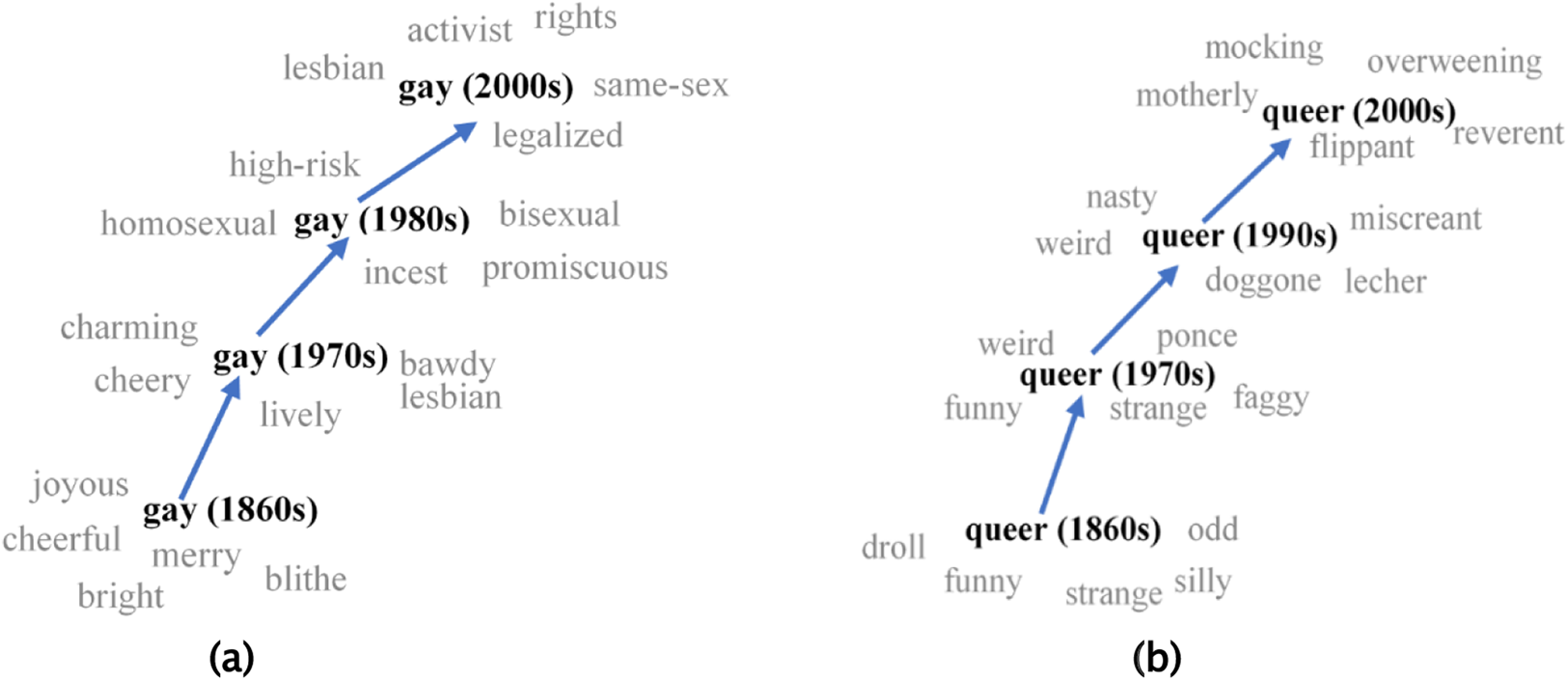
The word gay first occurred in the 1860s in COHA. As shown in Figure 1a, its denotation has probably shifted via three phases. First, from the 1860s to the 1960s, most of its nearest neighbours are positive words expressing happiness and joy, such as merry, blithe, cheerful, and mirthful. That is, in this phase, gay mainly meant happy, with a positive connotation. Nevertheless, in the second phase of the 1970s, gay began to have negative neighbours such as bawdy, flirtatious, and gullible, with its connotation starting to become negative. This phase may be a transitional phase when gay shifted in denotation, from happy to homosexual. Such a turning point conforms to the finding made by other studies that it is in the 1970s that gay as homosexual ‘entered the mainstream discourse’ (Robinson, Reference Robinson2012: 47; Wijaya, Reference Wijaya2011). Then, in the third phase starting from the 1980s, with homosexual as its top nearest neighbour, it has evolved to the semantic meaning of homosexual.
Visualization of semantic shifts of gay (a) and queer (b)
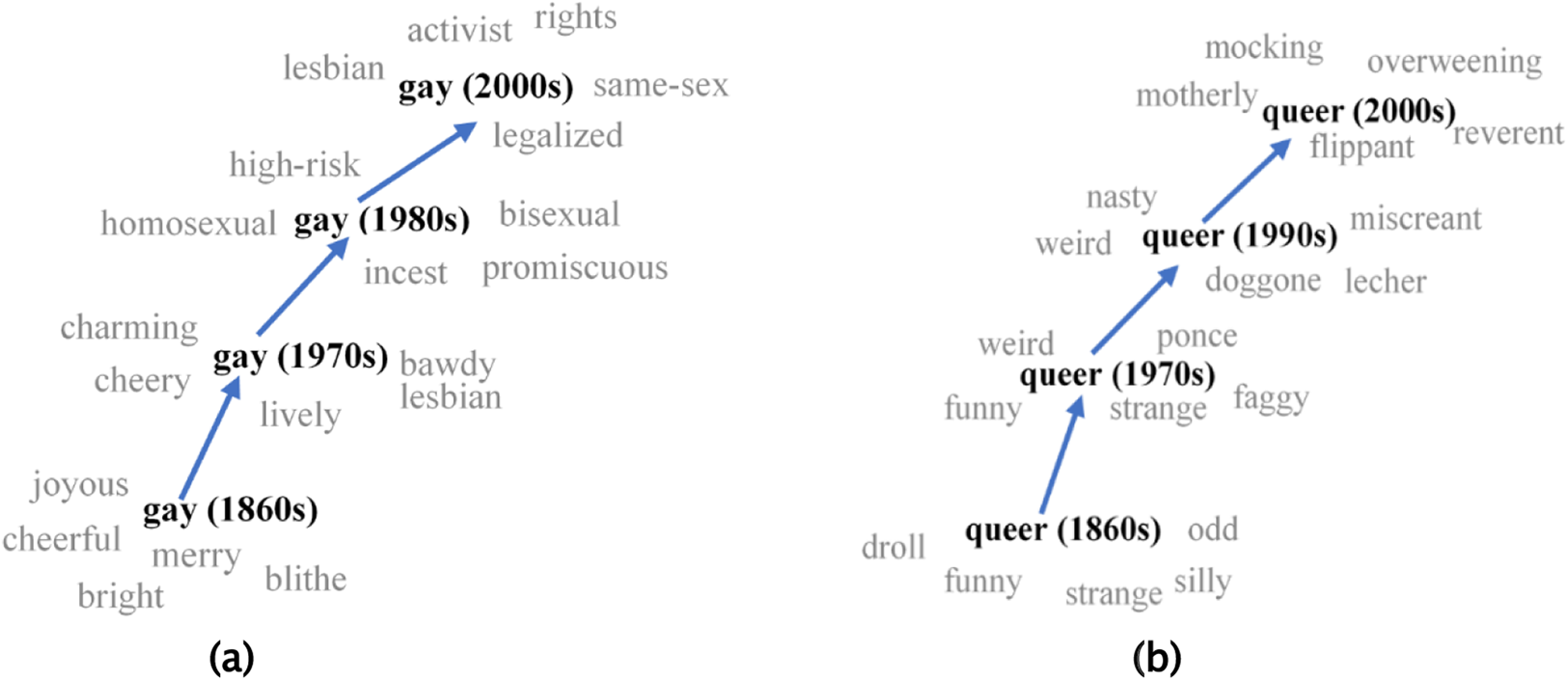
In the 1980s and the 1990s, gay was associated with strongly negative words, such as promiscuous, incest, kinky, psychopath, and antigay. These strongly negative words reflect the fact that during this period, gay, starting to refer to homosexual, might not have been accepted by society, and gay people were perceived negatively. However, in the 2000s, gay gradually lost its negative neighbours, with only four occurring in the list (stigmatized, extramarital, perversions, and taboo), which are not as negative as those occurring in the 1980s and 1990s. In addition, neighbours such as rights and legalized occurred in the 2000s. Thus, the change in its neighbours from the 1980s to the 2000s, especially the positive ones, indicates a positive change in the social perception of the term gay. That is, it is increasingly embraced and protected by the public.
Queer
Another word that has experienced a denotative shift is queer (see Figure 1b). Similar to gay, queer has undergone three phases of shifts. From the 1860s to the 1960s, its nearest neighbours in each decade were similar, with words such as odd, queer-looking, strange, weird, and freak frequently appearing in the list. That is, in the first phase, queer mainly meant strange and peculiar. However, from the 1970s to the 1990s, although most neighbours of queer were similar to those occurring between the 1860s and the 1960s, some words such as faggy (meaning homosexual) and lecher appeared in the list. Such a finding shows that the second phase may be a transitional period when queer shifted from its original meaning to a new one. Then, in the third phase of the 2000s, the nearest neighbours of queer were clearly different from those found in previous decades, with few neighbours expressing the meaning of odd and peculiar. Thus, starting from the 2000s, queer might have lost its original denotative meaning and evolved to a new one.
A close examination of the nearest neighbours of queer in the 2000s shows that almost half of them are negative words. Queer was often associated with flippant, overweening, bigot, bawdy, etc. However, positive neighbours also existed in this decade, such as motherly, reverent, artless, and condescending. The mixture of both negative and positive neighbours indicates that queer is not only perceived negatively. Although queer is still subject to negative stereotypes, discrimination, and prejudice, its positive semantic meaning has recently been recognized.
Shift in connotation: From negative to neutral
In this section, we report on the findings concerning shifts in connotation. Three words, homosexual, lesbian, and bisexual, were found to have experienced amelioration, shifting from negative to neutral connotation.
Homosexual
Homosexual first occurred in the 1920s, probably due to its limited coverage in COHA. However, most of the 50 nearest neighbours in the 1920s were names of famous figures, such as Parke, Copwer, and Molnar. Given that it is difficult to infer the denotation or connotation of homosexual with the names without any contextual information, the 50 nearest neighbours in this decade were excluded from the following analysis. The semantic shift of homosexual is observed from the 1930s to the 2000s (see Figure 2a).
Visualization of semantic shifts of homosexual (a), lesbian (b), and bisexual (c)
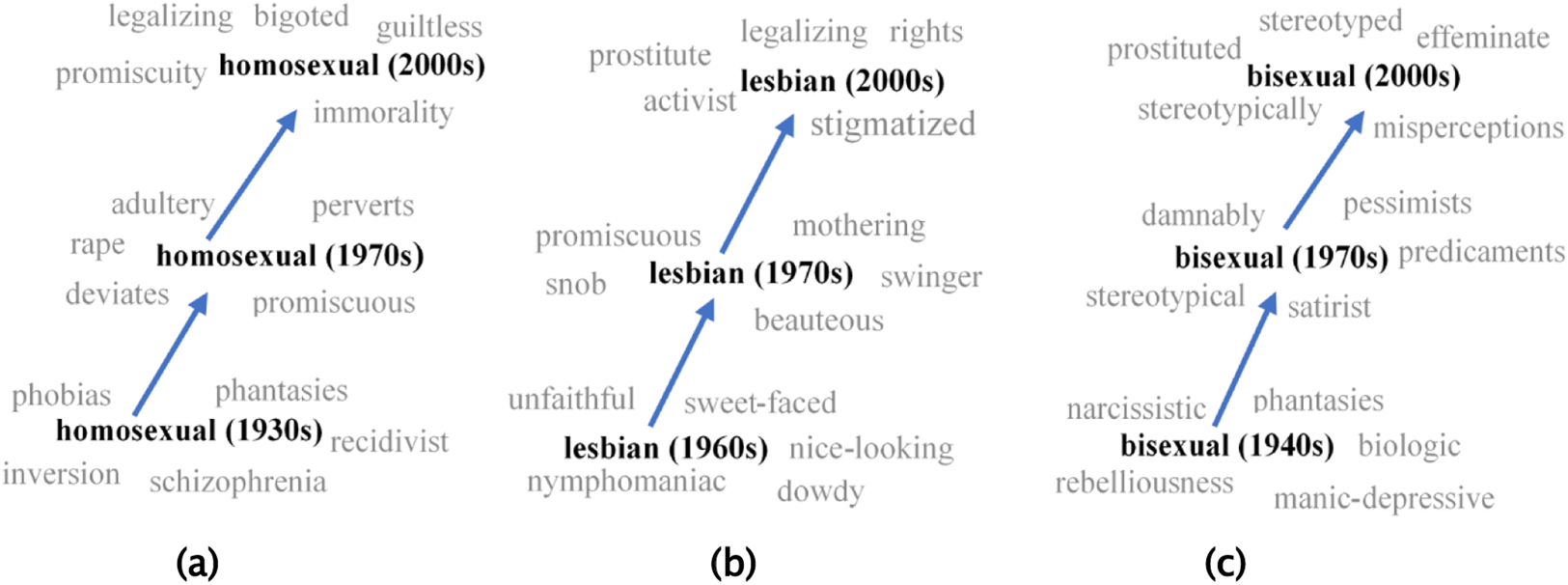
Somewhat unexpectedly, homosexual is always accompanied with negative neighbours from the 1930s to the 2000s. Homosexual was considered inconsistent with traditional values (e.g. inversion, non-human, degeneration, antisocial, deviant, culpable), and was frequently associated with seemingly immoral or illegal behaviours (e.g. masturbation, recidivism, truancy, incest, rape). From the 2000s, it lost many such neighbours and gained more neutral neighbours. Words such as legalizing and guiltless first appeared in this decade. The decrease in negative neighbours and increase in neutral ones indicates that homosexual became less negative in connotation, and more neutral.
Different from the other four words, homosexual has more neighbours related to mental disease (highlighted by underlining in the Supporting Materials). For example, from the 1930s to 1960s, many negative neighbours were related to mental disease. This was especially the case in the 1940s, where more than half of them (17 out of 30) were related to mental disease, such as psychotic, phantasies, schizophrenic, manic-depressive, phobias, and psychosis. The large number of neighbours related to mental disease implies that during this period, homosexual people might have been perceived as patients with a mental disorder. However, starting from the 1970s, it lost such neighbours, with only one or two occurring in each decade. This change indicates a positive shift in the social perception of homosexual, showing that homosexual was no longer considered as a mental disease. Such a positive shift is evidenced by the fact that the American Psychiatric Association removed homosexual from the Diagnostic and Statistical Manual of Mental Disorders in 1973 (Lamberg, Reference Lamberg1998). Therefore, after the 1970s, few neighbours were related to mental disease.
Lesbian
Similar to homosexual, lesbian has also experienced a semantic shift in connotation from negative to neutral (see Figure 2b). Lesbian first appeared in the 1960s in COHA, much later than homosexual did. In contrast to the other four words, lesbian had positive neighbours such as sweet-faced, nice-looking, and demure. It shows that lesbians were often associated with a beautiful appearance and good characters. This finding is in line with the simplified stereotype of femme lesbians that they exhibit more traditional feminine characteristics (Walker et al., Reference Walker, Golub, Bimbi and Parsons2012: 91), which may explain why lesbian is frequently accompanied by such positive neighbours.
Interestingly, approximately 30% (15 out of 50) of lesbian’s nearest neighbours were negative words in the 1960s, such as nymphomaniac, unfaithful, dowdy, and bitchy. However, such negative neighbours were decreasing from the 1970s. In the 1990s and the 2000s, only 10% of its neighbours were negative, and most others were neutral. That is, lesbian has become less negative and more neutral in connotation. This finding also shows that the social perception of lesbian has experienced a positive shift since lesbians were not only perceived as normal in a gradual manner, but also received protection (Faur, Reference Faur2018). This is particularly true when words such as activist, civil-rights, legalizing, and rights appeared as its nearest neighbours in the 1990s and 2000s.
Bisexual
Bisexual is the last word that has experienced a shift in connotation (see Figure 2c). From the 1940s to 1980s, its nearest neighbours were largely medical- or psychological-related words such as chromosome, manic-depressive, neurocirculatory, psychopath, and zygote. The close association with these medical- or psychological-related words indicates that during this period, bisexual might have been used more as a technical term. In particular, many negative neighbours in these decades were disease-related words, such as manic-depressive, lesions, and dysfunction. From the social perspective, similar to homosexual, bisexual was considered as a physiological or psychological disease during this period. An exception during this period is the 1970s in which bisexual only had three medical- or psychological-related neighbours, protoplasm, Jungian, and pathologically. Bisexual might have been more neutral in this decade. Then, starting from the 1990s, bisexual lost more medical- or psychological-related neighbours. Many neighbours, including negative neighbours, were related to the social humanities. In the 2000s, in particular, its negative neighbours, such as stereotypes, effeminate, and misperceptions, were not as negative as those in previous decades, which shows that bisexual became less negative and more neutral in connotation. In addition, the change in its nearest neighbours indicates a shift in the social perception of bisexual, from a scientific to a social perspective. That is, bisexuals were probably no longer perceived as patients with physiological or psychological diseases. In contrast, the public was more concerned about bisexuals themselves and their influence on society.
Conclusion
The present study found, based on their nearest neighbours, that gay and queer have experienced shifts in denotation, and homosexual, lesbian, and bisexual have undergone shifts in connotation. The two shifts have two points in common. First, both shifts started from the 1970s. Second, both of them have undergone shifts from negative to neutral or positive in denotation or connotation.
Such diachronic changes in these words in both denotation and connotation seem parallel to the societal changes in LGBT. In a society and at a time in which heterosexuality is the norm, homosexuality has long been subject to negative stereotypes, discrimination, and misrepresentation (Connolly, Reference Connolly2018; D'Augelli & Rose, Reference D'Augelli and Rose1990; Della Pelle et al., Reference Della Pelle, Cerratti, Di Giovanni, Cipollone and Cicolini2018). To be LGBT used to be regarded as a psychological disorder or abnormality. Consequently, these words were often accompanied with negative neighbours. However, the turning point occurred in 1973 when the American Psychiatric Association excluded it from the Diagnostic and Statistical Manual of Mental Disorders, hence excluding homosexuality from being classified as a mental disorder (Lamberg, Reference Lamberg1998). Also in the 1970s, the homosexual liberation movement in the wake of the Stonewall riots in 1969 was flowering, and more efforts were made to combat this misrepresentation (Connolly, Reference Connolly2018: 57). In the following decades, more laws and policies were enacted to decriminalize homosexual behaviours and protect LGBT rights in employment, housing, and services (e.g. Anti-Discrimination Act 1977). From discrimination to rights protection, the social perception of LGBT has clearly undergone a positive change. Such a societal change is necessarily reflected in language (Downes, Reference Downes1998; Hudson, Reference Hudson1996). The positive change in the views on LGBT results in a positive change in the nearest neighbours of the LGBT labelling words from negative to neutral or even positive. Our finding of the semantic shifts of these words from negative to neutral corroborates this positive societal change.
The meanings of words are always in flux. To track such semantic shifts of words, previous research largely appealed to literatures and dictionaries. With the development of techniques regarding corpus text analysis and computational semantics, shifts in word meanings can be captured efficiently with such data-driven methods. The present study successfully tracked the possible semantic shifts of five LGBT labelling words across a time span of 150 years with the word embeddings technique. This technique, complemented by qualitative analyses, appears to be effective in efficiently capturing semantic shifts in both the denotation and connotation of words. In addition, a close qualitative analysis of the nearest neighbours further reveals when and how these shifts have occurred and whether such shifts conform to the societal changes. In other words, a fuller picture of semantic shifts may be painted via the word embeddings technique. Hopefully, it may serve as an exemplar for how such techniques can be employed in future research. However, it is worth noting that the technique depends much on the coverage of the corpus. A limited coverage of the diachronic data of certain words, for example transgender in this study, may result in the lack of its nearest neighbours in some decades and corresponding failure to infer its semantic meaning in the periods. Future research may adopt a larger diachronic corpus for a fuller picture of the semantic shifts of certain words.
Supplementary material
Supplementary material is available online at https://doi.org/10.1017/S0266078419000270.
 YAQIAN SHI is an MA student in applied linguistics at the School of Foreign Languages, Huazhong University of Science and Technology. Her research interests include corpus linguistics, quantitative linguistics, and academic English.
 LEI LEI is Professor in Applied Linguistics at the School of Foreign Languages, Huazhong University of Science and Technology. His research interests include corpus linguistics, quantitative linguistics, and academic English. He has published extensively in journals such as Applied Linguistics, International Journal of Corpus Linguistics, and Journal of English for Academic Purposes. Email: leileibama@outlook.com