Introduction
The main treatment for parotid carcinoma is surgery.Reference Irvine, Larian and Azizzadeh1–Reference Hung, Liao, Kang and Huang3 Advanced parotid carcinoma can invade the skin or be close to the skin, and surgical resection including the skin is required to secure a safe margin.Reference Irvine, Larian and Azizzadeh1–Reference Ghanem5 Reconstruction of skin defects that occur after parotid carcinoma surgery is necessary to cover the wound, repair the defect and protect the important structures of the parotid region.Reference Irvine, Larian and Azizzadeh1–Reference Ghanem5 Free flap reconstruction or rotation flaps are generally adopted in this situation.Reference Irvine, Larian and Azizzadeh1–Reference Cass and Terella9
We performed bilobed flap reconstruction for skin defects after parotid carcinoma surgery and analysed the treatment results.
Materials and methods
This study was conducted after obtaining approval from the Institutional Review Board of Chonnam National University Hwasun Hospital, South Korea.
Ten patients who underwent bilobed flap reconstruction for skin defects after parotid carcinoma surgery from January 2014 to August 2020 were retrospectively enrolled in this study. The patients’ clinical data were reviewed and the following information was collected: age, sex, previous parotid surgery details, parotid carcinoma size and location, pre-operative fine-needle aspiration cytology (FNAC) results, skin status, clinical stage, surgical procedures, skin defect size, final histopathological results, post-operative treatment, complications, and any recurrence.
All patients underwent computed tomography before surgery to assess the extent of the lesions and to aid in treatment planning. Pre-operative skin status was categorised as being intact, having redness or having a degree of necrosis. Post-operative treatment was performed according to the histopathological results.
Technique
Patients
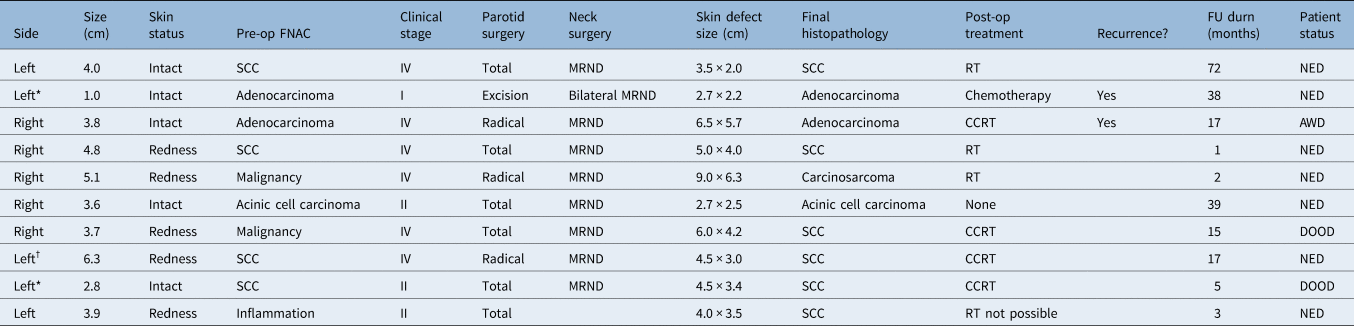
Clinical data of the 10 patients who underwent bilobed flap reconstruction for skin defects after parotid carcinoma surgery are summarised in Table 1. This study included six males and four females. The age of the patients ranged from 52 to 88 years (average, 71.0 ± 12.7 years).
Clinical data of 10 patients who underwent bilobed flap reconstructions for skin defects after parotid carcinoma surgery

*Two patients underwent surgery once for parotid carcinoma. †One patient developed partial flap necrosis in the retroauricular region. Pre-op = pre-operative; FNAC = fine-needle aspiration cytology; post-op = post-operative; FU durn = follow-up duration; SCC = squamous cell carcinoma; MRND = modified radical neck dissection; RT = radiotherapy; NED = no evidence of disease; CCRT = concurrent chemoradiotherapy; AWD = alive with disease; DOOD = died of other disease
Two patients had undergone surgery once previously for parotid carcinoma. Among the 10 lesions, 5 were in the right parotid gland and 5 were in the left. The average size of the parotid carcinoma was 3.9 ± 1.4 cm (range, 1.0–6.3 cm). The pre-operative skin status was intact in five patients; redness was present in five patients. No patient had a degree of necrosis. On pre-operative FNAC, nine patients were determined to have malignancies and one patient had inflammation. Regarding clinical stages, six patients had stage IV disease, three patients had stage II disease and one patient had stage I disease.
Surgical procedure
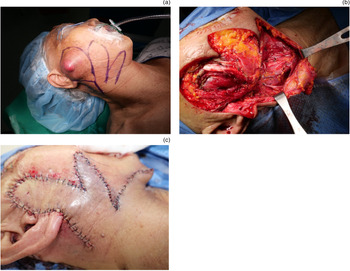
All patients underwent bilobed flap reconstruction for skin defects after parotid carcinoma surgery (Figure 1). The bilobed flaps were designed with a safety margin of at least 1 cm, prior to anaesthetic injection. All bilobed flaps were in equal proportions in terms of the angles and width of the flaps. The widths of the primary and secondary lobes were 75 per cent and 50 per cent of the skin defect, respectively. Sufficient undermining is always important to avoid tension and dog ears.
An 88-year-old female patient with right parotid carcinoma. (a) Bilobed flap design before surgery. (b) Skin defects measuring 9.0 × 6.3 cm after radical parotidectomy and modified neck dissection. (c) Reconstruction of skin defects using a bilobed flap.

The bilobed flaps were rotated and inset. The wounds were sutured with size 4-0 resorbable thread for the subcutaneous layer. The skin edges were reapproximated using size 5-0 nylon sutures in a simple interrupted fashion.
Six patients underwent total parotidectomies, three patients underwent radical parotidectomies and one patient underwent carcinoma excision only. Of the 10 patients, 8 underwent neck dissection. The size of the skin defect was 2.7 × 2.2 cm in the smallest dimension and 9.0 × 6.3 cm in the largest dimension. No major complications resulted from the surgical interventions.
Post-operative management and results
After surgery, all bilobed flaps except one healed without any problems. One patient developed partial flap necrosis in the retroauricular region, and was treated with skin grafts after removal of the necrotic tissue under local anaesthesia.
Post-operative radiotherapy (RT) was attempted in nine patients, but only seven received RT. One patient had previously received RT at the same site and was unable to receive additional RT, so only chemotherapy was performed. The other patient was elderly, and RT could not be performed because of poor general health. All bilobed flaps, including the case in which skin grafts were performed, survived after post-operative RT or chemotherapy.
Recurrence occurred in two patients after surgery and post-operative treatment. One patient with local recurrence is currently under follow up, with no evidence of disease after re-operation and chemotherapy. Local recurrence and systemic metastasis to the chest wall occurred in one patient who is receiving chemotherapy and undergoing observation. Of the 10 patients, 2 died from causes unrelated to cancer during follow up. The mean follow-up period after surgery was 20.9 ± 22.7 months (range, 1–72 months).
Discussion
The bilobed flap procedure is already widely used for reconstruction of the face and neck.Reference Irvine, Larian and Azizzadeh1–Reference Kruse-Lösler, Presser, Metze and Joos7 In this study, we successfully reconstructed the skin defects that occurred after parotid carcinoma surgery using bilobed flaps, in 10 patients.
There are several advantages to reconstructing skin defects after parotid carcinoma surgery using bilobed flaps.Reference Cai, Shui, Li, Sun, Zhou and Liu4–Reference Tamplen, Knott, Fritz and Seth8 First, a bilobed flap has a degree of skin activity that facilitates wound closure.Reference Cai, Shui, Li, Sun, Zhou and Liu4 In advanced parotid carcinoma, RT is required as soon as possible after surgery, and a bilobed flap makes this possible with a high success rate and fewer complications.Reference Kruse-Lösler, Presser, Metze and Joos7,Reference Lee, Yoon, Lee and Lim10 In this study, only one patient had a delay, of approximately three weeks, before post-operative RT, because of flap necrosis; all other patients had RT initiated within one month after surgery. In addition, all bilobed flaps survived after post-operative RT or chemotherapy.
Second, bilobed flaps are relatively easy to harvest in the same surgical field in a short time, compared to free flaps.Reference Cai, Shui, Li, Sun, Zhou and Liu4–Reference Tamplen, Knott, Fritz and Seth8 Neck metastasis often accompanies advanced parotid carcinoma, so it is necessary to perform neck dissection simultaneously with a parotidectomy.Reference Lee, Yoon, Lee and Lim10 In the case of neck dissection, sufficient rotational arcs and tissue coverage are available, making the double flap design or advancement easier.Reference Irvine, Larian and Azizzadeh1 We also performed neck dissections in 8 out of 10 patients, and the flaps were designed before surgery. Skin defects of 9.0 × 6.3 cm in size were reconstructed using bilobed flaps (Figure 1).
• Advanced parotid carcinoma can invade the skin or be close to the skin, and surgical resection including the skin is required to secure a safe margin
• Skin defects that occurred after parotid carcinoma surgery were successfully reconstructed using bilobed flaps, in 10 patients
• All bilobed flaps survived after post-operative radiotherapy or chemotherapy
• A bilobed flap is a good reconstruction option for skin defects after parotid carcinoma surgery in some cases
Third, a bilobed flap has a better colour match to the native face skin.Reference Cai, Shui, Li, Sun, Zhou and Liu4–Reference Tamplen, Knott, Fritz and Seth8 Our patients had scars from surgery, but the colour match with the skin around the face was good.
The complications of bilobed flaps include flap necrosis, wound dehiscence and scar hypertrophy.Reference Cass and Terella9 One of the 10 patients in this study developed flap necrosis due to inadequate vascularity and excessive tension. Fortunately, this patient was well treated with skin grafts after removal of the necrotic tissue under local anaesthesia, and there were no problems during post-operative concurrent chemoradiotherapy.
The surgeon must create a tailored reconstruction plan, taking into account the patient's age, co-morbidities, prognosis, treatment goals and post-operative treatment.Reference Tamplen, Knott, Fritz and Seth8 In this study, bilobed flaps were used to treat skin defects that occurred after parotid carcinoma surgery in patients with an average age of 70 years or older who required post-operative RT.
Conclusion
Parotid carcinoma surgery including skin resection is sometimes encountered in clinical practice. A bilobed flap is a good reconstruction option for skin defects after parotid carcinoma surgery in some cases.
Competing interests
None declared