Antibiotic resistance is a major public health problem and is amplified by patient-to-patient transmission in the healthcare setting. Methicillin-resistant Staphylococcus aureus (MRSA) is an opportunistic bacterial pathogen and an important cause of both community- and hospital-acquired infections. Efforts to control multidrug-resistant pathogens like MRSA depend on rapid identification and treatment of patients combined with epidemiologic investigations and interventions to prevent ongoing transmission. Surveillance for multidrug-resistant pathogens with molecular typing can aid in identifying ongoing transmission and in developing new interventions to prevent spread; however, current typing methods often lack sufficient resolution to allow accurate inferences regarding transmission events.
More effective containment of MRSA in the healthcare and community settings may be possible if rapid and accurate identification of transmission can be accomplished by whole-genome sequencing (WGS). WGS of MRSA has been used to examine outbreaks in a neonatal intensive care unit,Reference Koser, Holden and Ellington 1 , Reference Harris, Cartwright and Torok 2 3 intensive care units,Reference Eyre, Golubchik and Gordon 3 , Reference Miller, Price and Batty 4 several acute-care hospitals,Reference Miller, Price and Batty 4 and community settings.Reference Uhlemann, Dordel and Knox 5 , Reference Alam, Read and Petit 6 In each case, WGS was able to more precisely define and extend the boundaries of the outbreak by capturing additional transmissions that included other patients, individuals, and a healthcare worker who would not have been included using traditional methods. The extended boundaries included isolates with different antibiograms and different spa types. These studies were conducted in settings with a low prevalence of MRSA. WGS has not been used in a setting with a high prevalence of MRSA in which multiple patients are colonized with MRSA for long periods of time, such as long-term care facilities (LTCFs).
Approximately 1.5 million people in the United States reside in ~15,000 LTCFs. 7 In US LTCFs, multidrug-resistant organisms such as MRSA are increasingly important causes of colonization and infection.Reference Smith, Bennett and Bradley 8 Approximately 22%–28% of LTCF residents are colonized with MRSA,Reference Roghmann, Johnson and Sorkin 9 – Reference Crnich, Duster, Hess, Zimmerman and Drinka 13 which can be spread from resident to resident by healthcare workers. From 2005 to 2008, we performed a prospective cohort study to investigate MRSA transmission in multiple LTCFs.Reference Furuno, Shurland and Zhan 14 Thus, we have a unique and well-characterized collection of MRSA isolates and swabs from MRSA-colonized LTCF residents. In this study, we examined the genetic variation (1) between multiple MRSA isolates from 2 body sites per resident to assess the genetic variation within and between body sites and (2) between single MRSA isolates from residents in the same unit to assess the proportion of MRSA colonization attributable to transmission clusters.
METHODS
Study Population and Design
The study population consisted of LTCF residents from the Perry Point VA Medical Center. As part of a larger prospective cohort study conducted from March 2005 to September 2008,Reference Furuno, Shurland and Zhan 14 a single long-term-care unit was followed over two 12-week study periods approximately 1 year apart. This long-term-care unit had a dedicated nursing staff, and its residents were only on this unit during the 12-week study cycle. Residents were stratified by MRSA colonization status based on past clinical and surveillance cultures, which were routinely performed on admission. Cultures for MRSA were obtained weekly from multiple body sites (ie, anterior nares, perineum, axillary skin, and wounds) from residents with known MRSA colonization over 12-week study periods. Simultaneously, culture swabs for MRSA were obtained weekly from the anterior nares and wounds in all residents without known MRSA colonization to detect acquisition. All swab samples, including those from wounds, were cultured to detect colonization. Acquisition was defined as a new positive culture in a resident with no prior history of MRSA whose admission cultures were negative for MRSA by culture and PCR. From the first 12-week cycle, we sequenced 8 MRSA isolates per swab from each of 2 body sites for 6 residents to gain insight into the amount of variation at a single site. The nares comprised 1 body site in each pair of swab samples; the other body sites were wounds (n=2), axilla (n=2), and perineum (n=2). In the present study, 3 pairs of swab samples were selected to have concordant spa types (t008), and 3 pairs of swab samples were selected to be discordant (t008 and either t045 or t002) based on previously typed single isolates. For the second 12-week cycle, we sequenced 1 MRSA isolate from each body site of the all residents who had or acquired MRSA to define transmission clusters and to estimate resident-to-resident transmission.
Laboratory Methods
All study cultures for research were collected by a research nurse using a rayon-tipped swab with Amies transport medium (BactiSwab; Remel, Lenexa, KS). All swabs were streaked for isolation onto tryptic soy agar containing 5% sheep blood agar (Remel, Lenexa, KS). Plates were incubated at 37°C for 48 hours. Isolates were characterized as S. aureus by catalase and coagulase production (Pastorex, Bio-Rad Laboratories, Hercules, CA). S. aureus isolates were plated on oxacillin (6 µg/mL) agar screen plates and incubated at 37°C. Growth on the oxacillin agar screen was classified as oxacillin resistant (ie, MRSA).
Molecular Typing
When multiple MRSA cultures were available from the same resident and same body site, the earliest date with a positive culture was chosen for analysis. Chromosomal DNA was extracted from cells after growth in an overnight culture of tryptic soy broth at 37°C using previously described methods.Reference Miller and Diep 15 In brief, cells were lysed using 1:5 ratio of lysostaphin to cell suspension incubated at 37°C for 2–3 hours. DNA isolation was performed using the Prepman Ultra DNA extraction kit (Applied Biosystems, Foster City, CA). Each MRSA isolate was also characterized by the DNA sequence of the protein A (spa) gene hypervariable region.Reference Harmsen, Claus, Witte, Rothganger, Turnwald and Vogel 16 The spa repeats were defined based on comparison to the sequences in the database at http://www.ridom.de/spaserver.
Whole-Genome Sequencing
Frozen isolates and the original swabs frozen in glycerol were used for both analyses. The selected isolates were streaked; single colonies were selected and cultured overnight in brain-heart infusion (BHI) broth. DNA was then isolated using Qiagen columns (Qiagen, Valencia, CA). A ~350-bp library was prepared from DNA, sheared by a Covaris S2 sonicator (Covaris, Wolburn, MA), using the Nextera kit (Illumina, San Diego, CA). Libraries quantified using Picogreen (Nanodrop Fluorimeter 3300, Wilmington, DE) from 48 isolates were mixed at equal concentrations. The mixed libraries were sequenced using Illumina Hiseq 2500 (Illumina, San Diego, CA) using 100-bp paired-end reads. The reads were separated based on the barcodes indicative of the library.
Whole-Genome Assembly and Phylogenetic Analysis
Isolates were mapped to the reference genome of MRSA USA300 using SMALT v0.7.4. Regions containing mobile genetic elements were excluded from the analysis. An in-house pipeline using SAMtools and BCFtools was used to call bases. To call only high-quality bases, our method required at least 75% of high-quality mapped reads on each strand to agree with the base call, a base quality of at least 50, and a mapping quality of at least 30. Sequence reads that mapped equally well to >1 region were discarded to avoid mapping repetitive regions. Single-nucleotide variants (SNVs) were identified using a standard approach.Reference Harris, Feil and Holden 17 Maximum likelihood trees were constructed using RAxML based on variable positions in the whole-genome alignment.Reference Stamatakis 18 Tree files were viewed using FigTree v1.4.2.
RESULTS
MRSA Diversity Within and Between Body Sites on Residents
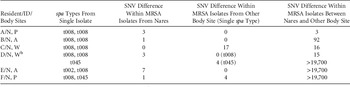
During the first 12-week study cycle, we examined 6 residents (labelled A-F) who were positive for MRSA at 2 of 4 different body sites. A frozen swab from each body site was streaked on selective media and 8 isolates were picked and sequenced for a total of 96 (Supplemental Table). With 2 exceptions, the isolates at each body site were very closely related to other isolates from the same site, differing at 7 or fewer SNVs (Table 1). For 6 of 12 body sites, the 8 isolates per body site differed at 1 or 0 sites. The 2 exceptions were both swabs from wounds. The wound from resident C revealed 2 closely related groups of isolates; 13 of 28 pairwise comparisons of the genotypes differed by 1 or 0 SNV, while the other 15 pairwise comparisons differed by 9 to 17 SNVs. The wound from resident D had 2 distinct genetic strains; 6 isolates differed by less than 4 SNVs and differed by >19,700 SNVs from the other 2 isolates, which did not differ from each other. Similar large differences (>19,700 SNVs) were seen among residents D, E, and F, who were chosen because a previously typed MRSA isolate from their body sites had distinct spa types. In contrast, those isolates with the same spa type from different body sites on different residents showed smaller differences (6–108 SNVs), but these differences were still generally larger than those from different sites within an individual (0–17 SNVs).
Single-Nucleotide Variant (SNV) Differences Within and Between 2 Body Sites on the Same Resident for 6 Residents From the First 12-Week Study CycleFootnote a

NOTE. ID, identification; MRSA, methicillin-resistant Staphylococcus aureus; N, nares; A, axilla; P, perineum; W, wound without active infection.
a 8 MRSA isolates were sequenced from each body site. Maximum number of SNV differences recorded except for alternative spa types when a lower bound was recorded.
b 2 spa types in 1 body site.
MRSA Genetic Diversity Between Residents on a Unit
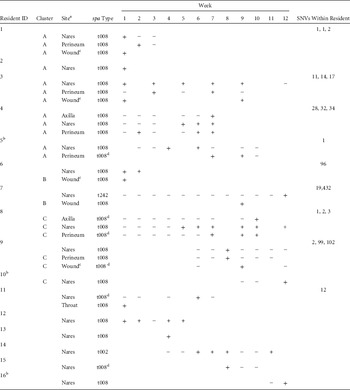
During the second 12-week study cycle, there were 52 residents on the unit; 51 participated in the study. We examined frozen MRSA isolates from all residents with MRSA colonization including 3 residents with newly detected MRSA acquisition. Among the 51 residents who were sampled, 16 residents (labelled 1–16) with MRSA colonization were positive at a total of 30 body sites (Table 2). All 30 isolates were successfully sequenced (Supplemental Table), and the SNVs between genotypes were determined; 28 isolates were spa type t008. The remaining 2 isolates were spa types t002 and t242. WGS confirmed that these isolates were distinct from each other (differing at 174 nucleotides) and from the rest (differing by >16,515 nucleotides).
Residents With MRSA Colonization by Week During the Second 12-Week Study Cycle

NOTE. ID, identification; SNV, single-nucleotide variant; MRSA, methicillin-resistant Staphylococcus aureus. MRSA-positive swabs are indicated by +; MRSA-negative swabs are indicated by −; missing values indicate that the resident was not on the unit for swab collection or the swab was not taken; MRSA samples used in the analysis are indicated by bold font.
a Only body sites with positive cultures are shown.
b Residents acquired MRSA.
c Without active infection.
d Inferred spa type t008 based on positive pvl and acme PCR tests.
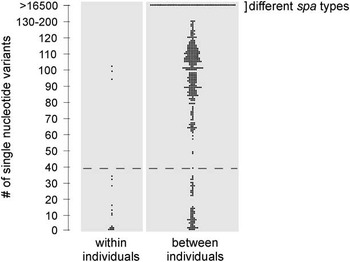
As in the first study cycle, SNVs were observed between t008 isolates from distinct body sites on the same individual. We identified 8 residents with t008 MRSA colonization at >1 body site (Table 2). The MRSA isolates may have differed only a few nucleotides (≤3 SNVs, as seen in residents 1, 5, and 8) or by a small number of nucleotides (11–36 SNVs, as seen in residents 3, 4, and 11) or by a larger number of nucleotides (96–102 SNVs, as seen in residents 6 and 9). The majority of isolates within individuals differed by <40 SNVs (Figure 1 and Supplemental Figure 1).
Single-nucleotide variant differences within the same resident and between residents for 30 methicillin-resistant Staphylococcus aureus (MRSA) isolates from 16 residents during the second 12-week study cycle.

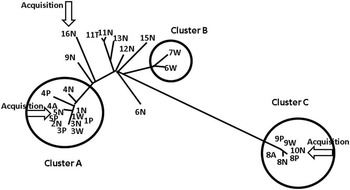
The genetic relatedness of the 28 t008 MRSA isolates is shown in a phylogenetic tree in Figure 2. Each of the 3 circles indicates a cluster of multiple isolates with a genotype that differs by <40 SNVs. The 2 larger clusters each contain 1 isolate that was epidemiologically identified as an acquisition. Cluster A has 12 isolates from residents 1–5. The maximum distance between genotypes in this cluster is 34 SNVs between 2 isolates from different body sites on resident 4. Resident 4 is also resident D and was present on the unit during both study cycles. Resident 4 antedates all of the other second study-cycle residents. Furthermore, 2 of the residents (1 and 2) present at the start of the cycle had isolates whose genotypes differed by 2 SNVs from the isolate of resident 5 (which was an epidemiological acquisition). Cluster B comprised 2 wound isolates from residents 6 and 7; the distance between them was 33 SNV. Although the nares isolate of resident 6 might be expected to be in this cluster, it had a distinct spa type (t242 instead of t008). Cluster C had 6 isolates from 3 residents; the maximum difference between genotypes in this cluster was 11 nucleotides. Resident 8 was present at week 0 and had 3 positive body sites. Resident 9 was admitted in week 5 and also had MRSA at 3 positive body sites; 2 of these differed from those of resident 8 by 2–11 SNVs. The third isolate 9N was not in the cluster; it differed by >250 SNVs. The last isolate in this cluster was from resident 10, who was admitted in week 8 and acquired MRSA in the nares in week 12. This isolate differed from the perineal isolate of resident 9 by 6 SNVs.
Genetic relatedness of 28 methicillin-resistant Staphylococcus aureus (MRSA) isolates of t008 spa type from 15 residents assessed using whole-genome sequencing. Isolates are labelled with resident identification (ID) and body site of MRSA isolation: N, nares; W, wound; T, throat; P, perineum; and A, axilla. Circles enclose clusters of isolates from >1 individual that are <40 SNVs apart.

DISCUSSION
Our WGS analyses of selected MRSA isolates from residents in LTCFs produced systematic patterns of genetic relatedness that may be interpreted for improved understanding of transmission clusters on a unit. The cluster identified the patients associated with likely transmission events and unambiguously defined patients who were not part of the cluster, but it did not define specific patient-to-patient transmission events.Reference Didelot, Gardy and Colijn 19 Traditional epidemiological evidence is required to define patient-to-patient transmission. The inability to define specific transmission events stems from the significant amount of variation observed within and between body sites.Reference Worby, Lipsitch and Hanage 20 Despite this limitation, the presence of a transmission cluster shows that patient-to-patient transmission did occur.
Genetic variation in a single body site tended to be very small. In general, the variation was <7 different nucleotides. In our sample, there were 2 exceptions; both were isolates from wound cultures. Resident C’s wound had isolates that differed by 9–17 nucleotides, which may have resulted from a single older colonization event or from 2 separate colonization events. Resident D’s wound had genotypes that differed by >19,000 SNVs and were characteristic of 2 unrelated spa types (t002 and t008). If the isolates from each wound were divided into groups based on the isolate genotypes, then there were 4 genotype groups and the variation within the genotype group was <4 SNVs. Because the colonization with MRSA isolates that had different spa types must have resulted from 2 independent acquisitions (or 1 acquisition of 2 genetically distinct strains), the same explanation can be applied to resident C’s wound, ie, it was the result of either 2 acquisitions or a single acquisition with 2 genetically distinct strains. Because of our small sample size and sampling methods in the first study cycle (in which we selected for cultures with >1 spa type), we cannot say whether multiple colonizations in a single body site were more common in wounds or how frequently multiple colonizations occurred at other body sites.
Colonization at each body site on the same individual represents at least 1 colonization event and perhaps more. These results extend the observation of 2 genetically distinct strains in 2 distinct wound samples, as discussed above. Although it has been described previously that 2 body sites may carry MRSA from 2 genetically distinct strains, ie, distinct spa types exemplified by resident 7 (t008 and t242 differing by 17,265 SNVs), our observation extends the number by adding genetically distinct strains from the same spa type. For example, residents 6 and 9 had isolates that differed by approximately 100 SNVs, even though all of the isolates were spa type t008.
Genetic variation of isolates from distinct body sites on the same resident and from different body sites on different residents ranged across the entire spectrum from a single SNV to >19,000 SNVs. Although a wide range of values was observed, the variations seemed to fall into 3 categories: <40 SNVs, 60–130 SNVs and different spa types, or >19,000 SNVs. A decision to use 40 SNVs as a cutoff for being from the same individual was also proposed by Price et alReference Price, Golubchik and Cole 21 for determining patient-to-patient transmission in an ICU. Our data are consistent with previous data; isolates that differ by <40 SNVs can be considered to come from the same transmission cluster, whereas those isolates that are genetically distinct came from separate sources.
When we assessed the 30 MRSA isolates with spa type t008 from 16 residents on the unit during the second study cycle (Figure 2), 3 clusters of isolates from multiple residents were apparent. All isolates within a single cluster can be considered to be the same transmission cluster. Cluster A included 12 body sites on 5 residents, 1 of whom (resident 4) was present during the first study cycle. However, the first-cycle isolates of resident 4 differed from those of the second cycle by 57 to 67 SNVs and thus belonged to different clusters. Examining the epidemiologic data, of these 5 residents, only resident 5 arrived on the unit after the study cycle started. We infer that he was infected by 1 of these 4 residents; however, the actual transmitter cannot be identified because sequenced isolates may not represent all of the genetic variants at each site. The most obvious cases in point are the examples of 2 genetically distinct strains in a single infection. Another example of inferred transmission from epidemiological data occurred in transmission cluster B. The genotypes of isolates from wounds on 2 different residents are consistent with a resident-to-resident transmission event. Based on the dates of stay, we can infer the likely transmission from resident 6 to 7. Transmission cluster C contains 6 body sites on residents 8, 9, and 10. Examining the epidemiologic data, resident 8 was previously colonized and was present on the unit from the beginning of the study cycle; this resident was the likely source for resident 9, who arrived on week 5, but the source for the colonization of resident 10, who arrived in week 8, is uncertain.
Of the 3 acquisitions detected by surveillance cultures, 2 acquisitons were due to resident-to-resident transmission events. This rate was substantially higher than the rate recently reported by Price et alReference Price, Golubchik and Cole 21 in an intensive care unit. We used a very restrictive definition of acquisition, which required no prior history of MRSA colonization and negative admission surveillance tests for MRSA by culture and PCR. Our definition minimizes new acquisitions that are due to false-negative admission tests; however, it discounts MRSA acquisitions of new strains that occur in residents with pre-existing MRSA colonization. An advantage of WGS is that it readily detects these acquisitions.
In our study, isolates from many residents occurred in transmission clusters of MRSA, which implies substantial levels of resident-to-resident transmission. We found that 63% of the residents colonized with MRSA during the second study cycle shared 1 of 3 strains, where the SNV differences were <40 between isolates from different individuals. We caution that this is a small sample size from a single site in need of expansion and replication. However, if the initial findings are confirmed, it may be more accurate to perform point prevalence surveys for MRSA and then analyze them using WGS to detect which residents have transmitted MRSA to other residents. This could move us closer to a future in which WGS is a routine component of public health surveillance.
ACKNOWLEDGMENTS
The authors acknowledge the valuable contributions of several colleagues: Deborah Grady, RN, MS, for collection of study specimens and resident data; Alison Lydecker, MPH, for assistance with data analyses; Elizabeth Humphries for assistance with figure creation; and Gwen Robinson, MPH, and Simone M. Shurland, PhD, for their assistance with the performance and interpretation of laboratory testing.
Financial support: This work was supported by a Veterans Affairs Merit Award (to M.R.), the Centers for Disease Control and Prevention (grant no. R01CI000369 to M.R.), and the University of Maryland General Clinical Research Center (grant no. M01RR16500). The contents do not represent the views of the U.S Department of Veterans Affairs or the United States Government.
Potential conflicts of interest: All authors report no conflict of interest relevant to this article.
SUPPLEMENTARY MATERIAL
To view supplementary material for this article, please visit http://dx.doi.org/10.1017/ice.2016.41