Introduction
By serving as lifelines between the public and prehospital care, 9-1-1 dispatch centers are at the heart of disaster and emergency response efforts. These efforts rely on effective communication with callers to gather accurate information during an emergency and with 9-1-1 telecommunicators (also referred to as dispatchers) to relay essential information to first responders for appropriate care. The 9-1-1 telecommunicators work to quickly determine the location and nature of an emergency in order to send the appropriate response (eg, police, fire, medical) as well as to effectively communicate safety or medical instructions. Unfortunately, such efforts can be hampered by cultural and language barriers, distrust of warning messages or instructions, and reluctance to engage the 9-1-1 system. These barriers are particularly common among limited local language proficient (LLLP) populations.Reference Andrulis and Brach1 Such barriers render LLLP populations disproportionately vulnerable during an emergency or a disaster, as lessons from hurricane Katrina have demonstrated, and subsequently tax the relationship between LLLP communities and emergency response workers.Reference Andrulis, Siddiqui and Purtle2-Reference Andrulis, Siddiqui and Gantner4
The number of individuals in the US who speak a language other than English at home has increased by 43.5% since 1990, reaching a total of over 59 million individuals in 2010; however, English is the predominant language.5, 6 As a result, studies in the US typically use the term limited English proficient (LEP) in lieu of limited local language proficient (LLLP). In King County, Washington, the location of this study, English is the dominant language, but nearly half a million residents speak a language other than English at home, over 45% of whom report speaking English “less than very well.”6 A recent California study emphasized the importance of providing language services during emergencies or disasters to help LEP populations receive more appropriate and higher quality services due to such increases in language barriers.Reference Andrulis, Siddiqui and Purtle2 Studies in emergency departments and clinical settings continue to demonstrate the importance of interpreters to help LEP individuals efficiently interact with and benefit from systems designed for English speakers.Reference Hacker, Choi and Trebino7-Reference Karliner, Jacobs, Chen and Mutha9 During a 9-1-1 call, 9-1-1 telecommunicators and LEP callers alike can experience confusion and frustration in the crucial moments of information exchange due to language barriers. Telecommunicators may connect to an over-the-phone interpreter (OPI) who can interpret instructions in the appropriate language; however, this three-way communication also comes with a set of challenges.Reference Meischke, Chavez, Bradley, Rea and Eisenberg3
According to a recent nationwide study of law enforcement agencies, police officers arrived on scene prior to emergency medical services in 70.7% of medical emergency calls, and 46.7% of police officers provided initial medical care.Reference Hawkins, Shapiro, Sever, Delbridge and Mosesso10 These officers rely on information gathered from 9-1-1 police telecommunicators. However, to date, there is little published on the relationship between LEP callers and 9-1-1 police telecommunicators, and the role of OPI services during these calls. This study assessed communication strategies and barriers that telecommunicators encounter while interacting with LEP callers during emergencies, including factors associated with use of OPI services. Results from this survey may inform emergency and disaster response efforts by illustrating the challenges 9-1-1 police telecommunicators face with LEP callers and highlighting potential strategies to ensure effective emergency communication.
Methods
Two 9-1-1 police dispatch centers serving large metropolitan cities in King County participated in a paper-based survey. The 9-1-1 police telecommunicators working at these centers were asked to complete an anonymous survey about their experiences with LEP callers. Participation was completely voluntary and surveys were distributed directly to the 9-1-1 police telecommunicators who were then asked to return the surveys within one week of distribution. The survey included 13 multiple-choice and three open-ended questions. This study was reviewed and approved by the Institutional Review Board of the University of Washington.
Survey Design
The survey included the following participant demographics: years working as a telecommunicator, gender, age and race/ethnicity. The survey asked the telecommunicators to report how often they encounter the following, on a six-point scale (from never to more than once a day): (1) callers who speak limited English; (2) language barrier calls that affect their ability to provide assistance to the callers; and (3) language barrier calls that affect their ability to assess the situation with respect to officer safety. The survey asked the telecommunicators to report how often they access OPI services when they receive a call from someone with limited English abilities (on a five-point scale from almost never to almost always), and to report how commonly they encounter the following challenges with OPI services (on a four-point scale from never to always): (1) long waiting times to connect to an interpreter; (2) difficulty accessing an interpreter for less common languages; (3) difficulty understanding the interpreter; (4) challenges in getting information quickly; and (5) technical difficulties such as poor sound quality or dropped calls.
Telecommunicators were also asked to indicate the most commonly used communication techniques with limited English proficient callers, such as repeating words or phrases and using OPI services. Additionally, telecommunicators were asked to rate their stress level when receiving a call from someone with limited English abilities compared with calls from fluent English speakers and to indicate their level of training for working with LEP callers (each on five-point scales from not at all stressful to very stressful, and from in need of much more training to more than enough training, respectively). Lastly, open-ended questions asked telecommunicators to describe the biggest challenges they face in handling LEP calls; to indicate what LEP callers need to know prior to calling 9-1-1 to facilitate effective communication; and to describe any other difficulties they have encountered while utilizing OPI services.
Analysis
All survey responses were entered into IBM SPSS Version 19 (IBM, Armonk, New York, USA). The brief responses to the open-ended questions were categorized by one of the authors based on recurring themes, and a sample of surveys (five percent) was independently coded by another member of the research staff to ensure the same assignment of themes occurred between researchers. Descriptive statistics were done with all survey responses and the responses were further evaluated by telecommunicator demographics. Goodman-Kruskal Gamma and chi-square tests were conducted to assess associations between (1) use of OPI services with LEP callers and (2) all of the survey responses with the exception of the question about the most commonly used communication techniques with LEP callers and the three open-ended questions.
Results
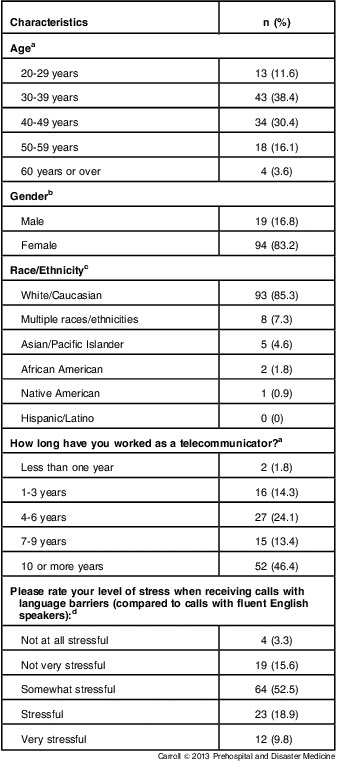
Of 141 surveys distributed to the two 9-1-1 police dispatch centers, 123 were returned (87.2%), with both centers equally represented. However, sample sizes varied for each question, as not all respondents answered every question. The telecommunicators surveyed were predominantly white women aged 30-49 years who had been working as 9-1-1 police telecommunicators for more than seven years (Table 1).
Characteristics of Survey Respondents

an = 112.
bn = 113.
cn = 109.
dn = 122.
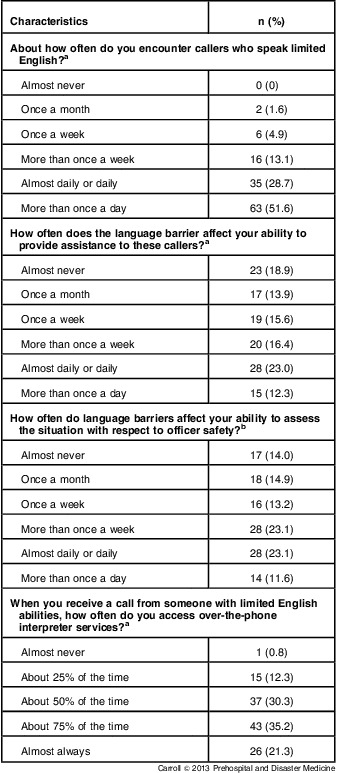
Ninety-eight (80.3%) of the surveyed telecommunicators reported encountering LEP callers almost daily or more often. More than half of the telecommunicators reported that language barrier calls affect their ability to provide assistance to the caller more than once a week (n = 63; 51.7%) and also affect their ability to assess officer safety more than once a week (n = 70; 57.8%) (Table 2). Additionally, 35 (28.7%) telecommunicators reported language barrier calls as more stressful than those with fluent English speakers (Table 1).
Experiences of Survey Respondents Serving LEP Callers

an = 122.
bn = 121.
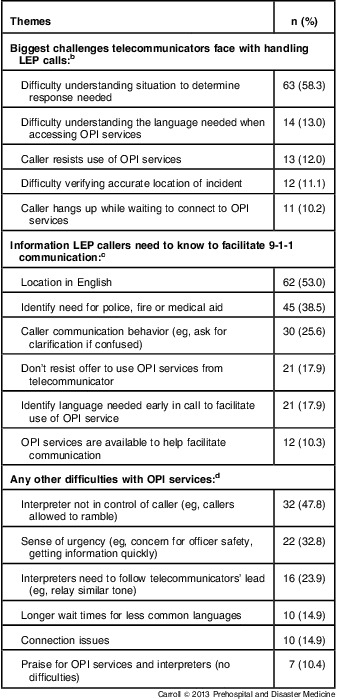
In the open-ended questions, telecommunicators identified difficulty in quickly understanding the situation to determine response needed as the biggest challenge with LEP callers. This need for urgency and clarity is reiterated in the information telecommunicators indicated LEP callers should know prior to calling 9-1-1, especially the ability to state their location in English; state whether the emergency required police, fire or medical aid; and to demonstrate helpful communication behavior, such as answering questions succinctly and asking for clarification when needed. Furthermore, telecommunicators reported needing the callers to identify what language they speak early in the call to minimize delays in connecting to an interpreter, and not to resist OPI services (Table 3). Additionally, 69 (56.5%) telecommunicators reported that they use OPI services at least 75% of the time when they receive a call from someone whom they perceived to speak with limited English abilities (Table 2).
Themes of Responses for Open-ended Survey QuestionsFootnote a

Abbreviations: LEP, limited English proficient; OPI, over-the-phone interpreter.
a Sample sizes and percentages for each question will vary as not all telecommunicators responded to every question and some may have described multiple themes. Only themes with percentages >10% are listed.
b n = 108.
c n = 117.
d n = 67.
Of the bivariate analyses, only stress level was significantly associated with use of OPI services. Telecommunicators who perceived language barrier calls as more stressful than fluent English calls also reported using OPI services with a higher frequency (Goodman-Kruskal Gamma test, P < .01). As stress level was the only variable significantly associated with use of OPI services, survey responses were further evaluated for associations with stress level during LEP calls. Notably, difficulties assessing the situation with respect to officer safety were reported more frequently among telecommunicators who identified LEP calls as more stressful than calls with fluent English speakers (Goodman-Kruskal Gamma test, P < .01). When connected with OPI services, 77 (65.8%) telecommunicators reported challenges getting information quickly at least most of the time. Telecommunicators reported both long waiting times to connect to an interpreter (n = 111, 95.7%) and technical difficulties as occurring less than some of the time (n = 108, 92.3%). Lastly, when telecommunicators were asked to identify any other challenges when utilizing OPI services, they expressed the need for OPIs to be in more control of the caller, such as relaying a similar tone of speech as the telecommunicator, and requested that the OPIs actively keep the telecommunicator aware of the situation by interpreting everything they hear (Table 3).
Discussion
This study explored the experiences of 9-1-1 police telecommunicators with LEP callers during emergencies, and investigated how these telecommunicators perceive and utilize OPI services. The survey responses emphasize the regularity with which the 9-1-1 police telecommunicators encounter LEP callers, and are consistent with a recent study conducted with 9-1-1 medical telecommunicators.Reference Meischke, Chavez, Bradley, Rea and Eisenberg3 The results highlight an association between telecommunicator stress levels during LEP calls compared with calls with fluent English speakers and use of OPI services. This positive association could conceivably be in either direction, or occur in both directions in different circumstances. Stress during LEP calls may encourage police telecommunicators to use the OPI services in order to better assess the situation. Alternatively, the process of managing three-way communication during LEP calls may increase stress among the telecommunicators.
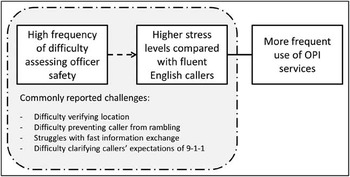
The survey responses highlight a connection between concern for officer safety, stress, and the use of OPI services (Figure 1). One interpretation of the survey responses suggests that 9-1-1 police telecommunicators may become more stressed during LEP calls in part due to the struggle to assess the situation with respect to officer safety. Among emergency services personnel, studies demonstrate high levels of stress associated with the pressure of effectively assessing the situation to provide the appropriate emergency response.Reference Boudreaux, Mandry and Brantley11, Reference Donnelly12 A New Jersey study of 9-1-1 police telecommunicators identified three major factors contributing to high occupational stress including a high level of responsibility to others.Reference Burke13 While these stressors occur during calls with fluent English and limited English speakers alike, such occupational stressors may be exacerbated by communication barriers during calls with limited English speakers.
Proposed Relationship of Assessing Officer Safety, Stress, and Use of OPI Services Abbreviation: OPI, over-the-phone interpreter

The responses from this survey also illustrate potential strategies to improve emergency communication with LEP populations and LLLP populations in settings where another language is dominant. Interventions focused both on 9-1-1 police telecommunicators and LLLP callers may enable the telecommunicators to better serve the callers by reducing barriers to communication. Community-based interventions with the goal of educating LLLP communities about communication behavior during a 9-1-1 call, such as providing the location of the incident and knowing to say “police, fire, or medical,” in the dominant local language may help facilitate communication with telecommunicators. Additional efforts should ensure that LLLP communities are aware of available OPI services and are encouraged to utilize them. In concert, 9-1-1 police telecommunicators could receive additional training specific to handling LLLP calls such as: strategies on how to best utilize an OPI, how to gather information more quickly and accurately by using very simple language, or methods to help telecommunicators manage stress associated with concern for officer safety. Moreover, ensuring OPI staff receives training to specifically address challenges associated with handling 9-1-1 calls may also facilitate improved communication.
Limitations
The survey responses highlight key themes in emergency communication with LEP callers, yet study limitations do exist. Although only two 9-1-1 police dispatch centers were surveyed, these centers serve large, diverse metropolitan areas with high call volumes. And while emergency situations may result in similar challenges for English speakers, the survey questions were deliberately worded to understand the unique communication exchange with LEP callers. While the self-reported responses illustrate only the perceptions of the 9-1-1 police telecommunicators, these perceptions are crucial in determining how the telecommunicators understand and interact with LEP callers. Lastly, due to the cross-sectional nature of surveys, directionality of associations identified in this survey cannot be assessed. However, this analysis provides important insight into emergency communication with LEP callers and highlights opportunities for interventions to improve communication with them.
Future Research
Further research will be necessary to better understand the relationship between concern for officer safety, stress with LLLP calls, and the use of OPI services. While there is evidence identifying high level of responsibility to others, such as concern for officer safety, as major causes of stress among 9-1-1 telecommunicators, future research should focus on elucidating the relationship. There is, however, less evidence to determine the directionality of the relationship between stress and use of OPI services. Additional research is needed to better understand how they interact during LLLP calls.
Conclusion
During an emergency, 9-1-1 police telecommunicators serve as lifelines to the community, and the information gathered during the call impacts the prehospital care a caller receives from the first responders. This study sought to understand the 9-1-1 telecommunicators’ perspective on handling LEP calls in order to provide an important step toward understanding what needs to be done to improve communication during these challenging calls. Moreover, the key lessons identified from this survey extend beyond English-dominant settings and could inform strategies to help LLLP populations interact with any local emergency system. The survey responses highlight relationships between assessing officer safety, stress levels, and OPI use which could inform interventions designed to improve communication, reduce barriers to three-way communication, and provide techniques to manage stress associated with concern for officer safety. Such interventions designed for 9-1-1 police telecommunicators and LLLP callers may, in concert, help facilitate less stressful, more efficient information exchange; consequently improving the prehospital care the first responders provide. Further research evaluating communication strategies and resources available to 9-1-1 police telecommunicators and LLLP callers may continue to provide insight on best communication practices to provide appropriate care and manage concern for officer safety.
Acknowledgements
The contents of this paper are solely the responsibility of the authors and do not necessarily represent the views of the Centers for Disease Control and Prevention.