Introduction
One of the diagnostic criteria for anorexia nervosa (AN) in the DSM-V (American Psychiatric Association, 2013) is the undue influence of weight and shape on self-evaluation. Self-evaluation can be influenced by many factors, one of which is body images in the media. There is evidence for a negative effect of the current thin-ideal presented in the media as well as the presentation of emaciated female bodies as ‘thinspiration’, e.g. on pro-eating disorder websites, on body dissatisfaction and eating pathology (Rodgers et al. Reference Rodgers, Lowy, Halperin and Franko2016).
In recent years, AN has been increasingly evaluated within the framework of aberrant reward reactions. It is suggested that reward pathways play a crucial role in the pathogenesis and maintenance of AN (Kaye et al. Reference Kaye, Wierenga, Bailer, Simmons and Bischoff-Grethe2013). ‘Reward contamination’ theory proposes that overlapping neurocircuits which process reward and punishment (e.g. the fronto-striatal neurocircuit) could lead to the processing of typically punishing or aversive stimuli, for example emaciated bodies, as rewarding (Keating, Reference Keating2011).
Our group investigated the effect of exposure to body image stimuli in adolescents with AN using event-related potentials (ERPs) (Horndasch et al. Reference Horndasch, Heinrich, Kratz and Moll2012). The ERP methodology is advantageous when compared to other imaging methods, due to its high temporal resolution of stimulus processing. We focused on the late positive potential (LPP), a sustained deflection in the electroencephalography (EEG) which can last several seconds, located over centro-parietal brain regions starting around 300–400 ms after stimulus onset (Schupp et al. Reference Schupp, Flaisch, Stockburger and Junghofer2006). The LPP is hypothesized to reflect the sustained attentive processing of arousing or motivationally significant stimuli (Cuthbert et al. Reference Cuthbert, Schupp, Bradley, Birbaumer and Lang2000). Manipulations of approach motivation – e.g. changes in physical posture – influence LPP amplitude (Price et al. Reference Price, Dieckman and Harmon-Jones2012).
The LPP consists of multiple and overlapping positivities with varying topography and therefore can be divided into early and late subcomponents. Early positive deflections with a posterior topography beginning as soon as 300–450 ms after picture onset are indicative of a more automatic processing stage and sensitive to intrinsic factors like emotional category of stimuli. In contrast, the LPP in later time windows has a more central topography and seems to reflect deeper and sustained processing as well as cognitive evaluation of stimuli (Hajcak et al. Reference Hajcak, MacNamara and Olvet2010). In the context of substance abuse disorders as well as behavioral addictions, the LPP has been interpreted as a marker of motivated attention has and has repeatedly been shown as being enhanced when participants are presented with addiction-related stimuli (Herrmann et al. Reference Herrmann, Weijers, Wiesbeck, Boning and Fallgatter2001; McDonough & Warren, Reference McDonough and Warren2001; Franken et al. Reference Franken, Dietvorst, Hesselmans, Franzek, van de Wetering and Van Strien2008; Robinson et al. Reference Robinson, Versace, Engelmann, Cui, Slapin, Oum and Cinciripini2015). Pathological gamblers displayed enhanced LPP amplitudes in reaction to gambling-relevant, but not gambling-irrelevant cues, possibly reflecting enhanced ‘cue reactivity’ (Wolfling et al. Reference Wolfling, Morsen, Duven, Albrecht, Grusser and Flor2011).
In our pilot study comparing adolescent girls suffering from AN with typically developing girls, we found that AN patients had the highest amplitudes of the LPP in both the early and late time windows when looking at underweight female bodies compared with normal weight and overweight bodies. Typically developing girls showed the highest amplitudes in the early time window when viewing overweight images, while normal weight images elicited higher amplitudes in the late time window (Horndasch et al. Reference Horndasch, Heinrich, Kratz and Moll2012). These results suggest that the LPP may not only code emotional valence of stimuli. As parallels between AN with compulsive weight loss behavior and substance addiction have been drawn (Scheurink et al. Reference Scheurink, Boersma, Nergardh and Sodersten2010; Zink & Weinberger, Reference Zink and Weinberger2010; Kaye et al. Reference Kaye, Wierenga, Bailer, Simmons and Bischoff-Grethe2013; Godier & Park, Reference Godier and Park2014; Park et al. Reference Park, Godier and Cowdrey2014), it is possible that enhanced LPP amplitudes reflect motivational salience of underweight figures in AN.
Some studies have shown a decreased amplitude of neural components, such as the P300 and LPP, during childhood and adolescence into early adulthood (Segalowitz et al. Reference Segalowitz, Santesso and Jetha2010; MacNamara et al. Reference MacNamara, Verges, Kujawa, Fitzgerald, Monk and Phan2016). Adolescence is a critical age for the onset of eating disorders and there is a high probability of chronic illness (Arcelus et al. Reference Arcelus, Mitchell, Wales and Nielsen2011; Smink et al. Reference Smink, van Hoeken and Hoek2012). Developmental effects of the evaluation of other bodies have been shown: healthy adolescent girls rate thinner women's figures more positively than healthy adult women (Baluch et al. Reference Baluch, Furnham and Huszcza1997). However in patients with AN, group differences regarding weight overestimation and an attractiveness bias toward extremely underweight figures were larger for adults than adolescents (Horndasch et al. Reference Horndasch, Heinrich, Kratz, Mai, Graap and Moll2015). While there is information about changes in image appraisal throughout both normal and abnormal development, there is a lack of research on developmental effects of biological alterations in AN. Understanding whether certain biological markers are stable or evolve during early stages of the disorder, and what markers might be related to chronicity, is missing from the literature and could be helpful for diagnosis and treatment of AN.
We aimed to investigate different aspects of responses toward body shapes, measured via the LPP (more automatic v. more conscious) with a standardized but naturalistic stimulus material to specifically look at effects which might occur in reaction to moderately v. extremely underweight and overweight body images. To do so, we created a stimulus set of photographic body pictures of women with a body mass index (BMI) ranging from 13.5 to 65 kg/m2, which were assessed concerning their weight and attractiveness by AN patients and control participants (Horndasch et al. Reference Horndasch, Heinrich, Kratz, Mai, Graap and Moll2015). Based on the findings of our pilot study, we expected enhanced amplitudes of the LPP in response to extremely underweight female bodies for AN patients. By including adolescent and adult patients and corresponding control groups (2 × 2 design), we were able to study developmental effects of aberrant processing of body images and examine whether potential group differences on the electrophysiological level would be stronger in more chronically ill adult patients compared with adolescents.
Methods and materials
Participants
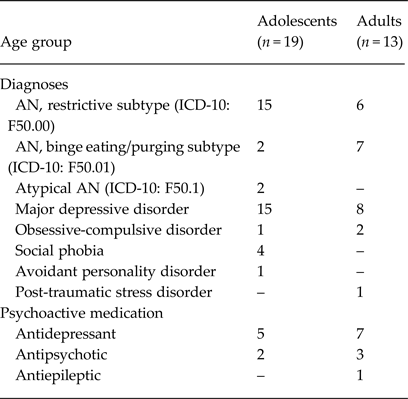
Participants consisted of 19 female adolescents aged 12–17 years old and 13 adult women aged 18–35 years old fulfilling the International Classification of Diseases [ICD-10 (1993)] criteria for AN (see Table 1 for AN subtypes) and 16 typically developing adolescent girls and 21 healthy adult women in the same age range. Written informed consent was obtained from all participants and from the adolescents’ parents.
Diagnoses (AN subtypes and comorbidities) and psychoactive medication taken at the time of the experiment in adolescent and adult AN patients

AN patients were recruited at the Department of Child and Adolescent Mental Health and the Department of Psychosomatics and Psychotherapy at the University Clinic Erlangen at the beginning of an inpatient treatment program and received their diagnosis by an experienced psychiatrist or psychologist using the ‘Diagnostic System for Mental Disorders for Children and Adolescents (DISYPS-KJ)’ (Döpfner et al. Reference Döpfner, Görtz-Dorten and Lehmkuhl2008) in adolescents and the ‘Structured Diagnostic Interview for Mental Disorders (DIPS)’ (Schneider & Margraf, Reference Schneider and Margraf2006) in adults.
Exclusion criteria for the control group were current or history of psychiatric disorder, learning disabilities, obesity and severe somatic issues, including neurological disease. Control participants were recruited through advertisements and personal contact.
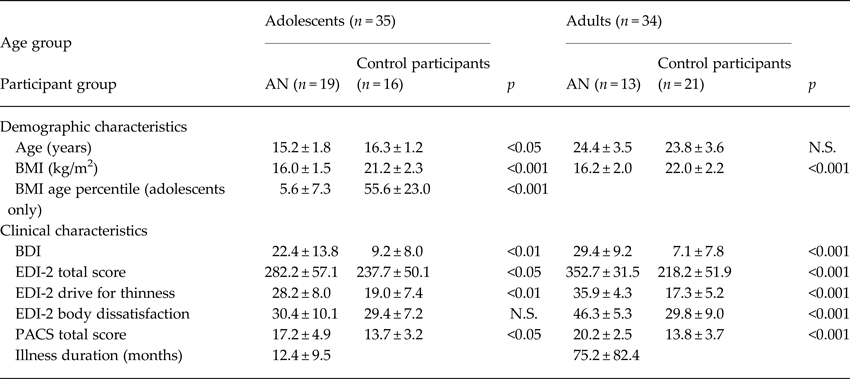
Both adult groups were similar in age; adolescent AN patients were approximately 1 year younger than controls. Both groups differed regarding clinical characteristics: BMI; BMI age percentile for adolescents; eating disorder pathology as assessed by the Eating Disorder Inventory-2 (EDI-2); the tendency to perform social appearance comparisons as assessed by the Physical Appearance Comparison Scale (PACS); and depressive symptoms as assessed by the Beck Depression Inventory (BDI-II). Regarding the EDI-2, we focused on the subscales ‘drive for thinness’ and ‘body dissatisfaction’ as most relevant scales for body image. However, the two adolescent groups did not differ regarding ‘body dissatisfaction’. Illness duration was considerably longer in adult than in adolescent patients. See Table 2 for participant characteristics. At least one psychiatric comorbidity was diagnosed in 16 adolescent and 10 adult patients. Six adolescent and eight adult patients were taking psychoactive medication (see Table 1 for details).
Sample characteristics (M ± s.d.)

The Ethics Committee of the University Hospital of Erlangen gave approval for the study and it was conducted in accordance with the Declaration of Helsinki.
Stimuli
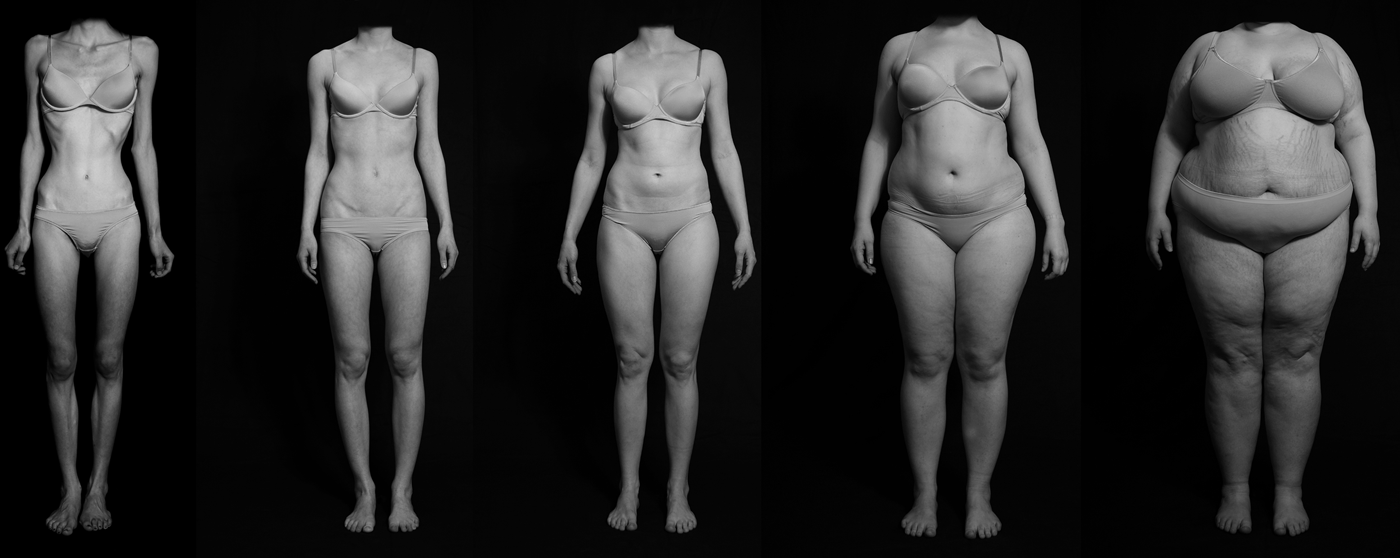
Standardized gray scale photographic stimuli showing women's bodies in underwear in four positions (front, rear, profile standing and profile sitting) were used [see (Horndasch et al. Reference Horndasch, Heinrich, Kratz, Mai, Graap and Moll2015)]. Eight pictures from each BMI category were shown: extremely underweight (BMI ranging from 13.5 to 15.0 kg/m2), underweight (BMI 17.0–18.0 kg/m2), normal weight (BMI 20.0–22.5 kg/m2), overweight (BMI 25.0–30.0 kg/m2) and extremely overweight (BMI 50.0–65.0 kg/m2) resulting in 40 trials in total. Examples are presented in Fig. 1.
Sample pictures of weight categories: extremely underweight, underweight, normal weight, overweight, and extremely overweight.

Procedure
First, all participants completed a German version of the EDI-2, which assesses eating disorder psychopathology and is comprised of 91 items divided into 11 subscales (Garner, Reference Garner1991), and the PACS, a five-item scale that assesses an individual's tendency to compare their own appearance to the appearance of others (Thompson et al. Reference Thompson, Heinberg and Tantleff1991). Depressive symptoms were rated on the BDI-II, the most widely used clinical instrument for detecting depression (Beck et al. Reference Beck, Steer and Brown1996).
The participants were seated comfortably 60 cm in front of a 19″ computer monitor. Pictures were presented in random order for 8 s. After viewing each picture, participants were asked to assess the attractiveness and weight of the woman shown in the photograph by button presses on two nine-point scales (ranging from ‘very unattractive’ to ‘very attractive’ and from ‘very underweight’ to ‘very overweight’, respectively).
During picture viewing, EEG activity was recorded with active Ag/AgCl electrodes (Brainamp amplifier, Brain Products, Germany) from 24 locations (10–20 system and locations Fpz, Oz; recording reference: FCz, ground: CPz). Additional electrodes were used for recording vertical EOG (Fp1 and below the left eye) and horizontal EOG (F7 and F8). The signals were digitized at a rate of 256 Hz and off-line re-referenced to linked mastoids. Data were processed and analysed with BrainVision Analyzer software, v2.1 (Brain Products, Gilching, Germany). After digital filtering between 0.1 and 20 Hz, data were segmented in epochs of 1600 ms (−300; 1300 ms). Artifacts due to blinks and eye movements were corrected using the Gratton and Coles algorithm (Gratton et al. Reference Gratton, Coles and Donchin1983). Epochs with EEG amplitudes exceeding ±125 µV were excluded automatically and the remaining epochs visually inspected for artifacts. A baseline correction was not applied in order to not distort the topographies of the components (Brandeis et al. Reference Brandeis, van Leeuwen, Rubia, Vitacco, Steger, Pascual-Marqui and Steinhausen1998).
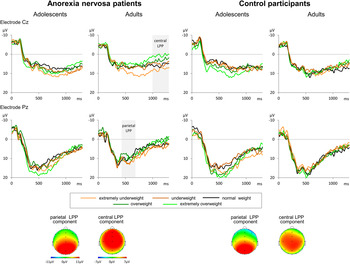
Averaged ERPs were computed for the different weight categories. Based on the visual inspection of the grand average ERP waveforms, a posterior component (450–700 ms) with maximum amplitudes at electrode Pz and a central component (1000–1300 ms) with maximum amplitudes at Cz were selected, distinguishable by a stable posterior v. central topography within these time windows. The first time window was chosen to capture the relative broad peak of the posterior component in the adolescent groups completely. The second time window started at the transition from a steeper to a flatter course of the posterior component accompanied by a change in topography and lasted until the end of the segment (see Fig. 2).
Grand averages of event-related potentials for the different picture categories. Parietal (electrode Pz, 450–700 ms) and central (electrode Cz, 1000–1300 ms) LPP components were determined. Topographic maps for AN patients and control participants (picture category extremely underweight) are shown.

Mean amplitudes were calculated to represent the posterior and central subcomponents of the LPP.
Statistical analysis
For attractiveness ratingsFootnote 1 Footnote † and separately for the posterior and central LPP component, the mean ERP amplitudes at the selected electrodes were analysed using repeated measures analyses of variance (ANOVAs) with ‘BMI category’ of the stimuli (extremely underweight, underweight, normal weight, overweight, and extremely overweight) as within-subjects variable and between-subject factors ‘participant group’ (‘AN patients’ and ‘control participants’) and ‘age group’ (adolescents v. adults). Greenhouse-Geisser correction was used when appropriate. T tests were conducted for specific group comparisons. For significant main and interaction effects related to the factor ‘category’, trend scores were computed for each group separately to study the relation of the different weight categories. Post-hoc, we tested a possible influence of depressive symptoms on AN-related LPP findings as BDI scores were considerably higher in the AN groups. Considering only patients with AN, we computed ANOVAs with the co-variate BDI (besides the between-subject factor ‘age group’ and within-subject factor ‘category’). In the text, means and standard deviations (s.d.) are reported.
Results
Attractiveness ratings
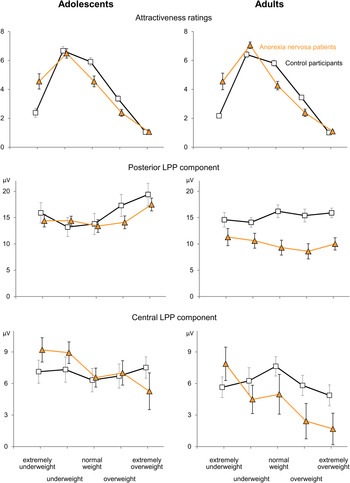
All participants rated the attractiveness of the five body shape categories differently [main effect of ‘category’: F(4, 260) = 243.3, p < 0.001, partial η 2 = 0.79] with highest ratings for underweight, followed by normal weight, extremely underweight, overweight and extremely overweight body shapes. A significant ‘category’ × ‘participant group’ interaction, F(4, 260) = 27.7, p < 0.001, partial η 2 = 0.30, indicates higher attractiveness ratings for extremely underweight [t(67) = −5.5, p < 0.001] and lower ratings for normal weight [t(67) = 4.9, p < 0.001] and overweight [t(67) = 5.1, p < 0.001] bodies in AN patients compared with control participants.
No other significant main effects or interactions were found (see Table 2 for attractiveness ratings).
ERP components
Posterior component (450–700 ms)
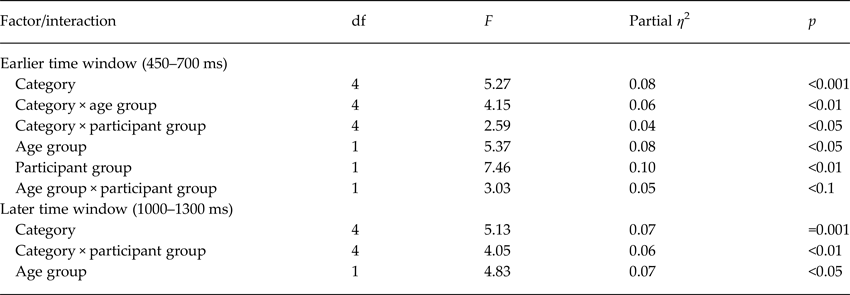
The ANOVA for the LPP in the posterior location (measured at electrode Pz) revealed several significant main and interaction effects (see Table 3).
ANOVA between picture category, age group and participant group for both LPP components

A highly significant effect of ‘category’ was found. Further analysing this effect, linear and quadratic trend scores turned out to be significant [T-lin(1,65) = 7.24, p = 0.009, partial η 2 = 0.10; T-quad(1,65) = 13.69, p < 0.001, partial η 2 = 0.17] indicating the highest amplitudes for extremely overweight pictures and no increase from extremely underweight to normal weight pictures (see also Fig. 3). These effects were more pronounced in adolescents than in adults [significant ‘category’ × ‘age group’ interaction: T-lin(1,65) = 8.84, p = 0.004, partial η 2 = 0.12; T-quad(1,65) = 6.12, p = 0.016, partial η 2 = 0.09].
Attractiveness ratings and LPP amplitudes at electrodes Pz and Cz (450–700 and 1000–1300 ms after stimulus presentation) across the different picture categories in adolescent and adult patients and corresponding control participants (mean ± s.e.).

A significant ‘category’ × ‘participant group’ interaction was also found accompanied by significant linear and cubic trend scores [T-lin(1,65) = 5.07, p = 0.028, partial η 2 = 0.07; T-cubic(1,65) = 4.68, p = 0.034, partial η 2 = 0.07]. The increase from extremely underweight to extremely overweight stimuli was higher in controls than in patients with AN; when comparing LPPs for underweight and overweight pictures, there was an increase in controls but rather a decrease in patients.
Overall, higher LPP amplitudes were observed in adolescents compared with adults (main effect ‘age group’: adolescents, 15.3 ± 5.2 µV; adults, 13.2 ± 5.1 µV) and for controls compared with patients (main effect ‘participant group’: patients, 12.8 ± 4.7 µV; controls, 15.5 ± 5.3 µV).
Since a trend was obtained for the interaction of ‘age group’ × ‘participant group’, patients and controls were compared for each age range separately. When separated, the factor ‘participant group’ was found to be significant for adults but not for adolescents: adult controls (15.2 ± 4.3 µV) showed higher amplitudes than adult patients (9.9 ± 4.7 µV), F(1,32) = 11.4, p = 0.002, partial η 2 = 0.26; no difference was found between adolescent controls (15.9 ± 6.6 µV) and patients (14.8 ± 3.7 µV), F(1,33) = 0.44, p = 0.51, partial η 2 = 0.01.
Central component (1000–1300 ms)
The ANOVA for the LPP in the central location (measured at Cz) revealed a significant ‘category’ effect accompanied by a highly significant linear trend score, T-lin(1,65) = 16.85, p < 0.001, partial η 2 = 0.21. This was due to a pronounced linear decrease of the LPP from extremely underweight pictures to extremely overweight pictures in patients with AN, whereas the LPPs of controls showed no systematic linear variation (significant linear trend score re. ‘category’ × ‘participant group’ interaction: T-lin(1,65) = 12.46, p = 0.001, partial η 2 = 0.16; see Fig. 3).
Similar to the posterior component, LPP amplitudes for the central component were significantly higher in adolescents compared with adults (main effect ‘age group’: adolescents, 7.2 ± 3.7; adults, 5.4 ± 3.8 µV).
Testing a potential influence of comorbid depressive symptoms
Post hoc analysis indicated that within the patient group, the amplitude of the posterior LPP component (averaged over all categories) was not associated with the BDI score [F(1,18) = 0.02, p = 0.88]. The ‘category’ × ‘BDI’ interaction tended to be significant [F(4,112) = 2.47, p = 0.066].
Regarding the central LPP component, the ‘category’ x ‘BDI’ interaction did not turn out to be significant [F(4,112) = 1.10, p = 0.358].
Discussion
In a sample of adolescent and adult AN patients and corresponding control participants, we could demonstrate differential effects for the LPP between age groups and participant groups during the processing of pictures of women's bodies (highly standardized but naturalistic pictures from five different body shape categories). For the earlier component with a posterior topography, adult patients showed generally reduced amplitudes. Looking at the later, central component, a clear pattern of heightened amplitudes toward extremely underweight body stimuli in AN patients emerged.
Developmental effects on LPP amplitude
A typical midline distribution (Hajcak et al. Reference Hajcak, MacNamara and Olvet2010) of the LPP was found, with peak amplitudes in the parietal location during an early (450–700 ms) phase and central location during a later (1000–1300 ms) phase, post-stimulus presentation. In both locations, adolescent girls showed generally higher LPP amplitudes than adult women. An effect of age on ERP amplitudes and a decrease of amplitude during adolescence has recently been reported (Kujawa et al. Reference Kujawa, Klein and Proudfit2013; MacNamara et al. Reference MacNamara, Verges, Kujawa, Fitzgerald, Monk and Phan2016), aligning our results with previously shown developmental effects.
Regarding the earlier posterior component, adolescents (AN and typically developing) presented a response pattern, which resembled that of the adult control group, namely with the highest amplitudes toward extremely overweight stimuli. This pattern is similar to the one observed in our previous study for adolescent control participants (Horndasch et al. Reference Horndasch, Heinrich, Kratz and Moll2012). It could be explained by a general heightened arousal and increased attention allocation during the relatively early processing stage toward the highly salient stimuli of extremely overweight bodies. These stimuli were more overweight than the ones displayed in our previous study, where a less standardized stimulus set was used. Anxiety with respect to extremely overweight body shapes might also play a role, as LPP amplitudes are described to be correlated with emotional intensity and increased in response to phobic stimuli (Michalowski et al. Reference Michalowski, Pane-Farre, Low and Hamm2015).
Cue reactivity toward body shapes in AN
Regarding the posterior component, chronically ill adult patients presented with clearly reduced LPP amplitudes toward body pictures in general. Reduced ERP amplitudes might be due to morphological brain alterations. However, in a recent meta-analysis, a decrease in white and gray matter in brains of patients with acute AN was found with an even stronger gray matter reduction in adolescent compared with adult patients (Seitz et al. Reference Seitz, Herpertz-Dahlmann and Konrad2016). A direct comparison between structural MRI data and EEG recordings in the same participants would be needed to draw conclusions regarding this connection. Similarly, lower amplitudes of earlier ERP components in reaction to emotional stimuli (Hatch et al. Reference Hatch, Madden, Kohn, Clarke, Touyz, Gordon and Williams2010), or reduced P300 amplitudes (Pollatos et al. Reference Pollatos, Herbert, Schandry and Gramann2008) in AN patients have been shown before. Lower LPP amplitudes in adult AN patients of our sample as compared with healthy women might therefore be more indicative of a blunted earlier reaction (probably reflecting automatic motivated attention) toward body pictures, independent of morphological factors.
During the earlier time period, a stronger amplitude increase occurred from extremely underweight to extremely overweight stimuli in controls compared with patients with AN, which may have partly been moderated by depressive symptoms. In control participants, an increase of LPP amplitudes for overweight compared with underweight pictures was observed, while patients’ LPP amplitudes decreased. The differential pattern was even more pronounced in the central location with the highest amplitudes evident in reaction to extremely underweight body pictures for the AN group. By contrast, the central component showed less modulation across picture categories in control participants. Neither the decreased amplitudes of the posterior LPP component in adult patients nor the heightened amplitudes of the central LPP component following extremely underweight stimuli were associated with depressive symptoms in the AN groups.
The pictures which belonged to the lowest weight category of our picture set depicted women with a BMI between 13.5 and 15.0 kg/m2, which targeted the range of BMIs presented on ‘thinspiration’ websites and is lower than the current thin ideal as presented in the media. The LPP has often been seen in the context of motivated attention, the notion that emotion automatically directs attention and thereby facilitates subsequent processing (Hajcak et al. Reference Hajcak, Dunning and Foti2009). The increased LPP of in response to underweight images for the AN group indicates that these are highly emotional and motivating stimuli. Regarding responses in other eating disorders, Mai et al. (Reference Mai, Gramann, Herbert, Friederich, Warschburger and Pollatos2015) found in women suffering from bulimia nervosa as well as in healthy women heightened LPP amplitudes to underweight female bodies.
In an fMRI study using a task where AN patients and controls were asked to process pictures of female bodies in a self-referential way, visual presentation of female body pictures showed a comparable pattern (Fladung et al. Reference Fladung, Gron, Grammer, Herrnberger, Schilly, Grasteit, Wolf, Walter and von Wietersheim2010): underweight female stimuli elicited the highest activity in the ventral striatum, which is part of the mesolimbic reward network, in AN patients, while normal weight cues produced the highest activity in healthy controls. Their fMRI results in adolescent and adult AN patients displayed a clearer pattern of striatal hyperactivation in adults as compared with adolescents (Fladung et al. Reference Fladung, Schulze, Scholl, Bauer and Gron2013); however, our 2 × 2 group analysis did not reveal age-specific effects regarding this bias toward extremely underweight bodies. The differential ventral striatal activation toward disease-related stimuli, similar to our LPP results, could indicate selective motivated attention as well as an obsessive reaction toward cues for emaciation. While it is still unclear which brain regions are generators of the LPP, emotional pictures have been shown to elicit co-variation of the LPP with fMRI recorded activity in emotion-modulated regions, like the ventral striatum (Sabatinelli et al. Reference Sabatinelli, Keil, Frank and Lang2013). The LPP has been demonstrated to be more sensitive to arousal than to valence of stimuli (Keil et al. Reference Keil, Bradley, Hauk, Rockstroh, Elbert and Lang2002; Olofsson et al. Reference Olofsson, Nordin, Sequeira and Polich2008; Hajcak et al. Reference Hajcak, MacNamara and Olvet2010), enhanced LPP amplitudes in response to extreme weight categories can be interpreted as an indication of increased negative feelings, especially anxiety. However, our current results taken together with those of our pilot study (Horndasch et al. Reference Horndasch, Heinrich, Kratz and Moll2012) – where no correlations between LPP amplitudes and emotional ratings of stimuli were found – and findings from (behavioral) addiction research suggest a more likely alternate interpretation that the increased LPP reflects motivational attention toward the salient body stimuli. Other studies looking at the time course of the LPP suggest differential effects for early and late LPP components as well (Franken et al. Reference Franken, Dietvorst, Hesselmans, Franzek, van de Wetering and Van Strien2008). Even beyond emotional significance of stimuli the later, more central, LPP component is thought to reflect cue reactivity related to the relevance of the stimulus and sustained engagement in its processing (Gable & Adams, Reference Gable and Adams2013).
Enhanced responses to motivational salient stimuli are in strong agreement with previous assumptions on the role of reward-related mechanisms in AN (Kaye et al. Reference Kaye, Wierenga, Bailer, Simmons and Bischoff-Grethe2013; O'Hara et al. Reference O'Hara, Campbell and Schmidt2015). Parallels to behavioral addictions can be seen as enhanced cue reactivity reflected by enlarged LPP amplitudes in reaction to gambling-relevant cues has been found. These results indicate that the LPP may reflect a marker for not only substance-related, but also non-substance-related craving and for ‘learned motivated attention’ (Wolfling et al. Reference Wolfling, Morsen, Duven, Albrecht, Grusser and Flor2011).
Relating subjective ratings and LPP patterns
Motivation regarding obtaining a specific body shape was not directly assessed in our task. However, when our stimulus set was evaluated regarding weight and attractiveness by AN patients and healthy controls, a differential rating pattern evolved, but AN patients as well as healthy controls perceived underweight – not extremely underweight – women as most attractive (Horndasch et al. Reference Horndasch, Heinrich, Kratz, Mai, Graap and Moll2015). This finding was confirmed for the present, smaller sample. In ERP studies investigating the processing of emotional pictures, co-variations of subjective responses and LPP amplitudes were found (Schupp et al. Reference Schupp, Flaisch, Stockburger and Junghofer2006; Hajcak et al. Reference Hajcak, MacNamara and Olvet2010); specifically in the study by Fladung et al. (Reference Fladung, Gron, Grammer, Herrnberger, Schilly, Grasteit, Wolf, Walter and von Wietersheim2010), higher preference ratings for the underweight stimuli were in line with increased activation of the ventral striatum. This might be due to the fact that in the Fladung et al. study, a smaller range of weight categories and therefore not as strongly underweight bodies were shown. Emaciated bodies were, in our study, rated as more attractive by AN patients than by control participants but still not as most attractive compared with other weight categories. Therefore – similar to results on cocaine craving and the LPP (Parvaz et al. Reference Parvaz, Moeller, Malaker, Sinha, Alia-Klein and Goldstein2016) and on implicit reward value of emaciated female bodies in AN assessed by an econometric choice task (Watson et al. Reference Watson, Werling, Zucker and Platt2010) – neural measures, such as the LPP, might reflect strong motivational processes better than overt subjective ratings.
Limitations
One limitation of the study is its relatively small sample size, especially with respect to the adult AN patient group. Although mean age of the two adolescent groups was 15.2 and 16.3 years, respectively, this difference was statistically significant, limiting our ability to draw firm conclusions about group differences in an exact age group.
Therapeutic implications
Therapists should not underestimate the motivation for extremely underweight body shapes in AN and the mechanisms by which that motivation is maintained. Pro-eating disorder websites appear to ‘offer a sense of support, validation and reassurance to those in the midst of an eating disorder, whilst simultaneously reinforcing and maintaining eating disordered behavior’ (Gale et al. Reference Gale, Channon, Larner and James2015). Therefore, enforceable regulation of these websites is often demanded (Rodgers et al. Reference Rodgers, Lowy, Halperin and Franko2016). Motivational responses can be up-regulated or down-regulated, their up-regulation has been shown to be correlated with larger amplitudes of the LPP (Langeslag & van Strien, Reference Langeslag and van Strien2013). It should be explored whether down-regulation could work in a similar way and which strategies to reduce motivational responses could be successful. Similarly, LPP amplitudes are reduced when participants are instructed to reinterpret unpleasant images in a less negative way and correlated with reductions in self-reported emotional experience following reappraisal (Hajcak & Nieuwenhuis, Reference Hajcak and Nieuwenhuis2006). It would be interesting to look at changes of covert measures of motivational attention in the course of eating disorder treatment and when weight is restored, as well as to assess the learned strategies to cope with dysfunctional motivational reactions, similar to the way reductions in LPP amplitude were shown in former as opposed to current smokers (Robinson et al. Reference Robinson, Versace, Engelmann, Cui, Slapin, Oum and Cinciripini2015). Recently, treatment approaches using non-invasive neuromodulatory techniques such as transcranial magnetic stimulation (TMS) and transcranial direct current stimulation (tDCS), which may induce changes in reward valuation mechanisms or attentional biases, have been proposed in AN and other eating disorders (Val-Laillet et al. Reference Val-Laillet, Aarts, Weber, Ferrari, Quaresima, Stoeckel, Alonso-Alonso, Audette, Malbert and Stice2015; Kekic et al. Reference Kekic, Boysen, Campbell and Schmidt2016).
Conclusions
In this study, despite a small sample size, two LPP components were shown to have different patterns elicited by body shapes for AN patients and control participants reflecting a bias toward underweight body shapes in AN. Particularly, the highest LPP amplitudes for extremely underweight body stimuli in AN patients may indicate increased sustained attention toward emaciated bodies. Differing responses in adolescent and adult patients for the earlier posterior component reflect increased responses toward extremely overweight bodies, especially in adolescents (patients and controls), as well as generally reduced responses in adult AN patients at this more automatic processing stage. Findings of the present study are in line with the results of our pilot study, but under more standardized and extended conditions providing a more refined picture. Large effect sizes underline the relevance of our findings. A differing pattern regarding subjective ratings as compared to LPP amplitudes toward body shapes suggests that looking at indicators of covert processing of specific stimuli could reveal important mechanisms in eating disorders.
Acknowledgements
The authors would like to thank Martin Deinzer for helping with the recordings for the study.