Introduction
Goosegrass, a monocot weed belonging to the family Poaceae, is one of the five most noxious weeds in the world (Lee and Ngim Reference Lee and Ngim2000). It is widespread in the tropical and subtropical regions, particularly in Asia, Africa, South America, and the southern parts of North America (Holm et al. Reference Holm, Plucknett, Pancho and Herberger1977). This weed competes with 50 crops in >60 countries (Wandscheer et al. Reference Wandscheer, Rizzardi and Reichert2013). The presence of goosegrass can severely reduce the yield of several crops, such as corn (Zea mays L.) (Wandscheer et al. Reference Wandscheer, Rizzardi and Reichert2013) and cotton (Gossypium hirsutum L.) (Ma et al. Reference Ma, Wu, Jiang, Ma and Ma2015). Intensive herbicide use on goosegrass has led to the evolution of resistance to many herbicides of distinct modes of action in >10 countries (Heap Reference Heap2018), such as the dinitroaniline herbicides (Mudge et al. Reference Mudge, Gossett and Murphy1984), acetyl CoA carboxylase inhibitors (Leach et al. Reference Leach, Devine, Kirkwood and Marshall1995), glyphosate (Lee and Ngim Reference Lee and Ngim2000), glufosinate, and paraquat (Chuah et al. Reference Chuah, Low, Cha and Ismail2010). Some populations have also been confirmed to have evolved multiple resistance to glufosinate, glyphosate, and paraquat (Jalaludin et al. Reference Jalaludin, Yu and Powles2015).
As a summer-growing annual grass, goosegrass is propagated by seed. Chin (Reference Chin1979) reported that goosegrass had high fecundity and that a single plant could produce as many as 140,000 seeds, which contributed to its ability to spread rapidly. Also, its tolerance to a broad range of environmental conditions contributes to its success as a global weed (Ismail et al. Reference Ismail, Chuah, Salmijah, Teng and Schumacher2002, Reference Ismail, Chuah, Salmijah and Teng2003). In addition, the wide emergence window of goosegrass makes its control very challenging for growers. Studies in Malaysia indicated that the emergence of goosegrass seedlings started at the beginning of April and continued through late September (Chuah et al. Reference Chuah, Salmijah, Teng and Ismail2004).
Previous studies have demonstrated that the emergence time has a significant effect on weed growth and reproduction. Fan (Reference Fan2011) reported that crabgrass [Digitaria ciliaris (Retz.) Koeler] that emerged early in the growing season produced more biomass and seeds than those plants that emerged late in the growing season. Similarly, Zhu et al. (Reference Zhu, Wu, Stanton and Burrows2013) documented that early-emerging cohorts of silverleaf nightshade (Solanum elaeagnifolium Cav.) produced more berries than the late-emergence cohorts. Phenological and ecological studies have provided important information on the prediction of the infestation density and seed production dynamics, especially for annual weeds propagated by seed (Murphy et al. Reference Murphy, Yakubu, Weise and Swanton1996). In the Yellow River cotton production region in China, goosegrass emerges between April and September, with the peak of seedling emergence occurring between early June and mid-July (Ma et al. Reference Ma, Ma, Xi, Jiang, Ma and Li2012). However, the lack of information about the impacts of the emergence timing on growth and development limits the formulation of effective weed control strategies. The objective of this study was to quantify the impact of emergence time on goosegrass growth and reproduction so as to determine the most effective timing for its management.
Materials and Methods
Seed Collection and Pretreatment
Goosegrass seed was collected in October from the experimental field of the Institute of Cotton Research of the Chinese Agricultural Academy of Sciences (CAAS) (36.13°N, 114.85°E). After collection, seeds were air-dried at ambient conditions for 10 d, with debris removed by hand. The seed was stored at room temperature (25 ± 1 C) in paper bags until planting in the following year.
Experimental Arrangement
Field experiments were conducted between March and November in 2015 and 2017 in the experimental field at the Institute of Cotton Research of the CAAS. Goosegrass seed was hand-sown approximately 2 cm deep in four hills at a row spacing of 50 cm in a 1-m2 plot (100 cm long, 100 cm wide) at the end of each month from March to August. Seedlings emerged about 4 to 6 d later. The emerging dates, determined at seedling emergence in all four hills, were on April 3, May 2, June 4, July 3, August 2, and September 4, 2015 and April 4, May 1, June 2, July 1, August 2, and September 2, 2017. Accordingly, six emergence times (April, May, June, July, August, and September) were set in both years. Goosegrass seedlings were thinned to a final weed density of four plants per plot (one plant per hill) when the seedlings were at the three- to four-leaf stage. The experimental design was a randomized complete block with four replications for each treatment. Plants were watered as needed, and all other weeds that emerged during the experiment were removed by hand at weekly intervals. The weather data during the experimental period were obtained from the Anyang Meteorological Bureau (Figure 1).
Daily average air temperature (A), total precipitation (B), and photosynthetically active radiation (PAR, C) at the experimental sites in 2015 and 2017.

Measurements
The date when the first inflorescence appeared was recorded for each plant, and the number of days from emergence to the first inflorescence was used to indicate the duration of vegetative growth. The growing degree-days (GDD) from emergence to flower were calculated by using the method described by McMaster and Wilhelm (Reference McMaster and Wilhelm1997), where the base temperature for goosegrass was 12.6 C (Masin et al. Reference Masin, Zuin, Archer, Forcella and Zanin2005). Mature inflorescences were collected and counted every 2 wk from August to December and preserved separately for all emergence cohorts. Inflorescence samples were stored at room temperature (25 ± 1 C) before total inflorescence weight per plant was determined. Plant height in centimeters was measured from the soil surface to the tip of the highest inflorescence just before harvest. All plants were harvested at maturity in mid-December by cutting at ground level. Plants were oven-dried at 80 C for 48 h until a constant dry weight was obtained, and then the total aboveground dry weights (including the total inflorescences weight) were determined. Average weight per inflorescence was measured on 10 inflorescences per plant randomly selected from the inflorescence samples collected from August to December. Seeds of these 10 inflorescences were threshed and removed from plant debris by hand rubbing. The seeds were then cleaned and counted to obtain the average seed number per inflorescence. The total number of seeds per plant was then estimated by multiplying the ratio of inflorescence number per plant by seed number per inflorescence. The 1,000-seed weight was estimated from four random samples of 100 seeds from each plant.
To determine the reproductive investment of goosegrass, the reproductive allocation was analyzed. Reproductive allocation is the percentage of the individual total aboveground dry weight allocated to inflorescences (Bazzaz et al. Reference Bazzaz, Ackerly, Reekie and Fenner2000).
Seed Germination Test
Five inflorescences were randomly selected and clipped twice monthly during August through November 2017, for a total of eight times, from all treatments with mature inflorescences. Just after collection, seeds were cleaned as described above. Four replicates of 50 seeds were evenly placed in 90-mm-diam Petri dishes on two layers of Whatman No. 1 filter paper moistened with 3 ml of deionized water. Dishes were sealed with Parafilm to minimize water losses from evaporation. After that, dishes were placed in an incubator at fluctuating day/light temperatures of 30/20 C (Chauhan and Johnson Reference Chauhan and Johnson2008). The photoperiod was set at 14 h, and the photosynthetic photon-flux density was 150 µmol m–2 s–1. Seed harvest, cleaning, and pretreatment of germination test were finished in 1 d for all treatments to avoid the effect of seed handling time on germination. The germinated seeds were counted 20 d after sowing. Seeds with a radicle of ≥1 mm length were considered germinated. The number of germinated seeds was used to determine germination percentage.
Statistical Analyses
Data were analyzed using the general linear models, treating goosegrass emergence month as fixed factor and year as random factor to test for significant main effects and interactions. There was significant weed emerging time-by-year interaction for several measured parameters (e.g., dry weight per plant, time to first inflorescence, GDD, and inflorescence number and weight per plant), and thus all data were analyzed separately for each year. Fisher’s Least Significant Difference test at P < 0.05 was used to determine the statistically different means. Regression analyses were performed to analyze the relationship between individual aboveground dry weight and inflorescence weight and total seed number per plant. Coefficients of determination (R2) were reported to indicate the amount of variation in the dependent variables that can be explained by the independent variables.
Results and Discussion
Vegetative Growth
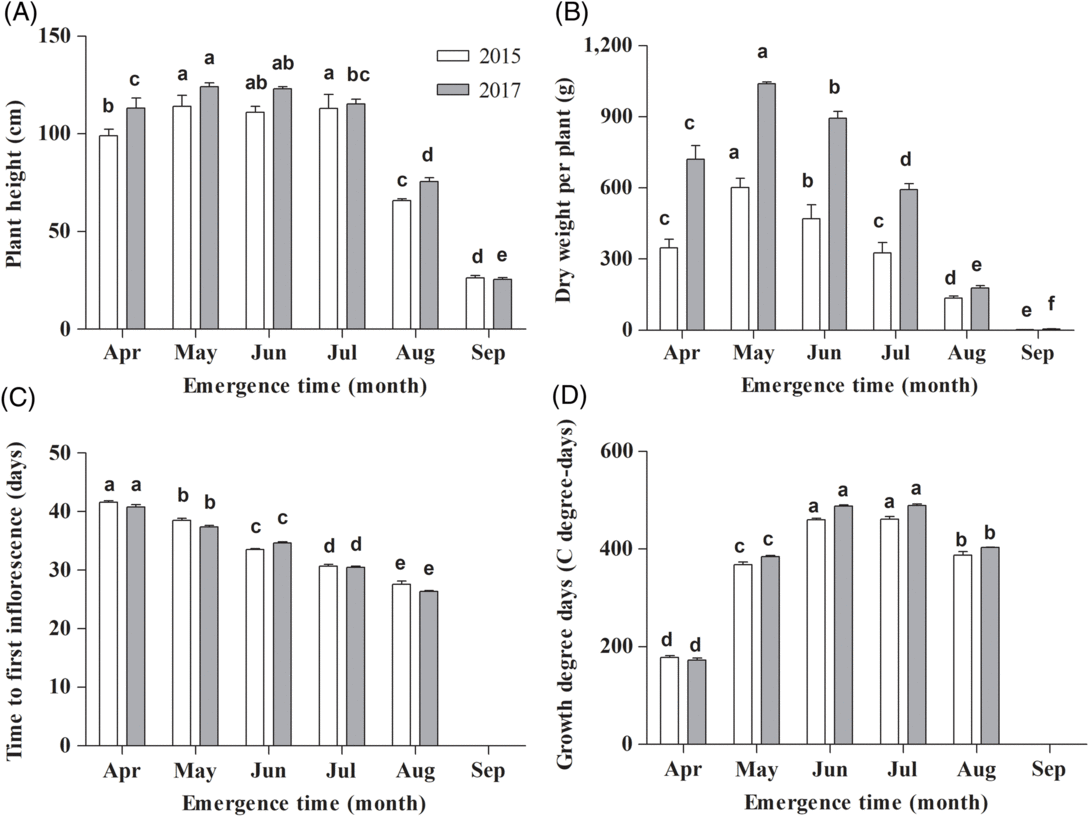
The time of emergence significantly affected the plant height and individual aboveground goosegrass dry weight ((P < 0.001 in both 2015 and 2017; Figure 2). Although the April cohort had the earliest emergence time, the plants were shorter and accumulated less biomass than the May emergence cohort in both 2015 and 2017. For example, the average plant height was 99 cm for the April cohort, which was significantly (P = 0.02) different from those emerging in May (114 cm) in 2015. The plant height and dry weight were greatest for the May emergence cohort and then declined thereafter. The plants that emerged in May produced the most biomass (602 and 1,039 g plant–1 in 2015 and 2017, respectively), which was 1- to 6-fold more than plants emerging in other months (excluding the September cohort). Goosegrass plants from the September cohort were the shortest (about 26 cm) in both years and only produced limited amounts of biomass (3 and 6 g plant–1 in 2015 and 2017, respectively).
Effects of emergence time on goosegrass vegetative growth. (A) Plant height, (B) individual aboveground dry weight, (C) time to first inflorescence, and (D) growth degree-days (GDD). Vertical bars represent standard errors. Vertical bars with the same letters do not differ significantly (P = 0.05).

In this study, the time from emergence to appearance of the first inflorescence in goosegrass decreased from 42 to 26 d between the April to August cohorts in both years, indicating that delay in emergence time results in a shorter vegetative growth period (Figure 2). Plants that emerged in April devoted more time to vegetative growth (42 and 41 d in 2015 and 2017, respectively) than the other four cohorts. Low temperature, low photosynthetically active radiation (PAR), and short day length in April may be the reasons for the longer vegetative growth period (Figure 1). However, the corresponding GDDs were 173 to 178 for the plants that emerged in April, which were the lowest among the five cohorts from April to August and might have resulted in the smaller sizes of individuals in the April cohort. Goosegrass plants allocated more growth time to reproduction (2 to 5 mo) rather than vegetative growth (average 35 d).
Reproductive Growth
Delayed emergence also affected reproduction in goosegrass (Figure 3). The number of inflorescences per plant was different (P < 0.001) among the six emergence cohorts in both years. The plants that emerged in April had the most inflorescences (366 and 592 inflorescences per plant in 2015 and 2017, respectively), and the number of inflorescences decreased as the emergence time was delayed; most plants (56% and 75% in 2015 and 2017, respectively) that emerged after September did not flower and set seed. Although the inflorescence number was the highest in the April cohort, these inflorescences were the lightest among all treatments in both years. For example, the average weight per inflorescence of the April cohort was only 0.313 g, which was 45% lighter than that of the May cohort (0.571 g) in 2015.
Effects of emergence time on goosegrass reproductive features. (A) Number of inflorescences per plant, (B) average weight per inflorescence, (C) inflorescence weight per plant, (D) average seed number per inflorescence, (E) total seed number per plant, and (F) 1,000-seed weight. Vertical bars represent standard errors. Vertical bars with the same letters do not differ significantly (P = 0.05).

A peak of the inflorescence weight per plant occurred for the May and June cohorts, and gradually decreased with later emergence. Similarly, goosegrass plants that emerged in May produced the greatest amount of seeds per inflorescence and per plant. For example, the total seeds produced by each individual plant from the May cohort were 225,954 and 322,501 in 2015 and 2017, respectively, which was about five times greater than the seed production per plant in the August cohort. However, delayed emergence did not affect the 1,000-seed weight (P = 0.902 and 0.421 in 2015 and 2017, respectively) (Figure 3). The results of regression analyses showed that inflorescence and seed production per plant tended to increase with increasing weed biomass (Figure 4).
Effect of dry weight of individual plant on inflorescence and seed production. Vertical bars represent standard errors.

In this study, the influential trend of emergence timing on goosegrass growth and reproduction was similar in both 2015 and 2017. Except for the April cohorts, delayed emergence from May to August reduced the biomass accumulation and seed production, partly as a result of a shorter vegetative growth period. A previous investigation produced similar results in a perennial weed species, silverleaf nightshade, with delayed emergence resulting in a shorter vegetative phase, less biomass, and less fruit production (Zhu et al. Reference Zhu, Wu, Stanton and Burrows2013). The plants that emerged later in the season did not flower. Daimon et al. (Reference Daimon, Miura and Tominaga2014) investigated the growth and reproductive success of seed-derived Sagittaria trifolia L. plants emerging at different times and found that the occurrence of the first inflorescence was delayed and the number of inflorescences, fruits, and seeds significantly decreased as emergence time was delayed. However, in the current study, the earliest emerging cohort of goosegrass (April) produced fewer seeds than the May cohort, possibly as a result of suboptimal temperature (average temperature of April was 15 C and 17 C in 2015 and 2017, respectively), low PAR, and fewer GDDs (Figures 1 and 2). Although there were more inflorescences per plant for April cohorts, the inflorescences were smaller and fewer seeds were produced, partly as a result of intracompetition between tillers within each plant. Similarly, goosegrass that emerged in August had poor vegetative and reproductive growth, which might have resulted from the steady decline in air temperatures (Figure 1). In all six emergence time treatments, the vegetative traits and reproductive traits were the highest in plants that emerged in May and June, e.g., an average of 446 g and 753 g dry weight and 225,954 and 322,501 seeds per plant in May 2015 and 2017, respectively. Presumably, the increasing temperature contributed to the optimal growth of plants that emerged in May and June. Moreover, other factors, such as photoperiod or PAR, could have a potential impact on goosegrass growth and development; these variables should be verified in further experiments under a controlled environment (Daimon et al. Reference Daimon, Miura and Tominaga2014; Verghis et al. Reference Verghis, McKenzie and Hill1999).
Reproductive Investment
There were significant differences in the reproductive allocation among the cohorts that emerged at different months (P < 0.001; Figure 5). The cohort that emerged in May had a relatively low reproductive allocation (26% and 28% in 2015 and 2017, respectively). The percentage allocation of total dry weight to inflorescence increased to 32% to 37%, with no significant difference among the other cohorts. Most plants that emerged in September failed to enter the stage of reproductive growth. If the April plants were excluded, the percentage allocation of dry weight to inflorescence increased as emergence time was delayed. The goosegrass that emerged in June, July, and August devoted resources mainly to the reproductive part of the plant.
Effects of emergence time on reproductive allocation in goosegrass. Vertical bars represent standard errors. Vertical bars with the same letters do not differ significantly (P = 0.05).

Seed Germination
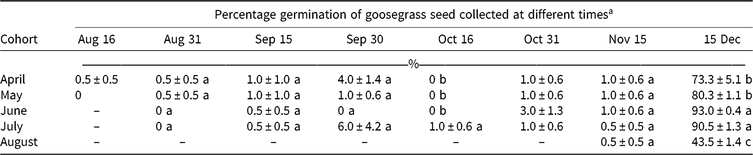
Goosegrass plants that emerged in April could produce mature seeds as early as July. Such a result raises an important question: whether these freshly shed seeds could emerge immediately as a second generation within the season and produce more seeds. Freshly harvested seeds collected from each cohort were extremely dormant, with a maximum germination of 6%. The low germination (0 to 6%) was maintained up to November after the initial germination test. When assessed in mid-December, the seeds from all the cohorts had a high rate of germination, ranging from 44% to 93% (Table 1). Chauhan and Johnson (Reference Chauhan and Johnson2008) found that an after-ripening period of at least 3 mo was required to improve goosegrass germination. The seed dormancy soon after maturity could avoid seed germinating from September to November, with no seed production. However, this study does show that fresh goosegrass seed collected in August from the April cohort could germinate, even though at a low rate of 0.5%, indicating that a second generation could potentially emerge in mid-August. Our data showed that the August cohort may produce an average of 67,000 seeds per plant (Figure 3). Therefore, it is necessary to control April-emerging goosegrass at the flowering stage before July to reduce the occurrence of second-generation cohorts within the year and to avoid the replenishment of the soil seed bank that would persist until the following year.
Seed germination in goosegrass that emerged in different months in 2017.

a Means (± SE) within columns followed by the same letter are not significantly different between treatments at the 0.05 probability level as determined by Fisher’s Protected LSD test. Dashes indicate that no mature seeds were produced.
The information regarding the effect of emergence time on the growth and production of this weed is useful for developing predictive models and for determining optimal timing for the control of goosegrass in a crop. In the Yellow River cotton production area in China, goosegrass emerges from April to September, with the peak of seedling emergence between early June and mid-July (Ma et al. Reference Ma, Ma, Xi, Jiang, Ma and Li2012). Although goosegrass seedlings that emerged in May were fewer than those that emerged in June and July (Ma et al. Reference Ma, Ma, Xi, Jiang, Ma and Li2012), this study showed that the average total number of seeds per plant emerging in May were 225,954 and 322,501 in 2015 and 2017, respectively, approximately two times more than those of the June and July cohorts. Therefore, July is a critical time for management, as it will control goosegrass from the earliest emergence in April up to the peak emergence in July, thereby stopping seed set from the earlier-emerging cohorts such as April and May. Seedlings from the April cohort could potentially give rise to the second generation, whereas the May cohort had the highest seed production. This study also highlighted that goosegrass seedlings emerging before August may set mature seed; thus, it is necessary to monitor seedling emergence early, so as to control them and avoid the replenishment of the soil seed bank. Management of seedlings emerging after September is unnecessary, as these plants are unlikely to flower and produce seeds.
Acknowledgments
The authors wish to acknowledge Jinyan Yang and Xinling Wang for their assistance in the field. Financial support was provided by the Fundamental Research Funds for Central Public Welfare Research Institutes, China. No conflicts of interest have been declared.