

INTRODUCTION
Cognitive decline is a reliable feature of old age, but the process is highly individualized and, in each case, is influenced by a complex interplay of biological and nonbiological factors (Arbuckle et al., 1998; Emery et al., 1995; Hultsch et al., 1998; Kramer et al., 2004). There is growing evidence in recent years that effective management of quality-of-life issues contributes to successful aging generally and, more specifically, to preserved cognitive function (Baltes & Willis, 1982; Hultsch et al., 1999; Jennings & Darwin, 2003; Wilson et al., 2002).
In old age, a healthy lifestyle is associated generally with psychological well-being, as reflected in such attributes as high self-esteem (Bailis & Chipperfield, 2002), feelings of personal control (Rodin et al., 1985), and self-efficacy beliefs (Albert et al., 1995). In a series of prospective studies (reviewed by Dawson et al., 1999), we investigated the relationship between psychological well-being and cognitive performance in groups of normal older adults, living in the community or in various types of assisted living environments. The groups were carefully matched in terms of health and various demographic factors. The consistent finding was that specific attributes related to psychosocial status—for example, personal control, optimism, general happiness—reliably predicted test performance on a range of cognitive tasks in both populations. Interestingly, although psychosocial factors similarly affected both populations, the community-based individuals consistently out-performed those living in institutions. This finding was interpreted as confirming the importance of maintaining an active lifestyle in a familiar and supportive physical/social environment.
The elderly undergo major changes in their lives, and as a result, can be considered psychosocially vulnerable. It follows that the inclusion of a psychosocial training component in a cognitive rehabilitation protocol might contribute to an improvement in overall functional status. Rehabilitation specialists have long recognized that long-term outcomes in people with traumatic brain injuries are affected by psychosocial factors as well as cognitive status (see reviews by Morton & Wehman, 1995; Ruff, 1999). Thus, many rehabilitation programs have taken an holistic approach that explicitly takes into account the personal and social changes that result from brain damage (e.g., Ben-Yishay, 1996; Prigatano, 1986; Wilson, 1987). Such programs typically include a variety of compensatory techniques that promote awareness and personal discovery to raise motivation and self-esteem as a means of achieving optimal cognitive function. While there have been relatively few systematic assessments of the effects of psychosocial training on rehabilitation, those that are available have yielded encouraging results with respect to cognitive recovery (Rath et al., 2003; Ruff & Niemann, 1990) and improved psychosocial outcome (Cope, 1995; Rattock et al., 1992).
Accordingly, based on our own research in this area and evidence that links psychosocial status to cognitive recovery in cognitively impaired individuals, we decided to incorporate a Psychosocial Training module in our protocol, which also included Memory Skills Training and modified Goal Management Training modules (see Introductory paper by Stuss et al., 2007). Psychosocial training covered a wide range of topics, including consideration of why psychological well-being is important for memory and related cognitive processes, personal feelings associated with successful realization of cognitive goals, and self-efficacy beliefs that build confidence in taking on challenging practical tasks. Importantly, psychosocial training was related to the Memory Skills Training and modified Goal Management Training modules, by emphasizing the importance of participants believing in their ability to respond to cognitive challenges, especially as they are encountered in daily life.
Our expectation was that, along with strategic processes related to cognitive function, specific attributes related to psychosocial function would benefit from our approach to cognitive rehabilitation training. In this paper, we report the results of the psychosocial outcome measures in the two groups of older adults that received our training program.
METHODS
Participants and Design
Detailed information on the participants, the training program, the experimental design, and the outcome measures, are summarized in the Introductory paper (Stuss et al., 2007). Briefly, the program divides into three, 4-week modules: (1) Memory Skills Training, where the emphasis was on the nature of memory loss and the types of aids that could be applied to the process of acquiring, retaining, and recovering information; (2) modified Goal Management Training (GMT), which focused on developing strategies for managing goal-directed behavior in “real-life” situations; (3) Psychosocial Training, in which the aim was to enhance psychological well-being and establish the link between overall functional status and cognitive function. In addition, the group leader met individually with each participant at the beginning of the trial and on two subsequent occasions. These meetings were intended to set individual goals, answer questions, and address any issues that arose over the course of the trial.
Forty-nine older, relatively healthy adults (71–87 years), living in the community, were quasirandomly divided into an Early Training Group (ETG; N = 29) and a Late Training Group (LTG; N = 20). The two groups did not differ in terms of demographic and neuropsychological variables. The ETG entered the rehabilitation program shortly after screening; the LTG first acted as a control group for 3 months, and then underwent the protocol. In the control procedure, contact with participants was maintained through an individual meeting with the group leader, by telephone, and in scheduled test sessions.
A within-subject, crossover design with repeated measures was used. There were four testing sessions, identified as Assessments A to D. Assessment A was administered at the beginning of the trial to evaluate baseline performance. Assessment B was administered after the ETG had received training and the LTG received the control procedure. After Assessment B, the LTG switched from the control condition to training, and the ETG from training to the control condition. Following the crossover, both groups were tested in Assessment C. Six months after training, both groups were re-tested, in Assessment D, to evaluate long-term benefits of rehabilitation. .
The rehabilitation program was administered to groups of five to six participants. The entire program spanned 14 weeks and included an introductory seminar, 12 weekly training sessions, and a wrap-up seminar. In the following sections, we provide the procedures and results related to the Psychosocial Training module.
Psychosocial Training
The aim of the Psychosocial Training module was to enhance participants' self-esteem and build confidence in their ability to respond to cognitive challenges. To underscore the importance of psychosocial status for overall well-being and cognitive function, the first session focused on nonbiological factors that affect overall function in older people and, in particular, on the relationship between psychosocial factors and cognitive performance. The group leader presented research that demonstrated the importance of psychological well-being in realizing one's full potential. There was considerable discussion of older people's tendency to overstate their memory problems which, in turn, probably results in below potential performance in many situations. Society's reduced expectation of older adults was also discussed, along with the dangers of falling prey to a self-fulfilling prophecy whereby older people, as a result of lost confidence and reduced effort, seriously underachieve. At this point, the group leader introduced important constructs (e.g., personal control, self-efficacy, lifestyle/activities, coping) as part of a positive approach to responding to cognitive challenges. Participants were encouraged to relate these constructs to their own experiences and consider how their performance reflected “how they feel,” and their personal reactions to successful task accomplishments. Participants were invited to offer vignettes from their personal lives, highlighting negative and positive experiences that could be related to lack of confidence, feelings of not being in control, pessimism over outcome, and so forth. At the end of the first session, participants were instructed to create a list of “things to do.” The list was to include longstanding projects that were never begun or left incomplete. Participants were also asked to keep a 1-week log of their daily activities that included their assessment and personal reactions to outcome.
The second session began with a review of highlights and foci of the previous week's session, a discussion of people's individual logs, and a hypothetical example of an individual completing a long overdue task (e.g., organizing family photos). The relationship between psychological well-being and functioning in memory and daily life was repeatedly emphasized to make the point that successful task completion was an important expression of well-being. To illustrate this, the projects of three participants scheduled to be initiated in the upcoming week were selected for discussion. The group leader ensured that participants set achievable, realistic goals so that participants could derive a sense of accomplishment and explore feelings of enhanced self-esteem and confidence associated with those accomplishments. The leader provided direction in scheduling the tasks at optimal times, taking appropriate breaks, and stressed the importance of applying the strategies discussed in the modified Goal Management Training sessions, which included organizing the tasks in smaller, more manageable units.
In the third session, the three participants whose projects had been selected reported on their progress. The discussion focused on their objectives, how they felt about what they accomplished, their confidence in taking on other tasks, and their appreciation of the relationship between the psychosocial constructs and success in daily life. The discussion was semistructured and directed by specific questions. Input from other members of the group was encouraged, and the ensuing discussion was usually lively and highly supportive. Projects for the second group of three participants were discussed and planned for execution throughout the coming week.
In the final session, the second group of participants reported on their project-related experiences, with the rest of the participants providing input and discussion. There was also discussion of the first group's continued progress on their projects, followed by a general wrap-up in which participants were encouraged to continue to work on their goals and their “things to do” list, drawing on experience gained during the seminars. Participants were reminded of the goals they had realized and the confidence they had gained in accomplishing all or part of the various tasks. Emphasis was placed on the importance of building on that confidence in responding to new cognitive challenges as they arise in daily life. The study was approved by the Baycrest Research Ethics Board and conducted in accordance with the guidelines of the Helsinki Declaration.
Psychosocial Tests
Nine tests were used to quantify various aspects of participants' psychosocial function at baseline (Assessment A) and the other Assessments (B, C, and D). The tests were selected to highlight specific constructs (i.e., personal control, optimism, activity, happiness, self-efficacy), shown in previous work to be reliable predictors of cognitive performance in older adults (Albert et al., 1995; Arbuckle et al., 1986; Winocur & Moscovitch, 1990; Winocur et al., 1987). Measures of general mood, quality of life, and coping were incorporated to quantify psychological well-being. We also included the Dysexecutive Questionnaire (DEX), as a measure of strategic functioning in social contexts. This measurement was of interest because of our approach, which targets rehabilitation of strategic processing. The following summarizes the main characteristics of each test:
1. The Geriatric Depression Scale (GDS): The GDS (Brink et al., 1982) is a 30-item self-report test of general mood. For each item (e.g., “Are you in good spirits most of the time?”), participants circled yes or no, depending on which response most appropriately described their feelings at the time. The maximum score is 30, with low scores representing elevated mood.
2. The Locus of Control Scale (LOC): This test, based on Flanagan's (1978) Quality of Life test, was developed by Nosek as part of her Personal Independence Profile (Nosek et al., 1992). The test assesses 15 life domains (e.g., participation in active recreation, health and personal safety, socializing). We included a 16th domain, “faith,” as this was thought to be important in our setting. For each domain, participants used a 5-point Likert-type scale to indicate how much control they felt they had in this aspect of their lives.
Of the 16 domains, 3 were not answered by most participants (i.e., Item 5—Close relationships, Item 8—Work, and Item 11—Having and raising children). We believe that these domains were not relevant to an elderly population and were deleted from scoring. Thus, the maximum score for the Locus of Control Scale was 65, with high scores representing greater levels of perceived control.
3. Quality of Life (QOL): Flanagan's (1978) Quality of Life test was also used as a measure of how well participants' needs and desires were being met in various important life domains. As in the LOC Scale, Items 5, 8, and 11 were deleted from scoring and an additional domain, “faith,” was added. For each domain, participants were asked to indicate how well their needs and wants were being met in this aspect of their lives. The component of the Flanagan test that rated the importance of each item was not included in the assessment. A 5-point Likert-type scale yielded a maximum total score (QOL-T) of 65, with high scores representing greater quality of life.
At the end of the test, we added an item that asked participants to rate their overall quality of life at the present time. This item provided an overall measure of quality of life (QOL-Ov) that was analyzed separately.
4. The Self-Efficacy Scale (SE): The SE Scale is a self-report measure of the extent to which individuals believe they have the ability to accomplish goals (Rodin & McAvay, 1992). The scale assesses feelings of self-efficacy in nine domains of living (e.g., family relationships, finances, relationships with friends, spouse, or significant other). One domain, related to marriage, was deleted from scoring as, in many cases, participants did not have a significant partner. A 4-point scale yielded a maximum score of 32 with high scores representing greater self-efficacy.
5. The Memorial University of Newfoundland Scale of Happiness (MUNSH): This test, devised by Kozma & Stones, (1980), measures happiness as an expression of well-being. Our scale, which was a slightly modified version from the original, consists of 23 statements, of which 10 relate to feelings of happiness over the past month (e.g., particularly content with my life) and 13 relate to general life experiences (e.g., I'm just as happy now as I have ever been). Participants were asked to rate each statement on a 5-point Likert-type scale. Of the 23 statements, 11 were worded negatively and 12 positively. Scores for negatively worded items were inverted so that higher scores signified higher happiness levels. An overall happiness index was constructed from the separate scores.
6. The Life Orientation Test (LOT): The LOT, devised by Scheier & Carver (1985), was used to measure personal optimism as a regulator of behavior. This test assesses generalized expectancies for positive and negative outcomes in life. We selected 13 statements of which 9 were used to derive an optimism score (4 filler statements were not used in scoring). Of the 9 that were scored, 5 were worded in a positive direction (e.g., “In uncertain times, I usually expect the best”) and 4 were worded in a negative direction (e.g., “I rarely count on good things happening to me”). For each statement, participants were asked to indicate the response that best described themselves on a 5-point Likert-type scale. Negatively worded items were inverted before scoring. The maximum achievable score was 45, with high scores representing greater optimism.
7. The Everyday Activity Questionnaire (EA): This test, developed by Pushkar et al. (1997), evaluates engagement in a broad range of activities. The EA is a 26-item self-report questionnaire, with the first five items addressing obligatory activities related to maintenance of self or property (e.g., “Do you use public transportation, such as, buses, subways?”) and the remaining 21 items addressing optional activities that facilitate psychological development (e.g., “Do you do any crafts or hobbies, such as knitting, woodworking, stamp collecting, or any other similar activities?”). Participants were asked to rate how often they engage in each activity on a 5-point scale ranging from 1 (more than once a week), 2 (weekly), 3 (monthly), 4 (a few times a year), and 5 (not at all). All items were inverted before scoring, so high scores represented higher levels of activity (maximum score = 130).
8. The Ways of Coping Questionnaire (WOC): This test, adapted from the original version by Folkman et al. (1986), evaluated strategies that people use to manage internal and external demands in difficult situations. Our test, which took statements from each subscale to capture all of the constructs, contained 24 statements that represented positive (e.g., “Make a plan of action and follow it”) and negative (e.g., “Go on as if nothing had happened”) coping styles. Statements were designated as “positive” or “negative” on the basis of agreement among several raters, who rated the statements independently. Participants were asked to indicate how much they might use the coping style depicted in each item on a 4-point scale. Indices were obtained for positive and negative coping styles by summing the scores in each category. A total WOC index was obtained by subtracting the negative coping index from the positive coping index.
9. DEX: This test, developed by Burgess et al. (1998), measures everyday signs of the dysexecutive (or “frontal lobe”) syndrome, that is, an inability to behave appropriately or make strategic decisions in everyday situations. The DEX is a 20-item self-report questionnaire based on four broad areas of executive dysfunctions as classified by Stuss and Benson (1984). These areas are emotional or personality changes, motivational changes, behavioral changes, and cognitive changes. Participants were presented with the list of items (e.g., “I act without thinking, doing the first thing that comes to mind”) and were asked to rate how often they observed each experience in themselves, using a 4-point scale. Responses were summed to yield a total score ranging from 0 to 80, with high scores representing greater frequency of dysexecutive symptoms (see also Levine et al., 2007).
Test Administration
The psychosocial tests were administered in the same order to all participants at all Assessments (A, B, C, and D). The GDS was completed during the actual sessions, and the remaining questionnaires were given to participants to complete at home.
Participants were instructed on how to complete the questionnaires and to return them in the addressed, stamped envelope provided as soon as possible after completion and, preferably, within 24 hours. They were also encouraged to call the examiner if they had any questions or concerns. Typically, questionnaires were returned within a week. Upon receiving the questionnaires, the examiner reviewed them to ensure that they were completed correctly.
In addition, following the training program, each participant was given a set of the questionnaires (excluding the GDS) for his/her “other-rater,” who had been identified at the beginning of the study, as someone who knew the participant well and could comment on his/her behavior, feelings, and so forth. Other-raters agreed to complete the questionnaires which, they were told, would assess the participants in various psychosocial domains. The questionnaires intended for the other-raters were modified slightly to indicate clearly that the questions referred to the participant. Other-raters were instructed to fill out the questionnaires as soon as possible independently from the research participant and mail them back in the envelope provided. Upon receipt by the examiner, the questionnaires were reviewed to ensure that they had been completed correctly.
Data Analyses
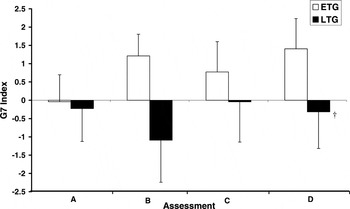
The general approach to data analysis is described in the Introductory paper (Stuss et al., 2007). With respect to the psychosocial data, a correlation matrix, based on observations from all participants at Assessment A, was calculated and is presented in Table 1. Inspection of this correlation matrix indicated that a subset of seven measures shared a similar pattern of associations, that is, linear association with other measures in the subset but not with those outside the subset. We generated a standardized global score, labeled G7, based on this subset of measures: MUNSH, QOL-To, QOL-Ov, SE, GDS, LOC, and LOT. Each measure was standardized to zero mean and unit variance before summation across the subset. This global score, or G7 index, ranged from −8.4 to 9.4 at baseline, with a higher value indicating a higher level of general psychosocial function. Group means for the G7 index at the four assessments are presented in Figure 1.
Correlations between psychosocial tests—EA, WOC, and DEX excluded from standardized global score (G7 index)


Standardized global score (G7 Index) for the Early (ETG) and Late (LTG) Training Groups at Assessments A (baseline), B (after ETG training, LTG control), C (after LTG training, ETG control), and D (long-term follow-up). Error bars represent the standard error of the mean. [dagger]Two participants had extreme values (−9.02; −9.01). Therefore, the mean and standard error of the mean at Assessment D were calculated excluding scores from these two participants.
Between- and within-group statistical comparisons to evaluate short- and long-term effects of rehabilitation training in the ETG and LTG were conducted as described in the Introductory paper (Stuss et al., 2007). Because this was an exploratory study, an unadjusted α-level of 5% was used. To avoid unacceptable loss of power, adjustments for multiple comparisons were not made. Accordingly, appropriate caution is taken in interpreting the results. Effect size index (η2) was calculated and is included in the appropriate tables.
To assess long-term effects of training, Assessment D data were analyzed by subtracting Assessment A mean scores from scores at both assessments and fitting linear regression for Assessment D on Assessment A. Testing the null hypothesis for the intercept provides a test of the long-term changes in each group. [As indicated in the Introductory paper, five participants in the LTG did not complete Assessments C and D due to an outbreak of Severe Acute Respiratory Syndrome (SARS), which effectively prohibited research participants from entering the hospital.] The G7 scores provided a global index that allowed us to assess the effect of training on overall psychological well-being. In presenting the results at each test Assessment, we will emphasize the G7 index for each group. As well, significant results from the component tests will also be presented. Those measures that did not contribute to the G7 index are also described.
RESULTS
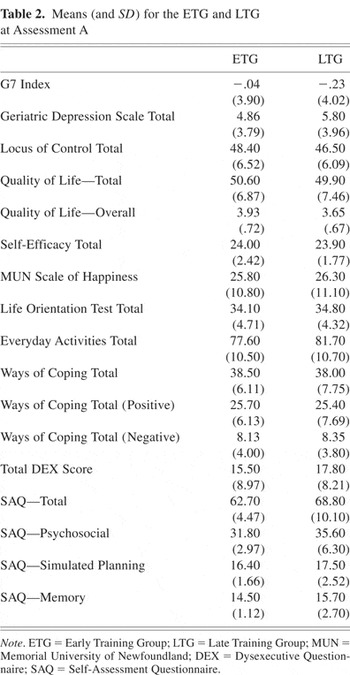
At baseline testing (Assessment A) there were no significant differences between the two groups on the G7 index (or any of its component measures), Everyday Activities, Ways of Coping, or DEX Questionnaire. Summary statistics for the two groups are presented in Table 2.
Means (and SD) for the ETG and LTG at Assessment A

Training Effects on ETG (Assessments A to B)
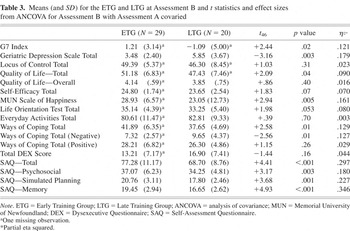
Figure 1 shows the average G7 index for the ETG and LTG at Assessments A, B, C, and D. Analysis of covariance (ANCOVA), conducted on the G7 index at Assessment B, covarying the baseline Assessment A score, showed a significant difference between groups (F1,43 = 5.94; p = .02) that indicated a higher level of psychosocial function in the ETG than the LTG. The G7 index for the ETG increased from an average of −.04 at Assessment A to an average of +1.21 at Assessment B, while in the LTG, which received no rehabilitation training during this interval, the average G7 index decreased from −.23 to −1.09 (see Table 3 for between-group statistical comparisons of G7 and other scores at Assessment B). In this and the following table, we present t-statistics to provide the direction of change, noting that a squared t-statistic is equal to the corresponding F-statistic.
Means (and SD) for the ETG and LTG at Assessment B and t statistics and effect sizes from ANCOVA for Assessment B with Assessment A covaried

The general improvement in the ETG in psychosocial function, as described by the G7 index, was reflected also in the individual component test results. As can be seen in Table 3, at Assessment B, there were significant differences between the ETG and the LTG on the GDS, QOL-To, MUNSH, and LOT test scores, and a borderline effect in the same direction on the SE score.
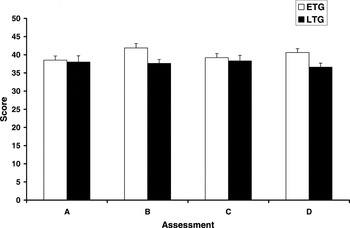
As for the psychosocial measures that were not included in the G7 index, there was a significant group effect on the total score of the WOC test (F1,45 = 6.67; p = .01) that reflected improved performance of the ETG from an average of 38.5 at Assessment A to an average of 41.9 at Assessment B, while the LTG remained relatively flat across this interval—from 38.0 to 37.7 (see Figure 2). Further analysis of WOC test results revealed that rehabilitation training had a stronger effect on the negative coping measure (WCN), which was significantly different between groups at Assessment B (F1,45 = 6.56; p = .01). The difference between groups on the positive coping measure (WCP) was not statistically significant (F1,45 = 1.33; p = .26). It should be noted that, in line with expectations, on this measure the ETG increased from an average of 25.7 to an average of 28.2, while the LTG's scores were virtually unchanged.

Ways of Coping Questionnaire (WOC) total score for the Early (ETG) and Late (LTG) Training Groups at Assessments A (baseline), B (after ETG training, LTG control), C (after LTG training, ETG control), and D (long-term follow-up). Error bars represent the standard error of the mean.
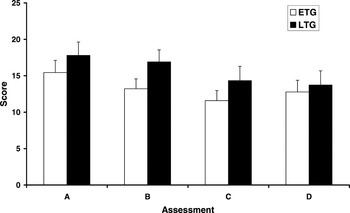
At Assessment B, there was also a borderline effect indicating improvement in the ETG in the DEX results (see Figure 3). Between Assessments A and B, the ETG's score changed from an average of 15.2 to an average of 13.2 (F1,27 = 3.03, p = .09), while remaining relatively flat for the LTG (M = 17.8 vs. M = 16.9, respectively). The between-group difference at Assessment B, while favoring the ETG, was not statistically significant (F1,45 = 2.06, p = .16). The immediate post-training change in the ETG on the DEX, while not statistically significant, is noteworthy in that it signaled a pattern of progressive improvement on this measure over the long-term (see the Long-Term Effects of Training section below).

Dysexecutive Questionnaire (DEX) score for the Early (ETG) and Late (LTG) Training Groups at Assessments A (baseline), B (after ETG training, LTG control), C (after LTG training, ETG control), and D (long-term follow-up). Error bars represent the standard error of the mean.
In summary, several lines of evidence at Assessment B point to a positive effect of rehabilitation training in the ETG. Following training, the ETG exhibited a higher level of overall psychosocial function than the LTG that had experienced only the control condition. Of particular interest, the training effect extended, to varying degrees, to a range of psychosocial measures, including some that reflected strategic functioning in a social context (i.e., LOC, DEX).
Training Effects on the LTG (Assessments B to C)
The LTG's performance on the G7 index at Assessment C indicated a positive response to rehabilitation training, while the ETG, which was in the control condition over this period, remained relatively stable on this measure. With the G7 index at Assessment B as a covariate, the LTG showed a nominally higher G7 index than the ETG at Assessment C, however, this effect was not significant (F1,34 = 1.73, p = .20). An examination of the distribution of simple difference scores over this period showed a skewed distribution in the LTG. Therefore, a nonparametric Mann–Whitney test was used to examine simple difference scores and indicated that the LTG's increase on the G7 index over this period was significantly different than the decrease exhibited by the ETG (U = 91, p = .04), reflecting, as expected, improved psychosocial function in the LTG following rehabilitation training.
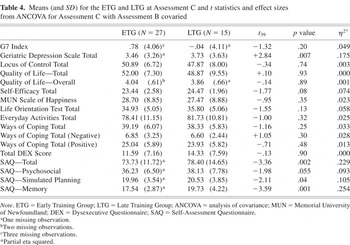
Examination of the individual component test results indicated that all the changes in the LTG between Assessments B and C were in the predicted direction, although only one change (GDS) was statistically significant (see Table 4). Note that the test statistics presented in Table 4 are expected to be in the opposite direction than those in Table 3, because we are expecting the LTG, rather than the ETG, to be improving relative to Assessment B. In summary, after receiving rehabilitation training, there was sufficient improvement in the LTG on the G7 index to bring their performance in this area close to that of the ETG, which remained stable during its control period.
Means (and SD) for the ETG and LTG at Assessment C and t statistics and effect sizes from ANCOVA for Assessment C with Assessment B covaried

Long-Term Effects of Training (Assessment D)
The composite G7 index was found to be just outside the range of statistical significance for the difference between groups at Assessment D, relative to their scores at Assessment A (F1,35 = 3.46; p = .07). However, at Assessment D, the amount of missing data was relatively high in the LTG (≈25%), due to factors related to human resources, which effectively reduced this group to 15 subjects. Missing data in the ETG was negligible (≈3%), leaving 28 subjects in this group. Because there was such a low proportion of collected data in the LTG and because we believe that the psychosocial status of participants in the LTG was profoundly influenced by the designed delayed start of the rehabilitation component of their program, we focused mainly on the long-term effects of training on the ETG. We separated the two groups for the above-mentioned reasons and ran Assessment D on Assessment A regression analyses to evaluate effects in each group. Assessment A average scores were subtracted from both variables to allow the Assessment D intercept to be interpreted as a rehabilitation effect. For this specific purpose, hypothesis tests regarding improved performance at Assessment D relative to Assessment A are presented as t-statistics. We found that the ETG had a borderline positive intercept (t21 = 1.98, p = .06), while the LTG had a nominally negative intercept point estimate (t13 = −.80, p = .44), suggesting that there was a general gain from rehabilitation training in the ETG that was not realized in the LTG (see Figure 1). The improvement in psychosocial function described by the G7 index in the ETG at Assessment D was reflected also in the individual component test results (see Appendix).
Performance on the psychosocial tests that did not comprise the G7 index also indicated gains by the ETG. In particular, the WOC test yielded interesting results. In the ETG, negative WOC was found to have significantly improved between Assessments A and D (t26 = −3.2, p = .003), while the LTG exhibited a borderline effect in the same direction (t13 = −1.8, p = .09). The LTG, however, showed a significant worsening on the positive WOC measure, which decreased significantly between Assessment A and Assessment D (t13 = −3.10; p = .008), while the ETG remained relatively flat (t26 = 1.10, p = .29).
At Assessment D, there was a major finding with respect to the DEX, which measures the ability to plan, problem solve, and self-regulate in social situations.a
The DEX test has broad relevance to strategic function in social and goal-management situations. For this reason, some of the scores for this test are reported here and in the paper by Levine et al. (2007). The implications of the results, in terms of psychosocial function and practical task planning, are discussed separately in the two papers.
In summary, over the long-term, the ETG retained gains in the psychosocial domain resulting from rehabilitation training. With the exception of the DEX Questionnaire, this did not appear to be the case in the LTG and, indeed, there were indications from the G7 and other measures that this group may have declined somewhat from baseline. However, any interpretation related to the LTG's performance must be tempered by the shortage of collected data at Assessment D and the high variability in the LTG scores.
Other-Raters' Results
Analyses of the other-raters' scores on the questionnaires yielded little evidence that they detected changes in psychosocial function that could be attributed to rehabilitation training. There were no differences in raters' assessments of the two groups at baseline (Assessment A) and few significant differences at any of the other observation points. There were only two indications, in the eyes of the raters, that training may have had an effect. Between-group comparisons on the QOL test revealed a difference that favored the ETG at Assessment B (F1,39 = 3.93, p = .05), and a borderline difference for the LTG at Assessment C (F1,30 = 3.69, p = .06). The same pattern was observed for the LOC test at Assessment B (F1,39 = 6.43, p = .01) and Assessment C (F1,31 = 4.01, p = .05). These results suggest an immediate benefit for the group that had just completed rehabilitation training. However, this conclusion is qualified by within-group comparisons that, for the most part, failed to provide evidence that other-raters perceived improvements on the measures that reflected training-related benefits. In fact, the only within-group comparisons that yielded significant changes that could be attributed to training effects were in the LTG, between Assessments B and C on the LOC test (F1,11 = 4.99, p = .05) and, on the WOC test, between Assessments A and C (F1,12 = 14.12, p = .003), and between Assessments A and D (F1,12 = 9.78, p = .01).
DISCUSSION
A psychosocial training module was included in our rehabilitation training program on evidence that psychosocial attributes related to general well-being are linked to cognitive loss in older or brain-impaired adults (Dawson et al., 1999). The results on a wide range of psychosocial tests showed that, following training, older adults improved in several areas of psychosocial well-being. This effect was particularly notable on the G7 index, which brought together several psychosocial attributes into a single measure of well-being, and mirrored the results of some of the individual tests that comprised the G7 index. As well, at least for the ETG, the benefits extended for several months beyond the completion of rehabilitation training.
It is noteworthy that, at Assessment B, as predicted, the ETG's G7 index was higher than that of the LTG. As well, when we controlled for performance differences at Assessment B, we found that the LTG, relative to the ETG, had improved significantly at Assessment C following training. We attribute the latter effect mainly to the LTG's response to training which, although not reflected statistically in within-group comparison between Assessments B and C, was sufficient to raise this group's G7 index to a level that approached that of the ETG. Both groups consolidated their post-training gains, resulting in comparable G7 scores at Assessment D. The training program also had a beneficial effect on measures that did not contribute to the G7 index. Both groups revealed a significant reduction in the number of negative coping responses of the WOC test immediately following training and, additionally, over the long-term, in the ETG. The total DEX scores did not reveal an immediate significant benefit in the post-training assessments, but there were indications of possible improvement over baseline. This trend continued so that, by Assessment D, both groups were performing significantly better on this test when compared to baseline and post-training performance. Both the DEX and the negative WOC measures are thought to assess the application of strategic processes to social situations. These results are in line with a recent study that demonstrated a relationship between executive function and coping strategies in patients with traumatic brain injury (Krpan et al., in press). Patients who tended to use adaptive, problem-focused coping strategies, as measured by the WOC Questionnaire—Revised, exhibited better executive performance, whereas lower executive performance was associated with more maladaptive emotion-focused coping. Overall, the present results are consistent with our expectation that our training program would improve strategic functioning, and furthermore, show that such benefits can extend to the psychosocial domain.
Interestingly, the improvements observed in the self-report measures of psychosocial function following training were not reflected to the same degree in the assessments of the “other-raters.” While this finding may indicate that benefits of the program failed to generalize to the participants' real-world behavior, it is our view that the other-raters' scores should be treated cautiously. Unlike the participants' whose high level of commitment was reflected in several ways (e.g., through excellent attendance, group participation, an absence of dropouts, home work assignments), the raters varied considerably in terms of their involvement and interest in the training program. Although not directly measured, it is unlikely that the raters consistently monitored participants' progress and, as a result, may have been insensitive to changes in participants' psychosocial behavior. Moreover, relative to the participants, there was less control over the circumstances in which the other-raters completed the questionnaire, and so, in this regard also, there was potential for greater variability among the other-raters. Notwithstanding these considerations, it is encouraging that the changes that the raters did observe were generally in the predicted direction.
Although the ETG and LTG exhibited enhanced psychosocial function as a result of rehabilitation training, the overall effect was greater in the ETG (see Figure 1). This effect was also observed in the other assessment domains (see Introductory paper by Stuss et al., 2007). As indicated in the Introductory paper, despite being fully briefed as to the schedule, the LTG appeared unprepared for the 3-month wait and expressed some disappointment and, even frustration, with the delay. We believe that this reaction may have adversely affected their participation in the program. There is no obvious explanation for the lack of preparation, although for reasons of personal dynamics or misunderstanding, their interpretation of the briefing may have been wrong, thereby creating false expectations and/or inappropriate mental strategies. In a program such as this, where the rehabilitative process appears to be linked closely to psychosocial factors, it is essential that participants clearly understand the procedures. This understanding may require additional effort during the individual meetings held at the beginning of the trial, which could also be used to reinforce participants' positive attitude and ensure a high level of motivation for the training program. In addition, an instrument designed specifically to assess participants' understanding of the schedule and capability to separate fact from personal interpretation could be administered before training, to indicate whether additional preparation might be needed.
The results of this study show that, in line with our expectations, the benefits of rehabilitation training extend to measures of psychosocial function. This finding is consistent with a growing body of evidence that cognitive decline in old age is linked to lifestyle decisions that promote healthy and meaningful activities (Churchill et al., 2002; Colcombe et al., 2003; Laurin et al., 2001) and, in turn, lead to a greater sense of well-being (Menec & Chipperfield, 1997; Rejeski & Mihalko, 2001). The results add important support to the view that psychosocial training is an important adjunct to rehabilitation programs that have, as their primary focus, the enhancement of cognitive function in older adults (Ben-Yishay, 1996; Prigatano, 1986; Wilson, 1987). In this regard, a reasonable observation is that the Psychosocial Training module in the present protocol complemented the benefits derived from the training provided in the Memory Skills Training and the modified GMT modules. It should also be noted that the other modules were also a source of psychosocial support (through professional attention, social interaction, stimulating activity, etc.) that probably factored into the overall treatment benefits. This point speaks to the relative contribution of each module to overall improved function and is one of the issues being addressed in current follow-up work (see Overview paper by Winocur et al., 2007, this issue, pp. 166–171).
Finally, the emphasis that we have placed on psychological well-being is supported by research that highlights the importance of other nonbiological factors for successful aging generally and cognitive function, in particular. As examples, such benefits have been demonstrated reliably in normal aging in relation to physical exercise (see review by Colcombe & Kramer, 2003), leisure activity (Hultsch et al., 1999), healthy diet (Greenwood & Winocur, 1999), and a stimulating supportive environment (Kramer et al., 2004). These variables have been shown to have protective value against the development of Alzheimer's disease and related dementias (Coulson et al., 2001; Scarmeas et al., 2001; Wilson & Bennett, 2003; Wilson et al., 2002) and clearly warrant consideration in the development and refinement of cognitive rehabilitation programs.
ACKNOWLEDGMENTS
The authors acknowledge the valuable contributions of the other coinvestigators on this project: Drs. M. Alexander, S. Black, F.I.M. Craik, D. Dawson, B. Levine, and I.H. Robertson. As well, the outstanding support provided by Marina Mandic, Rayonne Chavannes, Maureen Downey-Lamb, Melissa Edwards, Louise Fahy, Peter Glazer, Marie-Ève Couture, and Tara McHugh, is gratefully acknowledged. This study, and the experimental trial of which it is a part, were supported by the J.S.F. McDonnell Foundation. D. Stuss was supported by the Reva James Leeds Chair in Neuroscience and Research Leadership. The information reported in this manuscript and the manuscript itself are new and original. The manuscript is not under review by any other journal and has never been published either electronically or in print. There are no financial or other relationships that could be interpreted as a conflict of interest affecting this manuscript.
APPENDIX