Since the first publication by Jatene et alReference Jatene, Fontes and Paulista 1 in 1976, the arterial switch operation has become a safe and reproducible technique,Reference Stoica, Carpenter and Campbell 2 – Reference Qamar, Goldberg, Devaney, Bove and Ohye 5 allowing anatomical repair of transposition of the great arteries and selected forms of double-outlet right ventricle. The hospital mortality of the arterial switch operation given by the Society of Thoracic Surgeons Congenital DatabaseReference Jacobs, O'Brien and Pasquali 6 is 2.4% for arterial switch operation in transposition of the great arteries with intact ventricular septum and 6.4% for arterial switch operation with transposition of the great arteries-ventricular septal defect, with several centres reporting 0% mortality on overall series of arterial switch operation.Reference Stoica, Carpenter and Campbell 2
The evaluation of quality of care is becoming more accurateReference O'Brien, Clarke and Jacobs 7 and also different in our congenital heart surgery speciality. The traditional evaluation based on the risk for hospital mortality becomes obsolete for procedures with very low mortality and the assessment of quality requires measuring objectively morbidity as we started with the morbidity score.Reference Jacobs, O'Brien and Jacobs 8 Nevertheless, none of our two modern STAT Mortality and Morbidity ScoresReference O'Brien, Clarke and Jacobs 7 , Reference Jacobs, O'Brien and Jacobs 8 can predict the risk of mortality or morbidity of individual patients undergoing an arterial switch operation. Moreover, the risk for mortality is variable depending on the performance of the surgeon and his team.
In comparison, the comprehensive Aristotle complexity scoreReference Lacour-Gayet, Clarke and Jacobs 9 , Reference Bojan, Gerelli, Gioanni, Pouard and Vouhé 10 is designed to be a constant value. It includes detailed benchmarks of mortality and morbidity through the analysis of procedure-dependent and -independent factors, which provide a case-mix to evaluate the risk of the arterial switch operation.
Definition of the complex arterial switch operation
To circumvent the variability of risk, we will refer essentially to complexity factors in using the recently updated procedure-dependent factors of the arterial switch operation. It is noticeable that this approach is subjective, based on expert surgeons’ opinion and on the literature and personal experience.Reference Stoica, Carpenter and Campbell 2
Arterial switch operations are complex when undertaken in the presence of one or several of the following features:
-
• Complex coronary anatomy
-
• Malaligned commissures
-
• Aortic arch obstruction
-
• Multiple ventricular septal defect
-
• Double-outlet right ventricle
-
• Late referral
-
• Weight <2.5 kg.
Complex coronary anatomy
There are individual preferences for classification and surgical techniques of arterial switch operation. We have followed for two decades a similar coronary classification based on the course of the vessels, as well as a standardised surgical technique that was described elsewhere.Reference Lacour-Gayet and Anderson 11 , Reference Lacour-Gayet 12 Following a recent study,Reference Stoica, Carpenter and Campbell 2 we believe that today arterial switch operation cannot be considered complex when associated with one or several of these anatomical features: normal coronary anatomy, circumflex coming off the right coronary artery, eccentric ostium, and early take-off of an infundibular artery from the left or right coronary artery.
The complex coronary patterns represent around 20% of the coronary anatomy.
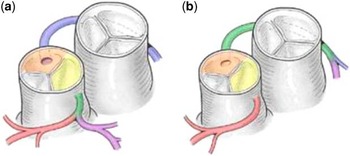
Double-looping coronaries (with two ostia; Fig 1)
These are the most frequent complex coronary arteries (15%).
Double-looping coronaries (with two ostia; 15%). ( a ) Right coronary artery looping anteriorly and Cx looping posteriorly and ( b ) right coronary artery looping anteriorly and the entire left trunk looping posteriorly.

The right coronary artery crosses in front and either the circumflex (Fig 1a) or the entire left trunk (Fig 1b) crosses behind. This later pattern is frequent in Taussig–Bing and sometimes called inverted coronary artery.
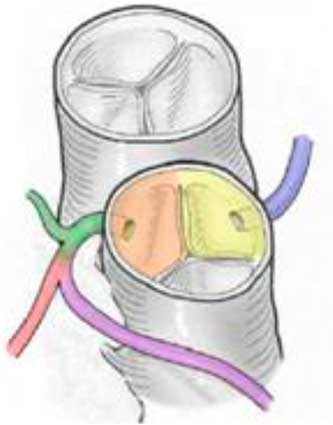
Anterior-looping coronaries (with two ostia; Fig 2)
These are very rare (0.1%). Left anterior descending coming from the right coronary artery and looping in front, with Cx coming from the left ostium.
Anterior-looping coronaries (with two ostia; 0.1%). Left anterior descending coming off the right coronary artery.

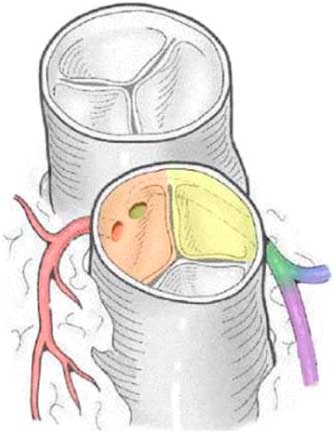
Intramural coronaries (Fig 3)
These represent 5% and are very challenging. They can be repaired with very low mortalityReference Stoica, Carpenter and Campbell 2 following the technique described by Mee et al.Reference Asou, Karl and Mee 13 The most challenging form is when the intramural coronary arteries are coming from a single ostium.
Intramural coronary (5%).

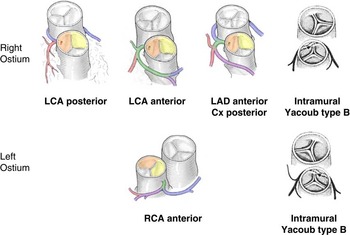
Single coronary ostium (Fig 4)
This represents 5%. The forms with single right ostium are the most frequent.Reference Scheule, Zurakowski, Blume, del Nido, Mayer and Jonas 14 The transfer is theoretically simpler as only one button is to be moved. In fact, the transfer is made difficult by the risk of kinking and stretching and implies to largely mobilise the coronary trunks on a long distance.
Single ostium (5%). LAD = left anterior descending; LCA = left coronary artery; RCA = right coronary artery.

Single ostium associated with intramural coronary, described initially by Yacoub and Radley SmithReference Yacoub and Radley Smith 15 as type B, is the most challenging coronary patterns. Different techniques are proposed. The technique of coronary relocation, described by Planche et al,Reference Planche, Lacour-Gayet and Kachaner 16 implies to rotate the common coronary button on 180°C. This technique is at risk for compression of the transferred coronary button by the pulmonary bifurcation standing in front following the Lecompte manoeuvre. The most appropriate technique is to create a fistula between the great vessels to re-route the single coronary ostium into the neoaortic root. This technique, first described by Aubert et al,Reference Aubert, Pannetier, Couvelly, Unal, Rouault and Delarue 17 was refined by Takeuchi and KatogiReference Takeuchi and Katogi 18 and Moat et al.Reference Moat, Pawade and Lamb 19
Malaligned commissures
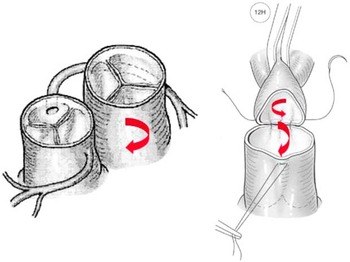
Malaligned commissures are not an absolute risk when minor. It makes the coronary transfer more difficult. The incidence of malaligned commissures varies from 50% in the Kim et alReference Kim, Kim, Lim, Oh and Kim 20 series to 15% in our recent experienceReference Stoica, Carpenter and Campbell 2 and was associated with early or late mortality.Reference Stoica, Carpenter and Campbell 2 , Reference Kim, Kim, Lim, Oh and Kim 20 Several techniques are used depending on the severity of the malalignment: trap-door, implantation above a commissure, tube reconstruction of a coronary artery,Reference Kim, Kim, Lim, Oh and Kim 20 and rotation of the neoaortic root (Fig 7). The transfer of the right coronary button is solved in placing the button in high positionReference Lacour-Gayet and Anderson 11 , Reference Lacour-Gayet 12 above the commissure. The transfer is more challenging for the left button. Performing a rotation of the neoaortic root to the right or to the left, when doing the end-to-end distal aortic anastomosis, allows to realign the commissures in placing the anterior commissure of the neoaortic valve close to the middle line.
Aortic arch obstruction
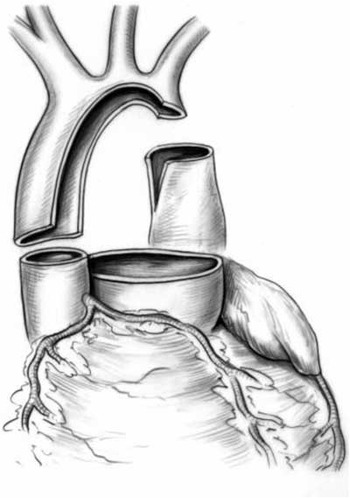
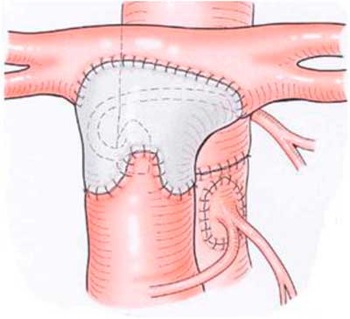
Frequently associated with Taussig–Bing, the anatomical repair is more complex because of the aortopulmonary size mismatch (Fig 5). It is necessary to enlarge (Fig 5) the ascending aorta in using a homograft patch. The small diameter of the neo-pulmonary annulus can create a right ventricular outflow tract obstruction, which is difficult to handle, as many times the right coronary artery is crossing in front the infundibulum. Side-by-side vessels are frequent in transposition of the great arteries-ventricular septal defect-coarctation. It could be necessary to move the pulmonary artery trunk to the right pulmonary artery branch (Fig 6) to avoid a compression of the right coronary artery that is frequently looping in front of the aorta.
Aortopulmonary mismatch.

Side-by-side vessels. Translation of the pulmonary trunk towards the right pulmonary artery.

Malaligned commissures.

Multiple ventricular septal defect
The presence of two ventricular septal defects does not contraindicate one stage repair. Over two ventricular septal defects, a pulmonary artery banding is a reasonable approach, but the repair should be performed before 6 months of age to avoid long-term impairment of the neoaortic valve.
Double-outlet right ventricle
Taussig–Bing
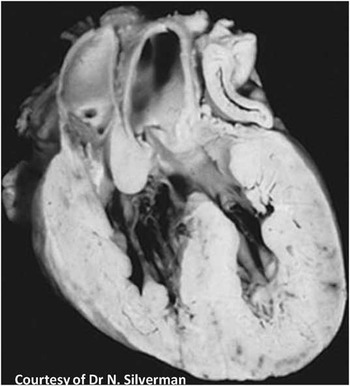
Double-outlet right ventricle associated with subpulmonary ventricular septal defect is complex because of multiple challenging associations: complex coronary anatomy with frequently double-looping coronaries, arch obstruction and side-by-side vessels, as already mentioned, and the presence of a subaortic obstruction by posterior malalignment of the conal septum (Fig 8).
Taussig–Bing with subaortic obstruction.

Double-outlet right ventricle non-committed ventricular septal defect
This complex form of double-outlet right ventricle is sometimes treated like a Taussig–Bing anomaly by rerouting of the ventricular septal defect to the pulmonary artery followed by arterial switch.Reference Stoica, Carpenter and Campbell 2 , Reference Lacour-Gayet 21 , Reference Artrip, Sauer and Lacour-Gayet 22
Late referral
Transposition of the great arteries-intact ventricular septum >3 weeks of age
In western countries, the delay in performing an arterial switch operation >1 month is most often due to an associated extra-cardiac lesion contraindicating the arterial switch operation, typically a necrotising enterocolitis, a brain haemorrhage, a severe infection, or a very low birth weight.Reference Lacour-Gayet, Piot and Zoghbi 23 The delayed arterial switch operation is undertaken after left ventricle retraining using a moderate pulmonary artery banding and a Blalock–Taussig shunt. The left ventricle reconditioning is obtained in 1–4 weeks, but is associated with significant morbidity.Reference Stoica, Carpenter and Campbell 2
Transposition of the great arteries-ventricular septal defect with high lung resistances
This population of patients is seen in countries with suboptimal paediatric cardiac surgery resources. When the pulmonary hypertension is severe, with lung resistances over six Woods units, there is an ongoing controversy between: doing a palliative arterial switch operation and leaving the ventricular septal defect open,Reference Fan, Hu and Zheng 24 using a fenestrated patch,Reference Lei, Chen and Cen 25 using a unidirectional patch technique,Reference Talwar, Choudhary and Airan 26 or abstaining.
Weight <2.5 kg
Extreme low birth weight, <1.5 kg, is clearly a risk factor. Between 1.5 and 2.5 kg, the arterial switch operation has been attempted with quite good success. The multi-centric Congenital Heart Surgeons' Society study including 507 infants with weight between 1 and 2.5 kg reports that weight at <2.5 kg is an incremental risk factor for arterial switch.Reference Curzon, Milford-Beland and Li 27
Listing of complexity factors
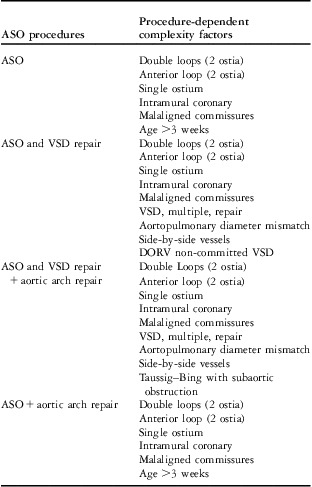
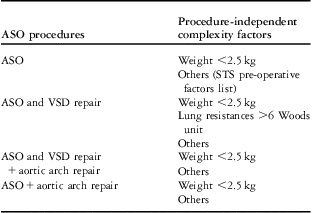
Tables 1 and 2 provide the list of procedure-dependent and -independent factors according to the four types of arterial switch operation. This listing will be discussed at the Society of Thoracic Surgeons and European Association for Cardio-Thoracic Surgery Database meeting along with other procedures.
Procedure-dependent complexity factors for the four ASO procedures.

ASO = arterial switch operation; DORV = double-outlet right ventricle; VSD = ventricular septal defect
Procedure-independent complexity factors.

ASO = arterial switch operation; STS = Society of Thoracic Surgeons; VSD = ventricular septal defect
Discussion
Coronary transfer in complex coronary arteries can be achieved with minimal risk and even with 0% peri-operative mortality in our series of 101 consecutive arterial switch operations with 45% of complex forms.Reference Stoica, Carpenter and Campbell 2 There is nevertheless a late risk of around 2% of coronary failure following arterial switch with complex coronaries. Coronary artery stenosis or occlusion could be silent because of the denervation of the great vessels. It is our practice to check the patency of the complex coronary arteries using computed tomography scan or magnetic resonance imaging, completed by coronarography when needed.
So far, the pulmonary valve seems to perform well under systemic pressures, with a long-term risk of aortic regurgitation around 2%. Nevertheless, the long-term dilation of the neoaortic root is a potential risk in forms with native large pulmonary roots.
Following more than a decade of work, the Society of Thoracic Surgeons and European Association for Cardio-Thoracic Surgery Databases have acquired now reliable benchmarks to measure the mortality and the morbidity associated with a given procedure. With the newly developed STAT Mortality and Morbidity Scores,Reference O'Brien, Clarke and Jacobs 7 , Reference Jacobs, O'Brien and Jacobs 8 it is possible to compare objectively the complexity of the procedures and the institutions. Nevertheless, it is not yet possible today to predict the risk of mortality and morbidity for a given patient. This requires a more comprehensive analysis, which is provided by the comprehensive Aristotle Score.Reference Lacour-Gayet, Clarke and Jacobs 9 The introduction of procedure-dependent complexity factors in the congenital databases should, in the future, allow to refine the exactness of the evaluation. Looking at the accuracy of the risk for mortality stratification models available today, the STAT Mortality Score obtained a C-index of 0.78 with data from the Society of Thoracic Surgeons and European Association for Cardio-Thoracic Surgery Databases,Reference O'Brien, Clarke and Jacobs 7 whereas the Comprehensive Aristotle Score reached a C-index of 0.860Reference Bojan, Gerelli, Gioanni, Pouard and Vouhé 10 with data from a single centre.
The introduction of a morbidity scoreReference Jacobs, O'Brien and Jacobs 8 is a decisive step to evaluate procedures with low mortality. Placing in perspective the outcomes of the arterial switch, it is anticipated that families and referral paediatric cardiologists, as well as payers, will favour centres with low morbidity. Decreasing morbidityReference Stoica, Carpenter and Campbell 2 in the arterial switch operation requires not only an excellent surgical technique, but also an optimal performance from the other participants of the team.