





Introduction
Contrary to earlier expectations of a global triumph of liberalism (Fukuyama Reference Fukuyama1992) and a convergence of modern societies around liberal principles (Inglehart and Welzel Reference Inglehart and Welzel2005; Marsh Reference Marsh2014), contemporary liberal societies are experiencing a sustained wave of contestations. These range from democratic backsliding (Levitsky and Ziblatt Reference Levitsky and Ziblatt2018; Waldner and Lust Reference Waldner and Lust2018), the rise of right-wing populism (Akkerman, de Lange and Rooduijn Reference Akkerman, de Lange and Rooduijn2016; Berman Reference Berman2021), and the global spread of illiberal regimes (Maerz Reference Maerz2020), to backlash against the implementation of liberal values (Norris and Inglehart Reference Norris and Inglehart2019). In this study, we argue that authoritarianism at the systemic level and authoritarian orientations at the individual level form a common denominator linking these developments. At the heart of this dynamic lies a fundamental clash over the conditions of freedom, which we exemplify by contrasting liberal and authoritarian views of what is required to live a self-determined life.
Self-determination is closely linked to the idea of personal control, which is not only a desirable ideal but also a psychological and biological necessity (Leotti, Iyengar and Ochsner Reference Leotti, Iyengar and Ochsner2010). Yet citizens disagree on what self-determination means due to divergent ideological orientations. Consequently, they also differ in their views on which conditions are essential for leading a self-determined life. Individuals with authoritarian orientations are expected to reject conditions typically associated with liberalism.
To investigate this expectation, we derive a liberal notion of self-determination from the literature. In part, this notion overlaps with other perspectives. For instance, physical well-being and basic economic security are not only central to liberal understandings of self-determination (Rawls Reference Rawls1971; Ringen Reference Ringen2005; Rosenblatt Reference Rosenblatt2018), but also resonate in non-liberal accounts as basic human needs (eg Maslow Reference Maslow1943, Reference Maslow1987; Ryan and Deci Reference Ryan and Deci2000; Ryff and Keyes Reference Ryff and Keyes1995). However, liberalism posits additional, more distinctive requirements: equal moral worth (Dworkin Reference Dworkin1977; Killmister Reference Killmister2023; Scheffler Reference Scheffler and Scheffler2002) and influence over collective decision-making (Dahl Reference Dahl1971; Graham Reference Graham1986; Held Reference Held1995). Although the pursuit of knowledge is acknowledged across ideological traditions (Cumbers and McMaster Reference Cumbers and McMaster2010; Samoff Reference Samoff1991), liberalism uniquely values it as a source of individual empowerment and personal growth beyond material utility (Nussbaum Reference Nussbaum2011, Reference Nussbaum2016; Sen Reference Sen2005). We thus categorise five conditions for self-determination according to their liberal uniqueness: physical well-being and economic security show a low degree of liberal uniqueness; moral equality and political participation, a high degree; and learning and personal growth, a moderate degree. We treat this distinction as a theoretically informed ordering rather than a directly measured construct.
This study tests two expectations concerning how these conditions relate to authoritarian orientations. First, we examine whether basic needs are universally valued, when uniquely liberal conditions are discounted by citizens with strong authoritarian orientations. Second, we consider cross-national variation; although autocratisation is a global trend, its intensity and impact vary across contexts. Although modernisation is theorised as a long-term process, we examine whether cross-national differences in attained levels of modernisation are associated with corresponding divergence in the relationship between authoritarian orientations and support for the conditions of self-determination. We expect this divergence to be most pronounced for the uniquely liberal conditions of self-determination.
We use the data from the ‘Public Attitudes towards the Liberal Script (PALS)’ survey (Giebler et al. Reference Giebler, Antoine, Ollroge, Gerhards, Zürn, Giesecke and Humphreys2023b, Reference Giebler, Antoine, Ollroge, Gerhards, Zürn, Giesecke and Humphreys2023c), an original comparative survey covering 30 countries and over 45,000 respondents. Our sample includes countries as varied as Australia, Germany, Japan, Sweden, India, Nigeria, Russia, Peru, and Tunisia. The regression results show that authoritarian orientations are strongly and negatively associated with support for liberal conditions – particularly moral equality and political influence. As expected, they are not negatively associated with support for basic needs, and interestingly, they are positively linked to physical well-being. Importantly, the gap between citizens holding weak and strong authoritarian orientations is associated with the level of societal modernisation. However, we also find that these differences are not universally driven by a backlash from authoritarians in liberal societies.
This study contributes to research on global political change by revealing how contestation over self-determination reflects a deeper normative divide between liberal and authoritarian orientations. The contribution of this paper lies in shifting attention from specific institutions and policy preferences to a more basic question: whether authoritarian orientations are associated with different understandings of what is necessary for living a self-determined life. This perspective helps uncover a deeper normative conflict over the conditions of freedom itself. Although liberal societies typically embrace pluralism and tolerate dissent, this consensus may falter when disagreement concerns not just policy but the foundational terms of freedom itself. By demonstrating that authoritarian orientations are systematically associated with reduced support for liberal conditions of self-determination, especially in more modernised contexts, we reveal important tensions in how citizens understand freedom – tensions that may underlie broader challenges to democratic resilience. These findings underscore that contestation of democracy and liberal principles may not only stem from elite strategies or institutional erosion, but from diverging conceptions of what a self-determined life entails. Recognising and addressing these core disagreements is essential to understanding – and potentially mitigating – current societal conflicts.
Individual self-determination, basic needs, and societal modernisation
Individual self-determination is the core principle of liberalism, both the central topic of liberal thought as well as the key principle around which liberal societies are organised (Wall Reference Wall and Wall2015). It refers to individuals having choices between acceptable alternatives in different situations of their life, in other words, having control over one’s own life and destiny. Historically, this required rethinking authority by turning against arbitrary power exercised by monarchs and the church to establish fundamental civil rights (Fawcett Reference Fawcett2018; Rosenblatt Reference Rosenblatt2018). Although there must be certain limitations on individual self-determination to enable living together (Williams Reference Williams and Hawthorn2005), ‘it is simply unimaginable to entertain, and empirically impossible to find, a variant of liberalism that dispenses with the concept of liberty’ (Freeden Reference Freeden2015: 58). In this line of thought, self-determination is distinct yet interconnected with ideas like positive and negative liberty, autonomy, and civil rights (Berlin Reference Berlin and Hardy2002; Deci and Ryan Reference Deci and Ryan1985; Gellner Reference Gellner1983).
Literature on self-determination in social psychology emphasises that although autonomy focuses on personal freedom and individual decision-making, self-determination often includes social and political dimensions – highlighting both the individual’s and group’s roles in shaping identity and exercising free will within a social context (Ryan and Deci Reference Ryan and Deci2000). Following this understanding of self-determination, within liberal thought as well as expressed by liberal institutions, norms, and practices, the extent of individual self-determination depends on a set of conditions. These conditions enable, support, and protect self-determination against the state but also against societal groups and other individuals. In this study, we do not focus on specific institutions as conditions, for example, the independence of courts or the existence of codified civil rights, but on abstract principles and human needs. This provides us with an advantage as they are far less contested within liberal theory than conceptualisations of the ‘perfect’ liberal institutional set-up. Moreover, these principles are arguably more fundamental, as specific norms, practices, and institutions are themselves manifestations of these principles. Hence, they represent something like underlying dimensions fostering a self-determined life. We focus on a total of five conditions of a self-determined life in a liberal sense: (1) moral equality, (2) influence on political decision-making, (3) physical well-being, (4) basic economic security, and (5) opportunities for learning and personal growth.
The liberal notion of control over one’s own life presupposes that one is protected from external control by others and that one’s own being and actions are tolerated and accepted (Dworkin Reference Dworkin1977: 182). Tolerance and acceptance crucially rely on being recognised as having equal moral worth (Scheffler Reference Scheffler and Scheffler2002). In liberal societies during the 20th century, minorities, who had often experienced oppression, discrimination, and injustice, have been pushing for the expansion of lifestyles and social identities. In turn, alternative categories based on gender, ethnicity, religion, and sexual orientation have worked themselves into the mainstream of liberalism (Freeden Reference Freeden2015: 50). Hence, the idea of equal moral worth and being fundamentally accepted for who you are constitutes one of the most central principles of liberal theory (Killmister Reference Killmister2023; Scheffler Reference Scheffler and Scheffler2002). Accordingly, we understand this condition as a recognition-oriented dimension of self-determination: being accepted as an equal, rather than merely being treated equally in a narrow legal or procedural sense.
Political rights also play a prominent role in liberal societies. It follows from the idea of collective self-determination that the people ought to possess the right to have ‘a say in political decisions’. This entails the ability to influence the societal framework conducive to the individual’s development (Graham Reference Graham1986) as well as to participate in collective decision-making processes regarding the imposition of restrictions on individual rights for the benefit of all (Held Reference Held1995). Consequently, individual self-determination is closely interwoven with political participation and issues such as democracy, freedom of assembly, and freedom of opinion and speech (Dahl Reference Dahl1971). Accordingly, we conceptualise this condition as a broad political dimension of self-determination: having a meaningful say in collective decision-making, rather than one specific institutional mechanism alone.
The extent to which an individual can exercise individual rights depends crucially on the individual’s endowment with material and immaterial resources. Therefore, they play a special role in liberal societies (Rawls Reference Rawls1971). Rights ‘open up choice for you but do not on their own give you choice’ (Ringen Reference Ringen2005: 37). In its most basic expression, a person’s physical well-being constitutes a very important condition. Within liberal thought, the right to health and health care is commonly deduced from Rawls (Reference Rawls1971), for example, by describing physical well-being as enabling equality of opportunity. Similarly, basic economic security provides individuals with the foundation to make autonomous choices about their lives, free from the fear of economic hardship. This can refer to the need for job security, stable income, or savings. Basically, it is about the means that prevent the individual from being hungry, sleeping rough, and experiencing similar consequences of poverty. Although the extent to which it is up to the state to provide individuals with economic security is debated in liberal thought (Rosenblatt Reference Rosenblatt2018), a minimum level of safety is generally considered a basic need that is of the highest relevance to all individuals (Maslow Reference Maslow1987).
In addition to having material resources, opportunities for learning and personal growth as an immaterial resource is seen as an important prerequisite for participation in society (Nussbaum Reference Nussbaum2011; Sen Reference Sen2005). Being able to learn, gain knowledge, and achieve personal growth, often conceived of as access to education, are of particular importance in liberal societies. This condition is closely linked to the principles of rationality and the idea of progress, which are inherent to a liberal understanding of society (Freeden Reference Freeden2015; Wall Reference Wall and Wall2015).
We do not define these five conditions as sufficient for living a self-determined life in a liberal sense but rather understand them as resembling necessary conditions. However, taking a closer look at the five conditions, they clearly differ from each other in terms of how unique they are to liberalism and liberal thought. Some of them also play an important role in non-liberal conceptions of societal organisation. For our study, this distinction is fundamental. Although we present the underlying argument of why this is the case comprehensively below, it boils down to authoritarian views being primarily incompatible with conditions which are unique to the liberal notion of self-determination. Consequently, although all five conditions are important for individual self-determination, they are not equally contested by authoritarians.
Physical well-being and economic security can be described as what others call universal human needs (eg Maslow Reference Maslow1943, Reference Maslow1987; Ryan and Deci Reference Ryan and Deci2000; Ryff and Keyes Reference Ryff and Keyes1995). The satisfaction of such needs is necessary for the human body to function optimally and is likely to enhance a person’s feeling of well-being – independent of their cultural or geographical background (Tay and Diener Reference Tay and Diener2011). In turn, both conditions are likely to be valued across all societies and cultures. Additionally, a focus on learning and gaining knowledge is also a core principle of some non-liberal societies. Socialist societies have, for example, emphasised education and knowledge as forms of instrumental rationality necessary for societal progress (Cumbers and McMaster Reference Cumbers and McMaster2010; Samoff Reference Samoff1991). Although liberalism understands the pursuit of knowledge not only as required for societal progress but also, crucially, as beneficial for the empowerment of the individual beyond economic benefits (Nussbaum Reference Nussbaum2016), there is still some overlap decreasing the unique liberal character of this condition.
Looking at the two remaining conditions, moral equality and influence on politics, is much more exclusively aligned with liberalism. As argued by modernisation theory (eg Lipset Reference Lipset1959; Parsons Reference Parsons1964; Rostow Reference Rostow1960), large-scale processes have ever more liberalised societies, making them increasingly secular, pluralistic, and individualistic. Similarly, Inglehart’s theory of value change (Abramson and Inglehart Reference Abramson and Inglehart1995; Inglehart Reference Inglehart1977, Reference Inglehart1997, Reference Inglehart2018; Inglehart and Welzel Reference Inglehart and Welzel2005) details how a related development can be observed on the individual level. Inglehart argues that the transformation to industrial societies brings about a change from traditional to secular-rational values. The subsequent transformation towards post-industrial societies comes with a change from survival to self-expression values. This is associated with an emphasis on post-materialism, gender equality, tolerance for sexual as well as ethnic minorities, environmentalism, and demands for more political participation (Inglehart and Welzel Reference Inglehart and Welzel2005). Hence, in more modernised societies, citizens are more likely to endorse orientations and principles that are closely tied to a liberal understanding of self-determination. We argue that these orientations are directly linked to a liberal notion of individual self-determination – modernisation increases the individual’s potential for control in a specific way (Nash Reference Nash1984). Consequently, moral equality and having influence on politics are uniquely liberal conditions for self-determination.
In summary, we identify five abstract conditions of individual self-determination. Of these five conditions, physical well-being and economic security should be valued in all societies irrespective of their level of modernisation or whether they are organised following liberal principles or not. Moral equality and having influence on politics are unique to liberalism as they are the products of modernisation processes which transformed traditional societies into liberal societies. Finally, learning and personal growth lie somewhere in between, thereby constituting a condition that is only unique to liberalism in a specific interpretation but not in its general nature.
We recognise that self-determination has been conceptualised in different ways across philosophical and sociopolitical traditions. Related approaches emphasise, for example, capabilities, non-domination, self-realisation, or the cultural resources that enable participation in public life (Almond and Verba Reference Almond and Verba1963; Pettit Reference Pettit1997; Sen Reference Sen1999; Taylor Reference Taylor and Gutmann1992). Our aim here is more limited: to identify a set of broad enabling conditions that are central to a liberal understanding of self-determination and that can be examined comparatively across diverse societies. By focusing on such general conditions rather than specific institutional arrangements, we provide a framework for analysing how self-determination may be supported or contested.
Authoritarian orientations: contesting the liberal notion of self-determination
Regardless of the existing critique of modernisation theory (Roxborough Reference Roxborough1988; Wallerstein Reference Wallerstein1974) and with certain geographic restrictions, real-world developments pointed to and were interpreted as the triumph of liberalism, democracy, and the principle of individual self-determination (Fukuyama Reference Fukuyama1992). There were clear expectations of a convergence of modern societies around liberal principles (Inglehart and Welzel Reference Inglehart and Welzel2005; Marsh Reference Marsh2014). For the past 30 years, however, contemporary societies have been confronted with substantial challenges and contestations. A common denominator linking these different forms of contestations is authoritarianism and authoritarian orientations (Berberoglu Reference Berberoglu2020). Phenomena such as democratic backsliding (Levitsky and Ziblatt Reference Levitsky and Ziblatt2018; Waldner and Lust Reference Waldner and Lust2018), the rise of right-wing populism (Akkerman et al. Reference Akkerman, de Lange and Rooduijn2016; Berman Reference Berman2021), the resurgence of autocratic regimes all over the world (Maerz Reference Maerz2020), the rise of China as the most successful alternative model to liberalism (Bell Reference Bell2015; Weiss Reference Weiss2019), and the current Russian war of aggression in breach of international law (Flockhart and Korosteleva Reference Flockhart and Korosteleva2022) constitute powerful contestations of the liberal model of society. Looking at individuals, some scholars observe a cultural and political backlash against the proliferation of liberal values around the world (Norris and Inglehart Reference Norris and Inglehart2019), and we see at least substantial electoral support for radical-right parties in (established) democracies almost all over the world (Mudde Reference Mudde2007).
Putting it more systematically, at the societal level, one can speak of a reemergence of the classical and historical divide between liberal and authoritarian societies and political regimes (Diamond Reference Diamond2021; Lührmann and Lindberg Reference Lührmann and Lindberg2019) as well as associated ideological orientations. Although authoritarianism was originally conceptualised as a personality trait explaining the rise of fascism in Europe (Adorno, Frenkel-Brunswik, Levinson et al. Reference Adorno, Frenkel-Brunswik, Levinson and Sanford1950), later work has described it in different ways, including as a set of attitudinal clusters, an ideological attitude, or a broader authoritarian orientation shaped in part through socialisation (Akrami and Ekehammar Reference Akrami and Ekehammar2006; Altemeyer Reference Altemeyer1981, Reference Altemeyer1996; Duckitt, Wagner, du Plessis et al. Reference Duckitt, Wagner, du Plessis and Birum2002). In this paper, we use the term authoritarian orientations to refer to such broader, non-policy-level predispositions. Many studies characterise authoritarian orientations as reflecting preferences related to authority, conformity, order, and security, rather than autonomy, pluralism, and openness (Cohrs, Moschner, Maes et al. Reference Cohrs, Moschner, Maes and Kielmann2005; Duckitt Reference Duckitt1992; Feldman Reference Feldman2003; Feldman and Stenner Reference Feldman and Stenner1997). In this literature, authoritarianism is most commonly conceptualised as having three subdimensions: submission to authority, conventionalism, and aggression towards those deviating from societal norms (Altemeyer Reference Altemeyer1981; Bizumic and Duckitt Reference Bizumic and Duckitt2018; Duckitt, Bizumic, Krauss et al. Reference Duckitt, Bizumic, Krauss and Heled2010). In that sense, stronger authoritarian orientations are often in tension with liberal principles that emphasise autonomy, pluralism, and equal individual freedom. We do not use the term ‘authoritarian orientations’ in the narrower sense of Schwartz-style value theory (Reference Schwartz2007, Reference Schwartz2012); rather, we are interested in a broad ideological orientation that is more general than any single issue attitude and therefore relevant for how individuals evaluate, among many other things, the conditions of self-determination.
Whether resulting authoritarian contestations of liberal societies are simply a recurring but temporary phenomenon (Welzel Reference Welzel2021), or whether this points to a more permanent conflict (Norris and Inglehart Reference Norris and Inglehart2019) remains to be seen. Regardless, support for authoritarian political actors should be interpreted as a contestation of liberal institutions and principles – including the liberal understanding of self-determination. Consequently, citizens holding strong authoritarian orientations should reject the above presented conditions in proportion to their liberal uniqueness. Although learning and personal growth fall somewhere in between, having an influence on politics and a free way of living, which are essential and unique to liberalism, are incompatible with submission to authority, conventionalism, and aggression towards those deviating from societal norms. In contrast, physical well-being as well as economic security should be of equal relevance to all citizens as they are not unique to a liberal notion of self-determination.
In a simplified manner, Maslow’s (Reference Maslow1943) classic model of a hierarchy of needs can be applied here to justify this claim. There is no agreement on the exact ordering of different needs and individuals can strive for the fulfilment of different needs at the same time (Maslow Reference Maslow1987; Tay and Diener Reference Tay and Diener2011). However, physical well-being and economic security should be of primary importance for all citizens. Modernisation theory and arguments concerning post-materialist value change share this viewpoint (Inglehart Reference Inglehart1977; Inglehart and Welzel Reference Inglehart and Welzel2005; Marsh Reference Marsh2014). A shift away from authoritarian orientations is partly caused by a surplus of material resources in the socio-economic environment and by being socialised in such an environment (De Witte Reference De Witte and Spielberger2004). Hence, satisfying basic needs as well as assigning high importance to these needs could even be described as a precondition for being able to live a self-determined life in the liberal sense. These arguments fit well with the argument developed in the prior section; physical well-being and some levels of economic security are necessary to live a self-determined life, but they are not unique to liberalism. Although moral equality and having an influence in politics are unique to a liberal understanding of self-determination, having learning opportunities falls somewhere in between.
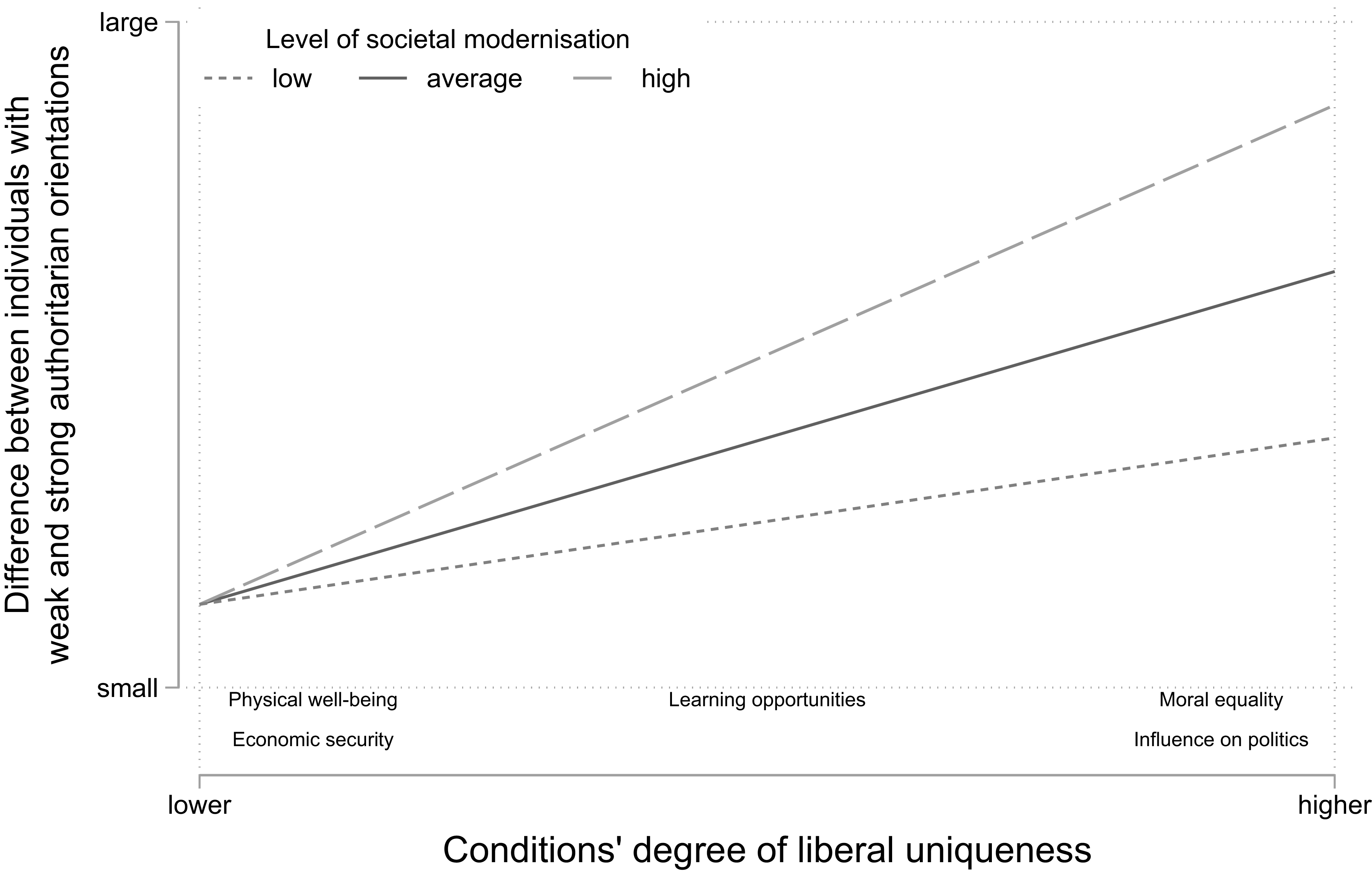
We summarise this hypothesised association between authoritarian orientations and the conditions of self-determination schematically in Figure 1. The difference in considering a condition to be important for a self-determined life between individuals with weak and strong authoritarian orientations is shown on the y-axis. The x-axis shows the degree of liberal uniqueness of the five conditions. The different lines represent different societal contexts, but for now, we are only interested in the solid line representing an average society. The slope of the solid line illustrates that differences in the support of the conditions being relevant for a self-determined life between individuals with strong authoritarian orientations and those with weak orientations increase in relation to the conditions’ liberal uniqueness. In other words, we expect a positive and substantial association between strong authoritarian orientations and rejecting uniquely liberal conditions of individual self-determination. This pattern weakens or even vanishes if a condition is less or not at all unique to a liberal notion – at least, we would not expect the strength of authoritarian orientations to matter for how conditions like health are seen by individuals.
Schematic depiction of the theoretical argument.

As stated above, there is a growing trend of authoritarianism opposing liberal principles. However, this does not imply that every society shows this trend, nor that resulting developments and conflicts are equally significant everywhere. Furthermore, it remains unclear why this has been happening more commonly in the last decades and why we see such contestations of liberal principles, especially in those societies that are often deemed to be the most liberal. Although there are probably various factors driving these developments (Börzel and Zürn Reference Börzel and Zürn2020), we focus on one mechanism directly related to the core argument of this study: the effect of societal modernisation.
Modernisation led to liberalisation both on the institutional level and on the level of value and ideological orientations. Borrowing from Popper’s notion of an open society (Reference Popper2011), we understand the consequences of these processes not only in economic terms (like, eg Rostow Reference Rostow1960) but also as transformations across other sub-systems that result in societal liberalisation. Hence, we neither solely focus on the common dimensions of modernisation in the traditional literature (Lipset Reference Lipset1959; Parsons Reference Parsons1964), nor do we follow the approach by Inglehart, Welzel, and others (Abramson and Inglehart Reference Abramson and Inglehart1995; Inglehart Reference Inglehart1977; Inglehart and Welzel Reference Inglehart and Welzel2005), both of which tend to overemphasise the socio-economic dimension of modernisation processes. For our purpose, we expand these conceptualisations of modernisation to a more comprehensive definition looking at (1) socio-economic development, (2) societal openness in the form of a country’s degree of globalisation and interdependence with other countries, and (3) democratic political institutions.
In line with the cross-sectional design of this study, we translate this process-oriented argument into a stationary one; we examine whether differences in attained levels of modernisation are associated with corresponding differences in the gap between authoritarians and non-authoritarians. We argue that preferences for what is important to live a self-determined life should diverge more strongly between authoritarians and non-authoritarians in societies with higher levels of modernisation. The gap between such preferences should thus vary between countries with different modernisation levels. However, this only pertains to the uniquely liberal conditions (and to a lesser degree to the condition of opportunities for learning and personal growth). Our expectation can again be illustrated with the help of Figure 1. Looking at the three lines that represent countries with different levels of societal modernisation, we expect that differences between individuals with stronger and weaker authoritarian orientations become larger the more modernised their society and the more uniquely liberal a condition is. This can be grasped by comparing the dashed line (more modernised society) and the dotted line (less modernised society) for the uniquely liberal conditions of ‘moral equality’ and ‘influence on political decision-making’.
Why should we expect such a moderation effect? Individuals with stronger authoritarian orientations may be more opposed to liberal principles in more modernised societies. Such individuals might feel increasingly constrained and perceive themselves as an oppressed minority. Norris and Inglehart (Reference Norris and Inglehart2019) argue that this can lead to a cultural backlash. Psychological research presents a dynamic perspective on authoritarian orientations and argues that how they manifest themselves in actual preferences is highly influenced by authoritarians’ social environment and their threat sensitivity (Cohrs and Ibler Reference Cohrs and Ibler2009; Feldman and Stenner Reference Feldman and Stenner1997; Oesterreich Reference Oesterreich2005; Russo et al. Reference Russo, Roccato and Merlone2020; Schnelle, Baier, Hadjar et al. Reference Schnelle, Baier, Hadjar and Boehnke2021). Authoritarians’ increased opposition to liberal institutions and principles would thus be a reaction to a perceived threat to their own ideological orientations and way of life due to their societies becoming more liberal. Particularly outside urban regions, many people continue to hold more conservative and authoritarian orientations, emphasising security, conformity, and deference to authority. As societies become more liberal, some may perceive these orientations as losing status and legitimacy. Cultural and ethnic diversity, often linked to immigration, may then be experienced as threatening, and economic concerns can intensify this sense of cultural backlash.
There is also a second, more positive scenario: Authoritarians and non-authoritarians might be further apart in more modernised societies, not because authoritarians are more opposed, but because larger parts of the population are more supportive of liberal orientations. Basically, this is the core argument of Inglehart’s seminal work (Reference Inglehart1977), whereby modernisation processes lead large parts of the population to adopt liberal values, orientations, and attitudes through socialisation. Modernisation processes foster specific institutions and norms, which socialise individuals in a liberal way.
Of course, it is also possible that both scenarios are responsible for the expected moderation effect. Both processes might be happening simultaneously. Consequently, in the analysis, after establishing that authoritarian orientations are negatively associated with the probability of considering unique liberal conditions of self-determination as important, we first focus on whether differences between both groups are indeed moderated by levels of modernisation for the uniquely liberal conditions before we try to identify what is driving this moderation.
Some might argue that this study suffers from a fundamental misconception: As authoritarians favour aspects like submission to leadership and life determined – and, thereby, restricted – by traditions and conservatism, they should be opposed to the idea of living a self-determined life in general. If this is the case, it would not really matter which conditions of self-determination are put forward, they would reject any conditions regardless of their degree of liberal uniqueness simply because self-determination is not a valid goal for individuals with strong authoritarian orientations. As this is completely the opposite for liberal individuals, our expectations become somewhat meaningless. We do not agree with this perspective. For instance, although the authoritarian backlash against societal liberalisation is fuelled by opposition to others living a self-determined life, it is equally accompanied by dissatisfaction with how freedom is restricted by what is described as ‘wokeness’ or the ‘liberal mainstream’. Furthermore, support for authoritarian populist parties is not just determined by authoritarian orientations, but also by anti-elitism, which seems to be a contradiction if authoritarians indeed prefer submission to authority (Veit, Hirsch, Giebler et al. Reference Veit, Hirsch, Giebler, Gründl and Schürmann2024). Taking a closer look, it is mainly about the ‘wrong’ elites being in power as they are, among other things, restricting freedom and the ‘correct’ way of life. Similarly, research has shown that support for authoritarianism can be partly attributed to feeling a lack of control (for an overview, see Hirsch, Veit and Fritsche Reference Hirsch, Veit and Fritsche2021). Or, as Donald Trump put it when talking about Brexit as a blueprint for his political agenda: ‘People want to take back control of their countries, and they want to take back control of their lives and the lives of their families’ (Rice-Oxley and Kalia Reference Rice-Oxley and Kalia2018). If lack of control becomes a motivation for support for authoritarian political actors, self-determination should also be valued by people holding authoritarian orientations. However, and this is what we want to test in the following, what is necessary to live a self-determined life – in a way, its meaning – should differ between individuals with strong and weak authoritarian orientations.Footnote 1
Data and methods
Data
We use the data from a novel two-wave survey called ‘Public Attitudes towards the Liberal Script (PALS)’ (Giebler, Antoine, Ollroge et al. Reference Giebler, Antoine, Ollroge, Gerhards, Zürn, Giesecke and Humphreys2023b, Reference Giebler, Antoine, Ollroge, Gerhards, Zürn, Giesecke and Humphreys2023c), which originally surveyed more than 60,000 individuals in 30 countries around the world, including countries of the so-called Global North and the Global South, between December 2021 and January 2023.Footnote 2 Countries included are Australia, Brazil, Chile, France, Germany, Ghana, Hungary, India, Indonesia, Israel, Italy, Japan, Latvia, Mexico, Nigeria, Peru, Poland, Russia, Senegal, Serbia, Singapore, South Africa, South Korea, Spain, Sweden, Thailand, Tunisia, Turkey, UK, and the USA. The survey focuses on attitudes towards liberal principles and people’s perspectives on how a society should be organised. Countries have been systematically selected to cover as much country heterogeneity as possible (Giebler, Antoine, Ollroge et al. Reference Giebler, Antoine, Ollroge, Gerhards, Zürn, Giesecke and Humphreys2023a). This was done along three dimensions: in terms of geographical spread (four world regions based on the United Nations’ official assignment of countries), political regime (based on Varieties of Democracy’s Electoral Democracy Index; Coppedge, Gerring, Knutsen et al. Reference Coppedge, Gerring, Knutsen, Lindberg, Skaaning, Teorell, Altman, Bernhard, Fish, Cornell, Gjerløw, Glynn, Hicken, Krusell, Marquardt, McMann, Mechkova, Medzihorsky, Gastaldi, Paxton, Pemstein, Römer, Hindle, Seim, Sigman, Staton, Alizada, Tzelgov, Wang, Wig, Wilson, Ziblatt, Ilchenko, Grahn, Kinzelbach and Rydén2022), and socio-economic conditions (a combination of the Human Development Index [HDI] and the Gini coefficient).
The target population in all 30 countries was permanent residents living in private households aged 18 or older regardless of their nationality. In 23 countries, the data were collected via computer-assisted web interviews (CAWIs). Respondents were quota-sampled from high-quality online-access panels by gender, age, education, region of living, and place of locality to match the distribution of the respective country’s offline population. In those seven countries where online surveys were not feasible due to too low internet penetration, data were collected via computer-assisted personal interviews (CAPIs) based on stratified probability samples.Footnote 3 Prior to the main fieldwork, extensive pre-tests were conducted in the form of cognitive interviews and pilot studies to corroborate and improve the survey’s methodological and cross-cultural validity. Although these procedures were intended to support item comprehension and cross-cultural comparability, formal measurement invariance across all country contexts is not established here. The survey was conducted in the most-spoken language(s) in each country.
Measures and operationalisation
Respondents’ evaluations of the conditions of individual self-determination were measured by asking respondents what they consider to be absolutely necessary for living freely. Respondents were presented with a list of items concerning different possible sources of individual freedom, from which they were asked to select as many as applicable. It was also possible to indicate that none of the items is necessary or to refrain from answering the question. The order of the items was randomised to rule out order effects. Table 1 shows the items as they were presented to the respondents. These items cover our five conditions.Footnote 4 Overall, the items fit our conceptual distinctions. At the same time, the item used for moral equality (‘being accepted for who you are’) does not fully capture the broader concept of generalised equal recognition and may also invite more personal or egocentric interpretations. We therefore treat it as a plausible, although imperfect, proxy for equal acceptance and tolerance. Appendix F provides additional concept-validation evidence showing that the item is systematically associated with broader liberal commitments to individual freedom, universal rights, and equal acceptance, which supports the intended meaning of the measure as capturing a generalised equal-recognition dimension despite its imperfections. Consequently, we use five binary variables as our dependent variables with a value of 1, indicating that a condition was selected by a respondent.
Conditions of individual self-determination

Table 1. Long description
A table with two columns and six rows. The first column is labeled ‘Condition’ and the second column is labeled ‘Survey item (short label)’. The rows are as follows: Row 1: Condition, Moral equality; Survey item, ‘Being accepted for who you are’ (Moral equality). Row 2: Condition, Influence on political decision-making; Survey item, ‘Having a say in political decisions’ (Influence on politics). Row 3: Condition, Opportunities for learning and personal growth; Survey item, ‘Being able to learn and gain knowledge’ (Learning opportunities). Row 4: Condition, Physical well-being; Survey item, ‘Being healthy’ (Physical well-being). Row 5: Condition, Basic economic security; Survey item, ‘Having a certain degree of economic security’ (Economic security).
To measure authoritarian orientations, we use the Very Short Authoritarianism (VSA) Scale by Bizumic and Duckitt (Reference Bizumic and Duckitt2018), which consists of six items including statements concerning, for example, the role of discipline, traditional values, and stricter laws in society (see Appendix B1). Respondents were asked to express their agreement with each statement on a six-point scale. This measure is rooted in the broader tradition measuring right-wing authoritarianism as well as related concepts, and it captures a broad ideological orientation.Footnote 5 The VSA was then constructed by calculating the mean across all six items and high values represent stronger authoritarian orientations. Following Gelman (Reference Gelman2008), we standardise the scale by subtracting the mean and dividing by two standard deviations. We use the terms ‘persons with weak authoritarian orientations’ or ‘non-authoritarians’ to describe respondents at the lower end of the scale and ‘persons with strong authoritarian orientations’ or ‘authoritarians’ for respondents at the higher end. At one point in the analysis, we define these two groups as the first and ninth decile of the scale to present moderation effects visually. However, for most of the analysis, we are simply interested in the average marginal effect (AME) of authoritarian orientations, that is, in the effect of a one-unit increase, which corresponds to an increase of two standard deviations.
Our conceptualisation of societal modernisation includes, in addition to a socio-economic perspective, a country’s degree of openness and interconnectedness, as well as the extent to which its political regime is democratic. We measure levels of societal modernisation by combining three established country indicators, each measuring one of the dimensions: First, we use the UN’s HDI for capturing a country’s socio-economic level of development (United Nations Development Programme 2021). Second, the KOF Index of Globalization measures countries’ openness and interconnectedness (Gygli, Haelg, Potrafke et al. Reference Gygli, Haelg, Potrafke and Sturm2019). Third, the Liberal Democracy Index of the Varieties of Democracy Project provides information on the degree to which the countries have democratic political regimes (Coppedge, Gerring, Knutsen et al. Reference Coppedge, Gerring, Knutsen, Lindberg, Skaaning, Teorell, Altman, Bernhard, Fish, Cornell, Gjerløw, Glynn, Hicken, Krusell, Marquardt, McMann, Mechkova, Medzihorsky, Gastaldi, Paxton, Pemstein, Römer, Hindle, Seim, Sigman, Staton, Alizada, Tzelgov, Wang, Wig, Wilson, Ziblatt, Ilchenko, Grahn, Kinzelbach and Rydén2022). We aggregate the three indicators into an overall modernisation index using a one-factor confirmatory factor analysis based on all countries for which data are available on all three indicators for the year 2021 (N = 166). The three normalised indicators are strongly correlated, load highly on the same latent factor, and the confirmatory factor analysis shows very good overall fit (see Appendix B2 for details). We use the predicted latent factor as our modernisation index.
Finally, we add several controls to the model: gender, age, education, income, having substantial savings, place of locality, membership in a religious denomination, and frequency of religious practices. More information concerning these controls and their measurement can be found in Appendix B1. The modernisation index is standardised using the same approach as our measure of authoritarian orientations, whereas the control variables retain their original coding. We must exclude 16,555 respondents from the sample due to missing values on variables used in the analysis (listwise deletion), still resulting in 45,621 valid cases.Footnote 6
Estimation approach
To analyse the association of authoritarian orientations with preferences for the conditions of individual self-determination, we estimate five separate multilevel mixed-effects logistic regression models with the five conditions as the respective outcome variables. Respondents are nested within countries, and the main models therefore include country-level random intercepts. The models include authoritarian orientations as the main predictor variable, a cross-level interaction between these orientations and the country-level modernisation index, and a set of control variables. We do not include additional country-level control variables in the main models because our aim is to examine whether a broad contextual dimension of societal modernisation moderates the association between authoritarian orientations and support for the conditions of self-determination. Given the limited number of country units and the likely conceptual overlap between modernisation and many plausible macro-controls, we retain a parsimonious country-level specification.
It is important to note that, although the vocabulary typically used in the discipline and the terminology of regression analysis relate to causal relationships, we cannot test causality in a proper sense with the data at hand, especially not on the micro-level. Although we strongly appreciate advances in causal research, we also see the merits of – and in this case rely on – theoretically deduced models (see also Savage Reference Savage2024). Still, we are careful in using causal language beyond statistical terminology.
The models add post-stratification weights on the individual level that weigh country distributions to population figures on age, gender, education, region, and residential environment, as well as country-level weights equalling the sample sizes between all 30 countries. Effects are presented as predicted probabilities and AMEs – tables showing full results can be found in Appendix C1.
Results
The section presenting our findings is divided into three parts: First, we look at some descriptive patterns concerning preferences for the five conditions. Second, we analyse the association between authoritarian orientations and the conditions of self-determination applying a multilevel regression analysis. Third, we look at whether the level of societal modernisation moderates this association. Taken together, the results will allow us to validate or reject our expectations.
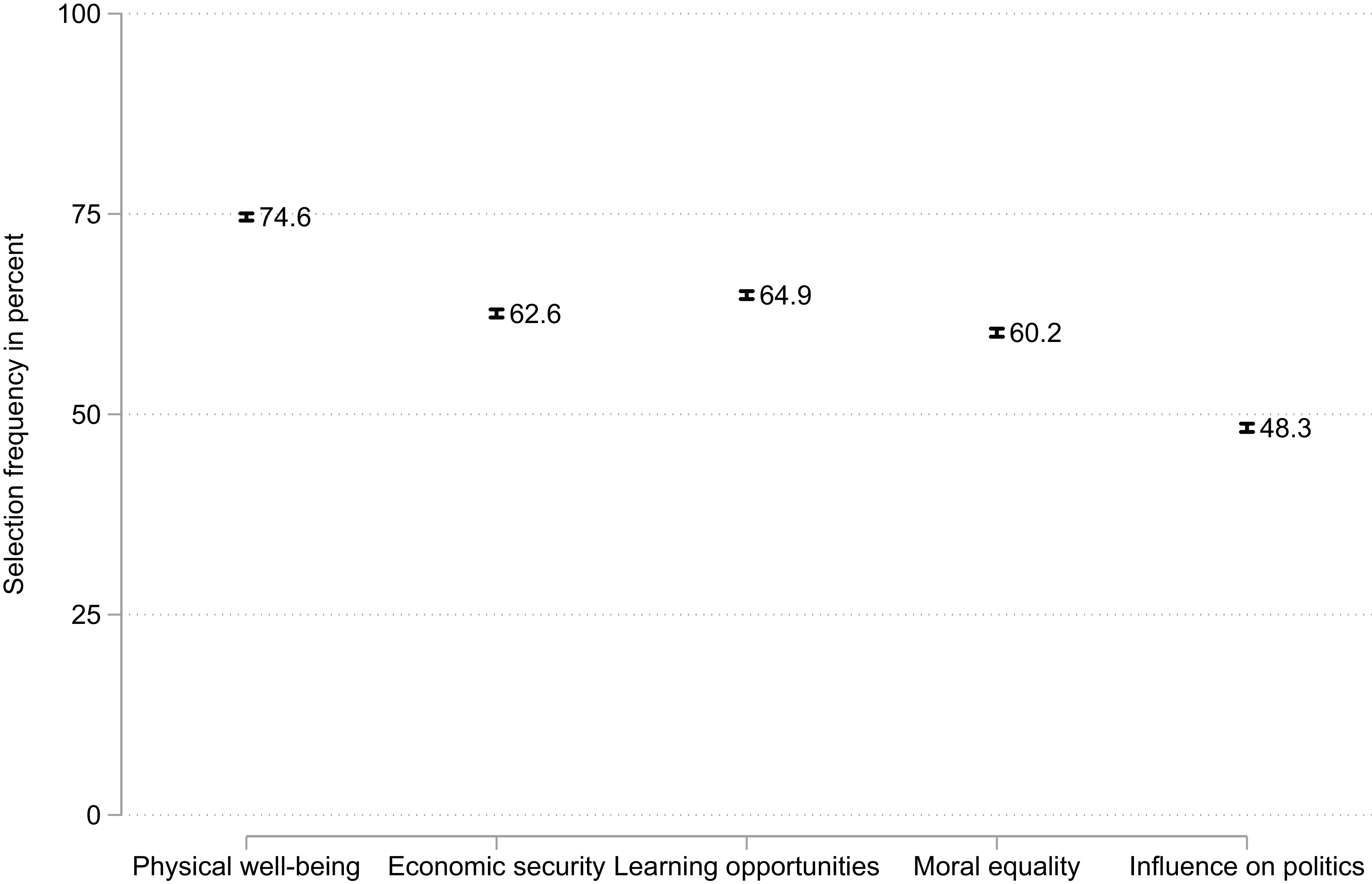
We start by looking at how frequently respondents deem the five conditions necessary for living a self-determined life.Footnote 7 Figure 2 presents the descriptive selection frequencies across all respondents in the 30 countries under investigation, together with 99% confidence intervals (CIs). The five conditions are arranged from left to right in ascending order according to their liberal uniqueness. Although uniqueness and selection frequency do not align perfectly, the descriptive pattern is broadly consistent with the expectation that more uniquely liberal conditions tend to be selected less frequently. This, in turn, fits the idea that some conditions are more universal than others. Among the five conditions, ‘Physical well-being’ is selected most often as necessary for living freely, which corresponds to our expectation that it reflects a widely prioritised basic human need. It is selected by 75% of respondents, followed by ‘Learning opportunities’ (65%), ‘Economic security’ (63%), and ‘Moral equality’ (60%). ‘Influence on politics’ is selected least often, at 48%.
Frequency of selection of conditions of individual self-determination across all respondents (with 99% CIs).
Note: N = 45,621, post-stratification weights on the individual level, as well as country weights adjusting for different sample sizes, are applied. The figure includes 99% CIs.

At the same time, Figure 2 also suggests some noteworthy nuances. First, even the conditions closest to basic human needs are not selected by all or nearly all respondents. Second, the descriptive frequencies appear to fall into three broad groups: ‘Physical well-being’ at a very high level, ‘Influence on politics’ at a substantially lower level, and the remaining three conditions at relatively similar levels. It is therefore useful to examine in the multivariate analyses whether these descriptive similarities and differences persist once authoritarian orientations and societal modernisation are considered. Finally, the fact that fewer than half of respondents select ‘Influence on politics’ is notable. This does not imply opposition to democracy as such. However, it does suggest that democratic influence is not universally understood as a necessary condition of individual self-determination. Respondents may take democracy for granted, feel that their voice is not heard anyway, or attach limited personal relevance to political participation. Whatever the reason, this descriptive pattern highlights some distance between democratic influence and everyday understandings of self-determination.
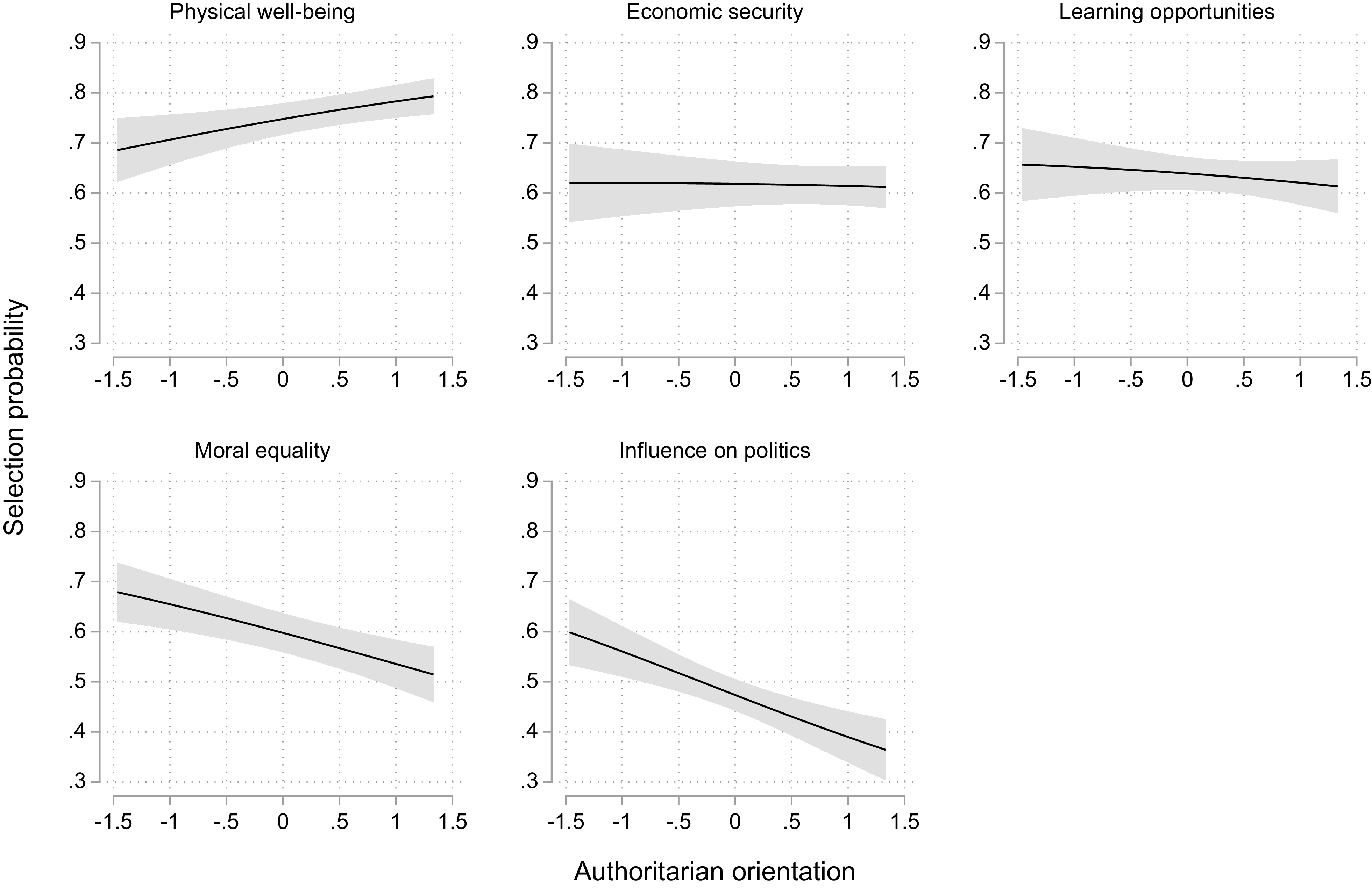
Next, we turn to our regression models to investigate whether preferences for the five conditions are associated with the degree to which people hold authoritarian orientations. Specifically, we expect such orientations to be related negatively with preferences towards the more uniquely liberal conditions. Figure 3 shows the regression results as the respective predicted probability of a condition being selected depending on the level of authoritarian orientation.Footnote 8 The conditions are again arranged in the order of their liberal uniqueness, from top left to bottom right.
Selection probability for each condition by degree of authoritarianism (with 95% CIs).
Note: N = 45,621, results from multilevel mixed-effects logistic regression models with respondents nested within countries, post-stratification weights on the individual level, and country weights adjusting for different sample sizes are applied; see Appendix C1 for the regression table.

Starting with ‘Moral equality’ as the first of the two uniquely liberal conditions, we find that stronger authoritarian orientations are associated with substantially lower preferences for this condition. A citizen with very weak authoritarian orientations has almost a 70% chance of selecting the condition as necessary for a self-determined life. In comparison, a strong authoritarian has a probability of only around 50%. This translates into a statistically significant AME of −0.059 (p-value < .001), that is, an increase in two standard deviations on the VSA scale lowers the probability of selecting ‘Moral equality’ by 5.9 percentage points. For ‘Influence on politics’, we can observe a very similar pattern. Stronger authoritarian orientations relate to a substantially lower probability of selecting this condition. The effect size is even bigger, showing an AME of −0.086 (p-value < .001). However, the overall selection probability of this condition is substantially lower, which was already indicated by Figure 2. In fact, citizens with very strong authoritarian orientations only see ‘Influence on politics’ as relevant with a probability of around 35%. Although consistent with the negative relationship of support for democracy and authoritarianism, this is really striking. Looking at ‘Moral equality’ in comparison, it is still one out of two authoritarians who consider the condition to be important.
For ‘Learning opportunities,’ the condition that has a medium degree of liberal uniqueness, we expected a somewhat reduced but still existing effect of authoritarian orientations. However, although the effect is indeed negative, results show no statistical significance (AME = −0.016, p-value = .426). Finally, we turn to ‘Physical well-being’ and ‘Economic security’. We did not expect to find differences in selection probability related to the VSA scale, as these two conditions refer to universally preferred basic needs. For ‘Economic security’, this is indeed the case, indicated by the flat line and the absence of a statistically significant effect (AME = −0.003, p-value = .862). However, concerning ‘Physical well-being’, persons with authoritarian orientations have a significantly stronger preference when compared with persons with weak authoritarian orientations (AME = 0.037, p-value = .007).
Although the overall pattern of authoritarians’ opposition towards uniquely liberal conditions corresponds to our expectations, the positive effect on ‘Physical well-being’ deviates from our initial expectation that basic-need conditions would be unaffected by authoritarian orientations. This result is robust to the inclusion of a wide range of controls, including age and other individual characteristics. Moreover, the effect on ‘Learning opportunities’ is also just tentatively in line with our expectations as there is a negative, but statistically insignificant, relationship. Finally, in contrast to the descriptive findings above, we at least find substantial differences between both uniquely liberal conditions and the remaining three conditions. In other words, although the effects do not fully validate our expectations, we can still conclude that especially those conditions that can be described as uniquely liberal are seen as much less important by authoritarian citizens. This points to substantial differences and potential for conflict.
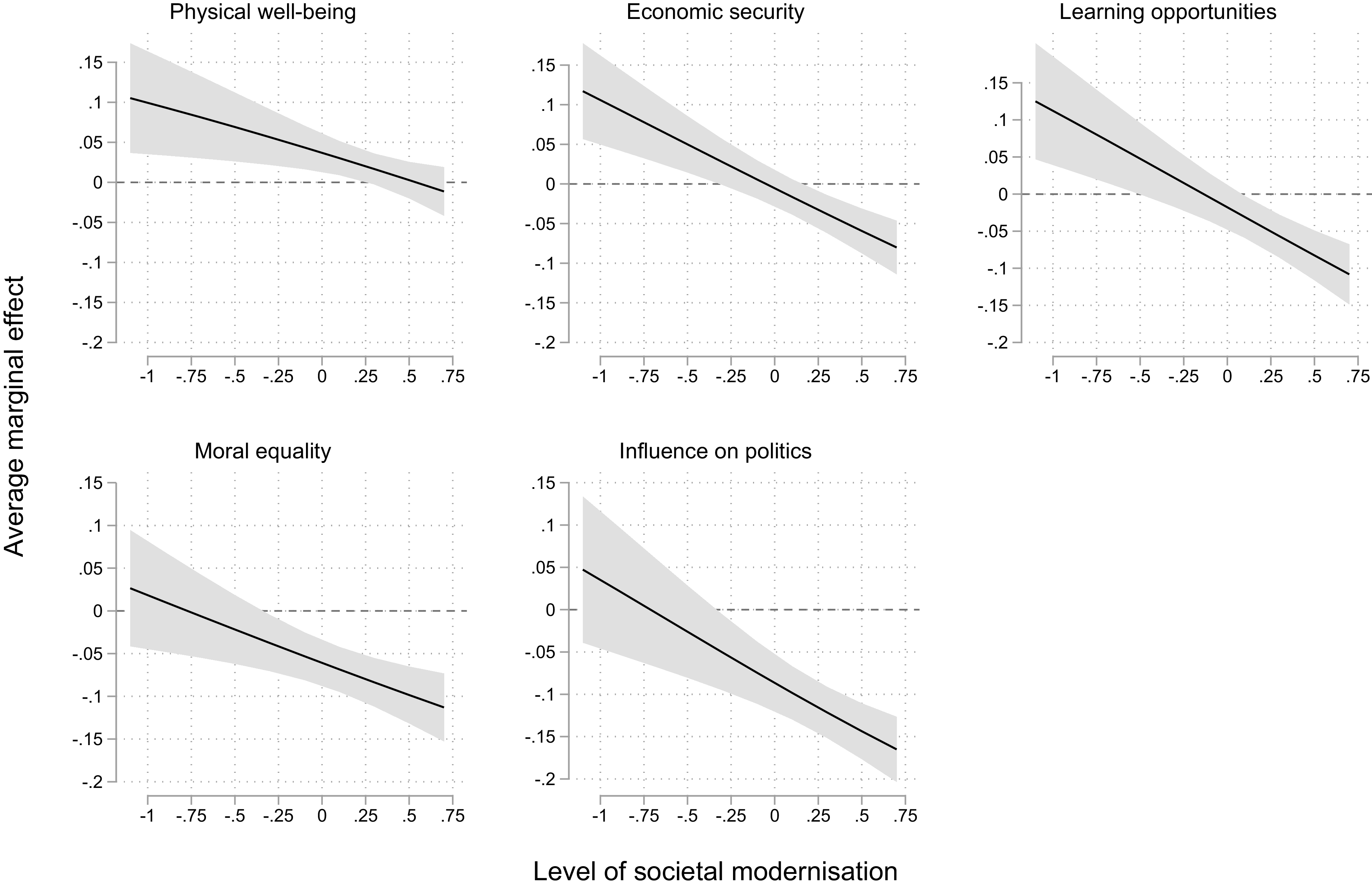
Our second expectation relates to the moderating effect of societal modernisation levels on the preferences towards the conditions of self-determination. Our expectations are that differences between citizens with weak and strong authoritarian orientations are more pronounced in countries with higher levels of societal modernisation, and that this is primarily the case for the uniquely liberal conditions. Figure 4 shows the interaction between authoritarian orientations and societal modernisation for each condition, plotting the AME of authoritarian orientations over the level of societal modernisation.
AMEs of authoritarian orientations over the level of societal modernisation (with 95% CIs).
Note: N = 45,621, results from multilevel mixed-effects logistic regression models with respondents nested within countries, post-stratification weights on the individual level, and country weights adjusting for different sample sizes are applied; see Appendix C1 for the regression table.

Across all five conditions, the effect of authoritarian orientations is significantly more negative at higher levels of societal modernisation. However, this pattern differs in important ways across conditions. First, for the two uniquely liberal conditions, the AMEs change from being around 0 in countries with the lowest level of societal modernisation to around −0.1 (‘Moral equality’) and −0.15 (‘Influence on politics’) in countries with the highest level of societal modernisation. In other words, across the range of modernisation levels, the contrast between respondents with weaker and stronger authoritarian orientations shifts from being statistically insignificant to being substantial in more modernised societies. To illustrate this pattern, we evaluate the AMEs at modernisation values corresponding to three countries in our sample. At the modernisation level observed for Nigeria, the country with the lowest level of societal modernisation in our sample, the estimated effect of authoritarian orientations on ‘Influence on politics’ is positive but statistically insignificant (AME = 0.05, p-value = .282). At the modernisation level observed for Chile, a country with an average modernisation level, the estimated effect is already substantially negative (AME = −0.09, p-value < .001). At the modernisation level observed for Sweden, the country with the highest level of modernisation, the estimated effect is very strongly negative (AME = −0.17, p-value < .001).
Second, for ‘Learning opportunities’ and ‘Economic security’, the effect changes from a positive to a negative AME, indicating that at low levels of societal modernisation, authoritarian citizens have stronger preferences for these two conditions than citizens with weaker authoritarian orientations. At higher levels of modernisation, this changes into the opposite. Third, ‘Physical well-being’ shows a similar trend, but the AME never becomes negative in a statistically significant way, that is, at no level of societal modernisation are respondents with weaker authoritarian orientations more favourable towards this condition than their counterparts. Overall, these patterns indicate that societal modernisation indeed moderates the authoritarian orientations’ effects on all five conditions, but in different ways. In terms of the magnitude of the moderation effect, the clearest difference remains that the widening gap is strongest for the two uniquely liberal conditions.
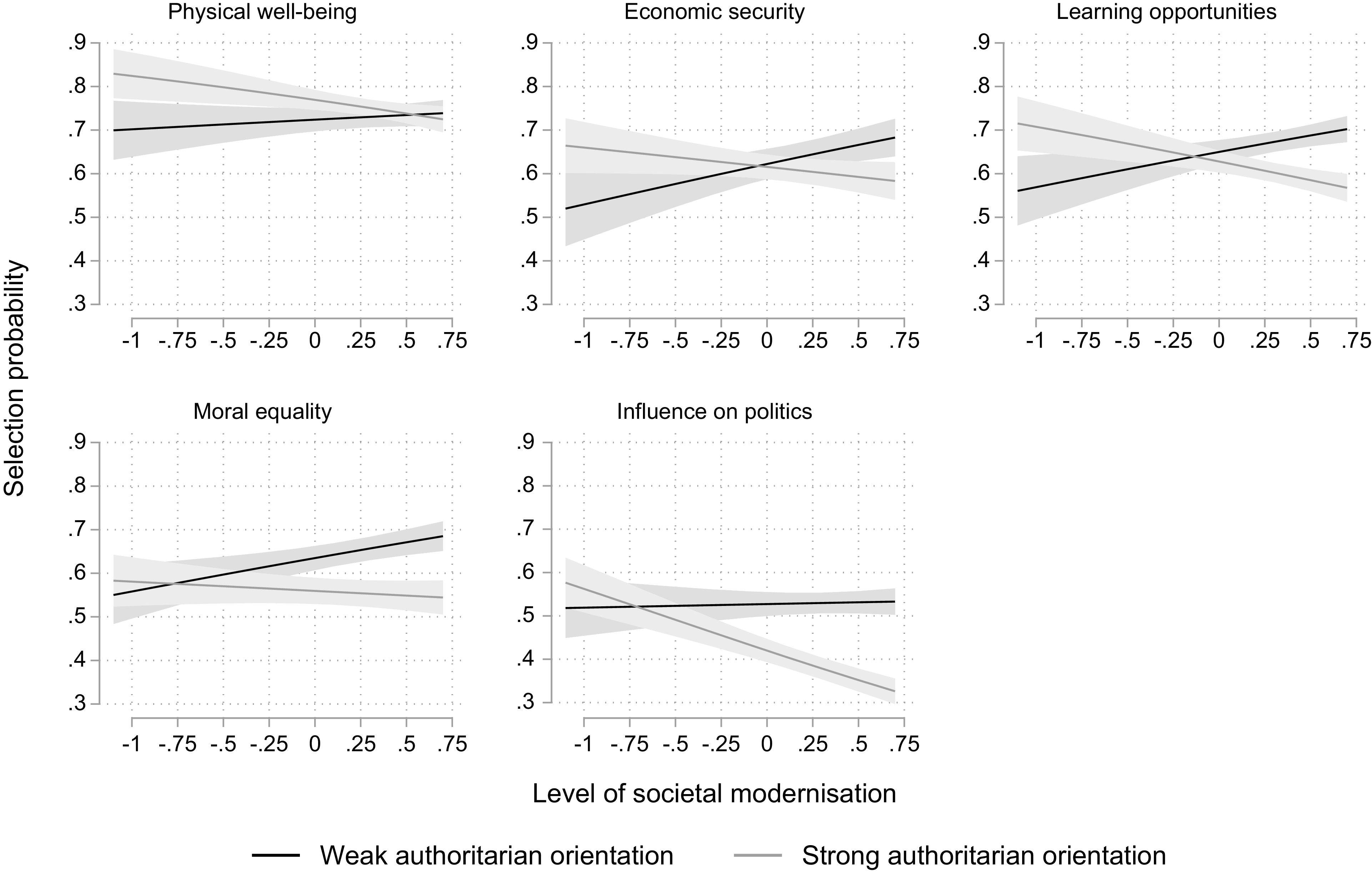
Looking at how the AMEs differ across levels of societal modernisation gives a good overall picture of the modernisation effect. However, it does not provide insight into the mechanisms underlying the moderation. Specifically, we want to know how the preferences of citizens with strong and weak authoritarian orientations vary across levels of modernisation. We argued that there are two possible interpretations of the observed increasingly negative effect of authoritarian orientations: respondents with stronger authoritarian orientations may be more opposed to liberal principles in more modernised societies (Scenario 1), larger parts of the population may be more supportive of liberal principles in such societies (Scenario 2), or both patterns may be present simultaneously (Scenario 3). To address this question, Figure 5 plots the selection probability of each condition for respondents holding weak authoritarian orientations (first decile, darker grey) and strong authoritarian orientations (ninth decile, lighter grey) conditional on the societal modernisation level.Footnote 9
Predictive margins for authoritarians and non-authoritarians over the level of societal modernisation.
Note: N = 45,621, results from multilevel mixed-effects logistic regression models with respondents nested within countries, post-stratification weights on the individual level, and country weights adjusting for different sample sizes are applied; see Appendix C1 for the regression table. CIs are set at the 83% level.

Figure 5. Long description
The image contains five line graphs, each depicting the relationship between the level of societal modernization and selection probability for different values. Panel A shows Physical wellbeing, Panel B shows Economic security, Panel C shows Learning opportunities, Panel D shows Moral equality, and Panel E shows Influence on politics. Each graph has the level of societal modernization on the horizontal axis, ranging from -1 to 0.75, and selection probability on the vertical axis, ranging from 0.3 to 0.9. The graphs compare weak authoritarian orientation (black line) and strong authoritarian orientation (gray line). In Physical wellbeing, the selection probability for weak authoritarian orientation decreases slightly with increasing societal modernization, while it remains relatively stable for strong authoritarian orientation. In Economic security, the selection probability for weak authoritarian orientation increases with societal modernization, while it decreases for strong authoritarian orientation. In Learning opportunities, the selection probability for weak authoritarian orientation increases with societal modernization, while it decreases for strong authoritarian orientation. In Moral equality, the selection probability for both orientations increases with societal modernization, with a more pronounced increase for weak authoritarian orientation. In Influence on politics, the selection probability for weak authoritarian orientation remains relatively stable, while it decreases for strong authoritarian orientation.
‘Moral equality’ and ‘Economic security’ most closely fit the second scenario; preferences among citizens with strong authoritarian orientations remain comparatively stable across modernisation levels, whereas citizens with weak authoritarian orientations are more favourable towards the condition in more modernised societies. ‘Influence on politics’ is better described by the first scenario. Non-authoritarian respondents show a stable pattern, but other respondents seem to be more opposed at higher levels of societal modernisation. ‘Physical well-being’ suggests a similar pattern, but the evidence is weaker because the decline among respondents with strong authoritarian orientations is not statistically significant at conventional levels. Finally, for ‘learning opportunities’, the observed pattern is more consistent with a combination of both and, thus, the third scenario. The two groups are further apart at different levels of modernisation, producing the reversal in the effect of authoritarian orientations shown in Figure 4. Taken together, the results indicate that the moderation effect arises through different mechanisms across conditions, with slightly more evidence for increasing support among respondents with weaker authoritarian orientations than for decreasing support among respondents with stronger authoritarian orientations. However, we do not find a pattern related to the degree of liberal uniqueness.
Finally, we conducted several robustness checks to validate our results. First, we address the argument that authoritarians could be opposed to any form of self-determination by showing that citizens with strong authoritarian orientations are not more likely to select none of the presented items than citizens with weak authoritarian orientations (Appendix D1). Second, controlling for the different modes of data collection or for the fact that some countries have been sampled one year after the other countries does not alter the main results (Appendix D3 and Appendix D4). Third, the visualisation of the moderation effect in Figure 5 depends to some extent on the categorisation of citizens holding strong and weak authoritarian orientations. However, using different operationalisations to the first and ninth decile (+/− one standard deviation from the mean; 25th and 75th percentile) results in very similar patterns (Appendix D2). Specifying models with random slopes for lower level variables in cross-level interactions, as recommended by Heisig and Schaeffer (Reference Heisig and Schaeffer2019), does not lead to different results (Appendix D5). Appendix E examines the structure of missingness and shows that the main findings remain substantively unchanged under less restrictive specifications, including reduced-control models and a less restrictive mean-based measure of authoritarian orientations. Finally, Appendix G reports descriptive country-level information on the distribution of authoritarian orientations and support for the five conditions.
Discussion
At the heart of liberal theory lies the principle of individual self-determination – a freedom that is not guaranteed but becomes possible only when certain enabling conditions are met. In this study, we distinguished between conditions that reflect more universal basic needs (physical well-being and basic economic security), conditions more distinctively tied to liberal thought (moral equality and influence over political decision-making), and an intermediate condition, namely opportunities for learning and personal growth. Against the backdrop of growing global contestation over liberal institutions and norms, we asked whether these liberal conditions for self-determination are also contested at the level of individual attitudes. If so, the backlash against liberalism may be more fundamental than typically assumed – targeting not just policies or procedures, but the normative core of liberalism itself. Building on recent debates about the sources of this backlash, we focused on the role of authoritarianism, and, in particular, on authoritarian orientations. We theorised that such orientations are negatively associated with support for liberal conditions of self-determination, while having little to no association with support for basic needs. Additionally, we proposed that the impact of authoritarian orientations is shaped by the broader context of societal modernisation, offering a potential explanation for why contestation varies across countries. These expectations were tested using original cross-national survey data from 30 countries and more than 45,000 respondents.
Our analysis reveals a clear and consistent distinction between liberal and non-liberal conditions in their association with authoritarian orientations. As expected, individuals with stronger authoritarian orientations were significantly less likely to consider moral equality and influence over political decision-making as important for leading a self-determined life. This pattern also alleviates concerns that the item used for moral equality may be read in a more particularistic way, as the observed relationship is consistent with our broader conceptual interpretation. At the same time, even though additional validation evidence supports the intended meaning of the measure, future research should rely on a more explicit measure or distinguish empirically between an egocentric recognition item and a more explicit measure of moral equality.
The relationship with learning and personal growth – the intermediate condition – was also negative, although not statistically significant. In contrast, authoritarian orientations showed no meaningful association with support for basic economic security and were positively associated with selecting physical well-being as essential. This latter finding departs from our expectation that basic-need conditions would be broadly shared across groups. One interpretation is that physical well-being is especially salient in the context of broader concerns with security, vulnerability, and protection from harm, which are often linked to authoritarian orientations, although our data do not allow us to identify the underlying mechanism directly. Taken together, these findings suggest that individuals with stronger authoritarian orientations are not opposed to self-determination as such but differ more in which conditions they prioritise than in whether self-determination matters at all. Our second expectation concerned the role of societal modernisation in shaping the relationship between authoritarian orientations and support for different conditions of self-determination. The findings confirm that these associations vary systematically across levels of modernisation. In more modernised societies, individuals holding strong authoritarian orientations were generally less likely to endorse four of the five conditions as essential for self-determination – with physical well-being again being the notable exception. This pattern indicates that although modernisation does not moderate preferences uniformly, it tends to widen the gap between authoritarians and non-authoritarians. Interestingly, the degree of liberal uniqueness did not sufficiently determine the strength or direction of this moderating effect. Under lower levels of modernisation, authoritarian orientations were associated with higher support for the three conditions not uniquely liberal in character. These results suggest that societal modernisation interacts with authoritarian orientations in complex ways. The widening gaps observed in more modernised societies do not arise through one single mechanism. In some cases, they are more consistent with increasing support among respondents with weaker authoritarian orientations; in others, they reflect increasing opposition among respondents with stronger authoritarian orientations; and in still others, both dynamics appear to operate simultaneously.
These findings carry important implications for how we understand the contemporary contestation of liberal democratic norms. First, they suggest that authoritarian orientations are systematically associated with a diminished emphasis on liberal conditions of self-determination – particularly moral equality and political voice. This pattern underscores that political disagreement is not limited to policies or institutional arrangements but extends to fundamental normative assumptions about freedom and individual agency. That individuals with authoritarian orientations are less likely to view influence over political decision-making as essential points to a deeper disconnection from core principles of liberal democracy. Second, although basic needs are more universally endorsed, the fact that even these are differently valued by authoritarians – with physical well-being being more prominent – challenges the assumption that liberal and authoritarian citizens agree on what constitutes a good life. Third, our results indicate that the effects of authoritarian orientations are shaped by modernisation, but not through one uniform backlash dynamic. The model-based predicted probabilities suggest that the observed moderation can emerge through different patterns across conditions: in some cases, respondents with weaker authoritarian orientations become more supportive in more modernised societies; in others, respondents with stronger authoritarian orientations become more opposed; and in still others, both dynamics operate simultaneously. Overall, there is somewhat more evidence for increasing support among respondents with weaker authoritarian orientations than for a pattern driven solely by growing opposition among respondents with stronger authoritarian orientations. This complicates simple narratives of reaction and regression and points instead to multiple pathways through which normative polarisation may deepen.
This study represents a first step towards understanding how authoritarian orientations intersect with normative ideas about self-determination – and how these intersections are shaped by broader societal conditions. Although we grounded our framework in political and moral theory, it is important to acknowledge that others might not agree that the five conditions we examined capture the core aspects of what citizens consider essential for living a self-determined life. Our typology is flexible; additional or alternative conditions can be integrated into this approach if they are theoretically and empirically justified. At the same time, our reliance on cross-sectional data limits our ability to draw causal conclusions or to test modernisation theory in its processual form. Rather than observing within-country change over time, we examine whether cross-national differences in attained levels of modernisation are associated with corresponding differences in the relationship between authoritarian orientations and support for the conditions of self-determination. Moreover, modernisation is a broad contextual measure and may also proxy for, or travel together with, other country-level characteristics, such as regime features, political inequality, or state capacity. Disentangling these contextual mechanisms is beyond the scope of the present paper but represents an important task for future research. We also want to highlight that the finding that even basic needs are valued differently by authoritarians raises new questions: do citizens view learning or autonomy as liberal ideals, or simply as functional necessities? Finally, although our data come from diverse and heterogeneous contexts, the persistence of divisions related to ideological orientations across countries suggests that the contestation over self-determination is unlikely to be resolved through institutional reform alone. Where authoritarian and liberal conceptions of freedom diverge this fundamentally, the roots of democratic conflict might lie in the normative foundations of public life itself. Such conflict is likely to be especially difficult to address because it concerns not only policies or institutions, but more fundamental issues. Such orientations are often shaped by longer-term processes of socialisation and formation and may therefore be irresponsive to short-term political compromise.
Supplementary material
The supplementary material for this article can be found at: https://doi.org/10.1017/S1475676526101856.
Data availability statement
The survey data used in this study are publicly available: PALS Wave 1 (https://doi.org/10.17169/refubium-41265) and PALS Wave 2 (https://doi.org/10.17169/refubium-41374). Comprehensive replication materials are available at: https://doi.org/10.5281/zenodo.21540175.
Acknowledgements
The authors would like to thank members of the research group ‘Comparative Survey’ at the Cluster of Excellence ‘Contestations of the Liberal Script’, panel participants at the 2022 EPSA conference, and Jürgen Gerhards, Ellen Lust, and Michael Zürn for helpful comments on earlier versions of this study.
Funding statement
Work on this paper was funded by the Deutsche Forschungsgemeinschaft (DFG, German Research Foundation) under Germany’s Excellence Strategy – EXC 2055 – 390715649.
Competing interests
There are no competing interests.
Ethical standards
The original data collection efforts were reviewed by the ethics committee of Freie Universität Berlin, which confirmed that the treatment of human participants met the applicable ethical requirements (applications 2021–23 and 2022–22). The study was conducted in accordance with the APSA Principles and Guidance for Human Subjects Research.
Use of generative artificial intelligence (AI)
ChatGPT (5.2, 5.4) was used for language editing and to validate and comment on the replication materials; no conceptual, statistical, or substantive decisions were delegated to the tool.



 Open access

