Background
The network paradigm was proposed based on the thought-provoking hypothesis that mental disorders are networks made up of mental health symptoms causing each other (Borsboom, Reference Borsboom2008; Fried, Reference Fried2015; Kendler, Zachar, & Craver, Reference Kendler, Zachar and Craver2011). Under the network paradigm, ‘disorders’ are complex, mutually reinforcing systems of symptoms that are causally related to each other (Fried, Reference Fried2015; Kendler et al., Reference Kendler, Zachar and Craver2011). The paradigm is an extension of earlier theoretical work (Cramer et al., Reference Cramer, van Borkulo, Giltay, van der Maas, Kendler, Scheffer and Borsboom2016; Hayes & Strauss, Reference Hayes and Strauss1998; Kendler et al., Reference Kendler, Zachar and Craver2011; Schiepek & Tschacher, Reference Schiepek, Tschacher, Tschacher, Schiepek and Brunner1992; Teasdale, Reference Teasdale1983) which conceptualized mental disorders as emergent properties and dynamic complex system. The fundamental assumption of this paradigm is that symptom relationships are directly causally related to each other, rather than being correlated due to arising from the same underlying construct. For example, a network hypothesis may be that depressed mood caused self-blame. Self-blame then caused insomnia. As a result of being fatigued, an inability to sleep is exacerbated and an individual has problems concentrating. The disorder of depression is made up of this network of causal chains. There may be multiple different symptom pathways that can be activated, resulting in heterogeneity in the presentation of the disorder. There may be a lag in effect on the system, and the system may be self-sustained via feedback loops (Borsboom, Reference Borsboom2017; Cramer et al., Reference Cramer, van Borkulo, Giltay, van der Maas, Kendler, Scheffer and Borsboom2016).
This fundamental assumption of symptoms causing each other contrasts with the traditional common cause paradigm. In the traditional paradigm, the assumption is that symptom relationships are correlational and that those correlations arise because symptoms are caused by an underlying disorder that is not directly measurable (American Psychiatric Association, 2013; Nesse & Stein, Reference Nesse and Stein2012). For example, common symptoms of depression include depressed mood, self-blame, insomnia, fatigue, and concentration problems. Under the common cause paradigm, these symptoms are associated with each other because the underlying dimension of depression caused each symptom. There has been great interest in contrasting the two paradigms but is predicated on the validity of the network paradigm.
The adoption of the network paradigm has gained popularity over the past decade, particularly for the study of depression. Since 2008, there have been more than 240 network studies on mental health psychopathology. During this time, researchers have widely applied and integrated this paradigm to examine a variety of mental health topics including, but not limited to, comorbidity, remission and onset of symptoms, development psychopathology, biological psychiatry, etc. Nearly one-third of empirical network studies have examined depressive symptoms (Robinaugh, Hoekstra, Toner, & Borsboom, Reference Robinaugh, Hoekstra, Toner and Borsboom2020). Studies that have adopted the network paradigm have yielded two consistent findings regarding the psychopathology of depression. First, a recent systematic review of 65 empirical network studies characteristics (e.g. sample type, instrument estimated, and reliability of findings) (Contreras, Nieto, Valiente, Espinosa, & Vazquez, Reference Contreras, Nieto, Valiente, Espinosa and Vazquez2019) found a multitude of depressive symptom associations. Moreover, these associations remained even after controlling for other depressive symptoms and demographic covariates (e.g. age, gender, and depression severity status). Second, studies suggest symptoms appear to mutually reinforce each other over time. Intraindividual analyses of depression experience revealed interaction and lags between different mood states and symptoms that are consistent with the network paradigm (aan het Rot, Hogenelst, & Schoevers, Reference aan het Rot, Hogenelst and Schoevers2012; Bringmann et al., Reference Bringmann, Vissers, Wichers, Geschwind, Kuppens, Peeters and Tuerlinckx2013; van Borkulo et al., Reference van Borkulo, Boschloo, Borsboom, Penninx, Waldorp and Schoevers2015; Wichers, Reference Wichers2014). By examining symptom dynamics, network studies have begun to uncover some of the complex mechanisms of depression, making the network paradigm potentially a useful tool for furthering our understanding of depression. However, the reviews also identified several major limitations with depression network studies.
Although the examination of the network theory may be valuable for the study of mental disorders, researchers have also raised concerns about the value and credibility of existing depression network studies. To date, three systematic network literature reviews (Contreras et al., Reference Contreras, Nieto, Valiente, Espinosa and Vazquez2019; Malgaroli, Calderon, & Bonanno, Reference Malgaroli, Calderon and Bonanno2021; Robinaugh et al., Reference Robinaugh, Hoekstra, Toner and Borsboom2020), two narrative reviews (Guloksuz, Pries, & van Os, Reference Guloksuz, Pries and van Os2017; Wichers, Riese, Hodges, Snippe, & Bos, Reference Wichers, Riese, Hodges, Snippe and Bos2021), and a number of commentary papers (Borsboom et al., Reference Borsboom, Deserno, Rhemtulla, Epskamp, Fried, McNally and Waldorp2021; Fried & Cramer, Reference Fried and Cramer2017) have noted limitations of the network literature. First, there is a reliance on cross-sectional data and the production of undirected correlation networks, which are not appropriate for causal inference. Undirected graphs do not contain information about directionality and consist of joint correlations between nodes that may or may not account for the fact that correlations may be due to shared relationships with other symptoms. There are very few studies that produce directed networks, which utilize longitudinal data and depict the temporal ordering between symptoms. Furthermore, inferring causation from observation data requires additional assumptions (e.g. exchangeability and positivity). Without the verification of such assumptions, network findings can only be, at best, interpreted as predictive over time (i.e. Granger's causality) and cannot be interpreted as causal (Granger, Reference Granger1969). The lack of empirical evidence for symptom causal relationships is a critical threat to the paradigm and studies which adopt this paradigm.
Second, researchers remain apprehensive about the accuracy of mental health measures. Network studies’ results lack reliability or fail to converge across study. Studies often focus on identifying the most influential symptom as measured by centrality indices, which are statistical measures that summarize and identify important node relationships within a network. However, studies have failed to converge on a set of central symptoms. In a recent review of 23 cross-sectional depression network studies, the most commonly reported central symptoms were depressed mood (10/32 networks) and fatigue (9/32 networks) but each of these were central symptoms in less than one-third of the studies (Malgaroli et al., Reference Malgaroli, Calderon and Bonanno2021). In addition to the lack of convergence on a central symptom, studies have also failed to converge on symptom patterns. For instance, anhedonia (i.e. the experience of loss of pleasure or interest) has been found to be a central symptom in some studies (Boschloo, van Borkulo, Borsboom, & Schoevers, Reference Boschloo, van Borkulo, Borsboom and Schoevers2016; Bringmann, Lemmens, Huibers, Borsboom, & Tuerlinckx, Reference Bringmann, Lemmens, Huibers, Borsboom and Tuerlinckx2015; Fried, Epskamp, Nesse, Tuerlinckx, & Borsboom, Reference Fried, Epskamp, Nesse, Tuerlinckx and Borsboom2016) but found to be the most peripheral symptom (Berlim, Richard-Devantoy, Dos Santos, & Turecki, Reference Berlim, Richard-Devantoy, Dos Santos and Turecki2020; Kendler, Aggen, Flint, Borsboom, & Fried, Reference Kendler, Aggen, Flint, Borsboom and Fried2018) in other studies. It is unclear whether the lack of convergence in findings is due to chance or methodological error. However, the lack of replicability hinders generalizability and identification of meaningful difference between group and time. The lack of convergent findings has been the subject of debates (Borsboom et al., Reference Borsboom, Fried, Epskamp, Waldorp, van Borkulo, van der Maas and Cramer2017; Forbes, Wright, Markon, & Krueger, Reference Forbes, Wright, Markon and Krueger2017a, Reference Forbes, Wright, Markon and Krueger2017b, Reference Forbes, Wright, Markon and Krueger2021; Funkhouser et al., Reference Funkhouser, Correa, Gorka, Nelson, Phan and Shankman2020; Jones, Williams, & McNally; Steinley, Hoffman, Brusco, & Sher, Reference Steinley, Hoffman, Brusco and Sher2017). Measurement error in the assessment of depressive symptoms is a potential explanation for the inconsistency within depression network studies and needs to be further investigated.
There are several limitations with the current network paradigm review studies. First, beyond critiques about the use of cross-sectional datasets, reviews have not fully assessed whether the existing studies met the assumptions for supporting causal relationships among symptoms. In a seminal paper, Borsboom (Reference Borsboom2017) defined a causal relationship between symptoms as, ‘the presence of a causal connection means that, if an (experimental or natural) intervention changed the state of one symptom, this would change the probability distribution of the other symptom’. This definition reflects a counterfactual approach to causal inference. Positivity and exchangeability are the major assumptions for identifying the causal effect (Pearl, Reference Pearl2000; Schwartz, Gatto, & Campbell, Reference Schwartz, Gatto and Campbell2016). Exchangeability is the lack of confounding, due to common causes of the exposure and outcome of interest (Greenland & Robins, Reference Greenland and Robins2009; VanderWeele, Reference VanderWeele2019). Positivity assumes there is an individual for every observed combination of exposure and covariates in the contrast of interest, which prevents off-support inference (Petersen, Porter, Gruber, Wang, & van der Laan, Reference Petersen, Porter, Gruber, Wang and van der Laan2012). In a recent narrative review (Wichers et al., Reference Wichers, Riese, Hodges, Snippe and Bos2021), the authors discussed concerns about the possible influence of third variables for the network connections but did not elaborate on the issue beyond importance of node selection. Other existing reviews also have not fully investigated nor discussed the underlying causal framework and assumptions.
Second, despite the concerns about the convergence of results and accuracy of mental health measures, the reviews do not elaborate on the extent to which measurement error has been investigated. In the context of depression networks, measurement error is the inability to capture all or aspects of depressive symptoms or other variables that are to be included in the network model of interest (Buonaccorsi, Reference Buonaccorsi2010). Measurement of depressive symptoms, in general, is subject to numerous sources of error – participants may forget their symptoms, misunderstand the question, and/or feel embarrassed and misreport their symptoms. Further, previous depression network studies have relied on scales that measure a varying number of depressive symptoms, at various time periods, and with heterogeneous underlying validity for measuring depression (Malgaroli et al., Reference Malgaroli, Calderon and Bonanno2021). Since each symptom could be susceptible to measurement error, the cumulative effect of measurement error across symptoms could result in different network structures and centrality indices across studies. Measurement error is a common source of unobserved non-exchangeability (Hernán & Robins, Reference Hernán and Robins2020; Pearl, Reference Pearl2000) and it is also related to violations of consistency, another causal assumption, which assumes the exposure is sufficiently measured so that there are no variations in exposure which could influence the outcome (Cole & Frangakis, Reference Cole and Frangakis2009; Rehkopf, Glymour, & Osypuk, Reference Rehkopf, Glymour and Osypuk2016; VanderWeele, Reference VanderWeele2009). The consistency assumptions have been the subject of numerous debates. Many social exposure and network approaches violate the interference criterion (Bhattacharya, Malinsky, & Shpitser, Reference Bhattacharya, Malinsky and Shpitser2019; Schwartz, Gatto, & Campbell, Reference Schwartz, Gatto and Campbell2012; VanderWeele & An, Reference VanderWeele, An and Morgan2013) for this assumption. As such, for this review, we will focus on the impact of measurement error rather than an evaluation of the consistency assumption.
An in-depth investigation of these issues within the network literature is needed prior to the widespread application of this paradigm. A systematic review investigating depression network studies on the credibility of their assumptions would close the existing knowledge gap. Thus, the aim of the review is to synthesize the existing literature to (1) evaluate the reliability of network findings by examining whether centrality results are converging or not and (2) evaluate the quality of empirical studies by assessing whether studies are designed to support symptom causal relationships. The second aim will also include an evaluation of the quality of empirical studies by assessing whether they have examined the impact of measurement error.
Methods
Registration
The Preferred Reporting Items for Systematic Reviews and Meta-Analyses (PRISMA) statement was followed for the conduct of the systematic review. The methods of the search, search terms, inclusion/exclusion criteria, and analysis were registered in advance with PROSPERO.
Search strategy
The systematic review sought to capture all English, full-text articles of depression network studies, published between 2008 and 2021. Since the network paradigm was first proposed in 2008, the search excluded studies prior to this year. The search was conducted in the PubMed, ISI, Web of Science, and PsycINFO databases, which are all major databases in capturing various psychiatry, psychology, data science, and public health journals. Search terms were broad and included: (‘network approach’ OR ‘network analysis’ OR ‘network perspective’ OR ‘causal system’ OR ‘symptom network’) AND (‘depression’ or ‘depressive’). Reference lists of the identified articles were further screened to capture any articles missed by the search terms or databases.
Screening and selection: inclusion and exclusion criteria
Search results were imported into Covidence for systematic review management. After removing the duplicate studies, titles and abstracts were screened to ensure the search criteria (i.e. English, peer-reviewed, full-text, and between 2008 and 2021) have been met.
There were two steps in the screening process. In the first step, two reviewers (DH and SM) independently reviewed titles and abstracts. Proportion of agreement was 83%. Disagreements (n = 156) were then discussed until reaching consensus. The selected full-text articles were then assessed according to the following inclusion and exclusion criteria. (1) Studies were related to the network paradigm. Previous reviews had not provided explicit criteria for what constituted a network study (Contreras et al., Reference Contreras, Nieto, Valiente, Espinosa and Vazquez2019; Guloksuz et al., Reference Guloksuz, Pries and van Os2017; Malgaroli et al., Reference Malgaroli, Calderon and Bonanno2021; Robinaugh et al., Reference Robinaugh, Hoekstra, Toner and Borsboom2020; Wichers et al., Reference Wichers, Riese, Hodges, Snippe and Bos2021). However, for the present review, a depression network study was defined as a study that had the results which produced (a) a network graph or (b) centrality results of depressive symptoms. These screening criteria excluded any study, for example, which evaluated social networks, brain circuitry networks, and healthcare system networks. (2) Studies included measures of depressive symptoms. Unlike previous reviews, which examined a variety of psychological phenomenon, the current review only focused on depression. Studies where the unit of analysis was another psychiatric disorder (e.g. dysthymia, generalized anxiety disorder, post-traumatic stress disorder), were excluded. (3) Studies examined only depression networks. Network studies that examined the network of depression with another disorder or discussed ‘bridge symptoms’ in the findings were excluded.
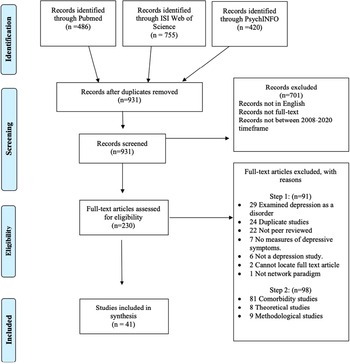
In the second step of the screening process, full articles were then categorized by the study type – theoretical (n = 8), methodological (n = 9), or empirical (n = 41). Theoretical articles were studies that provided an explanation for the network paradigm or theory but did not provide any empirical analysis. Methodological articles were studies that reported empirical results, but the goal was to demonstrate the robustness of the network model to a specific bias or test models for a specific assumption. Findings in methodological studies inform how statistical analysis should be conducted. Empirical articles were studies that reported analytic results, and the findings informed the psychopathology of depressive symptoms. The purpose of this review was to evaluate the quality of studies that adopted the network paradigm to understand the psychopathology of depressive symptoms. Thus, only empirical studies were included in this review. A summary diagram of the search and screening is shown in Fig. 1.
PRISMA flow diagram – depression network.

Data extraction and analysis
The current review is unique from other reviews (Contreras et al., Reference Contreras, Nieto, Valiente, Espinosa and Vazquez2019; Malgaroli et al., Reference Malgaroli, Calderon and Bonanno2021; Robinaugh et al., Reference Robinaugh, Hoekstra, Toner and Borsboom2020) in that it explores the causal assumptions within the network literature. As such, for this analysis, we consulted risk of bias tools and other causal inference measures to select a list of indicators that would be relevant for network studies and our study goals. The following pieces of information were extracted from the articles: source population, study design (i.e. cross-sectional, longitudinal), sample size, network analytic design (i.e. un-directed network, directed network), the depressive instrument used, number of symptoms measured, symptom connectivity, comparison groups (i.e. age, gender, severity group), and symptom centrality.
Symptom centrality is generally measured by centrality indices. Common indices for undirected networks included strength, betweenness, and closeness. Strength described how strongly nodes are connected to each other. Closeness provided information on the distance from a node to other nodes in the system. Betweenness described how often a node acted as a mediator or bridge between two other nodes, which provided information on how strongly a node can disrupt information flow within a network (Dalege, Borsboom, van Harreveld, & van der Maas, Reference Dalege, Borsboom, van Harreveld and van der Maas2017). Common centrality indices within directed network included in-strength/degree and out-strength/degree. In-strength referred to reactivity to other symptoms. Out-strength referred to the likelihood of impacting other symptoms. Nodes with high values on the common indices are the most central on that index. When more than one index was used in a study, the most central node is generally determined by the judgment of the investigator. While there have been arguments that betweenness and closeness may be unsuitable measures for the psychological networks (Bringmann et al., Reference Bringmann, Elmer, Epskamp, Krause, Schoch, Wichers and Snippe2019; Hallquist, Wright, & Molenaar, Reference Hallquist, Wright and Molenaar2021), in this review, central symptoms reported by any of these indices were extracted. For example, if the study found the symptoms sadness had a high betweenness score and fatigue had a strength score, the review would record both sadness and fatigue as central symptoms.
The studies were evaluated based on the study design, sample size, analytic design, adjustments for non-exchangeability, and assessment or discussion of other causal assumptions. Study design, sample size, and analytic design are important considerations in existing study quality assessment tools such as GRADE and STROBE. Any adjustments or discussion of two causal assumptions (i.e. exchangeability or positivity), assessment of positivity, addressing non-exchangeability (e.g. regression adjustment, control group), whether studies made any causal claims about depressive symptoms within its conclusion, and discussion of causality within its limitation were recorded (see Supplementary 1). A paper is considered to have made a causal conclusion only if the authors had explicitly stated the results could be interpreted as causal. Any discussions of instrument validity and reliability (i.e. psychometrics of instrument), the impact of measurement error (i.e. amount, source), and any post-hoc or sensitivity analysis to evaluate the impact of measurement error were also documented and included as considerations for non-exchangeability.
Results
Study characteristics
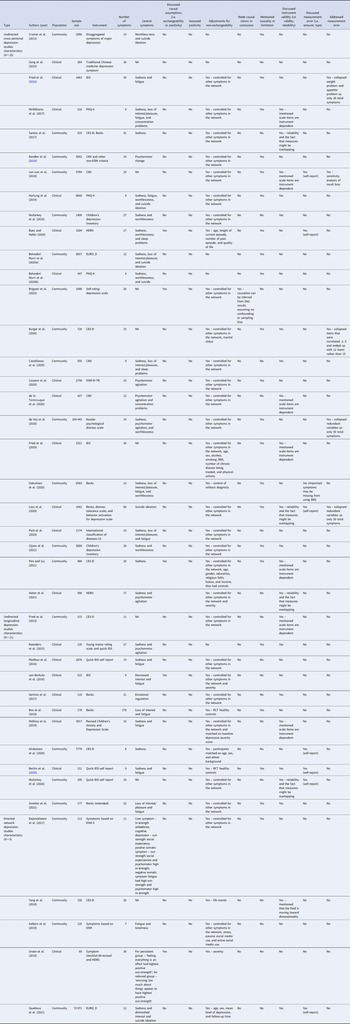
There were 41 empirical network studies identified which focused on depressive symptoms. The majority (63.41%) of these studies were published after 2019. The sample size of studies ranged from 69 to 254 443, with a median of 724. Half of the studies were conducted among community samples (n = 21, median sample size = 1090), and half were conducted among clinical samples (n = 20, median sample size = 553). There were 36 undirected network studies: 25 cross-sectional studies, and 11 longitudinal studies (all panel sampling). There were five studies (one panel and four intensive sampling) that reported directed network results (see Table 1 and Supplementary 2). Depressive symptoms were most assessed using the Beck's Depression Inventory-II and Center of Epidemiological Studies Depression Scale. The median number of symptoms measured was 16 (range of 7–178 symptoms).
Depression network studies characteristics

PHQ-9, Patient Health Questionnaire-9; HDRS, Hamilton Rating Scale for Depression; Becks, Beck Depression Inventory-II; IDS, Inventory of Depressive Symptomatology; CES-D, Center of Epidemiological Studies Depression Scale; ICD, International Classification of Diseases; CIDI, Composite International Diagnostic Interview; DSM, Diagnostic and Statistical Manual of Mental Disorders.
Convergence of centrality findings by study type
Centrality findings varied by the type of network study – cross-sectional undirected, longitudinal undirected, and directed. Within undirected cross-sectional network studies, the centrality results were highly variable and inconsistent. That is, findings across studies did not converge to suggest one symptom as the most central. The most reported central symptoms in undirected cross-sectional network studies were sadness and worthlessness. There were 15 studies that reported sadness as one of the central symptoms (15 highest strength, 4 betweenness, and 3 closeness). There were eight studies that reported worthlessness as one of the central symptoms (seven highest strength, three betweenness, and two closeness). Within undirected longitudinal studies, fatigue was the most reported central symptom at baseline networks and sadness was the most central symptom at follow-up networks. Within directed network studies, centrality results also greatly varied by study.
Convergence of centrality findings by instrument
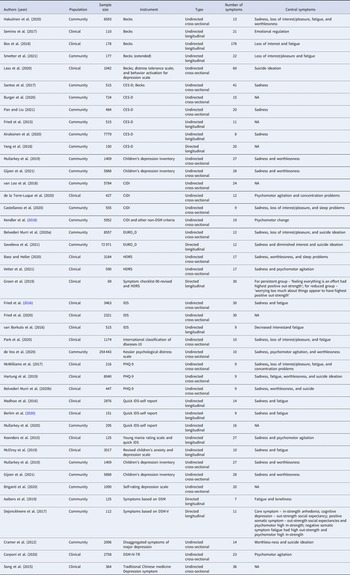
There was less heterogeneity in centrality results when examined within studies that used similar instruments (see Table 2). For studies which had utilized the Beck's Depression Inventory-II, three of the six studies had reported loss of interest and fatigue as the most central symptoms. Sadness was reported as the most central symptom in studies which used the Center of Epidemiological Studies Depression Scale (three out of six studies), Patient Health Questionnaire-9 (all three studies), and Inventory of Depressive Symptomatology (three out of four studies).
Depression network studies characteristics by measures

PHQ-9, Patient Health Questionnaire-9; HDRS, Hamilton Rating Scale for Depression; Becks, Beck Depression Inventory-II; IDS, Inventory of Depressive Symptomatology; CES-D, Center of Epidemiological Studies Depression Scale; ICD, International Classification of Diseases; CIDI, Composite International Diagnostic Interview; DSM, Diagnostic and Statistical Manual of Mental Disorders.
Casual assumptions and measurement error
Of the 41 studies assessed, 70.3% had some discussion related to an assumption of causal inference (see Table 3). But only five of the studies had mentioned sources of confounding or non-exchangeability that were not related to measurement error. None of the studies assessed positivity. About 88% adjusted for other depressive symptoms as potential confounders of the depressive symptom relationships. This included the five studies which had conducted sensitivity or post-hoc analysis to examine the impact of measurement error. For 46.3% of the studies, the inability to infer causation was mentioned as a limitation.
All depression network study causal inference assumptions (n = 41)

Discussion of causal assumptions was slightly between cross-sectional and longitudinal studies (see Tables 4 and 5). Sixty-eight percent of cross-sectional studies and 75% of longitudinal studies had some discussion of causal assumptions. A greater proportion of longitudinal studies (25% v. 16%) had discussed sources of measurement error. However, none of the longitudinal studies had conducted sensitivity or post-hoc analysis to examine the impact of measurement error. About 69% of longitudinal studies had mentioned causality within its limitation, whereas only 32% of cross-sectional had discussed this topic.
Cross-sectional studies depression network study causal inference assumptions (n = 25)

Longitudinal studies depression network study causal inference assumptions (n = 16)

Discussion
Depression network studies have expanded, particularly in the past 2 years. This expansion is a demonstration of the increasing interest to adopt the network approaches to study depression. However, the review revealed several challenges that continue to impede the credibility of network studies and the network paradigm.
First, most depression network studies are not capable of providing empirical support for symptom causal relationships. Studies are conducted under the assumption that symptom relationships are causal, but the study design elides establishing causal relationships from correlations. Symptom correlations arise due to confounding, such as by a shared latent construct. Results may be explained by the network paradigm, the common cause paradigm, or unmeasured factors. Since many depression network studies are still mostly conducted with cross-sectional data or are analyzed cross-sectionally, producing undirected network results, these studies are unable to demonstrate the precedence of symptoms and do not meet the assumptions for identifying causal effects. The reliance on cross-sectional data has been criticized by previous reviews of the general network literature (Contreras et al., Reference Contreras, Nieto, Valiente, Espinosa and Vazquez2019; Guloksuz et al., Reference Guloksuz, Pries and van Os2017; Malgaroli et al., Reference Malgaroli, Calderon and Bonanno2021; Robinaugh et al., Reference Robinaugh, Hoekstra, Toner and Borsboom2020). Results from the current review further found that this practice continues within newer depression network studies.
Depression network studies had rarely assessed the full series of causal assumptions. In this review, approximately 88% of the studies adjusted for sources of non-exchangeability. The majority of the adjustment had been limited to only existing study symptoms within the network. However, to isolate the independent association between two symptoms, adjustment of another symptom is not sufficient. Previous studies have found factors such as age (Colman & Ataullahjan, Reference Colman and Ataullahjan2010), gender (Piccinelli & Wilkinson, Reference Piccinelli and Wilkinson2000), and severity (Kessler, Chiu, Demler, Merikangas, & Walters, Reference Kessler, Chiu, Demler, Merikangas and Walters2005) are important contributors to the depression experience. Consideration of these factors and other potential sources of common causes of depressive symptoms should also be considered in future network studies.
Also, positivity was never assessed in any of the studies. In general, sparse or no data may suggest violation of positivity. Violation of positivity is important as estimates may be biased if one group has a zero probability, or close to zero probability, of experiencing a symptom conditional on observed covariates. For example, a comparison of individuals that experienced sadness and did not experience sadness is not valid or logical if data from one of the groups were not collected. As previously stated, most studies adjust for other existing symptoms within the network. The tendency to adjust for many covariates within an analysis suggests positivity is likely to be violated. Thus, depression network studies, in principle, are conducted under the assumption that symptom causal relationships exist. However, in practice, studies seldomly discussed or adequately tested these criteria.
Depression network studies must be designed to better inform a potential causal relationship between depressive symptoms. Future studies should attempt to (1) utilize longitudinal data and analytic designs, and (2) assess causal inference assumptions. This includes considering all potential sources of non-exchangeability and incorporate more rigorous methods (e.g. inverse probability weighting) for adjusting for non-exchangeability. Also, studies must take caution to not violate positivity. Studies incorporate both longitudinal study design and assessment of causal inference assumptions would better support potential causal relationships and demonstrate the credibility of the network paradigm.
Second, depression network studies neglected to investigate the impact of measurement error. In the context of depression network studies, measurement error is the inability to capture all or aspects of depressive symptoms (Buonaccorsi, Reference Buonaccorsi2010). However, other than recall bias, most studies do not discuss the validity and reliability of the instrument used or explore the impact measurement error. This is particularly concerning given the fact that this review also found that centrality results appeared to vary across different studies, and instability remains a critical concern (Forbes, Wright, Markon, & Krueger, Reference Forbes, Wright, Markon and Krueger2019; Forbes et al., Reference Forbes, Wright, Markon and Krueger2017a, Reference Forbes, Wright, Markon and Krueger2021; Funkhouser et al., Reference Funkhouser, Correa, Gorka, Nelson, Phan and Shankman2020; Guloksuz et al., Reference Guloksuz, Pries and van Os2017; Malgaroli et al., Reference Malgaroli, Calderon and Bonanno2021; Wichers et al., Reference Wichers, Riese, Hodges, Snippe and Bos2021). Sadness was generally the most reported central symptom. This was consistent with previous reviews (Contreras et al., Reference Contreras, Nieto, Valiente, Espinosa and Vazquez2019; Guloksuz et al., Reference Guloksuz, Pries and van Os2017; Malgaroli et al., Reference Malgaroli, Calderon and Bonanno2021; Wichers et al., Reference Wichers, Riese, Hodges, Snippe and Bos2021). But there was a great deal of heterogeneity, depending on the study type and instrument used. Considering that depressive symptoms were also measured by a variety of instruments; measurement error may be an important contributor to the difference in findings.
Measurement of depressive symptoms is subject to numerous sources of error. Underreporting of symptoms and recall bias are common sources of measurement error (Wells & Horwood, Reference Wells and Horwood2004). Different instruments assessed different numbers of symptoms, and symptoms are assessed with different levels of precision. For example, the Becks Depression Inventory (BDI) assessed 21 depressive symptoms (Beck, Ward, Mendelson, Mock, & Erbaugh, Reference Beck, Ward, Mendelson, Mock and Erbaugh1961). The Patient Health Questionnaire (PHQ-9) only assessed nine symptoms (Kroenke, Spitzer, & Williams, Reference Kroenke, Spitzer and Williams2001). And while the BDI assessed loss of interest and loss of pleasure as separate symptoms, the PHQ-9 assessed for both symptoms together as anhedonia. Due to these varying sources of error and precision, at any given moment, each symptom could be impacted by measurement error.
Measurement error may be ever-present and depending on the amount and type of measurement error, it can impact the connection between symptoms. Measurement error is a common form of unobserved source of non-exchangeability. The cumulative effect of measurement error across symptoms could result in different network structures and centrality indices. Results from previous robustness studies of non-mental health network studies have found centrality indices are prone to be influenced by measurement error (Borgatti, Carley, & Krackhardt, Reference Borgatti, Carley and Krackhardt2006; Frantz, Cataldo, & Carley, Reference Frantz, Cataldo and Carley2009; Kim & Jeong, Reference Kim and Jeong2007; Martin & Niemeyer, Reference Martin and Niemeyer2019). The robustness of mental health network findings to measurement error should be investigated.
In consideration of the issue of reliability and measurement error, future investigations should consider the following recommendations. First, studies should, at a minimum, discuss the reliability and validity of instruments. Studies need to better consider the number of symptoms measured, how well depressive symptoms are captured, that symptoms reported typically change over (even short) time intervals and discuss or explore the impact of measurement error on the interpretation of results. Also, studies are needed to examine the robustness of depression networks to measurement error. This would be useful for understanding how measurement error may contribute to inconsistent results across depression network studies.
Limitations
The current study has the following limitations. First, the search was conducted using three major databases (PubMed, ISI Web of Science, and PsycINFO databases), which should be sufficient in capturing various psychiatry, psychology, data science, and public health journals. Reference lists of the identified articles were also screened to capture any missed articles. However, it is still possible that studies published in smaller, international, or specialty journals were missed.
Second, the review excluded 81 depression comorbidity studies. There is a large body of literature that examined the network structure of depressive symptoms and other mental disorders. These studies focused on identifying symptoms that link disorders together (i.e. ‘bridge symptoms’). Consideration of causality and measurement error are more complex in these studies. There are potentially more sources of non-exchangeability and measurement error since symptoms from multiple disorders must be considered. Examination of the comorbidity network studies between depression and other mental disorders should be the focus of future investigations.
Third, the proposed study utilizes self-made indices to evaluate how well current studies evaluate and support the assumptions of the depression network. Study characteristics were chosen based on existing evaluation tools, causal frameworks, and previous studies. However, these indices merely act as a tool to summarize the existing network findings and are not validated measures of study causal validity. Future studies could consider different or more in-depth criteria.
Conclusion
The goal of the study is to evaluate depression network studies on their discussion and evaluation of the network paradigm's causal assumptions. There is growing enthusiasm to adopt the network approach. However, there are important gaps within this literature that must be addressed. Future network researchers should take caution when designing studies. There is a need to empirically test the causal relationship among symptoms and test the robustness of centrality results to measurement error. Prior to the widespread utilization of these techniques, the fundamental assumptions of this paradigm must be explored.
Supplementary material
The supplementary material for this article can be found at https://doi.org/10.1017/S0033291723000132.
Acknowledgment
The authors thank Dr Sarah McKetta for her assistance with the screening process.
Financial support
This work was supported by the National Institute of Mental Health (DH, grant numbers NIH T32 MH013043 and T32 MH 017119).
Conflict of interest
The authors have no conflict of interest to declare.