In 1843, John Lloyd Stephens announced discovery of “perhaps the greatest gem of aboriginal art which on the whole Continent of America now survives” (Stephens Reference Stephens1963 [1843]:II:211). While exploring Chichen Itza, Stephens had been astonished to find the interior of a small room in what he called the Gymnasium or Tennis-court entirely covered by colorful paintings, but to his disappointment they were even then in a sad state of preservation, and the few figures illustrated by Catherwood (Stephens Reference Stephens1963 [1843]:II:Plate 37) give little idea of why Stephens was so effusive in his praise. Stephens also made the prescient comment that the paintings “call forcibly to mind the well-known picture writings of the Mexicans; and if these analogies are sustained, this building attached to the walls of the Tennis-court stands an unimpeachable witness that the people who inhabited Mexico at the time of the conquest belong to the same great race which furnished the builders of the ruined cities in Yucatan” (Stephens Reference Stephens1963 [1843]:211–213). This might be cited as the first glimmering of the controversy that surrounds the ruins of Chichen Itza to this day, the question of why non-Maya traits should so dominate this site alone among the many Terminal Classic centers of northern Yucatan.Footnote 1
Stephens was of course describing what today is called the Upper Temple of the Jaguars (UTJ) of Chichen's Great Ballcourt. In the succeeding 60 years, the murals were studied by a number of prominent early explorers, among them Augustus and Alice Le Plongeon, Teobert Maler, Alfred Maudslay, and Eduard Seler, but towering above them all was the modest but determined figure of Adela Breton, who between 1900 and 1906 patiently produced complete color replicas of the entire mural cycle (Breton Reference Breton, Giles and Stewart1907; Giles and Stewart Reference Giles and Stewart1989; McVicker Reference McVicker2005; Tozzer Reference Tozzer1957).Footnote 2 Today the originals have suffered even greater damage, and so her watercolors provide virtually the only record of these invaluable paintings.Footnote 3 Her work languished for 70 years before being published in anything approaching complete form, and then only in black and white (Miller Reference Miller and Hammond1977). The sole full publication in color remains that of Coggins and Shane (Reference Coggins and Shane1984), but at a scale too small for detailed discussion. The comments in this paper have been made possible by recent digital photographs of the City Museum of Bristol copies, kindly provided by curator Susan Giles.
Fortunately, the murals do not occur in isolation. The polychrome bas-reliefs covering the interiors of two other small temples associated with the ballcourt, the well-known Lower Temple of the Jaguars and the less familiar North Temple, were both recorded by Adela Breton, often by tinting photographs of the walls (Breton Reference Breton1917; Giles and Stewart Reference Giles and Stewart1989). These copies have also been inadequately published, and like the murals, remain stored in the archives of the City Museum of Bristol, the Peabody Museum, and Tulane University. Nevertheless, these images have played a prominent part in interpretations of Chichen's history, and it is therefore fitting that they be revisited on the centenary of the completion of her work.
THE GREAT BALLCOURT
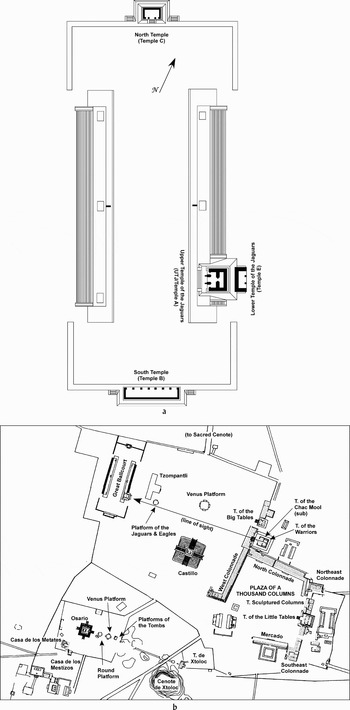
Before beginning examination of the murals, it is first necessary to have some understanding of the architecture of the ballcourt and its relationship to the other structures of the Great Terrace. The Great Ballcourt itself lies near the northwest corner of this vast plaza (Figure 1a). The North and South Temples are placed along the central axis at the extremities of the court, while the UTJ and five other much smaller platforms line the east and west edges of the playing court walls with the UTJ at the southeast position. The Lower Temple of the Jaguars, although part of the structure, lies outside the playing court proper and faces onto the Great Terrace.
(a) Plan of the Great Ballcourt, Chichen Itza. (b) Structures of the Great Terrace and Osario Platform, showing the alignment of the Temple of the Warriors with the Upper Temple of the Jaguars (modified after Schmidt Reference Schmidt, Schmidt, de la Garza and Nalda1998:431).

The dating of the UTJ continues to be debated, but several lines of evidence indicate that it antedates the Temple of the Warriors (Table 1). The first concerns the orientation of the structures. Morris et al. (Reference Morris, Charlot and Morris1931) demonstrated that the Temple of the Chac Mool and the Castillo were arranged about a formal plaza and hence shared the same orientation, with the Castillo antedating the Temple of the Chac Mool.Footnote 4 When the Temple of the Warriors was constructed over the Temple of the Chac Mool, the orientation of its midline shifted slightly but noticeably from 293° to 291° east of north, and its center was offset from that of the Temple of the Chac Mool. It seems logical that this was done purposefully. Cynthia Kristan-Graham (personal communication 2003) pointed out to me that the midline of the Temple of the Warriors points directly at the UTJ (Figure 1b). Thus, the Temple of the Warriors may have been built to align with an already existing UTJ. Note, however, that the reverse sequence cannot be true given that the UTJ faces just under 286° east of north (Kubler Reference Kubler1982:Table 4) and thus is not aligned with the Temple of the Warriors, which is in any case invisible from the west-oriented UTJ.
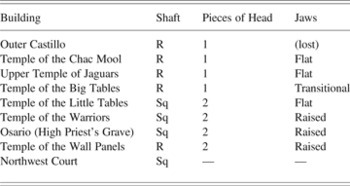
Traits of serpent columns at Chichen Itza

Note: R = round; Sq = square. Data from Kubler Reference Kubler1982; Tozzer Reference Tozzer1957.
On the basis of architectural traits, Kubler, for reasons not altogether clear, placed the UTJ fifth in his sequence of serpent temples, immediately following the Temple of the Warriors and the Little Tables. In contrast, both Cohodas (Reference Cohodas1978:289) and Tozzer (Reference Tozzer1957:34) identify the UTJ as being among the earliest Toltec buildings. However, Cohodas dates it contemporary with the Temple of the Chac Mool but before the final Castillo, while Tozzer simply included it among his earliest group of Toltec structures (see Kubler Reference Kubler1982: Table 2 for a comparison). One reason was a distinction noted by Tozzer (Reference Tozzer1957:100) between round and square serpent columns, in which case the UTJ groups with the Castillo, Temple of the Big Tables, and Temple of the Chac Mool. Another similarity of construction is that the serpent heads of the Temple of the Chac Mool, Castillo, Temple of the Big Tables, and UTJ form an integral part of the lowest block, whereas in the others, the head is a separate stone attached to the lowest load-bearing segment of the column (significantly, Late Postclassic period serpent heads from Tulum and Mayapan are also of two pieces). Furthermore, Kubler (Reference Kubler1982:96) notes that there are only two head types, a “flat-topped, table-like block” and another with “raised upper jaws.” If shaft morphology, head construction, and jaw form are seriated, the UTJ clearly groups with the Temple of the Chac Mool and the Outer Castillo (Table 1), although the serpent jaws of the Castillo were destroyed before they could be recorded. The Temple of the Big Tables, with a round shaft and a one-piece head but with intermediate jaws, may belong to this early group as well, as the similarities of its Atlanteans to those of the UTJ and its Pawahtuns to those of the Castillo also suggest. The similarity of the monster-face framing panels of the piers and jambs of the Temple of the Chac Mool and UTJ also suggests a close temporal relationship between the two.
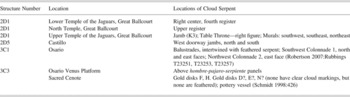
Warrior C and Cloud Serpent images at Chichen Itza

Notes: Data from Schmidt (Reference Schmidt, Kowalski and Kristan-Graham2007), Seler (Reference Seler, Thompson, Richardson and Comparato1998:83, 113), and personal observations. Serpent-accompanied warriors are absent from the Temple of the Chac Mool, Temple of the Warriors, and the Northwest Colonnade.
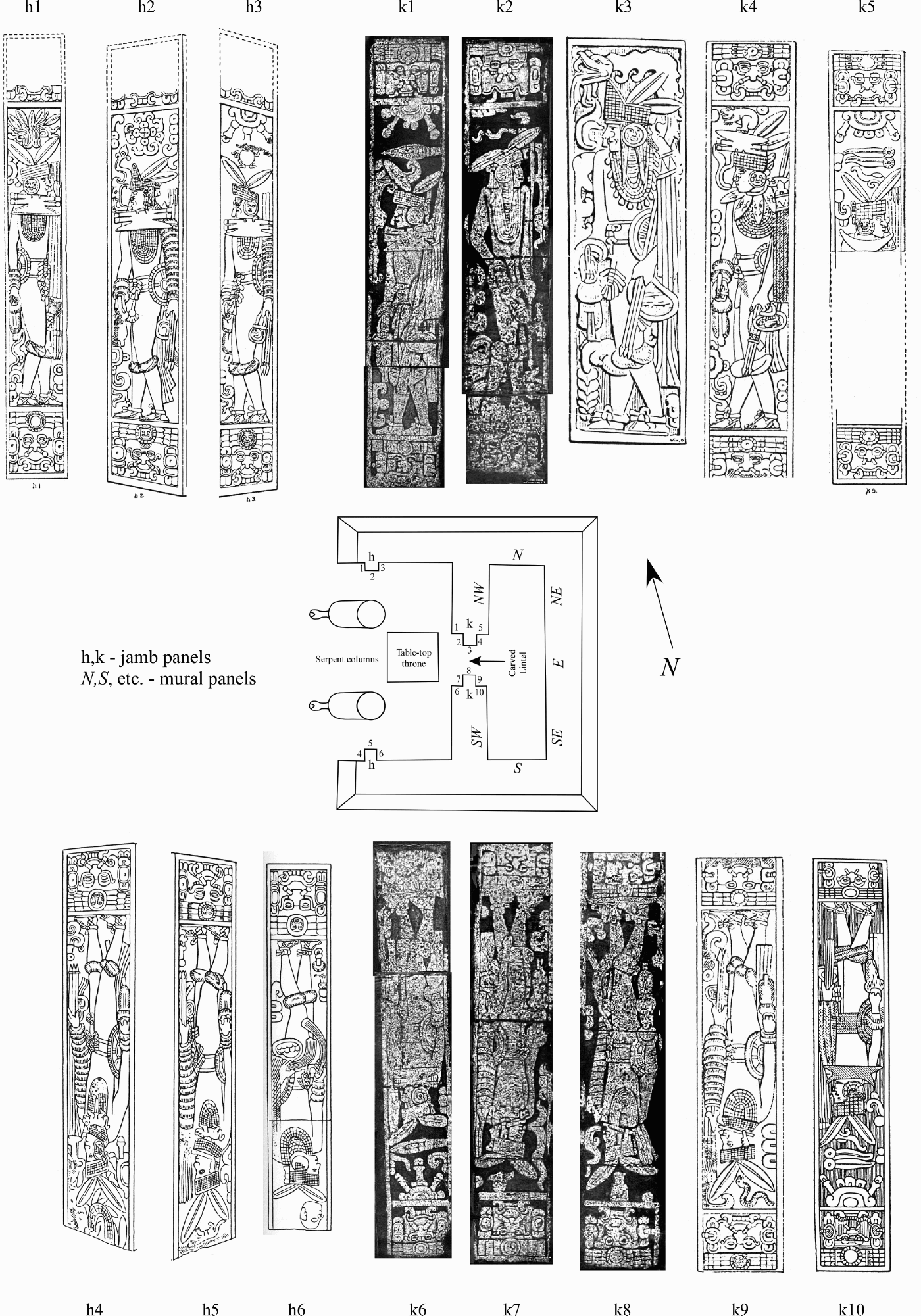
Like the interiors of the Temple of the Chac Mool, Temple of the Warriors, and Temple of the Big Tables, the UTJ consists of two tandem vaulted rooms connected by a central doorway (Figure 2). An elaborately carved wood lintel spanned this inner door, but of the exterior lintels we know nothing because, as can be seen in Catherwood's illustrations, the entire front facade of the building had collapsed well before the arrival of the first travelers of the nineteenth century. Portions of a large stone table supported by 15 Atlantean figures were found in the outer chamber by Le Plongeon.Footnote 5 To prevent theft (or to keep them from the eyes of Mexican authorities), he reburied the supports below the floor of the UTJ, and they were only reexcavated by Bolio in 1900 (McVicker Reference McVicker2005:80). Breton made a full set of color images of these figures as they reemerged, as well as the remaining portions of the tabletop. This “table” almost certainly served as a seat, and since existing plans of the UTJ indicate that it was too large to have been easily accommodated in the rear chamber, the outer chamber was most likely the original place of reception.
Plan of the Upper Temple of the Jaguars and associated jamb sculptures (plan and line drawings from Seler Reference Seler, Thompson, Richardson and Comparato1998:Figures 109–120; rubbings from Robertson Reference Robertson2007:Rubbings D15732, D15733, D17746, D17749, D15750).

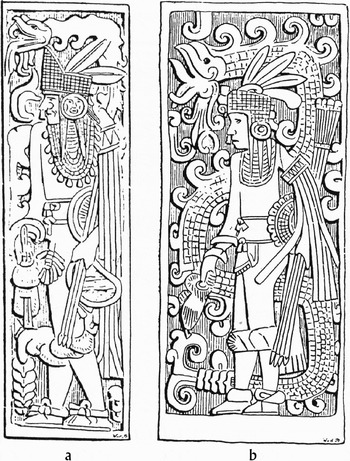
The inner and outer jambs were sculpted with a total of 16 warrior figures, three on each of the outer and five on each of the inner jambs. Each warrior is framed between an upper and lower panel depicting a monster with a flower headdress, very like the arrangement of the doorjambs of the North Temple and the Temple of the Chac Mool, as well as the balustrades of the North and South Temples. In comparison to warrior piers elsewhere at the site, the UTJ jamb sculptures have a much narrower range of costume. Each wears the two-feather aztaxelli hair ornament, variants of the “pillbox” headdress, a “back mirror” (tezcacuitlapilli), and a multistrand necklace, although in a few cases these are obscured by pose or other costume elements. All carry darts and an atlatl, with the exception of a single figure (H6) who carries two curved and grooved sticks, another common weapon. None wear capes and none of the headdresses have the small bird ornament. All this suggests that these figures belonged to a single warrior order or occupied a similar rank, but were not themselves of the highest leadership. Nevertheless, there are differences. Butterfly pectorals, peaked diadems (xiuhuitzontli), and Toltec nose buttons are worn only by warriors on the northern jambs, and the only figure backed by a serpent is from this side. In contrast, animal pectorals are found only on the southern warriors. All these traits form part of the Toltec military costume; the motivations for these costume elements will be discussed later in this paper.
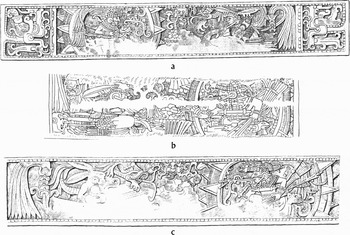
This emphasis on the midline by means of symmetries and asymmetries is reinforced by the central panel of the east wall mural and the three faces of the door lintel. The lintel faces pair individuals sometimes identified as “Captain Sun Disk” and “Captain Serpent” (Miller Reference Miller and Hammond1977), and in each, Captain Sun Disk is consistently placed to the north and Captain Serpent to the south (Figure 3). The emphasis on the central axis of the UTJ may be in part for astronomical reasons. Several studies (Galindo Trejo et al. Reference Galindo Trejo, Gutiérrez, Gallut and de la Fuente2001; Milbrath Reference Milbrath and Aveni1988, Reference Milbrath1999:68) have shown that the orientation of the UTJ falls 285°46′ east of north, so that the sun sets along the main axis, directly between the serpent columns and illuminating the central east mural panel, on April 29 and August 12/13 of the solar year. Both dates are of central importance in Maya cosmology,Footnote 6 but the general westward orientation is perhaps the most important factor to bear in mind, as all of the other serpent temples are generally oriented westward. For Seler (Reference Seler, Thompson, Richardson and Comparato1998), this signaled a tie between the UTJ, the setting sun, and the souls of dead warriors, but because these temples were placed on the east side of their respective plazas, they might also be associated with the ascendant sun, life, and living warriors.
Lintels from the Upper Temple of the Jaguars (Seler Reference Seler, Thompson, Richardson and Comparato1998:Figure 121). (a) Front, north to left, (b) underside, north to right, (c) rear, north to right. The north figure is sometimes referred to as Captain Sun Disk, the south as Captain Serpent.

FORMAL ASPECTS OF THE MURALS
It is striking that despite their location, the UTJ murals themselves make no reference to the ball game, unlike the friezes from the North Temple. Instead the subject is warfare. Of the murals in the outer chamber, Breton noted that “only a few round shields are now left, showing that the subjects were battles as in the inner chamber” (Breton Reference Breton, Giles and Stewart1907:166). The inner chamber was divided into eight panels, three each on the east and west walls (one being the central doorway) and a single mural on both the north and south end walls.Footnote 7 As will be seen, although they all depict battles, each panel differs in its setting with no obvious reading order indicated, although Breton (Reference Breton, Giles and Stewart1907), Coggins (Reference Coggins, Coggins and Shane1984), and Miller (Reference Miller and Hammond1977) have hazarded possibilities.
Breton (Reference Breton, Giles and Stewart1907:167) noted the hands of two artists in the murals. Examination of the southern versus the northern panels shows the latter to be of markedly lower quality. Clear differences of technique separate them: the southern figures are meticulously outlined in red, but the figures of the northern half are not and frequently lack any features whatsoever. The northern figures also are on the whole more awkwardly drawn and posed than those of the south. Breton further noted that the more carefully executed sections also employed true fresco, the paint elsewhere having been applied to a dry surface. However, differences can be noted even within the two groups: the southwestern and central panels, for instance, are the only ones to make use of flames to identify particularly important figures, a technique also found in the stone reliefs. This may suggest that more than two hands were at work.
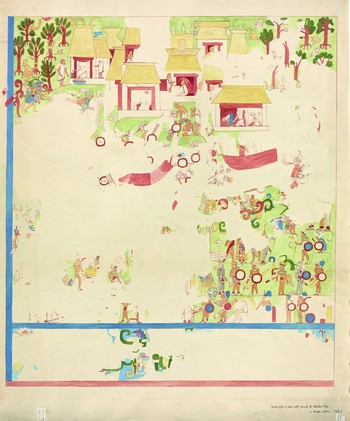
The lack of detail may also indicate that parts of the mural were never finished. In this regard, it should be noted that some studies have claimed that the blue sections at the top of the north and south murals represent water or air, making the placement of houses in these areas difficult to interpret. Breton (Reference Breton, Giles and Stewart1907:166) mentioned more than one layer of paint was visible, however, and Seler (Reference Seler, Thompson, Richardson and Comparato1998:117) commented: “In this entire part of the wall it can be observed at several places that this painting covered a former one (one that was uniformly blue?). In several places the outlines of the figures of the present, last painting have been introduced into a break of the stucco cover.” What he meant by this “entire part” is not clear: this quote occurs in a discussion of the southeast panel, where no blue is visible, but it may provide an explanation for the peculiar arrangement of the abovementioned houses. The houses on the south panel are set in two neat rows, over both blue and green backgrounds. Furthermore, it is clear that some of the figures at the top are climbing the same hilly ground depicted in the battle below, although the background there is blue. The conclusion must be that the mural is either incomplete or carelessly done.
The panels all share a common basal register delimited by a bright blue line (Figure 4). The imagery of this register is unambiguously Maya (Taube Reference Taube and Prem1994:214), consisting as it does of water lilies, cavorting Pawahtuns in turtle shells, and other underwater/underworld beings, very similar to the basal registers of the North Temple and the Lower Temple of the Jaguars. The only interruption is a recumbent figure below the central east panel, also on a blue ground. This figure also appears over the west doorway, again against a blue field, and in several other places around the ballcourt, though not elsewhere.
Southwest mural battle scene. Two sun disks are outlined by dashed lines. Adela Breton, unpublished image, courtesy City Museum of Bristol.

The upper sections each depict a pitched battle, with the exception of the central panel and the extant (south) tympanum. The visual organization of these battles is significantly different from that of the other Maya murals, especially their depiction of space. Most Maya murals, including those from northern Yucatan, foreground figures arranged along a single baseline, or at most two. The perspective of the viewer is always from the side, even for complicated battle scenes. The Maya-influenced murals from Cacaxtla would be an extreme example. The Bonampak battle mural is admittedly more complex, but nevertheless the perspective remains the same, little or no indication of exterior place is provided, and the dramatic thrust consists of two horizontally opposed groups.
In the UTJ, this type of horizontal organization is reflected in the two registers above the blue baseline (Figure 4) depicting the activities of what are probably military camps (and may reflect actions before or after the main scene).Footnote 8 The main battle scenes are unique in focusing on military actions in their totality and from a bird's eye view. Here the number and variety of actors vividly suggest the tumult of hand-to-hand battle within a landscape of unparalleled complexity and specificity. In the Chichen murals, the leaders are distinguished less by their size or position than by the large serpents that curl around them and by costume details difficult to appreciate except at close quarters. The emphasis is on the event, on the massed troops and their movements, and on the details of rank, rather than on personal heroics. As will be discussed, this may reflect fundamental differences in the way power was exerted at Chichen Itza.
INTERPRETATIONS
Earlier interpretations emphasized two aspects of the murals: the supposed opposition between Captain Sun Disk and Captain Serpent, reflecting a Maya-Toltec opposition (Coggins Reference Coggins, Coggins and Shane1984; Miller Reference Miller and Hammond1977) (Figure 3), or its interpretation as an astronomical allegory, either solar (Cohodas Reference Cohodas1978), solar and Venusian (Coggins Reference Coggins, Coggins and Shane1984, Milbrath 1999:181–183), or solar-lunar-Venusian (Lincoln Reference Lincoln1990; Seler Reference Seler, Thompson, Richardson and Comparato1998:119). Coggins (Reference Coggins, Coggins and Shane1984:157) fused these two scenarios, arguing that the scene represented a “reinterpretation, almost a reversal, of the cosmic order” in which the victories depict the world-historical conquest of the Venus-oriented Toltecs over the sun-worshiping Mayas, reversing Miller's identification of the victor. The solar orientation of the building, noted earlier, and the clear images of sun disks and feathered serpents in the murals make these suggestions worth considering.
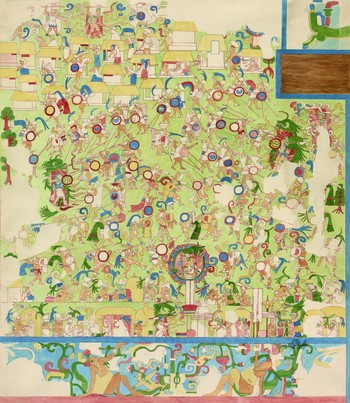
There are, however, difficulties with both arguments. The astronomical interpretation argues that the position of the several solar disks on the murals represents the position of the sun with respect to the horizon, with the proviso that here north represents zenith and south the point directly below the observer in the underworld. Venus is argued to be indicated by warriors who bear a large blue star sign around their waist, much like the Cacaxtla figures. Neither figure can be found on the three panels of the east wall, however. Although this may reflect the accidents of preservation, it does mean the argument is founded on just a few examples. Furthermore, the southwest panel actually has two sun disks, and the sun disk on the south panel, supposedly representing the nadir of its path, is high along the right side (Figure 4 and see also Figure 6).
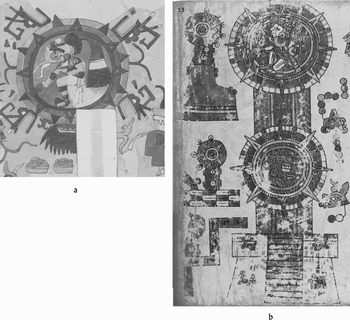
(a) Sun disk from the northwest panel with offerings before it. Adela Breton, unpublished image, courtesy City Museum of Bristol. (b) Sun disk, Codex Vienna f. 23b (Anders et al. Reference Anders, Jansen and Pérez-Jiménez1992).

South mural battle scene. Adela Breton, unpublished image, courtesy City Museum of Bristol.

As for the supposed Captain Sun Disk–Captain Serpent wars, one problem with this simple opposition is that there are multiple instances of these figures on the same panel, as both Miller and Coggins admitted. The case of multiple sun disks on the southwest panel has been already noted, but on this same panel three figures with large serpents behind them preside over the field of battle, two clearly being feathered serpents, while below are two additional figures with feathered serpents. The south panel has five feathered serpent warriors. More to the point, it is not clear that the serpent and sun-related figures are in fact opposed, for in several cases both appear to be on the same side. For instance, neither of the two sun disks on the southwest panel is clearly associated with the white-costumed enemies. One of the sun disks is placed squarely in the middle of the Itza camp, and the other may be part of an Itza attack from the upper right.
Seler (Reference Seler, Thompson, Richardson and Comparato1998:111) argued that the sun disks were instead images of the sun god, basing his argument on the southwest panel where he argued they were attached to a “sun temple.” Although the two uprights are probably white banners intruding into the pictorial space of the disk behind them, his point is well taken. Furthermore, the northwest panel sun disk has two bowls of offerings before it, which would be unlikely if it enclosed a human participant, an argument that can also be applied to the sun disks on the door lintels (Figure 5a). López de Cogolludo mentioned several such emblems at Chichen:
They venerated an idol of one who had been a great captain among them, called K'uk'ulkan, and one of another who they pretended brought a shield of fire to battle with which he defended himself, called K'ak' u Pakat, “Gaze of Fire.” During wars four captains carried an idol, whose name was Ah Chuy K'ak', who was the god of their battles. They had as a god Quetzalcoatl of Cholula, whom they called K'uk'ulkan, according to what Padre Torquemada states. (López de Cogolludo IV:4 [Reference López de Cogolludo and Mañe1957:196–197], author translation)
As noted in Ringle (Reference Ringle2004), the “effigy” of the Lower Temple of the Jaguars and the UTJ might be the “idol” of K'uk'ulkan/Quetzalcoatl. The sun disk, therefore, may be K'ak' u Pakat or more probably Ah Chuy K'ak'. Barrera Vásquez (Reference Barrera Vásquez1980:147) argue that chuy is a misspelled ch'uy, meaning either “hanging/suspended” or “hawk,” thus the war “idol” would be something like “Descending Fire” or “Fire Hawk.” At any rate, it is best identified as some sort of battle standard depicting a solar deity. Interestingly, although sun disks are a common feature of Aztec iconography, as well as El Tajín, Tula, and Teotihuacan (Taube Reference Taube and Prem1994:224), the closest parallel is with f. 23b of the Mixtec Codex Vienna (Figure 5b).
THE BATTLE SCENES
In my opinion, and that of Freidel et al. (Reference Freidel, Schele and Parker1993: 377), these murals instead represent a series of historical conquests by, or of importance to, the Itza leadership of Chichen. These may have been semimythic and foundational in nature, but as with many other Mesoamerican narratives, such events may well have been viewed as occurring within historical times, as in the origin narratives of the Books of Chilam Balam or the Mixtec codices. It is apparent that there is little consistency in the costume of the opposing forces or the locations of battles, suggesting that the murals depict a series of wars against several discrete enemies rather than a single ongoing conflict as hypothesized by the “Captain Sun Disk–Captain Serpent” interpretation.
The battle on the southwest panel to the left of the doorway is the best preserved and is most consistent with the imagery of the bas-reliefs (Figure 4). The battle takes place on moderately hilly ground, and the opponents may be identified by their large white spherical headdresses with blue feather decorations, the quivers of darts carried by several of the warriors, the distinctive back devices of others, and finally their circular shields, embossed with a crescent within a blue or red border. This shield may also be found sculpted on the East Court of the East Building of the Monjas complex (Bolles Reference Bolles1977:232), where it may be a war trophy of this same event. The enemy advances in two lines, with a few stragglers. It is also noteworthy that they are armed with atlatls and darts, as are the Itzas but unlike the vast majority of northern Maya, at least as they represented themselves. The only Late-Terminal Classic period exceptions I have found are the jambs of 2C6 at Kabah (Pollock 1980:Figures 372–373).
The Itzas attack from below and are most easily recognized by the bands of fur around their ankles and knees. (Two warriors appear to have surprised the village from the top as well, as on the southeast panel.) Several headdresses are present, suggesting some sort of ranking, including pillbox hats, white hats with a cluster of blue feathers, and simple two-feather aztaxelli ornaments. Some wear back mirrors, but a minority has more elaborate back devices from which fall quetzal feathers. These too are probably marks of rank, the most important of which are worn by the feathered serpent figure at the upper right. Their circular shields are for the most part simply decorated by a circular border contrasting with the color of the central circle. Below the battle a series of conferences take place in the Itza encampment. Note the tricolor standard pitched above a tricolored bowl and a large red ball, and in several cases tricolored vases, perhaps cups of cacao, separate the conferees. A multitiered white feathered canopy resembles a simpler one to the right, also pitched above a large red ball or cushion, perhaps related to similar canopies sculpted on the facade of the west building of the Nunnery, Uxmal, and to those mentioned in various Guatemalan highland chronicles as insignias of leadership at “Tulan” (Ringle Reference Ringle2004:177, 208).
The south panel (Figure 6) shares a common style with the southwest panel, but depicts a different opponent. It depicts a pitched battle against a foe who must reside behind some sort of fortification or on a natural advantage, because the attack demands siege towers and scaling ladders and because the poses of the warriors indicate they are ascending or descending sloping terrain. This panel is of the greatest importance for the study of Maya warfare, because it is our only image of this sort of technology. Differences of costume clearly indicate a new opponent. The majority wear a blue or blue-and-white headband crowned by longer red feathers, a red belt or loincloth, and sometimes a red tunic as well. In contrast to the Itzas and the opponents of the previous panel, they appear to be throwing darts or spears, rather than using atlatls.
The three scaffolds are clearly manned by higher-rank warriors marked by feathered serpents. One unusual feature of this scene is that two warriors with red serpents behind them frame the upper part of the scene and appear to be attacking the village. The one to the right wears a large blue star glyph and is next to the sun disk, suggesting he is an Itza. Finally, three airborne figures attack the village from above, probably Itzas as well.
Miller and Coggins argue that the fragmentary southeast panel depicted a state of peaceful expectation, for which reason they begin their versions of the narrative sequence here (Figure 7). Close inspection of Breton's watercolor suggests several figures around the periphery of enclosure walls have their arms raised to throw missiles, as does the Itza warrior to the upper left. Thus, the subject of this panel is probably also a battle. In any event, the fragmentary remains of an Itza camp along the baseline, the non-Itza architecture of the village, and the hilly terrain indicate it did not occur at Chichen Itza.
Southeast mural battle scene. Adela Breton, unpublished image, courtesy City Museum of Bristol.

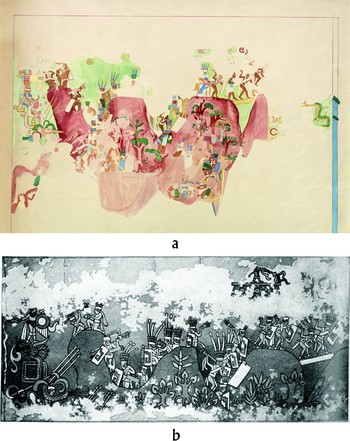
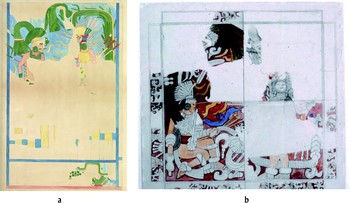
Despite the absence of its entire lower half, the northeast panel is the most distinctive topographically (Figure 8a). Lines of soldiers pass through narrow defiles between reddish hills, while another group crosses a footbridge between two peaks. The attacking soldiers wear a unique headdress marked either by a crest of red, yellow, or green feathers from which sprout three tall blue feathers with gold tips, or by deep blue caps, some with ear flaps. Several wear crossed “suspenders.” Also unique are the rectangular shields decorated with grecas, which are especially clear in an earlier copy of this panel by Teobert Maler (Figure 8b). Although Maler's copy must be used with caution, only this version shows a burning house at the top right of the picture. The question remains as to whether the invading soldiers along the top are Itzas or enemies. The conventions of the other murals would place the enemies at the top, but in Maler's copy at least, the upper warriors seemed to be garbed as Toltecs and the lower warriors seem foreign. This distinction is much less evident in Breton's version, however, and so the rectangular shields may in fact belong to foreign forces.
Northeast mural battle scene: (a) by Adela Breton, unpublished image, courtesy City Museum of Bristol; (b) by Teobert Maler, in Willard (Reference Willard1926:220).

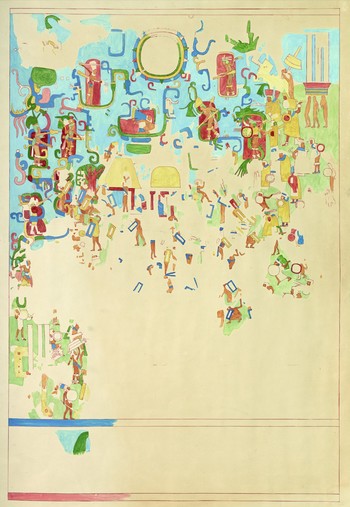
Although much of the main scene of the north mural is effaced, one can still make out a series of soldiers protected by rectangular shields, usually with a blue or gold border and a white interior (Figure 9). These would seem to be the defenders, whom the Itzas attack from the right, from above, and probably from below. Around the top and sides of the village are a series of Itza warriors surrounded by serpents or being carried by boatlike stylized serpents. An Itza camp probably ran across the bottom of the picture, as suggested by banner outlines, although only one soldier is clearly Itza.
North mural battle scene. Adela Breton, unpublished image, courtesy City Museum of Bristol.

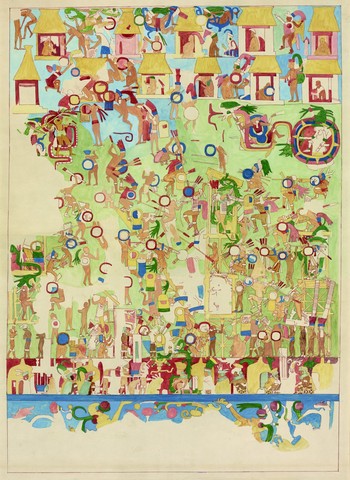
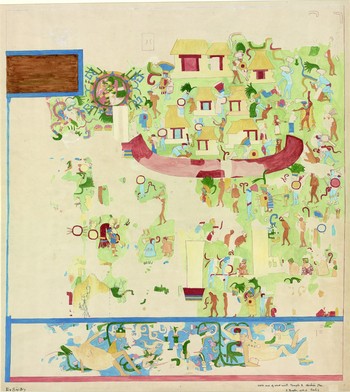
The conventions used to depict the battle on the final northwest panel are significantly different from the others, rendering its interpretation problematic (Figure 10). As will be discussed, the houses within the town's enclosure wall suggest that an Itza town is under attack. Yet the attacking forces are just as clearly Itza: a typical Itza camp occupies the bottom of the scene, including one of their beehive huts. Furthermore, leaders in typical Itza garb seem to lead prisoners away from the town. Many of the attackers are, however, decorated with a light blue body paint, a color not otherwise associated with the Itza forces. Just two wear Itza fur ankle and knee bands, but several others wear Itza insignias. By no means are all of the victors so painted: an avenging Itza Venus warrior enters the scene from the upper left, surrounded by a red serpent but without body paint, and most of the figures toward the bottom, at least the ones in authority, also lack body paint. If this is an attack on an Itza village, it is worth noting that it is not the only case of Itza-on-Itza aggression. The west lintel from the Castillo, for instance, depicts a number of bound prisoners in Toltec costume (Robertson Reference Robertson2007:Rubbings D15802, D15804–D15809). Likewise, several of the individuals with bound hands from the “captive” section of the Northwest Colonnade wear Toltec costume elements (e.g., Morris et al. Reference Morris, Charlot and Morris1931:Columns 25, 28, 37).
Northwest mural battle scene. Adela Breton, unpublished image, courtesy City Museum of Bristol.

These battles occur in localities whose differences were closely observed. In most Maya murals, place is indicated schematically by at most a single building or two. In contrast, at Chichen, we see camps, communities, and battlefields. Several of the murals clearly indicate differences of terrain, most famously the red hills of the northeast mural panel, but also the green hills upon which the village of the southeast mural is built and the hill or earthworks being scaled in the south mural. Although the red hills (Figure 8) have been identified as the Puuc Hills, none of the peaks there are set closely enough to make crossing by a footbridge possible, nor were they probably so denuded of vegetation. Miller's (Reference Miller and Hammond1977:213) suggestion that southern Oaxaca may be represented is intriguing given the other Mixteca-Puebla parallels noted herein. At present nothing about the topography in any of the murals directly implicates other polities of northern Yucatan, although it is logical that they might be involved, but other details of topography, architecture, and weaponry hint that areas beyond the northern plains may also be represented.
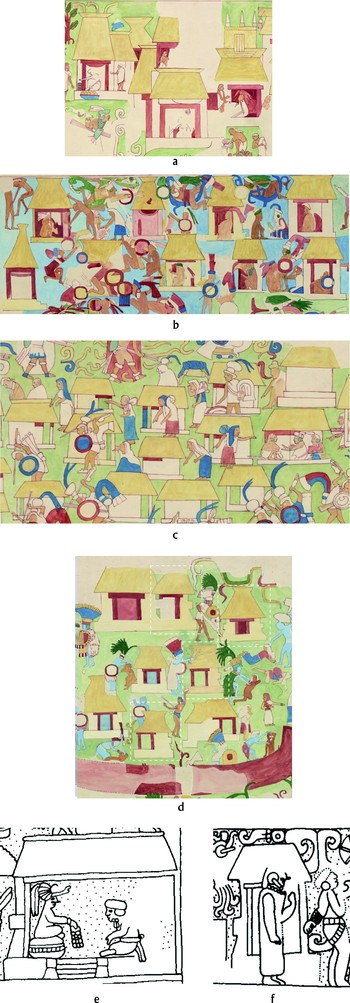
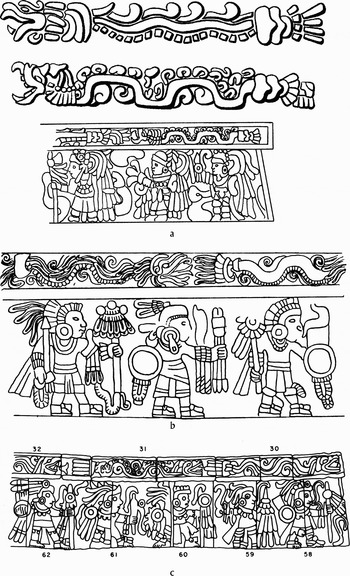
Specificity of place is also conveyed by the architecture of these scenes, among the very few depictions of Classic Maya communities to have survived. Two of the communities are walled (northwest and southeast panels), as is the community under attack on a mural from Las Monjas (Charlot in Bolles Reference Bolles1977:201–202; Breton in McVicker Reference McVicker2005:Plate 11; Willard Reference Willard1926:252). Furthermore, the houses reflect different construction styles and probably different ethnicities (Figure 11) (see also Angulo Villaseñor Reference Angulo Villaseñor, de la Fuente and Cicero2001; Smith Reference Smith2000). The houses on the southeast, northwest, and south panels are drawn frontally for the most part and all have thatched roofs and a single doorway framed in red. For many the crest of the thatch is distinctive in being constricted just below the peak, so that the thatch is bunched into an inverted wedge pattern above the ridgepole. In contrast, most of the houses on the southwest panel are drawn in profile, their roofs lack the constricted top, and many have a covered front porch, sometimes with partially painted posts.
House types depicted in the Upper Temple of the Jaguars murals: (a) southeast panel; (b) south panel; (c) southwest panel; (d) northwest panel, note battered lower wall zone and molding; (e) North Temple, rear (north) wall; (f) North Temple, north vault.

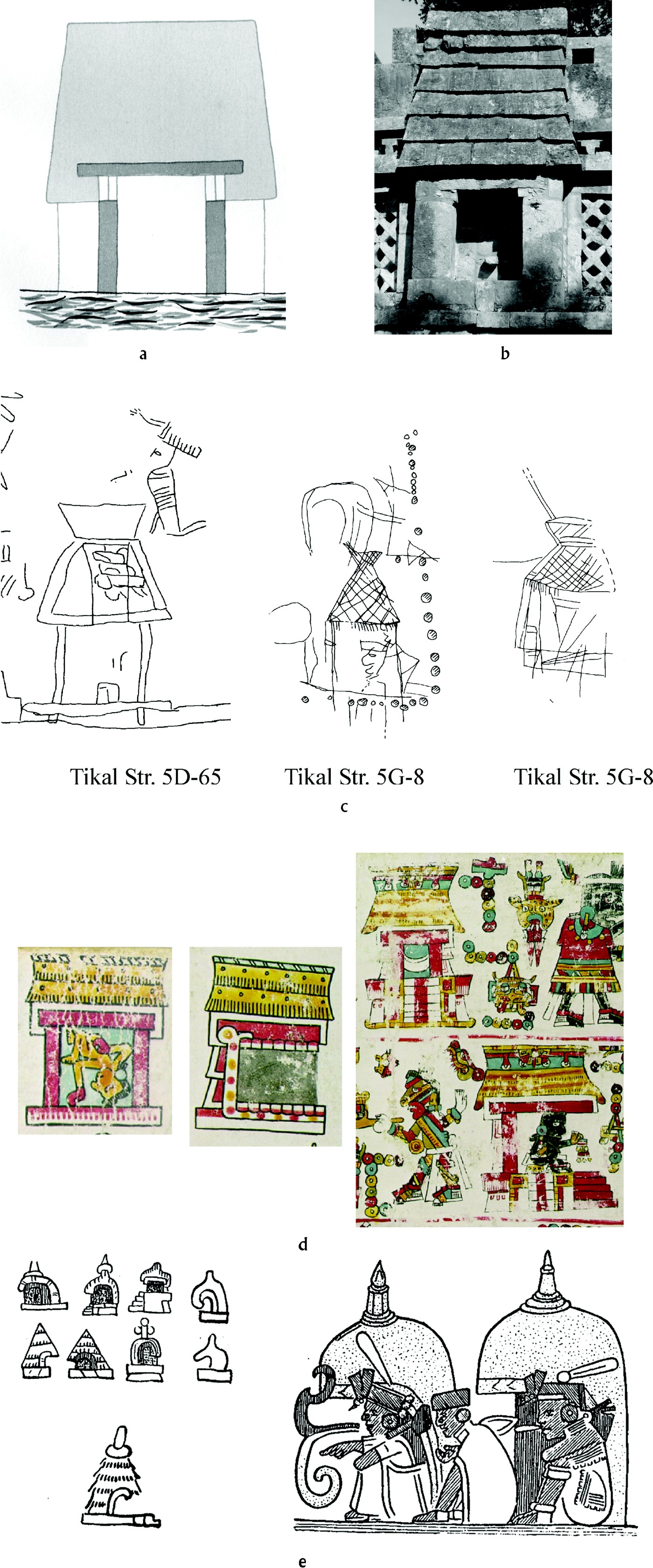
Although Wauchope (Reference Wauchope1934:116–118) felt confident in identifying all of these as typical northern Maya houses, that seems problematic for several reasons. First, at the northern sites with which I am familiar, most perishable houses have two or more rooms with a door in each. Although some have jamb stones, they are rarely more than 50 cm high. On the other hand, a house depicted in a mural from Dzula has a single doorway not unlike those from Chichen, as do the sculpted houses on the facades of the Arco at Labna and the south building of the Nunnery at Uxmal (Figures 12a and b). Porches too are absent among modern Yucatecan houses (Wauchope Reference Wauchope1938:98–100) and do not seem to be a common feature archaeologically, although admittedly postholes are difficult to identify. Even though ethnographic accounts indicate that houses at Mayapan and Chichen had open fronts, these always had masonry side walls with columns piercing the doorway (Ruppert and Smith Reference Ruppert and Smith1957), whereas the porches in the murals are true open porches. Porches are more common ethnographically in Guatemala, and archaeologically one of the Uaxactun houses also seemed to have had a porch (Wauchope Reference Wauchope1934:House 1).
Comparative house types: (a) Classic period Puuc house from Dzula, Yucatan (Thompson Reference Thompson1904:Plate II); (b) detail from the Arco, Labna, Yucatan (author photograph); (c) thatched roofs in Tikal graffiti (Trik and Kampen Reference Trik and Kampen1983:Figures 15, 18, 23, 27, 73, 80, 93); (d) houses and temples in the Mixtec codices (Vienna f. 11r, 14r, 6r); (e) Mixteca-Puebla “beehive” houses and their counterparts at Chichen Itza (Seler Reference Seler, Thompson, Richardson and Comparato1998:Figures 200, 203).

Although we know little about the thatching of precontact houses in Yucatan, the constricted crest is unknown ethnographically or in mural or sculptural depictions of houses from elsewhere in northern Yucatan.Footnote 9 They do occur several times in the Tikal graffiti alongside more typical hip roofs, although often these seem to be litters rather than houses (Figure 12c). Further afield, many of the same conventions for the depictions of structures are present in the Late Postclassic period Mixtec and Borgia Group codices coming from the Mixteca-Puebla-Tlaxcala region (Figure 12d) (Angulo Villaseñor Reference Angulo Villaseñor, de la Fuente and Cicero2001). The depiction of the doorway by red jambs and lintels is common throughout the Nuttall and Borgia, for instance, and houses are often depicted in profile. The constricted thatch roof may also be found in some of the temple depictions in the Nuttall, such as the Temples of Tilantongo and Tututepec. The beehive-shaped structures along the two basal registers provide another link to this area and the Mixteca-Puebla tradition, since, as noted by Seler (Reference Seler, Thompson, Richardson and Comparato1998:109), these resemble nothing so closely as glyphs for the day calli in the codices Vaticanus B and Bodley Footnote 10 (Figure 12e).
Finally, as already noted, the profiles of houses on the southeast mural panel are distinguished by a sloping or battered lower wall surmounted by a narrow horizontal molding. This construction technique is not found at any other northern Maya site, nor is it depicted in the codices, but it is a central trait of “Chichen-Toltec” architecture (although not at Tula itself).Footnote 11 The very similar houses depicted on the North Temple frieze confirm this, as certainly these scenes either took place at Chichen or someplace central to Itza ideology. The torched village on the Las Monjas mural also has battered lower wall zones; though these structures have an outset upper wall, unlike known Chichen structures (but like some examples in the Mixteca-Puebla codices). As already noted, these murals may record instances of conflict among groups sharing a common Toltec ideology of leadership.
INFORMATION ON MILITARY AND POLITICAL ORGANIZATION
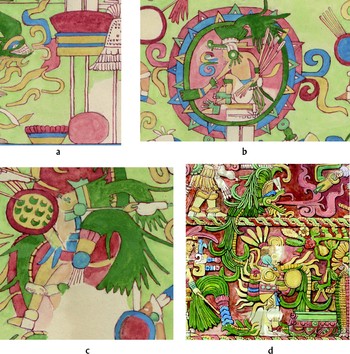
Although at present we do not have sufficient information to identify specific opponents or battle locations, the murals may usefully be examined for information concerning the internal organization of Chichen's military and therefore possibly the function of the UTJ. Considered alone, the murals may be suspected of reflecting idiosyncratic artistic choices or conventions, but if supporting materials can be cited from elsewhere at the site, we may be more confident in our conclusions. Recently, Ringle and Bey (2010) suggested that the advent of the mature Toltec style reflected a new form of political control exercised through the formation of military sodalities and the proliferation of ranks, reflected in, among other things, an intense emphasis on the details of costume visible on the sculpted jambs and piers. Another way ranking seems to have been expressed in the murals is through color. A striking aspect of the coloration of the murals and friezes of Chichen is the pervasive use of deep red, blue, and ocher banding (Figure 13).Footnote 12 Perhaps the clearest examples are the feather standards present on the north, northwest (twice), and southwest panels, consisting of an upper crown of red feathers with bands of blue and ocher beneath, above which stand two or three tall white banners. The colors of these standards, obviously insignias of the highest importance, strongly suggest that these three colors were in some way a political symbol. The concentric spiked rims of the sun disk banners on the southwest, south, northwest, and north walls conform to this palette, as do the head, tail, and underbelly of the large green feathered serpent at the center of the Lower Temple of the Jaguars and the arm padding of the peculiar effigy figure standing in front of it. Although its counterpart on the east wall of the UTJ does not wear such padding and little of his costume has survived, his helmet is banded blue and red with ocher adornments.
Examples of tricolor motifs at Chichen Itza: (a) standard, (b) sun disk, (c) warrior B (all from southwest panel), (d) effigy and feathered serpent, Lower Temple of the Jaguars. Adela Breton, unpublished images, courtesy City Museum of Bristol.

This scheme could seemingly be employed differentially to indicate rank and identity. For instance, the figure just left of center in the third register of the Lower Temple of the Jaguars, probably the most important person in that half of the row, has a blue and ocher feathered headdress with a red upper border; two individuals on the northwest mural panel wear similar headdresses. On the southwest panel, two seated individuals, apparently of secondary rank, wear capes of blue and ocher differing only in which color formed the central band, and two have yellow-crowned hats with small red ornaments at the back of their diadems (Figure 4). In this scene, one of the most important insignias was the back device. Most wear the tezcacuitlapilli back mirror, and only five have a spray of quetzal feathers held by a ribbed ferrule. Of these, only one has a tricolored device, the right feathered serpent warrior who is almost certainly one of the two or three Itza captains.
These colors also mark Itza speech (Figure 4). Turning again to the southwest panel, many of the Itza warriors are marked with speech scrolls that seem to vary in color with rank. Only three are tricolored: one is associated with the cloud serpent, another with a warrior unfortunately effaced, and the third, a row above and to the left of the lower sun disk, wears a long white tunic and a quetzal feather back device, seemingly another mark of high rank. In the camp scene along the base of the mural, the speech scroll of each of the principals is tricolored, with the exception of the individual just to the right of the sun disk, and in each case, this correlates well with costume details. Particularly interesting is the speech scroll of the left feathered serpent figure, which has not only all three colors (plus green), but also an embedded jester godlike profile (see Figure 15a). Speech scrolls of the subordinates seem on the whole simpler and of two colors at most, while their opponents are notably silent, with the exception of a possible enemy captain at top center.
Three final instances of the tricolor scheme remain to be noted. In the chambers of both the Temple of the Chac Mool and the Temple of the Warriors, the lower halves of the walls were decorated with a lower black band surmounted by bands of blue, red, and yellow, as were the serpent's bodies in the Chac Mool (Morris et al. Reference Morris, Charlot and Morris1931:20, 75, Plate 132). This same banding was used at Tula in the passageway between the Palacio Quemado and Edificio B (Acosta Reference Acosta1956:44, Figure 3). A recent study of color symbolism at Tenochtitlan reports similar banding in the Casa de las Águilas (López Luján et al. Reference López Luján, Chiari, Austin and Carrizosa2005:32, Figure 6). The authors note that the second stage of this structure was especially reminiscent of Tula-Toltec architecture, including processional benches, sunken patios, Tlaloc braziers. Thus, the tricolor schemata may have functioned symbolically as a marker of Toltec identity and heritage throughout its centers.
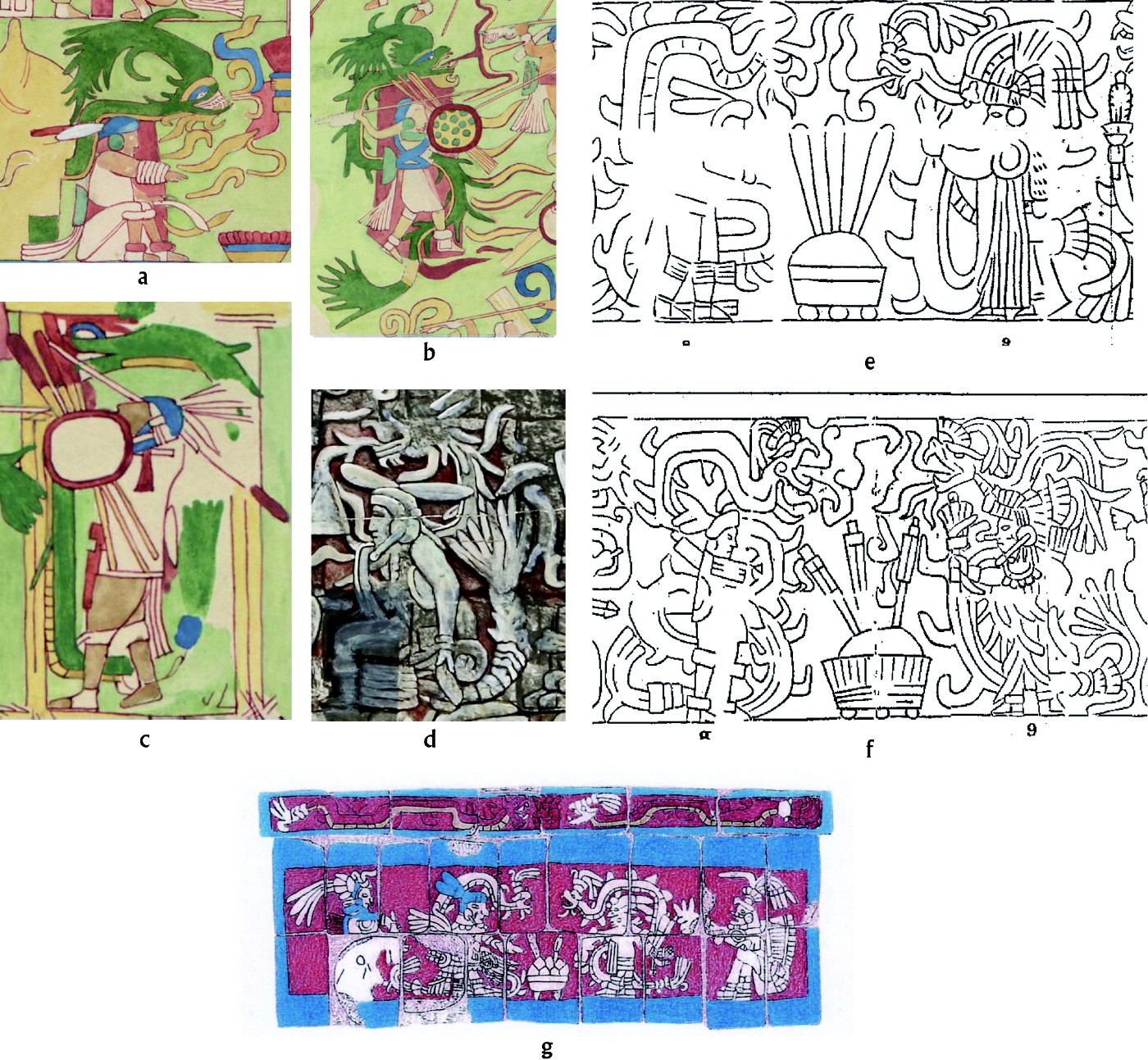
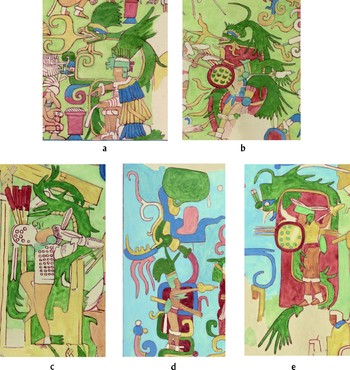
Turning now to the individuals depicted in the murals, three figures may reflect the highest ranks within the Itza hierarchy, distinguished by virtue of costume elements, their association with serpents, and their position in the overall composition. On the southwest panel, these three are marked with yellow flames similar to those associated with persons of power on the North Temple frieze.Footnote 13 Two are associated with green feathered serpents and the other with a white cloud snake, but all three seem to be real people, at least insofar as the UTJ murals depict real events. Costume elements such as shields also indicate their high rank. The first figure (warrior A, Figure 14a) sits at the center of the baseline scene on the southwest mural, just to the left of the great tricolored standard and a great reddish ball. He can be identified by his bright blue cap with a single white feather, surrounding yellow flames of potency, and a green feathered serpent curling up behind him. In the battle scene above, near its left edge, is another blue-capped figure throwing a dart and holding a shield decorated with dots or scallops (Figure 14b). Because both are dressed in white tunics and because both are surrounded by flames, I believe these are the same person, represented at two different points in the narrative. This same figure can be found on the uppermost level of the rightmost siege scaffolding on the south wall, where his blue cap has a crown of several white feathers (Figure 14c).
Examples of warrior A: (a) Southwest panel, battle scene; (b) southwest panel, lower register camp scene; (c) south panel. (a)–(c) by Adela Breton, unpublished images courtesy City Museum of Bristol. (d) North Temple, center of rear (north) wall. Adela Breton, unpublished image courtesy City Museum of Bristol. For full panel, see drawing by Linnea Wren in Ringle (Reference Ringle2004:Figure 3). (e) North dais, Temple of the Warriors (Morris et al. Reference Morris, Charlot and Morris1931:Figure 257). (f) Northwest colonnade dais, Temple of the Warriors (Morris et al. Reference Morris, Charlot and Morris1931:Plate 124). (g) Dismantled bench from near Structure 5C11, Grupo de la Serie Inicial (Schmidt Reference Schmidt2003). Courtesy Peter Schmidt.

The leadership role exercised by warrior A in the camp scene of the southwest mural is also reflected by his appearance as the central seated figure of the North Temple, where he seems to be confirming the standing figure to the left in office (Figure 14d). This portion of the North Temple frieze was damaged, but Breton's tracing suggests he had a typical Toltec costume, including a back mirror and a curved stick, as do the examples from the UTJ. He also figures prominently on bench processions, including the North Dais, the Northwest Colonnade Dais, and the recently discovered bench found near 5C–11 of the Initial Series Group, where he is shown with his hallmark blue cap meeting a warrior with a feathered serpent curling behind him, color unknown (Figures 14e–g). This figure may therefore have had a key role as an intermediary with warrior sodalities residing in outlying architectural complexes such as the Initial Series Group and the Southwest Group, and it is perhaps this sort of investiture that is depicted on the rear wall of the North Temple.
The costume of the second figure (warrior B, Figure 15), also associated with a green feathered serpent, is quite different. Again he seems to occur twice on the southwest mural, once near the extreme right of the lowest register and then directly above in the battle scene, just below the lintel (Figures 15a and b). Although the two differ in costume—the lower being wrapped in an ocher and blue feather cape, the upper being dressed for battle—the close similarity of their feathered serpents, as well as their headgear, suggest they are again variants of the same individual. Both wear the jade mosaic pillbox hat, here ornamented with a small bird and surmounted by a tall crown of green quetzal feathers. The upper individual's nose is pierced for both a tubular nosepiece and the Toltec button. Three other images are possibly versions of warrior B, though differing in details. One, possibly holding the same shield but wearing the aztaxelli ornament rather than the quetzal feather spray, is the warrior mounting the scaffold just right of center on the south panel (Figure 15c). A similar feathered serpent warrior occurs at the right-hand side of the north panel, and opposite him is a warrior with the quetzal feather spray but backed by a serpent that is less clearly feathered (Figures 15d and e).
Examples of warrior B: (a) Southwest panel, battle scene; (b) southwest panel, lower register camp scene; (c) south panel; (d) north panel, left side; (e) North panel, right side. All by Adela Breton, unpublished images courtesy City Museum of Bristol.

In the southwest battle scene, warrior B (Figure 15b) is in a throwing posture and holds a distinctive shield similar to that of warrior A but marked by several rows of small scallops. This same shield decorates the exterior of the UTJ, forms part of the frieze above the Castillo-sub, and is also found at Tula. It may therefore be an emblem of wider importance. If an emblem of high rank, it would be complemented by the jester godlike profile embedded in the speech scroll of warrior B. Whether the green-dotted shield of the blue-capped warrior A is of equal importance remains to be seen.
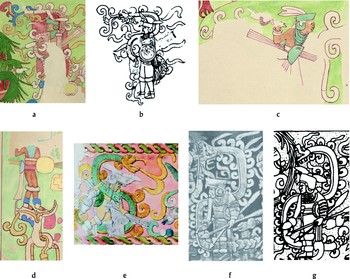
The final figure (warrior C, Figure 16) of the triumvirate is surrounded by a white serpent with hooked cloud markings rather than feathers. Because cloud serpents are associated with Mixcoatl in the highland tradition, it is worth dwelling on this figure and his iconography. On the southwest mural, he wears the jade pillbox cap with the small bird affixed to it, aztaxelli, large circular ear flares, both a pendant nose bead and a Toltec nose button, and has green marks, perhaps scarifications, on his cheek (Figure 16a). His body is badly damaged, but an earlier tracing by Teobert Maler (Figure 16b) shows him holding a scalloped shield identical to warrior B's, by whose side he stands. He also wears a multistrand necklace like those seen on the jamb figures. Another probable example of this figure may be found on the southeast panel (Figure 16c). Here the serpent's body has been effaced and only its outline permits identification as a cloud serpent, but the warrior is dressed almost identically to warrior C. Finally, a headless figure above a white snake can be found at the left edge of the northeast panel, where what survives of his costume is consistent with Figure 16c (Figure 16d). Whereas warriors B and C cluster together on the southwest panel, here they frame the battle scene.
Examples of warrior C: (a) Southwest panel. Adela Breton, unpublished images courtesy City Museum of Bristol. (b) Southwest panel. Detail of drawing by Teobert Maler, published in Willard (Reference Willard1926:217). (c) Southeast panel; (d) northeast panel, left side; (e) Lower Temple of the Jaguars; (f) North Temple, top center, north (rear) wall. (c)–(f) Unpublished images by Adela Breton courtesy City Museum of Bristol. (g) Line drawing of North Temple figure by Linda Schele.

This figure is most easily identified elsewhere at the site, however (Table 2). The two most prominent examples occur in the fourth register of the Lower Temple of the Jaguars (Figure 16e) and in the upper register of the North Temple (Figure 16f). Aside from the cloud serpent and costume details, the fact that both these instances are in the upper registers next to a sun disk argues for their homology. Both wear a pillbox headdress ornamented with the small bird, aztaxellis, back mirrors, nose pendants, and where visible, the nose button, and finally fur knee and ankle ornaments. The only difference is that the Lower Temple of the Jaguars example has the butterfly pectoral, and the others wear the multistrand necklace. Both these cloud serpent warriors stand at the head of a file of warriors clad in variants of the typical Toltec costume, suggesting they are the commanders.
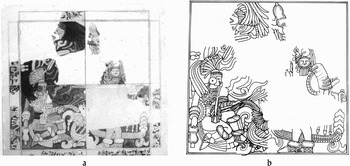
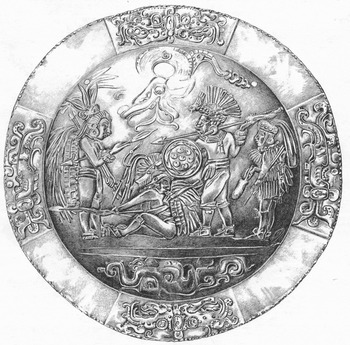
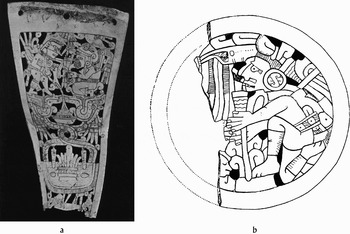
A key example of warrior C is the right figure on the table of the UTJ (Figure 17). Whereas I (Ringle Reference Ringle2004:196) formerly identified him with the effigy of the Lower Temple of the Jaguars, this is clearly wrong given the difference in serpents. Although fragmentary, what remains of his costume is consistent with his identification as warrior C: sandals, fur anklets, arm padding, the Toltec back mirror, and darts and arrows. Another tabletop fragment shows the grooved curved stick and the fur arm protector, and another an upraised atlatl. His nose is pierced for the Toltec button ornament. Unfortunately, his headdress has not survived, but clearly the badly damaged serpent behind him is neither feathered nor green, and arguably has at least one curl. A key facial feature is that this person is bearded, a rare trait among Chichen's warriors. However, it is characteristic of a warrior who consistently figures on the gold disks pulled from the Sacred Cenote, often attacking non-Itza warriors. This scene is found on disks A–F. On disks D and E, he is accompanied by a nonfeathered serpent and on F by a serpent that has both feathers and cloud marks. On disk F, he also holds the same scalloped shield associated with warriors B and C on the southwest mural (Figure 18).
Tabletop of the Upper Temple of the Jaguars: (a) painted version by Adela Breton, and (b) line drawing by Linda Schele.

Disk F from the Sacred Cenote (Lothrop Reference Lothrop1952:Figure 34).

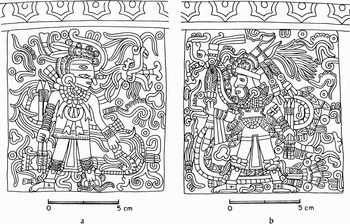
He is perhaps the prototypical occupant of the cloud-serpent office, possibly semi-divine, and hence a fit image for the UTJ tabletop. The UTJ table may therefore have been the seat of a leader who either had Cloud Serpent as a title or presided over a cloud serpent warrior sodality. Among the warriors on the UTJ jambs, only one is backed by a serpent, and tellingly it is a cloud serpent (Figure 19a). This warrior occupies the central facet of the inner north jamb, arguably the most prestigious position. Furthermore, although the jambs and piers of the Castillo are decorated with warriors in a great variety of costumes, including several with serpents, only two are cloud serpents and they pair to frame the west Castillo doorway (Figure 19b). This is, of course, the direction in which the UTJ and indeed all of the serpent temples face at Chichen, perhaps reflecting a tie between the setting sun, the cloud serpent, and warriors, as Seler (Reference Seler, Thompson, Richardson and Comparato1998) suggested. This may indicate that the Central Mexican linkage between Camaxtli-Mixcoatl and the souls of dead warriors was operative as early as the Terminal Classic period (and hence belies the migration myths of the Postclassic period Nahuas of the Puebla-Tlaxcala region, who viewed themselves as descendants of a Chichimec lord Mixcoatl). In any event, the cloud serpent clearly occupied a significant position within the symbolic geography of Chichen Itza.
Additional cloud serpent warriors from Chichen Itza (warrior C): (a) Jamb face K3, Upper Temple of the Jaguars (Seler Reference Seler, Thompson, Richardson and Comparato1998: Figure 120); (b) Castillo, West jamb, south side (Seler Reference Seler, Thompson, Richardson and Comparato1998: Figure 123).

The position of the cloud serpent leader in the overall hierarchy remains to be resolved and is important for an understanding Chichen's political hierarchy. The pairing of cloud and feathered serpent leaders (or Mixcoatl/Quetzalcoatl) can be seen in several contexts at Chichen (Table 2), such as the pairing of warriors B and C on the southwest mural mentioned earlier. Although warrior C is clearly a major captain, he never appears in the camp scenes and the warriors surrounding him on the UTJ jambs are all modestly costumed.Footnote 14 It is curious too that despite the apparent special link between the UTJ and the Temple of the Warriors, the latter has a far wider range of costume represented on its piers, and in fact, none of its warriors are backed by serpents of any sort (for a thorough and insightful discussion of the Temple of the Warriors, see Kowalski Reference Kowalski, Kowalski and Kristan-Graham2007).
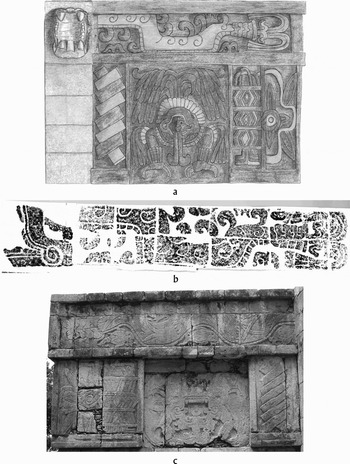
The Osario Group may represent a precinct dedicated to this sector of Chichen's leadership, however. As is well known, this group rests upon its own plaza, a smaller version of the Great Terrace, and like the latter, the Osario Group is centered around a radial pyramid and is connected to a cenote via a sacbe. Both groups have nearly identical Venus Platforms, with one significant difference: Schmidt's excavations have demonstrated that the Osario Venus Platform (3C3) has a cloud serpent in the homologous position to that occupied by a feathered serpent on the Venus Platform of the Great Plaza (Figures 20a–c, Schmidt Reference Schmidt, Kowalski and Kristan-Graham2007). This pairing is further made explicit by the intertwined feathered and cloud serpents forming the balustrades of the Osario itself. The interior of its temple features four warrior piers. Warriors are backed by serpents only on the two rear piers and then in just five or six of eight cases (they are absent on the two rear faces, possibly also the south side of pier 2), as if they were guarding the bench between them. The specifics of the serpents are weathered and difficult to discern, but at least three appear to be cloud serpents and none are feathered (Table 2) (Robertson Reference Robertson2007:Rubbings D23251–D23266).
Imagery from the Osario Group: (a) Panel from 3C3, the Osario Venus Platform (Schmidt Reference Schmidt, Kowalski and Kristan-Graham2007:172, Figure 17). (b) Rubbing of serpent from 3C3 (Robertson Reference Robertson2007:D23327). (c) Comparable facade from Venus platform, 2D4. Author photograph.

If the Osario Group represents a smaller version of the Great Plaza, then perhaps it hosted similar but less prestigious rites of investiture specific to its warrior ranks (it is probably significant that it has neither ballcourt or serpent temple). There remains the problem of the date of this complex. The hieroglyphic date on one of its pillars has been variously dated as a.d. 842 or a.d. 998 (Graña-Behrens et al. Reference Graña-Behrens, Prager and Wagner1999; Schele and Freidel Reference Schele and Freidel1990: 500, note 26; Thompson Reference Thompson1937), with many epigraphers now favoring the later (and original) reading. However, in a recent discussion, Cobos (Reference Cobos, Kowalski and Kristan-Graham2007:328–330) argued that the inscription postdates construction of the complex, which he places in his early Sotuta phase on the basis of ceramics from construction fill. Thus, Cobos suggests a relatively short interval between construction of the Great Terrace buildings and the Osario, followed by their contemporary usage for the remainder of the Sotuta phase. At present, further evidence is needed to decide among these alternatives.
One section of the murals remains to be treated, the central panel of the east wall (Figure 21a). Here a largely effaced feathered serpent and his “effigy,” the same figure who is at the center of the Lower Temple of the Jaguars, face a simply dressed individual with golden hair. The effigy, in conjunction with the warrior C figure on the tabletop (Figure 21b), again creates a feathered and cloud serpent pairing along the right halves of these compositions. Therefore, the final question to be resolved is the identities of the figures facing them to the left, both of whom are similarly depicted. In the case of the tabletop, I believe he is an initiate, because he wears a costume very much like the warriors on the piers, including a pillbox hat, fur anklets and knee rings, darts, and a back mirror. He lacks only the aztaxelli feather ornament, which appears to be descending from above. A twin feather was also an identifying characteristic of Mixcoatl's costume (Boone Reference Boone2007:42). Although his seems to have been of eagle feathers, this may possibly be just a variant of the more common aztaxelli, which is usually claimed to be of heron feathers.
(a) Central panel, east side, Upper Temple of the Jaguars; (b) Upper Temple of the Jaguars tabletop. Adela Breton, unpublished images, courtesy City Museum of Bristol.

With regard to the identity of the person on the left of the central mural panel, two possibilities present themselves: (1) he is an image of Captain Sun Disk or the sun god, as his hair color and diadem might indicate, or (2) he is that same initiate in somewhat different costume who now receives this diadem as a mark of office or investiture. The former is the opinion of most authorities, but in support of the latter, one might cite a similar diadem worn by 8 Deer Jaguar Claw only after his initiation (Figure 22a). 8 Deer is of particular relevance because his costume and face paint possess several of the attributes of Quetzalcoatl and because he is invested by the Toltec lord 4 Jaguar after undergoing rites that seem to be shared by many Tollans (Byland and Pohl 1994:139–145; Ringle Reference Ringle2004). The front of the Chichen diadem is composed of an image of the Jester God, widely recognized as an emblem of leadership, and so would be appropriately bestowed during an act of investiture. It should also be noted that both left-hand figures wear a similar headdress of green feathers, unlike that of the sun deity but like that of many warriors, and most importantly both lack an encircling sun disk. The sun god's jaguar throne is also absent, though it is not invariably present in images of the sun disk.
The sun diadem: (a) 8 Deer Jaguar Paw wearing “sun jewel” (Codex Nuttall f. 59; Nuttall Reference Nuttall1975). (b) Panel from the basal platform of the Osario (3C1) (Robertson Reference Robertson2007:Rubbing D40674).

This diadem provides another link to the Osario because it is worn by images of the Principal Bird Deity adorning the tiers of the platform (Figure 22b). The head of this bird is that of K'awil (God K), a god emblematic of dynastic spirit and power. The evidence taken as a whole thus leads to the conclusion that the Osario complex may represent a ceremonial area dedicated specifically to the Cloud Serpent leader and his cohort. The broader symbolism of the Great Ballcourt and the buildings and piers of the Great Terrace taken as a whole suggest that they were representative of all segments of Chichen's leadership, but I would argue that the UTJ was specifically the domain of the Cloud Serpent leader.
ETHNOHISTORICAL PARALLELS
Given the parallels suggested between ritual practices at Chichen and those of the later Postclassic period Mixteca-Puebla tradition, it is noteworthy that the most important stop during the initiation of a tecuhtli (teuclti) of Tlaxcala was at the temple of Mixcoatl-Camaxtli, but in Cholula, it was at the temple of Quetzalcoatl (see references in Carrasco Reference Carrasco1966, Byland and Pohl 1994:147). The title of tecuhtli was an honor accorded nobility for outstanding service, principally in warfare, but was by no means confined to the highest ranks (Spaniards equated it with the title of caballero). This rank would therefore seem to parallel very closely those hypothesized to have been conferred on the Great Terrace at Chichen (Ringle Reference Ringle2004).
Yet if Cloud Serpent/Mixcoatl was the title of an important leader during the Late Postclassic period, it seems to have gone largely unremarked by later chroniclers. The Codex Mendoza f. 17v lists a mixcoatl tlacatecuhtli as military governor of Tetenanco, while the title of mixcoatl tlailotlacteuctli is given to a war chief in the Anales de Tlatelolco (Umberger Reference Umberger2007). Barlow (Reference Barlow, Monjarás-Ruiz, Limón and de la Cruz Paillés1987:41) also mentions that the mixcoatl tlailotlaque were inspectors of the Aztec markets. Several historical figures have Mixcoatl as one of their names, possibly representing the same process of title incorporation evident in the many leaders having Quetzalcoatl as part of their name (most famously Topiltzin Quetzalcoatl of Tula). Mixcoamazatzin is listed as a founding king of that city in the Anales de Cuauhtitlan (cf. Prem Reference Prem1999), and according to Alva Ixlilxóchitl (Reference de Alva Ixlilxóchitl1985:I:102, 305, 321), a king named Mixcoatl was given by the Toltec Aculhuas to Tlatelolco at the same time Acamapichtli was bestowed upon Tenochtitlan, infusing both lines with Toltec legitimacy.
A variety of images also hint at the persistence and importance of the feathered/cloud serpent pairing in Postclassic period Central Mexico. Paired feathered-cloud serpents alternate on the central bench of the Palacio Quemado at Tula, a building that likely served the local warrior orders, and at Tenochtitlan, the two serpents alternate on the Centro Mercantil stone and along the edges of the benches from the Casa de las Águilas, a building with strong Tula-Toltec symbolism (Figure 23). A somewhat less direct pairing occurs on a pair of imitation Fine Orange vessels found in Offerings 10 and 14 near the Great Coyolxauhqui Stone at the foot of the Templo Mayor (Figure 24), offerings that Wagner (Reference Wagner and Moctezuma1982:127) recognized were in reality funerary urns because of the human cremations within. The cups respectively depict a Tezcatlipoca-like figure backed by a feathered serpent, and a figure with Mixcoatl attributes backed by a serpent marked with obsidian or flint blades, perhaps indicating the martial aspect of that deity.Footnote 15 Nicholson and Quiñones Keber (Reference Nicholson and Keber1983:94–97) maintained these were produced as acts of “conscious archaism” recalling the Aztec's Toltec heritage, although the details of costume recall Mixteca-Puebla iconographic conventions just as strongly. Umberger (Reference Umberger2007) recently argued that the bones found within were the remains of Moquihuix and Teconal, leaders of the rebellious Tlatelolcans. Umberger associates Moquihuix with the feathered serpent vase and Teconal, his war chief, with the Mixcoatl vessel (as she notes [2007:15], the latter may have had the title mixcoatl tlailotlacteuctli). If Umberger is correct, the figures stand in similar structural relations to one another as warriors B and C at Chichen Itza, although it must be admitted that the identifications rest on relatively slight grounds.
Pairings of the feathered and cloud serpents: (a) Bench from the central room, Palacio Quemado, Tula (Acosta Reference Acosta1957:Figure 3; Tozzer Reference Tozzer1957:Figure 600). (b) Centro Mercantil stone, Tenochtitlan (Tozzer Reference Tozzer1957:602). (c) Casa de las Águilas, Tenochtitlan (López Luján Reference López Luján2006:Figure 165).

Offertory vessels from the Templo Mayor, Tenochtitlan: (a) Figure with Tezcatlipoca attributes and a feathered serpent, vessel from Offering 14 (López Luján Reference López Luján, de Montellano and de Montellano2005:Figure 98). (b) Figure with Mixcoatl attributes and a “projectile point” serpent, vessel from Offering 10 (López Luján Reference López Luján, de Montellano and de Montellano2005:Figure 97).

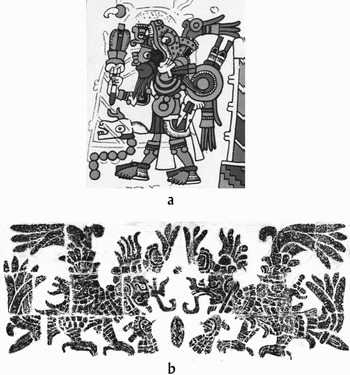
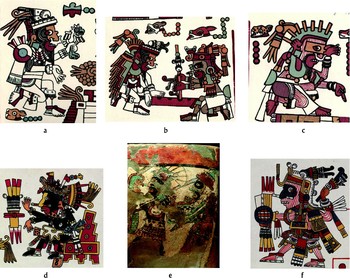
As mentioned, another example of an actor with Mixcoatl characteristics is 4 Jaguar in the Mixtec codices. On Nuttall f. 52, he is shown accompanying 8 Deer Jaguar Claw in the rituals prior to his investiture. His mouth area is painted red and, like images of Mixcoatl on the UTJ table and on the gold disks, 4 Jaguar is bearded (Figure 25a–c). He also wears a simple head ornament decorated with a down ball, a trait of Mixcoatl and very like the one on the Templo Mayor vase. Politically, 4 Jaguar seems to have served as an emissary, perhaps from Tulancingo (Byland and Pohl 1994:139–145). He was probably not a paramount ruler, but one with sufficient power to sanction the legitimacy of Toltec rulers, such as 8 Deer became. What seems to be a strikingly similar pairing may be found on a pot from the Sacred Cenote of Chichen Itza, of local manufacture but bearing figures with face paint very similar to that of 8 Deer and 4 Jaguar and to the gods Quetzalcoatl and Mixcoatl (Figure 25e).
Characters with Mixcoatl attributes: (a)–(c) 4 Jaguar (Codex Nuttall ff. 70, 78, 79, respectively; Nuttall Reference Nuttall1975). (d) Quetzalcoatl, Codex Borgia (Díaz and Rodgers Reference Díaz and Rodgers1993:Plate 62). (e) Vessel from the Sacred Cenote, Chichen Itza (Schmidt Reference Schmidt, Schmidt, de la Garza and Nalda1998:426). (f) Mixcoatl, Codex Borgia (Díaz and Rodgers Reference Díaz and Rodgers1993:Plate 25).

The association of Mixcoatl with noble warriors occurs even further afield. A series of shell ornaments from the Huasteca depict figures whose costumes include traits associated with Mixcoatl (Beyer 1933). Several of these depict paired serpents from which humans (or deities) emerge. On the most famous of these (Figure 26), two figures surmount a pair of intertwined serpents differing in their body decoration but with curls (or possibly feathers) along their backs. These in turn rise from a watery body with reeds growing at the center, a clear Tollan marker. Deer hoofs through the ear lobes of the left figure mark him as having traits of Mixcoatl. Another pectoral (Beyer Reference Beyer1933:Figure 24) shows a figure with Mixcoatl's hair ornament drilling fire. Besides being an invention of Mixcoatl, fire drilling was one of the steps in the investiture of teteuctin in the Puebla-Tlaxcala region. Although Beyer provided no information on the contexts of these shells, he demonstrated they were worn as pectorals. It is therefore not unlikely that they were ornaments of rank for the local equivalent of tecuhtli warriors, for whom Mixcoatl appears to have been of particular importance.
Huastec shell pectorals (Beyer Reference Beyer1933:Plate 1, Figure 24).

A final perspective on the role of the UTJ in rites of investiture come from striking resemblances it has to the tlacochcalco-tlacatecco, a building type to which López Luján (Reference López Luján2006:Chapter 8; cf. Klein Reference Klein and Boone1987) has recently assigned the so-called Casa de las Águilas of Tenochtitlan. To be more precise, these provide support for the role of the entire ballcourt in such rites, because traits of the tlacochcalco-tlacatecco can also be seen in the North Temple and the Lower Temple of the Jaguars. This building is described by several chroniclers as having served as a place for both penitential rites prior to investiture and vigils held for dead kings and warriors before their burials (see Klein Reference Klein and Boone1987:309–314; López Luján Reference López Luján2006:Chapter 8). Rites may have been conducted either in two related structures or in two chambers of the same building, the interpretation favored by López Luján for the Casa de las Águilas. As I argued previously (2004), a similar pairing can be seen in the bas-reliefs of the north and south vaults of the North Temple, where the theme of the death and regeneration of the king seems to parallel the general theme of the Casa de las Águilas. As with Chichen, it is important to note that such rituals were not for the tlahtoani alone, but also involved tecuhtli of lesser rank.
The various examples of the tlacochcalco-tlacatecco differed in detail, but most housed twin god effigies. In the case of Chalco and the Casa de las Águilas, these were Huitzilopochtli and Tezcatlipoca, and part of the investiture ritual was to perform penance in front of these two bundles and perhaps even don their vestments (López Luján Reference López Luján2006:284, citing others). The conceptual link is that “both were gods of war who, according to Motolinia, were brothers” (López Luján Reference López Luján2006:281). The UTJ references a different pair, Quetzalcoatl and Mixcoatl, but again both were gods of war (at least in the Chichen-Pueblan tradition) and both were closely related, Mixcoatl being equated with Quetzalcoatl in some later sources or alternatively identified as his father. And as in the tlacochcalco, a significant event in the UTJ investiture was to present the initiate before both deities: the one depicted on the table, the other on the rear wall.
Several more specific details can be noted. The tlacochcalco can be translated as “house of darts,” and its depiction in the Codex Mendoza shows a building with a series of darts adorning its roof, recalling the crossed-darts merlons of the UTJ, Tajin, and Tula.Footnote 16 Also the costume used by the attendants and the initiate for both initiation and funerary rites in the tlacochcalco was a long dresslike garment ornamented with skulls and bones. Similar vestments are depicted on the mortuary priests of the North Temple and some of the females depicted on the columns of the Lower Temple of the Jaguars. Another was the xicolli jacket, which Ringle (Reference Ringle2004) argued was donned by the central figure of the North Temple, and the twin-feather aztaxelli ornament, which Klein (Reference Klein and Boone1987:320) notes was worn both by penitent priests and by autosacrificial images of Tizoc and Ahuitzotl on the Templo Mayor Dedication Stone. Perhaps most important is the conscious archaism of the benches and artifacts of the Casa de las Águilas, which makes clear the historical Toltec basis of lordly and kingly legitimacy. Like the imagery of the UTJ and the Palacio Quemada of Tula, these benches show alternating feathered and cloud serpents (see Figure 23c) (López Luján Reference López Luján2006:Figures 148, 156–190).
Finally, although the two effigies were the most prominent deities, solar symbolism pervaded both the tlacochcalco and the rites practiced within. For instance, the famous ceramic “eagle warrior” was, in López Luján's (Reference López Luján2006:289) estimation, instead an image of the Cuauhtlehuánitl, a representation of the rising sun. As he notes, the course of the sun was the primary metaphor for the career of the warrior and the life cycle of the sovereign. In similar fashion, we can see the omnipresent role of the sun god on the murals and lintels of the UTJ; although there, the sun god seems also to have conferred specific objects on the initiate, in particular the sun diadem.
If there was indeed a historical link between the UTJ and the later tlacochcalco-tlacatecco, we might then ask whether the leadership of the UTJ in any way paralleled the Aztec offices later connected to these buildings. Although Chichen probably did not follow exactly the same system as Tenochtitlan, the roles of the associated offices are instructive. Sahagún (Reference de Sahagún and Kintana1979:355) told us that:
He (the sovereign) was aided by two senators with regard to that which related to the governance of the people; one of them was a noble (pilli) and the other was trained as a warrior. The one was called tlacatecutli and the other tlacochtecutli. Two other captains aided the lord in military affairs: one of these was a noble (pilli) and trained in warfare, and the other was not a noble. The one was called tlacateccatl and the other was called tlacochcalcatl.
The various sources, summarized by Piho (Reference Piho1972), are somewhat contradictory in their definitions of these four offices (tlacatecutli, tlacochtecutli, tlacateccatl, and tlacochcalcatl), but the first two seem to have been political councilors or governors, and the second two were military leaders. The tlacatecutli and tlacateccatl seem to be of somewhat lower status, but Piho (Reference Piho1972) showed that in fact all four offices could be occupied by nobles, despite Sahagún's statement. As López Luján notes in his commentary, many if not all tlahtoani and cihuacoatls, such as Tlacaelel, arose from these offices.
The pairing of a political leader (tlacochtecutli) with one who was primarily a war captain (tlacochcalcatl) recalls the pairing of warriors B and C on the southwest mural panel of the UTJ, where only warrior B converses with other leaders in the lower camp scene. Whether the tlacatecutli and tlacateccatl are also among the figures of the murals is unclear, but the tlacatecutli could be warrior A, the other figure backed by a feathered serpent that also seems to play a political role. The tlacateccatl warrior captain, as mentioned, complemented the tlacochcalcatl but was of lesser, sometimes non-noble origin. Perhaps this was embodied on the central faces (K3 and K8) of the UTJ jambs. We see from the Codex Mendoza (ff. 17–18) and Matricula de Tributos (f. 1) that one of the privileges of the three offices (save the tlacateccatl) was to wear the peaked xiuhuitzontli diadem. On the UTJ jambs, only K3 wears the peaked diadem (and is backed by a cloud serpent) while the hat of his opposite at K8 is undistinguished from the others. Possibly these therefore represent the paired tlacochcalcatl-tlacateccatl.Footnote 17
If something akin to these offices is being represented in the imagery of the Great Ballcourt, how do they relate to the supreme leadership? A possible answer comes from the fact among the Aztecs these offices could be held as one title among several others, so there was no contradiction in the tlatoani or cihuacoatl also being the tlacochtecutli. This is what I believe we see at Chichen: the feathered serpent leaders were the highest political officers and the cloud serpent warrior the highest military authority.
CONCLUSIONS
This paper has explored three themes related to the function of the UTJ. First, I have suggested that the UTJ was a contemporary of the outer Castillo and Temple of the Chac Mool, or at least did not long postdate them. This is consistent with the hypothesized use of the entire Great Plaza as the scenario for rituals of investiture, major stops of which were in the Great Ballcourt (Ringle Reference Ringle2004). Second, I argue that its murals depict battles of a historical or mythico-historical nature, rather than being allegories of celestial bodies or deities. Support for this is admittedly by analogy with other narrative types, because neither the places nor the costumes depicted in the murals can be identified as yet, but the significant differences of each panel in terms of place and opponent argue against strictly symbolic interpretations.
Finally, the paper argues that the murals provide concrete information concerning rank that can be correlated with other imagery. In keeping with the general role of investiture of the Great Ballcourt, I have attempted to demonstrate that this stop represented a leader or rank (or both) associated with the Cloud Serpent-Mixcoatl, who seems to have been a war captain but probably was not the supreme political leader. His close pairing with a feathered serpent leader suggests parallels with the later Aztec dual office of tlacochtecuhtli/tlacochcalcatl, and the UTJ itself echoes aspects of the tlacochcalco, a place where the ruler and other high lords stopped for various rites preparatory to final investiture (this last step may have happened on the Castillo for the highest political leaders). It is worth noting that in Aztec investiture, the stage immediately following the actual crowning was a “war of confirmation” (López Luján Reference López Luján2006:282, citing others) in which the candidate proved his mettle. A similar pattern can also be noted in the investiture of the Mixtec king 8 Deer of Tilantongo. Perhaps similar such wars, conducted by the ancestral war lords of Chichen Itza, provided the occasion for the wall murals of the UTJ and help explain their variety. Klein (Reference Klein and Boone1987:314) further suggests that penitential rites were an important component of the rituals held within the tlacochcalco to celebrate recent military victories. This may explain Virginia Miller's observation (personal communication 2008) that most of the warriors on the jambs have exposed and pierced penises.
If these assertions prove true, the murals and the temple in which they were housed underscore the view that the Toltec tradition was indeed ancient and that there was considerable continuity of offices and rituals as successive Tollans drew upon and reshaped the practices of their predecessors. What is interesting is that the UTJ and its murals merge two long-standing strains of Mesoamerican military ideology. One, associated with Venus, has roots extending back to the Early Classic period and to Teotihuacan, if not earlier. The other, sun associated, was later to be most dramatically expressed by the Aztecs. It is thus not a matter of Captain Serpent conquering Captain Sun, or vice versa, but, as with so many other aspects of this site, the creative melding of a wide spectrum of traditions to forge new forms of social and political organization.
RESUMEN
Este articulo reexamina el arte y arquitectura del Templo Superior de los Jaguares de Chichen Itza, en base a las nuevas imágenes digitales de alta resolución de las copias de los murales hechas por Adela Breton a principios del siglo XX. Después de una discusión de la antigüedad del edificio y de las interpretaciones previas de los murales, los análisis del traje, ambiente y de los tipos de casas sugieren que en lugar de representar episodios míticos o simbólicos, dichos murales ilustran encuentros bélicos reales entre Chichen y sus enemigos. La razón de su creación parece ser la utilización del Templo para ritos de investidura auspiciados por un sector especifico de los militares de Chichen. Se argumenta que este sector estuvo asociado con Mixcóatl (o “serpiente nube”), como el titulo de su líder o como una deidad patrona, mientras que el Templo mismo posiblemente se relaciona con algunos edificios Nahuas mas tardíos asociados con ritos penitenciales involucrados con guerra e investidura.
ACKNOWLEDGMENTS
I would like to thank the New World Archaeological Council of Irvine, California, for the opportunity to present a preliminary version of this paper at the Mysteries of Ancient Maya Murals Symposium and for their hospitality in hosting the speakers. I owe a particular debt to Sue Giles, Curator of Ethnography and Foreign Archaeology of the City Art Museum and Art Gallery, Bristol, for her help in obtaining digital images of the murals in rather short order, and to David Emeney, of the same institution, for performing the necessary photography despite more pressing commitments. I am also indebted to Annabeth Headrick, Virginia Miller, and an anonymous reviewer for several very helpful comments and editorial suggestions that undoubtedly improve the initial version. Finally, Tomás Gallareta Negrón kindly provided the translation for the article abstract, for which I am grateful.