INTRODUCTION
While most experiences of life-threatening illness appear to be negative on their face, some subjective life-transforming changes in response to illness can lead to positive personal growth (Brennan, Reference Brennan2001). These changes in those who have experienced a life-threatening illness and the fact that some individuals do make positive adjustments to life-threatening illness have been reported by the clinical staff of the Pain and Palliative Care Service (PPCS) at the NIH Clinical Center and by other palliative care providers (Skeath et al., Reference Skeath, Norris and Katherina2013; Andrykowski et al., Reference Andrykowski, Lykins and Floyd2008; Folkman, Reference Folkman2008; Hefferon et al., Reference Hefferon, Grealy and Mutrie2009). To further examine these positive life-transforming changes in those experiencing a life-threatening illness, the PPCS implemented a research protocol to explore the nature of both relief from suffering and personal positive change (“healing”) among such patients. The protocol began with two qualitative studies that employed a semistructured interview structure to determine the process by which healing occurs in patients who have experienced a life-threatening illness (Skeath et al., Reference Skeath, Norris and Katherina2013).
One of these studies found that cancer survivors adjusted to their life-threatening illnesses by maintaining hope, positively compensating for losses, and actively keeping up with their personal lives through a process of experiential and transformational learning (Skeath et al., Reference Skeath, Norris and Katherina2013; Jarvis, Reference Jarvis2008; Taylor, Reference Taylor2007). This learning process and continued engagement with their environment allowed individuals to create or discover opportunities for holding onto or finding enjoyment in their daily lives. These effects were even noticed as suffering continued over the course of their life-threatening illness and recovery. Another study was performed to extend our research program to patients who had survived life-threatening cardiac conditions. When a participant's new way of functioning in the context of a life-threatening illness was also employed outside the context of illness, this was identified as a positive, life-transforming change (Skeath et al., Reference Skeath, Norris and Katherina2013).
The main mission of the PPCS is to provide palliative and supportive care to all patients at the NIH Clinical Center and to train physicians and nurses in all phases of care. One of the most important aspects of palliative and supportive care is facilitating all aspects of healing: physical, psychosocial, and spiritual. In this article, we examine excerpts from PPCS research interviews that pertain to supportive medical care in order to identify clinically relevant themes. We then discuss how these themes can be applied in the development of effective interventions that facilitate improvements in palliative and supportive care. By connecting research and clinical practice, the most beneficial palliative and supportive care plans can be made available to all patients.
METHOD
Recruitment
Participant recruitment for this pilot study was performed using the methods utilized by Young and colleagues in 2015. Participant recruitment for the PPCS research on healing was directed toward finding participants whose experience best represented the phenomenon of interest (Wertz, Reference Wertz2005). To find appropriate participants for our investigation, survivors of life-threatening cancer and cardiac conditions were recruited in the greater Washington area using purposive sampling (Skeath et al., Reference Skeath, Norris and Katherina2013). Cancer survivors were recruited from a nonmedical holistic services organization and a research hospital. Cardiac survivors were recruited from a community hospital setting.
Procedure
The procedure employed in this study was identical to that employed by Young and colleagues in 2015. Prior to inclusion in the PPCS research studies, participants signed an IRB-approved informed consent and subsequently underwent three phases of screening. The first measured current distress level. This visual analog scale was a nonvalidated measure that was quite similar to the Distress Thermometer (DT) (Jacobsen et al., Reference Jacobsen, Donovan and Trask2005; Holland & Bultz, Reference Holland and Bultz2007; Holland et al., Reference Holland, Andersen and Breitbart2007). If an individual scored 4.0 or above (on a scale of 0 to 10) on the DT, the session would end, and the interviewer would refer these individuals to a social worker or spiritual counselor. If individuals scored from 3.0 to 4, they were excluded from the study in an attempt to add an extra margin of safety so that even a moderate level of distress did not influence the interview process. The second step was subjective experiential criteria screening. Participants were asked to briefly list and then self-rate at least one positive subjective change they had experienced in relation to their cancer or cardiac event. Potential participants who self-reported one to three of their positive subjective change(s) as life-transforming and lasting for more than six months were deemed eligible to take part in the study. The third and final step was establishing that participants had sufficient speaking volume and clarity for audio recording. There were no screening failures among those who expressed an interest in participating.
Participants who met the screening criteria then began a private interview session that lasted between 30 and 115 minutes. Sessions involved a semistructured interview oriented toward eliciting the sequence of experiences and decisions that led to the positive life-transforming change that the participant had reported during screening.
RESULTS
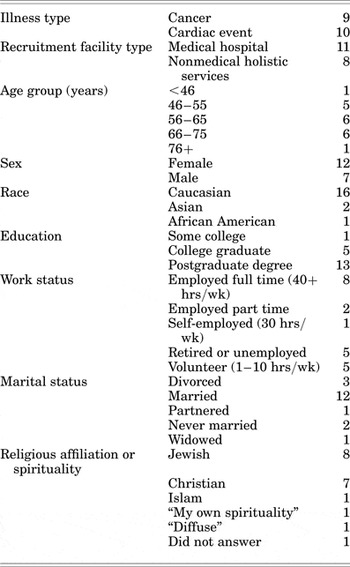
Some 19 participants (9 cancer survivors and 10 cardiac rehabilitation patients) were recruited from a medical hospital (11) and a nonmedical holistic services facility (8). Our interview excerpts are drawn from a sample that consisted of more females (n = 12) than males (n = 7). Approximately half the participants (n = 11) were employed. Almost (n = 18) had graduated from college. The participant demographic data are presented in Table 1 (Young et al., Reference Young, Nadarajah and Skeath2015).
Demographics of participants

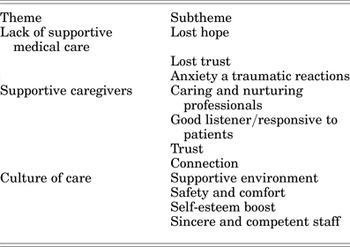
Participants indicated that they had experienced positive, life-transforming change(s) in the context of such life-threatening illnesses as cardiac events and cancer. An overall theme that was prevalent throughout the interviews was the presence of supportive medical care. It can clearly be seen from Table 2 that positive, life-transforming changes were typically associated with supportive caregivers who had helped to create a culture of care. An absence of this supportive medical care was seen as a hindrance to positive, life-transforming change.
Themes in supportive medical care and adjustment to life-threatening illness

Lack of Supportive Medical Care
When participants perceived a lack of supportive medical care, negative reactions ensued, including loss of hope and lack of trust in their caregiving team. One cancer survivor pointed out that an absence of support when needed most can be devastating:
And at the end, I went to see the guy at [major medical center], and he said to me, “That's it. I don't have anything more for you.” I just couldn't believe it. I just refuse— And he's like their expert. And I said, “You've got to be more creative.” I really mean it. He'd done standard things. And I love him—he's a great doctor. But I was stunned—again. After everything I've been through, I was stunned that he would say, “There's nothing left for you.”
When participants did not receive alternative treatment options from their caregivers, they felt they could no longer trust their caregivers to provide hope and keep their best interests in mind. One cardiac event survivor exemplified this by demonstrating the uncertainty and uneasiness associated with an absence of support from a physician:
You cannot have a positive feeling about heart disease. You just can't. I mean, it's something I live with— I've suggested other diagnostic tests to them [doctors] also after reading various statements, and then they have to do their research to find out about those tests and they say, “Well, we can have those tests done, but there isn't anything else we have in terms of your medicines.”
In these situations, participants generally felt that their doctors were not open to alternative treatments. This lack of support led to traumatic reactions and difficult choices to be made by participants. One cancer survivor was among those who had difficulty dealing with such troubling choices:
One doctor told me that I need to be prepared for the end of my life. And I really wasn't getting much support from him. I talked about it. We had talked about a transplant. He gave me three minutes to discuss it. And so I was searching. I was spinning around and searching.
Overall, participants indicated that the combination of the culture and environment around them (along with the support of their caregivers) was an important component of their life-transforming positive change. A lack of support from their medical team at times led to lack of hope. Ultimately, participants indicated that greater resilience was needed to overcome cancer or cardiac disease when the medical team and environment did not provide adequate support.
Supportive Caregivers
In many instances, the staff was nurturing and professional. Most importantly, participants were comforted to know that their caregivers would listen to them and answer any questions they might have. This responsiveness helped participants to trust their caregivers. As the level of trust grew, positive connections with caregivers provided participants with hope. One cancer survivor found this support from her attentive oncologist:
I happened to find an oncologist who was a very spiritual person herself. I didn't know that when I first met with her. … But meeting her the first time in a snowstorm on a Friday night, and having her spend three and a half hours with me and my husband answering every single question and being so articulate, I just felt like, “She's it!” She was young. She was only out of [major medical center] maybe three years—and I had my questions about that. But she just seemed so knowledgeable and so willing to do everything to support me that I said, “Okay!” So I didn't need to look any further, but she played a tremendous role.
Another cancer survivor indicated that his doctors provided hope and emotional support:
I had doctors who were rooting for me, fighting for me, and fighting the insurance companies. And it was a great blessing. I finally found the right doctors. … The doctors I found never stopped providing hope. … He [doctor] kept on saying, “We're going to get it unraveled. We're going to get [it] unraveled.” And then he made interventions, called the director of the research center. And he made it possible for my brother to fly there to freeze the marrow. He was just a caring, beautiful, clinician. … And so, finally finding the right doctors was wonderful. And I was getting great care and great emotional support.
One cardiac event survivor also found peace and spiritual support from the words of his doctor:
I mean, he is absolutely phenomenal as a diagnostician. … He called me in the hospital, and again, I'm gonna break down, but this is very, very, powerful content. He called and he said, “I'm praying for you.” So I'm going through all this and I was completely blown away because I said, “You know, this is the one doctor I respect most in this world and he's not saying anything like, ‘Don't worry, you're otherwise healthy. No diabetes. You never smoked,’ ‘No other problem[s],’ ‘This is a very routine operation,’ ‘There are hundreds of thousands of bypass surgeries that happen,’ and, ‘Don't worry, you'll get through it.’” He just said, “I'm praying for you.” That actually was extremely helpful because it gave me a lot of peace.
Overall, participants found that physicians and hospital staff were important factors in creating a culture of care. This culture of care allowed participants to find hope, peace, and support. Participants noticed that supportive medical care allowed them to access the spiritual and emotional resources needed to cope with the life-threatening illnesses they were dealing with.
Culture of Care
The supportive environment was created by a caring and accommodating staff at the facilities, which led to a more positive culture of care. One cancer survivor indicated that such a culture of care was created due to the facility being a safe and comfortable place for patients:
It's [hospice in the facility] just a wonderful place. It is such a haven. So it's really a haven for me, too. Because it's a lovely building that's almost like a house that has a lot of light and a little courtyard and trees. And the people there are really wonderful. I love some of the nurses and the practitioners there.
This culture of care provided a boost to the self-esteem of participants. According to one cardiac event survivor, the culture of care was even involved in a faster recovery from a life-threatening illness:
The staff was wonderful. I was able to gain confidence in terms of my physical abilities fairly quickly, and yet able to do that in an environment in which I was comfortable and felt that, if there's a problem, I've got some folks who are gonna take care of me. … I also appreciated the camaraderie with the other folks that were in the rehab program. I was probably on the younger end of that spectrum, but we all have the same challenges and have the same experiences or very similar experiences, so I really did appreciate that, overall. Very, very positive.
Moreover, it was clear that extra effort was expended by the staff to accommodate the wants of their patients—not just the needs that they were obligated to tend to. One cancer survivor demonstrated this by saying,
I think it is really important to be in an environment where they are very accommodating. And I was really lucky. In my hospital they have a culture of customer service. And it's really run like the most exquisite hotel or concierge service. And it's not even just the facilities— It's just the attitude of people who work there. And I'm down to the cashiers, to the orderlies, to the doctors.
Ultimately, participants noticed that a culture of care was created by the actions of the hospital staff. When supportive medical care was provided, participants felt safe and experienced a substantial increase in self-esteem. These effects in some cases led participants to perceive that the supportive medical care allowed them to recover more quickly from their life-threatening illness.
DISCUSSION
Supportive medical care emerged as an important theme, as participants indicated that caregivers were able to create a more positive culture of care. On the other hand, an absence of support from a medical care team led to increased trauma and pain. This reaction can lead people to catastrophize their pain to convey distress and elicit support (Gauthier et al., Reference Gauthier, Rodin and Zimmermann2012). If supportive medical care is offered, emotion regulation regarding pain related to life-threatening illness for patients can consequently improve.
Another benefit of greater perceived support is improved levels of optimism. Optimism is important in lowering levels of pain (Hanssen et al., Reference Hanssen, Peters and Vlaeyen2013). Hanssen and colleagues also found that interventions that enhance a patient's outlook can provide a better alternative in reducing catastrophizing of pain. These findings indicate that having a higher level of medical supportive care could help decrease pain and allow cancer survivors to better adjust to their condition.
A major part of gaining support is having the ability to trust others. Basic trust is the foundation upon which relationships are built. Trzebinski and Zieba (Reference Trzebinski and Zieba2013) indicate that the level of basic trust is related to a positive reinterpretation of new life situations and posttraumatic growth. These results suggest that basic trust enables an individual to overcome trauma using an approach that is always positively engaging with one's environment. Trzebinski and Zieba (Reference Trzebinski and Zieba2013) also found that positive reinterpretation, the lack of any dominant anxiety, and hopelessness–helplessness reactions are mediators in the relationship between basic trust and posttraumatic growth after a traumatic experience with a life-threatening illness. These findings demonstrate that supportive medical care is necessary to minimize the anxiety and helplessness present in patients who have been diagnosed with a life-threatening illness and indicate that trust and belief in the caregiving team are essential for patients to positively cope with a life-threatening illness.
Support also allows an opportunity for individuals to rely on their social network. This reliance is particularly important because individuals are able to disclose any difficulties they might be facing and to find solutions to problems. Even if solutions are not found, emotional disclosure can help an individual heal from a chronic condition. For instance, Lumley et al. (Reference Lumley, Leisen and Partridge2011) found that spoken disclosure and written disclosure decreased sensory pain in those with rheumatoid arthritis. Spoken disclosure led to faster walking speed at three months, and reduced pain, less swollen joints, and improved physician-rated disease activity at six months (Lumley et al., Reference Lumley, Leisen and Partridge2011). Similarly, Nils and Rime (Reference Nils and Rime2012) found a positive influence of spoken disclosure on emotional recovery, but they indicated that the listener must be actively involved and attentive during the disclosure.
These results suggest that only active support is capable of helping individuals to deal with the trauma of cancer or some other chronic illnesses. Lesser forms of support are ineffective and in some cases more harmful than no support at all. Moreover, these findings indicate that, if the caregiving team is not engaged and able to adequately attend to patients, it can be more detrimental to the quality of life of the patient experiencing the life-threatening illness than a total lack of supportive medical care would be. While patients may still feel uncomfortable asking their medical care team for support because it is a role outside their perceived area of expertise (Murray et al., Reference Murray, Kendall and Boyd2004), the availability of support will help patients engage additional positive coping resources to better deal with the pain associated with a life-threatening illness (MacAskill & Petch, Reference MacAskill and Petch1999).
While this pilot study identified important components in the treatment of cancer patients or of those who have experienced cardiac events, certain limitations must be noted. The sample was not as representative of the general population in terms of race and education. Our sample was more highly educated than the general population and had more Caucasians. Another limitation was that the Distress Thermometer cutoff was set at three points for extreme caution. If individuals who were exhibiting moderate to severe distress were included, interpretations of medical care might have been different. Most importantly, supportive medical care could be operationalized in the future for quantitative results.
CLINICAL IMPLICATIONS
Understanding the components of medical support allows us to create a palliative and supportive care plan for each individual patient with a life-threatening illness. The plan may include support groups, yoga, meditation, nature, music, prayer, and pet therapy, or referral to spiritual and at times religious counselors. Connecting to the patient and gaining a clearer idea of the level of support needed by them is essential to improving the quality of life of those facing a life-threatening illness.
As healthcare providers, it is important to understand that time is so very important to patients with a life-threatening illness. This understanding can help providers to improve their relationships with patients and provide the support that each individual patient needs. When patients are forced to redefine the goals of care at pivotal junctures, it is important that we, as healthcare providers, offer support to patients by being present and by not crushing their hopes by saying something like there is nothing more we can do for them.
Presence is the greatest gift we can offer patients. Presence is an interpersonal process that is sensitive, holistic, and intimate. Patients demonstrate a need for it and an openness to it. It is purposeful, interactive, shared, and available. It is centered on the patient—here and now. As healthcare providers, we need to suspend our own agendas and be with the patient—listening, touching, connecting, and sharing our expertise. Supportive medical care is certainly critical for attaining positive life-transforming change when one is experiencing a life-threatening illness.
ACKNOWLEDGMENTS
This work was funded by intramural research training awards to William C. Young, Sheeba Nadarajah, and Perry R. Skeath. The authors would like to thank the staff at Suburban Hospital and Smith Farm Center for Healing and the Arts for their assistance.