For babies with complex CHD, achieving adequate growth and nutrition can be a challenge. Previous studies have found that up to one in two neonates are not able to completely feed orally after cardiac surgery and are discharged home with a feeding tube.Reference Einarson and Arthur 1 – Reference Medoff-Cooper and Irving 4 Feeding difficulties in this population are often multifactorial, with preoperative, intraoperative, and postoperative factors potentially influencing a neonate’s ability to feed orally.
Preoperative factors associated with feeding difficulties include the presence of a genetic syndrome, as well as the type and complexity of the cardiac lesion.Reference Sables-Baus, Kaufman, Cook and da Cruz 2 , Reference Steltzer, Rudd and Pick 5 – Reference Jadcherla, Vijayapal and Leuthner 7 Haemodynamically significant cardiac lesions can lead to tachypnoea and fatigue, as well as increased metabolic demand, making it difficult for a neonate to consume adequate nutrition orally.Reference Steltzer, Rudd and Pick 5 Neonates with cyanotic lesions, for example, have been shown to take longer to achieve full oral feeds than those with acyanotic lesions.Reference Davis, Davis and Cotman 6 , Reference Jadcherla, Vijayapal and Leuthner 7 Intraoperative factors such as injury to the recurrent laryngeal nerve and the resulting vocal cord palsy are associated with feeding difficulties,Reference Einarson and Arthur 1 as are duration of aortic cross-clamp and duration of circulatory arrest, both surrogates for operative complexity.Reference Sables-Baus, Kaufman, Cook and da Cruz 2 The need for complex neonatal cardiac surgery is associated with neurodevelopmental impairment in up to 20% of patients, which can subsequently impact on feeding.Reference Gaynor 8 Postoperatively, longer duration of intubation and hospital stay have been identified as potential predictors of feeding difficulties;Reference Einarson and Arthur 1 – Reference Kogon, Ramaswamy and Todd 3 however, these variables may also reflect operative complexity and co-existing pathologies. Infant weight at surgery and discharge are also associated with feeding difficulties.Reference Einarson and Arthur 1 , Reference Sables-Baus, Kaufman, Cook and da Cruz 2 Limited studies have examined the association of feeding difficulties with these and other preoperative, intraoperative, and postoperative factors in neonates who have undergone cardiac surgery. The potential roles of factors such as socio-economic status, age at surgery, prematurity, preoperative intubation, and feeding modality, for example, are unclear.
Neonates who have feeding difficulties place a significant burden on the health-care system, as they often require longer hospital admissions as well as ongoing multidisciplinary management.Reference Sables-Baus, Kaufman, Cook and da Cruz 2 Maurer et alReference Maurer, Latal, Geissmann, Knirsch, Bauersfeld and Balmer 9 reported that 22% of infants who had undergone neonatal heart surgery required tube feeds and manifested developmentally inappropriate feeding behaviour or failure to thrive at 2 years of age. Hill et alReference Hill, Silverman and Noel 10 found that 50% of children aged between 2 and 6 years with single-ventricle CHD demonstrated some form of feeding dysfunction. It is unknown what proportion of these reported outcomes might be prevented by improved early management; however, early identification of infants at risk of feeding difficulties allows timely implementation of services and supports and is likely to reduce longer-term feeding difficulties.
Thus, the aim of the present study was to examine the prevalence and potential correlates of feeding difficulties in neonates who have undergone cardiac surgery in a major, quaternary paediatric cardiac centre. We also examined resource utilisation by neonates with feeding difficulties following cardiac surgery in order to gauge the burden placed on the health-care system by this group of infants.
Materials and methods
Participants
All living neonates (<28 days old) who underwent their first cardiac surgery between January and December, 2009 at the Heart Centre for Children, The Children’s Hospital at Westmead, were included in the present study. Cardiac surgery was defined as involving a significant change in the anatomical structure of the heart, thereby excluding procedures related solely to rhythm abnormalities and catheter-based procedures. A review of the cardiovascular surgical database identified 79 eligible neonates.
Study design and measures
A retrospective cohort study was undertaken using data collected through review of electronic medical records, with approvals from the Human Research Ethics Committees of the Sydney Children’s Hospitals Network (Randwick and Westmead) and The University of Sydney. This included scanned images of inpatient records as well as specialist correspondence. Infants were retrospectively followed-up on average from birth to 3 years of age, with data collected on a range of demographic, preoperative, intraoperative, and postoperative variables. The primary outcome variable was feeding difficulty, defined as discharge home or to another hospital with a feeding tube.
Demographics
Sex and country of birth were recorded. To assess socio-economic status, postcodes of family residential location were ranked from 1 to 10 on the basis of a postal area index for socio-economic disadvantage defined by the Australian Bureau of Statistics in the 2006 Census, where a score of 1 indicates the greatest disadvantage. 11
Preoperative variables
Birth weight, gestational age, presence of a genetic syndrome, type of cardiac lesion(s), and duration of intubation before surgery were recorded. Diagnoses unrelated to cardiac function or genetic syndromes with the potential to impact feeding were also recorded. Infants were classified on the basis of whether or not they required assisted feeding preoperatively, defined by the need for tube feeds or total parenteral nutrition to supplement or replace oral nutrition before surgery.
Intraoperative variables
Age and weight at surgery as well as durations of aortic cross-clamp, cardiopulmonary bypass, and circulatory arrest were recorded. Surgical procedures were categorised for each neonate into the following: single-ventricular procedures, palliative procedures ahead of biventricular repair, and biventricular repair. This categorisation was performed under the guidance of a cardiothoracic surgeon (D.W.), and the term “palliative” was used to refer to any surgical procedure that was a temporising or bridging procedure before biventricular repair. For neonates with multiple cardiac lesions and for whom multiple surgical procedures were needed, categorisation was based on the surgical procedure for the main cardiac lesion. Procedures considered to have a risk of injury to the recurrent laryngeal nerve were those involving coarctation repair, aortic arch repair, or ligation of a patent ductus arteriosus.
Postoperative variables
Durations of intubation, feeding-tube use, ICU admission, and hospital admission were recorded. Oxygen saturation at discharge was also recorded. Postoperative complications including the use of extra corporeal membrane oxygenation, diagnosis of vocal cord palsy, and whether a modified barium swallow was performed were recorded.
Resource use
Data were collected from records available at The Children’s Hospital at Westmead; further follow-up was beyond the scope of this study, and thus only infants living in Sydney were included in this sub-analysis. Resource utilisation included inpatient and/or outpatient review by a speech pathologist, dietician, or cardiac clinical nurse consultant, as well as telephone or email contact. The review was only counted if the primary issue of concern was related to feeding.
Statistical analysis
Data were analysed using IBM SPSS Statistics version 20.0 (IBM Corporation, United States of America). Initially, data were summarised as frequencies and percentages for categorical variables and as means, medians, standard deviations, and interquartile ranges (IQR) for continuous variables. Characteristics relating to neonates with feeding difficulty were compared with those without feeding difficulty using Pearson’s χ2 tests, t-tests, or Fisher’s exact tests, as appropriate. Non-normally distributed data were log transformed and analysed using t-tests. The significance level for all tests was set at 0.05.
Predictor variables with p⩽0.05 in the bivariate analyses, as well as variables previously shown to be associated with the primary outcome, were included in the logistic regression analysis to identify independent correlates for neonatal feeding difficulty.Reference Hosmer 12 A progressive, backward elimination modelling strategy was used. Co-morbidities unrelated to cardiac function or genetic syndromes that may influence feeding were included in the regression model as a potential confounder. When the preliminary final regression model had been built, the potential confounder was removed. If its removal resulted in a >10% change in the coefficient of any predictor, the variable was considered a confounder and retained in the final model.Reference Kleinbaum and Muller 13
Results
A total of 79 neonates with CHD underwent cardiac surgery at the Heart Centre for Children in 2009. Among infants for whom the duration of tube feeds was known (n=72), the median duration of tube feeds was 8 days (IQR=3–18 days), with one infant requiring tube feeding for 349 days. Of the 79 neonates, 24 (30%) were discharged home or transferred to another hospital with a feeding tube, and 11 of the 12 infants (92%) who were transferred had a feeding tube in place. During the follow-up period, two of the 79 infants (3%) received a gastrostomy.
Infant characteristics and medical management
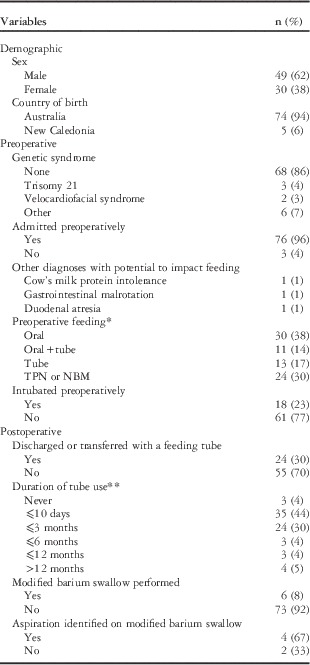
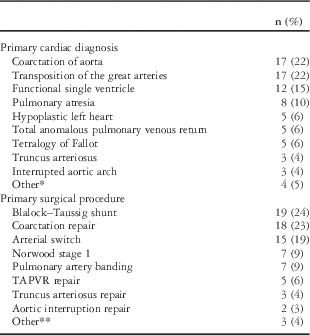
Characteristics of the entire neonatal group are shown in Table 1. Frequencies of primary cardiac diagnoses as well as primary surgical procedures are summarised in Table 2. The mean gestational age was 39 weeks (SD=1.7 weeks). Nineteen neonates (24%) underwent single-ventricle procedures, 24 (30%) had palliative procedures ahead of biventricular repair, and 36 (46%) underwent biventricular repair. The mean age at the time of first cardiac surgery was 9 days (SD=7.0 days, range: 1–26 days), and the mean weight at surgery was 3.18 kg (SD=0.6 kg). Among all, six infants (8%) were diagnosed with vocal cord paralysis or palsy postoperatively, of whom five infants (83%) underwent a surgical procedure with risk of injury to the recurrent laryngeal nerve. Other postoperative complications included re-intubation (n=8), re-admission to the ICU (n=4), multiple neonatal surgeries (n=5), extra corporeal membrane oxygenation (n=1), sepsis (n=3), wound dehiscence (n=3), and renal impairment (n=4).
Clinical characteristics of the sample (n=79).

TPN=total parenteral nutrition; NBM=nil by mouth
Other genetic syndromes: chromosomal microdeletion syndrome, Kabuki syndrome, 19q12 deletion, Mowat–Wilson syndrome
* Data missing for one patient
** Data missing for seven patients
Cardiac diagnoses and surgical procedures (n=79).

TAPVR=total anomalous pulmonary venous return
* Ventricular septal defect, atrioventricular septal defect, aberrant origin of the right pulmonary artery, pulmonary artery sling
** Atrioventricular septal defect repair, aortic arch repair, pulmonary artery sling correction
Correlates of neonatal feeding difficulties
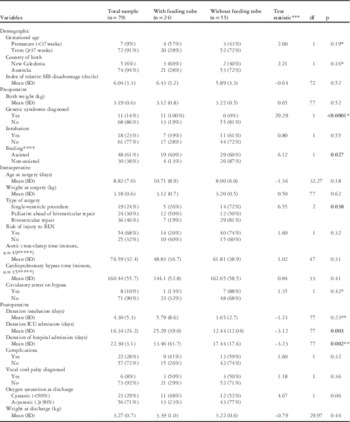
Demographic and clinical variables associated with neonatal feeding difficulties at the bivariate level are shown in Table 3. All 11 infants with a genetic syndrome were discharged with a feeding tube, compared with 19% of infants without a genetic syndrome. Among them, eight neonates (73%) underwent palliative procedures ahead of biventricular repair (p=0.004). A greater proportion of infants who required assisted feeding preoperatively were discharged with a feeding tube (40%), compared with those who did not require preoperative feeding assistance (13%, p=0.03). Half of the infants who underwent a palliative procedure ahead of biventricular repair were discharged with a feeding tube, compared with 26% of those who underwent single-ventricle repair and 19% of those who underwent biventricular repair (p=0.03). Postoperatively, infants with feeding difficulties spent a greater number of days in the ICU and had a greater total length of hospital admission.
Comparison of demographic and clinical characteristics of patients discharged with or without a feeding tube.

SES=socio-economic status; RLN=recurrent laryngeal nerve
Values are numbers (percentages) unless stated otherwise
p values in bold typeface are significant at 0.05 level
* Fisher’s exact test
** Based on log10-transformed data
*** χ2 for categorical variables and t-value for continuous variables
**** Data missing for one patient
***** Only patients who had aortic cross-clamp or cardiopulmonary bypass included
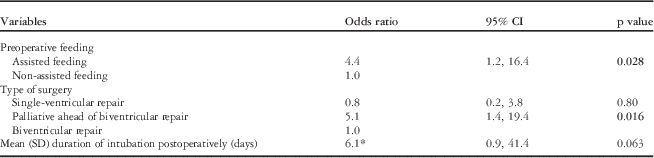
Table 4 shows the logistic regression model for the presence of feeding difficulties in neonates with complex CHD. Initially, eight variables were entered into the model: preoperative feeding, type of cardiac surgery, and duration of postoperative ICU admission, identified at the bivariate analysis level, and aortic cross-clamp time, duration of postoperative intubation, oxygen saturation at discharge, vocal cord palsy, and weight at surgery – the previously identified correlates of feeding difficulty.Reference Einarson and Arthur 1 , Reference Sables-Baus, Kaufman, Cook and da Cruz 2 Presence of a genetic syndrome was not included, as all infants with a genetic syndrome were discharged with a feeding tube, creating model instability. To avoid multicollinearity between length of ICU admission and total duration of hospital stay, the latter variable was also omitted. In the final model, infants who required assisted feeding preoperatively were four times more likely to be discharged with a feeding tube (p=0.03), compared with those who did not require preoperative assistance. Having palliative surgery ahead of biventricular repair increased the odds of being discharged with a feeding tube by five times (p=0.02). The association between feeding difficulty and duration of postoperative intubation did not reach statistical significance.
Logistic regression results for variables associated with feeding difficulties in neonates with complex CHD.

CI=confidence interval
p values in bold typeface are significant at 0.05 level
* Based on log10-transformed data
Post-hoc analyses showed that 84% of neonates who underwent single-ventricular procedures (16/19) and 71% of neonates who had palliative procedures ahead of biventricular repair (17/24) required preoperative feeding assistance compared with only 43% of neonates who underwent biventricular procedures (15/35, p=0.006). Neonates who required preoperative feeding assistance had a mean postoperative admission of 27 days (SD=34.3) compared with 14 days (SD=9.3) for those who did not require preoperative feeding assistance (p=0.02).
Health resource utilisation
Resource utilisation by infants with and without feeding difficulties during their 1st year of life is shown in Table 5. Of those living in Sydney and alive at 1 year of age (n=39), infants with feeding difficulties had more reviews by speech pathologists (p=0.03), dieticians (p=0.009), and cardiac clinical nurse consultants (p=0.04). Only three infants (4%) attended the multidisciplinary feeding clinic at the Children’s Hospital at Westmead, all of whom had been discharged with a feeding tube. The mean number of presentations to the Emergency Department at The Children’s Hospital at Westmead for feeding-tube replacement was 2.89 (SD=6.0, range: 0–18).
Reviews for feeding issues as an inpatient and outpatient, up to 12 months after surgery (n=39).

CNC=clinical nurse consultant
p values in bold typeface are significant at 0.05 level
Values are means (SD)
* Based on log10-transformed data
Discussion
Feeding difficulties in neonates following cardiac surgery are common and can lead to poor growth and nutrition, affecting recovery and mortality in the short term and psychosocial and neurological development in the longer term.Reference Medoff-Cooper and Ravishankar 14 , Reference Eskedal, Hagemo and Seem 15 Early identification of factors that contribute to feeding difficulties in babies with heart disease is thus of high clinical importance. In the present study, preoperative feeding assistance, palliative surgery ahead of biventricular repair, and the presence of a genetic syndrome were all associated with infant discharge with a feeding tube. Infants with feeding difficulties also utilised more services – for example, speech pathology and dietetics – and required more feeding-related reviews by cardiac clinical nurse consultants.
The association between feeding difficulty and presence of a genetic syndrome is likely to be multifactorial, with anatomical as well as physiological and behavioural factors playing a role. The two main genetic syndromes identified in this study were Down syndrome and Velocardiofacial syndrome, both with known associations with feeding difficulty.Reference Cooper-Brown, Copeland and Dailey 16 All three infants reviewed in the Multidisciplinary Feeding Clinic had genetic syndromes; however, this represented only 27% of infants with a genetic syndrome in the present study, highlighting potential underutilisation of, or difficulty accessing, this resource.
Infants with feeding difficulties were also more likely to have received nasogastric tube feeding, either alone or in combination with oral feeding before surgery. Full oral feeds preoperatively may help the neonate develop the oromotor skills required postoperatively for successful initiation of oral feeds. Pickler et alReference Pickler, Best and Crosson 17 found that preterm neonates with more oral feeding experience before surgery made a faster transition to full oral feeds, irrespective of illness severity. Alternatively, those well enough to feed orally before surgery may have had less complex lesions, and therefore a smoother postoperative course. Post-hoc analysis showed that neonates who had single-ventricle CHD or heart defects requiring palliative surgery ahead of biventricular repair were more likely to require preoperative feeding assistance (χ2=10.2, p=0.006). Haemodynamic stability and presence of a prostaglandin-dependent ductal lesion are important determinants of preoperative oral feeding in the neonate. There is still some controversy as to whether enteral feeding is safe in neonates on prostaglandins, with the main reason for withholding enteral feeds being a fear of gastrointestinal hypoperfusion and the development of necrotising enterocolitis.Reference Howley, Kaufman and Wymore 18 The current practice at The Children’s Hospital at Westmead is for neonates to have nothing by mouth while receiving prostaglandins. Recently, however, several small studies have demonstrated the safety of enteral feeding in neonates receiving prostaglandins.Reference Natarajan, Reddy Anne and Aggarwal 19 , Reference Willis, Thureen, Kaufman, Wymore, Skillman and da Cruz 20 Slicker et alReference Slicker, Hehir and Horsley 21 described a feeding algorithm for patients with hypoplastic left heart in which early initiation and advancement of total parenteral nutrition preoperatively was implemented to prevent malnutrition. Preoperative enteral feeding in haemodynamically stable patients appropriately monitored for potential gastrointestinal complications was also recommended. Further research is required to determine whether increasing oral feeds before cardiac surgery results in decreased duration of tube feeding postoperatively.
Neonates who underwent palliative procedures ahead of biventricular repair had a five times greater risk of feeding difficulties compared with those who underwent single-ventricle or biventricular repair procedures. The magnitude of this association was unexpected. Post-hoc analysis comparing the mean duration of hospital admission of neonates who underwent single-ventricle procedures with those who underwent palliation ahead of biventricular repair found no difference in length of admission (p=0.13); however, when neonates with genetic syndromes were removed from the sample, there was no longer a significant association between surgery type and discharge with a feeding tube (χ2=0.9, p=0.64). Thus, the most likely explanation is that palliative procedures ahead of biventricular repair were associated with feeding difficulties due to the greater likelihood of a genetic syndrome in these infants.
Several factors previously found to be associated with feeding difficulties in neonates after cardiac surgery were not supported by the present results. These included weight at surgery, weight at discharge, duration of aortic cross-clamp, duration of circulatory arrest, duration of intubation, and vocal cord palsy.Reference Einarson and Arthur 1 – Reference Kogon, Ramaswamy and Todd 3 Several reasons may account for these discrepancies. Most studies, including the present study, have reported on small samples recruited retrospectively from single centres, limiting the generalisability of results and highlighting the need for greater collaboration across centres. Measurement of feeding difficulties varies across studies, with some studies using time to maximum oral feeds as the primary outcome, making comparisons between studies difficult. Similarly, the management and investigation of postoperative complications, such as vocal cord palsy, may vary resulting in discrepancies when comparing results.
Increasingly, research is focussed on the development and implementation of feeding protocols for infants with CHD. Much of this research has been aimed at infants with complex single-ventricle CHD, because of the increased risk of poor feeding and growth in this population, with results demonstrating an improvement in nutrition.Reference Kaufman, Vichayavilas and Rannie 22 Increased home monitoring of weight and volume of enteral intake, allowing for earlier intervention if feeding is inadequate, has also been shown to be beneficial for inter-stage growth in infants with univentricular pathology.Reference Hehir, Rudd and Slicker 23 Obtaining standardised feeding guidelines for infants with univentricular pathology, as well as research into the application of these guidelines in other CHD groups, is an important next step.
There is also some evidence to suggest that gastrostomies in infants with hypoplastic left heart can improve both hospital survival and survival to stage 2 palliation.Reference Srinivasan, Sachdeva and Morrow 24 , Reference Garcia, Jaquiss, Imamura, Swearingen, Dassinger and Sachdeva 25 Interestingly, in our study, the rates of gastrostomy were considerably low; only two infants (3%) underwent the procedure. The low gastrostomy rate may demonstrate reluctance on the part of parents and/or the treating team for the infant to undergo a further procedure to address what many hope will be a short-term problem. There is mixed evidence regarding the effectiveness of gastrostomy placement; some studies suggest worse outcomes in those with a gastrostomy, but this may be because of significant co-morbidities in these infants.Reference Hebson, Oster, Kirshbom, Clabby, Wulkan and Simsic 26 , Reference Uzark, Wang and Rudd 27 Studies have shown that despite initial reluctance, parental satisfaction with gastrostomy feeding is good.Reference Hofner, Behrens, Koch, Singer and Hofbeck 28 , Reference Srinivasan, O’Neill, Blumenow and Dalzell 29 Srinivasan et alReference Srinivasan, O’Neill, Blumenow and Dalzell 29 found that 97% of parents were highly satisfied with the gastrostomy, experiencing feeding as easier and less time consuming, and noticing an improvement in their child’s well-being. On the basis of the current evidence, earlier gastrostomy placement in infants at higher risk of feeding difficulties should be considered. This would include infants who required preoperative feeding assistance as well as those with genetic syndromes, as demonstrated by the results of this study.
In terms of resource use, as expected, neonates discharged with a feeding tube required greater input from feeding-related services such as speech pathology and dietetics, and presented on average almost three times to the Emergency Department for tube replacement in the follow-up period. This is not only costly to the hospital, but also burdensome and stressful for families. These results most likely underestimate the burden these infants place on the health-care system, as data were collected from The Children’s Hospital at Westmead only, missing potential follow-up with local health-care services. Prevention of feeding difficulties is likely to reduce the consumption of these limited resources, which would be beneficial not only to the individual institution but also to the health-care system as a whole.
This study also found that only 13% of neonates with feeding difficulties had attended the Multidisciplinary Feeding Clinic at The Children’s Hospital at Westmead, suggesting that this specialist resource, which offers consultation with an expert paediatrician, speech pathologist, dietician, and nurse in a single appointment, may be underutilised or difficult for families to access. This model has specific benefits for the infant, his or her parents, and the health system as it is time efficient, facilitates enhanced communication between members of the health-care team, and draws on the unique skills and expertise of multiple health-care professionals. An extensive clinic waiting list (mean wait time: 3–4 months) may have impacted access to this resource in this study. For patients with feeding difficulties, delays in access to the Multidisciplinary Feeding Clinic can lead to loss in somatic growth, as well as potential delays in achieving developmental milestones. Evidence suggests that interdisciplinary care can improve nutrition in infants with CHD.Reference Benzecry, Leite, Oliveira, Santana, de Carvalho and Silva 30
A resource not examined in this study was psychological care. It is well established that parents of infants with complex CHD experience significant psychological stress.Reference Kasparian, Winlaw and Sholler 31 – Reference Kasparian, Fidock and Sholler 34 Coming to terms with their baby’s diagnosis, witnessing their baby’s experience of painful and intrusive medical interventions, coping with lengthy hospital admissions, and grappling with fears and concerns about their child’s future health is profoundly challenging for parents.Reference Kasparian, Winlaw and Sholler 31 Parents of children with CHD have been found to have higher levels of stress when compared with Australian norms.Reference Blue, Kasparian, Sholler, Kirk and Winlaw 33 Feeding difficulties intensify the anxieties experienced by parents, particularly mothers, who often find their infant’s transition to home with a feeding tube highly stressful.Reference Svavarsdottir and McCubbin 32 Recently, Tregay et alReference Tregay, Brown, Crowe, Bull, Knowles and Wray 35 found that feeding-related concerns following discharge after cardiac surgery dominated parent interviews, sometimes above any ongoing cardiac concerns. Once discharged, parents often feel the loss of nursing staff support, and may find using their baby’s feeding tube challenging, despite pre-discharge education.Reference Hartman and Medoff-Cooper 36 Infants with complex CHD, particularly those with feeding tubes, tend not to show obvious verbal or non-verbal cues to signal hunger or satiety, making it even more difficult for parents to know when and how much to feed.Reference Hartman and Medoff-Cooper 36 Parents also report pervasive concerns about their baby’s weight gain.Reference Hartman and Medoff-Cooper 36 Thus, there are many reasons why timely, specialist psychological care could improve the emotional well-being of parents, with benefits for both the infant and the family as a whole.
Finally, it is acknowledged that defining the primary outcome as discharge or transfer with a feeding tube is clinically relevant and has been used in previous studies;Reference Einarson and Arthur 1 , Reference Sables-Baus, Kaufman, Cook and da Cruz 2 , Reference Davis, Davis and Cotman 6 however, it may not have captured all neonates with feeding difficulties. In turn, discharge with a feeding tube should not necessarily be regarded as a negative outcome as it does enable earlier discharge for some infants.
Conclusion
Feeding difficulties are an important challenge for a subset of neonates who undergo heart surgery. In this study, presence of a genetic syndrome and preoperative feeding assistance were identified as key determinants of feeding difficulty. An area of future research that has the potential to decrease feeding difficulties is the examination of measures that increase oral feeding opportunities before surgery. Development and implementation of standardised protocols and management pathways for neonatal feeding difficulties after heart surgery also have the potential to benefit the infant, his or her family, and the health-care system.
Acknowledgements
The authors thank Stephanie Newton and Karen Leclair for their input into the study design. The authors would also thank Janelle Bowden for her statistical advice and Dr Kathy Wu for her advice regarding genetic syndromes.
Financial Support
This research received no specific grant from any funding agency or from commercial or not-for-profit sectors. Nadine Kasparian is the recipient of a Career Development Fellowship from the National Health and Medical Research Council of Australia (NHMRC 1049238).
Conflicts of Interest
None.
Ethical Standards
The authors assert that all procedures contributing to this work comply with the ethical standards of the relevant national guidelines, with approvals from the Human Research Ethics Committees of The Sydney Children’s Hospitals Network (Randwick and Westmead) and The University of Sydney.