In August 1849, outspoken proslavery Missouri Supreme Court Judge James H. Birch sued Unionist Senator Thomas Hart Benton of Missouri for slander because he had publicly accused Birch of having kept “his own negro wench” and whipped his wife because she had dared to complain about it. On first impression, the lurid accusation and resulting lawsuit might seem merely colorful window dressing for the virulent sectional politics of the late antebellum period. Benton's objectionable utterances certainly exemplify the verbal pyrotechnics that, after the Mexican War, often accompanied public debate over the question of whether African-American bondage was to extend across the continental United States. But the vituperation that gave rise to Birch v. Benton, in fact, marked the beginning of one of the most widely-publicized episodes in the struggle pitting the champion of Jacksonian democracy in the trans-Mississippi Southwest against a powerful cadre of proslavery leaders who sought to end his thirty-year career in the United States Senate.Footnote 1 According to legal historian Gerald T. Dunne, the politicized nature of the case and its contentious appeal to the Missouri Supreme Court provided the critical catalyst for lawmakers in the state to amend its constitution in 1850 to replace lifetime tenure for judges with periodic voter choice. The landmark constitutional revision both instituted popular election of judges and shook up the composition of the proslavery high court, including the removal of Judge Birch.Footnote 2
Beyond the institutional alterations and political fallout resulting from Birch v. Benton, the case implicates numerous issues of considerable importance to constitutional scholars and historians interested in the legal and political culture of the United States before the Civil War. Benton's slander of Judge Birch encroached on the centuries-old common law right to individual reputation to which the law afforded even political leaders and their household dependents. Given the political impulses that spawned Birch's slander action, and the gendered and racist charges that Benton employed, the whole affair invites some sober reflection about the relationship between public vilification of elected officials, the rise of competitive two-party politics, and the implications of these developments for constitutionally protected freedom of political expression in the antebellum United States. By the same token, close study of the legendary cause célèbre discloses what ordinary people, newspaper editors, and elected officials deemed to be the proper role for political invective and the appropriate limitations on defamation actions in a boisterous white man's democracy deeply conflicted over the question of African-American bondage.
Combining the gamut of approaches typically employed for the study of free political expression in United States history, this article is organized around the holistic presupposition that gauging fully the historical significance of a case such as Birch v. Benton requires close examination of relevant legal doctrines, the work of courts, and the sociocultural context in which the case arose, including popular understandings of law and emerging democratic politics. As will be shown, Thomas Hart Benton decried his proslavery opponent with all the considerable oratorical tools at his command: exploiting local rumors that the judge had engaged in an adulterous relationship with his slave woman Hannah and assaulted his wife Sarah Halstead Birch because she had expressed to neighbors her outrage over the situation. The strategies that Benton and Birch utilized in the lawsuit drew on tactics ordinary residents employed in slander litigation that was part and parcel of the gossip-driven “small politics” of individual reputation mediating social relations in rural neighborhoods, villages, and small towns. Benton complicated the action by further insulting his opponent in the legal proceedings themselves and with libelous publications in the columns of party-driven newspapers. Missouri's organic and judge-made law of libel was extraordinarily libertarian. But Benton primarily took advantage of a popular tradition of free speech (denoting hereafter speech and press liberties) prevailing in the trans-Mississippi Southwest, which powerfully suppressed political libel actions, while virtually banning political slander suits altogether. To the extent that this tradition both produced Birch v. Benton and shaped its outcome, the case highlights the limited practical role of courts and defamation law in the shaping of antebellum Missouri's democratic politics and public sphere of political disputation. The ordinary slander action that Birch brought against Benton, furthermore, provided elected officials no more protection from vicious public discussion of their private lives than it did common people. Benton's machinations demonstrated on a grand scale the folly of a political defamation action in the burgeoning democracy. The refusal of the Missouri Supreme Court to uphold a trial court judgment in favor of Birch, ostensibly on doctrinal grounds, bolstered the high wall that citizens, newspaper editors, and elected officials had informally maintained for decades between political insult and defamation actions. To this extent, the decision sustained the freedom of office holders and ordinary residents to retaliate against public disparagements and engage in open and robust political debate.
Birch v. Benton also demonstrates that popular traditions of free speech and informal regulation of contention in the public sphere of antebellum Missouri had a number of unanticipated and often less than savory consequences. The unbounded free political expression that gave rise to the case and shaped its proceedings spurred an unprecedented amount of partisan verbal abuse. The tactics that Benton employed reveal the dynamics of a political culture in which freedom of speech could easily degenerate into sexist and racist demagoguery, character assassination, the persecution of scapegoats, and the rhetorical immolation of innocent political noncombatants. Benton's sexual slander of Birch and his distinctive response to the slur demonstrate that politicians could transform modes of verbal and legal conflict ordinarily attributed to women in that era into political combat at that time engaged in only by men, while simultaneously blurring the distinction between public and private spheres. Common law proscriptions of sedition and seditious libel adopted legislatively in 1837 institutionalized the consensus among white men that the publication of abolitionist sentiments transgressed legal bounds. But their commitments both to slavery and democratic republican ideals that constrained the use of government power to suppress contentious publications prompted white male partisans to suppress abolitionist proclamations with physical force. The popular free speech tradition that predominated in antebellum Missouri magnified the politically polarizing impact of a new and powerful print culture fraught with divisive reportage about slavery. Gross abuses of speech and press liberties, informal suppression of disfavored political oratory, and anti-press vigilantism that targeted abolitionist newspapers degraded political discourse and generated in western Missouri and the Territory of Kansas some of the most notorious violence over the question of slavery in the six years preceding secession. In so regulating the public sphere, militant white men displayed to the nation their power to define themselves as “the people” and established the actual limits of political free expression.
I. Slander as a Free Speech Problem in Antebellum Missouri
The work of legal historian Andrew J. King reveals the constitutional and political dilemmas that a slander action such as that brought by Judge Birch entailed in the early nineteenth-century United States. Examining the appellate decisions of judges eager to Americanize the received English common law of slander, King explores the clash of slander law protections of individual reputation with the democratic imperatives of free speech from the American Revolution through about 1830. He argues that lawmakers, judges, and treatise writers in the period refashioned the common law of slander to make it fit for capitalism and liberal democracy. United States judges initially formulated a law of slander that viewed reputation as the property of rights-bearing individuals, while abandoning colonial-era conceptions of the slander action concerned primarily with maintaining community morals, preserving the public peace, and punishing social deviance. King argues further, however, that judges increasingly insisted on procedural orthodoxy and technical precision in pleadings after about 1820. Committed to a positivist “rule of law approach” that “demanded of legal rules certainty and predictability,” they adopted these strictures to deter slander litigation and its “seemingly petty grievances.” In King's estimation, judges refashioning the law of slander conceptualized a public–private division of social relations to deal with the dilemma posed by the conflicting demands of individual reputation and unfettered democratic speech. In doing so, they determined to protect the private lives of leading men while permitting free reign to discussion of their public activity.Footnote 3
Traditional scholarship dealing with political defamation in United States history provides valuable insights into an antebellum political slander case by exploring, as does King, the decisions of judges eager to construct a distinctively American law of libel. This body of largely court-centered studies has concentrated on seditious and criminal libel and the enlightened legal thinkers and judges who developed First Amendment principles. Key developments typically include the 1735 New York seditious libel prosecution of John Peter Zenger, the libertarian ferment ushered in by the infamous 1798 Sedition Act, the opinions of United States Supreme Court Justice Oliver Wendell Holmes, Jr., dealing with several Red Scare prosecutions under the Espionage Act of 1917, and free speech victories in the Supreme Court in the 1930s built on the “clear and present danger test” articulated in those opinions. Rounding out the narrative are a handful of Warren Court decisions, including the 1964 press libel decision New York Times v. Sullivan.Footnote 4 In this tradition, defamation and political free speech issues that arose in state courts between the Federalist Era and First Red Scare have drawn relatively little attention. After all, only in 1925 did the United States Supreme Court hold that First Amendment protections applied to state action through the Due Process Clause of the Fourteenth Amendment.Footnote 5
In the last twenty years or thereabouts, a new generation of scholars has employed more critical and culturally contextualized approaches quite useful in gauging the significance of a slander case involving the interplay of popular politics, a highly politicized press, and sectionalism in the antebellum United States. Legal historian Norman L. Rosenberg illuminates how important judges, editors, and legal thinkers struggled through the first half of the nineteenth century to define the relationship between persistent “neo-Blackstonian” libel law and more libertarian free press principles in the emerging democracy. Much like King, Rosenberg argues that judges bent on Americanizing the law of libel recognized the need to expand the range of permissible political disputation while protecting only the private lives of “the best men.” Rosenberg argues that jurists such as abolitionist United States Senator William H. Seward of New York promoted an enlarged “public sphere” of rational debate quite similar to that which social theorist Jürgen Habermas attributes to the development of eighteenth-century Western Europe. Libertarian thinkers maintained that, with a liberalized law of defamation, a free marketplace of ideas and robust print culture would engender a homogenization of national opinion. To this extent, free speech advocates idealized the young United States much as did leaders in the many “imagined communities” of nationality emerging in the nineteenth century described by Benedict Anderson.Footnote 6 Legal historians such as Michael K. Curtis, Mark A. Graber, and David M. Rabban have identified “popular free speech traditions” that flourished apart from the rulings of courts. These scholars demonstrate that ordinary citizens, reform groups, and oppressed minorities often contended militantly through the nineteenth century to shape potent common understandings of political free speech, a collective claim to which Curtis refers under a rubric that Harrison Otis Gray of Massachusetts, during the 1798 Sedition Act debate, termed: “the people's darling privilege.”Footnote 7
On the other hand, numerous scholars have identified customary practices in the antebellum United States not at all conducive to the expansion of free political expression. Historians John Nerone and Richard B. Kielbowicz have exposed popular traditions that engendered virulent anti-press violence to suppress the publications of abolitionists and other dissident groups. Kielbowicz demonstrates how community leaders often organized anti-press mob actions with public deliberations that relied on common-law doctrine and proceedings. Invoking the thesis of legal historian William J. Novak, Kielbowicz maintains that these vigilantes drew on a centuries-old tradition of common law governance that privileged the collective rights of the people over individual liberties to promote “the public good.” According to Nerone, anti-press vigilantism was an integral regulating mechanism of the middle-class public sphere from the American Revolution through at least the first half of the nineteenth century. Such violence, Nerone argues, stemmed fundamentally from competition among partisans to define the sovereign will of the people in the new republican order.Footnote 8 Historian Edward Ayers and literary historian Trish Loughran, furthermore, have identified the ways unrestrained political contention among imagined communities of partisans in the public sphere of antebellum print culture powerfully exacerbated political antagonisms and further produced division, dissent, and violence over the question of slavery.Footnote 9
This study combines court-centered approaches and those that concentrate on sociocultural contexts to illuminate more thoroughly the dynamic interaction of defamation law and adjudication, free expression constitutionalism, and conflicting popular traditions that both promoted and suppressed free speech in the antebellum United States. No study has systematically examined these interrelated developments in any specific regional, state, or community setting. Missouri is the prime candidate for such a maiden enquiry, and Birch v. Benton is optimally suited as its focus. Beginning with the contentious 1820 Missouri Crisis, politics in the slaveholding frontier polity was rooted in unusually strong popular commitments to white man's democracy and the ideal of open discussion of political issues. The work of historians Perry McCandless, Dick Steward, William H. Lyon, Jr., and Frances L. McCurdy demonstrates that the politics of the state in the antebellum era generated extraordinary amounts of political name-calling and defamatory charges on the stump and in the sheets of party-controlled newspapers. Wanton words commonly spurred political violence throughout the period.Footnote 10 Small-town partisan newspapers and, by the 1840s, their mass circulation “penny press” counterparts in St. Louis further generated political strife. It is not the contention of this article that the exercise of free speech rights caused the Civil War. But the vituperation that zealous proslavery and Free-Soil Missouri politicians and editors flung at one another in the late 1840s and 1850s produced unprecedented levels of open political rancor. In this context, the tensions between traditional veneration of individual reputation, the laws and judicial processes available to protect that right, the legal and democratic demands of free expression, and the impulse of unruly partisans to regulate the public sphere were more pronounced than in any other state of the Union before the Civil War.
II. The Dispute and its Underlying Politics
Birch v. Benton arose from the most volatile political conflict that gripped the United States in the last fifteen years of the antebellum period: zealous support of and opposition to the extension of slavery into the West. The immediate cause of the slander suit was an imbroglio resulting from Benton's campaign through Missouri beginning in the spring of 1849 to denounce rising disunion sentiment there. “Old Bullion” was incensed at the recently-passed “Jackson Resolutions.” With these formal expressions of legislative will, the general assembly had announced its view that Congress could not constitutionally prohibit slavery in newly acquired territories, and instructed Missouri's United States senators to act accordingly. Benton seized upon the idea of a tour through the state to condemn the resolutions and those behind it. The “nullifiers,” to use Benton's pejorative tag, were led by state senator and future pro-Confederate governor Claiborne Fox Jackson, who had introduced the resolutions. Their actual author, and the architect of the controversial 1852 decision Dred Scott v. Emerson, was the Missouri Supreme Court judge from Howard County, William Barclay Napton, founder and leader of the “Central Clique” of proslavery Democrats. Also included in the militant group was United States Senator from Platte County and future “border ruffian” David Rice Atchison.Footnote 11 Benton believed, quite correctly, that these “Southern rights” Democrats wanted to drive him from the Senate because of his stand against the extension of slavery into the territory the United States had “annexed” in 1848 on the heels of its military victory over Mexico. Benton delivered his famous “Appeal to the People” in Jefferson City on May 26, 1849. Thereafter he traveled from county to county to make more speeches spurning the “Southern Address” of South Carolina Senator John C. Calhoun, his doctrine of nullification, and those in the state who supported him.Footnote 12
During Benton's early July visit to Richmond, Ray County, “a rider” just in from Clinton County, informed him and his crowd that newly appointed Missouri Supreme Court Judge James H. Birch, leader of the anti-Benton Democrats in the western Platte Country, had, only days earlier, at Plattsburg, Clinton County, announced his plans to “meet” the senator and oppose him wherever he spoke. The “horseman,” whose name the senator was careful never to divulge, was Birch's slaveholding next-door-neighbor John T. Hughes. Benton averred that the unnamed informant described a second speech that Birch had given the same day in which the judge had sought to explain to an “outraged community” neighborhood rumors that he had whipped his wife because of some irregularity with a slave woman. By the time Benton arrived in Liberty, the seat of Clay County, to give a speech on Saturday, July 14, anti-Benton leaders had already made arrangements for Judge Birch to speak at the courthouse the following Monday. While visiting Green's Tavern and learning of these developments, in a fit of pique, Benton turned to the crowd and pondered loudly, “I wonder when the damned scoundrel whipped his wife last?”Footnote 13 On August 4, at the Gaines Hotel in Platte City, Platte County, Benton lashed out at the judge again, declaring, according to Birch's amended petition, “The Platte City clique have brought Jim Birch—that cur dog—yes, that son of a cur—yes, a damned sheep-killing dog—to speak against me; since I was at Liberty he has whipped his wife, and…she went to a neighbor's house with her teeth knocked out…all for keeping his own negro wench.” Birch filed his suit on August 9, 1849, represented by Jackson County Circuit Judge James Sheley, widely regarded for his legal acumen and impeccable character.Footnote 14
III. The Conservative Origins of an Anomalous Suit
Without even considering the details of the case, one can hazard a few reasonable guesses about what agitated Judge Birch enough to sue Benton. Born in Montgomery County, Virginia, in 1804, Birch was the son of an Episcopal minister. Moving with his family to Cynthiana, Kentucky, at an early age, James Birch received a collegiate education in the classics, studied law and medicine, was very bright, extremely ambitious, and quite prosperous by 1850. In that year, he owned $20,000 in real estate and four slaves, making him one of the wealthiest men in Clinton County, a western Missouri subdivision opened in 1833 where slaves were held in small numbers and constituted about ten percent of the population. Even as Sarah Halstead lay dying in the spring of 1852, Birch campaigned for Congress; a determined effort to extend a checkered political career punctuated by loyalties to the party of Jackson, Whig William Henry Harrison, and, finally, the proslavery wing of the Missouri Democratic party. At forty-five years of age, in contrast to Benton's sixty-seven, it could be that Birch perceived Benton's charges as simply too serious to be ignored if he were to achieve more than the secretariat of the Missouri Senate and an appointment to the state supreme court. After all, Benton had played a key role in the rise of Jackson's Democratic Party, and was the preeminent spokesman for Missouri in Congress, and the most influential orator in the West.Footnote 15 Vain and proud, Judge Birch was, himself, an eloquent speaker, typically displaying a highly polished yet affected style. On special occasions, he sometimes wore high silk stockings, breeches, and a blue waistcoat with large round brass buttons, the outfit of a refined gentleman from a bygone era. Regardless of his slave ownership, Birch thought of himself as a religious person. At least he was dutiful in his devotions and active in various churches, holding membership finally in St. Mary's Episcopal Church in Clinton County. In many respects, Judge Birch was an old-school patrician who had joined the game of mass politics and suddenly found the jostle of democratic name-calling not altogether to his liking.Footnote 16
The accusations that Benton made were well calculated to injure the judge. To a religiously conscious paternalist such as Birch, nothing could have been more humiliating. Abolitionists had identified the sexual exploitation of slave women as one of the worst moral transgressions of which slaveholders were guilty. Even more galling was the imputation that he was degraded enough to whip his wife, Sarah Halstead. Born in New York in 1805, she was the daughter of Daniel Halstead, a well-known War of 1812 veteran who had later settled in Lexington, Kentucky, to become a prosperous tobacco farmer and slave owner. At twenty years of age, Sarah had married Birch and moved with him to St. Louis in 1828. Shortly thereafter, they relocated to Howard County and, in the fall of 1841, migrated farther west to live near the town of Plattsburg in Clinton County. Sarah was the mother of Birch's seven children, including, by 1849, two grown sons who had fought in the Mexican War. She was unquestionably a respectable lady; the kind of woman no true gentlemen with a Virginia pedigree would have dared to brutalize.Footnote 17
Notwithstanding the virulence of Senator Benton's accusations and the conservative sensibilities of Judge Birch, the filing of a political defamation suit in Missouri was highly unusual in 1849. Only three civil libel suits and two criminal libel prosecutions had come before the highest courts that presided over the Territory of Louisiana (1805–1811), its major political subdivisions, the Territory of Missouri (1812–1819), and the state of Missouri before 1861. Political rancor had generated three of these cases in the period from 1844 to 1850, when competition between Whigs and Democrats in the state had been most keen.Footnote 18 But Birch's slander suit was one of only four slander appeals arising from actions brought in response to verbal abuse associated with political debate. The other three cases, furthermore, embroiled gentlemen of the frontier elite in disputes that arose in a social context and political culture far removed from that which yielded Birch v. Benton. Filed from 1806 through 1816, these controversies were the product of factional competition between silk-stocking Republicans in territorial Louisiana and Missouri.Footnote 19
Birch's slander action was fit for an elitist political culture that had waned rapidly after about 1815 and disappeared completely at least twenty years before he sued Benton. Politicians across the United States employed the slander suit to stifle harsh critics only rarely after 1800. Criminal libel prosecutions for political defamation, then bearing the stigma of the Sedition Act, declined precipitously. A few eminent men, however, fought an unsuccessful battle between 1800 and 1830 to bring newspaper scandal to heel with a surge of civil libel suits. As Rosenberg shows, these indignant stalwarts averred that state-level libel law should protect, as always, the reputations of political and business leaders, that is, “the best men.” Maintenance of the traditional civil law of libel, they argued, was critical to the success of republican government because it ensured that virtuous men would seek offices, voters would not be duped into supporting unworthy candidates, and public opinion would not become corrupted. But the forces of popular politics overwhelmed this conservative agenda. By the late 1830s, only the persistent James Fenimore Cooper, outraged over politicized reviews of his Home as Found (1838), had the energy to bring serial libel suits against his equally determined newspaper critics, mostly Whig party editors in New York such as Horace Greeley.Footnote 20
Similarly to Cooper's last stab at the United States newspaper establishment, Birch's slander suit invoked an enduring set of interrelated religious beliefs and political ideals that made defamation law a bulwark for the traditional right to reputation. The ideological zeal and strenuous party competition that drove the litigation in Birch v. Benton stands in stark contrast to the naked ambition and individualistic concerns about “fame and repute” that produced the few political slander actions in territorial Louisiana. From the perspective of the factionalized Anglo-American Republicans who aggressively sought wealth and political influence in the territories of Louisiana and Missouri, trespass on the case for words spoken constituted merely one of many tactics of self-advancement. Notorious Virginia-born duelist John Smith T, for example, sued fellow lead mining mogul Moses Austin for slander in 1806 in the Ste. Genevieve Court of Common Pleas because the latter had had the audacity to call him a “murderer.” For Smith T and others of his ilk, “fame” denoted one's standing in history or at least one's memory among “the better sort.”Footnote 21 Yet the common law protections of reputation had a more encompassing meaning than this. Centuries earlier, judges, legal commentators, and political thinkers in England had cast individual reputation as a fundamental right alongside life, liberty, and property. This conception, grounded most solidly in sixteenth-century English common law, found its paramount legal expression in Blackstone's Commentaries, the most influential legal volumes in the trans-Mississippi Southwest. Blackstone's articulation certainly comported with the rural, hierarchical model of society appealing to the mostly Southern settlers who inhabited Upper Louisiana and Missouri.Footnote 22 But it also drew on a moral philosophy that had matured during the Enlightenment. This ethical system emphasized divinely instituted natural laws that undergirded the order and harmony of society, reciprocal relations among its members, and the moral obligations that such relations entailed. Based on the presupposition that these laws were entirely consistent with reason, scripture, and the discernment of conscience, this conservative philosophical tradition persisted well into the nineteenth century in the United States, especially in the slaveholding states.Footnote 23
At the time Birch sued Benton, the Free Speech and Press Clause of the Missouri Constitution embodied an Enlightenment-era valuation of reputation, while presupposing a defamation law rooted in the traditional distinction between liberty and licentiousness. This ideological admixture was of a piece with foundational United States political principles holding that individual liberties, including freedoms of speech and of the press, were properly limited. Laws appropriately penalized licentious abuses of these freedoms for the protection of other individuals and the benefit of society as a whole; or “the public good.”Footnote 24 As legal historian Robert C. Palmer has shown, this communitarian conception of ordered liberty found prominence in early United States republicanism and virtually all early state constitutions. The 1820 Constitution of the State of Missouri, which remained basically unaltered through the antebellum years, was no exception. Its Declaration of Rights guaranteed to every person the right to “freely speak, write, or print, on any subject, being responsible for the abuse of that liberty.”Footnote 25 Judges in antebellum Missouri persisted in supporting a viable law of slander and libel to aid citizens in protecting their reputations against licentious abuses of speech and press liberties.Footnote 26
IV. Stump Speeches, Partisan Newspapers, and the Reign of Political Invective
Benton's denunciations of Birch in the summer of 1849 were, to some extent, the product of a democratic political culture that initially had laid siege to the venerable right of individual reputation at about the time of Missouri statehood. Through the first dozen years of Anglo-American rule, well-to-do Republicans dominated the territories of Louisiana and Missouri. Politics was a game for gentlemen. During the War of 1812, however, common men began to clamor for a voice in politics and challenge elite control.Footnote 27 After the Panic of 1819 and statehood, an expanded electorate of hard-pressed farmers and working men successfully demanded debt relief measures. Amid the Missouri Crisis and the virulent congressional debates that followed, a new style of politics emerged that featured a turn to active campaigning for popular support. The ascendance of Andrew Jackson's Democratic Party brought the issues of banking, internal improvements, and land policy into play and further invigorated the trend toward popular participation. Aggressive oratory emerged as the prime modus operandi in the growing democracy. Office seekers and party chieftains alike cultivated the high art of the stump speech during political “canvases.” These factious campaign addresses typically employed vernacular usages intermixed occasionally with learned turns of phrase well crafted to engage ordinary men. Political hopefuls and old party wheel horses delighted virtually all-male audiences with diabolical modulations of language that pilloried their opponents. In extravagant presentations especially manufactured for popular consumption, blatant disinformation, name-calling, and character assassination became commonplace.Footnote 28 Common men exploited their growing political leverage to voice assessments of leading men on the stump or those who otherwise spoke publicly about contentious issues. Frances Lea McCurdy shows that ordinary men cheered and clapped their hands when they liked what they heard and hissed, groaned, and stamped their feet to express their disapproval. They routinely interrupted speakers to ask questions, commented audibly on the speaker's integrity or lack of it, spoke out to deny or support the speaker's assertions, shouted down those whose views were unpopular, and sometimes called for favorites to take the platform. When opponents could not commandeer the podium, proceedings not infrequently deteriorated into free-for-all brawls. Creatively virulent speech making increased and the rowdy, informal regulation of oral disputation became even less restrained after the Mexican War when sectional strife over the westward expansion of slavery inflamed national political passions and ultimately destroyed the second two-party system.Footnote 29
The editorial warfare that emerged in the new democracy was no less malignant than its stump speech counterpart. By the mid-1830s, most Missouri newspapers had become the mouthpieces of the Democratic or Whig parties, and the volume of extremist editorializing and printed slurs increased notably.Footnote 30 Slander and libel became intertwined in the new democratic politics, even as partisan-based, mass-circulation newspapers in St. Louis included ever larger urban readerships. The changing political culture in Missouri encouraged the propagation of political misrepresentations and slurs both orally and in print. Contributors and editors duly emulated the style of the electioneer to enhance the popular appeal of a smorgasbord of political editorializing, including full texts of strident campaign speeches, intemperate pseudonymous letters, and “cards” chock full of execrations. Informal sanctions levied on editors whose deprecations raised the ire of politicians and their supporters ranged from nighttime charivaris to physical attacks.Footnote 31
A practical grasp of defamation law enhanced the ability of Missouri politicians to maximize the effect of their diatribes while minimizing the risk of legal retaliation. Under the received common law, as set out by Blackstone, a complainant could bring both a criminal prosecution and a civil action for libel in response to any printed publication that subjected him or her to public ridicule or scorn. Under the doctrine of slander per se, an action was warranted for any false and malicious utterance publicly charging a heinous criminal offense without the necessity of proving “special,” or monetary, damages. The same body of centuries-old rules held that any derogatory utterances made about “a peer, a judge, or other great officer of the realm,” called scandalum magnatum, constituted slander per se, as did any words “tending to scandalize a magistrate or person in a public trust.” In these cases, the law required no accusation of any criminal offense.Footnote 32 Most Missouri politicians were lawyers and quite familiar with Blackstone and the common law of slander and libel. In their editorial forays and stump speeches, they usually employed aspersions that refrained from making charges specific enough to justify a defamation action. Editorial combatants usually derogated political parties and principles rather than individual persons and did not name their opponents singled out for disparagement. They typically employed pseudonyms, in theory, the classical method for negating the self and advancing wholly rational and impersonal deliberation in the public sphere.Footnote 33 This troublesome practice, however, often entailed a total disregard of customary restraints. In speeches and in print, politicians in the state routinely, and with impunity, decried one another with epithets such as “rascal,” “villain,” “puppy,” “sneak,” “wretch,” “swindler,” “baseborn,” and “black cockade Federalist.” Equally common were accusations of unchivalrous treatment of a white woman, excessive drunkenness and use of profanity, and profligate gambling.Footnote 34
Benton's searing denunciations of Birch reveal the extent to which the widening scope of democratic invective in the public sphere included modes of verbal conflict customarily deemed fit only for the female gender. Most adult white males agreed that women were prone to gossip about the sexual misconduct of others much more than men. In the estimation of Georgia Chief Justice Joseph Henry Lumpkin in an 1857 opinion, courts could feel little sympathy for a man who would go through a neighborhood prating about the sexual indiscretions of his neighbors. According to Lumpkin, “It is bad enough in women. But women will talk, for God has made them so. It is un-manly in a man thus to tattle.”Footnote 35 But players in Missouri's rough-and-tumble democratic political arena had, for decades, discounted the tacit agreement among white men to refrain from tattling about sexual misadventures. They recognized, if only ambivalently, a special exception that allowed rebuke of political opponents for such transgressions as adultery, illicit sexual relations with a slave or Native American woman, or taking a Native American wife.Footnote 36 Benton knew, perhaps more than most, the political damage that could be inflicted with a public accusation of cross-racial sexual relations. In 1820, partisan opponents had accused him in the St. Louis Missouri Gazette of fathering a Negro child, a charge stemming from rumors that Benton had kept a beautiful mulatto slave mistress named “Mary” while still a bachelor in Tennessee. By 1849, accusations of adultery with a slave woman and brutality toward a wife ranked among the most damaging that could be leveled against a public official.Footnote 37 Benton easily cast such accusations against Birch as manly political thrusts by connecting them to the all-pervading struggle over slavery restriction in the West.
V. Democracy and the Popular Ban on Political Defamation Actions
The critical context for Benton's impromptu diatribes against Birch at Liberty and Platte City was a frontier slaveholding democracy that made political defamation actions a rarity.Footnote 38 The paucity of such proceedings and the broad latitude that Missouri politicians enjoyed to practice the art of democratic name-calling derived fundamentally from a tacit popular mandate proscribing slander and libel lawsuits and prosecutions for criminal libel. The powerful commitment of ordinary citizens, newspaper men, and political leaders in the trans-Mississippi Southwest to free individual expression and untrammeled popular government, more than anything else, undergirded this demand.
The published writings of those whom legal historian Norman Rosenberg has named the “new libertarians” constituted the most comprehensive exegesis to which Missouri officials might have adverted to reject entirely the strictures of Blackstonian defamation law. Following the Sedition Act controversy, numerous jurisdictions in the United States adopted the so-called “truth-plus” test for criminal libel prosecutions that Alexander Hamilton maintained in People v. Croswell (1804). Hamilton had defended Federalist editor Harry Croswell in the New York Court of Chancery before Chancellor James Kent with the argument that evidence of the truth of an allegedly libelous publication should be allowed as a defense in criminal libel prosecutions when the publication at issue had been made with “good motives and justifiable ends,” that is, for discussion of public issues and the conduct of officials rightly of concern to the people.Footnote 39 Through the antebellum period some jurisdictions retained the strict-liability standard that Blackstone articulated, which deemed truth no defense in criminal libel cases. More, however, adopted the more libertarian Hamiltonian formulation. As legal historian Michael K. Curtis demonstrates, editors, political leaders, and ordinary citizens in the North redoubled their commitments to freedom of the press in response to the suppression of antislavery publications that arose on the heels of the 1835–1837 American Anti-Slavery Society postal campaign in the slaveholding states and the mob attacks on St. Louis abolitionist editor Elijah P. Lovejoy that culminated with his murder in Alton, Illinois, on November 7, 1837.Footnote 40 By this time, most of those concerned with free expression issues had come to accept that restrictive defamation doctrines could not be maintained as easily as before. Even conservatives acceded that, in the context of rising popular politics, libel actions merely made martyrs out of editors who published or republished defamatory charges against elected officials.Footnote 41
Beginning in the 1840s, eminent editors and jurists, such as Frederick Grimke of South Carolina and William Seward, launched a highly publicized attack on traditional defamation law and the liberty-licentiousness formulation that underlay it. Similarly to other critics who viewed the nation through the lens of rapid urbanization in the northeastern states, their aim was to facilitate the unfettered exchange of information and a “free marketplace of ideas.” This intellectual emporium would include contributions from people of all ranks and thus promote full participation in the public sphere. In particular, Grimke and Seward took aim at the civil libel doctrine of strict liability for newspaper editors who published or republished defamatory falsehoods, even when controversial politicians were plaintiffs. The influential 1829 New York decision Root v. King had undergirded this rule.Footnote 42 Far ahead of their time, the new libertarians demanded that, in civil libel cases, editors should enjoy a qualified privilege to make false publications; if such had some bearing on political figures or issues about which the general public had a right to know. To these men, even the relatively liberal Hamiltonian “truth-plus” standard for criminal libel prosecutions was far too restrictive.Footnote 43
The popular free speech tradition that prevailed in Missouri when Birch sued Benton, however, first manifested itself in the organic law of the state and drew on the revolutionary idealism that had shaped its formulation. The free speech and press clause set out in the Declaration of Rights included in the 1820 Missouri Constitution was, from its adoption, extraordinarily libertarian. Partaking of early United States republican idealism, it explicitly protected “the free communication of thoughts and opinions” as “one of the invaluable rights of man.” Notwithstanding its proscription of licentious abuses of speech and press liberties, the clause maintained that “every person may freely speak, write, and print, on any subject”and that “in all prosecutions for libels, the truth thereof may be given in evidence, and the jury may determine the law and the facts, under the direction of the court.”Footnote 44 Insofar as libel was concerned, this standard was entirely consistent with that which Andrew Hamilton advanced in the 1735 seditious libel trial of John Peter Zenger and even more libertarian than the “truth-plus” standard Alexander Hamilton asserted in People v. Croswell. Writing in 1826, Chancellor James Kent emphasized the distinctive liberality of the Missouri free press clause. Kent pointed out that it provided the right to give truth in evidence in all prosecutions or indictments for libels “without qualifications annexed in restraint of the privilege.”Footnote 45
Supreme Court of Missouri decisions articulating the common law of libel dealt almost exclusively with defendants who were factious newspaper editors and hewed closely to the state's libertarian press clause to promote vigorous public criticism of politicians. From the organization of the Louisiana Purchase through 1860, only ten civil libel suits and six criminal libel prosecutions arose in the local venues under study.Footnote 46 Proceedings in two of the three civil libel cases rising on appeal to the Supreme Court of Missouri before the Civil War suggest that juries, trial court judges, and the high bench were sometimes quite willing to penalize editors who published libels that injured ordinary men, especially when such publications adversely affected their occupations or employment.Footnote 47 In an 1849 opinion, Benton protégé Judge John F. Ryland invoked Cooper v. Greeley (1845) and People v. Croswell to uphold a damage award of $100 to St. Louis steam boat agent Richard Sass. His newspaper critics had denounced him as an “impertinent…small person” unworthy of business confidence. According to Ryland, “The freedom and liberty of the public press will always be promoted and maintained by restraining its licentiousness.”Footnote 48 The remaining civil libel action and two criminal libel prosecutions coming before the Supreme Court of Missouri during the antebellum years, however, reveal that juries and judges were reluctant to impose meaningful sanctions on Whigs and Democrats who hurled insults in partisan newspapers at opposition leaders. With defendants typically invoking truth in justification for their slurs, the high bench disposed of these cases in ways that consistently vitiated the claims of libeled politician complainants.Footnote 49
Ordinary men and politicians in antebellum Missouri formulated a distinctive trans-Mississippi Southwest democratic imperative for free political expression that made little allowance for libel actions in response to political scurrility. Whig stalwart William P. Darnes, a carpenter by trade, beat to death St. Louis Missouri Argus proprietor Andrew Jackson Dave on June 1, 1840 in response to disparaging publications that Argus editor William Gilpin had published about the new opposition party. In editorial pieces appearing in late May of that year, Gilpin had charged that the Whigs were Federalists, toadies, members of a “dung hill breed,” jackasses, poltroons, and vagrants.Footnote 50 At the much-publicized trial, defense counsel Henry Geyer scoffed at the idea that libel actions could constitute an effective means for defending individual reputation. Conceding that licentious publications posed a threat to the body politic, the eminent jurist and lawmaker declared that, “for obvious considerations, legislative interference is dangerous.”Footnote 51 In his view, restrictive libel laws raised the “danger of an infraction of the constitution—none can tell at what point it would stop….”Footnote 52 Injuries to reputation that occurred in the clash of political debate were, according to Geyer, simply an unfortunate but necessary evil in the working out of democratic politics. The press and political arena, the forum of public opinion, rather than lawsuits, he maintained, usually offered victims of vicious insults the appropriate means to redeem themselves with words. “It is, therefore, better that the press not be shackled by the law…leaving licentiousness to the rebuke of public opinion.” Geyer further argued that a “higher law” allowed men to vindicate themselves in the face of blackguardism, not only with words but, if necessary, with deadly violence. Commitments among the growing ranks of politically viable white men to “manly independence” and unfettered political expression unyieldingly underwrote this proposition.Footnote 53
As Geyer's argument suggests, trans-Mississippi Southwest frontier understandings of masculinity were central to the widespread disapproval of defamation actions as a response to political vilification. One of the most problematic cultural constructs that contributed to the emergence of popular opposition to defamation actions in the Missouri political arena was an obstinate cult of masculine honor that prevailed in both town and country. The model for praiseworthy manhood in antebellum Missouri was Andrew Jackson, whose mother summed up its essence with the colloquial advice, “Never tell a lie, nor take what is not your own, nor sue anybody for slander or assault and battery. Always settle them cases yourself.”Footnote 54 Law suits in lieu of manly action to redress insulting words risked the appearance of aristocratic foppishness. Ordinary and elite men agreed that litigation in the face of egregious affronts strongly suggested emasculation and disgrace. The vindication of personal honor, as much as deference to free speech principles, therefore frequently prompted common men and politicians to respond to political insults with lethal violence.Footnote 55
For better or worse, retaliatory invective became the response of choice to political insults. Of the eighty-four affairs of honor and duels in Upper Louisiana and Missouri that historian Dick Stewart documents in the period 1806–1860, thirty-two of them, or thirty-eight percent, resulted from spoken or printed slurs cast in the political arena. Notwithstanding these encounters and the numerous deadly brawls resulting from partisan strife, most politicians adhered to the more moderate advice that Henry Geyer offered. Those who served the public typically adopted the view that one politically motivated disparagement deserved another. Combat with words exemplified cardinal precepts of elite manhood. Prowess with language in political conflict demonstrated intelligence, right reason, moral rectitude, courage, heroism, and fitness for office. Savvy politicians cast such traits as republican virtues, whereas their political causes infused high-profile verbal warfare with deep democratic meanings. By the late 1840s, most public men sloughed off abusive reproaches and rarely resorted to fisticuffs, dirks, or duels, much less defamation suits. They simply responded to verbal abuse in kind.Footnote 56 This approach undoubtedly helped reduce the amount of mayhem and murder. But it also had the not-so-beneficial result of emboldening some wire-pulling editors and politicians to widen the scope of their execrations.
VI. Seasoned Veterans of Newspaper Politics
Birch's slander suit seems particularly inexplicable when one takes into account that he had been, for more than twenty years, one of the most aggressive practitioners of the new newspaper partisanship. Arriving in Missouri in the late 1820s, Birch witnessed the demise of genteel Republican dominance and its occasionally litigious mode of rough politics. He became politically active in the burgeoning democracy as a practicing attorney in the central Missouri Democratic stronghold of Howard County. With Democratic Party financing, Birch founded the Fayette Western Monitor in 1827.Footnote 57 This pro-Jackson paper quickly became one of the most politicized and vituperation prone in the state. Birch was, in fact, emblematic of the emerging breed of lawyer–editor–politicians who assailed opponents mercilessly with a cultivated and poisonous pen. This prompted opposition editor Nathaniel Patten in October 1830 to dub Birch's paper the “Western Monster.” After Birch had come under Democratic censure in 1832 for turning on the pro-Jackson camp for not supporting his bid for governor, Patten wrote that Birch had been bitten by a pole cat and suffered from hydrophobia: “He foams and raves in all the phrenzy of madness.”Footnote 58
No less than Birch, Benton was a spirited warhorse and master of political mudslinging. Historians have long recognized Benton's uncanny ability to deliver eloquent addresses in the Senate and wickedly effective speeches on the stump. His swift rise to political prominence in Missouri owed much to his willingness to engage in aggressive, and sometimes violent, public controversy.Footnote 59 With his takeover of the St. Louis Enquirer in 1819, Benton joined the corps of lawyer–politicians who commandeered newspapers for self-advancement and partisan purposes. Benton held the view that the public prints in the United States were the analogue of the fora in Greece and Rome. In Benton's estimation, newspapers were “the most powerful levers which can be applied to the human mind.”Footnote 60 Editor of the Missouri Gazette Joseph Charless learned only too well the practical application of this philosophy. In the years Benton clawed his way into the leadership of the St. Louis “junto,” Charless routinely denounced the newcomer from Nashville as the mere tool of an aristocratic and militaristic clique. Benton turned his Enquirer into an anti-Charless attack machine, serving up to his antagonist some satirical fare on one occasion at least equal to that which the old republican printer had treated some of his conservative opponents:
Spleen to mankind his canker'd heart posses't
And much he hated all, but most the best;
“The Enquirer man” his everlasting theme,
And filthy scandal his delight supreme…Pope, Jr.Footnote 61
Charless repaid the favor by imposing on Benton the ultimate editorial sanction and insult: exclusion of his name from the pages of his paper. But the feisty Irishman still could not resist occasionally referring obliquely to his opponent as “The Enquirer-man, bent-on mischief.”Footnote 62 After Missouri Republicans had split between Jackson supporters and those who backed Henry Clay and John Quincy Adams, Benton sided with the Democrats and turned his distinctive talents to advancing the cause of the common man on the hustings and in the United States Senate. But Benton's commitment to newspaper politics remained a prime concern for him as he worked to consolidate the power of Jackson's Democratic party.Footnote 63
VII. A Household Under Siege
Extraordinary circumstances barely known to the general public at the time Benton first denounced Birch help explain why the veteran of hardball politics ultimately decided to sue his nemesis. Family members and several neighbors deposed that Sarah Halstead Birch had been very upset and behaving strangely quite some time before the political wrangling began. Neighbor Francis Wilkerson and the judge's two sons, Charles and James, Jr., testified that Sarah became very agitated and tried to kill Hannah, one of Judge Birch's female slaves, in the winter of 1848–1849. During a visit from Wilkerson and his wife Laura, Sarah first burned Hannah with some fireplace tongs. Later the same evening she went after Hannah with a double-barrel shotgun. Judge Birch took the shotgun away from Sarah by force while she called out to Laura, asleep upstairs, to save her from being beaten to death by her husband. In the summer of 1849, shortly before Benton arrived in Liberty, Sarah became upset one afternoon and ran from the house and down a nearby road toward some California-bound overnight campers situated in a wooded area. On this occasion, Judge Birch gave chase, grabbed her, and clamped his hand over her mouth to keep her from alarming the visitors with her cries. According to Charles and his brother James, Jr., both academically trained lawyers by the time they gave their depositions in November 1852, the “excited comments” of their mother to neighbors about this event and the efforts of Judge Birch to stop her from killing Hannah with the shotgun were the bases for the negative report in circulation about their father.Footnote 64 In lengthy depositions, Judge Birch's two sons described how, for years, Mrs. Birch had been subject to fits of “passion” and “spells” during which she grew violent and irrational, and expressed suspiciousness toward all around her. During some of these episodes, including those mentioned, Sarah had accused Judge Birch, privately at least, of having had sexual relations with Hannah.Footnote 65
Records indicate only dimly the plight that Hannah faced during the turmoil that besieged the Birch household in the years preceding the night Sarah Halstead attacked her. Charles Birch testified that Hannah was “a negro girl we had raised,” unmarried and with no children. This averment seems quite plausible in light of 1840 census records. In that year, they show that the judge owned two slaves, one female under ten years of age and another between twenty-four and thirty-six years of age, possibly the mother of the younger slave. If this individual was, in fact, Hannah, she could have been as young as seventeen or as old as twenty-seven in the winter of 1848–1849. James Birch, Jr. and Francis Wilkerson also referred to Hannah in their depositions as a “slave girl” or “servant girl.” But she certainly appears to have been womanly enough to make Sarah Halstead feel threatened. Charles testified that when his mother was in a state of “mental alienation” she “conceived so great a jealousy and consequent prejudice” toward Hannah “that she caused my father (for the sake of peace) sometimes to whip her—and we were all satisfied and sure, without the slightest real cause.” James, Jr. also recalled the whippings that Hannah and other slaves “so unjustly” had endured only because his mother had demanded them. In the extraordinarily cold winter when his mother attacked Hannah, according to him, she had the job of tending the fireplace at night in the bedroom of his parents, routinely sleeping next to it. In the grips of one of her spells, Sarah had gone after Hannah with the shotgun in an effort to force her to stay in the kitchen, a room in which it was too cold to sleep that night without freezing to death. James, Jr. further testified that his father sold Hannah shortly after the assault and immediately acquired another female slave to replace her, one who was both married and a mother. This statement comports with the 1850 census showing that the judge owned four slaves in that year, a male age twenty-eight, a female age twenty-four, and two young children. Testifying further about the continuing suspicion of his mother toward the slave women in the house, James, Jr. recalled that “upon the comparative passing away of her mental malady… she seemed to live and die satisfied with the 5th woman thus purchased.” The Birch men were adamant in their assertions that Hannah was entirely innocent of the sexual improprieties spicing the rumors that circulated in the neighborhood and, ultimately, throughout the state. But none of their testimony or the records of the case mention her parents or family, to whom she was sold, or the personal impact that the dislocation had on her. As it turned out, Hannah had been only one among at least five young slave women who had suffered to make life easier for the disturbed lady of the household.Footnote 66
Family physicians deposed that Sarah Halstead was, at times at least, non compos mentis. Consider the testimony of physician Noah Essig, a neighbor who had treated members of the Birch family for eight or nine years before the summer of 1849. In response to an impromptu request made by Sarah Halstead on July 16, 1849, Dr. Essig visited her in the home of neighbors Francis and Laura Wilkerson to discuss one of the ailing Birch children. According to him, Mrs. Birch immediately changed the subject, pointing out that she had previously sent him a note, through her daughter Harriet, asking him to come and “advise” with her about “the intolerable situation” in which the judge had placed her. This was an invitation she had similarly extended to neighbor and family friend Winslow Turner and to Judge Birch's younger brother Thomas E Birch. After Mrs. Birch had related what Dr. Essig described as her “aggrievances and afflictions,” he concluded that her “brain was disordered” and that she was “a complete monomaniac.” Relying on Joseph Chitty's Practical Treatise on Medical Jurisprudence to support his diagnosis, Dr. Essig further concluded that Mrs. Birch's “partial insanity” might have been a consequence of her having arrived at that “period of life” when “the female sexes are liable to multiplicity of affections, particularly those of strong passions, [and] affixations of mind….”Footnote 67 Dr. Essig at last lamented, “I must confess upon perceiving that high intellect could vanish and Lunacy supersede acute reason so imperceptibly that only an experienced eye can discern, my heart sunk within me and my eyes filled with tears….” Physician Henry Essig concurred fully with his father's diagnosis. He testified that “…neither of us doubted that she was at times so affected as to be irrational or insane upon some subjects and especially in relation to the feelings and conduct of her husband….”Footnote 68
VIII. Litigating in Earnest
Benton's answer suggests that he had no intention of giving Birch the benefit of any doubt about the domestic circumstances giving rise to the unsavory neighborhood rumors concerning him. Benton and his supporters quite probably laughed uproariously at the August 1849 Lafayette County criminal libel trial of Lexington Journal editor H. B. Branch, who had published the charges that Benton had made at Liberty and Platte City. Only under pressure from the judge had the jury returned a verdict of guilty and levied a fine of one cent. And this ruling came after Judge Birch had publicly characterized the libels as “infamous and fiendish.”Footnote 69 Represented by staunch political ally and close friend Henry L. Routt of Clay County, Benton responded to Birch's amended petition with notable flair. Benton admitted saying that Birch had whipped his wife but vigorously denied that he had accused the judge of the crimes of assault and battery or mayhem. He denied saying that Birch had committed adultery with a Negro woman but admitted saying that Mrs. Birch, to whom he referred as “an aged and respectable lady,” had accused the judge of “improper conduct with the negro wench.”Footnote 70 Benton denied that he had said Birch was a “sheep-killing dog” but admitted he had called him a “sheep-biting dog.” Benton provided pages of explanation of how Birch and his “conspiracy” had “provoked” him to say the things he did. Yet he also maintained that he had simply “repeated what was a matter of general and current conversation…publickly spoken by so many respectable persons….” Benton, however, did not plead truth in justification, nor did he name the author or authors of the rumors he purported merely to repeat.Footnote 71 Future congressman and lawyer James N. Burns, a key witness, later testified that Benton had made utterances at Platte City generally corresponding to Birch's allegations and innuendos but recited no particular language.Footnote 72
Commentators have typically emphasized the entertaining and amusing aspects of Benton's answer.Footnote 73 The calculated flippancy and seemingly ridiculous verbal gymnastics built into it appear to epitomize the flamboyant styles of the irreverent democratic editor and disputatious frontier pettifogger. Yet the full import of Benton's answer, Birch's amended petition, and the alleged slander itself can only be measured if one takes into account that the tactics of the combatants drew deeply on a mode of slander litigation that had developed for over forty years in the rural neighborhoods, villages, and small towns of Upper Louisiana and Missouri.
Whereas politicians almost never filed slander suits against their critics in antebellum Missouri, ordinary residents commonly brought such actions. The finding of legal historian Andrew King that people in the United States filed slander suits much more frequently than libel actions in the nineteenth century certainly holds true for the territories of Louisiana and Missouri and the state of Missouri before the Civil War. During the period 1805–1860, eighty-three slander cases appeared on the dockets of the highest courts overseeing the region. On average, three slander cases came up for review every two years, ultimately from thirty-nine different counties.Footnote 74
Slander Suits Reviewed by the General Court of the Territory of Louisiana, the Superior Court of the Territory of Missouri, and the Supreme Court of Missouri, 1805–1860.

Source: Case files of the General Court of the District of Louisiana (Territory of Indiana), General Court of the Territory of Louisiana, Superior Court of the Territory of Missouri, and Supreme Court of Missouri, MSA; Historical Census Browser (2004). Retrieved September 27, 2009, from the University of Virginia, Geospatial and Statistical Data Center: http://fisher.lib.virginia.edu/collections/stats/histcensus/index.html
aThe general court reviewed its first 100 cases or thereabouts in 1804–1805 while presiding over the District of Louisiana (Territory of Indiana), which was established on October 1, 1804. 2 Stats. at Large 283; Laws for the Government of the District of Louisiana (Vincennes: E. Stout, 1804), 92–95. None of these cases were slander actions. On March 20, 1805, the District of Louisiana became the Territory of Louisiana, but the general court continued in operation with the same jurisdiction as before. 2 Stats. at Large 331.
bThe Superior Court of the Territory of Missouri was organized on June 4, 1812. 2 Stats. at Large 743. The Missouri Supreme Court was organized June 12, 1820 and began functioning in August 1820 or thereabouts. MO Const. (1820), Art. 5, Secs. 1–4. McCandless, A History of Missouri, 21.
cThe population of Upper Louisiana in 1803–1804, not including slaves, was 9,175. n. a., History of Missouri: The General History (Chicago: The Goodspeed Publishing Co., 1888), 188.
Redeeming individual reputation with slander suits was generally of little interest to those residing in large towns and the city of St. Louis after the mid-1830s.Footnote 75 As King has shown regarding New York and Indiana in the nineteenth century, most slander appeals in Upper Louisiana and Missouri before 1861 came from rural settlements, farming villages, and small towns with populations usually of only several hundred people, as did the 256 slander suits that arose in the trial courts of the selected venues under study.Footnote 76
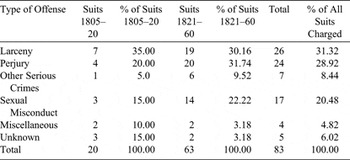
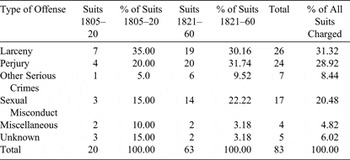
Virtually all of the slander litigation that arose in Upper Louisiana and Missouri fit into two basic categories for the action that the law of England had developed long before the cession of Louisiana to the United States. No high court decision in the included polities before 1861 adjudicated the slander per se actions scandalum magnatum, for words tending to scandalize a magistrate; for false and malicious utterances that impaired one in his or her trade, business, or profession; or for like publications excluding one from society, such as charging a person with having an infectious disease. Missouri plaintiffs, instead, brought the vast majority of their slander suits under Blackstonian common law, also making slander per se false and malicious utterances charging a heinous criminal offense.Footnote 77 Malice was implied when plaintiffs alleged and proved defamatory words of this kind.Footnote 78 Unequivocal false accusations of adultery or fornication, within the spiritual purview of the English ecclesiastical courts, were also slander per se from the earliest years of Anglo-American rule. The Missouri General Assembly regularized this characteristically American meld of temporal and spiritual jurisdictions with an act passed in January 1825.Footnote 79 Sixty-nine percent of the slander cases that came up for review through 1860 dealt with utterances charging some serious crime. Accusations of larceny and perjury gave rise to thirty-one and twenty-nine percent of the cases respectively. Similar to the array that historian Donna J. Spindel has identified for eighteenth-century North Carolina, underlying utterances usually resulted from disputes between men over dishonest dealings that involved farm animals, produce, and arable land. Utterances imputing bestiality and other illicit sex to men and women comprised twenty percent of the cases.Footnote 80
Slander Actions by Type of Offense Charged, 1805–1860.
Source: Case files of the General Court of the Territory of Louisiana, the Superior Court of the Territory of Missouri, and the Supreme Court of Missouri, MSA.
The traditional common law of slander that ordinary litigants employed in Upper Louisiana and Missouri from 1805 to 1860 suited the action quite well for the communitarian dynamics of rustic life in the trans-Mississippi Southwest. Day-to-day oral sharing of information among neighbors, gossip, and, sometimes, mean talk were constituent features of a largely Anglophone pastoral world that persisted in the region from the late eighteenth century at least through 1860. Residents here filed slander suits as one of several tactics available in the “small politics” of personal reputation that mediated social relations in farming neighborhoods, crossroad villages, and fledgling towns.Footnote 81 The slander litigation of Anglo-Americans, however, was much more structured, adversarial, and public than the informal proceedings that had taken place occasionally before district commandants in Upper Louisiana during French and Spanish rule.Footnote 82 Working within the common law framework of slander per se, plaintiffs sought damages that ranged from several hundred dollars to as much as $10,000.Footnote 83 In the inducements set forth in their declarations and petitions, plaintiffs typically described in great detail the “good name and fame” they had enjoyed among their neighbors, “respectable persons,” and other “good people” before the slander.Footnote 84 Next came precise descriptions of the “false, scandalous, and malicious” utterances, innuendos explaining ambiguous words allegedly defamatory, and sometimes a colloquium setting forth “extrinsic facts” to illuminate further their meaning and show that the objectionable words had been spoken of the plaintiff.Footnote 85 Provisions in a new code of practice, adopted legislatively in 1847 in response to democratic pressures, allowed a petitioner alleging words explicitly slander per se, in most cases, to aver simply that they had been spoken of him or her. The law no longer required a plaintiff to provide a colloquium when a simple averment that the actionable words had been spoken of the plaintiff would suffice to show a cause of action.Footnote 86 But before and after adoption of the new code, the requisite elements for the common slander suit provided plaintiffs multiple opportunities to attribute to defendants the most scurrilous and seemingly unjust kinds of verbal abuse. A plaintiff typically concluded with statements alleging how the slander had wrongly threatened a criminal prosecution or how seriously it had damaged his or her reputation, “social intercourse” with neighbors, domestic happiness, and good credit.Footnote 87
Those sued for actionable slurs utilized the slander action to advance their own whispering campaigns. In their answers, some defendants denied uttering the words plaintiffs alleged, while admitting having said only similar ones. Thus they established a foundation for a “fatal variance” between words alleged and proved.Footnote 88 Much more frequently, defendants specially pleaded the truth of their utterances rather than denying them. With this kind of “justification,” they deflected the charge of bearing false tales and advanced their verbal campaigns against plaintiffs. With sufficient evidence at trial, those pleading justification enjoyed an absolute defense if this were pleaded initially, and a mitigation of damages otherwise.Footnote 89 To reduce damages, defendants frequently pleaded the general issue and brought evidence at trial to show that, before the alleged slander, plaintiffs had had a “bad reputation for character.”Footnote 90 They often specially pleaded that they had only repeated rumors or “reports circulating in the neighborhood.” Such a plea, supported by sufficient evidence at trial, provided a complete justification if the defendant had named the author of the slander at the time of repetition, and a mitigation of damages if the defendant named the author in his or her pleadings.Footnote 91 An 1839 Missouri Supreme Court decision held a plea of repetition good only if a defendant had repeated a false accusation without malicious intent.Footnote 92 Nonetheless, such a plea under this traditional rule usefully enlisted the understanding of jurors drawn from the locality and linked with local networks of gossip. The 1847 code of practice, furthermore, maintained that a defendant could specially plead the truth of the matter charged as defamatory and, using the general issue plea, declare and prove mitigating circumstances to reduce the amount of damages even if he or she failed to prove justification and escape a finding of guilt.Footnote 93
Benton's choice of words to deride Judge Birch suggests a close familiarity with ordinary slander suits and a keen sense of what opprobrious usages would work to his advantage among common men and those of the gentlemen class. At both Liberty and Platte City, Benton refrained from employing insults that typically generated violent responses from yeomen, tradesmen, and elite men alike, that is, words such as “liar,” “coward,” or “poltroon.”Footnote 94 Benton's use of the word “scoundrel” to berate Judge Birch, however, was well calculated to resonate with the male citizenry and skirt the boundaries of slander liability. In the eighty-three slander cases that came before the appellate courts of Upper Louisiana and Missouri from 1805 to 1860, defendants most often denounced adult male plaintiffs with the words “rascal,” “rogue,” or “scoundrel.” Antagonists typically employed these words to suggest an array of character flaws that any self-respecting man would resent, especially those with Southern heritage.Footnote 95 Uttered usually in combination with a rather consistent array of criminal accusations: stealing hogs and corn and “false swearing,” the standard maledictions imputed traits thoroughly inimical to manly honor: dishonesty, laziness, and unreliability. If nothing else, such insults denoted unfitness to provide for and protect household dependents or meet the important civil obligations that exclusively signified manhood.Footnote 96 But the epithet “scoundrel” alone, like the words “rascal” and “rogue,” did not constitute slander per se because it did not explicitly aver the commission of any crime. Benton had gone to some pains, furthermore, to avoid even the suggestion that Judge Birch was guilty of criminal wrongdoing. In his answer to Birch's amended petition, for example, Benton pointedly denied calling Birch a “sheep-killing dog,” refraining thereby from implicitly accusing Birch of the crime of attempted murder. Of course, this language, as well as the words “sheep-biting dog,” employed a colloquial metaphor that homesteaders across the region well understood to connote vicious disloyalty on the part of one ordinarily deemed trustworthy and faithful.
Benton's overall case strategy skillfully exploited common understandings about village gossip, common slander litigation, and the contentious large politics that drove his dispute with Birch. In doing so, he infused the action with easily discernable social, political, and constitutional meanings for a general public whom he intended fully to be privy to the proceedings. For example, when Benton admitted in his answer that he had openly accused Judge Birch of whipping his wife, he undoubtedly understood that such an accusation was precisely the kind of juicy morsel that kept scandal mongers busy in rural neighborhoods.
Equally adept was Benton's plea that he had only repeated neighborhood “reports in circulation,” the supposedly innocuous routine mode of exchanging information in country settlements and small towns. With this plea, however, he also invoked the common law rule that mere repetition of slanderous gossip could serve, depending upon the circumstances, to mitigate damages. Benton heavily emphasized that Birch and the other “nullifiers” had “provoked” his public charges against Birch. In this way, Benton maintained that his whole course of action at both Liberty and Platte City was retaliatory rather than offensive and therefore less reprehensible under the informal rules that shaped the rumor wars sometimes waged in the rustic world of small politics. Such an argument, furthermore, undoubtedly appealed to the ordinary frontiersman's sense of justice. No honorable man could back down when provoked. Benton also maintained that he had made his charges against Birch to inform the people of the supposedly illicit conspiracy of his opposition. Yet Benton's plea alluded to, but did not explicitly claim, the presumption of law in favor of a defendant's innocence when words slander per se were uttered in the discharge of some duty that the public required him to perform.Footnote 97 In essence, Benton sought to establish a defense that most ordinary men, circuit judges, and politicians would have deemed acceptable in the courtroom and in the bucolic realm of neighborhood tale bearing. At the same time, however, he undergirded this cagey positioning with only a tacit plea that his utterances were made in the context of open political warfare and therefore privileged.
The discovery phase of Birch v. Benton proved to be lengthy and complicated but demonstrates further the small and large politics at work in the controversy. Lead counsels Henry Routt and James Sheley employed the full array of litigation tactics. There were multiple changes of venue, from Buchanan, to Clay, to Jackson, and finally to Henry County Circuit Court. There were continuances, dozens of depositions taken, and numerous motions to suppress depositions. Various witnesses gave testimony about the neighborhood gossip concerning Judge Birch, virtually all of which absolved him from the charges that Benton advanced. At least seven neighbors or close acquaintances of the Birch family, including several women, testified that they had never heard the rumor that Judge Birch had whipped his wife or “kept a negro wench” until about the time of Benton's summer 1849 tour. Neighbors Laura Wilkerson and Hanna Riley recounted that Sarah Halstead had complained that Judge Birch had failed to “correct” Hannah and that he had once slapped her, albeit “without the full weight of his hand,” during a confrontation over the slave woman. But all the witnesses maintained that they did not believe the reports.Footnote 98 Friend of the family and Clinton County Circuit Court Clerk Winslow Turner testified, “The report, as is common in such cases, assumed a great many variations, and very soon became mixed up with the political warfare then going on in that part of the state. This last circumstance caused the matter to be more spoken of doubtless, than it would otherwise have been.” Turner asserted further that “no one in the vicinity believed that Judge Birch had struck or whipped Mrs. Birch, or otherwise mistreated her…Nevertheless…I do believe that some personal and political enemies of the plaintiff did, in certain circles, affect to believe the report…”Footnote 99
Benton drove the litigation in a direction not at all typical for slander actions when he took the case into the editorial columns of the partisan press. Spatially and culturally distant from the rural neighborhoods and hamlets that were home to the vast majority of Missourians, the rapidly growing metropolis of St. Louis provided distinctive opportunities for zealous politicians to employ local gossip to their advantage: party-controlled, mass-circulation newspapers increasingly preoccupied with the issue of slavery.Footnote 100 On July 4, 1853, almost two years after Birch had lost his seat on the high bench in the initiatory August 1851 judicial elections, the St. Louis Missouri Democrat published a letter about the litigation between Birch and Benton over the pseudonym “Clay County.” Editor William McKee identified the author as Benton, but only after the court had sent McKee to jail for several months on a contempt citation because he had refused to give up this information. The published letter, which was reprinted in pro-Benton papers across the state, was a slightly less virulent version of another Benton had tried to publish in the St. Louis Union in May 1852, shortly after he was voted out of the Senate. It repeated all of the charges he had made against Birch initially, but in the way of “usefully informing the people.” Among other things, Benton explained how he had outwitted Birch with his answer to the judge's original petition, which had alleged only that Benton had charged Birch with whipping his wife. Invoking Blackstone, Benton pointed out that, under the common law, a man could lawfully chastise his wife with a rod no bigger than his thumb. Although a barbaric practice, he emphasized, this was no criminal offense. A false and malicious charge of physically castigating one's wife, therefore, could not amount to slander per se. Benton wrote that the judge had foolishly presupposed that he would demur to his petition on this ground and end the matter. But Benton had not done this. And so to stanch his “bleeding honor” Birch had to file an amended petition also alleging the utterances about the “negro wench.” Now Birch was reluctantly litigating the case, drawing it out to avoid having all of his political machinations and unsavory domestic problems revealed.Footnote 101 Benton vigorously denied Birch's claim that Sarah Halstead was in any way mentally impaired. In his unpublished letter of May 1852, Benton taunted Birch with references to his “insane suit” and “non compos mentis…interrogation” of Governor Austin King, a unionist Democrat whom Birch had called as a deposition witness and whom Benton had skillfully cross-examined to his own advantage. In closing this letter and its published July 4, 1853 version, Benton wrote that Birch had, at Plattsburg, admitted that he had used force on his wife “and said it was because she was ‘insane’—a pretext which all the neighbors knew to be false.”Footnote 102 In the published letter of July 1853, appearing fourteen months after the death of Sarah Halstead, Benton adverted to his opponent's courtship of Sarah Carter, daughter of Fitzhugh Carter of Fairfax County, Virginia. In his words, “Birch is trying to get married in Virginia, and must hook the new wife before she finds out how the old was served…”Footnote 103
While Benton omitted to aver explicitly that Birch's course of action against him was “womanish,” he seemed to imply as much in the public rhetorical campaign he prosecuted along with his legal defense. Litigation instituted by a politician in response to public insult certainly smacked of emasculation in the view of most Missourians. To the extent that Judge Birch prosecuted his slander suit in response to a charge of adultery, furthermore, he employed a thoroughly feminine cause of action. King argues that paternalistic lawmakers in Missouri, as in the rest of the country, adopted the sexual slander action in 1825 to shield young unmarried middle-class women from damaging gossip that might undercut their prospects for marriage and motherhood.Footnote 104 Eager to meet traditional patriarchal gender prescriptions that demanded unerring female chastity, white women in Upper Louisiana and Missouri brought slander actions in response to accusations of extramarital sex much more frequently than in response to any other actionable slurs. Of the eighty-three slander suits that rose on appeal to the highest courts under study, thirteen, or sixty-seven percent, of the eighteen slander suits brought by women were filed in response to accusations of adultery or fornication. Birch was the only man to bring an action of this kind.Footnote 105 Benton refrained entirely from pointing this out, perhaps because his own tactics were not altogether free from associations with the supposed tendency of women to gossip more than men about sexual indiscretions. Like Benton's sexual tattle, Birch's cross-gender legal response appears to have been tied sufficiently to the give-and-take of large politics to pass muster among the manly sovereigns of the state. Nonetheless, Benton's unpublished letter deriding Birch's “insane suit” and “non compos mentis” interrogation of Governor King recalled pointedly the very affliction that testifying physicians Noah and Henry Essig had attributed to Mrs. Birch as a consequence of her distinctively female “period of life.” And in the published version of that letter, Benton ridiculed Birch for unmanfully fleeing in fear from face-to-face confrontations with Benton's most powerful supporters shortly before he gave his July 14 speech in a grove outside of Liberty. According to Benton, Birch had “scudded back to town on his old mare.”Footnote 106
Benton's out-of-court litigating exploited invidious race, class, and gender stereotypes to bolster his defense and score political points in the wider forum of public opinion. By referring to the slave woman Hannah as a “negro wench” in his initial defamatory utterances, his pleadings, and editorial gambits, Benton brought into play some of the most virulent bigotry of the era. Given Benton's mastery of vernacular and formal language, his repeated use of the words suggests he did not intend them simply to denote a young female slave. In 1849, Americans North and South commonly employed the term “wench” to describe a lewd woman or a prostitute. Since the late sixteenth century in England, a “wencher” was a man who consorted with debased women for the purposes of illicit sex. With his loaded incantation, Benton branded Judge Birch a dissolute sexual predator who made a mockery of planter pretensions to paternalism, while casting Hannah as a “Jezebel,” a biblically-inspired epithet interchangeable in the slave states with the words “negro wench.” Both usages presupposed that young African-American slave women were lewd, lascivious, and inveterate temptresses who lured slaveholding men into adulterous and sometimes ruinous liaisons.Footnote 107
Benton's idealized characterization of Sarah Halstead and his description of how Judge Birch had brutalized her exploited common resentments toward slaveholders who abused flagrantly a sexual double standard never meant to be publicly acknowledged. It seems unlikely that Benton described Sarah Halstead as an “aged and respectable lady” only by accident in the same passage in his answer referencing the “negro wench.” This juxtaposition, which Benton also articulated in his denunciations of Birch at Platte City and subsequent editorial pieces, invoked potent, interrelated racial and gender conceptions specific to black and white women that played on anxieties common among ordinary Missourians about the domestic morality of slavery. Historian Deborah Gray White argues that the ideal Southern lady was the absolute antithesis of the Jezebel. The latter did not lead men and children to God. Piety was of no concern. Religiously infused domestic obligations shrank to insignificance in contrast to matters of the flesh. Especially when in advanced age, the lady was the living apotheosis of pure white womanhood, whose stature and standing only gained strength in contrast to the “negro wench.” Yet patriarchal gender prescriptions required gentlewomen to tolerate the sexual intrigues of such supposedly vile creatures. In this scenario, the household paragon was a tragic yet sympathetic figure. All at once, she was required to keep herself chaste and above all suspicion of sexual impropriety, while maintaining grateful and loving subordination to her husband, ever forgiving his sexual foibles. The toleration expected in this situation was a hard rule that elite men deemed an unfortunate necessity. But it was also a burden that any gentleman would spare his wife if at all possible. Whipping one's culturally sanctified white wife to compel her toleration of an adulterous connection with a common slave woman placed any man beyond the pale. Benton knew this and played it for all it was worth.Footnote 108
Birch did some out-of-court litigating of his own. As ordinary residents did, he could look to venues other than courts of law to defend himself against damaging gossip. Birch undoubtedly circulated among neighbors, friends, and political associates his own explanation of the household irregularities that Benton had broadcast. In early 1852, Birch made a courthouse speech, before potential jurors, explaining how a church tribunal and the Sons of Temperance in Clinton County had conducted a formal investigation into the scurrilous charges made against him and found him blameless. He also responded to Benton's letter in the Missouri Democrat with a letter of his own, over his real name, published in the Independence Occidental Messenger on July 16, 1853 and carried also in the St. Louis Missouri Republican. Birch's letter identified Benton as the author of the Fourth of July piece from “Clay County.” He accused Benton of “cowardice” and “brutal malevolence,” while denouncing his pseudonymous contribution as an “ignoble” and “malignant…web work of calumnies” having the “the purpose of prejudicing the jury against me” and constituting an “aggravated renewal and amplification of the original slander.”Footnote 109
Under the circumstances, Birch and his sons managed better than might have been expected to prevent Sarah Halstead from doing more damage to the reputation of the Birch family than she did. Even if Judge Birch had not been guilty of the misconduct that Benton alleged, one must certainly credit Sarah Halsted with an extraordinary amount of boldness and resolve. Voicing her suspicions violated a cardinal rule of family honor and loyalty among those with Southern orientations. White society in slaveholding states expected women of high rank to keep silent about the suspected sexual indiscretions of their husbands. Sarah Halstead, however, made her complaints known to influential men in her community. She also publicized them among women in her neighborhood and thereby further enlisted the power of local gossip networks, a potent self-protective tactic more to be expected of ordinary women than of those within the ranks of the elite.Footnote 110 But Birch's lawyers took no deposition from Sarah Halstead, who died in May 1852 from an extended illness that the court documents do not specify. And even had she survived her illness and put her own words directly into the record, the testimony of Charles, James, Jr., and the physicians Henry and Noah Essig had provided evidence well tailored to permit the grim medicolegal conclusion that she was, although of sterling character, either a lunatic or a monomaniac and therefore incompetent to testify. And whereas Missouri law did not permit slaves to give testimony against whites, Judge Birch's sale of Hannah shortly after the fireplace tongs and shotgun assault in the winter of 1848–1849 would have made even informal questioning of her next to impossible by the time the lawyers in the case turned to taking statements and depositions.Footnote 111
IX. Judgment and Appeal
The way Judge DeWitt C. Ballou of the Henry County Circuit Court instructed the jurors almost certainly shaped the outcome of the trial in favor of Birch. Judge Ballou posed these issues to the jury: Were the accusations Benton made against the judge true or false? As Benton had not pleaded truth in justification, a finding that the charges were true could only mitigate damages. Upon a finding that the utterances were false, the jury was to mitigate damages only if Benton had repeated the charges without malicious intent. Next, were the words shown by testimony to have been uttered by Benton substantially the same as those alleged in Birch's amended petition, or was there a fatal variance? If determined to be substantially the same, the jury was to find for Birch, yet allow for a mitigation of damages if Benton had, indeed, merely repeated rumors without malice. Judge Ballou refused to instruct the jury, as Benton requested, that a false and malicious accusation of physically chastising one's wife was not slander per se. Therefore the jury rendered a general verdict for Birch on May 11, 1855 and awarded him $5,000 plus costs.Footnote 112
The verdict reflected the traditional conservative ideals to which the Henry County jury and Judge Ballou adhered. Birch's reputation for religiosity, commitments to temperance, and support of William Henry Harrison hardly could have alienated the jurors. Former attorney general of Missouri Banton G. Boone, who knew the litigants and lawyers involved in the case, averred that all of them were Whigs. Those of this persuasion, in Missouri and elsewhere, placed a premium on evangelical religion, private and public morals, and related beliefs that emphasized the obligations of family, community, and citizenship. In Boone's estimation, the Henry County jury had vindicated the inviolability of the domestic circle and the sacredness of individual reputation.Footnote 113 According to him, the verdict of the jury, composed of “twelve of the sturdy and sterling yeomanry…attest the fact that they had a high and true appreciation of the value of character and of the sanctity of the home, and that however exalted may be the private and public standing of a man, he cannot with impunity, bear false witness against his neighbor, or wantonly and maliciously assail with defamation the home and the happiness of the family.”Footnote 114
The case came on for hearing in the Missouri Supreme Court in January 1858 on a writ of error, only three months before Benton's death. Boone reported there was little, if any, reference to the evidence or assigned errors in the oral arguments. The time allowed for argumentation was unlimited, and the courtroom was packed. Former Whig congressman Samuel Woodson opened for Birch, praising his virtue and condemning the malevolence of Benton. An ardent “southern rights” convert since the bloody border strife over the question of slavery in Kansas, Henry Routt remained loyal to his old friend Benton and followed with a litany of denunciations against Birch.Footnote 115 Lafayette County Circuit Judge Russell Hicks was third, arguing for Benton with a two-and-a-half-hour diatribe that worked over the full array of slavery-related issues that had divided the nation, from the 1820 Missouri Compromise to the more recent Kansas–Nebraska Act (1854), finishing off with a eulogy of Andrew Jackson. Next to speak was future senator in the congresses of both the United States and the Confederacy Waldo P. Johnson, who let loose a thunderous philippic against Birch, hammering home the point that a ruling against Benton would amount to nothing less than a violation of constitutionally protected free speech and personal liberty. Last, Judge James Sheley concluded with yet another encomium to Birch's high character and the good and moral example that he would leave to posterity.Footnote 116
The Missouri Supreme Court reversed and remanded the case with not a single reference to antislavery politics, freedom of political expression, or the character of either litigant. Judge William Barclay Napton prudently recused himself from the deliberations. Former Supreme Court judge John F. Ryland, who had ten slander opinions under his belt, wrote the brief for Benton. Notable for its paucity of citations to authority, the brief was short, straightforward, and clear. Recently elected Judge John C. Richardson of St. Louis, whose nomination had been engineered by Unionist Democrat and former Supreme Court judge Hamilton Rowan Gamble, wrote for the Court.Footnote 117 With Virginia-born proslavery advocate Judge William Scott concurring, the opinion echoed the salient points set out in Ryland's brief.Footnote 118 The opinion maintained that the trial court had erred in instructing the jury that a charge of whipping one's wife was slander per se, just as Benton had maintained all along. Even though dishonorable and vicious, this was no crime. Judge Richardson wrote further that the Court had never defined precisely what kind of criminal imputation constituted slander per se. He explicitly rejected the formulation set out in the influential 1809 New York decision Brooker v. Coffin, which held words actionable in themselves if they subjected the party charged to an indictment for a crime involving “moral turpitude” or to an “infamous punishment.” Instead, Judge Richardson declared a rule derived from English jurist Thomas Starkie's widely referenced treatise on slander: false and malicious charges of an indictable offense for which imprisonment could be inflicted as the immediate punishment.Footnote 119 Relying on long-established doctrine, Judge Richardson further maintained that the trial court had erred in permitting the jury to decide whether there was a fatal variance between utterances that Birch alleged in his amended petition and those that the testimony of James N. Burns had put into evidence.Footnote 120
X. Implications
In the world of large politics, Birch v. Benton was most obviously significant because of the way it resolved the dilemma posed by the conflicting reputation and free expression claims of the two litigants. The Missouri Supreme Court rested its decision largely on well-established slander per se doctrine without explicitly addressing the question of free speech. Yet beneath the complex discussion about variances and actionable words lurked the basic question: Which would it vindicate? Judge Birch's right to reputation or Benton's right of free speech and the related democratic imperative of open political debate?
The decision in Birch v. Benton certainly did not repudiate the conservative sentiments that had generated the suit. Its decision did not deny that a jury might properly find actionable slander per se in words such as those allegedly spoken by Benton about Judge Birch and the slave woman Hannah. And the Court explicitly reaffirmed its recognition of community esteem as an important individual right. In the words of Judge Richardson, “The law engages not only to guard the property and personal security of individuals, but their good name and reputation…” Blackstone had put it almost exactly this way.Footnote 121
Judge Richardson's opinion was consistent with the pattern of democratization in the United States law of slander that Andrew King describes. The determination of the Court to maintain strict rules about variances perpetuated its policy, announced a year earlier, of discouraging “vexatious litigation” and strife inimical to the “peace and well-being of the community.” This holding drew on longstanding English precedents that recognized the values of a social order more urbane, commercially oriented, and individualistic than that which still prevailed in the rural neighborhoods that encompassed most of newly settled Missouri.Footnote 122 The Court's adoption of a more precise definition of slander per se certainly contributed to the early nineteenth-century effort of judges in the United States to transform the traditional slander suit into a predictable tort. Judge Richardson could not have more clearly expressed the Court's chief objection to the common law rule perpetuated in Brooker v. Coffin, which held words to be slander per se if they subjected the party accused to an indictment for a crime involving “moral turpitude” or to an “infamous punishment.” According to Richardson, “This rule lacks certainty.” For the same reason, he rejected another timeworn precept defining words as slander per se if they simply accused one of an indictable offense. Echoing the views of Thomas Starkie, Richardson took the position that this doctrine was unworkable if only because the Missouri General Assembly had made so many relatively minor offenses indictable. But Richardson did find appealing part of the formulation that Starkie had drawn from a number of common law precedents: words charging an offense for which corporal punishment, or imprisonment, was the primary immediate penalty. For Richardson, any valid rule had to define the penal nature of the offense charged. For Richardson and the Court, clarity, certainty, and predictability were paramount.Footnote 123 Holdings of the Court on variances and the definition of slander per se in Birch v. Benton comported entirely with a policy promoting open political discussion, carving out a bit more space for the political diatribes of zealous partisans.
The way Birch and Benton litigated the case was more thoroughly attuned to democratic realities than was Judge Richardson's opinion. Their tactics powerfully endorsed the stalwart commitments of ordinary and leading men to free political expression. Boone called Birch v. Benton Missouri's “famous scandalum magnatum action.”Footnote 124 This certainly suggests the eminence of the litigants. But both Birch and Benton argued the case, in legal terms at least, strictly as an ordinary slander case. Regardless of his conservative propensities, even Judge Birch recognized the political folly, in a burgeoning frontier democracy, of claiming to have been slandered in his capacity a great officer. Benton similarly refrained from attempting to employ Anglo-American slander law that privileged the official utterances of judges and legislators by requiring plaintiffs in such cases to prove actual malice.Footnote 125 Yet Benton made a political case. His initial plea maintained that it was his duty to expose and put down the proslavery conspirators and take Birch publicly to task for “dogging him.” His lawyers strenuously invoked freedom of speech and related libertarian principles in argumentation before the high bench.Footnote 126 The Court's opinion studiously omitted to discuss such issues. But jurists and politicians familiar with the case, including Boone, easily discerned its import.
Birch v. Benton hardly serves to validate Andrew King's argument that a democratized United States law of slander distinctively shielded the private affairs of politicians while facilitating discussion of their public activities. Notwithstanding the jury verdict, the popular free speech tradition giving rise to the case and shaping its contours did not encourage such fine distinctions. Birch's supposed adultery with the slave woman Hannah and related discord with Sarah Halstead were, in one sense, domestic matters touching on personal rectitude and character. But Birch's ordeal at home also implicated public questions about the morality and social consequences of slavery, the prime political controversy of the day. Quite useful in reframing this seeming duality is the contention of feminist historians, such as Gisela Bock, that traditional political history has improperly cast the sphere of power and the domestic sphere as mutually exclusive.Footnote 127 Given the choice of both Benton and Birch to argue the case as an ordinary slander action, and the acquiescence of the high bench to this approach, the public–private dichotomy was irrelevant as a matter of law. It was also a crude abstraction incapable of decoupling utterances that were, all at once, harsh political commentary and disparagements about intimate household relations.
The popular free speech tradition that encouraged Benton's verbal attack on Birch and marked the course of their legal battle also generated consequences in the case not as salutary as the proponents of a free market of political ideas would have preferred. The evidence in the record does not easily permit the conclusion that Judge Birch whipped his wife because of an adulterous relationship with the slave woman Hannah. Certainly there was no preponderance of evidence to support such a finding. It appears, however, that this made little difference to Benton, as he successfully undercut his political opponent with accusations of despicable domestic wrongdoing. With the cooperation of partisan editors he made Birch a scapegoat in the wider rhetorical war against the westward expansion of slavery, characterizing the judge as a self-indulgent slaveholder whose habits of mastery over other human beings and lack of self- control had resulted in both the battery of his wife and sexual exploitation of his bondswoman. In doing so, Benton laid upon Birch's head the sins of all slave owners and cast him into the political wilderness. With equal skill, Benton portrayed Sarah Halstead Birch as a venerable exemplar of pure white womanhood, the sympathetic victim of domestic abuse. In all likelihood, however, she had been the prime source of the neighborhood reports in circulation that Benton had seized upon to attack Judge Birch. Sarah Halstead had not, in fact, behaved in the retiring and long-suffering manner required of the archetypal Southern lady, and she may well have concocted the stories that Benton turned to his advantage. But the idealized version of Mrs. Birch worked better for Benton's purposes, as did his denials that she was mentally impaired. Without certain knowledge on this point, Benton's airing out of her grievances, or at least the versions of them that circulated in her Clinton County neighborhood, revealed a systematic disregard of the distinct possibility that, to suit his political designs, he made a public spectacle of a confused and incompetent woman who deserved protection rather than exposure. From the best evidence available, it seems almost certain that Benton had little cause to accuse the slave woman Hannah of illicit sexual relations with Judge Birch and cast her as a wanton Jezebel who had “betrayed” her mistress. But Hannah was virtually powerless to make her version of the story known. Almost certainly the press was not interested in publicizing it. She was, furthermore, entirely bereft of legal means to redress the accusations against her. The law did not recognize that a slave had a right to reputation or any other rights that white women and men were bound to respect.
The singular contributions of lawyer Henry Routt to the controversy between Birch and Benton reveal that Missouri's popular free speech tradition flourished alongside calculated partisan efforts to shackle political debate. As lead counsel in the litigation battle, Routt energetically defended Benton's right to free speech. But his involvement in the imbroglio both predated the lawsuit and played an instrumental role in contributing to the enmity that gave rise to it. As a pro-Benton plant, Routt had interrupted the speech that Birch gave on July 16, 1849 at the Clay County courthouse in response to Benton's address given two days before in a grove just outside of Liberty. Routt ceremoniously handed the judge a note averring that the agitated assemblage wanted an explanation of the unsavory reports concerning the judge that were circulating in Clinton County. Benton alleged in his answer that Judge Birch had first explained his supposed misconduct “to an outraged community” in a speech given at Plattsburg days earlier. But the testimony of Charles Birch, James Birch, Jr., and Winslow Turner suggests that, in actuality, his first attempted public explanation of the matter came in response to the heavy-handed intervention of Henry Routt at Liberty. The ruse both sabotaged Birch's anti-Benton speech-making campaign and further fueled the ugly rumors.Footnote 128
The concerted efforts of lawyer Henry Routt to thwart his political opponents with mob actions constitutes a paradigmatic case of what historians John Nerone and Richard B. Kielbowicz have described as an antebellum popular tradition of press suppression – one that coexisted openly with its more celebrated libertarian counterpart. They make prime examples of the 1833 ransacking of the offices of the Independence, Missouri, Evening and Morning Star, a Mormon newspaper with supposed antislavery leanings, and the April 14, 1855 mobbing of the offices of the Parkville Industrial Luminary, an abolitionist paper published by George S. Park in Platte County, Missouri.Footnote 129 Kielbowicz shows that an orderly assemblage of leading men, organized as the Platte County Self-Defensive Association, adopted a resolution before the assault on the Luminary offices declaring it a public nuisance, announced their intention to abate it, and gave Park advance notice to cease and desist. A second resolution demanded that its editors leave town within three weeks or risk “punishment.” In the estimation of Kielbowicz, the resolution declaring the paper a nuisance and the vigilante “abatement” that followed exemplified the tendency of nineteenth-century anti-press mobs, typically under the leadership of elected officials, to draw earnestly on the common law's doctrines, procedures, and language to protect the collective interests of local communities. Quite similarly, lawyer Henry Routt chaired a public meeting of citizens at the Clay County courthouse in Liberty on April 21, 1855 that formally expressed their approval of the Parkville attack. Routt personally drafted the concurring resolutions, which purported to declare the consensus of opinion among the law-abiding residents of the county. In particular, the resolutions denounced abolitionist “traitors” who supposedly instigated slave rebellion, assisted antislavery settlers in Kansas, slandered Missouri slaveholders, and preached religion against them. Routt and others, including militant proslavery former attorney general and state legislator Benjamin F. Stringfellow, concluded the meeting with incendiary speeches rife with harsh rebukes.Footnote 130
The mob action supported so enthusiastically by lawyers Routt and Stringfellow essentially amounted to popular enforcement of common law proscriptions of sedition and seditious libel contained in a criminal statute the Missouri General Assembly adopted in 1837. The act penalized spoken or printed publication “of any statements, arguments, or opinions tending directly to excite any slave or other colored persons in this state to rebellion, insurrection, or murder.” Historian Michael K. Curtis demonstrates that measures such as these, which numerous slave states adopted after the 1835 abolitionist postal campaign, constituted a fundamental violation of press freedom in the view of antislavery jurists. But leaders in the slaveholding states maintained that these statutes merely penalized licentious abuses of speech and press liberties. This liberty–licentiousness distinction was set out in the free speech and press clauses of virtually all state constitutions in the early national period, including that of Missouri, and was one that exemplified republican understandings of ordered liberty.Footnote 131 The most obvious source of the 1837 Missouri act, and of its counterparts in other slave states, were common law rules, articulated by Blackstone, which punished the misprision of speaking words that “sowed sedition” against the King's government as well as seditious libels having the “dangerous . . . or pernicious tendency” of threatening “peace and good order” or spurring rebellion against the government.Footnote 132 In a widely circulated tract published in 1854 by the Platte County Self-Defensive Association and edited by Stringfellow, the association first denied that any Missouri legislation penalized the expression of abolitionist sentiments. The association based this curious assertion on the fact that the 1837 act proscribed only publications having a direct tendency to spur rebellion, a libertarian modulation of the common law that an 1855 legislative revision jettisoned entirely. On the other hand, the association embraced the logic of the English common law rules from which the 1837 act was derived. It thoroughly decried the expression of abolitionist sentiments as “not even within the much abused liberty of speech” but rather “a crime of the highest grade…more criminal, more dangerous, than kindling the torch of the incendiary.” The association maintained that, in the absence of an “adequate penal law,” its members, who represented a “slave holding community of good citizens,” had no choice but to act in their own “self defense,” that is, “investigate and punish” violations of the laws protecting slavery and expel from the community “all who shall be found proclaiming principles which tend to induce our slaves to insurrection and rebellion.”Footnote 133
Popular understanding of the constraints that democratic republican principles imposed on the use of government power to suppress the expression of contentious opinions left white men determined to preserve slavery little choice but to regulate the public sphere of political conflict with intimidation and violence. Courts in the slave states were reluctant to enforce their anti-abolitionist statutes. Curtis observes that legislators who adopted these measures expected vigilantes to punish those who expressed abolitionist opinions. This certainly appears to have been the case in Missouri. There were no prosecutions under its 1837 act in the circuit courts under investigation and no appeals from such actions to the Missouri Supreme Court through 1860.Footnote 134 The distinctive press clause of the Missouri Constitution declaring truth a defense in all libel prosecutions may well have made circuit attorneys, grand jurors, and judges think twice before enforcing the 1837 act. In theory, actual prosecutions could have turned the courts into venues for high-profile public debates over the veracity of abolitionist publications. But it seems much more likely that the dearth of prosecutions in Missouri from 1837 to 1860 was primarily a consequence of the extraordinarily strong commitment of ordinary white men, legislators, and judges, in principle at least, to free political expression. The unusually libertarian press clause of the state's constitution fundamentally reflected these commitments. With private citizens assuming the task of punishing those who openly declared abolitionist opinions, the courts of the state retained their integrity as unsullied protectors and institutional emblems of free speech principles. Popular practices that employed threats and physical force to quell unwanted political expression outside courts of law constituted prototypes for this extrajudicial approach. The argument with which the Platte Self-Defensive Association denied the efficacy of the 1837 act for penalizing the expression of abolitionist sentiments certainly served to justify its vigilantism. But that same legalistic hair splitting also excluded the courts as proper venues for suppressing such publications.
From the mid-1830s through at least 1860, unbridled popular traditions of free speech and anti-abolitionist vigilantism combined with a rapidly expanding modern print culture in Missouri to produce some of the most notorious partisan violence over the question of slavery. Trish Loughran challenges the idea advanced by United States leaders such as Daniel Webster and William Seward that progress in communications would promote a cohesive nation. In her view, the printing industry that arose in the last three decades of the antebellum period, in fact, produced deep divisions, dissent, and a national debate “about the right to free speech and the free circulation of printed speech.” After the 1835 abolitionist postal campaign in the South, such contention spurred mob violence against abolitionist newspaper editors, including Elijah Lovejoy. Loughran also attributes this anti-press vigilantism to the rise of the mass party system and partisan newspaper networks that fueled popular animus over the question of slavery.Footnote 135 Historian Edward Ayers similarly maintains that the unrestrained publications of editors and politicians consumed by pro- and antislavery partisanship generated imagined communities whose members zealously cultivated mutual hatreds, prejudices, and an unparalleled lust for violence.Footnote 136 According to Ayers, the new mix of industrial print culture and popular politics gave extraordinary power to their incendiary speeches and writings. Ayers points to the violence in “Bleeding Kansas” as a prime example of this dangerous combination of “modern contexts.” Indeed, after passage of the Kansas–Nebraska Act (1854), proslavery editors and Democratic fire-eaters took advantage of the popular free speech tradition that prevailed in Missouri to spew imprecations in public addresses and newspapers that demonized the abolitionists in Kansas associated with Eli Thayer's Massachusetts Emigrant Aid Company. Amid the guerilla warfare waged by pro- and antislavery zealots in 1855 and 1856, armed partisans from Missouri resorted to unbridled anti-press vigilantism. “Border ruffians” from western Missouri, led by proslavery Kansas officials, notoriously crossed over into the territory in May 1856 and destroyed two abolitionist presses in Lawrence. Spurring on mobs such as these with especially demagogic oratory and newspaper publications were anti-Benton Democrat Senator David R. Atchison and pro-Southern apologist extraordinaire James Shannon, minister and controversial president of the University of Missouri.Footnote 137
XI. Conclusions
The combined court-centered and sociocultural analysis employed in this study reveals the palpable political effects of a popular free speech tradition that flourished in Upper Louisiana and Missouri from shortly after the War of 1812 through 1860. An extraordinarily libertarian free press clause in Missouri's 1820 Constitution both reflected and undergirded the commitment of common white men and politicians alike to this customary understanding. But judges were rarely called upon to interpret this language in prosecutions brought by defamed political leaders. Popular devotion to free political expression on the trans-Mississippi Southwest frontier, grounded in white man's democracy, manifested itself most obviously in the choices of myriad officials to forego legal retaliation against political invective. By the same token, the judge-made law of oral defamation remained largely irrelevant to politically motivated vituperation. The law of slander that did take hold in Upper Louisiana and Missouri among ordinary people provided no less protection of their private lives than of those of leading men. In keeping with frontier ideals of viable manhood, eminent politicians and common men alike enjoyed the freedom to reciprocate disparagements in kind, a practice that facilitated the open exchange of useful information and robust political debate.
When Birch sued Benton in fall 1849, the worlds of small and large politics aligned to produce a turbulent conjunction. Birch's slander suit and the accusations of adultery and wife abuse that gave rise to it suggest that leading men could transform modes of verbal abuse typically attributed to women and their legal tactics for redeeming sexual reputation into manly political combat, often in ways that blurred the middle-class distinction between public and private spheres. By the same token, the celebrated case illuminates how a savvy defendant in a political slander action could bolster his case by exploiting the social kinetics of local gossip in the courtroom, on the stump, and in the pages of party-controlled mass-circulation newspapers. It also demonstrates how the popular free speech tradition that triumphed in frontier Missouri entailed a number of distressing consequences that the praiseworthy eastern champions of libertarian ideals had almost certainly never intended. Their eminently civilized version of political free speech, and the rational public sphere that it presupposed, hardly comported with the less restrained popular free speech tradition that emerged in the trans-Mississippi South-West. Aggressive politicians like Thomas Hart Benton took advantage of free speech liberties in ways that sometimes inflicted unjust suffering on powerless household dependents. Unfettered exploitation of free speech rights often produced political slurs that drew on and reinforced the invidious gender, race, and class distinctions that permeated a patriarchal slaveholding society. Common law proscriptions of sedition and seditious libel adopted statutorily in 1837 institutionalized the consensus among white men that abolitionist publications transgressed legal bounds. But their deep commitments both to slavery and democratic republican principles that limited the use of government power to suppress controversial publications left them unable to envision any other option than to suppress abolitionist proclamations with physical force. Demagogic leaders and their media operatives amplified the politically divisive impact of a powerful new print culture, taking full advantage of libertarian free speech prerogatives to produce inflammatory newspaper reportage on the question of slavery in the West. Especially after 1854 on the border between Kansas and Missouri, popular free speech traditions that regulated political disputation and authorized vigilantism against abolitionist presses spurred extremist violence and bloodshed.
Unpacked in sociocultural and political context, Birch v. Benton reveals that “the people's darling privilege” achieved only a precarious existence in the trans-Mississippi Southwest between 1805 and 1860. Much more often than the adjudication of courts, a boisterous white male electorate in antebellum Missouri resolved the extraordinary tensions that prevailed there between customary respect for individual reputation and the constitutional and democratic imperatives of free expression. Popular regulation of the public sphere both promoted and suppressed the articulation of contentious political opinions. But it usually did so in ways that depended on the extent to which such expression comported with cardinal social and political arrangements that the majority of white male citizens in particular venues preferred. The violence that arose in western Missouri and Kansas from 1854 through 1860 over the question of slavery restriction thus showcased for the nation the power of white male majorities and militant minorities of white men to define themselves as “the people” and determine the actual boundaries of political free expression.
Slander Actions in the General Court of the Territory of Louisiana (1805–1811), the Superior Court of the Territory of Missouri (1812–1819), and the Supreme Court of Missouri, 1820–1860.

Source: Case files of the General Court of the Territory of Louisiana, the Superior Court of the Territory of Missouri, the Supreme Court of the State of Missouri, MSA, and Missouri Reports, vols. 1–33.
Note: See note 74 in the main text for a discussion of the alterations to the boundaries of the original territorial districts and changing boundaries and addition of new counties 1820–1860.