Attachment transmission, how a parent's mental representation of attachment influences her infant's development of behavioral attachment strategies, is a critical theoretical and empirical question. A robust empirical link has quite consistently been reported between maternal attachment representations and the quality of the mother–infant attachment relationship (Grossmann, Fremmer-Bombik, Rudolph, & Grossmann, 1988; Pederson, Gleason, Moran, & Bento, 1998; van IJzendoorn, 1995; Ward & Carlson, 1995). Attachment theory largely attributes the quality of this first relationship to variation in the sensitivity displayed by the caregiver in early interactions with the infant (Ainsworth, Blehar, Waters, & Wall, 1978); however, a reasonable extension of this notion, that is, that maternal sensitivity should account for the strong association between parental and infant attachment classifications, has not been supported empirically. This failure led van IJzendoorn to coin the phrase “transmission gap” (Atkinson et al., 2005; van IJzendoorn, 1995).
The suggestion of this void in our understanding of the transmission of attachment has stimulated an extensive search for other potential mediators of the established association between maternal representations and the attachment relationship. Some researchers have advocated the use of measures that reflect a different conceptualization or that focus on particular aspects of sensitivity (Atkinson et al., 2000; Pederson, Gleason, et al., 1998; Raval et al., 2001); others have appealed for methodological enhancements, including more powerful and context-specific measures of sensitivity, and a consideration of how associations may differ according to characteristics of the population under study (Atkinson et al., 2005; Pederson, Gleason, et al., 1998; Ward & Carlson, 1995).
Attempts to bridge the transmission gap, however, have not focused to any great extent on alternative research methodologies and a reconceptualization of the process. Research on the transmission of attachment typically has utilized a traditional, variable-oriented approach, compatible with an evaluation of the linear mediational model proposed by van IJzendoorn (1995). In recent years, an alternative, person-oriented approach has increasingly been applied to the study of a variety of other developmental processes, including those underlying the development and stability of personality types (Hart, Atkins, & Fegley, 2003) and problem behavior (Van Leeuwen, De Fruyt, & Mervielde, 2004; Van Leeuwen, Mervielde, Braet, & Bosmans, 2004). The person-oriented approach treats the individual rather than the variable as the unit of analysis, using identifiable patterns of organization of variables to distinguish individuals (Bergman, 2002; Bergman & Magnusson, 1997; von Eye & Bergman, 2003) and can effectively be seen as a complement rather than a replacement for variable-based analyses (Bates, 2000).
The current study employs such an integration of person- and variable-oriented approaches to explicate the complex associations between maternal attachment representations, mother–infant attachment relationships, and assessments of the quality of mother–infant interaction. The two complementary analytical methods were used both to advance our understanding of the attachment transmission gap within the traditional linear causal model and also to explore the utility of different conceptualizations of this intergenerational transmission and related analyses that emerge from a person-oriented perspective. This study also represents one of the few extant studies to utilize naturalistic observations of maternal behavior in the home, a methodological approach that has revealed the strongest associations with attachment measures in previous studies (see meta-analytic review by Atkinson et al., 2000; Pederson, Gleason, et al., 1998; Raval et al., 2001). Studies of disorganized attachment in the home are especially rare. Although the majority of investigations of attachment transmission have been conducted with low-risk samples in which the range of maternal sensitivity is relatively restricted (but see Ward & Carlson, 1995), this study examined a higher social-risk sample featuring greater variability in maternal behavior. The frequency of unresolved and disorganized attachment observed in this population was sufficient to allow a focus on the critical question of transmission of these nonoptimal attachment patterns.
Maternal Interaction as the Mediator of Attachment Transmission
Organized attachment
Attachment theory largely attributes the quality of the first relationship to sensitivity displayed by the caregiver in early interactions with the infant: maternal sensitivity promotes the development of secure attachment, whereas relative insensitivity leads to avoidant and resistant mother–infant relationships (Ainsworth et al., 1978). Despite widespread acceptance of this assertion, the task of empirically establishing the link between organized attachment relationships (secure, avoidant, and resistant) and maternal sensitivity has proven to be a surprising challenge, although a number of studies have succeeded in doing so (see reviews by Atkinson et al., 2000; Goldsmith & Alansky, 1987; van IJzendoorn, 1995).
A natural extension of this basic developmental model has been the assertion that the quality of maternal interactive behavior is largely influenced by representational process and is the essential mediator of the association between maternal state of mind regarding attachment and the attachment relationship. Van IJzendoorn's (1995) meta-analysis of studies examining the interrelations of these three variables led him to conclude, however, that maternal sensitivity could not account adequately for the strong empirical association between maternal representations of attachment and the mother–infant attachment relationship—what he labeled a transmission gap. Of the few studies in this meta-analysis that included all three variables (the large majority involved only two of the three), none supported the mediational model. More recent reports involving the assessment of all three variables in a single sample, however, have confirmed van IJzendoorn's conclusion, that is, only very modest evidence exists demonstrating the mediational role of maternal sensitivity between maternal state of mind and attachment security (Atkinson et al., 2005; Pederson, Gleason, et al., 1998; Raval et al., 2001).
In summary, despite well-established theoretical links between organized attachment relationships, the quality of maternal interaction and the mother's representations of attachment, empirical substantiation and elaboration of this developmental model remains a challenge. This challenge was substantially increased with the recognition of disorganized patterns of attachment.
Adding to the mix: Disorganized attachment
Disorganized relationships are thought to result from substantial disruptions in normal interactions resulting from maternal behavior other than maternal sensitivity. Main and Hesse (1990) proposed that a mother's unresolved state of mind associated with past loss and/or trauma (as assessed in the Adult Attachment Interview [AAI]; Main & Goldwyn, 1998) can give rise to current fears that substantially impair her ability to monitor interactions and predispose her to behave in a manner that frightens her infant. According to this model, the infant is thus placed in an irresolvable approach/avoidance conflict because the parent is simultaneously both the source of the child's fear and the only hope of security. When confronted with other sources of stress, the infant is therefore motivated simultaneously both to approach and avoid the parent, resulting in the contradictory or inexplicable behaviors characteristic of the disorganized relationship. Lyons-Ruth and her colleagues (Lyons-Ruth, Bronfman, & Atwood, 1999; Lyons-Ruth, Yellin, Melnick, & Atwood, 2003, 2005) have extended this model by proposing that mothers with a substantially disrupted childhood history, but not including loss or substantial trauma, may develop a maladaptive set of attachment-related representations that they have labeled a hostile/helpless state of mind. They argue further that such mothers are likely to display significantly atypical and maladaptive patterns of interactions with their children.
Recent theoretical elaborations have attempted to situate maternal frightened and frightening behavior in the broader context of such atypical mother–child interactions. Solomon and George considered the cases of mothers who suffer a profound disruption of the caregiving system (George & Solomon, 1999; Solomon & George, 1999). They argued the attachment systems of the infants of these mothers are chronically activated because the mother is unable to provide security and reduce fear, ultimately leading to a disorganized relationship. Lyons-Ruth and colleagues (Lyons-Ruth, Bronfman, & Atwood, 1999; Lyons-Ruth et al., 2003, 2005) have argued similarly that the unintegrated traumatic experiences of mothers with unresolved or hostile/helpless states of mind make it especially difficult for them to monitor and respond appropriately to their infants' distress, often leaving them profoundly unresponsive at times when they are most needed. This inability to provide minimal interactive support for the infant's development of affect regulation particularly in stressful circumstances, they reason, fosters disorganization.
Research conducted with middle-class, nonclinical samples has lent preliminary support to Main and Hesse's (1990) model and its elaborations. Mothers classified as unresolved with respect to loss on the AAI, and mothers of disorganized infants, have been observed to display significantly more frankly atypical behavior, including that which is viewed as frightening or frightened within the Main and Hesse (1990) model (Abrams, 2001; Goldberg, Benoit, Blokland, & Madigan, 2003; Jacobvitz, Hazen, & Riggs, 1997, as cited in Lyons-Ruth & Jacobvitz, 1999; Schuengel, Bakermans-Kranenburg, & van IJzendoorn, 1999; True, Pisani, & Oumar, 2001). Goldberg et al. (2003) examined disorganized attachment and atypical maternal behavior in a low-risk community sample using Lyons-Ruth, Bronfman, and Parsons' (1999) AMBIANCE coding system, and found that mothers with unresolved states of mind and those in disorganized attachment relationships had a higher level of disrupted communication in the strange situation than other mothers. Atypical maternal behavior, however, did not account for a significant portion of the association between unresolved states of mind and disorganized attachment. Goldberg et al. (2003) attributed their failure to find such evidence to the small numbers of cases of unresolved mothers and disorganized dyads in their community sample. Madigan, Moran, and Pederson (2006) recently completed a parallel study of adolescent mother–infant dyads in which such attachment disorganization was more prevalent: although they found evidence of significant mediation, the percentage of total variance accounted for by atypical maternal behavior remained relatively small. Lyons-Ruth et al. (2005) performed a similar test of the mediation analysis employing the hostile/helpless system of categorization with similar results, that is, statistically significant but modest evidence that disrupted maternal behavior mediated the association between maternal state of mind and a disorganized attachment relationship.
Although the focus of past research has been such detailed measures of atypical maternal behavior, there is some suggestion that broader aspects of maternal interaction may be implicated in the development of disorganization, especially in some high-risk populations. In their meta-analysis of the correlates of disorganized attachment, van IJzendoorn, Schuengel, and Bakermans-Kranenburg (1999) found a small but significant association between insensitivity and disorganized attachment. A further examination of the data, however, reveals that the association was considerably stronger in the relatively higher risk, low-socioeconomic status (SES) samples: after adjusting for sample size, the average effect size for low-SES samples is r = .28—an effect size comparable to that of the average association between sensitivity and security described in previous meta-analyses (.32 for Goldsmith & Alansky, 1987; .24 for De Wolff & van IJzendoorn, 1997). This result suggests that something of a diathesis-stress process may be at work in which infants in high-risk groups may be vulnerable to the development of disorganized patterns of attachment as a result of disruptions in parenting that may not predispose infants in less-stressed circumstances. Alternately, extreme maternal insensitivity is more frequently observed in at-risk populations, and may exceed an as yet undefined threshold of limited sensitivity or responsiveness necessary to sustain the development of an organized attachment relationship.
Existing work on the development of disorganized attachment thus prompts conclusions similar to those pertaining to organized patterns: despite clear theoretical models and empirical evidence of predicted associations between maternal representations, mother–infant interaction, and attachment relationships, research has yet to provide a compelling and comprehensive account of the mechanism of the transmission of attachment.
Conceptual and Methodological Considerations Contributing to the Design of This Study
The design of the current study reflects a number of considerations aimed at moving closer to uncovering the mechanisms underlying the transmission of attachment with particular emphasis on the origins of disorganized attachment in a higher risk population.
Understanding developmental mechanism demands naturalistic observations
Although attachment theory and research have their origins in Ainsworth's pioneering naturalistic observations in the home, the majority of research in the intervening years has been based on observations in relatively controlled conditions, especially the Strange Situation. As critical as this work has been, a renewed focus on naturally occurring interaction is essential to the advancement of our understanding of the developmental processes that underlie attachment's formation. We must establish that specific interactive correlates of attachment are part of the developmental environment rather than epiphenomena associated with specific observational conditions.
As much as we have a great deal to learn about the interactive behavior of mothers in naturalistic contexts, even less has been described regarding the infant's behavior outside of the diagnostic circumstances of the Strange Situation. This is particularly true of infants in disorganized relationships. Van Bakel and Riksen-Walraven (2002) observed the behavior of low-risk, 15-month-old infants in the home during a series of structured tasks completed by mothers and infants. They found that infants classified as avoidant or disorganized were less compliant, more avoidant, and displayed more negative behavior. Their study represents the first documented relationship between disorganized behavior in the lab and infants' interactive behavior with their parent at home.
Higher risk samples and atypical attachment
Barnett, Butler, and Vondra (1999) have compellingly argued that we consider the possibility of the existence of multiple pathways to atypical attachment. Such distinct pathways are best explored in higher risk populations featuring a prevalence of atypical attachment relationships (Barnett et al., 1999). Approximately 15% of infants studied in low-risk populations are classified as disorganized but this frequency of occurrence is higher among clinical samples and groups at developmental risk, ranging, for example, from around 20% for infants of depressed mothers to an average approaching 50% among maltreated infants and mothers with substance abuse difficulties (Claussen, Mundy, Mallik, & Willoughby, 2002; van IJzendoorn et al., 1999). Mother–infant interaction in such high-risk populations, especially adolescent mothers, also features a broader range of maternal interactive behavior than typically seen in community samples (Culp, Culp, Osofsky, & Osofsky, 1991; Jaffee, Caspi, Moffitt, Belsky, & Silva, 2001).
This suggestion that the interactive patterns of adolescent mothers fall outside the range typically observed in low-risk populations was supported by the results of a study comparing a sample of low-risk (adult, nonclinical) and at-risk (adolescent) mothers (Bailey, Waters, Pederson, & Moran, 1999). The study used a q-factor analysis of descriptions of mother–infant interaction in the home (based on the Maternal Behavior Q-Sort [MBQS]; Pederson & Moran, 1995a, 1995b; Pederson, Moran, & Bento, 1998) to produce empirically derived profiles that emerge from an examination of naturalistically occurring maternal interaction. For the low-risk sample, a single factor or profile corresponding to Sensitive versus Insensitive behavior was sufficient to explain the variability in interactive behaviors of the mothers. In the sample of adolescent mothers, however, a three-factor solution, each involving a distinct behavioral profile, was required to describe the variation in maternal interactive behavior. The three behavior profiles paralleled Ainsworth's descriptions of three types of insensitive parenting (see Ainsworth et al., 1978) and were similarly labeled as “Accepting versus Hostile-Rejecting,” “Neglecting versus Interactive,” and “Interfering.” Moreover, the adolescent mothers were substantially less sensitive than adult mothers overall. The greater variability of interactive behavior, especially in the insensitive range, observed in a high-risk sample of adolescent mothers is likely to provide a richer environment for exploring the origins of disorganized attachment.
Q Methodology
The MBQS and the Attachment Q-set (AQS; Waters, 1995) provide the opportunity for the identification and analysis of complex patterning of maternal and infant interactive behaviors (Pederson et al., 1990; Pederson & Moran, 1995a; Strayer, Verissimo, Vaughn, & Howes, 1995). Researchers can choose several different approaches to reducing, organizing, and analyzing the data from such q-sort descriptions (Pederson & Moran, 1995a; Waters & Deane, 1985), but by far the most common output of q-sort descriptions has been a single continuous measure reflecting the similarity of an observation to the behavior of a prototypical individual: infant attachment security, in the case of the AQS, and maternal sensitivity, in the case of the MBQS.
Originally, however, the q-sort instrument was developed together with q-factor analysis to identify distinctive groups of similar individual sorts (Stephenson, 1953). The q-factor analysis technique is similar to traditional factor analysis, in that factors are extracted that account for the greatest common variance among variables of interest. In a q-factor analysis, however, the participants are entered as variables, and the variables (in this case, maternal or infant behavioral items) are entered in place of participants. Therefore, instead of reducing the maternal or infant behaviors into factors or behavioral domains, a q-factor analysis reduces the sample of participants into groups—factors composed of people—based on similarities in their behaviors (see Bailey et al., 1999).
Person-oriented approaches complement traditional models and analyses
Current theoretical models portray maternal interactive behavior as the most significant mediator of the empirically established link between maternal attachment representations and mother–infant attachment. As the preceding brief review suggests, however, the predicted empirical associations between these variables remain to be convincingly demonstrated. This absence of a compelling confirmation provides an impetus for consideration of a somewhat different approach to the bridging of van IJzendoorn's transmission gap than has been taken to date.
Although the introduction of this notion of a transmission gap has been effective in encouraging new directions in attachment research and theory, the concept itself arises not so much from theory as from the results of a statistical analytic tool, linear regression. Our reliance on linear regression models may have inhibited an exploration of nonlinear models of attachment processes. Few would debate, in fact, that the interrelations of mental representations, the attachment relationship, and mother–infant interaction are fundamentally bidirectional and constitute a true control system (Ainsworth et al., 1978; Bowlby, 1969/1982; Froming, Moser, Mychack, & Nasby, 1995; Rutter, 1997; Waters, Posada, Crowell, & Lay, 1993). The attachment relationship itself is both a determinant of interaction of the social partners and modified by those interactions (see Moran & Pederson, 1999; Pederson, Gleason, et al., 1998). Such reciprocal relations are notoriously difficult to capture with traditional statistical techniques and often resistant to easy description or even discussion: our language, and perhaps our way of conceptualizing the world, lend themselves more readily to simpler causal models. Although linear regression based statistical analyses clearly sometimes provide a useful approximation of such processes, the repeated portrayal of the associations between attachment variables in current studies of transmission as elements of a unilinear causal system may do a disservice to the richness of attachment theory and risks promoting imprecision in our conceptualization of its workings (see Bergman, 2002; Richters, 1997, for a discussion of statistical limitations in developmental research).
Methods have recently been developed for studying nonlinear dynamical systems but have not commonly been utilized because it is difficult to estimate the many parameters that comprise complex developmental systems (Bergman, 2002). As a preliminary alternative to these methods, Bergman (2002) suggests the use of person-oriented methods. This approach involves a description of the patterning of variables within a system (a person or a relationship) to capture its essential features as opposed to a model based on linear associations between variables. This, in turn, allows the identification of optimal combinations of values of the relevant variables that are assumed to be in equilibrium and therefore can be observed as a whole at a single point in time. The most common combinations of variables are taken as representative of the essence of the system (Bergman, 2002). Such a person-oriented or, in our context, dyad-oriented approach echoes the work and arguments of Hsu and Fogel (2003): “In the terms of dynamic systems theory, a sustained and recurring pattern of mother–infant communication can be considered an attractor state, a stable organization of behavioral actions preferred by the mother–infant dyad under certain conditions” (p. 1062). Compared to the traditional, linear approach, a person- or dyad-focused approach has the added advantage of being able to compare numerous levels of a categorical variable, rather than having to dichotomize an attachment variable (e.g., secure vs. nonsecure), which reduces dramatically the variability of the distinct attachment categories. Latent class analysis (LCA), in combination with q-factor-based descriptions of mother–infant interaction, allows a dyad-based approach to the question of attachment transmission without requiring an assumption of a linear causal association between the variables or having to dichotomize the attachment-related variables.
The Current Study
In summary, the current study investigated attachment transmission through an examination of patterns of interaction of adolescent mothers and their infants under relatively naturalistic conditions in the home. Q-factor methodology is exploited to identify dominant interactive styles of both mother and infant. A first goal of our study was to replicate the descriptive behavioral styles identified through previous q-factor analysis of similar q-sort data. The associations between these different styles and the categories of attachment were then explored using both traditional analyses—multivariate analyses of variance (MANOVAs) and mediational models—and LCA. The traditional methods provided information on linear associations between attachment variables, whereas LCA was used to identify dominant dyadic groups defined by the associations between the different levels of maternal representations of attachment, interactive styles, and the mother–infant attachment relationship.
Method
Participants
Ninety-nine adolescent mothers and their infants (50 girls, 49 boys) participated in a longitudinal intervention study conducted by the Child Development Centre at the University of Western Ontario (for details, see Moran, Pederson, & Krupka, 2005). They were recruited during their postpartum stay in a London, Ontario, hospital if they met the following criteria: mothers < 20 years of age, uneventful delivery, and infants born at full-term birth with no medical complications.
Demographic information was obtained during an initial 6-month home visit. Approximately 81% of the sample were Caucasian; the remaining mothers were of Native American (n = 5), Middle Eastern (n = 5), Latin American (n = 4), Caribbean (n = 1), and Asian (n = 1) ethnic backgrounds. Fifty-seven percent were single/never married, 28% were living common law, and 15% were married. Mean age at the time of the infant's birth was 18.42 (SD = 1.01), with a range from 15.97 to 19.98 years. Annual personal and family incomes were recorded on a scale from 1 to 8, with 1 = <$5,000 and 8 = >$60,000 (Canadian dollars). The average personal income corresponded to approximately 2—between $5,000 and $9,999. The average household income was only slightly higher, corresponding to approximately 3—between $10,000 and $19,999. The majority of the sample (80%) reported being unemployed or a full-time student. According to Statistics Canada, the poverty cutoff line for a single mother with one child living in a city the size of London was $19,697 per year (Paquet, 2001).
Procedure
The AAI (George, Kaplan, & Main, 1985) was administered when infants were 6 months of age. At approximately 12 months of age, researchers trained in home observations visited each mother–infant dyad in their home. Following approximately 2 hr of home observation they completed the MBQS and the AQS, describing maternal and infant interactive behavior, respectively. Each dyad also took part in the Strange Situation procedure on a separate day following the home visit.
Measures
AAI
The AAI (George et al., 1985) was conducted with the mothers when infants were 6 months of age. The AAI includes questions addressing the mother's experiences with attachment figures, early childhood and perceptions of her parents at that time, experiences of early emotional and physical upsets, physical and sexual abuse, and deaths of loved ones. Mothers also were asked to reflect on how these past experiences may have affected their present personalities. In accordance with the AAI coding system (Main & Goldwyn, 1998), each transcript was classified for state of mind with respect to attachment. Autonomous individuals responded to questions about their childhood in a consistent, relevant, and coherent manner. Dismissing adults often idealized their childhood experiences, had difficulty providing explicit examples to support their overall positive characterizations of childhood relationships, and sometimes appeared oblivious to clear contradictions in their stories. Preoccupied adults, in contrast, typically expressed confusion, passivity, anger, and distress when speaking about their attachment figures; interviews often were incoherent and difficult to follow. Unresolved individuals exhibited lapses in monitoring of reasoning or discourse during discussions of abuse or loss. Thirty-five interviews were classified independently by coders who had passed the Main and Hesse reliability test procedures with 86% agreement (κ = .782, p < .001). Differences were resolved by conferencing.
Measures of interactive behavior
Two home visitors conducted a 2-hr semistructured home visit when infants were 12 months of age. The visit was structured around completing assessment materials to reduce observer effects in the home and create a busy period of activity in which, much like a naturalistic context, the mother's attention was divided between attending to her infant and completing other tasks. Mothers were interviewed regarding their infant's health and developmental history and demographic information was collected. Following the interview one observer assessed infants' cognitive development while mothers completed a series of questionnaires and a q-sort (these data are not included in the current study). Dyads also were videotaped during 5 min of interaction. Infants were free to play when they were not being assessed, creating additional demands for mothers whose attention was divided between monitoring and responding to their infants and completing the assessment materials. Throughout the visit both observers took notes describing infant and maternal behavior and interactions, with particular attention to infant secure base behavior, bids for attention, affective sharing, fussiness, and resistance toward the mother, and to maternal availability, monitoring, and responsiveness to signals. Recent meta-analyses have found that our use this home visiting procedure has resulted in some of the most robust assessments of attachment security and maternal sensitivity (Atkinson et al., 2005; van IJzendoorn, Vereijken, Bakermans-Kranenburg, & Riksen-Walraven, 2004).
Following each home visit trained observers completed the MBQS and the AQS. The MBQS consists of 90 items that describe different aspects of the mother's interactive behavior. Observers progressively sort these cards into nine equal piles from 1 = most unlike the mother's behavior to 9 = most like the mother's behavior. The AQS consists of 90 items describing infant behaviors, sorted in similar fashion, with items most descriptive of the infant at the upper end of the distribution (piles 9, 8, and 7) and items least descriptive of the infant at the lower end of the distribution (piles 1, 2, and 3; see Pederson & Moran, 1995b, and Waters, 1995, for more detailed descriptions of these procedures). On some visits a trained observer was accompanied by a trainee, in which case both q-sorts were completed by the trained observer. When they achieved an acceptable level of reliability trainees progressed to completing one and then two q-sorts. When q-sort data from two trained observers were available these data were used to calculate reliability. Because for a number of dyads the same observer completed both the MBQS and the AQS, they were not considered independent measures of maternal and infant behavior.
Interobserver reliability for the MBQS was calculated by conducting item-by-item correlations for 64 participants. The average interobserver q-sort correlation was .67 (SD = .20). Interobserver agreement was somewhat lower on the AQS, with an average item-by-item correlation of .57 (SD = .21) for 58 participants. It was expected that an item-by-item assessment of reliability would result in lower correlations than typically reported estimates of reliability for aggregate measures. Typically, reliability for the global constructs of maternal sensitivity and infant security is calculated by correlating the maternal sensitivity or infant security scores of two raters. These aggregate scores are derived by correlating an observer's q-sort ranking of, for example, a mother's behavior with a theoretically constructed ranking of a prototypically sensitive mother. Using this reliability method, interobserver agreement for maternal sensitivity in the present study was r = .94, a level comparable with that of previous research (Pederson & Moran, 1995a, 1995b, 1996). Similarly, interobserver agreement assessed by correlating AQS security scores was r = .89.
Strange Situation classifications
At 12 months of age the infant–mother dyads visited the university and participated in the Strange Situation procedure (Ainsworth et al., 1978). This laboratory procedure consists of a succession of separation and reunion episodes between the mother and her infant, with the goal of heightening infant attachment behavior. The infant's behavior at reunion with the mother is of particular interest. Based on the infant's behavior during the Strange Situation, infant–mother relationships were assigned to one of four attachment relationship classifications: secure, avoidant, resistant, and disorganized/disoriented (Ainsworth et al. 1978; Main & Solomon, 1990). Secure infants responded to the mother's return in the reunion episodes by showing a desire for proximity or contact or a wish for interaction. These infants were effective in obtaining comfort from the mother and were then able to resume exploration of the environment. Avoidant infants showed little or no desire for proximity, contact, or interaction with their mothers. In fact, they tended to ignore or avoid their mothers during the reunion episodes. Resistant infants displayed resistant or ambivalent behaviors in the reunions. They failed to use their mothers as a source of security, and thus were unable to resume exploration on reunion (Ainsworth, Bell, & Stayton, 1971). Disorganized/disoriented infants exhibited inexplicable and/or odd behaviors in the presence of their caregivers in the Strange Situation. They did not maintain an organized strategy for coping with the stress of the situation. Following conventional Strange Situation coding procedures, infants classified as disorganized were also assigned a best fitting secure, avoidant, or resistant classification: this secondary classification is believed to reflect an attachment strategy that breaks down under stress.
Strange Situations were coded by coders who had passed the Sroufe and Carlson reliability test for secure, avoidant, resistant and disorganized classifications. Twenty-five Strange Situations were independently coded with 88% reliability for the four classifications (κ = .78, p < .001).
Results
Emergent profiles of maternal and infant interaction: Q-factor analyses
We conducted q-factor analyses using PQMethod, a statistical program designed for the factor analysis of q-sort data including factor rotation and description (Schmolck, 1997). The q-sorts were q-factor analyzed using principal components analysis with varimax rotation. Weighted aggregates were computed for each q-set item on each factor to describe the behavioral profiles that best characterized the individuals in this data set and to determine whether factors derived using a different sample were replicated in the current study. To compute each weighted aggregate, we first selected mothers with high positive (>.40) and high negative (<.40) factor loadings on a given factor.1
All references to a “high” factor loading in the remainder of the article reflect this criterion.
Maternal interactive profiles
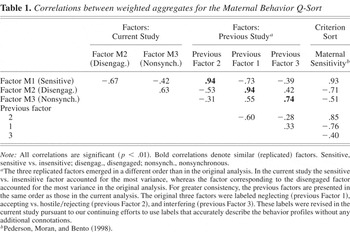
The MBQS data for the 99 mothers were q-factor analyzed. To allow for comparisons with the previous q-factor analysis of maternal interactive profiles (Bailey et al., 1999), three factors were selected for rotation. These factors collectively accounted for 67% of the total variance. Item-by-item correlations between the weighted aggregates of the factors and those identified in the original study revealed high positive correlations, providing substantial evidence that the three profiles were consistent across the two samples (see Table 1).
Correlations between weighted aggregates for the Maternal Behavior Q-Sort

The first replicated factor accounted for 42% of the variance after rotation. As shown in Table 1, this factor was highly correlated with the standard MBQS criterion sort for the prototypically sensitive mother and therefore was labeled “Sensitive versus Insensitive.” Fifty mothers had high positive loadings on this factor. An examination of the items ranked most highly on the weighted aggregate for this factor indicated that the interactive behavior of mothers with positive loadings was characterized by sensitivity, responsiveness and acceptance of their infant. Twenty-three mothers had high negative loadings on the first factor, indicating relative insensitivity toward their infant. Insensitive items included some behaviors characteristic of the second and third factors in addition to punitive, retaliatory behavior, and annoyance directed toward the baby. The 10 q-sort items most and least descriptive of mothers who loaded highly on this and other factors are listed in Appendix A.
The second factor accounted for 20% of the variance after rotation and was labeled “Disengaged.” The interactive style of the 44 mothers who loaded positively on this factor was characterized by a lack of attention to their infants' cues: for example, they might ignore or fail to notice their infant's signals while engaged with another activity such as interacting with the home visitor (see Appendix A). Only four mothers had high negative loadings on this factor.
A third factor, termed “Nonsynchronous,” accounted for 5% of the variance after rotation. Nine mothers had a high positive loading on this factor, indicating that they displayed nonsynchronous behavior during interactions, such as failing to modify the pace or intensity of their behavior in response to cues from the infant (see Appendix A). No mothers received high negative loadings on this factor.
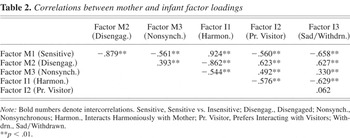
As detailed in Table 1, intercorrelations between the three factors were moderate to high. The second and third factors were negatively correlated with the standard MBQS criterion sort for the prototypically sensitive mother. Table 2 lists correlations between mother and infant factor loadings. Mothers who loaded heavily on the Sensitive versus Insensitive factor were unlikely also to load highly on the Disengaged or Nonsynchronous factors.
Correlations between mother and infant factor loadings

Infant interactive profiles
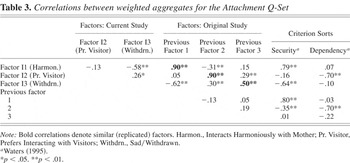
A parallel q-factor analysis was conducted using the AQS for the 99 infants, with four factors selected for rotation in an attempt to replicate the four factors identified in the previous study (Bailey et al., 1999). High item-by-item correlations were found between the first three original factors and those delineated in the present analysis (r = .95, .93, and .72, ps < .001); however, the correlation between the fourth factor in the current study that of the original study was not significant (r = .15); therefore, it was excluded from further analyses and a second varimax rotation was conducted with only the first three factors selected for rotation. The resulting item-by-item correlations between the original and replicated factors were high for the first two factors and reasonably strong for the third (see Table 3). These three factors collectively accounted for 58% of the total variance before rotation in the current sample. Following rotation, the three factors derived from q-factor analysis of the AQS accounted for 23, 23, and 12% of the variance, respectively.
Correlations between weighted aggregates for the Attachment Q-Set

Of the 99 infants, 44 had a high positive loading on the first factor, “Interacts Harmoniously with Mother,” whereas only one infant displayed a high negative loading. Children with a high positive loading on this factor used their mother as a secure base from which to explore, and enjoyed physically affectionate moments with their mothers. This factor was strongly correlated with Waters' (1995) criterion profile for a prototypically secure child (see Table 3). Items most and least descriptive of infants loading highly on this and other factors are listed in Appendix A.
Forty-four infants received a high positive loading on the second factor, “Prefers Interacting with Visitors,” reflecting their tendency both to approach the visitor and solicit positive, friendly interaction, and to display little inclination for physical closeness or interaction with their mother, in fact, to avoid the mother (see Appendix A). Three infants loaded negatively on the second factor.
Twenty infants had a high positive loading on the third factor, “Sad/Withdrawn,” characteristically exhibiting little inclination to interact with either the visitor or their mothers. These children were observed to play alone with their toys, to avoid approaching adults even if distressed, and to appear relatively sad, serious or businesslike (see Appendix A). Nine infants had a high negative loading on this factor, indicating the opposite preference; that is, they clearly wished to interact with both the mothers and the visitors. These infants appeared lighthearted and playful, showed physical affection toward their mothers, and quickly grew fond of visitors.
Correlations between infants' loadings on the three factors are presented in Table 2. Infants displaying a pattern of harmonious interaction with the mother were unlikely to load highly on the factors indicating a preference for visitor or sad–withdrawal; the latter two factors were not correlated.
Adult attachment and Strange Situation classifications
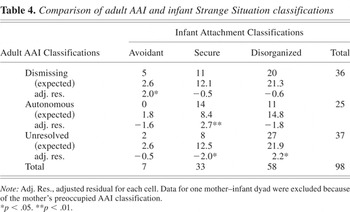
The distributions of adult and mother–infant attachment classifications are presented in Table 4. Twenty-five adolescent mothers were found to display an autonomous state of mind, 36 were dismissing, and fully 37 were judged to be unresolved.2
The transcripts of 11 mothers were considered unclassifiable (i.e., to best fit the cannot classify category; Hesse, 1996) because these mothers clearly demonstrated both dismissing and preoccupied profiles of discourse. Ten of these mothers were classified as unresolved with respect to loss or trauma; 1 received a primary classification of preoccupied. Because this was the only mother with a primary preoccupied classification her data were excluded from analyses involving AAI classifications.
Comparison of adult AAI and infant Strange Situation classifications

The distribution of Strange Situation classifications in the sample also contrasted sharply with that normally observed in a community sample: only 34 infants were found to be in a secure relationship with their mothers, 7 were in avoidant relationships, and 58 of the relationships were categorized as disorganized.3
Ten mother–infant attachment relationships were deemed to best fit the cannot classify category. All of these dyads also were classified as disorganized because of the infant's display of behavioral indices of disorganized attachment during the Strange Situation.
Consistent with previous research, there was a significant association between maternal and infant attachment classifications (Table 4), χ2 (4) = 11.104, p < .05. In 46 of 98 cases the mother's AAI corresponded with the theoretically predicted attachment relationship. As indicated by the adjusted residuals for each cell, three pairings occurred more frequently than expected because of chance: unresolved/disorganized (71%), autonomous/secure (56%), and dismissing/avoidant (14%).4
unresolved/secure pairings occurred at a level significantly below chance (21%).Attachment and behavior profiles
Mothers' attachment representations and maternal and infant behavior profiles
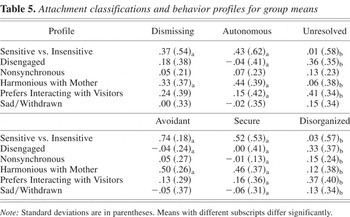
A MANOVA revealed a significant association between AAI classifications and maternal behavior profiles, Pillais' F (6, 188) = 4.32, p < .01, with significant main effects for the first two maternal factors, Fs (2, 95) = 5.27 and 8.32, respectively, ps < .01. Table 5 lists the mean factor loadings and standard deviations for dismissing, autonomous, and unresolved groups. Post hoc analyses using Tukey's honestly significant difference revealed that (a) dismissing and autonomous mothers displayed similar levels of sensitivity, and unresolved mothers were significantly less sensitive than mothers in either of these groups (ps < .01); (b) autonomous mothers were less disengaged than unresolved mothers (p < .01) and, although not statistically significant, tended to be less disengaged than dismissing mothers (p < .10).
Attachment classifications and behavior profiles for group means

A second MANOVA revealed a significant association between maternal representations of attachment classifications and the three infant interactive factors, Pillais' F (6, 190) = 2.79, p < .01. Significant main effects were found for the first two infant factors, Fs (2, 95) = 8.91 and 3.96, ps < .01 and .05, respectively. Specifically (see Table 5), (a) infants of unresolved mothers were less harmonious in interactions with their mothers than infants of dismissing or autonomous mothers (ps < .01 and .001, respectively), and (b) infants of unresolved mothers displayed a preference for the visitor over their mother to a greater extent than infants of autonomous mothers (p < .05). No significant association was found between maternal AAI classifications and the infant Sad/Withdrawn profile.
Infant attachment classifications and maternal and infant behavior profiles
Our next question concerned whether the quality of the attachment relationship, as assessed with the Strange Situation, was related to the factors derived from an analysis of mother–infant interactions in the home. A first MANOVA examining the association between Strange Situation classifications and maternal interactive profiles was significant, Pillais' F (6, 190) = 4.61, p < .01, with significant main effects for all three maternal factors, Fs (2, 96) = 12.01, 9.42, and 6.04, respectively; ps < .01. Post hoc analyses revealed an overall pattern for mothers in disorganized relationships with their infants to demonstrate less adaptive parenting behavior. They were (see Table 5) (a) less sensitive than mothers in secure or avoidant relationships (ps < .01), (b) more disengaged than mothers in secure (p < .01) or avoidant (p < .05) relationships, and (c) more nonsynchronous than mothers in secure relationships (p < .01).
A MANOVA was conducted to determine the relations between attachment classifications and the three factors characterizing infant interactional profiles. The overall effect was significant, Pillais' F (6, 190) = 3.18, p < .01, with significant main effects for all three infant factors, Fs (2, 96) = 10.41, 4.09, and 4.09, respectively; ps < .001 for the first factor and .05 for the second and third factors. Specifically, infants in disorganized relationships (see Table 5) (a) were less harmonious with their mothers than those in secure relationships (p < .01) or in avoidant relationships (p < .05), (b) preferred the visitor more than infants in secure relationships (p < .05), and (c) were more sad/withdrawn than infants in secure relationships (p < .05).
Traditional mediational analyses
Given the preceding evidence of empirical associations, a series of binary logistic regressions were conducted to test the traditional hypothesis that the association between maternal representations of attachment and the quality of the attachment relationship was mediated by the nature of the mother's interaction with her infant. Two sets of models were tested: first, the often-examined mediation by maternal interaction of the association between maternal autonomous state of mind and the secure attachment relationship; and, second, the mediation by maternal interaction of the association between unresolved maternal state of mind and the disorganized attachment relationship. The latter path was tested based on meta-analytic evidence reviewed previously (van IJzendoorn et al., 1999) and the pattern of empirical associations reported in the preceding section of this paper. The three profiles of maternal interaction were employed to test both sets of mediational models. Beta values, standard errors (SE), Wald chi-square statistics, and p values are reported. The Goodman (I) test (cf. Baron & Kenny, 1986; Preacher & Leonardelli, 2001) was used to determine whether mediation significantly reduced the strength of the association between maternal and mother–infant attachment, and Nagelkerke R2 values were reported as an estimate of the portion of variability in the dependent variable accounted for by the model. We applied a traditional Bonferroni adjustment to the Goodman (I) tests of mediation, setting the α value at .05 for each of the two sets of mediational models, resulting in an experiment-wise Type I error rate of α = .10.
Autonomous to secure attachment
The results of the first regression testing the mediation of autonomous and secure attachment were the following: (a) Strange Situation (secure vs. nonsecure) on AAI classification (autonomous vs. nonautonomous), β = 1.23 (SE = 0.48), Wald χ2 = 6.60, p < .05; (b) maternal Sensitivity factor loadings on AAI autonomy, β = 0.71 (SE = 0.42), Wald χ2 = 2.90, p < .10; and (c) infant security on both AAI autonomous classification and Sensitivity factor loadings, β = 1.07 (SE = 0.51), Wald χ2 = 4.37, p < .05, and β = 1.20 (SE = 0.41), Wald χ2 = 8.38, p < .01, respectively.
The association between AAI autonomy and infant security was reduced in Equation 3 (β = 1.07) compared to Equation 1 (β = 1.23); however, the difference between beta weights was not significant (z = 1.40, p > .10), and the association between autonomy and Sensitivity factor loadings did not reach significance. The Nagelkerke R2 value was .21 for this model.
The same analyses were the conducted to evaluate Disengaged's role as a mediator between autonomy and security and revealed (a) maternal Disengaged factor loadings on AAI autonomy, β = −2.04 (SE = 0.65), Wald χ2 = 9.88, p < .01, and (b) infant security on both autonomous status and Disengaged factor loadings, β = 0.84 (SE = 0.52), Wald χ2 = 2.61, p > .10, and β = −1.57 (SE = 0.60), Wald χ2 = 6.82, p < .01, respectively.
Again, all conditions held in the predicted direction and the effect of AAI classification on security was reduced (and no longer significant) in the third equation; however, the Goodman (I) test of mediation did not achieve significance (z = 1.95, p < .10). The Nagelkerke R2, reflecting the strength of association for this mediational model, was .18.
Finally, the mediational role of nonsynchronous maternal interaction was evaluated. The regression analyses results were (a) Nonsynchronous factor loadings on AAI Autonomy, β = −0.49 (SE = 1.08), Wald χ2 = 0.21, p < .10, (b) and infant security on both AAI Autonomy and nonsynchronous factor loadings, β = 1.31 (SE = 0.52), Wald χ2 = 6.32, p < .05, and β = −3.83 (SE = 1.27), Wald χ2 = 9.02, p < .01, respectively. The association between Nonsynchronous behavior and autonomy was not significant, and the link between autonomy and security was not reduced; therefore, a mediational model was not supported.
In summary, none of the three patterns of maternal behavior significantly mediated the association between maternal autonomous and mother–infant secure attachment.
Unresolved to disorganized attachment
Binary logistic regressions also were conducted to test the theoretical prediction that maternal behavior mediated the link between unresolved and disorganized attachment. Testing first the mediational role of the maternal sensitivity factor, a parallel set of regression analyses to those reported in the previous section produced the following results: (a) infant disorganization on AAI unresolved status (again both dichotomous variables), β = 0.99 (SE = 0.45), Wald χ2 = 4.90, p < .05; (b) maternal Sensitivity factor loadings on AAI Unresolved status, β = −1.15 (SE = 0.37), Wald χ2 = 9.45, p < .01; and (c) infant disorganization on both AAI unresolved status and Sensitivity factor loadings, β = 0.51 (SE = 0.50), Wald χ2 = 1.02, p > .10, and β = −1.60 (SE = 0.43), Wald χ2 = 13.96, p < .001, respectively.
All conditions held in the predicted direction and the effect of AAI unresolved status on infant disorganization in the Strange Situation was smaller in the third equation (β = 0.51) than in the first (β = 0.99); it was no longer significant in the third equation. There was a significant difference between these beta weights (z = −2.33, p < .016), indicating that Sensitivity mediated the association between unresolved and disorganized attachment. For the model as a whole, the Nagelkerke R2 value was .26.
The analyses were then repeated using the Disengaged factor as a potential mediator of the link between unresolved status and disorganized attachment and revealed (a) regressing maternal Disengaged factor loadings on unresolved status, β = 1.79 (SE = 0.58), Wald χ2 = 9.72, p < .01, and (b) regressing infant disorganization on both unresolved status and Disengaged factor loadings, β = 0.54 (SE = 0.49), Wald χ2 = 1.18, p > .10, and β = 2.03 (SE = 0.60), Wald χ2 = 11.60, p < .001, respectively. Again, all conditions held in the predicted direction, the effect of AAI classification on Strange Situation behavior was similarly reduced (and no longer significant) using Disengaged factor loadings to mediate the relationship, and the Goodman (I) test revealed evidence of a significant mediation (z = 2.25, p < .016; Nagelkerke R2 = .22).
Finally, the mediational role of the Nonsynchronous factor was evaluated, revealing (a) regressing maternal factor loadings on unresolved status, β = 1.60 (SE = 0.95), Wald χ2 = 2.82, p < .10, and (b) regressing infant disorganization on both unresolved status and Nonsynchronous factor loadings, β = 0.83 (SE = 0.47), Wald χ2 = 3.11, p < .10, and β = 3.33 (SE = 1.16), Wald χ2 = 8.23, p < .01, respectively. All conditions held in the predicted direction; however, the link between unresolved status and nonsynchronous behavior was not significant, nor was the mediational model (z = 1.38, p > .10; Nagelkerke R2 = .19).
To summarize these analyses, the association between unresolved and disorganized attachment was mediated by two types of maternal behavior: a lack of maternal sensitivity and a disengaged interactive style.
A relationship-focused approach: Using LCA to identify groupings based on attachment classifications and interactive behavior
As we have argued, a variable-oriented method of analysis that relies on “a few discrete points in time” may be inadequate to assess theory-based hypotheses regarding the dynamic development of attachment relationships within continuous time (Bergman, 2002). A more theoretically inclusive statistical alternative to the traditional mediational model such as LCA provides room for developing more complex theoretical accounts of the transmission of attachment. LCA is a person-oriented (or in this case, a relationship-oriented) approach resulting in a delineation of typical patterns of values of the variables under study. It allows the identification of a set of mutually exclusive patterns, or classes, of people/relationships that account for the dependence between categorical variables that describe these people/relationships. Although a large number of classes are theoretically possible, based on different combinations of relevant variables, typically only a few combinations function optimally, and therefore are most commonly observed (Bergman & Magnusson, 1997; von Eye & Bergman, 2003). The people/relationships in a class are similar to each other but are distinct from those of other classes.
LCA first addresses the question of the number of classes necessary to explain the interrelationships among the categorical variables: the minimum number of underlying groups or categories into which the data set must be divided to achieve independence among the manifest (measured) variables within each of the resultant groups. A latent variable with a single latent class is equivalent to finding no association, or independence, among the observed variables: no class distinctions are necessary to explain associations between different levels of the categorical variables, and therefore a single latent class contains all participants in the sample. However, if the categorical variables were dependent, resulting in a significant chi-square statistic, a two-class solution would be attempted to account for the majority of covariation between variables. This procedure is repeated with an increasing number of classes until the remaining association between the measured categorical variables is no longer significant.
LCA provides information on the relative size of the resultant classes, or the proportion of the sample included within each latent class. In addition, the classes can be characterized by examining the conditional probabilities for class membership. Similar to factor loadings in a factor analysis, conditional probabilities indicate the likelihood that an individual in a given class of the latent variable is at a particular level of each categorical variable. Thus, we can use conditional probabilities to describe the groups of people/relationships corresponding to each class. In the current study, for example, the majority of dyads in a specific latent class were expected to share theoretically corresponding adult attachment representations, attachment classifications, and interactive behavior profiles.
The traditional mediational model requires researchers to isolate specific attachment categories (e.g., autonomous vs. nonautonomous, secure vs. nonsecure), reducing the variability of data that can be used in any single analysis to predict the quality of attachment relationships. In contrast, LCA can be used to identify dyads or relationships that are distinguished by the patterning of categorical attachment variables (i.e., maternal attachment representations, Strange Situation classifications, and combinations of maternal and infant interactive behavior), without having to dichotomize any of these variables.
For the purpose of these analyses it was necessary to create categories of dyads based on the pattern of association between the interactive profiles of mothers and infants. First, mothers were grouped according to their highest factor loading, establishing mutually exclusive categories based on the single style that best characterized their interactions with their infant. This procedure produced four groups of mothers: Sensitive (48), Disengaged (38), Nonsynchronous (7), and Insensitive (5). Because 1 mother did not load highly on any factor, these groups accounted for 98 of the 99 mothers. Second, using a similar procedure, 93 of the children could be grouped according to their highest factor loading as follows: Harmonious (42), Prefers Visitor (37), and Sad/Withdrawn (14). These two (maternal and infant) categorical variables could not be entered into a single LCA because they were based on observations of the same interaction and thus were methodologically dependent. Thus, as a final step, we created and included in the LCA dyadic combinations of mother and infant interactive groupings that were relatively prevalent (n > 10): Sensitive mothers and Harmonious infants (n = 41), emotionally Disengaged mothers and infants who Preferred Interacting with Visitors (n = 25), and emotionally Disengaged mothers and Sad/Withdrawn infants (n = 11).5
Groups of n > 10 were selected to reduce the problem of sparse tables. The next most frequent combination applied to only five mother–infant dyads.
Total N = 76 because one dyad was excluded from Group 1 because of the mother's preoccupied classification. Dyads included in the LCA did not differ significantly from those not included with respect to household income, level of education, age at child's birth, AAI, or Strange Situation classifications.
The LCA addressed interrelations between maternal attachment representations, combined dyadic behavior categories, and dyadic attachment classifications. Each of these three variables had three categorical levels resulting in a total of 27 cells. We conducted 5,000 bootstrapping analyses to compensate for the sparse tables resulting from the participant to cell ratio (Langeheine, Pannekoek, & van de Pol, 1996; von Davier, 1997). When tables are sparse, p values may not be distributed according to a chi-square distribution. Bootstrapping analyses estimate the distributions of test statistics, resulting in calculated p values that are more valid for the sample being analyzed (Langeheine et al., 1996; Mooney & Duval, 1993). Original and bootstrapping p values are reported; however, bootstrapping p values are interpreted as a conservative estimate of p value.
The one-class model, grouping all levels of each variable as a single category, resulted in a likelihood ratio (LR) of 43.69 (p < .001; bootstrap p < .05), thus failing to account adequately for covariation between the three variables. The two-class model resulted in an LR of 14.44 (p > .10; bootstrap p > .10); therefore, it was accepted as an adequate representation of the pattern of associations between the three variables.7
A parallel LCA was conducted using either primary or secondary organized attachment classifications for adult (i.e., dismissing, autonomous, and preoccupied) and mother–infant attachment (i.e., avoidant, secure, ambivalent). A one-class model provided the best fit to the data, indicating that no meaningful patterns between different levels of the variables were identified.
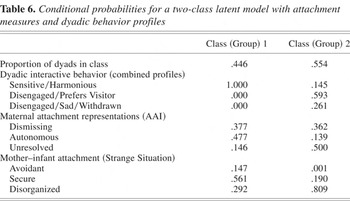
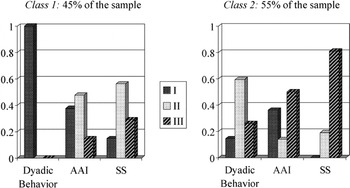
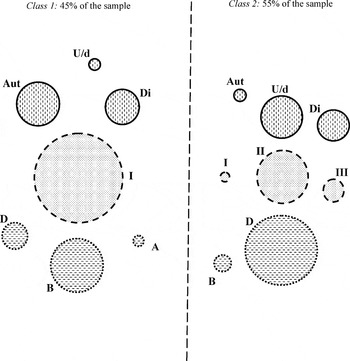
The two latent classes identified in the above analysis can best be interpreted by assessing their degree of association with each of the observed variables (i.e., dyadic behavior categories, adult, and mother–infant attachment classifications). Conditional probabilities indicating the degree of association between each of the three categorical variables and the two latent classes are listed in Table 6 and presented graphically in Figures 1 and 2. The first of the two figures illustrates the results of the LCA in a traditional bar graph format; the second presents the same data but in a format that facilitates a more holistic view of the results of the analyses. The first class, descriptive of 45% of the sample, was composed primarily of sensitive/harmonious dyads, mothers who were not classified as unresolved (i.e., either dismissing or autonomous), and secure mother–infant attachment relationships, but also some disorganized relationships. The second class accounted for the remaining 55% of the sample and primarily included dyads characterized by a combination of mothers who were disengaged and infants who either preferred interacting with the visitor or were sad/withdrawn, mothers who did not have autonomous attachment representations (i.e., either dismissing or unresolved), and disorganized mother–infant attachment relationships.
Conditional probabilities for a two-class latent model with attachment measures and dyadic behavior profiles


A graphic description of two classes identified through LCA. Dyadic interactive style (infant/mother): I, Sensitive/Harmonious; II, Disengaged/Prefers Visitor; III, Disengaged/Sad/Withdrawn; maternal state of mind: I, dismissing; II, autonomous; III, unresolved; relationship: I, avoidant; II, secure; III, disorganized.

A graphic description of two classes identified through LCA using co-occurring patterns of mother/infant behavior profiles. The diameter of the circles represents relative conditional probabilities. Maternal state of mind: Di, dismissing; Aut, autonomous; U/d, unresolved; dyadic interactive style: I, Sensitive/Harmonious; II, Disengaged/Prefers Visitor; III, Disengaged/Sad/Withdrawn; relationship: A, avoidant; B, secure; D, disorganized.
Discussion
The results of the current study expand our understanding of the interrelations between maternal representations of attachment, mother–infant interaction in the home, and the early attachment relationship in the transmission of attachment across generations. In particular, the study provides important insights into the interplay of these factors in the development of attachment disorganization and into the nature of the disorganized attachment relationship itself. A combination of traditional and person- or relationship-oriented analyses was used to identify interactive patterns and explicate these associations.
Profiles of maternal and infant interaction in the home
The distinct profiles of interaction of adolescent mothers and their infants identified in the current study closely replicate those described previously by Bailey et al. (1999). The predominant profiles of mothers were Sensitive versus Insensitive, Disengaged, and Nonsynchronous and, for the infants, Interacts Harmoniously with Mother, Prefers Interacting with Visitors, and Sad/Withdrawn. Factor analytic results suggest, therefore, that adolescent mothers and infants can be reliably described according to qualitatively distinct, characteristic patterns of early interactive behavior.
These naturally occurring profiles of interaction emerged from a quantitative analysis of empirical descriptions of the interactions of each dyad. This approach contrasts with the more common practices of using q-set descriptions to describe an individual's behavior according to its similarity to a theoretical profile, or criterion sort, of the interaction of a prototypically sensitive mother or a secure infant (Pederson & Moran, 1995a, 1996; Waters & Deane, 1985) or to characterize the interaction along a set of rationally derived behavioral domains (Pederson & Moran, 1995a; Strayer et al., 1995). These latter approaches constrain the description of the interaction more so than the q-factor approach in which the categories emerge from the naturally occurring structure of the interaction.
Given this significant methodological distinction, then, it is noteworthy that the predominant emergent maternal interactive profile in this study (and in Bailey et al., 1999) was Sensitivity versus Insensitivity. This profile was found to correlate highly with and to be theoretically consistent with the MBQS sensitivity criterion sort. The Sensitivity profile also corresponded closely to the theoretically derived sensitivity–insensitivity rating scale created by Mary Ainsworth through naturalistic observation (Ainsworth et al., 1971). Specific items that best described mothers with high Sensitive factor loadings portrayed these mothers as responding accurately to their infants' cues, in a way that satisfied the infant and, thus, resulting in positive dyadic resolutions. Behavior most characteristic of the sensitive profile of maternal interaction notably lacked any items that might be seen as indicating rejection, disconnection, or aloofness.
Equally importantly, distinct profiles of mothers whose behavior was not predominantly sensitive also emerged through the q-factor analysis. Rather than being reduced to a description of these mothers simply as lacking sensitivity (i.e., as insensitive), we were able to identify substantive behavior patterns beyond the sensitivity/insensitivity spectrum. The specification of such patterns is an essential step in elaborating the details of the attachment developmental system. The two additional patterns, Disengaged and Nonsynchronous, also bore a distinct conceptual resemblance to two of Ainsworth's rating scales: accessibility–ignoring and cooperation–interference (Ainsworth et al., 1971). The majority of mothers who did not load highly on the Sensitive versus Insensitive factor displayed a primarily Disengaged interactive pattern: they frequently failed to notice their infants or respond to their signals, and rarely initiated interactions with them. In other words, they behaved in a way that suggested that they did not have an ongoing social or emotional relationship with their infant, apart from meeting some instrumental needs. At its extreme, such a lack of relational involvement constitutes emotional neglect (Hildyard & Wolfe, 2002). The Nonsynchronous factor accounted for a small but meaningful portion of the variance among maternal interactive patterns. Mothers loading heavily on this factor interacted frequently with their infants but such interactions tended not to be well resolved because the mother's behavior was directed according to her own agenda rather than to the infant's signals and needs.
In our original application of a q-factor approach to the description of early interaction, Bailey et al. (1999) found that the patterns of maternal interaction in an adolescent sample differed from that in a community sample: adolescent mothers were best described using a three-factor solution (corresponding to three conceptually distinct behavioral profiles), whereas adult mothers at low social risk could be described along a single dimension corresponding to sensitivity versus insensitivity. In terms used by von Eye and Bergman (2003) this distinction entails a lack of dimensional identity in the maternal behavior of mothers at differing social risk and underscores the possibility that the interactive patterns necessary to capture variation in interaction in one population may differ from those in another. This point has been similarly argued by researchers studying crosscultural and subcultural differences in attachment (Chao, 2001; Rothbaum, Weisz, Pott, Miyake, & Morelli, 2000, 2001; van IJzendoorn & Sagi, 1999, 2001). The three behavior patterns replicated in the current study are similar to interactive patterns observed in depressed and abusive mothers (Field, Healy, Goldstein, & Guthertz, 1990; Oldershaw, Walters, & Hall, 1989), suggesting that these patterns may be characteristic of a range of populations at relatively high social risk.
The q-factor approach also was used to explore infant interactive behavior. Three distinct profiles of interaction emerged: Interacts Harmoniously with Mother, Prefers Interacting with Visitors, and Sad/Withdrawn. Although descriptions of mother and infant behavior shared considerable method variance, the fact that a mother whose behavior was principally sensitive tended to have a child whose interaction was predominantly harmonious reflects an internal consistency. The behavior featured in the Harmonious profile overlapped considerably with that of the prototypically secure infant reflected in the criterion sort for the AQS (Waters, 1987): behaviors descriptive of this profile were consistent with the classical notion of effectively using the mother as a secure base, returning to her as needed, deriving comfort from her, and enjoying her physical closeness. Indications of anger, conflict, and fussiness were rarely seen in infants loading highly on this factor.
Two distinct profiles of interaction emerged as characteristic of those infants who were not harmonious in their interactions with their mothers: Prefers Visitor and Sad/Withdrawn. These two behavior patterns most often were observed together with a maternal Disengaged interactive style. Such a match is consistent with the attachment theory assertion that a mother and infant adopt complementary patterns that allow for a sustainable relationship (Ainsworth et al., 1971). That is, infants loading highly on the Prefers Visitor factor seldom approached their mother for assistance or other interaction but were instead more likely to approach visitors. This pattern suggests an even greater independence than would be expected of infants in avoidant relationships, who typically approach the mother in object-mediated interaction with toys even if avoiding potentially affect laden interaction. Infants loading highly on the Sad/Withdrawn factor appeared “serious, sad, or annoyed” (AQS item 9), and did not tend to appreciate interactions with either mother or visitors. This behavior pattern, once again, is potentially detrimental to the infant's development because it suggests little interest in establishing social contact of any kind.
Associations between interactive behavior and unresolved and disorganized attachment
One of the most striking findings of this study was that both maternal unresolved attachment and disorganized relationships were associated with distinct patterns of naturalistic maternal and infant interactive behavior in the home. These two classifications were associated with a mother's display of low maternal sensitivity and a disengaged style at home. Moreover, mediational analyses confirmed that both these maternal behavior profiles mediated the link between unresolved and disorganized attachment. The emergence of such robust organizational patterns based on disorganized/unresolved attachment underscores the extent to which this population was at substantial developmental risk. This risk status could be seen in other features of the sample, as well, including a high frequency of unresolved attachment consistent with the fact that approximately one-half reported childhood histories of trauma in the form of physical or sexual abuse (Moran et al., 2005). Similarly, disorganization was more prevalent than is typical of low SES and adolescent mother samples but similar to that observed in studies of high-risk dyads, including those featuring maltreatment or substance abuse (van IJzendoorn et al., 1999).
As discussed previously, our reading of a recent meta-analysis suggested that maternal sensitivity might be implicated in the development of disorganized attachment, particularly in populations at high social risk such as that studied here (van IJzendoorn et al., 1999) even though such a role is not explicitly predicted by extant attachment theory. We not only found evidence to confirm this link but demonstrated that maternal insensitivity, as well as maternal disengagement, statistically mediated the association between maternal unresolved representations and disorganization. These associations are mirrored strikingly in the results of the LCA (Figures 1 and 2). Here again, this mechanism of transmission is not explicitly predicted by extant theory of the development of disorganized attachment or characteristic of lower risk populations and, thus, begs a modest conceptual elaboration.
Infants in disorganized relationships display atypical or contradictory behaviors in the presence of their caregiver during the Strange Situation procedure, behaviors that appear illogical unless we assume that the infant is either frightened of the caregiver or otherwise inhibited about approaching the caregiver when distressed. Physiological observations of these infants suggest that such distress is not resolved through interaction with the mother (Hertsgaard, Gunnar, Erickson, & Nachmias, 1995; Spangler & Grossmann, 1993). On the basis of the results of the current study, we propose that this combination of distress without a mechanism of resolution provides an accurate portrait of a child of a disengaged, inaccessible mother. Such infants are left without the maternal support and scaffolding necessary for the acquisition of emotion regulatory strategies and have more difficulty coping with stressors than other infants (Briere, 2002; DeOliveira, Bailey, Moran, & Pederson, 2004; Hildyard & Wolfe, 2002). When confronted, therefore, with the high stress of the Strange Situation, their impulse to approach their caregiver for reassurance is incompatible with their repeated experience of their mother's disengagement and emotional unavailability. In contrast to infants in avoidant or ambivalent relationships, their mothers' substantial disengagement leaves them without any organized strategy and fated, therefore, to display the atypical, anomalous patterns characteristic of disorganized attachment.
Maternal insensitivity also was found to mediate the association between unresolved and disorganized attachment. At its extreme, maternal insensitivity encompasses displays of overt hostility and punitive or retaliatory behavior, which could be construed as constituting emotional abuse. Maternal displays of hostile and punitive behavior (often coupled with high levels of disengagement) would cause an infant to experience heightened negative emotions when interacting with the mother, without recourse to a strategy for coping with these emotions. Much like the infant of a disengaged mother, these infants would therefore lack an organized strategy for coping with the stress of the Strange Situation procedure. It should be noted, however, that although the MBQS profile of a substantial number of mothers loaded highly on both the Disengaged and (negatively) the Sensitive versus Insensitive factors, most mothers had higher factor loadings on the Disengaged factor, suggesting that the predominant behavior pattern of adolescent mothers lacking in sensitivity was disengagement. It makes sense, then, that both insensitivity and disengagement mediated the association between unresolved and disorganized attachment.
It is noteworthy that some of the items linked to those mothers loading heavily on insensitivity included punitive, retaliatory behavior, and annoyance directed toward the baby. Lyons-Ruth and her colleagues (Lyons-Ruth, Bronfman, & Atwood, 1999; Lyons-Ruth, Bronfman, & Parsons, 1999; Lyons-Ruth et al., 2005) have suggested that just such patterns of maternal behavior are associated with the hostile/helpless of mind and responsible for the development of disorganized attachment in higher risk populations. Our findings lend additional credence to the suggestion that the mechanisms of transmission of disorganized attachment in such populations may differ from that in lower risk groups.
Our findings of such systematic associations between disorganization and home-based maternal behavior point to a broader conceptualization of the development and consequences of disorganized attachment than now available. Current theories of the origins of disorganization focus on the short-term disorganizing or disorienting impact of the mother's atypical behavior on her infant's ability to sustain an organized strategy of interaction in response to attachment-related stress (Main & Hesse, 1990). Implicit in these models is the assumption that an underlying organized interactive strategy (avoidant, secure, or ambivalent; traditionally assigned as a secondary classification) is available to the infant under situations that do not feature high levels of attachment-related stress. Taking this argument one step further, current models of disorganization suggest that infants who are disorganized in the Strange Situation should revert to these underlying, organized patterns in the home. In sharp contrast to this model, we have in the preceding proposed that the conditions thought to give rise to disorganized behavior in the Strange Situation are also manifested in the formative social interactions that comprise the everyday life of the child: disorganized attachment behavior may result from a dyadic regulatory deficit shaped by and reflected in much of the normative interactions of the mother and infant. We found that disorganized infants displayed patterns of interaction in the home that were distinct from those displayed by infants with an organized attachment system: most notably, children classified as disorganized were more likely to actively avoid their mother in favor of the visitor, and were less likely to display harmonious patterns of interaction with their mothers, including patterns of secure base behavior and physical closeness with their mother. These results are consistent with and substantially elaborate the findings of van Bakel and Riksen-Walraven (2002), who found that 15-month infants classified as disorganized were less compliant at home, more avoidant, and displayed more negative behavior. Consistent with the proposed model, naturalistic infant (and maternal) interactive behavior was systematically related to disorganized attachment behavior and maternal unresolved state of mind.
Our proposal, based on evidence of disorganization-specific patterns of interaction in the home, that quite broad features of the naturalistic interaction of mother and infant are implicated in the development of disorganized attachment is not incompatible with a role for markedly atypical or frightened/frightening behavior as portrayed by extant theoretical models (e.g., Lyons-Ruth, Bronfman, & Parsons, 1999; Lyons-Ruth et al., 2005; Main & Hesse, 1990). The proposal raises the possibility, however, that distinct patterns of substantially disrupted social interaction have a more pervasive impact on the relationship than previously recognized and may, themselves, play a role in the development of disorganization in at-risk populations in which parental sensitivity is lower and more variable. This suggestion is supported by our observation of differential effect sizes reported for the association between insensitivity and disorganization: for low SES samples, adjusting for sample size, an average of >.28 compared to an average effect size of only .13 for middle-class samples (see van IJzendoorn et al., 1999). In accordance with a stress-diathesis model, maternal displays of discrete atypical or frightened/frightening behaviors may exert an additive or synergistic effect when combined with pervasive suboptimal parenting: an infant of an insensitive and/or disengaged mother would have an underdeveloped capacity for regulating stress, individually or dyadically, and thus would be more vulnerable to stress caused by the maternal display of atypical behaviors. Alternatively, maternal atypical behavior could constitute a separate and distinct pathway to disorganization. Our LCA revealed that some sensitive mothers also developed disorganized attachment relationships with their infants, suggesting that for these dyads other factors, perhaps maternal atypical behaviors, led to disorganization.
Associations between interactive behavior and organized patterns of attachment
The current study confirmed a number of important, theoretically predicted associations between secure/autonomous attachment and patterns of interactive behavior in the home: infants classified as secure were more likely to demonstrate physical affection and secure base behavior toward their mothers (evidenced by a harmonious behavior profile), and were less likely to show a preference for playing with the visitor over their mother. Likewise, their mothers displayed more sensitivity, and less disengagement and nonsynchrony, than mothers in disorganized relationships. Mothers classified as autonomous also displayed higher levels of sensitivity and were less disengaged than those classified as unresolved; their infants engaged in more harmonious interactions with them, compared to infants of unresolved mothers. At the same time, we failed to find evidence that maternal behavior mediated the link between autonomous and secure attachment using traditional statistical techniques, a link that has been demonstrated in some studies of lower risk samples (e.g. Pederson, Gleason, et al., 1998; Raval et al., 2001; van IJzendoorn, 1995). This failure to confirm one of the core predictions of attachment theory is consistent with Atkinson et al.'s (2005) characterization of the mediational model as ephemeral, dependent upon particular descriptive methods and the population under study. In addition, we also observed atypical associations between dismissing attachment representations, avoidant attachment relationships, and maternal sensitivity. These results and others not entirely consistent with the predictions of extant attachment theory were clarified somewhat by a consideration of the results of the LCA.
Maternal representations, interactive profiles, and the attachment relationship: Added value of a relationship-oriented approach using LCA
Through the identification of dominant combinations of maternal attachment representations, interactive behavior, and mother–infant attachment relationships, the LCA proved useful both as a confirmation and elaboration of the results of more traditional analyses. Perhaps most importantly, the approach allowed us to seek emergent patterns in addition to testing specific theoretical hypotheses of associations and mediation.
These emergent patterns can be seen in Figures 1 and 2, which illustrate the two resultant classes. In each figure the left-hand frame can be thought of as a latent class representing a developmental system primarily associated with organized patterns of attachment. Many of the principal results of the MANOVAs are mirrored in this class: the system depicts a clear association between interactions characterized by sensitive maternal and harmonious infant behavior, and autonomous and secure attachment. Such associations clearly are consistent with the strongest predictions of attachment theory and substantially parallel the results of the MANOVAs discussed previously.
The right-hand cells of the two figures depict a developmental system that is predominantly associated with disorganized development. The majority of associations within this system also were largely consistent with results of the traditional MANOVAs and mediational analyses. As mentioned earlier, some aspects of the overall pattern of this system confirm current theories of the development of disorganization, whereas others suggest the need for elaborations of these accounts. In the former category, there is a clear association between unresolved maternal state of mind and disorganized attachment relationships. In addition, mothers within the disorganized system were most likely to behave in a disengaged and, to a lesser extent, nonsynchronous manner, and infant interaction was predominantly characterized by an avoidance of the mother and a preference for the visitor, or by sadness and withdrawal.
By contrast, the more complex results made possible by the LCA reveal a number of elements within the predominantly organized model that do not follow in a straightforward manner from classical attachment theory and are worthy of future investigation. For example, dismissing attachment was represented within both systems, and avoidant attachment primarily within the organized system. Whereas a dismissing maternal state of mind and avoidant attachment relationships traditionally are associated with insensitive maternal interaction, it is striking here that within the organized system, dismissing and avoidant attachment are associated predominantly with sensitive parenting. These associations are consistent with the MANOVA results, and reflect a diversity in developmental pathways that is not typically observed in adult, community samples. It may be, for example, that sensitive interaction by a mother can be associated with a dismissing state of mind more often than has been suggested by other analyses or that such associations are more characteristic of adolescent than adult, community samples. This same possibility is also raised by considering the relatively strong association between a dismissing state of mind and a harmonious pattern of infant interaction, suggesting that, at least for some dyads, dismissing mothers sustain a smooth and integrated natural pattern of interaction with their infants in the home.
Dismissing attachment representations were not always associated with optimal relational patterns, however; mothers with a dismissing attachment representation were equally represented within the maternal and infant classes predominantly related to disorganized attachment. Most mothers within the disorganized system displayed a disengaged interactive pattern, and infants tended to prefer interacting with the visitor. This suggests that the interactive behavior of mothers classified as dismissing varied considerably. MANOVA results revealed that although dismissing and autonomous mothers demonstrated similar mean levels of sensitivity, there was a trend toward dismissing mothers behaving in a more disengaged fashion, an interactive style that clearly was associated with disorganized attachment.
Finally, although disorganized attachment was clearly more frequent within what we have referred to as the disorganized class, the organized grouping also was substantially linked to the occurrence of disorganized mother–infant attachment relationships. This finding raises the possibility that even when key elements of the system are present (e.g., sensitive maternal interaction and harmonious infant patterns), other factors may be implicated in the development of a disorganized relationship. These factors may include maternal behaviors considered to be independent of sensitivity, such as frightened or frightening behavior, which have been associated with disorganized attachment (Main & Hesse, 1990; van IJzendoorn et al., 1999).
We also found that if the alternative, organized relationship classifications for those dyads identified as disorganized were used, this same LCA produced a one-class model, indicating that no meaningful patterns were identified. This contrasting finding reinforces one of the central conclusions of this study: disorganized attachment is associated with a distinctive, atypical pattern of interaction that is a pervasive part of the dyad's daily life rather than limited only to situations of high attachment-related stress.
One of the key advantages of the use of the relationship-centered approach reflected by the LCA is that it makes explicit such patterns of associations that are not entirely consistent with the expectations of commonly endorsed versions of attachment theory and are less visible in more traditional approaches. For example, the basic pattern of results in this study indeed confirmed current theory by finding statistically significant associations between autonomous and unresolved maternal states of mind and secure and disorganized attachment relationships, respectively. A closer look at the cross tabulation, however, reveals in addition a sizeable theoretical mismatch in the associations between organized states of mind and disorganization: 56% of the infants whose mothers displayed dismissing states of mind were in disorganized relationships and 44% of the infants with autonomous mothers were disorganized. These associations belie any straightforward expectation of a developmental link of disorganized/organized maternal representations and disorganized/organized attachment relationships. In our interpretations of the results of traditional statistical analyses we tend to set aside such mismatches as measurement error or the product of sample anomalies. In contrast, as shown by the forgoing discussion, the LCA revealed a series of quite specific associations that identify the systematic associations that are the basis for these empirical complexities.
The current study thus supports the development and use of nontraditional descriptions of mother–infant interaction and the exploration of diverse analytic methods in our study of the development of attachment in naturalistic circumstances. The results provide confirmation of a number of theoretical predictions regarding the interrelations of maternal attachment representations, mother–infant interaction, and the attachment relationship but also raise a number of questions, especially concerning the development of disorganized patterns of attachment. Many of these questions suggest substantial differences between the attachment patterns and processes at work in higher risk samples and those in lower risk community-based samples.
Appendix A
Items most and least descriptive of maternal and infant factors identified through q-factor analysis. (Note: The first item is most or least like, the second item is second-most or least like, etc.)
Mothers: Factor 1 (Sensitive vs. Insensitive)
Most like:
- Interprets cues correctly as evidenced by B's response
- Speaks to B directly
- Responds to B's signals
- Interventions satisfy B
- Shows delight in interaction with B
- Notices when B is distressed (e.g., cries, fusses, or whimpers)
- When B is distressed, M is able to identify the source.
- Well-resolved interaction with B—interaction ends when B is satisfied—also consider the termination of ongoing interactions that B is enjoying
- Monitors B's activities during visit
- Realistic expectations regarding B's self-control of affect
Least like:
- Punitive or retaliatory during interactions with B
- Consistently unresponsive
- Interactions with B are characterized by conflict
- Awkward and ill at ease during intimate interactions with B
- Is irritated by demands of B for physical contact or proximity
- Scolds or criticizes B
- Provides B with little opportunity to contribute to the interaction
- Nonsynchronous interactions with B, that is, the timing of M's behavior out of phase with B's behavior
- Responds only to frequent, prolonged, or intense distress
- Display of affect does not match B's display of affect (e.g., smiles when B is distressed)
Mothers: Factor 2 (Disengaged)
Most like:
- During interaction with visitor, does not notice B
- Not skillful in dividing her attention between B and competing demands and therefore misses B's cues
- Interactions with B are incomplete
- Appears to “tune out” and not notice bids for attention
- Content and pace of interactions set by M rather than according to B's responses
- Ignores positive signals (vocalizations, smiles, reaches)
- Nonsynchronous interactions with B, that is, the timing of M's behavior out of phase with B's behavior
- Interactions with B are object oriented (e.g., with toys, food)
- Redirects B's bids for proximity and/or contact without a transition period to facilitate smooth interactions
- Breaks off from B in midinteraction to speak to visitor or attend to some other activity
Least like:
- Frequently and spontaneously expresses positive feelings to B
- Seeks interactions with B
- Responds to B's distress and nondistress signals even when engaged in some other activity such as having a conversation with visitor
- Anxious about B's exploration (e.g., hovers over B)
- Well-resolved interaction with B—interaction ends when B is satisfied—also consider the termination of ongoing interactions that B is enjoying
- Vocalizes to B throughout the visit
- Responds immediately to cries/whimpers
- Praises B
- Gives signal or explanation to B when leaving the room
- Realistic expectations regarding B's self-control of affect
Mothers: Factor 3 (Nonsynchronous)
Most like:
- Content and pace of interactions set by M rather than according to B's responses
- Uses verbal prohibitions (e.g., “no or don't”)
- Nonsynchronous interactions with B, that is, the timing of M's behavior out of phase with B's behavior
- During ongoing interactions, misses “slow down” or “back off” signals from B
- Instructive during interactions with B
- Teases B to promote continued interaction/contact
- Interactions with B are incomplete
- Interactions with B are object oriented (e.g., with toys, food)
- Annoyed by B's uncooperative behavior
- Display of affect does not match B's display of affect (e.g., smiles when B is distressed)
Least like:
- Well-resolved interaction with B—interaction ends when B is satisfied—also consider the termination of ongoing interactions that B is enjoying
- Respects B as an individual, that is, is able to accept B's behavior even if it is not consistent with her wishes
- Builds on the focus of B's attention
- Slows pace down, waits for B's response during interactions
- Anxious about B's exploration (e.g., hovers over B)
- Interactions appropriately vigorous and exciting as judged from B's responses
- Plays social games with B
- Responds to B's distress and nondistress signals even when engaged in some other activity such as having a conversation with visitor
- Realistic expectations regarding B's self-control of affect
- Home shows little evidence of presence of B
Infants: Factor 1 (Interacts Harmoniously with Mother)
Most like:
- Child clearly shows a pattern of using mother as a base from which to explore
- Child keeps track of mother's location when he plays around the house
- If held in mother's arms, child stops crying and quickly recovers after being frightened or upset
- Child puts his arms around mother or puts his hand on her shoulder when she picks him up
- Child readily shares with mother or lets her hold things if she asks to
- Child asks for and enjoys having mother hold, hug, and cuddle him
- When child is bored, he goes to mother looking for something to do
- Child often hugs or cuddles against mother, without her asking or inviting him to do so
- Child is lighthearted and playful most of the time
- Child readily lets new adults hold or share things he has, if they ask to
Least like:
- Child easily becomes angry at mother
- Child sometimes signals mother (or gives the impression) that he wants to be put down, and then fusses or wants to be picked right back up
- When child returns to mother after playing, he is sometimes fussy for no clear reason
- Child acts like he expects mother to interfere with his activities when she is simply trying to help him with something
- Child is easily upset when mother makes him change from one activity to another
- Child enjoys climbing all over visitors when he plays with them
- When mother does not do what child wants right away, child behaves as if mom were not going to do it at all
- Child is demanding and impatient with mother; fusses and persists unless she does what he wants right away
- When child is near mother and sees something he wants to play with, he fusses or tries to drag mother over to it
- Child easily becomes angry with toys
Infants: Factor 2 (Prefers Interacting with Visitors)
Most like:
- Child is independent with mother; prefers to play on his own; leaves mother easily when he wants to play
- When child finishes with an activity or toy, he generally finds something else to do without returning to mother between activities
- Rarely asks mother for help; middle if child is too young to ask
- Child laughs and smiles easily with a lot of different people
- On average, child is a more active type person than mother
- Child is very active, always moving around; prefers active games to quiet ones
- Child easily grows fond of adults who visit his home and are friendly to him
- If visitors laugh at or approve of something the child does, repeats it again and again
- Child is strongly attracted to new activities and new toys
- Child ignores most bumps, falls, or startles
Least like:
- When child is near mother and sees something he wants to play with, he fusses or tries to drag mother over to it
- When child finds something new to play with, he carries it to mother or shows it to her from across the room
- Child enjoys climbing all over mother when they play
- Child stays closer to mother or returns to her more often than the simple task of keeping track of her requires
- Child uses mother's facial expressions as good source of information when something looks risky or threatening
- Child asks for and enjoys having mother hold, hug, and cuddle him
- When child is bored, he goes to mother looking for something to do
- Child often hugs or cuddles against mother, without her asking or inviting him to do so
- Child wants to be the center of mother's attention. If mom is busy or talking to someone, he interrupts
- Child clearly shows a pattern of using mother as a base from which to explore
Infants: Factor 3 (Sad/Withdrawn)
Most like:
- Child is often serious and businesslike when playing away from mother or alone with his toys
- When mother does not do what child wants right away, child behaves as if mom were not going to do it at all
- Child becomes shy or loses interest when an activity looks like it might be difficult
- Child cries as a way of getting mother to what he wants
- Rarely asks mother for help; middle if child is too young to ask
- Child largely ignores adults who visit the home; finds his own activities more interesting
- Child quickly loses interest in new adults if they do anything that annoys him
- When given a choice, child would rather play with toys than with adults
- Child has trouble handling small objects or putting small things together
- Child's initial reaction when people visit the home is to ignore or avoid them, even if he eventually warms up to them
Least like:
- Child is lighthearted and playful most of the time
- Child copies a number of behaviors or way of doing things from watching mother's behavior
- Child quickly greets his mother with a big smile when she enters the room (shows her a toy, gestures, or says “Hi, mommy”)
- Child tries to get mother to imitate him, or quickly notices and enjoys it when mom imitates him on her own
- Child clearly shows a pattern of using mother as a base from which to explore
- When the family has visitors, child wants them to pay a lot of attention to him
- When child finds something new to play with, he carries it to mother or shows it to her from across the room
- Child puts his arms around mother or puts his hand on her shoulder when she picks him up
- Child enjoys climbing all over mother when they play
- Child easily grows fond of adults who visit his home and are friendly to him