Introduction
More than half of plant dry matter (DM) consists of carbohydrates, of which starch and cellulose are considered to be the most abundant polysaccharides. Natural substances contained in forages and grains may reduce the digestibility of polysaccharides by decreasing the activity of ruminal microbiota or by protecting the cell wall (Minson, Reference Minson1990). Condensed tannins and methylcellulose prevent microbial attachment or promote microbial detachment, partially or completely inhibiting cellulose digestion. Moreover, the protein matrix of cereal grains is extremely resistant to microbial attachment and penetration (McAllister et al., Reference McAllister, Bae, Jones and Cheng1994).
Applied biotechnology and feed industries currently offer exogenous enzymes as feed additives for enhancing the nutritive value of animal diets. There are many studies about adding enzyme preparations to diets for non-ruminant species, but research for ruminants is more limited. Beauchemin et al. (Reference Beauchemin, Colombatto, Morgavi and Yang2003) reviewed the use of enzymes in ruminants indicating an increase in DM and fibre digestion in vitro, in situ or in vivo and an increase in milk yield and weight gain in cattle, although results did not agree in all cases. Much of the variability can be attributed to factors such as type, dose and activity of the enzyme; application method and portion of the diet (forage or concentrate) to which the enzyme was applied and differences in the physiological status of the test animals (Bowman et al., Reference Bowman, Beauchemin and Shelford2002; Beauchemin et al., Reference Beauchemin, Colombatto, Morgavi and Yang2003). Addition of enzymes in the concentrate portion of the diet is especially interesting in practice when enzyme activity is not compromised (Bowman et al., Reference Bowman, Beauchemin and Shelford2002 and Reference Bowman, Beauchemin and Shelford2003).
The use of enzymes in sheep diets has been limited to digestibility trials in wethers (Lee et al., Reference Lee, Hass and Cheng2000; Pinos-Rodríguez et al., Reference Pinos-Rodríguez, González, Mendoza, Bárcena, Cobos, Hernández and Ortega2002) and to growth trials with fattening lambs (McAllister et al., Reference McAllister, Stanford, Bae, Treacher, Hristov, Baah, Shelford and Cheng2000; Muwalla et al., 2007; Miller et al., 2008). As far as we know, however, only one experiment has been conducted with suckling sheep and goats (Titi and Lubbadeh, Reference Titi and Lubbadeh2004). The objective of this study was to evaluate the effects of diet supplementation with a commercial xylanase and cellulase fibrolytic enzyme product included in the concentrate on the lactation performances of suckling ewes.
Material and methods
Two experiments aiming to investigate the effects of adding a fibrolytic enzyme product to the diet of dairy ewes were conducted on the experimental farm of the ‘Servei de Granges i Camps Experimentals’ of the Universitat Autònoma de Barcelona in Bellaterra (Spain). The experimental and animal care procedures were approved by the Ethical Committee on Human and Animal Experimentation of the Universitat Autònoma de Barcelona (Reference CEEAH 03/429).
Lactation experiment
Animals and treatments
Experiment consisted of a 2 × 2 replicated factorial design in which two dairy sheep breeds in early lactation were used to investigate the effects of two dietary treatments consisting of including or not including a fibrolytic enzyme product in the concentrate. In all, 72 multiparous ewes from two dairy breeds (Manchega and Lacaune) were used from weeks 1 to 4 after lambing. Ewes (Manchega, n = 36, 74.6 ± 1.2 kg BW and Lacaune, n = 36, 73.1 ± 1.4 kg BW; mean ± s.d.) were housed in eight balanced groups (nine ewes per group) according to breed, number of lactation, BW and body condition score (BCS) at lambing. Ewes were confined to straw-bedded pens and the balanced groups of each breed randomly assigned to the dietary treatments. Lambs were allowed to suckle from their mothers 24 h a day until week 4 after birth.
Dietary treatments started immediately after lambing and were control (without enzyme) and enzyme (supplemented in the concentrate).
Diets
The fibrolytic enzyme product used was a commercial product (Promote®; Agribrands International, St Louis, MO, USA) characterized by high cellulase (130 U/g) and xylanase (120 000 U/g) activities (P. Frumholtz, Agribrands International, personal communication).
Ewes and lambs were moved to the experimental pens after lambing where the ewes received an ad libitum total mixed ration based on 70% forage (dehydrated mixture of 50% alfalfa and 50% maize-whole plant) and 30% concentrate pellets to which the fibrolytic enzyme product was or was not added. Lambs were supplemented with creep-feeding using a commercial starter concentrate (DM, 87.9%; CP, 19.3%; ether extract, 3.3%; NDF, 17.0%; DM basis; Fimsa, La Bisbal del Penedés, Tarragona, Spain).
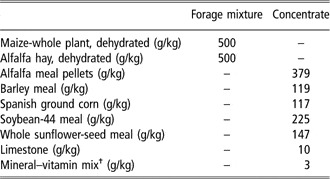
The enzyme product was added to the entire concentrate according to the conclusions of Bowman et al. (Reference Bowman, Beauchemin and Shelford2002). The liquid enzyme preparation was sprayed (0.47 ml/kg of concentrate) onto the previously manufactured and cooled concentrate pellets in a horizontal mixer. Diet ingredients are shown in Table 1. The total mixed ration was offered twice daily (0900 and 1500 h) at a rate of 115% of the voluntary intake from the previous day. The concentrate was included in the ration at a rate of 0.8 kg per kg of forage offered. Fresh water was permanently available in the pens.
Ingredients of the experimental diets

†Supplied by Agribrands Europe-España, Barcelona, Spain. The preparation contained per kg of product: 105.0 g Ca, 20.0 g Mn, 17.5 g Fe, 15.0 g Zn, 250 mg I, 100 mg Se, 50 mg Co, 3600 IU of vitamin A, 700 IU of vitamin D3, 22 000 IU of vitamin E (α-tocopherol).
Fill value evaluation experiment
In all, 24 dry and open ewes from the two dairy breeds (Manchega, n = 12, 71.4 ± 1.9 kg BW and Lacaune, n = 12, 70.3 ± 1.4 kg BW) were used over a 2-week adaptation period and a 5-week measurement period to estimate the ration fill value (FV). The FV was calculated as defined by the INRA system (Jarrige, Reference Jarrige1989) by dividing the voluntary DM intake of the reference pasture hay (75 g DM/kg BW0.75) by the measured DM intake of that forage in wethers. In our case we used dry and open ewes according to Bocquier et al. (Reference Bocquier, Thériez and Brelurut1987) and Caja et al. (Reference Caja, Bocquier, Pérez-Oguez and Oregui1997 and Reference Caja, Marie, Bocquier, Ferret, Gasa, Pérez-Oguez, Plaixats and Oregui2002). The experiment consisted of a 2 × 2 replicated factorial design as in the lactation experiment.
The dry and open ewes were distributed into four balanced groups (six ewes per group) according to breed, BW and BCS, and housed in straw-bedded pens next to the dairy ewes. Straw was not replaced during the experiment to prevent consumption. Diets, feeding management, and BW and BCS measurements were similar to those used in the lactation experiment.
Measurements, sampling and analysis
Enzyme activity
Endoglucanase activity of the fibrolytic enzyme product was measured using acetic acid/di-sodium phosphate buffer (pH 6.5) and carboxymethylcellulose as substrate (C-5678; sodium salt, medium viscosity; Sigma, St. Louis, MO, USA). A solution was prepared by adding 20 μl of enzyme solution (4%) and 250 μl of substrate solution to a tube containing 250 μl of buffer. The mixture was incubated at 39°C for 3 h (Pastor et al., Reference Pastor, Pujol, Blanco, Vidal, Torres and Díaz2001), and the reaction was stopped by adding Somogyi reagent and boiling for 10 min. For background corrections, incubations were also carried out with samples in the absence of substrate and enzyme solutions alone plus buffer solution. Concentrations of reducing sugars were determined by the Nelson–Somogyi copper reduction method (Somogyi, Reference Somogyi1952) with glucose as the standard. One unit of enzymatic activity was defined as the amount of enzyme that catalyzed the release of 1 nmol of reducing sugar equivalent per min under the assay conditions described. Reducing sugars were quantified spectrophotometrically (Spectrophotometer UV-120-01; Shimadzu, Kyoto, Japan) at 520 nm, using glucose as the standard (González, 2004).
Animal performance
Individual milk yield during suckling was estimated fortnightly using the oxytocin method (Doney et al., Reference Doney, Peart, Smith and Louda1979) with machine milking according to Casals et al. (Reference Casals, Caja, Such, Torre and Calsamiglia1999). Ewes were milked twice at a 4-h interval after intravenous injections of 2 IU oxytocin (Veterin Lobulor; Laboratorios Andreu, Barcelona, Spain). Machine milking was done in a double-12 stall parallel milking parlor (Westfalia Landtechnik, Granollers, Spain) with recording jars. A small amount of concentrate (50 g per ewe) was also offered at each milking in the milking parlor to encourage the ewe to enter. Milking was conducted at a vacuum pressure of 42 kPa, a pulsation rate of 120 pulses/min and a pulsation ratio of 50%, as indicated by Such et al. (Reference Such, Caja, Fernández, Molina and Torres1999) for Manchega and Lacaune ewes. Between these two milkings, ewes were prevented from suckling their lambs. Milk secretion during 4 h was assumed to be the normal rate of milk secretion and was extrapolated at 24 h to estimate daily milk yield.
Intake of DM was calculated for each ewe group as the difference between the total amount offered and the amount refused daily. Individual lamb BW, and BW and BCS of the ewes were recorded weekly throughout the experiment. The BCS was measured on a scale of 0 to 5 (Russell et al., Reference Russell, Doney and Gunn1969) to the nearest 0.25.
Samples and analysis
Daily samples of the ration and orts were collected and composited by period for each group and treatment throughout the experiment for analysis of composition. Samples were ground to pass through a 1-mm stainless-steel screen and were analyzed for organic matter and DM (AOAC, 2004). The CP (N × 6.25) was determined using a Kjeltec Auto 1030 Analyzer (Tecator, Hogänäs, Sweden). The method of Van Soest et al. (Reference Van Soest, Robertson and Lewis1991) was used to analyze NDF and ADF using the Ankom200 Fiber Analyzer incubator (Ankom Technology, Fainport, NY, USA) adding amylase and sodium sulfite solutions.
Milk samples from the second milking done in the milk yield test-days were taken for milk composition analysis and preserved with potassium dichromate (0.5 ml of a 70 mg/l solution in 100 ml milk). Milk samples were analyzed for total milk solids, fat, total protein (N × 6.38), true protein and casein using a near-infrared spectroscopy analyzer (Technicon InfraAnalyzer-450, Bran + Luebbe, Nordersted, Germany) according to Albanell et al. (Reference Albanell, Cáceres, Caja, Molina and Gargouri1999). Calibration was checked using the AOAC (2004) reference methods. Energy-corrected milk (ECM) was calculated from milk composition according to Bocquier et al. (Reference Bocquier, Barillet, Guillouet and Jacquin1993).
Statistical analysis
Individual data for BW of lambs and for milk yield and composition, BW and BCS of the ewes and group data for DM intake of the ewes were analyzed using the PROC MIXED procedure with repeated measures of SAS (SAS v. 9.1; SAS Institute, Inc., Cary, NC, USA). The statistical model contained the fixed effects of treatment, parity, prolificacy, breed, week of lactation as the repeated factor, the random effects of the animal inside the group, the first-order interactions of these factors and the residual error. The PROC MIXED was also used in the ration FV experiment to analyze the effects of treatments on DM intake, and BW and BCS change. The covariance structure that yielded the smallest Schwartz Bayesian criterion was considered to be the most suitable analysis (Littell et al., Reference Littell, Henry and Ammerman1998). Differences between means were tested using the PDIFF option of SAS and were considered significant at P < 0.05. Trends were discussed at P < 0.10.
Results and discussion
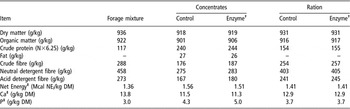
Endoglucanase activity of the enzyme mixture indicated 850, 842 and 215 nmol of glucose liberated per min, for pH 4.0, 5.5 and 6.5, respectively. Chemical composition and nutritive value of the forage mixture, concentrate and ration are shown in Table 2. The concentrate fed to the enzyme group contained slightly more CP (4.1 g/kg) than the control group due to differences in the manufacturing process. This difference in CP supply suggested a slightly lower CP intake (<1%), which was not relevant for treatment comparison. No relevant differences between experimental diets were observed for any other nutrient either.
Chemical composition and nutritive value of feeds used in the experimental diets

†Fibrolytic enzyme mixture (Promote®, Agribrands International, St Louis, Missouri, USA) applied by spraying onto the concentrate at 0.47 ml/kg of concentrate.
‡Estimated from INRA tables (Jarrige, Reference Jarrige1989) by using the PreValim 2.7 software.
Lactation experiment
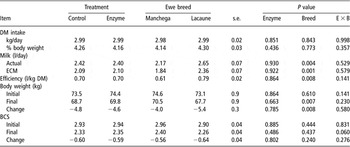
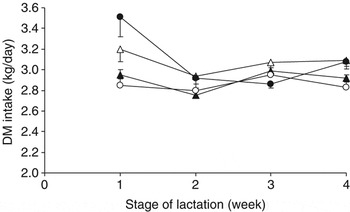
Intake of ration during the suckling period was high (Table 3 and Figure 1) for both ewe breeds and feeding treatments, averaging 3.0 kg DM/day. Values observed for DM intake reached 4.3% of BW and were greater than those reported by Molina et al. (Reference Molina, Ferret, Caja, Calsamiglia, Such and Gasa2001) in Manchega and Lacaune dairy ewes for similar milk yield and exploitation conditions. Despite the differences in estimated milk yield between the two breeds (0.52 l/day; P < 0.001), no DM intake differences between them were detected during suckling, as also reported by Molina et al. (Reference Molina, Ferret, Caja, Calsamiglia, Such and Gasa2001). An initial decrease in DM intake in all ewe groups was observed between weeks 1 and 2, most probably due to the adaptation of the ewes to the lactation diet and to a compensatory intake after parturition.
Effects of enzyme supplementation on lactational performance of dairy ewes during the suckling periodFootnote †

† Abbreviations are: ECM = energy corrected milk; BCS = body condition score (scale of 0 to 5); E × B = interaction enzyme × breed.
Dry matter intake of dairy ewes during the suckling period according to breed and dietary treatment. Each point represents the mean of 2 observations (Manchega: control, ▵; and enzyme, ▴; and Lacaune: control, ○; and enzyme, ●).

Enzyme supplementation treatments did not affect DM intake but interaction between treatment and breed was significant (P < 0.001) as a result of the different trend of DM intake change according to the week of lactation for each breed (Figure 1).
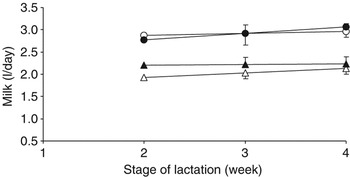
Supplementation with the fibrolytic enzyme product did not affect actual milk yield (average 2.41 l/day) or ECM (average 2.10 l/day) or milk efficiency (average 0.70 l/kg) during suckling (Table 3), but Lacaune ewes yielded more actual milk (22%; P < 0.05) and ECM (28%; P < 0.001) than Manchega ewes (Figure 2). Moreover, Lacaune ewes were 30% (P < 0.01) more efficient than Manchega ewes, transforming feed into milk during the suckling period (Table 3) as a consequence of their greater milk yield for a similar DM intake as observed in dairy sheep during milking by Molina et al. (Reference Molina, Ferret, Caja, Calsamiglia, Such and Gasa2001) and Marie et al. (Reference Marie, Such, Barillet, Bocquier and Caja2002).
Milk yield of dairy ewes during the suckling period according to breed and dietary treatment. Each point represents the mean of 18 observations (Manchega: control, ▵; and enzyme, ▴; and Lacaune: control, ○; and enzyme, ●).

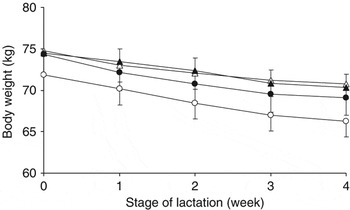
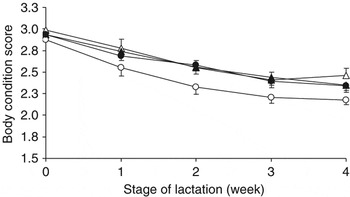
The enzyme supplementation affected neither final BW nor change in BW, nor BCS during suckling. Ewes of both breeds and both treatments lost BW (−4.7 kg) and BCS (−0.60) during the suckling period (Table 3; Figures 3 and 4), indicating a similar negative energy balance for both dietary treatments. Loss of BW was greater in Lacaune than in Manchega ewes (35%; P < 0.01) as a consequence of their greater milk yield with similar DM intake and maintenance requirements. Rode et al. (Reference Rode, Yang and Beauchemin1999) observed an increase in milk yield (10%) in dairy cows after adding the same enzyme product as in our experiment to the concentrate, and concluded that this enzyme product has a great potential application in ruminants in negative energy balance. These positive effects of enzyme supplementation were not observed in our case in dairy ewes as well as with other fibrolytic enzyme products in dairy cows at early lactation (Dhiman et al., Reference Dhiman, Zaman, Gimenez, Walters and Treacher2002; Vicini et al., Reference Vicini, Bateman, Bhat, Clark, Erdman, Phipps, Van Amburgh, Hartnell, Hintz and Hard2003).
Body weight of dairy ewes during the suckling period according to breed and dietary treatment. Each point represents the mean of 18 observations (Manchega: control, ▵; and enzyme, ▴; and Lacaune: control, ○; and enzyme, ●).

Body condition score of dairy ewes during the suckling period according to breed and dietary treatment. Each point represents the mean of 18 observations (Manchega: control, ▵; and enzyme, ▴; and Lacaune: control, ○; and enzyme, ●).

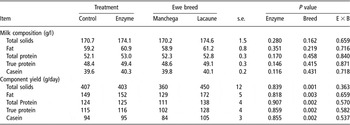
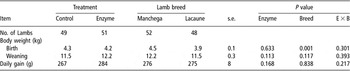
Milk composition during suckling was not affected by enzyme supplementation or breed (Table 4). Lamb growth was not affected by the dietary treatments and averaged 276 g/day (Table 5). Breed of ewe significantly affected lamb BW at birth (P < 0.001), the Lacaune lambs being lighter than Manchega lambs (−0.6 kg; P < 0.001), but the difference was not significant at weaning. Lamb growth rate was similar to the values previously reported by Casals et al. (Reference Casals, Caja, Such, Torre and Calsamiglia1999) in Manchega sheep. Manchega lambs were apparently more efficient converting milk during suckling (P < 0.001) than Lacaune lambs due to the lower milk yield of their mothers as estimated by the oxytocin method. Enzyme × breed interaction was not significant. The results on lamb growth were congruent with the lack of effect of the enzyme supplementation on milk yield and composition during suckling.
Effects of enzyme supplementation on milk composition of dairy ewes during the suckling periodFootnote †

† Abbreviations are: E × B = interaction enzyme × breed.
Effects of enzyme product supplementation on lamb growth during sucklingFootnote †

† Abbreviations are: E × B = interaction enzyme × breed.
Fill value evaluation experiment
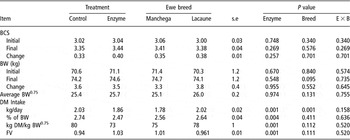
The dry and open ewes used to evaluate the effect of enzyme supplementation on the FV of the ration increased BW and BCS during the ingestion experiment (Table 6) as expected because of the high nutritive value of the ration (Table 2). No significant differences in BW or BCS change were observed for breed or treatment, although Manchega ewes tended (P < 0.10) to be heavier than Lacaune at the end of the experiment.
Effects of enzyme product supplementation on fill units evaluation in dry and open dairy ewesFootnote †

† Abbreviations are: B × E = interaction enzyme × breed; BCS = body condition score (ranging from 0 to 5; FV = fill value estimated in filling units according to INRA methodology (Jarrige, 1989).
The DM intake of the ration was high for ewes at maintenance requirements and differed (P < 0.001) for both breed and enzyme treatment (Table 6). Breed differences disappeared when daily DM intake was expressed as percentage of BW, being 2.6% BW on average. Nevertheless, Lacaune ewes showed a numerically greater DM intake than Manchega ewes (Table 6) when values were expressed per kg of metabolic BW (P = 0.112).
Enzyme supplementation reduced daily DM intake by 9.1% (2.03 v. 1.86 kg/day; P < 0.001) and intake per metabolic weight by 8.8% (80 v. 73 g/kg BW0.75; P < 0.001). Differences in intake results between lactation (no change) and FV (increased) experiments may be a consequence of the lower palatability of the enzyme-supplemented ration and to the lower requirements of the dry ewes when compared with the lactating ewes. Since dry ewes were over-fed, they probably refused the unpalatable feed more easily than the lactating ewes. Moreover, enzyme supplementation may have modified the volatile fatty acids pattern in the rumen, as recently reported by Miller et al. (2008), being responsible for the altering intake. Beauchemin et al. (Reference Beauchemin, Rode and Sewalt1995) also reported differences in the ration DM intake according to the enzyme dose in steers fed enzyme-treated forages, DM intake was reduced for medium doses whereas it increased for high and low doses. Moreover, Beauchemin et al. (Reference Beauchemin, Rode, Maekawa, Morgavi and Kampen2000) indicated greater improvements in DM intake when the enzyme was added to the concentrate portion of the ration at a low dose rather than at a high dose in dairy cows.
As a consequence of the reduced voluntary intake, sheep FV estimated according to the INRA system (Jarrige, Reference Jarrige1989) increased by enzyme supplementation, being 0.94 and 1.03 (P < 0.001) for the control and enzyme-supplemented ration, respectively. The difference in FV can account for approximately 90 g/kg of ration DM intake, which cannot be attributed to changes in digestibility or rate of passage because their cell wall constituents were unchanged. These sheep FV were used to calculate the voluntary intake of the ewes during the lactation experiment using the equation proposed by Caja et al. (Reference Caja, Bocquier, Pérez-Oguez and Oregui1997 and Reference Caja, Marie, Bocquier, Ferret, Gasa, Pérez-Oguez, Plaixats and Oregui2002) for dairy ewes. Predicted DM intake values for the suckling ewes were 3.20 and 2.95 kg/day for control and enzyme treatments, respectively, giving an overestimation of 10.3% and 1.5%, respectively, for the intake of each diet (5.9% on average).
Conclusions
In conclusion, no lactational effects were detected when the Promote® fibrolytic enzyme product was added to the concentrate of dairy ewes. Enzyme dose (commercial recommendation) and application method (sprayed onto the concentrate) may have conditioned the response to enzyme supplementation in dairy ewes. No incorporation of the enzyme into the concentrate, for the fibrolytic product and dose used, is recommended in dairy ewes.
Acknowledgments
This study was partially supported by a grant from the MEC (Ministerio de Educación y Ciencia) of Spain (Project CICYT AGL2001-2617) and Agribrands Europe-España, S.A. (Barcelona, Spain). The authors also thank Gastón Vera, Ramón Costa and the team of the Servei de Granges i Camps Experimentals of the Universitat Autònoma de Barcelona for the care of animals, R. Armengol and B. Sánchez for helping in laboratory analyses, and Nic Aldam for the English revision of the manuscript.