The Chinese government has officially carried out an affirmative action policy to reduce ethnic disparities in the People's Republic of China (PRC).Footnote 1 At the same time, it has, under the leadership of the Chinese Communist Party (CCP), promoted the growth of a market economy that emphasizes profits, efficiency and the “survival of the fittest.” For example, over 70 per cent of the urban labour force worked in the state sector before market reforms started in 1978. Since then, the Chinese government has aggressively reformed the state sector and downsized the state workforce in an effort to turn state firms into competitive market players.Footnote 2 While the Chinese economy has expanded at an explosive rate, market efficiency is gained at the expense of equality. In this situation, workers of minority status are likely to suffer from human capital deficiency and discrimination in the labour market. Has this been the case in China, or have minority workers been protected by the government? Or has the government paid lip service to its affirmative action policy in market transition? Have all state firms and government agencies discriminated against minority workers? What are the rationales for ethnic discrimination?
To address these questions, this article studies ethnic disparities in job attainment in the state sector. I compare two ethnic groups (Han Chinese and Uyghur) with regard to the probabilities of employment in the state sector, which includes state firms as well as government offices and public organizations. Following existing procedures, I label government offices and public organizations (such as trade unions, women's federations, youth organizations) as redistributive agencies.Footnote 3 Data for this research are from a 2005 survey (N = 2,947) conducted in the city of Ürümchi, capital of the Xinjiang Uyghur Autonomous Region in China.
It is necessary to point out that in the West, a worker may choose to work in a private firm or a public agency. A job in a private firm is not necessarily better than a job in the public sector. In China, however, job attainment in the state sector was a major indicator of status attainment before the mid-1990s since it was associated with a good wage, housing benefits, health care, pensions and so on.Footnote 4 Today, employment in the state sector is still a treasured achievement given the cut-throat competition in the labour market in China. It offers more job security than the private sector. A job in a government agency or a public organization has continued to be a major avenue of upward mobility in urban China.Footnote 5 For example, I found that in Ürümchi, 32 per cent of the workers in redistributive agencies were CCP members, compared with 24 per cent of those in state firms and 4 per cent of those in the private sector. The mean educational attainment was 5.05 (in a scale of 1–7) in the redistributive agencies, compared with 3.64 in state firms and 2.88 in the private sector. On average, workers in redistributive agencies earned 1,198.5 yuan in 2007, whereas their counterparts in state firms earned 929.4 yuan and in the private sector made 562.1 yuan.
Market Reforms and Ethnic Inequality
This section provides some background information about ethnic minorities in China and summarizes existing views of ethnic inequality in employment in Xinjiang in the reform era. It is known that every PRC citizen belongs to one of the 56 ethnic groups which are classified and maintained by the PRC government. The majority group is Han Chinese. The 55 minority nationalities comprise 8.4 per cent of China's total population (more than 100 million people). Scholars have argued that, with certain exceptions, minority nationalities, including the Uyghur, trail the Han in status attainment in education, employment and income by a large margin.Footnote 6
The PRC government has tirelessly advertised its commitment to protecting minorities' rights and cultural heritages, motivated by its socialist ideology of social justice and equality. The government also hopes to promote inter-ethnic peace, maintain political stability and preserve territorial integrity.Footnote 7 It has adopted various measures to enhance the wellbeing of ethnic minorities. For example, when it industrialized Ürümchi's economy in the 1950s and 1960s, large state factories had ethnic quotas; the workforce in the state sector has remained 10 to 20 per cent Uyghur “to the present.”Footnote 8 As another example, the Chinese government has granted administrative areas with a large number of minority populations sizeable funding for local development projects and local control over the distribution of tax revenues.Footnote 9 It has also carried out an ethnic entitlement policy in university admission quotas,Footnote 10 job placement in the state sector and ethnic slots in leadership representation.Footnote 11 For example, many leaders (including the chairperson) of the Xinjiang Uyghur Autonomous Region are required by law to be members of ethnic minority groups.
At the same time, however, the Chinese government has adopted various measures to promote efficiency and cast off its responsibilities for providing jobs, housing, health care and pensions to urban citizens. Examples include its campaign to “smash the iron rice bowl” in the state sector that has eliminated job security and involved massive layoffs.Footnote 12 Industrial restructuring has been implemented nationwide, including in Xinjiang. Since the losers of industrial restructuring are likely to be disadvantaged social groups, it is questionable whether the state affirmative action policy has been effective in protecting minority workers in the labour market.
Indeed, existing studies have suggested an increasing ethnic gap in job attainment in the state sector in the post-1978 era. This is explained mainly with reference to ethnic variation in schooling and ethnic discrimination. Some scholars have studied ethnic minorities in Xinjiang to show this point. First, market transition has raised the importance of human capital because of the emphasis on performance and efficiency.Footnote 13 Education has become a key determinant of labour market placement, which has increased the probabilities of job attainment among Han workers at the expense of minority workers due to ethnic variation in schooling. “This interpretation is supported by the absence of an increase in ethnic differences in occupational attainment once we account for educational composition.”Footnote 14 A recent study has found an enlarged ethnic difference in occupational attainment in Xinjiang between 1982 and 1990, which is related to a widened educational gap between Han Chinese and ethnic minorities during this period.Footnote 15 These patterns reflect mainly the employment patterns in the state sector given its predominant position in the economy in Xinjiang at that time.
Secondly, discrimination has become a major determinant of ethnic inequality in Xinjiang.Footnote 16 It is noted that when a state firm downsized its workforce, managers first chose to sack minority workers. Educated ethnic youths were unable to obtain good jobs because of Han discrimination against minority nationalities in Xinjiang.Footnote 17 It is reported that ethnic minorities in Xinjiang had “complained that the government has forsaken the preferential policy for national minorities. Moreover, thousands of minority youth, newly graduated from colleges and universities, are without jobs. By comparison, Han graduates from local or inland universities can easily land a job in the government.”Footnote 18 Amnesty International similarly stated that:
Many Uighurs complain that racial abuse and discrimination against ethnic minorities is common, and that they have no equal opportunity in education, health care and employment … In industry, the vast majority of workers employed in the new oil fields and other enterprises in the north, which are key to the region's development, are Han Chinese. In the south, according to some sources, many enterprises which have been privatized have come under Chinese management and increasingly hired Han Chinese workers instead of Uighurs.Footnote 19
Labour market discrimination against the Uyghur has been a major social issue because “Xinjiang's economy remains among the most state-centered of all China's provinces.”Footnote 20
State Firms and Redistributive Agencies
Hence, despite the official affirmative action policy, it is not certain whether workers of minority status have been protected in the labour market during market transition. It is likely that they have not, as otherwise discrimination would not have increased ethnic inequality in employment in the state sector. However, the state sector is a broad category. Do all state firms and agencies discriminate against workers of minority status? If the answer is no, why are some state actors less supportive of equal opportunity than others?
A careful consideration of the state sector may shed light on these questions. The state sector can be visualized as a vast network of work units, or danwei 单位, which include different types of workplaces, such as schools, hospitals, hotels, state firms, government offices and so on. They were the basic cell of the governance structure in China before market reforms and have remained a key actor in urban areas since the 1980s. Danwei can be conceptualized at different levels subject to theoretical interests. For example, danwei can simply refer to each and every workplace in the state sector.Footnote 21 Or they can be sorted by different bureaucratic status since each of them carries a rank in the state sector hierarchy that determines resource allocation.Footnote 22 Alternatively, danwei can be divided into three broad categories based on their manifested functions: government offices and party agencies (dangzheng jiguan 党政单位); public organizations, such as schools, research institutes and social welfare agencies (shiye danwei 事业单位); and state enterprises (qiye danwei 企业单位).Footnote 23
The post-1978 reforms have created a new distinction between market involvement and redistribution among different state units.Footnote 24 All state agencies functioned to redistribute resources in some way before the 1980s.Footnote 25 Since then, reforms have sought to improve the efficiency of the state sector by implementing role differentiation: state firms are oriented to market competition, whereas government agencies and public organizations continue their redistributive tasks to provide social goods and promote justice. This trend has become increasingly salient since the 1990s as the Chinese government has intensified its campaign to transform state firms into market players. Those who have failed to undergo the structural change are promptly declared bankrupt, resulting in the massive layoff of state workers in urban China.Footnote 26
In comparison, government offices and public organizations have been protected from relentless market competition. They have been restructured so as to raise their efficiency in redistribution. A key component of the restructuring efforts is to introduce education as a major criterion of recruitment into these organizations.Footnote 27 Yet there has been impressive continuity in primary functions, central budget allocation and employment stability. Hence, it is clear that state firms are more involved in market activities, compared to government offices and public organizations (redistributive agencies).Footnote 28
Ethnic Penalty and Ethnic Premium
I use the distinction between state firms and redistributive agencies to study whether the Chinese government has protected ethnic minorities in the labour market during market reforms. I explain below that the impact of market reforms on state firms and redistributive agencies has varied greatly. As a result, the probabilities of job attainment for workers of minority status are greater in redistributive agencies than in state firms in Ürümchi.
Market competition and ethnic penalty
First, state firms may discriminate against minority groups in recruitment (“ethnic penalty”) as a result of market competition. If state firms do not become competitive and profit thirsty they will go bankrupt. Government subsidies are no longer available to rescue those losing money. At the same time, the government has ceased to assess and reward state firms in terms of their contribution to social justice since such assessments may undermine their attempts to become competitive market actors. State firms have to shift their focus from political campaigns to efficiency and profits.
Efficiency is related to human capital. Thus, when employers are oriented towards market competitiveness, they often make a decision to hire or keep a worker on the expectation that certain workers have more desirable characteristics – such as on-the-job productivity – than others. But employers cannot directly observe the characteristics of a new worker, or accurately measure existing workers since outputs are often the result of collective efforts. Employers thus use attributes such as loyalty and capacity for teamwork that they think are correlated with productivity to rank workers. Minority-group workers are disadvantaged in this subjective ranking process since these desirable attributes tend to be assigned to majority-group workers. Minority-group workers suffer since most employers are from the majority group.Footnote 29
As elsewhere, minority-group workers in China are viewed as less capable and industrious than majority-group workers, even if they are in fact equally productive. The government has identified Han Chinese as the model of civilization and described minority nationalities in terms of backwardness.Footnote 30 My fieldwork in Ürümchi indicates the wide acceptance of this official assessment of ethnic differences by both Han and minority respondents.Footnote 31 As a result of this prejudiced identification, state firms may rank the quality of a minority-group (Uyghur) worker lower than that of a majority-group (Han) worker, even if they differ from each other only in nationality status. A minority status levy is placed on minority-group workers. Hence, Uyghur workers should be less likely than Han workers to be employed by state firms, holding major characteristics constant.
Agency demonstration and ethnic premium
Redistribution may give rise to an ethnic premium on minority employment in redistributive agencies. State firms survive and expand depending on successful market competition and profit margins. In comparison, redistributive agencies justify their existence by demonstrating their ability to pursue social justice. They operate on budgets from the government which are awarded on the basis of their manifested goals and achievements. They must advertise their compliance with social justice, regardless whether they in fact deviate from official policies.
Ironically, the above-mentioned belief about the distribution of average productivity across ethnic groups, which puts Uyghur workers at a serious disadvantage in job attainment in state firms, turns minority ethnicity into a valued asset in redistributive agencies. This is because social justice involves equality and assistance to the weak and poor. Redistributive agencies can derive enormous benefits from minority “backwardness” since they can handily demonstrate their conformity to social progress with publicized assistance to the disadvantaged. They can afford affirmative action because they are shielded from market competition. There thus may be a premium on minority ethnicity in recruitments by government agencies since they can use it as an efficient means of public relations. The ethnic premium suggests equal or greater probabilities of employment in redistributive agencies among minority-group workers than Han workers. Hence, Uyghur workers should not be less likely than Han workers to work in redistributive agencies, everything else being equal.
Public demonstration by redistributive agencies and market dynamism in state firms may be translated into a lower impact of affirmative action on recruitment in the latter than in the former. As a result, Uyghur workers may suffer an ethnic penalty in state firms but enjoy an ethnic premium in redistributive agencies. Interestingly, both the ethnic premium and ethnic penalty are based on the perspective of efficiency, that is, minority status is regarded as much a valuable asset for demonstration by redistributive agencies as a human capital deficiency for market competition by state firms. State firms and redistributive agencies pursue different institutional tasks and define efficiency and the worth of minority ethnicity differently.
The Imperative of Ethnic Premium in Xinjiang
Despite the above discussion, the Chinese government may not care about social justice and equality given its preoccupation with profits and efficiency during market transition. It may not see the need to continue the affirmative action policy since this may increase its financial burdens and reduce the speed of market reforms in the state sector. Nevertheless, it is imperative for the Chinese government to pursue equal opportunity programmes in Xinjiang. Xinjiang is important geopolitically as it has 5,600 kilometres of international frontiers with India, Afghanistan, Pakistan, Kazakhstan, Kyrgyzstan, Tajikistan, Russia and Mongolia. The Uyghur are the largest ethnic group in Xinjiang. In 2004, of the total population in Xinjiang (19.6 million), the Uyghur comprised 45.7 per cent (nearly 9 million), whereas Han Chinese made up 39.7 per cent (7.8 million) only.Footnote 32 In addition, the Uyghur are ethnically Turkic and Sunni Muslims. They differ from the Han linguistically and culturally and are “one of the most nationalistic and least assimilated minorities in China.”Footnote 33 Also, they regard Xinjiang as their homeland and the Han in the territory as uninvited guests. Uyghur–Han relations are generally tense. It is reported that some Uyghur have resented Han migration into Xinjiang because Han migrants have allegedly taken jobs away from them.Footnote 34
There is a broad consensus that groups that have a strong sense of grievance may demand complete independence.Footnote 35 Indeed, some Uyghur have since the 1990s sought to form an independent nation state in Xinjiang. Although few Uyghur in Xinjiang have openly joined the separatist movement, they are influential because of their connection with bin Ladin's al-Qaeda and their efforts to split China through terrorist activities. The Chinese government requested that the UN Security Council list a major Uyghur separatist organization, the East Turkistan Islamic Movement based in Istanbul, Turkey, as a terrorist group. This request was granted in a motion passed by the UN Security Council on 12 September 2002.Footnote 36
Thus, the Chinese government may consider the Uyghur as a threatening people, especially with regard to the Uyghur separatist demand for an independent nation state in Xinjiang. Xinjiang occupies one-sixth of China's territory (it is about three times the size of France) with a lot of natural resources including petroleum, natural gas, coal and iron ore. In an interview with a Hong Kong television reporter televised on 2 February 2008, the CCP Secretary of the Xinjiang Uyghur Autonomous Region, Wang Lequan 王乐泉, predicted that Xinjiang would be the leading producer of energy in China in the years to come. A lot of state interests are at stake in the interaction between the CCP and the Uyghur.
Not surprisingly, the Chinese government is ready to suppress Uyghur separatism with an iron hand. At the same time, it may try to integrate the Uyghur into the PRC regime in an effort to counterbalance Uyghur separatists in Xinjiang. It may be cost-effective for the Chinese government to accommodate the Uyghur with equal opportunity programmes. A less threatening minority group could be ignored, but the government cannot afford to ignore the Uyghur. Research shows that a host state is likely to protect minority rights when dealing with a more threatening minority group and is likely to use repression when dealing with a less threatening group.Footnote 37 The Chinese government can use various incentives such as the affirmative action policy in its interaction with the Uyghur. In its struggle against Uyghur separatism, affirmative action may reduce some dissatisfaction and bind Uyghur state workers, the beneficiaries of equal opportunity programmes, to the PRC.
Since state firms are market players and are not obliged to pursue equal opportunity programmes, redistributive agencies must shoulder the responsibility of implementing an affirmative action policy since their institutional task is to maintain social order and promote social justice and ethnic parity. In addition, job attainment in redistributive agencies has a greater demonstration effect than that in a state firm since jobs in redistributive agencies carry more prestige than those in state firms.Footnote 38 Hence, the Chinese government may encourage redistributive agencies to recruit Uyghur workers.
Data
Data are drawn from Ürümchi, in northern Xinjiang, to test this possibility. Although the Uyghur are the majority group in Xinjiang, they are a minority group in Ürümchi. Of the 1.4 million people in urban Ürümchi, 1.1 million are Han Chinese, 0.2 million are Uyghur and the rest are members of other ethnic minorities. There were some predominantly Uyghur neighbourhoods before the 1990s,Footnote 39 but urban renewal projects have since changed this pattern. The 2000 Census showed that, of the 52 urban neighbourhoods, Tuanjie lu 团结路 had the highest percentage of Uyghur households (47.5), followed by Yan'an lu 延安路 with 38.1 per cent. Xinhua nanlu 新华南路 was ranked eighth with 21.1 per cent. Given this population composition, a randomly selected sample would not draw a sufficient number of Uyghur for a study of ethnic variation in employment in the state sector. It was thus decided that a disproportionate sampling method would be used to achieve a balanced sample of the Uyghur and Han respondents for the 2005 survey.
My local collaborators chose eight neighbourhoods that had the highest percentages of Uyghur households in Ürümchi (the Uyghur clusters). They then randomly selected eight neighbourhoods from the remaining 44 (the Han clusters). They used a disproportionate sampling method to select 2,437 households from the 16 clusters. Households in the Uyghur clusters were given a disproportionately better chance of selection than those in the Han clusters to yield roughly similar numbers of Uyghur and Han respondents in the final sample. A total of 1,600 interviews was conducted, representing a completion rate of nearly 66 per cent (69.6 for the Uyghur and 62.1 for the Han). Among them, 799 were Uyghur and 801 were Han households. However, 208 out of the 1,600 households were single families. The rest were either nuclear or stem families. For these, information on both the household heads and their spouses was solicited, resulting in a sample of 2,947 cases (Han = 1,464, Uyghur = 1,483) for data analysis.
The questionnaire for the 2005 Ürümchi survey was first written in English and then translated into a Chinese version, which was translated back into an English version by different translators to ensure consistency between the two versions. Next, the local collaborators hired professional translators to produce a Uyghur version, which was compared with the Chinese version to ensure consistency. The local collaborators recruited interviewers from students in local universities and members of the neighbourhood management committees in the sampled clusters. Interviewers were trained by experienced survey researchers. Some Han interviewers spoke Uyghur and many Uyghur interviewers spoke Chinese. In the survey, Uyghur interviewers were assigned to interview Uyghur respondents only and Han interviewers were assigned to interview Han respondents only. The survey included questions on demographics, marital status, mate selection, education and CCP membership.
Other participants of the 2005 survey included scholars from several local universities, the Statistical Bureau of the Xinjiang Autonomous Region and the Statistical Bureau of the Ürümchi municipal government. The survey started in March 2005 and ended in August 2005. I also conducted fieldwork in the city between 2005 and 2008. My fieldwork experience has enhanced my understanding of ethnic inequality in job attainment in Ürümchi.
Variables
As mentioned above, I compare the Han and the Uyghur in job attainment in redistributive agencies and state firms. However, logistic regression analysis, which is used to model dichotomous (0 or 1) outcomes, cannot accomplish this task satisfactorily since both the Han and the Uyghur work in state factories, redistributive agencies and non-state sectors (which include collective enterprises, private firms and family businesses). Accordingly, multinomial regression analysis is performed, using those employed in non-state sectors as the reference group. The dependent variable in question consists of three categories: redistributive agencies, state firms and the non-state sector.
The independent variables used in the following analysis include age group, gender, married, native, urban status, native residents, mother tongue, education, CCP, father state worker and Uyghur. Many of these variables are self-explanatory and have been used extensively in research on status attainment in China.Footnote 40Age group is an ordinal variable (44 and younger, 45–54, 55–64 and 65 and above). Urban status is a dummy variable with urban residents coded as 1 and rural migrants as 0. Gender is also a dummy variable with men coded as 1 and women as 0. Married is another dummy variable with married respondents coded as 1 and others as 0.
Mother tongue is a dummy variable with the respondents who reportedly spoke their mother tongue well coded as 1 and others as 0. Education is measured by six categories, from low to high: 1 = illiterate/semiliterate; 2 = junior high school; 3 = senior high school; 4 = vocational school; 5 = community college; 6 = university and above.Footnote 41 In the analysis, education is treated as a set of dummy variables with “university and above” as the reference group.
Existing studies suggest the importance of family background and personal connections in job attainment in urban China. Family background is measured by father state worker, a dummy variable with respondents whose fathers were state workers coded as 1.Footnote 42 I use native status to measure personal connections. Due to a longer period of residence in Ürümchi, native residents should know more people and thus have a wider social network than migrants. Also, friendship ties nurtured since childhood should be more intimate and helpful than those developed in adulthood. Native is a dummy variable with residents who were born in Ürümchi coded as 1 and migrants as 0. CCP is also a dummy variable with CCP members coded as 1 and others as 0. Finally, Uyghur is a dummy variable with the Uyghur respondents coded as 1 and the Han respondents as 0.
Findings
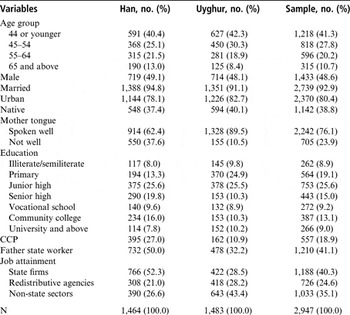
Table 1 provides some descriptive statistics. It seems that the Han and the Uyghur do not differ from each other in terms of age, married status and nativity. For example, 40.4 per cent of the Han respondents are 44 years old or younger, compared with 42.3 per cent of the Uyghur respondents. The mean age of the Han respondents is 49 and the mean age of the Uyghur respondents is 48. Table 1 also shows that 49.1 per cent of the Han respondents and 48.1 per cent of the Uyghur respondents are men. The Uyghur–Han difference is not statistically significant. In addition, 78.1 per cent of the Han respondents are local residents, compared with 82.7 per cent of the Uyghur respondents. Nearly 95 per cent of the Han respondents are married, compared with 91.1 per cent of the Uyghur respondents.
Descriptive Statistics, Ürümchi

Table 1 also shows that 27 per cent of the Han respondents are CCP members, compared with 10.9 per cent of the Uyghur respondents. The mean educational level of the Han respondents is higher than that of the Uyghur respondents (3.89 versus 3.56) and statistically significant at .001 level (F-statistic = 25.853). Education and CCP membership attainment are two key determinants of labour market outcomes in China. These findings are consistent with existing research that the Han have achieved a higher degree of status attainment than ethnic minority groups.
In addition, Table 1 shows inter-group disparities in job attainment in both state firms and redistributive agencies: 52.3 per cent of the Han work in state firms, compared with 28.5 per cent of the Uyghur. The difference is understandable given the Uyghur–Han differences in schooling and CCP membership attainment. However, 21 per cent of the Han respondents are employed in redistributive agencies, compared with 28.2 per cent of the Uyghur respondents. The ethnic difference is statistically significant at .001 level (Chi-square = 22.902, df = 1). This is surprising since educational attainment and CCP membership are closely related to employment in the redistributive sector in China.Footnote 43 Yet the Uyghur–Han differences in schooling and CCP membership do not explain the ethnic difference in employment in redistributive agencies in Ürümchi. In addition, the Uyghur and the Han are similar in demographic variables such as married status and age. Clearly, the main background characteristics of the respondents cannot be held responsible for the ethnic variation in employment in distributive agencies in Ürümchi.
Next, multivariate analyses were conducted to examine the Uyghur–Han differences in labour market placement. The findings reported in Table 1 are illustrative but are obtained without controls. It is not clear whether they are the effect of spurious relationships between Uyghur ethnicity and job attainment in redistributive agencies, whether the effect of minority ethnicity on employment in redistributive agencies will persist in a multivariable model, and whether ethnic variation in job attainment is related to the educational gap between the Uyghur and the Han. Multivariate analysis is needed to answer these questions.
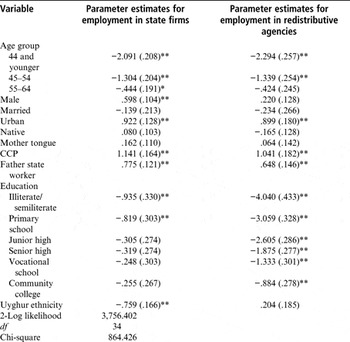
Table 2 shows that age group is negatively related to the probabilities of employment in state firms, that is, the younger respondents are, the less likely it is that they work in a state firm. Age group is also negatively related to the probabilities of job attainment in redistributive agencies: the younger respondents are, the less likely it is that they work in a redistributive agency. These findings are consistent with the fact that it is getting hard to find a job in the state sector in China nowadays. As noted, industrial restructuring efforts have aimed at downsizing the workforce in the state sector.
Uyghur–Han Variation in Job Attainment in the State Sector

Notes:
*P < .05, **p < .01. Figures in parentheses are standard errors. The reference group for education is university and above and for the age group is 65 and above. The omitted category is the non-state sector.
Table 2 also shows that men are more likely than women to work in state firms, whereas there is no gender variation in the probabilities of employment in redistributive agencies. These findings are consistent with the fact that state firms are more likely to hire men than women. In addition, schooling is weakly related to job attainment in state firms: only illiterates, semi-illiterates and primary school graduates are disadvantaged in getting a job in a state firm. In comparison, it is difficult to be employed in redistributive agencies without a university education. These findings are intuitively appealing since educational requirements for entry into state firms are lower than into redistributive agencies, that is, state firms are mainly peopled by blue-collar workers and technicians, whereas government offices and public organizations are largely occupied by better-educated white-collar workers such as professionals and government officials.Footnote 44
Finally, the coefficient for Uyghur in the first equation of Table 2 suggests that Uyghur workers are less likely to enter state firms than Han workers, holding background characteristics constant. This finding shows discrimination against Uyghur workers in state firms. The coefficient for Uyghur in the second equation of Table 2 shows similar probabilities of job attainment in redistributive agencies for the Han and the Uyghur, everything being equal. Thus, there is no evidence that, compared with Han workers, Uyghur workers are discriminated against in redistributive agencies. These findings support the above discussion about the possible ethnic penalty for Uyghur in state firms and the possible ethnic premium for them in redistributive agencies.
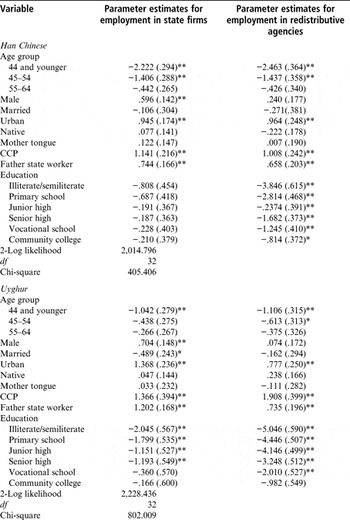
Next, I run a multinomial regression analysis on the Han sub-sample and another analysis on the Uyghur sub-sample (Table 3). It can be seen that many findings from Table 2 are similar to those derived from the Han sub-sample and the Uyghur sub-sample, especially with regard to the coefficients for age group, male, urban and CCP. For example, the younger respondents are, the less likely it is that they will find a job in a state firm or a redistributive agency, and this is true for both the Uyghur and the Han. Also for both, men are more likely than women to become a worker in a state firm. However, there is no gender variation in job attainment in redistributive agencies.
Uyghur–Han Variation in Job Attainment in the State Sector

Notes:
*P < .05, **p < .01. Figures in parentheses are standard errors. The reference group for education is university and above and for the age group is 65 and above. The omitted category is the non-state sector.
As another example, urban Uyghur are 293 per cent more likely than Uyghur migrants to work in state firms and 118 per cent more likely than their rural cousins to find a job in a redistributive agency. The corresponding figures for the Han are 157 per cent and 162 per cent respectively. Uyghur with CCP membership are 292 per cent more likely than other Uyghur to enter state firms and 574 per cent more likely than other Uyghur to work in government agencies. The corresponding figures for the Han respondents are 213 per cent and 174 per cent respectively. The Uyghur whose fathers are state workers are 233 per cent more likely than other Uyghur to work in state firms and 109 per cent more likely than other Uyghur to enter redistributive agencies. The corresponding figures for the Han are 110 per cent and 93 per cent respectively.
Table 3 shows that education is a key determinant of entry into redistributive agencies for both the Han and the Uyghur. Nevertheless, the penalty is higher for the Uyghur as the coefficients for education variables have greater negative values for the Uyghur than for the Han at every level down the educational hierarchy with regard to recruitment into redistributive agencies. In comparison, the effect of education on the probabilities of job attainment in state firms among the Han is limited as none of the coefficients for educational attainment is statistically significant. Yet the educational requirements for entry into state firms are higher for the Uyghur than for the Han since the coefficients for illiterate & semi-illiterate, primary school, junior high school and senior high school are statistically significant for the Uyghur sub-sample. These findings suggest the ethnic penalty for the Uyghur in state firms.
It is important to note that the ethnic gap in entry into redistributive agencies is a difference in degree since the coefficients for both the Uyghur and the Han are statistically significant (except the one for community college for the Uyghur sub-sample), whereas the ethnic gap in entry into state firms is a difference in kind since the coefficients for Uyghur workers are statistically significant but those for Han workers are not. The contrast between the significant coefficient for community college for the Han and insignificant coefficient for the Uyghur shows that the educational requirement for entry into redistributive agencies for the Uyghur is lower than that for the Han. Overall, the findings reported in the three tables suggest the importance of the distinction between state firms and redistributive agencies for understanding ethnic differences in job attainment in the reform era. They also suggest that ethnic minorities are better protected in redistributive agencies than in state firms, which can be explained in terms of their different exposures to market competition.
Summary and Discussion
This article asks various questions. Have workers of minority status suffered discrimination in labour market placement during market transition, or have they been protected by the government? Have all firms and government agencies in the state sector discriminated against minority workers? What are the rationales for ethnic discrimination? To study these questions, I compared Uyghur–Han differences in employment in the state sector and analysed a data set collected in Ürümchi in 2005. I show that controlling background characteristics does not remove the Uyghur–Han differences in job attainment in state firms. However, there is no ethnic variation in job attainment in redistributive agencies, controlling for background characteristics. I also find that formal schooling is more important for the Uyghur than the Han to enter state firms. These findings suggest an ethnic penalty for the Uyghur in state firms and an ethnic premium for the Uyghur in redistributive agencies.
To explain these patterns, I call for attention to role differentiation in the state sector. All state danwei were redistributive agencies before market reforms. In the reform era, state firms have been differentiated from redistributive agencies in budget allocation and institutional tasks, which leads to a contrast in the effect of discrimination and education between the two. Minority workers are rewarded with an ethnic premium by redistributive agencies, who must demonstrate compliance with social justice. In comparison, employment decisions in market-oriented state firms weigh against minority-group workers. Market competition encourages state firms to shunt minority-group workers to the back of the hiring queue because of the prevalent belief about the distribution of average productivity across ethnic groups that favours the Han in the labour market.
There is no doubt that the CCP has retreated from its commitment to socialist egalitarianism in pursuit of efficiency during market reforms. However, it is necessary to point out the limit on its retreat from equality. While workers of minority status are disadvantaged in getting a job in state firms, they have similar probabilities of entry into redistributive agencies as Han workers. The effect of discrimination on minority achievement in the state sector varies across institutional contexts. A government agency is more likely to carry out an equal opportunity policy in organizing its staff profile the further away it is from market competition, and vice versa.