Mastitis is the most common and costly disease in dairy cattle worldwide (Fetrow & Anderson, Reference Fetrow and Anderson1987; Rajala & Grohn, Reference Rajala and Grohn1998). Owing to the negative economic consequences of the disease, mastitis control measures are particularly important. One of these control measures is the treatment of cows at dry-off with antimicrobials both to eliminate existing intramammary infections (IMI) and to prevent new ones at the end of lactation (i.e., dry cow therapy, DCT) (Macmillan et al. Reference Macmillan, Duirs and Duganzich1983; Bradley & Green, Reference Bradley and Green2004; Robert et al. Reference Robert, Bareille, Roussel, Poutrel, Heuchel and Seegers2006a).
Most dairy herds in the USA (USDA, 2002) and other countries (Robert et al. Reference Robert, Seegers and Bareille2006b) treat all quarters of all cows with antibiotics at the end of lactation as part of their mastitis control programme (i.e., total dry cow therapy, TDCT). However, selective dry cow therapy (SDCT) has recently received more attention owing to growing concerns over the use of antimicrobials in animal production. The issue of antimicrobial resistance in food animals has been a cause for genuine concern. Although the debate continues on the potential role of animals in transferring bacteria and their resistance genes to human pathogens (Witte, Reference Witte1998), newer antimicrobials have been either removed from use in food animal species or have not been approved for use in animals because of concerns about resistance development (Prescott, Reference Prescott and Aarestrup2006). Consequently, it is in the best interest of the food animal industry to consider management strategies that will effectively reduce antimicrobial use. For the dairy industry, switching from routine treatment of all cows at dry-off to more selective treatment would offer such an opportunity. With the most prudent approach for using antimicrobials with respect to DCT, only infected cows expected to respond to treatment receive SDCT, those with chronic infections are culled, and uninfected cows are left without treatment (Browning et al. Reference Browning, Mein, Brightling, Nicholls and Barton1994; Østerås et al. Reference Østerås, Edge and Martin1999; Bradley & Green, Reference Bradley and Green2004; Robert et al. Reference Robert, Seegers and Bareille2006b).
The general concern about SDCT, however, is that leaving cows without treatment is detrimental for the health of the udder, once the prophylactic effect of DCT is lost. However, several member countries of the International Dairy Federation (e.g., Finland, New Zealand, Norway, Sweden, and Switzerland) use SDCT and produce high-quality milk with national averages of somatic cell counts (SCC) <200 000 cells/ml (International Dairy Federation, 2001; Pitkälä et al. Reference Pitkälä, Haveri, Pyörälä, Myllys and Honkanen-Buzalski2004; Østerås et al. Reference Østerås, Solverød and Reksen2006). This is an indication that SDCT can be used successfully and good udder health maintained.
The challenge with the implementation of SDCT is efficient and accurate identification of infected cows. Selection of cows for treatment requires practical and inexpensive methods that use information readily available on the farm (Poutrel & Rainard, Reference Poutrel and Rainard1981; Eberhart, Reference Eberhart1986; Browning et al. Reference Browning, Mein, Brightling, Nicholls and Barton1994). One possible method is selection of cows based on SCC (Kirk et al. Reference Kirk, Berry, Reynolds, Maas and Ahmadi1996). Owing to the significant difference in SCC between healthy and infected udders, classification of cows as infected or uninfected based on SCC is possible (Dohoo & Leslie, Reference Dohoo and Leslie1991; Middleton et al. Reference Middleton, Hardin, Steevens, Randle and Tyler2004). Østerås et al. (Reference Østerås, Edge and Martin1999) reported that an elevated geometric mean of the last three months' SCC had the strongest association with the probability of failure to clear an infection with major pathogens in the following lactation as compared with SCC information from the last month, the last two months, or the complete lactation. The use of a series of SCC instead of a single test has also been recommended by others for assessing the infectious status of a cow (Reneau, Reference Reneau1986). Use of farm records regarding the occurrence of clinical mastitis (CM) is also important when making decisions about SDCT (Whist & Østerås, Reference Whist and Østerås2006), and if combined with SCC information this can improve the accuracy of identifying cows for treatment.
A variety of criteria has been used to identify uninfected and infected cows/quarters in studies that evaluated the effect of SDCT (Rindsig et al. Reference Rindsig, Rodewald, Smith and Spahr1978; Browning et al. Reference Browning, Mein, Brightling, Nicholls and Barton1994; Hassan et al. Reference Hassan, Daniel, O'Boyle and Frost1999; Whist et al. Reference Whist, Østerås and Solverød2007). A recent study conducted in North America evaluated the test characteristics of cow-side California Mastitis Test (CMT) for detecting the presence of IMI at dry-off (Sanford et al. Reference Sanford, Keefe, Sanchez, Dingwell, Barkema, Leslie and Dohoo2006). The authors recommended the use of CMT for identification of IMI when herd prevalence of IMI is lower than 15%. At present, approximately half of dairy herds in the USA participate in DHI mastitis screening programmes (Wiggans, Reference Wiggans2007). In those farms, test reports of SCC from composite samples of all four quarters from every lactating cow are received on a monthly basis, which makes the use of this approach feasible. Additionally, many modern, large dairy herds are computerized and dairy producers and their veterinarians use electronic records in herd management. The objective of the present study was to evaluate the use of CM history and SCC from monthly DHI records in identification of infected and uninfected cows at dry-off.
Materials and Methods
Animals and sampling
Holstein cows from two commercial and two institutional dairy herds in Ohio enrolled in a dry cow therapy investigation were sampled at dry-off. Paired quarter milk samples were collected from 665 clinically healthy cows (i.e., without CM at dry-off) at the last milking at the end of lactation according to National Mastitis Council (NMC) guidelines (Oliver et al. Reference Oliver, Gonzalez, Hogan, Jayarao and Owens2004). After collection, samples were immediately placed in ice, transported to the laboratory, and stored at −20°C until microbiology procedures.
SCC from the current lactation of every cow in each farm were obtained electronically from PCDART (Herd Manager © 2005 Dairy Records Management Systems, Raleigh NC, USA). Individual CM records were collected at each farm for two complete calendar years before the beginning of the study as well as during the study and data were entered into electronic spreadsheets (Microsoft Office Excel 2003).
Milk samples were examined microbiologically according to NMC guidelines (Oliver et al. Reference Oliver, Gonzalez, Hogan, Jayarao and Owens2004). Briefly, samples were examined by plating 0·01 ml of milk on trypticase soy agar with 5% sheep blood (Remel Inc., Lenexa KS, USA) and on MacConkey agar plates (Remel Inc.) using sterile disposable calibrated loops. Plates were incubated for 48 h at 37°C and bacterial growth was recorded at 24 h and 48 h of incubation. Colonies on blood agar with similar morphology were counted and recorded as colony forming units (cfu)/ml of milk. Samples were considered contaminated when more than two types of colonies were present in the sample (Oliver et al. Reference Oliver, Gonzalez, Hogan, Jayarao and Owens2004).
Different selection criteria
Based on monthly records for composite milk samples from DHI and history of CM during the current lactation, four selection criteria were evaluated for classification of cows as uninfected: (1) Cows with SCC <100 000 cells/ml and no CM during the lactation (SC1); (2) Cows with SCC <200 000 cells/ml and no CM during the lactation (SC2); (3) as criterion two, but additionally a cow was also considered uninfected if it experienced a case of CM during the first 3 months of the lactation and the SCC was <100 000 cells/ml for the rest of the lactation (SC3); (4) Cows with SCC <300 000 cells/ml and no CM during the lactation (SC4). Cows that did not meet the requirements of each specific criterion for being uninfected were considered infected. The optimal number of monthly SCC records to be used as a part of the criteria was also investigated. The use of one to six tests prior to dry-off was evaluated.
Microbiological gold standard
Two different gold standards based on culture results from single and paired milk samples from the same quarter were considered: (1) Based on single samples (i.e., the first sample of each pair), a quarter was considered infected if ⩾100 cfu/ml of major contagious pathogens (Staphylococcus aureus and Streptococcus agalactiae) or ⩾500 cfu/ml of any other pathogens were isolated; (2) based on paired samples, a quarter was considered infected if the same pathogen (⩾100 cfu/ml) was isolated from both samples of the same quarter. Multiple samples are generally recommended by the NMC (Oliver et al. Reference Oliver, Gonzalez, Hogan, Jayarao and Owens2004) for diagnosis of intramammary infection (IMI); however, according to International Dairy Federation (1987), in field trials, determination of prevalence of infection can be based on a single, aseptically collected milk sample. Many field studies report results based on single samples (Barkema et al. Reference Barkema, Schukken, Lam, Galligan, Beiboer and Brand1997; Elbers et al. Reference Elbers, Miltenburg, De Lange, Crauwels, Barkema and Schukken1998; Dingwell et al. Reference Dingwell, Leslie, Schukken, Sargeant and Timms2003) and thus two different gold standards were used in the current analyses to evaluate the selection criteria.
A cow was considered infected when at least one quarter was positive. Cows with two or more contaminated quarter samples were dropped from the analysis. Eighteen cows (2·7%) were dropped because of contaminated samples (4 presumably uninfected and 14 presumably infected cows), with data from 647 cows available for the analyses.
Data analysis
The ability of the four selection criteria to correctly identify infected and uninfected cows was evaluated separately for both data sets (i.e., IMI diagnosed based on single or paired samples) by calculating sensitivity and specificity with exact 95% confidence intervals (CI) (Dohoo et al. Reference Dohoo, Wayne and Stryhn2003) using microbiological culture results as the gold standard. Efficiency [(number of true positives+true negatives)/total number of samples], positive predictive values (PPV), negative predictive values (NPV), and prevalence of IMI were also calculated. All the selection criteria were also evaluated with the purpose of identifying only cows infected with major pathogens, using results from single samples as the gold standard and classifying cows with minor pathogens as uninfected.
The analyses were performed at cow level in STATA 9.2 (STATA, College Station TX, USA). Quality indices for efficiency [κ(0·5,0)] were calculated according to the Kraemer (Reference Kraemer1992) formula:

Where:SE is the sensitivity, SP' is the complement of the specificity, Q is the apparent prevalence, P is the prevalence, and P' is the complement of P.
Results
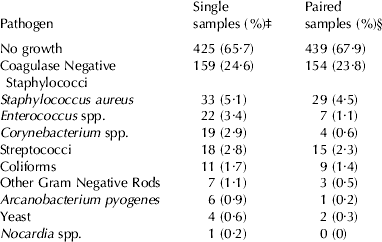
Overall prevalence of infection at dry-off was 32·2% (95% CI: 28·6, 35·9) based on paired samples and 34·3% (95% CI: 30·7, 38·1) based on single samples. The most common pathogens isolated were coagulase negative staphylococci (CNS). No Str. agalactiae was isolated from any of the milk samples. Overall, based on the results from single samples, 159 (24·6%) cows were infected with CNS and 33 (5·1%) with Staph. aureus at dry-off, respectively. The respective numbers were 154 (23·8%) and 29 (4·5%) from paired samples. Of cows with IMI at dry-off, 71·6% (159/222) and 74·0% (154/208) were infected with CNS when diagnosis was based on single and paired samples, respectively. The percentage of Staph. aureus infected cows was 14·9% (33/222) and 13·9% (29/208), when diagnosis was based on single and paired samples, respectively. Distribution of pathogens isolated from single and paired quarter milk samples are shown in Table 1.
Distribution of pathogens isolated from single and paired quarter milk samples from 647 clinically healthy cows at dry-off in four Ohio dairy herds. Results are presented as percentages of cows infected with a particular organismFootnote †
† A cow was classified as infected if at least one quarter was infected; however, she could be infected with more than one pathogen, if she had more than one quarter infected with different organisms and/or if she had mixed infections
‡ Isolation of ⩾100 cfu/ml of Staph. aureus or Str. agalactiae or ⩾500 cfu/ml of any other pathogen from single samples as the gold standard (GS)
§ Isolation of the same pathogen from both paired samples (⩾100 cfu/ml) as GS
Identification of infected cows based on SCC only from the last month of lactation had the lowest efficiency. The efficiency varied with the number of tests used to identify infected cows, reaching its maximum with the last three months and decreasing when SCC from the last four, five, and six months were used regardless of the selection criteria evaluated (data not shown). Because using SCC from the last three consecutive months prior to dry-off provided the most efficient method for identifying infected and uninfected cows at dry-off, the detailed results are presented only from this option.
Single samples: sensitivity and specificity of the selection criteria
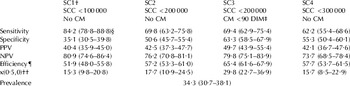
Sensitivity and specificity of the four selection criteria are shown in Table 2. As expected, sensitivity was highest when classification of infected cows was based on SC1. The highest specificity was observed when SC3 was used. The data suggested that SC3 had the highest probability that a cow identified by the criterion as infected was indeed an infected cow (PPV). SC1, on the other hand, had the highest probability (80·9%) that a cow identified as uninfected by the criterion did not have an IMI (NPV); however, the NPV for SC3 was very similar (79·8%).
Sensitivity, specificity, positive (PPV) and negative predictive values (NPV) for selection of uninfected cows at dry-off based on somatic cell counts (SCC) during the last three months of lactation and clinical mastitis (CM) history. Isolation of ⩾100 cfu/ml of Staph. aureus or Str. agalactiae or ⩾500 cfu/ml of any other pathogens from single samples was used as the gold standard (n=647)

† Different selection criteria for identifying uninfected cows; cows not fulfilling the criteria were considered infected
‡ Cows that had CM during the first 90 days in milk (DIM) but SCC <100 000 cells/ml during the rest of the lactation were considered uninfected in addition to cows with SCC <200 000 cells/ml and no CM
§ 95% Confidence intervals
¶ [(Number of true positives+Number of true negatives)/Total number of samples]
†† Quality index (Kraemer, Reference Kraemer1992)
The highest correct classification rate (efficiency) as well as the optimal efficiency as evaluated by the quality index was obtained with SC3 (Kraemer, Reference Kraemer1992). The percentage of Staph. aureus-infected cows classified as uninfected (number missed/total infected) was 0% (0/33), 27·3% (9/33), 18·2% (6/33) and 33·3% (11/33) with SC1, SC2, SC3 and SC4, respectively.
When only cows infected with major pathogens were classified as infected, sensitivity of all selection criteria increased and specificity decreased compared with when cows with any infection (minor or major) were considered infected (results not shown). SC1 had the highest sensitivity (88·4%), but it also had the lowest specificity (31·0%) and efficiency (38·6%). The efficiency for identifying cows infected with major pathogens reached the highest level when SC3 was used (59·8%). Sensitivity and specificity of SC3 to identify cows with major pathogens was 79·1% and 56·9%, respectively.
Paired samples: sensitivity and specificity of the selection criteria
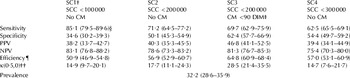
Sensitivity and specificity of the four selection criteria, when the gold standard was based on isolating the same pathogen from both samples of the same quarter are shown in Table 3. The highest sensitivity was obtained using SC1 (85·1%). The highest specificity was observed with SC3 (62·4%). The highest PPV was obtained when cows were classified using SC3, followed by SC1 and SC4 with similar results. The highest NPV was observed with SC1 closely followed by SC3.
Sensitivity, specificity, positive (PPV) and negative predictive values (NPV) for selection of uninfected cows at dry-off based on somatic cell counts (SCC) during the last three months of lactation and clinical mastitis (CM) history. Isolation of the same pathogen from paired samples (⩾100 cfu/ml) was used as the gold standard (n=647)
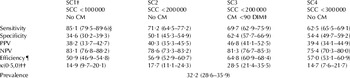
† Different selection criteria for identifying uninfected cows; cows not fulfilling the criteria were considered infected
‡ Cows that had CM during the first 90 days in milk (DIM) but SCC <100 000 cells/ml during the rest of the lactation were considered uninfected in addition to cows with SCC <200 000 cells/ml and no CM
§ 95% Confidence intervals
¶ [(Number of true positives+Number of true negatives)/Total number of samples]
†† Quality index (Kraemer, Reference Kraemer1992)
The highest correct classification rate was obtained when SC3 was used. This criterion also had optimal efficiency. Percentage of Staph. aureus-infected cows misclassified (number missed/total infected) was 0% (0/29), 13·8% (4/29), 6·9% (2/29) and 17·2% (5/29) when SC1, SC2, SC3 and SC4 were used, respectively.
Performance of the optimal selection criterion
The performance of the selection criterion with optimal efficiency (SC3) using single samples was evaluated using four different levels of prevalence of IMI. As prevalence increased from 15% to 45%, PPV increased linearly from approximately 23% to 58% and NPV decreased from 91% to 68% (Table 4).
Positive (PPV) and negative predictive values (NPV) using the optimal selection criterion (SC3Footnote †) for identifying infected and uninfected cows at dry-off with different prevalence of intramammary infections in the herdFootnote †, Footnote ‡

† Cows without clinical mastitis (CM) and SCC <200 000 cells/ml during last 3 months of lactation and cows that had CM during the first 90 days in milk but SCC <100 000 cells/ml during the rest of the lactation were considered uninfected. Sensitivity 69·4%, specificity 63·3%, and efficiency 65·4%
‡ Gold standard: Isolation of ⩾100 cfu/ml of Staph. aureus or Str. agalactiae or ⩾500 cfu/ml of any other pathogens from single samples
§ 95% Confidence intervals
Discussion
The gold standard for identifying IMI is the microbiological culture of aseptically collected milk samples (International Dairy Federation, 1987; Oliver et al. Reference Oliver, Gonzalez, Hogan, Jayarao and Owens2004; Sanford et al. Reference Sanford, Keefe, Sanchez, Dingwell, Barkema, Leslie and Dohoo2006). Isolation of the same pathogen from repeated samples of the same quarter is traditionally used to determine prevalence of IMI (International Dairy Federation, 1987). Microbiological results from quarter milk samples have been used by several researchers as a criterion for identification of infected quarters and/or cows for allocation to SDCT at dry-off (Bratlie, Reference Bratlie1973; Robinson et al. Reference Robinson, Jackson and Marr1983; Østerås et al. Reference Østerås, Sandvik, Aursjø, Gjul and Jørstad1991; Browning et al. Reference Browning, Mein, Brightling, Nicholls and Barton1994; Østerås et al. Reference Østerås, Aursjø, Gjul and Jørstad1994). In commercial herds, collection of milk samples for culturing prior to dry-off to identify infected cows would be impractical and cost-prohibiting (Eberhart, Reference Eberhart1986; Berry et al. Reference Berry, Maas, Kirk, Reynolds, Gardner and Ahmadi1997), and for this reason a series of criteria using information available on the farm (monthly SCC records and CM occurrence) was evaluated in the present study.
Reported prevalence of infection at dry-off, due to any pathogen, ranges from 28% to 50% on a cow level (Smith et al. Reference Smith, Neave and Dodd1966; Rindsig et al. Reference Rindsig, Rodewald, Smith and Spahr1978; Browning et al. Reference Browning, Mein, Brightling, Nicholls and Barton1994). Diagnosing IMI based on single samples considered the epidemiology of the mastitis pathogens (i.e., possible source and type of organisms) by using different cfu cut-offs for major contagious and environmental organisms. In the present study, prevalence of IMI was similar to results reported in the literature, either when single or paired samples were used in the diagnosis (Bratlie, Reference Bratlie1973; Browning et al. Reference Browning, Mein, Brightling, Nicholls and Barton1994; Pitkälä et al. Reference Pitkälä, Haveri, Pyörälä, Myllys and Honkanen-Buzalski2004; Sanford et al. Reference Sanford, Keefe, Sanchez, Dingwell, Barkema, Leslie and Dohoo2006). Comparison of results of this study with those reported in the literature, however, is challenging owing to differences in study designs and in definitions of infection that have been used as gold standard.
It is generally accepted that SCC from uninfected quarters are <200 000 cells/ml (Reneau, Reference Reneau1986; Harmon, Reference Harmon1994), allowing classification of cows as infected or uninfected (Dohoo & Leslie, Reference Dohoo and Leslie1991; Cook et al. Reference Cook, Bennett, Emery and Nordlund2002; Schukken et al. Reference Schukken, Wilson, Welcome, Garrison-Tikofsky and Gonzalez2003). The results of the current study agreed with this as infected cows were most accurately identified when SCC cut-off was set at 200 000 cells/ml when no CM had occurred during the lactation combined with a cut-off of 100 000 cells/ml, if CM occurred in early lactation (i.e., <90 days in milk). Including the additional requirement to SC2 of a lower SCC threshold at dry-off for those cows that experienced CM during early lactation to call them uninfected (SC3) as compared with those without CM cases provided the highest correct classification rate. This suggests that these cows appeared to have cured and remained uninfected during the lactation and therefore they would not need treatment at dry-off. Østerås et al. (Reference Østerås, Edge and Martin1999), on the other hand, reported that cows treated for acute CM during the previous lactation and with high SCC at dry-off were more likely to be infected with major pathogens in the next lactation. Thus, it would be beneficial for those cows to be considered infected at dry-off and to receive DCT (i.e., therapeutic effect), or be recommended for culling as suggested by Østerås et al. (Reference Østerås, Edge and Martin1999).
In the present study, using the SCC results of the last three months with a cut-off value of 200 000 cells/ml and CM history to identify infected cows (i.e., either SC2 or SC3) from either single or paired milk samples, had similar sensitivity to that reported by Rindsig et al. (Reference Rindsig, Rodewald, Smith and Spahr1978), Poutrel & Rainard (Reference Poutrel and Rainard1981) and Dohoo & Leslie (Reference Dohoo and Leslie1991) but lower than results reported by McDermott et al. (Reference McDermott, Erb and Natzke1982) and Timms & Schultz (Reference Timms and Schultz1987). The lower the cut-off values for SCC, the higher the sensitivity, but simultaneously specificity decreases. Estimates of specificity in the present study using either SC2 or SC3 were lower than those previously reported by McDermott et al. (Reference McDermott, Erb and Natzke1982), Timms & Schultz (Reference Timms and Schultz1987) and Dohoo & Leslie (Reference Dohoo and Leslie1991) but similar to results reported by Rindsig et al. (Reference Rindsig, Rodewald, Smith and Spahr1978) and Poutrel & Rainard (Reference Poutrel and Rainard1981). High prevalence of minor pathogens has been reported to have a negative effect in the sensitivity and specificity of SCC (Dohoo & Leslie, Reference Dohoo and Leslie1991). This could partially explain the low specificity observed in the present study, as the majority of infections in this study were caused by CNS. Considering only cows with major pathogens as infected increased the sensitivity of all selection criteria. A similar increase in sensitivity was observed by Sanford et al. (Reference Sanford, Keefe, Sanchez, Dingwell, Barkema, Leslie and Dohoo2006) when detection of all pathogens was compared with detection of only major pathogens. Overall, the selection criteria performed equally regardless whether the diagnosis of IMI was based on single or paired milk samples.
When SCC cut-off value was 200 000 cells/ml or higher, some Staph. aureus-infected cows were erroneously classified as uninfected, owing to the relatively low SCC of these cows. Low somatic cell response to Staph. aureus has been observed previously, with SCC as low as 158 000 cells/ml (Hogan et al. Reference Hogan, White and Pankey1987). However, cellular response to this pathogen, determined from quarter samples, generally induces a geometric mean of 333 000 cells/ml (Djabri et al. Reference Djabri, Bareille, Beaudeau and Seegers2002). Thus, setting the SCC at 200 000 cells/ml will in most cases allow proper identification of Staph. aureus-infected cows, especially if multiple quarters are infected. The number of Staph. aureus-infected cows that were missed was lower with SC3 than with SC2 or SC4.
The efficiency of SCC to identify infected cows increased with the number of tests used, reaching its maximum when results of the last three months of lactation were used, in agreement with the report by Østerås et al. (Reference Østerås, Edge and Martin1999). Based on the efficiency of the four criteria evaluated in this study the most accurate identification of the health status of the udder at dry-off was obtained with SC3. This held true both when identifying cows with any infections or just with infections caused by major pathogens. Even though sensitivity using SC3 was lower than with SC1, this criterion allowed better identification of truly uninfected and infected cows because it had the highest efficiency, making the use of this criterion feasible on commercial farms. However, our results regarding the varying levels of prevalence suggested that farm characteristics (prevalence of infection in the herd) need to be considered carefully.
Positive and negative predictive values change with the prevalence of infection in the population and the test characteristics (i.e., sensitivity and specificity) (Dohoo et al. Reference Dohoo, Wayne and Stryhn2003). The lower the prevalence of IMI the higher the NPV, while the higher the prevalence, the higher the PPV (Dohoo, Reference Dohoo2001; Dohoo et al. Reference Dohoo, Wayne and Stryhn2003; Sanford et al. Reference Sanford, Keefe, Sanchez, Dingwell, Barkema, Leslie and Dohoo2006). In this study, with a prevalence of IMI of 34·3% based on single samples, the probability that a cow classified as uninfected was truly uninfected varied between 76·2% and 80·9% depending on the selection criteria used, similar to the results calculated from Rindsig et al. (Reference Rindsig, Rodewald, Smith and Spahr1978) and Poutrel & Rainard (Reference Poutrel and Rainard1981) with 28% and 43% of prevalence, respectively. However, with a lower 15% prevalence of IMI, over 91% of the cows classified as uninfected were truly uninfected, similar to the results of McDermott et al. (Reference McDermott, Erb and Natzke1982) with prevalence of 24%. On the other hand, half of the cows that were classified as infected in the present study and that would be treated if SDCT was used were actually not infected. Thus we will treat more cows than potentially needed. Similar to this study, low PPV (38–55%) was found previously when prevalence was between 24% and 28% (Rindsig et al. Reference Rindsig, Rodewald, Smith and Spahr1978; McDermott et al. Reference McDermott, Erb and Natzke1982), while for prevalence of 43%, PPV of 61% was observed (Poutrel & Rainard, Reference Poutrel and Rainard1981).
Practical implications
Since prevalence of IMI differs from one farm to another, the utility and success of any selection criteria used to implement SDCT will depend on individual farm characteristics. Management styles and record-keeping abilities of specific farms need to be considered if and when planning to implement SDCT. Selection criteria with high sensitivity will have few false negatives, ensuring that infected cows will be identified and treated, while selection criteria with high specificity will have few false positives (Dohoo et al. Reference Dohoo, Wayne and Stryhn2003). Every herdsman needs to consider the possible cost of misclassifications (i.e., false positives and false negatives) (Andrews et al. Reference Andrews, Kitchen, Kwee and Duncalfe1983) and the type of pathogens present in the farm when selection criteria to identify potentially infected cows are chosen. When both false results are clinically important a test with optimal efficiency is preferred (Kraemer, Reference Kraemer1992). In the current study, selection of potentially infected cows based on SCC threshold of 200 000 cells/ml using the last three months' test records and CM history provided optimal efficiency. When the prevalence of contagious pathogens in the herd is high, false negatives and thus leaving infected cows untreated are undesirable, and it may be preferable to treat all quarters of all cows (Huxley et al. Reference Huxley, Green, Green and Bradley2002; Sanford et al. Reference Sanford, Keefe, Sanchez, Dingwell, Barkema, Leslie and Dohoo2006). On the other hand, if the goal is reduction of the use of antimicrobials and minor pathogens or pathogens ubiquitous in the environment are the most prevalent microorganisms, selective treatment of only those cows suspected to be infected using a selection criterion that provided optimal efficiency is a reasonable approach.
In conclusion, cows with IMI at dry-off can be identified adequately combining information from SCC and CM records, but decisions regarding the optimal selection criteria and adaption of SDCT depend on herd characteristics, such as prevalence of IMI and type of microorganisms present in the herd.
This study was supported by USDA Animal Health Formula Funds through the Council for Research at OSU College of Veterinary Medicine and by the National Research Initiative of the USDA Cooperative State Research, Education and Extension Service, grant number 2005-35204-15587. The authors appreciate the cooperation of the farm managers who were involved in this project and we thank Yayoi Fukuhara for her invaluable help.