Understanding ancient coinage in an archaeological context
Within the past several decades, archaeologists and social anthropologists have increasingly recognized the importance of examining the consumption and the material context of objects for addressing broader social questions (Comaroff Reference Comaroff and Howes1996; Dietler Reference Dietler and Cusick1998; Gell Reference Gell and Appadurai1986; Miller Reference Miller and Miller1995). By investigating processes of consumption in daily life, scholars have offered a more nuanced and intimate understanding of the role of artefacts in social life. In particular, by acknowledging processes of consumption, one is able to explore the specific cultural context in which societies interacted with the material world, and how the use of certain material objects constructed, reshaped and reinforced cultural ideologies about identity, value and so on. An understanding of consumption entails a knowledge of the material context of the artefacts in question. Archaeologists can approach context by looking at the spatial and temporal relationships between an object and the associated features and artefact assemblages of a site. In many cases, the original function of an object is not evident or inherent in its form, and an examination of its archaeological context can aid scholars in understanding the ways in which it was valued and consumed (Wells Reference Wells and Haselgrove2006, 144–45). This is especially useful for a class of objects such as coinage or money whose use and value have varied widely among different societies.
Although numismatics has traditionally focused on the distribution, chronology and typology of coins (Collis Reference Collis, Casey and Reece1974, 1; Wellington Reference Wellington and de Jersey2006, 81), a growing number of coin specialists have added to these understandings by investigating the archaeological context of ancient coins (Aarts Reference Aarts2000; Reference Aarts2005; Curteis Reference Curteis and de Jersey2006; Haselgrove Reference Haselgrove1987; Reference Haselgrove and Mays1992; Reference Haselgrove1996; Reference Haselgrove1999; Reference Haselgrove2005; Reference Haselgrove and de Jersey2006; Wellington Reference Wellington and de Jersey2006). In the case of Iron Age Europe, this trend has involved a shift away from studies that examine the broad distribution of coinage across large parts of Celtic-speaking Europe (e.g. Allen and Nash Reference Allen and Nash1980; Briggs Reference Briggs and Green1996; Nash Reference Nash1987), to more regional studies (Gruel and Haselgrove Reference Haselgrove and de Jersey2006; Haselgrove Reference Haselgrove and Mays1992, 125–27). In a recent publication, Colin Haselgrove outlined three areas of future research for enhancing our current understanding of Iron Age coinage. He writes (2006, 109),
There needs to be further analysis of stratified coin sequences, as only this can provide reliable comparative data on the incidence of indigenous and Roman issues deposited in successive periods and at different types of sites . . . Second, we need to consider religious and symbolic attitudes to coinage and to the metals from which it was minted . . . [Third,] the time has come for us to build some of these anthropological ideas into our approach and seek to establish which, if any, of them might be relevant in an archaeological context.
In this article I attempt to incorporate these three suggestions into a discussion of the changing function and value of coinage at the ancient town of Lattara in southern Gaul before and after the Roman conquest of 121 B.C. This article utilizes the substantial work of Michel Py (Reference Py2006) on the approximately 6,000 coins unearthed during ongoing excavations at the site. Although this article can only offer insight into the use of coinage and monetary exchange systems through the limited window of a single site, such an approach can still serve as an interesting case study for comparison with other examples from Iron Age Europe and in colonial situations in general. In particular, the results from this discussion can help scholars of Iron Age Europe to understand better two important and recurring themes: the possible development of a monetary economy at the pre-conquest oppida of Celtic-speaking Europe, and the religious and/or economic significance of Iron Age coinage.
Despite the increasing discovery of Iron Age coins, scholars have commonly remarked how the archaeological context of Iron Age coinage is rarely ideal, often because coinage seldom appears in stratified deposits (de Jersey Reference De Jersey and de Jersey2006b, 2–3; Reference De Jersey and de Jersey2006a, 121; Kretz Reference Kretz and de Jersey2006, 197; Wellington Reference Wellington and de Jersey2006, 90). In this regard, using the coin data from the excavations at Lattara is especially beneficial because of the excellent preservation of the stratigraphic units within the site. Due to the nature of this heavily stratified site, in which floor layers are well preserved, archaeologists have been able to precisely date the units of stratigraphy, allowing for a close study of changes in coinage at the site over time (Garcia Reference Garcia2004, 53). In addition, the use of the computer program Syslat (Py Reference Py1997) allows for convenient retrieval and study of the data.
Based upon a careful analysis of the archaeological context of coins at Lattara, I argue that coinage functioned as special-purpose money and was part of a distinct sphere of exchange involving trade with the Greek-speaking colony at Massalia (modern Marseille) from the end of the 4th century B.C. to the end of the 2nd century B.C. Following the Roman conquest around 121 B.C., the increasing need for commensurate systems of exchange in this intensified colonial situation led to the growth of a limited money economy at Lattara, in which coinage functioned as general-purpose money.
The ancient town of Lattara
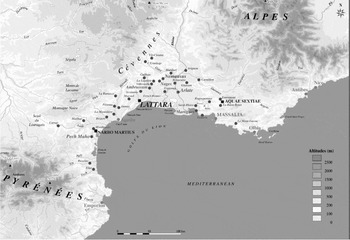
The ancient town of Lattara was an important Celtic-speaking settlement inhabited from c.525 B.C. to c. A.D. 200. The name ‘Lattara’ is Celtic in origin and probably means ‘the river of the marsh’ (Barruol Reference Barruol1988, 10–13). Today the modern town of Lattes lies within the département of Hérault in the Languedoc-Roussillon région of France (figure 1). Situated along a lagoon bordering the Mediterranean, the site was an important port for trade, first with Etruscan merchants, then with Greeks from the colony of Massalia, and finally with the Romans. Archaeologists first began to investigate the lands just south of the modern town in 1963 under the guidance of the Groupe archéologique Painlevé (GAP). Recognizing the importance of the growing number of finds, the French state acquired the land during the 1970s (Py and Garcia Reference Py1993, 3–7). Since 1984 Lattes has been the site of significant and extensive excavations by international teams of archaeologists (Garcia Reference Garcia1996, 7).
Map of southern France indicating the location of Lattara within the region. Indigenous Celtic oppida are labelled in italics, while Greek and Roman colonies (in capital letters) are in regular font (map courtesy of Lattes excavations).

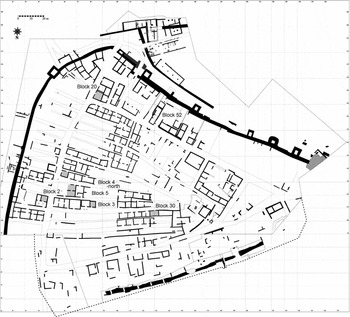
In terms of the town's physical layout and its material culture, Lattara was similar to other towns in southern Gaul, such as Ensérune (Jannoray Reference Jannoray1955), Pech Maho (Gailledrat and Soldier Reference Gailledrat and Soldier2004), Nemausus (modern Nîmes) (Monteil Reference Monteil1999; Py Reference Py1981), Ambrussum (Fiches Reference Fiches1979; Reference Fiches1986), Nages (Py Reference Py1978), Ile-de-Martigues (Chausserie-Laprée, Nin and Domallain Reference Chausserie-Laprée, Nin and Domallain1984; Chausserie-Laprée and Nin Reference Chausserie-Laprée and Nin1987), and Entremont (Coutagne Reference Coutagne1993). From its foundation, Lattara exhibited a planned layout, with fortification walls forming a triangle roughly 3.3 hectares in size and enclosing long rows of stone and mud-brick houses (Garcia Reference Garcia1996; Py Reference Py2004b) (figure 2). By the 4th century B.C. the population of Lattara was between 4,000 and 5,000 inhabitants (Py Reference Py1999, 653).
Plan of Lattara showing the areas of the site excavated up to 2006. The zones mentioned in the article are labelled, with the specific houses/rooms highlighted in grey (plan courtesy of Lattes excavations).

Colonial interaction with the Etruscans, Massalian Greeks and Romans played an important role in the development of the town. The inhabitants of Lattara may have traded grain, livestock and possibly slaves to the foreign merchants in exchange for imported fineware, bronze objects and, most importantly, large quantities of wine in amphorae (Py Reference Py2006, 1151). During the 5th century B.C. the Greeks of Massalia had replaced the Etruscans as the primary merchants of southern Gaul and by the 4th century B.C. they held a monopoly over trade in the region (Py Reference Py and Garcia1993, 232). Although there is abundant archaeological evidence in the form of wine amphorae and Greek fineware testifying to sustained trade with Massalian merchants, there is no clear evidence of whether these Greek-speaking merchants permanently resided in the town or visited periodically. Furthermore, there is little archaeological evidence to suggest that Lattara had a rigid social hierarchy or a powerful ruling elite at any time in its history (Dietler Reference Dietler1999, 671).
By the 2nd century B.C. the Roman Republic had begun to take a serious interest in southern Gaul. At the behest of their ally, Massalia, Rome launched a series of campaigns against the Celtic-speaking peoples of the region, culminating in the defeat of the powerful Arverni kingdom in 121 B.C. (Florus, Epitome 1.37.2; Livy, Summaries 61; Strabo, Geography 4.2.3). Following the defeat of the regional Gallic powers, the Romans established a colony at Narbo Martius (modern Narbonne) in 118 B.C. and incorporated the area (what is today Languedoc and Provence) into the province of Gallia Transalpina. Despite this new colonial presence, there is little archaeological evidence to suggest that for the first century of imperial rule the inhabitants of Lattara were adopting Roman customs in any significant way (Dietler Reference Dietler2004). It was not until the end of the 1st century B.C. that important changes in the cultural practices of the settlement became apparent, including the appearance of ‘Gallo-Roman’-style houses (ibid., 406; Py and Garcia Reference Py1993, 22). Although still apparently a thriving port, by the time of the Roman Empire Lattara had declined in importance due to the growth of cities at Narbo Martius and Arelate (Arles). By c. A.D. 200 the harbour at Lattara had silted up and the occupants of the town had abandoned it (Py and Garcia Reference Py1993, 21).
Coinage in the Celtic and Mediterranean worlds
One important consequence of the relationship between the Celtic-speaking peoples and their Mediterranean neighbours, such as the Etruscans, Greeks and Romans, was the introduction of coinage into many areas of Europe. The practice of minting coins originated in Asia Minor during the 7th century B.C. and eventually spread into the western Mediterranean through the Greek colonies along the coast (Grierson Reference Grierson1975, 11). The function of these early coins was probably limited to social transactions, such as tribute, wergeld, dowries, bride price and offerings, as opposed to commercial transactions (Grierson Reference Grierson1978; Jenkins Reference Jenkins1990, 3). Massalia started minting coins at the end of the 6th century B.C., and continued until 49 B.C. when Julius Caesar seized the city (Nash Reference Nash1987, 28). Beginning in the 3rd century B.C., the indigenous peoples of Europe began to mint silver and gold coins of their own, using Greek and Macedonian coinage as a prototype (Allen and Nash Reference Allen and Nash1980, 9–10; Briggs Reference Briggs and Green1996, 244–48; Gruel Reference Gruel1989; Ziegaus Reference Ziegaus, Dannheimer and Gebhard1993).
Although Lattara was founded towards the end of the 6th century B.C., coins did not appear at the site until the middle of the 4th century, and even then only in small quantities. To date, archaeologists have discovered and catalogued over 6,000 coins at Lattes, including 4,339 coins found in four separate hoards (Py Reference Py2006, 5). The GAP excavations unearthed three hoards (3,493 coins) and another 1,618 isolated coins. The fourth hoard was discovered after 1983, along with an additional 846 coins from stratified deposits (Py Reference Py2008).
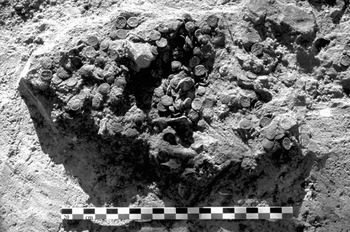
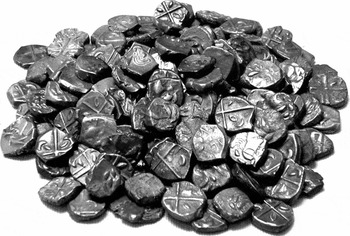
The first hoard consists of 1,708 Massalian silver obols and was buried at the end of the 4th century B.C. (Py Reference Py2006, 760–87). The second hoard consists of 999 obols and dates to the second half of the 3rd century B.C. (ibid., 903). The third hoard consists of 786 obols and also dates to the 3rd century B.C., although slightly later than the second hoard (ibid., 985) (figure 3). Finally, the fourth hoard consists of 843 locally minted silver coins known as monnaies à la croix, and dates to c.150 B.C. (ibid., 1064) (figure 4). Unfortunately, the first three hoards (trésors nos 1, 2 and 3), discovered during the GAP excavations of the site, lack any useful contextual information. The fourth hoard was located in a level of soil that was heavily disturbed by ploughing, and it is therefore difficult to reconstruct its exact relationship with the town.
Photo of trésor no. 4 from Lattara, a hoard of 786 Massalian silver obols from the second half of the 3rd century B.C. found in zone 52, sector 3 (photo courtesy of Lattes excavations).

Photo of a group of silver monnaies à la croix from trésor no. 3 at Lattara (photo by the author, courtesy of Lattes excavations).

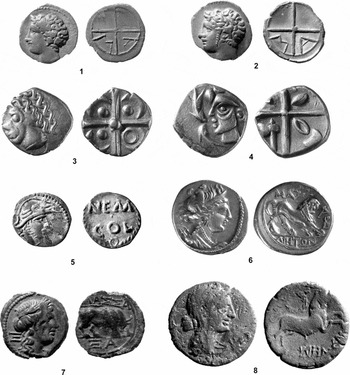
Of the coins from Lattes, over 75 per cent are from the mints at Massalia, with the other quarter consisting of coins from the local regions of Languedoc and Provence, as well as from farther north in Gaul and other parts of the Mediterranean (figures 5 and 6). Unlike other regions of the Celtic-speaking world, including the nearby towns of Nemausus and Ambrussum, Lattara never minted its own coins. Interestingly, even after the Roman conquest around 121 B.C., the number of Roman coins at the site remained extremely limited (Py Reference Py2006).
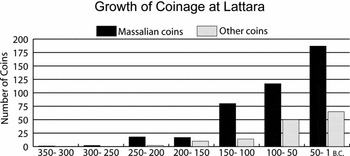
Graph indicating the growth in the number of coins by period at Lattara, excluding coins with no context and the four hoards. ‘Massalian coins’ include silver obols, silver drachmae, large bronzes, medium bronzes and small bronzes. ‘Other coins’ include silver and bronze coins from Provence/Rhône Valley, silver and bronze coins from Nîmes/eastern Languedoc, silver monnaies à la croix, silver and bronze coins from Ibero-Languedoc, silver and bronze coins from the Mediterranean, silver and bronze coins from temperate Gaul and silver and bronze Roman coins (data from Py Reference Py2006).

Examples of coins found at Lattara. 1–2, silver Massalian obols. Obverse: head of juvenile, reverse: wheel with MA. 3–4, silver monnaies à la croix. Obverse: unknown head, reverse: cross with various motifs in the canons. 5, silver obol from Nemausus (colonial period, pre-Augustus). Obverse: bearded head with helmet, reverse: latin legend NEM COL. 6, silver Massalian drachma. Obverse: bust of Artemis, reverse: lion with legend MAΣΣ(A) above and ΛIHTΩN below. 7, Massalian small bronze. Obverse: head of Apollo, reverse: bull with legend MAΣΣA above and letters ΞA below. 8, Bronze coin from Ibero-Languedoc. Obverse: head of a woman, reverse: running bull with wreath above and Iberian inscription below. The identification and descriptions of the coins are based on Py (Reference Py2006) (photo courtesy of Lattes excavations).

Coinage at Lattara before the Roman conquest: the problem of silver and spheres of exchange
For the first 150 years of Lattara's history, coins were notably absent at the site. When coinage first appeared in the town during the second half of the 4th century B.C. it was predominantly in the form of a small number of Massalian silver obols. However, the four hoards (c. 4th century B.C.–c.150 B.C.) imply that certain individuals were accruing large sums of Massalian coins (Py Reference Py2006). During the 3rd century B.C., Massalia began to mint smaller denominations of bronze coins in addition to the silver obols, both of which appeared at Lattara during this time (ibid.). The earliest coin archaeologists have uncovered at Lattes is a silver Massalian obol found in a stratigraphic context dating between 350 and 325 B.C. (ibid., 35).
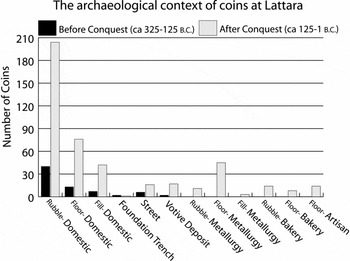
With the exception of the four hoards, the coins discovered in the stratigraphic units from the 4th to the 2nd centuries B.C. were either single finds or found in groups of between two and seven coins. Every coin that archaeologists have unearthed up to the period of the Roman conquest comes from an indigenous, domestic context associated with other artefacts commonly found in the houses of Lattara (ibid.) (figure 7).Footnote 1 The only exception was the small number of coins uncovered in the streets. The associated artefacts in the houses included imported black-gloss fineware (most commonly Campanian A), communal ware involved in cooking and eating, common coarseware vessels, Massalian wine amphorae, animal bones and some fragments of bronze jewellery and fibulae (ibid.). In general, the stratigraphic units containing coins were either floor levels or rubble layers associated with the renovation or realignment of houses. In the case of the floor layers, we can speak of coins as primary deposits that entered the archaeological record through accidental loss or intentional discard (LaMotta and Schiffer Reference LaMotta, Schiffer and Allison1999). The coins found in the rubble layers are either de facto deposits from the abandonment of the house or secondary refuse consisting of debris brought in from other areas of the site as fill for the construction of a new house. There is evidence to suggest that some of the coins may have been kept as small caches in the houses (Py Reference Py2006, 105, 540) and then subsequently buried when these houses were torn down (de facto deposits).
Graph indicating the different archaeological contexts of coinage found at Lattara, excluding the coins with no context and the coins from the four hoards (data from Py Reference Py2006).

Compared with the evidence for the accidental loss or discard of coins, the evidence for the religious significance of coinage is sparse (figure 7). Of the 53 stratigraphic units containing coins prior to c.125 B.C., only two (3.77 per cent) were classified as votive deposits. Similarly, of the 173 stratigraphic units containing coins after c.125 B.C., only four (2.31 per cent) were classified as votive deposits (data from Py Reference Py2006; for descriptions of the votive finds see Py Reference Py2004a, 147–48; Reference Py2006, 35, 313, 319, 324, 326, 412). One example of a votive deposit comes from Block 20 of the site, where archaeologists found a single Massalian silver obol that had been deliberately placed under the foundation of a mud-brick bench along with the jawbone of a pig (Py Reference Py2006, 35).
The majority of coins appear to have entered the archaeological record through accidental loss. Archaeologists have noted the importance of discernible floor layers for reconstructing the use of artefacts in social life because primary deposits reflect daily activities associated with specific stratigraphic units (LaMotta and Schiffer Reference LaMotta, Schiffer and Allison1999, 21). The coins from these floor layers were probably lost and either swept away or trampled down into the clay or dirt floors of the houses, and became part of the floor accumulation. The presence of floor layers implies that coinage may have had some function in daily life and was not just a form of storable wealth that could be hoarded away. Although small-scale craft specialization was present at Lattara before the Roman conquest, in the form of several bronze workshops, bakeries, and flour mills, it is notable that no coins have been found in any of these contexts (Lebeaupin Reference Lebeaupin1994, 43–48; Reference Lebeaupin and Feugère1998; Py Reference Py1992, 215–20; Reference Saul1996, 180, 184; Roux Reference Roux1994, 19).
The presence of coinage as primary deposits suggests that many of Lattara's inhabitants utilized Massalian coins in some fashion prior to the Roman conquest. One possibility is that coins were a means of exchange for purchasing goods. In the absence of a clearly demarcated market area, it is not an unreasonable hypothesis that the economic exchange of goods occurred at the site of their production. However, there is no evidence for coin circulation at the places of production such as workshops or bakeries before the Roman conquest. One could object that this is simply the result of factors in coin deposition, but the presence of coinage as primary deposits at production sites after the Roman conquest, as we shall see later, seems to nullify this point. Therefore it appears that coinage did not function as a means of exchange for purchasing locally produced goods at Lattara prior to the Roman conquest. Instead, a more likely explanation is that the introduction of silver coinage by Massalian Greeks represented a foreign system of value that contrasted with pre-existing systems of value, exchange and the calculation of wealth at Lattara.
Moreover, several works have drawn attention to the problem of assuming that precious metals such as gold, silver or bronze were inherently valuable to ancient societies (e.g. Haselgrove Reference Haselgrove1987, 25; Reference Haselgrove and Mays2005, 109). In the case of Lattes, there is a notable paucity of evidence to suggest that the people of Lattara valued silver as a form of wealth. In contrast to Celtic-speaking regions further north, there are almost no examples of silver in the archaeological record of southern Gaul during the Iron Age, other than coins – which the Massalian Greeks introduced into the region. Presumably coins were often valuable in the ancient world as bullion because they could be melted down and used for jewellery and other adornments (at least for non-Greeks; see Seaford Reference Seaford2004, 137, 146). In southern Gaul before the Roman conquest, items of personal adornment such as fibulae, bracelets and necklaces were overwhelmingly of either bronze or gold (Dietler Reference Dietler2005, 193–226; Py Reference Py and Garcia1993, 128, 146; Willaume Reference Willaume and Coutagne1993, 137). Poseidonios, a Greek traveller of the early 1st century B.C., noted, ‘In general, throughout Gaul there is no silver, but much gold, which nature renders to the inhabitants without mining or labor’ (author's translation; for the Greek text see Tierney Reference Tierney1960, 226, 249). He also described how the Gauls used much gold in their jewellery. In contrast to the Gauls, the Greeks used the same word (argúros) interchangeably for both silver and money. Any archaeologist seeking to understand how coinage functioned in southern Gaul during the late Iron Age must therefore confront the problem of how the indigenous peoples valued (or did not value) silver.
The evidence discussed here suggests that coinage at Lattara before the Roman conquest was not a part of an indigenous system of economic transactions, but instead was limited to some specific sphere of exchange. Ethnographers have noted the presence of ‘multi-centric economies’ and discrete ‘spheres of exchange’ in many societies throughout the world, although there has never been a consensus on what exactly constitutes a sphere of exchange (Barth Reference Barth1967a; Reference Bloch, Parry, Parry and Bloch1967b; Bohannan Reference Bohannan1955; Reference Bohannan1959; Dietler Reference Dietler1999, 676; Kopytoff Reference Kopytoff and Appadurai1986, 70–72; Piot Reference Piot1991; see also the notion of regimes of value in Appadurai Reference Appadurai and Appadurai1986, 14–15). In most examples there are differing systems of value for different objects within a society, resulting in the general prohibition of certain categories of goods being exchanged for other categories of goods. Indigenous conceptions of value that excluded silver may have prevented coinage from entering the circulation of local economic exchanges at Lattara, and thereby limited coins to a sphere of exchange involving foreign trade.
Because nearly all of the coins prior to the Roman conquest were from Massalia, the inhabitants of Lattara most likely came into possession of Massalian coinage through contact with Greek-speaking merchants. Although there are several possible explanations, I suggest that Massalian coinage may have functioned as a convenient way to render commensurate the opposing systems of value between Greek merchants and locals in order to facilitate the exchange of goods. As Jean and John Comaroff (Reference Comaroff and Comaroff2006) have concluded, based upon their research in South Africa, in any colonial situation there is always a need for ‘commensuration’ to equate and translate opposing systems of value in order to foster interaction and exchange between the two groups. They discuss how the process of making opposing regimes of value commensurate requires material objects such as ‘beads, coin, contracts and the like – with the capacity, simultaneously, to construct, negate and transfigure difference’ (Comaroff and Comaroff Reference Comaroff and Comaroff2006, 109). As portable symbolic tokens, coins may have been an acceptable way of estimating and calculating the wealth and value of objects circulating between Lattaran and Massalian systems of value.Footnote 2 Rather than functioning as an actual form of exchangeable wealth, the Massalian coins at Lattara may have functioned as tokens for designating the transactions of goods and for calculating credit. Although these coins functioned as a means of exchange and a standard of value for objects exchanged with foreign merchants, coins never became an indigenous standard of value, a mode of payment, or a means of exchange for local products before the Roman conquest.
Coinage at Lattara after the Roman conquest: the development of a money economy?
After the Roman conquest of 121 B.C., dramatic changes in coinage occurred at Lattara. As figure 5 illustrates, the number of coins at Lattara rose sharply after the second half of the 2nd century B.C. The majority of coins from stratigraphic contexts after the Roman conquest remained Massalian, but smaller bronze denominations were now more numerous than the silver (Py Reference Py2006). At the same time, local silver coinage minted in southern Gaul, known as monnaie à la croix, also became more common (ibid., 499).
In addition to the overall increase in the number of coins, the number of coins per stratigraphic unit also escalated after the Roman conquest. All but one of the 20 stratigraphic units containing five or more coins date to a period between 125 and 1 B.C. (ibid., 1251–53). This single stratigraphic unit (US 52104), dating between 200 and 175 B.C., contained a cache of seven monnaies à la croix found in House 52 (ibid., 540). The inhabitants of Lattara did not begin keeping large numbers of coins until the end of the 2nd century or the beginning of the 1st century B.C. Unlike the four large hoards from the 4th to 2nd centuries B.C., which contained a homogeneous collection of silver coins, these smaller caches comprised a variety of small denominations from both Massalia and other regions of southern Gaul.
For the majority of the 2nd century B.C. the coins were again predominantly found in domestic contexts (figure 7). There were no coins found in any of the metallurgy workshops at Lattara between 200 and 125 B.C., such as those at Block 36, House 11 of Block 3, and House 1 of Block 2 (Lebeaupin Reference Lebeaupin and Feugère1998; Roux Reference Roux1994). However, after 100 B.C. the one major metallurgy workshop found at Lattara (75–50 B.C., Room 1 of Block 4-north), which produced both bronze and iron objects, also contained 44 coins (Lebeaupin Reference Lebeaupin and Feugère1998; Py Reference Py2006, 83; Py and Lopez Reference Py and Lopez1990, 213–17, 243). The context of these 44 coins was a floor layer of the workshop, created by accumulated sediment and debris from workshop activities, making these coins primary deposits. This stands in stark contrast to the earlier workshops at Lattara that lacked any coinage.
Archaeologists also discovered 13 coins associated with House 3003 of Block 30 during the phase between 100 and 75 B.C. Based upon the lack of evidence for domestic activities, the excavators concluded that during this time period House 3003 was likely a space devoted solely to specialized production or commercial activity (Py Reference Py2004a, 139, 148). Later, between 75 and 50 B.C., this building functioned as a specialized room for the processing of grain and other activities associated with bread production (ibid., 145). The excavators found three small bronze coins within the floor level from this phase (ibid., 146). This indicates that the workers in House 3003 were using small denominations of coinage in a manner that caused several stray coins to be lost in the floor accumulation. The association between coinage and grain production was also noted at Block 5, which functioned between 50 and 1 B.C. as a space for the processing of grain and the baking of bread (Py Reference Py2006, 272, 284, 629; Sternberg Reference Sternberg1994). Here, archaeologists found 19 coins (Py Reference Py2006).
This new association of coinage with specialized activities and the dramatic increase in the sheer number of coins in the decades following the Roman conquest of southern Gaul attests to a significant change in the economic and greater social life of the inhabitants of Lattara. Whereas before the Roman conquest coinage was probably restricted to its own sphere, involving the exchange of foreign imports from Massalia, by the 1st century B.C. coinage had entered into other spheres of exchange. The contextual data of the coins from the 1st century B.C. suggest that craft specialists such as bronze- and ironworkers were now accepting money in exchange for their goods and services. Ninety-five (21.05 per cent) of the 451 coins from stratified deposits dating to after the Roman conquest were from specialized workshops (Py Reference Py2006) (see figure 7).
Issues of monetization and the emergence of a money economy have always been central to discussions of Iron Age coinage. According to the economic anthropologist George Dalton, a money economy exists only when money is all-purpose and can be used in almost any kind of economic exchange (Bohannan Reference Bohannan1959, 492; Dalton Reference Dalton1961, 15; Reference Dalton1965). Peter Bohannan (Reference Bohannan1959, 491–92) defined ‘general-purpose money’ as a group of objects that fulfil all three of the criteria of money: a means of exchange, a mode of payment and a standard of value. By contrast, ‘special-purpose money’ fulfils only one or two of the criteria (for examples see Bohannan Reference Bohannan1959; Dalton Reference Dalton1965; Gerriets Reference Gerriets1985; Gruel Reference Gruel1989, 113–19; Saul Reference Saul2004; von Reden Reference Von Reden1997, 156–60). At Lattara the earliest coinage was, as special-purpose money, only involved in transactions with foreign merchants. After the Roman conquest coinage became part of a much wider range of economic and social transactions. Coinage had become, at least for some things, a means of exchange, a mode of payment and a standard of value, and one can speak of a transition from coins being special-purpose money to coins being general-purpose money. While this is not the first time someone has suggested that the Roman provinces became at least partially monetized (Andreau Reference Andreau2000, 775; Howgego Reference Howgego1992, 29), hopefully the discussion here about a specific site can nuance broader views on the subject and provide greater specificity.
At the same time, one should be cautious about being too quick to assume that money had totally eradicated or subsumed all other forms of economic exchange at Lattara. Ethnographers such as Charles Piot have noted the persistence of spheres of exchange in many societies despite the incursion of money into forms of economic exchange (Piot Reference Piot1991, 405–6). Furthermore, in many societies that adopted money, land and labour often remained outside the domain of monetary transactions (Barth Reference Barth1967a; Reference Bloch, Parry, Parry and Bloch1967b, 663; Dietler and Herbich Reference Dietler, Herbich, Dietler and Hayden2001, 247). For example, among the Tiv of Nigeria, who incorporated money into their economy, land remained something that could be neither bought nor sold for money or any other medium of exchange. Bohannan wrote, ‘Land is, for them, a unique category. Nothing is exchangeable for it’ (Bohannan and Bohannan Reference Bohannan and Bohannan1968, 90).
In the decades following the Roman conquest the locals at Lattara considered money a proper medium for the exchange and purchase of bronze and iron objects, some subsistence goods such as bread, and foreign imports. However, this does not necessarily mean that coinage had become an acceptable form of exchange for all manner of goods and services. For example, the possibility is certainly still open that the inhabitants of Lattara used feasting as a means to mobilize labour both before and after the Roman conquest, as is often common in many archaeological and ethnographic examples (Dietler and Herbich Reference Dietler, Herbich, Dietler and Hayden2001). The ‘ethnographic’ observations of Poseidonios from the early years of the 1st century B.C. indicate that feasting was still important among at least some Celtic-speaking societies. We should therefore show caution in speaking of a true ‘money economy’ in place at Lattara by the first century B.C.
After the Roman conquest the inhabitants of Lattara stored coins in their houses and used them to purchase both bread and metal products. This development represents not just a change in practice, but also a change in the way in which locals conceived of cultural concepts such as wealth and value. Coins were no longer foreign objects with a limited value in social life, but instead became tokens of a more general category of wealth that could be exchanged for a wider array of objects. The major change behind all this was the acceptance by locals of coinage as a new standard of wealth and a mode of payment for local exchange. This adoption of a new form of wealth by the inhabitants of Lattara may have been related to the shift in coinage from silver to bronze that would have adhered better to indigenous tastes in metal.
This new acceptance of coinage appears to have involved neither the development of an ideology involving commoditization nor alienated economic exchange. As scholars such as Maurice Bloch and John Parry (Reference Bloch, Parry, Parry and Bloch1989, 20–21) have argued, the introduction of money into an economy does not have the intrinsic power to transform society. Instead, they emphasized how the meaning and value of money is culturally specific. For Lattara, there is no evidence that the coinage introduced had an intrinsic power to induce social change. Indeed, there were no major changes in housing arrangements or social organization during the 1st century B.C. that would have coincided with the creation of a limited money economy. The most notable social changes occurred during the 3rd century B.C. with the appearance of large, Mediterranean-style courtyard houses – well over a century before the Roman conquest and the increase in coinage at Lattara (Dietler et al. Reference Dietler, Kohn, Moya i Garra and Rivalan2008).
Coinage was significant in the intensified colonial encounter after the Roman conquest because it provided a necessary form of commensuration that could standardize the ways of calculating value in instances of economic exchange between the locals and the Roman colonizers (cf. Comaroff and Comaroff Reference Comaroff and Comaroff2006). As a common standard of value, means of exchange and mode of payment, coins allowed both Celtic-speaking and Roman individuals to bridge the gap between their opposing systems of value. This development opened up new possibilities of exchange for the inhabitants of Lattara within the new Roman markets established in Gallia Transalpina.
Scholars have often emphasized the role that the creation of an imperial taxation system could have had on the use of money in the conquered provinces. Michael Dietler (Reference Dietler2004, 410), citing ethnographic accounts of colonial situations in Africa, suggests that the imposition of such a taxation system upon Lattara may have had the unintended consequence of spurring the development of a monetized economy. During the 19th century A.D. colonial regimes such as the British and French empires forced their African subjects to incorporate money into their economy in order to pay regular taxes in the form of cash (see also Bohannan Reference Bohannan1959; Saul Reference Saul2004). At the same time, colonialism also created new markets for goods and services as the European colonists introduced goods into the region and established cities where jobs were available that paid in cash.
These developments and the presence of a new external market allowed those living under the colonial regimes to step outside their traditional systems of exchange and re-enter it with new wealth. Bohannan (Reference Bohannan1959, 502) recorded, for example, that the Tiv could now sell crops and other subsistence goods in these British markets for money, something that was impossible in their own traditional society. With this newly acquired money, they could then buy prestige items such as cattle and cloth at the colonial markets, which would increase their social rank within their local society. All of this led to the inclusion of Tiv society in a larger, monetized economy that consequently resulted in the break-up of traditional forms of exchange and a dramatic increase in the amount of money used amongst the Tiv. These changes benefited the colonial regimes, since they could then more easily extract taxes in the form of cash.
The major changes in coinage at Lattara preceded the development under Augustus of an imperial census and a coherent system of taxation at the end of the 1st century B.C. Before these reforms, the Senate had relied upon private tax collectors (publicani) to gather tribute from the conquered provinces (Aarts Reference Aarts2000, 12–13). Furthermore, during the republican period, taxation was sporadic and often in kind rather than in coinage (Aarts Reference Aarts2000, 8–17; Duncan-Jones Reference Duncan-Jones1990, 187–98; Howgego Reference Howgego1992; Reference Howgego1994, 18; Woolf Reference Woolf1998, 43–44). At the time when Lattara witnessed a dramatic increase in the use of money, the impact of the Roman taxation system was therefore rather limited.
A more significant development following the Roman conquest was the creation of colonies within Gallia Transalpina and the establishment of new markets for the people of Lattara. In 124 or 123 B.C. the Roman consul Sextus Calvinus founded a garrison at Aquae Sextiae (modern Aix-en-Provence) and in 118 B.C. the Roman Republic founded the colony of Narbo Martius (Livy, Summaries 61; Strabo, Geography 4.1.5; Velleius Paterculus 1.15). The creation of these two new cities would have significantly affected the local economies of southern Gaul by creating new trade networks. The archaeological record at Lattes reflects this development with the decline in the number of Massalian wine amphorae sherds, and the corresponding increase in the number of Italic amphorae sherds during the latter half of the 2nd century (Py and Garcia Reference Py1993, 70). In part, the increasing amount of coinage in daily use at Lattara was one aspect of a larger trend that the creation of market economies at the Roman colonies of Narbo Martius and Aquae Sextiae helped accommodate.
Imperial conquest and colonization meant that Roman merchants, soldiers and other newcomers entered into the region and settled upon the newly redistributed land between the Volcae Arecomisci and Massalia (MacMullen Reference MacMullen2000, 101; Woolf Reference Woolf1998, 42). These colonizers, already accustomed to a monetized economy, may have begun to offer coins to the indigenous peoples of Gallia Transalpina in exchange for basic goods such as metal products and food. The locals of Lattara may have accepted this form of coinage because it adhered to their cultural tastes in metal – that is, a preference for golden-colored metals. In doing so, they helped create a standardized form of exchange in the region that contributed to the growth of trade during the 1st century B.C. The creation of a limited money economy at Lattara was therefore the combined result of the new demand among Roman travellers and traders for coinage and the concomitant need for a standardized system of exchange between colonizers and colonized. Furthermore, I would argue that this commensurate system of exchange involving coinage allowed for the eventual participation of the indigenous peoples in the Roman state, a process scholars have broadly defined as ‘Romanization’. In the absence of other interactions at Lattara with Roman customs and values, this development facilitated later instances of negotiation and hybridization of cultural value systems.
Concluding thoughts
Or, if a certain woman having ten drachmae might lose one drachma, does she not light a lamp and sweep clean the house and zealously search until she might find it?
Gospel of Luke 15:8Particularly in the case of artefacts such as coins, archaeologists are often strangely dependent upon the bad luck or forgetfulness of others for their data. For every person like the widow of the famous parable who found what she had lost, there were (thankfully) countless others who accidentally dropped coins unknowingly, or forgot where they had put them, thereby leaving these objects to slowly enter into the archaeological record. Removed from their archaeological context and viewed in a museum, it becomes all too easy to forget that these objects were once an intrinsic part of the social lives of real individuals. Like the lost drachma of the widow, each coin has a unique social history that is infused with meaning for the individual and for society as a whole.
In the case of Lattara, the archaeological context allows one to imagine an inhabitant of Lattara placing an obol along with an offering of pork on a mud-brick base before continuing with the construction of the house, in hopes that such an act of devotion would bring good favour to the residents of the house. Perhaps, around the same time, a leading figure within the town prepared for a seasonal feast by purchasing several amphorae of wine from the Massalian merchants living at Lattara. While retrieving the necessary number of silver obols, functioning as tokens for calculating value, from where they were kept hidden within the confines of the back room of a mud-brick house, he or she may have accidentally misplaced one of the silver obols. Left forgotten in a dark recess of the room, the coin would be recovered by archaeologists over two millennia later. After the Roman legions had swept through the region and established a nearby colony, the residents of Lattara in need of their daily bread may have gone to the town bakery, where they could now purchase loaves for a small bronze coin. While all three scenarios are hypothetical, they are all quite plausible and help to illustrate the changing function of coinage in the social lives of the inhabitants of Lattara.
I hope that this case study can offer new insights and raise new questions for archaeologists and historians involved with Iron Age coinage, and for those interested in the adoption of coinage in colonial encounters in general. Among the many issues confronting scholars of Iron Age coinage today, two important themes are the continued debate concerning the formation of a monetary economy at the pre-conquest oppida of Celtic-speaking Europe, and the growing awareness of the religious function of coins among Iron Age societies.
In regard to the question of monetization and a money economy prior to the Roman conquest, the discussion of evidence from Lattara suggests that we should show caution in assuming the development of a true money economy based upon the presence of small-denomination coins. A common suggestion over the years has been that the appearance of bronze potin coins signalled the creation of a monetary system of exchange because these smaller denominations were ideal for daily transactions (e.g. Allen Reference Allen, Hill and Jesson1972; Briggs Reference Briggs and Green1996, 245). While this may be true, scholars have often assumed that potins represented small change because they were of the ‘baser’ metal of bronze, rather than the more valuable silver or gold. However, the discussion in this article indicates that our own hierarchy of metals does not necessarily correspond with ancient standards. In fact, bronze coins may have become part of daily exchange because, unlike silver, they corresponded better with pre-existing preferences for certain metals, not because they were of a lesser value. The tin required to produce bronze was just as difficult to obtain as silver. Moreover, although silver tarnishes and bronze corrodes, the unsullied form of bronze more closely resembles gold – a metal which appeared in indigenous jewelry before the Roman conquest.
As for the second theme in Iron Age coinage, scholars have traditionally discussed coinage in terms of its economic function, explaining how the creation of coinage gradually replaced an economy based on barter with one relying on market exchange. More recent work on the subject has emphasized the ritual aspects of coinage and the relation of coins to larger social constructions of value (for a discussion, see Aarts Reference Aarts2005, 12–17). A number of excellent works concerning the relationship between money and the emergence of the Greek polis draw on the writings of Bloch and Parry (Reference Bloch, Parry, Parry and Bloch1989) and explore how coinage was linked to politics, religion and cosmologies (e.g. Kurke Reference Kurke, Scheidel and von Reden2002; Seaford Reference Seaford2004; von Reden Reference Von Reden1997). These examples rely primarily on the written record, and their method may be difficult to apply to the archaeological data from sites like Lattara. For Iron Age coinage, the increasing emphasis upon the religious aspects of money has been related to the growing awareness that many Iron Age coins from temperate Europe, particularly those from before the Roman conquest, were intentionally deposited in the ground for religious purposes (Aarts Reference Aarts2005, 13, 18; Curteis Reference Curteis and de Jersey2006, 67, 77; Haselgrove Reference Haselgrove2005, 130; Haselgrove and Wigg-Wolf Reference Haselgrove, Wigg-Wolf, Haselgrove and Wigg-Wolf2005; Wellington Reference Wellington and de Jersey2006, 89).
In contrast to other areas of Iron Age Europe, there is not a great deal of evidence from ancient Lattara for the primacy of coinage as a religious medium. The majority of coins, in the form of primary and de facto deposits, appear to be from accidental loss in daily use, implying more of an economic function. This discussion has illustrated how coinage at Lattara did not have any intrinsic meaning, but became part of a system of exchange because it was an expedient strategy for commensuration in the historical process of a long-term colonial encounter. By emphasizing the economic function of coinage in this article and examining how money and other goods functioned in social exchange, I hope to have laid the necessary foundation for a possible broader investigation of the relation of money in southern Gaul to the ‘general symbolic world of transactions’ (Bloch and Parry Reference Bloch, Parry, Parry and Bloch1989, 28).
Lastly, this case study has demonstrated the usefulness of a closer examination of coins within their archaeological context for understanding the significance of coinage in past societies and its value and function in daily life. In the case of coinage at Lattara, such an approach has revealed important changes in money within society that would not have been as apparent using a more generalized method of analysis. When the inhabitants around the lagoon founded Lattara c.525 B.C., there was no coinage present at the site. As interactions with Massalian merchants evolved, the need for a commensurate standard of value and means of exchange for the purchase of Greek imports may have resulted in the locals keeping small amounts of coin in their homes. After the Roman conquest the impetus from the creation of new markets and the demand by Romans in the region for coins led to the creation of a limited money economy at Lattara. A crucial factor for all of these developments was the desire of both locals and foreign merchants to create a standardized system of value in order to better expedite exchange. Hopefully, this emphasis upon the consumption of objects within daily social life and the careful study of archaeological context may prove productive at other sites as well.
Acknowledgements
I am grateful for the advice and suggestions of Michael Dietler and for his assistance in the editorial process. I am also grateful to Michel Py for his encouragement and for allowing me to discuss the extensive published data on coinage at Lattara. In addition, I would also like to thank the two anonymous reviewers for their constructive criticism and helpful suggestions. Finally, I would like to thank Julie A. Hanlon for her support and editorial assistance.