Significant outcomes
∙ Quality of life (QOL) of parents who have children with autism spectrum disorder (ASD) in a South African cohort is reduced compared with those of typically developing (TD) children across all domains.
∙ Factors associated with parental QOL in this study are lower household income, severity level of ASD and lack of access to school placement of children with ASD.
Limitations
∙ The study is a cross-sectional study, which does not allow for the identification of any causal relationship between noted correlates.
∙ In addition, it is limited by a small sample size.
∙ Further, the World Health Organization Quality of Life Assessment-BREF (WHOQOL-BREF) measure used in this study, though widely used globally, is not specifically validated in the South African population.
Introduction
ASD is a neurodevelopmental disorder that is defined by impaired social communication along with unusual restricted and repetitive behaviours (1). It is one of the most common developmental disorders, affecting persons of all ethnic and socio-economic backgrounds (2). Current estimates suggest that in the United States the prevalence of ASD is 20 in every 1000 school-aged children (Reference Blumberg, Bramlett, Kogan, Schieve, Jones and Lu3). A recent surge in the number of children identified with ASD has raised concern regarding the burden on parents and caregivers of children with ASD. In particular, emphasis has fallen on QOL of caregivers.
The World Health Organisation defines QOL as an ‘individual’s’ perception of their position in life in the context of the culture and value systems in which they live and in relation to their goals, expectations, standards and concerns’ (4). In the context of treatment, QOL is an apparently thorough measure of numerous attributes, all of which constitute the individual’s well-being. These include social relations, relationships with one’s setting, psychological state and physical well-being. It is thus subjective and culturally governed; definitions may vary, moreover, depending on socio-cultural contexts (Reference Verdugo, Schalock, Keith and Stancliffe5). Previous studies have reported lower QOL in parents of children with ASD in Italy (Reference Mugno, Ruta, D’Arrigo and Mazzone6), Taiwan (Reference Tung, Huang, Tseng, Yen, Tsai, Lin and Chen7), India (Reference Perumal, Veeraraghavan and Lekhra8) as well as Japan (Reference Yamada, Kato, Suzuki, Suzuki, Watanabe, Akechi and Furukawa9). The impact of caring for a child with ASD on parents may be affected by previously reported factors such as stress, coping mechanisms, social support and employment (Reference Verdugo, Schalock, Keith and Stancliffe5,Reference Lindsay10).
Studies of QOL have, to date, largely been reported from western and well-resourced countries. There is a gap in research aimed at measuring the impact of raising children with ASD on parents in resource-limited settings and in South Africa specifically (Reference de Vries11). Many cultural, economic, and educational factors which are highly prevalent in this setting, may independently or cumulatively affect the QOL of caregivers living in South Africa. These factors include poverty, low level of education, material deprivation, poor access to jobs and services, mental and physical ill health, violence, human immune deficiency virus (HIV), alcohol and drug abuse (Reference Tomlinson12). In developing countries, low and middle class income families caring for children with ASD frequently struggle to access professional support services that provide specialist ASD diagnostic, therapeutic and educational services (Reference de Vries11). This, together with other listed factors, results in parents of children with ASD being at high risk of having low QOL.
The importance of QOL must be acknowledged. Health professionals are increasingly recognising the importance of parental QOL when planning a child’s treatment. However, locally valid studies investigating the possible role of the many cultural and cross-cultural factors are needed to provide health workers and policy makers with the necessary information to guide appropriate interventions (Reference de Vries11,Reference Dardas and Ahmad13–Reference Parish, Seltzer, Greenberg, Floyd and Taylor15). To our knowledge, only one study reported by Schlebusch et al. (Reference Schlebusch, Dada and Samuels16) has addressed QOL of the families who are raising children with ASD in this region. The study reported on QOL in 180 families of children with ASD who were attending therapeutic or educational services in the Gauteng province of South Africa. The study demonstrated that families were most satisfied with the disability-related support domain and the least satisfied with the emotional health domain. In addition, it revealed significant association between family QOL and some variables such as low-income, family type and severity of the core features of ASD (Reference Schlebusch, Dada and Samuels16). This study was an important first step in establishing an evidence base for QOL of caregivers for children with ASD in South Africa.
The WHOQOL-BREF self-administered instrument is an international cross-culturally validated measure that evaluates the individual’s perceptions in the context of their culture (17). This QOL measure has been selected for this study because of this broad global validation across multiple cultural and socio-economic contexts. In particular, it has been used in studies investigating the QOL of parents of children with ASD in other low and middle income countries, specifically India, Middle East and Asia (Reference Tung, Huang, Tseng, Yen, Tsai, Lin and Chen7,Reference Perumal, Veeraraghavan and Lekhra8,Reference Dardas and Ahmad23).
Aims of the study
In order to investigate the effect of caring for children with ASD on parents and caregivers, this study set out to evaluate the QOL among parents of children with ASD and to compare with those of TD children in Cape Town, South Africa. It also aimed to investigate the correlation between QOL and socio-demographic variables of parents and children with ASD in the specific context of Cape Town.
Material and methods
The study, a cross-sectional study, was completed between 1 June 2016 and March 2017. It was conducted at Red Cross War Memorial Children’s Hospital (RCWMCH). RCWMCH is a dedicated children’s hospital providing tertiary paediatric services to the greater Cape Town area. Approximately 4000 children with developmental disabilities are evaluated in this division of Developmental paediatrics service every year.
Study population
Parents of children aged 2–7 years old who had a clinical diagnosis of ASD based on the diagnostic criteria of the Diagnostic and Statistical Manual of Mental Disorders made at the RCWMCH developmental clinic at least 6 months before the commencement of this study were eligible for inclusion in the study. Background exclusion criteria included: parents of a child with ASD who had siblings diagnosed with ASD or other chronic medical illness, and parents with any known psychiatric illness. TD cases were enrolled from RCWMCH general outpatient department. Parents of TD children were included if they had children with no mental, developmental or physical disabilities who presented to the outpatient department with minor ailments for routine follow-up visits. Parents of children who had dysmorphic features, ASD or a diagnosis of any genetic syndromes were excluded. The TD group was matched with the clinical group on age and socio-economic status, using household income category and geographic area as variables to define the socio-economic status for comparison.
Sample size
The sample size was calculated based on previous studies done to measure QOL of parents of children with ASD using the same measure WHOQOL-BREF (Reference Tung, Huang, Tseng, Yen, Tsai, Lin and Chen7,Reference Perumal, Veeraraghavan and Lekhra8). This study was set to detect a 10-point differences between the groups with power of 80% and p value of 0.05 with the total sample size of 52 parents, 26 in group 1 (parents of children with ASD) and 26 in the typically developing group.
Recruitment and enrolment
Children with ASD were identified from the list of follow-up appointments provided by the Division of Developmental Paediatrics. Study staff approached potentially eligible parents attending the developmental clinic for routine follow-up appointments and completed the eligibility-criteria checklist. Eligible participants were given information on of the purpose and methods of the study verbally as well as in writing and were invited to participate. The study WHOQOL-BREF and a background questionnaire concerning parents and children’s characteristics and socio-demographic data were administered by the researcher or research assistant for those parents that agreed to participate and who had signed informed consent.
Measures
Parents and children’s characteristics and socio-demographic data questionnaire
Characteristics of parents that were considered with regards to demographics included age, gender and other family members’ details (including the number of other children and adults in the household). Characteristics collected that reflected socio-economic status included level of education, household income and employment status. The monthly household income was rated into three categories: level 1 (<3999 South African Rand, US $ <300) to level 3 (>6000 South African Rand, US $ >450) per month. For the child, details collected included age, gender, ASD severity and details of schooling.
The WHOQOL-BREF self-administered instrument
The WHOQOL-BREF measure is a shortened version of the WHOQOL-100 which is an international cross-culturally validated measure that evaluates the individual’s perceptions in the context of their culture. The WHOQOL-BREF contains 26 items developed in an attempt to provide a measurement of QOL (17). This instrument includes four main domains; physical, psychological, social and environmental health. The scores rated from 1 to 5, with higher scores denoting higher QOL. Standardised total scores (percentages) for the QOL scale were used in this study. The questionnaire was made available in English, Afrikaans and isiXhosa reflecting the main primary language spoken by families attending the RCWMCH.
Data analysis
Statistical analyses were carried out using R software (18). Tests of associations between pairs of nominal variable were conducted using Fisher’s exact test, whereas tests of association between continuous variables and categories were conducted using the Kruskal–Wallis test.
Ethical considerations
Ethical approval for the study was obtained from the Human Research Ethics Committee of the Faculty of Health Sciences of the University of Cape Town (HREC REF 206/2016). Written Informed consent was obtained at commencement of the study from the parents. Participating parents were assured that their participation was completely voluntary and that they could withdraw without affecting their children’s care.
Results
Characteristics of the parents and their children
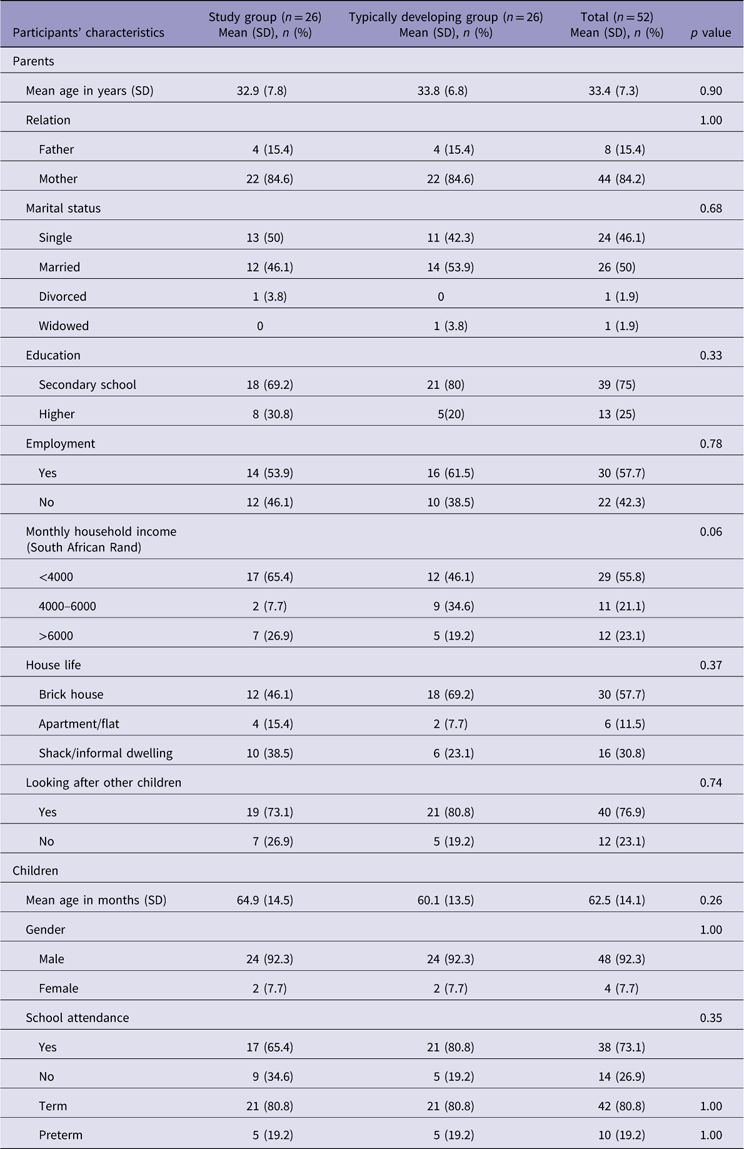
A total of 52 parents were recruited to this study. There were 44 mothers and eight fathers with mean parental age of 33.4 years (SD 7.3). The socio-demographic data of study participants are shown in Table 1. With respect to child characteristics, there was a male predominance (48; 92.3%). The mean age of children was 64.9 months (SD 14.5). Being verbal versus nonverbal was used as a proxy for severity level in this study. Nonverbal children with ASD in this study was defined as a child with ASD who cannot functionally communicate with others using their voice and/ or using <10 words (Reference Mody19); 54% of the children with ASD were classified as having a nonverbal form of the disorder.
Characteristics of the parents and their children (n=54)

Comparison of the QOL of parents of children with ASD with matched typically developing peers
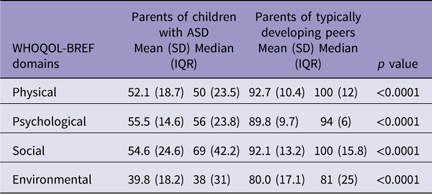
As compared with parents of TD children in this cohort, parents of children with ASD had lower mean QOL scores for all measured domains. Significant differences (p<0.0001) were found in the four QOL domains: physical, psychological, social and environmental health (Table 2).
Comparison of the quality of life (QOL) of parents of children with autism spectrum disorder (ASD) with matched typically developing peers

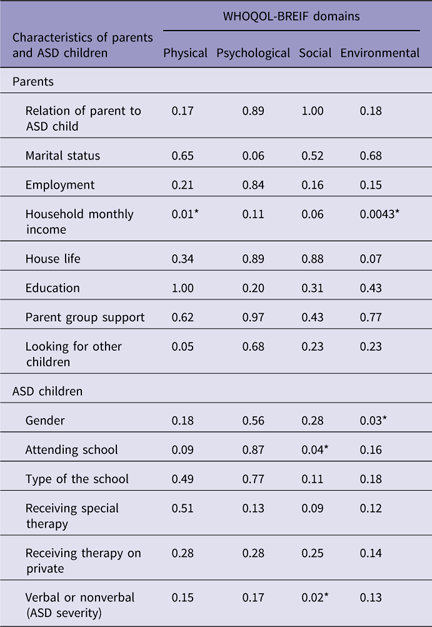
There was no significant association between the parents’ QOL and the following demographic variables: parental age, gender, marital status and child’s age. The parents of children with ASD who were not attending schools were found to have a significantly lower score in the social domain, compared with parents whose children were attending school (p=0.04). In addition, the social domain score of parents of children with severe (nonverbal) ASD was significantly lower than the social domain score of parents whose children had a less severe form of ASD (p=0.02). Table 3 shows the association of the parents and children with ASD’s demographic and socio-economic variables with the QOL results.
The correlates of quality of life (QOL) in the parents of children with autism spectrum disorder (ASD)

*p<0.05.
Parental education level, monthly household income and employment were used as proxies for socio-economic status in this study. Parents who had a higher monthly income were found to have significantly higher scores in the physical and environmental domains of QOL (p=0.0029 and 0.00099, respectively). However, there was no significant association between education level or employment status and parental QOL in this study.
Discussion
The results of our study demonstrate that, the QOL of the parents of children with ASD attending a tertiary children’s hospital in South Africa, is significantly lower than the QOL of parents of TD children from the same community. These findings are consistent with the previous studies that found poorer level of QOL among parents caring of children with ASD as compared with general population in other contexts (Reference Mugno, Ruta, D’Arrigo and Mazzone6–Reference Perumal, Veeraraghavan and Lekhra8,Reference Shu20–Reference Allik, Larsson and Smedje22).
Our study demonstrated significant reduction in QOL across all domains (physical, psychological, social and environmental health) in the parents caring of ASD children. This finding is consistent with that of Indian study (Reference Perumal, Veeraraghavan and Lekhra8), which may reflect some similarities between South Africa and India. In particular, general socio-economic, health and economic difficulties, including limited services that cater to those children with ASD and their caregivers may be common across both environments. In contrast, a similar study in Taiwan (Reference Tung, Huang, Tseng, Yen, Tsai, Lin and Chen7), using the same measure, reported a different QOL profile. In the Taiwanese study, there were significant differences among three of the four domains: physical, psychological and social health but not in environmental health. The reported monthly household income in the Taiwan study (US $ 1682) was higher than among 65% of the caregivers in their study. However, in our study, 56% of the parents reported monthly household income of lower than US $ 300. The differences in household income could potentially explain the difference in QOL between the South African and Taiwan findings in the environmental domain.
The lowest parent QOL scores in this study were reported in the environmental health domain. The environment domain measured the financial resources, health and social care accessibilities and feeling of safety and security (17). This result is consistent with previous research done in a resource-constrained context in Jordan (Reference Dardas and Ahmad23), which reported that more than 80% of the participants lived below the poverty line. Our results may be explained by referring to the socio-economic background of the families, which may influence the lower score in the environmental domain especially in the context of families caring for a child with neurodisability. Poverty, violence, drug abuse, HIV and mental ill health, difficulty accessing health support services for children with ASD, home environment, poor physical safety, overburdened school services and concerns about reduced opportunities for leisure activities are prevalent factors in the South African context and are likely to play a contributing role to parents experience in this domain (Reference de Vries11,Reference Tomlinson12).
The physical heath domain measures the parents’ energy level, activities of daily living, sleep and the work capacity (17). Our significantly low result in the physical domain of the parents of children with ASD is consistent with previous studies (Reference Tung, Huang, Tseng, Yen, Tsai, Lin and Chen7,Reference Perumal, Veeraraghavan and Lekhra8,Reference Schlebusch, Dada and Samuels16). This finding may, in part, be explained by the extra physical demands on parents caring for children with ASD. This includes activities such as travelling to training, education and supportive services places for their children, often on public transport (Reference Perumal, Veeraraghavan and Lekhra8). In addition, the parents of children with ASD frequently suffer from poorer sleep quality and lower sleep quantity than those of TD children (Reference Ghanizadeh, Alishahi and Ashkani24,Reference Meltzer25). Therefore, parents’ may have lower employment potential as a result (Reference Parish, Seltzer, Greenberg, Floyd and Taylor15,Reference Ghanizadeh, Alishahi and Ashkani24).
Significant impairment was also found in the psychological domain of the parental QOL in our study. Previous studies have reported similar results among parents of children with ASD (Reference Tung, Huang, Tseng, Yen, Tsai, Lin and Chen7,Reference Perumal, Veeraraghavan and Lekhra8,Reference Parish, Seltzer, Greenberg, Floyd and Taylor15,Reference Hartley, Barker, Seltzer, Floyd, Greenberg, Orsmond and Bolt26,Reference Dardas and Ahmad27). Factors that may affect caregivers’ psychological health independently or cumulatively may include parental stress, emotional distress, challenges with coping strategies, inadequate social support, ASD severity, difficult behavioural profile of child with ASD and associated comorbidities such as cognitive deficit, epilepsy and self-regulatory problems (Reference Parish, Seltzer, Greenberg, Floyd and Taylor15,Reference Schlebusch, Dada and Samuels16,Reference Dardas and Ahmad27,Reference Dardas28). This, together with aforementioned challenges in local context may result in parents of children with ASD being left psychologically drained with limited support for their own psychological needs. Indeed, parents of children with ASD benefit from psychological support and this is reported as being associated with positive outcomes for both the child and the caregiver QOL (Reference Schlebusch, Dada and Samuels16,Reference Dardas28). While in South Africa parents are the primary caregivers for their children with ASD, there are very few formal psycho-educational intervention or skills training programmes for parents of children with ASD in the public health or education sector (Reference de Vries11). Thus, the establishment programmes such as parent support groups or parent-centred interventions in the local setting may contribute to supporting families of children with ASD in meeting their psychological needs (Reference de Vries11,Reference Schlebusch, Dada and Samuels16).
This study revealed a significant link between more severe forms of ASD and the low social domain score of parents’ QOL. The social domain of QOL measures personal relationships and social support (17). These findings are consistent with previous studies (Reference Schlebusch, Dada and Samuels16,Reference Pozo, Sarriá and Brioso29). Parents of children with ASD often limit social interaction with relatives and friends because they fear embarrassment (Reference Gray30). Some feel stigmatized in public situations because of the disruptive behaviours of their children and as a result may become socially isolated (Reference Perumal, Veeraraghavan and Lekhra8).
The study also found that the parents of children with ASD who were not attending schools had a significantly lower score in the social domain of QOL. This finding is supported by previous studies indicated higher level of QOL of caregivers of children with ASD who were accessing services compared with those who were not (Reference Eskow, Pineles and Summers31,Reference Eskow, Chasson and Summers32). This finding is relevant in the South African and other low-resource contexts where caregivers for children with ASD suffer from significant challenges to access diagnostic, therapeutic and educational services (Reference de Vries11,Reference Schlebusch, Dada and Samuels16). Moreover, the limited preschool intervention programmes in South Africa and the fact that comprehensive and compulsory school placement only starts at age of 6 years may be one of the factors resulting in parents of young children with ASD in South Africa having lower QOL.
With respect to socio-economic status in this cohort, our study revealed a significant association between lower parental income and low scores of physical and environmental domains. The findings of this study indicated that QOL and income were closely related, confirming results of previous studies (Reference Hatton and Emerson14,Reference Schlebusch, Dada and Samuels16,Reference Mendoza33). The higher the income, the more parents are able to supply their children with support and care (Reference Hatton and Emerson14,Reference Kheir, Ghoneim, Sandridge, Al-Ismail, Hayder and Al-Rawi21). Thus, parents who do not receive economic support may be at risk of a lower QOL (Reference Schlebusch, Dada and Samuels16).
In conclusion, this study provides the second examination of QOL in parents of children with ASD in South Africa, recruited from different region from the first publication. The study provides important information on lower QOL in these parents, which will hopefully contribute towards policy changes to provide improved services for this group. Furthermore, the findings of this study emphases the importance of holistic support for the parents of children with ASD and the need to involve their families in such supportive programmes.
Financial Support
Research Award from the Department of Paediatrics and Child Health, University of Cape Town funded this project; Fund Number 436424.
Conflicts of Interest
None.
Acknowledgements
The authors are grateful to the parents and children who had participated in this study. Authors also thank the staff of the Developmental Pediatrics services at Red Cross War Memorial Children’s Hospital (RCWMCH) for their continuous support through this study. Authors’ Contribution: All of the authors in this study are adheres to the definition of authorship set up by The International Committee of Medical Journal Editors (ICMJE). According to the ICMJE authorship criteria should be based on (1) substantial contributions to conception and design of, or acquisition of data or analysis and interpretation of data, (2) drafting the article or revising it critically for important intellectual content and (3) final approval of the version to be published. Authors in this study meet conditions 1, 2 and 3.