Introduction
Depressive disorders are a major public health concern (see Sartorius, Reference Sartorius2001; Üstün et al. Reference Üstün, Ayuso-Mateos, Chatterji, Mathers and Murray2004; Kessler, Reference Kessler2012). Major depressive disorder (MDD) is among the most frequently occurring psychiatric disorders (16.6% lifetime prevalence; Kessler et al. Reference Kessler, Berglund, Demler, Jin, Merikangas and Walters2005) and has considerable negative implications for functioning and quality of life, including concurrent and prospective associations with impaired interpersonal relationships, academic and occupational functioning, and physical health (Kessler, Reference Kessler2012). Given the pervasive and deleterious consequences of MDD, extensive research has sought to identify factors that confer risk for developing MDD or influence its course and severity (Burcusa & Iacono, Reference Burcusa and Iacono2007). One particularly promising approach has been the investigation of associations between individual differences in personality and MDD (see Clark, Reference Clark2005; Tackett, Reference Tackett2006). In the present study, we examined prospectively inter-relationships between late-adolescent personality and MDD in early adulthood, and considered whether personality trait trajectories during this period differed as a function of the timing (adolescent versus adult onset) and course (chronic/recurrent versus remitting) of MDD.
Inter-relationships between personality traits and MDD
A well-established body of literature demonstrates links between personality traits and psychiatric disorders among adults (see Kotov et al. Reference Kotov, Gamez, Schmidt and Watson2010). Negative emotionality/neuroticism (NEM; a tendency to experience negative mood states) is implicated as a non-specific personality trait that confers general vulnerability for psychopathology whereas (low) positive emotionality/extraversion (PEM; a tendency to experience positive mood states) is posited to be specifically associated with MDD (Clark & Watson, Reference Clark and Watson1991). Studies demonstrate concurrent associations between high NEM and low PEM and depressive symptoms among children (Brown et al. Reference Brown, Chorpita and Barlow1998; Lonigan et al. Reference Lonigan, Hooe, David and Kistner1999; Joiner & Lonigen, Reference Joiner and Lonigan2000) and adolescents (Lonigan et al. Reference Lonigan, Hooe, David and Kistner1999; Wetter & Hankin, Reference Wetter and Hankin2009), and depressive symptoms and MDD diagnosis among adults (Watson et al. Reference Watson, Gamez and Simms2005; De Fruyt et al. Reference De Fruyt, Van Leeuwen, Bagby, Rolland and Rouillon2006; Kotov et al. Reference Kotov, Gamez, Schmidt and Watson2010). Although less frequently considered, there is also some evidence that (low) constraint/conscientiousness (CON; a tendency to inhibit impulsive, risky behavior) is concurrently associated with depressive symptoms among children (John et al. Reference John, Caspi, Robins, Moffitt and Stouthamer-Loeber1994) and MDD diagnosis among adults (Kotov et al. Reference Kotov, Gamez, Schmidt and Watson2010).
Models of personality–depression associations
Although there is evidence that personality traits are concurrently associated with depressive symptoms and disorders, determining the interplay of personality traits and MDD, and particularly their causal relationships over time, can be complex (see Klein et al. Reference Klein, Kotov and Bufferd2011). Prospective studies of personality–depression associations have focused predominantly on NEM and PEM. Results consistently indicate that higher NEM predicts MDD, consistent with a vulnerability model in which personality traits confer risk for the development of MDD. By contrast, results have been less straightforward for PEM, with mixed evidence that PEM acts as a vulnerability factor for MDD. However, there is evidence that PEM is associated with the course and severity of MDD, consistent with a pathoplasty model in which personality traits are associated with MDD presentation or outcome. Notably, the vast majority of studies on personality–depression associations have been conducted with adults. Although several prospective studies provide evidence that higher NEM and lower PEM predict subthreshold depressive symptoms during childhood and adolescence (Lonigen et al. Reference Lonigan, Phillips and Hooe2003; Wetter & Hankin, Reference Wetter and Hankin2009; but see also Joiner & Lonigan, Reference Joiner and Lonigan2000), to our knowledge no prospective studies with younger samples have considered MDD diagnoses or personality–MDD associations during adolescence and the transition to adulthood.
The lack of prospective studies with adolescents is unfortunate because this is likely to be a particularly informative period for investigations of personality–depression associations. Adolescence is a time of rapid change, increasing independence and emerging responsibilities. The vast majority of adolescents make the transition into adulthood smoothly, but an important subset fails to master the developmental milestones of this period. In many cases of MDD, the onset occurs during adolescence (Costello et al. Reference Costello, Mustillo, Erkanli, Keeler and Angold2003; Kessler et al. Reference Kessler, Berglund, Demler, Jin, Merikangas and Walters2005). Given evidence that the timing of MDD onset may be related to its severity and course (Hammen et al. Reference Hammen, Brennan, Keenan-Miller and Herr2008; Weissman et al. Reference Weissman, Wolk, Goldstein, Moreau, Adams, Greenwald, Klier, Ryan, Dahl and Wickramaratne1999), studies of first onsets of MDD among adults may include less severe cases, and thus report attenuated estimates of personality–depression associations. Moreover, because personality traits become increasingly stable with age (Roberts & DelVecchio, Reference Roberts and DelVecchio2000; Blonigen et al. Reference Blonigen, Carlson, Hicks, Krueger and Iacono2008), studies with adults may capture already established personality–depression patterns whereas studies with younger samples may be better suited to examining the dynamic influences of personality and MDD over time.
Continuity and change in personality traits
There is evidence of rank-order consistency in personality traits over time (Roberts & DelVecchio, Reference Roberts and DelVecchio2000) but there is also evidence of normative developmental changes during adolescence and adulthood (Roberts et al. Reference Roberts, Walton and Viechtbauer2006). In general, NEM decreases whereas CON increases (‘the maturity principle’; Caspi et al. Reference Caspi, Roberts and Shiner2005). However, a significant minority does not evidence this normative, adaptive developmental change, or instead evidences maladaptive change (Blonigen et al. Reference Blonigen, Carlson, Hicks, Krueger and Iacono2008). Developmentally salient events, including a major depressive episode, may be particularly influential for personality trajectories during earlier developmental periods, when personality traits show greater variability (Roberts & DelVecchio, Reference Roberts and DelVecchio2000), making adolescence an optimal period for prospective investigations of associations between personality traits and MDD.
Present study
We examined prospectively inter-relationships between personality and the onset and course of MDD during the transition from adolescence to adulthood in a large, community sample. Specifically, we examined whether NEM, PEM and CON were associated with the timing (adolescent versus adult onset) and course (chronic/recurrent versus remitting) of MDD, and whether the timing and course of MDD were associated with differing trajectories of NEM, PEM and CON from ages 17 to 29 years. We defined five naturally occurring groups based on the trajectories of MDD diagnoses from adolescence to early adulthood: MDD onset during (a) adolescence (by age 17) or (b) early adulthood (between ages 18 and 24) that either (c) remitted by or (d) persisted to age 29, and (e) no MDD up to age 29. We addressed the following questions: Are personality traits differentially associated with MDD that onsets during adolescence versus early adulthood? Are personality traits differentially associated with MDD that evidences a chronic/recurring versus remitting course? Are these naturally occurring MDD groups differentially associated with personality trait trajectories over time? Evidence that personality traits are associated with the subsequent development of MDD would lend support to the vulnerability model whereas evidence that personality traits are associated with different courses of MDD would lend support to the pathoplasty model. Evidence that MDD is associated with differing trajectories of personality traits would suggest that the experience of MDD has implications for normative personality development during the transition from adolescence to adulthood. By considering whether MDD groups defined by onset and course were distinguishable from one another in terms of personality trait trajectories, we sought to identify pre-morbid personality risk factors, and also to characterize personality outcomes for individuals with differing MDD trajectories.
Method
Participants and procedures
Participants were same-sex male and female twins from the Minnesota Twin Family Study (MTFS) (54% female). The MTFS is an ongoing community-based, longitudinal study of reared-together twins and their parents; the study design and sample, including inclusion and exclusion criteria, have been described extensively elsewhere (Iacono & McGue, Reference Iacono and McGue2002; Iacono et al. Reference Iacono, McGue and Krueger2006) and are only reviewed here briefly. The present study included a cohort of twins first recruited for participation at age 17. Consistent with the demographic make-up of Minnesota during the targeted birth years, families were predominately Caucasian (98%). The MTFS design includes assessments at target ages of 17 (mean = 17.48, s.d. = 0.46), 20 (mean = 20.67, s.d. = 0.57), 24 (mean = 24.70, s.d. = 0.97) and 29 years (mean = 29.62, s.d. = 0.61). Diagnostic data were collected at assessments at age 17 (n = 1252), 20 (n = 1105), 24 (n = 1108) and 29 years (n = 1168); 1051 participants (84%) had diagnostic data at all four assessments. Personality data were collected at assessments at age 17 (n = 1111), 24 (n = 1013) and 29 years (n = 1093); 842 participants (67%) had personality data at all three assessments. χ 2 tests indicated that participants with MDD at age 17 were no less likely to provide personality data at intake or follow-up assessments (all p's > 0.05). Participants with MDD at age 17 were less likely to provide diagnostic data at age 20 (χ 2 1 = 7.16, p = 0.007); 96% without MDD provided diagnostic data at age 20 whereas 91% with MDD did. However, participants with MDD at age 17 were not less likely to provide diagnostic data at age 24 (χ 2 1 = 2.12, p = 0.145), meaning that missing age-20 diagnostic data were largely obtained at the age-24 assessment. Participants with MDD at age 17 were less likely to provide diagnostic data at age 29 (χ 2 1 = 3.87, p = 0.049); 90% without MDD provided diagnostic data at age 29 whereas 84% with MDD did, indicating only a small difference based on age-17 MDD status and suggesting that attrition effects were at most minimal.
Measures
MDD
MDD diagnoses and information on the onset and course of MDD symptoms were assessed at age 17 in semi-structured interviews with participants' mothers using the Diagnostic Interview for Children and Adolescents – Revised (DICA-R; Reich & Welner, Reference Reich and Welner1988) and with participants using the Structured Clinical Interview for DSM-III-R (SCID; Spitzer et al. Reference Spitzer, Williams, Gibbon and First1987). A best-estimate procedure was used to assign age-17 diagnoses if symptoms were endorsed by either mother or participant. MDD diagnoses were assessed at ages 20, 24 and 29 with participants using the SCID. MDD diagnoses were based on DSM-III-R criteria to maintain continuity with the diagnostic system used at intake. Lifetime MDD symptoms were assessed at age 17 and MDD symptoms experienced at any time during the interval since the prior assessment were assessed at ages 20, 24 and 29. Diagnostic interviews were conducted by interviewers who had received extensive training in psychiatric interviewing, and who held a bachelor's or master's degree in psychology or a related discipline. All interviews were reviewed in case conferences, and consensus was required prior to assigning each symptom. Computer algorithms were used to assign diagnoses. Inter-rater reliability was assessed on a randomly selected subsample of 600 MTFS participants (κ = 0.81 for MDD). MDD diagnoses were assigned if criteria were met at a ‘definite’ (i.e. at least five DSM-III-R criteria met) or ‘probable’ (i.e. at least four DSM-III-R criteria met) level using Research Diagnostic Criteria (Spitzer et al. Reference Spitzer, Endicott and Robins1978) guidelines, which allow for the fact that most participants were not symptomatic at the time of the diagnostic assessment, meaning that they relied on memory when reporting past symptomsFootnote 1 Footnote †. The cumulative lifetime prevalence of MDD (definite and probable cases) in the present sample was 13% at age 17, 21% at age 20, 28% at age 24 and 33% at age 29.
To examine the effects of MDD onset and course, participants were classified into one of five naturally occurring, mutually exclusive MDD groups. The ‘never-depressed’ group (n = 726; 72%) did not meet criteria for MDD at any assessment point. The ‘adolescent-onset, remitting’ group (n = 91; 9%) met lifetime criteria for MDD at age 17 but did not meet criteria at the age-29 assessment; 14 (15%) and 13 (14%) participants met criteria at the age-20 and age-24 assessments respectively. The ‘adolescent-onset, chronic/recurrent’ group (n = 49; 5%) met lifetime criteria for MDD at age 17 and at the age-29 assessment; 23 (47%) and 26 (53%) participants also met criteria at the age-20 and age-24 assessments respectively. The ‘adult-onset, remitting’ group (n = 99; 10%) met criteria for MDD at the age-20 (n = 49; 50%) and/or age-24 (n = 59; 60%) assessments but did not meet criteria at the age-29 assessment. The ‘adult-onset, chronic/recurrent’ group (n = 48; 5%) met criteria for MDD at the age-20 (n = 27; 56%) and/or age-24 (n = 34; 71%) assessments and also met criteria at the age-29 assessment. A total of 1013 (81%) participants were classified into MDD groups; 239 participants could not be classified because of one or more missing assessments and they were excluded from subsequent analyses. Independent-samples t tests indicated that participants who were not assigned to an MDD group reported higher age-24 CON (t 1011 = 2.49, p = 0.013) and age-29 NEM (t 1091 = 2.95, p = 0.003).
Personality
Participants reported on their personality traits at ages 17, 24 and 29 using the 198-item version of the Multidimensional Personality Questionnaire (MPQ; Tellegen, Reference Tellegen2006). The MPQ includes NEM, PEM and CON scales, which have demonstrated good criterion and convergent validity and high internal consistency in the present sample and others (Tellegen, Reference Tellegen2006; Hopwood et al. Reference Hopwood, Donnellan, Blonigen, Krueger, McGue, Iacono and Burt2011).
Statistical analysis
We conducted multilevel modeling (MLM) analyses that accounted for the repeated measures and nested nature of the data to examine whether personality traits were associated with the timing and course of MDD, and whether the timing and course of MDD were associated with differing personality trait trajectories. Specifically, we conducted three-level multilevel models comprising time-varying variables (personality traits assessed at ages 17, 24 and 29) at level 1, nested within individual participants at level 2, and nested within families at level 3. First, we fit a series of group trajectory models to estimate effects of age at level 1 for each personality trait, separately for each of the MDD groups. We used age in years as the unit of time to account for variation in age at each assessment. Age was centered at age 17 so that the intercept of each model reflects the age-17 level of the personality trait and the slope represents change from age 17 to 29. These models quantify personality trait trajectories for each of the MDD groups. Next, we fit a series of group comparison models that explicitly tested whether personality trait trajectories differed among the MDD groups by adding simultaneously dummy coded variables representing each MDD group to the intercept and slope parameters at level 2 (a cross-level interaction between MDD group and age); we systematically compared each of the MDD groups by recoding the reference group. Effects at the intercept indicate whether personality traits at age 17 differ between the MDD group and the reference group, and effects at the slope indicate whether the rates of change from age 17 to 29 differ. We included participant sex as a covariate by adding a dummy term to the intercept and slope parameters at level 2Footnote 2 . In each model, the variance component for the level-1 intercept was allowed to vary randomly across participants; variance components for all other parameters were fixed. All analyses were conducted with Scientific Software International's HLM 6.04 (Raudenbush et al. Reference Raudenbush, Bryk, Cheong and Congdon2004) using full maximum likelihood estimation.
Results
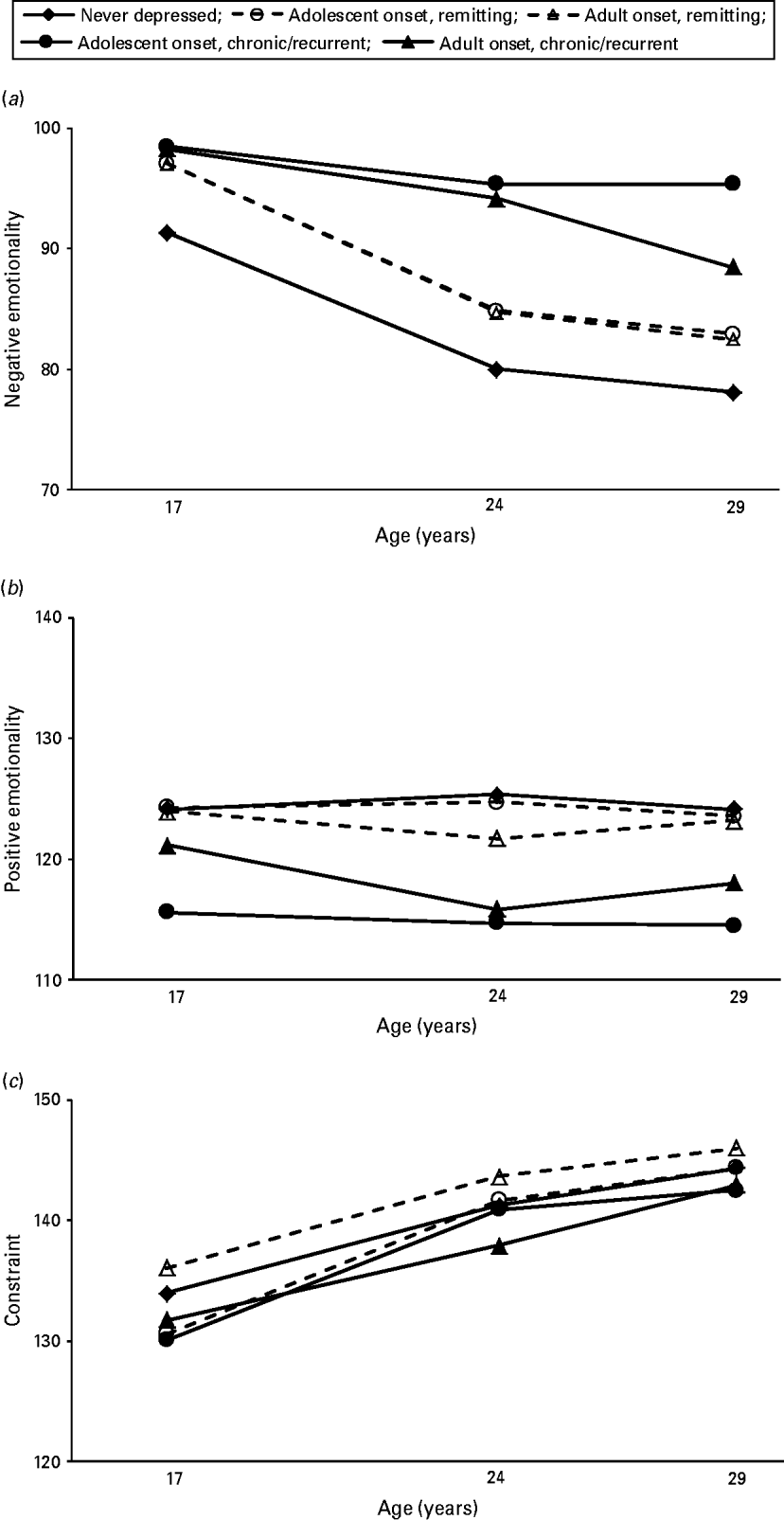
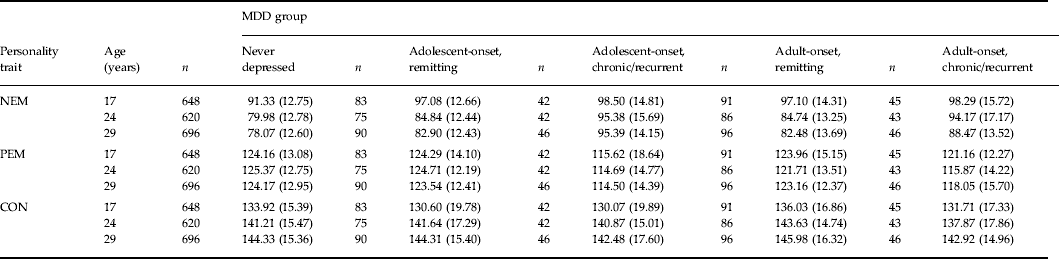
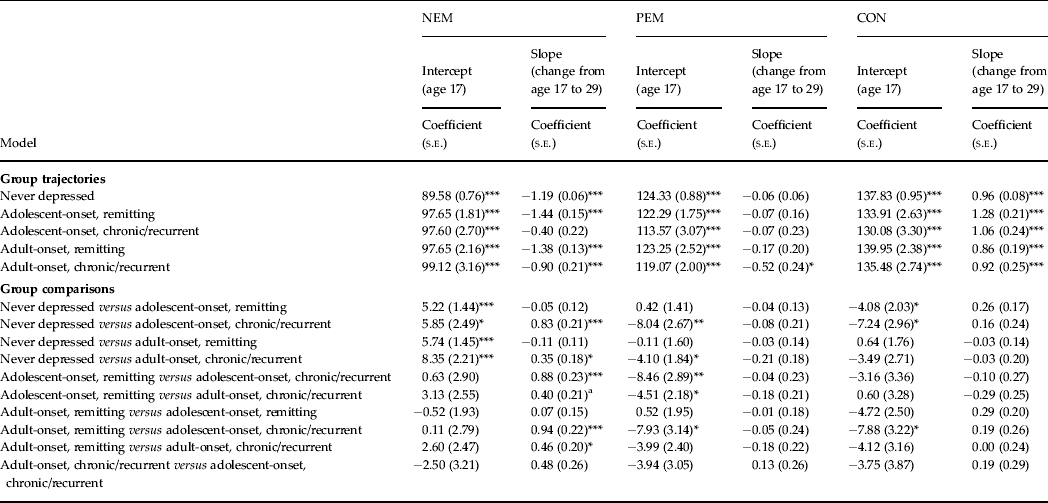
Means and standard deviations for personality traits at each age and by MDD group status are presented in Table 1, and mean-level personality trait trajectories for each MDD group are depicted in Fig. 1. MLM analyses were used to (1) model personality trait trajectories from age 17 to age 29 for each MDD group and (2) explicitly test whether the MDD groups differed in their trajectories. The results of the MLM analyses are summarized in Table 2.
Mean levels of personality traits by major depressive disorder (MDD) group at ages 17, 24 and 29 years: (a) negative emotionality (NEM); (b) positive emotionality (PEM); (c) constraint (CON).

Descriptive statistics for personality traits at ages 17, 24 and 29 years among MDD groups

MDD, Major depressive disorder; NEM, negative emotionality; PEM, positive emotionality; CON, constraint.
Values given as mean (standard deviation).
Summary of results of multilevel modeling (MLM) analyses for personality trait trajectories

NEM, Negative emotionality; PEM, positive emotionality; CON, constraint; s.e., standard error.
Group trajectory models quantify personality trait trajectories for each MDD group; in these models, the intercept indicates the average personality trait score for each group at age 17 and the slope indicates the change in the personality trait score per year, with significant values indicating that the age-17 score differs significantly from zero (intercept) or changes significantly from age 17 to 29 (slope). Group comparison models test whether the groups in the comparison differ; these models include dummy coded variables representing each MDD group entered simultaneously and recoding the reference group to systematically compare each group, with positive values indicating that the age-17 score for the second group is significantly larger than that for the first group (intercept) or changes at a significantly faster (when the overall trajectory is positive) or slower (when the overall trajectory is negative) rate from age 17 to 29 (slope). All models include participant sex as a covariate.
a All results for analyses including definite and probable MDD cases were comparable to those including only definite cases with the single noted exception, which was significant when only definite cases were included.
*p < 0.05, ** p < 0.01, *** p < 0.001.
NEM
MLM analyses quantify the trajectories of NEM over time for each group depicted in Fig. 1 a, along with differences in these trajectories; a summary of the MLM results for the NEM trajectories for each group is presented in the upper portion of Table 2, and for comparisons between groups in the lower portion. MLM results for NEM trajectories for each group map onto the trajectories shown in Fig. 1 a; the significant positive coefficients for the intercepts of these models indicate that age-17 NEM for each group differed significantly from zero, and the negative coefficients for the slopes indicate that all of the groups evidenced normative decreases in NEM from age 17 to 29 except for the adolescent-onset, chronic/recurrent group, which showed no changes in NEM over time. Comparisons between the groups indicated significant differences in age-17 levels and trajectories of NEM. The significant positive coefficients for the intercepts of comparisons for all MDD groups with the never-depressed group indicate that age-17 NEM was significantly higher for groups that experienced any MDD, regardless of timing or course. By contrast, the non-significant coefficients for the intercepts of comparisons of MDD groups with one another indicate that none of the MDD groups differed significantly in age-17 NEM. This pattern of results clearly supports the vulnerability model, in that even groups that were free of MDD at age 17 but who subsequently developed MDD in adulthood reported higher NEM at age 17. Moreover, because NEM showed an overall decreasing trajectory over time, the significant positive coefficients for the slopes of comparisons between the chronic/recurrent groups and the never-depressed and remitting groups indicate that the adult-onset, chronic/recurrent group showed a more modest decrease in NEM from age 17 to 29 whereas the adolescent-onset, chronic/recurrent group failed to show any decrease in NEM over time. Taken together, the results support the vulnerability model in indicating that higher NEM is associated with the subsequent development of MDD, regardless of whether onset is during adolescence or early adulthood. Moreover, although any MDD, regardless of timing and course, is associated with higher NEM, the results also suggest that MDD that follows a chronic/recurrent course has particularly pernicious implications in its disruption of the normative decreases in NEM from late adolescence to early adulthood.
PEM
A summary of the MLM results for PEM trajectories for each group are presented in the upper portion of Table 2, and for comparisons between groups in the lower portion. Consistent with the trajectories in Fig. 1 b, the significant positive coefficients for the intercepts of the group trajectory models indicate that age-17 PEM for each group differed significantly from zero, and the non-significant coefficients for the slopes indicate that PEM remained stable from age 17 to 29 for all groups except the adult-onset, chronic/recurrent group, which showed decreases in PEM for the same age range. Comparisons between groups indicate significant differences in age-17 levels of PEM. The significant negative coefficients for the intercepts of comparisons between the chronic/recurrent groups with the never-depressed and remitting groups indicate that age-17 PEM was significantly lower for groups with chronic/recurrent MDD. The non-significant coefficients for the slopes of all comparisons between groups indicate that no groups differed in their PEM trajectories, although PEM was consistently lower in the chronic/recurrent groups. Taken together, these results offer some support for the vulnerability model in indicating that lower PEM is associated with the subsequent development of MDD in early adulthood, but only for chronic/recurrent MDD. Moreover, the results support the pathoplasty model, in that lower PEM is specific to MDD that follows a chronic/recurrent course; in fact, the remitting groups showed levels of PEM comparable to the never-depressed group.
CON
A summary of the MLM results for CON trajectories for each group are presented in the upper portion of Table 2, and for comparisons between groups in the lower portion. The significant positive coefficients for the intercepts of the group trajectory models indicate that age-17 CON for each group differed significantly from zero, and the positive coefficients for the slopes indicate that all of the groups evidenced normative increases in CON from age 17 to 29, as depicted in Fig. 1 c. Comparisons between groups indicate significant differences in age-17 levels of CON for the adolescent-onset groups. The significant negative coefficients for the intercepts of comparisons between the adolescent-onset groups with the never-depressed and adult-onset, remitting groups indicate that age-17 CON was significantly lower for groups with adolescent-onset MDD. The non-significant coefficients for the slopes of all comparisons between groups indicate that no groups differed in their CON trajectories; CON showed normative increases from age 17 to 29 for all groups. Taken together, these results suggest that MDD is associated with lower CON, but only MDD that onsets during adolescence. There was no evidence that CON was associated with the subsequent development of MDD, or with the course of MDD. Moreover, there was no evidence that MDD, regardless of whether onset occurred during adolescence or adulthood, or followed a remitting or chronic/recurrent course, had implications for the normative development of CON from adolescence to early adulthood.
Discussion
Extensive research has investigated links between personality traits and psychiatric disorders. NEM has emerged as a key non-specific risk factor for psychiatric disorders, including MDD (Kotov et al. Reference Kotov, Gamez, Schmidt and Watson2010). By contrast, although implicated in theoretical models as a risk factor specific to MDD (Clark & Watson, Reference Clark and Watson1991), (low) PEM has received less consistent empirical support, and CON has been only rarely considered. The field has been increasingly moving beyond simple examination of concurrent links between personality traits and depressive disorders to prospective studies and experimental designs that consider the dynamic interplay of these constructs over time (see Klein et al. Reference Klein, Kotov and Bufferd2011). The present study makes an important contribution to the existing literature by examining prospectively associations between NEM, PEM and CON and the timing and course of MDD during a key developmental period, the transition from late adolescence to early adulthood. In general, the adolescents in our sample evidenced decreasing NEM and increasing CON as they transitioned into adulthood, consistent with maturational growth processes marked by adaptive response to the developmental tasks that characterize this period. However, MDD was associated with important differences in developmental trajectories of personality traits that were further differentiated by whether the onset of MDD occurred during adolescence or adulthood, and followed a chronic/recurrent or remitting course.
Consistent with previous research in samples of children, adolescents and adults (Tackett, Reference Tackett2006; Klein et al. Reference Klein, Kotov and Bufferd2011), the results of the present study demonstrate that, any MDD, regardless of timing or course, was associated with higher NEM. Moreover, consistent with the vulnerability model, higher NEM was associated with the subsequent development of MDD. The results for PEM were more nuanced. There was some support for the vulnerability model, in that PEM was associated with the subsequent development of MDD, but only MDD that followed a chronic/recurrent course. Consistent with the pathoplasty model, lower PEM was associated with chronic/recurrent, but not remitting, MDD. Adolescent-onset MDD was associated with lower CON. Taken together, these results clearly speak to the pernicious implications of chronic/recurrent MDD, particularly when the onset is during adolescence. At age 17, the adolescent-onset, chronic/recurrent group was characterized by high NEM, low PEM and low CON. Moreover, because the adolescent-onset, chronic/recurrent group failed to show the normative decrease in NEM from age 17 to 29 evidenced by all other groups, this group continued to report high levels of NEM and low levels of PEM up to age 29. The present study adds to a relatively small but important body of literature on the implications of adolescent-onset MDD for subsequent functioning (Weissman et al. Reference Weissman, Wolk, Goldstein, Moreau, Adams, Greenwald, Klier, Ryan, Dahl and Wickramaratne1999; Hammen et al. Reference Hammen, Brennan, Keenan-Miller and Herr2008). Notably, although the results are consistent with evidence of the deleterious outcomes of adolescent-onset MDD, they also suggest these may be a function less of its early onset per se than of its associated increased incidence of severe, chronic and recurrent MDD into adulthood (Weissman et al. Reference Weissman, Wolk, Goldstein, Moreau, Adams, Greenwald, Klier, Ryan, Dahl and Wickramaratne1999; Hammen et al. Reference Hammen, Brennan, Keenan-Miller and Herr2008; Rohde et al. Reference Rohde, Lewinsohn, Klein, Seeley and Gau2013). That the adolescent- and adult-onset chronic/recurrent groups generally differed from the never-depressed and remitting groups but did not differ from one another is consistent with evidence that recurrent MDD is prospectively associated with psychosocial impairment, regardless of whether it onsets in adolescence or early adulthood (Hammen et al. Reference Hammen, Brennan, Keenan-Miller and Herr2008).
Although the results of the present study are sobering in speaking to the deleterious implications of chronic/recurrent MDD for adaptive personality development, they also offer some hope in suggesting that the personality trait trajectories of both adolescents and adults who remit from MDD are remarkably similar to trajectories of individuals who have never experienced MDD. This is consistent with evidence that young adults who remit from childhood- and adolescent-onset MDD show psychosocial outcomes that are comparable to those for never-depressed youth (Hammen et al. Reference Hammen, Brennan, Keenan-Miller and Herr2008). Moreover, the results dovetail with our group's recent investigation of prospective links between alcohol use disorders and NEM and (low) CON (Hicks et al. Reference Hicks, Durbin, Blonigen, Iacono and McGue2011), suggesting that remission from MDD and desistance from alcohol use during adolescence and early adulthood are associated with at least some personality ‘recovery’. Taken together, the results point to the importance of targeted intervention efforts during this developmental period that can help adolescents with MDD get ‘back on track’ in terms of adaptive personality development and psychosocial functioning.
The present study has several strengths, including a large, community-based sample and a prospective design, and high participation rates over 12 years with minimal attrition bias, although it also has limitations that prompt caution in interpreting the results and suggest directions for future research. Given that the median age of onset for mood disorders is 25–32 years (Kessler et al. Reference Kessler, Berglund, Demler, Jin, Merikangas and Walters2005), it is likely that some participants classified as never depressed will eventually be diagnosed with MDD, some classified as chronic/recurrent will remit and some classified as remitting will relapse. We measured personality in late adolescence, at age 17, and results may differ for personality assessed at earlier ages. Moreover, although repeated assessment of personality allowed us to model linear personality trait trajectories from late adolescence to adulthood, additional personality and MDD assessments would allow for a more fine-grained examination of the potentially non-linear course of personality traits and MDD, and for a more direct test of personality–depression associations. Because the majority of participants were not currently symptomatic at the diagnostic assessment, we cannot examine the extent to which MDD has mood-dependent ‘state’ effects on personality traits. In addition, because, by definition, the adolescent-onset MDD groups had experienced MDD by the age-17 assessment, we are unable to definitively rule out a ‘scarring’ effect of MDD by examining pre- and post-morbid personality levels in these groups. Our assessment of MDD diagnoses was somewhat coarse, in that participants were classified as having chronic/recurrent MDD if they reported experiencing MDD at multiple assessment points that persisted to the age-29 assessment. Although this approach yields information on the ongoing presence of MDD and allows us to contrast these participants with those with remitting MDD, it does not allow for a more fine-grained examination of MDD chronicity or recurrence (for reviews, see Burcusa & Iacono, Reference Burcusa and Iacono2007; Klein, Reference Klein2010). Although beyond the scope of the present paper, future investigations that take advantage of twin designs to model genetic and environmental influences on personality–MDD associations during the transition from adolescence to adulthood will prove informative (e.g. Kendler et al. Reference Kendler, Gatz, Gardner and Pedersen2006; Hopwood et al. Reference Hopwood, Donnellan, Blonigen, Krueger, McGue, Iacono and Burt2011). Finally, although representative of the demographic make-up of Minnesota during the targeted birth years, our sample lacks racial or ethnic diversity, thereby limiting generalizability.
In conclusion, the present study highlights the dynamic interplay of personality and MDD in demonstrating that personality traits confer risk for the onset of MDD, and MDD has important implications for adaptive personality development during the transition from adolescence to adulthood. Our results speak to the importance of intervention efforts targeted toward individuals at high risk for the subsequent development of MDD because of high NEM and low PEM. Moreover, our results add to growing research on the heterogeneity of MDD, with naturally occurring groups defined by MDD onset and course evidencing different personality trajectories and indicating that chronicity/recurrence and adolescent onset are important determinants of MDD outcome.
Acknowledgments
Research reported in this publication was supported by the National Institute on Drug Abuse of the National Institutes of Health under award number R01DA05147, the National Institute on Alcohol Abuse and Alcoholism of the National Institutes of Health under award number R01AA09367, and by the National Institute of Mental Health of the National Institutes of Health under award number T32MH017069 to A.C.D. The content is solely the responsibility of the authors and does not necessarily represent the official views of the National Institutes of Health.
Declaration of Interest
None.