

Introduction
Previously described, submicroscopic olivooids from the earliest Cambrian (ca. 535 Ma) of South China are well known from exceptionally preserved embryos and elongate tubes exhibiting tetra-, penta-, or hexaradial symmetry (e.g., Han et al., Reference Han, Kubota and Li2013, Reference Han, Kubota and Li2016a; Dong et al., Reference Dong, Vargas, Cunningham, Zhang, Liu, Chen, Liu, Bengtson and Donoghue2016 and references cited therein). Olivooid tubes are further characterized by a tapered apical region of embryonic tissue and a strongly corrugated (longitudinal [long.]) abapical region of postembryonic tissue with prominent annulations and very fine longitudinal striations. Additional details of the anatomy of olivooids have been revealed through the use of powerful imaging techniques such as environmental scanning electron microscopy and synchrotron radiation X-ray tomographic microscopy. Thanks largely to the results of highly sophisticated studies of olivooid anatomy and development, combined with the application of cladistic methodologies to the problem of olivooid affinities, there now appears to be a consensus that olivooids were crown- or stem-group medusozoan cnidarians (see in particular Han et al., Reference Han, Kubota and Li2013, Reference Han, Kubota and Li2016a, Reference Han, Li and Kubotab; Dong et al., Reference Dong, Vargas, Cunningham, Zhang, Liu, Chen, Liu, Bengtson and Donoghue2016; Duan et al., Reference Duan, Dong, Porras, Vargas, Cunningham and Donoghue2017), though with fairly substantial disagreement over the phylogenetic relationships of olivooids to major groups within the subphylum. Thus, whereas Yue and Bengtson (Reference Yue and Bengtson1999), Dong et al. (Reference Dong, Cunningham, Bengtson, Thomas, Liu, Stampanoni and Donoghue2013, Reference Dong, Vargas, Cunningham, Zhang, Liu, Chen, Liu, Bengtson and Donoghue2016), and Duan et al. (Reference Duan, Dong, Porras, Vargas, Cunningham and Donoghue2017) argued for a scyphozoan affinity for olivooids, Han et al. (Reference Han, Kubota and Li2013, Reference Han, Kubota and Li2016a) argued that olivooids were stem-group cubozoans. In addition, Dong et al. (Reference Dong, Vargas, Cunningham, Zhang, Liu, Chen, Liu, Bengtson and Donoghue2016) and Duan et al. (Reference Duan, Dong, Porras, Vargas, Cunningham and Donoghue2017) concluded that olivooids were members of a clade of scyphozoans that included conulariids, an extinct group that ranges downward into the terminal Proterozoic (Paraconularia sp. from the lower Tamengo Formation of southern Brazil; Van Iten et al., Reference Van Iten, Marques, Leme and Simões2014, Reference Van Iten, Leme, Pacheco, Simões, Fairchild, Rodrigues, Galante, Boggiani, Marques, Goffredo and Dubinsky2016). The hypothesis of a cubozoan affinity for olivooids is based mainly on interpretations of relic olivooid soft-part structures, including features homologized with the cubozoan velarium, interradial gonads, and perradial frenula. Under the scyphozoan hypothesis, the minute olivooid soft polyp was fully encased in a thin annulated periderm homologous to that of conulariids and extant coronate scyphozoan polyps. Due partly to the presence in most olivooids of pentaradial symmetry, which is rarely seen in extant medusozoans (Han et al., Reference Han, Kubota and Li2016a), it has also been proposed that olivooids were ancestral Acraspeda (Cubozoa + Scyphozoa; Han et al., Reference Han, Li and Kubota2016b) or stem-group medusozoans (Dzik et al., Reference Dzik, Balinski and Sun2017). Whatever the case may be, it is mainly because of reversed pagoda-shaped Quadrapyrgites quadratacris P. Li et al., Reference Li, Hua, Zhang, Zhang, Jin and Liu2007 (Fig. 1.1–1.3) and other tetraradial forms (Han et al., Reference Han, Kubota and Li2016a) that discussions of the phylogenetic affinities of olivooids have focused on possible relationships to medusozoans. Finally, the fate of olivooids in succeeding ages of the Cambrian Period has been unclear.
Quadrapyrgites quadratacris P. Li et al., Reference Li, Hua, Zhang, Zhang, Jin and Liu2007 from the lower Cambrian (Fortunian Stage) Kuanchuanpu Formation in Xixiang, Shaanxi Province, China. (1) Complete specimen (ELIXX24-295) displaying the prominent asymmetrical (longitudinal) annulations; (2) oral-lateral view of a specimen (ELIXX24-319) preserving the twelve V-shaped apertural lobes; (3) oblique view of the low-pyramid-shaped termination of the apical part, with four basal ridges extending from the corners to the center of the pyramid (ELIXX24-343). aar = abapical region; ac = annulation crest; al = apertural lobe; ar = apical region; br = basal ridges; car = corner of the apical region; et = embryonic tissue; pet = post-embryonic tissue.

Bed 5 in the lower Cambrian Yanjiahe Formation in the Three Gorges Area in Hubei Province yields abundant, minute, phosphatized fossils including mollusks, hyoliths, protoconodonts, enigmatic tubular fossils, enigmatic sclerites, and spheroidal fossils (Guo et al., Reference Guo, Li and Li2014). The abraded and fragmental state of many of the skeletal fossils in intraclastic limestones indicates that Bed 5 was deposited on a high-energy shallow shelf (Guo et al., Reference Guo, Han, Van Iten, Wang, Qiang, Song, Wang, Zhang and Li2019). Bed 5 also contains Aldanella yanjiaheensis Chen, Reference Chen1984, an index species of Cambrian Stage 2, which is equivalent to the Aldanella attleborensis Assemblage Zone (= the A. yanjiaheensis Assemblage Zone; Guo et al., Reference Guo, Li and Li2014). Recently, Bed 5 yielded a new, biradial Hexangulaconulariidae (originally Hexaconulariidae He, Reference He1987; He, Reference He1987; Conway Morris and Chen, Reference Conway Morris and Chen1992), Septuconularia yanjiaheensis, which exhibits a total of fourteen faces (Guo et al., Reference Guo, Han, Van Iten, Wang, Qiang, Song, Wang, Zhang and Li2019). This species may have been derived from six-sided Hexaconularia (interpreted as a junior synonym of Pseudooides Qian, Reference Qian1977 by Duan et al., Reference Duan, Dong, Porras, Vargas, Cunningham and Donoghue2017), specimens of which are common in the Fortunian Stage of South China. Thus, tubular small shelly fossils from Bed 5 of the Yanjiahe Formation have the potential to shed additional light on the evolution of medusozoan cnidarians across the Fortunian Age–Cambrian Age 2 boundary during the multiphasic Cambrian explosion (Shu et al., Reference Shu, Isozaki, Zhang, Han and Maruyama2014; Zhuravlev and Wood, Reference Zhuravlev and Wood2018; Wood et al., Reference Wood, Liu, Bowyer, Wilby, Dunn, Kenchington, Cuthill, Mitchell and Penny2019).
Here we describe a new, relatively rare, tetraradial polypoid medusozoan (Figs. 2–4), Octapyrgites elongatus n. gen. n. sp. from Bed 5 of the Yanjiahe Formation. The new taxon resembles tubular Olivooides and Quadrapyrgites from the Cambrian Fortunian Stage in consisting of a quadrate (transverse [transv.]) apical portion and a reversed pagoda-like, corrugated abapical portion bearing V-shaped apertural lobes. In addition, the new taxon may provide additional evidence bearing on the origin of tetraradial symmetry in extant medusae.
The holotype specimen (CUBar90-5) of Octapyrgites elongatus n. gen. n. sp. from the lower Cambrian (Stage 2) Yanjiahe Formation, Yichang, Hubei Province, China. (1) Lateral view showing the apical–abapical boundary; (2) apical view showing the square-shaped apical end; (3) close-up view of the apical end; (4) tube wall of the apical region covered by a thick apatite coating, indicated by the number 4 in (2); (5) oral view of the aperture showing the eight V-shaped apertural lobes; (6) close-up view of the apertural lobes; (7) multiple generations of apatite coatings on the apertural tube wall, indicated by the number 7 in (5). aab = apical–abapical boundary; aar = abapical region; ac = annulation crest; al = apertural lobe; apc = apatite coating; ar = apical region; car = corner of the apical region; lpc = large polygonal crystals.

The paratype specimens of Octapyrgites elongatus n. gen. n. sp. from the lower Cambrian (Stage 2) Yanjiahe Formation, Yichang, Hubei Province, China. (1–5) CUBar170-3, (1) lateral view, (2) apical view showing the square-shaped apical end, (3) apertural view showing the oral side, (4) close-up view of the apical portion, showing the longitudinal striations, indicated by the number 4 in (1), (5) close-up view of the apical end; (6–10) CUBar170-4, (6) lateral view, (7) apical view showing the square-shaped apical end, (8) apertural view showing the oral side, (9) close-up view of the apical end, (10) close-up view of the annulation crest, showing the subparallel longitudinal striations, indicated by the number 10 in (6). ac = annulation crest; al = apertural lobe; car = corner of the apical region; ls = longitudinal striations; spls = subparallel longitudinal striations.

The paratype specimens of Octapyrgites elongatus n. gen. n. sp. from the lower Cambrian (Stage 2) Yanjiahe Formation, Yichang, Hubei Province, China. (1–3) CURBar13-1, (1) lateral view of the apical portion, showing three of the prominent rounded corners, (2) apical view showing the square-shaped apical end, (3) apertural view showing the oral side; (4–9) CUBar78-11, (4) lateral view of the apical portion, showing the tube cavity housing a short, axial shaft-like structure surrounded by microbially induced thread-like filaments and a tabula-like, internal transverse wall, (5) close-up view of the axial shaft-like structure, showing the cauliflower-like surface and thread-like filaments, (6) tube wall of the apical region with a thick apatite coating, indicated by the number 6 in (4), (7) side view of the apical region, showing two of the corners and the basalmost two annulations, (8) bottom view of two of the corners, (9) view of the apertural end of the apical portion, showing a tabula-like, internal transverse wall. ac = annulation crest; apc = apatite coating; car = corner of the apical region; css = central short shaft; ta = tabula; tlf = thread-like filaments; ls = longitudinal striations.

Material and methods
Rock samples were collected from siliceous-phosphatic, intraclastic limestone of Bed 5 in the measured Yanjiahe section near the city of Yichang, Hubei Province, China. A total of five specimens of Octapyrgites elongatus were recovered from samples digested in 10% acetic acid. All of these specimens were coated with gold and then imaged using an FEI Quanta 400 FEG scanning electron microscope (SEM) at an accelerating voltage of 15 kV. Up to 1,000 micro-computed tomographic (micro-CT) images (tiff format) of the holotype specimen (CUBar90-5) were acquired using the Zeiss Xradia 520 at the State Key Laboratory of Continental Dynamics, Northwest University, Xi'an, China, employing a beam current/accelerating voltage of 80 μA/40 kV with a voxel size of 2.23 μm. The micro-CT data were processed using Dragonfly 4.0 for three-dimensional (3D) volume rendering and movie generation.
Repository and institutional abbreviations
All five fossil specimens are housed in the paleontological collections of Chang'an University (CU) in Xi'an, China, under collection numbers CUBar90-5, CUBar170-3, CUBar170-4, CUBar78-11, and CURBar13-1. Three comparison specimens of Quadrapyrgites quadratacris P. Li et al., Reference Li, Hua, Zhang, Zhang, Jin and Liu2007 (Fig. 1.1–1.3) were collected from the Kuanchuanpu Formation in Hexi, Xixiang County, southern Shaanxi Province. These are housed in the Early Life Institute (ELI), Northwest University in Xi'an, China, under collection numbers ELIXX24-295, ELIXX24-319, and ELIXX24-343.
Systematic paleontology
Terminology
Anatomical terminology used herein mostly follows precedents found in Liu et al. (Reference Liu, Li, Shao, Zhang, Wang and Qiao2014), Steiner et al. (Reference Steiner, Qian, Li, Hagadorn and Zhu2014), and Han et al. (Reference Han, Li, Wang, Yang, Guo, Sasaki and Komiya2018).
Phylum Cnidaria Verrill, Reference Verrill1865
Subphylum Medusozoa Petersen, Reference Petersen, Larwood and Rosen1979
Order uncertain
Family Olivooidae Steiner et al., Reference Steiner, Qian, Li, Hagadorn and Zhu2014
Type genus
Olivooides Qian, Reference Qian1977.
Other genera
Quadrapyrgites P. Li et al., Reference Li, Hua, Zhang, Zhang, Jin and Liu2007; Sinaster Wang et al., Reference Wang, Han, Vannier, Ou, Yang, Uesugi, Sasaki, Komiya and Sevastopulo2017; Qinscyphus Liu et al., Reference Liu, Shao, Zhang, Wang, Zhang, Chen, Liang and Xue2017; Octapyrgites n. gen.
Genus Octapyrgites new genus
Type species
Octapyrgites elongatus n. gen. n. sp., from the Aldanella attleborensis Assemblage Zone in the Yanjiahe Formation (Bed 5; Cambrian Stage 2) in the Yanjiahe section near the city of Yichang, Hubei Province, China.
Diagnosis
As for the type species by monotypy.
Occurrence
The A. attleborensis Assemblage Zone, Bed 5 of the Cambrian (Terreneuvian, Stage 2) Yanjiahe Formation in the Yanjiahe section near the city of Yichang, Hubei Province, China.
Etymology
Octa, Latin, referring to the eight apertural lobes on the apertural margin; pyrgos, Greek for tower.
Remarks
The new genus currently comprises the type species only. Octapyrgites differs from Quadrapyrgites in certain details of the peridermal ornament and in size. First, Octapyrgites exhibits eight apertural lobes (and corresponding projections on the crests of the annulations) instead of the twelve apertural lobes seen in Quadrapyrgites. Second, even though Quadrapyrgites exhibits up to 17 annulations, individuals with only seven annulations (~1,000 μm long and 500 μm wide) are substantially smaller than the holotype of Octapyrgites (~4,000 μm long and 1,000 μm wide), which likewise exhibits seven annulations and presumably represents the same growth stage. In addition, the apical portion of Octapyrgites (~1,000 μm long and 500 μm wide) is substantially longer than that of all known specimens of Quadrapyrgites (~200–300 μm in both length and width) and all other Fortunian olivooids (see also discussion that follows).
Octapyrgites elongatus new species
Figures 2–4
Holotype
CUBar90-5 (Fig. 2.1–2.7); the A. attleborensis Assemblage Zone, Bed 5 of the Cambrian (Terreneuvian, Stage 2) Yanjiahe Formation in the Yanjiahe section near the city of Yichang, Hubei Province, China. The paratypes CUBar170-3 (Fig. 3.1–3.5), CUBar170-4 (Fig. 3.6–3.10), CURBar13-1 (Fig. 4.1–4.3), and CUBar78-11 (Fig. 4.4–4.9) from the same stratigraphic level and locality as the holotype.
Diagnosis
Periderm consists of an elongate, steeply pyramidal, four-sided apical region and a strongly corrugated (long.), short or reversed pagoda-like abapical region. Faces of the striated apical region narrowly trapezoidal, outwardly concave, bordered by straight corners; apical end of the apical region smooth, square (transv.), nearly planar. Abapical region with wavy, asymmetrical (long.) transverse annulations having a long, shallow adapical slope and a short, steep adapertural slope; crest of the annulations crenulated, with eight arcuate to broadly V-shaped lobes; located between the crests are numerous fine, irregular longitudinal wrinkles. Circular apertural margin with eight, evenly spaced, V-shaped apertural lobes of uniform size and shape that are in phase with the eight lobes of the crenulated annulation crests.
Occurrence
As for the type species.
Description
Periderm consists of two parts: an elongate, steeply pyramidal apical region and a strongly corrugated, short or reversed pagoda-like abapical region (Figs. 2–5, 6.1; see Supplemental Data Movie 1). Apical region measures ~1,000 μm in length and 500 μm in width and exhibits four narrowly trapezoidal, outwardly concave faces delimited by sharply rounded (transv.), ridge-like corners (car; Figs. 2.1, 2.2, 3.1, 3.2, 3.6, 3.7, 4.1, 4.2, 4.7, 4.8, 5.1, 5.2), with the angle formed by the two adjacent corners bordering a given face measuring ~15°; apical region with discontinuous longitudinal striations in the four paratype specimens (ls; Figs. 3.1, 3.4, 3.6, 4.1, 4.7); apical end of the apical region more or less planar, square, smooth (Figs. 2.2, 3.2, 3.7, 4.2, 5.2). In one specimen, the apertural end of the incomplete apical region exhibits a partial, tabula-like transverse wall (Fig. 4.4, 4.9) that originally may have isolated the interior of the apical region from the rest of the peridermal cavity.
3D reconstructions of Octapyrgites elongatus n. gen. n. sp. with hypothetical aperture, highlighting key anatomical features and terms used herein. (1–3) Lateral, apical, and oral lateral views, respectively. aab = apical–abapical boundary; aar = abapical region; ac = annulation crest; al = apertural lobe; ar = apical region; car = corner of the apical region; et = embryonic tissue; pet = postembryonic tissue; ls = longitudinal striations; spls = subparallel longitudinal striations.

Micro-CT tomography of the holotype specimen (CUBar90-5) of Octapyrgites elongatus n. gen. n. sp. from the lower Cambrian (Stage 2) Yanjiahe Formation, Yichang, Hubei Province, China. (1) 3D volume rendering; (2) virtual intersection along the oral–aboral axis, indicated by 2’ in (1); (3) virtual intersection of the apical part, indicated by 3’ in (2); (4) virtual transverse intersection at the level of the upper abapical region, indicated by 4’ in (2). apc = apatite coating; css = central short shaft; tlf = thread-like filaments.

Abapical region with up to seven longitudinally asymmetrical transverse annulations having a long and gentle adapical slope and a short and steep adapertural slope; crest of the annulations crenulated, with eight arcuate to broadly V-shaped lobes (ac; Figs. 2.1, 3.1, 3.6, 4.4, 4.7, 5.1, 5.2), four of which are centered on the corners of the apical portion, the other four lining up with its faces (Figs. 2.5, 3.1, 3.6, 5.1, 5.2); adapical slope of the annulations exhibits fine, irregular, subparallel longitudinal striations (spls; Figs. 3.1, 3.6, 3.10, 5.1, 5.2) which may be deformation features of an originally flexible periderm; abapical region of the holotype widest (~1,000 μm) at the level of the second annulation below the aperture.
Aperture with eight V-shaped, strongly folded apertural lobes of uniform size (al; Figs. 2.5, 2.6, 3.3, 3.8, 5.3). Apertural lobes evenly spaced, bent toward the longitudinal axis of the periderm at their base and almost closing the aperture. Zigzagged apertural margin in phase with the crenulated annulations.
Inner surface of the apical region (Fig. 6.3) covered by multiple layers of secondary apatite embedded within a few large polygonal crystals (Figs. 2.4, 2.7, 4.6), substantially thicker than the abapical portion (Fig. 6.4). Interior of the holotype exhibits: (1) hollow, thread-like, concentrically layered filaments (tlf) (Fig. 6.2–6.4, see also Steiner et al., Reference Steiner, Qian, Li, Hagadorn and Zhu2014, fig. 4; Han et al., Reference Han, Li, Wang, Yang, Guo, Sasaki and Komiya2018, fig. 2) that are connected to the inner wall of the periderm (and probably represent microbially induced structures showing several generations of apatitic coatings) and (2) a short, axially situated longitudinal shaft (css) with a cauliflower-like surface (Fig. 4.5) and probably representing relic soft tissue (see Han et al., Reference Han, Li, Wang, Yang, Guo, Sasaki and Komiya2018, fig. 2).
Etymology
Elongatus, Latin, referring to the long embryonic apical portion.
Remarks
Octapyrgites elongatus n. gen. n. sp. is most similar to Quadrapyrgites quadratacris. In addition to showing elements of four-fold radial symmetry, the periderm of both taxa consists of a quadrate (transv.) apical region and (in the ontogenetically oldest specimens) a strongly corrugated, reversed pagoda-like adapical region bearing smoothly folded apertural lobes. Furthermore, an internal transverse wall similar to that observed in the single partial specimen of O. elongatus (Fig. 4.9) is also occasionally present in olivooids (see Chen and Dong, Reference Chen and Dong2008, fig. 3h). More broadly speaking, the four-sided apical region of O. elongatus and Q. quadratacris, with its distinct, prominent corners, resembles the periderm of certain conulariids. Indeed, it is tempting to hypothesize that the corners of O. elongatus and Q. quadratacris (and other olivooids) are homologous to the corners of conulariids, some of which, for example Anaconularia anomala (Barrande, Reference Barrande1867), lack a corner sulcus and/or have relatively smooth faces (see, for example, illustrations in Bouček, Reference Bouček1928). Moreover, the tabula-like internal wall found in O. elongatus and some olivooids resembles the transverse portion of the conulariid apical wall or schott (Van Iten, Reference Van Iten1991).
Octapyrgites elongatus differs from Q. quadratacris in size, in the number of apertural lobes, and in having the apical region longitudinally striated. Both Octapyrgites and Quadrapyrgites differ from Olivooides in: (1) showing tetraradial instead of pentaradial symmetry, (2) lacking tiny stellate protuberances on the external surface of the apical region, and (3) having irregular rather than parallel striations (see Steiner et al., Reference Steiner, Qian, Li, Hagadorn and Zhu2014, fig. 3). The flat or blunt apical termination shared by Octapyrgites and Quadrapyrgites may have served as an adaptation for a sessile mode of life by increasing the contact area of this structure with the seafloor or other substrate(s).
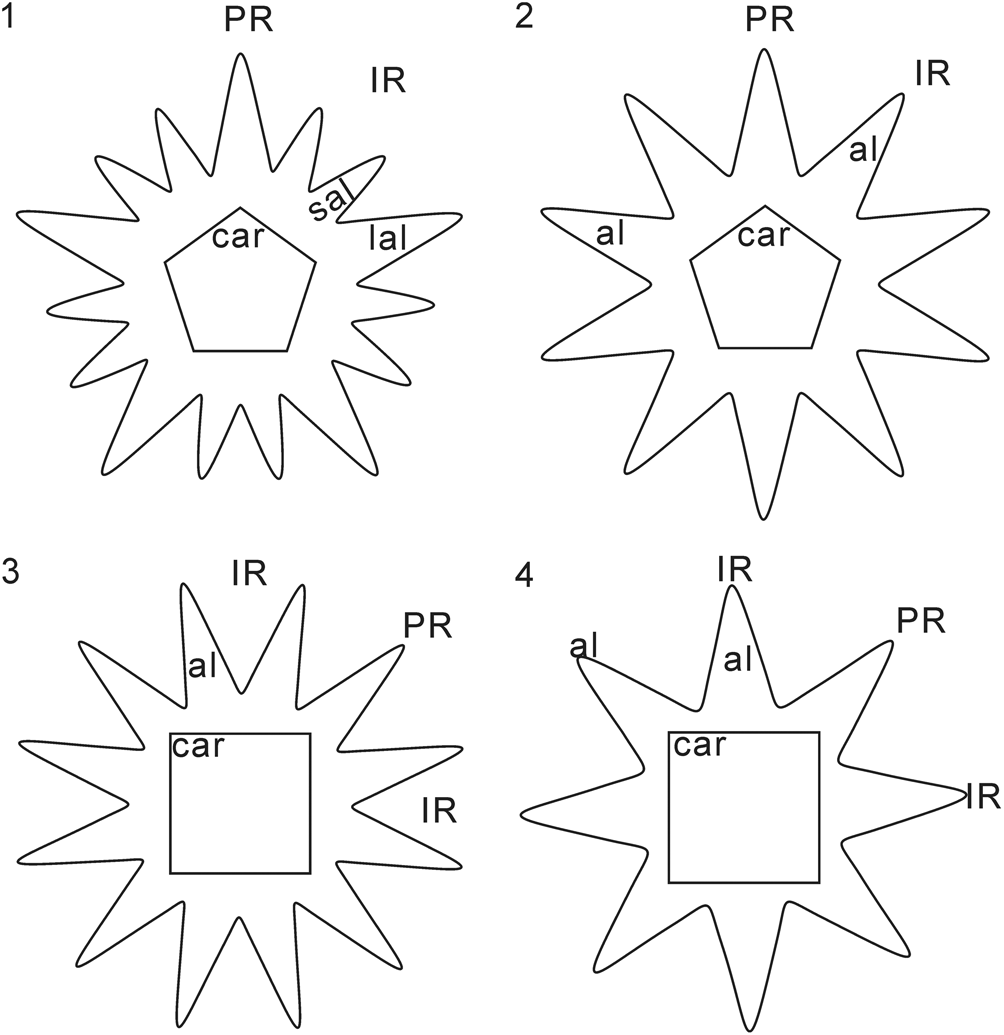
Looking more closely at the patterns of arrangement of particular anatomical structures, Olivooides multisulcatus, Qian, Reference Qian1977 exhibits five apical corners and fifteen apertural lobes (see Steiner et al., Reference Steiner, Qian, Li, Hagadorn and Zhu2014, figs. 9, 10) that collectively straddle five meridional planes, each of which bisects a single perradial lobe and a pair of smaller adradial lobes, as indicated by the arrangement of relic internal soft parts (Fig. 7.1; see also Dong et al., Reference Dong, Cunningham, Bengtson, Thomas, Liu, Stampanoni and Donoghue2013, Reference Dong, Vargas, Cunningham, Zhang, Liu, Chen, Liu, Bengtson and Donoghue2016; Han et al., Reference Han, Li and Kubota2016b). This pattern is shared with Qinscyphus necopinus (Liu et al., Reference Liu, Shao, Zhang, Wang, Zhang, Chen, Liang and Xue2017) and Sinaster petalon (Wang et al., Reference Wang, Han, Vannier, Ou, Yang, Uesugi, Sasaki, Komiya and Sevastopulo2017). Olivooides mirabilis Yue in Xing et al., Reference Xing, Ding, Luo, He and Wang1983 exhibits five apical corners but only 10 apertural lobes (see Steiner et al., Reference Steiner, Qian, Li, Hagadorn and Zhu2014, figs. 11, 12), all situated in five meridional planes that each bisect a single perradial lobe and a single interradial lobe (Fig. 7.2; see also Han et al., Reference Han, Li and Kubota2016b). The spatial relationships between the apical corners and apertural lobes in O. multisulcatus and O. mirabilis are similar to those in Quadrapyrgites and Octapyrgites (i.e., in all cases the perradial apertural lobes are bisected by a meridional plane containing one or two apical corners), though with Quadrapyrgites exhibiting four apical corners and twelve apertural lobes (Fig. 7.3), and Octapyrgites also exhibiting four apical corners but only eight apertural lobes (Fig. 7.4). In this respect, Octapyrgites is similar to Olivooides mirabilis, and the latter species should be elevated to genus status. More fundamentally, though, future work on patterns of radial symmetry in olivooids should address the problem of possible character state transformations among the patterns of arrangement of apical corners and apertural lobes here enumerated.
Schematic diagram of olivooids showing the dispositions of the apertural lobes and apical corners. (1) Olivooides multisulcatus, Qinscyphus necopinus, and Sinaster petalon; (2) Olivooides mirabilis; (3) Quadrapyrgites quadratacris; (4) Octapyrgites elongatus. IR = interradial; PR = perradial; al = apertural lobe; car = corner of the apical region; lal = large apertural lobe; sal = small apertural lobe.

Discussion
Direct development
As revealed by examination of Quadrapyrgites quadratacris and other olivooids from the Kuanchuanpu Formation, growth of the olivooid periderm involved the addition of transverse annulations along the apertural margin (Liu et al., Reference Liu, Li, Shao, Zhang, Wang and Qiao2014; Han et al., Reference Han, Kubota and Li2016a, b). Thus, the peridermal tube consisting of the apical region and only the first annulation most likely represents the embryonic tissue and the earliest stage of the olivooid polyp (Fig. 5). All available evidence indicates that olivooid embryos, which measure ~500–700 μm in diameter, underwent direct development (Han et al., Reference Han, Kubota and Li2013; Duan et al., Reference Duan, Dong, Porras, Vargas, Cunningham and Donoghue2017; Shao et al., Reference Shao, Liu, Duan, Zhang, Zhang, Wang, Zhang and Qin2018). The apical region of Octapyrgites elongatus, the diameter of which exceeds 1,000 μm, is substantially larger than the earliest juvenile stage and embryos of other olivooids (see Steiner et al., Reference Steiner, Qian, Li, Hagadorn and Zhu2014, fig. 8). Nevertheless, ontogenetic considerations suggest that O. elongatus, like its nearest olivooid relatives, hatched from large eggs containing enough yolk to support direct development. This hypothesis is also consistent with the uniform morphology of the abapical region.
Paleoecological succession
Differences in the biodiversity of marine communities between the first two Cambrian stages have been well documented (Maloof et al., Reference Maloof, Porter, Moore, Dudás, Bowring, Higgins, Fike and Eddy2010), and the abrupt increase in the genus-level diversity of small shelly fossils in South China through the early–mid Meishucunian (541 Ma–521 Ma) has been taken as the first stage of the Cambrian explosion (G. Li et al., Reference Li, Steiner, Zhu, Yang, Wang and Erdtmann2007; Shu, Reference Shu2008; Shu et al., Reference Shu, Isozaki, Zhang, Han and Maruyama2014). Thus, investigations focusing on the diversity of cnidarians between the first two Cambrian ages may provide additional insight into metazoan evolution and ecological succession during that period. Probable or possible polypoid cnidarians currently known from the Fortunian Kuanchuanpu Formation collectively represent five families, at least twelve genera, and sixteen species (Fig. 8) and comprise: (1) triradial anabaritids, (2) hexaradial Eolympia, (3) the biradial hexangulaconulariid Hexaconularia sichuanensis He and Yang, Reference He and Yang1986, (4) tri-, tetra-, and pentaradial carinachitids (Liu et al., Reference Liu, Li, Shao, Zheng, Zheng, Wang, Wang and Wang2011), and (5) a number of tetra-, penta-, and hexaradial olivooids (Han et al., Reference Han, Kubota and Li2016a). Together, these fossil taxa attest to the rapid radiation of cnidarians collectively exhibiting a wide range of radial symmetries during the early stages of the Cambrian explosion.
Symmetry patterns of benthic polypoid cnidarians from the lower Cambrian Kuanchuanpu Formation (Fortunian Stage) in Shaanxi Province and the Yanjiahe Formation (Stage 2) in Hupei Province, China.

Probable or possible polypoid cnidarians currently known from the Yanjiahe Formation (Cambrian Stage 2) include: (1) triradial Anabarites (Guo et al., Reference Guo, Li and Li2014), (2) the biradial hexangulaconulariid Septuconularia yanjiaheensis (Guo et al., Reference Guo, Han, Van Iten, Wang, Qiang, Song, Wang, Zhang and Li2019), (3) Octapyrgites elongatus, and (4) the tetraradial conulariid Conulariella sp. (Guo, unpublished data), previously known from the Lower and/or Middle Ordovician of Bohemia, northwest France, and South China (Van Iten et al., Reference Van Iten, Muir, Botting, Zhang and Lin2013). Two families, Carinachitidae (three genera and five species) and Olivooidae (at least three genera as well as other indeterminate forms in Han et al., Reference Han, Kubota and Li2013), are abundant in the Cambrian Fortunian Stage but have not been found in Cambrian Stage 2 (Fig. 8). This observation suggests that during the early Cambrian, the total number of medusozoan symmetry patterns was reduced from five to three: biradial, triradial, and tetraradial. The apparent decline of other medusozoans may reflect ecological replacement in the high-energy shallow shelf setting, though taphonomical and paleogeographic biases cannot be ruled out completely. Since only tetraradial medusozoans have been found in subsequent Cambrian stages (Cartwright et al., Reference Cartwright, Halgedahl, Hendricks, Jarrard, Marques, Collins and Lieberman2007; Han et al., Reference Han, Hu, Cartwright, Zhao, Ou, Kubota, Wang and Yang2016c), the origin of multiple medusozoan symmetry patterns, which event(s) likely commenced during earliest Cambrian or Ediacaran times, may have ended during Cambrian Age 3. Therefore, the dominance of tetraradial symmetry seen in modern medusozoans may have been established during the peak phase (Cambrian Stage 3) of the Cambrian explosion. In short, then, the substantial increase in the total diversity of small shelly fossils during the first two Cambrian stages (G. Li et al., Reference Li, Steiner, Zhu, Yang, Wang and Erdtmann2007; Maloof et al., Reference Maloof, Porter, Moore, Dudás, Bowring, Higgins, Fike and Eddy2010) appears to have involved the concomitant diversification of bilateral invertebrates and a decrease in cnidarian disparity, including apparently the extinction of nontetraradial, benthic medusozoans.
Conclusions
The new olivooid Octapyrgites elongatus from the Yanjiahe Formation (Cambrian Stage 2) of South China is similar to the genera Olivooides and Quadrapyrgites from the Cambrian Fortunian Stage. However, in contrast to the radiation of abundant medusozoans showing diverse symmetry patterns during the Fortunian Age, the subsequent rareness of benthic medusozoans with biradial and tetraradial symmetry indicates an appreciable reduction (olivooids) or, apparently, extinction (carinachitiids) during the transition between the first two Cambrian ages, when bilaterians fared better than medusozoans as a whole.
Acknowledgments
We thank X. Liu (NWU) for the 3D drawings of olivooids. We are grateful to R. Elias, G. Young, and one anonymous reviewer for their constructive comments and suggestions. This work was supported by the Strategic Priority Research Program of the Chinese Academy of Sciences (no. XDB26000000), the Natural Science Foundation of China (nos. 41890844, 41890840, 41472015, 41672009, 41621003, 41772010, 41720104002), and the Ministry of Science and the Overseas Expertise Introduction Centre for Discipline Innovation Project (111) of the Ministry of Education of China (no. D17013).
Accessibility of supplemental data
Data available from the Dryad Digital Repository: https://doi.org/10.5061/dryad.wm37pvmhd.