


Introduction
Self-critical thinking has been reported across a number of psychological conditions, including depression (Luyten et al., Reference Luyten, Sabbe, Blatt, Meganck, Jansen and De Grave2007), eating disorders (Fennig et al., Reference Fennig, Hadas, Itzhaky, Roe, Apter and Shahar2008; Lehman and Rodin, Reference Lehman and Rodin1989), social anxiety (Cox et al., Reference Cox, Rector, Bagby, Swinson, Levitt and Joffe2000), and post-traumatic stress disorder (PTSD; Cox et al., Reference Cox, MacPherson, Enns and McWilliams2004). The impact self-criticism can have on clinical interventions is significant; it has been shown that people with high levels of self-criticism give lower ratings of the working alliance with their therapist (Whelton et al., Reference Whelton, Paulson and Marusiak2007), show generally poorer treatment outcomes (Cox et al., Reference Cox, Walker, Enns and Karpinski2002; Dent and Teasdale, Reference Dent and Teasdale1988; Marshall et al., Reference Marshall, Zuroff, McBride and Bagby2008; Rector et al., Reference Rector, Bagby, Segal, Joffe and Levitt2000) and have greater risk of relapse (Mongrain and Leather, Reference Mongrain and Leather2006). Furthermore, self-criticism has been shown to predict depression in a longitudinal study (Dunkley et al., Reference Dunkley, Sanislow, Grilo and McGlashan2009), and has been identified as a risk factor for suicide (O'Connor and Noyce, Reference O'Connor and Noyce2008).
Much of the extant literature has subsumed self-criticism under the umbrella of perfectionism using categories of ‘self-oriented perfectionism’ (Hewitt and Flett, Reference Hewitt and Flett1991) or ‘self-critical perfectionism’ (Dunkley and Blankstein, Reference Dunkley and Blankstein2000). The perfectionism literature tends to consider self-criticism as a stable personality variable or cognitive style, e.g. the model of Hewitt and Flett (Reference Hewitt and Flett1991), which outlines three domains of perfectionism (self-oriented, other-oriented, and socially prescribed perfectionism), and suggests that self-criticism may stem from each of these. This approach does not readily allow for fluctuations in self-critical thinking, or acknowledge that ‘non-perfectionists’ can also be self-critical. Studies using failure feedback designs have shown that, on average, most participants show a tendency to criticize their own performance following perceived task failure, regardless of the presence of a self-critical ‘trait’ (see Besser et al., Reference Besser, Flett and Hewitt2004; Stoeber et al., Reference Stoeber, Hutchfield and Wood2008; Wenzlaff and Grozier, Reference Wenzlaff and Grozier1988). This indicates that ‘state’ self-criticism is possible and may be common for all people in certain contexts, although it may be more marked among people with long-standing experience of self-criticism or clinical conditions.
More recent research has begun to examine the role of self-criticism in various clinical problems outside the construct of perfectionism. For example, Pinto-Gouveia and colleagues (Reference Pinto-Gouveia, Castilho, Matos and Xavier2013) demonstrated that where someone experiences a shameful early life event that becomes central to their identity, this is associated with depression symptoms, but only given the presence of self-criticism. A similar mediating role for self-criticism has been shown in the relationship between childhood emotional abuse and both depression symptoms and body dissatisfaction in binge-eating disorder (Dunkley et al., Reference Dunkley, Masheb and Grilo2010).
Self-criticism is also a main component of the Interpersonal Theory of Depression put forward by Blatt and colleagues (see Blatt, Reference Blatt1974; Blatt and Zuroff, Reference Blatt and Zuroff1992), which suggests two main subtypes: anaclitic depression, characterized by feelings of loneliness and helpnessness, and introjective depression, characterized by self-criticism and feelings of unworthiness and failure. Blatt and Zuroff (Reference Blatt and Zuroff1992) noted that although ‘self-critical individuals are vulnerable to experiences of dysphoria in the face of different negative events, it is less clear why they are vulnerable’ (p. 553). It remains true that the mechanism by which self-critical thinking may contribute to psychological problems is unclear, but one possible route is through the process of overgeneralization. This is the process whereby specific negative appraisals of an event become magnified and applied more broadly across a range of situations or times, leading to people making global judgements about their characteristics or abilities. Beck's cognitive model of depression (Beck et al., Reference Beck, Rush, Shaw and Emery1979) highlighted overgeneralization from specific events to general negative judgements as a common cognitive bias in depression.
In support of this, student cohort studies have shown that participants with an unconstructive, self-critical style of thinking tend to overgeneralize and judge themselves more negatively following negative outcomes, compared with more constructive, less critical thinkers (Epstein, Reference Epstein1992), and that overgeneralization is the strongest predictor of depression when compared with self-criticism and high standards (Carver and Ganellen, Reference Carver and Ganellen1983). There has been less experimental research into the process of overgeneralization from the effect of a specific event to a general self-belief. One exception is a study by Wenzlaff and Grozier (Reference Wenzlaff and Grozier1988) in which students were given predetermined failure feedback about a task purporting to assess social perceptiveness. Depressed participants, unlike non-depressed participants, subsequently reported lower estimates of their general proficiency. It is possible that self-critical thinking was elicited by the task and resulted in such overgeneralizations, but self-critical thinking was not assessed directly. An experimental study by Rimes and Watkins (Reference Rimes and Watkins2005) also found that analytical self-focused thinking increased ratings of the self as worthless and incompetent in depressed but not healthy participants; however, their paradigm was designed to elicit analytic self-focused cognition in general rather than self-criticism specifically.
The aim of the present study was to investigate the relationship between self-criticism and overgeneralization, and to compare this across two clinical disorders where self-criticism is common: depression and eating disorders. Tasks designed to elicit self-critical thoughts were used to investigate the following hypotheses:
-
1. Changes following failure experience: following task-related failure, it was hypothesized that the two clinical groups would report more self-critical thinking and greater overgeneralization (increased endorsement of general negative self-views) compared with controls, and that there would be no significant difference between the clinical groups.
-
2. Predicting overgeneralization: self-critical thinking would be a significant predictor of overgeneralization after each task, and it would show a stronger association with overgeneralization compared with negative perfectionism.
-
3. Predicting increased low mood: self-critical thinking and overgeneralization would both be associated with increases in low mood after each task, but overgeneralization would show the stronger association.
-
4. Changes specific to eating disorders: compared with the other two groups, the eating disorder group would show significantly more body/appearance-related self-critical thinking and overgeneralization after a task focusing on body image.
Method
Participants
The study recruited 78 adults across three groups: current major depressive disorder (n = 26), a current eating disorder (n = 26), and no current or historical psychological disorders (n = 26). A sample size calculation (using β = 0.8 and α = 0.05) based on the effect size calculated from Wenzlaff and Grozier (Reference Wenzlaff and Grozier1988) indicated 10 participants per group would be required to detect a small effect for the first hypothesis. Given the further planned analyses, we sought the larger group sizes above. Participants in the two clinical groups were recruited from local mental health services, where eligible participants were approached initially by a member of their clinical team. Additionally, study information and advertising material was distributed to local voluntary and charitable organizations, public buildings, and relevant online forums. Participants in the third (control) group were recruited from university student and staff populations and local advertisement. Exclusion criteria were high levels of risk (identified by clinician), or difficulties with written/spoken English. Participants were reimbursed for their time using vouchers or, where relevant, course credit.
Design
The study used a group (depression, eating disorder, non-clinical control) by time (before and after each task) between and within-participant design to compare the impact of two tasks across the three groups, with overgeneralization as the main dependent variable.
Materials
Diagnostic interview
The Mini International Neuropsychiatric Interview (MINI; version 6.0.0; Sheehan et al., Reference Sheehan, Lecrubier, Sheehan, Amorim, Janavs and Weiller1998) is a brief structured interview protocol with good reliability and validity (Lecrubier et al., Reference Lecrubier, Sheehan, Weiller, Amorim, Bonora and Harnett Sheehan1997) that screens for the presence of major Axis I psychiatric disorders, as outlined in DSM-IV and ICD-10.
Questionnaire measures
The following standardized measures were used:
-
• Habit Index of Negative Thinking (HINT; Verplanken et al., Reference Verplanken, Friborg, Wang, Trafimow and Woolf2007). A measure of habitual self-critical thinking as a cognitive process, the HINT has good psychometric properties (Verplanken et al., Reference Verplanken, Friborg, Wang, Trafimow and Woolf2007) and internal consistency; Cronbach's alpha in this study was 0.97.
-
• Frost Multidimensional Perfectionism Scale (MPS; Frost et al., Reference Frost, Marten, Lahart and Rosenblate1990). Analyses used the total of the following subscales: Concern over Mistakes, Doubting of Actions, Parental Expectations, and Parental Criticism, which have been shown to represent the negative aspects of perfectionism (see Frost et al., Reference Frost, Heimberg, Holt, Mattia and Neubauer1993). Cronbach's alpha was 0.94.
-
• Centre for Epidemiological Studies Depression Scale (CES-D; Radloff, Reference Radloff1977). The CES-D is a widely used and validated brief measure of depression symptoms (see Weissman et al., Reference Weissman, Sholomskas, Pottenger, Prusoff and Locke1977). Cronbach's alpha was 0.93.
-
• Eating Disorder Examination Questionnaire (EDE-Q; Fairburn and Beglin, Reference Fairburn, Beglin and Fairburn2008). A general measure of self-reported eating disorder symptoms, the present study used the global scale of the EDE-Q, which averages the four subscales of Restraint, Eating Concern, Weight Concern, and Shape Concern. Cronbach's alpha was 0.96.
Participants also completed brief demographic questions and questions regarding current or previous treatments for mental health difficulties.
Visual analogue scales: general negative self-views, self-criticism and mood
Based on those used in Wenzlaff and Grozier (Reference Wenzlaff and Grozier1988) and Rimes and Watkins (Reference Rimes and Watkins2005), these visual analogue scales have been shown to be sensitive to change in experimental studies. To capture the process of overgeneralization, Rimes and Watkins (Reference Rimes and Watkins2005) used four items taken from the devaluation scale of the Depressed States Checklist (Teasdale and Cox, Reference Teasdale and Cox2001): competent, acceptable to others, worthless, unlovable. These items (first two reverse-scored) were averaged to form a composite indicator of general negative self-views (see Rimes and Watkins, Reference Rimes and Watkins2005). The change in scores on the composite measure of general negative self-views before and after each of the tasks was computed to produce a single variable of overgeneralization (i.e. post-task minus pre-task ratings). To capture changes in mood and self-criticism participants rated the following items: low in mood, self-critical, and self-critical about my body or appearance; all items were rated on a 0 (not at all) to 100 (extremely) scale. Participants rated how they were feeling at the time of completion, apart from the two self-criticism scales, where they were asked to consider the past five minutes.
Verbal ability task
This task was adapted from the ‘Remote Associates Task’ (Mednick, Reference Mednick1962). Three ‘clue’ words are given (e.g. ‘teacher’, ‘primary’, ‘learning’), and the task is to produce a fourth word that can be combined with all the clues, either by making a compound phrase or semantic association (e.g. ‘school’). These can vary in difficulty, and a difficult version of the task has been used in previous research in perfectionism as a trigger for self-critical thinking (Schneider et al., Reference Schneider, Gerstenberg, Altstotter-Gleich, Zureck and Schmitt2012). Twenty difficult and twenty easy items were selected following piloting that demonstrated that no participants were able to successfully answer all of the difficult items in the time available, that the difficult items were effective in eliciting self-critical thoughts, and that the easy items were effective in reducing these.
Participants were given instructions and an example set of clue words and their solution. They were given three minutes to complete the difficult items. Following this they completed the easy items, for which they were allowed five minutes. No performance feedback was provided, therefore participants’ evaluations of performance and failure experiences were self-generated.
Body image task
Adapted from tasks described in Shafran et al. (Reference Shafran, Lee, Payne and Fairburn2007) and Forbes et al. (Reference Forbes, Adams-Curtis, Rade and Jaberg2001), this task was designed to trigger self-critical thinking related to comparisons of the self with people in the images shown. Advertisements featuring idealized male and female images were selected from popular men's and women's magazines, which were piloted to select 10 male and 10 female images that showed the strongest negative impact on viewers’ own self-image. Additionally, two further advertisements not featuring people were added to each set to disguise the nature of the task.
Participants were asked to view each image for five seconds, then provide ratings on a 5-point Likert scale (1 = strongly agree, 5 = strongly disagree) for the following statements: ‘the style of this image appeals to me’; ‘this image would catch my eye if I was flipping through a magazine’; ‘it is clear what this image is trying to promote’; and ‘this is a memorable image’. These instructions were designed to hide the purpose of the task while ensuring that participants fully viewed and engaged with each image.
Procedure
The study was approved by the UK National Research Ethics Committee (study reference 13/WA/0158). Potential participants were provided with an information sheet and the opportunity to ask questions. Suitability for the study was assessed via telephone using the MINI (Sheehan et al., Reference Sheehan, Lecrubier, Sheehan, Amorim, Janavs and Weiller1998) to assess diagnoses and determine their group allocation if appropriate.
Eligible volunteers were sent a consent form and questionnaire pack to complete at home. The researcher then met with participants to undertake the experimental tasks. This meeting followed the structure below:
-
1. Information about the experimental session;
-
2. Completion of visual analogue scales (VAS) – time A;
-
3. Verbal ability task – part 1 (difficult; ‘failure experience’);
-
4. VAS – time B;
-
5. Verbal ability task – part 2 (easy);
-
6. VAS – time C;
-
7. Body image task;
-
8. VAS – time D;
-
9. Full debrief, including optional relaxation exercise for participant wellbeing.
Task order was not counterbalanced as although there was a method for negating the effects of the failure experience in the verbal ability task (i.e. the second part in which participants experience success at the task), there was no such method available for the body image task.
Data analysis
Data were analysed using SPSS version 20. One participant from the depression group was excluded from analyses of the verbal ability task due to misunderstanding the instructions. Missing questionnaire data were replaced with the mean score given for items in the same subscale. Overgeneralization scores for the verbal ability task were found to be positively skewed, therefore a square root transformation (including a constant to remove negative values) was performed to realign scores with the normal distribution prior to analysis.
Results
Demographics of sample
One-way ANOVA and chi-square analyses were used as appropriate to compare demographic information for the three groups, with response options combined where required to ensure sufficient cell counts. The groups did not differ with respect to ethnicity [χ2 = 1.9, p = .538 (Fisher's exact probability test)], years of education (χ2 = 2.9, p = .238), marital status (χ2 = .1, p = .956), or financial status (χ2 = 6.7, p = .151). The mean age of the depression group (mean = 45, SD = 13) was higher than that of the eating disorder (mean = 28, SD = 7) and control (mean = 26, SD = 12) groups: F (2,75) = 20.7, p < .001, and there was a greater proportion of female participants in the depression (81%) and eating disorder (100%) groups compared with controls (51%): χ2 = 16.4, p < .001. As might be expected, the proportion of participants not currently employed or studying was higher in the depression (50%) and eating disorder (50%) groups compared with controls (8%): χ2 = 14.0, p = .001. There was no difference between the depression (65%) and eating disorder (54%) groups regarding the proportion currently taking psychiatric medication: χ2 = .3, p = .572.
Clinical characteristics of sample
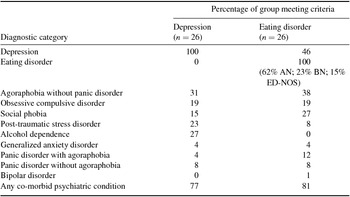
One-way ANOVA analyses with Tukey's honest significant difference post-hoc tests indicated that both the depression (mean = 35, SD = 9) and eating disorder (mean = 31, SD = 10) groups showed significantly greater depression symptoms, as measured by the CES-D, compared with the control group (mean = 11, SD = 7): F (2,75) = 53.5, p < .001. On the EDE-Q, scores for the eating disorder group (mean = 4.20, SD = 0.98) were significantly greater than the depression group (mean = 2.54, SD = 1.38), which in turn were greater than the control group (mean = 1.11, SD = 0.97): F (2,75) = 49.5, p < .001. Participants in the two clinical groups met diagnostic criteria for various psychiatric conditions, which are shown in Table 1.
Percentages of participants in each clinical group who met MINI screening criteria for psychiatric conditions

AN, anorexia nervosa; BN, bulimia nervosa; ED-NOS, eating disorder not otherwise specified.
Task manipulation checks: changes in self-critical thinking
To check whether participants attempted and solved fewer of the hard than the easy puzzles as intended, 3 (group) by 2 (difficulty) ANOVAs were conducted. A significant main effect of difficulty was found for both the number of puzzles attempted (Wilks's lambda = .11, F (1,74) = 628.0, p < .001) and the number correctly solved (Wilks's lambda = .10, F (1,74) = 708.6, p < .001). On average, participants attempted fewer hard puzzles (mean = 4.8, SD = 3.9) than easy puzzles (mean = 16.3, SD = 3.4), and correctly solved fewer hard puzzles (mean = 2.2, SD = 1.7) than easy puzzles (mean = 13.9, SD = 4.2).There was no main effect of group for the number of puzzles attempted (F (2,74) = 2.0, p = .144) or solved (F (2,74) = 0.4, p = .646), and no difficulty by group interaction for puzzles attempted (F (2,74) = 0.4, p = .662) or solved (F (2,74) = 0.8, p = .449). This indicated that between-group differences would be attributable to perceived performance rather than actual performance.
To assess the effectiveness of the tasks in eliciting self-critical thoughts, paired t-tests were calculated comparing participants’ ratings of the extent of self-critical thinking experienced over the past five minutes at times A and B (verbal ability task), and also at times C and D (body image task). Mean ratings of self-critical thinking increased from 41.4 (SD = 26.1) at time A to 65.3 (SD = 29.0) at time B: t (76) = –8.6, p < .001, indicating that the failure experience was effective in eliciting self-critical thoughts. The decrease in ratings from time B (mean = 65.3, SD = 29.0) to time C (mean = 50.0, SD = 27.9) was also significant: t (76) = 7.7, p < .001, indicating that the easy puzzles were effective in reducing self-critical thinking. A one-way ANOVA of the change in self-critical thinking from time B to time C showed that there were no differences between groups: F (2,74) = .004, p = .996. The body image task led to a significant increase in body/appearance-related self-critical thinking from mean ratings of 30.4 (SD = 28.1) at time C to 46.0 (SD = 32.5) at time D: t (77) = –5.8, p < .001, but no change in the general self-critical thinking VAS: t (77) = .4, p = .667. This suggested that each task produced specific changes in self-criticism and that any effects observed in the latter task were not simply a carry-over effect.
Changes in mood and general negative self-views after each task
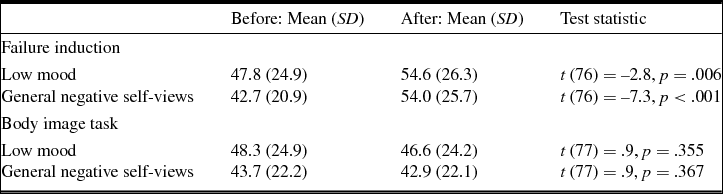
Paired t-tests comparing pre- and post-task VAS scores indicated that the verbal ability task was associated with significant increases in low mood and overgeneralization, but that the body image task was not (see Table 2).
Ratings of low mood and general negative self-views before and after each task

SD, standard deviation.
Testing of study hypotheses
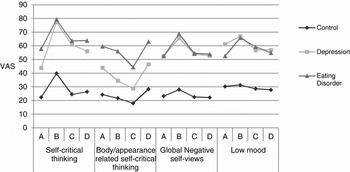
Hypothesis 1: changes following failure experience. A mixed ANOVA using a within-subjects factor of time (before vs after the failure experience), and a between-subjects factor of group (depression vs eating disorder vs control) was conducted using self-criticism ratings. This showed a significant main effect of time, F (1,74) = 79.126, p < .001, partial η 2 = .517, and group, F (2,74) = 28.347, p < .001, partial η 2 = .434, and a significant interaction effect, F (2,74) = 3.135, p = .049, partial η 2 = .078. Post-hoc pairwise comparisons (with Bonferroni correction) indicated that both clinical groups showed a greater increase in self-critical thinking compared with the control group (p values < .001), and that there was no difference between the clinical groups (p = .447). Group means across the four time points for self-critical thinking and other VAS are presented in Fig. 1.
Mean visual analogue scale (VAS) scores (0–100) by group, across the four measurement points: A (baseline), B (post-hard word puzzles), C (post-easy word puzzles), and D (post-body image task).

The equivalent analysis for overgeneralization also revealed a significant main effect of time, F (1,74) = 60.572, p < .001, partial η 2 = .450, group, F (2,74) = 41.827, p < .001, partial η 2 = .531, and a significant interaction effect, F (2,74) = 5.516, p = .006, partial η 2 = .130. Again, both clinical groups showed a greater increase in self-critical thinking compared with the control group (p values < .001), and there was no difference between the clinical groups (p = .929).
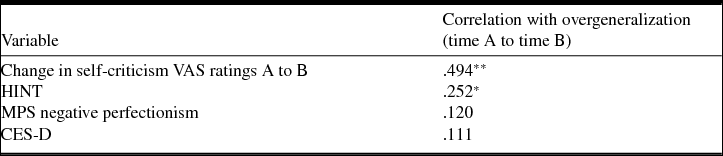
Hypothesis 2: predicting overgeneralization. Correlational and multiple regression analyses were undertaken to investigate the relationship between self-critical thinking and overgeneralization. The change in self-criticism ratings following the verbal ability task (time B minus time A) was significantly correlated with overgeneralization (increase in general negative self-views): (r= .494, p < 001). As shown in Table 3, habitual self-criticism as measured by the HINT was also significantly correlated with overgeneralization (r = .252, p = .027), although MPS negative perfectionism (r = .120, p = .300) and CES-D (r = .111, p = .335) scores were not. To compare their relative contributions, habitual self-criticism and task-related increases in self-criticism were entered into a multiple regression analysis. The overall model was significant: F (2,76) = 13.872, p < .001, adjusted R 2 = .253, but only task-related increases in self-criticism were a significant predictor (beta = .464, p < .001).
Correlations between overgeneralization, self-criticism, negative perfectionism, and mood in relation to the verbal ability task

VAS, visual analogue scale; HINT, Habit Index of Negative Thinking; MPS, multidimensional perfectionism scale; CES-D, Centre for Epidemiological Studies depression scale. *p < .05; **p < .001.
On the body image task, changes in body/appearance-related self-criticism (time D minus time C) significantly correlated with overgeneralization (r = .304, p = .007). Scores on the HINT (r = –.054, p = .638), MPS negative perfectionism (r = –.043, p = .712) and CES-D (r = .019, p = .867) were not significantly correlated with overgeneralization.
Hypothesis 3: predicting increased low mood. Correlation analyses indicated that after the verbal ability task, increases in low mood were significantly associated with overgeneralization (r = .524, p < .001) and increases in self-criticism (r = .377, p = .001). A multiple regression including overgeneralization and change in self-criticism (time A to time B) showed that overgeneralization was the only significant predictor of change in low mood ratings (time A to time B): beta = .446, p < .001, in a significant overall model: F (2,76) = 15.312, p < .001, adjusted R 2 = .274.
After the body image task, increases in low mood were significantly correlated with overgeneralization (r = .523, p < .001) but not with increases in body/appearance-related self-criticism (r = .099, p = .390).
Hypothesis 4: changes specific to eating disorders. A mixed ANOVA using a within-subjects factor of time (before vs after the failure body image task), and a between-subjects factor of group was conducted using body/appearance-related self-criticism ratings. This showed a significant main effect of time, F (1,75) = 33.522, p < .001, partial η 2 = .309, and group, F (2,75) = 9.461, p < .001, partial η 2 = .201, but a non-significant interaction effect, F (2,75) = 0.950, p = .391, partial η 2 = .025, indicating that the increase in self-criticism following the task did not differ significantly between the groups.
For overgeneralization following the body image task, the main effect of time was non-significant, F (1,75) = 0.803, p = .373, partial η 2 = .011, suggesting that these did not change following the task. There was a significant main effect of group, F (2,75) = 32.648, p < .001, partial η 2 = .465, but not the time by group interaction, F (2,75) = 0.098, p = .907, partial η 2 = .003.Footnote 1
Discussion
In line with expectations, participants in the depression and eating disorder groups showed significantly greater increases in self-criticism and greater overgeneralization (increases in endorsement of general negative self-views) following a verbal ability failure task compared with controls. This suggests a tendency towards overgeneralization in both depression and eating disorders. The finding of overgeneralization after specific failure experiences is consistent with related work in this area (e.g. Wenzlaff and Grozier, Reference Wenzlaff and Grozier1988) and Beck's suggestion that overgeneralization is a feature of amplified mood states (Beck et al., Reference Beck, Rush, Shaw and Emery1979). To the authors’ knowledge, this is also the first experimental demonstration of overgeneralization following failure experiences among participants with eating disorders.
Self-critical thinking in both habitual, and state, forms was significantly associated with the extent of overgeneralization following failure experience on the verbal ability task, with the latter being the stronger predictor of the two. This finding questions the tendency in the literature to conceptualize self-criticism as purely a stable construct of personality. The second hypothesis was therefore supported and provides evidence for a possible role for self-critical thinking within the overgeneralization process. By contrast, MPS negative perfectionism was not significantly associated with overgeneralization on the verbal ability task, and this is consistent with previous evidence suggesting that self-criticism is not only a key component in the association between perfectionism and depressive symptoms (Gilbert et al., Reference Gilbert, Durrant and McEwan2006), but is also important, in comparison with negative perfectionism, in the relationship between overgeneralization and mood state.
Increases in both self-criticism and overgeneralization were associated with increases in low mood following failure experiences on the verbal ability task. When both self-critical thinking and overgeneralization were entered into a regression model, only the latter significantly predicted increases in low mood. The primacy of relationship found between overgeneralization and mood state is consistent with previous research (Carver and Ganellen, Reference Carver and Ganellen1983) and suggests a mechanism where self-criticism affects mood via overgeneralization. However, as the three factors were measured at the same point in time, i.e. after each task, this conclusion must be interpreted with caution.
Contrary to the fourth hypothesis, there was no difference in body/appearance-related self-criticism between the clinical groups following a task thought to be more relevant to the concerns of people with an eating disorder. The task was successful in eliciting an overall increase in appearance-related self-critical thinking but the increase in the clinical groups was not significantly larger than for controls, and this did not have an impact on overgeneralization. It is possible that modifying the task may result in a greater differential effect between clinical and healthy individuals. This could include asking questions relating directly to one's own appearance in comparison with the images being viewed, which are more likely to activate body-related global beliefs. Such questions had not been included in the present study as it was anticipated that this would make the true purpose of the task (eliciting self-criticism) too obvious.
The present findings suggest that self-critical and overgeneralization processes occur similarly across people with depression and eating disorders, and that these processes seem to represent an exaggerated form of those occurring in people without current mental health difficulties. The lack of differences between the two clinical groups provides tentative support for the idea that it may be useful to consider these processes from a transdiagnostic perspective, whereas in the past these processes, particularly overgeneralization, have been examined predominantly in depression. Caution is required because the present eating disorder group showed relatively high levels of secondary depressive symptomatology. However, analyses comparing this subgroup with those in the eating disorder group without depression and the depression group indicated that there were no differences between them in response to the experimental tasks, although these findings are limited due to the subgroup sample sizes.
Other limitations of the study include some demographic group differences, and the reliance on self-report approaches, although this is to an extent unavoidable due to the internal nature of self-critical thinking. It was not possible to counterbalance the order of the two tasks, as no method was available to counteract the effect of the body image task had it been presented first. Lastly, it is noted that the conceptualization and measurement of the overgeneralization process is not straightforward; the present study used the increase in general negative self-views in response to a negative experience as an index of this process following Rimes and Watkins (Reference Rimes and Watkins2005), but other methodologies would be possible and would merit further exploration. For example, participants could be asked to rate their perceived likelihood of failing other unrelated tasks.
Although these results suggest that self-criticism and overgeneralization may be key elements in the endorsement of general negative self-beliefs, and that these in turn are associated with low mood, it remains an open question how best to intervene with this process. Future research could examine the clinical effectiveness of targeting the self-critical thinking, the overgeneralization process, or the general negative self-views directly. The current findings could be taken to suggest that the treatment of self-criticism may improve mood by reducing overgeneralization, although further work would be required to investigate this.
This study has demonstrated that following a failure experience, both clinical and non-clinical populations show a significant increase in self-critical thinking; however, compared with healthy individuals, participants with depression or eating disorders showed greater overgeneralization, i.e. an increase in general negative self-views. Both habitual and state increases in self-criticism were associated with the extent of overgeneralization, and overgeneralization in turn was associated with increases in low mood. These results provide evidence that self-criticism and overgeneralization may be important components in the processing and emotional impact of negative experiences.
Acknowledgements
The authors wish to thank the study participants and the following for their valuable assistance with recruitment: Jan Bagnall, Mark Bernard, Alison Burrows, Melanie Chalder, Sam Clark-Stone, Bev Corbett, Will Devlin, Alysun Jones, Glyn Lewis, Phan Nguyen, Christa Schreiber-Kounine and Alison Sedgwick-Taylor.
Conflicts of interest: The authors have no conflicts of interest with respect to this publication.
Financial support: This research received no specific grant from any funding agency, commercial or not-for-profit sectors.
Ethical standards: The authors assert that all procedures contributing to this work comply with the ethical standards of the relevant national and institutional committees on human experimentation and with the Helsinki Declaration of 1975, and its most recent revision.



Comments
No Comments have been published for this article.