1. Introduction
Defined broadly as ‘those strategies employed by states and international institutions to deal with a legacy of human rights abuses and to effect social reconstruction in the wake of widespread violence’, transitional justice is one of the most important policy developments of recent decades.Footnote 1 There is now a growing consensus that engaging the past is necessary for societies to heal and move forward following episodes of political violence.Footnote 2 Transitional justice encompasses a range of mechanisms and models for dealing with past violence. International and domestic tribunals hold perpetrators accountable – perhaps best emblematised by United Nations (UN) ad hoc tribunals to address the ethnic-fuelled wars in the former Yugoslavia and the Rwandan genocide in the mid-1990s. Investigatory commissions and truth-telling processes, made prominent by the South African Truth and Reconciliation Commission that examined apartheid, attempt to uncover the truth about past violence. States also enact elaborate reparations policies and erect monuments and memorials for victims; restructure government offices and vet employees; and design disarmament, demobilisation and reintegration programmes for ex-combatants. A correspondingly large academic literature has emerged to examine these diverse approaches.Footnote 3
Yet amnesties and pardons – defined as official declarations that those accused or convicted of crimes, whether as individuals or in groups, will not be prosecuted, further prosecuted, and/or will be pardoned for their crimes and released from prisonFootnote 4 – are insufficiently studied, and we still do not yet have a firm grasp on how they are used and to what effect.Footnote 5 This is despite the fact that amnesties have been widely demonstrated to be the most common transitional justice response.Footnote 6 Moreover, amnesties are extremely controversial, with many scholars and activists arguing that amnesty is no longer a legitimate response to political violence. There is now a strong global norm of accountability – a justice ‘cascade’ or ‘revolution’ – that has replaced amnesties with prosecutions when engaging the past.Footnote 7 These scholars contend that the failure to effectively address the past through accountability and the lack of deterrence can entrench divisions within society and make them increasingly susceptible to future episodes of violence. Yet other scholars argue that in cases of armed conflict with opposing sides, amnesty may be an important tool for peacemakers and peacekeepers. Ending the killing and preventing its recurrence should be the clear priority for all actors, and these scholars contend that amnesty can be useful to convince actors to lay down their guns and refrain from violence.
Despite the strong, competing views on amnesty in the context of armed conflict, empirical research in this area remains in its incipient stages. The Uppsala Conflict Data Program has started to track amnesties included as part of peace agreements, and analysis of this data suggests that the success or failure of amnesty provisions may depend on the nature of the regime granting them.Footnote 8 These findings, however, are preliminary; they fail to distinguish important differences among amnesties, and are limited to the few amnesties included directly in peace agreements. Similarly, an unpublished 2007 study uses statistical analyses and finds that amnesties tend to be associated with shorter peace spells, but there are no distinctions between types of amnesty, the study is limited to amnesties used after conflict is over, and the authors stress that the findings are not very robust and encourage refined research.Footnote 9 Louise Mallinder has produced the most comprehensive study of amnesties to date, and identifies a number of key differences among them – including enactment procedure, perpetrators and crimes covered, and conditionality – but focuses predominantly on how amnesties relate to international law rather than on their overall political effects.Footnote 10 In sum, we still know very little about how amnesty is used in conflict or what effects it ultimately has on peace. This article aims to fill this void by empirically examining the global use of amnesties to address crimes committed in the context of internal (intrastate) armed conflicts since 1970, the time at which transitional justice processes began to proliferate.
The article proceeds in four parts. First, it briefly reviews the theoretical approaches to amnesty in the academic literature, highlighting the competing views on the permissibility and potential effectiveness of amnesty, particularly in the context of internal armed conflict. The article then reflects on the use and impact of amnesty by qualitatively examining 236 amnesties implemented in the context of internal armed conflicts from 1970 to 2005. The section generates a typology of amnesties and explores their potential effects. The concluding section reviews the overall findings and reflects on avenues for future research.
2. Competing Theoretical Approaches to Amnesty
Many scholars and practitioners who promote transitional justice around the world have challenged amnesty on a variety of normative, moral, legal and political grounds. Beginning with the post-Second World War Nuremberg Trials and continuing to the recent creation of the International Criminal Court, the international human rights system has attempted to replace amnesty with justice for past human rights violations. Scholars examining this justice ‘cascade’ or ‘revolution’ contend that prosecutions have now replaced amnesties as the only acceptable response to past human rights violations.Footnote 11 The ad hoc criminal tribunals for the former Yugoslavia and Rwanda underscore the international view that perpetrators of such crimes should be held accountable, and the UN has recently shifted away from endorsing peace agreements that promise amnesties for genocide, war crimes, crimes against humanity and other gross violations of human rights.Footnote 12 In addition, a variety of non-state actors, working through dense transnational advocacy networks,Footnote 13 have worked to expand this norm globally and help to shape policy in conflict and post-conflict environments.Footnote 14 Because of this normative shift, the types of amnesty granted have also shifted, from ‘broader to more tailored, from sweeping to qualified, from laws with no reference to international law to those which explicitly try to stay within its strictures’.Footnote 15
Scholars argue that this new norm has emerged because of the superiority of accountability over amnesty as a response to atrocity. First, states have a moral obligation to bring justice to victims and survivors of past crimes.Footnote 16 Juan Méndez, for example, argues that ‘victims have a right to a process that fully restores them in the enjoyment of their rights and in the dignity and worth that society owes to each of its members’.Footnote 17 Scholars contend that it is only accountability for perpetrators that can do this for victims; indeed, the use of amnesty can lead to a sense of re-victimisation in society.Footnote 18 In addition, states have an obligation to pursue individual accountability to avoid the emergence of collective guilt that would unfairly stigmatise parts of society connected with perpetrators of human rights violations, but who are themselves innocent of any wrongdoing. In sum, these scholars argue that there are clear moral obligations to avoid amnesty and pursue accountability for past human rights violations; such obligations cannot be abrogated for political or strategic purposes.
Similarly, other scholars contend that amnesty is no longer a legally accepted response for these types of crime. Shifts in international law since the Second World War now impose a duty on states to prosecute perpetrators of past atrocities.Footnote 19 The Convention on the Prevention and Punishment of the Crime of Genocide, for example, explicitly outlines the duty of countries to enact domestic legislation to punish perpetrators of genocide, and their responsibility to provide effective penalties for those found guilty.Footnote 20 The Convention against Torture, and Other Cruel, Inhuman or Degrading Treatment or Punishment compels countries to ensure that all acts of torture are illegal, and requires state parties to either prosecute or extradite alleged torturers.Footnote 21 In addition, other international agreements that outlaw and punish hijacking, aircraft sabotage, the taking of hostages and terrorism all include explicit extradition or prosecution provisions.Footnote 22 Scholars thus contend that there is a clear international legal position against amnesty for human rights violations.
Finally, amnesty is criticised on political grounds, with scholars arguing that amnesties impinge upon deterrence and prevent the development of the rule of law, both of which are necessary for the construction of a peaceful, democratic society. Some scholars even contend that the failure to deal with the past through trials can lead to cycles of retributive violence or vigilante justice, and demobilised rebel groups may be more likely to return to war.Footnote 23
In contrast, proponents of amnesty contend that in some cases the benefits of amnesty outweigh its drawbacks and it should not be taken off the table as a political tool. These scholars criticise the opponents of amnesty for narrowing the interpretation of moral duties following atrocity, overstating the legal restrictions on amnesty, and failing to realise the political benefits of this practice to states in particular situations.
Foremost, these scholars argue that the moral duty to stop the killing or prevent future mass atrocities should trump any moral duty to individual victims. In extreme circumstances, amnesty may be a necessary evil to achieve peace and security, and can thus be justified in that it may reduce future injustices or deflect other grave social harms.Footnote 24 Moreover, amnesties can play a crucial role in helping societies heal following mass atrocity: a peace agreement that includes an amnesty, for example, can ‘mark a clear turning point between the conflict-ridden and impunity-plagued climate of the past and a new, much more peaceable social climate’.Footnote 25
In addition, scholars argue that the legal arguments against amnesty are not as clear as many contend.Footnote 26 In an extensive review of the compatibility of amnesty with international law, Mark Freeman and Max Pensky noteFootnote 27 that
no unambiguous reading of treaty law exists that definitively rules out domestic amnesties, since every attempt to infer such a ban is subject to alternative interpretations that establish at least the possibility of plausible arguments for the compatibility of amnesties.
Moreover, legal scholars argue that amnesties should not all be treated equally. Even though some may be incompatible with international law, many types of amnesty, tailored in specific ways, are legal.Footnote 28
Finally, those who argue for amnesty contend that they are effective in achieving key political goals following atrocity – even more so than trials. They argue that trials can actually lead to more violence and instability, and provoke spoilers who threaten peace and can reignite conflict.Footnote 29 Accountability mechanisms may also backfire and stimulate, rather than deter, violence if actors view them as victor's justice or if they open old wounds between former warring enemies.Footnote 30 Assurances of amnesty, on the other hand, may encourage potential spoilers to accept compromise and share power in the new political system.Footnote 31 They may be important components of disarmament, demobilisation and reintegration programmes that bring former warring actors into society.Footnote 32 Amnesties may also be effective tools to achieve the political bargains necessary to secure peace agreements.Footnote 33 Amnesty should thus be viewed as an enabler of ‘increased truth, reparation, and reform with respect to past violations, and for increased democracy, peace and justice in the long term’.Footnote 34
In sum, the controversy over the use of amnesty, particularly in the context of internal armed conflict, continues to rage. Yet the debate remains largely theoretical and legal in nature, and surprisingly little empirical research has been conducted in this area. Overall, we still do not have a clear sense of how amnesty is being used in relation to internal armed conflicts and what effects it has had on peace and security. The remainder of the article represents such an attempt to examine this issue cross-nationally over time in an effort to critically reflect on the merits of this debate.
3. Data on Amnesties for Internal Armed Conflicts
A thorough assessment of the use and, most importantly, the impact of amnesties in the context of internal armed conflict requires a broad approach that examines amnesties cross-nationally and over time. Moreover, it necessitates a critical investigation into the types of amnesties implemented and the unique conditions under which they are enacted. This section does so. I first describe the source for the data on amnesties. I then describe the case selection process from which a comprehensive set of internal armed conflicts has been generated, and I provide summary statistics on the amnesties used in relation to those armed conflicts. I then create a typology of amnesties used in relation to internal armed conflicts and qualitatively examine their use and impact.
Data on amnesties come from the Transitional Justice Database Project (TJDB).Footnote 35 The TJDB project includes data on five transitional justice mechanisms – trials, truth commissions, amnesties, reparations and lustration – for all countries in the world. The TJDB was constructed by systematically analysing Keesing's World News Archives, a catalogue of world events.Footnote 36 Keesing's provides the coverage – geographic and temporal – necessary to develop a cross-national dataset of transitional justice over nearly four decades. Using news sources from around the world, including newspapers and wire services together with government reports, Keesing's provides an unparalleled source of unbiased summaries of world events. Finally, Keesing's constitutes a respected and reliable resource for coverage of political, social and economic events used widely in the field, making it an ideal resource for information on transitional justice mechanisms.Footnote 37 The database begins in 1970. While transitional justice mechanisms occurred prior to that year, this time frame captures the commencement of the era in which these mechanisms began to assume a more frequent and prominent role in the aftermath of atrocity, and receive heightened attention by scholars and policymakers.
The database codes amnesties at the point at which a state officially declares that those accused or convicted of crimes, whether as individuals or in groups, will not be prosecuted, further prosecuted, and/or will be pardoned for their crimes and released from prison. The database codes all amnesties relating to political violence that occurs during episodes of political turmoil, periods of state repression or armed conflict.Footnote 38 The TJDB now contains over 600 amnesties implemented from 1970 to 2008.
My universe of cases comprises all internal armed conflicts that occurred between 1970 and 2005. These include conflicts that ended during this period as well as those in which fighting is ongoing. I examine cases of internal armed conflict and internationalised internal armed conflict, as defined by the Uppsala/PRIO Armed Conflict Dataset,Footnote 39 which defines armed conflict as ‘a contested incompatibility that concerns government and/or territory where the use of armed force between two parties, of which at least one is the government of a state, results in at least 25 battle-related deaths’.Footnote 40
The dataset includes minor conflicts (25–999 battle deaths per year) and major wars (more than 1,000 battle deaths in at least one year). This selection process yields 151 cases of internal armed conflict in 91 countries. The 151 cases comprise 67 major wars and 84 minor conflicts.Footnote 41
Using this selection method means that the sample includes some coups and coup attempts, minor armed revolts and small skirmishes. Thus, in addition to the typical decades-long civil wars at the forefront of transitional justice research (for example, Guatemala, Cambodia and Uganda), around 25 per cent of the conflicts in the dataset last for only a year or less. While they are shorter in duration than most civil wars, these episodes can nonetheless lead to high levels of violence. Moreover, states frequently use transitional justice mechanisms in their aftermath. The government of Trinidad and Tobago, for example, granted an amnesty to Muslim insurgents who forcefully took over Parliament in 1990. Responses to minor conflicts can also have profound political implications: had Hugo Chavez failed to receive an amnesty following the coup attempt he led in February 1992, for example, he would probably not have ascended to power in Venezuela. Overall, the average conflict in the database is eleven years in length, while the median conflict lasts for five years.
In this analysis, I examine only those amnesties that apply to crimes committed in the context of the cases of armed conflict delineated above. These amnesties can be enacted at any time – during the conflict, at the time of its termination, or even years after fighting has ceased. There are 236 amnesties that fit this criterion. These amnesties are implemented in 84 different conflicts occurring in 71 different countries. Of those conflicts with amnesties, 32 implemented only one, while 18 implemented five or more (with a maximum of nine); the average is 2.84.
4. A Typology of Amnesties
These 236 amnesties vary widely on a range of dimensions. I thus first create a typology of amnesties implemented in relation to internal armed conflict based on their timing, targets and conditions, and the context in which they are extended.
The most important dimension of amnesties implemented in this context is their timing. There are three distinct periods during which amnesties occur: (i) while armed conflict is ongoing; (ii) as a part of a peace process; and (iii) after conflict has terminated. Overall, 119 amnesties were implemented during conflict, 48 were granted as part of peace processes, and 69 occurred post-conflict. Below I examine in turn the amnesties implemented in those three distinct periods, further breaking them down by their targets, conditions and political contexts to shed light on how amnesties are used and the ultimate effects they may have on peace and reconciliation. To categorise the amnesties and reflect upon their impact, I examine the actual amnesty laws (where available), US Department of State Country Reports on Human Rights, reports produced by Human Rights Watch and Amnesty International and other organisations, secondary academic sources, and media reports for each country.
4.1 Amnesties Extended during Ongoing Conflict
While amnesty is often considered to be a post-conflict mechanism, surprisingly over half of all amnesties for internal armed conflicts in the dataset were extended by the state while conflict was ongoing. These amnesties take on a variety of forms.
First, many amnesties are extended to non-state actors who voluntarily surrender or demobilise, whether in groups or as individuals. These amnesties are best categorised as a carrot used by the state in an effort to obtain peace or, at the very least, higher levels of peace by removing some armed actors from the conflict. The database contains 28 of these types of amnesty.
The logic behind the use of amnesties in this way is multifaceted. First, states may hope to simply weaken the opposition militarily. Extending an amnesty for any rebels who surrender is an easy way to encourage defections within opposition forces and, in turn, deplete their ranks and damage their morale. This is a low-cost option for states which could bring a slight military benefit, and states can use this tactic repeatedly when facing a low-level insurgency. Nepal, for example, issued five carrot amnesties to Maoist rebels between 1998 and 2005.
Second, in wars where multiple non-state groups are fighting the state, governments extend carrot amnesties in the hope of enticing small rebel groups to demobilise entirely. If successful, this allows the state to concentrate its forces on the remaining larger groups. Smaller groups may calculate that they are on the verge of being eliminated by the state or by larger rebel groups and seek peace before it is too late. Others may realise that the state is on the verge of winning the conflict against the main rebel groups and thus choose to demobilise to be on the side of the state before the main conflict ends. In other cases, smaller rebel groups develop political disagreements with the main rebel forces and now want to pursue a separate path of peace with the government. The Algerian Civil War illustrates the complexities involved with amnesties and multiple armed groups. In the decade-long war in the 1990s, the state found itself facing multiple armed Islamic groups, most prominently the Armed Islamic Group (GIA), based in the mountains, and the Islamic Salvation Army (AIS), based in urban areas. Conflict soon emerged between the two major factions, and in 1999 the AIS accepted an offer of amnesty extended by the government and demobilised. The GIA was soon hunted down by the government and the war was over by 2002.
In the end, it is difficult to assess the effectiveness of this type of amnesty; if only a few individuals surrender, the event is likely to go unreported. Yet research into each amnesty demonstrates that most have little effect on peace and security. Of the 28 carrot amnesties, only four led to the demobilisation of sufficient numbers of individuals for it to be reported by the government, despite the fact that governments would have strong incentives to exaggerate the number of surrenders. In addition to one amnesty each in Nepal and Bangladesh and the important Algerian amnesty, Colombia successfully used a carrot amnesty in 1982 to gain the surrender of 4,000 rebels during its civil war.
In the other 24 cases, these amnesties were simply ignored by non-state actors. Rebels may feel they have the upper hand in the conflict and perhaps interpret the extension of an amnesty as a sign of weakness on the part of the state. Group cohesion may be strong and prevent any defections. Amnesty alone, absent other political and economic benefits, may not be a sufficient incentive to demobilise. Alternatively, rebel groups may not trust the state and are suspicious of its intentions. It is likely that many of these amnesties were extended to make a political statement, with no real anticipation of rebel groups taking the state up on its offer. In sum, carrot amnesties granted during conflict, for the most part, have no significant impact on peace, although in some cases they lead to a minor reduction in violence and the reintegration of armed actors.
A second type of amnesty granted during conflict takes the form of a pardon and a prisoner release. Large groups, or sometimes small groups of specific individuals, of the opposition held in custody by the state are officially pardoned and released. These efforts are almost always a calculated political move to demonstrate to the public and/or the opposition that the state is conciliatory and interested in peace (whether this is true or not). Israel, for example, has frequently released Palestinian political prisoners as part of peace negotiations,Footnote 42 or as a goodwill gesture following an accord in an effort to increase support for it.Footnote 43 There are 27 amnesties in the dataset that are most accurately categorised as prisoner releases during conflict.
While carrots tied to demobilisations and prisoner releases have a clear objective, most other amnesties extended during conflicts are vague, and their intentions are uncertain. These are broad amnesties extended to armed actors who challenge the state, but are not tied to any demobilisation or peace process. They are best categorised as political gestures; there are 61 of these in the dataset. Typically granted by the executive, they sometimes come at key political moments. Following elections or regime change, government leaders often announce an amnesty to symbolise a shift in the state's position on the conflict (whether or not true), as occurred in Guatemala (in 1988) and repeatedly in Afghanistan (in 1992, 1997 and 2003).
In most cases, these amnesties go no further than the initial announcement; little information is available on most of these amnesties and they appear to be simply ignored by the opposition. On occasion, however – such as in Angola in 2000 – rebels take the time to officially reject the offer. In some cases, the decision to ignore the amnesty by rebels is appropriate, as they seem to correspond to, and thus are an attempt to provide political cover for, increased military activity by the state, as happened in Iran (Kurdistan, in 1979), Philippines (in 2000) and Guatemala (in 1983). Yet in some cases these gestures appear to be legitimate and bear fruit: a 2005 amnesty in India led to ceasefires with several armed groups in Assam; a 1994 amnesty intended to lure the Zapatista National Liberation Army to the negotiating table with the government was effective,Footnote 44 although negotiations then broke down and it was not until several years later that the two sides were able to end the conflict. These are the exceptions, however, and the vast majority of these political gestures have no discernible influence on events.
Finally, there are three amnesties issued during conflict classified as self-amnesties. States grant these amnesties to cover crimes committed during the internal armed conflict by its own agents only, with no application to non-state combatants in the conflict. In two cases, the amnesties were blanket amnesties, covering all ranges of conduct committed by government forces during the war. The goal of this type of amnesty is two-fold. First, regimes seek to prevent any possible prosecutions for its actions. A potential side effect of an increase in accountability around the world is a corresponding increase in regimes seeking to grant amnesties to protect themselves legally from potential prosecutions. Such an amnesty not only protects the foot soldiers who committed the crimes, but also the political and military leadership who gave the orders. Amnesties can be durable; even when the political context shifts, many regimes find it difficult to completely overturn amnesties that were enacted legally by previous regimes. A Peruvian amnesty, for example, was granted by President Alberto Fujimori in 1995 to provide immunity for all military, police and civilian officers involved in the fight against terrorism unleashed by the government against the Shining Path (Sendero Luminoso) and the Túpac Amaru Revolutionary Movement. Despite a wide array of legal challenges, including the important Barrios Altos case in the Inter-American Court of Human Rights,Footnote 45 the amnesty law has still not been fully overturned.
The second purpose of self-amnesties is symbolic or political. Governments aim to justify their conduct during the war as necessary, if not heroic. An amnesty represents the government's official recognition that the cause of fighting was so vital to the state's interest that all means were required to fight it, and that no individual should receive punishment for such actions. Regimes can use them strategically to rally support and make a political statement. They may also be aimed at those on the front lines in the conflict to assure them that the leadership stands by them and will protect them from any wrongful acts perpetrated in the war. Nigeria, for example, extended an amnesty in October 2004 to cover any human rights abuses committed by the armed forces during the conflict in the Niger Delta, just as domestic and international pressure was beginning to mount over the conduct of the armed forces, including raiding homes for plunder and launching an air campaign on villages.
4.2 Amnesties as Part of Peace Processes
The most promising amnesties, theoretically, are those attached to a peace process. Advocates of amnesty insist that they are often necessary to get adversaries to the negotiating table and ultimately reintegrate rebels into society. Rebels are not likely to lay down arms, their main source of power, if they fear that prison sentences will immediately follow. There are 48 such amnesties in the data – granted as part of an actual peace agreement, or passed shortly after a comprehensive agreement was signed.
These amnesties vary considerably. In some cases, they are an opening salvo on the part of the state to start peace talks. The government extends an amnesty coupled with an invitation to negotiate. If the rebels trust the state's efforts, they can enter into negotiations without fear of being captured and imprisoned. In many ways, the use of amnesty in this context is a form of costly signalling on the part of the regime.Footnote 46 Reneging on the amnesty would harm its reputation and ability to enter into future negotiations with domestic actors. Because of the cost associated with going back on the amnesty, it represents a signal to the rebels that the regime is serious about negotiating a peace. In some cases, rebel groups may insist on an amnesty being in place prior to entering into peace negotiations. Indonesia, for example, granted an amnesty to Aceh rebels in January 2005 at the start of peace negotiations. A second amnesty was then included in the final comprehensive peace agreement that ended the conflict in August of that year.
In other cases, amnesties are agreed upon and adopted during the peace process itself. Negotiations progress to the point at which each side begins to think about the post-war political environment, and protection from legal accountability becomes paramount. Actors may also insist on an amnesty at this point to make a clear political statement to the general population on their role in the previous violence. Many amnesties granted as part of signed peace agreements are carefully crafted, detailing specific individuals and crimes that are and are not covered by its terms. They may also outline protocols for receiving the amnesty, such as rallying at demobilisation centres. In some cases, these amnesties are not granted until after groups sign a peace agreement and begin the demobilisation process. Here, amnesty is not included in the actual peace agreement, but is linked to the peace process and actors agree that it will be extended when it is clear that both sides are serious and committed to peace.
Overall, the results of peace process amnesties are promising. In a full 26 cases,Footnote 47 comprehensive peace agreements that contained amnesties led to a permanently terminated conflict and lasting peace between the parties. These include major civil wars, such as those in El Salvador, Guatemala, Mozambique, Angola and Burundi, and specific rebel groups in multi-actor conflicts, such as those in Chad, Colombia, Niger and Sudan. In 13 other cases, temporary peace was obtained with an agreement that contained an amnesty, but the peace agreement later collapsed and war resumed. Finally, in four cases, amnesties served to assist in starting peace negotiations, but no agreement was reached. While the presence of amnesty alone is not indicative of its necessity or utility in negotiating these peace agreements, evidence from many cases suggests that they do play an integral role in negotiating the end of the conflict. Scholars have identified the importance, and even the necessity, of amnesty across a range of civil war peace agreements, including Mozambique, El Salvador, Sierra Leone and Macedonia, among others.Footnote 48
4.3 Post-Conflict Amnesties
As is expected by the academic literature, many amnesties – 69 in the dataset – are employed after conflict is over. The use of amnesties post-conflict mirrors those used during conflict. One carrot amnesty was granted by Oman in spring 1976, following the end of the Dhofar rebellion, to any remaining remnants of opposition forces who were willing to surrender. Similarly, there are two cases of self-amnesties, both in Latin America, that were granted after the conflict was terminated. The Argentine military regime granted itself an amnesty for crimes committed in the Dirty War before it left power in 1983, and Augusto Pinochet's regime granted itself an amnesty in 1978 for crimes committed by state agents in its war against subversives since its seizure of power in 1973. Both amnesties were intended by the regimes to protect the leadership from future accountability, and while both were eventually eroded by democratic actors, they had significant political and legal ramifications that extended well after the regimes had left power and armed conflict had ended.
Just as during conflict, it is common for states to release political prisoners after the fighting has ended – there are 33 such amnesties in the dataset. States may enact such amnesties to score political points by demonstrating that they are forgiving of former adversaries. Releasing a key rebel leader or small numbers of former rebels from prison may garner national headlines and help to improve the image of the current political leadership, while posing no risk to the government. In the late 1990s, for instance, Azerbaijani President Heydar Aliyev extended a series of amnesties, at key political moments, to a number of former opponents who had been imprisoned for armed violence and coup attempts against his regime in 1993 and 1994. Given the strong police state that Aliyev had consolidated at this point, there was little threat to the regime in doing this, but the acts would support the regime's façade that it was respecting human rights. In many cases, such amnesties are organised around symbolically important dates. For example, in Syria, President Bashar al-Assad granted an amnesty on 16 November 2000 in honour of the 30th anniversary of his father's seizure of power to still imprisoned members of guerrilla groups who were successfully defeated in 1982. Similarly, in 1988, President Eyadema of Togo granted an amnesty to 11 individuals convicted for their roles in the coup attempt of September 1986 in honour of the anniversary of his accession to power. In some cases, prisoner releases appear to contribute to reconciliation, such as when Rwanda, in 2003 as part of the country's comprehensive efforts to deal with its past, pardoned and released thousands of prisoners suspected of involvement in the 1994 genocide.
Finally, there are 33 amnesties categorised as efforts towards post-conflict reconciliation: broad amnesties extended without conditions after the conflict is over. In some cases, they may be reactionary and implemented to keep the peace, as occurred in Argentina with a series of amnesties in the mid-1980s to appease the military. In most cases, however, they are forward-looking actions supported by many elements in society that mark a clear decision to move forward from a conflict era. For example, in 2005, Algeria approved, via referendum, the Charter for Peace and National Reconciliation, which granted an amnesty for all participants in the civil war that had ended five years earlier. In this case, society democratically expressed a clear interest in moving on from the past and eschewing accountability. Major, sweeping amnesties also occurred following the long civil wars in Nicaragua, Zimbabwe and Liberia, and there is no case in the dataset in which a post-conflict reconciliation amnesty was extended and war restarted.
5. Conclusion and Future Research
The use of amnesty as a transitional justice mechanism remains controversial. One side has clear legal, moral and political arguments against amnesty and is in favour of accountability following periods of internal conflict. They argue that amnesties for many crimes are illegal, are an affront to the dignity of victims, erode the principle of deterrence and weaken the rule of law. Moreover, they point to a normative shift in the international arena that is making amnesty an unacceptable response to violence. The other side, however, argues that amnesty is sometimes a necessary evil to stop violence and prevent future human rights violations. Nowhere are these arguments more clear than in cases of internal armed conflict, where amnesties are often justified as an indispensable tool for states to end bloodshed and reconcile divided societies. To date, however, little empirical testing has examined these claims. Moreover, existing research on amnesties has been hindered by a failure to disaggregate among the many types of amnesty used by states. This article, drawing on a database of over 200 amnesties used in relation to internal armed conflicts, represents an important first insight into global patterns of amnesty use and their ultimate effectiveness in terms of peace and reconciliation.
The main finding is that the use of amnesties and pardons for internal conflict varies significantly and different types of amnesty have divergent implications for peace and reconciliation. During conflict, states use amnesties as carrots to entice rebels to demobilise, though the success rate of such efforts is very low. States also release prisoners and grant amnesties as political gestures to the public and opposition, generally with little effect, although in some cases a prisoner release or an amnesty granted as a goodwill gesture may lead to the start of peace negotiations. If used legitimately, these types of amnesty at least have the potential to increase the likelihood of peace, and thus should not be removed from the policymakers' toolkit. In contrast, however, states also grant self-amnesties during conflict that are intended to do no more than shield their own forces from accountability for human rights violations.
When extended as part of a peace process – granted during negotiations, as part of an actual peace agreement, or passed shortly after a comprehensive agreement is signed – amnesties correlate highly with lasting peace. While I do not show that these amnesties were crucial to the peace process in this study, existing research suggests that in many cases they are vital to securing peace.
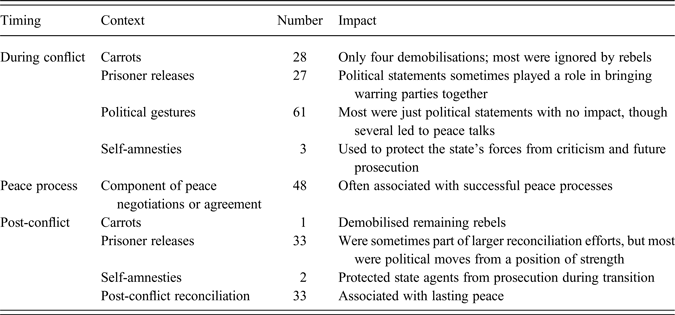
Finally, following conflict, states use amnesties as carrots to secure the demobilisation of holdout rebels. They also pardon and release prisoners related to the terminated conflict. In most cases, these are political acts intended to increase public support for the government, though in some cases they can serve as important reconciliation efforts in divided societies. Finally, amnesties are often associated with large, societal efforts to bring closure to the past and move forward from violence. Amnesty thus appears to have the potential to play an important role in maintaining peace and striving towards reconciliation in the post-conflict environment; but, here again, states also use self-amnesties after conflict simply to shield their forces from prosecution. The overall findings from the examination of amnesties used in relation to internal armed conflicts are summarised in Table 1 below.
Amnesty timing, context and impact

Moving forward, more in-depth examination of the impact of amnesties is needed. This study focused primarily on understanding the different ways in which amnesties are used and has presented only preliminary findings on their impact. Future research should examine the effects of various types of amnesty through cross-national and case study work. In particular, the role of amnesties in demobilisations should be explored further, and additional work should examine the conditions surrounding prisoner releases and how they are received by society and the opposition: two aspects of amnesty neglected by previous research. In addition, scholars should examine the importance of the role that amnesty plays in peace agreements and in post-conflict reconciliation initiatives. This study finds a high correlation between amnesties and lasting peace, but this is just one factor that can impact on peace and reconciliation and we need greater understanding of the interactive role played by amnesty in these processes.