INTRODUCTION
Telomeres are repetitive TTAGGG hexanucleotide sequences that cap the ends of linear chromosomal DNA, preventing genomic instability during cell replication (Hochstrasser, Marksteiner, & Humpel, Reference Hochstrasser, Marksteiner and Humpel2012; Honig, Kang, Schupf, Lee, & Mayeux, Reference Honig, Kang, Schupf, Lee and Mayeux2012; Moverare-Skrtic et al, Reference Moverare-Skrtic, Johansson, Mattsson, Hansson, Wallin, Johansson and Svensson2012; Wikgren et al., Reference Wikgren, Karlsson, Nilbrink, Nordfjall, Hultdin and Sleegers2012). Telomeres are maintained by telomerase, a ribonucleoprotein enzyme complex, which elongates and repairs these hexanucleotide repeats, alleviating some of the telomere shortening that otherwise occurs with each cell division due to the inherent incapability of the genomic replication machinery to replicate the full length of the chromosome. Telomere length is most often measured in DNA extracted from leukocytes. Leukocyte telomere length (LTL) decreases with increasing human age (Honig, Schupf, Tang, & Mayeux, Reference Honig, Schupf, Tang and Mayeux2006; Martin-Ruiz et al., Reference Martin-Ruiz, Dickinson, Keys, Rowan, Kenny and von Zglinicki2006; Honig et al., Reference Honig, Kang, Schupf, Lee and Mayeux2012; Wikgren et al., Reference Wikgren, Karlsson, Nilbrink, Nordfjall, Hultdin and Sleegers2012). LTL may be a marker for the construct of “biological age” since inter-individual variation can arise from genetic, lifestyle, and disease factors among people of the same chronological age (Cai, Yan, & Ratka, Reference Cai, Yan and Ratka2013; Eitan, Hutchison, & Mattson, Reference Eitan, Hutchison and Mattson2014; Grodstein et al., Reference Grodstein, van Oijen, Irizarry, Rosas, Hyman, Growdon and De Vivo2008; Herrmann, Pusceddu, Marz, & Herrmann, Reference Herrmann, Pusceddu, Marz and Herrmann2018; Honig et al., Reference Honig, Schupf, Tang and Mayeux2006, Reference Honig, Kang, Schupf, Lee and Mayeux2012). Studies have indicated that LTL may reflect cumulative damage from cellular stress and heightened inflammatory responses, which allow it to serve as an indicator of biological or cellular aging (Chang et al., Reference Chang, Crous-Bou, Prescott, Rosner, Simon, Wang and Okereke2018). Persons with longer average LTL may be biologically “younger” than those with shorter average LTL. Men exhibit shorter average LTL than women, consistent with sex-specific differences in lifespan (Honig et al., Reference Honig, Kang, Schupf, Lee and Mayeux2012).
Extant literature further demonstrates how shorter LTL may be associated with mortality and several age-related diseases like cancer, cardiovascular disease, type II diabetes, and neurodegenerative disorders such as Parkinson’s Disease, Huntington’s Disease, and Alzheimer’s Disease (AD) (Cai et al., Reference Cai, Yan and Ratka2013; Degerman et al., Reference Degerman, Domellof, Landfors, Linder, Mathias, Haraldsson and Forsgren2014; Forero et al., Reference Forero, Gonzalez-Giraldo, Lopez-Quintero, Castro-Vega, Barreto and Perry2016; Herrmann et al., Reference Herrmann, Pusceddu, Marz and Herrmann2018; Honig et al., Reference Honig, Kang, Schupf, Lee and Mayeux2012; Insel, Merkle, Hsiao, & Vidrine, Reference Insel, Merkle, Hsiao and Vidrine2012; Ma et al., Reference Ma, Lau, Suen, Lam, Leung, Woo and Tang2013; Scarabino, Broggio, Gambina, & Corbo, Reference Scarabino, Broggio, Gambina and Corbo2017; Wikgren et al., Reference Wikgren, Karlsson, Söderlund, Nordin, Roos, Nilsson and Norrback2014). Some studies have also found relationships between LTL with neuropsychiatric disorders such as depression, anxiety-related disorders, schizophrenia, and other psychotic disorders, as well as bipolar disorder (Richard, Reitz, Honig, Schupf, & Tamg, Reference Richard, Reitz, Honig, Schupf and Tamg2013; Chang et al., Reference Chang, Crous-Bou, Prescott, Rosner, Simon, Wang and Okereke2018; Czepielewski et al., Reference Czepielewski, Massuda, Panizzutti, Grun, Barbe-Tuana, Teixeira and Gama2018; Nieratschker et al., Reference Nieratschker, Lahtinen, Meier, Strohmaier, Frank, Heinrich and Hovatta2013, Powell, Dima, Frangou, & Breen, Reference Powell, Dima, Frangou and Breen2018; Vasconcelos-Moreno et al., Reference Vasconcelos-Moreno, Fries, Gubert, dos Santos, Fijtman, Sartori and Yatham2017; Wang et al., Reference Wang, Sundquist, Hedelius, Palmer, Memon and Sundquist2017; Colpo, Leffa, Quevedo, & Carvalho, Reference Colpo, Leffa, Quevedo and Carvalho2015; Lindqvist et al., Reference Lindqvist, Epel, Mellon, Penninx, Revesz, Verhoeven and Wolkowitz2015). Such aging-, metabolic-, psychiatric-, and inflammation-related conditions have all been associated with cognitive outcomes (Cohen-Manheim et al., Reference Cohen-Manheim, Doniger, Sinnreich, Simon, Pinchas, Aviv and Kark2016).
Age-related cognitive decline is caused by oxidative stress triggering neuroinflammation, and subsequent neurodegeneration and cell apoptosis (Ma et al, Reference Ma, Lau, Suen, Lam, Leung, Woo and Tang2013). In this way, it relates to telomere attrition, which can arise from the cumulative burden of inflammation and oxidative stress through the lifecourse (Ma et al, Reference Ma, Lau, Suen, Lam, Leung, Woo and Tang2013; Rask et al, Reference Rask, Bendix, Harbo, Fagerlund, Mortensen, Lauritzen and Osler2016). Yet, the extent to which LTL relates to typical and/or pathologic cognitive aging is still largely unknown; it is uncertain whether shortened telomeres are a cause, consequence, or both for deteriorating cognitive ability (Hagg et al., Reference Hagg, Zhan, Karlsson, Gerritsen, Ploner, van der Lee and Pederson2017). The literature is limited and inconsistent in that some studies have observed LTL being associated with cognitive decline, whereas others have not (Cohen-Manheim et al., Reference Cohen-Manheim, Doniger, Sinnreich, Simon, Pinchas, Aviv and Kark2016; Devore, Prescott, De Vivo, & Grodstein, Reference Devore, Prescott, De Vivo and Grodstein2011; Hagg et al., Reference Hagg, Zhan, Karlsson, Gerritsen, Ploner, van der Lee and Pederson2017; Harris et al., Reference Harris, Martin-Ruiz, von Zglinicki, Starr and Deary2012; Honig et al., Reference Honig, Schupf, Tang and Mayeux2006; Martin-Ruiz et al., Reference Martin-Ruiz, Dickinson, Keys, Rowan, Kenny and von Zglinicki2006; Mather et al., Reference Mather, Jorm, Anstey, Milburn, Easteal and Christensen2010; Moverare-Skrtic et al., Reference Moverare-Skrtic, Johansson, Mattsson, Hansson, Wallin, Johansson and Svensson2012; Valdes et al., Reference Valdes, Deary, Gardner, Kimura, Lu, Spector and Cherkas2010; Yaffe et al., Reference Yaffe, Lindquist, Kluse, Cawthon, Harris, Hsueh and Cummings2011; Zekry et al., Reference Zekry, Herrmann, Irmingard, Ortolan, Genet, Vitale and Krause2010). Differences in study findings may be attributed to methodological differences in the measurement of LTL, use of varying cognitive assessment tools, diverse sociodemographic and clinical characteristics, and distinct study designs (e.g., cross-sectional vs. cohort). For example, not all studies have conducted their investigation in an aging cohort or distinguished whether some individuals in their sample may be cognitively impaired. Since several papers have already shown a relationship between shorter average LTL and the risk of dementia or AD (Grodstein et al., Reference Grodstein, van Oijen, Irizarry, Rosas, Hyman, Growdon and De Vivo2008; Hochstrasser et al., Reference Hochstrasser, Marksteiner and Humpel2012; Honig et al., Reference Honig, Schupf, Tang and Mayeux2006, Reference Honig, Kang, Schupf, Lee and Mayeux2012; Martin-Ruiz et al., Reference Martin-Ruiz, Dickinson, Keys, Rowan, Kenny and von Zglinicki2006; Roberts et al., Reference Roberts, Boardman, Cha, Johnson, Christianson and Peterson2014), the extent to which telomere length is related to cognitive function may be dependent on whether or not there are individuals within a given study who show evidence of cognitive impairment.
In this investigation, we explored whether LTL relates to cognitive performance among family members and spouse controls enrolled in the Long Life Family Study (LLFS). This LLFS cohort is unique because it consists of families who were selected based on collective survival exceptionality, and previous work has shown that family members have both longer telomeres and higher cognitive functioning than spouse controls. Specifically, Honig et al. (Reference Honig, Kang, Cheng, Eckfeldt, Thyagarajan, Leiendecker-Foster and Schupf2015) demonstrated that LTL is highly heritable across generations within this cohort and that first-degree offspring of long-lived probands had longer average LTL than second-degree relatives (i.e., nieces and nephews), who in turn had longer LTL than unrelated spouses, supporting a genetic underpinning for telomere length (Honig et al., Reference Honig, Kang, Cheng, Eckfeldt, Thyagarajan, Leiendecker-Foster and Schupf2015). Prior studies with this population have also shown that relatives in the offspring generation demonstrate higher cognitive functioning than spouse controls, that genetic variants might influence cognitive ability, and that exceptional cognitive ability may contribute to exceptional longevity in these families (Barral et al., Reference Barral, Cosentino, Costa, Matteni, Christensen and Andersen2012, Reference Barral, Cosentino, Costa, Andersen, Christensen, Eckfeldt and Mayeux2013, Reference Barral, Singh, Fagan, Cosentino, Andersen-Toomey, Wojczynski and Schupf2017).
The purpose of this study was to elucidate the significance of LTL across the cognitive continuum between normal aging and dementia. We examined whether LTL is associated with individual differences in various cognitive functions, including episodic memory, semantic processing, working memory, and information processing speed, for aging members of the LLFS cohort, separately for non-demented individuals and individuals with dementia or incipient dementia. Lack of an association between LTL and cognitive ability in the non-demented group may suggest that the association between telomere length and cognitive function relates to the presence of degenerative disorders such as AD and Lewy Body disease. This explanation would be strengthened if, in juxtaposition, an association was present between LTL and cognitive function for the group with cognitive impairment.
METHODS
Participant Recruitment
The LLFS is a multi-generational cohort study that enrolled individuals with exceptional survival phenotypes for an examination of several key indicators of longevity, including major chronic diseases, risk factors, physical, and cognitive function. Families were recruited from field centers located in the USA (Boston, New York, or Pittsburgh) and Denmark. Eligible families in the USA had to meet the following criteria: 1) have at least two living siblings above 80 years of age, including the proband; 2) have at least one living offspring from one of the two living siblings; 3) have one living spouse of the offspring generation to serve as a control; and 4) demonstrate exceptional survival through a Family Longevity Selection Score (FLoSS) of seven or higher for members of the proband generation. FLoSS is a summary measure of the survival experience for probands and their siblings relative to what would be expected based on birth cohort-specific life tables and the availability of living subjects for the study (Sebastiani et al., Reference Sebastiani, Hadley, Province, Christensen, Rossi, Perls and Ash2009). In Denmark, the same criteria were used to select eligible families initially identified from the Danish National Register of Persons. First, individuals who had an age of 90 and above were identified; then, parish registers from regional archives were searched for place of birth and names to locate the parents of the elderly individuals and to identify sibships. Detailed characteristics of the unique LLFS cohort have been published elsewhere (Barral et al., Reference Barral, Cosentino, Costa, Matteni, Christensen and Andersen2012, Reference Barral, Cosentino, Costa, Andersen, Christensen, Eckfeldt and Mayeux2013; Cosentino et al., Reference Cosentino, Schupf, Christensen, Andersen, Newman and Mayeux2013; Newman et al., Reference Newman, Glynn, Taylor, Sebastiani, Perls, Mayeux and Hadley2011). There are 4559 participants from 552 different families that have been followed since recruitment. Recruitment, informed consent, and study procedures were approved by the Institutional Review Boards of all participating sites, including Columbia University, Boston University, University of Pittsburgh, and University of Southern Denmark.
Cognitive Assessment
All participants underwent cognitive assessment at baseline. Episodic memory in the form of immediate and delayed memory were evaluated with the Logical Memory subset of the Wechsler Memory Scale-Revised (Wechsler, Reference Wechsler1987), where subjects had to recall one paragraph at immediate and delayed intervals. Working memory was measured with Digit Span Forward and Backward, where each subject was required to repeat number sequences of increasing length, both forward and backward. Semantic processing was assessed by asking subjects to name as many animals and vegetables as possible in two separate 1-min trials. The digit symbol subtest of the Wechsler Adult Intelligence Scales–Revised (WAIS-R) was used to measure information processing speed. This test consisted of digit–symbol pairs, followed by a grid with digits only. Participants were required to place the corresponding symbol below each digit as fast as possible. Higher scores for all assessments indicated better cognitive performance. Unadjusted z-scores were computed for the seven cognitive test scores using the mean and standard deviation (SD) of the final analytic sample, separately for cognitively impaired versus unimpaired individuals, to allow for comparisons to be made across cognitive domains. Composite standardized measures were then computed for working memory (average of digit forward and digit backward), episodic memory (average of immediate and delayed memory), semantic processing (average of animal and vegetable fluency), and global cognitive function (average of all seven cognitive test scores: digit forward, digit backward, immediate memory, delayed memory, animal fluency, vegetable fluency, and Digit Symbol Substitution Test (DSST)).
Measurement of Telomere Length
To determine telomere length, blood samples were first drawn from study participants and then DNA was obtained from white blood cells (WBCs) using a salt precipitation method (Gentra Puregene, Qiagen Inc., Germantown, MD, USA) (Honig et al., Reference Honig, Kang, Cheng, Eckfeldt, Thyagarajan, Leiendecker-Foster and Schupf2015). The DNA was processed to measure LTL in a blinded fashion using a modification of the polymerase chain reaction (PCR) method developed by Cawthon and colleagues (Cawthon, Reference Cawthon2002; Cawthon, Smith, O’Brien, Sivatchenko, & Kerber, Reference Cawthon, Smith, O’Brien, Sivatchenko and Kerber2003; Honig et al., Reference Honig, Kang, Schupf, Lee and Mayeux2012; Shaffer et al., Reference Shaffer, Epel, Kang, Ye, Schwartz, Davidson and Shimbo2012). Real-time PCR was performed using a CFX384 thermocycler (Biorad, Richmond, CA, USA). The assay method involves use of a single 384-well plate to amplify both telomere (T) and single copy gene (S) sequences, with reference standard DNA samples on each plate. Test DNA samples each underwent two triplicate PCR reactions, with use of “calibrator samples” for correction of inter-plate variability. Amplification primers for telomeres included Tfor: 5′-CGGTTTGTTTGGGTTTGGGTTTGGGTTTGGGTTTGGGTT-3′ and Trev: 5′-GGCTTGCCTTACCCTTACCCTTACCCTTACCCTTACCCT-3′, and for single copy gene (beta-globin) Sfor 5′-GCTTCTGACACAACTGTGTTCACTAGC-3′ and Srev 5′-CACCAACTTCATCCACGTTCACC-3′. Thermocycling parameters were 95°C × 10 min activation, followed by 34 cycles of 95°C × 15 sec and 55°C × 120 sec. Assay coefficient of variance was 5–8%. T/S ratio was converted to base pairs (bp) of TL using a linear regression formula: bp = (1585 * T/S ratio) + 3582, derived from co-analysis of selected DNA samples using both PCR and terminal restriction fragment (non-radioactive TeloTAGGG Telomere Length; Roche Diagnostics, Mannheim, Germany) methods (correlation coefficient r = 0.90).
Study Population
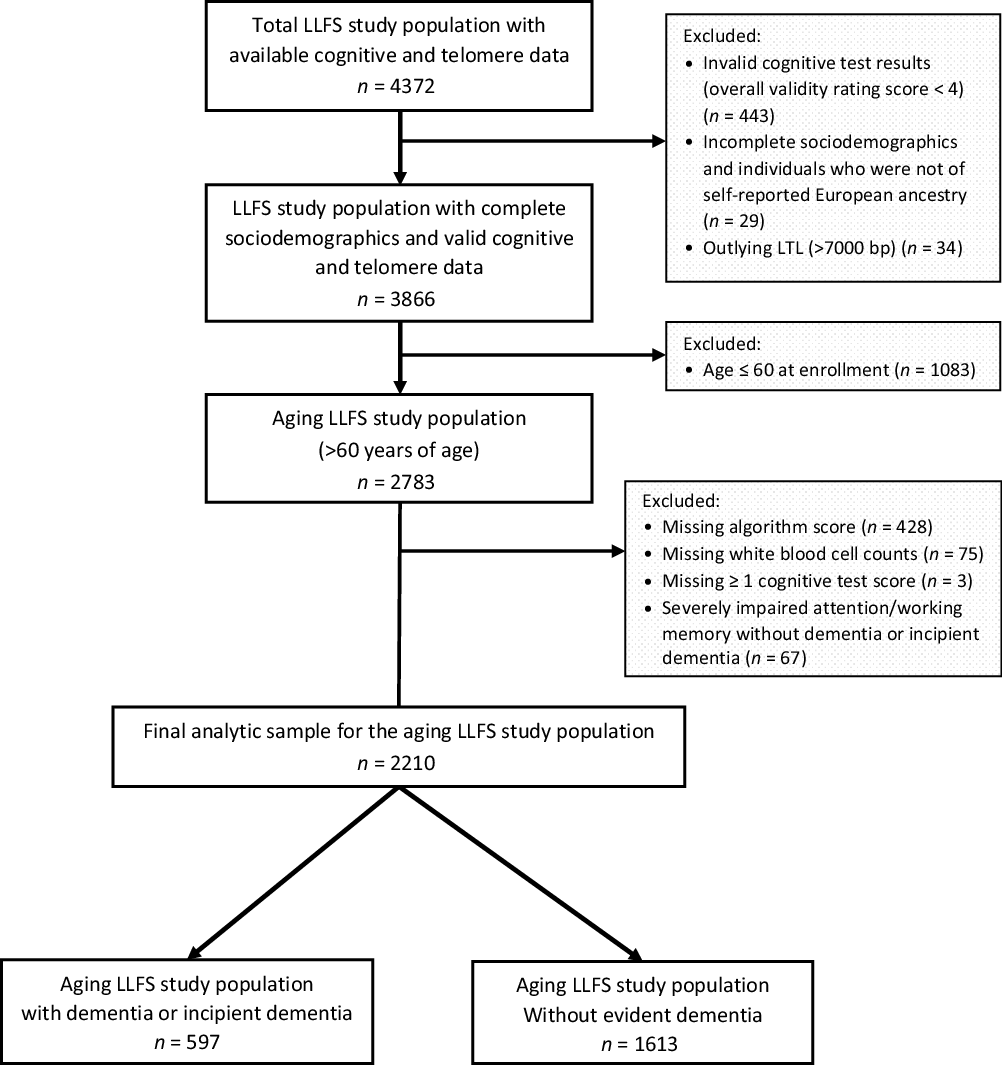
A total of 4372 participants had available data on LTL and at least one cognitive test, both of which were measured at baseline, for this cross-sectional LLFS sample (Figure 1). Individuals were excluded if they had incomplete sociodemographics (e.g., information on sex, age, education, ancestry, and relationship to proband), and only participants who were of self-reported European ancestry were included in the analysis, as they were the overwhelming majority lineage (>99% of sample). Individuals with extreme, outlying LTL were further removed (e.g. >7000 bp) as were individuals for whom cognitive testing was judged to be invalid by the examiner (overall validity rating score < 4). Valid cognitive test scores did not incorporate deficits related to sensorimotor problems, environmental factors such as distractions during the test sessions, or issues related to participation engagement in the testing. 3866 subjects with complete sociodemographics and valid cognitive and telomere data remained.
Non-demented versus demented persons of the LLFS. 2210 individuals, of which 1613 were cognitively unimpaired and 597 had dementia or incipient dementia, fulfilled the inclusion and exclusion criteria (had available and valid cognitive and telomere data, complete sociodemographic information, met the age restriction, and had no missing data).

Since the purpose of the study was to observe the relationship between telomere length and cognitive function among the aging population, participants aged 60 and below at the time of enrollment were excluded. Of the 2783 individuals who stayed, including members of the proband generation (probands and their siblings) and the offspring generation (sons, daughters, nieces and nephews of the probands), 428 individuals were excluded because they had missing information on a previously published dementia algorithm variable (Cosentino et al., Reference Cosentino, Schupf, Christensen, Andersen, Newman and Mayeux2013). This algorithm variable distinguished between individuals with mild AD and cognitively normal older adults in the National Alzheimer’s Coordinating Center (NACC) sample on the basis of demographic and cognitive attributes. Using the dementia algorithm variable, participants meeting criteria for cognitive impairment in the LLFS sample were separated from those who were cognitively normal. An additional 75 individuals with missing information on WBC/leukocyte counts and 3 individuals with a missing score on at least one cognitive test were removed to ensure complete case analysis. Also, 67 individuals who demonstrated severely impaired attention or working memory in the absence of other cognitive impairment were excluded (operationalized as digit span forward < 4, digit span backward < 3, or immediate memory < 6). Performance in this range of each test would, for example, fall at or below the 7th percentile for a 90-year old with a high-school education, or be ≤ to the 3rd percentile for an 80-year old with a college education. Among the 2210 individuals who remained in the final analytic sample, 597 study participants had dementia or incipient dementia, while 1613 study participants had no evident cognitive impairment. The final analytic sample spanned both proband and offspring generations and included both relatives and spouses. Using partners of long-lived subjects and their offspring as comparison groups avoided potential cofounders, since it is likely that they had a similar distribution of birth cohort, socioeconomic, and geographical backgrounds.
Statistical Analyses
The sociodemographic and clinical characteristics of LLFS family members were compared with spouse controls using chi-squared tests and analysis of variance (ANOVA) to assess statistically significant differences between categorical and continuous variables, respectively. To address the question of whether LTL was related to cognitive function among older adults in the LLFS cohort, separately for individuals who lacked cognitive impairment versus individuals whose performance was consistent with mild cognitive impairment (MCI) or dementia, we used linear regression with general estimating equations (GEE). The GEE method adjusted for the relatedness of the LLFS sample by treating family membership as a cluster without assuming joint distribution of the whole family and allowing for differences in family size. It, therefore, allowed for the possibility that the characteristics of family members are correlated by both shared genetics and shared environment.
All regression analyses were adjusted for potential confounders such as sex (male vs. female), age (in years), education (less than college, some college, or post college), country (USA or Denmark), generation (proband vs. offspring), and lymphocyte percentage. Since different leukocyte subpopulations have varying replicative histories and may thus differ in telomere length, we wanted to account for variations in leukocyte differential counts (Fagan et al., Reference Fagan, Sun, Bae, Elo, Andersen, Lee and Honig2017). Lymphocytes are generally longer-lived than neutrophils, eosinophils, basophils, or monocytes. Therefore, we adjusted for the percentage of lymphocytes as a fraction of the total WBC count, analogous to what was done previously by Fagan et al. (Reference Fagan, Sun, Bae, Elo, Andersen, Lee and Honig2017) in this LLFS cohort. SPSS version 25.0 (IBM Corp., Reference Corp.2017) was used to perform all the descriptive and regression analyses. Since we assessed the relationship between LTL and 11 different cognitive measures, some of which were composites of the individual cognitive tests, we corrected for multiple testing using a Bonferroni-adjusted p-value of 0.005 (α = 0.05/11) to determine if findings were significant. Scatterplots, depicting the relationship between LTL and cognitive ability, were created using adjusted z-scores for the independent and dependent variables in R software (R Core Team, 2014). Post hoc power calculations were conducted for both non-demented and cognitively impaired samples using G * Power software (Faul, Erdfelder, Buchner, & Lang, Reference Faul, Erdfelder, Buchner and Lang2009).
RESULTS
Participant Characteristics
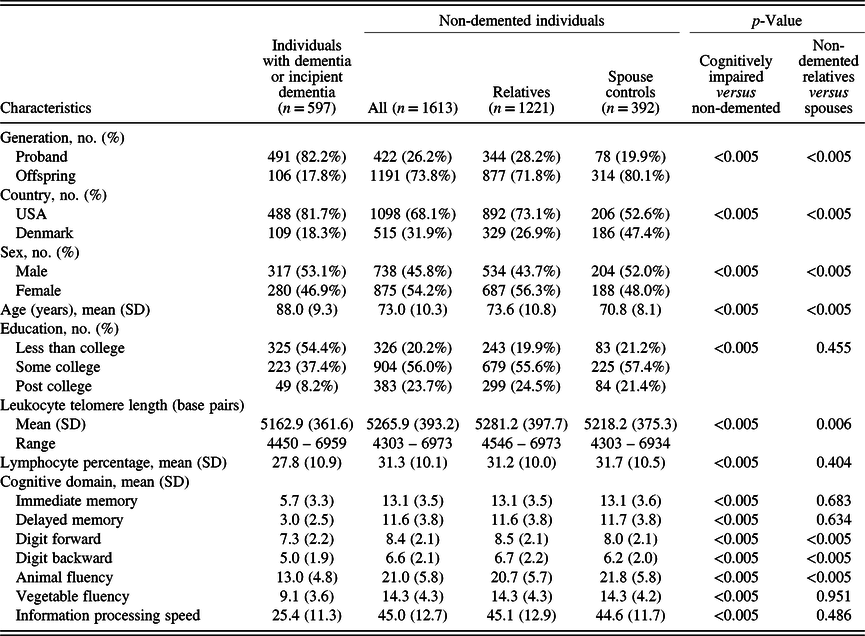
As non-demented individuals of the aging LLFS cohort were separated from subjects with MCI or dementia, those in the former group (n = 1613) had significantly (p < 0.005) higher mean cognitive scores across all domains compared to those in the latter group (n = 597) (Table 1). The non-demented subsample had the following mean (SD) raw scores for each cognitive test: immediate memory = 13.1 (3.5), delayed memory = 11.6 (3.8), digit forward = 8.4 (2.1), digit backward = 6.6 (2.1), animal fluency = 21.0 (5.8), vegetable fluency = 14.3 (4.3), and DSST = 45.0 (12.7). In contrast, subjects with MCI or dementia averaged cognitive scores that were up to 74.1% lower than their non-demented counterparts: immediate memory = 5.7 (3.3), delayed memory = 3.0 (2.5), digit forward = 7.3 (2.2), digit backward = 5.0 (1.9), animal fluency = 13.0 (4.8), vegetable fluency = 9.1 (3.6), and DSST = 25.4 (11.3).
Sociodemographic and clinical characteristics among individuals of the aging Long Life Family Study cohort (n = 2210)

Comparisons for categorical variables used chi-squared tests and comparisons for continuous variables used ANOVA.
Shorter LTL was correlated with older age in both groups (demented: r = 0.110, p = 0.007; non-demented: r = −0.213, p < 0.005). Males, on average, had shorter LTL than females for the cognitively impaired (mean (SD): 5133 (361) vs. 5197 (360) bp, t = −2.164, p = 0.031) and unimpaired groups (mean (SD): 5253 (401) vs. 5277 (386) bp, t = −1.208, p = 0.227), albeit the differences were insignificant. Individuals with MCI or dementia were also significantly older (mean (SD): 88.0 (9.3) vs.73.0 (10.3) years) and more likely to be members of the proband generation (82.2% vs. 26.2%) than those without evident dementia, consistent with an overall shorter average LTL (mean (SD): 5163 (362) vs. 5266 (393) bp) (p < 0.005). Additionally, they were significantly less educated, more likely to be male and reside in the USA than non-demented subjects (p < 0.005). Over half of LLFS participants without evident dementia had some college education (56.0%) as their highest level of study, whereas over half of subjects with dementia had no post-secondary education (54.4%). The ratio of US to Danish subjects was approximately 2:1 in the former group, but 4:1 in the latter group. Lastly, study subjects with cognitive impairment had a slightly lower lymphocyte percentage in their WBC count than non-demented individuals (p < 0.005).
In the non-demented sample, there were nearly three times more family members (n = 1221) than spouse controls (n = 392) (Table 1). Relatives were more likely to be female (56.3% vs. 48.0%), members of the proband generation (28.2% vs. 19.9%), and older (mean (SD): 73.6 (10.8) vs.70.8 (8.1) years), as well as from the USA (73.1% vs. 52.6%) when compared to spouse controls (p < 0.005). LTL was, on average, longer in family members than their spouses (mean (SD): 5281 (398) vs. 5218 (375) bp, p < 0.005) (Table 1). With respect to cognitive function, relatives, on average, had higher digit span forward and backward mean scores, but a lower animal fluency mean score than spouse controls (p < 0.005).
LTL and Cognitive Function in Individuals Without Evident Dementia
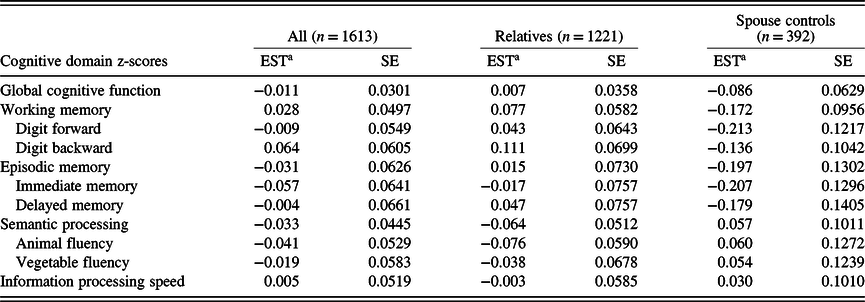
No significant associations were detected between LTL and any of the cognitive tests within the non-demented subsample of the aging LLFS cohort, after adjusting for sex, age, education, country, generation, and lymphocyte percentage (p > 0.005) (Table 2). The relationship between LTL and each cognitive measure in the regression analyses was as follows: global cognitive function = β: −0.011 (standard error (SE): 0.0301), working memory = β: 0.028 (SE: 0.0497), digit forward = β: −0.009 (SE: 0.0549), digit backward = β: 0.064 (SE: 0.0605), episodic memory = β: −0.031 (SE: 0.0626), immediate memory = β: −0.057 (SE: 0.0641), delayed memory = β: −0.004 (SE: 0.0661), semantic processing = β: −0.033 (SE: 0.0445), animal fluency = β: −0.041 (SE: 0.0529), vegetable fluency = β: −0.019 (SE: 0.0583), and DSST = β: 0.005 (SE: 0.0519). Subsequent sensitivity analyses revealed that not adjusting for education in the regression model, in case it may overcorrect and bias the associations of interest toward the null, did not alter these insignificant findings (Supplementary Table S1). Inclusion of those subjects who were initially excluded because they had severely impaired attention/working memory, but did not necessarily classify as having dementia (by the NACC algorithm), into the analytic sample again also did not change the null results (Supplementary Table S2).
Association between leukocyte telomere length (per 1000 base pairs) and cognitive domain z-scores among individuals of the aging Long Life Family Study cohort without evident dementia

EST, beta estimate.
Leukocyte telomere length is expressed as kilo base pairs, while cognitive scores are unadjusted z-scores. The significance of the association between the two is evaluated using the Wald Chi-Square Test.
a Analysis adjusted for sex (males vs. females), generation (proband vs. offspring), country (USA vs. Denmark), education (less than college, some college, or post college), age (in years), and lymphocyte percentage.
p-Values are denoted as follows: *p < 0.005.
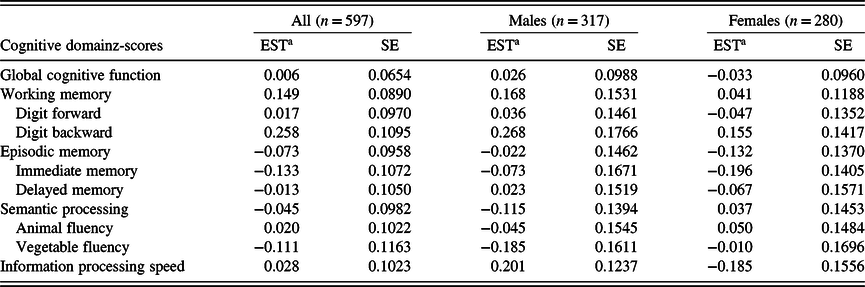
Association between leukocyte telomere length (per 1000 base pairs) and cognitive domain z-scores among individuals of the aging Long Life Family Study cohort with dementia or incipient dementia

EST, beta estimate.
Leukocyte telomere length is expressed as kilo base pairs, while cognitive scores are unadjusted z-scores. The significance of the association between the two is evaluated using the Wald Chi-Square Test.
a Analysis adjusted for sex (males vs. females), generation (proband vs. offspring), country (USA vs. Denmark), education (less than college, some college or post college), age (in years), and lymphocyte percentage.
p-Values are denoted as follows: *p < 0.005.
With a sample size of 1613 subjects, a post hoc power analysis indicated a 96.0% chance of detecting a small effect size (f 2 = 0.02 or 2% of the variance of Y) if there was one at the 0.5% level of Bonferroni-adjusted significance (Cohen, Reference Cohen1988). While the association between LTL and cognitive function was null, significant associations were observed between each of the cognitive domains with sex, age, generation, education, and country, as expected (Supplementary Table S3). For example, significantly worse global cognitive function (p < 0.005) was observed in males as opposed to females (β: −0.186; SE: 0.0262), with increasing age (β: −0.016; SE: 0.0022), among individuals who had less education (less than college vs. post college – β: −0.441; SE: 0.0380; some college vs. post college – β: −0.232; SE: 0.0315), and for members of the proband versus the offspring generation (β: −0.226; SE: 0.0331).
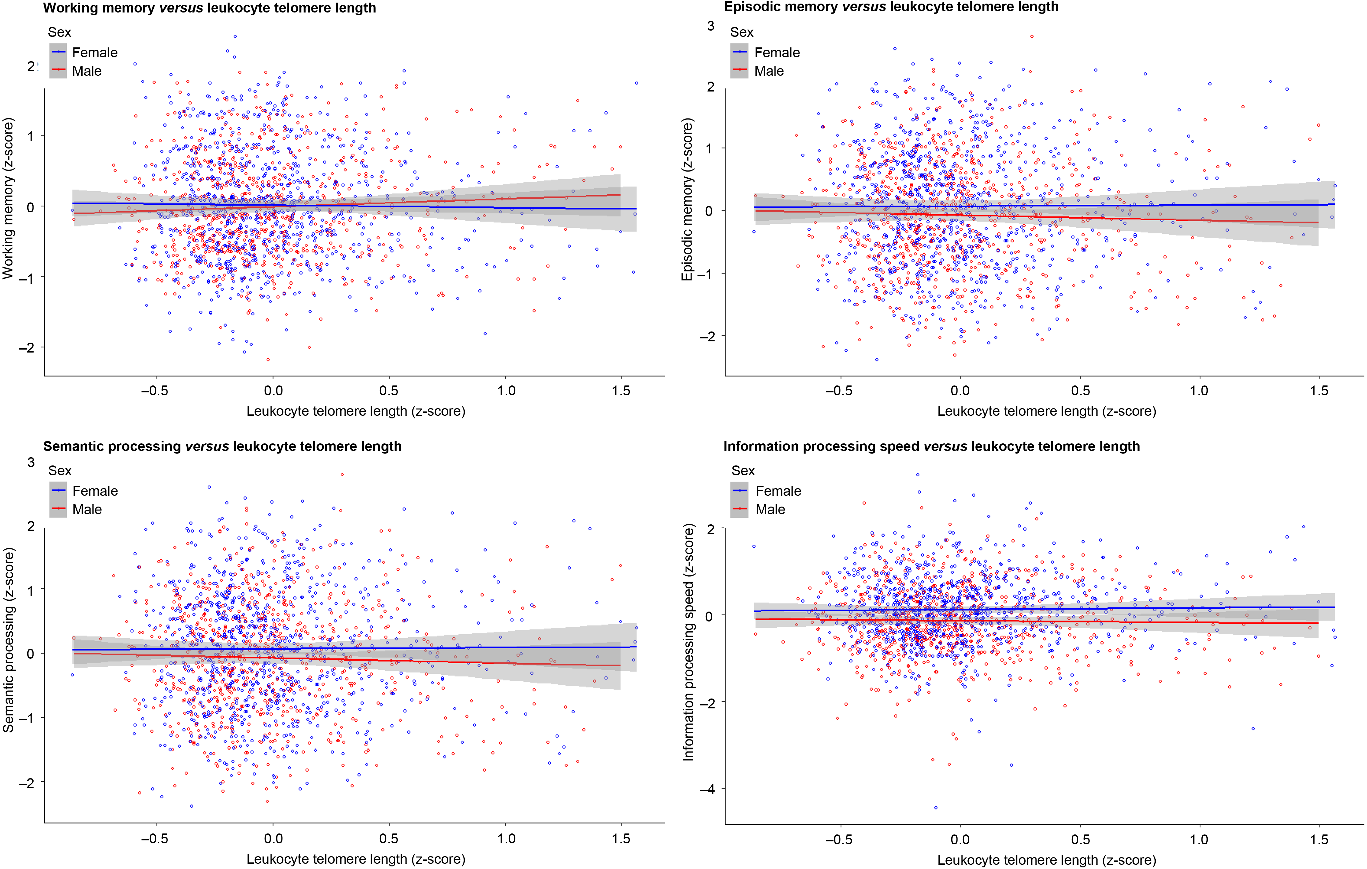
After stratifying by LLFS family member status, the relative and spousal control groups independently displayed null findings (p > 0.005) (Table 2). Also, when the sample was divided by sex, neither males nor females demonstrated an association between LTL and cognitive function across all domains (Figure 2, Supplementary Table S4).
Scatter plots between leukocyte telomere length and the cognitive performance, stratified by sex. A linear relationship and the corresponding 99.5% confidence interval (shaded region) are modeled to depict the association between z-scores for leukocyte telomere length and working memory, episodic memory, semantic processing, and information processing speed, separately for aging LLFS males (n = 752) and females (n = 883) in the cognitively unimpaired group (n = 1613). The z-score computed for each cognitive domain adjusts for age, generation, education, and country, while the z-score for leukocyte telomere length adjusts for the aforementioned in addition to lymphocyte percentage.

LTL and Cognitive Function in Individuals With AD, Dementia, or Incipient Dementia
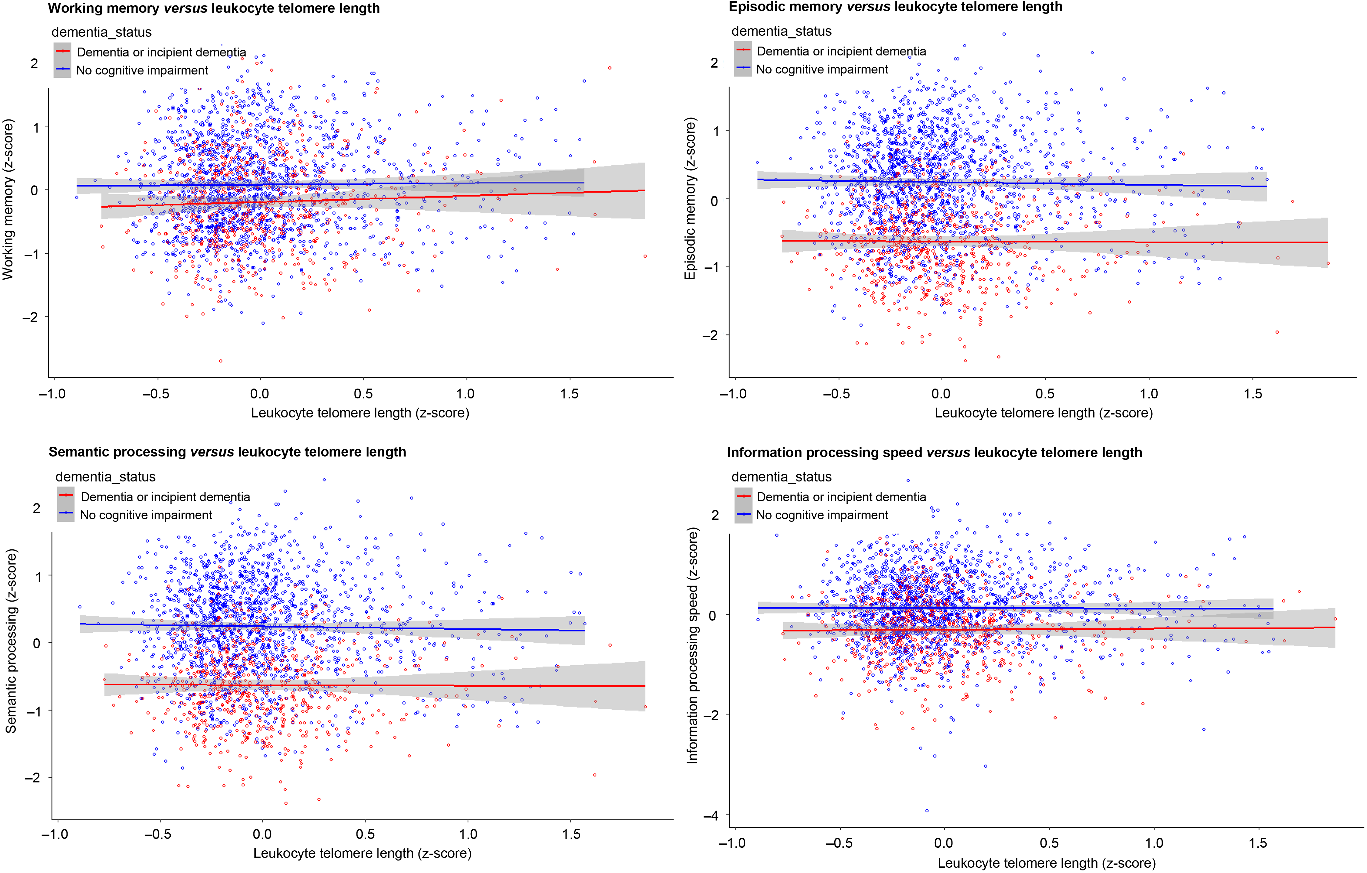
The group of aging LLFS individuals who had MCI or dementia (n = 597) constituted of 525 relatives and 72 spousal controls. With this sample size, there was a 37.8% chance of detecting a small effect size (f 2 = 0.02) and a 100.0% chance of detecting a medium-effect size (f 2 = 0.15) if there was one at the 0.5% level of Bonferroni-adjusted significance (Cohen, Reference Cohen1988). Similar to the non-demented group, null findings were detected between LTL and all of the cognitive tests, after adjusting for sex, age, education, country, generation, and lymphocyte percentage (p > 0.005) (Figure 3). More specifically, the relationship between LTL and each cognitive measure in the regression analyses was as follows: global cognitive function = β: 0.006 (SE: 0.0654), working memory = β: 0.149 (SE: 0.0890), digit forward = β: 0.017 (SE: 0.0970), digit backward = β: 0.258 (SE: 0.1095), episodic memory = β: −0.073 (SE: 0.0958), immediate memory = β: −0.133 (SE: 0.1072), delayed memory = β: −0.013 (SE: 0.1050), semantic processing = β: −0.045 (SE: 0.0982), animal fluency = β: 0.020 (SE: 0.1022), vegetable fluency = β: −0.111 (SE: 0.1163), and DSST = β: 0.028 (SE: 0.1023).
Scatter plots between leukocyte telomere length and the cognitive performance, stratified by dementia status. A linear relationship and the corresponding 99.5% confidence interval (shaded region) are modeled to depict the association between z-scores for leukocyte telomere length and working memory, episodic memory, semantic processing, and information processing speed, separately for those with (n = 597) and without cognitive impairment (n = 1613). The z-score computed for each cognitive domain adjusts for sex, age, generation, education, and country, while the z-score for leukocyte telomere length adjusts for the aforementioned in addition to lymphocyte percentage.

Upon stratification by sex, neither males nor females demonstrated an association between LTL and cognitive function across all domains (p > 0.005) (Table 3). However, significant findings for some of the other covariates, similar to what was described in the non-demented sample, were observed between sex, age, education, country, and lymphocyte percentage with each of the cognitive domains in this group of individuals with dementia or incipient dementia (Supplementary Table S5).
DISCUSSION
Overall, within this LLFS sample, null associations were detected between LTL and working memory, episodic memory, semantic processing, and information processing speed for 1613 aging, non-demented individuals and 597 aging individuals with dementia or incipient dementia (p > 0.005). Very few other studies have investigated the relationship between LTL and cognitive function in older adult populations and distinguished whether subjects were unimpaired at baseline. Harris et al. (Reference Harris, Deary, MacIntyre, Lamb, Radhakrishnan, Starr and Shiels2006) studied 550 Scottish 79-year olds in the Lothian Birth Cohort 1921 (LBC1921), who were without evident dementia, as determined by the Mini-Mental State Examination (MMSE) to be a total score of 24 or higher. The mean telomere length of the LBC1921 was longer than that of the non-demented LLFS individuals (6.63 (SD = 1.70) kbp vs. 5.27 (SD = 0.40) kbp), despite the fact that the aging LLFS participants were, on average, younger (72 years old). Aside from a small negative correlation between telomere length and verbal fluency (r = −0.16, p = 0.027), Harris et al. (Reference Harris, Deary, MacIntyre, Lamb, Radhakrishnan, Starr and Shiels2006) found that telomere length was not cross-sectionally associated with test scores on the Raven’s standard progressive matrices (used to measure verbal reasoning), the Moray House Test (used to measure mental ability, including following directions, word classification, analogies, practical items, reasoning, arithmetic, and spatial items), and the Logical Memory Test (p > 0.05).
Harris et al. (Reference Harris, Martin-Ruiz, von Zglinicki, Starr and Deary2012) then further replicated these null findings in another larger cross-sectional study of 1091 non-demented members of the Lothian Birth Cohort 1936 (LBC1936). At age 70, there were no significant correlations in their overall sample between telomere length and general cognitive ability (derived from matrix reasoning, letter-number sequencing, block design, symbol search, digit span backwards, and digit symbol subtests on the Wechsler Adult Intelligence Scale-III (WAIS-III)), general processing speed (derived from a set of mental speed measures: symbol search, digit symbol, simple reaction time mean, choice reaction time mean, and inspection time), or general memory (derived from subtests of the Wechsler Memory Scale-III (WMS III) and WAIS-III, including Logical Memory I and II, spatial span forward and backward, Verbal Paired Associates I and II, letter-number sequencing, and digit span backwards) (p > 0.05). In their most recent study, Harris et al. (Reference Harris, Marioni, Martin-Ruiz, Pattie, Gow, Cox and Deary2016) additionally found no association between change in telomere length and change in general cognitive ability in either of these two Scottish cohorts, LBC1921 or LBC1936. All these findings coincide with the null associations we detected between LTL and several cognitive domains in the non-demented LLFS subsample.
Martin-Ruiz et al. (Reference Martin-Ruiz, Dickinson, Keys, Rowan, Kenny and von Zglinicki2006) also evaluated the relationship between LTL and cognitive function prospectively in 195 non-demented stroke survivors from the UK, above age 75, who had MMSE total scores greater than 24 at baseline. The mean age of participants (80 years) and the baseline average telomere length (6.17 (SD = 0.57) kbp) in their sample were both higher than our non-demented LLFS sample. The authors found that telomere length at baseline was inversely associated to cognitive decline (p = 0.04), as measured by changes in the MMSE score, for the 145 individuals who survived to 2 years. By year 2, however, many of these participants had cognitive impairment (MMSE scores <24) and 20 were even diagnosed with dementia. This result contrasts with our own study finding that LTL is unrelated to cognitive ability when the sample includes individuals with MCI or dementia. This dissimilarity may be attributed to differing study designs between our study and theirs (cross-sectional vs. cohort).
Contrary to our study findings, Valdes et al. (Reference Valdes, Deary, Gardner, Kimura, Lu, Spector and Cherkas2010) evaluated a non-demented, healthy group of 382 women, aged 19 to 78 years, from the TwinsUK cohort cross-sectionally. After adjusting for age and prior intellectual ability, they found that LTL was associated with episodic memory and associative learning (via the Paired Associates Learning test), working memory capacity (via the Space Span (SSP) test), and recognition memory for non-verbal patterns (via the Delayed Matching to Sample (DMS) test). They further discovered that among pairs of twins discordant for LTL, twins with longer telomeres had significantly better SSP and DMS scores compared to their siblings (p < 0.05). Similarly, Yaffe et al. (Reference Yaffe, Lindquist, Kluse, Cawthon, Harris, Hsueh and Cummings2011) found that among 2741 non-demented, multi-ethnic elders, aged 70–79 years in the USA, those with longer telomere lengths exhibited better baseline attention, psychomotor speed, and executive function via the DSST. They also found that longer telomere length was associated with slower global cognitive decline (MMSE) over 7 years when compared to short and medium telomere lengths within the older population (−1.7 points vs. −2.5 and −2.9, p = 0.01). The reason for the discrepancy in findings between the study by Valdes et al. (Reference Valdes, Deary, Gardner, Kimura, Lu, Spector and Cherkas2010) and our own study may be attributed to differences in the age range of the two cohorts. Valdes et al. (Reference Valdes, Deary, Gardner, Kimura, Lu, Spector and Cherkas2010) studied individuals from a broader and younger age group than our LLFS aging analytic sample. The association of LTL with age-related cognitive decline will change according to the timing of telomere analysis and age at cognitive assessment (Mather, Jorm, Parslow, & Christensen, Reference Mather, Jorm, Parslow and Christensen2011). Further, LTL changes may depend on different factors that vary across the lifespan (Rask et al., Reference Rask, Bendix, Harbo, Fagerlund, Mortensen, Lauritzen and Osler2016). Divergent findings between the Yaffe et al. (Reference Yaffe, Lindquist, Kluse, Cawthon, Harris, Hsueh and Cummings2011) study and our own investigation may be a consequence of differing study designs and the fact that the former comprises an ethnically diverse population of community residents, while the latter comprises individuals solely of European ancestry, who were selected based on exceptional survival attributes.
Studies that were comprised of older individuals across the full spectrum of cognitive function, including those who may have MCI or dementia, reported mainly positive findings. Mather et al. (Reference Mather, Jorm, Anstey, Milburn, Easteal and Christensen2010) examined two cohorts of Australian middle-aged (n = 351, 44–49 years) and older (n = 295, 64–70 years) adults. While cross-sectional analyses showed no significant relationships between LTL and cognitive function in the middle-aged cohort, a positive association was detected within the older cohort between telomere length and the Symbol Digit Modalities Test (SDMT), which measured processing speed and attention. This association with SDMT remained significant among men only, after stratification by sex. In another cross-sectional study, Ma et al. (Reference Ma, Lau, Suen, Lam, Leung, Woo and Tang2013) studied 976 Chinese men, aged 65–91 years, and observed significant correlations between telomere length with episodic memory (r = 0.086, p = 0.007) and executive function (r = −0.053, p = 0.048), assessed through a three-item recall and verbal fluency test, respectively. Additionally, Devore et al. (Reference Devore, Prescott, De Vivo and Grodstein2011) detected a modest association (p = 0.04) between longer telomere length and slower cognitive decline, as measured by the Telephone Interview for Cognitive Status, within a 10-year time span among ~2000 participants in the Nurses’ Health Study, over 70 years old.
Our own study makes a valuable contribution to the literature on LTL and cognitive ability in that we are able to examine this potential relationship in a large, unique cohort with exceptional cognitive function and survival attributes. We previously established that members of long-lived families evidence longer telomere length (Honig et al., Reference Honig, Kang, Cheng, Eckfeldt, Thyagarajan, Leiendecker-Foster and Schupf2015) and a cognitive advantage as compared with spouse controls (Barral et al., Reference Barral, Cosentino, Costa, Matteni, Christensen and Andersen2012; Cosentino et al., Reference Cosentino, Schupf, Christensen, Andersen, Newman and Mayeux2013), and we observed these same findings in the current sample of LLFS participants. It should be noted that variations in the specific cognitive test scores, which differed across relatives and spousal controls, likely indicate differences in the specific individuals included in the analysis. A key strength of our study is that we evaluated cognitive function and identified cognitive impairment through a wide array of age-sensitive cognitive tests. We also adjusted for sex and age, both of which are well-established predictors of telomere length, along with education, country, family generation, and lymphocyte percentage. While the subjects in our study are not independent observations, we did adjust for familial clustering through robust regression methods so that it would not bias the levels of significance. Furthermore, our sample size was large and had sufficient power to detect an association between LTL and cognitive function, if there was one, for both the non-demented group (n = 1613) and the group with dementia or incipient dementia (n = 597).
Our study had several limitations as well. Dementia status was not clinically ascertained; we used a dementia algorithm variable to separate cognitively impaired individuals from unimpaired individuals. We examined the relationship between LTL and cognitive function cross-sectionally. It may be that cross-sectional measurements of both variables are less informative than longitudinal change scores in capturing a potential association. As the pathology underlying cognitive impairment arises decades before detectable symptoms appear, measuring LTL change prior to assessment of cognitive change may be necessary and may be most clinically relevant for informing the extent to which telomere length influences, initiates, or corresponds with the onset or rate of cognitive decline. However, the previously mentioned study by Harris and colleagues (Reference Harris, Marioni, Martin-Ruiz, Pattie, Gow, Cox and Deary2016) found no link between change in LTL and change in cognitive ability. Additionally, the current findings are not generalizable to different ethnic populations, given the homogenous demographic and geographic characteristics of our study cohort. This highly selected sample of exceptional LLFS families further constrains the external validity of the observed findings. For example, the non-significant associations observed between LTL and cognitive function in our study, even among the group of individuals with dementia or incipient dementia, may be a consequence of the LLFS participants being “biologically younger” than the general population.
In conclusion, this study suggests that among individuals whose cognitive abilities are broadly intact and who have longer telomeres and higher cognitive function, on average, than the general population, a single measure of telomere length is not directly associated with episodic memory, semantic processing, working memory, and information processing speed. Likewise, for LLFS individuals with cognitive impairment, LTL is unrelated to cognitive function. Future studies should evaluate this association prospectively to determine whether LTL attrition across the lifespan plays a potential causal role in cognitive decline. Researchers should also seek to explore the association between LTL and cognitive ability in a sample that is more representative of the general population and/or with clinically verified dementia diagnoses. It is critically important to identify biomarkers of cognitive change for early treatment and detection of neurodegenerative diseases. The relative advantage of investigating telomere length as a potential biomarker for cognitive function is that it can be measured through minimally invasive, readily available, and inexpensive methods.
ACKNOWLEDGMENTS
The authors declare that the research was conducted in the absence of any commercial or financial relationships that could be construed as a potential conflict of interest. We are grateful to the participants and family members of the LLFS for allowing us to study how they have achieved their longevity. This work was funded by the National Institute on Aging/National Institutes of Health (grant number: U01AG023749).
CONFLICT OF INTEREST
The authors have nothing to disclose.
SUPPLEMENTARY MATERIAL
To view supplementary material for this article, please visit https://doi.org/10.1017/S1355617720000363