INTRODUCTION
Conserved and human-altered tropical systems (e.g. old-fields, forest fragments, etc.) present physical and biological factors that affect forest regeneration. The relative importance of such factors as regeneration facilitators or inhibitors differs according to the tropical system and the tree species involved (Benítez-Malvido Reference BENÍTEZ-MALVIDO, Bierregaard, Lovejoy and Mesquita2001, Benítez-Malvido et al. Reference BENÍTEZ-MALVIDO, MARTÍNEZ-RAMOS, CAMARGO and FERRAZ2005, Ganade & Brown Reference GANADE and BROWN2002, Lewis & Tanner Reference LEWIS and TANNER2000).
In Central Amazonia forest succession is arrested in abandoned cattle pastures due to the competitive dominance by initial colonizers of the genus Vismia (Norden et al. Reference NORDEN, MESQUITA, BENTOS, CHAZDON and WILLIAMSON2011). The dominance of Vismia in abandoned pastures is maintained for at least two decades (Norden et al. Reference NORDEN, MESQUITA, BENTOS, CHAZDON and WILLIAMSON2011). Dispersal of old-growth forest tree seeds into these monogeneric stands is negligible (Mesquita Reference MESQUITA2000, Mesquita et al. Reference MESQUITA, ICKES, GANADE and WILLIAMSON2001, Wieland et al. Reference WIELAND, MESQUITA, BOBROWIEC, BENTOS and WILLIAMSON2011) with the seed rain being dominated by second-growth species present in those stands (e.g. Bellucia spp., Cecropia spp., Miconia spp.). Further, poor soil conditions, Vismia leaf litter and reduced canopy shade are some other factors believed to limit the establishment of old-growth forest species into Vismia-dominated secondary forests (Wieland et al. Reference WIELAND, MESQUITA, BOBROWIEC, BENTOS and WILLIAMSON2011, but see Benítez-Malvido et al. Reference BENÍTEZ-MALVIDO, MARTÍNEZ-RAMOS, CAMARGO and FERRAZ2005). However, there is evidence indicating that old-growth-forest species are capable of germinating and persisting under Vismia stands when seeds are sown directly or when young seedlings are planted (Benítez-Malvido et al. Reference BENÍTEZ-MALVIDO, MARTÍNEZ-RAMOS, CAMARGO and FERRAZ2005, Camargo et al. Reference CAMARGO, FERRAZ and IMAKAWA2002, Ganade & Brown Reference GANADE and BROWN2002).
Herbivores could also delay forest recovery in these stands by reducing both seedling survival and/or growth, however few studies (which have led to contrasting results), have addressed herbivory in degraded tropical lands (Cubiña & Aide Reference CUBIÑA and AIDE2001, Ganade Reference GANADE, Cramer and Hobbs2007, Holl & Lulow Reference HOLL and LULOW1997, Nepstad et al. Reference NEPSTAD, PEREIRA and CARDOSO DA SILVA1996). Information on herbivory and/or seed and seedling predation is essential to understand plant population dynamics in disturbed tropical ecosystems.
Relative to limited seed dispersal, the role of other factors that restrain the recruitment of old-growth-forest species into Vismia stands remains unclear. Further, it is unknown whether or not old-growth-forest plant species that may inhabit this type of disturbed vegetation can persist in the long term. In addition, many studies assessing performance on conserved and altered tropical systems follow the fate of seedlings typically for less than 5 y, making it difficult to assess their long-term persistence (Mesquita et al. Reference MESQUITA, ICKES, GANADE and WILLIAMSON2001, Nepstad et al. Reference NEPSTAD, PEREIRA and CARDOSO DA SILVA1996, Peña-Claros & de Boo Reference PEÑA-CLAROS and DE BOO2002).
In this study we have explored, for nearly a decade, the performance (i.e. growth and survival) and herbivory levels of three native forest species with similar ecological attributes (Sapotaceae, Chrysophyllum pomiferum, Micropholis venulosa and Pouteria caimito) planted into a young secondary forest dominated by Vismia, and into an old-growth forest of the Central Amazon (Benítez-Malvido et al. Reference BENÍTEZ-MALVIDO, MARTÍNEZ-RAMOS, CAMARGO and FERRAZ2005). The old-growth forest was used to observe long-term plant species performance and herbivory within their natural habitat. Using information of a previous study with these three species as a reference, we were able to address the next hypotheses: (1) because plants age and forests are naturally dynamic, within- and among-species habitat preferences and herbivory levels are not maintained in the long term; and (2) initial high growth rates under Vismia stands, indicate that old-growth forest species are capable of persisting for more than 1 y in this habitat.
STUDY SITE
For this study, which was set up in 1992, we selected two contrasting tropical habitats common in the area (Benítez-Malvido et al. Reference BENÍTEZ-MALVIDO, MARTÍNEZ-RAMOS, CAMARGO and FERRAZ2005): old-growth continuous forest and a young secondary forest dominated by Vismia spp. (mainly V. guianensis, V. japurensis and V. cayennensis). The study site in old-growth forest was located in reserve 1501 (10 000 ha) of the Biological Dynamics of Forest Fragment Project (Lovejoy et al. Reference LOVEJOY, BIERREGAARD, RYNALDS, MALCOLM, QUINTELA, HARPER, BROWN, POWELL, SHUBART, HAYS and Soulé1986); whereas the secondary forest (c. 5 ha) was located on the north side of fragment 2107 (Lovejoy et al. Reference LOVEJOY, BIERREGAARD, RYNALDS, MALCOLM, QUINTELA, HARPER, BROWN, POWELL, SHUBART, HAYS and Soulé1986). The secondary forest grows on a previously maintained pasture, which was abandoned about 3–6 y (1986) before the beginning of the study.
STUDY SPECIES
Seedlings of the tropical trees Pouteria caimito (Ruiz & Pavón) Radlkofer, Chrysophyllum pomiferum (Eyma) Pennington and Micropholis venulosa (Martius & Eichler) Pierre (Pennington Reference PENNINGTON1990) were used for the experiment (Benítez-Malvido et al. Reference BENÍTEZ-MALVIDO, MARTÍNEZ-RAMOS, CAMARGO and FERRAZ2005). These native species of the Sapotaceae are long-lived canopy trees, having less than 1 individual ha−1 in the continuous natural forest (Milliken et al. Reference MILLIKEN, MILLER, POLLARD and WANDELLI1992, Pennington Reference PENNINGTON1990, Spironello Reference SPIRONELLO1999). Details on seed collection, seedling emergence and sowing can be found elsewhere (Benítez-Malvido & Kossmann-Ferraz Reference BENÍTEZ-MALVIDO and KOSSMANN-FERRAZ1999, Benítez-Malvido et al. Reference BENÍTEZ-MALVIDO, MARTÍNEZ-RAMOS, CAMARGO and FERRAZ2005).
METHODS
Experimental design
This long-term study is based on the early responses (1992–1993) of young seedlings planted into old-growth and secondary forests (1992). For further details of the experimental design please refer to Benítez-Malvido et al. (Reference BENÍTEZ-MALVIDO, MARTÍNEZ-RAMOS, CAMARGO and FERRAZ2005). In 1992, five parallel 100-m transects (20 m apart) were placed in each habitat and four 1-m2 plots were randomly positioned along each transect. A total of 13 seedlings m−2 was planted at random positions within the 1-m2 plots at the following densities per species: P. caimito, n = 5; M. venulosa, n = 5; and C. pomiferum, n = 3. The presence of a nearby conspecific adult in old-growth and secondary forest was unlikely because these three species occur at very low density. No tending was given to the transplants.
Long-term seedling performance and herbivory
To evaluate the long-term performance of seedlings, we recorded survival and growth in height (from the ground to the plant crown top) and in the standing number of leaves, every 2 y from 1993 to 2001. From 1997 to 2001, leaf numbers in P. caimito and M. venulosa increased notably in the Vismia forest. Therefore, we counted the number of leaves from three branches per surviving individual selected at random and used the data for the comparisons.
Observations on herbivore damage were also made, based on a long-term measurement record of standing herbivory in 1993 and thereafter every 2 y to 2001. Damage constituted percentage of leaf area chewed and/or missing by insect herbivores. The score of each leaf was used to define an index of herbivory per plant as suggested by Benítez-Malvido & Kossmann-Ferraz (Reference BENÍTEZ-MALVIDO and KOSSMANN-FERRAZ1999). Values are expressed as a weighted average of the percentage of leaf area damaged per seedling.
Statistical analysis
To assess differences in survival among species at each habitat, we used deviance analysis with generalized linear models (GLMs), considering the proportion of surviving individuals from the original transplanted seedling as the dependent variable and time as the independent variable. In this analysis, we lumped data from all plots of each habitat, and used a binomial error and a logarithmic link function (Crawley Reference CRAWLEY1993). Differences in survival among species in the long term were tested by exploring the significance of the interaction Species × Time term. In this analysis time was considered as a random variable and species as a fixed factor with three levels. When the Species × Time term was significant, we adjusted data to the best-fit model using logistic regression to show temporal survival trajectories. These analyses were conducted using the package GLIM 3.77 and the GLM routine of Data Desk 6.1.
In the following statistical tests, we considered average measures of surviving individuals as sampling units for our 1-m2 permanent plots at each census time to avoid pseudoreplication. To assess long-term differences in growth (height and number of leaves) among species in the two habitats, we performed repeated-measures analyses of variance (rANOVA), using the statistical package SYSTAT (ver. 11). The long-term analyses included five time measurements. All repeated subjects (species and the different size measurements through time) were fixed. Average seedling height and leaf number per plot were ln and ln (x+1)-transformed, respectively, prior to analysis to meet homoscedasticity and parametric criteria (Sokal & Rohlf Reference SOKAL and ROHLF1998). Differences in growth among species were evaluated by the Species × Time interaction term. Mauchly's criterion test for the compound symmetry of the variance–covariance matrix was obtained automatically, together with the corrected significance levels in case of the rejection of the symmetry assumption (Greenhouse–Geisser & Huynh–Feldt corrections). When significant Species × Time interactions were found, we adjusted data to the best-fit model using simple regression analysis procedure to show temporal growth trajectories.
To assess differences in the temporal change in herbivory level among species within habitats we performed rANOVA. We followed the same protocol described above for the growth analyses. Average herbivory scores per plot underwent angular transformation in order to meet parametric criteria (Sokal & Rohlf Reference SOKAL and ROHLF1998). Finally, to estimate species relative success in old-growth forest and in the secondary forest at different time scales we ranked species according to their rates of mortality, growth and herbivory. Species ranked 1 indicates best success and lowest herbivory; 2, intermediate success and herbivory; and 3, worst success and greatest herbivory, respectively.
RESULTS
Long-term performance in old-growth forest
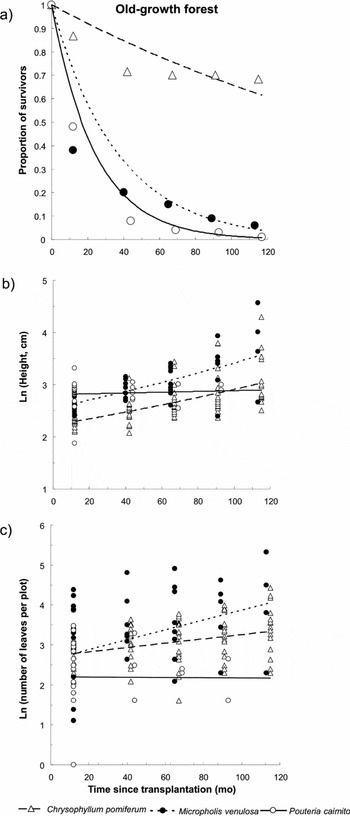
Survivorship differences among species were pronounced. After 120 mo, C. pomiferum showed significantly greater survival (Species × Time interaction: χ2 = 72.2, df = 2, P < 0.001; Figure 1a) than the other two species; practically all seedlings of P. caimito died. We detected a significant Species × Time interaction effect on height (F6, 153 = 2.1, P = 0.05). Pouteria caimito showed practically no change in height after c. 10 y since transplantation and both M. venulosa and C. pomiferum showed slow but constant growth, the first species grew taller than the second (Figure 1b). The range of height across species was: C. pomiferum, 8–75 cm; M. venulosa, 9–104 cm; and P. caimito, 8–21 cm. Pouteria caimito showed a rather constant number of leaves over time; while C. pomiferum and mainly M. venulosa gained leaves (F6,153 = 4.9, P < 0.0001; Figure 1c). The range of absolute leaf numbers across species was: C. pomiferum, 4–45 leaves; M. venulosa, 9–104 leaves; and P. caimito, 4–7 leaves.
Best-fit generalized linear models for seedling survival (a) and growth height (b) and leaf numbers (c) in the long term. Seedlings of the native tree species: Chrysophyllum pomiferum (n = 60); Micropholis venulosa (n = 100); and Pouteria caimito (n = 100); were planted into an old-growth forest north of Manaus, Brazil.

Long-term performance in secondary forest
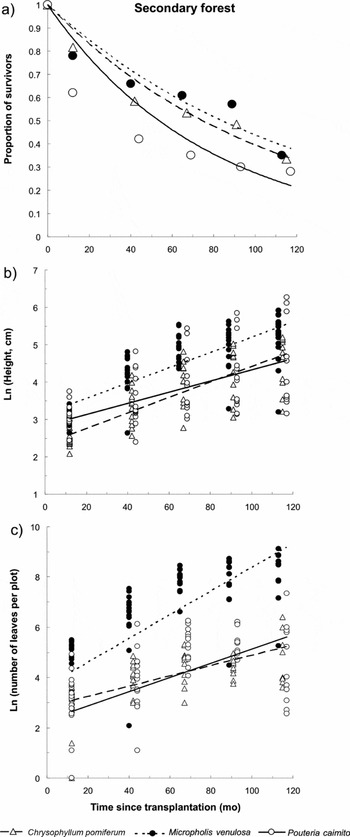
The slope of survivorship curves did not differ significantly among species (Species × Time interaction: χ2 = 0.47, df = 2, ns). Species showed similar survival but P. caimito endured a slighter higher mortality rate (Figure 2a). In a similar way, species did not differ significantly in growth in height (Species × Time interaction: F 8, 140 = 1.2, P = 0.33). All species increased in height but M. venulosa grew taller than P. caimito and C. pomiferum (Figure 2b). The range of height across species was: C. pomiferum, 10–225 cm; M. venulosa, 10–600 cm; and P. caimito, 18–600 cm. For growth in leaf number, species differed strongly (Species × Time interaction: F 8, 136 = 4.5, P < 0.0001; Figure 2c). Through time, M. venulosa maintained significantly greater number of leaves than the other two species. The range of absolute leaf numbers across species was: C. pomiferum, 5–200 leaves; M. venulosa, 7–3266 leaves; and P. caimito, 3–600 leaves.
Best-fit generalized linear models for seedling survival (a) and growth height (b) and leaf numbers (c) in the long term. Seedlings of the native tree species: Chrysophyllum pomiferum (n = 60); Micropholis venulosa (n = 100); and Pouteria caimito (n = 100); were planted into a secondary forest dominated by Vismia spp. north of Manaus, Brazil.

Long-term herbivory damage
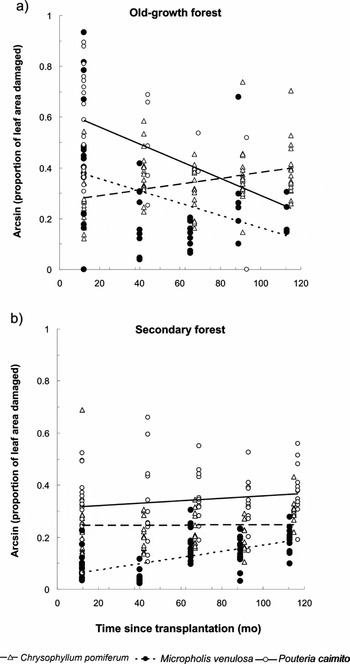
There was a significant difference in the temporal change of herbivory levels among species within the old-growth forest (Species × Time interaction: F 6, 66 = 11.6, P < 0.001). After 1 y since transplantation, levels of damage were greater in P. caimito than in M. venulosa and in the latter than in C. pomiferum (Figure 3a). After 120 mo, such differences changed as M. venulosa had the lowest damage (Figure 3a).
Best-fit generalized linear models for long-term insect herbivory on tree seedlings. Seedlings of the native tree species: Chrysophyllum pomiferum (n = 60); Micropholis venulosa (n = 100); and Pouteria caimito (n = 100) were planted into an old-growth forest (a) and into a secondary forest (b) dominated by Vismia spp. north of Manaus, Brazil.

In secondary forest, species did not differ significantly in herbivory levels through time (Species × Time interaction: F 8, 120 = 1.8, P = 0.09; Figure 3b). In 1-y-old seedlings, herbivory was greater in P. caimito followed by C. pomiferum and M. venulosa. As time elapsed, herbivory increased significantly for all species. After c. 120 mo since transplantation, P. caimito and C. pomiferum had the same herbivory levels and M. venulosa the lowest ones (Figure 3b).
Species success in old-growth and secondary forests
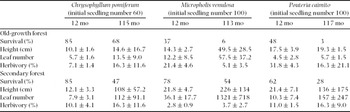
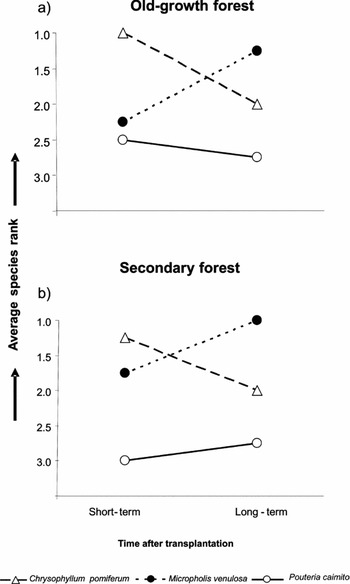
For most cases species changed rank in growth, survival and herbivory through time for the two habitats (Table 1). In old-growth forest 1-y-old seedlings of C. pomiferum showed better success than the other species that performed poorly; whereas in the long term M. venulosa was more successful than C. pomiferum followed by P. caimito which failed to establish in old-growth forest (Figure 4a). In contrast, for secondary forest 1-y-old seedlings of C. pomiferum showed better success followed by M. venulosa and P. caimito. Finally, in the long term, M. venulosa succeeded in secondary forest, followed by C. pomiferum, with P. caimito having the lowest survival and growth and highest herbivory (Table 1; Figure 4b).
Performance and herbivory (mean ± SD) of seedling species at different times after being transplanted into old-growth and a secondary forest dominated by Vismia spp. north of Manaus, Brazil. In the old-growth forest no seedling of P. caimito survived until the end of the experiment (c. 120 mo) therefore the information represents the time for the last recorded individuals. Herbivory levels at 12 mo from Benítez-Malvido et al. (Reference BENÍTEZ-MALVIDO, MARTÍNEZ-RAMOS, CAMARGO and FERRAZ2005).

Species ranks in terms of seedling survival, growth and herbivory. Seedlings were planted into an (a) old-growth forest (Chrysophyllum pomiferum, n = 60; Micropholis venulosa, n = 100; and Pouteria caimito, n = 100 seedlings, respectively); and (b) a secondary forest (Chrysophyllum pomiferum, n = 60; Micropholis venulosa, n = 100; and Pouteria caimito), north of Manaus, Brazil. Seedling performance and herbivory were measured in the short term (1 y); and in the long-term (c. 10 y) after transplantation. Species ranked 1, indicates best success (i.e. fast growth rates, fewer deaths and less herbivory); 2, intermediate success; and 3, worst success, respectively.

DISCUSSION
Growth and survival at different habitats and time scales
One year after planting (1993), each species showed different responses to the environmental variability present within and between habitats. Initial seedling size, incident light and herbivory but not litter amount affected growth and survival (Benítez-Malvido et al. Reference BENÍTEZ-MALVIDO, MARTÍNEZ-RAMOS, CAMARGO and FERRAZ2005). Initially larger seedlings resulted in lower survival for C. pomiferum and P. caimito. Effects of herbivory were greater under low-light conditions. Seedlings of C. pomiferum, on average, presented greater growth in height and leaf numbers, less mortality and less herbivory for both habitats, followed by M. venulosa and P. caimito (Benítez-Malvido et al. Reference BENÍTEZ-MALVIDO, MARTÍNEZ-RAMOS, CAMARGO and FERRAZ2005). For all species, growth was greater in the Vismia forest.
Plant performance and herbivory diverged over time in old-growth and secondary forests. Seedlings from the same species and cohort showed increased variation in growth as time elapsed and plants aged. Differences in growth in height and leaf numbers within species were several orders of magnitude greater in secondary forest than in old-growth forest. For instance, individuals that survived throughout the study were not necessarily those with greater height and leaf numbers as found earlier (Benítez-Malvido et al. Reference BENÍTEZ-MALVIDO, MARTÍNEZ-RAMOS, CAMARGO and FERRAZ2005) indicating that stochastically external factors (e.g. gap openings) and the microenvironment at the 1-m2 plot level are also important for species regeneration.
Generally, the 1-y data were not good predictors of species performance in the long term, except for P. caimito which ranked consistently low (Benítez-Malvido et al. Reference BENÍTEZ-MALVIDO, MARTÍNEZ-RAMOS, CAMARGO and FERRAZ2005). Seedlings of P. caimito persisted in the old-growth forest for 1 y but with suppressed growth and high mortality throughout the study period. One-year-old seedlings of M. venulosa showed high mortality but the few surviving plants (six individuals) showed high growth. In contrast, C. pomiferum showed positive growth and high survival in both habitats. However, 1-y data did not show that C. pomiferum preferred old-growth forest conditions over those of secondary forest, and that individuals could persist for years in the understorey with continuous but minimal growth (cf. Chrysophyllum sp. nov. in Australia, Connell & Green Reference CONNELL and GREEN2000). Secondary-forest conditions enhanced growth for all species over both time scales, as has been observed for many old-growth forest tree species exposed to moderate light levels (Ashton et al. Reference ASHTON, GUNATILLEKE and GUNATILLEKE1994, Brown & Whitmore Reference BROWN and WHITMORE1992).
In old-growth forest, all seedling species showed low growth and only a few individuals (i.e. M. venulosa) reached more than 1 m tall, or more than 1 cm stem girth after c. 10 y. Generally, height remained < 1 m, and the principal effects of the physical and biological factors (e.g. light, litterfall, competition, predators) that affected early performance might have remained relatively unchanged as plants remained small. In contrast, many individuals transplanted into the secondary forest were > 1 m tall and > 1 cm stem girth, and changed in ontogeny (Clark & Clark Reference CLARK and CLARK1992, King Reference KING1996), as some individuals were even flowering and fruiting (i.e. P. caimito). Hence, some agents of mortality that jeopardized their early existence as seedlings changed in magnitude as plants continued to grow and approached maturity. For instance, as time elapsed Vismia trees have greater size and canopy depth (from 5 m to 15 m tall) changing incident light and increasing competition. Nevertheless, incident light in 2001 was still higher in secondary forest than in old-growth forest as Vismia stands do not present a dense closed canopy (J. Benítez-Malvido, pers. obs.). Competition with neighbouring experimental individuals and natural vegetation might have affected sapling growth particularly in the nutrient-poor soils of the study area (Ganade & Brown Reference GANADE and BROWN2002, Lewis & Tanner Reference LEWIS and TANNER2000). The distance between transplants within plots was 20 cm. As transplants grew, within and among species root and crown competition for space and resources (light and nutrients) might have increased affecting their performance.
Herbivory over time
Seedling herbivory at a given time depends on the target species, habitat type, and seedling age and ontogeny (Boege & Marquis Reference BOEGE and MARQUIS2005, Del Val & Dirzo Reference DEL VAL and DIRZO2003). In our study, changes in herbivory levels as plants developed occurred in a linear fashion (but see Boege & Marquis Reference BOEGE and MARQUIS2005). Strong shifts in herbivory within and between habitats through time may be the consequence of an interplay of factors of two kinds: (1) those factors intrinsic to plant physiology, such as resource allocation to growth and defence, and rate of foliar exchange; and (2) those extrinsic to plant performance, such as micro-environment, density of predators and plant appearance. However, in our study we do not know the relative importance of such factors (intrinsic and extrinsic) on the observed herbivory trends.
Intrinsic factors affecting herbivory
Firstly, leaves of different age differ in their susceptibility to herbivores with young leaves suffering greater damage than mature leaves (Coley Reference COLEY1980, Reference COLEY1983; Coley & Barone Reference COLEY and BARONE1996, Fonseca Reference FONSECA1994). Mature leaves are tough and contain substances that reduce digestibility, which might explain the decrease level of damage for P. caimito and M. venulosa in old-growth forest throughout time. Secondly, species might have different rates of leaf emergence and shedding. We observed that C. pomiferum held its foliaceous cotyledons for more than 3 y after transplantation. Increased herbivory in old-growth forest throughout time may have resulted from damage accumulation as leaves aged. Future studies should consider rates of damage and quantify leaf demography altogether.
Initial low herbivory in secondary forest could be consequence of drier conditions that favour strong anti-herbivore defences (Givnish Reference GIVNISH1999). As time elapsed, changes in herbivory levels were less marked than in old-growth forest. Because of the more favourable environment of secondary forest (greater PAR), it is likely that plants had greater rates of leaf exchange and damaged leaves were replaced quickly. Finally, in secondary forest seedlings apparently invested more resources in growth than in defence and hence damage increased slightly through time. Compensatory growth may represent an alternative to chemical defence as a strategy to reduce net losses to herbivores, mainly in resource-rich environments (Herms & Mattson Reference HERMS and MATTSON1992). In contrast, in old-growth forest P. caimito and M. venulosa might have decreased the nutritional quality of their foliage increasing the production of chemical defences to reduce future tissue loss and in consequence reduced the allocation of resources to growth (Wold & Marquis Reference WOLD and MARQUIS1997).
Extrinsic factors affecting herbivory
Plant predation has shown to decline as the scale and the intensity of habitat destruction increases (Benítez-Malvido Reference BENÍTEZ-MALVIDO, Bierregaard, Lovejoy and Mesquita2001, Benítez-Malvido et al. Reference BENÍTEZ-MALVIDO, MARTÍNEZ-RAMOS, CAMARGO and FERRAZ2005, Janzen & Vázquez-Yanes Reference JANZEN, VÁZQUEZ-YANES, Gómez-Pompa, Whitmore and Hadley1991). One of the reasons for lower predation in disturbed open habitats is that drier or less humid conditions lessen herbivory (Givnish Reference GIVNISH1999). Herbivores could be strongly influenced by changes in forest structure and microclimate within habitats (Givnish Reference GIVNISH1999, Jones et al. Reference JONES, SUSILO, BIGNELL, HARDIWINOTO, GILLISON and EGGLETON2003, Klein Reference KLEIN1989, Strong Reference STRONG1977). Many forest animals may occur in early successional stages but at densities lower than in intact forests (Janzen & Vázquez-Yanes Reference JANZEN, VÁZQUEZ-YANES, Gómez-Pompa, Whitmore and Hadley1991) and in the study area some insect species are unable to persist in open areas (Klein Reference KLEIN1989). Initial high herbivory in old-growth forest may have resulted from greater moisture that is correlated with greater insect abundance and diversity in tropical ecosystems (Givnish Reference GIVNISH1999, Jones et al. Reference JONES, SUSILO, BIGNELL, HARDIWINOTO, GILLISON and EGGLETON2003, Strong Reference STRONG1977). An additional explanation is that the source of host-plants and potential enemy herbivores are likely greater therein, especially so if enemies are strongly host-specific and localized to near adult trees where food is readily found (Benítez-Malvido & Kossmann-Ferraz Reference BENÍTEZ-MALVIDO and KOSSMANN-FERRAZ1999).
Variation in litter fall and accumulation, vegetation development and the opening of forest gaps may have modified the initial assemblages of herbivores in both habitats (Coley Reference COLEY1983, Peña-Claros & de Boo Reference PEÑA-CLAROS and DE BOO2002), especially in secondary forest where natural and transplanted plants showed a marked increase in height and canopy depth. The appearance of a food plant is related with the number of predators (Janzen Reference JANZEN1970, Soberón et al. Reference SOBERÓN, CORDERO, BENREY, PARLANGE, GARCÍA-SAEZ and BERGES1988). The number of surviving seedlings decreased sharply for P. venulosa and M. venulosa in old-growth forest making the surviving individuals less apparent to herbivores through time; whereas in secondary forest all individuals were bigger and leafy making them more conspicuous to predators.
Final considerations
We found that successful planting of species considered to be naturally restricted to old-growth forest is possible in young Vismia stands (Wieland et al. Reference WIELAND, MESQUITA, BOBROWIEC, BENTOS and WILLIAMSON2011). Therefore, limited seed dispersal and predation but not high incident light and/or leaf litter are affecting the regeneration of old-growth forest species into this highly modified habitat.
Herbivory affected seedling performance in all studied species in both habitats at different time scales. For 1-y-old seedlings, negative effects of herbivory were intensified under the low PAR conditions of old-growth forest (Benítez-Malvido et al. Reference BENÍTEZ-MALVIDO, MARTÍNEZ-RAMOS, CAMARGO and FERRAZ2005); whereas no significant effect of litter amount on seedling performance and herbivory was found for either habitat (Benítez-Malvido et al. Reference BENÍTEZ-MALVIDO, MARTÍNEZ-RAMOS, CAMARGO and FERRAZ2005). For the secondary forest, in the long term we observed that insects, canopy debris and climbing lianas are harmful to saplings (Clark & Clark Reference CLARK and CLARK1992, King Reference KING1996), especially for those of M. venulosa. The stems (> 2 m tall) of M. venulosa are slender (≤1.5 cm dbh), and are easily bent down or broken at ground level by lianas, insects and canopy debris (Benítez-Malvido, pers. obs.). The loss of biomass due to broken stems in saplings may not be replaceable as rapidly as might have been at the seedling stage. Therefore herbivory at different stages of plant development might be a constant threat in both habitats.
Our study clearly showed strong shifts in plant performance and herbivory through time across two common but contrasting habitats in Central Amazonia. Our results emphasize the importance of investigating within and among species divergences and habitat-specific responses in the long term when possible. This is because an early evaluation of seedling performance is not necessarily a reliable indicator of whether or not a target species is capable of persisting in the long term. Therefore, beyond preserving remaining old-growth forests, it is critical to investigate native species of trees capable of surviving in Vismia stands and other degraded lands (Chazdon et al. Reference CHAZDON, HARVEY, KOMAR, VAN BREUGEL, FERGUSON, GRIFFITH, MARTÍNEZ-RAMOS, MORALES, NIGH, SOTO-PINTO and PHILPOTT2009, Harvey et al. Reference HARVEY, KOMAR, CHAZDON, FERGUSON, FINEGAN, GRIFFITH, MARTÍNEZ-RAMOS, MORELAES, NIGHT, VAN BREUGEL and WISHNIE2008).
ACKNOWLEDGEMENTS
The authors thank the National Institute for Research in Amazonia (INPA), the Smithsonian Institution, the Centro de Investigaciones en Ecosistemas (UNAM), the Mexican Council for Science and Technology (CONACyT, grant number 56519) for financial and logistic support. I. Ferraz and all the field directors of the BDFFP during the study period for much support during our visits to Manaus. O. Benítez, E. de Assis, M. Lohman and J. Osborne helped to plant the seedlings. A. Cardoso was especially helpful with the fieldwork. T. Pennington and A. de Oliveira identified the seedling species. We thank J.M. Lobato and H. Ferreira for technical support. This is publication number 619 in the INPA-Smithsonian Biological Dynamics of Forest Fragments Project (BDFFP) technical series.