The past decade witnessed a steadily growing interest in child bilingual language learners (Paradis, Reference Paradis, Hoff and Shatz2007), and increasing attention has been paid to the internal and external factors that would affect the rate and route of children's linguistic development (Unsworth, Hulk, & Marinis, Reference Unsworth, Hulk and Marinis2011). Internal factors include properties more inherent to the learner, such as biological and cognitive capacities, whereas external factors involve aspects of the learner's environment, such as input quantity and quality. Understanding the impact of these factors is assumed to be crucial in promoting the development of existing theories (e.g., usage based theory) and the formulation of educational policies and advice (e.g., language instructional hours at school; Unsworth, Persson, Prins, & de Bot, Reference Unsworth, Persson, Prins and de Bot2015). Both internal and external factors have been found to significantly predict children's bilingual development (e.g., Paradis, Reference Paradis2011; Unsworth, Reference Unsworth, Nicoladis and Montanari2016); however, the relationship between internal and external factors is not fully understood, and few papers have touched upon the issue explicitly (but see Paradis, Reference Paradis2011; Sunderman & Kroll, Reference Sunderman and Kroll2009). Our understanding of the interdependence between internal and external factors in language acquisition would benefit from further exploration, as it will provide us “a unique window onto the cognitive and experiential underpinnings of language” (Dabrowska, Reference Dąbrowska2016, p. 485). It is important to develop a “consistent research agenda that addresses the interaction of individual cognitive abilities and the differential aspects of learning contexts” (Collentine & Freed, Reference Collentine and Freed2004, p. 165) to optimize learning processes and outcomes at an individual level.
The current paper explores this issue with preschool children in Singapore. There are four official state languages (i.e., English, Mandarin Chinese, Malay, and Tamil) and three major ethnic groups (i.e., Chinese 74.3%, Malays 13.3%, and Indians 9.1% in population; Singapore Department of Statistics, 2016) in this country. Children are expected to acquire both English and their ethnic language (mother tongue language [MT language]); but the two languages have been assigned different functions by the government (Bokhorst-Heng, Reference Bokhorst-Heng, Alatis and Tan1999). English has been promoted as the language of international business, access to science and technology, and the medium of instruction within schools and universities, which in turn has increased its usage within Singaporean families (Dixon, Zhao, Quiroz, & Shin, Reference Dixon, Zhao, Quiroz and Shin2012; Pakir, Reference Pakir, Alatis and Tan1999). As such, children's exposure to English is rich both outside and inside the home. In contrast, MT languages are mostly relegated to educational contexts, with exposure comparatively limited in amount and variety. The utilitarian attitude and the decreasing proficiency level of parents’ MT languages reduce children's MT language exposure at home even further (Dixon, Zhao, et al., Reference Dixon, Zhao, Quiroz and Shin2012; Saravanan, Reference Saravanan2001). As a consequence, although most children have access to English and their ethnic language at a young age and are assumed to be simultaneous or early sequential bilinguals, there could be a large variation in the learning environment of the two languages: learning English in an input-rich setting (home, school, and social domains) while learning their MT language in a comparatively input-poor setting (predominantly restricted to classroom instruction). Such an ethnic language learning environment shares critical features with an instructional learning environment, where (a) the amount of language exposure is limited, (b) teachers have a great impact on children's learning outcome, (c) children barely use the target language to communicate with their peers, and (d) the target language generally is not spoken outside of the classroom (Muñoz, Reference Muñoz2008).
Different learning environments might result in wide variation in external factors, and further influence the impact of internal factors on acquisition of English and MT languages. Research on the acquisition of grammar has shown the critical role of input in the emergence of syntactic rules in children's developing linguistic system. It has been argued, for example, that a threshold amount (or a “critical mass”) of linguistic input works in conjunction with cognitive linguistic principles (such as complexity and salience) to influence the sequence of grammar learning (Gathercole & Hoff, Reference Gathercole, Hoff, Hoff and Shatz2007). Similarly, input threshold quantified as the number of exposures is also requisite for the learning of vocabulary items (e.g., Meara, Reference Meara, Schmitt and McCarthy1997; Nation, Reference Nation1990). In relation to the current study, then, the different amount of input for English versus MT may translate into the differential effects of internal versus external factors on learning outcome. If relatively limited exposure to the MT language means that input level is below a required “threshold,” we would expect students’ performance in this language to be subject primarily to external factors, akin to what has been found in instructional settings (e.g., learning English in China as in Sun, Steinkrauss, Tendeiro, & de Bot, Reference Sun, Steinkrauss, Tendeiro and De Bot2016). In contrast, if the relatively ample input to English means that input level has exceeded the requisite threshold, then we would expect students’ performance to be subject less to external, and more to internal, factors similar to what was found in input-rich learning settings (e.g., learning English in Canada as in Paradis, Reference Paradis2011). We explore this issue in the present study.
LITERATURE REVIEW
Both internal and external factors are considered essential to child early language development (Clark, Reference Clark2003; Sun, Steinkrauss, Wieling, & de Bot, Reference Sun, Steinkrauss, Wieling and de Bot2016). As noted above, internal factors are intrinsic to the learner, including biological characteristics (age and gender) and cognitive abilities (e.g., working memory and intelligence). External factors are those variables existing in the learner's environment such as the nature and amount of linguistic input, school instruction, and SES of the home. The following sections introduce significant internal and external factors on child bilingual vocabulary development found by previous studies (e.g., Unsworth, Reference Unsworth2013).
Internal factors
Age, gender, and language aptitude are frequently investigated in child bilingual vocabulary development. In general, older bilingual children may demonstrate an initial advantage of learning rate over their younger counterparts in terms of receptive and productive vocabulary (Cummins & Swain, Reference Cummins and Swain1986; Goldberg, Paradis, & Crago, Reference Goldberg, Paradis and Crago2008), probably because of older children's more advanced cognitive development. However, the younger learners may catch up and obtain a better outcome in the long run (Muñoz, Reference Muñoz2008).
Gender differences in child early vocabulary development have been observed in monolingual studies (Eriksson et al., Reference Eriksson, Marschik, Tulviste, Almgren, Pérez, Wehberg and Gallego2012; Pivik, Andres, & Badger, Reference Pivik, Andres and Badger2011) and in some on bilingual studies (Uchikoshi, Reference Uchikoshi2006). In terms of monolingual children, Huttenlocher, Haight, Bryk, Seltzer, and Lyons (Reference Huttenlocher, Haight, Bryk, Seltzer and Lyons1991) found that before 20 months, girls outperformed boys in the rate of vocabulary growth. Such an advantage has been shown to persist over time (e.g., Bauer, Goldfield, & Reznik, Reference Bauer, Goldfield and Reznik2002; Bouchard, Trudeau, Sutton, Bourdeault, & Deneault, Reference Bouchard, Trudeau, Sutton, Boudreault and Deneault2009; Eriksson et al., Reference Eriksson, Marschik, Tulviste, Almgren, Pérez, Wehberg and Gallego2012; but see Bornstein, Hahn, & Haynes, Reference Bornstein, Hahn and Haynes2004). In terms of bilingual children, the gender differences are less clear. Uchikoshi (Reference Uchikoshi2006) followed 150 Latino English learners over a preschool year and found boys began with and maintained higher receptive and productive English vocabulary than girls. The author attributed such gender differences to exposure history and cultural value. Parents were assumed to emphasize academic language achievement more for boys than girls. However, in some other studies on bilingual preschoolers’ vocabulary development (e.g., Allman, Reference Allman, Cohen, McAlister, Rolstad and MacSwan2005), such gender differences were not observed. In the present study, we explore any possible gender effects on receptive vocabulary measures in bilingual samples.
Language aptitude, which refers to learners’ specific capability for language learning (Carroll & Sapon, Reference Carroll and Sapon2002), has been found to influence child bilingual vocabulary learning as well. Aspects of internal abilities such as phonological short-term memory, nonverbal intelligence, and phonological awareness are assumed to underlie language aptitude. These aspects were found to be associated with vocabulary outcomes in child bilinguals (e.g., Alexiou, Reference Alexiou and Nikolov2009; Knell et al., Reference Knell, Qiang, Pei, Chi, Siegel, Zhao and Zhao2007; Paradis, Reference Paradis2011). In general, phonological awareness enables children to segmentalize the global lexical representation, accommodating the pressure of children's enlarging vocabulary size (Metsala & Walley, Reference Metsala, Walley, Metsala and Ehri1998; Pi-Yu & Rvachew, Reference Pi-Yu and Rvachew2007); short-term memory helps children retain the novel sequence of the phonological properties of a language, facilitating word articulation and semantic memory (Gathercole & Baddeley, Reference Gathercole and Baddeley1989; Paradis, Reference Paradis2011); and nonverbal intelligence may help children impute structures and reorganize patterns, allowing them to approach the linguistic tasks in an analytic way (Daller & Ongun, Reference Daller and Ongun2017; Hakuta & Diaz, Reference Hakuta and Diaz1985).
External factors
External factors (i.e., environmental factors) have also been found to significantly impact bilingual children's early vocabulary acquisition (Dixon, Wu, & Daraghmeh, Reference Dixon, Wu and Daraghmeh2012). These factors include input quantity, input quality, children's language output, and family SES (Unsworth, Reference Unsworth2013).
“Of all the relevant factors that parent or communities have some control over, quantity of input is the largest” (Pearson, Reference Pearson2007, p. 400), and there is large variation among families. Child bilingual language learners usually vary in overall length of exposure and current exposure time (Paradis, Reference Paradis2011). Input quantity has been revealed to affect bilingual children's vocabulary acquisition (Unsworth, Reference Unsworth2013). One source of input would come from active communication, and children's input quantity is estimated by the amount of talk they receive from families, friends, and so on. Another source of language input would be in the form of media, which unlike typical home language use, is noninteractional. Research has shown that the development of bilingual children's societal dominant language will benefit from TV exposure (e.g., Latino children's English vocabulary development in the United States; Uchikoshi, Reference Uchikoshi2006). However, such benefit to children's ethnic language development remains unclear. For instance, Scheele, Leseman, and Mayo (Reference Scheele, Leseman and Mayo2010) did not find a correlation between watching TV in the ethnic language and vocabulary development in that language, in 3-year-old Moroccan-Dutch and Turkish-Dutch children.
Input quality could be operationalized in different ways. Various interlocutors (Rojas et al., Reference Rojas, Iglesias, Bunta, Goldstein, Goldenberg and Reese2016), higher maternal language proficiency (Chondrogianni & Marinis, Reference Chondrogianni and Marinis2011), and rich literacy environment (e.g., book reading; Paradis, Reference Paradis2011) have all been found to facilitate child bilingual's vocabulary development. For instance, Rojas et al. followed 224 Spanish-speaking English learners in US kindergartens and found the presence of older siblings at home predicted children's expressive language skills. The rationale is that older siblings might have more experience with the societal language and consequently might bring more societal language to home settings.
In recent years, some studies have also highlighted the role of children's language use, especially children's language output at home, as a significant factor in their bilingual vocabulary development (Bohman, Bedoe, Pena, Mendez-Perez, & Gillam, Reference Bohman, Bedore, Pena, Mendez-Perez and Gillam2010). It is taken as the most functional measure of exposure as it provides a general index of children's overall language experience (Bohman et al., Reference Bohman, Bedore, Pena, Mendez-Perez and Gillam2010; Gutiérrez-Clellen & Kreiter, Reference Gutiérrez-Clellen and Kreiter2003). Controlling for the role of input, these studies revealed an “independent contribution” of language output to bilingual children's vocabulary outcome (Bohman et al., Reference Bohman, Bedore, Pena, Mendez-Perez and Gillam2010, p. 339). According to Swain (Reference Swain2007), output has three main functions in language learning: a noticing function, a hypothesis-testing function, and a metalinguistic function. Output may prompt children to consciously recognize their language limits, allowing them to reflect their own and others’ language behaviors. The role of output could be also illustrated from the perspective of the input-proficiency-use cycle (Pearson, Reference Pearson2007). Namely, more input exposure leads to better proficiency, which increases children's confidence in using the language; more use (output) in turn encourages more input, which starts the cycle again. Pearson (Reference Pearson2007) argued that this cycle would be more visible in bilingual children's minority language acquisition.
Family SES, usually estimated from maternal educational levels and family income, has been found to affect bilingual children's vocabulary size (Dixon, Zhao, et al., Reference Dixon, Zhao, Quiroz and Shin2012; Goldberg et al., Reference Goldberg, Paradis and Crago2008). In Goldberg et al.’s (Reference Goldberg, Paradis and Crago2008) study, bilingual children whose mother had a higher education level (postsecondary) outperformed their peers whose mothers had a lower level of education (secondary) in their English (societal language) receptive vocabulary. In contrast, SES might have a different effect on the maintenance of minority languages. Oller and Eilers (Reference Oller and Eilers2002) found that children from working-class families did better than their peers from professional families in oral Spanish skills, despite the fact that professional mothers professed to attach more value to learning Spanish than working-class mothers (e.g., Lambert & Taylor, Reference Lambert and Taylor1996). Similarly, in the Singapore context, Saravanan (Reference Saravanan2001) found that children from higher SES families tended to have lower proficiency in ethnic languages, due to the preference of the parents to use English at home.
The general picture that emerges from the survey of the literature is that both internal and external factors are relevant to child bilingual's vocabulary acquisition. This is consistent with a usage-based approach to understand language acquisition (Dąbrowska, Reference Dąbrowska2016; Ibbotson, Reference Ibbotson2013), which makes reference to the interaction among domain-general factors, including “physiology, processing, working memory, pragmatics, social interaction, properties of the input, the learning mechanisms, and so on” (O'Grady, Reference O'Grady2008, p. 448). One issue that deserves our attention is that most of the existing studies on internal/external factors and child bilingual vocabulary development address the contribution of individual factors to vocabulary acquisition, and very few of them took internal versus external factors as two contrastive sets of predictors nor explored their interdependence on child vocabulary learning. The exploration of such interdependence is both meaningful and necessary as it would reveal the mechanism of cognition and environment in shaping language, providing specific predictions and illustrations under the realm of usage-based theory and addressing the individual differences in language learning (Dąbrowska, Reference Dąbrowska2012, Reference Dąbrowska2016).
The relationship between internal and external factors
As mentioned above, there are not many studies on the relationship between internal and external factors in child vocabulary acquisition, and those conducted by Paradis (Reference Paradis2011) and Sun et al. (Sun, Steinkrauss, Tendeiro, et al., Reference Sun, Steinkrauss, Tendeiro and De Bot2016; Sun, Steinkrauss, Wieling, et al., Reference Sun, Steinkrauss, Wieling and de Bot2016) are among the few. Paradis's research (Reference Paradis2011) on immigrant children in Canada found that internal factors together (e.g., short-term memory and analytical ability) were better predictors of linguistic outcome than external factors. In contrast, Sun et al.’s studies of English L2 learners in China found that, in an instructional setting, it is the set of external factors (e.g., quantity and quality of input at school and home) that explained more variance in L2 outcome. The opposing findings in the studies by Paradis and Sun et al. conducted in their specific learning contexts could be understood, in our view, as the external factors (specifically input) exerting a threshold/bottleneck effect on internal factors. That is to say, internal factors begin to influence learning outcome only after the input reaches a certain threshold level. We find relevant insight from research bearing on the critical mass hypothesis (Elman, Reference Elman2003; Gathercole & Hoff, Reference Gathercole, Hoff, Hoff and Shatz2007; Marchman & Bates, Reference Marchman and Bates1994) that establishes the primacy of the role of input before related patterns/abilities/factors can emerge. Such a supposition is entirely consistent with the central tenet in usage-based thinking, which prioritizes input and general cognitive factors in explaining language learning. A series of studies have been conducted to examine the critical mass hypothesis. For instance, Marchman and Bates (Reference Marchman and Bates1994) found that children begin to demonstrate productive knowledge on past-tense morphology only after sufficient linguist input enabled their verb vocabulary size to exceed 50. The assumption was that productive morphosyntactic knowledge emerges after exposure to sufficient instances of inflected verbs in the input. Gathercole and Hoff (Reference Gathercole, Hoff, Hoff and Shatz2007) also showed a “seesaw” relationship between input and cognitive linguistic principles, in their conjoint effect on grammar learning. For instance, more complex and less salient properties require a higher level of input for acquisition, compared with less complex and more salient properties whose critical mass requirement is lower. Applied to the issues pertinent to the present study (i.e., the relationship between external and internal factors), such a critical mass perspective might suggest that the relative role of internal versus external factors in language acquisition could depend on the setting of learning (i.e., input-rich setting vs. input-poor setting). More specifically, in an input-rich environment, learners are exposed to ample linguistic stimuli that provide the requisite amount and quality of input for internal mechanisms to contribute to language learning (e.g., establishing form–meaning mappings in lexical meanings). We can think of this requisite amount and quality of input as a sort of threshold in order for internal mechanisms to manifest their importance. In input-poor settings (e.g., instructional settings) where such a threshold level of input is not reached, then internal mechanisms remain in the background, so to speak. In such a scenario, outcome of language learning then is determined primarily by the quantity and quality of input at the initial period. Failing to encounter this critical mass would result in delayed or incomplete learning of language structures.
The current study intends to explore the specific role that each internal factor (i.e., age, language aptitude, and gender) and external factor (i.e., input quantity, input quality, output, and SES) plays in bilingual children's English and MT vocabulary learning, from the perspective of usage-based theory. More important, we would like to explore the interdependence of internal and external factors and address the issue when we should give more weight to internal factors and when we should not, shedding light on individual differences within the realm of usage-based theory. From our point of view, such an interdependence may be backed up by the critical mass hypothesis in terms of input threshold. Different from the existing literature, we examined both scenarios (one in which internal mechanisms can be expected to play a major role, and the other in which external factors such as input can be expected to play a major role) within the same individual by investigating vocabulary acquisition of bilingual children's dual languages. Specifically, due to English and MT's different learning environments, we expect opposing effects of internal versus external factors on each language. Following Paradis (Reference Paradis2011), we expect that learning English for our bilingual children is more affected by internal factors given the abundance and quality of English language input in the school and home environments. Following the two Sun et al. (Reference Sun, Steinkrauss, Tendeiro and De Bot2016) studies, we expect that learning MT languages (Mandarin, Malay, or Tamil) are more affected by external factors, given the relative deficiency of input for MT in many families.
QUESTIONS AND HYPOTHESES
-
Question 1: Which individual internal and external factors contribute to bilingual children's vocabulary knowledge in English and MT languages, respectively?
-
Hypothesis 1: Based on findings in input-rich (e.g., Paradis, Reference Paradis2011) and input-poor settings (e.g., Sun, Steinkrauss, Tendeiro, et al., Reference Sun, Steinkrauss, Tendeiro and De Bot2016; Sun, Steinkrauss, Wieling, et al., Reference Sun, Steinkrauss, Wieling and de Bot2016), components of both internal factors (i.e., age, language aptitude, and gender) and external factors (i.e., input quantity, input quality, output, and SES) are expected to explain some variance of English and MT vocabulary knowledge.
-
Question 2: What is the relative contribution of sets of internal versus external factors to predicting variation in children's bilingual vocabulary knowledge?
-
Hypothesis 2: Because English is prevalent in Singapore, bilingual children's English will be better predicted by internal factors, while their MT will be better predicted by external factors.
METHOD
Participants
The data reported in this study are from part of a larger longitudinal study examining early childhood development in Singapore (Singapore Kindergarten Impact Project; Bull et al., Reference Bull, Lee, Karuppiah, Poon, O'Brien's, Towndrow and Bautista2014). Children in kindergarten 1 (K1) were recruited in Singapore across a various types of preschool, including public (24), government-run (10), not-for-profit (18), and commercial (2) preschool education providers. During the first wave of data collection, 1,123 participants provided full data and 318 children were excluded from analysis because they have been actively exposed to more than two languages at home or their MT was not among the three official languages offered in local preschools. This resulted in a sample of 805 K1 children (4 years, 1 month to 5 years, 8 months old) for the current study: 551 Mandarin-English speaking children, 105 Malay-English speaking children, and 149 Tamil-English speaking children. The proportion of the bilingual groups is representative of the demographics of Singapore.
Measures and procedures
Internal and external factors have been measured with a series of standard tests and parental questionnaires as follows.
Independent variables: Measures on internal factors
Raven's Colored Progressive Matrices (Raven, Court, & Raven, Reference Raven, Court and Raven1995) was used to measure children's nonverbal reasoning ability in the current study. Known to be an unbiased measure of cognitive functioning across various populations, it is highly suitable to allow for an evaluation of fluid intelligence without significant influence by external factors (e.g., cultural and educational). It has three sections: A, AB, and B; each section has 12 items. Participants were instructed to choose the missing part of a presented matrix from an array of six options to make the matrix complete. Before administering the test items for Section A, there is a practice item where extensive and detailed feedback was given to the participant to ensure understanding of the task assigned. There were 36 items in total increasing in complexity. Administration of each section was stopped after four consecutive incorrect responses.
Elision and blending, the subtests of the Comprehensive Test of Phonological Processing, were administered to measure children's phonological awareness (Wagner, Torgesen, & Rashotte, Reference Wagner, Torgesen and Rashotte1999). The Comprehensive Test of Phonological Processing is a reliable and valid measure of phonological awareness for individuals between the ages of 5 and 24. Elision is a 20-item subtest where a word is orally presented for the participant to repeat and then is instructed to remove a segment from the word. The participant would then say the resulting word. The items progressively get more difficult as the size of the removed segments gets smaller. Administration was discontinued after three consecutive incorrect test item responses. Blending words is a 20-item subtest that assesses young children's ability to combine sounds to form a whole word. Each participant was instructed to combine individual sounds into a word by saying it aloud. As in elision, the items in blending increased in difficulty, and the task was discontinued after three consecutive incorrect responses.
The backward digit recall (BDR) test was used to assess young children's working memory. The BDR task started with a series of digits (from 1 to 9) with a visual cue (arrow) to introduce the young participants to count backward from 9 to 1. After the practice items, participants were instructed to listen to two numbers via an audio clip and to respond by reciting the numbers in backward (reverse) order. The BDR task consists of six trials per block (total of 6 blocks) with increasing digit spans after each block of trials. Administration was discontinued after incorrect responses to three test items in a particular block.
Independent variables: Parental questionnaire on external factors
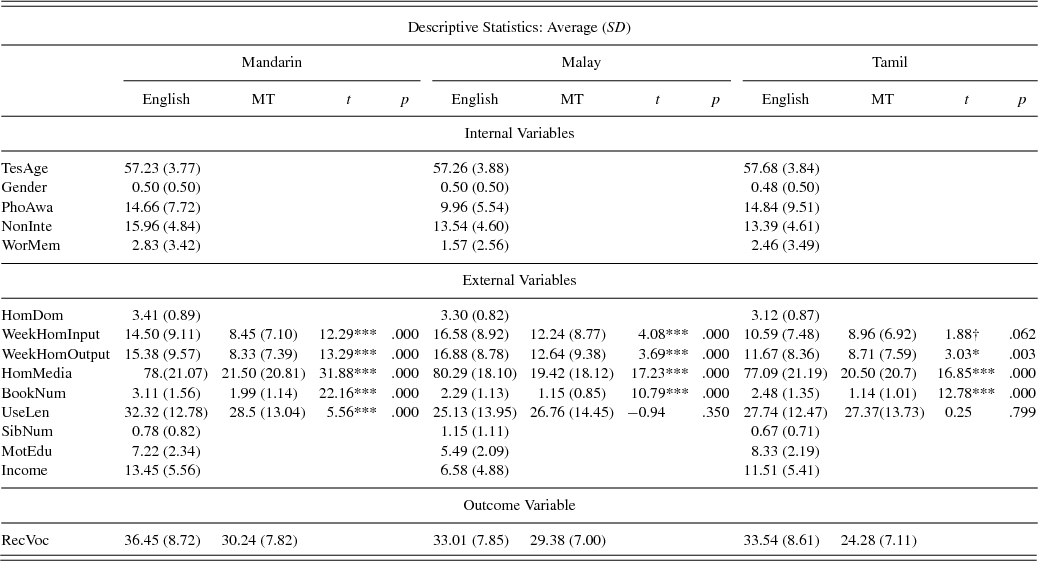
A parental questionnaire was administered that included items adapted from prior studies to explore children's home language exposure (Bedore et al., Reference Bedore, Peña, Summers, Boerger, Resendiz, Greene and Gillam2012; Gutiérrez-Clellen & Kreiter, Reference Gutiérrez-Clellen and Kreiter2003; Lim, Lincoln, Chan, & Onslow, Reference Lim, Lincoln, Chan and Onslow2008; Marian, Blumenfeld, & Kaushanskaya, Reference Marian, Blumenfeld and Kaushanskaya2007; Sénéchal, LeFevre, Thomas, & Daley, Reference Sénéchal, LeFevre, Thomas and Daley1998) and literacy environment (Burgess, Hecht, & Lonigan, Reference Burgess, Hecht and Lonigan2002; Farver, Xu, Eppe, & Lonigan, Reference Farver, Xu, Eppe and Lonigan2006; Phillips & Lonigan, Reference Phillips and Lonigan2009). Parents completed the questionnaire during the child's K1 school year. They provided information about the extent of English spoken at home on a 5-point scale (1 = never, 2 = rarely, 3 = sometimes, 4 = often, 5 = primary), the amount of English and MT language each family member (i.e., mother, father, grandparents, siblings, and others) spoke to children (0, 1/4, 1/2, 3/4, always), the amount of English and MT language children spoke to each family member (0, 1/4, 1/2, 3/4, always), the proportion of English and MT input from media at home, children's onset age of speaking English and the MT language, and the number of English and MT books at home. Children's family background information was obtained from another parental survey, including children's chronological age, number of older siblings, mother's educational level (i.e., highest degree), family income level (1–20, with S$500 increment for each higher level), and children's waking hours spent with each family member on a typical weekday and weekend. Children's weekly input and output in English and MT languages at home was calculated based on the waking hours and the proportion of each language used with family members. The length of English/MT output was calculated using the current age to subtract their onset age of speaking the language. Language dominance at home was estimated based on the item of the extent of English dominance at home. The larger the ranking number was, the more English (i.e., the less MT language) was assumed to be used in this family. In the end, there were nine external factors extracted from the parental questionnaires, five quantity oriented in nature (e.g., current weekly home input and output), and four quality oriented (e.g., number of language books in each language and number of older siblings; Table 1).
Raw scores of predictors and outcome variables

Note: TesAge, age at the time of testing in months; Gender, children's gender (0 = male, 1 = female); PhoAwa, phonological awareness based on sum of elision and blending tasks; WorMem, working memory score based on backward digits recall; NonInte, nonverbal IQ scores as a measure of analytic reasoning; HomDom, the extent of English dominance at home; WeekHomInput, the amount of language input to children at home in hours per week; WeekHomOutput, the amount of children's language output at home in hours per week; HomMed, the percentage of Media input in English and mother tongue; UseLen, number of months of children using English or mother tongue actively; BookNum, number of English or mother tongue books at home on a 1–7 point scale; SibNum, number of older siblings at home; MotEdu, mothers’ highest educational level; Income, monthly family income on a 1–20 increasing point scale; Vocab, receptive vocabulary size based on Bilingual Language Assessment Battery tests.
†p < .1. *p < .05. ***p < .001.
Outcome variables: Bilingual vocabulary knowledge tests
Participants took part in a locally developed, standardized receptive picture vocabulary task, Bilingual Language Assessment Battery (Rickard Liow, Sze, & Lee, Reference Rickard Liow, Sze and Lee2013), in both English language and their MT (based on their school records; Mandarin Chinese and Malay). Previously developed versions of the Bilingual Language Assessment Battery in Mandarin and Malay (Rickard Liow & Sze, Reference Rickard Liow and Sze2009) were used, and the items were translated into Tamil for the present study. Children participated in three practice items before proceeding to 80 trial items. The task had four response options, and children were asked to identify the picture that best corresponded to the word they heard. Stimuli were presented on an iPad monitor and via headphones. Approximately 1.6% of data were missing mainly due to parent's overlooking of an item in questionnaires, and expectation-maximization was used to replace the missing data.
Data preparation and analysis
The fundamental assumption of the current study is that Singapore preschoolers’ bilingual language development occurs in two types of settings: an input-rich setting for English learning and an input-poor setting for MT language learning. Paired t tests were used to explore the potential discrepancy in input and output between English and MT language and confirmed that English environment is significantly better than MT environment with regard to media input, number of books, weekly home input, and weekly home output across all three MT populations (Table 1). Among these exposure variables, media input has the largest discrepancy between English and MT languages.
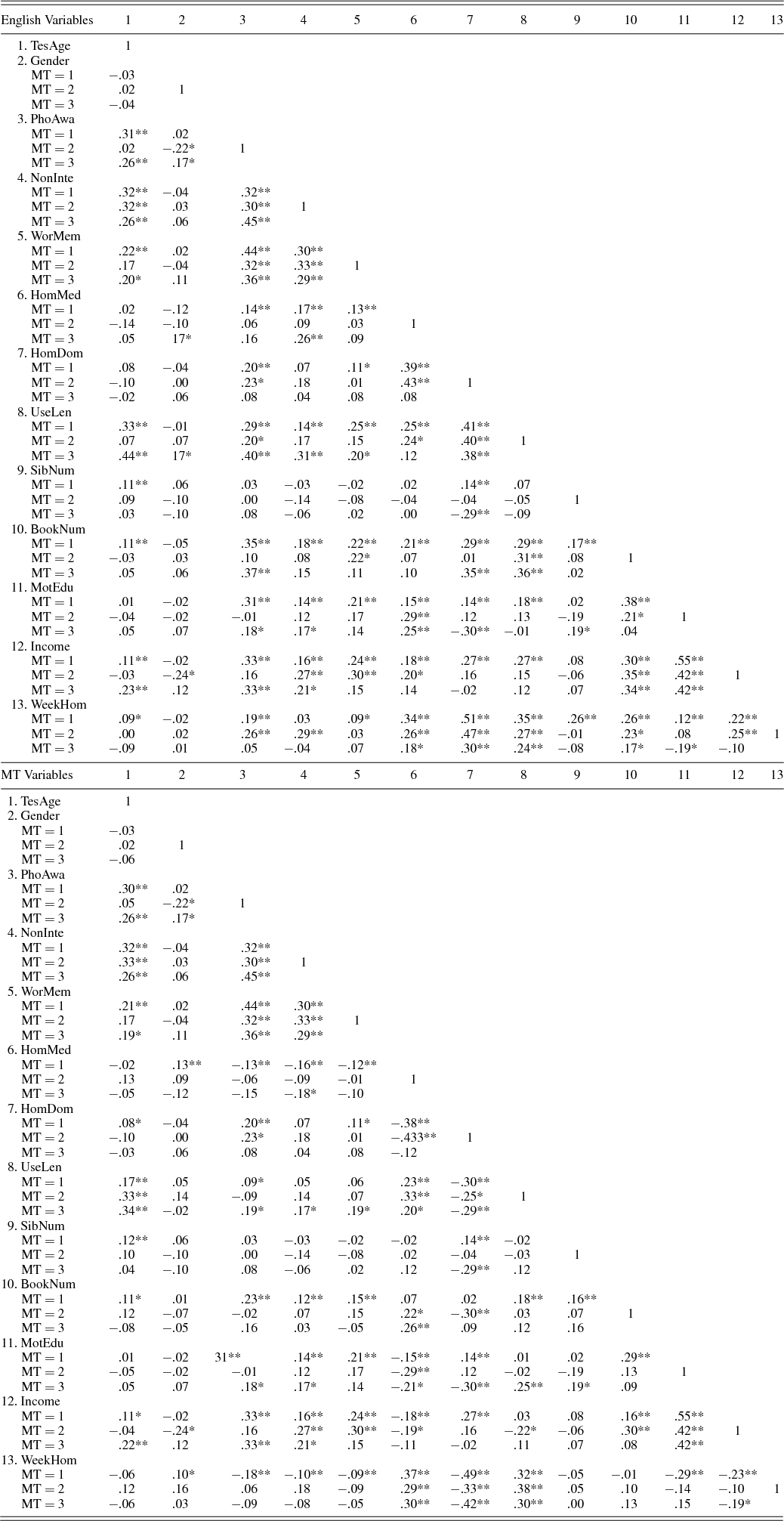
Regression models were used to explore the relative contribution of internal and external factors to children's English and MT receptive vocabulary knowledge. Children speaking different MT languages were investigated separately. Nonparametric Spearman correlations were conducted to check the relationships between the predictors. Those displaying a high correlation with other variables (r = .6–.9) would be averaged or excluded. Weekly home input was found to be highly correlated with weekly home output across three ethnic groups either in English or in MT language (e.g., English input and output of children in Mandarin group: r = .92). Therefore, values of the two variables were averaged into one score (e.g., WeekHomEng) to indicate general language usage at home per week. After the variable combinations, five internal factors were used in the subsequent analysis: age at the testing time (TesAge), gender (Gender), phonological awareness (PhoAwa), analytical reasoning (NonInt), and working memory (WorMem). Eight external factors were included: language input at home in general indicated by the extent of English dominance (LanDom), current weekly language usage at home (WeekHomLan), cumulative language output by children over years (UseLen), language input from media (LanMedia), mothers’ educational level (MotEdu), family income (Income), number of older siblings (SibNum), and number of books at home (BookNum). Table 2 presents the correlations between these predictors.
Nonparametric correlations of the predictors in the model analysis

Note: TesAge, age at the time of testing in months; Gender, children's gender (0 = male, 1 = female); MT, mother tongue; PhoAwa, phonological awareness based on sum of elision and blending tasks; NonInte, nonverbal IQ scores as a measure of analytic reasoning; WorMem, working memory score based on backward digits recall; HomMed, the percentage of Media input in English and mother tongue; HomDom, the extent of English dominance at home; UseLen, number of months of children using English or mother tongue actively; SibNum, number of older siblings at home; BookNum, number of English or mother tongue books at home on a 1–7 point scale; MotEdu, mothers’ highest educational level; Income, monthly family income on a 1–20 increasing point scale; WeekHom, the amount of language to children at home in hours per week. The number of MT languages refer to Mandarin (1), Malay (2), and Tamil (3).
* p < .05. **p < .01.
To answer Question 1, backward regression analyses were conducted to explore the best predictors of children's English and MT receptive vocabularies. Separate models were built according to language (English/MT) and for sets of children with different MT languages (Chinese/Malay/Tamil), for a total of 6 models. Backward regression has been used to address possible multicollinearity effects (Field, Reference Field2013), as some of the predictors were moderately correlated as demonstrated in Table 2. It is vital to make sure that large portions of explained variance of the dependent variable are not shared between predictors, in order to allow interpretability of effects and reliability of estimated coefficients (Sun, Steinkrauss, Tendeiro, et al., Reference Sun, Steinkrauss, Tendeiro and De Bot2016; Sun, Steinkrauss, Wieling, et al., Reference Sun, Steinkrauss, Wieling and de Bot2016). Variance inflation factor and tolerance indicators were examined for the six models, and all variance inflation factor values were below 10 and tolerance figures above 0.2, allowing us to safely conclude that there is no issue with multicollinearity in our final models (Field, Reference Field2013).
To answer Question 2, significant predictors selected by each final model in the backward regression analysis were categorized into two groups (internal factors vs. external factors) and were put in forced entry regression models. The aim is to demonstrate how internal factors and external variables are two distinct groups contributing to English and MT receptive vocabularies.
RESULTS
Regression analyses for English receptive vocabulary
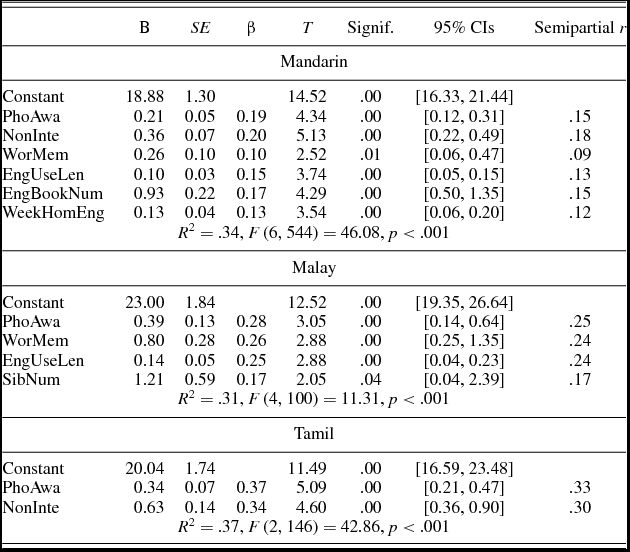
In order to address the first research question on the contribution of individual internal and external factors to English receptive vocabulary, children using different MTs were analyzed separately, and all 13 predictors were entered into each of the three backward regressions to find the best fitting models. The results are presented in Table 3 by MT language group (Part I: MT = Mandarin, Part II: MT = Malay, and Part III: MT = Tamil). All three models are significant and explained a large portion of the variance in English receptive vocabulary scores.
Backward regression model results for English receptive vocabulary

Note: PhoAwa, phonological awareness based on sum of elision and blending tasks; NonInte, nonverbal IQ as a measure of analytic reasoning; WorMem, working memory based on backward digits recall; EngUseLen, number of months that children using English actively; EngBookNum, number of English books at home on a 1–7 point scale; WeekHomEng, the amount of English usage at home in hours per week; SibNum, number of older siblings at home.
Specifically, in terms of Mandarin-speaking children, approximately 34% of the variance, F (6, 544) = 46.08, p < .001, could be explained by six predictors in the besting fitting model: phonological awareness, nonverbal intelligence, working memory, English use length, number of English books at home, and weekly English usage at home. Nonverbal intelligence made the largest contribution to English vocabulary (β = 0.20, semipartial r = .18). For Malay-speaking children, approximately 31% of the variance, F (6, 544) = 46.08, p < .001, could be explained by four predictors in the besting fitting model: phonological awareness, working memory, English use length, and number of older siblings. Phonological awareness made the largest contribution to English vocabulary (β = 0.28, semipartial r = .25). In terms of Tamil-speaking children, the final model explained about 37% of the variance, F (2, 146) = 42.86, p < .001, and two predictors were selected: phonological awareness and nonverbal intelligence. As in the model of Malay-speaking children, phonological awareness made the largest contribution to English vocabulary (β = 0.37, semipartial r = .33).
As a further step, hierarchical regression was conducted to answer the second research question that relates to the relative contribution of internal and external factors when taken as two different sets for predicting variation in children's English receptive vocabulary. For Mandarin-speaking children, a hierarchical regression analysis was conducted in which the internal factors (PhoAwa, NonInte, and WorMem) were entered as a first block and the external factors (EngUseLen, EngBookNum, and WeekHomEng) as a second block. Results revealed that the internal factors alone explained about 25% of the variance in English receptive vocabulary scores, R 2 = .25, F (3, 547) = 59.64, p < .001, and just 9% of additional variance was explained by entering the external factors, R 2 change = .09, F (6, 544) = 46.08, p < .001. The same analysis was conducted on predictors selected by Malay-speaking children's best fitting model. Internal factors (PhoAwa and WorMem) were entered as a first block, and the external factors (EngUseLen and SibNum) were put in as a second block. It was found that the internal factors alone explained about 21% of the variance in English receptive vocabulary scores, R 2 = .21, F (2, 102) = 59.64, p < .001, and 7% of additional variance was explained by entering the external factors, R 2 change = .070, F (4, 100) = 11.31, p < .001. In terms of Tamil-speaking children, since no external factors were found to be significant predictors for English receptive vocabulary, no forced entry regression was conducted to compare the variance explained by internal and external factors. Across all the three groups, it was found that internal factors explained more variance than external factors.
Regression analyses for MT receptive vocabulary
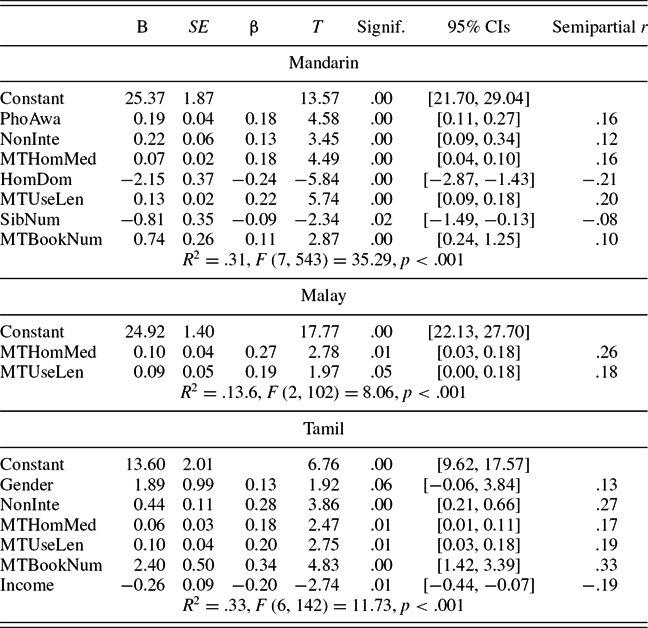
As with the English receptive vocabulary skills, backward regression was used on MT receptive vocabulary scores by language group (Table 4; Part I: MT = Mandarin, Part II: MT = Malay, and Part III: MT = Tamil) to address Question 1. In terms of Mandarin-speaking children, seven predictors were maintained in the final model: phonological awareness, nonverbal intelligence, media input in MT, the extent of English dominance at home, length of language output in MT, number of MT books at home, and number of older siblings. The model accounted for 31% of the variance in Mandarin receptive vocabulary, F (7, 543) = 35.29, p < .001. Among the seven predictors, home language dominance had the strongest contribution to Mandarin vocabulary (β = 0.24, semipartial r = .21). For Malay children, only two external factors, media input in MT and length of language output in MT, were maintained in the final model. They explained about 13.6% of the variance in Malay receptive vocabulary, F (2, 102) = 8.06, p < .001, with media input in Malay having the strongest contribution to Malay vocabulary (β = 0.27, semipartial r = .26). In terms of Tamil-speaking children, the best fitting model held six predictors, and all are significant: gender, nonverbal intelligence, media input in MT and length of language output in MT, number of books in MT, and family income. The final model captured approximately 33% of the variance in Tamil receptive vocabulary, F (6, 142) = 11.73, p < .001. Number of books in Tamil showed the largest contribution to Tamil vocabulary (β = 0.34, semipartial r = .33).
Backward regression model results for mother tongue receptive vocabulary

Note: PhoAwa, phonological awareness based on sum of elision and blending tasks; NonInte, nonverbal IQ as a measure of analytic reasoning; MTHomMed, the percentage of Media input in mother tongue languages; HomDom, the extent of English dominance at home; MTUseLen, number of months children using mother tongue languages actively; SibNum, number of older siblings at home; MTBookNum, number of mother tongue books at home on a 1–7 point scale; Gender, children's gender (0 = male, 1 = female); Income, monthly family income on a 1–20 increasing point scale.
As the next step, forced entry regression was used again to compare the impact from internal and external factors, respectively, addressing Question 2. For Mandarin-speaking children, internal factors from the best fitting model (PhoAwa and NonInte) were entered as a first block, followed by external factors (MTMedia, HomEngInput, MTUseLen, SibNum, and MTBookNum) as a second block, to calculate the R² change. The data show that internal factors alone explained 5% of the variance in Mandarin receptive vocabulary scores, F (2, 548) = 15.694, p < .001, and 26% of additional variance was explained by entering external factors, F (7, 543) = 35.287, p < .001. In terms of Malay-speaking children, since no internal factors were selected in the final model, all variance was explained by the external factors. For Tamil children, internal factors from the final model (Gender and NonInte) were entered as a first block, followed by external factors (MTMedia, MTUseLen, MTBookNum, and Income) as a second block. The data show that internal factors alone explained 7% of the variance in Tamil receptive vocabulary scores, F (2, 146) = 5.54, p = .005, and 26% of additional variance was explained by entering external factors, F (6, 142) = 11.73, p < .001. Therefore, contrary to significant factors of English receptive vocabulary, external factors were found to explain more variance than internal factors of MT receptive vocabulary across all the ethnic-language groups. This interesting distinction will be discussed in detail in the following session.
DISCUSSION
The current study examined how internal and external factors individually and as two sets affect the acquired vocabulary in English and MT language of very young Singapore bilinguals. This is one of the few studies that takes a comprehensive view to examine both internal and external factors on bilingual preschoolers’ dual language learning. More important, it aims at demonstrating how the learning environment may modulate the effects of internal and external factors on vocabulary learning. A common pattern for English receptive vocabulary was that predictors related to internal abilities (e.g., phonological awareness and working memory) explained more variance than external factors (e.g., length of language use), which was found to be consistent with findings of studies in input-rich environments (Paradis, Reference Paradis2011). In contrast, MT receptive vocabulary has an opposite pattern applied for all groups. Namely, external factors explained more variance in the data than internal factors, a pattern consistent with observations regarding language learning in input-poor environments (Sun, Steinkrauss, Tendeiro, et al., Reference Sun, Steinkrauss, Tendeiro and De Bot2016; Sun, Steinkrauss, Wieling, et al., Reference Sun, Steinkrauss, Wieling and de Bot2016).
Internal and external factors
Internal factors in English and MT receptive vocabulary
Phonological awareness, a measure of metalinguistic knowledge of phonemes and phonological structure, was found to significantly predict receptive English vocabulary for all bilingual learners and receptive Chinese vocabulary for Mandarin-speaking learners. Previous research has demonstrated the central role of phonological awareness in word reading and spelling (e.g., Gillon, Reference Gillon2004), and the present study extended such an association to vocabulary knowledge. General analytical reasoning ability, measured with Raven's Coloured Progressive Matrices, was a significant predictor for both Mandarin-speaking children's and Tamil-speaking children's English and MT receptive vocabulary. Working memory, measured by backward digit recall, also emerged as a significant predictor for English vocabulary with Mandarin-speaking and Malay-speaking children. These findings pertaining to the role of language aptitude are generally consistent with previous findings from child bilingual studies (French & O'Brien, Reference French and O'Brien2008; Paradis, Reference Paradis2011), demonstrating the robustness of language aptitude in predicting preschool children's bilingual receptive vocabulary knowledge. Furthermore, gender emerged as a significant predictor for Tamil vocabulary. Since such an association has been only observed in one ethnic group, we are reluctant to attribute this to biological reasons as explained in some studies (e.g., Eriksson et al., Reference Eriksson, Marschik, Tulviste, Almgren, Pérez, Wehberg and Gallego2012; Pivik et al., Reference Pivik, Andres and Badger2011), but suggest future studies to explore it from a social–cultural perspective.
External factors in English and MT receptive vocabulary
External factors are less consistent than internal factors in predicting English and MT receptive vocabulary, with only length of language output being common across the languages. We therefore discuss English and MT separately for the effect of external factors.
Language output in English (i.e., EngUseLen) was significantly associated with Mandarin-speaking and Malay-speaking children's English receptive vocabulary. Current weekly English usage, which included the average of English input and output at home, was also significant for Mandarin-speaking children's English receptive vocabulary. In general then, this finding points to the crucial role that language exposure, especially output, might play in child bilingual vocabulary knowledge, keeping in line with previous studies (Bohman et al., Reference Bohman, Bedore, Pena, Mendez-Perez and Gillam2010; Montrul, Reference Montrul2008; Paradis, Reference Paradis2011). The number of English books at home was found to significantly predict Mandarin-speaking children's English vocabulary knowledge. This echoes previous findings that a rich and sound literacy environment at home is important for vocabulary growth (e.g., the Turkish-Dutch children in Scheele et al., Reference Scheele, Leseman and Mayo2010). Finally, the number of older siblings was found to be positively related to Malay-speaking children's English vocabulary, consistent with findings on the importance of child-to-child communication in English learning (Gutiérrez-Clellen & Kreiter, Reference Gutiérrez-Clellen and Kreiter2003).
Similar to what was found for English, language output in MT was also associated with children's MT receptive vocabulary across the three ethnic groups. Even though previous research has argued for the importance of language use (i.e., output) in facilitating the development of accuracy and automaticity in grammar knowledge (Bohman et al., Reference Bohman, Bedore, Pena, Mendez-Perez and Gillam2010), the present study found that output is also important for vocabulary growth, as was observed for MT learning in our participants just as for English. Media input emerged as a significant factor across all three groups in predicting MT vocabulary, and the extent of English dominance at home was found to negatively correlate to Mandarin-speaking children's Chinese vocabulary. This generally confirms the importance of input quantity to child bilingual's vocabulary learning found by other studies (e.g., Place & Hoff, Reference Place and Hoff2011; Unsworth, Reference Unsworth2013). In an environment where children could only receive limited MT language input from home and school, media offers a particular channel for children to get valuable exposure. As was observed for English learning, number of MT books at home was also found to significantly predict Mandarin-speaking children's Chinese receptive vocabulary, and Tamil-speaking children's Tamil receptive vocabulary. Differing from English, the number of older siblings was found to be negatively associated with Mandarin-speaking children's Chinese vocabulary. The seemingly contradictory findings for English and MT might be explained from a sociolinguistic perspective. Older siblings in an immigrant family have been argued to introduce more society language to the home domain (Paradis, Reference Paradis2011). In the present study, conducted in a multilingual society, it did appear that siblings prefer to speak English, the societally dominant language, at home. Based on paired t tests, we have found a significant difference between siblings’ amount of time spent on English use and on MT use (t = 15.28, p = .000). Regarding the role of family income, previous findings on monolingual populations showed a positive relationship between SES and vocabulary skills (i.e., children from richer homes command a larger vocabulary than those from poorer homes). However, in the present study, family income was negatively related to Tamil vocabulary, a finding in Dixon, Zhao, et al.’s (2012) study as well, which may be explained by the preference of Singapore high-income Indian families to use English at home (e.g., Saravanan, Lakshmi, & Caleon, Reference Saravanan, Lakshmi and Caleon2007). In the current study, Tamil-speaking children's family income is found to be significantly and negatively correlated to children's weekly MT output at home (r = –.23).
To sum up, both internal and external factors have been found to significantly predict bilingual children's vocabulary knowledge. Specifically, language aptitude and language exposure (i.e., length of language output in months) functioned in a similar manner across the three ethnic groups on both English and MT languages. In terms of language aptitude, the current study demonstrates the underlying acquisition mechanism shared by the dual languages of a bilingual (Cummins, Reference Cummins1979) and verifies the fundamental role that phonemic coding ability, language analytic ability, and verbal memory plays in bilingual children's vocabulary knowledge (Paradis, Reference Paradis2011). The current study also highlights the crucial role of language output in bilingual children's vocabulary development. Language output as part of human psychological processes originates from collective behaviors (e.g., discourse) and facilitates the internalization of language knowledge as part of one's mental activity (Stetsenko & Arievitch, Reference Stetsenko and Arievitch1997; Swain, Reference Swain2007). In attempting to produce language, learners may begin to notice the gap between what they want to express and what they can express. In addition, erroneous language produced by the learner may invite implicit/explicit feedback from the interlocutors. These aspects of language output may therefore enable children to notice their linguistic limitations and to mitigate their language problems via conversations with competent speakers.
Internal factors versus external factors
The current study also shows that, at least in the learning of English, as a socially dominant language in Singapore, internal resources play a more significant role than external resources in vocabulary acquisition. This echoes findings of studies conducted in similar learning settings (e.g., Paradis, Reference Paradis2011). At the same time, our study shows that in the learning of MTs, that are considered less socially dominant, external resources should be given more weight, which also echoes previous findings (Sun, Steinkrauss, Tendeiro, et al., Reference Sun, Steinkrauss, Tendeiro and De Bot2016; Sun, Steinkrauss, Wieling, et al., Reference Sun, Steinkrauss, Wieling and de Bot2016). It revealed that learning contexts play an important role in determining the relative weight of internal versus external factors. Specifically, an input-rich context characterized by abundant language exposure allows the working of internal resources to manifest. In contrast, an input-poor context characterized by impoverished language input suppresses the role of internal factors. Paired contrasts showed a significant difference between English and MT learning contexts in terms of the quantity and quality of input, which we take to mean that the context for the English is more input-rich than that for the ethnic language.
In sum, there seems to be a seesaw effect between internal and external factors, depending on the learning context. This, as mentioned earlier in the paper, is reflective of assumptions in the critical mass hypothesis, in that we can see the input (external factors) as exerting a constraining effect on internal factors unless and until the former surpasses a threshold level (Marchman & Bates, Reference Marchman and Bates1994). Other studies showing the effect of critical mass include Bates, Bretherton, and Snyder (Reference Bates, Bretherton and Snyder1988), who found that vocabulary size was the best predictor of mean length of utterance at a later age, which can be taken to mean that complexity in language is contingent upon sufficient exposure to linguistic input enabling the extraction of linguistic patterns. Our explanation in terms of the difference in learning context finds broad support in the language acquisition literature as well. For instance, with regard to first language learning (an input-rich context), the argument has sometimes been that linguistic cognition (internal factor) trumps language input (external factor), illustrated in the so-called poverty-of-stimulus situations where grammatical competence emerges despite lack of decisive evidence in the input (Crain, Reference Crain1991; Singleton & Newport, Reference Singleton and Newport2004). In contrast, observations of instructed adult second language learners have frequently pointed to the lack of a role of internal factors (such as working memory; Clahsen & Felser, Reference Clahsen and Felser2006; Juffs, Reference Juffs2004) and to an increased importance of external variables (such as instruction and practice; Bley-Vroman, Reference Bley-Vroman1990).
The findings for Question 1 and Question 2 are compatible with the fundamental assumptions within the usage-based tradition, but expand on these assumptions. Findings for the first question in general support the assumption that language learning is an interaction between input material and domain-general characteristics. Bilingual children's vocabulary emerges from their experience with language (e.g., input and output), together with the general cognitive skills (e.g., phonological awareness) to make categorization and linguistic representations based on a rich memory of exemplars. Findings for the second question demonstrated the modulation of general learning context on the relationship between external and internal factors in bilingual children's vocabulary learning. While some researchers within the tradition of usage-based theory give primary recognition to the role of input properties such as frequency information (e.g., Ellis, Reference Ellis2002), we might consider adopting a more eclectic view about the weight of internal and external factors on language acquisition, answering the call of Dąbrowska (e.g., Reference Dąbrowska2012, Reference Dąbrowska2016), who addresses the importance of paying more attention to examining individual differences in learners’ internal and external resources while examining learning outcomes (see Verhagen & Mos, Reference Verhagen and Mos2016). Cognitive processes, such as categorization, chunking, rich memory, analogy, and cross-modal association, have been found to influence language development (Bybee, Reference Bybee2010), yet it remains unclear under which circumstances these factors better demonstrate their prominence. The current study revealed the dominant role of input environment at the initial stage of learning, showing that while both internal and external factors were crucial for bilingual children's vocabulary learning, they have different degrees of importance depending on the specific input context.
Limitations
There are several limitations of the present study. No causality between internal/external factors and receptive vocabulary knowledge could be generated from the current cross-sectional study. Researchers could adopt a longitudinal design to examine the association bidirectionally in the future. Moreover, only receptive vocabulary knowledge has been examined, and future studies could include knowledge from various language domains (e.g., expressive vocabulary and receptive grammar) to verify the impact of language learning context on these linguistic domains. Furthermore, language environment has been only comprehensively scrutinized at home, whereas contextual factors at preschool (e.g., MT instruction hours and teacher's proficiency level) may be similarly influential and should also be considered in future studies (Unsworth et al., Reference Unsworth, Persson, Prins and de Bot2015). In addition, estimating children's language environment based on parental survey is less objective and therefore not necessarily accurate. Environmental assessing technology, such as the language environment analysis system, might be adopted in future studies to more precisely capture the input and output quantity between a child and his/her family members. Last but not least, it remains unclear where the threshold is or when the critical mass is reached. Future studies might longitudinally follow older children from the same groups to explore the potential threshold.
Conclusion and implications
In the present study, we examined the influence of external and internal factors on Singapore bilingual children's receptive vocabulary knowledge in both of their languages. We found that, while both sets of factors explain lexical knowledge in each language, the relative contribution is different for English (the societal language) compared with ethnic languages. Specifically, internal factors explained more variance in English language vocabulary, whereas external factors were more important in explaining ethnic language knowledge. We attribute this difference to the crucial role of exposure in language learning, as suggested by the critical mass hypothesis. Our findings in general are consistent with previous research pointing to the role of the home language environment in the maintenance of heritage/ethnic languages (e.g., Dixon, Zhao, et al., Reference Dixon, Zhao, Quiroz and Shin2012). The significance role that external factors played in all three MT vocabulary supports Pearson's (Reference Pearson2007) comment that “learning to speak two language in one's personal or professional life is always a possibility, but never a given” (p. 399). If children could not enjoy ample input from the environment, their learning might be greatly affected. The results in the current study regarding language output imply that children can be encouraged to start to use their dual languages actively at a young age, as doing so would help build up their receptive vocabulary above and beyond the impact of language input (Sun, Steinkrauss, Tendeiro, et al., Reference Sun, Steinkrauss, Tendeiro and De Bot2016; Sun, Steinkrauss, Wieling, et al., Reference Sun, Steinkrauss, Wieling and de Bot2016). Future research may follow a group of preschoolers longitudinally and verify whether the discrepancy of effects of internal and external factors on English and MT learning would last over time. It would be necessary to further specify the amount of input and output children need to become fluent bilinguals in the interest of making concrete policy suggestions.
ACKNOWLEDGMENTS
We are indebted to Rasmus Steinkrauss for his comments on an earlier version of this manuscript. We also thank the research assistants of the Singapore Kindergarten Impact Project for collecting data.