To select the right words in the appropriate language, it is assumed that bilinguals implement control processes. To investigate bilingual control, language-switching paradigms have frequently been used in which bilinguals name pictures or digits, and in which the required language is indicated by a cue (e.g., differently colored squares for different languages). In these cued language-switching studies, it is commonly found that performance in language-switch trials deteriorates. That is, reaction times (RTs) and error rates increase in language-switch trials in comparison to language repetitions (see, e.g., Christoffels, Firk & Schiller, Reference Christoffels, Firk and Schiller2007; Costa & Santesteban, Reference Costa and Santesteban2004; Declerck, Koch & Philipp, Reference Declerck, Koch and Philipp2012; Fink & Goldrick, Reference Fink and Goldrick2015; Macnamara, Krauthammer & Bolgar, Reference Macnamara, Krauthammer and Bolgar1968; Verhoef, Roelofs & Chwilla, Reference Verhoef, Roelofs and Chwilla2009). These language-switch costs have been taken to reflect processes of language control (see Declerck & Philipp, Reference Declerck and Philipp2015, for a review).
In 1:1 cue-to-language mappings, language repetitions are triggered by cue repetitions, and language switches by cue switches. In research on switching non-linguistic tasks (see, e.g., Kiesel, Steinhauser, Wendt, Falkenstein, Jost, Philipp & Koch, Reference Kiesel, Steinhauser, Wendt, Falkenstein, Jost, Philipp and Koch2010, for a review), it has been shown that not only task switches but also cue switches could result in performance costs (see, e.g., Forstmann, Brass & Koch, Reference Forstmann, Brass and Koch2007; Logan & Bundesen, Reference Logan and Bundesen2003; Mayr & Kliegl, Reference Mayr and Kliegl2003). Logan and Bundesen (Reference Logan and Bundesen2003) argued that perceptual encoding of the cue is facilitated by cue-repetition priming, which might increase the estimate of switch costs (see Jost, De Baene, Koch & Brass, Reference Jost, De Baene, Koch and Brass2013, for a review). This cue-switch effect raises the question of whether cue-priming benefits also contribute to language-switch costs. If so, language-switch costs might be caused in part, or even entirely, by switching between cues instead of switching between languages per se.
So far, only one language-switching study implemented more than one cue for each language. In this study, Philipp and Koch (Reference Philipp and Koch2009) examined the contribution of cue priming on so-called n-2 language-repetition costs when switching between three languages (A, B, and C). These costs can be calculated by comparing language sequences of the ABA type (n-2 repetition) with CBA-sequences, and the presence of n-2 repetition costs may serve as an index of inhibition (Mayr & Keele, Reference Mayr and Keele2000; see Koch, Gade, Schuch & Philipp, Reference Koch, Gade, Schuch and Philipp2010, for a review). In fact, Philipp and Koch (Reference Philipp and Koch2009) found reliable n-2 language-repetition costs even when the contribution of n-2 cue repetitions was removed. In this way, they provided a purer demonstration of inhibitory language-control processes. Yet, as their study focused exclusively on n-2 language repetition costs, the standard comparison of (n-1) language switches versus language repetitions was not included.
The goal of the present study was to disentangle cue-switch costs from language-switch costs. We implemented a 2:1 cue-to-language mapping in two experiments (Experiment 1A and Experiment 1B). In both experiments we had participants name pictures either in German or English according to the gender of faces. However, instead of using only one cue for each language (i.e., one male and one female face), two cues were assigned to each of the two languages (i.e., two male and two female faces). With this procedure, three trial types can be distinguished: cue-repetition trials (cue and language repeat), cue-switch trials (cue switches, but the language repeats), and language-switch trials (cue and language both switch). Cue-priming benefits were measured by comparing performance in cue-switch trials versus cue-repetition trials (cue-switch contrast). To remove the contribution of cue-priming benefits, language-switch costs were measured by comparing performance in language-switch trials versus cue-switch trials (language-switch contrast).
The potential contribution of cue-switch costs to the overall costs in cued language switching has not been examined so far. This examination is important because language switching and task switching differ in various ways, such as in the number of response alternatives (which is typically much larger in language switching than in task switching; see, e.g., Declerck & Philipp, Reference Declerck and Philipp2015; Weissberger, Gollan, Bondi, Clark & Wierenga, Reference Weissberger, Gollan, Bondi, Clark and Wierenga2015, for a discussion), so that the validity of the interpretation of switch costs in cued language switching as an empirical marker of bilingual control still needs to be demonstrated. In fact, we expected to find a substantial influence of cue switching, so that the critical issue was whether we would also find substantial ‘pure’ language-related switch costs.
Moreover, language-switch costs have been explained by assuming inhibitory control (e.g., Green, Reference Green1998). Specifically, switch costs are sometimes larger when switching to the first language (L1) than when switching to L2 (e.g., Meuter & Allport, Reference Meuter and Allport1999). This switch-cost asymmetry is consistent with the idea that the dominant L1 needs to be inhibited more when performing in L2 due to relatively higher activation, and that this inhibition hampers performance when switching back to L1. The robustness of asymmetric language-switch costs and the underlying inhibitory mechanisms are still under debate (see, e.g., Bobb & Wodniecka, Reference Bobb and Wodniecka2013; Declerck, Thoma, Koch & Philipp, Reference Declerck, Thoma, Koch and Philipp2015, for discussion). Given the critical issue of a potential contribution of cue priming, it is important to explore whether the switch-costs asymmetry, if it is observed at all, is due to an asymmetry of the effects of cue priming, language switching, or both.
Method
Participants
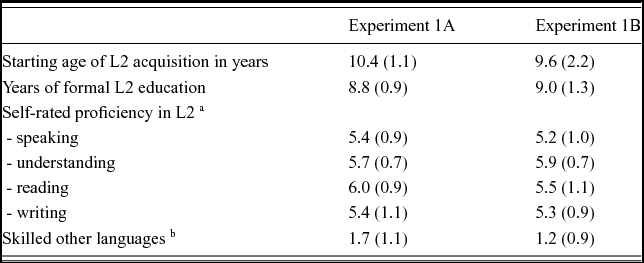
In Experiment 1A, 24 students (21 women, 3 men, Mage = 22.1 years (SD = 3.15), range: 18–33 years) of the RWTH Aachen University, who spoke German as their L1 and English as their L2, participated and received €6 or partial course credit. In Experiment 1B, 24 (newly, but similarly recruited) students (20 women, 4 men; Mage = 22.0 years (SD = 3.26), range: 18–29 years) participated. Information about L2 age of acquisition, years of formal L2 education and self-rated L2 proficiency were collected prior to the experiments (Table 1).
Mean scores (SD in parentheses) of self-rated proficiency in English (L2) of participants in Experiment 1A (24) and Experiment 1B (24).

Note. a Self-rated proficiency was measured on a 7-point scale, b Skilled other languages does not include English (L2)
Stimuli and Materials
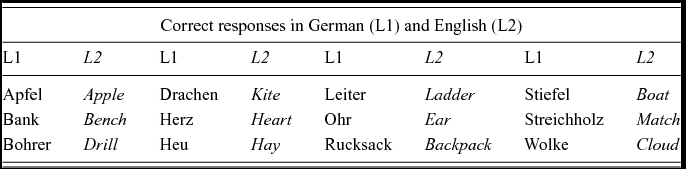
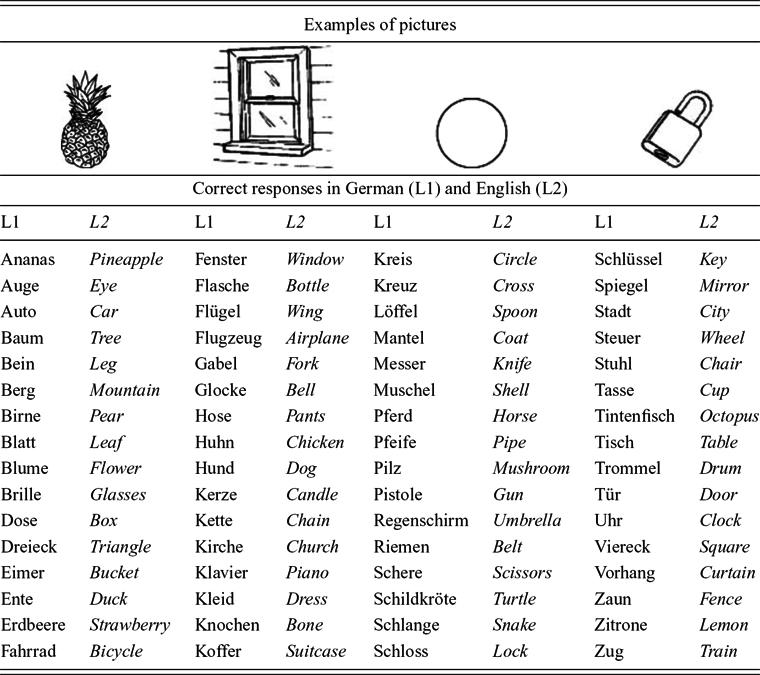
Sixty-four black line drawings were selected as to-be-named pictures for experimental trials and 16 for practice trials (see Appendix, Table A1 and A2). To-be-named pictures were 4.7 cm in width and 4.5 cm in height and their upper border was placed 0.5 cm below the border of a centered fixation cross (0.5 cm by 0.5 cm). As cues, grayscale photos of female and male faces were used. Two male faces were mapped to L1 and two female faces to L2, or vice versa, counterbalanced across participants. In Experiment 1A, faces were from familiar and unfamiliar politicians, musicians, and athletes, whose native language was German, English, or Dutch. Experiment 1B was a replication of Experiment 1A, but we omitted the unfamiliar faces. For exploratory reasons, we included a variation of face familiarity and implied language, but this did not significantly affect the data pattern and thus will not be reported in more detail.Footnote 1
Within an imaginary square with the same dimensions as the to-be-named pictures, a face appeared simultaneously, but above the fixation cross, on a white background. Cues and stimuli were presented by E-prime version 1.1.4.1 on a 15-inch monitor. Viewing distance was approximately 60 cm. Speech onsets were recorded by a voice-key and naming errors were recorded by the experimenter.
Procedure
Participants were tested individually and experiments lasted about 30 minutes. After a short introduction, the 64 to-be-named pictures were shown on a single sheet of paper. Participants were asked to name the pictures all first in German and then in English. When picture naming was different from the standard name, naming was corrected. When a participant did not know the name of a picture, the name was given orally. After this practice session, participants were instructed that, if they would not know the name of a picture in the experiment, they had to say “nein” in German or “no” in English, depending on the required language.
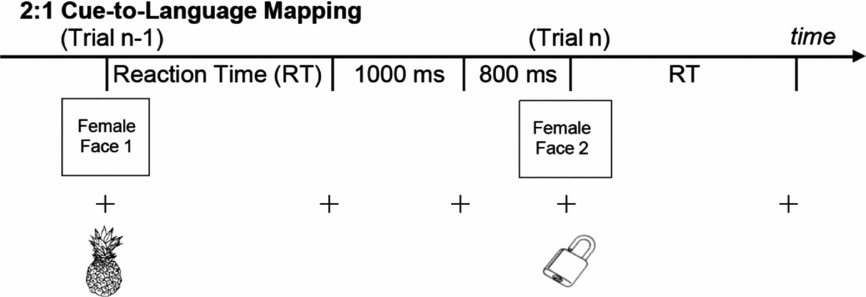
Participants had to name pictures in L1 or L2 depending on the gender of the face (e.g., male face means German and female face means English). In a block, two different male faces were assigned to naming in English and two different female faces to naming in German, or vice versa, counterbalanced across participants. There were short practice blocks (16 trials). In each block of the four experimental blocks of 64 trials, there was an equal number of L1 and L2 picture-naming trials, an equal number of language-repetition and language-switch trials, and to-be-named pictures appeared once. A trial started with a centered fixation cross. After 800 ms, a face and a picture appeared. Stimuli remained on the screen until the voice-key recorded a response. The interval between the onset of the voice-key and the onset of next trial was 1000 ms (see Figure 1). Participants started next blocks by pressing the spacebar after a self-paced pause. Participants were asked to respond as fast as possible while remaining accurate.
Time course of trials in Experiment 1A and 1B. According to the gender of the face above the centered fixation cross, participants named the picture below either in their first language (German) or their second language (English). “Female Face 1” and “Female Face 2” represent different photos of female faces (e.g., the face of Madonna (Face 2) and B. Spears (Face 1)). The depicted trial is an example of a cue-switch trial in which the cue has switched (from “Female Face 1” to “Female Face 2”) and the language (cued by the gender of the face, e.g., female is German) repeats. The size of cues and pictures are not up to scale in this figure.

Design
The independent within-subjects variables were language (L1 vs. L2) and transition (language switch, cue switch, cue repetition). We defined two non-orthogonal contrasts: the cue-switch contrast (cue switches vs. cue repetitions) and the language-switch contrast (language switches vs. cue switches). We also included experiment (Experiment 1A vs. 1B) as between-subjects variable. The dependent variables were RT and error rates.
Results
The first trial of each block (for both Experiment 1A and 1B, 1.6%), RTs below 200 ms (for Experiment 1A, 0.4%; for Experiment 1B, 0.6%), and erroneous trials (e.g., technical errors, stuttering, naming errors) plus trials preceded by an error (for both Experiment 1A and 1B, 20%), were discarded from RT analysis. RTs three standard deviation (SD) above or below each participant's mean RT (0.5% for both Experiment 1A and 1B) were replaced by the respective RT at three SD above or below each participant's mean. In accuracy analysis only ‘true naming errors’ were included (including hesitations, stuttering, wrong naming responses, and “no” and “nein” responses), excluding all other types of errors (e.g., technical errors).
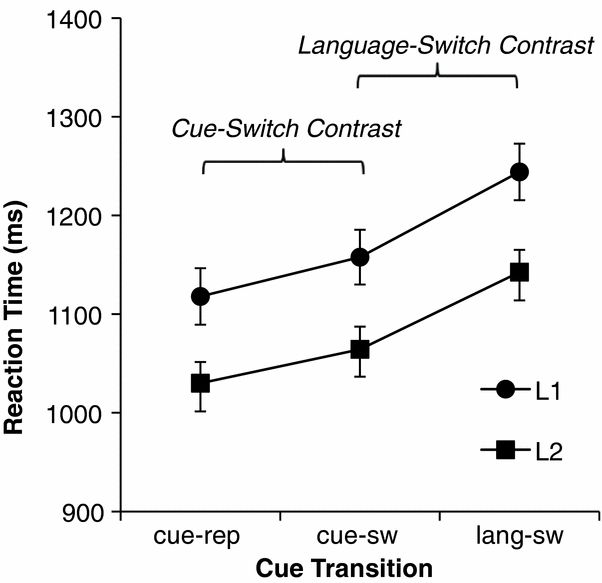
For RT and accuracy, results were analyzed in mixed analyses of variance (ANOVAs) with language (L1 vs. L2) and transition as within-subjects variables and experiment (Experiment 1A vs. Experiment 1B) as a between subjects variable (α set at < .05). In these ANOVAs, it turned out that experiment did not make any significant contribution, neither as a main effect nor in modifying other effects (i.e., interactions). Therefore, for simplicity, below we only report the effects of language and transition. Figure 2 presents mean RTs for cue-repetition trials, cue-switch trials, and language-switch trials, for picture naming in L1 and L2 (see Table 2 for accuracy data).
Mean reaction time as a function of cue transition (cue-rep(etitions), cue-sw(itches), and lang(uage)-sw(itches)) and picture naming in German (L1) and English (L2). Cue-priming benefits are reflected in the cue-switch contrast (i.e., RTs in cue-switch trials minus RTs in cue-repetition trials) and language-switch costs in the language-switch contrast (i.e., RTs in language-switch trials minus RTs in cue-switch trials). For simplicity, results of Experiment 1A and 1B are not presented separately in this figure. Error bars indicate ± one standard error of the mean.

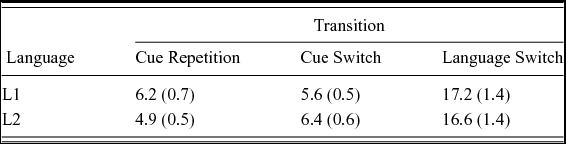
Mean error rates (in percentages, with standard errors in parentheses) as a function of transition (cue repetitions, cue switches, and language switches) and picture naming in German (L1) and English (L2). For simplicity, results of Experiment 1A and 1B are not presented separately in this table.

Cue-priming contrast
For the cue-priming contrast, the ANOVA for RT revealed a main effect of language (F(1, 46) = 22.8, p < .001, η2 p = .331) and transition (F(1, 46) = 11.6, p = .001, η2 p = .202), indicating that RTs in L1 (M = 1138 ms, SE = 27.2) were 91 ms longer than in L2 (M = 1047 ms, SE = 20.7), and RTs in cue-switch trials (M = 1111 ms, SE = 23.1) were 37 ms longer than in cue-repetition trials (M = 1074 ms, SE = 22.6), revealing a component of switch costs driven exclusively by cue priming, not by language switching. The interaction of transition and language was not significant (F < 1).
The corresponding ANOVA for accuracy revealed no main effects of language and transition (Fs ≤ 1). However, the two-way interaction between language and transition was significant (F(1, 46) = 4.95, p = .031, η2 p = .097), indicating asymmetric cue-switch costs. That is, in L2 participants made fewer errors in cue-repetition trials (4.9%, SE = .54) than in cue-switch trials (6.4%, SE = .65; that is, cue-switch costs of 1.5%) (F(1, 46) = 6.31, p = .016, η2 p = .121, when tested separately), whereas there was no significant cue-switch effect in L1 (F < 1; 6.2%, SE = .68, in cue repetition trials vs. 5.6%, SE = .55, in cue-switch trials).
Language-switch contrast
For the language-switch contrast, the ANOVA for RT revealed a main effect of language (F(1, 46) = 33.4, p < .001, η2 p = .421) and transition (F(1, 46) = 67.4, p < .001, η2 p = .594), indicating that RTs in L1 (M = 1201 ms, SE = 27.4) were 98 ms longer than in L2 (M = 1103 ms, SE = 21.8), and that RTs in language-switch trials (M = 1193 ms, SE = 24.5) were 82 ms longer than RTs in cue-switch trials (M = 1111 ms, SE = 23.1), revealing substantial language-switch costs. The two-way interaction between language and transition was not significant (F < 1). This indicates that language-switch costs did not significantly differ (i.e., were not asymmetrical) for L1 (86 ms) and L2 (79 ms).
The corresponding analysis for accuracy revealed an effect of transition (F(1, 46) = 118.9, p < .001, η2 p = .721), indicating more errors in language-switch trials than in cue-switch trials (16.9% vs. 6.0%). The main effect of language and the interaction between language and transition was not significant (F < 1).
Discussion
The aim of the present study was to explore the contribution of cue processing in cued language switching. We introduced two different cues for each language (a 2:1 cue-to-language mapping), so that we could distinguish between language switches, cue switches, and cue-repetitions. The performance difference between language switches (cue and language switched) and cue switches (cue switched, but the language repeated) would thus reflect language-switch costs. We found a cue-switch effect (37 ms) and in addition language-switch costs (82 ms). Overall, we found slower responses for L1 than for L2, which have been observed in several language switching studies and has been attributed to sustained L1 inhibition (e.g., Christoffels et al., Reference Christoffels, Firk and Schiller2007; see also Bobb & Wodniecka, Reference Bobb and Wodniecka2013, for a review).
The results of our study generally support the inference of other studies that language-switch costs reflect, at least to some degree, the time taken by control processes needed for adequate language selection. Yet, the present finding also suggests that previously reported findings using 1:1 cue-to-language mappings might have reflected some cue-switch costs as well. Moreover, in the present study, the influence of cue switching might even have been underestimated because the two cues mapped to each language could have easily been categorized by the sex of the faces, so that the contribution of cue-switch costs to overall measured switch costs might be even larger with less easily categorizable cues.
Notably, with regard to ‘pure’ language-related switch costs we did not observe an asymmetry. This is not a novel finding. Language dominance, modality, differential levels of preparation, and the duration of the inter-trial interval have been proposed as variables that potentially influence the switch-cost (a)symmetry (for reviews, see Bobb & Wodniecka, Reference Bobb and Wodniecka2013; Declerck & Philipp, Reference Declerck and Philipp2015). In the present study, the latter might be most conceivable as a large inter-trial interval was implemented, which has been shown to decrease and even abolish asymmetric switch costs (e.g., Verhoef et al., Reference Verhoef, Roelofs and Chwilla2009).
However, our results indicated an asymmetrical effect of language on cue-switch costs in the error rates. Interestingly, these cue-switch costs were larger for L2 than for L1, which is the opposite of the occasionally reported asymmetric language-switch costs (e.g., Meuter & Allport, Reference Meuter and Allport1999; see Bobb & Wodniecka, Reference Bobb and Wodniecka2013, for a review), possibly suggesting that cue-priming benefits might be stronger for the less dominant language. At this stage, in the absence of a corresponding asymmetry in RT it is not clear whether this effect reflects a robust finding or rather a false positive. Still, this finding might encourage future studies to investigate differential cue-priming effects for the dominant versus the less dominant language and how these effects interact with other factors (e.g., cue type, the inter-trial interval, language dominance, and modality) in cued language switching.
Conclusion
This study aimed at exploring the role of cue processing in cued language switching by using a 2:1 cue-to-language mapping. We found that cue repetitions resulted in a facilitation (priming) of performance relative to cue switches that still indicated the same language. Yet, we also found a substantial benefit of language repetitions with cue switches relative to language switches. Hence, even though we found a non-negligible effect of cue priming on switch costs, we conclude that at least a substantial portion of language-switch costs assessed in cued language switching may still be taken to reflect language control processes.
List of correct responses of practice trial pictures in Experiment 1A and 1B.

Examples of pictures and list of correct responses of the 64 experimental pictures in Experiment 1A and 1B.