Measles is a highly contagious infectious disease transmitted by respiratory droplets and aerosolized particles or through contact with nasal or throat secretions from infected persons. Measles virus has the highest basic reproductive number among all infectious pathogens; a single person with measles can infect 9–18 susceptible people. However, 2 doses of measles vaccine given at appropriate intervals are 97% effective.Reference Moss1 Seroprevalence studies in Hong Kong showed a persistently high herd immunity >95% against measles.2 However, international travel facilitates intercontinental measles transmission,Reference Jost, Luzi, Metzler, Miran and Mutsch3 which can affect the small number of unimmunized persons and those with primary or secondary vaccine failure.Reference Bitzegeio, Majowicz, Matysiak-Klose, Sagebiel and Werber4 Outbreaks of measles have been reported in international airports in the United Kingdom, The Netherlands,Reference Nic Lochlainn, Mandal and de Sousa5 the United States,Reference Coleman, Burke and Welstead6–Reference Banerjee, Hickman, Engels and Kenyon8 and Japan.Reference Watanabe, Kobayashi and Shimada9 Nosocomial outbreaks of measles in emergency departments, triage wards, and waiting rooms of the hospitals have also been summarized.Reference Botelho-Nevers, Gautret, Biellik and Brouqui10 However, a direct linkage of measles transmission between airport and hospital has not been described. Here, we report a hospital outbreak of measles in Hong Kong with a clear epidemiological link to an airport outbreak.
Methods
Epidemiological investigation in Hong Kong International Airport (HKIA)
An outbreak of measles was observed among staff working in HKIA between March and April 2019. The setting of HKIA and local epidemiology of measles are illustrated in Supplementary File 1 online. Clinical criteria of measles were defined as a person presenting with generalized rash lasting for ≥3 days, fever of ≥38.3°C, and at least 1 of the following symptoms: cough, coryza, or conjunctivitis. A laboratory-confirmed case of measles was defined as a person with positive serology for measles IgM antibody, and/or positive reverse transcriptase-polymerase chain reaction (RT-PCR) for measles RNA in nasopharyngeal and/or throat swabs. The on-site investigation was initially performed by a team of epidemiologists from the Centre for Health Protection (CHP) to identify the possible source of infection. A seroprevalence survey was performed for HKIA staff, and MMR vaccines were provided to staff working in HKIA according to risk stratification. A joint investigation was also performed by a team of epidemiologists and infection control professionals with the senior management and the engineering team of HKIA, and particular attention was given to the air ventilation system of HKIA. Air samples were collected from the baggage reclaim hall for measles RNA detection. In addition, air filters of the ventilation system supplying the immigration hall, the baggage reclaim hall, and the self-service food premises with measles-infected staff were retrieved for measles RNA detection. Direct observation of infection control practices at the self-service food premises with measles-infected HKIA staff was performed, from issuing of food items put on trays to cleaning of food trays returned to the kitchen.
The epidemiological characteristics and epidemic curve of the laboratory-confirmed measles cases in HKIA and the community were analyzed. The end of outbreak was defined as the lack of new cases of measles for 42 days (2 incubation periods) after the isolation of the last infected patient. Reports of measles outbreak at the airport were reviewed. This study was approved by the Institutional Review Board of The University of Hong Kong/Hospital Authority Hong Kong West Hospital Cluster.
Environmental surveillance and laboratory investigations
Air samples and swabs from the ventilation filters of the HKIA air ventilation system were collected (Supplementary File 2 online). The clinical specimens and air samples were submitted for measles RNA detection, sequencing, and phylogenetic analysis of hemagglutinin (H) and nucleoprotein (N) gene (Supplementary File 3 online).
Infection control preparedness and investigation for measles outbreak in hospitals
In response to the outbreak of measles in HKIA, proactive infection control measures (Supplementary File 4 online) were implemented by our Hospital Authority, a governing body of 7 healthcare networks with 43 public hospitals in Hong Kong as described previously.Reference Cheng, Lau, Woo and Yuen11–Reference Cheng, Lee, Sridhar, Ho and Yuen16 Also, 2 frontline healthcare workers (HCWs) working in hospital A were infected with measles, but neither had history of travel outside Hong Kong nor visits to HKIA during the incubation period of measles. Therefore, an outbreak investigation for possible nosocomial acquisition of measles was initiated.
Statistical analyses
The χ2 or Fisher exact test was used to compare independent categorical variables between groups. All reported P-values were 2-sided. A P-value <.05 was considered to be statistically significant. SPSS version 19 software (IBM, Armonk, NY) was used to perform the statistical analyses.
Results
Epidemiological investigation in HKIA
From March 4 to April 3, 2019, 29 staff working in HKIA were confirmed to have measles. No measles-infected flight passengers were identified upon arrival at Hong Kong. Among the measles-infected staff, 20 were male and 9 were female, with a median age of 25 years (range, 20–49); 7 (24.1%) were born between 1967 and 1984; 22 (75.9%) were born in or after 1984; and 25 (86.2%) were of Chinese ethnicity. The assignments of the affected HKIA staff included passenger service team (n = 7, 24.1%), baggage service team (n = 6, 20.7%), security team (n = 6, 20.7%), self-service food premises or retail shops (n = 3, 10.3%), in-flight service team (n = 2, 6.9%), immigration service team (n = 1, 3.4%), ramp service team (n = 1, 3.4%), and train service team (n = 1, 3.4%). Among this group of 29 workers, 9 (31.0%) had a history of travel during the incubation period of measles: 3 to mainland China, 2 to Japan, 1 to the Philippines, 1 to Taiwan, 1 to Thailand, 1 to the United States and South Korea. Infected HKIA staff were advised to refrain from duty during the infectious period. Exposed persons were contacted and advised to seek medical attention immediately if they developed a fever and/or a rash. The seroprevalence of measles was assessed among HKIA staff. Of 100 staff randomly tested for measles IgG, 17 of 17 persons born before 1967 were positive, whereas 39 of 46 (84.8%) persons born between 1967 and 1984 were positive, and 30 of 37 (81.1%) persons born in or after 1985 were positive. A total of 8,501 doses of MMR vaccine had been delivered to HKIA staff as of May 17, 2019. Interviews with the individual staff did not identify a common source of infection. Of 9 staff who could recall detailed exposure history, 6 (66.7%) had visited self-service food premises during incubation. On-site inspection revealed that the food trays, a shared food utensil in self-service food premises, were not washed or properly disinfected after use. This has important infection control implication because the food trays were commonly handled by all customers in these self-service food premises.
With regard to the HKIA air ventilation system, the proportion of outside air intake was increased from 15% at baseline to the maximum level of 30% on March 30, 2019. After maximizing outside air intake, the outside air intake for circulation space was 33 liters per second (L/s) per person in HKIA, which is much higher than the required minimum ventilation rate (2.5 L/s per person) for public assembly spaces.17
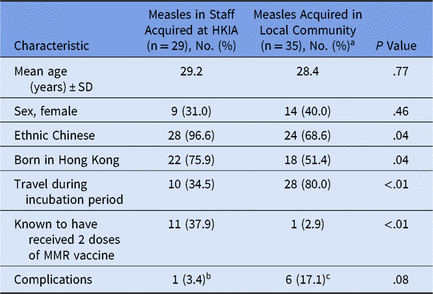
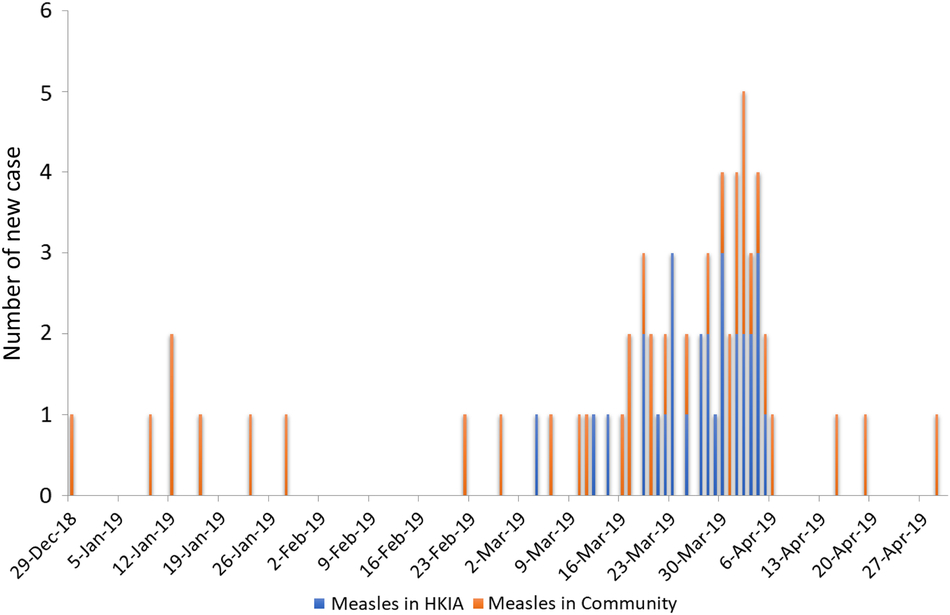
The measles-infected HKIA staff had a higher proportion of ethnic Chinese, history of 2 doses of MMR vaccines, and lower proportion of traveling outside Hong Kong during the incubation period for measles than the persons with non–HKIA-related community-acquired measles (Table 1). The epidemic curve of measles infections between January and April 2019 is illustrated in Fig. 1. The outbreak ended on May 17, 2019.18 Reports of measles outbreaks in international airports in the past decade are summarized in Supplementary Table 1 online.
Epidemiological Characteristics of Measles-Infected Staff of the Hong Kong International Airport (HKIA) and in the Community from January to April 2019

Note. SD, standard deviation.
a The 2 healthcare workers who acquired measles infection in hospital A were excluded.
b 1 patient developed deranged liver function tests.
c 5 patients developed deranged liver function tests and 1 patient had pneumonia.
Epidemic curve of laboratory-confirmed measles infection in the HKIA and community between January 2019 and April 2019 in Hong Kong.

Environmental surveillance in HKIA
Two air samples were collected from the baggage reclaim hall (south and north); and air filters were retrieved from the air ventilation system supplying the south immigration hall (2 filters); the north immigration hall (2 filters), baggage reclaim hall (2 filters), and the self-service food premises (where measles-infected staff worked during their respective incubation and infectious periods). All specimens had no detectable measles RNA.
Infection control preparedness and investigation for measles outbreak in hospitals
To prevent nosocomial transmission of measles in hospitals, patients with clinical symptoms suspicious of measles and epidemiological link, either working in HKIA or who contact with a confirmed case during the infectious period, would be transferred to the airborne infection isolation room (AIIR) upon presentation to Accidental and Emergency Department (AED) or outpatient clinic. Nasopharyngeal and throat swabs were collected for the detection of measles RNA by RT-PCR. If the initial RT-PCR was negative, nasopharyngeal and throat swabs were repeated and blood was collected for measles IgM on day 4 of rash to exclude a diagnosis of measles. Pregnant HCWs were exempted from working in the triage area of AEDs, outpatient clinics, and AIIRs. The MMR vaccine was offered to HCWs born in or after 1967 who had not received 2 documented doses of vaccine. In total, 5,493 HCWs were vaccinated between April 1, 2019, and May 17, 2019 (at the time of writing). Also, 45 staff forum sessions were arranged for HCWs. From January to April 2019, 21 measles-infected patients were admitted across 12 different public hospitals, and 1,064 exposed persons (440 patients and 624 HCWs) were traced to assess their immunity against measles. Moreover, 45 (4.2%) exposed persons (19 patients and 26 HCWs) had no or unknown immunity against measles, and a postexposure MMR vaccination was given to 22 immunocompetent persons, and intravenous immunoglobulin was given to 3 persons with an immunocompromised state. Also, 2 secondary measles-infected HCWs were identified.
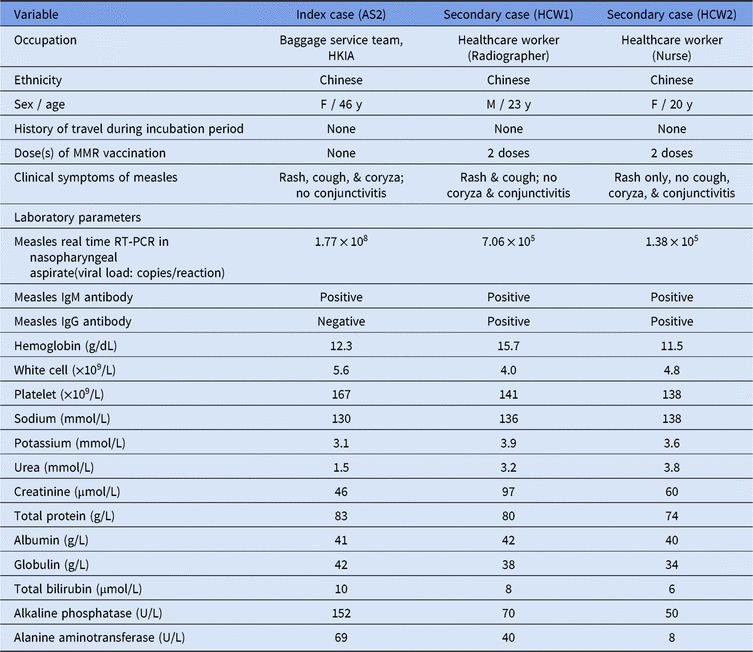
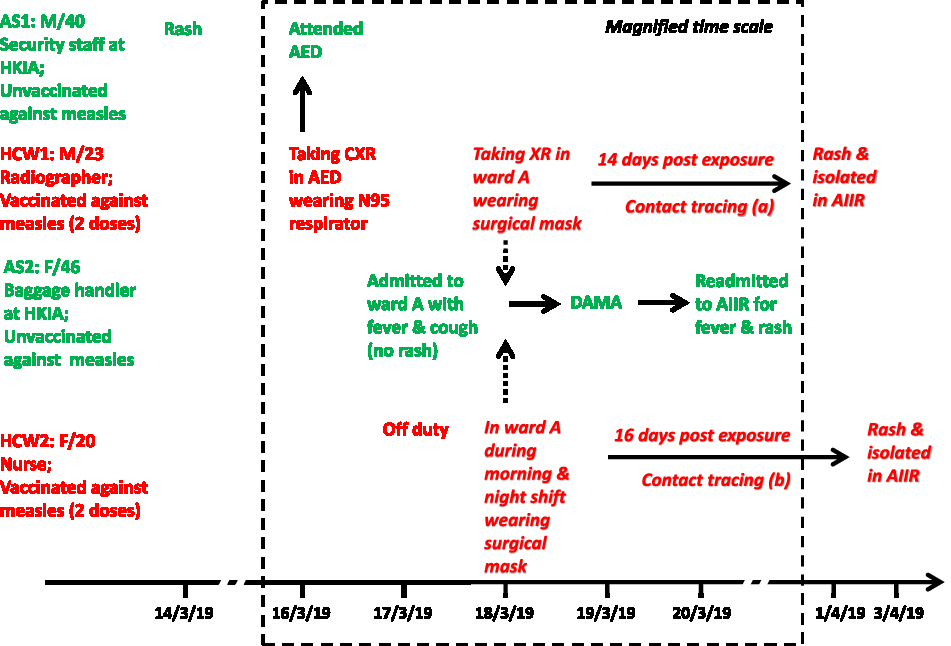
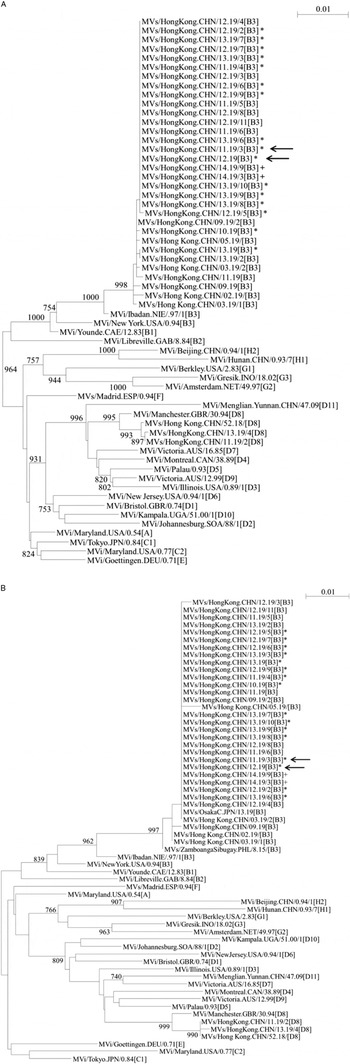
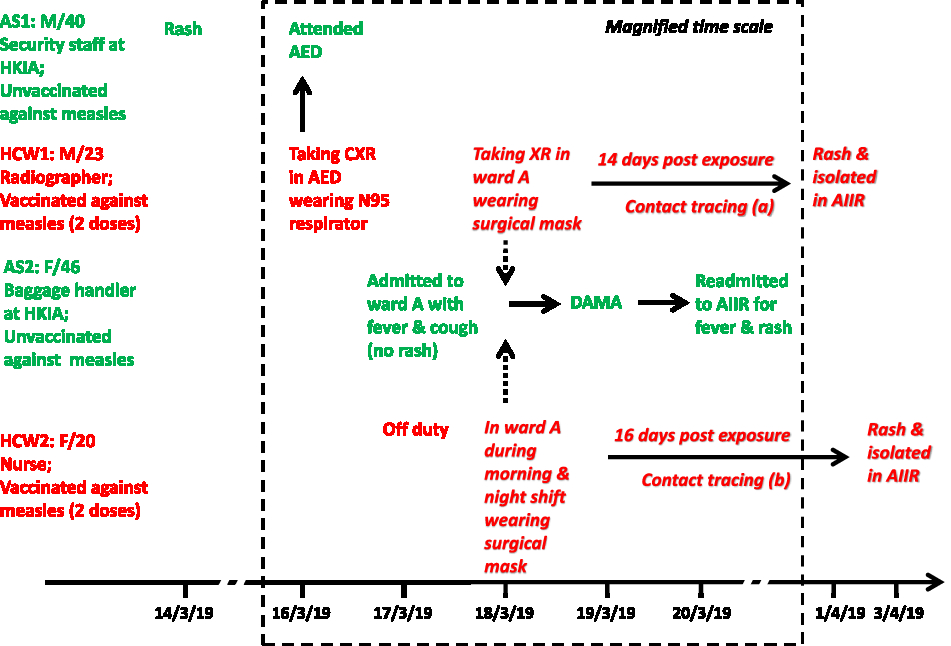
Two HCWs at hospital A, a radiographer (HCW1) and a nurse (HCW2), had onsets of rash on April 1 and 3, 2019, respectively. Both claimed to have received 2 doses of MMR vaccine and were positive for measles IgG antibody on presentation. The clinical, epidemiological, and laboratory investigations of the HCWs are summarized in Table 2. These 2 HCWs were isolated in AIIRs and were confirmed to have measles infection by RT-PCR on admission. Neither had visited HKIA or traveled outside Hong Kong during the incubation period. HCW1 performed chest radiographic examination while wearing N95 respirator for a security staff at HKIA (AS1), who presented to AED of hospital A with fever and rash on March 16, 2019. Both HCW1 and HCW2 were exposed to the index case, a baggage handler at HKIA (AS2), hospitalized in ward A of hospital A on March 18, 2019. They wore surgical masks during their clinical duty in ward A but developed skin rash 14 (HCW1) and 16 days (HCW2) after exposure, respectively (Fig. 2). Contact tracing was performed for both during their infectious period. In total, 168 persons (97 hospitalized patients and 71 HCWs) were investigated. Of 168 persons with unknown immunity to measles, 24 (14.3%) were tested for measles IgG antibody. Among these, 4 HCWs were nonimmune to measles and were exempted from clinical duty during the potentially infectious period. The viral loads (copies per reaction) of the nasopharyngeal specimens were as follows: AS2 (index case), 1.77 × 10⁸; AS1, 6.74 × 10⁵; HCW1, 7.06 × 10⁵; and HCW2, 1.38 ×10⁵. The PCR cycle threshold cutoff was 40. The serum of the index case was negative for measles IgG but positive for measles IgM at presentation. Among the measles virus strains (genotype B3) from the 16 measles-infected staff working in HKIA (including AS1 & 2), those from HCW1 and HCW2 clustered closely on phylogenetic analysis using measles virus hemagglutinin (H) and nucleoprotein (N) gene sequences (Fig. 3A and 3B).
Clinical, Epidemiological, and Laboratory Test Findings of Index and Secondary Cases in Hospital A

Note. AS2, airport staff 2, HCW, healthcare worker; HKIA, Hong Kong International Airport; RT-PCR, reverse transcriptase-polymerase chain reaction.
Transmission of measles from Hong Kong International Airport to hospital A.
Phylogenetic relationship of the measles virus strains from patients, healthcare workers (HCWs), and staff working in HKIA using measles virus hemagglutinin (H) and nucleoprotein (N) gene sequences. The trees were inferred from data using the neighbor-joining method with bootstrap values calculated from 1,000 trees. In total, (A) 1,478 nucleotide positions in the measles virus H gene and (B) 450 nucleotide positions in the measles virus N gene were included in the analysis. Scale bars indicate estimated number of nucleotide substitutions per 100 nucleotides. Asterisks indicate the measles virus strains detected in HKIA outbreak. Cross indicate the measles virus strains (HCW1 and HCW2) detected in the hospital outbreak. Arrows indicate the measles virus strains detected in airport staff 1 (AS1) and airport staff 2 (AS2) in hospital A.

Discussion
We describe an outbreak of measles with epidemiological link from the airport to hospital. Previous outbreaks were confined to either transmission of measles at airports or at hospitals.Reference Nic Lochlainn, Mandal and de Sousa5,Reference Coleman, Burke and Welstead6,Reference Watanabe, Kobayashi and Shimada9,Reference Botelho-Nevers, Gautret, Biellik and Brouqui10 In nonendemic areas, air travel was considered as a risk factor for the introduction of measles in a highly vaccinated population.Reference van Binnendijk, Hahne and Timen19 The measles seropositive rates among all age groups from 2011 to 2017 in Hong Kong were >95%,2 exceeding the cutoff of 93%–95% required to prevent sustained local transmission.Reference Anderson and May20,Reference Moss and Strebel21 Although all 29 HKIA measles-infected staff were born after the availability of measles vaccine, >62% had not had 2 documented doses of measles vaccination. Although 35% of measles-infected HKIA staff had history of travel during their incubation period, it was significantly lower than the corresponding percentage of non–HKIA-related community-acquired measles-infected persons between January and April 2019, suggesting measles transmission at HKIA.
The source of measles outbreak in HKIA could not be definitely identified. Based on phylogenetic analysis, the measles isolates in our study belonged to genotype B3 (Fig. 3B). The source is probably from the Philippines, which is geographically close to Hong Kong and has endemic B3 genotype circulation. However, the lack of recent sequence data from the Philippines for comparison renders it difficult to draw a definite conclusion regarding the source. We observed 1 sequence from Osaka, Japan (MVs/OsakaC.JPN/13.19) clustered closely with the airport isolates; no epidemiological information was obtained regarding this isolate. However, >95% of measles virus isolated from Japan in 2019 belonged to genotype D8,22 and we hypothesize that the Osaka isolate may also have been obtained from a returned traveler from the Philippines. Because the infectious period of measles occurs 4 days prior to the onset of rash and the virus remains active and contagious in the air for up to 2 hours,Reference Remington, Hall, Davis, Herald and Gunn23,Reference Bloch, Orenstein and Ewing24 the source patient is usually difficult to identify. It has been reported that secondary cases of measles can be acquired in physician offices even 1 to 2 hours after departure of the source patient.Reference Remington, Hall, Davis, Herald and Gunn23,Reference Bloch, Orenstein and Ewing24 Air samples and air filters from HKIA were negative for measles RNA. These results were not unexpected due to the dilution effect of the air ventilation system. Moreover, measles RNA in air samples was only detected at a distance from patient’s head of 0.61 m (head of bed) to 2.44 m (foot of bed).Reference Bischoff, McNall and Blevins25 Also, many days had elapsed between the last confirmed measles-infected HKIA staff and the specimen collection. Among infected HKIA staff who recalled detailed exposure history, nearly 70% had visited self-service food premises during their incubation and infectious period. During field inspection, we observed that these used shared food trays were not washed or properly disinfected. We are not certain whether the contaminated surfaces served as a potential vector for indirect transmission of measles. Although the duration of survival of measles virus on environmental surfaces is not known, measles RNA has been shown on a bed handrail, a food tray table, and a table at the back of the room (~3 m from the foot of the bed) previously.Reference Bischoff, McNall and Blevins25 The concept of hand hygiene before meals is not only important in healthcare settingsReference Cheng, Wong, Wong and Yuen26 but is also generally applicable in controlling community outbreaks.
Nosocomial transmission of measles in hospital A was epidemiologically linked and phylogenetically associated with the outbreak at HKIA through AS2, who presented with a high viral load upon admission. Both HCW1 and HCW2 were exposed to AS2, who was subsequently confirmed to be infected and epidemiologically linked to the HKIA outbreak. There was no other patient with community acquisition of measles at that time. Both HCWs wore appropriate personal protective equipment with surgical masks in the general ward where AS2 was hospitalized after presenting with fever without rash. The clinical symptoms of both HCWs were relatively mild and their viral loads of measles were low. This incident illustrates the risk of spillover of occupational outbreaks into hospitals where affected patients seek medical attention. A similar situation was observed with severe acute respiratory syndrome coronavirus (SARS-CoV) where an outbreak in a wild-game meat market eventually resulted in major hospital outbreaks.Reference Cheng, Lau, Woo and Yuen11 Notably, airport outbreaks of SARS or Middle East Respiratory Syndrome not only spillover to the community but could result in paralysis of major transit hubs. Therefore, this measles outbreak constitutes a sentinel event to strengthen airport infection control measures.
In addition to using N95 respirator, or equivalent respiratory protection, in developing countries when caring for febrile patients with epidemiological links to measles outbreak area, maintaining high MMR vaccination rates among HCWs is also vital because a small number of vaccine failures could be encountered. As illustrated in our outbreak, 38% of infected cases were documented to have had 2 doses of MMR vaccine. It is also possible that currently used measles vaccines may not protect as well against some circulating B3 strains. Interindividual variation in measles vaccine-induced antibodies as a result of human leukocyte antigen (HLA) and non-HLA genetic influences may play a role in primary vaccine failure.Reference Haralambieva, Kennedy, Ovsyannikova, Whitaker and Poland27 An increasing number of studies have shown that 2%–10% of individuals may have secondary vaccine failure after 2 doses of measles vaccines because they do not have sustained protective measles humoral immunity, leading to community measles outbreaks with gradual accumulation of susceptible individuals.Reference Defay, De Serres and Skowronski28–Reference Mathias, Meekison, Arcand and Schechter32 Measles transmission has been reported in 6 twice-vaccinated HCWs. Of 4 twice-vaccinated cases, 2 had preillness plaque reduction neutralization titers of >120 mIU/mL.Reference Hahne, Nic Lochlainn and van Burgel30 In the outbreak of mumps at the University of Iowa (Iowa City, IA), students in whom 13 or more years had lapsed from the second dose of MMR vaccine had an increased risk of mumps. A campaign to administer a third dose of MMR vaccine was implemented, resulting in improved mumps outbreak control.Reference Cardemil, Dahl and James33 The Advisory Committee on Immunization Practices recommended a third dose of MMR vaccine to persons at increased risk for acquiring mumps during outbreaks.Reference Marlow, Marin, Moore and Patel34 This approach likely cannot be applied to measles because a recent study found minimal secondary immune response after a third dose of MMR vaccine in young adults.Reference Fiebelkorn, Coleman and Belongia35 However, it is likely that the outbreaks at HKIA and hospital A would have been even larger if there were more under vaccinated individuals. Therefore, MMR vaccines were provided to any HCWs without natural immunity and who had not received 2 doses, and MMR vaccination was provided to nonimmune staff at employment.Reference Basu, Giri, Adisesh and Mc36
Infection control preparedness in hospitals to prevent nosocomial transmission of measles is of utmost importance.Reference Shakoor, Mir, Zaidi and Zafar37 We organized staff education forums to update knowledge, and we emphasized the importance of early identification of potential measles patients for isolation in AIIR. Contact tracing of exposed persons in a timely manner remains the most difficult task. In our study, ~50 exposed persons required follow-up and medical surveillance per measles-infected patient confirmed after hospitalization. The number of contacts traced may be >600 per measles case, as illustrated in a hospital-associated measles outbreak in Pennsylvania.38 Delayed diagnosis of the first case of measles may result in extensive nosocomial transmission with secondary and tertiary cases.Reference Porretta, Quattrone and Aquino39 Timely identification of nonimmune exposed contacts for the provision of postexposure MMR vaccination or immunoglobulin may minimize the risk of measles infection.Reference Baxi, Mytton and Abid40
Supplementary material
To view supplementary material for this article, please visit https://doi.org/10.1017/ice.2019.278
Acknowledgments
The authors thank the senior management team of Airport Authority, Hong Kong to facilitate the outbreak investigation.
Financial support
This work was supported in part by the donations of Mr Michael Tong, Providence Foundation Ltd (in memory of the late LuiHac Minh), and the Hong Kong Hainan Commercial Association; by funding from the Consultancy Service for Enhancing Laboratory Surveillance of Emerging Infectious Diseases of the Department of Health, Hong Kong Special Administrative Region; and by funding from the Collaborative Innovation Center for Diagnosis and Treatment of Infectious Diseases, the Ministry of Education of China.
Conflicts of interest
All authors report no conflicts of interest relevant to this article.