


Introduction
Across cultural contexts, sexual minority adolescents face markedly higher risk of mental health problems and suicidality than their heterosexual peers (di Giacomo et al., Reference Di Giacomo, Krausz, Colmegna, Aspesi and Clerici2018; Marchi et al., Reference Marchi, Arcolin, Fiore, Travascio, Uberti, Amaddeo, Converti, Fiorillo, Mirandola, Pinna, Ventriglio and Galeazzi2022; Wang et al., Reference Wang, Gan, Zhou, Cosquer, Falissard, Corruble, Jousselme and Gressier2023). They show not only a substantially greater prevalence of suicidal ideation, plans and attempts, but also an earlier onset and faster progression from suicidal thoughts to planning (Huang et al., Reference Huang, Li, Guo, Gao, Xu, Huang, Deng and Lu2018a; Luk et al., Reference Luk, Goldstein, Yu, Haynie and Gilman2021), underscoring a persistent and pronounced disparity in suicidality associated with sexual orientation.
The minority stress model (Meyer, Reference Meyer2003) posits that health disparities experienced by sexual minority populations arise from chronic exposure to stressors associated with marginalized social status and limited access to protective resources (Frost and Meyer, Reference Frost and Meyer2023). Accordingly, the elevated suicide risk among sexual minority adolescents may reflect both a greater accumulation of stressors and fewer sources of support. Consistent with this framework, studies to date have consistently shown that sexual minority adolescents are more likely to be victims of bullying and sexual harassment (Webb et al., Reference Webb, Clary, Johnson and Mendelson2021; Smith et al., Reference Smith, Johns and Raj2022), receive less social support from family and peers (Perales and Campbell, Reference Perales and Campbell2020) and report lower academic achievement (Birkett et al., Reference Birkett, Russell and Corliss2014). Factors such as sexual violence and bullying victimization are key pathways linking sexual minority status to adverse mental health outcomes, including suicidal ideation and suicide attempts (Huang et al., Reference Huang, Li, Lai, Jia, Xiao, Wang, Guo and Lu2018b; Scheer et al., Reference Scheer, McConocha, Behari and Pachankis2021).
Expanding upon the minority stress model, the psychological mediation framework (Hatzenbuehler, Reference Hatzenbuehler2009) views minority stress as a catalyst that disrupts psychosocial processes, such as emotion regulation, social interactions and cognitive processing, ultimately contributing to the development of psychopathology (Hatzenbuehler, Reference Hatzenbuehler2009; Pitoňák, Reference Pitoňák2017). This implies that the elevated mental health and suicide risks among sexual minority adolescents stem not only from the heightened stressors and reduced support they encounter but also from their altered responses to these factors. Sexual minority adolescents often display more maladaptive patterns in emotion regulation, such as increased rumination and poor emotional awareness, compared with their heterosexual peers (Hatzenbuehler et al., Reference Hatzenbuehler, McLaughlin and Nolen-hoeksema2008). Physiological evidence suggests that sexual minorities may have different stress responses, reflected in varied cortisol stress reactivity (Juster et al., Reference Juster, Hatzenbuehler, Mendrek, Pfaus, Smith, Johnson, Lefebvre-louis, Raymond, Marin, Sindi, Lupien and Pruessner2015). Furthermore, while adult support outside the school community was linked to reduced suicidality among all adolescents, its protective effect appears weaker for sexual minority adolescents than for their heterosexual peers (Coulter et al., Reference Coulter, Kessel Schneider, Beadnell and O’donnell2017).
While global research on health disparities among sexual minority populations is expanding, studies of sexual minority adolescents in the Chinese context remain limited. This scarcity, driven by cultural sensitivities surrounding sexual orientation, also extends to other Asian societies with Confucian heritage, such as Japan, Singapore and South Korea, which collectively constitute nearly one-fifth of the global population (Adamczyk and Cheng, Reference Adamczyk and Cheng2015). Confucian family values prioritize marriage and procreation as essential to continuing family lineages (Kwok and Wu, Reference Kwok and Wu2015). For sexual minorities, these expectations often clash with their identities and relationships, leading to stigmatization and marginalization (Hahm and Adkins, Reference Hahm and Adkins2009; Kwok and Wu, Reference Kwok and Wu2015). Confucian societies tend to exhibit lower tolerance towards sexual minorities than European and American societies (Adamczyk and Cheng, Reference Adamczyk and Cheng2015). Studies conducted in Chinese contexts may therefore offer insights relevant to other societies with a Confucian heritage.
Hong Kong, one of China’s most developed and modern metropolises, exemplifies a complex sociocultural landscape where traditional Confucian values intersect with Christian influences, shaped by its history as a former British colony (Kwok and Wu, Reference Kwok and Wu2015). The Christian ideal upholds a heterosexual, monogamous and lifelong model of marriage, with non-heterosexuality often viewed as less acceptable or even sinful and immoral (Kwok and Wu, Reference Kwok and Wu2015). In Hong Kong, faith-based organizations play a significant role in the operation of social services, with approximately half of primary and secondary schools having religious affiliations, predominantly Christian (Jackson, Reference Jackson2015). Currently, there is no comprehensive legal protection against discrimination based on sexual orientation and gender identity in Hong Kong. Sexual minority groups face discrimination across various domains of life, including employment, housing, interactions with teachers and peers and even within their own families (Suen and Wong, Reference Suen, Wong, Lin, Haywood and an Ghaill2017; Pang et al., Reference Pang, Chow and Huang2022). However, no large-scale studies in Hong Kong have systematically examined how intra- and interpersonal factors contribute to sexual orientation disparities in mental health and suicidality among adolescents.
Although multiple factors contribute to sexual orientation disparities in adolescent suicidality, some are especially critical given their central role in shaping well-being during adolescence. School and family constitute the primary contexts for adolescent development, with difficulties in these environments serving as key contributors to suicide among adolescents (Hsu et al., Reference Hsu, Junus, Zhang, Wong, Lam, Cheung, Liu, Lui and Yip2023). In Chinese society, where education is highly prioritized, academic performance serves as a key metric of self-worth and a major driver of suicidal behaviours among adolescents (Li et al., Reference Li, Hsu and Yip2025). Adolescence also brings heightened body image concerns due to rapid physical, cognitive and social changes, with body dissatisfaction strongly associated with mental health problems and suicidality (Perkins and Brausch, Reference Perkins and Brausch2019). Furthermore, cyberbullying and sexual harassment become increasingly prevalent in middle and late adolescence, a stage characterized by intensified peer interactions, greater online engagement and heightened sensitivity to social evaluation and are strongly linked to suicidal behaviours (Chiodo et al., Reference Chiodo, Wolfe, Crooks, Hughes and Jaffe2009; Holt et al., Reference Holt, Vivolo-kantor, Polanin, Holland, DeGue, Matjasko, Wolfe and Reid2015). Examining how sexual minority adolescents experience and respond to these factors differently would provide a more comprehensive understanding of sexual orientation disparities in suicidality during adolescence within the Chinese context.
Consistent sex differences in suicidal ideation and suicide attempts are observed during adolescence, with girls disproportionately affected (Miranda-Mendizabal et al., Reference Miranda-Mendizabal, Castellví, Parés-badell, Alayo, Almenara, Alonso, Blasco, Cebrià, Gabilondo, Gili, Lagares, Piqueras, Rodríguez-jiménez, Rodríguez-marín, Roca, Soto-sanz, Vilagut and Alonso2019; Van Meter et al., Reference Van Meter, Knowles and Mintz2023). This pattern highlights the value of adopting an intersectionality perspective (Crenshaw, Reference Crenshaw1989) to examine how sex and sexual orientation jointly shape adolescent suicidality. As a theoretical and analytical framework, intersectionality posits that individuals’ experiences are shaped by intersecting social identities/positions (e.g., sexual orientation, sex), which reflect and are reinforced by interlocking structural systems of discrimination (e.g., sexism, heterosexism) (Beccia et al., Reference Beccia, Baek, Austin, Jesdale and Lapane2021). Integrating an intersectionality perspective is thus essential for a more nuanced understanding of sexual orientation disparities in adolescent suicidality.
In summary, many studies have investigated why suicidality is more prevalent among sexual minority adolescents than heterosexual adolescents, especially in Western societies. However, few have investigated whether the suicide risk disparity between these groups stems from differing levels of risk/protective factors, or from distinct behavioural responses to them. Furthermore, research on sexual minority adolescents in Chinese contexts is limited. To address these gaps, we employed decomposition analysis to examine how various factors critical to adolescent well-being contribute to the disparity in suicidal ideation between sexual minority and heterosexual adolescents, based on a population-based sample of secondary school students in Hong Kong. Given the well-documented sex differences in suicidal ideation (Miranda-Mendizabal et al., Reference Miranda-Mendizabal, Castellví, Parés-badell, Alayo, Almenara, Alonso, Blasco, Cebrià, Gabilondo, Gili, Lagares, Piqueras, Rodríguez-jiménez, Rodríguez-marín, Roca, Soto-sanz, Vilagut and Alonso2019), we adopted an intersectionality perspective, investigating the sexual orientation disparities by sex, as well as the disparities between sexual minority boys and girls.
Methods
Data
We utilized data from the 2021 wave of the Youth Sexuality Study (YSS), conducted by The Family Planning Association of Hong Kong. The YSS targets full-time students attending local secondary schools across Hong Kong, representing over 90% of the secondary student population (Education Bureau, 2024).
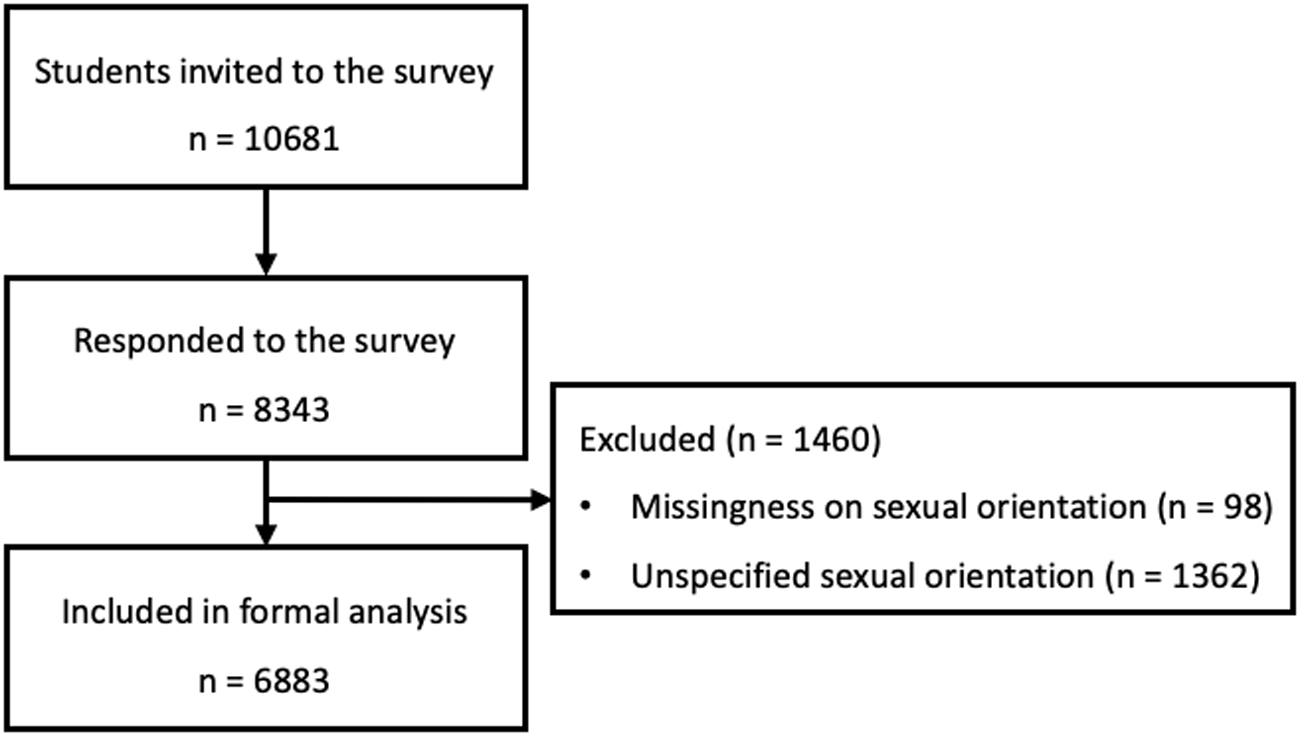
To achieve a representative sample, cluster sampling was applied, with schools as the sampling units and the four districts of Hong Kong (Hong Kong Island, Kowloon, New Territories West and New Territories East) as the clusters. Among the 455 schools in the sampling pool, 25 participated, and all students (n = 10 681) were invited to join the survey between May and July 2021. The overall response rate was 78.1%, resulting in a dataset that included 8343 participants.
Informed consent to participate in the study was obtained from the participants or their legal guardian, stating that participation was completely voluntary and anonymous. To prevent any potential bias, teachers were instructed to refrain from interacting with students during the survey process.
Measures
Suicidal ideation was measured using a binary response question, asking respondents whether they had considered suicide within the past 12 months. This approach has been widely employed in large-scale adolescent population surveys in China (Yan and Gai, Reference Yan and Gai2022; Xiao et al., Reference Xiao, Huang, Yang, Mu, Wang, Deng, Cai, Deng, Tang, Chen, Shi, Jiang, Xu, Yin, Huang, Zhang and Ran2024), demonstrating reliable prevalence estimates and expected associations with known risk factors.
Sexual orientation was measured using seven options: (1) heterosexuality, (2) homosexuality, (3) bisexuality, (4) pansexuality, (5) asexuality, (6) others and (7) don’t know. The formal analysis included only adolescents explicitly indicating their sexual orientation (options 1–6), due to the potential heterogeneity within the ‘don’t know’ category (unspecified sexual orientation), which may encompass adolescents who were either in the process of exploring their sexual orientation or those who may not fully understand the question. Moreover, due to the limited number of respondents in certain categories, options 2–6 were combined into a single category, resulting in a binary variable distinguishing between heterosexuality and sexual minority. For the frequencies and percentages of all sexual orientation categories, please see Supplementary Appendix Table S1.
Respondents’ perceptions of their family life, peer relationships and academic performance were gathered through survey questions that asked about their feelings towards family life, interactions with classmates and academic performance. The response options were on a scale from 1 = very bad to 5 = very good. These items were adapted from domain-specific life satisfaction measures developed for adolescents (Huebner et al., Reference Huebner, Seligson, Valois and Suldo2006; OECD, 2022), which have been shown to correlate strongly with overall well-being (Woode and Chen, Reference Woode and Chen2024).
Overall body dissatisfaction was assessed by asking respondents to rate their satisfaction with their appearance on a scale from 1 to 6 (1 = very dissatisfied, 2 = dissatisfied, 3 = normal, 4 = satisfied, 5 = very satisfied, 6 = indifferent). Similar measures have been employed in previous research on children and adolescents (Calzo et al., Reference Calzo, Sonneville, Haines, Blood, Field and Austin2012; Gmeiner and Warschburger, Reference Gmeiner and Warschburger2020). Due to the ‘indifferent’ option (6), the variable could not be treated as continuous and was therefore recoded into a binary format: responses of 1 (very dissatisfied) and 2 (dissatisfied) were combined to denote body dissatisfaction, while responses from 3 to 6 were grouped to indicate non-body dissatisfaction.
Respondents were also asked whether they had experienced cyberbullying and sexual harassment within the past 12 months, with response options being ‘yes’ or ‘no’ for each question. Similar items have been adopted in previous large-scale adolescent surveys and have demonstrated meaningful associations with mental health and behavioural outcomes (Baiden et al., Reference Baiden, Panisch, Kim, LaBrenz, Kim and Onyeaka2021; Arnon et al., Reference Arnon, Brunstein Klomek, Visoki, Moore, Argabright, DiDomenico, Benton and Barzilay2022).
The family’s education level, derived from the educational attainment of either parent, was included in the model as a confounding variable. If a respondent provided the education level of only one parent, that level was used to represent the family’s education level. When both parents’ information was available, the higher level was adopted. Respondents who did not provide information for either parent were categorized as having missing values. The original education level variable included four levels: no formal education, primary education, secondary education and tertiary education or above. These categories were subsequently recoded into binary format: below tertiary and tertiary or above.
The construction of the analytic sample is provided in Figure 1. Except for the key grouping variable, sexual orientation, all other variables with missing values were addressed using multivariate imputation by chained equations (MICE), resulting in the generation of 20 imputed datasets. The patterns of missing data and further details of the imputation procedure are presented in the Supplementary Appendix.
Flowchart of analytic sample construction from the 2021 Youth Sexuality Study.

Data analysis
Descriptive analyses were conducted separately by sex and sexual orientation. Logistic regression analyses were performed to identify the factors associated with suicidal ideation, including body dissatisfaction, cyberbullying victimization, sexual harassment victimization, perceptions of family life, peer relationships and academic performance within each group.
Since the outcome variable is binary, a nonlinear Oaxaca-Blinder decomposition based on a logit model was employed to examine the sexual orientation disparities in suicidal ideation by sex and to further explore differences between sexual minority girls and boys. The decomposition results are expressed as contributions to differences in predicted probabilities. This method, first introduced by Blinder (Reference Blinder1973) and Oaxaca (Reference Oaxaca1973), has been extensively used to investigate health inequalities across various population groups. It can disaggregate the observed differences in the outcome variable (e.g., the difference in suicidal ideation prevalence between sexual minority and heterosexual adolescents) into two components: the endowment effect and the coefficient effect. The endowment effect captures the differences attributed to variations in the levels of explanatory variables. For instance, the sexual minority group may experience more cyberbullying, leading to a higher risk of suicidal ideation among them compared with heterosexual adolescents. The coefficient effect captures the differences resulting from variations in the associations between suicidal ideation and these explanatory variables (e.g., the association between cyberbullying victimization and suicidal ideation may be stronger or weaker among sexual minority adolescents than heterosexual adolescents), as well as the factors that were not included in the analysis. Technical details of the decomposition analysis can be found in the Supplementary Appendix.
Before formal analyses, to check model stability, we calculated the events-per-variable ratio for each subgroup model, which ranged from 18 to 67 and exceeded the widely adopted benchmark of ≥10 (Meehan et al., Reference Meehan, Lewis, Fazel, Fusar-poli, Steyerberg, Stahl and Danese2022). We also assessed multicollinearity using complete-case analyses for each subgroup; variance inflation factors ranged from 1.01 to 1.23, indicating no evidence of problematic multicollinearity. In formal analyses, based on the 20 imputed datasets produced by the MICE method, pooled estimates for logistic regression models and decomposition analysis were computed following Rubin’s rules. To account for school-level clustering, cluster-robust standard errors were used in all logistic regression and decomposition models. Data preprocessing was performed in R 4.3.2. Multivariate imputation was conducted using the mi command in Stata 17, and the decomposition analysis was conducted using the Oaxaca command with the logit option under the latest Oaxaca package (version 4.1.1) in Stata 17.
Results
A detailed descriptive analysis of the study variables is presented in Table 1. A total of 6883 adolescents (age range: 10–21; mean age = 14.90, standard deviation [SD] = 1.65) were included in the analysis, with 55.76% being boys. Among the boys, 14.83% were identified as sexual minorities, compared with 27.49% of the girls. Sexual minority adolescents were significantly younger than their heterosexual counterparts. Across both sexes, they showed a higher prevalence of suicidal ideation, cyberbullying, sexual harassment and body dissatisfaction, and reported less positive perceptions of family life, peer relationships and academic performance than heterosexual adolescents.
Descriptive analysis of study variables by sex and sexual orientation (heterosexual vs. Sexual minority)

Table 1 Long description
Boys and girls are each split into heterosexual and sexual minority groups, with sample sizes and percentages shown, and each row lists either mean with standard deviation or count with percent plus a p-value from Mann Whitney U test or Chi Square test. For boys, heterosexual group size is 3269 and sexual minority group size is 569; for girls, heterosexual group size is 2208 and sexual minority group size is 837. Age means are 14.98 for heterosexual boys and 14.77 for sexual minority boys, and 14.93 for heterosexual girls and 14.57 for sexual minority girls, with p-values below 0.01 for boys and below 0.001 for girls. Cyber bullying counts are 315 and 81 for boys and 224 and 120 for girls, with p-values below 0.01 in both sexes; sexual harassment counts are 143 and 52 for boys with p-value below 0.001, and 382 and 178 for girls with p-value below 0.05. Family education, tertiary or above is 858 and 152 for boys with p-value 0.93, and 527 and 217 for girls with p-value below 0.05. Body dissatisfaction counts are 457 and 106 for boys with p-value below 0.01, and 437 and 201 for girls with p-value below 0.05. Mean scores for family life are 3.76 and 3.62 for boys and 3.78 and 3.50 for girls, and for peer relationship are 3.92 and 3.68 for boys and 3.90 and 3.67 for girls, with p-values below 0.001 for both measures in both sexes. Academic performance means are 2.92 and 2.84 for boys with p-value below 0.05, and 2.82 and 2.65 for girls with p-value below 0.001.
Significant P-values are highlighted in bold.
Logistic regression models (Figure 2) reveal broadly consistent patterns across sexes and sexual orientations. Body dissatisfaction, cyberbullying and sexual harassment victimization were associated with higher odds of suicidal ideation, although the association for sexual harassment was only marginally significant among sexual minority boys. In contrast, positive perceptions of family life and academic performance were negatively associated with suicidal ideation across all subgroups.
Logistic regression analyses of suicidal ideation among heterosexual and sexual minority boys and girls.

Figure 2 Long description
Four forest plots showing odds ratios for factors associated with suicidal ideation among heterosexual and sexual minority boys and girls. The x-axis is labeled ′Odds Ratio′ and is unitless, ranging from 0.0 to 4.0 with a reference line at 1.0. The y-axis lists predictors: age, body dissatisfaction, cyberbullying, sexual harassment, family education greater than or equal to tertiary, family life, peer relationship and academic performance. Each plot represents a different group: heterosexual boys, sexual minority boys, heterosexual girls and sexual minority girls. Odds ratios (OR) with 95 percent confidence intervals (CI) are shown for each factor. For example, body dissatisfaction has an OR of 1.58 (1.15 to 2.19) for heterosexual boys and 2.47 (1.73 to 3.52) for sexual minority girls, indicating a strong association with suicidal ideation. Positive perceptions of family life and academic performance show lower OR values, such as 0.75 (0.65 to 0.87) for heterosexual boys, indicating a protective effect. The plots use blue for boys and red for girls. The data highlights differences in factors′ impact across groups, with sexual minority groups generally showing higher odds ratios for negative factors.
Some subgroup differences were also observed. Older girls were less likely to report suicidal ideation than younger ones, although this association was only marginally significant among sexual minority girls and was not observed among boys. Additionally, perceptions of peer relationships were significant only for heterosexual boys and sexual minority girls.
Decomposition analyses (Table 2) reveal factors contributing to the disparity in suicidal ideation between heterosexual and sexual minority adolescents, as well as between sexual minority boys and girls. For each independent variable, a positive (negative) endowment effect indicates that between-group differences in the distribution of the variable increase (reduce) the disparity in suicidal ideation. Likewise, a positive (negative) coefficient effect reflects that differences in the estimated effects of the variable contribute to a widening (reduction) of this disparity. Among boys, the prevalence of suicidal ideation among the sexual minority group was higher than that of the heterosexual group by 10.7 percentage points (pp). Of this gap, 3.3 pp was attributable to endowment effect and 7.4 pp to coefficient effect. Within the endowment effects, compared with heterosexual boys, sexual minority boys had more experience of cyberbullying and sexual harassment, and less positive perceptions of family life and peer relationships. This significantly contributed to the sexual orientation disparity in suicidal ideation. Perceptions of family life played the most important role, accounting for a 1 pp difference in the prevalence of suicidal ideation. However, for the coefficient effect, no variables were statistically significant.
Decomposition analyses of the disparity in suicidal ideation among Hong Kong adolescents
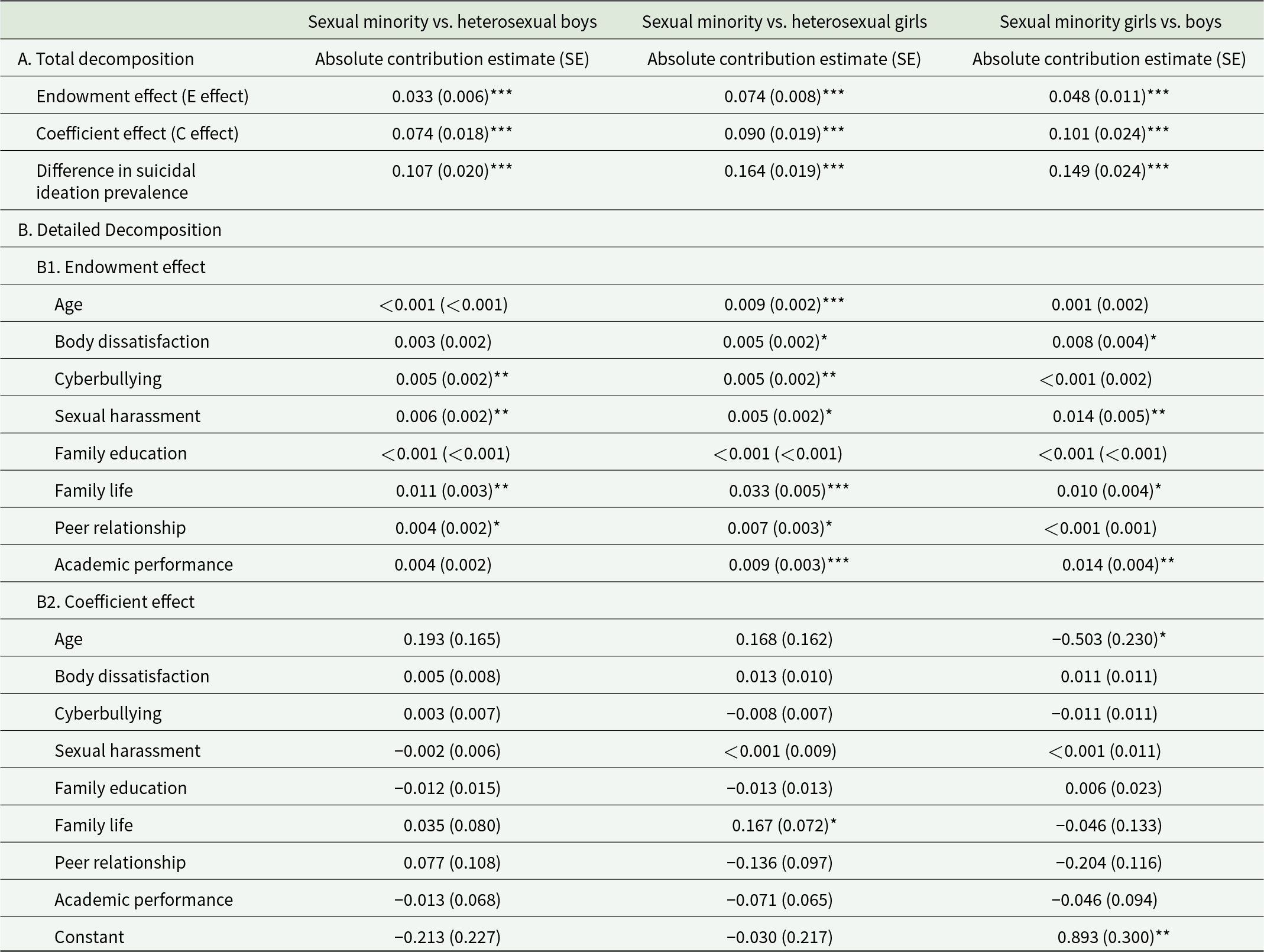
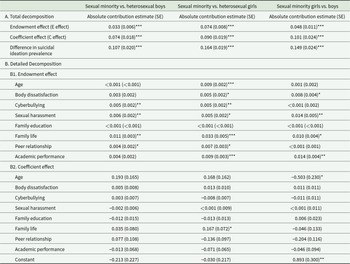
Table 2 Long description
Three comparisons report absolute contribution estimates with standard errors for total decomposition, detailed endowment effect, and detailed coefficient effect. Total decomposition lists endowment effect and coefficient effect: for sexual minority versus heterosexual boys, endowment effect 0.033 with standard error 0.006 and three asterisks, and coefficient effect 0.074 with standard error 0.018 and three asterisks; for sexual minority versus heterosexual girls, endowment effect 0.074 with standard error 0.008 and three asterisks, and coefficient effect 0.090 with standard error 0.019 and three asterisks; for sexual minority girls versus boys, endowment effect 0.048 with standard error 0.011 and three asterisks, and coefficient effect 0.101 with standard error 0.024 and three asterisks. Detailed endowment effect rows list age, body dissatisfaction, cyberbullying, sexual harassment, family education, family life, peer relationship, and academic performance, with values including several reported as less than 0.001 and multiple entries marked with one to three asterisks. For sexual minority versus heterosexual boys, endowment effect values include family life 0.011 with standard error 0.003 and two asterisks, sexual harassment 0.006 with standard error 0.002 and two asterisks, and cyberbullying 0.005 with standard error 0.002 and two asterisks. For sexual minority versus heterosexual girls, endowment effect values include family life 0.033 with standard error 0.005 and three asterisks, age 0.009 with standard error 0.002 and three asterisks, and academic performance 0.009 with standard error 0.003 and three asterisks. For sexual minority girls versus boys, endowment effect values include sexual harassment 0.014 with standard error 0.005 and two asterisks, academic performance 0.014 with standard error 0.004 and two asterisks, and body dissatisfaction 0.008 with standard error 0.004 and one asterisk. Detailed coefficient effect rows list the same factors plus constant, with values that include negatives and several marked with asterisks; examples include age for sexual minority girls versus boys, negative 0.503 with standard error 0.230 and one asterisk, family life for sexual minority versus heterosexual girls 0.167 with standard error 0.072 and one asterisk, and constant for sexual minority girls versus boys 0.893 with standard error 0.300 and two asterisks.
Significance at the 0.05, 0.01 and 0.001 level were indicated by one, two and three asterisks. Values with absolute magnitude <0.001 are reported as <0.001.
The prevalence of suicidal ideation among sexual minority girls was 16.4 pp higher than heterosexual girls, with 7.4 pp attributed to the endowment effect and 9.0 pp to the coefficient effect. Consistent with the findings for boys, the endowment effects of cyberbullying, sexual harassment and perceptions of family life and peer relationships were also significant for girls. Additionally, we found that endowment effects of age, body dissatisfaction and academic performance, which were not observed in boys, played a significant role among girls. Specifically, the younger age and less positive perceptions of their body and academic performance among sexual minority girls compared with heterosexual girls significantly contributed to the disparity in suicidal ideation between these two populations. Among these factors, perceptions of family life demonstrated the most substantial effect, contributing 3 pp to the difference in the prevalence of suicidal ideation. Regarding the coefficient effects, the perception of family life was a significant factor among girls, with a contribution of 17 pp. As shown in Figure 2, family life showed a weaker negative association with suicidal ideation among sexual minority girls (odds ratio [OR] = 0.60, 95% confidence interval [CI]: 0.49–0.73) than among heterosexual girls (OR = 0.47, 95% CI: 0.42–0.52). This contrasts with boys, where the association was similar across groups, resulting in a small, insignificant coefficient effect.
When comparing sexual minority boys and girls, the prevalence of suicidal ideation was 14.9 pp higher among girls. Of this, 4.8 pp can be attributed to endowment effect, while 10.1 pp is due to coefficient effect. The endowment effects mainly resulted from sexual minority girls experiencing more body dissatisfaction, sexual harassment and having less positive perceptions of family life and academic performance than boys. As for the coefficient effects, a negative value for age was observed, indicating a larger negative association of age with suicidal ideation among sexual minority girls (OR = 0.90, 95% CI: 0.80–1.01) than boys (OR = 1.07, 95% CI: 0.95–1.21) reduced the disparity in suicidal ideation between them.
To enhance transparency and assess robustness, we conducted a series of supplementary and sensitivity analyses. First, we compared adolescents with unspecified sexual orientation to their heterosexual peers (Supplementary Appendix Tables S3–5). Adolescents with unspecified sexual orientation reported a lower prevalence of suicidal ideation than heterosexual adolescents across both sexes, with the difference being significant only among boys. Further decomposition analyses revealed significant coefficient effects but no significant endowment effects. Second, we conducted complete-case analyses, and the results were largely the same (Supplementary Appendix Tables S6–7). Third, we employed the Fairlie decomposition method to assess whether the results were sensitive to the choice of decomposition approach. The findings remained similar to those of the main analyses (Supplementary Appendix Table S8).
Discussion
To our knowledge, this is the first population-based study in Hong Kong that provides an in-depth decomposition analysis of disparities in suicidal ideation by sexual orientation among adolescents. We found that sexual minority adolescents had a significantly higher prevalence of suicidal ideation than their heterosexual peers, with the disparity more pronounced among girls than boys. Our decomposition analysis shows that approximately 31%–45% of these disparities are attributable to differences in exposure to risk and protective factors, while about 55%–69% are attributable to differences in the estimated associations with these factors and potentially unobserved characteristics.
We considered factors covering critical aspects of adolescent life, showing how demographic, intrapersonal and interpersonal factors collectively contribute to the elevated suicidal ideation experienced by sexual minority adolescents. Consistent with previous global research (Chiodo et al., Reference Chiodo, Wolfe, Crooks, Hughes and Jaffe2009; Holt et al., Reference Holt, Vivolo-kantor, Polanin, Holland, DeGue, Matjasko, Wolfe and Reid2015; Perkins and Brausch, Reference Perkins and Brausch2019; Ati et al., Reference Ati, Paraswati and Windarwati2021), our study identified significant relationships between suicidal ideation and body dissatisfaction, cyberbullying, sexual harassment, perceptions of family life and academic performance. However, the negative association of age with suicidal ideation was evident only in girls, suggesting distinct trajectory patterns of suicidal ideation by sex during adolescence. Furthermore, the association between peer relationships and suicidal ideation varied by sexual orientation and sex. This inconsistency may be due to our use of classmates as a proxy for peer relationships, which may not fully capture all possible peer interactions (e.g., friendships outside school, online peer interactions), potentially leading to an underestimation of its associations with suicidality.
Sexual minority adolescents, irrespective of sex, were found to experience multiple stressors more frequently and receive less support from families, schools and peers than their heterosexual counterparts. This contributed to the observed disparity in suicidal ideation, as evidenced by the significant endowment effects in decomposition analyses. Adversities faced by sexual minority populations are compounded by minority stress, which is distinct from general stress due to its origins in prejudice and stigma (Frost and Meyer, Reference Frost and Meyer2023). In Hong Kong, exposure to global influences and a dense, urban and highly educated population has fostered greater openness towards social diversity, leading to a gradual rise in acceptance of sexual minority populations over recent decades, a pattern that contrasts with the limited progress observed across Asia overall (Flores, Reference Flores2021). Nevertheless, our findings suggest that even as societal attitudes shift, sexual minority adolescents in Hong Kong may continue to face challenges when legal protections against discrimination are limited, and the cultural and religious contexts of educational institutions are unable to fully support efforts to reduce prejudice towards sexual minority adolescents (Kwok, Reference Kwok, Kasai, Toda and Russell2023). When discrimination against sexual minorities persists without consequences, these adolescents are more likely to be exposed to behaviours like sexual harassment and cyberbullying and to receive less support from their social networks. Moreover, exposure to such adverse experiences may reinforce expectations of stigmatization or rejection and encourage concealment of their identities, further restricting access to social support (Douglass et al., Reference Douglass, Conlin and Duffy2020; Pachankis et al., Reference Pachankis, Mahon, Jackson, Fetzner and Bränström2020).
Among all variables with notable endowment effects, perceptions of family life made the most substantial contribution for both sexes. This finding echoed previous research emphasizing family-related factors in shaping minority stress among Chinese sexual minority populations, as the Chinese context is characterized by a family-oriented culture as well as collective and relational values (Sun et al., Reference Sun, Hoyt, Tarantino, Pachankis, Whiteley, Operario and Brown2021). However, significant rejection towards sexual minorities persists within Chinese families. According to a national survey (Wang et al., Reference Wang, Hu, Peng, Xin, Yang, Drescher and Chen2019), over 10% of heterosexual respondents were not accepting of LGBT (lesbian, gay, bisexual, and transgender) family members. The rejection rate within familial relationships was found to be two to five times higher than in other social relationships (Wang et al., Reference Wang, Hu, Peng, Xin, Yang, Drescher and Chen2019). Therefore, interventions fostering understanding and acceptance within families are crucial for improving the mental health of sexual minority adolescents in Chinese contexts. Educational programmes to augment knowledge of sexual minority identities, alongside counselling services to aid families in managing these issues, could be effective strategies.
Decomposition analysis indicated that a considerable proportion of the suicidal ideation disparity can be attributed to the overall coefficient effects; however, when disaggregated into factor-specific effects, most of these effects were not statistically significant. This is not contradictory, but reflects a statistical property of the Blinder–Oaxaca decomposition: a significant overall coefficient effect indicates that the full set of coefficients for the sexual minority group, including the intercept, is structurally different from that for the heterosexual group, capturing the joint shift across all coefficients. The lack of significance in factor-specific coefficient effects may be due to the relatively large standard errors at the factor level, correlation among explanatory factors and unmeasured factors or pathways not captured in the current model. The larger overall coefficient effect relative to the endowment effect observed among boys than among girls suggests that the mechanisms underlying sexual orientation disparities may differ by sex. Among girls, the disparity appeared to be more strongly explained by level differences in common intrapersonal and interpersonal factors associated with adolescent mental health. Among boys, however, it appeared to stem more from differences in the associations between these factors and suicidal ideation, as well as the potential influence of additional unmeasured factors not captured in the current analysis. One potential explanation is the rigid masculine norms embedded in the Chinese cultural context, which are inherently difficult to measure, and under which sexual minority boys may face greater identity concealment stress and social ostracism. The only factor with a significant coefficient effect was perceptions of family life in the comparison between sexual minority and heterosexual girls. Positive family life showed a weaker negative association with suicidal ideation among sexual minority girls than among heterosexual girls, exacerbating the suicidal ideation disparity between the two groups. However, no such differences were found among boys. This sex difference aligns with previous findings that family factors generally exert a weaker influence on boys (Lin et al., Reference Lin, Chou, Wu and Lin2014; Chiu et al., Reference Chiu, Tseng and Lin2017). Girls often assume greater caregiving responsibilities and feel highly responsible for the well-being of significant others in their network, showing greater tendencies towards emotional interdependence and relational orientation (Kessler and McLeod, Reference Kessler and McLeod1984; Cross and Madson, Reference Cross and Madson1997; Lavoie et al., Reference Lavoie, Dupéré, Dion, Crosnoe, É and Archambault2019). This may increase their exposure to potential family stressors and amplify their sensitivity to them. For sexual minority girls, this dynamic may be further complicated by additional challenges, such as awareness of social stigma surrounding their identity or fears of rejection, potentially leading to a greater emotional detachment from their families.
Sexual minority girls exhibited a 15% higher prevalence of suicidal ideation than boys, largely driven by their greater experiences of body dissatisfaction, sexual harassment and less favourable perceptions of family life and academic performance. While this disparity was partially offset by the larger negative association of age with suicidal ideation among girls, these findings underscore significant heterogeneity within sexual minority adolescents and necessitate more nuanced approaches to understand and address their diverse experiences, ensuring interventions account for the interconnected nature of their identities and unique challenges (Zubizarreta and Beccia, Reference Zubizarreta and Beccia2025).
Limitations
First, due to the limited sample size, all sexual minority groups were combined into a single ‘sexual minority’ category. This may obscure the heterogeneity within the sexual minority population, as previous studies showed that bisexual individuals can have higher suicidal risk than homosexual counterparts (Marchi et al., Reference Marchi, Arcolin, Fiore, Travascio, Uberti, Amaddeo, Converti, Fiorillo, Mirandola, Pinna, Ventriglio and Galeazzi2022). Future research needs larger samples to explore this heterogeneity more comprehensively. Second, this study was unable to examine other dimensions of intersectionality, such as ethnicity, cultural background and gender identity. Although ethnicity was measured, the number of ethnic minority participants was limited. Among the 6883 participants included in the analysis, only 129 (1.88%) identified as non-Chinese, which did not permit reliable analyses examining the intersection of ethnicity and sexual orientation. This is also consistent with the broader demographic profile of Hong Kong, where approximately 92% of the population identifies as ethnically Chinese (Census and Statistics Department, 2022). Future studies should leverage larger datasets that capture a broader range of identities or intentionally oversample minority populations to enable more comprehensive intersectionality analyses. Third, the cross-sectional design limits causal inference and the assessment of the temporal dynamics of sexual identity-related risks, necessitating a longitudinal design. Fourth, our study was based on secondary analysis of data from a large-scale survey in which concise measures were employed to enhance participation and data quality among adolescent respondents. No validated mental health questionnaires were used, therefore the complexity of constructs such as mental health and interpersonal relationships may not be fully captured. Future studies should consider using more comprehensive instruments to enhance measurement validity. Fifth, this study did not account for other potentially relevant factors, including household income, religion, area/type of residence, family structure, romantic relationships and access to mental health services, which could influence the observed sexual orientation disparity in suicidality. Future studies should incorporate a broader range of explanatory factors. Finally, social desirability bias may have affected our results, given the stigma surrounding suicidality and minority identities, although we attempted to mitigate this by assuring respondent anonymity and minimizing teacher involvement during the survey.
Supplementary material
The supplementary material for this article can be found at https://doi.org/10.1017/S2045796026100997.
Availability of data and materials
The data that support the findings of this study are available from the Family Planning Association of Hong Kong. Still, restrictions apply to the availability of these data, which were used under license for the current study, and so are not publicly available. Data are, however, available from the authors upon reasonable request and with permission of the Family Planning Association of Hong Kong.
Acknowledgements
Youth Sexuality Study (YSS) was supported by the Department of Health of the Hong Kong SAR government. We extend our gratitude to the members of the YSS Task Force for their invaluable assistance in designing the study questionnaire. We also wish to express our appreciation to Ms. Joe Yiu and Mr. Sun Chan of the Family Planning Association of Hong Kong for their support of the YSS study, as well as to the school teachers and adolescents for their participation in this survey. During the preparation of this work, the authors used ChatGPT to improve the clarity and readability in some parts of the manuscript. After using this tool, the authors reviewed and edited the content as needed and take full responsibility for the content of the publication.
Author contributions
Z.L.: Conceptualization, Formal analysis, Literature review, Writing – original draft. M.C.: Conceptualization, Methodology, Writing – review and editing, Supervision. P.S.F.Y.: Resources, Conceptualization, Writing – review and editing, Supervision, Funding acquisition. All authors contributed to and have approved the final manuscript. P.S.F. Yip and M. Chen are considered co-corresponding authors. M. Chen can also be contacted for correspondence at mech@soc.ku.dk.
Financial support
M.C. acknowledges support from Danmarks Frie Forskningsfond (10.46540/2099-00009B) during the period of this work.
Competing interests
None.
Ethical standards
Ethical approval for this study was obtained from the Human Research Ethics Committee of the University of Hong Kong (Reference number = EA230458).




 Open access

