Introduction
According to Algase et al. (Reference Algase, Moore, Vandeweerd and Gavindreschnack2007), wandering can be defined as “a syndrome of dementia-related locomotion behavior having a frequent, repetitive, temporally-disordered, and/or spatially-disoriented nature that is manifested in lapping, random, and/or pacing patterns, some of which are associated with eloping, eloping attempts, or getting lost unless accompanied” (pp. 696). This behavior can be problematic not just for the patients (falls injury, weight loss, fatigue, malnourishment, sleep disorders, agitation, or anxiety), but also for the caregivers and fellow patients.
The phenomenon of wandering does not have a widely accepted definition, possibly due to the fact that this is not a simple behavior and the variety of changes associated with wandering.
Traditional managements for dementia-driven wandering range from physical constraints to pharmacological treatments, although both have limitations in their effectiveness and even ethical concerns with their application (Lai and Arthur, Reference Lai and Arthur2003). Other strategies that have been put in place include: physical activity-related therapies (e.g. Coltharp et al., Reference Coltharp, Richie and Kaas1996), behavioral intervention (e.g. Heard and Watson, Reference Heard and Watson1999), and environmental intervention such as subjective barriers (e.g. Livingston et al., Reference Livingston, Johnston, Katona, Paton and Lyketsos2005).
The main objective of this study was to test the effectiveness of an intervention program for reducing the frequency of wandering behavior of a patient with dementia, through the use of different non-invasive and non-restrictive strategies (environmental and cognitive-behavioral), and then see to what degree each of these strategies reduce this behavior in the same patient.
Methods
Clinical case
The case is of an 80-year-old man who is institutionalized in Adult Day Care Center in Spain. His legal guardian has provided written informed consent for this study. He was previously diagnosed with progressive Alzheimer type dementia. His past medical history mainly included metabolic disorders that are not known to influence mobility or dementia-driven wandering. His medications included acetaminophen, tiotropium, trimetazidine, fluoxetin, domperidone, and memantine hydrochloride, the side effects of which may exacerbate wandering behavior. At the time of the study, the patient shows good mobility and physical health. Since joining the Center, the patient wanders and frequently attempts to escape. Because of this, he wears a detector that sounds an alarm.
A Spanish translation of the original Algase Scale was used to evaluate wandering behavior (Algase et al., Reference Algase, Beattie, Song, Mike, Duffield and Cowan2004). The scores indicate highly repetitive and persistent wandering behavior: persistent walking = 44/60; spatial disorientation = 18/20; attention shifting = 30/35; eloping behavior = 23/30; and shadowing = 23/30.
Psychological testing revealed severe deterioration according to the Mini-Mental State Examination (MMSE = 0), the Reisberg Global Deterioration Scale (GDS = 7), and the Revised Cambridge Cognitive Examination (CAMCOG-R = 7/130). With the Barthel Basic Daily Life Activities Scale (Mahoney and Barthel, Reference Mahoney and Barthel1965), the patient showed severe dependence (55/100) and with Lawton and Brody Crucial Daily Life Activities Scale (Lawton and Brody, Reference Lawton and Brody1969) the patient showed total dependence (0/8). For emotional state, the Cornell Scale for Depression in Dementia (Alexopoulos et al., Reference Alexopoulos, Abrams, Young and Shamoian1988) tested normal (total score = 6).
All assessments are clinician-rated and were completed by a psychologist.
Design and procedure
A single case “A-B-A-C-A-B-BC-B” was used – a variant of multiple treatment design “A-B-A-C-A” but with the addition of the sequence “B-BC-B.” This is to check the effectiveness of each types of interventions and the joint effect.
The frequency of escape attempts, measured throughout the study, was the dependent variable, operationally defined as “the number of times the Center's glass exit door was approached within the distance of the alarm sensor (approximately 2 m).”
On the other hand, the type of “intervention” was the independent variable of this study with four levels: no intervention (A); environmental intervention (B); cognitive/behavioral intervention (C); and combined intervention (BC). Overall, 33 sessions of four hours (from 10:00 to 14:00) were conducted daily (except weekends), distributed as shown in Table 1.
Intervention distribution

The same observer recorded the escape attempts in each session with identical observation site conditions. During the no-intervention (A) sessions – log-baseline – in addition to recording the problem behavior frequency in its natural context, an analysis was performed of the problem behavior's causes and consequences. During the period of observation, no “trigger” was found that commonly provokes wandering behavior and the stability of said behavior.
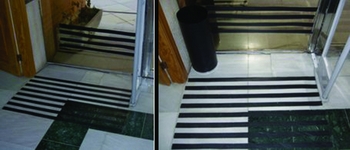
During the environmental intervention (B) sessions, the exit door was altered. To do this, eight strips of 4 × 105 cm black tape were used, placed 25 cm from the exit door with 4 cm distance between each strip. In addition, four other strips were used as above (4 × 90 cm) with the same distance between them (4 cm), but placed on the glass door at a distance of 25 cm from the floor (see Figure 1).
Subjective barriers.

The cognitive/behavioral intervention (C) consisted in differential reinforcement of behaviors while working with the patient on different types of language, memory, and attention tasks. These were used to distract the subject's attention from the door, not to change the cognitive skills of the patient. Therefore, before and after cognitive level differences were not measured. The behavioral part of the intervention was implemented through a program of differential reinforcement of incompatible behaviors of fixed ratio. Each time, the non-maladaptive actions and behaviors (e.g. going to the bathroom when necessary or talk to other residents) that were unrelated to the behavior sought to be eliminated (wandering) and were socially reinforced with words of praise or caring physical contact (e.g. a pat on the back). However, if he did try to leave, the therapist simply ignored the behavior.
Results and discussion
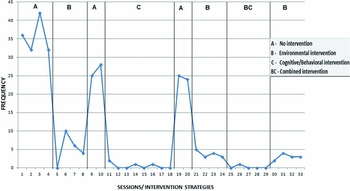
Figure 2 exhibits the frequency of problematic behavior during the 33 intervention sessions.
Frequency of wandering behavior during each intervention session.

The results showed a decrease in wandering behavior frequency in the subject, from an average of 37 escape attempts to an average of one or two a day. This decrease in problematic behavior becomes gradually generalized with the withdrawal of management, as the baselines are not completely identical to the first, which indicates that after the first intervention, the reduction is maintained over time. In the last sessions without intervention (A; sessions 19 and 20), the frequency of escape attempts is lower than in the previous (sessions 9 and 10) and the baseline (sessions 1 through 4).
According to Center staff notes, the patient's escape attempts decreased the hours of non-intervention.
Before the intervention, we performed initial registration of the antecedents and consequences of behavior that gave us an understanding of the apparent reason for which the person with dementia wandered. At first, it was thought that the fact of seeing people coming in and out of the Center caused the beginning of his conduct. In the analysis, it was found that there was no such cause, as there was no contingency whatsoever.
The environmental intervention (the exit door alterations) acted as a subjective barrier to the patient, although the patient was unable to report his subjective perception of the environmental modifications made in the intervention (B). In addition, other residents with dementia with significant cognitive deficits, like our subject, did not approach the area with subjective barriers. One possible explanation of this result is the presence of difficulties of visual perception in these patients. As other authors have suggested (e.g. Hussian and Brown, Reference Hussian and Brown1987), the misperception might be relied upon to stop ambulation when a two-dimensional stimulus was present because it would be perceived as barrier by the patient with dementia (see also, Price et al., Reference Price, Hermans and Grimley2000).
Although in the three types of intervention there was a clear improvement with respect to the baseline, the cognitive/behavioral intervention, both when applied alone (C) and in joint implementation (BC), was shown to most reduce wandering behavior frequency. Although the difference in efficacy between the intervention BC and intervention C is minimal (see Figure 2), it is important to note that in the first five sessions of both BC and C the number of escape attempts in BC was lower (one).
In our opinion, the simultaneous development of differential reinforcement schedule, with environmental modification (BC intervention), was adequate to reduce escape attempts in this case. A possible explanation could be that with this differential reinforcement program the patient receives continuous social reinforcement. The resulting positive emotions mean that the person wishes to stay there and displays a sense of well being that benefits the person on the whole. On the other hand, changing the environment is only preventive, as the subject performs the previous program only for a few hours. It has been shown that every escape attempt was due to a delay of time without receiving attention from the staff. Therefore, the implementation the use of subjective barriers is necessary to prevent such dangerous approaches to the exit. The importance of this intervention includes, in addition to avoiding the negative consequences of a possible departure, highly improving the individual's quality of life by improving their personal autonomy and emotional state.
The results of this intervention can be beneficial not just for the individual patient but also for the staff and fellow residents – for the patient, because it avoids the risk of dementia-driven wandering from the Center along with the negative consequences that could result. In addition, the subject participated in most activities and interacted more with the people around him in the Center. Informal staff interviews showed that the excessive worry and care for this patient has declined, although they continue to provide special attention to the individual to prevent the now occasional and minor escape attempts. This could possibly affect caregiver “burnout.” The other residents were also participants in reducing their companion's problem and thanks to the intervention their attention to the problematic behavior was reduced along with their frustration in seeing that their comments had no impact.
The intervention did not appear to have any negative consequences on the patient; pharmacological treatments and other that impede the patient autonomy were avoided. What is more, the subjective barrier intervention has little to no economic or human resource cost. This alone can reduce escape attempts, freeing staff time and worry.
Limitations
As this single case study showed positive results, it would be of interest to repeat the intervention but with a larger sample size. In future, studies could also test if changes improve the results. For example, in the environmental intervention, it should be checked by changing the color and position of the tape.
It would also be interesting to see how patients with varying degrees of dementia may benefit from this treatment. Likewise, other variables could be considered subject to the age or state of impairment of certain cognitive processes or the presence of agnosia in the effectiveness of the intervention and its different phases.
Finally, the patient could not be observed by the same researcher 24 hours a day, seven days a week, which is a limitation of the study. To avoid this problem, in future studies video recording the patient's behavior and evaluating the number of escape attempts with more than one observer may be convenient.
Conflict of interest
None.
Description of authors’ roles
D. Valle Padilla formulated the research question, designed the study, collected and analyzed the data, and wrote the paper; M. T. Daza González and I. Fernández Agis collaborated with data analysis and writing the paper; and J. Strizzi and R. Alarcón Rodríguez assisted with writing the paper.