Introduction
Productivity of agroecosystems in rainfed, dry environments is often constrained by low availability of water and nitrogen (N), the two major components of ecosystems (Ross et al., Reference Ross, Izaurralde, Janzen, Robertson and McGill2008; Rasouli et al., Reference Rasouli, Whalen and Madramootoo2014). Innovative practices are required to manage these two components and to consequently enhance systems productivity (Astier et al., Reference Astier, Speelman, López-Ridaura, Masera and Gonzalez-Esquivel2011; Garcia-Franco et al., Reference Garcia-Franco, Albaladejo, Almagro and Martínez-Mena2015; Tribouillois et al., Reference Tribouillois, Cruz, Cohan and Justes2015). To tackle the challenge of water scarcity in dry areas, many practices have been developed in recent years, such as the use of early-seeding to capture water conserved in the soil from snowmelt (Angadi et al., Reference Angadi, Cutforth, McConkey and Gan2004); the adoption of no-till management with direct seeding to minimize soil evaporation (Fabrizzi et al., Reference Fabrizzi, García, Costa and Picone2005; Ramnarine et al., Reference Ramnarine, Voroney, Wagner-Riddle and Dunfield2015); and the use of various water-harvest techniques to enhance precipitation use efficiency (Chai et al., Reference Chai, Gan, Turner, Zhang, Yang, Niu and Siddique2014; Hu et al., Reference Hu, Chai, Yu, Yin, Cui and Gan2015; Yin et al., Reference Yin, Yu, Chai, Hu, Feng and Gan2015).
Many approaches have been used to manage soil nutrients in dry agroecosystems, such as the use of diverse crop rotations to improve soil fertility (Tiemann et al., Reference Tiemann, Grandy, Atkinson, Marin-Spiotta and McDaniel2015); the retention of plant residues on the soil surface through no-till to improve soil aggregates and enhance physiochemical protection of organic carbon (C) (Garcia-Franco et al., Reference Garcia-Franco, Albaladejo, Almagro and Martínez-Mena2015); adoption of biospecific mixtures to improve the C:N ratio of the soil and to balance soil nutrients (Tribouillois et al., Reference Tribouillois, Cruz, Cohan and Justes2015). A common approach is the application of inorganic fertilizer to meet the N requirement of crop plants (Malhi et al., Reference Malhi, Johnson, Hall, May, Phelps and Nybo2014; Wile et al., Reference Wile, Burton, Sharifi, Lynch, Main and Papadopoulos2014; Tribouillois et al., Reference Tribouillois, Cruz, Cohan and Justes2015). However, N fertilizer is one of the major contributors to greenhouse gas emissions in crop production (Gan et al., Reference Gan, Liang, Chai, Lemke, Campbell and Zentner2014). To minimize environmental impacts, ecosystem-based approaches for crop N management have been proposed where crop production relies more on renewable N resources, such as the access of N pools and mineral reservoirs in the soil or use of N2-fixing pulses, than replenishing the nutrient shortfall with inorganic fertilizer (Siddique et al., Reference Siddique, Johansen, Turner, Jeuffroy, Hashem, Sakar, Gan and Alghamdi2012; Linquist et al., Reference Linquist, Liu, van Kessel and van Groenigen2013). An effective ecosystem-based approach is the exploration and utilization of soil residual nutrients that remain in the soil after crop harvest, the nutrients that are fixed by plants themselves, and the nutrients supplied by the soil through mineralization (Bajgai et al., Reference Bajgai, Kristiansen, Hulugalle and McHenry2013). A simple practice moving toward ecosystem-based approaches for soil N management is the inclusion of pulse crops in crop rotation (Siddique et al., Reference Siddique, Johansen, Turner, Jeuffroy, Hashem, Sakar, Gan and Alghamdi2012). This approach substitutes biological N2-fixation through plant–bacteria symbiosis for fossil-based chemical N fixation.
With the context of sustainable development of agroecosystems, we consider lentil (Lens culinaris Medikus) an ecosystem enhancement provider because lentil in short-season northern latitudes such as the Northern Great Plains of North America has two unique features: (1) lentil plants fix atmospheric N2 through symbiosis with an effective Rhizobium strain (McCauley et al., Reference McCauley, Jones, Miller, Burgess and Zabinski2012; Zakeri et al., Reference Zakeri, Bueckert and Schoenau2013). The abundant atmospheric N can contribute to the sustainability of crop production without, or with reduced inorganic fertilizer input (Allen et al., Reference Allen, Pikul, Waddell and Cochran2011), and (2) lentil plants have a shallow rooting depth (Gan et al., Reference Gan, Liu, Cutforth, Wang and Ford2011), with approximately 77–85% of the roots located in the 0–0.4 m soil depth (Liu et al., Reference Liu, Gan, Bueckert, Van Rees and Warkentin2010). Thus, the lentil plants use water within the 0.6 m soil layer and water below 0.6 m remains at crop harvest, and is available for other crops grown in the subsequent years (Liu et al., Reference Liu, Gan, Bueckert and Van Rees2011; Wang et al., Reference Wang, Gan, Hamel, Lemke and McDonald2012). In comparison with lentil cultivation, summerfallow, a farming practice used for decades in many arid and semiarid areas of the world, has two unique features in common with lentil: (1) during the summerfallow period, N is released via the mineralization of soil organic matter (Campbell et al., Reference Campbell, Zentner, Basnyat, DeJong, Lemke, Desjardins and Reiter2008; Hunt et al., Reference Hunt, Browne, McBeath, Verburg, Craig and Whitbread2013), thus increasing soil N availability to subsequent crops (Koutika et al., Reference Koutika, Ndango and Hauser2004; Campbell et al., Reference Campbell, Zentner, Basnyat, DeJong, Lemke, Desjardins and Reiter2008; Nyamadzawo et al., Reference Nyamadzawo, Nyamangara, Nyamugafata and Muzulu2009); and (2) a proportion of rainfall is conserved in the soil during the summerfallow period (Tanaka and Aase, Reference Tanaka and Aase1987; Tanwar et al., Reference Tanwar, Rao, Regar, Datt, Praveen, Jodha, Santra, Kumar and Ram2014), which is available for crops the following year (Sun et al., Reference Sun, Gao, Zhao, Deng, Deng, Zhao, Ren, Li and Yang2013).
At first glance, the lentil- and summerfallow-based production systems are similar—soil N benefits and soil water conservation for the subsequent crops. However, the two systems are fundamentally different. Lentil cultivation provides a renewable source of N, which is abundant in the atmosphere. Also, the lentil N2-fixation process that converts atmospheric N into plant-available N is accomplished through a symbiotic relationship, with N-rich plant residue returned back to the soil, thus increasingly enhancing soil fertility over years (Biederbeck et al., Reference Biederbeck, Campbell, Rasiah, Zentner and Wen1998). In contrast, summerfallowing practice is essentially ‘mining’ the soil for nutrients (Campbell et al., Reference Campbell, Zentner, Basnyat, DeJong, Lemke, Desjardins and Reiter2008). The process of N mineralization can deplete the soil organic C pool over years (Panettieri et al., Reference Panettieri, Knicker, Murillo, Madejón and Hatcher2014; Ramnarine et al., Reference Ramnarine, Voroney, Wagner-Riddle and Dunfield2015).
In a recent publication, we report that a cropping system that includes chickpea and dry pea can enhance ecosystem productivity as compared with conventional summerfallow- or continuous cereal systems productivity (Gan et al., Reference Gan, Hamel, O'Donovan, Cutforth, Zentner, Campbell, Niu and Poppy2015). However, it is unknown if such an effect can be true with different cultivars. Many lentil cultivars have been developed in recent years (DellaValle et al., Reference DellaValle, Thavarajah, Thavarajah, Vandenberg and Glahn2013), but do different lentil cultivars affect residual soil water and soil N availability substantially differently? The objective of this study was to quantify residual soil water and soil N in lentil-based systems in comparison with cereal-monoculture and summerfallow-based systems and their contribution to the system productivity. We hypothesize that lentil cultivars differ substantially in affecting residual soil water and providing N benefits to the systems, and that lentil-based systems are as productive as summerfallow-based systems in dry environments.
Materials and Methods
Experimental site
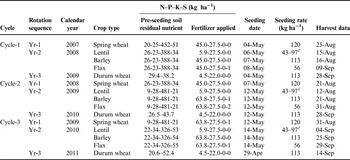
Field experiments were conducted at the Swift Current Research and Development Centre of Agriculture and Agri-Food Canada, in Saskatchewan (50.28°N, 107.79°W) from 2007 to 2011. The soil on the Research Farm is an Orthic Brown Chemozem with silt loam texture containing 28% sand, 49% silt and 23% clay, with organic C content of 20 g kg−1, and pH (CaCI2) 6.5 in the top 15-cm depth measured at the beginning of the experiment (in 2007). Soil nutrients and fertilization in the subsequent years are summarized in Table 1.
Fertility and agronomic data for the three cycles of a 3-yr cropping sequence field experiment conducted in Swift Current, Saskatchewan, 2007–2011.

1 Varying with cultivars, depending on seed size and pre-seed germination rates.
Experimental design
A 3-yr crop sequence study was conducted for three cycles (i.e. repeated three times over years). The first cycle was initiated in 2007 and was completed in 2009; the second cycle started in 2008 and was completed in 2010; and the third cycle occurred between 2009 and 2011 (Table 1). In the first year of each cycle (Year-1), hard red spring wheat (cv. AC Lillian) was grown using no-till direct seeding practices. At harvest, wheat stubble was cut to 15 cm and left standing, and the rest of the wheat straw was chopped and spread evenly in the field with the capacity of the specialized research combine. In the following year (Year-2), eight lentil cultivars of three market classes (popular in the major lentil-growing areas on the semiarid Northern Great Plains) were planted between the rows of the standing wheat stubble of Year-1. The lentil cultivars, along with oilseed flax (Linum usitatissimum L.), barley (Hordeum vulgare L.), and a summerfallow check, were arranged in a randomized, complete block design with four replicates. In Year-3 of each cycle, durum wheat cv. AC Strongfield was seeded over all plots. In the experimental design, the inclusion of barley in the crop sequence created a continuous cereal monoculture system with different cereal species (hard red spring wheat in Year-1, barley in Year-2 and durum wheat in Year-3), whereas the inclusion of oilseed flax in the crop sequence provided a system similar to lentil-based systems. The inclusion of these two additional systems allowed us to assess the effectiveness of the lentil-based systems in comparison with the other systems.
Seeding and plot management
All plots were planted using an in-house-built no-till plot seeder, which was equipped with boxes for seed, fertilizer and inoculant, facilitating a single pass operation for planting and application of fertilizer for cereals and oilseed flax and the application of Rhizobium inoculants for lentil. There were eight seed rows in each plot with 0.228 m between rows and the plot size was 2 m × 8 m. For lentil in Year-2, pre-packaged granular Rhizobium inoculant (1 million active Rhizobium cells kg−1 of seed) was evenly distributed over the eight seed rows in each plot. No fertilizer N was applied to lentil. The Year-2 barley and flax plots were fertilized with urea (46-0-0-0 fertilizer) and monoammonium phosphate [(NH)4H2PO4] at the rates shown in Table 1. For the summerfallow plots in Year-2, two to three tillage operations were applied with a cultivator during the summerfallow period. The crops grown on summerfallow fields were managed using the same practices as those for crops grown on stubble. In Year-3, durum wheat seeds were direct seeded into the stubble of Year-2 plots. To quantify the contribution of soil residual N from previous crops, no N fertilizer was applied to the durum wheat. Glyphosate (C3H8NO5P) was applied at the rate of 200 g a.e. ha−1 for pre-planting weed control and no in-crop pesticide was applied. For all crops, seed rates were used to target optimal plant population (Anonymous, 2007) (Table 1).
Data collection
Each year, soil samples were taken from each plot within 3 days of planting and again within 3 days after crop harvest. Two 30-mm diameter soil cores were taken in each plot and the measurements averaged for plot values. The soil cores were taken to a depth of 1.2 m and were divided into the increments of: 0–0.15, 0.15–0.30, 0.30–0.60, 0.60–0.90 and 0.90–1.20 m. Soil water content of the samples was determined using the oven-drying method. The soil samples were air-dried, ground to pass through 2-mm sieve, extracted using 2 M KCl, and filtered for the determination of soil NO3-N and NH4-N using an automated colorimeter (Autoanalyzer II, Technicon Industrial Systems 1978, California, USA). The resulting percentage data were converted into volumetric units using soil bulk densities of 1.16, 1.29, 1.39, 1.54 and 1.63 g cm−3, respectively, for the five depths (Campbell et al., Reference Campbell, Lafond, van den Bygaart, Zentner, Lemke, May and Holzapfel2011). Crops grown in the semiarid Northern Great Plains typically have a rooting depth of <1.2 m (Liu et al., Reference Liu, Gan, Bueckert, Van Rees and Warkentin2010; Cutforth et al., Reference Cutforth, Angadi, McConkey, Miller, Ulrich, Gulden, Volkmar, Entz and Brandt2013), thus the soil sampling was taken to 1.2 m deep.
To assess the contribution of residual soil water and soil N to the crops grown the following year of the cropping sequence, we measured the amounts of residual soil water and soil N at three key stages: (i) that which remained after harvest of Year-2 crops (i.e. eight lentil cultivars, barley, oilseed flax and summerfallow); (ii) that gained or lost in the 0–1.2 m soil profile from the postharvest period in the fall and winter to the following spring; and (iii) that in the 0–1.2 m rooting zone available at planting time of the Year-3 crop (i.e. durum wheat). These detailed measurements allowed an assessment of soil water and N dynamics and their availability to future crops.
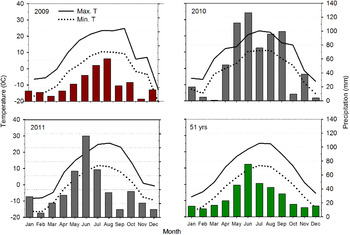
At full maturity, the center six crop rows in each plot were harvested with a plot combine, air-dried and weighed for grain yield. Crude protein concentration of the grain was determined using NIR methods. Weather data (Fig. 1) were collected from a weather station located on the Research Farm, within 1.2 km distance from the experimental plots.
Weather conditions in the durum wheat growing year (Year-3) of 2009, 2010 and 2011; and the long-term average (1961–2011) at the experimental site, Swift Current, Saskatchewan, Canada.

Statistical analysis
The data were analyzed with mixed models using the Proc Mixed of SAS, with previous crop type (including summerfallow) as fixed effects, and replicate as random effect. Analysis of variance (ANOVA) showed significant interactions between the applied treatments and the three cycles of the experiment for most of the variables evaluated, thus, the treatment effect was presented and discussed for each cycle separately. For each cycle, ANOVA was then employed to determine whether or not the different lentil cultivars performed similarly in affecting soil water, soil N and the yield of the subsequent crops following lentil cultivars. In all analyses, the significant differences were declared using least significant difference (LSD) at P < 0.05.
Results and Discussion
Residual soil water
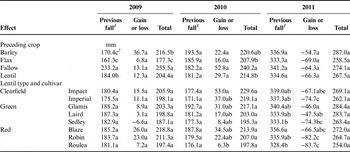
The amounts of residual soil water at the harvest of Year-2 crops varied among test years and between precrop treatments (Table 2). At harvest time in 2008 and 2009, there was 187 mm of water remaining in the 0–1.2 m soil profile, and in 2010 there was 337 mm remaining. In both 2009 and 2010, summerfallow contained the same amounts of water as the cropped treatments. However, in 2008, summerfallow contained significantly more water than the barley, lentil or oilseed flax treatments. Lentil cultivars did not differ in soil water that was remaining at the harvest.
Soil water content in the 0–1.2 m depth remaining at harvest of Year-2 crops (previous fall), soil water gain (or loss) postharvest in the fall and winter, and total amount of water at planting time of Year-3 crop (durum wheat), in Swift Current, Saskatchewan.

1 In the fall of 2008, 2009 and 2010, respectively.
2 Different letters denote significant differences among treatments using LSD at P < 0.05.
The period from harvest of Year-2 crops in the fall to the planting of the Year-3 durum wheat the following spring varied from 7 to 9 months. During this period, soil water was recharged. From fall 2008 to spring 2009, soil water content was increased by 17 mm (9%); from fall 2009 to spring 2010, soil water content was increased by 30 mm (16%); however, from fall 2010 to spring 2011, all plots lost water, averaging 64 mm (−19%) (Table 2).
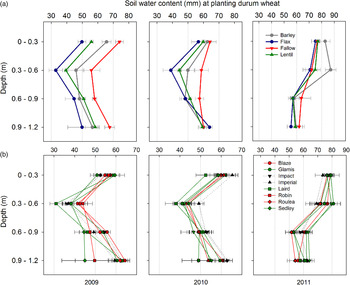
Measured at the planting time of durum wheat in Year 3, soil water distribution profiles across the 0–1.2 m rooting zone varied among test years and among preceding crop types (Fig. 2a). In 2009 and 2010, the amounts of water across the rooting zone tended to decrease from the topsoil layer to the 0.6 m depth and thereafter tended to increase in the deeper soil layers (0.6–1.2 m). An opposite trend was shown in 2011 when soil water content decreased with the soil depth. Among the preceding crops, the water content of most soil layers was greater following the summerfallow treatment than following the cropping treatments in spring 2009 and 2010. In spring 2011, however, the summerfallow treatment had a similar amount of water as the cropped treatments at any soil depth. Soil water at the planting time the following spring differed among the preceding lentil cultivars and the magnitude of the effect varied with study years (Fig. 2b). Green lentil cultivars (Glamis, Laird and Sedley) conserved more soil water in spring 2009 and 2010 than red lentil cultivars (Blaze, Robin and Roulea); in spring 2011, however, no differences were found among lentil cultivars.
Water content in the 0–1.2 m soil profile measured at durum wheat planting time in 2009, 2010 and 2011, with (a) the differences among the preceding barley, oilseed flax, lentil and summerfallow check, and (b) differences among eight lentil cultivars, in Swift Current, Saskatchewan. The line bars at each point are standard errors of the means.

Water is key for crop production in semiarid areas like the experimental site (De Jong et al., Reference De Jong, Campbell, Zentner, Basnyat, Cutforth and Desjardins2008; Hunt et al., Reference Hunt, Browne, McBeath, Verburg, Craig and Whitbread2013). The three cycles of this 3-year cropping sequence study showed that the soil at the experimental site had a fairly large amount of water remaining in the 0–1.2 m profile at crop harvest, ranging from 187 mm in 2008 to 337 mm in 2010. These amounts are greater than 134 mm, the ‘permanent wilting point’ for the particular soil at the experimental site (Cutforth et al., Reference Cutforth, Jefferson and Campbell1991). The amount of residual soil water greater than permanent wilting point is considered ‘available water’, that is available to the crops the following year. Some available water is still remaining in the soil profile after crop harvest, suggesting that the crops are unable to utilize all the water that is available during the growing period. Average frost-free days are 114.3 ± 1.6 days over the 126 years of recorded data at the experimental site (He et al., Reference He, Wang, Qian, McConkey, Cutforth, Lemke, Depauw, Brandt, McCaig, Hu and Hoogenboom2012). The short growing period may not give some crops sufficient time to utilize all the water resources available to maximize yield potential.
Soil water content at the planting time of the following spring is the ultimate reflection of the amount of water remaining at harvest the previous fall plus the amount of water gained or lost during the postharvest period in the fall and winter. The available water amount in the soil is critical for seed germination, seedling establishment and the early part of the plant growth; however, precipitation during a cropping season is more important to crop yield (De Jong et al., Reference De Jong, Campbell, Zentner, Basnyat, Cutforth and Desjardins2008; Gan et al., Reference Gan, Campbell, Liu, Basnyat and McDonald2009). In the present study, precipitation from 01 May to 31 August (the crop growing season) totaled 270, 176 and 410 mm, for 2008, 2009 and 2010, respectively. During the same period, the summerfallow treatment conserved 52 and 29 mm of water in the 0–1.2 m soil profile in 2008 and 2009, respectively, and lost 23 mm in 2010. On average, about 80% of the precipitation received during the cropping season was lost in the summerfallow treatment, which otherwise could have been used by a crop. These results indicate that the use of summerfallow practice to conserve rainfall may not be as effective as most expect, and that the replacement of summerfallow with a short-season such as lentil could help improve water use efficiency for the whole rotation system.
Residual soil N
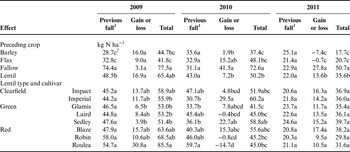
Large differences in residual soil mineral N (NO3 − plus exchangeable NH4 +) at harvest of Year-2 crops were observed among preceding crop types and lentil cultivars in each year (Table 3). In fall 2009 and 2010 at crop harvest, the cropped treatments had statistically comparable amounts of residual soil N as the summerfallow treatment (P = 0.278), averaging 35.6 kg N ha−1 in fall 2009 and 22.8 kg N ha−1 in fall 2010. In fall 2008 at crop harvest, however, the soil after lentil contained 48.5 kg N ha−1, which was 19.8 and 15.7 kg ha−1 higher (P < 0.05) than the soil after barley and after oilseed flax, respectively. Summerfallow contained 74.4 kg N ha−1, twice the amount of N in the soil after barley or oilseed flax. Among the eight lentil cultivars evaluated, differences in the amount of soil N remaining at harvest were detected only in 2009, where the red-lentil cv. Roulea, had significantly higher N in the soil than the Clear-field lentil cv. Imperial (54.7 versus 44.2 kg N ha−1). In the other 2 yr, however, no differences in soil N were found among lentil cultivars.
Soil N content remaining at harvest of Year-2 crops (previous fall), soil N gain (or loss) postharvest in the fall and winter months, and total amount of soil N at durum wheat planting time in Year-3 crop (durum wheat) in Swift Current, Saskatchewan.

1 In the fall of 2008, 2009 and 2010, respectively.
2 Different letters denote significant differences among treatments using LSD at P < 0.05.
Averaged across all experimental plots, the soils gained 11.2, 16.4 and 8.3 kg ha−1 of N from postharvest in the fall to spring planting time of 2009, 2010 and 2011, respectively (Table 3); these values represented 20, 32 and 27% of the total amounts of soil N that were available by planting time of the Year-3 durum wheat, in the three respective years.
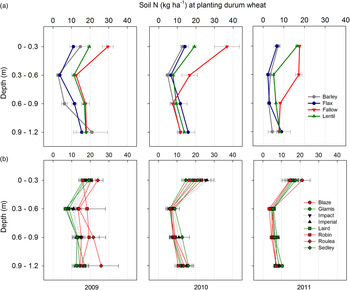
Total amount of soil N at planting of durum wheat was consistently higher after lentil treatments (on average 44% higher) and after summerfallow (on average 91% higher) than after barley or oilseed flax treatments (Table 3). The largest increase in soil N after summerfallow, relative to barley or oilseed flax, was in the top 0–0.6 m soil layer with little or no difference below the 0.6 m soil depth (Fig. 3a). In spring 2009, the soils after the green lentil cultivars Glamis, Laird and Sedley contained significantly higher soil N than the soils after the red lentil cultivars Blaze, Robin and Roulea, mostly in the below 0.3 m soil layers (Fig. 3b). However, such differences among lentil cultivars were not detected in the other 2 yr.
Soil mineral N (NO3 − plus exchangeable NH4 +) in the 0–1.2 m soil profile measured at planting of durum wheat in 2009, 2010 and 2011, with (a) the differences among the preceding barley, oilseed flax, lentil and summerfallow check; and (b) differences among the eight lentil cultivars, in Swift Current, Saskatchewan. The line bars at each point are standard errors of the means.

Averaged across the three study years, the lentil treatments had 37.8 kg ha−1 of N remaining in the 0–1.2 m soil profile at harvest, which was about 88% of the amount that was retained in the summerfallow treatments (42.8 kg ha−1) and was 129% of the amount retained in the barley and oilseed flax treatments. Further, during the 7–9-month-period from crop harvest the previous fall to the planting durum wheat the following spring, the soil N status changed probably due to the mineralization of soil organic matter and crop straw and root decomposition. These processes resulted in additional N to the soil N pools, even although N leaching may occur in some cases (Campbell et al., Reference Campbell, Selles, Zentner, De Jong, Lemke and Hamel2006). On the Northern Great Plains of North America, a net soil N gain during the postharvest period ultimately contributes to the total amount of N available to the following crop. On average, plots following lentil crops gained soil N totaling 12.6 kg N ha−1, which was 123% more compared with the preceding barley or flax, but was 52% less compared with summerfallow treatment. Among the eight lentil cultivars evaluated in the study, there were no trends of differences in soil N gain during the postharvest to spring planting time across three test years. In a few cases some differences in soil N gain were shown, but the ranking of the differences among lentil cultivars varied largely from year to year. The large year-to-year variations in the amount of soil N gain may have masked any differences among lentil cultivars. The year-to-year shift in the differences of soil N gain among lentil cultivars suggests that these differences may not be a genetic characteristic.
Comparisons of patterns of soil water and N distribution across the 0–1.2 m rooting zone revealed that both patterns had a similar trend, suggesting that water conservation in the soil plays a crucial role in the mineralization and accumulation of N in the profile. Adequate soil moisture is required to stimulate soil microbial activity that is essential for soil N mineralization and accumulation (Setia and Marschner, Reference Setia and Marschner2013).
System productivity
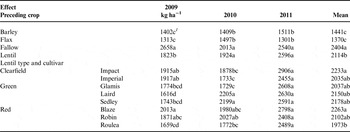
The preceding crop (or summerfallow) had a significant effect on the grain yield of durum wheat grown in Year-3 of the crop sequence, and the magnitude of the effect varied from year to year (Table 4). Durum wheat preceded by summerfallow produced grain yields 96, 39 and 81% greater (P < 0.01) than when it was preceded by barley or oilseed flax, in 2009, 2010 and 2011, respectively. Grain yield increased by 34, 32 and 85% for durum wheat preceded by lentil compared with the durum wheat preceded by barley or oilseed flax, in the three respective years. In both 2010 and 2011, durum wheat grown on lentil stubble produced as much grain as after summerfallow. In 2009, however, durum wheat produced 45% more grain after summerfallow than after lentil. A small difference in durum grain yield was observed after the various preceding lentil cultivars; the cultivars Blaze and Robin increased the grain yield of the subsequent durum wheat more than the cultivar Roulea in the test years.
Grain yield of durum wheat preceded by barley, flax, summerfallow or by various lentil cultivars in Swift Current, Saskatchewan, 2009, 2010 and 2011.

1 Different letters denote significant differences among treatments using LSD at P < 0.05.
Protein yield (a product of grain dry weight × grain crude protein concentration) for durum wheat grown on summerfallow was 338 kg ha−1 in 2009, 246 kg ha−1 in 2010 and 258 kg ha−1 in 2011; they were, respectively, 122, 39 and 99% greater than when grown on the stubble of barley or oilseed flax. Durum wheat grown on lentil stubble had the same protein yield as the durum wheat grown on summerfallow in 2010 or 2011, but in 2009, the former had lower (22%) protein yield than the latter. There was no difference in protein yield of durum wheat preceded by different lentil cultivars.
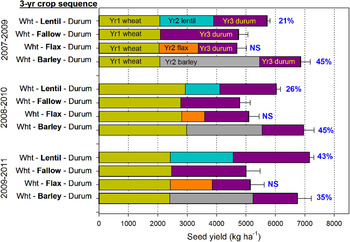
Total grain production was assessed for the 3-yr cropping systems (Fig. 4). In the 2009–2011 crop cycle (the bottom part of the figure, with hard red spring wheat in 2009; lentil, barley, oilseed flax and summerfallow in 2010; and durum wheat in 2011), the wheat–summerfallow–durum system produced a total grain of 5.0 t ha−1 over the 3-yr sequences, the wheat–lentil–durum system 7.2 t ha−1, and the wheat–cereal–durum 6.8 t ha−1. The two latter systems increased total grain production by 43 and 35%, respectively, compared with the cereal–summerfallow–cereal system. Similarly, in the 2007–2009 (top part of the figure) and 2008–2010 (middle part of the figure) crop cycles, the wheat–lentil–durum system increased total grain production by 21 and 26%, respectively, compared with the summerfallow system; the cereal monoculture increased total grain production by 45% in both years, compared with the summerfallow system.
Total grain production over a 3-yr cropping sequence. In each cycle, hard red spring wheat was no-till seeded in Year-1; eight lentil cultivars were grown in Year-2, along with oilseed flax, barley, and a summerfallow; and in Year-3, durum wheat was no-till seeded over each plot. The line bars are standard errors of the means for the total grain production. Percentages are % increase of grain production over the wheat–summerfallow–durum wheat systems.

It is clear that although durum wheat grown after summerfallow increased grain yield significantly (22–33%) compared with the durum wheat preceded by lentil crops, the increased durum wheat yield after summerfallow was unable to offset the opportunity cost of the summerfallow phase of the rotation system. Although summerfallow conserved the greatest amount of water and accumulated the greatest amount of N in the soil profile among the systems evaluated, a loss of 1 yr of cropping in the crop rotation (a typical system traditionally used for durum wheat production on the Northern Great Plains) decreased total grain production substantially compared with non-summerfallow systems.
We acknowledge that summing the different types of grain together in the presentation of total grain production may not always be valid, but the intention is to provide an idea of the total quantity of grain produced over a 3-yr cycle at the whole farm level. Given that lentil is historically priced about 30–150% higher than cereal grains, summing the lentil yields with cereal grain yield for an assessment of total grain production may substantially underestimate the potential profitability of the systems that include lentil. Economic assessments are encouraged in our future analysis.
Practical implications
Global demand for staple food such as wheat and pulse are estimated to increase 80–100% by 2050 (Godfray et al., Reference Godfray, Beddington, Crute, Haddad, Lawrence, Muir, Pretty, Robinson, Thomas and Toulmin2010) due to projected world population growth, which requires more food, feed, fiber and fuel. To keep up with population growth, more intensive farming systems are required (Tilman et al., Reference Tilman, Balzer, Hill and Befort2011). Given the limited availability of uncultivated land appropriate for crop production on the planet (Garnett et al., Reference Garnett, Appleby, Balmford, Bateman, Benton, Bloomer, Burlingame, Dawkins, Dolan, Fraser, Herrero, Hoffmann, Smith, Thornton, Toulmin, Vermeulen and Godfray2013), future increases in grain production must come mostly from existing farmland (Mueller et al., Reference Mueller, Gerber, Johnston, Ray, Ramankutty and Foley2012). The traditional summerfallow practice leaves farmland without a crop for a whole year, during which a large portion of the precipitation (80% of the total growing season precipitation) is lost. This practice is inefficient, and has negative environmental consequences (Manalil et al., Reference Manalil, Riethmuller and Flower2014). In contrast, with lentil crops, available water and nutrients are used for grain production in an efficient manner.
Intensive farming systems rely heavily on inputs, especially inorganic fertilizer, to increase grain yield. But growing evidence indicates that yield in some crops may have plateaued with the rate of yield increase decreasing (Grassini et al., Reference Grassini, Eskridge and Cassman2013), or crop yields have even collapsed (Ray et al., Reference Ray, Ramankutty, Mueller, West and Foley2012). Therefore, ecosystem-based approaches to crop production are highly desirable. Long-term field studies have shown that the use of pulse crops to diversify cropping systems can increase crop yield (Miller et al., Reference Miller, Gan, McConkey and McDonald2003; Campbell et al., Reference Campbell, Zentner, Basnyat, Wang, Selles, McConkey, Gan and Cutforth2007) and improve water and N use efficiencies (Kröbel et al., Reference Kröbel, Lemke, Campbell, Zentner, McConkey, Steppuhn, De Jong and Wang2014; Tanwar et al., Reference Tanwar, Rao, Regar, Datt, Praveen, Jodha, Santra, Kumar and Ram2014). The present study shows that lentil cultivars differ in affecting residual soil water and N, at least, in some cases, suggesting that there is potential that the benefits of using pulses to enhance ecosystem productivity can be further improved with genetic improvement of lentil cultivars for these traits.
Conclusion
The lentil-based cropping system has the potential to boost total grain production over a 3-yr rotation period by an average of 30% compared with the traditional summerfallow-based systems. The increased grain production with lentil systems is accomplished through access to residual soil water and biological fixation of atmospheric N, rather than increasing inorganic fertilizers as in continuous cereal production system or ‘mining’ the soil and depleting soil organic C in summerfallow system. The eight lentil cultivars evaluated in this study showed comparable rotational effects, providing strong confidence to conclude that lentil-based cropping systems can significantly enhance system productivity in rainfed dry areas. More research is required to quantify the socioeconomic benefits and environmental impacts and to determine the feasibility of adopting this system in regions with climates different from those on the semiarid Northern Great Plains.
Acknowledgements
The authors acknowledge Duaine Messer, Cal McDonald, and Ray Leshures for technical assistance in chemical analysis and field plot management, Agriculture and Agri-Food Canada and Saskatchewan Pulse Growers for financial support, and Barilla America for the support of the data analysis and manuscript preparation.